
Green Wraps, Healthy Bites: How Eco-Friendly Packaging Shapes Food Perceived Healthiness and Purchase Intentions


Abstract
1. Introduction
2. Theoretical Background and Hypotheses Development
2.1. The Association Between Packaging Eco-Friendliness and Perceived Healthiness
2.2. The Moderating Role of Environmental Consciousness
2.3. The Moderating Role of Food Type
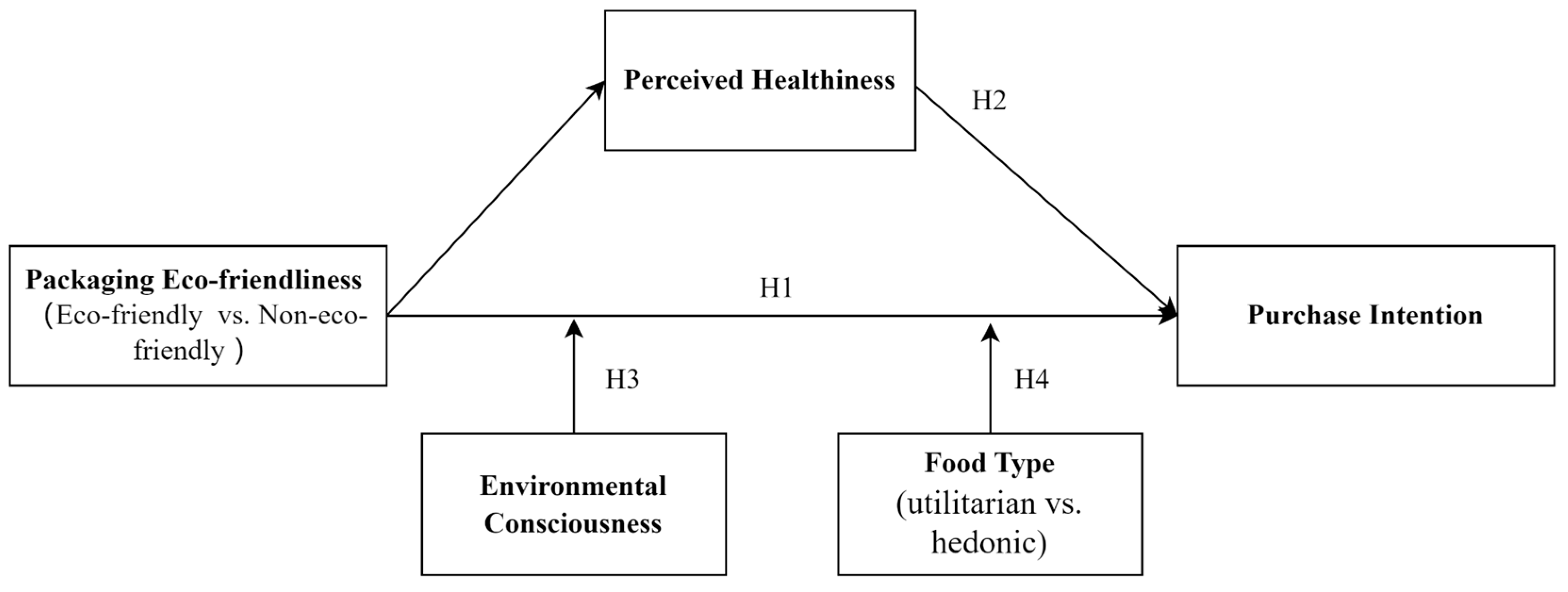
3. Study Overview
4. Study 1: Main Effect and Mediating Effect
4.1. Methodology
4.1.1. Participants
4.1.2. Materials and Procedures
4.2. Results
4.2.1. Manipulation Check
4.2.2. Main Effect
4.2.3. Mediating Effect
5. Study 2: The Moderating Effect of Environmental Consciousness
5.1. Methodology
5.1.1. Participants
5.1.2. Materials and Procedures
5.2. Results
5.2.1. Manipulation Check
5.2.2. Mediating Effect
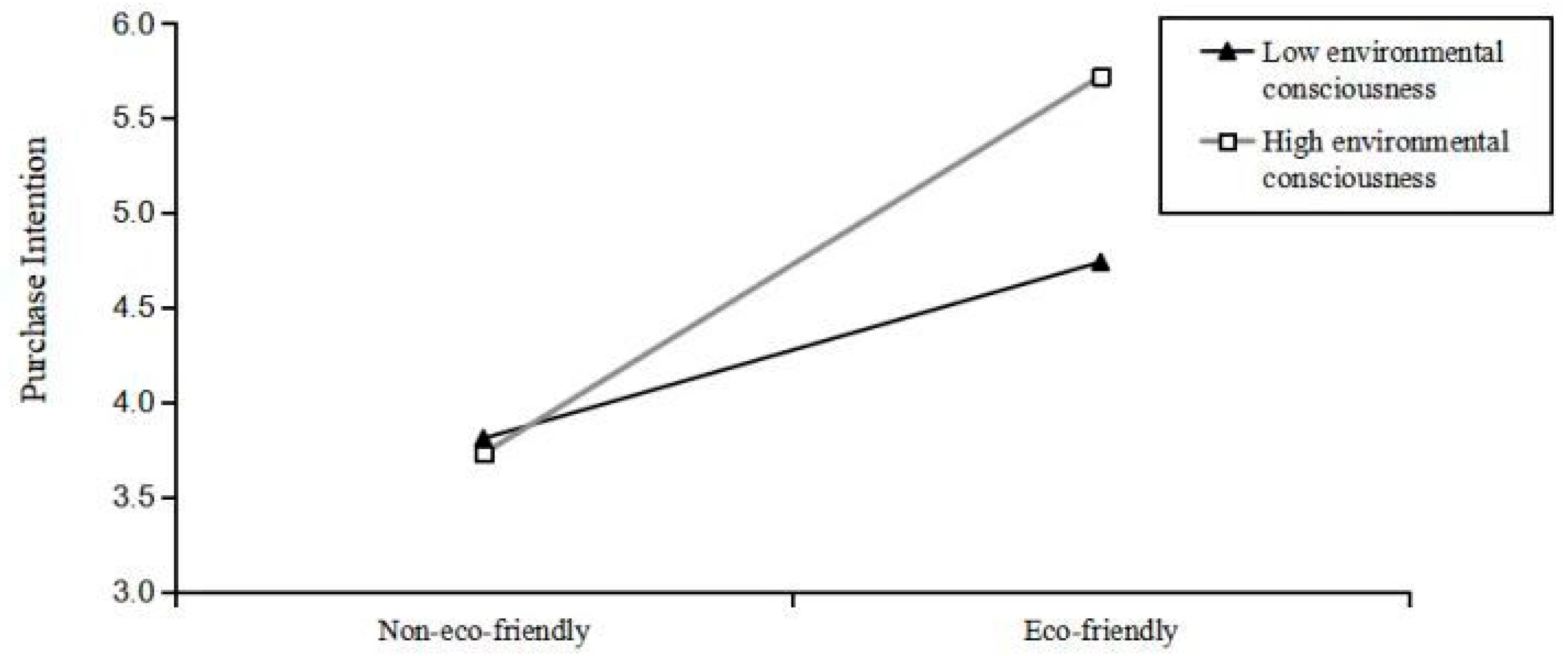
5.2.3. Moderating Effect
6. Study 3: The Moderating Effect of Food Type
6.1. Methodology
6.1.1. Participants
6.1.2. Materials and Procedures
6.2. Result
6.2.1. Manipulation Checks
6.2.2. Mediating Effect
6.2.3. Moderating Effect
7. Discussion
7.1. Theoretical Contributions
7.2. Managerial Implications
7.3. Limitations and Future Research
8. Conclusions
Author Contributions
Funding
Institutional Review Board Statement
Informed Consent Statement
Data Availability Statement
Conflicts of Interest
Appendix A. Manipulation Stimulus in Study 1

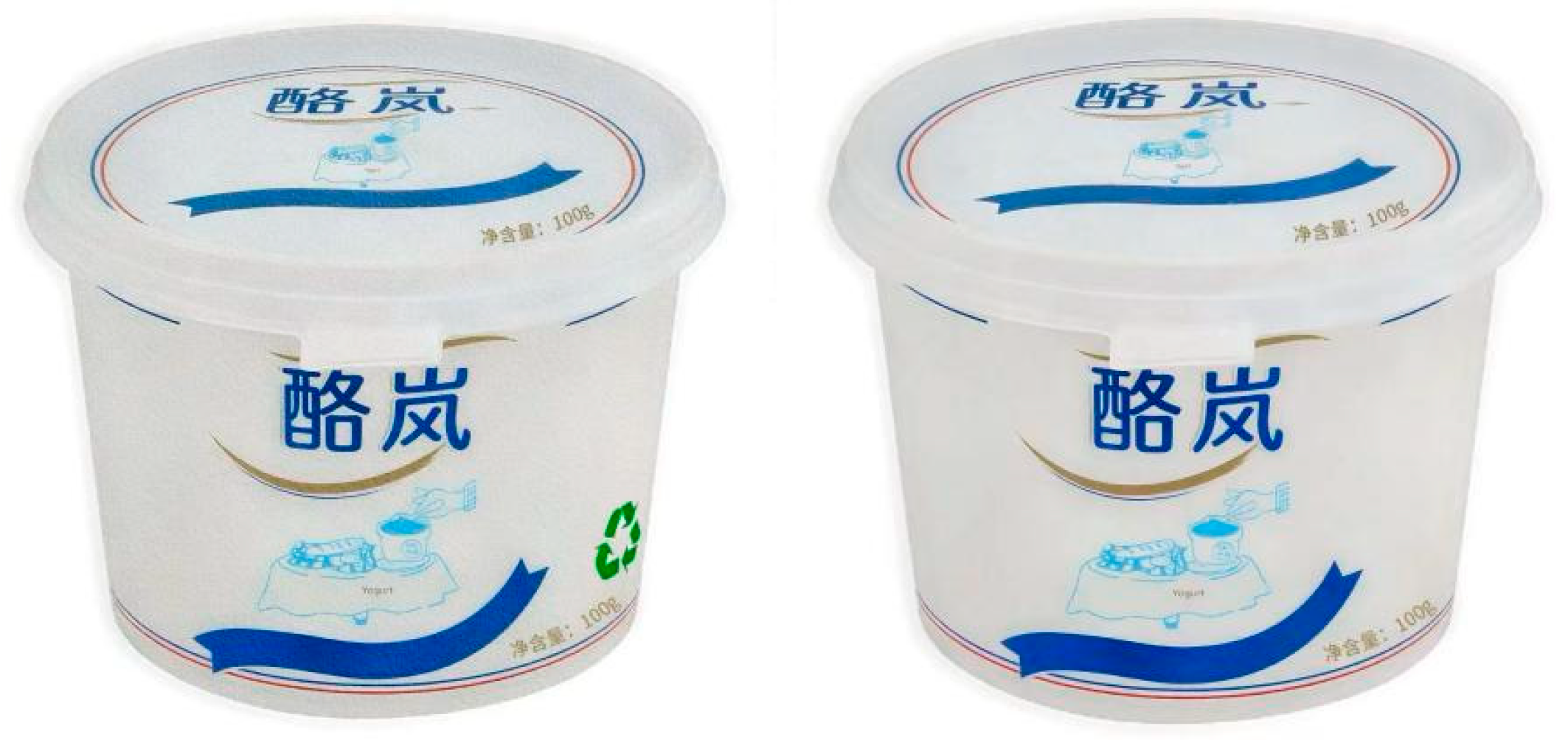
Appendix B. Manipulation Stimulus in Study 2

Appendix C. Manipulation Stimulus in Study 3
| Food Type | Hedonic Food | Stimuli | Packaging TYPE | |
| Eco-Friendly Packaging | Non-Eco-Friendly Packaging | |||
| “VERSUES” is a chocolate brand. Its products feature rich aroma and smooth flavor, delivering sweet enjoyment and emotional satisfaction for a pleasurable, indulgent experience. |  |  | ||
| Utilitarian Food | “VERSUES” is a dried okra brand. Its products feature nutritional value and health benefits, delivering satiety and energy support for sustained physical well-being. |  |  | |
| Note: We manipulated packaging eco-friendliness by varying the packaging materials of the foods. The eco-friendly packaging is made from more sustainable, biodegradable paper materials that have a lower environmental impact. In contrast, the non–eco-friendly packaging is made from low-sustainability PET plastic materials and is therefore less environmentally friendly. | ||||
References
- Kim, M.; Lennon, S. The effects of visual and verbal information on attitudes and purchase intentions in internet shopping. Psychol. Mark. 2008, 25, 146–178. [Google Scholar] [CrossRef]
- 2023 Buying Green Report. Available online: https://www.triviumpackaging.com/news-media/reports/2023-buying-green-report/ (accessed on 22 April 2023).
- Eco-Friendly Packaging’s Pros and Cons. Available online: https://www.halfpricepackaging.com/blog/pros-and-cons-of-eco-friendly-packaging (accessed on 2 June 2022).
- Gustavo, J.U.; Pereira, G.M.; Bond, A.J.; Viegas, C.V.; Borchardt, M. Drivers, opportunities and barriers for a retailer in the pursuit of more sustainable packaging redesign. J. Clean. Prod. 2018, 187, 18–28. [Google Scholar] [CrossRef]
- Mai, R.; Symmank, C.; Seeberg-Elverfeldt, B. Light and Pale Colors in Food Packaging: When Does This Package Cue Signal Superior Healthiness or Inferior Tastiness? J. Retail. 2016, 92, 426–444. [Google Scholar] [CrossRef]
- Yang, L.; Yan, D.; Raghubir, P. EXPRESS: The Stability Effect for Weight Judgments. J. Mark. Res. 2025, 00222437251360993. [Google Scholar] [CrossRef]
- Prakash, G.; Choudhary, S.; Kumar, A.; Garza-Reyes, J.A.; Khan, S.A.R.; Panda, T.K. Do altruistic and egoistic values influence consumers’ attitudes and purchase intentions towards eco-friendly packaged products? An empirical investigation. J. Retail. Consum. Serv. 2019, 50, 163–169. [Google Scholar] [CrossRef]
- Nguyen, A.T.; Parker, L.; Brennan, L.; Lockrey, S. A consumer definition of eco-friendly packaging. J. Clean. Prod. 2020, 252, 119792. [Google Scholar] [CrossRef]
- Koenig-Lewis, N.; Palmer, A.; Dermody, J.; Urbye, A. Consumers’ evaluations of ecological packaging—Rational and emotional approaches. J. Environ. Psychol. 2014, 37, 94–105. [Google Scholar] [CrossRef]
- Zwicker, M.V.; Brick, C.; Gruter, G.-J.M.; van Harreveld, F. Consumer attitudes and willingness to pay for novel bio-based products using hypothetical bottle choice. Sustain. Prod. Consum. 2023, 35, 173–183. [Google Scholar] [CrossRef]
- Acuti, D.; Pizzetti, M.; Dolnicar, S. When sustainability backfires: A review on the unintended negative side-effects of product and service sustainability on consumer behavior. Psychol. Mark. 2022, 39, 1933–1945. [Google Scholar] [CrossRef]
- Lynch, D.H.J.; Klaassen, P.; Broerse, J.E.W. Unraveling Dutch citizens’ perceptions on the bio-based economy: The case of bioplastics, bio-jetfuels and small-scale bio-refineries. Ind. Crops Prod. 2017, 106, 130–137. [Google Scholar] [CrossRef]
- Macht, J.; Klink-Lehmann, J.; Venghaus, S. Eco-friendly alternatives to food packed in plastics: German consumers’ purchase intentions for different bio-based packaging strategies. Food Qual. Prefer. 2023, 109, 104884. [Google Scholar] [CrossRef]
- Johnstone, M.-L.; Tan, L.P. Exploring the Gap Between Consumers’ Green Rhetoric and Purchasing Behaviour. J. Bus. Ethics 2015, 132, 311–328. [Google Scholar] [CrossRef]
- Büttner, V.; Gassler, B.; Teuber, R. Does the Eco-Score lead to a halo effect? Influence of a sustainability label on product perceptions and purchase intention. Food Qual. Prefer. 2024, 121, 105246. [Google Scholar] [CrossRef]
- Steenis, N.D.; van der Lans, I.A.; van Herpen, E.; van Trijp, H.C.M. Effects of sustainable design strategies on consumer preferences for redesigned packaging. J. Clean. Prod. 2018, 205, 854–865. [Google Scholar] [CrossRef]
- Chen, X.; Cui, F.; Lei, W.; Liu, Y.; Zhang, X. Evaluation and Development of DHGF Model for Eco-Health Tourism Resources in Hong Kong Wetland Park. Sustainability 2022, 14, 15532. [Google Scholar] [CrossRef]
- Garcia, S.N.; Osburn, B.I.; Jay-Russell, M.T. One Health for Food Safety, Food Security, and Sustainable Food Production. Front. Sustain. Food Syst. 2020, 4, 1. [Google Scholar] [CrossRef]
- Chernev, A.; Blair, S. When Sustainability is Not a Liability: The Halo Effect of Marketplace Morality. J. Consum. Psychol. 2021, 31, 551–569. [Google Scholar] [CrossRef]
- Felix, R.; González, E.M.; Castaño, R.; Carrete, L.; Gretz, R.T. When the green in green packaging backfires: Gender effects and perceived masculinity of environmentally friendly products. Int. J. Consum. Stud. 2022, 46, 925–943. [Google Scholar] [CrossRef]
- Shimul, A.S.; Cheah, I. Consumers’ preference for eco-friendly packaged products: Pride vs guilt appeal. Mark. Intell. Plan. 2022, 41, 186–198. [Google Scholar] [CrossRef]
- Ketelsen, M.; Janssen, M.; Hamm, U. Consumers’ response to environmentally-friendly food packaging—A systematic review. J. Clean. Prod. 2020, 254, 120123. [Google Scholar] [CrossRef]
- Ampuero, O.; Vila, N. Consumer perceptions of product packaging. J. Consum. Mark. 2006, 23, 100–112. [Google Scholar] [CrossRef]
- Wang, X.; Chen, J.; Ma, C.; Jiang, Y. Simpler is greener: The impact of packaging visual complexity on products’ eco-friendliness perception. Psychol. Mark. 2024, 41, 2992–3008. [Google Scholar] [CrossRef]
- Benachenhou, S.; Guerrich, B.; Moussaoui, Z. The effect of packaging elements on purchase intention: Case study of Algerian customers. Manag. Sci. Lett. 2018, 8, 217–224. [Google Scholar] [CrossRef]
- Prakash, G.; Pathak, P. Intention to buy eco-friendly packaged products among young consumers of India: A study on developing nation. J. Clean. Prod. 2017, 141, 385–393. [Google Scholar] [CrossRef]
- Oroian, C.F.; Safirescu, C.O.; Harun, R.; Chiciudean, G.O.; Arion, F.H.; Muresan, I.C.; Bordeanu, B.M. Consumers’ Attitudes towards Organic Products and Sustainable Development: A Case Study of Romania. Sustainability 2017, 9, 1559. [Google Scholar] [CrossRef]
- Sokolova, T.; Krishna, A.; Döring, T. Paper Meets Plastic: The Perceived Environmental Friendliness of Product Packaging. J. Consum. Res. 2023, 50, 468–491. [Google Scholar] [CrossRef]
- Wee, C.S.; Ariff, M.S.B.M.; Zakuan, N.; Tajudin, M.N.M.; Ismail, K.; Ishak, N. Consumers Perception, Purchase Intention and Actual Purchase Behavior of Organic Food Products. Rev. Integr. Bus. Econ. Res. 2014, 3, 378. [Google Scholar]
- Verdú Jover, A.J.; Lloréns Montes, F.J.; Fuentes Fuentes, M.a.d.M. Measuring perceptions of quality in food products: The case of red wine. Food Qual. Prefer. 2004, 15, 453–469. [Google Scholar] [CrossRef]
- Plasek, B.; Lakner, Z.; Temesi, Á. Factors that Influence the Perceived Healthiness of Food—Review. Nutrients 2020, 12, 1881. [Google Scholar] [CrossRef]
- Eichin, K.N.; Effert, A.; Renner, B.; Sproesser, G. The ‘healthy = sustainable’ heuristic: Effects of health and sustainability labels on perceived sustainability and healthiness of foods. Appl. Psychol. Health Well-Being 2025, 17, e70031. [Google Scholar] [CrossRef]
- Ton, L.A.N.; Smith, R.K.; Sevilla, J. Symbolically Simple: How Simple Packaging Design Influences Willingness to Pay for Consumable Products. J. Mark. 2023, 88, 121–140. [Google Scholar] [CrossRef]
- Hagen, L. Pretty Healthy Food: How and When Aesthetics Enhance Perceived Healthiness. J. Mark. 2020, 85, 129–145. [Google Scholar] [CrossRef]
- Jiang, H.; Wang, Y.; Liu, Y. A well-visualized effect: How nutritional content–equivalent labels influence healthfulness perceptions. J. Bus. Res. 2025, 188, 115113. [Google Scholar] [CrossRef]
- Kim, J.C.; Huh, Y.E.; McFerran, B. To Dispose or Eat? The Impact of Perceived Healthiness on Consumption Decisions for About-to-Expire Foods. J. Mark. 2024, 89, 118–135. [Google Scholar] [CrossRef]
- Kumar, A.; Prakash, G.; Kumar, G. Does environmentally responsible purchase intention matter for consumers? A predictive sustainable model developed through an empirical study. J. Retail. Consum. Serv. 2021, 58, 102270. [Google Scholar] [CrossRef]
- Okada, T.; Tamaki, T.; Managi, S. Effect of environmental awareness on purchase intention and satisfaction pertaining to electric vehicles in Japan. Transp. Res. Part D Transp. Environ. 2019, 67, 503–513. [Google Scholar] [CrossRef]
- Tavitiyaman, P.; Zhang, X.; Chan, H.M. Impact of environmental awareness and knowledge on purchase intention of an eco-friendly hotel: Mediating role of habits and attitudes. J. Hosp. Tour. Insights 2024, 7, 3148–3166. [Google Scholar] [CrossRef]
- Ole, H.C.; Sakka, E.W.M.; Mandagi, D.W. Perceived Quality, Brand Trust, Image, and Loyalty as Key Drivers of Fast Food Brand Equity. Indones. J. Islam. Econ. Financ. 2025, 5, 99–124. [Google Scholar] [CrossRef]
- Huang, L.; Lu, J. The Impact of Package Color and the Nutrition Content Labels on the Perception of Food Healthiness and Purchase Intention. J. Food Prod. Mark. 2016, 22, 191–218. [Google Scholar] [CrossRef]
- Haws, K.L.; Reczek, R.W.; Sample, K.L. Healthy Diets Make Empty Wallets: The Healthy = Expensive Intuition. J. Consum. Res. 2017, 43, 992–1007. [Google Scholar] [CrossRef]
- Teeny, J.; Briñol, P.; Petty, R.E. The elaboration likelihood model: Understanding consumer attitude change. In Routledge International Handbook of Consumer Psychology; Routledge: Oxfordshire, UK, 2016; pp. 408–428. [Google Scholar]
- Maehle, N.; Iversen, N.; Hem, L.; Otnes, C. Exploring consumer preferences for hedonic and utilitarian food attributes. Br. Food J. 2015, 117, 3039–3063. [Google Scholar] [CrossRef]
- Loebnitz, N.; Grunert, K.G. Impact of self-health awareness and perceived product benefits on purchase intentions for hedonic and utilitarian foods with nutrition claims. Food Qual. Prefer. 2018, 64, 221–231. [Google Scholar] [CrossRef]
- Faul, F.; Erdfelder, E.; Buchner, A.; Lang, A.-G. Statistical power analyses using G*Power 3.1: Tests for correlation and regression analyses. Behav. Res. Methods 2009, 41, 1149–1160. [Google Scholar] [CrossRef] [PubMed]
- Nisticò, R. Polyethylene terephthalate (PET) in the packaging industry. Polym. Test. 2020, 90, 106707. [Google Scholar] [CrossRef]
- Adibi, A.; Trinh, B.M.; Mekonnen, T.H. Recent progress in sustainable barrier paper coating for food packaging applications. Prog. Org. Coat. 2023, 181, 107566. [Google Scholar] [CrossRef]
- Chang, H.H.; Chen, S.W. The impact of online store environment cues on purchase intention: Trust and perceived risk as a mediator. Online Inf. Rev. 2008, 32, 818–841. [Google Scholar] [CrossRef]
- Pichierri, M.; Pino, G. Less saturated, more eco-friendly: Color saturation and consumer perception of product sustainability. Psychol. Mark. 2023, 40, 1830–1849. [Google Scholar] [CrossRef]
- Lee, D.C.; Kim, J. Feeling younger and acting greener: The impact of subjective age on sustainable consumption. Psychol. Mark. 2024, 41, 2310–2328. [Google Scholar] [CrossRef]
- Wimbush, J.C.; Shepard, J.M.; Markham, S.E. An Empirical Examination of the Multi-dimensionality of Ethical Climate in Organizations. J. Bus. Ethics 1997, 16, 67–77. [Google Scholar] [CrossRef]
- Ollitervo, V.; Sipilä, J.; Terho, H. The Package Says More Than a Thousand Words: The Effect of Eco-Labelling and Package Material on Consumer’s Purchase Intentions. J. Consum. Behav. 2025, 24, 1421–1440. [Google Scholar] [CrossRef]
- Hayes, A.F. Introduction to Mediation, Moderation, and Conditional Process Analysis: A Regression-Based Approach; Guilford Publications: New York, NY, USA, 2017. [Google Scholar]
- Hallez, L.; Vansteenbeeck, H.; Boen, F.; Smits, T. Persuasive packaging? The impact of packaging color and claims on young consumers’ perceptions of product healthiness, sustainability and tastiness. Appetite 2023, 182, 106433. [Google Scholar] [CrossRef] [PubMed]
- Schlegelmilch, B.B.; Bohlen, G.M.; Diamantopoulos, A. The link between green purchasing decisions and measures of environmental consciousness. Eur. J. Mark. 1996, 30, 35–55. [Google Scholar] [CrossRef]
- Marozzo, V.; Raimondo, M.A.; Miceli, G.N.; Scopelliti, I. Effects of au naturel packaging colors on willingness to pay for healthy food. Psychol. Mark. 2020, 37, 913–927. [Google Scholar] [CrossRef]
- Kivetz, R.; Zheng, Y. The effects of promotions on hedonic versus utilitarian purchases. J. Consum. Psychol. 2017, 27, 59–68. [Google Scholar] [CrossRef]
- Donato, C.; Barone, A.M.; Romani, S. The satiating power of sustainability: The effect of package sustainability on perceived satiation of healthy food. Br. Food J. 2021, 123, 162–177. [Google Scholar] [CrossRef]
- Tan, C.N.-L.; Fauzi, M.A.; Harun, S.A.B. From perceived green product quality to purchase intention: The roles of price sensitivity and environmental concern. Mark. Intell. Plan. 2025, 43, 1329–1348. [Google Scholar] [CrossRef]
- Shao, P.; Liu, L.; Yu, J.; Lin, Y.; Gao, H.; Chen, H.; Sun, P. An overview of intelligent freshness indicator packaging for food quality and safety monitoring. Trends Food Sci. Technol. 2021, 118, 285–296. [Google Scholar] [CrossRef]



| Study | Product | Purpose | Measures | Results |
|---|---|---|---|---|
| Study 1 (N = 200) | Juicy drinks | Testing the main effect of packaging eco-friendliness on purchase intention (H1), and the mediating effect of perceived healthiness (H2). | Purchase intention. Perceived healthiness. | Purchase intention: Meco-friendly = 5.38, SDeco-friendly = 1.03, Mnon-eco-friendly = 3.64, SDnon-eco-friendly = 0.99, t (198) = 12.09, p < 0.001. Perceived healthiness: Meco-friendly = 5.53, SDeco-friendly = 0.99, Mnon-eco-friendly = 3.99, SDnon-eco-friendly = 1.12, t (198) = 10.35, p < 0.001 |
| Study 2 (N = 177) | Yogurt | Testing the main effect (H1), the mediating effect (H2), and the moderating effect of environmental consciousness between packaging eco-friendliness and purchase intention (H3). | Purchase intention. Perceived healthiness. Environmental consciousness. | Purchase intention: Meco-friendly = 5.25, SDeco-friendly = 1.52, Mnon-eco-friendly = 3.77, SDnon-eco-friendly = 1.22, t (175) = 7.38, p < 0.001. Perceived healthiness: Meco-friendly = 5.79, SDeco-friendly = 0.71, Mnon-eco-friendly = 4.98, SDnon-eco-friendly = 1.21, t (175) = 5.45, p < 0.001. Moderating effect of environmental consciousness: Effect = 0.72, Standard Error = 0.28, p = 0.010, 95% CI = [0.1720, 1.2743]. |
| Study 3 (N = 183) | Dried okra and chocolate | Testing the main effect (H1), the mediating effect (H2), and the moderating effect of food type (utilitarian vs. hedonic) between packaging eco-friendliness on purchase intention (H4). | Purchase intention. Perceived healthiness. | Purchase intention: Meco-friendly= 5.67, SDeco-friendly = 0.71, M non-eco-friendly= 4.60, SDnon-eco-friendly = 1.45; t (181) = 6.30, p <0.001. Perceived healthiness: Meco-friendly = 4.63, SDeco-friendly = 1.34, Mnon-eco-friendly = 4.12, SDnon-eco-friendly = 1.54; t (181) = 2.39, p = 0.018. Moderating effect of food type: Effect = 0.82, Standard Error = 0.33, p = 0.014, 95% CI = [0.1706, 1.4773]. |
Disclaimer/Publisher’s Note: The statements, opinions and data contained in all publications are solely those of the individual author(s) and contributor(s) and not of MDPI and/or the editor(s). MDPI and/or the editor(s) disclaim responsibility for any injury to people or property resulting from any ideas, methods, instructions or products referred to in the content. |
© 2026 by the authors. Licensee MDPI, Basel, Switzerland. This article is an open access article distributed under the terms and conditions of the Creative Commons Attribution (CC BY) license.
Share and Cite
Ruan, C.; Zhang, X.; Quan, Y.; Zhang, T.; Zhao, X. Green Wraps, Healthy Bites: How Eco-Friendly Packaging Shapes Food Perceived Healthiness and Purchase Intentions. Foods 2026, 15, 165. https://doi.org/10.3390/foods15010165
Ruan C, Zhang X, Quan Y, Zhang T, Zhao X. Green Wraps, Healthy Bites: How Eco-Friendly Packaging Shapes Food Perceived Healthiness and Purchase Intentions. Foods. 2026; 15(1):165. https://doi.org/10.3390/foods15010165
Chicago/Turabian StyleRuan, Chenhan, Xiaoyang Zhang, Yuanyuan Quan, Tingting Zhang, and Xirong Zhao. 2026. "Green Wraps, Healthy Bites: How Eco-Friendly Packaging Shapes Food Perceived Healthiness and Purchase Intentions" Foods 15, no. 1: 165. https://doi.org/10.3390/foods15010165
APA StyleRuan, C., Zhang, X., Quan, Y., Zhang, T., & Zhao, X. (2026). Green Wraps, Healthy Bites: How Eco-Friendly Packaging Shapes Food Perceived Healthiness and Purchase Intentions. Foods, 15(1), 165. https://doi.org/10.3390/foods15010165