Article

Diverse Genotypes of Cronobacter spp. Associated with Dairy Farm Systems in Jiangsu and Shandong Provinces in China

1
Key Laboratory of Food Quality and Safety of Jiangsu Province—State Key Laboratory Breeding Base, Institute of Food Safety and Nutrition, Jiangsu Academy of Agricultural Sciences, Nanjing 210014, China
2
College of Animal Science and Technology, Guangxi University, Nanning 530004, China
3
College of Veterinary Medicine, Nanjing Agricultural University, Nanjing 210095, China
4
Institute of Environmental Science and Research, 27 Creyke Road, Ilam, Christchurch 8041, New Zealand
5
International Phage Research Center, Jiangsu Academy of Agricultural Sciences, Nanjing 210014, China
*
Authors to whom correspondence should be addressed.
Foods 2024, 13(6), 871; https://doi.org/10.3390/foods13060871
Submission received: 11 January 2024 / Revised: 4 March 2024 / Accepted: 11 March 2024 / Published: 13 March 2024
(This article belongs to the Special Issue The Microbial Safety of Milk, Cheese and Dairy Products)

Abstract

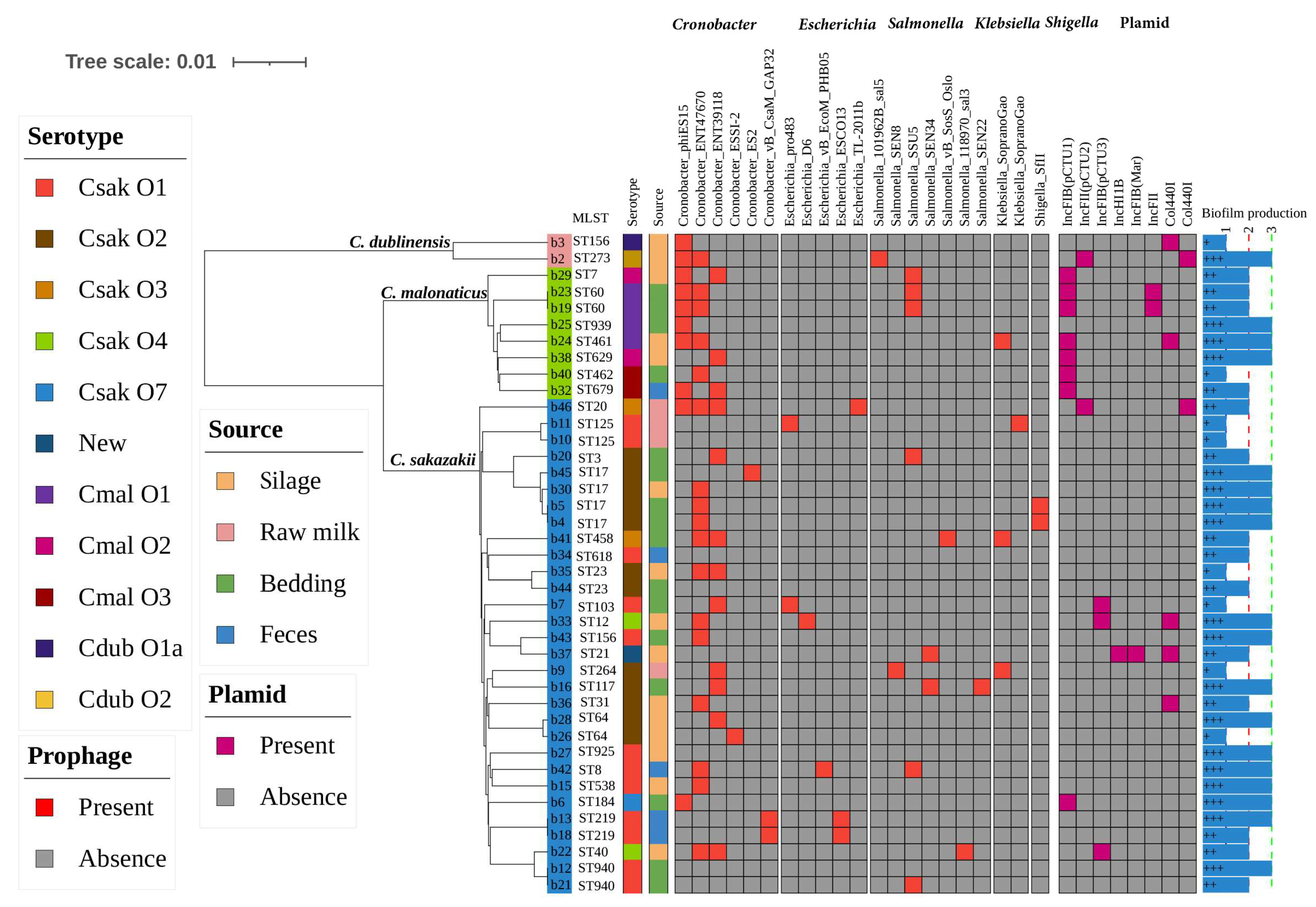
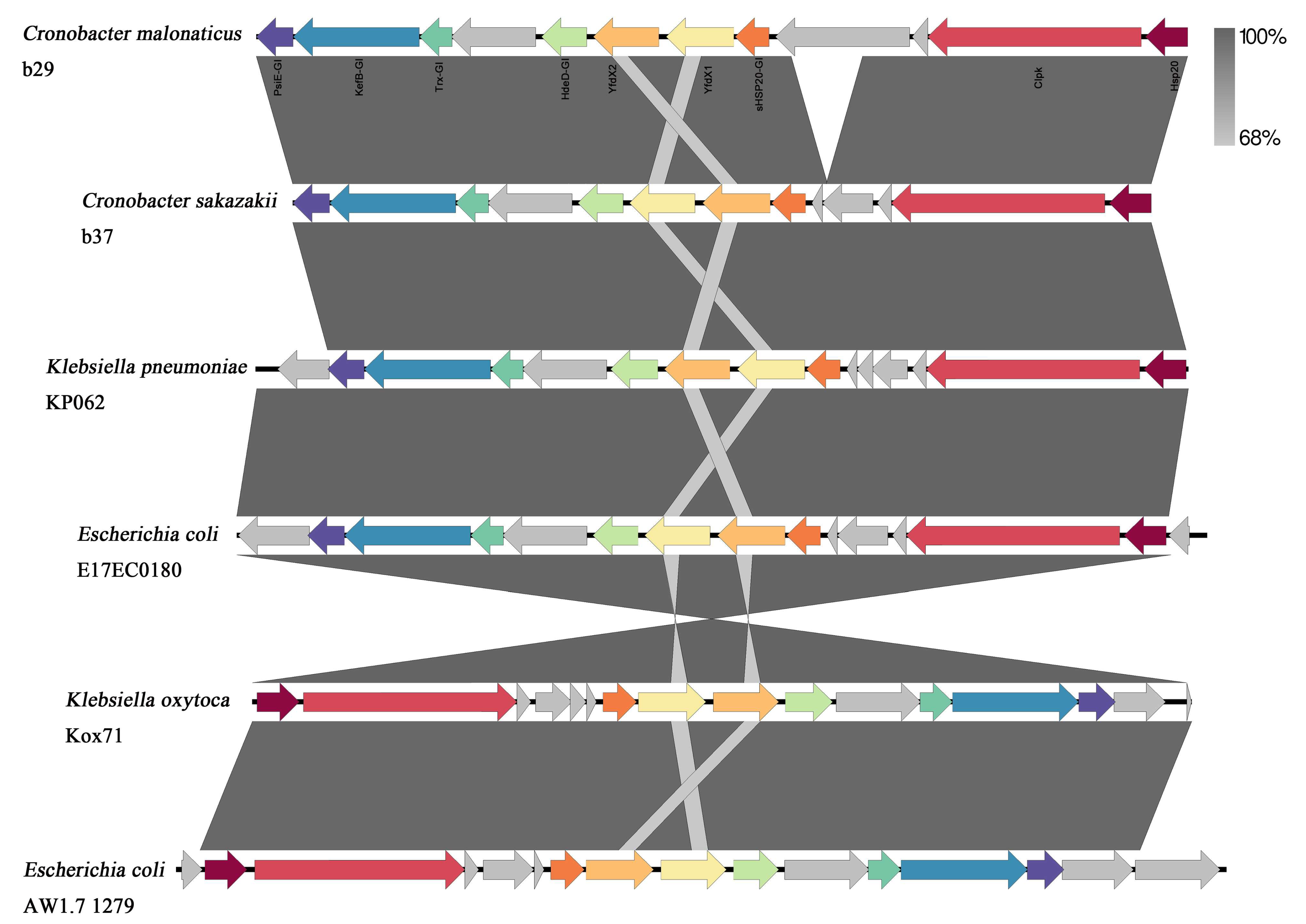
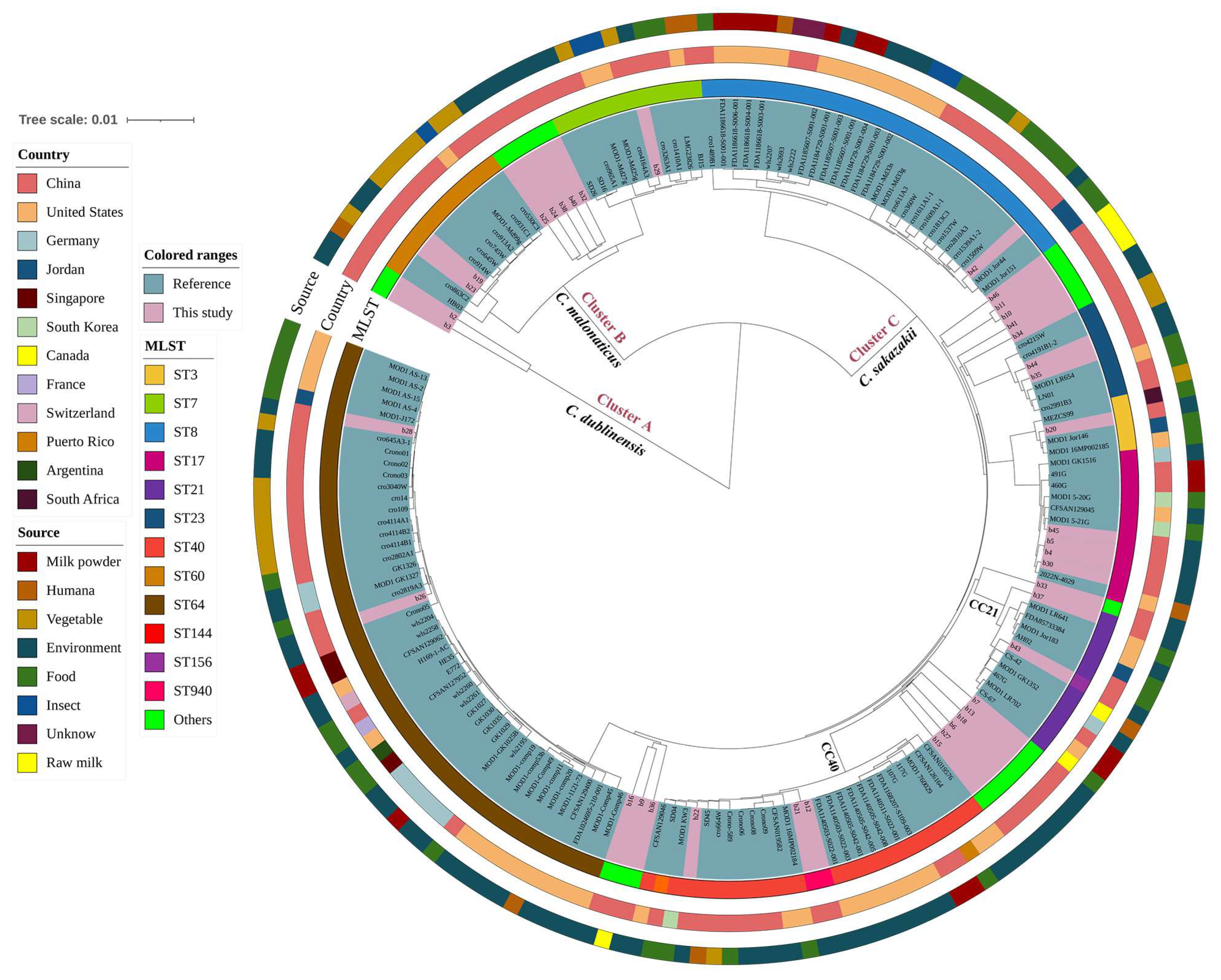
Cronobacter spp. are the most concerning foodborne pathogen in infant formula milk powder. Currently, there are many reports on the prevalence of Cronobacter spp. in infant formula milk and its processing environment, but there are few studies on the prevalence of Cronobacter spp. on dairy farms. We have, therefore, undertaken this study to investigate and track genomic epidemiology of Cronobacter spp. isolates from Chinese dairy farms in the provinces of Jiangsu and Shandong. In this study, forty Cronobacter spp. strains, consisting of thirty Cronobacter sakazakii, eight Cronobacter malonaticus, and two Cronobacter dublinensis, were obtained from 1115 dairy farm samples (raw milk, silage, bedding, and feces), with a prevalence rate of 3.57%. These isolates were classified into 10 Cronobacter serotypes and 31 sequence types (STs), including three novel STs which were isolated for the first time. Notably, pathogenic Cronobacter STs 7, 8, 17, 60, and 64, which are associated with clinical infections, were observed. Antimicrobial susceptibility testing showed that all the Cronobacter spp. were highly resistant to cephalothin and fosfomycin, which was consistent with the antimicrobial genotype. All isolates carried core virulence genes related to adherence, invasion, endotoxin, immune evasion, secretion system, and regulation. Approximately half the isolates were also able to produce a strong biofilm. Twenty-one prophages and eight plasmids were detected, with the most common prophage being Cronobacter_ENT47670 and the most common plasmid being IncFIB (pCTU1). In addition, two isolates harbored the transmissible locus of stress tolerance (tLST) which confers high environmental persistence. Phylogenetic analysis showed strong clustering by species level and sequence types. Isolates from different sources or regions with a similar genomic background suggests the cross-contamination of Cronobacter spp. The presence of diverse genotypes of Cronobacter spp. in dairy farms in Jiangsu and Shandong provinces indicates that surveillance of Cronobacter spp. on dairy farms should be strengthened, to prevent and control transmission and ensure the quality and safety of raw dairy products.
Keywords: Cronobacter spp.; whole-genome sequencing; antimicrobial susceptibility; phylogenetic analysis Cronobacter spp.; whole-genome sequencing; antimicrobial susceptibility; phylogenetic analysis