You are currently viewing a new version of our website. To view the old version click .
Foods
  • Article
  • Open Access

23 February 2024

Variations in Key Aroma Compounds and Aroma Profiles in Yellow and White Cultivars of Flammulina filiformis Based on Gas Chromatography–Mass Spectrometry–Olfactometry, Aroma Recombination, and Omission Experiments Coupled with Odor Threshold Concentrations


,
,
,
,
,
and
1
School of Perfume and Aroma Technology, Shanghai Institute of Technology, Shanghai 201418, China
2
Institute of Edible Fungi, Shanghai Academy of Agricultural Sciences, Shanghai 201403, China
3
Institute of Edible Fungi, Sanming Academy of Agricultural Sciences, Sanming 365000, China
4
Fujian Key Laboratory of Crop Genetic Improvement and Innovative Utilization for Mountain Area, Sanming 365509, China
This article belongs to the Special Issue The Identification and Characterization of Aroma Compounds in Food

Abstract

Flammulina filiformis (F. filiformis) is called the ‘benefiting intelligence’ mushroom. There is a notable difference between a yellow cultivar (with a robust aroma) and a white mutant cultivar (with a high yield) of F. filiformis. A thorough analysis of aroma differences is essential to improve the aroma of high-yield strains. This study employed a combination of gas chromatography–mass spectrometry–olfactometry (GC-MS-O) and aroma extract dilution analysis (AEDA) to analyze the variations in aroma compounds. Then, the contribution of the odorants was determined using flavor dilution (FD) factors and odor activity values (OAVs). Aroma omission and recombination experiments were used to identify the key odorants. A total of 16 key aroma compounds were characterized in F. filiformis, along with four eight-carbon volatiles (3-octanone, 3-octanol, octanal, and 1-octen-3-ol). Finally, the dominant aroma characteristic was “sweet” for the yellow strain, while it was “green” for the white strain. More research is required to investigate the enzymes and corresponding genes that regulate the synthesis of aroma compounds in F. filiformis for future breeding programs.

1. Introduction

Flammulina filiformis (F. filiformis), or East Asian needle mushroom, falls under the family Physalacriaceae and the order Agaricales [1,2]. F. filiformis is a highly valued edible fungus due to its high nutritional and medicinal value. Additionally, it is one of the most productive edible types of fungus in industrialized cultivation [2]. There are two distinct strains of F. filiformis, identified by their stipe color in both yellow and white forms [3]. Most of the F. filiformis currently consumed in the Asian market consists of the white strains with high yield and the yellow strains with a robust aroma [2]. Therefore, to generate a strain of F. filiformis that exhibits high yield and a robust aroma, an in-depth analysis of F. filiformis with desirable traits is crucial for breeding.
In addition, aroma is a crucial quality in edible fungi, and various aroma compounds have been characterized in F. filiformis in previous studies [4,5,6,7,8]. Eight-carbon compounds, including 3-octanol and 3-octanone with green and mushroom notes, contribute significantly to the aroma of F. filiformis [9]. Interestingly, F. filiformis volatiles were significantly dynamic in various cultivars [10]. Conversely, few studies have reported on the differences in aroma profiles between yellow and white cultivars of F. filiformis.
Furthermore, a thorough analysis of the differences in key aroma compounds is essential to improving the aroma of white mutant cultivars. Calculating the odor activity values (OAVs) is a crucial method utilized to identify key odorants. However, current research on OAVs exhibits certain limitations, particularly with regard to odor thresholds [11,12,13]. Most odor thresholds for aroma compounds were obtained from literature searches, resulting in inaccurate overall aroma profiles due to a lack of knowledge on the aroma contribution of some odorants (not available in the literature) [14]. Accurately measuring the threshold of key aroma compounds could help obtain richer and more complete aroma profiles.
In summary, this study aimed to analyze the differences in aroma profiles between yellow and white F. filiformis. Odorants were identified and quantified using gas chromatography–mass spectrometry–olfactometry (GC-MS-O) and external standard methods. Later, based on flavor dilution factors (FDs) and OAVs, key aroma compounds were determined and their contributions confirmed through aroma recombination and omission experiments. Through these experiments, an aroma profile for F. filiformis was established. Finally, the results will offer important insights into a comprehensive characterization of the aroma profile of F. filiformis, along with a better comprehension of the aroma variations between yellow and white cultivars.

2. Materials and Methods

2.1. Mushroom Samples and Chemicals

Three cultivars of F. filiformis that differ in colors, caps, and stipes were provided by the Institute of Edible Fungi (Shanghai Academy of Agricultural Sciences, Shanghai, China) and were named F1, F2, and F3, respectively. At their mature stage, three cultivars, with distinct features as outlined in Table S1, were identified by a stipe color range that spans from light yellow (F1) to yellow (F2) and white (F3) [15]. Through the crossbreeding of F1 and F3, F2 was developed. The F. filiformis samples were kept on ice during transportation, frozen using liquid nitrogen, and then pulverized into a fine powder using a blender (Shanghai Wansheng Co. Ltd., Shanghai, China). The powder samples were properly packaged and stored at −20 °C for further use. Commercially, the authentic standards were available (listed in Supplementary Materials). All chemicals used were analytical grade or higher.

2.2. Headspace Solid-Phase Microextraction (HS–SPME) Analysis

Based on a previously reported method with a minor alteration, preliminary experiments were conducted to optimize the HS-SPME procedures [16]. Each F. filiformis sample (5 g) was weighed into a 20 mL headspace vial, followed by the addition of saturated saline (3 mL) and 1,2-dichlorobenzene (2 μL, 100 mg/kg, solvent: acetone). The samples were equilibrated for 3 min in a water bath at 55 °C. A flexible fiber coated with a 50/30 μm layer of PDMS/DVB (Supelco, Bellefonte, PA, USA) was utilized to extract the volatile compounds at 55 °C for 50 min. Subsequently, the SPME fiber was removed and promptly placed into a GC injector for desorption at 250 °C (5 min), followed by detection. And the samples were injected in splitless mode.

2.3. Solvent-Assisted Flavor Evaporation (SAFE)

At room temperature, samples (30 g) and dichlorobenzene (300 μL) were stirred (3 × 1 h) with dichloromethane (3 × 100 mL). After combining the organic phases, they were dried using anhydrous sodium sulfate and then transferred into a 500 mL distillation flask, which was a part of the SAFE apparatus (Glasbläserei Bahr, Manching, Germany). The SAFE process involves the separation of volatile fractions using relatively low temperatures (40 °C) and high vacuum pressures (5 × 10⁻⁵ mbar). The distillate was concentrated using a nitrogen stream until the final volume was 1 mL. For GC-MS, 2 μL of concentrate was injected into the injection port at 250 °C.

2.4. Gas Chromatography–Mass Spectrometry–Olfactometry (GC-MS-O) Analysis

The experiment employed a gas chromatography 8860 system coupled with a 5977B mass spectrometer (Agilent Technologies, Santa Clara, CA, USA). An HP-INNOWAX analytical fused silica capillary column (60 m × 0.25 mm × 0.25 μm, Agilent Technologies, USA) was used to isolate volatiles. The oven heating procedure involved programming at 40 °C (maintained for 3 min) and ramping at 5 °C/min to 100 °C (held for 5 min), followed by an increase to 210 °C (held for 5 min) at 3 °C/min. Helium (>99.99%) was used as the carrier gas, maintaining a constant flow at 1.0 mL/min in splitless mode. The mass spectrometer was configured to use an electron ionization mode at a 70 eV ionization energy and a 230 °C ion source temperature. It was scanned for a range of 30 to 450 m/z in full scan mode.
The GC-O experiment utilized an Agilent 8860 gas chromatography system that was equipped with an olfactory detection port (Gerstel, Mülheim an der Ruhr, Germany; ODP-4). The chromatographic conditions were consistent with the GC-MS method, and the flow split ratio was 1:1 between the detector and the olfactory port at the end of the column. To reduce nasal discomfort and fatigue, the GC-O evaluation sessions were divided based on elution time into 2 segments: 0–31 and 32–62 min (recording of compounds, aroma characteristics, and retention times was carried out by at least 3 assessors).

2.5. Aroma Profile Analysis

The aroma profiles were measured at the Sensory Laboratory located in the Shanghai Institute of Technology (Shanghai, China), following the International Standard Guidelines (ISO) 8589-2007 [17]. The Ethics Committee at the Shanghai Institute of Technology approved the sensory analysis. The sensory panel comprised 10 sensory assessors (5 males and 5 females aged from 22 to 30 years old, all of whom signed informed consent forms) following ISO 8586-2023 for selection, training, and monitoring [18]. Once acquainted with the F. filiformis aroma, the assessors were requested to articulate and identify aroma descriptors by discussing aroma attributes [12]. The 7 aroma descriptors, which include sweet (δ-dodecalactone), fatty (decanol), cheese (nonanoic acid), mushroom (1-octen-3-ol), floral (terpineol), green (2-penten-1-ol), and fruity (ethyl 3-hexenoate), were identified along with their reference standards through discussion among the sensory panel. The aroma intensities (AIs) were evaluated using a 10-point scale, following a previously reported method with minor changes, ranging from 0 to 9, wherein “0”, “1”, “5”, and “9” correspond to none, weak, moderate, and strong. All sensory evaluations were conducted by this sensory panel in triplicate.

2.6. Aroma Extract Dilution Analysis (AEDA)

For the AEDA, the F. filiformis extract samples underwent stepwise dilution in a 1:2 ratio with dichloromethane solvent before being injected for sniffing until no odorant could be detected [13]. In addition, if the volatile extract was acquired using SPME, it was diluted by gradually adjusting the split ratio to 1:2. The dilution was determined by the flavor dilution (FD) factor (indicated by the odorant maximum dilution).

2.7. Identification and Quantification of the Key Aroma Compounds

Volatile compounds were identified based on odor characteristics using an authentic method by comparing retention indices (RIs) with reference standards (https://webbook.nist.gov/chemistry/, accessed on 7 August 2022) and mass spectra with data from the NIST Mass Spectrometry Data Center (2023 version) [19].
The aroma-active compounds were quantified by constructing external standard curves. For the matrix preparation, dichloromethane (300 mL) added to F2 (30.0 g) was extracted for 12 h. The extraction was repeated until nothing was detected by SAFE-GC-O-MS. The aroma-active compound standards at different concentrations (0.004–0.149 mg/kg) were mixed with 1,2-dichlorobenzene (300 μL, 100 mg/kg), then diluted in the matrix prepared above at 7 different concentration ratios (1:5, 1:10, 1:50, 1:100, 1:200, 1:400, and 1:1000). Subsequently, the above solution mixture was extracted using the SAFE or HS-SPME method and analyzed through the GC-MS procedure (described in Section 2.4), with the exception that MS was performed in selected ion monitoring (SIM) mode [20].
To construct the calibration curves, the ratio between the peak area of the quantified compounds and that of the internal standard (1,2-dichlorobenzene) was plotted against the ratio of their respective concentrations (listed in Supplementary Materials). All analyses were conducted three times to ensure accuracy. The limits of detection (LODs) referred to the concentration of a standard compound whose signal-to-noise (S/N) ratio was 3, while the limit of quantitation (LOQ) was 10 [21]. LOD and LOQ data are listed in Table S4.

2.8. Odor Threshold Concentrations

Odor threshold concentrations were measured using the three-alternative forced choice (3-AFC) test in the mushroom matrix (matrix preparation mentioned in Section 2.7) based on ASTM E679-19 (ASTM, 2019) [22]. Seven concentration groups were established for testing, and each group comprised a spiked sample and two matrix samples. The concentrations of the odorants (set with a three-digit random code) were decreased in turn with a dilution factor of three and presented to panelists in ascending order [23]. Supplementary Table S2 contains the maximum concentrations utilized for each compound. Before determining the OT, the panelists were presented with a spiked reference sample (with a concentration equivalent to the fourth level) to showcase the respective aroma characteristics. Samples (10 mL) were placed in transparent vials covered with plastic lids at room temperature (22 ± 1 °C). A one-minute break was imposed between each test, and each OT test was carried out three times in a row.
The statistical analysis was performed on all the results obtained from the 3-AFC test. OTs for each odorant were calculated using the S-curve fitting (CF) method. Further corrections were implemented using the following formula:
P = 3 × p 1 2
where P represents the correction value for the correct recognition probability, and p represents the measured correct identification probability value (the percentage of panelists who correctly identified the spiked sample). Logarithmic concentration and detection probability curves were created for 7 different concentration points, with the log (concentration) plotted on the X-axis. The S-curve equation was ultimately utilized for fitting, and the resulting formula was as follows [24]:
P = 1 1 + e x C D
where P represents the correction value for the correct recognition probability. C and x are used to represent the logarithmic concentration and OT, respectively, and D represents the characteristic parameter for the odorant, which relates to the gradient for the function [25].

2.9. Odor Activity Values (OAVs)

The OAV was used to assess the contributions of the aroma compounds to the overall aroma of F. filiformis, which was determined by calculating the ratio of their concentrations to the odor detection threshold.

2.10. Aroma Omission/Recombination Experiments

The aroma omission and recombination experiments were conducted as previously described with a slight modification [19]. To verify the individual or group contribution of odorants (OAV ≥ 1) to the overall aroma of F. filiformis, omission models were created by omitting a single or a group of specific aroma-active compounds from the complete reconstituted model (Table 3). Furthermore, triangle tests (ISO 4120, 2021) [26] were carried out by 10 panelists to compare the odor differences between the omission models and the complete recombinant models [26,27]. For the omission experiments, significant differences were determined by counting the panelists (a total of 10 individuals) who could recognize the odor differences 0–3 (p > 0.05, −), 4–6 (p ≤ 0.05, *), and 7–10 (p ≤ 0.01, **).
For the recombination experiments, quantified odorants that contribute significantly to the overall aroma (with significant differences validated by panelists in the omission experiment) were mixed in the matrix (mentioned in Section 2.7). Subsequently, the sensory panel (described in Section 2.5) compared the aromas between the recombinant samples and the actual model of F. filiformis through triangle tests (ISO 4120, 2021) to construct the final recombination model [26,28].

2.11. Statistical Analysis

The statistical analysis was presented as the mean value plus or minus the standard deviation (SD) using Microsoft Office Excel 2016. SPSS 26 (SPSS Inc., Chicago, IL, USA) was used to conduct the Student–Newman–Keuls test to determine the significant differences (p < 0.05) among individual samples for each aroma characteristic (we performed a one-way analysis of variance). TBtools version 1.132 [29] was used to create a cluster heatmap of the volatile compounds in F. filiformis. The correlations between sensory attributes and aroma-active compounds were analyzed by PLSR using SIMCA version 14.1 (Sartorius Stedim, Umea, Sweden).

3. Results and Discussion

3.1. Identification of the Aroma-Active Compounds in F. filiformis

A total of 53 volatiles were identified from F. filiformis using GC-MS, including 4 acids, 18 alcohols, 7 aldehydes, 5 ketones, 15 esters, and 4 other compounds (Table 1). F1 and F2 (yellow cultivars) were found to contain 27 and 29 compounds, respectively. On the other hand, 15 odorants were detected in F3 (white cultivar). The extraction method is crucial to enhancing the volatile compounds in F. filiformis. Previous research has indicated that a combination of two extraction methods can lead to a more effective enrichment of aroma compounds, resulting in an increased quantity and variety [19]. Referring to previous research [19], different pretreatment methods were compared in detail. Table 1 summarizes the volatile data obtained from two pre-treatment methods.
Table 1. Identification of aroma-active compounds in F. filiformis.
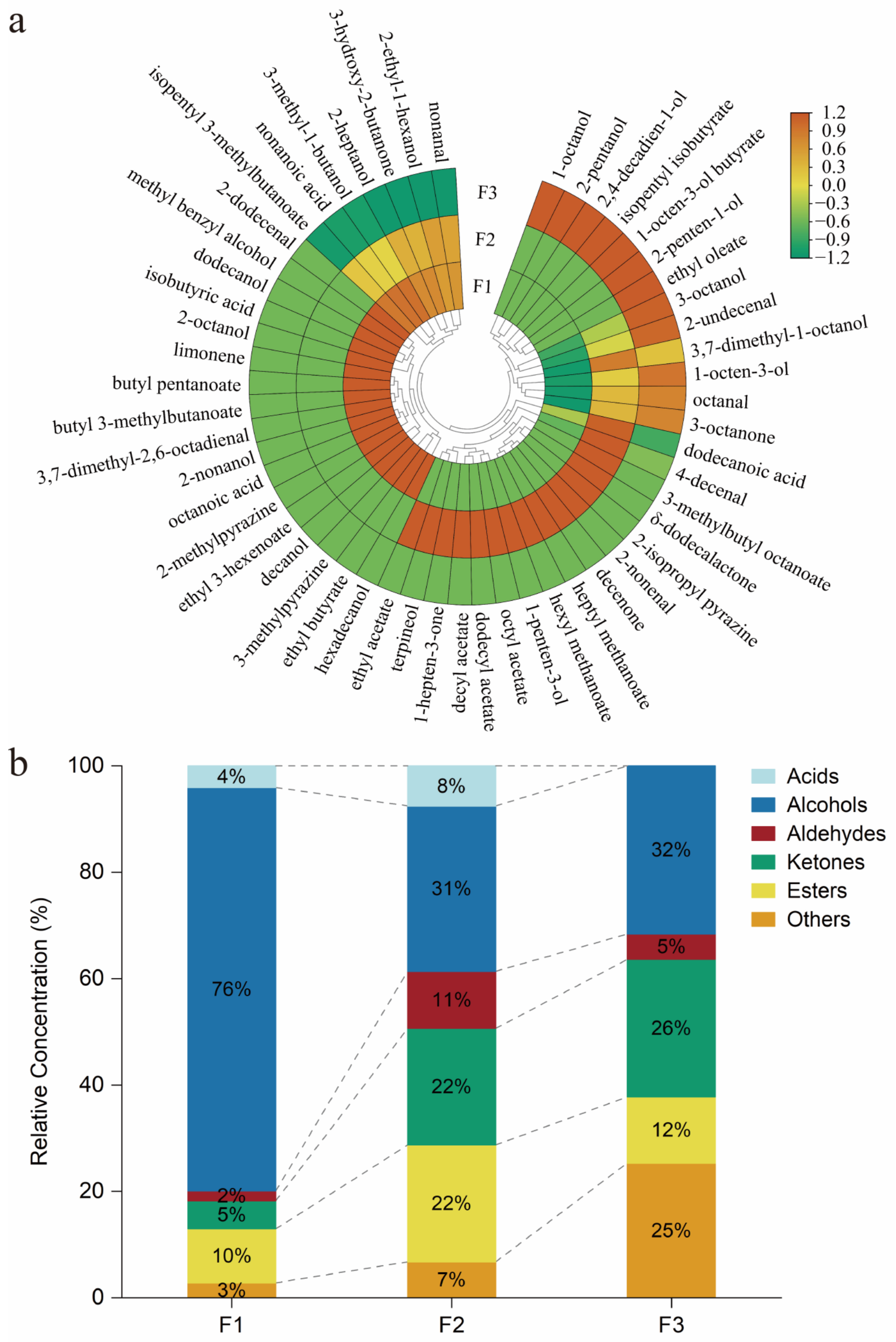
A visual comparison was conducted using a heatmap analysis to determine the variations in aroma compounds across various F. filiformis cultivars (Figure 1a). The color intensity was determined by a normalized scale, with the upper limit set to 1.2 (orange) and the lower limit to −1.2 (green). It is capable of discerning between different cultivars and presenting the relative abundances of volatiles, ranked from highest to lowest. The names of the compounds are mentioned on the outer edge of the fan, while the names of the samples are on its inner edge. The cluster analysis revealed varying cultivars and quantities of distinctive and common compounds present in the concentration results of the three diverse cultivars of F. filiformis [10]. To begin with, two volatiles were odorants commonly presented in F1, F2, and F3. 3,7-Dimethyl-1-octanol and octanal belong to eight-carbon compounds linked to typical mushroom notes. Octanal also acted as an info-chemical that inhibits fungal growth and interferes with mycotoxin production [10,30].
Figure 1. (a) Heatmap analysis of the volatile aroma compound contents identified in F. filiformis cultivars; (b) compositions of volatile compounds in F. filiformis cultivars: F1, F2, and F3, respectively.
Furthermore, F1 contained 27 unique compounds. Interestingly, limonene, also identified in Volvariella volvacea, exhibits an enantioselective odor, described as a lemon odor [9,31]. A total of 29 distinct compounds were present in F2. Dodecanol and dodecanoic acid were found in the F1 variety and discovered to be hydroxylated at the ω-7 position to form δ-dodecalactone by sub-terminal fatty acid hydroxylases, which is crucial for future research on cultivating and transforming the aroma among different cultivars of F. filiformis [32]. F3 comprised 15 distinctive compounds. 1-Octanol (an eight-carbon compound) has been found to inhibit fungal spore germination and is produced through a reduction from 1-octanal, with alcohol dehydrogenase as its source [10,33].
Furthermore, F1 and F2 both contained 10 odorants. Nonanal has been identified as a major aroma compound in various edible mushrooms [9]. 3-Hydroxy-2-butanone, not commonly found in raw mushrooms, has been detected in cooked pine mushrooms [34]. There were eight compounds commonly found in both F2 and F3. They comprised eight-carbon compounds reportedly associated with distinct functions. 3-Octanol served as an inhibitor for both plant growth and seed germination [10]. 1-Octen-3-ol, “mushroom alcohol”, has various functions such as inhibiting fungal growth, promoting seed germination, inducing conidiation, defending plants, and affecting mycotoxin production [10]. It is also possible to identify the origin of the detected 1-octen-3-ol, whether fungal or vegetal, by analyzing its stereochemistry and accompanying compounds [33]. 3-Octanone exhibits inhibitory effects on the fungal spore germination process [10].
The 53 compounds are classified in Figure 1b, wherein it can be observed that the volatiles differ in terms of their types, contents, and amounts among the three cultivars. It was obvious that high overall alcohol concentrations existed among all the cultivars. Alcohols are primarily synthesized by reducing aldehydes through alcohol dehydrogenase. It was visually observed that a higher alcohol content was associated with a lower aldehyde content in the various strains of F. filiformis, which is related to alcohol dehydrogenase activity [33]. In the future, clarifying the regulatory genes of aroma compounds in edible mushrooms would be crucial in cultivating cultivars of F. filiformis with more appealing scents for consumers [35]. The concentrations of acids, aldehydes, and esters showed a consistent trend, peaking in F2 and having lower values in F1 and F3. Acid compounds, in particular, had 0% content in F3. The content of esters in F2 was higher than in the other two cultivars. Additionally, all three cultivars exhibited an increasing trend in the content of ketones. And other compounds included pyrazines, furans, and sulfur compounds. Overall, the yellow strains contained relatively low levels of aldehydes, particularly in F1, where it was less than 10% of the total content. And esters, ketones, and alcohols were present at relatively high levels in F2, making up more than 70%. Conversely, in the white strains (F3), the content of esters and aldehydes was quite low.

3.2. Further Confirmation for Aroma Attributes by GC-O and Contributions by AEDA

Although various volatiles were identified through GC-MS, only a few contributed to the overall aroma, and these are considered to be key aroma compounds in F. filiformis. GC-O combined with AEDA was utilized to characterize the primary aroma-active compounds in three cultivars. Then, a sensory evaluation and GC-O were used to determine seven aroma descriptors, including sweet, fatty, cheese, mushroom, floral, green, and fruity notes, for further research.
As shown in Table 1, compared to the white strains, most compounds in the yellow strains have higher FD factors. Out of 38 compounds with an FD ≥ 2, F1, F2, and F3 contained 16, 22, and 6 aroma-active compounds, respectively. In general, most odorants with a high FD (FD ≥ 64) were associated with sweet and typical mushroom notes and were found mainly in yellow strains. It could be further inferred that the sweet notes in the yellow cultivar contributed more to the overall aroma, in comparison to the white cultivar. Yellow strains have been found to contain a variety of sweet note compounds, further classified into distinct types, such as fruity-sweet and honey-sweet. This observation might lay the foundation for exploring the underlying causes of the differences in sweet notes among yellow cultivars.
Compounds with a high FD factor could be responsible for the unique aroma characteristics in samples [36]. Specifically, several sweet note odorants with an FD of 1024 contributed to the sweet aroma in the yellow strains, such as 3-methylbutyl octanoate. The above compounds contributed less to the aroma in the white F. filiformis, possibly explaining why such strains lack a sweet aroma sold on the market [1]. Furthermore, 2-penten-1-ol, presented as a green aroma, had the greatest FD factor in the white cultivars, which might potentially lead to a dominant green aroma.
Moreover, the yellow F. filiformis had a higher FD factor compared to the white. The distinct mushroom aroma in the yellow variety was caused by these volatiles, including 3-octanol (FD: 512 (yellow) and 1 (white), mushroom), 1-octen-3-ol (FD: 4 (yellow) and 1 (white), mushroom), and 3-octanone (FD: 512 (yellow) and 4 (white), mushroom). Similar key odorants have also been identified in different mushroom cultivars [37]. The variation in aroma in F. filiformis could be attributed to these odorants.

3.3. Quantitative Analysis and OAV Referring to Volatile Compounds

As shown in Table 2, F1, F2, and F3 contained high concentrations of aroma compounds, such as 3-hydroxy-2-butanone (27.9547 mg/kg, sweet) and 3-octanone (1.6570 mg/kg, sweet). However, the concentration of odorants might not always reflect their contribution to the overall aroma. To accurately assess their aroma contribution, it was necessary to consider their odor thresholds [14]. The odor thresholds for these compounds were measured in the matrix of F. filiformis (Table 2). Due to the presence of the largest number of key volatiles, the F2 cultivar was selected to prepare the matrix for odor threshold measurement.
Table 2. Concentration, odor threshold, and OAV of key aroma-active odorants in three cultivars of F. filiformis.
In the realm of food aroma research, compounds with an OAV ≥ 1 were considered key aroma compounds [11]. The OAV of each compound was calculated by dividing the concentration by the odor threshold value, as presented in Table 2. A total of 28 key aroma compounds were identified in the three cultivars. And 14, 19, and 6 key aroma compounds were identified in F1, F2, and F3, respectively. Among these odorants, octanal was present as a common key aroma compound in three cultivars, contributing to fruity notes, respectively. 2-Penten-1-ol was a key aroma compound unique to F3. This could explain the variation in aroma among the three types of F. filiformis.
First of all, there were six key volatiles with an OAV > 1000 in F1. Secondly, there were 10 key volatiles with an OAV > 1000 in F2. Furthermore, distinctive key aroma compounds found in F2 might give rise to sweet and mushroom notes. The F2 sweet note was attributed to 3-octanone (sweet), which was in line with previous studies [8]. Likewise, F2 presented a strong fruity note because of the odorant octanal (fruity), with a low threshold (0.0034 mg/L) and concentration (0.0317 mg/kg). On the whole, the key compounds found in the yellow cultivars were mostly characterized by sweet notes. The unique sweet compounds in the two yellow strains could potentially serve as primary factors in distinguishing different strains of F. filiformis. Finally, in F3, 3-octanone, octanal, 2-penten-1-ol, 3-octanol, and 1-octen-3-ol were the key aroma compounds with an OAV > 1000. It was apparent that the F3 white strain possessed a noticeable green note, attributed to the presence of 2-penten-1-ol (green).

3.4. Aroma Recombination and Omission Experiments

Further aroma recombination and omission experiments were conducted to verify the impact of key aroma compounds in F. filiformis. To conduct omission experiments, the triangle test method was employed, and 28 odorants with an OAV ≥ 1 were determined [13]. As shown in Table 3, aroma models were developed to examine the impact of singular or clustered volatile compounds (based on aroma notes) on the overall aroma of F. filiformis. These odor models were compared with the omission compounds one by one and with the complete models. In addition, the sensory panel members were required to accurately describe the detected differences in odor [12]. In the sensory panel, 90% of the participants were able to distinguish differences in aroma between the model missing 3-hydroxy-2-butanone (1-2) and the complete model. They noted that the deficient model had a less creamy and sweet aroma as compared to the complete model. The study found that the compounds had low OAVs and were not significant contributors to the aroma of F. filiformis. This is consistent with previous studies, which suggested that compounds with low OAVs may not necessarily have a strong impact on the overall aroma [38]. In addition, there are seven aroma note omission models in Table 3. The omission of five aroma attributes, namely sweet, mushroom, floral, green, and fruity, caused the most significant (p ≤ 0.01) impact on the overall aroma of F. filiformis. On the contrary, the influence of the omission of fatty and cheese notes on the overall aroma was relatively minimal (p ≤ 0.05) due to the lesser quantity of key aroma compounds with fatty and cheese aromas [19].
Table 3. Omission experiments of F. filiformis based on the complete aroma recombination model.
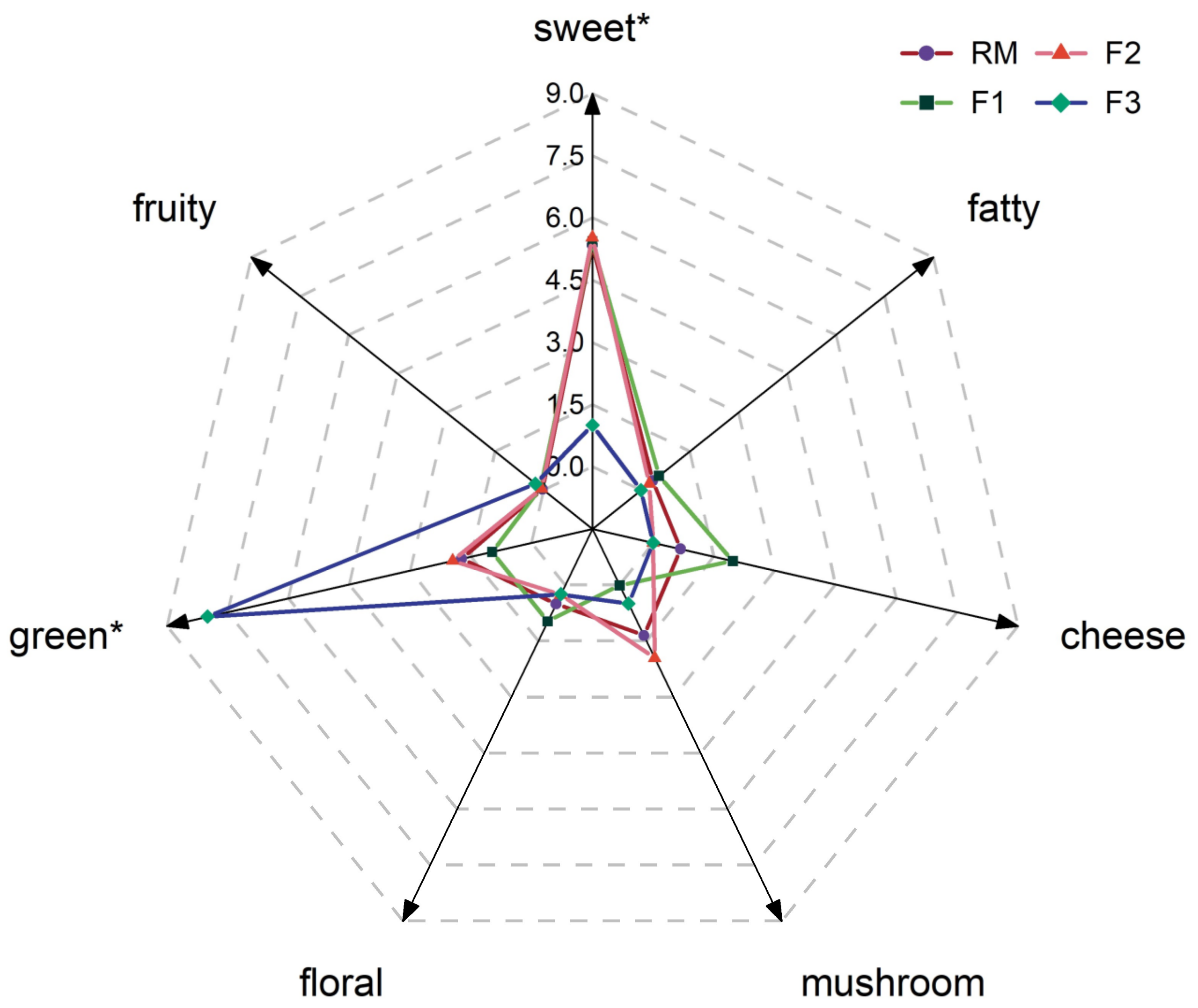
To identify the most robust aroma in the yellow cultivars, significant odorants (p ≤ 0.05) in omission tests were selected and added to the matrix to create a reconstitution model for F2. In addition, a sensory comparison was conducted between the aroma profiles of the three mushroom cultivars. Based on Figure 2, the sensory panel compared the seven aroma attributes in the recombination model with the three cultivars and scored these attributes (on a scale of 10). First, there was a significant difference (p ≤ 0.05) in the sweet and green notes among the three cultivars, which is consistent with the differences in their key aroma compounds. At the same time, it suggested that aroma compounds were the origin of aroma attributes. This could be because the green note in F. filiformis primarily came from volatile aldehydes and alcohols, which were relatively challenging to extract [39]. Moreover, the complexity of aroma formation (the synergy between aroma compounds) and the possible existence of undetectable substances could also result in variations in aroma traits [14].
Figure 2. Aroma profile of three cultivars of F. filiformis and aroma recombinant model. * p ≤ 0.05. RM: recombinant model.
Then, the calculation of OAVs and the AEDA were methods used to assess the contribution of compounds to the overall aroma. These methods incorporated human perception, specifically odor thresholds and ODP olfactory ports, to determine the contribution of each compound. However, further research is necessary to fully understand the relationships between these two factors. For example, the FD factors of these compounds showed a positive correlation with the OAV, such as 3-methylbutyl octanoate, 3-octanone, octyl acetate, and 3-octanol. In contrast, the FD factors of these compounds were relatively high; however, their OAVs were less than one. Consequently, the recreation of the initial aroma characteristics in cultivars using recombination models proved to be a demanding task, requiring further investigation in subsequent research [36]. However, considering the high similarity between the recombination model and the yellow variety (F2), it can be deemed a successful recombination model for yellow F. filiformis in this study.

3.5. Aroma Attributes’ Correlation with Aroma-Active Compounds Using Partial Least-Squares Regression (PLSR)

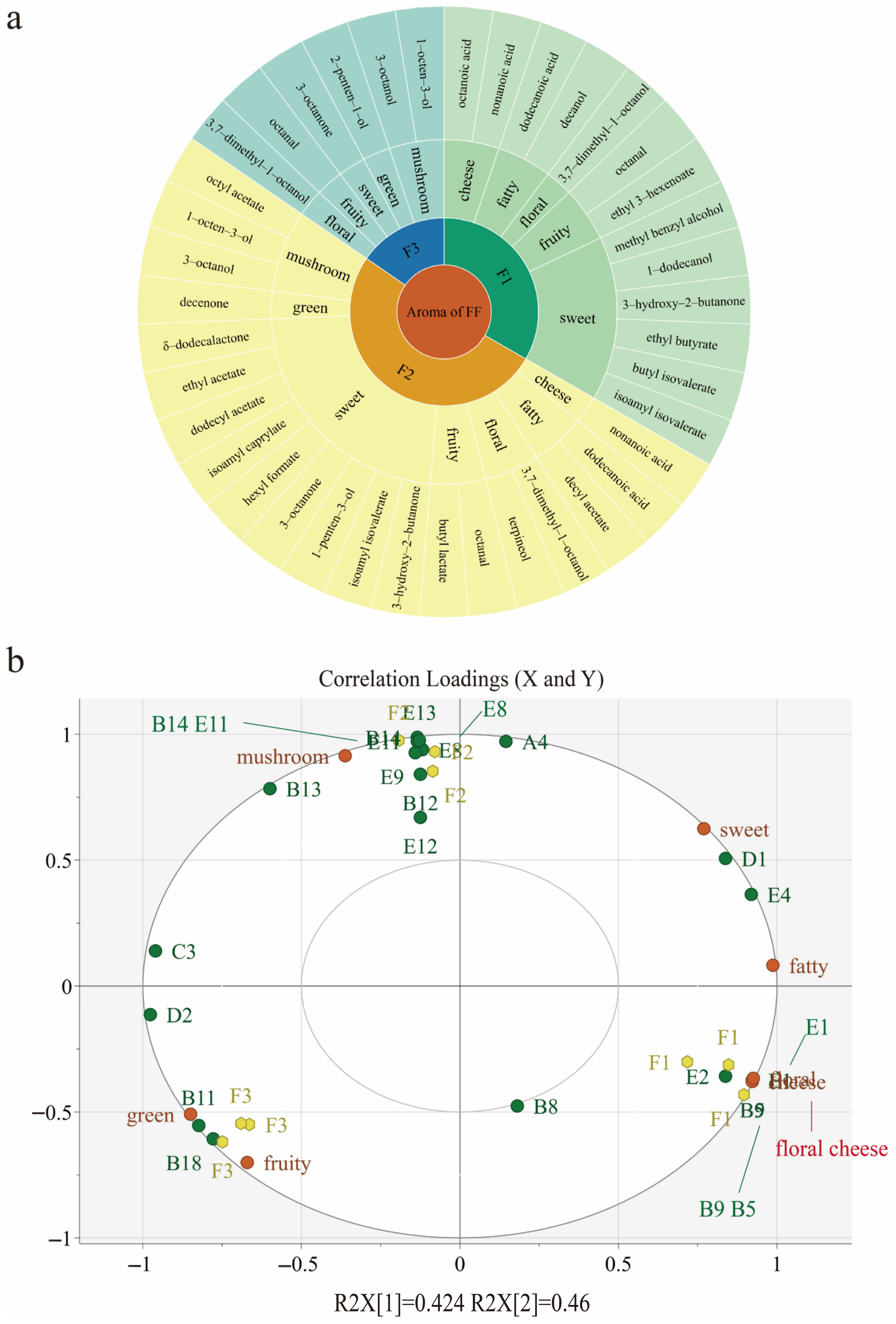
Using validated key aroma compounds obtained from the recombination experiments, a PLSR model was utilized to determine the relationships between aroma characteristics and key volatiles (Figure 3b). The cultivars were tested thrice, and the outcomes displayed reliable repeatability with good clustering. The load chart showed two ellipses, one representing 50% and the other 100% of the explanatory variable [19]. All the aroma attributes fell between these two ellipses, and the correlation coefficients of R2, X1 = 0.424, and X2 = 0.46, with a total of 0.884, indicated that the PLSR model was effective in explaining the correlation between sensory evaluation and compounds. Upon analysis of the correlation chart, it was revealed that F3 was closely correlated with green and fruit notes. The sweet attribute was distributed between F1 and F2, being furthest from F3. This observation leads to the hypothesis of a correlation between the sweet note and the respective cultivars (F1 and F2), which is consistent with previous findings (Figure 2).
Figure 3. (a) Aroma wheel of key odorants and aroma attributes from three F. filiformis (FF) cultivars; (b) correlation loading plot for aroma-active compounds (X-matrix) and aroma attributes from F. filiformis (Y-matrix).
This study focused on identifying the key aroma compounds in three types of F. filiformis and their seven aroma attributes. Based on the results, an aroma wheel was created to describe the aroma characteristics of F1, F2, and F3 in F. filiformis (Figure 3a). As a result, the research concluded that in F1, five odorants were found to be the main contributors to sweet notes (B9, D1, E1, E2, and E4). The compounds mentioned were observed to be closer to F1 on the PLSR plot. Notably, 3-hydroxy-2-butanone and isopentyl 3-methylbutanoate showed a significant correlation with sweet notes. 3-hydroxy-2-butanone, which has been identified as a key aroma compound in F. filiformis, was linked to the quality of “creamy” in previous studies [40]. In addition, nonanoic acid contributed to a cheese-like odor, whereas octanal played a vital role in fruity notes. Octanal is considered a key aroma compound in many edible fungi and is mainly generated through the oxidation or photochemical degradation of toluene or other hydrocarbons [9,33].
Secondly, seven odorants were identified in F2 as having the greatest effect on sweet notes (B12, D1, E4, D5, E9, E12, and D2). Obviously, B12, D5, E9, and E12 showed a strong correlation with F2, according to the correlation map. Furthermore, 3-octanol, 1-octen-3-ol, and 1-octen-3-ol were characteristic compounds that contributed to the mushroom note, which is consistent with studies on other edible fungi [9]. Terpineol was considered a potential contributor to floral notes.
Furthermore, the aroma wheel of F3 included sweet, floral, green, and fruity notes, attributed to by key components like 3-octanone, 2-penten-1-ol, and octanal, respectively. On the other hand, 2-penten-1-ol was closely associated with green notes in the PLSR plot, indicating a strong correlation. The mushroom note in F3 was derived from compounds like 3-octanol and 1-octen-3-ol. In this study, it was found that certain compounds played a crucial role in the aroma present in edible mushrooms like F. filiformis. These compounds not only contributed to the typical mushroom note but also offered various other aromas, such as fruity and sweet notes, which were crucial for analyzing the aroma in F. filiformis. While this study provided a comprehensive analysis and quantification of the volatile components in F. filiformis, several limitations should be acknowledged. This study did not explore the enzymes and corresponding genes involved in the synthesis of volatile compounds in F. filiformis, warranting future research to elucidate the aroma synthesis mechanisms and contribute to breeding initiatives aimed at enhancing aroma robustness.

4. Conclusions

In this study, the volatiles from three types of F. filiformis were extracted using both HS-SPME and SAFE methods and identified through GC-MS-O and AEDA. Based on their high FD values, volatile compounds with a high aroma contribution were selected for external standard quantification. Among all the quantitative compounds, 28 odorants were determined to be the main aroma volatiles due to their high OAVs (OAVs ≥ 1). Moreover, 20 key aroma compounds were identified through aroma recombination and omission experiments as further verification. Finally, the correlation between key odorants and aroma characteristics was evaluated by PLSR, and aroma wheels were plotted for the three types of F. filiformis. In conclusion, the dominant aroma in the yellow cultivar is sweet, with 3-hydroxy-2-butanone and isopentyl 3-methylbutanoate as the common main contributors in F1 and F2. In contrast, the characteristic aroma of the white cultivar is green, with 2-penten-1-ol being the major contributor. In particular, isopentyl 3-methylbutanoate and 2-penten-1-ol were identified as key aroma compounds in F. filiformis for the first time. This work offers significant insights into elucidating the aroma variation between yellow and white strains. And this research will also help improve the current situation regarding the preference of consumers for the aroma in yellow cultivars and the lack of diversification in F. filiformis cultivars. Therefore, further research is required to explore the enzymes and corresponding genes regulating the synthesis of aroma compounds in F. filiformis for breeding initiatives with both high yields and a robust aroma.

Supplementary Materials

The following supporting information can be downloaded at https://www.mdpi.com/article/10.3390/foods13050684/s1: Table S1. Three cultivars of F. filiformis; Table S2. Chemical standards; Table S3. Highest presented aroma compound concentrations for OT determination; Table S4. Standard curves for aroma-active compounds in F. filiformis; Table S5. Supplementary information about aroma-active compounds in F. filiformis.

Author Contributions

W.S.: Conceptualization, supervision, methodology, investigation, writing—original draft, visualization, writing—review and editing. M.S.: Supervision, writing—review and editing. H.L.: Methodology, supervision. S.W.: Visualization. R.W.: Methodology, supervision, funding acquisition. X.S.: Investigation, formal analysis. T.F.: Conceptualization, validation, supervision, project administration, writing—review and editing. All authors have read and agreed to the published version of the manuscript.

Funding

This research was funded by the agricultural science and technology project of Shanghai 2021 “Science and Technology Innovation Action Plan” (21N11900300). And The APC was funded by Shanghai academy of agricultural sciences.

Data Availability Statement

Data will be made available upon request. Email address: fengtao@sit.edu.cn.

Conflicts of Interest

The authors declare no conflicts of interest.

References

  1. Fu, Y.; Yu, Y.; Tan, H.; Wang, B.; Peng, W.; Sun, Q. Metabolomics reveals dopa melanin involved in the enzymatic browning of the yellow cultivars of East Asian golden needle mushroom (Flammulina filiformis). Food Chem. 2022, 370, 131295. [Google Scholar] [CrossRef]
  2. Li, H.; Shi, L.; Tang, W.; Xia, W.; Zhong, Y.; Xu, X.; Xie, B.; Tao, Y. Comprehensive Genetic Analysis of Monokaryon and Dikaryon Populations Provides Insight into Cross-Breeding of Flammulina filiformis. Front. Microbiol. 2022, 13, 887259. [Google Scholar] [CrossRef]
  3. Liu, X.B.; Feng, B.; Li, J.; Yan, C.; Yang, Z.L. Genetic diversity and breeding history of Winter Mushroom (Flammulina velutipes) in China uncovered by genomic SSR markers. Gene 2016, 591, 227–235. [Google Scholar] [CrossRef]
  4. Fang, D.; Yang, W.; Kimatu, B.M.; Zhao, L.; An, X.; Hu, Q. Comparison of flavour qualities of mushrooms (Flammulina velutipes) packed with different packaging materials. Food Chem. 2017, 232, 1–9. [Google Scholar] [CrossRef]
  5. Hou, Z.; Xia, R.; Li, Y.; Xu, H.; Wang, Y.; Feng, Y.; Pan, S.; Wang, Z.; Ren, H.; Qian, G.; et al. Key components, formation pathways, affecting factors, and emerging analytical strategies for edible mushrooms aroma: A review. Food Chem. 2023, 438, 137993. [Google Scholar] [CrossRef]
  6. Sun, M.; Ni, L.; Huang, Y.; Yang, M.; Cheng, G.; Zhang, M.; Wu, M.; Ma, C. Effects of different drying treatments on the microstructure, free amino acids, volatile compounds and antioxidant activity of Flammulina velutipes root. Food Chem. X 2023, 18, 100656. [Google Scholar] [CrossRef]
  7. Xia, R.; Wang, L.; Xin, G.; Bao, X.; Sun, L.; Xu, H.; Hou, Z. Preharvest and postharvest applications of 1-MCP affect umami taste and aroma profiles of mushrooms (Flammulina velutipes). LWT 2021, 144, 111176. [Google Scholar] [CrossRef]
  8. Yang, W.; Yu, J.; Pei, F.; Mariga, A.M.; Ma, N.; Fang, Y.; Hu, Q. Effect of hot air drying on volatile compounds of Flammulina velutipes detected by HS-SPME–GC–MS and electronic nose. Food Chem. 2016, 196, 860–866. [Google Scholar] [CrossRef]
  9. Zhu, R.; Wen, Y.; Wu, W.; Zhang, L.; Salman Farid, M.; Shan, S.; Wen, J.; Farag, M.A.; Zhang, Y.; Zhao, C. The flavours of edible mushrooms: A comprehensive review of volatile organic compounds and their analytical methods. Crit. Rev. Food Sci. Nutr. 2022, 1–15. [Google Scholar] [CrossRef]
  10. Pennerman, K.K.; Yin, G.; Bennett, J.W. Eight-carbon volatiles: Prominent fungal and plant interaction compounds. J. Exp. Bot. 2021, 73, 487–497. [Google Scholar] [CrossRef] [PubMed]
  11. Huang, Y.; Wan, J.; Wang, Z.; Sun, M.; Feng, T.; Ho, C.T.; Song, S. Variation of Volatile Compounds and Corresponding Aroma Profiles in Chinese Steamed Bread by Various Yeast Species Fermented at Different Times. J. Agric. Food Chem. 2022, 70, 3795–3806. [Google Scholar] [CrossRef]
  12. Xu, X.; Xu, R.; Jia, Q.; Feng, T.; Huang, Q.; Ho, C.-T.; Song, S. Identification of dihydro-β-ionone as a key aroma compound in addition to C8 ketones and alcohols in Volvariella volvacea mushroom. Food Chem. 2019, 293, 333–339. [Google Scholar] [CrossRef]
  13. Yao, L.; Mo, Y.; Chen, D.; Feng, T.; Song, S.; Wang, H.; Sun, M. Characterization of key aroma compounds in Xinjiang dried figs (Ficus carica L.) by GC–MS, GC–olfactometry, odor activity values, and sensory analyses. LWT 2021, 150, 111982. [Google Scholar] [CrossRef]
  14. Wan, J.; Liu, Q.; Ma, C.; Muhoza, B.; Huang, Y.; Sun, M.; Song, S.; Ho, C.T. Characteristic flavour fingerprint disclosure of dzo beef in Tibet by applying SAFE-GC-O-MS and HS-GC-IMS technology. Food Res. Int. 2023, 166, 112581. [Google Scholar] [CrossRef]
  15. Liu, F.; Wang, S.H.; Jia, D.H.; Tan, H.; Wang, B.; Zhao, R.L. Development of Multiple Nucleotide Polymorphism Molecular Markers for Enoki Mushroom (Flammulina filiformis) Cultivars Identification. J. Fungi 2023, 9, 330. [Google Scholar] [CrossRef]
  16. Li, W.; Li, R.; Chen, W.; Feng, J.; Wu, D.; Zhang, Z.; Zhang, J.; Yang, Y. The anabolism of sulphur aroma volatiles responds to enzymatic and non-enzymatic reactions during the drying process of shiitake mushrooms. Food Chem. 2022, 371, 131123. [Google Scholar] [CrossRef]
  17. ISO 8589; Sensory Analysis—General Guidance for the Design of Test Rooms. ISO: Geneva, Switzerland, 2007.
  18. ISO 8586; Sensory Analysis—Selection and Training of Sensory Assessors. ISO: Geneva, Switzerland, 2023.
  19. Feng, T.; Sun, J.; Wang, K.; Song, S.; Chen, D.; Zhuang, H.; Lu, J.; Li, D.; Meng, X.; Shi, M.; et al. Variation in Volatile Compounds of Raw Pu-Erh Tea upon Steeping Process by Gas Chromatography–Ion Mobility Spectrometry and Characterization of the Aroma-Active Compounds in Tea Infusion Using Gas Chromatography–Olfactometry–Mass Spectrometry. J. Agric. Food Chem. 2022, 70, 13741–13753. [Google Scholar] [CrossRef]
  20. Zhao, Y.; Wei, W.; Tang, L.; Wang, D.; Wang, Y.; Wu, Z.; Zhang, W. Characterization of aroma and bacteria profiles of Sichuan industrial paocai by HS-SPME-GC-O-MS and 16S rRNA amplicon sequencing. Food Res. Int. 2021, 149, 110667. [Google Scholar] [CrossRef] [PubMed]
  21. Li, X.; Zeng, X.; Song, H.; Xi, Y.; Li, Y.; Hui, B.; Li, H.; Li, J. Characterization of the aroma profiles of cold and hot break tomato pastes by GC-O-MS, GC × GC-O-TOF-MS, and GC-IMS. Food Chem. 2023, 405, 134823. [Google Scholar] [CrossRef] [PubMed]
  22. ASTM. E679-19; Standard Practice for Determination of Odor and Taste Threshold by a Forced-Choice Ascending Concentration Series Method of Limits. ASTM International: West Conshohocken, PA, USA, 2019.
  23. Gottmann, J.; Vestner, J.; Fischer, U. Sensory relevance of seven aroma compounds involved in unintended but potentially fraudulent aromatization of wine due to aroma carryover. Food Chem. 2023, 402, 134160. [Google Scholar] [CrossRef] [PubMed]
  24. Yang, S.; Zhang, G.; Xu, L.; Duan, J.; Li, H.; Sun, J.; Sun, B. Investigation on the interaction between 1,3-dimethyltrisulfide and aroma-active compounds in sesame-flavour baijiu by Feller Additive Model, Odor Activity Value and Partition Coefficient. Food Chem. 2023, 410, 135451. [Google Scholar] [CrossRef] [PubMed]
  25. Yang, Y.; Yu, P.; Sun, J.; Jia, Y.; Wan, C.; Zhou, Q.; Huang, F. Investigation of volatile thiol contributions to rapeseed oil by odor active value measurement and perceptual interactions. Food Chem. 2022, 373, 131607. [Google Scholar] [CrossRef] [PubMed]
  26. ISO 4120; Sensory Analysis—Methodology—Triangle Test. ISO: Geneva, Switzerland, 2021.
  27. Wang, L.; Wu, L.; Xiang, D.; Huang, H.; Han, Y.; Zhen, P.; Shi, B.; Chen, S.; Xu, Y. Characterization of key aroma compounds in aged Qingxiangxing baijiu by comparative aroma extract dilution analysis, quantitative measurements, aroma recombination, and omission studies. Food Chem. 2023, 419, 136027. [Google Scholar] [CrossRef]
  28. Wang, P.; Kan, Q.; Yang, L.; Huang, W.; Wen, L.; Fu, J.; Liu, Z.; Lan, Y.; Huang, Q.; Ho, C.T.; et al. Characterization of the key aroma compounds in soy sauce by gas chromatography-mass spectrometry-olfactometry, headspace-gas chromatography-ion mobility spectrometry, odor activity value, and aroma recombination and omission analysis. Food Chem. 2023, 419, 135995. [Google Scholar] [CrossRef] [PubMed]
  29. Chen, C.; Chen, H.; Zhang, Y.; Thomas, H.R.; Frank, M.H.; He, Y.; Xia, R. TBtools: An Integrative Toolkit Developed for Interactive Analyses of Big Biological Data. Mol. Plant 2020, 13, 1194–1202. [Google Scholar] [CrossRef] [PubMed]
  30. Vlot, A.C.; Rosenkranz, M. Volatile compounds—The language of all kingdoms? J. Exp. Bot. 2022, 73, 445–448. [Google Scholar] [CrossRef] [PubMed]
  31. Okur, S.; Qin, P.; Chandresh, A.; Li, C.; Zhang, Z.; Lemmer, U.; Heinke, L. An Enantioselective e-Nose: An array of Nanoporous Homochiral MOF Films for Stereospecific Sensing of Chiral Odors. Angew. Chem. Int. Ed. 2020, 60, 3566–33571. [Google Scholar] [CrossRef]
  32. Smit, M.S.; Maseme, M.J.; van Marwijk, J.; Aschenbrenner, J.C.; Opperman, D.J. Delineation of the CYP505E subfamily of fungal self-sufficient in-chain hydroxylating cytochrome P450 monooxygenases. Appl. Microbiol. Biotechnol. 2023, 107, 735–747. [Google Scholar] [CrossRef]
  33. Xia, R.; Wang, Z.; Xu, H.; Hou, Z.; Li, Y.; Wang, Y.; Feng, Y.; Zhang, X.; Xin, G. Cutting root treatment combined with low-temperature storage regimes on non-volatile and volatile compounds of Oudemansiella raphanipes. LWT 2022, 166, 113754. [Google Scholar] [CrossRef]
  34. Cho, I.H.; Kim, S.Y.; Choi, H.K.; Kim, Y.S. Characterization of Aroma-Active Compounds in Raw and Cooked Pine-Mushrooms (Tricholoma matsutake Sing.). J. Agric. Food Chem. 2006, 54, 6332–6335. [Google Scholar] [CrossRef]
  35. Sun, L.; Xin, G.; Hou, Z.; Zhao, X.; Xu, H.; Bao, X.; Xia, R.; Li, Y.; Li, L. Biosynthetic Mechanism of Key Volatile Biomarkers of Harvested Lentinula edodes Triggered by Spore Release. J. Agric. Food Chem. 2021, 69, 9350–9361. [Google Scholar] [CrossRef] [PubMed]
  36. Huang, Y.; Wan, J.; Sun, M.; Feng, T.; Liu, Q.; Song, S.; Zhang, X.; Ho, C.T. Flavour profile disclosure of Chinese steamed breads (CSBs) by sensomics approach. Food Biosci. 2023, 51, 102198. [Google Scholar] [CrossRef]
  37. Selli, S.; Guclu, G.; Sevindik, O.; Kelebek, H. Variations in the key aroma and phenolic compounds of champignon (Agaricus bisporus) and oyster (Pleurotus ostreatus) mushrooms after two cooking treatments as elucidated by GC–MS-O and LC-DAD-ESI-MS/MS. Food Chem. 2021, 354, 129576. [Google Scholar] [CrossRef] [PubMed]
  38. He, C.; Li, Z.; Liu, H.; Zhang, H.; Wang, L.; Chen, H. Characterization of the key aroma compounds in Semnostachya menglaensis Tsui by gas chromatography-olfactometry, odor activity values, aroma recombination, and omission analysis. Food Res. Int. 2020, 131, 108948. [Google Scholar] [CrossRef]
  39. Yin, C.; Fan, X.; Fan, Z.; Shi, D.; Yao, F.; Gao, H. Comparison of non-volatile and volatile flavour compounds in six Pleurotus mushrooms. J. Sci. Food Agric. 2018, 99, 1691–1699. [Google Scholar] [CrossRef]
  40. Lu, H.; Song, W.; Shang, X.D.; Liu, J.Y.; Zhang, D.; Li, L.; Wang, R.J.; Zhai, X.T.; Feng, T. Expression of terpene synthase-related genes in parents and offspring of Flammulina filiformis based on differences in volatile aroma components. Food Chem. Mol. Sci. 2023, 6, 100156. [Google Scholar] [CrossRef]
Disclaimer/Publisher’s Note: The statements, opinions and data contained in all publications are solely those of the individual author(s) and contributor(s) and not of MDPI and/or the editor(s). MDPI and/or the editor(s) disclaim responsibility for any injury to people or property resulting from any ideas, methods, instructions or products referred to in the content.

Article Metrics

Citations

Article Access Statistics

Multiple requests from the same IP address are counted as one view.