
Abstract
In this study, the effects of frozen storage time, thawing treatments, and their interaction on the rheological properties of non-fermented dough were evaluated. Texture profile analysis (TPA), rheological measurements, including strain/frequency sweep, and creep-recovery measurement were applied to the dough. Compared with unfrozen fresh dough, the frozen storage time (S) and thawing treatment (T) influenced almost all indicators significantly, and their mutual effects (S × T) mainly affected the hardness and springiness. Frozen time was the main factor resulting in the destruction of non-fermented dough during the thawing treatments. Moreover, refrigerator thawing (4 °C) produced a dough with minimal changes in the rheological properties, regardless of the frozen storage time. Meanwhile, microwave thawing resulted in lower G′ and lower zero shear viscosity (η0) values, as well as higher maximum creep compliance (Jmax) and hardness values. Moreover, the difference between the three thawing treatments was exacerbated after 30 days of frozen storage. SEM images also showed that long-term frozen storage combined with microwave thawing seriously destroyed the rheological properties, structural stability, and inner microstructure of the dough.
1. Introduction
Recently, the demand for frozen non-fermented dough products such as noodles, steamed bread, and dumplings in the Chinese market has increased because of its economic superiority [1]. However, the quality of frozen dough products is often inferior compared with fresh ones because freezing and frozen treatments can destroy the dough’s structure [2]. Lots of work has been conducted to investigate the relationship between the quality degradation of frozen dough and freezing parameters such as freezing temperature [3,4,5], frozen storage duration [6,7,8], and freeze−thaw cycles [9,10]. Furthermore, some experts have explored methods to promote the quality of frozen dough by using various improvers [11,12].
Additionally, some researchers have stated that the influence of thawing treatments on the quality of frozen dough should also be taken into consideration as a key parameter as the thawing process is an essential procedure for some frozen dough before cooking [13]. The dough’s textural properties and cooking performance might be influenced by the thawing conditions. For example, Du et al. [14] found that fermented sweet dough thawed at 35 °C with an RH of 85% had the overall best quality. In addition, the microwave-thawed dough tended to have a harder texture, and refrigerator-thawing produced dough with lower resistance against mixing [13]. In our previous study, we proved that thawing treatments had a notable impact on the structural properties of frozen dough. Refrigerator (4 °C) thawing produced a dough with a softer texture, whereas microwave thawing mostly worsened the dough’s quality. However, almost no studies have focused on the rheological properties of long-term frozen storage dough treated with different thawing treatments. Whether the negative impact of different thawing treatments on the textural properties of dough remain constant after long-term frozen storage is still unclear.
Rheological properties are other key parameters used to evaluate the quality of dough, which is also widely used to predict the quality of final products and to adjust processing conditions in the production of frozen dough products [15]. Rheological properties can be characterized by the results of dynamic strain sweeps, frequency sweeps, temperature sweeps, and creep-recovery tests [16,17,18,19,20,21]. However, to our knowledge, no much literature has evaluated the interaction effects between frozen storage and thawing treatments on the viscoelastic properties of non-fermented dough.
Hence, this study aims to evaluate the effects of frozen storage time, different thawing treatments, and their interaction on the rheological properties and textural properties of non-fermented dough. For this purpose, TPA analysis and rheological measurements, including strain sweep and frequency sweep, and creep-recovery testing were applied using different instrumental analyses. Meanwhile, the dough’s internal structure was observed by scanning electron microscopy (SEM) directly. The current study will provide new insight into the textural properties and rheological properties of the dough treated with frozen storage and thawing. It also provides theoretical support for reducing the freezing-induced dough deterioration from the perspective of optimizing the frozen-thawing technology.
2. Materials and Methods
2.1. Wheat Flour
The flour material was produced from the winter wheat variety Xiaoyan 22. The milling process was performed based on AACCI Method 26-21.02. The basic information about the flour is provided in the Table 1.
Table 1.
The quality of flour used in the experiment.
2.2. Dough Preparation
2.2.1. Dough Mixing and Freezing
To prepare the dough, 300 g of raw material was placed into the farinograph. The mixing process was completed until the dough reached a consistency of 500 Brabender Units (BU). Subsequently, the dough was cut into 60 g portions and sealed in bags. The packaged dough was then moved into an ultra-low temperature refrigerator for freezing. The freezing temperature was set as −30 °C, and the freezing process continued until the core temperature of the dough decreased to −18 °C. Afterward, the frozen dough was stored at −18 °C for 1 day and 30 days, respectively. The fresh dough that reached to 500 BU were regarded as the control samples (CK).
2.2.2. Thawing Treatments
Frozen dough was thawed under various thawing conditions, and the thawing process continued until the center temperature of the dough increased to 4 °C. Three thawing treatments were applied: RT-thawing in a refrigerator at 4 °C for 6 h, CT-thawing in an environmental chamber at 25 °C and RH 85% for 1 h, and MT-thawing in a microwave oven at 1000 W for 25 s [22].
2.3. Measurement of Dough’s Rheological Properties
2.3.1. Dynamic Strain Sweep
The linear viscoelasticity region (LVR) of the dough was measured by dynamic strain sweep. Based on previous methods [23], each dough sample (2 g) was placed between two plates 25 mm in diameter, which were loaded onto the rheometer, and the excess dough was scraped off. The measurement involved a 10 min relaxation period followed by dynamic strain sweep testing at 25 °C. The testing conducted with strain ranged from 0.01% to 100% and had an angular frequency of 10 s−1.
2.3.2. Dynamic Frequency Sweep
The frequency sweep tests were conducted as described by Yang et al. [7] to obtain G′ and G″ as a function of the frequency. Testing was conducted from an angular frequency of 0.1 to 100 s−1 at a strain of 0.1%. To obtain the values of z′ and K′, the frequency sweep data were fitted to the power law model as follows:
where ω is the angular frequency.
2.3.3. Creep-Recovery Measurements
Creep-recovery testing was performed as previously described in a previous study [24], and the maximum creep compliance (Jmax), zero shear viscosity (η0), relative elastic part of the maximum creep compliance (Je/Jmax), and relative viscous part of the maximum creep compliance (Jv/Jmax) were calculated using RHEOPLUS/32 version 3.21 software.
2.4. Texture Profile Analysis
TPA analysis was carried out based on our previous work [7]. Briefly, testing was conducted using a texture analyzer (Stable Micro Systems, London, UK) with a cylindrical probe (50 mm diameter). The instrument settings were as follows: auto 10 g trigger force, 3 mm/s pre-test speed, 3 mm/s post-test speed, 1 mm/s test speed, 70% strain, and 10 s time. Six biological replicates were tested from each group.
2.5. Microstructure Observation (SEM)
Before the microstructure observation, the thawed dough was freeze-dried for 72 h in a vacuum freezer. The freeze-dried samples were carefully broken up. A thin layer was then mounted on the copper sample holder with double-sided carbon tape and plated with gold particles [7]. The observation was conducted using S-570 Scanning Electron Microscopy (Hitachi, Tokyo, Japan). The instrument settings were as follows: 10 kV of acceleration voltage and 200× magnification of the image.
2.6. Statistical Analysis
Data analysis was performed using SPSS 22.0 software (IBM Corporation, Armonk, NY, USA). One-way ANOVA followed by Duncan’s multiple-range test was applied to analyze the differences between dough under different treatments. p < 0.05 was considered statistically significant. The general linear model (GLM) was performed and the contribution rate following the mean square value was calculated. All of graphs were drawn by OriginPro 2021b (Origin Lab Corporation, Northampton, MA, USA).
3. Results
3.1. Dynamic Rheological Properties of the Dough
3.1.1. Dynamic Strain Sweep
The linear viscoelasticity region (LVR) limit is a parameter that can offer information related to the objectives’ relative strength of the junction zones and their relative resistance to flow [23]. The LVR values of the dough ranged from 0.23–0.33% (Table 2). Furthermore, the unfrozen fresh dough showed the highest LVRs. Long-term frozen storage produced dough with lower LVRs values and the dough frozen and stored for 30 days with microwave thawing (MT), which exhibited the lowest LVRs limits (p < 0.05), indicating a weak and fragile network for this dough. Additionally, there was no significant difference among the three thawing groups with 1 day of frozen storage, whereas a significant difference was obtained between MT and other thawing groups after 30 days of frozen storage. Thus, frozen storage time had a more obvious impact on the LVRs of frozen dough.
Table 2.
Effect of thawing treatment on the G′ and G″ and the structural parameters of non-fermented dough frozen stored for 1 day and 30 days, respectively.
3.1.2. Dynamic Frequency Sweep
The viscoelastic properties can be also reflected by G values as a function of angular frequency (ω). The storage modulus (G′) and loss modulus (G″) are the key indicators for evaluating the dough’s rheological characteristics, presenting the solid and liquid state of the dough. In this study, the G′ of the dough was higher than G″, indicating a solid state of dough. Compared with the unfrozen dough, which had the highest G values, the dough that had been frozen showed significantly low G′ and G″ values, suggesting both the frozen storage and thawing treatments had a negative impact on the rheological properties of frozen dough. Furthermore, the G′ value for both the dough frozen and stored 1 day and for 30 days showed significant differences between microwave thawing (MT) and other thawing groups (RT and CT). The frozen samples with refrigerator thawing and microwave thawing always showed the highest and lowest elasticity and viscosity in both the 1-day stored dough and 30-day stored dough, respectively, suggesting that microwave thawing created more obvious damage to the dough.
Additionally, based on the logarithmic plot of G′ = K′(ω)z′ [24], the relationship between G′ and frequency can be determined. The K′ value indicates the strength of the dough. Generally, a higher K′ value represents a strong strength of dough [23]. Meanwhile, the z′ value reflects the type of molecular interaction. z′ = 0 means a covalent linkage with a stable network structure, a higher z′ value indicates a fragile network structure in the dough. The imitative effect of the model can be reflected by the corresponding coefficients of determination (R2). The results showed that the G′ values of all of the dough were dependent on frequency (R2 > 0.99) (Table 2). Further, the K′ value ranged from 3.440 to 3.858, and the highest K′ value was found for the unfrozen dough, indicating the highest strength of the dough. Meanwhile, the z′ of all of the dough ranged from 0.245 to 0.293, suggesting the dough had a physical linkage with low stability in the network structure. The frozen storage and thawing treatment affected the K′ and z′ values differently. Among all of the frozen−thawed treatment dough, the dough stored for 30 days and then thawed using a microwave had the highest K′ value and the lowest z′ value, indicating a weak network structure in the dough. It is worth noting that the dough stored for 1 day had no significant difference in different thawing condition groups. However, after 30 days of frozen storage, both the K′ and z′ values using microwave thawing treatment showed notably different values compared with the other thawing groups. The results indicate that the dough in long-term frozen storage is more sensitive to thawing treatments.
3.1.3. Creep and Recovery Measurements
In general, non-linear creep-recovery measurements were performed to evaluate the macrostructure properties of the dough. The maximum compliance (Jmax) could be used to evaluate the deformation capacity and rigidity of the dough during the creep phase. Higher compliance indicated lower dough hardness [23]. In this study, both the frozen storage time and thawing treatment had marked effects on Jmax, while their interaction effect was also significant. The Jmax of the frozen samples decreased significantly compared with the unfrozen dough, while the lowest compliance was observed in the samples stored for 30 days and then treated by microwave thawing (Table 3). For the dough stored only for 1 day, no notable difference between the three thawing groups was obtained. But, after 30 days of frozen storage, a significant difference among the different thawing groups was observed. This indicated that extended frozen storage increased the dough’s rigidity, and the dough was more vulnerable to thawing treatments. Additionally, zero shear viscosity (η0) indicated the flowability of dough during the creep phase. Frozen storage (S) and thawing treatment (T) had a significant impact on the η0 (p < 0.05). Compared to the frozen dough, the unfrozen fresh dough had a lower η0 value (Table 3). Regardless of frozen storage time, MT always produced a dough with the highest η0, followed by CT and RT, indicating it was harder for such MT-treated dough to maintain their shape, whereas it was easier for RT dough to retain their shape.
Table 3.
Effects of thawing methods on the creep-recovery parameters of frozen dough stored for 1 day and 30 days, respectively.
During the recovery phase, the relative elastic part of maximum creep compliance (Je/Jmax) and the relative viscosity part of maximum creep compliance (Jv/Jmax) were obtained to evaluate the recovery capacity of the dough after deformation. Both the frozen storage time and thawing treatments affected these values significantly. The highest Je/Jmax value was shown by the unfrozen fresh dough, while the lowest was observed in the dough stored for 30 days and then treated using microwave thawing. This result indicated that frozen storage and thawing treatment reduced the recovery ability of the dough sample, and 30 days of frozen storage combined with the microwave thawing produced the dough with the worst recovery ability and inner structure. Moreover, the decreased G′, Jmax, and Je/Jmax values indicated that the dough with a long frozen storage time had a lower resistance to deformation, which may be because the mechanical action of ice crystals could lead to damage to the gluten matrix, resulting in more separated starch granules and a more ruptured gluten network [25]. Besides, the starch in the dough usually serves as a rigid filler, which helps to keep and form a stable network structure within the inner the dough [26]. During the frozen storage and thawing procedure, stress will be applied to the starch granules, which may cause a deterioration in granule integrity. As a result, it was difficult for dough to maintain their shape after frozen and thawing treatment.
3.2. Texture Profile Analysis (TPA) of Non-Fermented Dough
TPA parameters, including hardness, springiness, and adhesiveness, are the most common indicators for evaluating the dough’s rheological properties from the view of large deformation [27]. In this study, the frozen storage time (S) and thawing treatment (T) and their mutual effects (S × T) had a highly significant influence on dough hardness and springiness. Frozen storage combined with thawing treatments produced dough that were significantly harder than the unfrozen fresh dough (Table 4), and prolonged storage time further increased the hardness of the dough. Moreover, among the different thawing treatment groups, the dough samples treated with refrigerator thawing were softer, and the difference between RT and MT was significant, regardless of the frozen storage time.
Table 4.
Effect of thawing treatments on TPA parameters of frozen non-fermented dough stored for 1 day and 30 days, respectively.
Additionally, the values of the springiness and adhesiveness of the frozen dough decreased with extended storage time compared with the unfrozen fresh dough. There was no obvious difference between the dough different thawing treatments after 1-day frozen storage. However, microwave thawing produced dough with significantly lower springiness after 30 days of storage, indicating long-term storage exacerbated the difference between different thawing groups.
3.3. Microstructure
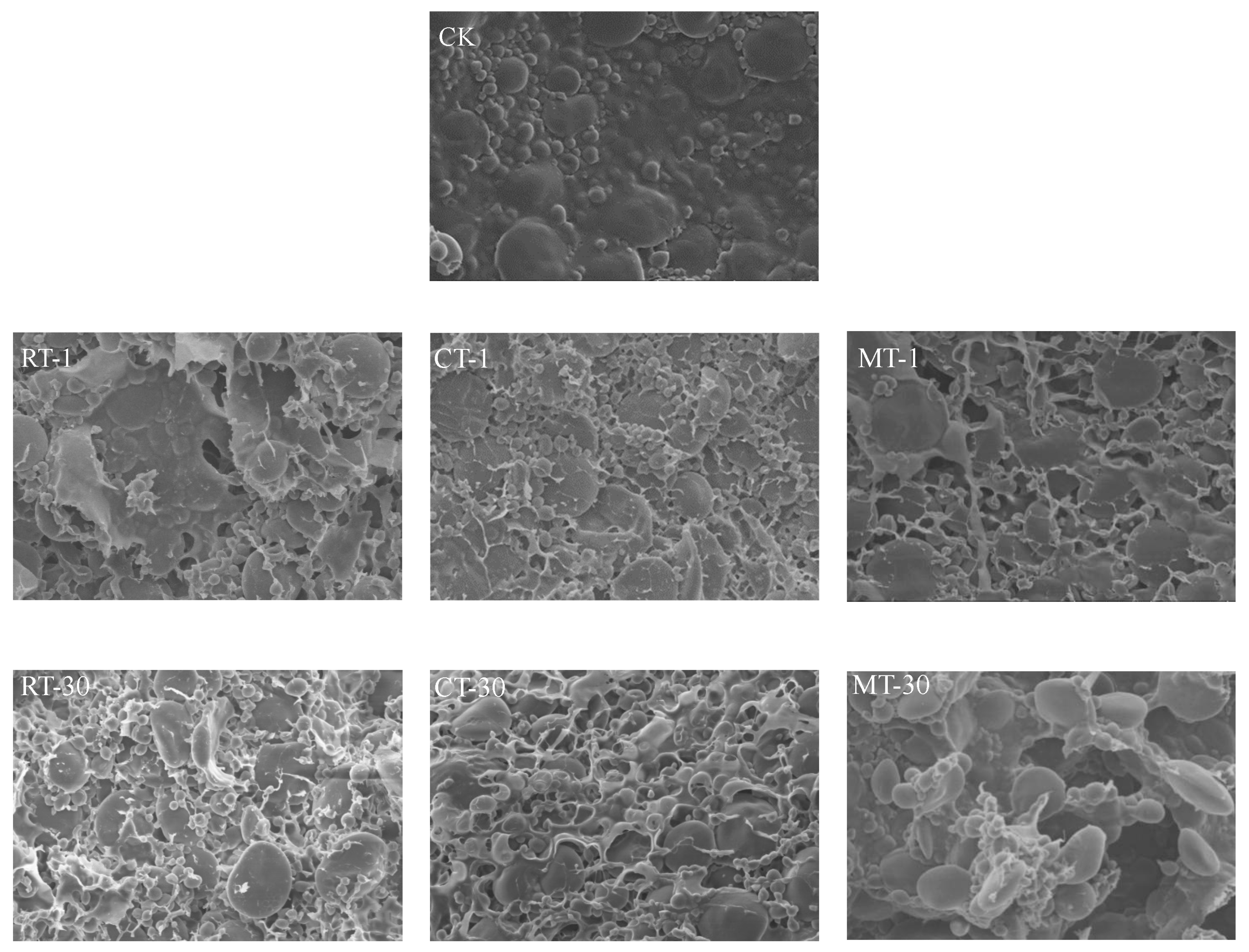
SEM images can provide information about dough’s structure from the view of the microstructure directly. Compared with the frozen dough, the fresh dough (CK) had a more flat, uniform inner surface with a denser gluten structure. Furthermore, the complete/contact starch granules were filled in the gluten network, which played a role in supporting the structure of the dough, and almost no obvious pores existed. In contrast, the inner structure of the dough changed notably. The angular voids gradually appeared in the gluten network, with part of the starch granules exposed (Figure 1). The 30-day frozen storage enlarged the pores and further deteriorated the gluten structure into pieces. Additionally, the protein structure of the 1-day frozen storage dough thawed with RT showed less structural destruction, with only some small pores, whereas the MT thawed dough was less homogeneous in structure with thinner strands and more pores. Moreover, for the dough stored for 30 days, thawing treatments had a significant impact on the inner structure and MT still resulted in maximum deterioration of the dough.
Figure 1.
The scanning electron microscope images of dough (200×).
3.4. Multi-ANOVA Analysis
To evaluate the frozen storage time, thawing treatment, and their interaction effects on the rheological properties of the frozen−thawed dough, the general linear model (GLM) combined with an analysis of variance was performed (Table 5). The mean square value was used to compute the contribution rate for all factors. The higher the mean square value, the higher the contribution rate.
Table 5.
Multi-ANOVA variance analysis of the dough’s textural and rheological properties.
Frozen storage time and thawing treatments significantly influenced almost all of rheological parameters in the current study. However, their mutual effects were only significant for z′ value, hardness, and springiness. For all of the factors, the contribution order was S > T > S × T. Therefore, frozen storage time was the main factor that contributed largely, and thawing treatments also significantly contributed to most of the factors.
3.5. Relationship between TPA Properties and Rheological Properties
Pearson’s correlation analysis was performed to obtain the relationship between rheometer parameters and the texture profile analysis (Table 6). The results showed that hardness was positively correlated with z′ value, η0, and Jv/Jmax (r = 0.89, 0.79, 0.735, respectively), while it was negatively correlated with G′, K′ value, Jmax, and Je/Jmax. In contrast, springiness was highly positively related to G′, K′ value, Jmax, and Je/Jmax. All of the parameters that are considered as indicators (springiness, G′, K′ value, G′, K′ value, Jmax and Je/Jmax) of an elastic dough with a better inner structure were positively correlated among themselves. All of these results indicate that both small viscoelastic parameters and large viscoelastic parameters played a key role in assessing the frozen dough′s rheological properties.
Table 6.
Relationship within fundamental and empirical dough rheological properties.
4. Discussion
In this study, frozen storage (S) was the dominant factor that contributed largely to all of the parameters. Previous studies have determined the variations in dough’s rheological properties during different frozen storage periods; however, it is still hard to produce a clear conclusion because of conflicting findings. For example, in this study, the hardness of frozen dough increased notably compared with the fresh one, supporting the findings of previous works [28,29]. However, the opposite results were also observed [30]. The reason for this might be related to the fact that when the type of dough was different and when the ingredients such as yeast, sugar, salt, and so on were added to dough formulations, the impact of frozen treatments on the properties of dough could be altered [3,4]. Additionally, G′ and springiness decreased significantly with increased storage time, and G′ was positively correlated with springiness, indicating a reduction in dough elasticity with the increased storage period. With increased storage time, LVRs and Jmax decreased, whereas η0 increased, suggesting a fragile structure for the 30-day frozen storage dough. The reason could be due to degradation of the gluten protein and disruption of the gluten cross-linking derived from ice crystallization and moisture redistribution. This hypothesis was also proven by the SEM results, in which the dough with a longer frozen storage time had a network structure with less continuity, more fractures, and more separation from starch granules.
The thawing treatment also had a significant impact on the rheological properties of frozen dough. Refrigerator thawing presented a more elastic and strong dough, regardless of the frozen storage period. In contrast, microwave thawing treatment presented a dough with a low stability and harder texture. The results also showed that microwave-thawed and refrigerator-thawed dough had the largest and smallest reduction in G՛ and dough, respectively. On the one hand, refrigerator-thawed dough and environment chamber-thawed dough tended to show a uniform temperature distribution, but the microwave-thawed dough did not. Probably, during rheological measurement, this non-homogenous temperature distribution could lead to less uniform dough properties. On the other hand, the dough treated with microwave thawing was more likely to form fractures on the surface than the dough treated with other thawing conditions, which may also lead to increased hardness of the dough. Some studies reported that thawing treatments caused destabilization and structural damage to proteins in foods [31], which can also be responsible for the deterioration of dough’s rheological properties. Differently, Yang et al. [8] indicated microwave thawing led to a dough with the highest G′ value. However, the reports lacked the results of the dough structural parameters. The differences may be caused by the type of dough, the selection of the thawing parameters, and the measurement methods used on both sides. In the current study, we also found that frozen storage time was the dominant factor that contributed largely to all rheological parameters, followed by thawing treatments. For that matter, the long-term frozen storage aggravated the difference in the rheological properties among the three things treatments, indicating that after long-term storage, the dough was more sensitive to be influenced by thawing conditions. As mentioned above, during the frozen storage and thawing treatment, the ice crystallization, the recrystallization, and retrogradation of starch, as well as the depolymerization of gluten and water distribution, could have a negative impact on the structure and qualities of the dough. That is why the dough stored for 30 days was more vulnerable to thawing treatments, especially for microwave thawing.
Dough is a mixed system consisting of different ingredients such as protein, starch, and lipids. All of these substances play a role in stabilizing the dough’s structure. During cooking, a series of physicochemical reactions like polymerization reactions of the gluten protein, starch gelatinization, and lipid oxidation occur, which may influence the quality of the final products. Thus, further studies should be conducted to investigate the effects of the frozen storage and thawing conditions on the properties of the final products and to reveal if the viscoelastic properties of dough systems better correlate with the final cooked products’ quality. On this basis, small deformation testing combined with large deformation testing should be considered as a tool to predict the final frozen dough product’s quality.
5. Conclusions
Compared with unfrozen fresh dough, both the frozen storage time (S) and thawing treatment (T) influenced almost all indicators significantly. Meanwhile, their mutual effects (S × T) had a significant impact on the hardness and springiness values of the dough. Frozen storage time was the dominant factor resulting in the destruction of non-fermented dough compared with thawing treatments. Moreover, the short-term frozen storage dough and the long-term frozen stored dough had different responses to thawing treatment in terms of rheological properties. The difference between the three thawing treatment groups was exacerbated after 30 days of frozen storage. Moreover, the frozen dough thawed by the refrigerator and environment chamber had the overall best results. Long-term frozen storage combined with microwave thawing seriously destroyed the rheological properties, structural stability, and inner microstructure of the dough.
Author Contributions
Conceptualization, J.Y. and B.G.; Methodology, J.Y. and B.G.; Software, J.Y.; Validation, J.Y.; Formal analysis, J.Y.; Investigation, J.Y., Y.Z., J.J., B.Z., M.L. and B.G.; Resources, J.Y. and B.G.; Data curation, J.Y. and B.G.; Writing—original draft, J.Y., Y.Z. and B.G.; Writing—review & editing, J.Y., Y.Z. and B.G.; Visualization, J.Y. and B.G.; Supervision, B.G.; Project administration, B.G.; Funding acquisition, Y.Z. and B.G. All authors have read and agreed to the published version of the manuscript.
Funding
This research was funded by the National Natural Science Foundation of China (Grant No. 31972159), the Central Public-interest Scientific Institution Basal Research Fund (No. S2022JBKY-04), and the China Agriculture Research System (CARS-03).
Data Availability Statement
Data are contained within the article.
Conflicts of Interest
The authors declare no conflict of interest.
References
- Xu, K.; Chi, C.; She, Z.; Liu, X.; Zhang, Y.; Wang, H.; Zhang, H. Understanding How Starch Constituent in Frozen Dough Following Freezing-Thawing Treatment Affected Quality of Steamed Bread. Food Chem. 2022, 366, 130614. [Google Scholar] [CrossRef] [PubMed]
- Omedi, J.O.; Huang, W.; Zhang, B.; Li, Z.; Zheng, J. Advances in Present-Day Frozen Dough Technology and Its Improver and Novel Biotech Ingredients Development Trends—A Review. Cereal Chem. 2019, 96, 34–56. [Google Scholar] [CrossRef]
- Meziani, S.; Kaci, M.; Jacquot, M.; Jasniewski, J.; Ribotta, P.; Muller, J.M.; Ghoul, M.; Desobry, S. Effect of Freezing Treatments and Yeast Amount on Sensory and Physical Properties of Sweet Bakery Products. J. Food Eng. 2012, 111, 336–342. [Google Scholar] [CrossRef]
- Kondakci, T.; Zhang, J.W.; Zhou, W. Impact of Flour Protein Content and Freezing Conditions on the Quality of Frozen Dough and Corresponding Steamed Bread. Food Bioprocess Technol. 2015, 8, 1877–1889. [Google Scholar] [CrossRef]
- Yi, J.; Kerr, W.L. Combined Effects of Freezing Rate, Storage Temperature and Time on Bread Dough and Baking Properties. Food Sci. Technol. 2009, 42, 1474–1483. [Google Scholar] [CrossRef]
- Esselink, E.F.J.; Van Aalst, H.; Maliepaard, M.; Van Duynhoven, J.P.M. Long-Term Storage Effect in Frozen Dough by Spectroscopy and Microscopy. Cereal Chem. 2003, 80, 396–403. [Google Scholar] [CrossRef]
- Yang, J.; Zhang, B.; Zhang, Y.; Rasheed, M.; Gu, S.; Guo, B. Effect of Freezing Rate and Frozen Storage on the Rheological Properties and Protein Structure of Non-Fermented Doughs. J. Food Eng. 2021, 293, 110377. [Google Scholar] [CrossRef]
- Lou, X.; Yue, C.; Luo, D.; Li, P.; Zhao, Y.; Xu, Y.; Wang, L.; Bai, Z. Effects of Natural Inulin on the Rheological, Physicochemical and Structural Properties of Frozen Dough during Frozen Storage and Its Mechanism. LWT-Food Sci. Technol. 2023, 184, 114973. [Google Scholar] [CrossRef]
- Shan, S.; Campanella, O.H. The Effects of Freeze-Thaw Cycles on the Rheological Properties of Yeasted and Non-Yeasted Frozen Bread Doughs. J. Cereal Sci. 2023, 112, 103691. [Google Scholar] [CrossRef]
- Zhang, Y.; Li, Y.; Liu, Y.; Zhang, H. Effects of Multiple Freeze—Thaw Cycles on the Quality of Frozen Dough. Cereal Sci. 2018, 95, 499–507. [Google Scholar] [CrossRef]
- Mohammadi, M.; Zoghi, A.; Azizi, M.H. Effect of Xylanase and Pentosanase Enzymes on Dough Rheological Properties and Quality of Baguette Bread. J. Food Qual. 2022, 2022, 2910821. [Google Scholar] [CrossRef]
- Chen, N.; Yang, Q.; Zhang, C.C.; Chen, H.Q. Impact of Basil Seed Gum on the Textural, Rheological Proper-ties, Water State, Gluten Depolymerization and Microstructure of Frozen Dough. J. Cereal Sci. 2023, 112, 103728. [Google Scholar] [CrossRef]
- Yang, S.; Jeong, S.; Lee, S. Elucidation of Rheological Properties and Baking Performance of Frozen Doughs under Different Thawing Conditions. J. Food Eng. 2020, 284, 110084. [Google Scholar] [CrossRef]
- Du, H.; Zheng, X.; Han, X.; Zhang, J.; Li, L.; Liu, C.; Bian, K. Effects of Freezing Conditions and Thawing Methods on the Qualities Od Emptins Frozen Dough for Steamed Bread. Cereal Feed. Ind. 2015, 5, 14–18. [Google Scholar] [CrossRef]
- Peng, B.; Li, Y.; Ding, S.; Yang, J. Characterization of Textural, Rheological, Thermal, Microstructural, and Water Mobility in Wheat Flour Dough and Bread Affected by Trehalose. Food Chem. 2017, 233, 369–377. [Google Scholar] [CrossRef] [PubMed]
- Tan, J.M.; Li, B.; Han, S.Y.; Wu, H. Use of a Compound Modifier to Retard the Quality Deterioration of Frozen Dough and Its Steamed Bread. Food Res. Int. 2023, 172, 113229. [Google Scholar] [CrossRef] [PubMed]
- Guo, W.T.; Yang, X.F.; Ji, Y.S.; Hu, B.; Li, W.G.; Zhong, X.Y.; Jiang, S.T.; Zheng, Z. Effects of Transglutaminase and Glucose Oxidase on the Properties of Frozen Dough: Water Distribution, Rheological Properties, and Microstructure. J. Cereal Sci. 2023, 111, 103689. [Google Scholar] [CrossRef]
- Bai, N.; Guo, X.N.; Xing, J.J.; Zhu, K.X. Effect of Freeze-Thaw Cycles on the Physicochemical Properties and Frying Performance of Frozen Youtiao Dough. Food Chem. 2022, 386, 132854. [Google Scholar] [CrossRef]
- Han, R.; Lin, J.; Hou, J.; Xu, X.; Bao, S.; Wei, C.; Xing, J.; Wu, Y.; Liu, J. Ultrasonic Treatment of Corn Starch to Improve the Freeze-Thaw Resistance of Frozen Model Dough and Its Application in Steamed Buns. Foods 2023, 12, 1962. [Google Scholar] [CrossRef]
- He, T.; Zhang, B.; Cai, K.; Tao, H.; Xu, X.; Wang, H. Application of Magnetic Field for Improving the Frozen Deterioration of Wheat Dough. LWT-Food Sci. Technol. 2023, 186, 115227. [Google Scholar] [CrossRef]
- Xie, X.; Li, J.; Zhu, H.; Zhang, B.; Liang, D.; Cheng, L.; Hao, M.; Guo, F. Effects of Polydextrose on Rheological and Fermentation Properties of Frozen Dough and Quality of Chinese Steamed Bread. Starch 2023, 75, 2200153. [Google Scholar] [CrossRef]
- Yang, J.; Chen, L.; Guo, B.; Zhang, B.; Zhang, Y.; Li, M. Elucidation of Rheological Properties of Frozen Non-Fermented Dough with Different Thawing Treatments: The View from Protein Structure and Water Mobility. J. Cereal Sci. 2022, 108, 103572. [Google Scholar] [CrossRef]
- Zhang, D.Q.; Mu, T.H.; Sun, H.N. Comparative Study of the Effect of Starches from Five Different Sources on the Rheological Properties of Gluten-Free Model Doughs. Carbohydrapolym 2017, 176, 345–355. [Google Scholar] [CrossRef] [PubMed]
- Weipert, D. The benefits of basic rheometry in studying dough rheology. Cereal Chem. 1990, 67, 311. [Google Scholar]
- Havet, M.; Mankai, M.; Le Bail, A. Influence of the Freezing Condition on the Baking Performances of French Frozen Dough. J. Food Eng. 2000, 45, 139–145. [Google Scholar] [CrossRef]
- Dapčević Hadnadev, T.R.; Torbica, A.M.; Hadnadev, M.S. Influence of Buckwheat Flour and Carboxymethyl Cellulose on Rheological Behaviour and Baking Performance of Gluten-Free Cookie Dough. Food Bioprocess Technol. 2013, 6, 1770–1781. [Google Scholar] [CrossRef]
- Angioloni, A.; Balestra, F.; Pinnavaia, G.G.; Rosa, M.D. Small and Large Deformation Tests for the Evaluation of Frozen Dough Viscoelastic Behaviour. J. Food Eng. 2008, 87, 527–531. [Google Scholar] [CrossRef]
- Bhattacharya, M.; Langstaff, T.M.; Berzonsky, W.A. Effect of Frozen Storage and Freeze-Thaw Cycles on the Rheological and Baking Properties of Frozen Doughs. Food Res. Int. 2003, 36, 365–372. [Google Scholar] [CrossRef]
- Gaikwad, S.; Arya, S.S. Influence of Frozen Storage on Quality of Multigrain Dough, Par Baked and Ready to Eat Thalipeeth with Additives. LWT-Food Sci. Technol. 2018, 96, 350–356. [Google Scholar] [CrossRef]
- Meziani, S.; Jasniewski, J.; Gaiani, C.; Ioannou, I.; Muller, J.M.; Ghoul, M.; Desobry, S. Effects of Freezing Treatments on Viscoelastic and Structural Behavior of Frozen Sweet Dough. J. Food Eng. 2011, 107, 358–365. [Google Scholar] [CrossRef]
- Wang, B.; Kong, B.; Li, F.; Liu, Q.; Zhang, H.; Xia, X. Changes in the Thermal Stability and Structure of Protein from Porcine Longissimus Dorsi Induced by Different Thawing Methods. Food Chem. 2020, 316, 126375. [Google Scholar] [CrossRef]
Disclaimer/Publisher’s Note: The statements, opinions and data contained in all publications are solely those of the individual author(s) and contributor(s) and not of MDPI and/or the editor(s). MDPI and/or the editor(s) disclaim responsibility for any injury to people or property resulting from any ideas, methods, instructions or products referred to in the content. |
© 2023 by the authors. Licensee MDPI, Basel, Switzerland. This article is an open access article distributed under the terms and conditions of the Creative Commons Attribution (CC BY) license (https://creativecommons.org/licenses/by/4.0/).