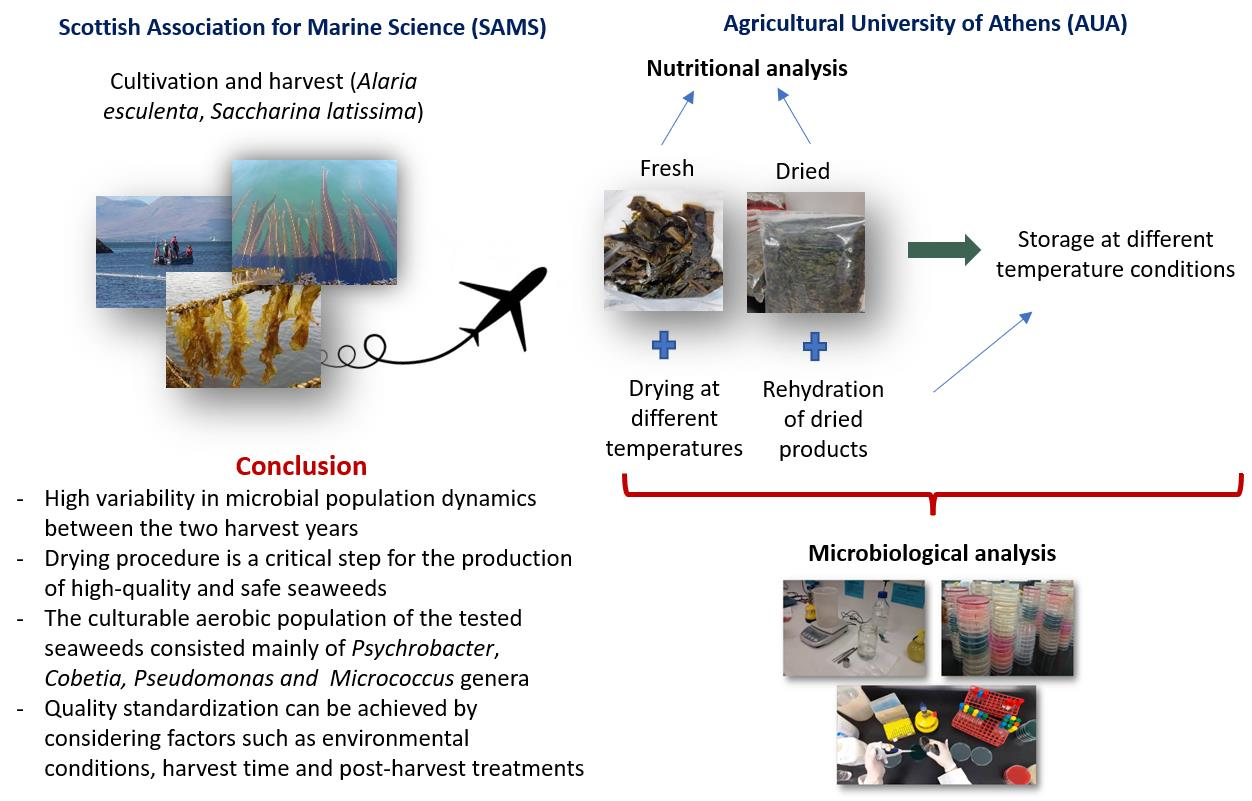
Quality and Safety Assessment of Edible Seaweeds Alaria esculenta and Saccharina latissima Cultivated in Scotland
 , , ,
, , ,  and
and Abstract
Share and Cite
Lytou, A.E.; Schoina, E.; Liu, Y.; Michalek, K.; Stanley, M.S.; Panagou, E.Z.; Nychas, G.-J.E. Quality and Safety Assessment of Edible Seaweeds Alaria esculenta and Saccharina latissima Cultivated in Scotland. Foods 2021, 10, 2210. https://doi.org/10.3390/foods10092210
Lytou AE, Schoina E, Liu Y, Michalek K, Stanley MS, Panagou EZ, Nychas G-JE. Quality and Safety Assessment of Edible Seaweeds Alaria esculenta and Saccharina latissima Cultivated in Scotland. Foods. 2021; 10(9):2210. https://doi.org/10.3390/foods10092210
Chicago/Turabian StyleLytou, Anastasia E., Eirini Schoina, Yunge Liu, Kati Michalek, Michele S. Stanley, Efstathios Z. Panagou, and George-John E. Nychas. 2021. "Quality and Safety Assessment of Edible Seaweeds Alaria esculenta and Saccharina latissima Cultivated in Scotland" Foods 10, no. 9: 2210. https://doi.org/10.3390/foods10092210
APA StyleLytou, A. E., Schoina, E., Liu, Y., Michalek, K., Stanley, M. S., Panagou, E. Z., & Nychas, G.-J. E. (2021). Quality and Safety Assessment of Edible Seaweeds Alaria esculenta and Saccharina latissima Cultivated in Scotland. Foods, 10(9), 2210. https://doi.org/10.3390/foods10092210