


Effect of Processing on Fish Protein Antigenicity and Allergenicity


Abstract
1. Introduction
2. Immunogenicity, Antigenicity, and Allergenicity
3. Fish Allergy and Allergens
3.1. Fish Allergy Prevalence

| Target | Method | Prevalence (%) | Comment | Reference |
|---|---|---|---|---|
| 5529 households | Telephone survey | 0.4 | Adults have a higher prevalence than children Females have a higher prevalence than males | [62] |
| 574 adults (>18 yr) | Telephone survey | 0.8 | [63] | |
| 38,480 U.S. children | Telephone survey | 0.5 | [6] | |
| 20,686 U.S. participants | Self-report survey | 0.45 | Adults have a higher prevalence than children | [14] |
| 7218 U.S. households (>18 yr) | Telephone survey | 0.9 | Finfish allergy is likely to be developed in adulthood | [13] |
| 11,434 children in the Philippines (14–16 yr) | Questionnaire survey | 2.9 | Females have a higher prevalence than males | [64] |
| 6498 children in Singapore (14–16 yr) | Questionnaire survey | 0.26 | Females have a higher prevalence than males | |
| 2304 children in Bangkok (14–16 yr) | Questionnaire survey | 0.29 | Females have a higher prevalence than males | |
| 9667 individuals in Canada | Telephone survey | 0.61 | Cod and salmon are most reported allergenic species | [65] |
| 3500 children in Turkey (6–9 yr) | Questionnaire | 3.5 | [66] | |
| Skin prick test | 5.6 | |||
| DBPCFC † | 4.5 | Only one child was positive in the DBPCFC | ||
| 9184 children in low-income clinic (0–21 yr) | Medical records | 0.4 | Fish is the second species group that easily causes anaphylaxis | [67] |
| 30,018 individuals in Taiwan, China | Questionnaire | 19 | Mostly occurred in children between 4-18 yr | [68] |
| 430 children in Poland with asthma | DBPCFC | 0.3 | The prevalence of fish allergy in Poland was relatively low | [69] |
| 22 Chinese patients with fish allergy | DBPCFC | 71.4 | 17.8% of patients were allergic to both carp and salmon | [70] |
3.2. Fish Allergens
4. Effect of Processing on Fish Allergens
| Food Processing Technique | Property | Impact on Fishery Products | Reference |
|---|---|---|---|
| Cooking | Different strategies such as boiling, steaming, microwaving, baking, roasting, frying, and grilling are applied | Improve taste and flavor; affect texture and nutrition value; induce protein denaturation | [27] |
| Canning | Add food in jars and process in a pressure canner | Extend shelf life; induce flavor, texture, and nutrition loss | [27] |
| Hot smoking | Apply the smoke from burning materials such as wood at a temperature around 70–80 °C | Reduce moisture and microorganisms; impart desirable flavor | [95] |
| Drying | Remove water or other solvents by evaporation | Reduce moisture and microorganisms; induce protein denaturation; alter fish texture and color | [96] |
| Fermenting | Apply microorganisms to convert carbohydrates into different products | Extend shelf life; impart organoleptic and nutritional characteristics | [97] |
| Salting | Apply dry edible salt | Reduce moisture and microorganisms; induce lipid and protein degradation; alter fish texture and color | [98] |
| Cold smoking | Smoking of the product up to 33 °C | Less efficient in microbial reduction; alter texture, color, and flavor | [95] |
| High-pressure processing | Apply pressure between 200–800 MPa at a mild temperature of 5 to 35 °C | Inactivate microorganisms; induce protein denaturation; increase lipid oxidation; decrease water-holding capacity | [99,100,101] |
| Ultrasound | Apply an ultrasound frequency from 20 kHz to 10 MHz | Reduce microbials; affect color | [102,103] |
| Pulsed light | Apply short duration, high-peak power pulsed light of wide spectra (100–1100 nm) | Reduce microbials; affect color and texture; reduce lipid oxidation | [104,105] |
| Pulsed electric fields | Induce electroporation phenomena between two electrodes, leading to a non-invasive tissue structure modification | Improve water-holding capacity; tenderize texture; extraction of fishery by-products | [106] |
| Cold plasma | Apply energetic, reactive gases such as argon, helium | Reduce microbials; alter moisture content and lipid oxidation | [107,108] |
| Ozone | Works as a powerful oxidant and does not leave residues in foods | Reduce microbials; extend shelf life | [109] |
| Fish Matrix | Processing Method | Method | Antibody | Major Results | Explanation | Reference |
|---|---|---|---|---|---|---|
| Pacific mackerel protein extracts | 60, 80, 100, 120, 140 °C for 5, 10, 15, 20, 25, 30 min | Western blot | mAb PARV-19 | Parvalbumin band decreased as a function of heating temperature and time | The reduction was caused by heat-induced conformational change due to the release of calcium | [30] |
| Indirect non-competitive ELISA | Human IgE | IgE reactivity decreased as a function of heating temperature and time; a complete loss of IgE reactivity at 140 °C | ||||
| Hilsa, pomfret, bhetki, and mackerel | 90 °C for 10 min | Indirect non-competitive ELISA | Human IgE | A decrease in IgE reactivity was observed in pomfret, hilsa, and mackerel while an increase in IgE reactivity was seen in bhetki | Boiling removed many polypeptide bands | [110] |
| Skin prick test | Patients exhibited different reactions to boiled fish | |||||
| Fry with mustard oil for 5 min | Indirect non-competitive ELISA | Human IgE | A decrease in IgE reactivity was observed in pomfret, hilsa, and mackerel while an increase in IgE reactivity was seen in bhetki | Frying removed many polypeptide bands and caused protein denaturation to form high molecular weight proteins | ||
| Skin prick test | Patients exhibited different reactions to boiled fish | |||||
| Snapper, silver bream, yellowtail kingfish, barramundi, bluefin tuna, slimy mackerel, orange roughy, tiger flathead, Atlantic salmon, rainbow trout, carp, pilchard, rock ling, Atlantic cod, | 95 °C for 15 min | Western blot | mAb PARV-19 | Parvalbumin from heated fish was still immunodetectable. Especially for yellowfin tuna, a stronger and more intense parvalbumin band was observed compared to unheated extracts | Heat processing affected antibody–antigen interaction differently for each species | [111] |
| gummy shark, sparsely spotted stingaree, blacktip shark, and elephant shark | 95 °C for 15 min | Western blot | mAb PARV-19 | Except for elephant shark, immunoreactive parvalbumin was not visible | ||
| Purified cod parvalbumin | 80 °C for 30 min | Indirect non-competitive ELISA | Human IgE | IgE binding was not affected | Heat-induced secondary structure and calcium-binding ability changes were not enough to reduce antigenicity | [112] |
| 80 °C, 300 MPa for 30 min | IgE binding was not affected | |||||
| Bhetki and mackerel fish extracts | 90 °C, 10 min then pepsin digested | Indirect non-competitive ELISA | No significant difference in IgE level was observed | [113] | ||
| Western blot | Additional immunoreactive protein bands were observed | Thermal processing generated new allergenic epitopes that were pepsin stable | ||||
| Fry in mustard oil for 5 min then pepsin digested | Western blot | Increased IgE binding proteins were observed | Structural changes may offer some protection from enzymatic digestion | |||
| Surimi | 100 °C for 10, 15, and 20 min | Indirect non-competitive ELISA and indirect competitive ELISA | Anti-fish tropomyosin mAb | IgG binding decreased after 10 min and remained constant for 15 and 20 min | High temperature and long processing time decreased extractable protein concentration, destroyed epitopes, and affected antibody–antigen interaction | [114] |
| Steam at 100 °C for 10, 15, and 20 min | IgG binding decreased after 10 min and remained constant for 15 and 20 min | |||||
| Bake at 149 °C for 10, 20, and 30 min | IgG binding decreased as a function of baking temperature | |||||
| Microwave on high power for 0.5, 1, and 1.5 min | IgG binding decreased as a function of microwaving temperature | |||||
| Fry in canola oil for 0.5, 1, and 1.5 min | IgG binding decreased after 10 min and remained constant for 15 and 20 min | |||||
| Purified cod parvalbumin | Glycation with D-glucose (60 °C for 5 h) and in vitro digestion | SDS-PAGE | All parvalbumin was digested after 30 min | Reduced aggregation during processing allowed a better protein degradation by pepsin | [115] | |
| Fish protein hydrolysates | Glycation with ribose at 121 °C for 30, 60, and 90 min | Histamine release using RBL-2H3 cells | Histamine release in RBL-2H3 cells was reduced | Glycated fish protein hydrolysates reduced NO synthesis | [116] | |
| Purified great snakehead parvalbumin | 90 °C for 1, 2, 3 h | SDS-PAGE | The parvalbumin band intensity decreased as a function of heating time but was visible after 3 h heating | Parvalbumin maintained its typical structural properties after experiencing extensive thermal stroke | [117] | |
| Purified sardine parvalbumin | 70, 80, and 90 °C for 30, 60, and 120 min | Indirect non-competitive ELISA and dot blot | Rabbit anti-parvalbumin antibody | IgG binding to parvalbumin diminished 65% after 90 °C heating for 30 min | Heating was responsible for the reduction of antibody binding to purified sardine parvalbumin | [93] |
| Human IgE | 90% of patients showed reduced IgE binding, while 10% patients showed increased IgE binding | |||||
| Monkfish, Atlantic salmon, trout, pink ling, jewfish, pumpkin head trevally, swordfish, northern sand flathead, red gurnard, tiger flathead, and mosaic leatherjacket | 100 °C for 45 min | Western blot | Anti-carp mAb Anti-cod mAb | Reduced IgG binding | [118] | |
| Pilchard, cod, dory, bright redfish, sea mullet, pink ling, barramundi, blue threadfin, cobia, crimson snapper, flame snapper, grunter bream, jewfish, pink snapper, pumpkin head trevally, sweetlip emperor, saddletail snapper, striped snapper, yellowfin bream, yellowtail scad, northern sand flathead, and red gurnard | 100 °C for 45 min | Western blot | Anti-carp mAb Anti-cod mAb | Consistent IgG binding as the raw protein extracts | ||
| Coral trout, eastern school whiting, grass emperor, sand whiting, Spanish mackerel, yellowfin tuna, and tiger flathead | 100 °C for 45 min | Western blot | Anti-carp mAb Anti-cod mAb | Increased IgG binding | ||
| Purified sardine parvalbumin | 90 °C for 1 h then pepsin digested for 30, 60, 120 min at pH 2, 37 °C | Indirect non-competitive ELISA and dot blot | Rabbit anti-parvalbumin antibody | Decreased IgG binding | Pepsin hydrolysis decreased the binding of IgG | |
| Human IgE | All IgE-binding capacity was eliminated completely | |||||
| Whiting protein extracts | Soak in vinegar for 30 min and then heat at 100 °C for 5 min | Indirect non-competitive ELISA and Western blot | Anti-fish tropomyosin mAb | IgG-binding capacity decreased significantly regardless of different types of vinegar | Acidic pH changed the immunoreactivity and detectability of whiting | [119] |
| Whiting, cod, and red grouper protein extracts | Soak in vinegar for different periods (<1 min, 15 min, 30 min, and 60 min) and then heat at 100 °C for 5 min | Indirect non-competitive ELISA and Western blot | Anti-fish tropomyosin mAb | Whiting: IgG immunoreactivity decreased significantly after 15 min treatment; cod and grouper: IgG immunoreactivity decreased significantly even within 1 min treatment | Acid pH either altered tropomyosin conformation or lowered its solubility | |
| Whiting, cod, and red grouper protein extracts | 100 °C for 5, 15, 30, and 60 min | Western blot | Human IgE | Prolonged vinegar cooking time significantly reduced the IgE immunoreactivity | Acid pH-induced protein denaturation | |
| Cod protein extracts | In vitro digestion at pH 1.25–5 | Western blot | Human IgE | When pH ≤ 2.5, all proteins lost IgE-binding capability within 1 min; when 2.5 < pH ≤ 5, IgE immunoreactivity was still observed after 1 h digestion | Gastric pH could digest and degrade cod proteins. Those patients with abnormal gastric pH may be exposed to an increased allergenicity | [120] |
| RAST inhibition | Human IgE | Digested cod proteins inhibited IgE binding as a function of time | ||||
| Histamine release assay | Histamine release was only observed at high concentration of digests | |||||
| Whiff protein extracts | 100 °C for 10 min | Western blot | Human IgE | More IgE-reactive bands were observed | [88] | |
| Whiff protein extracts | 100 °C for 10 min and then in vitro gastric digestion | Western blot | Human IgE | IgE bound to fragmented proteins even after 120 min; IgE binding to 24 kDa, 34 kDa, and 130 kDa proteins was weakened | Heating-induced protein degradation | |
| Purified whiff parvalbumin | 100 °C for 10 min and then in vitro gastric digestion | Western blot | Human IgE | Immunoreactive parvalbumin monomer disappeared after 5 s digestion while its dimer was visible after 120 min | Heating generated dimers that were partially stable towards gastric digestion | |
| Purified Alaska pollock parvalbumin | Glycation with glucose, fructose, ribose, lactose, and galactose at 60 °C, 65% for 1 h | Indirect competitive ELISA | Rabbit antisera | Glycation with glucose and fructose enhanced both IgG and IgE binding, while glycation with ribose, lactose, and galactose decreased both IgG and IgE binding | Glycation changed protein conformation, which affected the specific recognition of antigen and antibody | [121] |
| Human IgE | ||||||
| Glass carp purified parvalbumin | Glycation with maltose | Indirect competitive ELISA | Rabbit anti-PV sera | Reduced IgG binding | Heat treatment was the major cause for decreased immunoreactivity | [36] |
| Human IgE | Suppressed IgE binding | Heat treatment and Maillard reaction led to the structural change of parvalbumin | ||||
| Recombinant silver cap parvalbumin | Glycation with glucose at 60 °C for 72 h | Dot blot | Human IgE | Decreased IgE binding | Glycation sites were partially located at IgE-binding epitopes | [122] |
| Rat basophilic leukemia assay | Reduced histamine release and secretion of IL-4 and TNF-α. | |||||
| Tuna | Canning | Double-blind placebo-controlled food challenge | All patients did not show sensitization and adverse reaction after consumption | Canning led to the formation of a homogenous mixture of different molecular weight fragments | [123] | |
| Immunoblot and indirect competitive ELISA | Human IgE | All sera showed minimal to absent IgE binding | ||||
| Salmon | Canning | Double-blind placebo-controlled food challenge | All patients did not show an adverse reaction after consumption | Canning led to a remarkable loss of definable protein bands on SDS-PAGE | ||
| Immunoblot and indirect competitive ELISA | Human IgE | Minimal IgE binding | ||||
| Haddock and rainbow trout | Hot smoking at 80–100 °C | Indirect competitive ELISA | Human IgE | 83.3% of patients showed increased IgE binding | Novel bands at around 65 kDa were observed on SDS-PAGE | [38] |
| Tuna | Canning at high temperature (116–121 °C) and pressure for up to 14 h | Indirect competitive ELISA | Human IgE | All patients showed decreased IgE binding | No parvalbumin band was visible on the SDS-PAGE | |
| Atlantic cod | Drying | Indirect competitive ELISA | Human IgE | All patients showed increased IgE binding | Several novel bands from 70 to > 188 kDa were observed on SDS-PAGE | [38] |
| Atlantic cod | Dried cod soaked in a pH 11–12 lye solution and subsequently in cold water | Indirect competitive ELISA | Human IgE | All patients showed reduced IgE binding | Parvalbumin band intensity on SDS-PAGE was reduced 48% | |
| Atlantic cod | Cod dried after salting | Indirect competitive ELISA | Human IgE | 58.3% of patients showed decreased IgE binding, while 33.3% patients showed increased IgE binding | Several novel bands from 70 to > 188 kDa were observed on SDS-PAGE | |
| Atlantic salmon | Cured in a mixture of sugar, spices, and salt | Indirect competitive ELISA | Human IgE | 80% of patients showed reduced IgE binding, while 20% of patients showed 65 times more IgE binding | Parvalbumin band intensity on SDS-PAGE was reduced by 34% | |
| Atlantic salmon | Cold smoking at 20–30 °C after being cured for a day | Indirect competitive ELISA | Human IgE | 80% of patients showed increased IgE binding | Novel bands at around 30 kDa were observed on SDS-PAGE | |
| Rainbow trout | Salted trout undergoes controlled enzymatic fermentation | Indirect competitive ELISA | Human IgE | 81.8% of patients showed decreased IgE binding, while 18.2% patients showed 30 times more IgE binding | Parvalbumin band intensity on SDS-PAGE was reduced by 40% | |
| Herring | Pickled herrings are prepared in an acetic acid–salt brine | Indirect competitive ELISA | Human IgE | 87.5% of patients showed decreased IgE binding | Few bands < 62 kDa were observed, and parvalbumin band intensity decreased on SDS-PAGE | |
| Salmon | Hydrolysis | Indirect competitive ELISA | Human IgE | Three patients showed more IgE binding | Absence of discernible bands and weak bands up to around 50 kDa | |
| Blue whiting | Hydrolysis | Indirect competitive ELISA | Human IgE | Two patients showed decreased IgE binding, while one patient showed more IgE binding | Absence of discernible bands and weak bands up to around 50 kDa | |
| Carp, catfish, chub mackerel, sardine, chinook salmon, albacore tuna, and mahi-mahi | Stored at −20 °C | Indirect non-competitive ELISA | IgG | A decrease in parvalbumin immunoreactivity was observed after 112-day storage, but parvalbumin was still considered stable at frozen stages | Less freeze-induced protein denaturation was observed in intact muscle. Frozen storage mainly altered myofibrillar proteins instead of sarcoplasmic proteins | [124] |
| Food-grade cod gelatin | Histamine release assay | 10% of patients showed histamine release | ||||
| Skin prick test | 23.3% of patients showed positive results | |||||
| Double-blind placebo-controlled food challenge | None of the patients showed allergic symptoms to 3.61 g fish gelatin | [125] | ||||
| Yellowfin tuna gelatin | Western blot | Human IgE | 3% of patients showed IgE binding | The manufacturing process eliminated the fish allergens | [32] | |
| Double-blind placebo-controlled food challenge | None of the patients showed allergic symptoms to 5 g fish gelatin |
5. Conclusions
Author Contributions
Funding
Institutional Review Board Statement
Informed Consent Statement
Data Availability Statement
Conflicts of Interest
References
- Johansson, S.; Bieber, T.; Dahl, R.; Friedmann, P.S.; Lanier, B.Q.; Lockey, R.F.; Motala, C.; Martell, J.A.O.; Platts-Mills, T.A.; Ring, J. Revised nomenclature for allergy for global use: Report of the Nomenclature Review Committee of the World Allergy Organization, October 2003. J. Allergy Clin. Immunol. 2004, 113, 832–836. [Google Scholar] [CrossRef]
- Stone, K.D.; Prussin, C.; Metcalfe, D.D. IgE, mast cells, basophils, and eosinophils. J. Allergy Clin. Immunol. 2010, 125, S73–S80. [Google Scholar] [CrossRef]
- Yu, W.; Freeland, D.M.H.; Nadeau, K.C. Food allergy: Immune mechanisms, diagnosis and immunotherapy. Nat. Rev. Immunol. 2016, 16, 751–765. [Google Scholar] [CrossRef]
- Raposo, A.; Perez, E.; Faria, C.T.D.; Carrascosa, C. Allergen management as a key issue in food safety. In Food Safety and Protection; Rai, V.R., Bai, J.A., Eds.; CRC Press Taylor & Francis Group: Boca Raton, FL, USA, 2017; pp. 157–195. [Google Scholar]
- Alessandro, F.; Fierro, V. World Allergy Organization: Food Allergy. Available online: https://www.worldallergy.org/education-and-programs/education/allergic-disease-resource-center/professionals/food-allergy#:~:text=Food%20allergy%20is%20described%20as,from%201%25%20to%2010%25 (accessed on 16 April 2021).
- Gupta, R.S.; Springston, E.E.; Warrier, M.R.; Smith, B.; Kumar, R.; Pongracic, J.; Holl, J.L. The Prevalence, Severity, and Distribution of Childhood Food Allergy in the United States. Pediatrics 2011, 128, e9–e17. [Google Scholar] [CrossRef] [PubMed]
- Maslova, E.; Granström, C.; Hansen, S.; Petersen, S.B.; Strøm, M.; Willett, W.C.; Olsen, S.F. Peanut and tree nut consumption during pregnancy and allergic disease in children—Should mothers decrease their intake? Longitudinal evidence from the Danish National Birth Cohort. J. Allergy Clin. Immunol. 2012, 130, 724–732. [Google Scholar] [CrossRef] [PubMed]
- Jensen, M.P.; Meldrum, S.; Taylor, A.L.; Dunstan, J.A.; Prescott, S.L. Early probiotic supplementation for allergy prevention: Long-term outcomes. J. Allergy Clin. Immunol. 2012, 130, 1209–1211.e5. [Google Scholar] [CrossRef] [PubMed]
- Vassallo, M.F.; Camargo, C.A. Potential mechanisms for the hypothesized link between sunshine, vitamin D, and food allergy in children. J. Allergy Clin. Immunol. 2010, 126, 217–222. [Google Scholar] [CrossRef] [PubMed]
- USFDA. FDA Approves First Drug for Treatment of Peanut Allergy for Children. Available online: https://www.fda.gov/news-events/press-announcements/fda-approves-first-drug-treatment-peanut-allergy-children (accessed on 16 April 2021).
- El-Ghoneimy, D.; Lamia, D.; Cesar, G.; Sakura, S. World Allergy Organization Food Allergy Information Sheet. Available online: https://www.worldallergy.org/UserFiles/file/WAO-2019-Food-Allergy-Information-Sheet.pdf (accessed on 16 April 2021).
- Rona, R.J.; Keil, T.; Summers, C.; Gislason, D.; Zuidmeer, L.; Sodergren, E.; Sigurdardottir, S.T.; Lindner, T.; Goldhahn, K.; Dahlstrom, J.; et al. The prevalence of food allergy: A meta-analysis. J. Allergy Clin. Immunol. 2007, 120, 638–646. [Google Scholar] [CrossRef] [PubMed]
- Gupta, R.S.; Warren, C.M.; Smith, B.M.; Jiang, J.; Blumenstock, J.A.; Davis, M.M.; Schleimer, R.P.; Nadeau, K.C. Prevalence and Severity of Food Allergies Among US Adults. JAMA Netw. Open 2019, 2, e185630. [Google Scholar] [CrossRef]
- McGowan, E.C.; Keet, C.A. Prevalence of self-reported food allergy in the National Health and Nutrition Examination Survey (NHANES) 2007–2010. J. Allergy Clin. Immunol. 2013, 132, 1216–1219.e5. [Google Scholar] [CrossRef]
- Tang, M.L.K.; Mullins, R.J. Food allergy: Is prevalence increasing? Intern. Med. J. 2017, 47, 256–261. [Google Scholar] [CrossRef]
- WHO/IUIS Allergen Nomenclature Sub-Committee. Allergen Nomenclature. Available online: http://www.allergen.org/index.php (accessed on 16 April 2021).
- Ruethers, T.; Raith, M.; Sharp, M.F.; Koeberl, M.; Stephen, J.N.; Nugraha, R.; Le, T.T.K.; Quirce, S.; Nguyen, H.X.M.; Kamath, S.D.; et al. Characterization of Ras k 1 a novel major allergen in Indian mackerel and identification of parvalbumin as the major fish allergen in 33 Asia-Pacific fish species. Clin. Exp. Allergy 2017, 48, 452–463. [Google Scholar] [CrossRef] [PubMed]
- Ruethers, T.; Taki, A.C.; Karnaneedi, S.; Nie, S.; Kalic, T.; Dai, D.; Daduang, S.; Leeming, M.; Williamson, N.A.; Breiteneder, H.; et al. Expanding the allergen repertoire of salmon and catfish. Allergy 2020, 1–11. [Google Scholar] [CrossRef]
- Untersmayr, E.; Szalai, K.; Riemer, A.B.; Hemmer, W.; Swoboda, I.; Hantusch, B.; Schöll, I.; Spitzauer, S.; Scheiner, O.; Jarisch, R.; et al. Mimotopes identify conformational epitopes on parvalbumin, the major fish allergen. Mol. Immunol. 2006, 43, 1454–1461. [Google Scholar] [CrossRef] [PubMed]
- Elsayed, S.; Apold, J. Immunochemical Analysis of Cod Fish Allergen M: Locations of the Immunoglobulin Binding Sites as Demonstrated by the Native and Synthetic Peptides. Allergy 1983, 38, 449–459. [Google Scholar] [CrossRef]
- Perez-Gordo, M.; Pastor-Vargas, C.; Lin, J.; Bardina, L.; Cases, B.; Ibáñez, M.D.; Vivanco, F.; Cuesta-Herranz, J.; Sampson, H.A. Epitope mapping of the major allergen from Atlantic cod in Spanish population reveals different IgE-binding patterns. Mol. Nutr. Food Res. 2013, 57, 1283–1290. [Google Scholar] [CrossRef] [PubMed]
- Yoshida, S.; Ichimura, A.; Shiomi, K. Elucidation of a major IgE epitope of Pacific mackerel parvalbumin. Food Chem. 2008, 111, 857–861. [Google Scholar] [CrossRef]
- Keshavarz, B.; Jiang, X.; Hsieh, Y.-H.P.; Rao, Q. Matrix effect on food allergen detection—A case study of fish parvalbumin. Food Chem. 2019, 274, 526–534. [Google Scholar] [CrossRef] [PubMed]
- Sharp, M.F.; Taki, A.C.; Ruethers, T.; Stephen, J.N.; Daly, N.L.; Lopata, A.L.; Kamath, S.D. IgE and IgG4 epitopes revealed on the major fish allergen Lat c 1. Mol. Immunol. 2021, 131, 155–163. [Google Scholar] [CrossRef]
- Ruethers, T.; Kamath, S.; Taki, A.; Le, T.; Karnaneedi, S.; Nugraha, R.; Cao, T.; Nie, S.; Williamson, N.; Mehr, S.; et al. Tropomyosin Is A Novel Major Fish Allergen Of Unrecognized Importance. J. Allergy Clin. Immunol. 2020, 145, AB226. [Google Scholar] [CrossRef]
- Kalic, T.; Kamath, S.D.; Ruethers, T.; Taki, A.C.; Nugraha, R.; Le, T.T.; Humeniuk, P.; Williamson, N.A.; Hira, D.; Rolland, J.M.; et al. Collagen—An Important Fish Allergen for Improved Diagnosis. J. Allergy Clin. Immunol. Pract. 2020, 8, 3084–3092.e10. [Google Scholar] [CrossRef] [PubMed]
- Abraha, B.; Admassu, H.; Mahmud, A.; Tsighe, N.; Shui, X.W.; Fang, Y. Effect of processing methods on nutritional and physico-chemical composition of fish: A review. MOJ Food Process. Technol. 2018, 6, 1. [Google Scholar] [CrossRef]
- Wisuthiphaet, N.; Kongruang, S.; Chamcheun, C. Production of Fish Protein Hydrolysates by Acid and Enzymatic Hydrolysis. J. Med. Bioeng. 2015, 4, 466–470. [Google Scholar] [CrossRef]
- De Jongh, H.H.J.; Robles, C.L.; Timmerman, E.; Nordlee, J.A.; Lee, P.-W.; Baumert, J.L.; Hamilton, R.G.; Taylor, S.L.; Koppelman, S.J. Digestibility and IgE-Binding of Glycosylated Codfish Parvalbumin. BioMed Res. Int. 2013, 2013, 1–10. [Google Scholar] [CrossRef]
- Kubota, H.; Kobayashi, A.; Kobayashi, Y.; Shiomi, K.; Hamada-Sato, N. Reduction in IgE reactivity of Pacific mackerel parvalbumin by heat treatment. Food Chem. 2016, 206, 78–84. [Google Scholar] [CrossRef]
- Kobayashi, Y.; Kuriyama, T.; Nakagawara, R.; Aihara, M.; Hamada-Sato, N. Allergy to fish collagen: Thermostability of collagen and IgE reactivity of patients’ sera with extracts of 11 species of bony and cartilaginous fish. Allergol. Int. 2016, 65, 450–458. [Google Scholar] [CrossRef]
- André, F.; Cavagna, S.; André, C. Gelatin Prepared from Tuna Skin: A Risk Factor for Fish Allergy or Sensitization? Int. Arch. Allergy Immunol. 2003, 130, 17–24. [Google Scholar] [CrossRef] [PubMed]
- Punt, J.; Stranford, S.A.; Jones, P.P.; Owen, J.A. Kuby Immunology; W. H. Freeman and Company: New York, NY, USA, 2007. [Google Scholar]
- Parenti, M.D.; Santoro, A.; Del Rio, A.; Franceschi, C. Literature review in support of adjuvanticity/immunogenicity assessment of proteins. EFSA Support. Publ. 2019, 16, 1551. [Google Scholar] [CrossRef]
- Faisal, M.; Vasiljevic, T.; Donkor, O.N. Effects of selected processing treatments on antigenicity of banana prawn (Fenneropenaeus merguiensis) tropomyosin. Int. J. Food Sci. Technol. 2018, 54, 183–193. [Google Scholar] [CrossRef]
- Li, Z.; Jiang, M.; You, J.; Luo, Y.; Feng, L. Impact of Maillard reaction conditions on the antigenicity of parvalbumin, the major allergen in grass carp. Food Agric. Immunol. 2013, 25, 486–497. [Google Scholar] [CrossRef]
- Song, Y.-S.; Frias, J.; Martinez-Villaluenga, C.; Vidal-Valdeverde, C.; de Mejia, E.G. Immunoreactivity reduction of soybean meal by fermentation, effect on amino acid composition and antigenicity of commercial soy products. Food Chem. 2008, 108, 571–581. [Google Scholar] [CrossRef] [PubMed]
- Sletten, G.; Van Do, T.; Lindvik, H.; Egaas, E.; Florvaag, E. Effects of Industrial Processing on the Immunogenicity of Commonly Ingested Fish Species. Int. Arch. Allergy Immunol. 2010, 151, 223–236. [Google Scholar] [CrossRef]
- Teodorowicz, M.; Van Neerven, J.; Savelkoul, H. Food Processing: The Influence of the Maillard Reaction on Immunogenicity and Allergenicity of Food Proteins. Nutrients 2017, 9, 835. [Google Scholar] [CrossRef]
- Ilchmann, A.; Burgdorf, S.; Scheurer, S.; Waibler, Z.; Nagai, R.; Wellner, A.; Yamamoto, Y.; Yamamoto, H.; Henle, T.; Kurts, C.; et al. Glycation of a food allergen by the Maillard reaction enhances its T-cell immunogenicity: Role of macrophage scavenger receptor class A type I and II. J. Allergy Clin. Immunol. 2010, 125, 175–183.e11. [Google Scholar] [CrossRef]
- Abramovitch, J.B.; Lopata, A.L.; O’Hehir, R.E.; Rolland, J.M. Effect of thermal processing on T cell reactivity of shellfish allergens—Discordance with IgE reactivity. PLoS ONE 2017, 12, e0173549. [Google Scholar] [CrossRef] [PubMed]
- Waserman, S.; Watson, W. Food allergy. Allergy Asthma Clin. Immunol. 2011, 7, S7. [Google Scholar] [CrossRef]
- Deifl, S.; Bohle, B. Factors influencing the allergenicity and adjuvanticity of allergens. Immunotherapy 2011, 3, 881–893. [Google Scholar] [CrossRef] [PubMed]
- Mari, A. When does a protein become an allergen? Searching for a dynamic definition based on most advanced technology tools. Clin. Exp. Allergy 2008, 38, 1089–1094. [Google Scholar] [CrossRef]
- Zhang, J.; Tao, A. Antigenicity, Immunogenicity, Allergenicity. Transl. Bioinform. 2015, 8, 175–186. [Google Scholar] [CrossRef]
- WHO/IUIS Allergen Nomenclature Sub-Committee. New Allergen Submission Form. Available online: http://www.allergen.org/submission.php (accessed on 16 April 2021).
- CDC. Laboratory Procedure Manual: Specific IgE/total IgE. Available online: https://www.cdc.gov/nchs/data/nhanes/nhanes_05_06/al_ige_d_met_specific_ige_total_ige.pdf (accessed on 16 April 2021).
- Santos, A.F.; Lack, G. Basophil activation test: Food challenge in a test tube or specialist research tool? Clin. Transl. Allergy 2016, 6, 1–9. [Google Scholar] [CrossRef]
- Fæste, C.K.; Namork, E.; Lindvik, H. Allergenicity and antigenicity of fenugreek (Trigonella foenum-graecum) proteins in foods. J. Allergy Clin. Immunol. 2009, 123, 187–194. [Google Scholar] [CrossRef]
- Wild, L.G.; Lehrer, S.B. Fish and shellfish allergy. Curr. Allergy Asthma Rep. 2005, 5, 74–79. [Google Scholar] [CrossRef]
- Sharp, M.F.; Lopata, A.L. Fish Allergy: In Review. Clin. Rev. Allergy Immunol. 2013, 46, 258–271. [Google Scholar] [CrossRef] [PubMed]
- Sicherer, S.H.; Sampson, H.A. Food allergy. J. Allergy Clin. Immunol. 2010, 125, S116–S125. [Google Scholar] [CrossRef]
- Helbling, A.; Haydel, R.; McCants, M.L.; Musmand, J.J.; El-Dahr, J.; Lehrer, S.B. Fish allergy: Is cross-reactivity among fish species relevant? Double-blind placebo-controlled food challenge studies of fish allergic adults. Ann. Allergy Asthma Immunol. 1999, 83, 517–523. [Google Scholar] [CrossRef]
- Borrego, J.T.; Cuevas, J.M.; García, J.T. Reactividad cruzada entre pescados y mariscos. Allergol. Immunopathol. 2003, 31, 146–151. [Google Scholar] [CrossRef]
- Kuehn, A.; Codreanu-Morel, F.; Lehners-Weber, C.; Doyen, V.; Gomez-André, S.-A.; Bienvenu, F.; Fischer, J.; Ballardini, N.; Van Hage, M.; Perotin, J.-M.; et al. Cross-reactivity to fish and chicken meat—A new clinical syndrome. Allergy 2016, 71, 1772–1781. [Google Scholar] [CrossRef] [PubMed]
- Hilger, C.; Thill, L.; Grigioni, F.; Lehners, C.; Falagiani, P.; Ferrara, A.; Romano, C.; Stevens, W.; Hentges, F. IgE antibodies of fish allergic patients cross-react with frog parvalbumin. Allergy 2004, 59, 653–660. [Google Scholar] [CrossRef]
- Ross, M.P.; Ferguson, M.; Street, D.; Klontz, K.; Schroeder, T.; Luccioli, S. Analysis of food-allergic and anaphylactic events in the National Electronic Injury Surveillance System. J. Allergy Clin. Immunol. 2008, 121, 166–171. [Google Scholar] [CrossRef] [PubMed]
- Bock, S.; Muñoz-Furlong, A.; Sampson, H.A. Fatalities due to anaphylactic reactions to foods. J. Allergy Clin. Immunol. 2001, 107, 191–193. [Google Scholar] [CrossRef]
- Pitsios, C.; Dimitriou, A.; Stefanaki, E.C.; Kontou-Fili, K. Anaphylaxis during skin testing with food allergens in children. Eur. J. Nucl. Med. Mol. Imaging 2009, 169, 613–615. [Google Scholar] [CrossRef] [PubMed]
- Attaran, R.R. Histamine fish poisoning: A common but frequently misdiagnosed condition. Emerg. Med. J. 2002, 19, 474–475. [Google Scholar] [CrossRef]
- Moneo, I.; Caballero, M.L.; Gómez, F.; Ortega, E.; Alonso, M.J.; Gómez-Aguado, F. Isolation and characterization of a major allergen from the fish parasite Anisakis simplex. J. Allergy Clin. Immunol. 2000, 106, 177–182. [Google Scholar] [CrossRef]
- Sicherer, S.H.; Muñoz-Furlong, A.; Sampson, H.A. Prevalence of seafood allergy in the United States determined by a random telephone survey. J. Allergy Clin. Immunol. 2004, 114, 159–165. [Google Scholar] [CrossRef]
- Verrill, L.; Bruns, R.; Luccioli, S. Prevalence of self-reported food allergy in U.S. adults: 2001, 2006, and 2010. In Allergy and Asthma Proceedings; Oceanside Publications Inc.: Chichester, UK, 2015; Volume 36, pp. 458–467. [Google Scholar]
- Connett, G.J.; Gerez, I.; Cabrera-Morales, E.A.; Yuenyongviwat, A.; Ngamphaiboon, J.; Chatchatee, P.; Sangsupawanich, P.; Soh, S.-E.; Yap, G.-C.; Shek, L.P.-C.; et al. A Population-Based Study of Fish Allergy in the Philippines, Singapore and Thailand. Int. Arch. Allergy Immunol. 2012, 159, 384–390. [Google Scholar] [CrossRef]
- Ben-Shoshan, M.; Harrington, D.W.; Soller, L.; Fragapane, J.; Joseph, L.; Pierre, Y.S.; Godefroy, S.B.; Elliot, S.J.; Clarke, A.E. A population-based study on peanut, tree nut, fish, shellfish, and sesame allergy prevalence in Canada. J. Allergy Clin. Immunol. 2010, 125, 1327–1335. [Google Scholar] [CrossRef] [PubMed]
- Orhan, F.; Karakas, T.; Cakir, M.; Aksoy, A.; Baki, A.; Gedik, Y. Prevalence of immunoglobulin E-mediated food allergy in 6–9-year-old urban schoolchildren in the eastern Black Sea region of Turkey. Clin. Exp. Allergy 2009, 39, 1027–1035. [Google Scholar] [CrossRef] [PubMed]
- Taylor-Black, S.; Wang, J. The prevalence and characteristics of food allergy in urban minority children. Ann. Allergy Asthma Immunol. 2012, 109, 431–437. [Google Scholar] [CrossRef] [PubMed]
- Wu, T.-C.; Tsai, T.-C.; Huang, C.-F.; Chang, F.-Y.; Lin, C.-C.; Chu, C.-H.; Lau, B.-H.; Wu, L.; Peng, H.-J.; Tang, R.-B. Prevalence of food allergy in Taiwan: A questionnaire-based survey. Intern. Med. J. 2012, 42, 1310–1315. [Google Scholar] [CrossRef] [PubMed]
- Krogulska, A.; Dynowski, J.; Funkowicz, M.; Małachowska, B.; Wąsowska-Królikowska, K. Prevalence and Clinical Impact of IgE-Mediated Food Allergy in School Children With Asthma: A Double-Blind Placebo-Controlled Food Challenge Study. Allergy Asthma Immunol. Res. 2015, 7, 547–556. [Google Scholar] [CrossRef]
- Leung, A.S.Y.; Leung, N.Y.H.; Wai, C.Y.Y.; Xu, K.J.Y.; Lam, M.C.Y.; Shum, Y.Y.; Lee, T.H.; Ho, M.H.K.; Duque, J.S.D.R.; Chua, G.T.; et al. Characteristics of Chinese fish-allergic patients: Findings from double-blind placebo-controlled food challenges. J. Allergy Clin. Immunol. Pract. 2020, 8, 2098–2100.e8. [Google Scholar] [CrossRef]
- Ruethers, T.; Taki, A.C.; Johnston, E.B.; Nugraha, R.; Le, T.T.; Kalic, T.; McLean, T.R.; Kamath, S.D.; Lopata, A.L. Seafood allergy: A comprehensive review of fish and shellfish allergens. Mol. Immunol. 2018, 100, 28–57. [Google Scholar] [CrossRef]
- Fernandes, T.J.R.; Costa, J.; Oliveira, M.B.P.P.; Mafra, I. An overview on fish and shellfish allergens and current methods of detection. Food Agric. Immunol. 2015, 26, 848–869. [Google Scholar] [CrossRef]
- Klueber, J.; Schrama, D.; Rodrigues, P.; Dickel, H.; Kuehn, A. Fish Allergy Management: From Component-Resolved Diagnosis to Unmet Diagnostic Needs. Curr. Treat. Options Allergy 2019, 6, 322–337. [Google Scholar] [CrossRef]
- Stephen, J.N.; Sharp, M.F.; Ruethers, T.; Taki, A.; Campbell, D.E.; Lopata, A.L. Allergenicity of bony and cartilaginous fish—Molecular and immunological properties. Clin. Exp. Allergy 2017, 47, 300–312. [Google Scholar] [CrossRef] [PubMed]
- Perez-Gordo, M.; Lin, J.; Bardina, L.; Pastor-Vargas, C.; Cases, B.; Vivanco, F.; Cuesta-Herranz, J.; Sampson, H.A. Epitope Mapping of Atlantic Salmon Major Allergen by Peptide Microarray Immunoassay. Int. Arch. Allergy Immunol. 2012, 157, 31–40. [Google Scholar] [CrossRef]
- Keshavarz, B.; Rao, Q.; Jiang, X.; Hsieh, Y.-H.P. Immunochemical analysis of pepsin-digested fish tropomyosin. Food Control 2020, 118, 107427. [Google Scholar] [CrossRef]
- Bugajska-Schrette, A.; Grote, M.; Vangelista, L.; Valent, P.; Sperr, W.R.; Rumpold, H.; Pastore, A.; Reichelt, R.; Valenta, R.; Spitzauer, S. Purification, biochemical, and immunological characterisation of a major food allergen: Different immunoglobulin E recognition of the apo- and calcium-bound forms of carp parvalbumin. Gut 2000, 46, 661–669. [Google Scholar] [CrossRef] [PubMed]
- Sigma-Aldrich. P3088: Monoclonal Anti-Parvalbumin Antibody Produced in Mouse. Available online: https://www.sigmaaldrich.com/catalog/product/sigma/p3088?lang=en®ion=US (accessed on 16 April 2021).
- Gajewski, K.G.; Hsieh, Y.-H.P. Monoclonal Antibody Specific to a Major Fish Allergen: Parvalbumin. J. Food Prot. 2009, 72, 818–825. [Google Scholar] [CrossRef] [PubMed]
- Tomura, S.; Ishizaki, S.; Nagashima, Y.; Shiomi, K. Reduction in the IgE reactivity of Pacific mackerel parvalbumin by mutations at Ca2+-binding sites. Fish. Sci. 2008, 74, 411–417. [Google Scholar] [CrossRef]
- Bugajska-Schretter, A.; Elfman, L.; Fuchs, T.; Kapiotis, S.; Rumpold, H.; Valenta, R.; Spitzauer, S. Parvalbumin, a cross-reactive fish allergen, contains IgE-binding epitopes sensitive to periodate treatment and Ca2+ depletion. J. Allergy Clin. Immunol. 1998, 101, 67–74. [Google Scholar] [CrossRef]
- Swoboda, I.; Bugajska-Schretter, A.; Verdino, P.; Keller, W.; Sperr, W.R.; Valent, P.; Valenta, R.; Spitzauer, S. Recombinant Carp Parvalbumin, the Major Cross-Reactive Fish Allergen: A Tool for Diagnosis and Therapy of Fish Allergy. J. Immunol. 2002, 168, 4576–4584. [Google Scholar] [CrossRef]
- Ashie, I.N.A.; Smith, J.P.; Simpson, B.K.; Haard, N.F. Spoilage and shelf-life extension of fresh fish and shellfish. Crit. Rev. Food Sci. Nutr. 1996, 36, 87–121. [Google Scholar] [CrossRef] [PubMed]
- Knorr, D.; Watzke, H. Food Processing at a Crossroad. Front. Nutr. 2019, 6, 85. [Google Scholar] [CrossRef]
- Mills, E.N.C.; Sancho, A.I.; Rigby, N.M.; Jenkins, J.A.; Mackie, A.R. Impact of food processing on the structural and allergenic properties of food allergens. Mol. Nutr. Food Res. 2009, 53, 963–969. [Google Scholar] [CrossRef]
- Sathe, S.K.; Teuber, S.S.; Roux, K.H. Effects of food processing on the stability of food allergens. Biotechnol. Adv. 2005, 23, 423–429. [Google Scholar] [CrossRef] [PubMed]
- Sathe, S.K.; Sharma, G.M. Effects of food processing on food allergens. Mol. Nutr. Food Res. 2009, 53, 970–978. [Google Scholar] [CrossRef]
- Griesmeier, U.; Bublin, M.; Radauer, C.; Vázquez-Cortés, S.; Ma, Y.; Fernández-Rivas, M.; Breiteneder, H. Physicochemical properties and thermal stability of Lep w 1, the major allergen of whiff. Mol. Nutr. Food Res. 2009, 54, 861–869. [Google Scholar] [CrossRef] [PubMed]
- Verhoeckx, K.C.; Vissers, Y.M.; Baumert, J.L.; Faludi, R.; Feys, M.; Flanagan, S.; Herouet-Guicheney, C.; Holzhauser, T.; Shimojo, R.; van der Bolt, N.; et al. Food processing and allergenicity. Food Chem. Toxicol. 2015, 80, 223–240. [Google Scholar] [CrossRef]
- Kristinsson, H.G.; Lanier, T.C.; Halldorsdottir, S.M.; Geirsdottir, M.; Park, J.W. Chapter 6 Fish protein isolate by pH shift. In Surimi and Surimi Seafood; Park, J.W., Ed.; CRC Press: Boca Raton, FL, USA, 2013; pp. 141–169. [Google Scholar]
- Nugraha, R.; Ruethers, T.; Johnston, E.; Rolland, J.; O’Hehir, R.; Kamath, S.; Lopata, A. Effects of Extraction Buffer on the Solubility and Immunoreactivity of the Pacific Oyster Allergens. Foods 2021, 10, 409. [Google Scholar] [CrossRef] [PubMed]
- Jiaju, M.; Ramesh, P.T.; Zhen-Xing, L.; Hong, L. Optimisation of an extraction technique of fish allergens suitable for detection and diagnosis. Czech J. Food Sci. 2017, 35, 24–31. [Google Scholar] [CrossRef]
- Mejrhit, N.; Azdad, O.; El Kabbaoui, M.; Ouahidi, I.; Tazi, A.; Aarab, L. Sensitivity of Moroccans to sardine parvalbumin and effect of heating and enzymatic treatments. Food Agric. Immunol. 2017, 28, 1362–1373. [Google Scholar] [CrossRef][Green Version]
- Vissers, Y.M.; Wichers, H.J.; Savelkoul, H.F.J. Influence of food processing, digestion and the food matrix on allergenicity & cellular measures of allergenicity. In Multidisciplinary Approaches to Allergies; Gao, Z.-S., Zheng, M., Gilissen, L.J.W.J., Shen, H.-H., Frewer, L.J., Eds.; Springer: Berlin/Heidelberg, Germany, 2012; pp. 203–227. [Google Scholar]
- Arvanitoyannis, I.S.; Kotsanopoulos, K.V. Smoking of Fish and Seafood: History, Methods and Effects on Physical, Nutritional and Microbiological Properties. Food Bioprocess Technol. 2011, 5, 831–853. [Google Scholar] [CrossRef]
- Van Nguyen, M.; Arason, S.; Eikevik, T.M. Drying of Fish. In Seafood Processing; Wiley: Hoboken, NJ, USA, 2013; pp. 161–175. [Google Scholar]
- Zang, J.; Xu, Y.; Xia, W.; Regenstein, J.M. Quality, functionality, and microbiology of fermented fish: A review. Crit. Rev. Food Sci. Nutr. 2020, 60, 1228–1242. [Google Scholar] [CrossRef] [PubMed]
- Jónsdóttir, R.; Sveinsdóttir, K.; Magnússon, H.; Arason, S.; Lauritzsen, K.; Thorarinsdottir, K.A. Flavor and Quality Characteristics of Salted and Desalted Cod (Gadus morhua) Produced by Different Salting Methods. J. Agric. Food Chem. 2011, 59, 3893–3904. [Google Scholar] [CrossRef] [PubMed]
- De Oliveira, F.A.; Neto, O.C.; dos Santos, L.M.R.; Ferreira, E.H.R.; Rosenthal, A. Effect of high pressure on fish meat quality—A review. Trends Food Sci. Technol. 2017, 66, 1–19. [Google Scholar] [CrossRef]
- Hogan, E.; Kelly, A.L.; Sun, D.-W. High Pressure Processing of Foods: An Overview. In Emerging Technologies for Food Processing; Elsevier BV: Amsterdam, The Netherlands, 2005; pp. 3–32. [Google Scholar]
- Rode, T.M.; Hovda, M.B. High pressure processing extend the shelf life of fresh salmon, cod and mackerel. Food Control 2016, 70, 242–248. [Google Scholar] [CrossRef]
- Rastogi, N.K. Opportunities and Challenges in Application of Ultrasound in Food Processing. Crit. Rev. Food Sci. Nutr. 2011, 51, 705–722. [Google Scholar] [CrossRef]
- Pedrós-Garrido, S.; Condón-Abanto, S.; Beltrán, J.; Lyng, J.; Brunton, N.; Bolton, D.; Whyte, P. Assessment of high intensity ultrasound for surface decontamination of salmon (S. salar), mackerel (S. scombrus), cod (G. morhua) and hake (M. merluccius) fillets, and its impact on fish quality. Innov. Food Sci. Emerg. Technol. 2017, 41, 64–70. [Google Scholar] [CrossRef]
- Nicorescu, I.; Nguyen, B.; Chevalier, S.; Orange, N. Effects of pulsed light on the organoleptic properties and shelf-life extension of pork and salmon. Food Control 2014, 44, 138–145. [Google Scholar] [CrossRef]
- Zhao, Y.-M.; De Alba, M.; Sun, D.-W.; Tiwari, B. Principles and recent applications of novel non-thermal processing technologies for the fish industry—A review. Crit. Rev. Food Sci. Nutr. 2019, 59, 728–742. [Google Scholar] [CrossRef] [PubMed]
- Gómez, B.; Munekata, P.E.S.; Gavahian, M.; Barba, F.J.; Martí-Quijal, F.J.; Bolumar, T.; Campagnol, P.C.B.; Tomašević, I.; Lorenzo, J.M. Application of pulsed electric fields in meat and fish processing industries: An overview. Food Res. Int. 2019, 123, 95–105. [Google Scholar] [CrossRef] [PubMed]
- Alves Filho, E.G.; de Brito, E.S.; Rodrigues, S. Chapter 8—Effects of cold plasma processing in food components. In Advances in Cold Plasma Applications for Food Safety and Preservation; Bermudez-Aguirre, D., Ed.; Academic Press: Cambridge, MA, USA, 2020; pp. 253–268. [Google Scholar]
- Choi, S.; Puligundla, P.; Mok, C. Effect of corona discharge plasma on microbial decontamination of dried squid shreds including physico-chemical and sensory evaluation. LWT 2017, 75, 323–328. [Google Scholar] [CrossRef]
- Crowe, K.M.; Skonberg, D.; Bushway, A.; Baxter, S. Application of ozone sprays as a strategy to improve the microbial safety and quality of salmon fillets. Food Control 2012, 25, 464–468. [Google Scholar] [CrossRef]
- Chatterjee, U.; Mondal, G.; Chakraborti, P.; Patra, H.; Chatterjee, B. Changes in the Allergenicity during Different Preparations of Pomfret, Hilsa, Bhetki and Mackerel Fish as Illustrated by Enzyme-Linked Immunosorbent Assay and Immunoblotting. Int. Arch. Allergy Immunol. 2006, 141, 1–10. [Google Scholar] [CrossRef] [PubMed]
- Saptarshi, S.R.; Sharp, M.F.; Kamath, S.D.; Lopata, A.L. Antibody reactivity to the major fish allergen parvalbumin is determined by isoforms and impact of thermal processing. Food Chem. 2014, 148, 321–328. [Google Scholar] [CrossRef] [PubMed]
- Somkuti, J.; Bublin, M.; Breiteneder, H.; Smeller, L. Pressure–Temperature Stability, Ca2+ Binding, and Pressure–Temperature Phase Diagram of Cod Parvalbumin: Gad m 1. Biochemistry 2012, 51, 5903–5911. [Google Scholar] [CrossRef]
- Mondal, G.; Chatterjee, U.; Samanta, S.; Chatterjee, B.P. Role of pepsin in modifying the allergenicity of bhetki (Lates calcarifer) and mackerel (Rastrelliger kanagurta) fish. Indian J. Biochem. Biophys. 2007, 44, 94–100. [Google Scholar]
- Hou, C.M. Competitive Enzyme-Linked Immunosorbent Assay for Quantitative Detection of Fish Proteins in Heat-Processed Crab Meat. Master’s Thesis, Florida State University, Tallahassee, FL, USA, 2011. [Google Scholar]
- De Jongh, H.H.; Taylor, S.L.; Koppelman, S.J. Controlling the aggregation propensity and thereby digestibility of allergens by Maillardation as illustrated for cod fish parvalbumin. J. Biosci. Bioeng. 2011, 111, 204–211. [Google Scholar] [CrossRef]
- Yang, S.-Y.; Kim, S.-W.; Kim, Y.; Lee, S.-H.; Jeon, H.; Lee, K.-W. Optimization of Maillard reaction with ribose for enhancing anti-allergy effect of fish protein hydrolysates using response surface methodology. Food Chem. 2015, 176, 420–425. [Google Scholar] [CrossRef]
- Arif, S.H.; Hasnain, A.-u. A major cross-reactive fish allergen with exceptional stability. Parvalbumin. Afr. J. Food Sci. 2010, 4, 109–114. [Google Scholar]
- Liang, J.; Taylor, S.L.; Baumert, J.; Lopata, A.L.; Lee, N.A. Effects of thermal treatment on the immunoreactivity and quantification of parvalbumin from Southern hemisphere fish species with two anti-parvalbumin antibodies. Food Control 2021, 121, 107675. [Google Scholar] [CrossRef]
- Wang, Y. Effects of Vinegar Treatment on Detectability and Allergenicity of Finfish. Master’s Thesis, Florida State University, Tallahassee, FL, USA, 2013. [Google Scholar]
- Untersmayr, E.; Poulsen, L.K.; Platzer, M.H.; Pedersen, M.H.; Boltz-Nitulescu, G.; Skov, P.S.; Jensen-Jarolim, E. The effects of gastric digestion on codfish allergenicity. J. Allergy Clin. Immunol. 2005, 115, 377–382. [Google Scholar] [CrossRef]
- Zhang, M.; Tu, Z.; Liu, J.; Hu, Y.; Wang, H.; Mao, J.; Li, J. The IgE/IgG binding capacity and structural changes of Alaska Pollock parvalbumin glycated with different reducing sugars. J. Food Biochem. 2021, 45, e13539. [Google Scholar] [CrossRef]
- Zhao, Y.-J.; Cai, Q.-F.; Jin, T.-C.; Zhang, L.-J.; Fei, D.-X.; Liu, G.-M.; Cao, M.-J. Effect of Maillard reaction on the structural and immunological properties of recombinant silver carp parvalbumin. LWT 2017, 75, 25–33. [Google Scholar] [CrossRef]
- Bernhisel-Broadbent, J.; Strause, D.; Sampson, H.A. Fish hypersensitivity. II: Clinical relevance of altered fish allergenicity caused by various preparation methods. J. Allergy Clin. Immunol. 1992, 90, 622–629. [Google Scholar] [CrossRef]
- Lee, P.-W.; Nordlee, J.A.; Koppelman, S.J.; Baumert, J.L.; Taylor, S.L. Measuring parvalbumin levels in fish muscle tissue: Relevance of muscle locations and storage conditions. Food Chem. 2012, 135, 502–507. [Google Scholar] [CrossRef] [PubMed]
- Hansen, T.K.; Poulsen, L.K.; Skov, P.S.; Hefle, S.L.; Hlywka, J.J.; Taylor, S.L.; Bindslev-Jensen, U.; Bindslev-Jensen, C. A randomized, double-blinded, placebo-controlled oral challenge study to evaluate the allergenicity of commercial, food-grade fish gelatin. Food Chem. Toxicol. 2004, 42, 2037–2044. [Google Scholar] [CrossRef]
- Kuehn, A.; Scheuermann, T.; Hilger, C.; Hentges, F. Important Variations in Parvalbumin Content in Common Fish Species: A Factor Possibly Contributing to Variable Allergenicity. Int. Arch. Allergy Immunol. 2010, 153, 359–366. [Google Scholar] [CrossRef]
- Thomas, K.; Herouet-Guicheney, C.; Ladics, G.; Bannon, G.; Cockburn, A.; Crevel, R.; Fitzpatrick, J.; Mills, C.; Privalle, L.; Vieths, S. Evaluating the effect of food processing on the potential human allergenicity of novel proteins: International workshop report. Food Chem. Toxicol. 2007, 45, 1116–1122. [Google Scholar] [CrossRef] [PubMed]
- Elsayed, S.; Aas, K.; Sletten, K.; Johansson, S. Tryptic cleavage of a homogeneous cod fish Allergen and isolation of two active polypeptide fragments. Immunochemistry 1972, 9, 647–661. [Google Scholar] [CrossRef]
- Rao, Q.; Jiang, X.; Li, Y.; Samiwala, M.; Labuza, T.P. Can Glycation Reduce Food Allergenicity? J. Agric. Food Chem. 2018, 66, 4295–4299. [Google Scholar] [CrossRef]
- Zhang, H.; Liao, H.; Lu, Y.; Hu, Y.; Yang, H.; Cao, S.; Qi, X. Effects of high hydrostatic pressure on the structural characteristics of parvalbumin of cultured large yellow croaker (Larimichthys crocea). J. Food Process. Preserv. 2020, 44, 14911. [Google Scholar] [CrossRef]
- Ebo, D.G.; Bridts, C.H.; Mertens, C.H.; Sabato, V. Principles, potential, and limitations of ex vivo basophil activation by flow cytometry in allergology: A narrative review. J. Allergy Clin. Immunol. 2021, 147, 1143–1153. [Google Scholar] [CrossRef]
- Ueno, R.; Takaoka, Y.; Shimojo, N.; Ohno, F.; Yamaguchi, T.; Matsunaga, K.; Kameda, M. A case of pediatric anaphylaxis caused by gummy tablets containing fish collagen. Asia Pac. Allergy 2020, 10, e35. [Google Scholar] [CrossRef]
- Abe, N.; Ito, T.; Kobayashi, T.; Egusa, C.; Maeda, T.; Okubo, Y.; Tsuboi, R. A case of anaphylaxis due to fish collagen in a gummy candy. Allergol. Int. 2020, 69, 146–147. [Google Scholar] [CrossRef]
| Species | Protein | UniProtKB Accession Number | Method | Amino Acid | Reported IgE Epitope | Comment | Reference |
|---|---|---|---|---|---|---|---|
| Gadus morhua (Baltic cod) | Parvalbumin beta | P02622 | Epitope mapping | 33–44 | VGLDAFSADELK | Located on the junction between AB and CD domains Located on the junction between CD and EF domains Located on the calcium-binding loop of EF domain | [20] |
| 49–64 | IADEDKEGFIEEDELK | ||||||
| 65–74 | LFLIAFAADL | ||||||
| 88–96 | AGDSDGDGK | ||||||
| Generation of mimotopes using phage display to mimic epitopes | 23 | S | The IgE binding epitopes are partially in accordance with previously defined peptides The identified IgE binding epitopes are conformational | [19] | |||
| 25–29 | NHKAF | ||||||
| 33–37 | VGLTS | ||||||
| 77–79 | LTG | ||||||
| 87 | K | ||||||
| 89–92 | GDSD | ||||||
| 94 | D | ||||||
| Gadus morhua (Atlantic cod) | Parvalbumin beta | Q90YK9 | Epitope mapping Indirect non-competitive ELISA | 95–109 | GDGKIGVDEFGAMIKA | Corresponding to EF domain | [21] |
| Parvalbumin beta | D3GME4 | Indirect non-competitive ELISA | 21-40 | AGSFDHKKFFKACGLSGKST | It is a specific IgE epitope of Sco j 1 | [22] | |
| Salmo salar (Atlantic salmon) | Parvalbumin beta 2 | Q91483 | Peptide-based microarray immunoassay | No IgE epitopes were found | [75] | ||
| Parvalbumin beta 1 | Q91482 | Peptide-based microarray immunoassay | 1–18 | MACAHLCKEADIKTALEA | Located in the AB domain Located in the AB domain; also reported in Baltic cod Located between CD and EF domains; also reported in Baltic cod | ||
| 28–45 | KTFFHTIGFASKSADDVK | ||||||
| 61–85 | VEELKLFLQNFCPKARELTDA | ||||||
| Asian seabass | Parvalbumin beta 1 | Q5IRB2 | Indirect non-competitive ELISA | 17–25 | AACQAADSF | Both IgE binding regions are very similar to the identified regions from cod and carp | [24] |
| 106–109 | LVKV | ||||||
| Salmo salar (Atlantic salmon) | Tropomyosin alpha-1 chain | Q91472 | Epitope mapping | 43–57 | LVALQKKLKGTEDEL | Both peptides were found in flathead gray mullet and Mozambique tilapia | [76] |
| 235–252 | AETRAEFAERSVAKLEKT |
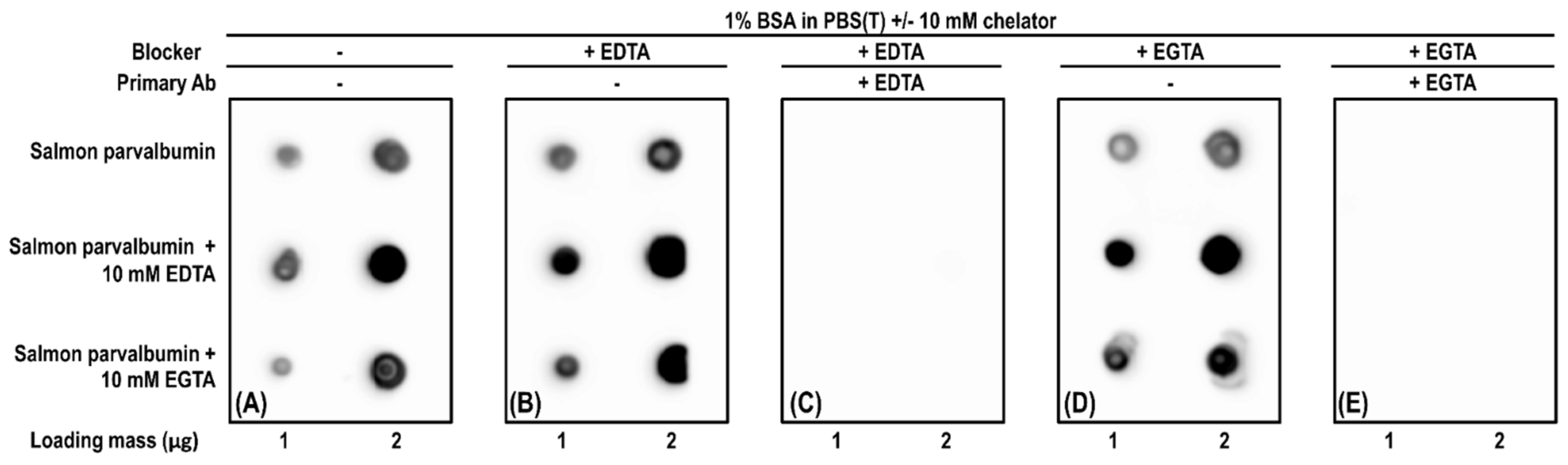
| Sample | Method | Chelator in Blocker | Antibody | Chelator in Antibody Buffer | Major Result | Reference |
|---|---|---|---|---|---|---|
| Frog muscle protein extracts | Western blot | No | Human sera | 5 mM EGTA | A decrease in IgE binding | [56] |
| No | mAb PARV19 | 5 mM EGTA | No IgG binding | |||
| Pacific mackerel protein extracts | Western blot | No | Rabbit anti-Pacific mackerel parvalbumin antiserum | 5 mM EDTA | Same IgG binding | [30] |
| No | mAb PARV19 | 5 mM EGTA | No IgG binding | |||
| Scamp, sunfish, ocean perch, mullet, striped bass, catfish, pompano, red grouper, cobia, sheephead, tilapia, red snapper, basa, tra, amberjack, wahoo, Alaskan halibut, and yellowfin tuna protein extracts in coating buffer containing 10 mM EGTA | Indirect non-competitive ELISA | No | mAb PARV19 | No | An increase in IgG binding | [79] |
| No | mAb3E1 | No | An increase in IgG binding | |||
| Salmon and mullet protein extracts in water | Western blot | 10 mM EDTA | mAb PARV19 | 10 mM EDTA | No IgG binding | [23] |
| 10 mM EDTA | mAb3E1 | 10 mM EDTA | IgG binding was not affected | |||
| Salmon and mullet protein extracts in 5 mM EDTA in water | Western blot | No | mAb PARV19 | No | IgG binding was enhanced | |
| No | mAb3E1 | No | IgG binding was enhanced | |||
| Pacific mackerel parvalbumin | Indirect non-competitive ELISA | Unknown | Human sera | 5 mM EGTA | Reduced IgE binding for 100% of patients | [80] |
| Cod, tuna, carp, salmon, and eel protein extracts | Western blot | No | Human sera | 5 mM EGTA | More than 50% IgE binding reduction was observed in 64.2% of patients | [81] |
| Carp parvalbumin | Western blot | Unknown | Human sera | 5 mM EGTA | 100% of patients showed IgE binding reduction to a different extent | [77] |
| Unknown | Anti-parvalbumin mAb | 5 mM EGTA | 18% IgG binding reduction | |||
| Recombinant carp parvalbumin | Western blot | Unknown | Human sera | 5 mM EGTA | 100% of patients showed IgE binding reduction to a different extent | [82] |
Publisher’s Note: MDPI stays neutral with regard to jurisdictional claims in published maps and institutional affiliations. |
© 2021 by the authors. Licensee MDPI, Basel, Switzerland. This article is an open access article distributed under the terms and conditions of the Creative Commons Attribution (CC BY) license (https://creativecommons.org/licenses/by/4.0/).
Share and Cite
Jiang, X.; Rao, Q. Effect of Processing on Fish Protein Antigenicity and Allergenicity. Foods 2021, 10, 969. https://doi.org/10.3390/foods10050969
Jiang X, Rao Q. Effect of Processing on Fish Protein Antigenicity and Allergenicity. Foods. 2021; 10(5):969. https://doi.org/10.3390/foods10050969
Chicago/Turabian StyleJiang, Xingyi, and Qinchun Rao. 2021. "Effect of Processing on Fish Protein Antigenicity and Allergenicity" Foods 10, no. 5: 969. https://doi.org/10.3390/foods10050969
APA StyleJiang, X., & Rao, Q. (2021). Effect of Processing on Fish Protein Antigenicity and Allergenicity. Foods, 10(5), 969. https://doi.org/10.3390/foods10050969

