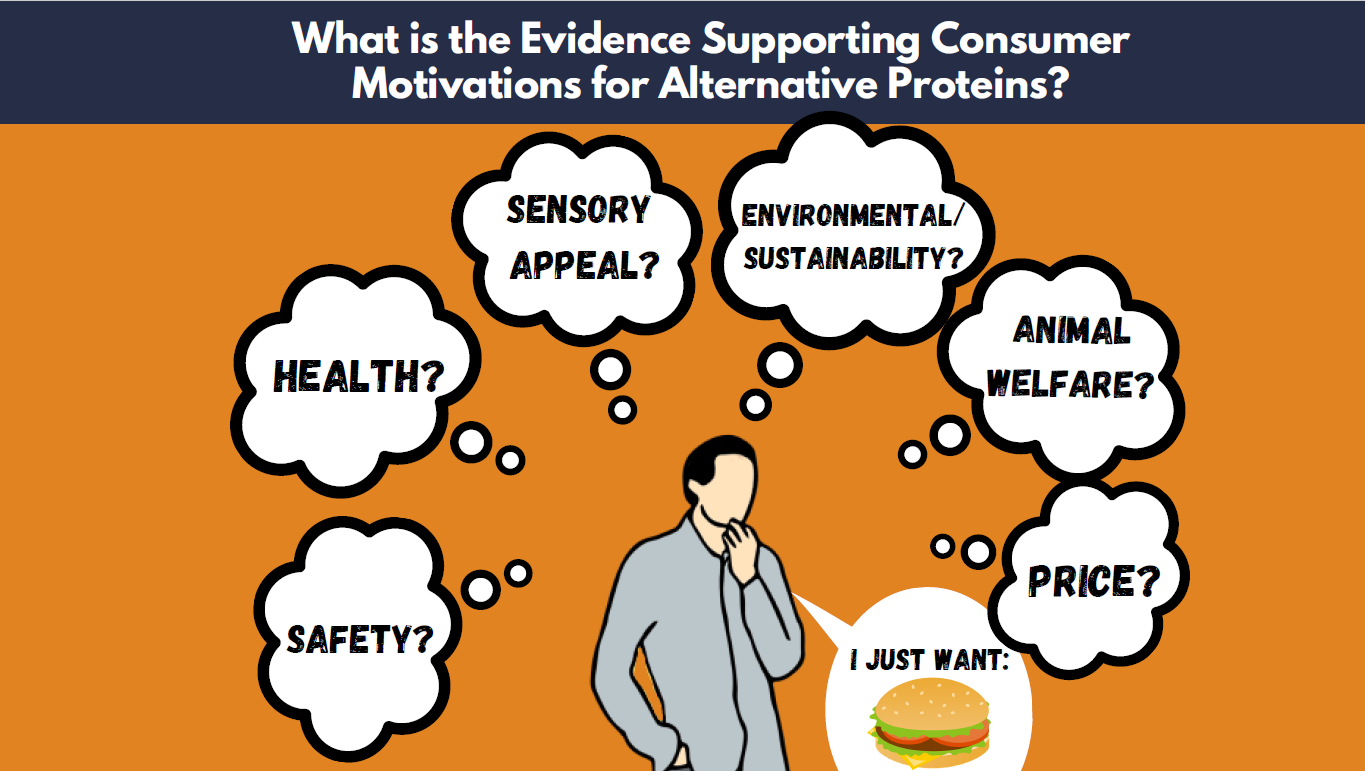
A Critical Appraisal of the Evidence Supporting Consumer Motivations for Alternative Proteins


Abstract
1. Introduction
2. What Are ‘Alternative Proteins’?
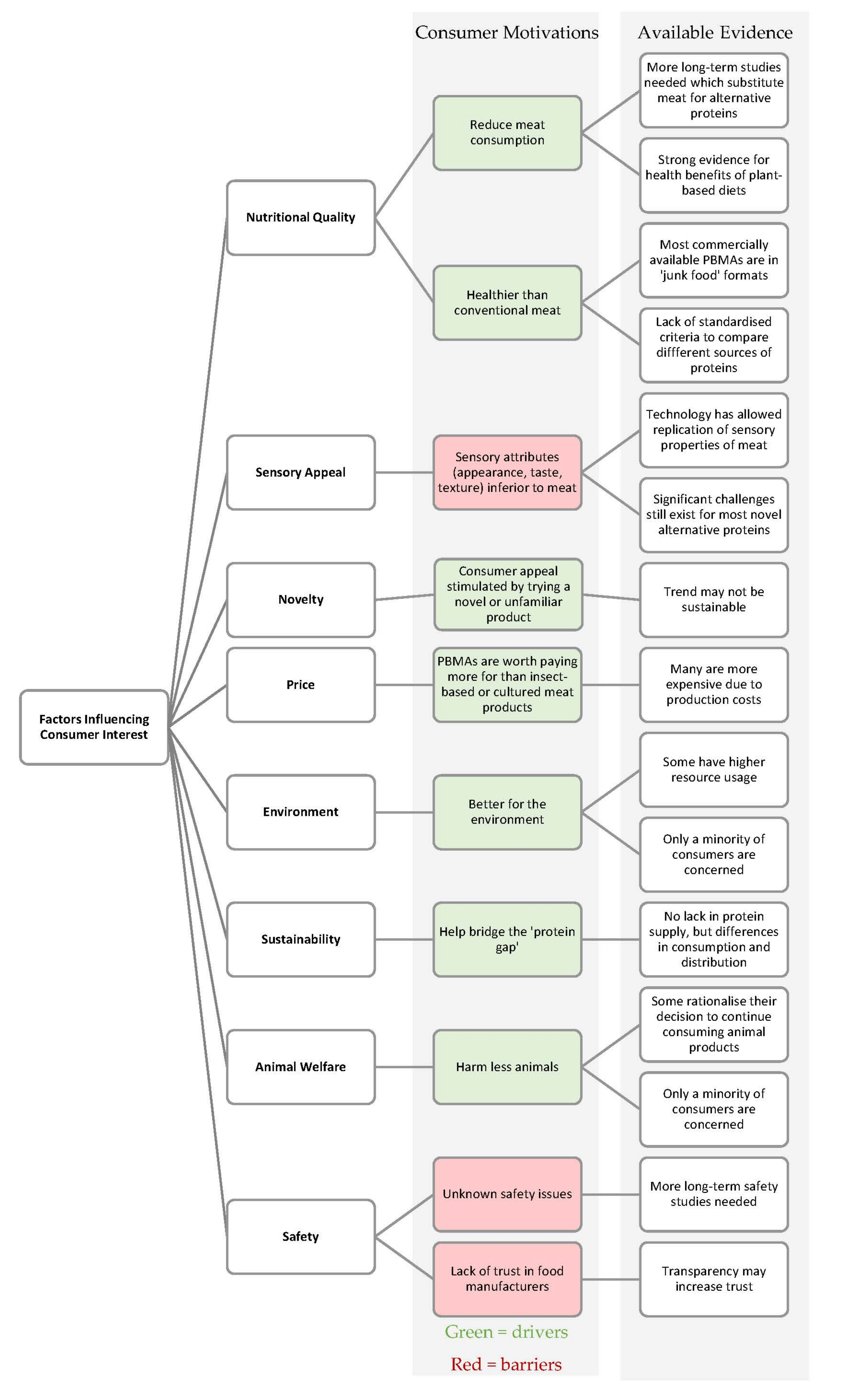
3. Summary of Evidence on the Motivations to Consume Alternative Proteins
3.1. Nutritional Quality of Conventional and Alternative Proteins
3.1.1. Nutritional Concerns of Consumers about Meat Consumption
3.1.2. Comparing the Nutrient Densities of Conventional and Alternative Proteins

| Dairy Milk (Whole, Unfortified) 1 | Soya Milk (Unsweetened, Unfortified) 2 | Soya Milk (Unsweetened, Fortified with Calcium) 1 | Almond Milk (Unsweetened, Unfortified) 1 | Almond Milk (Unsweetened, Fortified with Calcium) 1 | Hen Egg (Scrambled) 1 | Vegan Egg Substitute (Scrambled) 3 | ||||||||
|---|---|---|---|---|---|---|---|---|---|---|---|---|---|---|
| Per Serving (240 mL) | Per 100 g | Per Serving (240 mL) | Per 100 g | Per Serving (240 mL) | Per 100 g | Per Serving (240 mL) | Per 100 g | Per Serving (240 mL) | Per 100 g | Per Serving (50 g) | Per 100 g | Per Serving (50 g) | Per 100 g | |
| Calories (kcal) | 148.84 | 61.00 | 80.52 | 33.00 | 80.52 | 33.00 | 131.76 | 54.00 | 36.60 | 15.00 | 123.15 | 175.93 | 128.70 | 183.85 |
| Protein (g) | 7.69 | 3.15 | 6.59 | 2.70 | 6.98 | 2.86 | 5.08 | 2.08 | 1.44 | 0.59 | 6.67 | 9.53 | 6.15 | 8.79 |
| Carbohydrate (g) | 11.71 | 4.80 | 2.93 | 1.20 | 4.25 | 1.74 | 3.05 | 1.25 | 1.42 | 0.58 | 1.20 | 1.71 | 1.86 | 2.65 |
| Sugar (g) | 12.32 | 5.05 | 2.68 | 1.10 | 1.00 | 0.41 | 1.02 | 0.42 | 0 | 0 | 0.86 | 1.23 | 0.76 | 1.08 |
| Total Fat (g) | 7.93 | 3.25 | 4.88 | 2.00 | 3.93 | 1.61 | 11.18 | 4.58 | 2.68 | 1.10 | 9.97 | 14.24 | 10.67 | 15.24 |
| Saturated Fat (g) | 4.55 | 1.87 | 0.63 | 0.26 | 0.50 | 0.21 | 1.02 | 0.42 | 0 | 0 | 2.21 | 3.16 | 0.61 | 0.87 |
| Polyunsaturated Fat (g) | 0.48 | 0.20 | 2.27 | 0.93 | 2.46 | 1.01 | - | - | 0.58 | 0.24 | 2.21 | 3.16 | 3.00 | 4.29 |
| Monounsaturated Fat (g) | 1.98 | 0.81 | 0.90 | 0.37 | 0.96 | 0.39 | - | - | 1.73 | 0.71 | 4.79 | 6.84 | 6.38 | 9.12 |
| Cholesterol (mg) | 24.40 | 10.00 | 0 | 0 | 0 | 0 | 0 | 0 | 0 | 0 | 207.00 | 295.71 | 1.50 | 2.14 |
| Sodium (mg) | 104.92 | 43.00 | 29.28 | 12.00 | 90.28 | 37.00 | 4.88 | 2.00 | 173.24 | 71.00 | 70.95 | 101.36 | 199.63 | 285.19 |
| Fibre (g) | 0 | 0 | 1.95 | 0.80 | 1.22 | 0.50 | 0 | 0 | 0 | 0 | 0 | 0 | 0 | 0 |
| Vitamin B12 (µg) | 1.10 | 0.45 | - | - | 2.71 | 1.11 | - | - | 1.54 | 0.63 | 0.58 | 0.83 | - | - |
| Iron (mg) | 0.07 | 0.03 | 0.98 | 0.40 | 1.12 | 0.46 | 1.02 | 0.42 | 0.85 | 0.35 | 0.84 | 1.20 | 0 | 0 |
| Zinc (mg) | 0.90 | 0.37 | 0.49 | 0.20 | - | - | - | - | 0.17 | 0.07 | 0.68 | 0.97 | - | - |
| Calcium (mg) | 275.72 | 113.00 | 24.40 | 10.00 | 302.56 | 124.00 | 7.32 | 3.00 | 480.68 | 197.00 | 40.95 | 58.50 | 16.95 | 24.21 |
| Potassium (mg) | 322.08 | 132.00 | 275.72 | 113.00 | 292.80 | 120.00 | 163.48 | 67.00 | 183.00 | 75.00 | 85.80 | 122.57 | 19.80 | 28.29 |
| Protein Source | Casein, whey | Soy | Soy | Almonds | Almonds | Lipoproteins, ovalbumin | Mung beans | |||||||
3.2. Consumer Attitudes, Sensory Appeal, Novelty, and Price of Alternative Proteins
3.2.1. Do Alternative Proteins Have a Higher Sensory Acceptance than Animal Meat?
3.2.2. Is Novelty Driving the Acceptance of Plant-Based Meat Alternatives?
3.2.3. Is the Price of Alternative Proteins Driving Their Acceptance?
3.3. Sustainability, Environmental, and Animal Welfare Concerns
3.3.1. Are Consumer Concerns about Sustainability and the Environment Driving Acceptance of Alternative Proteins?
3.3.2. Are Consumer Concerns about Animal Welfare Driving Alternative Protein Consumption?
3.4. Do Consumers Have Concerns about the Safety Aspects of Alternative Proteins?
4. Gaps and Opportunities
5. Conclusions
Author Contributions
Funding
Data Availability Statement
Conflicts of Interest
References
- Mintel. Plant-Based Push: UK Sales of Meat-Free Foods Shoot Up 40% between 2014–2019. Available online: https://www.mintel.com/press-centre/food-and-drink/plant-based-push-uk-sales-of-meat-free-foods-shoot-up-40-between-2014-19#:~:text=According%20to%20Mintel%20research%2C%20the,%25%20among%20all%20under%2D45s (accessed on 13 October 2020).
- The Business Times. Impossible Foods launches plant-based sausage product in HK. The Business Times. 11 September 2020. Available online: https://www.businesstimes.com.sg/consumer/impossible-foods-launches-plant-based-sausage-product-in-hk (accessed on 13 October 2020).
- Bashi, Z.; McCullough, R.; Ong, L.; Ramirez, M. Alternative proteins: The Race for Market Share Is on. Available online: https://www.mckinsey.com/industries/agriculture/our-insights/alternative-proteins-the-race-for-market-share-is-on (accessed on 28 September 2020).
- Henchion, M.; Hayes, M.; Mullen, A.M.; Fenelon, M.; Tiwari, B. Future Protein Supply and Demand: Strategies and Factors Influencing a Sustainable Equilibrium. Foods 2017, 6, 53. [Google Scholar] [CrossRef] [Scilit]
- United Nations. World Population Prospects 2019: Highlights; United Nations, Department of Economic and Social Affairs, Population Division: New York, NY, USA, 2019. [Google Scholar]
- Attwood, S.; Hajat, C. How will the COVID-19 pandemic shape the future of meat consumption? Public Health Nutr. 2020, 1–5. [Google Scholar] [CrossRef] [Scilit]
- Terazono, E.; Meyer, G. Pandemic accelerates shift to meat substitutes. The Financial Times. 27 April 2020. Available online: https://www.ft.com/content/0127984a-6def-4040-9bca-002b6ffd4e0a (accessed on 15 October 2020).
- Monaco, E. How meat eaters, not vegans, are driving the plant-based foods boom, according to industry experts. Business Insider. 21 September 2020. Available online: https://www.businessinsider.com/plant-based-meats-flexitarians-vegetarians-vegans-market-revolution-2020-9 (accessed on 15 October 2020).
- Lucas, A. An unintended consequence of meatless burger boom: Vegans’ lives got easier. CNBC. 26 October 2019. Available online: https://www.cnbc.com/2019/10/26/an-unintended-consequence-of-meatless-burger-boom-vegans-lives-got-easier.html (accessed on 15 October 2020).
- Hartmann, C.; Siegrist, M. Consumer perception and behaviour regarding sustainable protein consumption: A systematic review. Trends Food Sci. Technol. 2017, 61, 11–25. [Google Scholar] [CrossRef] [Scilit]
- Lang, M. Consumer acceptance of blending plant-based ingredients into traditional meat-based foods: Evidence from the meat-mushroom blend. Food Qual. Prefer. 2020, 79, 103758. [Google Scholar] [CrossRef] [Scilit]
- Henchion, M.; McCarthy, M.; Resconi, V.C.; Troy, D. Meat consumption: Trends and quality matters. Meat Sci. 2014, 98, 561–568. [Google Scholar] [CrossRef] [Scilit] [PubMed]
- Bryant, C.; Szejda, K.; Parekh, N.; Desphande, V.; Tse, B. A Survey of Consumer Perceptions of Plant-Based and Clean Meat in the USA, India, and China. Front. Sustain. Food Syst. 2019, 3, 11. [Google Scholar] [CrossRef] [Scilit]
- Delgado, C.L. Rising Consumption of Meat and Milk in Developing Countries Has Created a New Food Revolution. J. Nutr. 2003, 133, 3907S–3910S. [Google Scholar] [CrossRef] [Scilit]
- Popkin, B.M.; Adair, L.S.; Ng, S.W. Global nutrition transition and the pandemic of obesity in developing countries. Nutr. Rev. 2012, 70, 3–21. [Google Scholar] [CrossRef] [Scilit]
- Slade, P. If you build it, will they eat it? Consumer preferences for plant-based and cultured meat burgers. Appetite 2018, 125, 428–437. [Google Scholar] [CrossRef] [Scilit]
- Hoek, A.C.; Luning, P.A.; Weijzen, P.; Engels, W.; Kok, F.J.; De Graaf, C. Replacement of meat by meat substitutes. A survey on person-and product-related factors in consumer acceptance. Appetite 2011, 56, 662–673. [Google Scholar] [CrossRef] [Scilit]
- Vanhonacker, F.; Van Loo, E.J.; Gellynck, X.; Verbeke, W. Flemish consumer attitudes towards more sustainable food choices. Appetite 2013, 62, 7–16. [Google Scholar] [CrossRef] [Scilit] [PubMed]
- Tao, J.; Li, Y.O. Edible insects as a means to address global malnutrition and food insecurity issues. Food Qual. Saf. 2018, 2, 17–26. [Google Scholar] [CrossRef] [Scilit]
- Mutungi, C.; Irungu, F.G.; Nduko, J.; Mutua, F.; Affognon, H.; Nakimbugwe, D.; Ekesi, S.; Fiaboe, K.K.M. Postharvest processes of edible insects in Africa: A review of processing methods, and the implications for nutrition, safety and new products development. Crit. Rev. Food Sci. Nutr. 2019, 59, 276–298. [Google Scholar] [CrossRef] [Scilit] [PubMed]
- Orkusz, A.; Wolańska, W.; Harasym, J.; Piwowar, A.; Kapelko, M. Consumers’ Attitudes Facing Entomophagy: Polish Case Perspectives. Int. J. Environ. Res. Public Health 2020, 17, 2427. [Google Scholar] [CrossRef] [Scilit] [PubMed]
- Wells, M.L.; Potin, P.; Craigie, J.S.; Raven, J.A.; Merchant, S.S.; Helliwell, K.E.; Smith, A.G.; Camire, M.E.; Brawley, S.H. Algae as nutritional and functional food sources: Revisiting our understanding. J. Appl. Phycol. 2017, 29, 949–982. [Google Scholar] [CrossRef] [Scilit] [PubMed]
- Fortune Business Insights. Commercial Seaweed Market Size, Share & COVID-19 Impact Analysis, By Type (Red Seaweed, Brown Seaweed, & Green Seaweed), Form (Flakes, Powder, & Liquid), End-uses (Food & Beverages, Agricultural Fertilizers, Animal Feed Additives, Pharmaceuticals, and Cosmetics & Personal Care), and Regional Forecast, 2020–2027; Fortune Business Insights. September 2020, p. 160. Available online: https://www.fortunebusinessinsights.com/industry-reports/commercial-seaweed-market-100077 (accessed on 14 October 2020).
- Misurcova, L. Chemical Composition of Seaweeds. In Handbook of Marine Macroalgae; Kim, S.-K., Ed.; John Wiley & Sons, Ltd: Chichester, West Sussex, UK, 2011; pp. 171–192. [Google Scholar]
- Fountain, H. Engineering the $325,000 In Vitro Burger. The New York Times. 12 May 2013. Available online: https://www.nytimes.com/2013/05/14/science/engineering-the-325000-in-vitro-burger.html (accessed on 15 October 2020).
- Verbeke, W.; Marcu, A.; Rutsaert, P.; Gaspar, R.; Seibt, B.; Fletcher, D.; Barnett, J. ‘Would you eat cultured meat?’: Consumers’ reactions and attitude formation in Belgium, Portugal and the United Kingdom. Meat Sci. 2015, 102, 49–58. [Google Scholar] [CrossRef] [Scilit]
- Kumar, S. Meat Analogs “Plant based alternatives to meat products: Their production technology and applications”. Crit. Rev. Food Sci. Nutr. 2016. [Google Scholar] [CrossRef] [Scilit]
- Cotas, J.; Leandro, A.; Pacheco, D.; Gonçalves, A.M.M.; Pereira, L. A Comprehensive Review of the Nutraceutical and Therapeutic Applications of Red Seaweeds (Rhodophyta). Life 2020, 10, 19. [Google Scholar] [CrossRef] [Scilit]
- Köster, E.P. Diversity in the determinants of food choice: A psychological perspective. Food Qual. Prefer. 2009, 20, 70–82. [Google Scholar] [CrossRef] [Scilit]
- Tuorila, H.; Hartmann, C. Consumer responses to novel and unfamiliar foods. Curr. Opin. Food Sci. 2020, 33, 1–8. [Google Scholar] [CrossRef] [Scilit]
- Michel, F.; Hartmann, C.; Siegrist, M. Consumers’ associations, perceptions and acceptance of meat and plant-based meat alternatives. Food Qual. Prefer. 2020, 87, 104063. [Google Scholar] [CrossRef] [Scilit]
- Motoki, K.; Ishikawa, S.-I.; Spence, C.; Velasco, C. Contextual acceptance of insect-based foods. Food Qual. Prefer. 2020, 103982. [Google Scholar] [CrossRef] [Scilit]
- Van Loo, E.J.; Hoefkens, C.; Verbeke, W. Healthy, sustainable and plant-based eating: Perceived (mis)match and involvement-based consumer segments as targets for future policy. Food Policy 2017, 69, 46–57. [Google Scholar] [CrossRef] [Scilit]
- Sanchez-Sabate, R.; Sabaté, J. Consumer Attitudes Towards Environmental Concerns of Meat Sonsumption: A Systematic Review. Int. J. Environ. Res. Public Health 2019, 16, 1220. [Google Scholar] [CrossRef] [Scilit] [PubMed]
- Clonan, A.; Wilson, P.; Swift, J.A.; Leibovici, D.G.; Holdsworth, M. Red and processed meat consumption and purchasing behaviours and attitudes: Impacts for human health, animal welfare and environmental sustainability. Public Health Nutr. 2015, 18, 2446–2456. [Google Scholar] [CrossRef] [Scilit] [PubMed]
- Clark, J.E. Taste and flavour: Their importance in food choice and acceptance. Proc. Nutr. Soc. 1998, 57, 639–643. [Google Scholar] [CrossRef] [Scilit]
- Willett, W.; Rockström, J.; Loken, B.; Springmann, M.; Lang, T.; Vermeulen, S.; Garnett, T.; Tilman, D.; Declerck, F.; Wood, A.; et al. Food in the Anthropocene: The EAT-Lancet Commission on healthy diets from sustainable food systems. Lancet 2019, 393, 447–492. [Google Scholar] [CrossRef] [Scilit]
- Bouvard, V.; Loomis, D.; Guyton, K.Z.; Grosse, Y.; Ghissassi, F.E.; Benbrahim-Tallaa, L.; Guha, N.; Mattock, H.; Straif, K. Carcinogenicity of consumption of red and processed meat. Lancet Oncol. 2015, 16, 1599–1600. [Google Scholar] [CrossRef] [Scilit]
- Leroy, F.; Cofnas, N. Should dietary guidelines recommend low red meat intake? Crit. Rev. Food Sci. Nutr. 2020, 60, 2763–2772. [Google Scholar] [CrossRef] [Scilit]
- MarketsandMarkets. Plant-based Meat Market by Source (Soy, Wheat, Pea, Quinoa, Oats, Beans, Nuts), Product (Burger Patties, Sausages, Strips & Nuggets, Meatballs), Type (Pork, Beef, Chicken, Fish), Process, and Region—Global Forecast to 2025. FB 7110. MarketsandMarkets, May 2019. Available online: https://www.marketsandmarkets.com/Market-Reports/plant-based-meat-market-44922705.html (accessed on 29 September 2020).
- Ensaff, H.; Coan, S.; Sahota, P.; Braybrook, D.; Akter, H.; McLeod, H. Adolescents’ Food Choice and the Place of Plant-Based Foods. Nutrients 2015, 7, 4619–4637. [Google Scholar] [CrossRef] [Scilit]
- Sogari, G.; Bogueva, D.; Marinova, D. Australian Consumers’ Response to Insects as Food. Agriculture 2019, 9, 108. [Google Scholar] [CrossRef] [Scilit]
- Guasch-Ferré, M.; Satija, A.; Blondin, S.A.; Janiszewski, M.; Emlen, E.; O’Connor, L.E.; Campbell, W.W.; Hu, F.B.; Willett, W.C.; Stampfer, M.J. Meta-Analysis of Randomized Controlled Trials of Red Meat Consumption in Comparison With Various Comparison Diets on Cardiovascular Risk Factors. Circulation 2019, 139, 1828–1845. [Google Scholar] [CrossRef] [Scilit] [PubMed]
- Zheng, Y.; Li, Y.; Satija, A.; Pan, A.; Sotos-Prieto, M.; Rimm, E.; Willett, W.C.; Hu, F.B. Association of changes in red meat consumption with total and cause specific mortality among US women and men: Two prospective cohort studies. BMJ 2019, 365, l2110. [Google Scholar] [CrossRef] [Scilit] [PubMed]
- Poortvliet, P.M.; van der Pas, L.; Mulder, B.C.; Fogliano, V. Healthy, but Disgusting: An Investigation into Consumers’ Willingness to Try Insect Meat. J. Econ. Entomol. 2019, 112, 1005–1010. [Google Scholar] [CrossRef] [Scilit]
- Musundire, R.; Zvidzai, C.J.; Chidewe, C.; Samende, B.K.; Manditsera, F.A. Nutrient and anti-nutrient composition of Henicus whellani (Orthoptera: Stenopelmatidae), an edible ground cricket, in south-eastern Zimbabwe. Int. J. Trop. Insect Sci. 2014, 34, 223–231. [Google Scholar] [CrossRef] [Scilit]
- Cherry, P.; O’Hara, C.; Magee, P.J.; McSorley, E.M.; Allsopp, P.J. Risks and benefits of consuming edible seaweeds. Nutr. Rev. 2019, 77, 307–329. [Google Scholar] [CrossRef] [Scilit]
- Venkatraman, K.L.; Mehta, A. Health Benefits and Pharmacological Effects of Porphyra Species. Plant Foods Hum. Nutr. 2019, 74, 10–17. [Google Scholar] [CrossRef] [Scilit]
- Food and Agriculture Organization. Food Energy—Methods of Analysis and Conversion Factors. REPORT of a Technical Workshop; Food and Agriculture Organization of the United Nations: Rome, Italy, 2003. [Google Scholar]
- Darmon, N.; Darmon, M.; Maillot, M.; Drewnowski, A. A Nutrient Density Standard for Vegetables and Fruits: Nutrients per Calorie and Nutrients per Unit Cost. J. Am. Diet. Assoc. 2005, 105, 1881–1887. [Google Scholar] [CrossRef] [Scilit]
- Fulgoni, V.L., III; Keast, D.R.; Drewnowski, A. Development and Validation of the Nutrient-Rich Foods Index: A Tool to Measure Nutritional Quality of Foods. J. Nutr. 2009, 139, 1549–1554. [Google Scholar] [CrossRef] [Scilit]
- United States Department of Agriculture. FoodData Central; United States Department of Agriculture, Agricultural Research Service: Beltsville, MD, USA, 2019. [Google Scholar]
- Health Promotion Board. Energy & Nutrient Composition of Food, 2011 ed.; Health Promotion Board: Singapore, 2011. [Google Scholar]
- Osimani, A.; Milanović, V.; Cardinali, F.; Roncolini, A.; Garofalo, C.; Clementi, F.; Pasquini, M.; Mozzon, M.; Foligni, R.; Raffaelli, N.; et al. Bread enriched with cricket powder (Acheta domesticus): A technological, microbiological and nutritional evaluation. Innov. Food Sci. Emerg. Technol. 2018, 48, 150–163. [Google Scholar] [CrossRef] [Scilit]
- Impossible Foods. What Are The Nutrition Facts? Available online: https://faq.impossiblefoods.com/hc/en-us/articles/360018939274-What-are-the-nutrition-facts- (accessed on 16 September 2020).
- Bugfoundation. Germany’s First Insect Burger. Available online: https://www.bugfoundation.com/our-burger.html (accessed on 17 September 2020).
- ADM. The Plant-Based Protein Market Is Changing What it Takes to Succeed. Available online: https://www.foodnavigator.com/News/Promotional-Features/The-plant-based-protein-market-is-changing-what-it-takes-to-succeed?source=3&utm_source=newsletter_daily&utm_medium=email&utm_campaign=15-Sep-2020 (accessed on 16 September 2020).
- The Good Food Institute. Plant-Based Market Overview. Available online: https://www.gfi.org/marketresearch (accessed on 29 September 2020).
- McCrickerd, K.; Tang, C.S.; Forde, C.G. The independent and combined impact of front-of-pack labelling and sensory quality on calorie estimations and portion selection of commercial food products. Food Qual. Prefer. 2020, 79, 103766. [Google Scholar] [CrossRef] [Scilit]
- McCrickerd, K.; Tay, P.P.S.; Tang, C.S.; Forde, C.G. Using Sensory Cues to Optimise the Satiety Value of a Reduced-Calorie Product Labelled ‘Healthier Choice’. Nutrients 2019, 12, 107. [Google Scholar] [CrossRef] [Scilit] [PubMed]
- World Health Organization. Obesity and Overweight. Available online: https://www.who.int/news-room/fact-sheets/detail/obesity-and-overweight (accessed on 16 November 2020).
- Bao, W.; Rong, Y.; Rong, S.; Liu, L. Dietary iron intake, body iron stores, and the risk of type 2 diabetes: A systematic review and meta-analysis. BMC Med. 2012, 10, 119. [Google Scholar] [CrossRef] [Scilit] [PubMed]
- McClements, D.J.; Newman, E.; McClements, I.F. Plant-based Milks: A Review of the Science Underpinning Their Design, Fabrication, and Performance. Compr. Rev. Food Sci. Food Saf. 2019, 18, 2047–2067. [Google Scholar] [CrossRef] [Scilit]
- JUST Egg. JUST Egg|Made from Plants. Available online: https://www.ju.st/en-us/products/consumer/egg/egg (accessed on 1 October 2020).
- Itkonen, S.T.; Päivärinta, E.; Pellinen, T.; Viitakangas, H.; Risteli, J.; Erkkola, M.; Lamberg-Allardt, C.; Pajari, A.-M. Partial Replacement of Animal Proteins with Plant Proteins for 12 Weeks Accelerates Bone Turnover Among Healthy Adults: A Randomized Clinical Trial. J. Nutr. 2020. [Google Scholar] [CrossRef] [Scilit]
- Crimarco, A.; Springfield, S.; Petlura, C.; Streaty, T.; Cunanan, K.; Lee, J.; Fielding-Singh, P.; Carter, M.M.; Topf, M.A.; Wastyk, H.C.; et al. A randomized crossover trial on the effect of plant-based compared with animal-based meat on trimethylamine-N-oxide and cardiovascular disease risk factors in generally healthy adults: Study with Appetizing Plantfood—Meat Eating Alternative Trial (SWAP-MEAT). Am. J. Clin. Nutr. 2020, 112, 1188–1199. [Google Scholar] [CrossRef] [Scilit] [PubMed]
- Elzerman, J.E.; Van Boekel, M.A.; Luning, P.A. Exploring meat substitutes: Consumer experiences and contextual factors. Br. Food J. 2013. [Google Scholar] [CrossRef] [Scilit]
- Moskin, J. How Do the New Plant-Based Burgers Stack Up? We Taste-Tested Them. The New York Times. 22 October 2019. Available online: https://www.nytimes.com/2019/10/22/dining/veggie-burger-taste-test.html (accessed on 23 November 2020).
- Fellet, M. A fresh take on fake meat. In Can Scientists Deliver a Meatless Burger that Tastes Good and Will not Harm the Planet? ACS Publications: Washington, DC, USA, 2015. [Google Scholar] [CrossRef] [Scilit]
- Schouteten, J.J.; De Steur, H.; De Pelsmaeker, S.; Lagast, S.; Juvinal, J.G.; De Bourdeaudhuij, I.; Verbeke, W.; Gellynck, X. Emotional and sensory profiling of insect-, plant-and meat-based burgers under blind, expected and informed conditions. Food Qual. Prefer. 2016, 52, 27–31. [Google Scholar] [CrossRef] [Scilit]
- Bryant, C.; Barnett, J. Consumer acceptance of cultured meat: A systematic review. Meat Sci. 2018, 143, 8–17. [Google Scholar] [CrossRef] [Scilit]
- Castro, M.; Chambers, E. Consumer Avoidance of Insect Containing Foods: Primary Emotions, Perceptions and Sensory Characteristics Driving Consumers Considerations. Foods 2019, 8, 351. [Google Scholar] [CrossRef] [Scilit]
- Megido, R.C.; Gierts, C.; Blecker, C.; Brostaux, Y.; Haubruge, É.; Alabi, T.; Francis, F. Consumer acceptance of insect-based alternative meat products in Western countries. Food Qual. Prefer. 2016, 52, 237–243. [Google Scholar] [CrossRef] [Scilit]
- MacArtain, P.; Gill, C.I.R.; Brooks, M.; Campbell, R.; Rowland, I.R. Nutritional value of edible seaweeds. Nutr. Rev. 2007, 65, 535–543. [Google Scholar] [CrossRef] [PubMed]
- Parniakov, O.; Toepfl, S.; Barba, F.J.; Granato, D.; Zamuz, S.; Galvez, F.; Lorenzo, J.M. Impact of the soy protein replacement by legumes and algae based proteins on the quality of chicken rotti. J. Food Sci. Technol. 2018, 55, 2552–2559. [Google Scholar] [CrossRef] [Scilit] [PubMed]
- Fiorentini, M.; Kinchla, A.J.; Nolden, A.A. Role of Sensory Evaluation in Consumer Acceptance of Plant-Based Meat Analogs and Meat Extenders: A Scoping Review. Foods 2020, 9, 1334. [Google Scholar] [CrossRef] [Scilit]
- Asgar, M.A.; Fazilah, A.; Huda, N.; Bhat, R.; Karim, A.A. Nonmeat protein alternatives as meat extenders and meat analogs. Compr. Rev. Food Sci. Food Saf. 2010, 9, 513–529. [Google Scholar] [CrossRef] [Scilit]
- Sha, L.; Xiong, Y.L. Plant protein-based alternatives of reconstructed meat: Science, technology, and challenges. Trends Food Sci. Technol. 2020, 102, 51–61. [Google Scholar] [CrossRef] [Scilit]
- Scholliers, J.; Steen, L.; Fraeye, I. Partial replacement of meat by superworm (Zophobas morio larvae) in cooked sausages: Effect of heating temperature and insect: Meat ratio on structure and physical stability. Innov. Food Sci. Emerg. Technol. 2020, 66, 102535. [Google Scholar] [CrossRef] [Scilit]
- Keefe, L.M. #FakeMeat: How big a deal will animal meat analogs ultimately be? Anim. Front. 2018, 8. [Google Scholar] [CrossRef] [Scilit]
- Lafarga, T. Effect of microalgal biomass incorporation into foods: Nutritional and sensorial attributes of the end products. Algal Res. 2019, 41, 101566. [Google Scholar] [CrossRef] [Scilit]
- Michalak, I.; Chojnacka, K. Seaweeds as a component of the human diet. In Algae Biomass: Characteristics and Applications; Springer: Cham, Switzerland, 2018; pp. 57–71. [Google Scholar]
- Grahl, S.; Strack, M.; Mensching, A.; Mörlein, D. Alternative protein sources in Western diets: Food product development and consumer acceptance of spirulina-filled pasta. Food Qual. Prefer. 2020, 84, 103933. [Google Scholar] [CrossRef] [Scilit]
- Grahl, S.; Palanisamy, M.; Strack, M.; Meier-Dinkel, L.; Toepfl, S.; Mörlein, D. Towards more sustainable meat alternatives: How technical parameters affect the sensory properties of extrusion products derived from soy and algae. J. Clean. Prod. 2018, 198, 962–971. [Google Scholar] [CrossRef] [Scilit]
- Zamuz, S.; Purriños, L.; Galvez, F.; Zdolec, N.; Muchenje, V.; Barba, F.J.; Lorenzo, J.M. Influence of the addition of different origin sources of protein on meat products sensory acceptance. J. Food Process. Preserv. 2019, 43, e13940. [Google Scholar] [CrossRef] [Scilit]
- Chiang, J.H.; Hardacre, A.K.; Parker, M.E. Effects of Maillard-reacted beef bone hydrolysate on the physicochemical properties of extruded meat alternatives. J. Food Sci. 2020, 85. [Google Scholar] [CrossRef] [Scilit] [PubMed]
- Lee, S.J.; Moon, T.W.; Lee, J. Increases of 2-furanmethanol and maltol in Korean red ginseng during explosive puffing process. J. Food Sci. 2010, 75, C147–C151. [Google Scholar] [CrossRef] [Scilit] [PubMed]
- Weinrich, R. Opportunities for the Adoption of Health-Based Sustainable Dietary Patterns: A Review on Consumer Research of Meat Substitutes. Sustainability 2019, 11, 4028. [Google Scholar] [CrossRef] [Scilit]
- Hartmann, C.; Siegrist, M. Insects as food: Perception and acceptance. Findings from current research. Ernahr. Umsch. 2017, 64, 44–50. [Google Scholar] [CrossRef] [Scilit]
- Siegrist, M.; Hartmann, C. Perceived naturalness, disgust, trust and food neophobia as predictors of cultured meat acceptance in ten countries. Appetite 2020, 155, 104814. [Google Scholar] [CrossRef] [Scilit]
- International Food Information Council. Consumer Survey on Plant Alternatives to Meat Shows That Nutrition Facts Are More Influential Than the Ingredients List; Food Insight: Washington, DC, USA, 2020. [Google Scholar]
- Mullee, A.; Vermeire, L.; Vanaelst, B.; Mullie, P.; Deriemaeker, P.; Leenaert, T.; De Henauw, S.; Dunne, A.; Gunter, M.J.; Clarys, P.; et al. Vegetarianism and meat consumption: A comparison of attitudes and beliefs between vegetarian, semi-vegetarian, and omnivorous subjects in Belgium. Appetite 2017, 114, 299–305. [Google Scholar] [CrossRef] [Scilit]
- Popper, N. Behold the Beefless ‘Impossible Whopper’. The New York Times. 1 April 2019. Available online: https://www.nytimes.com/2019/04/01/technology/burger-king-impossible-whopper.html (accessed on 28 September 2020).
- Hwang, J.; You, J.; Moon, J.; Jeong, J. Factors Affecting Consumers’ Alternative Meats Buying Intentions: Plant-Based Meat Alternative and Cultured Meat. Sustainability 2020, 12, 5662. [Google Scholar] [CrossRef] [Scilit]
- Pliner, P.; Pelchat, M.; Grabski, M. Reduction of neophobia in humans by exposure to novel foods. Appetite 1993, 20, 111–123. [Google Scholar] [CrossRef] [Scilit]
- Paradise, L.; Jordan, B. From Rainbow Everything to Cake on a Stick, These are the Food Trends that Lived and Died in the 2010s. Insider. 1 January 2020. Available online: https://www.insider.com/5-food-trends-that-lived-and-died-this-decade-2019-12 (accessed on 23 November 2020).
- Sidman, J. Chronicling the Death of Fro-Yo. Washington City Paper. 22 January 2015. Available online: https://washingtoncitypaper.com/article/333656/chronicling-the-death-of-fro-yo/ (accessed on 23 November 2020).
- Root, A. Beyond Meat and the Limits of a Tesla Strategy at the Grocery Store. Barron’s. 3 June 2019. Available online: https://www.barrons.com/articles/beyond-meat-price-comparison-51559339044 (accessed on 15 October 2020).
- Specht, L. Why Plant-Based Meat Will Ultimately Be Less Expensive Than Conventional Meat. Available online: https://www.gfi.org/plant-based-meat-will-be-less-expensive (accessed on 11 November 2020).
- Santo, R.E.; Kim, B.F.; Goldman, S.E.; Dutkiewicz, J.; Biehl, E.M.B.; Bloem, M.W.; Neff, R.A.; Nachman, K.E. Considering plant-based meat substitutes and cell-based meats: A public health and food systems perspective. Front. Sustain. Food Syst. 2020, 4, 134. [Google Scholar] [CrossRef] [Scilit]
- Reinicke, C. Beyond Meat Costs More than Traditional Meat, but Data Show Consumers Are Willing to Pay the Premium Price—For Now (BYND). Markets Insider. 11 July 2019. Available online: https://markets.businessinsider.com/news/stocks/beyond-meat-sales-are-high-but-so-is-price-2019-7-1028346898 (accessed on 4 October 2020).
- Haws, K.L.; Reczek, R.W.; Sample, K.L. Healthy Diets Make Empty Wallets: The Healthy= Expensive Intuition. J. Consum. Res. 2017, 43, 992–1007. [Google Scholar] [CrossRef] [Scilit]
- Kornher, L.; Schellhorn, M.; Vetter, S. Disgusting or Innovative-Consumer Willingness to Pay for Insect Based Burger Patties in Germany. Sustainability 2019, 11, 1878. [Google Scholar] [CrossRef] [Scilit]
- Wilks, M.; Phillips, C.J. Attitudes to in vitro meat: A survey of potential consumers in the United States. PLoS ONE 2017, 12, e0171904. [Google Scholar] [CrossRef] [Scilit] [PubMed]
- Rolland, N.C.M.; Markus, C.R.; Post, M.J. The effect of information content on acceptance of cultured meat in a tasting context. PLoS ONE 2020, 15, e0231176. [Google Scholar] [CrossRef] [Scilit]
- Pyett, S.; de Vet, E.; Trindade, L.M.; van Zanten, H.; Fresco, L.O. Chickpeas, Crickets and Chlorella: Our Future Proteins; Wageningen University & Research: Wageningen, The Netherlands, 2019. [Google Scholar]
- Westhoek, H.; Rood, T.; van den Berg, M.; Janse, J.; Nijdam, D.; Reudink, M.; Stehfest, E. The Protein Puzzle: The Consumption and Production of Meat, Dairy and Fish in the European Union; PBL Netherlands Environmental Agency (Hague): The Hague, The Netherlands, 2011. [Google Scholar]
- United States Department of Agriculture. Livestock & Meat Domestic Data; United States Department of Agriculture, Economic Research Service: Washington, DC, USA, 2020. [Google Scholar]
- Roser, M.; Ritchie, H. Food Supply. Available online: https://ourworldindata.org/food-supply (accessed on 12 November 2020).
- McMichael, A.J.; Powles, J.W.; Butler, C.D.; Uauy, R. Food, livestock production, energy, climate change, and health. Lancet 2007, 370, 1253–1263. [Google Scholar] [CrossRef] [Scilit]
- Gerber, P.J.; Steinfeld, H.; Henderson, B.; Mottet, A.; Opio, C.; Dijkman, J.; Falcucci, A.; Tempio, G. Tackling Climate Change through Livestock: A Global Assessment of Emissions and Mitigation Opportunities; Food and Agriculture Organization of the United Nations (FAO): Rome, Italy, 2013. [Google Scholar]
- Food and Agriculture Organization. Livestock and Landscapes. Available online: http://www.fao.org/3/ar591e/ar591e.pdf (accessed on 23 November 2020).
- Poore, J.; Nemecek, T. Reducing food’s environmental impacts through producers and consumers. Science 2018, 360, 987–992. [Google Scholar] [CrossRef] [Scilit]
- Neville, M.; Tarrega, A.; Hewson, L.; Foster, T. Consumer-orientated development of hybrid beef burger and sausage analogues. Food Sci. Nutr. 2017, 5, 852–864. [Google Scholar] [CrossRef] [Scilit]
- Springmann, M.; Clark, M.; Mason-D’Croz, D.; Wiebe, K.; Bodirsky, B.L.; Lassaletta, L.; De Vries, W.; Vermeulen, S.J.; Herrero, M.; Carlson, K.M.; et al. Options for keeping the food system within environmental limits. Nature 2018, 562, 519–525. [Google Scholar] [CrossRef] [Scilit]
- Gibney, M.J. Food Technology and Plant-Based Diets. J. Nutr. 2020. [Google Scholar] [CrossRef] [Scilit]
- Drewnowski, A.; Rehm, C.D.; Martin, A.; Verger, E.O.; Voinnesson, M.; Imbert, P. Energy and nutrient density of foods in relation to their carbon footprint. Am. J. Clin. Nutr. 2015, 101, 184–191. [Google Scholar] [CrossRef] [Scilit] [PubMed]
- Pimentel, D.; Pimentel, M. Sustainability of meat-based and plant-based diets and the environment. Am. J. Clin. Nutr. 2003, 78, 660S–663S. [Google Scholar] [CrossRef] [Scilit] [PubMed]
- McClements, D.J. Future foods: Is it possible to design a healthier and more sustainable food supply? Nutr. Bull. 2020, 45, 341–354. [Google Scholar] [CrossRef] [Scilit]
- Heller, M.C.; Keoleian, G.A. Beyond Meat’s Beyond Burger Life Cycle Assessment: A Detailed Comparison between a Plant-Based and an Animal-Based Protein Source; CSS18-10; Center for Sustainable Systems, University of Michigan: Ann Arbor, MI, USA, 2018. [Google Scholar]
- The Economist. Plant-based meat could create a radically different food chain. The Economist. 12 October 2019. Available online: https://www.economist.com/international/2019/10/12/plant-based-meat-could-create-a-radically-different-food-chain (accessed on 11 November 2020).
- Smetana, S.; Palanisamy, M.; Mathys, A.; Heinz, V. Sustainability of insect use for feed and food: Life Cycle Assessment perspective. J. Clean. Prod. 2016, 137, 741–751. [Google Scholar] [CrossRef] [Scilit]
- Grant, C.A.; Hicks, A.L. Comparative Life Cycle Assessment of Milk and Plant-Based Alternatives. Environ. Eng. Sci. 2018, 35, 1235–1247. [Google Scholar] [CrossRef] [Scilit]
- Loveday, S. Plant protein ingredients with food functionality potential. Nutr. Bull. 2020, 45, 321–327. [Google Scholar] [CrossRef] [Scilit]
- Cole, M.; Miele, M.; Hines, P.; Zokaei, K.; Evans, B.; Beale, J. Animal foods and climate change: Shadowing eating practices. Int. J. Consum. Stud. 2009, 33, 162–167. [Google Scholar] [CrossRef] [Scilit]
- De Boer, J.; Schösler, H.; Boersema, J.J. Climate change and meat eating: An inconvenient couple? J. Environ. Psychol. 2013, 33, 1–8. [Google Scholar] [CrossRef] [Scilit]
- Lea, E.J.; Crawford, D.; Worsley, A. Public views of the benefits and barriers to the consumption of a plant-based diet. Eur. J. Clin. Nutr. 2006, 60, 828–837. [Google Scholar] [CrossRef] [Scilit]
- Van Dam, Y.K.; van Trijp, H.C.M. Relevant or determinant: Importance in certified sustainable food consumption. Food Qual. Prefer. 2013, 30, 93–101. [Google Scholar] [CrossRef] [Scilit]
- Borenstein, S. Study: Fix to food climate problem doesn’t require veganism. Associated Press News. 6 November 2020. Available online: https://apnews.com/article/food-climate-problem-does-not-veganism-ed1ae1cd85cca04d1e4442909ef13fdc (accessed on 11 November 2020).
- Wynes, S.; Nicholas, K.A. The climate mitigation gap: Education and government recommendations miss the most effective individual actions. Environ. Res. Lett. 2017, 12, 074024. [Google Scholar] [CrossRef] [Scilit]
- Leroy, F. Animal Source Foods in Ethical, Sustainable & Healthy Diets. Available online: https://aleph-2020.blogspot.com/2019/06/greenhouse-gas-emissions.html (accessed on 17 December 2020).
- Gössling, S.; Humpe, A. The global scale, distribution and growth of aviation: Implications for climate change. Glob. Environ. Chang. 2020, 65, 102194. [Google Scholar] [CrossRef] [Scilit]
- Gössling, S. Celebrities, air travel, and social norms. Ann. Tour. Res. 2019, 79, 102775. [Google Scholar] [CrossRef] [Scilit]
- Lenzen, M.; Sun, Y.-Y.; Faturay, F.; Ting, Y.-P.; Geschke, A.; Malik, A. The carbon footprint of global tourism. Nat. Clim. Chang. 2018, 8, 522–528. [Google Scholar] [CrossRef] [Scilit]
- Nijdam, D.; Rood, T.; Westhoek, H. The price of protein: Review of land use and carbon footprints from life cycle assessments of animal food products and their substitutes. Food Policy 2012, 37, 760–770. [Google Scholar] [CrossRef] [Scilit]
- Finnigan, T. Food 2030. Life Cycle Analysis and the Role of Quorn Foods within the New Fundamentals of Food Policy. Summary Document. January 2010. Available online: https://docplayer.net/21090260-Food-2030-life-cycle-analysis-and-the-role-of-quorn-foods-within-the-new-fundamentals-of-food-policy-summary-document-tja-finnigan-jan-2010.html (accessed on 11 November 2020).
- Souza Filho, P.F.; Andersson, D.; Ferreira, J.A.; Taherzadeh, M.J. Mycoprotein: Environmental impact and health aspects. World J. Microbiol. Biotechnol. 2019, 35, 147. [Google Scholar] [CrossRef] [Scilit]
- Mattick, C.S.; Landis, A.E.; Allenby, B.R.; Genovese, N.J. Anticipatory life cycle analysis of in vitro biomass cultivation for cultured meat production in the United States. Environ. Sci. Technol. 2015, 49, 11941–11949. [Google Scholar] [CrossRef] [Scilit]
- De Backer, C.J.S.; Hudders, L. Meat morals: Relationship between meat consumption consumer attitudes towards human and animal welfare and moral behavior. Meat Sci. 2015, 99, 68–74. [Google Scholar] [CrossRef] [Scilit]
- Hagmann, D.; Siegrist, M.; Hartmann, C. Meat avoidance: Motives, alternative proteins and diet quality in a sample of Swiss consumers. Public Health Nutr. 2019, 22, 2448–2459. [Google Scholar] [CrossRef] [Scilit]
- Bryant, C.J. We can’t keep meating like this: Attitudes towards vegetarian and vegan diets in the United Kingdom. Sustainability 2019, 11, 6844. [Google Scholar] [CrossRef] [Scilit]
- Hopkins, P.D.; Dacey, A. Vegetarian Meat: Could Technology Save Animals and Satisfy Meat Eaters? J. Agric. Environ. Ethics 2008, 21, 579–596. [Google Scholar] [CrossRef] [Scilit]
- Schröder, M.J.A.; McEachern, M.G. Consumer value conflicts surrounding ethical food purchase decisions: A focus on animal welfare. Int. J. Consum. Stud. 2004, 28, 168–177. [Google Scholar] [CrossRef] [Scilit]
- Lin-Schilstra, L.; Fischer, A.R.H. Consumer Moral Dilemma in the Choice of Animal-Friendly Meat Products. Sustainability 2020, 12, 4844. [Google Scholar] [CrossRef] [Scilit]
- National Academies of Sciences; Engineering; Medicine. Innovations in the Food System: Exploring the Future of Food: Proceedings of a Workshop—In Brief; The National Academies Press: Washington, DC, USA, 2019. [Google Scholar]
- Wiebe, M.G. Myco-protein from Fusarium venenatum: A well-established product for human consumption. Appl. Microbiol. Biotechnol. 2002, 58, 421–427. [Google Scholar] [CrossRef] [Scilit]
- World Health Organization. Food Safety. Available online: https://www.who.int/news-room/fact-sheets/detail/food-safety (accessed on 4 October 2020).
- Saeed, T.; Dagga, F.A.; Saraf, M. Analysis of Residual Pesticides Present in Edible Locusts Captured in Kuwait. Arab. Gulf J. Sci. Res. 1993, 11, 1–5. [Google Scholar]
- Green, K.; Broome, L.; Heinze, D.; Johnston, S. Long distance transport of arsenic by migrating Bogon Moth from agricultural lowlands to mountain ecosystem. Vic. Nat. 2001, 118, 112–116. [Google Scholar]
- Banjo, A.D.; Lawal, O.A.; Fasunwon, B.T.; Alimi, G.O. Alkali and Heavy Metal Contaminants of Some Selected Edible Arthropods in South Western Nigeria. Am.-Eurasian J. Toxicol. Sci. 2010, 2, 25–29. [Google Scholar]
- Chai, J.Y.; Shin, E.H.; Lee, S.H.; Rim, H.J. Foodborne Intestinal Flukes in Southeast Asia. Korean J. Parasitol. 2009, 47, S69–S102. [Google Scholar] [CrossRef] [Scilit]
- Testa, M.; Stillo, M.; Maffei, G.; Andriolo, V.; Gardois, P.; Zotti, C.M. Ugly but tasty: A systematic review of possible human and animal health risks related to entomophagy. Crit. Rev. Food Sci. Nutr. 2017, 57, 3747–3759. [Google Scholar] [CrossRef] [Scilit]
- Castro, M.; Chambers IV, E. Willingness to eat an insect based product and impact on brand equity: A global perspective. J. Sens. Stud. 2019, 34, e12486. [Google Scholar] [CrossRef] [Scilit]
- Desideri, D.; Cantaluppi, C.; Ceccotto, F.; Meli, M.A.; Roselli, C.; Feduzi, L. Essential and toxic elements in seaweeds for human consumption. J. Toxicol. Environ. Health Part A 2016, 79, 112–122. [Google Scholar] [CrossRef] [Scilit] [PubMed]
- Hwang, Y.O.; Park, S.G.; Park, G.Y.; Choi, S.M.; Kim, M.Y. Total arsenic, mercury, lead, and cadmium contents in edible dried seaweed in Korea. Food Addit. Contam. Part B 2010, 3, 7–13. [Google Scholar] [CrossRef] [Scilit]
- Van Huis, A.; Van Itterbeeck, J.; Klunder, H.; Mertens, E.; Halloran, A.; Muir, G.; Vantomme, P. Edible Insects: Future Prospects for Food and Feed Security; Food and Agriculture Organization of the United Nations: Rome, Italy, 2013; p. 201. [Google Scholar]
- Van der Spiegel, M.; Noordam, M.Y.; van der Fels-Klerx, H.J. Safety of Novel Protein Sources (Insects, Microalgae, Seaweed, Duckweed, and Rapeseed) and Legislative Aspects for Their Application in Food and Feed Production. Compr. Rev. Food Sci. Food Saf. 2013, 12, 662–678. [Google Scholar] [CrossRef] [Scilit]
- European Institute of Innovation & Technology. EIT Food TrustTracker. Available online: https://www.eitfood.eu/projects/eit-food-trusttracker (accessed on 18 September 2020).
- Lu, Z.X.; He, J.F.; Zhang, Y.C.; Bing, D.J. Composition, physicochemical properties of pea protein and its application in functional foods. Crit. Rev. Food Sci. Nutr. 2020, 60, 2593–2605. [Google Scholar] [CrossRef] [Scilit] [PubMed]
- National Institutes of Health. Soy. Available online: https://www.nccih.nih.gov/health/soy#:~:text=Except%20for%20people%20with%20soy,as%20stomach%20pain%20and%20diarrhea (accessed on 23 November 2020).
- Bianchi, F.; Aveyard, P.; Astbury, N.M.; Cook, B.; Cartwright, E.; Jebb, S.A. Replacing meat with alternative plant-based products (RE-MAPs): Protocol for a randomised controlled trial of a behavioural intervention to reduce meat consumption. BMJ Open 2019, 9, e027016. [Google Scholar] [CrossRef] [Scilit]
- Tong, T.Y.N.; Appleby, P.N.; Armstrong, M.E.G.; Fensom, G.K.; Knuppel, A.; Papier, K.; Perez-Cornago, A.; Travis, R.C.; Key, T.J. Vegetarian and vegan diets and risks of total and site-specific fractures: Results from the prospective EPIC-Oxford study. BMC Med. 2020, 18, 353. [Google Scholar] [CrossRef] [Scilit] [PubMed]
- Taylor, J.; Ahmed, I.A.M.; Al-Juhaimi, F.Y.; Bekhit, A.E.-D.A. Consumers’ Perceptions and Sensory Properties of Beef Patty Analogues. Foods 2020, 9, 63. [Google Scholar] [CrossRef] [Scilit]
- Castro, M.; Chambers IV, E.; Carbonell-Barrachina, A.; Noguera-Artiaga, L.; Vidal-Quintanar, R.; Burgos-Hernandez, A. Consumer acceptability in the USA, Mexico, and Spain of chocolate chip cookies made with partial insect powder replacement. J. Food Sci. 2020, 85, 1621–1628. [Google Scholar] [CrossRef] [Scilit]
- Hendrie, G.A.; Baird, D.; Ridoutt, B.; Hadjikakou, M.; Noakes, M. Overconsumption of Energy and Excessive Discretionary Food Intake Inflates Dietary Greenhouse Gas Emissions in Australia. Nutrients 2016, 8, 690. [Google Scholar] [CrossRef] [Scilit]
- Masset, G.; Vieux, F.; Verger, E.O.; Soler, L.G.; Touazi, D.; Darmon, N. Reducing energy intake and energy density for a sustainable diet: A study based on self-selected diets in French adults. Am. J. Clin. Nutr. 2014, 99, 1460–1469. [Google Scholar] [CrossRef] [Scilit]
- Miles, S.; Ueland, Ø.; Frewer, L.J. Public attitudes towards genetically-modified food. Br. Food J. 2005, 107, 246–262. [Google Scholar] [CrossRef] [Scilit]
- Meijer, G.W.; Lähteenmäki, L.; Stadler, R.H.; Weiss, J. Issues surrounding consumer trust and acceptance of existing and emerging food processing technologies. Crit. Rev. Food Sci. Nutr. 2020, 1–19. [Google Scholar] [CrossRef] [Scilit] [PubMed]
- Bryant, C.; Barnett, J. What’s in a name? Consumer perceptions of in vitro meat under different names. Appetite 2019, 137, 104–113. [Google Scholar] [CrossRef] [Scilit] [PubMed]
- Possidónio, C.; Prada, M.; Graça, J.; Piazza, J. Consumer perceptions of conventional and alternative protein sources: A mixed-methods approach with meal and product framing. Appetite 2020, 156, 104860. [Google Scholar] [CrossRef] [Scilit]

| Traditional | Novel | |||
|---|---|---|---|---|
| Origin | Brief Definition | Origin | Brief Definition | |
| Plant Protein | Traditional part of diets globally |
|
|
|
| Insect Protein | Traditional part of diets in many African, South American and Asian countries |
| The first bread using insect flour (Fazer Sirkkaleipä or Fazer Cricket Bread) was created in 2017 by Finnish company, Fazer |
|
| Algal Protein | Traditional part of diets, especially in Asian countries |
| Recent decades have seen a rise in nutraceuticals and functional foods incorporated with algae or its extracted ingredients [24,28] |
|
| In vitro/Cultured Meat Protein | NA | NA | The first in vitro meat patty was created in 2013. It was cultivated using stem cells extracted from the biopsy of a cow. |
|
| Consumer Perceptions | Nutritional Evidence | |
|---|---|---|
| Plants | Plant-based diets are generally perceived as healthy [33] Plant-based meat alternatives (e.g., Impossible Foods, Beyond Meat):
| Plant-based diets:
|
| Insects | Perceived as nutritious and high in protein, though more disgusting or dangerous [42,45] |
|
| Algae | Perceived as having functional benefits [22,47] |
|
| Cultured meat |
|
| Beef Patty (Grilled) 1 | Fish (Steamed) 1 | Fishballs (Boiled) 2 | Fishballs (Deep-Fried) 2 | Chicken Breast (Grilled) 1 | Mock Chicken (Stir-Fried) 3 | |||||||
|---|---|---|---|---|---|---|---|---|---|---|---|---|
| Per Serving (120 g) | Per 100 g | Per Serving (113 g) | Per 100 g | Per Serving (74 g) | Per 100 g | Per Serving (82 g) | Per 100 g | Per Serving (120 g) | Per 100 g | Per Serving | Per 100 g | |
| Calories (kcal) | 326.40 | 272.00 | 181.00 | 160.00 | 49.00 | 66.21 | 71.09 | 86.70 | 247.20 | 206.00 | 106.00 | 110.7 |
| Protein (g) | 30.54 | 25.45 | 29.10 | 25.80 | 7.32 | 9.90 | 11.64 | 14.20 | 30.86 | 25.72 | 11.00 | 11.49 |
| Carbohydrate (g) | 0 | 0 | 0 | 0 | 3.39 | 4.60 | 1.15 | 1.40 | 0 | 0 | 6.00 | 6.27 |
| Sugar (g) | 0 | 0 | 0 | 0 | 0.72 | 0.99 | 0.25 | 0.30 | 0 | 0 | 3.00 | 3.13 |
| Total Fat (g) | 21.82 | 18.18 | 6.25 | 5.53 | 0.66 | 0.90 | 2.21 | 2.70 | 12.74 | 10.62 | 4.25 | 4.44 |
| Saturated Fat (g) | 8.34 | 6.95 | 1.15 | 1.02 | 0 | 0.001 | 1.39 | 1.70 | 3.02 | 2.52 | 0.17 | 0.17 |
| Polyunsaturated Fat (g) | 0.62 | 0.51 | 1.15 | 1.02 | - | - | 0.16 | 0.20 | 3.01 | 2.51 | - | - |
| Monounsaturated Fat (g) | 9.83 | 8.19 | 1.92 | 1.70 | - | - | 0.57 | 0.70 | 4.83 | 4.02 | - | - |
| Cholesterol (mg) | 104.40 | 87.00 | 65.50 | 58.00 | 23.67 | 32.00 | 9.02 | 11.00 | 114.00 | 95.00 | 0 | 0 |
| Sodium (mg) | 459.60 | 383.00 | 460.00 | 407.00 | 486.99 | 658.00 | 533.00 | 650.00 | 394.80 | 329.00 | 873.00 | 911.75 |
| Fibre (g) | 0 | 0 | 0 | 0 | 0.06 | 0.10 | 0 | 0 | 0 | 0 | 1.00 | 1.04 |
| Vitamin B12 (µg) | 3.30 | 2.75 | 5.02 | 4.44 | - | - | 0 | - | 0.20 | 0.17 | - | - |
| Iron (mg) | 2.89 | 2.41 | 0.54 | 0.48 | 0.36 | 0.50 | 2.38 | 2.90 | 0.64 | 0.53 | - | - |
| Zinc (mg) | 7.40 | 6.17 | 0.55 | 0.49 | - | - | 0.25 | 0.30 | 1.04 | 0.87 | - | - |
| Protein Source | Beef | Fish | Combination of fish meat | Chicken | Gluten | |||||||
| Beef Patty (Grilled) 1 | Silken Tofu (Boiled) 1 | Tofu (Fried) 1 | Tempeh, (Fried) 1 | Black Beans (Boiled) 1 | Seaweed (Spirulina) Salad (with Seasoning) 1 | Bread with Cricket Flour (with Butter) 2 | White Bread (with Butter) 1 | |||||||||
|---|---|---|---|---|---|---|---|---|---|---|---|---|---|---|---|---|
| Per Serving (120 g) | Per 100 g | Per Serving (60 g) | Per 100 g | Per Serving (93 g) | Per 100 g | Per Serving (90 g) | Per 100 g | Per Serving (120 g) | Per 100 g | Per Serving (80 g) | Per 100 g | Per Serving (80 g or 2 Slices) | Per 100 g | Per Serving (80 g or 2 Slices) | Per 100 g | |
| Calories (kcal) | 326.40 | 272.00 | 39.60 | 43.95 | 84.60 | 91.71 | 206.22 | 229.14 | 158.40 | 132.00 | 36.02 | 45.02 | 327.26 | 347.41 | 297.20 | 315.50 |
| Protein (g) | 30.54 | 25.45 | 4.00 | 4.44 | 4.00 | 4.34 | 18.04 | 20.04 | 10.63 | 8.86 | 4.52 | 5.65 | 21.63 | 22.96 | 5.46 | 5.79 |
| Carbohydrate (g) | 0 | 0 | 1.00 | 1.11 | 1.00 | 1.08 | 6.79 | 7.55 | 28.45 | 23.71 | 2.28 | 2.85 | - | - | 33.79 | 35.87 |
| Sugar (g) | 0 | 0 | 0 | 0 | 0 | 0 | - | - | 0.38 | 0.32 | 0.81 | 1.01 | - | - | 3.56 | 3.78 |
| Total Fat (g) | 21.82 | 18.18 | 2.00 | 2.22 | 6.50 | 7.05 | 13.60 | 15.11 | 0.65 | 0.54 | 1.83 | 2.29 | - | - | 15.05 | 15.98 |
| Saturated Fat (g) | 8.34 | 6.95 | 0 | 0 | 0.33 | 0.36 | 2.55 | 2.83 | 0.17 | 0.14 | 0.21 | 0.26 | - | - | 7.29 | 7.74 |
| Polyunsaturated Fat (g) | 0.62 | 0.51 | 1.00 | 1.11 | 2.27 | 2.46 | 4.95 | 5.5 | 0.28 | 0.23 | 0.51 | 0.64 | - | - | - | - |
| Monounsaturated Fat (g) | 9.83 | 8.19 | 0 | 0 | 3.35 | 3.63 | 5.38 | 5.98 | 0.06 | 0.05 | 1.01 | 1.26 | - | - | - | - |
| Cholesterol (mg) | 104.40 | 87.00 | 0 | 0 | 0 | 0 | 0 | 0 | 0 | 0 | 0 | 0 | - | - | 30.50 | 32.38 |
| Sodium (mg) | 459.60 | 383.00 | 333.00 | 369.59 | 514.60 | 557.83 | 452.44 | 502.72 | 284.40 | 237.00 | 567.72 | 709.65 | - | - | 340.10 | 361.04 |
| Fibre (g) | 0 | 0 | 0 | 0 | 0 | 0 | - | - | 10.44 | 8.70 | 0.28 | 0.35 | 1.95 | 2.07 | 1.76 | 1.87 |
| Vitamin B12 (µg) | 3.30 | 2.75 | - | - | - | - | 0.07 | 0.08 | 0 | 0 | - | - | - | - | - | - |
| Iron (mg) | 2.89 | 2.41 | 0.72 | 0.80 | 0.72 | 0.78 | 2.40 | 2.67 | 2.52 | 2.10 | 2.05 | 2.56 | - | - | 1.92 | 2.04 |
| Zinc (mg) | 7.40 | 6.17 | - | - | - | - | 1.01 | 1.13 | 1.34 | 1.12 | 0.16 | 0.20 | - | - | - | - |
| Protein Source | Beef | Soy | Soy | Soy | Black beans | Algae (Spirulina) | Crickets | Wheat | ||||||||
| Beef Patty 1 | Impossible Burger Patty 2 | Beyond Burger Patty 3 | Quorn Burger Patty 3 | Insect Burger Patty 2 | Black Bean Patty 1 | |||||||
|---|---|---|---|---|---|---|---|---|---|---|---|---|
| Per Serving (120 g) | Per 100 g | Per Serving (113 g) | Per 100 g | Per Serving (113 g) | Per 100 g | Per Serving (80 g) | Per 100 g | Per Serving (98 g) | Per 100 g | Per Serving (71 g) | Per 100 g | |
| Calories (kcal) | 326.40 | 272.00 | 260.00 | 228.57 | 280.00 | 246.15 | 158.18 | 195.89 | 293.76 | 299.75 | 160.00 | 223.00 |
| Protein (g) | 30.54 | 25.45 | 19.00 | 16.70 | 20.00 | 17.58 | 12.55 | 15.54 | 20.23 | 20.65 | 6.00 | 8.36 |
| Carbohydrate (g) | 0 | 0 | 9.00 | 7.91 | 5.00 | 4.40 | 5.82 | 7.21 | 4.38 | 4.47 | 15.00 | 20.91 |
| Sugar (g) | 0 | 0 | 1.00 | 0.88 | 0 | 0 | 0.55 | 0.68 | 1.36 | 1.39 | 3.00 | 4.18 |
| Total Fat (g) | 21.82 | 18.18 | 16.25 | 14.29 | 20.25 | 17.80 | 8.61 | 10.67 | 20.67 | 21.09 | 9.25 | 12.89 |
| Saturated Fat (g) | 8.34 | 6.95 | 8.17 | 7.18 | 5.17 | 4.54 | 2.89 | 3.58 | 2.20 | 2.25 | 0.66 | 0.92 |
| Polyunsaturated Fat (g) | 0.62 | 0.51 | - | - | - | - | - | - | - | - | - | - |
| Monounsaturated Fat (g) | 9.83 | 8.19 | - | - | - | - | - | - | - | - | - | - |
| Cholesterol (mg) | 104.40 | 87.00 | 0 | 0 | 0 | 0 | - | - | - | - | 0 | 0 |
| Sodium (mg) | 459.60 | 383.00 | 870.00 | 764.84 | 850.00 | 747.25 | 863.64 | 1069.52 | 1108.88 | 1131.51 | 820.00 | 1142.86 |
| Fibre (g) | 0 | 0 | 3.00 | 2.64 | 2.00 | 1.76 | 3.64 | 4.50 | - | - | 2.98 | 4.15 |
| Vitamin B12 (µg) | 3.30 | 2.75 | - | - | - | - | - | - | - | - | - | - |
| Iron (mg) | 2.89 | 2.41 | 4.20 | 3.69 | 4.00 | 3.52 | - | - | - | - | 1.20 | 1.67 |
| Zinc (mg) | 7.40 | 6.17 | - | - | - | - | - | - | - | - | - | - |
| Protein Source | Beef | Soy | Pea protein, rice protein, mung bean protein | Mycoprotein, fermented from the fungus Fusarium venenatum | Buffalo worms, soy | Black beans, brown rice | ||||||
| Alternative Protein | Food Safety Aspects |
|---|---|
| Plants |
|
| Insects |
|
| Algae |
|
| Cultured Meat |
|
Publisher’s Note: MDPI stays neutral with regard to jurisdictional claims in published maps and institutional affiliations. |
© 2020 by the authors. Licensee MDPI, Basel, Switzerland. This article is an open access article distributed under the terms and conditions of the Creative Commons Attribution (CC BY) license (http://creativecommons.org/licenses/by/4.0/).
Share and Cite
Tso, R.; Lim, A.J.; Forde, C.G. A Critical Appraisal of the Evidence Supporting Consumer Motivations for Alternative Proteins. Foods 2021, 10, 24. https://doi.org/10.3390/foods10010024
Tso R, Lim AJ, Forde CG. A Critical Appraisal of the Evidence Supporting Consumer Motivations for Alternative Proteins. Foods. 2021; 10(1):24. https://doi.org/10.3390/foods10010024
Chicago/Turabian StyleTso, Rachel, Amanda JiaYing Lim, and Ciarán G. Forde. 2021. "A Critical Appraisal of the Evidence Supporting Consumer Motivations for Alternative Proteins" Foods 10, no. 1: 24. https://doi.org/10.3390/foods10010024
APA StyleTso, R., Lim, A. J., & Forde, C. G. (2021). A Critical Appraisal of the Evidence Supporting Consumer Motivations for Alternative Proteins. Foods, 10(1), 24. https://doi.org/10.3390/foods10010024