1. Introduction
The Committee on Publication Ethics (COPE) states that “authors who have benefited from the peer review process should consider becoming peer reviewers as a part of their professional responsibilities” (
COPE, 2017). However, editors frequently struggle to find willing reviewers (
Grabarič Andonovski et al., 2019;
Hazen et al., 2016;
Künzli et al., 2022;
Publons, 2018), with large percentages of invited reviewers declining or not even responding to the review invitation (
Künzli et al., 2022). The 2018 Clarivate report projected that by 2025, on average 3.6 review invitations would be needed to obtain one completed review (
Publons, 2018).
Flaherty (
2022) quoted an editor stating that it already required approximately eight attempts to find one willing reviewer.
Künzli et al. (
2022) reported that in 2021, only 9% of reviewers invited by the
International Journal of Public Health agreed to review, while 38% declined and 53% did not respond to review invitations. In 2018, Clarivate reported that over all research fields the average number of reviews per manuscript was 2.7 (
Publons, 2018). The number of willing reviewers to meet the required number of reviewers is not keeping pace with the increasing number of manuscripts to be reviewed (
Adam, 2025). The increasing burden placed on manuscript reviewers has led to reviewer burnout (
Flaherty, 2022;
Phuljhele, 2024), and statements that the review process is broken (
Hazen et al., 2016).
The International Committee of Medical Journal Editors (ICMJE) recommends that reviewers should be informed about the journal’s final decision regarding acceptance or rejection of a reviewed manuscript. In order for reviewers to learn from the review process, the ICMJE also encourages editors to provide reviewers’ comments to all reviewers of a specific manuscript (
ICMJE, 2026).
The aim of this study was to reflect on a health sciences reviewer’s experience by summarising (i) the decision to decline or accept the review invitation; and (ii) the review process and outcome in terms of communication received from the journal and duration.
2. Methods
This audit included all manuscript review invitations received by the researcher from 2022 to 2024, with the analysis focusing mainly on manuscripts which were reviewed. Information regarding journals’ scope and geographic location, dates of communication and feedback received was recorded on a data form, compiled in REDCap (REDCap Consortium; Nashville, TN, USA), from emails received from the journals. No information regarding the authors of reviewed manuscripts or the contents of the manuscripts or reviews was noted. Journal names and manuscript titles were kept on a password-protected platform, only accessible to the researcher. The researcher also noted her responses to invitations, reasons to decline review invitations (one main reason per invitation with no pre-specified options) and challenges experienced. No details that can identify a manuscript or a journal are reported. The research protocol was approved by the Health Sciences Research Ethics Committee (HSREC) of the University of the Free State (UFS-HSD2024/0089/2603-0003).
The first three review invitations received in 2024 were used for the pilot study. The data of these cases were included in the main study. Subsequent changes and additions to the data form were approved by the HSREC as amendments.
The researcher summarised the data, exported to an Excel file (Microsoft Corporation; Redmond, WA, USA), by frequencies and percentages (categorical variables), and medians and interquartile ranges (IQRs, numerical variables, due to skew distributions) using SAS Version 9.4 (SAS Institute Inc.; Cary, NC, USA). Associations between categorical variables were investigated using chi-squared tests, with the significance level set at 0.05.
3. Results
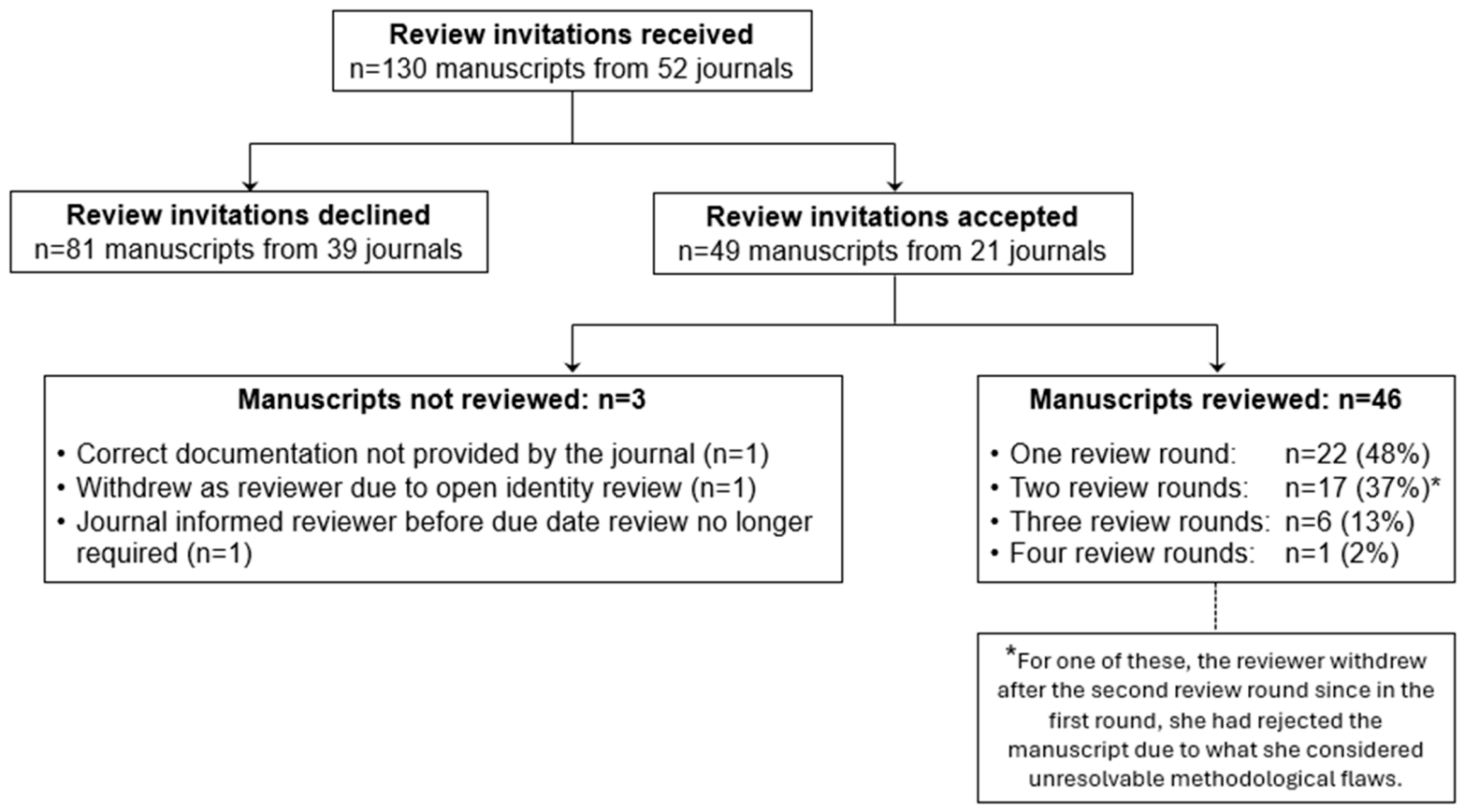
The reviewer responded to all 130 review invitations received from 2022 to 2024, and accepted 49 (38%) (
Figure 1). The acceptance percentage per year was 42% (18/43) in 2022; 36% (10/28) in 2023; and 36% (21/59) in 2024 (
p = 0.79). The reasons for declining review invitations (n = 81) are summarised in
Table 1. The most common reason (23/81; 28%) was that the researcher, a biostatistician, did not regard herself as having the necessary clinical background to do a proper review, for example, of clinical case reports or systematic reviews of a clinical condition.
The 49 accepted review invitations were from 21 journals (
Figure 1), mainly broad-scope medical or health journals (n = 7; 33%). Six (29%) of the journals were based in South Africa or elsewhere in Africa. For three of the accepted invitations, the reviewer did not submit a review of the manuscript, although she read two of the manuscripts. The context of the manuscript for which the reviewer decided not to do the open review (the reviewer’s name would be known) was such that she thought the lack of anonymity would influence her review. Of the 46 manuscripts reviewed, the majority (n = 24; 52%) had more than one review round, with the maximum number of review rounds being four in the case of one manuscript.
Table 2 summarises the communication received from journals subsequent to reviews being submitted. For 22 (48%) reviewed manuscripts, the reviewer was informed of the journal decision (accept, reject, revise or resubmit) after the review round. However, the reviewer received the final journal decision regarding acceptance of rejection of the manuscript for only 14 (30%) reviewed manuscripts. Journals provided other reviewers’ reviews for 20 (44%) reviewed manuscripts. Of the 22 manuscripts with only one review round, other reviewers’ comments were only provided in seven cases (32%). The same type of communication was not always received regarding manuscripts from the same journal. Of the 37 review rounds for which all reviewer comments were provided, the majority had two reviewers (n = 22; 59%), followed by 11 (30%) with three to five reviewers, and four (11%) with only one reviewer (the researcher).
Table 3 summarises the time in days elapsed between successive invitations for the same manuscript, between the first invitation and the last invitation of a manuscript, and between the first invitation and the final journal decision for a manuscript (if known). The median time between successive invitations was approximately 2 months (with an extreme value of 6 months). The median time between the first and last invitation was slightly under three months (with an extreme value of more than 9 months).
4. Discussion
The experience of one health sciences reviewer is by its nature subjective since the types of journals (with differing editorial processes) that approach a specific reviewer and the types of manuscripts they offer for review depend on characteristics of the potential reviewer. In addition, journals in other subject areas may follow different approaches. However, reflecting on my experience in a structured way, quantifying elements of the review process based on factual data may be of value to journal editors and other reviewers. I acknowledge that the coding of reasons for declining review invitations (one main reason per invitation) was subjective. This coding was done retrospectively, and for 15% of review invitations declined, no specific reason could be ascertained.
My acceptance percentage was similar for the three years despite receiving markedly varying numbers of invitations per year. Forty-nine accepted review invitations over a 3-year period, i.e., 1.4 per month, is substantially lower than the monthly average of 3.5, and approximately half of the lowest country average (Germany at 2.6) reported by
McNair et al. (
2019) in a survey of academics in 10 countries. It has to be noted that in that survey nearly half (47%) of the respondents who accepted one to three review invitations per month, and two thirds (66%) of those who accepted four or more review invitations per month, used the assistance of early-career researchers in the review process (
McNair et al., 2019), a practice which I have not used. Calculating a monthly average hides the fact that review invitations frequently come in waves; for example, 13 (22%) of the review invitations received in 2024 came in December (a summer holiday month in South Africa). I accepted four of these (31%), which was slightly less than the 36% acceptance percentage for the whole of 2024. Of the 49 accepted review invitations, only three (6%) did not lead to a completed review, with two of these cases being related to circumstances beyond the reviewer’s control. Hazen et al. noted that accepted review invitations frequently do not result in completed reviews (
Hazen et al., 2016).
It is unclear what could be considered an acceptable or realistic number of reviews to perform.
Fiedorowicz et al. (
2022) proposed the peer review debt index, which subtracts the number of reviews a researcher has performed from the number of reviews the researcher has received as an author (taking into account the number of authors on the researcher’s manuscripts), with a negative value for the index indicating that the researcher is repaying more than the debt (
Fiedorowicz et al., 2022).
Raoult (
2020) recommended that researchers should review at least as many manuscripts as they publish.
My main reason for declining invitations, namely, lack of the necessary expertise (47%), also commonly occurred in other studies. In the Clarivate survey (
Publons, 2018), main reasons for declining review invitations were “the article was outside my area of expertise” (70.6%) and “too busy with my own research” (42%) (respondents could select up to two options).
Grabarič Andonovski et al. (
2019) reported “work overload” (22%), “the paper was out of the reviewer’s expertise” (14%) and “the paper was of poor quality” (7%) as main reasons to decline review invitations (
Grabarič Andonovski et al., 2019). Despite the matching of manuscripts to reviewers based on reviewers’ specified fields of expertise, there will be nuances that cannot be identified adequately.
In my experience, there is an interplay (which is difficult to measure or quantify) between various factors such as the reviewer’s interest in the topic, the state of the manuscript, the time when the review invitation is received, and the reviewer’s previous review experience with the specific journal, which determines a reviewer’s willingness to accept a review invitation. Journal systems should ensure that technical inconsistencies, such as review invitations being addressed to a different person, do not occur. Pre-screening by editorial offices should identify manuscripts of obviously poor quality that are not ready to be sent for review.
Given the challenges of editors to find willing reviewers, some resort to automatic mass invitations (
Künzli et al., 2022). There was only one case where the journal informed me that my review was no longer required (although the due date had not yet arrived). Only upon my enquiry did the editor inform me that they had already received two reviews and wished to expedite the process. The procedure described by
Breuning et al. (
2015), where the editor contacts reviewers in such a case to inform them of the reviews already received and enquire whether the reviewer still wishes to review the manuscript, seems more reviewer-friendly.
Open review is a term used for a variety of review approaches, one of which is the disclosure of reviewer names or so-called open identities (
Ross-Hellauer et al., 2017). In their survey of authors, reviewers and editors
Ross-Hellauer et al. (
2017) found that respondents were positive about most aspects of open review but not open identities. Respondents indicated that reviewers should have the choice of being identified or not. Similar to my experience, with the one review invitation stipulating compulsory open identity review, two thirds of their survey respondents felt that this would lead them to be less likely to give strongly critical reviews (
Ross-Hellauer et al., 2017).
As
Watling et al. (
2021) pointed out, it is educational to see other reviewers’ comments, their varying interpretations, and which problems they focus on. The phrases other reviewers use (
Watling et al., 2021) or reviewing approaches used can also be helpful to the reviewer in future reviews. (It is, however, unclear what a reviewer should do if review comments by other reviewers are clearly wrong or other reviewers have done only extremely superficial reviews.) One can argue that reviewers see other reviewers’ comments in later review rounds when authors revise their manuscripts and respond to reviewer comments, but such responses are only seen if the revised manuscript is in fact sent to the reviewers again for further review.
Nearly half the manuscripts in this study had only one review round, and for the majority (68%) of those manuscripts, the journal provided no summary of reviewer feedback. The summary provided in author responses also does not necessarily give a complete picture of reviewer feedback. In my study, journal feedback to reviewers (if any) consisted of a listing of reviewer comments. There was little evidence of editorial engagement with the manuscript and the direction that the editor was giving authors in addition to the reviewer comments, as proposed by
Sovacool et al. (
2022) as editorial roles. Feedback regarding such editorial input would be educational to reviewers.
Journal websites frequently provide information regarding the journal’s acceptance percentage and average time from manuscript submission to journal decision and publication. It may be of value for reviewers if summarised information regarding the usual number of review rounds and time between review rounds are available. An overextended reviewer may prefer to avoid reviewing for a journal that usually has a large number of review rounds or lengthy intervals between successive review rounds. This may lead journals to try to ensure that review rounds are few and time intervals as short as possible.
A high number of review rounds could be a sign of insufficient initial manuscript screening by the editorial office, placing an additional burden on reviewers who repeatedly have to point out basic manuscript deficiencies. Phuljhele mentioned “the frequent poor quality and repetitiveness of the submissions” as a factor contributing to reviewer burnout (
Phuljhele, 2024).
Hazen et al. (
2016) advised that a reviewer should “match” the review to the state of the manuscript, while
Watling et al. (
2021) urged reviewers to “think big picture” and limit the time spent per review.
Monfort et al. (
2025) proposed a “hybrid AI–human peer review model”, “where AI handles initial screening and technical checks while human reviewers focus on intellectual and contextual evaluations”. Other authors have proposed more extensive involvement of AI in the review process (
Checco et al., 2021;
Mehmani & Ghildiyal, 2015).
When there are long time lapses between review rounds, a busy reviewer could lose track and consider the revised manuscript as a new manuscript, adding new comments for the authors to address. This may be exacerbated by review invitations not clearly stating that the invitations are for a revised manuscript (
Joubert, 2025). The length of time calculated in this study may be an underestimate of the entire time applicable for the specific manuscript since other participating reviewers may have been contacted earlier.
In conclusion, to align with the recommendations of the
ICMJE (
2026), journals should provide feedback to reviewers regarding other reviewers’ comments and the final journal decision. This would be of educational value to reviewers. Reviewers thus may feel that they also benefit from the process, and that their contributions are valued, potentially leading to more willing reviewers. Journal information regarding the usual number of review rounds and the duration of the review process, as well as editorial offices ensuring that only reviewable manuscripts are sent for review, may further impact reviewer willingness.