

Predictability of Sequential Distalization of the Upper Arch Using Invisalign®: A 3D Superimposition Study
 ,
,  , , and
Abstract
1. Introduction
2. Materials and Methods
2.1. Study Design and Sample
2.2. Inclusion and Exclusion Criteria
2.3. Sample Size Calculation
2.4. Sequential V-Pattern Distalization Protocol
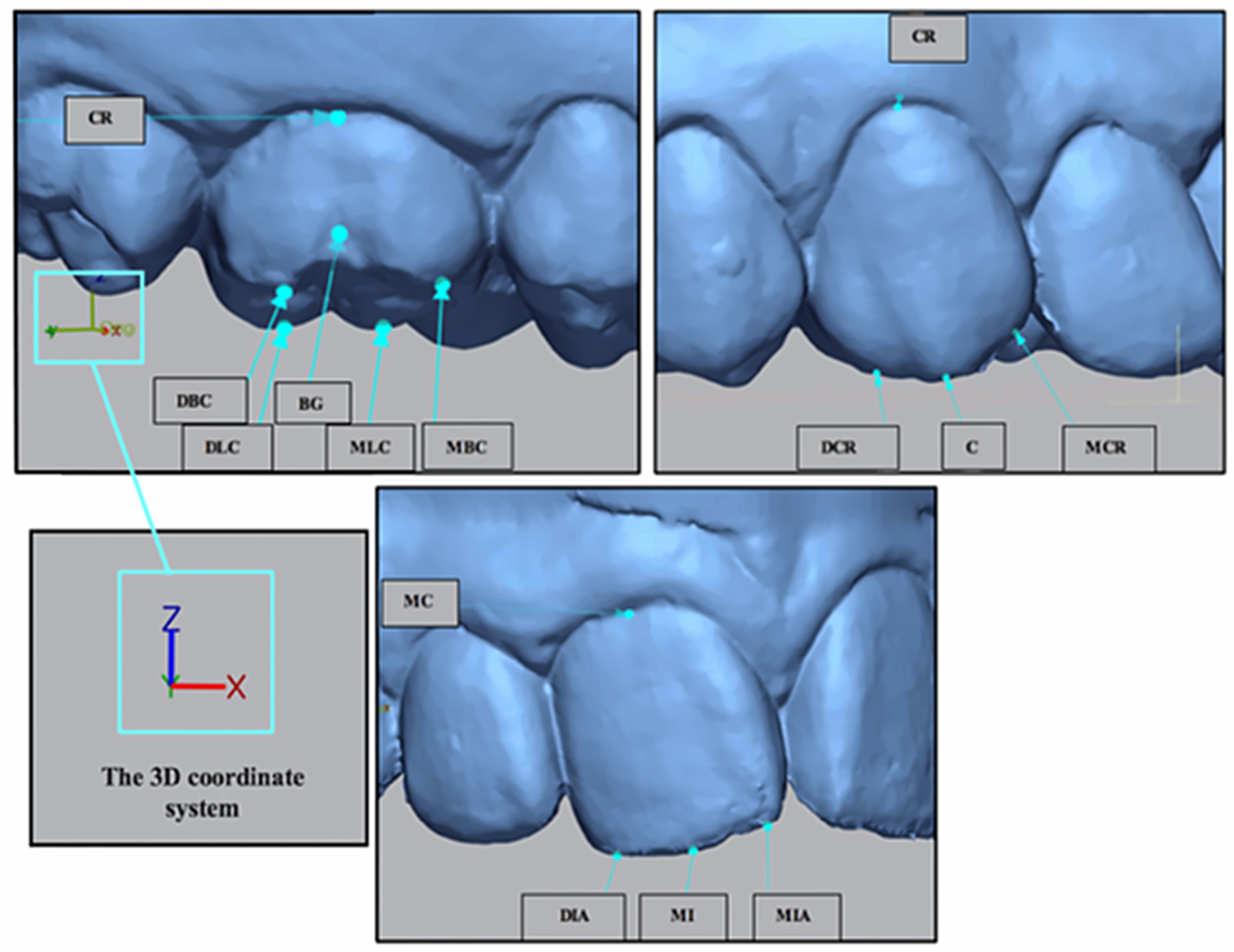
2.5. Digital Records and Measurements
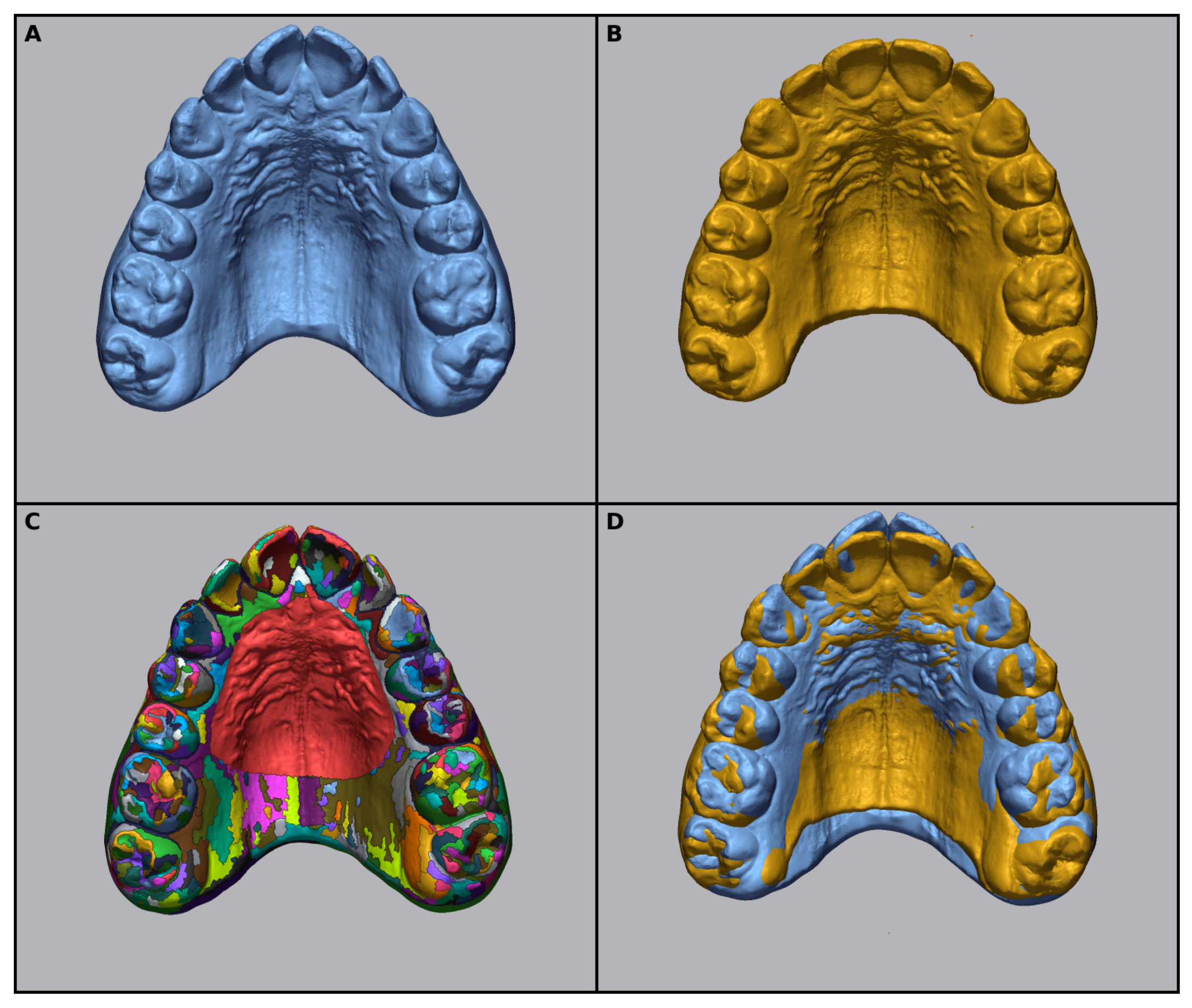
2.6. Superimposition Protocol
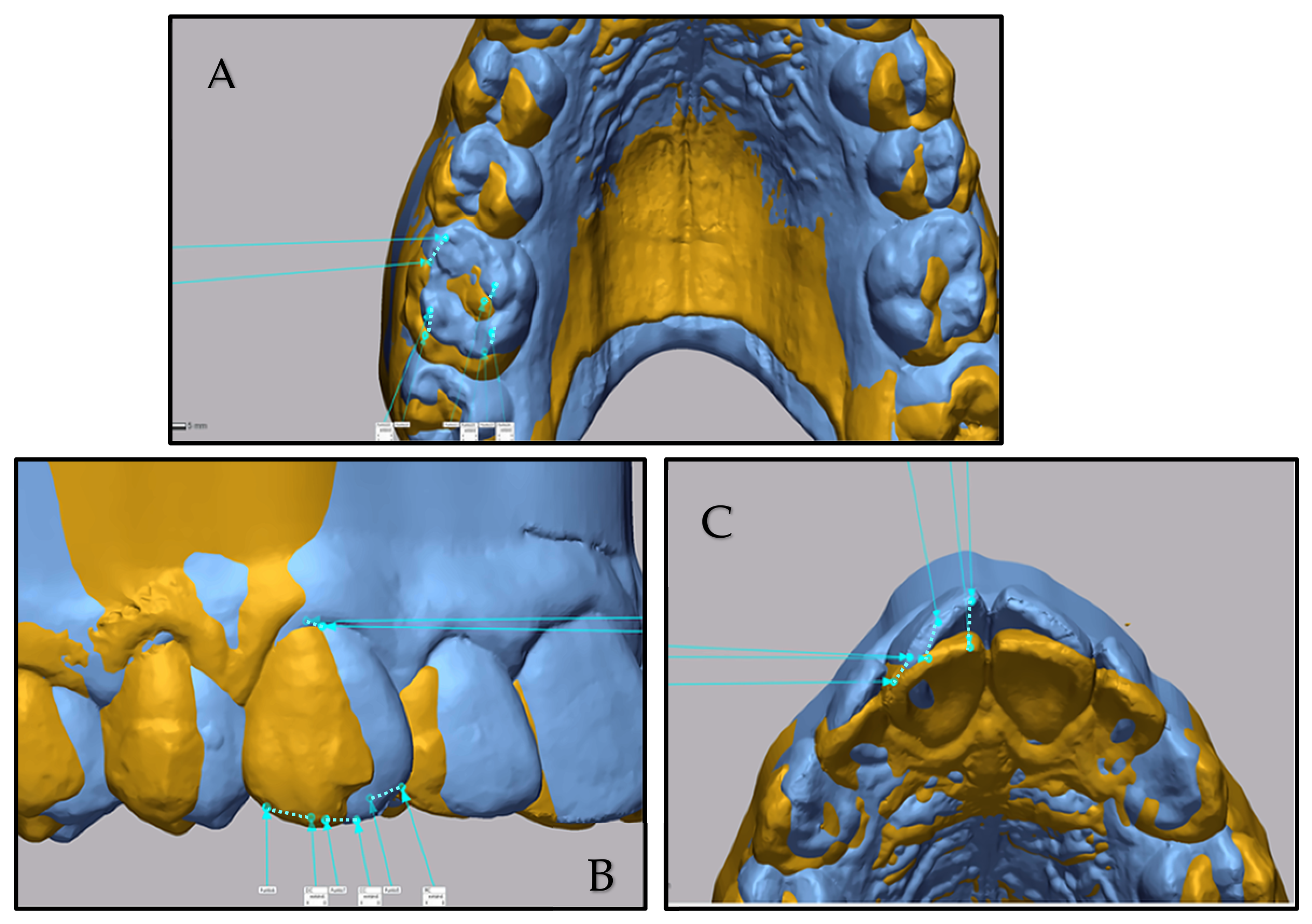
2.6.1. Linear Measurements
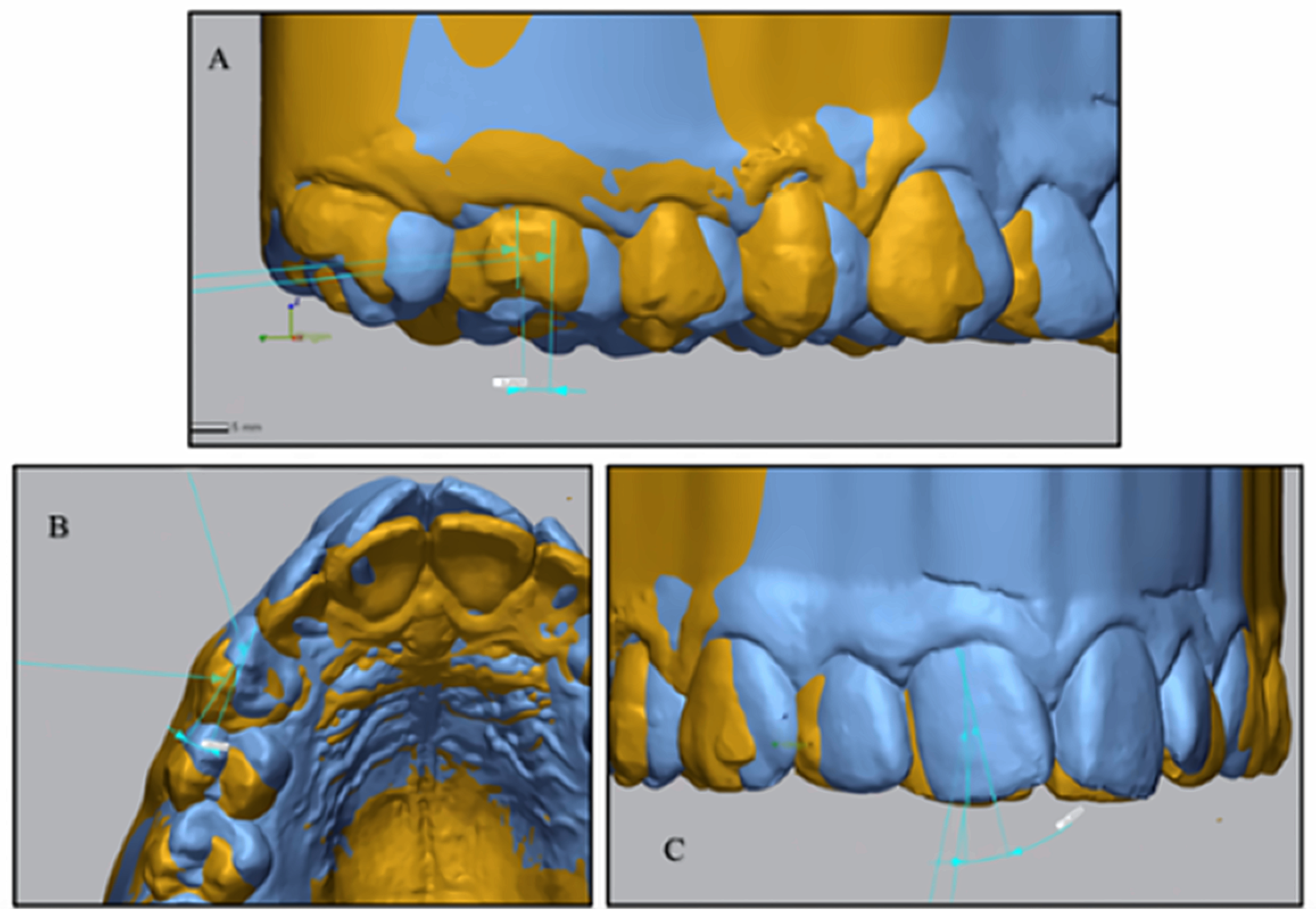
2.6.2. Angular Measurements
2.7. Statistical Analysis
3. Results
3.1. Molar Movements
3.2. Canine Movements
3.3. Incisor Movements
3.4. Predictability
3.5. Multivariable Analysis
4. Discussion
4.1. Biomechanical Interpretation of Molar Movements
4.2. Canine Movements
4.3. Incisor Movements
4.4. Clinical Implications
4.5. Limitations
5. Conclusions
- The predictability of sequential distalization in the upper arch has been shown to be unreliable in molars, canines, and incisors. The planned distalization of 2.60 and 2.45 mm for first molars and canines, respectively, resulted in actual distal movements of approximately 1.80 and 1.12 mm, as observed in the CAT. Given that the planned movements were only partially achieved after the initial treatment plan, and due to this lack of predictability, subsequent refinement stages should be anticipated later in treatment to correct the initial objectives.
- Molar distalization led to distal inclination movement and corono-buccal torque, as well as unplanned intrusion. The use of vertical rectangular attachments was associated with better control over molar crown inclination.
Author Contributions
Funding
Institutional Review Board Statement
Informed Consent Statement
Data Availability Statement
Conflicts of Interest
References
- Bechtold, T.E.; Park, Y.C.; Kim, K.H.; Jung, H.; Kang, J.Y.; Choi, Y.J. Long-term stability of miniscrew anchored maxillary molar distalization in Class II treatment. Angle Orthod. 2020, 90, 362–368. [Google Scholar] [CrossRef] [Scilit] [PubMed]
- Kusy, R.P. Influence of force systems on archwire-bracket combinations. Am. J. Orthod. Dentofac. Orthop. 2005, 127, 333–342. [Google Scholar] [CrossRef] [Scilit] [PubMed]
- Rossini, G.; Parrini, S.; Castroflorio, T.; Deregibus, A.; Debernardi, C.L. Efficacy of clear aligners in controlling orthodontic tooth movement: A systematic review. Angle Orthod. 2015, 85, 881–889. [Google Scholar] [CrossRef] [Scilit] [PubMed]
- Simon, M.; Keilig, L.; Schwarze, J.; Jung, B.A.; Bourauel, C. Treatment outcome and efficacy of an aligner technique—Regarding incisor torque, premolar derotation and molar distalization. BMC Oral Health 2014, 14, 68. [Google Scholar] [CrossRef] [Scilit] [PubMed]
- Saif, B.S.; Pan, F.; Mou, Q.; Han, M.; Bu, W.; Zhao, J.; Guan, L.; Wang, F.; Zou, R.; Zhou, H.; et al. Efficiency evaluation of maxillary molar distalization using Invisalign based on palatal rugae registration. Am. J. Orthod. Dentofac. Orthop. 2022, 161, e372–e379. [Google Scholar] [CrossRef] [Scilit] [PubMed]
- Ravera, S.; Castroflorio, T.; Garino, F.; Daher, S.; Cugliari, G.; Deregibus, A. Maxillary molar distalization with aligners in adult patients: A multicenter retrospective study. Prog. Orthod. 2016, 17, 12. [Google Scholar] [CrossRef] [Scilit] [PubMed]
- Caruso, S.; Nota, A.; Ehsani, S.; Maddalone, E.; Ojima, K.; Tecco, S. Impact of molar teeth distalization with clear aligners on occlusal vertical dimension: A retrospective study. BMC Oral Health 2019, 19, 182. [Google Scholar] [CrossRef] [Scilit] [PubMed]
- Grunheid, T.; Loh, C.; Larson, B.E. How accurate is Invisalign in nonextraction cases? Are predicted tooth positions achieved? Angle Orthod. 2017, 87, 809–815. [Google Scholar] [CrossRef] [Scilit] [PubMed]
- Lombardo, L.; Arreghini, A.; Ramina, F.; Huanca Ghislanzoni, L.T.; Siciliani, G. Predictability of orthodontic movement with orthodontic aligners: A retrospective study. Prog. Orthod. 2017, 18, 35. [Google Scholar] [CrossRef] [Scilit] [PubMed]
- Inchingolo, A.M.; Inchingolo, A.D.; Carpentiere, V.; Del Vecchio, G.; Ferrante, L.; Di Noia, A.; Palermo, A.; Di Venere, D.; Dipalma, G.; Inchingolo, F. Predictability of Dental Distalization with Clear Aligners: A Systematic Review. Bioengineering 2023, 10, 1390. [Google Scholar] [CrossRef] [Scilit] [PubMed]
- Hmud, R.; Alamri, A. Evaluating the efficacy and predictability of distalization protocols for maxillary molars in Class II treatment with clear Aligners: A narrative review. Saudi Dent. J. 2024, 36, 1184–1189. [Google Scholar] [CrossRef] [Scilit] [PubMed]
- Miao, Z.; Zhang, H.; Yang, Y.; Han, Y.; Leng, J.; Wang, S. Influence of maxillary molar distalization with clear aligners on three-dimensional direction: Molar distal movement, intrusion, distal tip and crown buccal torque. Prog. Orthod. 2023, 24, 48. [Google Scholar] [CrossRef] [Scilit] [PubMed]
- Adel, S.M.; Vaid, N.R.; El-Harouni, N.; Kassem, H.; Zaher, A.R. TIP, TORQUE & ROTATIONS: How accurately do digital superimposition software packages quantify tooth movement? Prog. Orthod. 2022, 23, 8. [Google Scholar] [CrossRef] [Scilit] [PubMed]
- Meade, M.J.; Weir, T.; Byrne, G. Comparison of digital study model superimposition methods using implant-supported crowns and best-fit algorithms. Am. J. Orthod. Dentofac. Orthop. 2024, 166, 384–392. [Google Scholar] [CrossRef] [Scilit] [PubMed]
- Choi, D.S.; Jeong, Y.M.; Jang, I.; Jost-Brinkmann, P.G.; Cha, B.K. Accuracy and reliability of palatal superimposition of three-dimensional digital models. Angle Orthod. 2010, 80, 497–503. [Google Scholar] [CrossRef] [Scilit] [PubMed]
- Shukla, D.; Chowdhry, A.; Bablani, D.; Jain, P.; Thapar, R. Establishing the reliability of palatal rugae pattern in individual identification (following orthodontic treatment). J. Forensic Odonto-Stomatol. 2011, 29, 20–29. [Google Scholar]
- Lucchese, A.; Manuelli, M.; Albertini, P.; Ghislanzoni, L.H. Transverse and torque dental changes after passive self-ligating fixed therapy: A two-year follow-up study. Am. J. Orthod. Dentofac. Orthop. 2019, 156, 94–103. [Google Scholar] [CrossRef] [Scilit] [PubMed]
- D’Anto, V.; Valletta, R.; Ferretti, R.; Bucci, R.; Kirlis, R.; Rongo, R. Predictability of Maxillary Molar Distalization and Derotation with Clear Aligners: A Prospective Study. Int. J. Environ. Res. Public Health 2023, 20, 2941. [Google Scholar] [CrossRef] [Scilit] [PubMed]
- Li, L.; Guo, R.; Zhang, L.; Huang, Y.; Jia, Y.; Li, W. Maxillary molar distalization with a 2-week clear aligner protocol in patients with Class II malocclusion: A retrospective study. Am. J. Orthod. Dentofac. Orthop. 2023, 164, 123–130. [Google Scholar] [CrossRef] [Scilit] [PubMed]
- Li, J.; Yang, Y.; He, X.; Lai, W.; Long, H. Effects of Attachment Orientation and Designed Vertical Movement on Molar Distalisation With Clear Aligners: A Biomechanical Finite Element Study. Orthod. Craniofacial Res. 2025, 28, 296–303. [Google Scholar] [CrossRef] [Scilit] [PubMed]
- Garino, F.; Castroflorio, T.; Daher, S.; Ravera, S.; Rossini, G.; Cugliari, G.; Deregibus, A. Effectiveness of Composite Attachments in Controlling Upper-Molar Movement with Aligners. J. Clin. Orthod. 2016, 50, 341–347. [Google Scholar] [PubMed]
- Vlaskalic, V.; Samoto, H. Class II correction with weekly changes of computer-generated aligners: Distalize or jump. J. Clin. Orthod. 2018, 52, 684–700. [Google Scholar] [PubMed]
- Mao, B.; Tian, Y.; Liu, D.; Zhou, Y.; Wang, S. The effect of maxillary premolar distalization with different designed clear aligners: A 4D finite element study with staging simulation. Prog. Orthod. 2024, 25, 46. [Google Scholar] [CrossRef] [Scilit] [PubMed]
- Lione, R.; Paoloni, V.; De Razza, F.C.; Pavoni, C.; Cozza, P. Analysis of Maxillary First Molar Derotation with Invisalign Clear Aligners in Permanent Dentition. Life 2022, 12, 1495. [Google Scholar] [CrossRef] [Scilit] [PubMed]
- Morales-Burruezo, I.; Gandia-Franco, J.L.; Cobo, J.; Vela-Hernandez, A.; Bellot-Arcis, C. Arch expansion with the Invisalign system: Efficacy and predictability. PLoS ONE 2020, 15, e0242979. [Google Scholar] [CrossRef] [Scilit] [PubMed]
- Benedetti, G.; Sicca, N.; Lopponi, G.; Dettori, C.; Verdecchia, A.; Spinas, E. Evaluating the Clinical Success of Clear Aligners for Rotational Tooth Movements in Adult Patients: A Systematic Review. Dent. J. 2025, 13, 440. [Google Scholar] [CrossRef] [Scilit] [PubMed]
- Miao, Z.; Yang, Y.; Zhang, H.; Zheng, C.; Gao, X.; Zhu, J.; Han, Y.; Wang, S. Anchorage loss in maxillary premolar and anterior teeth during maxillary molar distalization in clear aligner treatment. Am. J. Orthod. Dentofac. Orthop. 2025, 167, 690–702. [Google Scholar] [CrossRef] [Scilit] [PubMed]
- Ren, L.; Liu, L.; Wu, Z.; Shan, D.; Pu, L.; Gao, Y.; Tang, Z.; Li, X.; Jian, F.; Wang, Y.; et al. The predictability of orthodontic tooth movements through clear aligner among first-premolar extraction patients: A multivariate analysis. Prog. Orthod. 2022, 23, 52. [Google Scholar] [CrossRef] [Scilit] [PubMed]
- Kravitz, N.D.; Kusnoto, B.; BeGole, E.; Obrez, A.; Agran, B. How well does Invisalign work? A prospective clinical study evaluating the efficacy of tooth movement with Invisalign. Am. J. Orthod. Dentofac. Orthop. 2009, 135, 27–35. [Google Scholar] [CrossRef] [Scilit] [PubMed]
- Kravitz, N.D.; Kusnoto, B.; Agran, B.; Viana, G. Influence of attachments and interproximal reduction on the accuracy of canine rotation with Invisalign. A prospective clinical study. Angle Orthod. 2008, 78, 682–687. [Google Scholar] [PubMed]
- Palone, M.; Pignotti, A.; Morin, E.; Pancari, C.; Spedicato, G.A.; Cremonini, F.; Lombardo, L. Analysis of overcorrection to be included for planning clear aligner therapy: A retrospective study. Angle Orthod. 2023, 93, 11–18. [Google Scholar] [CrossRef] [Scilit] [PubMed]
- Fracchia, D.E.; Bignotti, D.; Lai, S.; Battista, E.; Verdecchia, A.; Spinas, E. Predictability of Lower Incisor Intrusion with Clear Aligners: A Systematic Review of Efficacy and Influencing Factors. J. Clin. Med. 2025, 14, 6339. [Google Scholar] [CrossRef] [Scilit] [PubMed]
- Sandhya, V.; Arun, A.; Reddy, V.P.; Mahendra, S.; Chandrashekar, B.; Aravind, N. Biomechanical Effects of Torquing on Upper Central Incisor with Thermoplastic Aligner: A Comparative Three-Dimensional Finite Element Study with and Without Auxillaries. J. Indian Orthod. Soc. 2022, 56, 49–56. [Google Scholar] [CrossRef] [Scilit]



| Molar Movement | Predicted Mean ± SD | Achieved Mean ± SD | Deviational Movement Mean ± SD | p |
|---|---|---|---|---|
| Extrusion/Intrusion (mm) | −0.01 ± 0.40 | 0.79 ± 0.52 | 0.80 ± 0.53 | 0.000 * |
| Translation B/L (mm) | 1.17 ± 0.90 | 1.14 ± 0.77 | −0.04 ± 0.44 | 0.462 |
| Translation M/D (mm) | 2.60 ± 1.42 | 1.80 ± 1.09 | −0.80 ± 0.71 | 0.000 * |
| Rotation (°) | 6.28 ± 5.21 | 5.55 ± 4.92 | −0.74 ± 2.48 | 0.008 * |
| Angulation (°) | 2.83 ± 2.89 | 6.51 ± 3.56 | 3.69 ± 2.47 | 0.000 * |
| Torque (°) | 0.57 ± 4.38 | 4.12 ± 3.88 | 3.55 ± 2.88 | 0.000 * |
| Canine Movement | Predicted Mean ± SD | Achieved Mean ± SD | Deviational Movement Me an± SD | p |
|---|---|---|---|---|
| Extrusion/Intrusion (mm) | 0.12 ± 0.74 | −0.03 ± 1.45 | −0.14 ± 1.32 | 0.337 |
| Translation B/L (mm) | −0.35 ± 1.18 | 0.00 ± 1.08 | 0.36 ± 1.55 | 0.042 * |
| Translation M/D (mm) | 2.45 ± 1.36 | 1.12 ± 0.99 | −1.33 ± 1.01 | 0.000 * |
| Rotation (°) | 9.61 ± 12.12 | 5.14 ± 7.25 | −4.47 ± 7.01 | 0.000 * |
| Angulation (°) | 0.69 ± 5.65 | 2.80 ± 4.97 | 2.11 ± 7.11 | 0.009 * |
| Torque (°) | 3.20 ± 4.82 | 4.20 ± 4.29 | 1.01 ± 2.17 | 0.000 * |
| Incisor Movement | Predicted Mean ± SD | Achieved Mean ± SD | Deviational Movement Mean ± SD | p |
|---|---|---|---|---|
| Extrusion/Intrusion (mm) | 1.45 ± 1.12 | 0.03 ± 0.82 | −1.42 ± 1.23 | 0.000 * |
| Translation B/L (mm) | 0.76 ± 2.15 | −0.09 ± 1.64 | −0.86 ± 1.07 | 0.000 * |
| Translation M/D (mm) | −0.13 ± 1.20 | −0.07 ± 0.81 | 0.05 ± 0.98 | 0.628 |
| Rotation (°) | 2.62 ± 13.63 | 1.63 ± 8.85 | −0.99 ± 6.62 | 0.184 |
| Angulation (°) | 1.69 ± 3.81 | 0.91 ± 2.90 | −0.78 ± 1.36 | 0.000 * |
| Torque (°) | 7.59 ± 8.56 | 1.76 ± 6.37 | −5.83 ± 4.57 | 0.000 * |
| Movement | Molar Accuracy (%) | Canine Accuracy (%) | Incisor Accuracy (%) |
|---|---|---|---|
| Extrusion/Intrusion | — a | — b | 2.1 |
| Translation B/L | 97.4 | — a | — a |
| Translation M/D | 69.2 | 45.7 | — b |
| Rotation | 88.4 | 53.5 | 62.2 |
| Angulation | — c | — c | 53.8 |
| Torque | — c | — c | 23.2 |
| Maxillary First Molar | Extrusion/Intrusion (mm) | Translation B/L (mm) | Translation M/D (mm) | |||
| B (CI) | p | B (CI) | p | B (CI) | p | |
| Optimized Attachment | −0.181 (−0.461, 0.099) | 0.200 | −0.086 (−0.305, 0.132) | 0.431 | 0.004 (−0.348, 0.339) | 0.980 |
| Rectangular Attachment | Reference | Reference | Reference | |||
| ANB | −0.059 (−0.155, 0.037) | 0.224 | −0.027 (−0.103, 0.049) | 0.482 | 0.020 (−0.102, 0.143) | 0.738 |
| Mandibular Plane | 0.006 (−0.024, 0.037) | 0.688 | 0.003 (−0.026, 0.020) | 0.779 | −0.025 (−0.064, 0.013) | 0.192 |
| Number of Aligners | 0.003 (−0.014, 0.019) | 0.763 | 0.005 (−0.008, 0.018) | 0.454 | −0.006 (−0.027, 0.013) | 0.505 |
| Maxillary First Molar | Rotation (°) | Angulation (°) | Torque (°) | |||
| B (CI) | p | B (CI) | p | B (CI) | p | |
| Optimized Attachment | 0.725 (−0.707, 2.220) | 0.335 | 1.430 (0.031, 2.828) | 0.045 * | −0.737 (−2.242, 0.776) | 0.330 |
| Rectangular Attachment | Reference | Reference | Reference | |||
| ANB | −0.033 (−0.528, 0.461) | 0.892 | 0.106 (−0.375, 0.588) | 0.659 | −0.005 (−0.532, 0.522) | 0.985 |
| Mandibular Plane | −0.212 (−0.372, −0.052) | 0.010 * | −0.130 (−0.279, 0.019) | 0.086 | −0.137 (−0.300, 0.026) | 0.099 |
| Number of Aligners | 0.029 (−0.056, 0.114) | 0.505 | 0.017 (−0.066, 0.101) | 0.680 | 0.001 (−0.087 to 0.090) | 0.969 |
| Maxillary Canine | Extrusion/Intrusion (mm) | Translation B/L (mm) | Translation M/D (mm) | |||
| B (CI) | p | B (CI) | p | B (CI) | p | |
| Optimized Attachment | −0.210 (−0.958, 0.537) | 0.576 | −0.100 (−0.690, 0.489) | 0.736 | −0.158 (−0.525, 0.208) | 0.392 |
| Rectangular Attachment | Reference | Reference | Reference | |||
| ANB | −0.125 (−0.351, 0.099) | 0.270 | −0.035 (−0.221, 0.142) | 0.693 | −0.056 (−0.166, 0.053) | 0.308 |
| Overbite | 0.090 (−0.102, 0.283) | 0.353 | 0.003 (−0.120, 0.127) | 0.958 | −0.071 (−0.147, 0.003) | 0.062 * |
| Overjet | −0.016 (−0.289, 0.256) | 0.906 | 0.051 (−0.157, 0.260) | 0.622 | −0.095 (−0.224, 0.032) | 0.142 |
| Maxillary Canine | Rotation (°) | Angulation (°) | Torque (°) | |||
| B (CI) | p | B (CI) | p | B (CI) | p | |
| Optimized Attachment | 1.242 (−0.735, 3.221) | 0.214 | −1.824 (−4.156, 0.506) | 0.123 | −0.408 (−1.494, 0.677) | 0.455 |
| Rectangular Attachment | Reference | Reference | Reference | |||
| ANB | −0.447 (−1.050, 0.156) | 0.144 | 0.289 (−0.403, 0.982) | 0.407 | 0.077 (−0.239, 0.393) | 0.628 |
| Overbite | −0.034 (−0.446, 0.378) | 0.870 | −0.846 (−1.333, 0.359) | 0.001 | 0.167 (−0.059, 0.394) | 0.145 |
| Overjet | −0.281 (−0.978, 0.415) | 0.422 | −1.202 (−2.024, 0.380) | 0.005 | −0.174 (−0.547, 0.198) | 0.353 |
| Maxillary Incisor | Extrusion/Intrusion (mm) | Translation B/L (mm) | Translation M/D (mm) | |||
| B (CI) | p | B (CI) | p | B (CI) | p | |
| Without Attachment | −0.005 (−0.381, 0.370) | 0.976 | 0.047 (−0.421, 0.516) | 0.840 | −0.023 (−0.399, 0.351) | 0.900 |
| With Attachment | Reference | Reference | Reference | |||
| Without Power Ridge | 0.062 (−0.297, 0.421) | 0.732 | −0.412 (−0.858, 0.034) | 0.070 * | 0.108 (−0.259, 0.475) | 0.559 |
| With Power Ridge | Reference | Reference | Reference | |||
| ANB | −0.0435 (−0.143, 0.056) | 0.386 | 0.000 (−0.122, 0.120) | 0.988 | −0.029 (−0.128, 0.069) | 0.554 |
| Overbite | 0.138 (0.040, 0.236) | 0.014 * | −0.017 (−0.105, 0.070) | 0.693 | −0.088 (−0.158, −0.018) | 0.014 * |
| Overjet | −0.189 (−0.310, 0.068) | 0.003 * | 0.048 (−0.126, 0.223) | 0.582 | −0.038 (−0.156, 0.080) | 0.521 |
| Maxillary Incisor | Rotation (°) | Angulation (°) | Torque (°) | |||
| B (CI) | p | B (CI) | p | B (CI) | p | |
| Without Attachment | −0.579 (−2.7436, 1.576) | 0.594 | −0.060 (−0.597, 0.476) | 0.818 | −2.422 (−4.232, −0.612) | 0.009 * |
| With Attachment | Reference | Reference | Reference | |||
| Without Power Ridge | 0.544 (−1.516, 2.604) | 0.600 | 0.119 (−0.383, 0.622) | 0.638 | −3.788 (−5.636, −1.940) | 0.000 * |
| With Power Ridge | Reference | Reference | Reference | |||
| ANB | 0.330 (−0.236, 0.898) | 0.249 | −0.042 (−0.181, 0.096) | 0.544 | −0.173 (−0.650, 0.303) | 0.470 |
| Overbite | −0.020 (−0.424, 0.382) | 0.918 | −0.018 (−0.116, 0.079) | 0.708 | −0.192 (−0.562, 0.176) | 0.302 |
| Overjet | 0.073 (−0.569, 0.717) | 0.820 | 0.015 (−0.144, 0.175) | 0.849 | −0.228 (−0.887, 0.430) | 0.492 |
Disclaimer/Publisher’s Note: The statements, opinions and data contained in all publications are solely those of the individual author(s) and contributor(s) and not of MDPI and/or the editor(s). MDPI and/or the editor(s) disclaim responsibility for any injury to people or property resulting from any ideas, methods, instructions or products referred to in the content. |
© 2026 by the authors. Licensee MDPI, Basel, Switzerland. This article is an open access article distributed under the terms and conditions of the Creative Commons Attribution (CC BY) license.
Share and Cite
López-Mateos, C.M.; López-Mateos, M.L.M.; Alarcón, J.A.; Menéndez-Núñez, M.; Martin, C. Predictability of Sequential Distalization of the Upper Arch Using Invisalign®: A 3D Superimposition Study. Dent. J. 2026, 14, 601. https://doi.org/10.3390/dj14090601
López-Mateos CM, López-Mateos MLM, Alarcón JA, Menéndez-Núñez M, Martin C. Predictability of Sequential Distalization of the Upper Arch Using Invisalign®: A 3D Superimposition Study. Dentistry Journal. 2026; 14(9):601. https://doi.org/10.3390/dj14090601
Chicago/Turabian StyleLópez-Mateos, Cristina Menéndez, Mª Luisa Menéndez López-Mateos, José Antonio Alarcón, Mario Menéndez-Núñez, and Conchita Martin. 2026. "Predictability of Sequential Distalization of the Upper Arch Using Invisalign®: A 3D Superimposition Study" Dentistry Journal 14, no. 9: 601. https://doi.org/10.3390/dj14090601
APA StyleLópez-Mateos, C. M., López-Mateos, M. L. M., Alarcón, J. A., Menéndez-Núñez, M., & Martin, C. (2026). Predictability of Sequential Distalization of the Upper Arch Using Invisalign®: A 3D Superimposition Study. Dentistry Journal, 14(9), 601. https://doi.org/10.3390/dj14090601