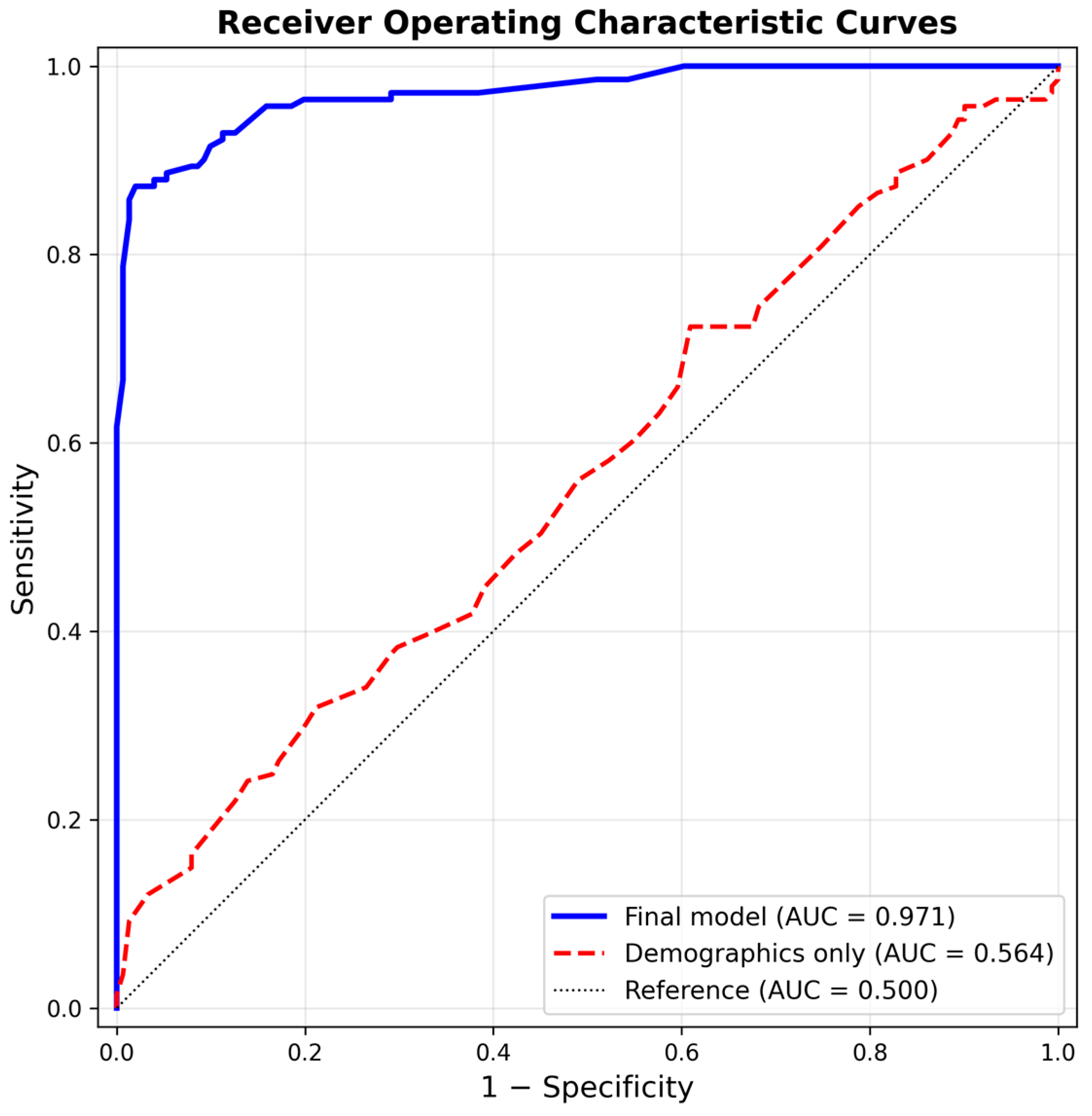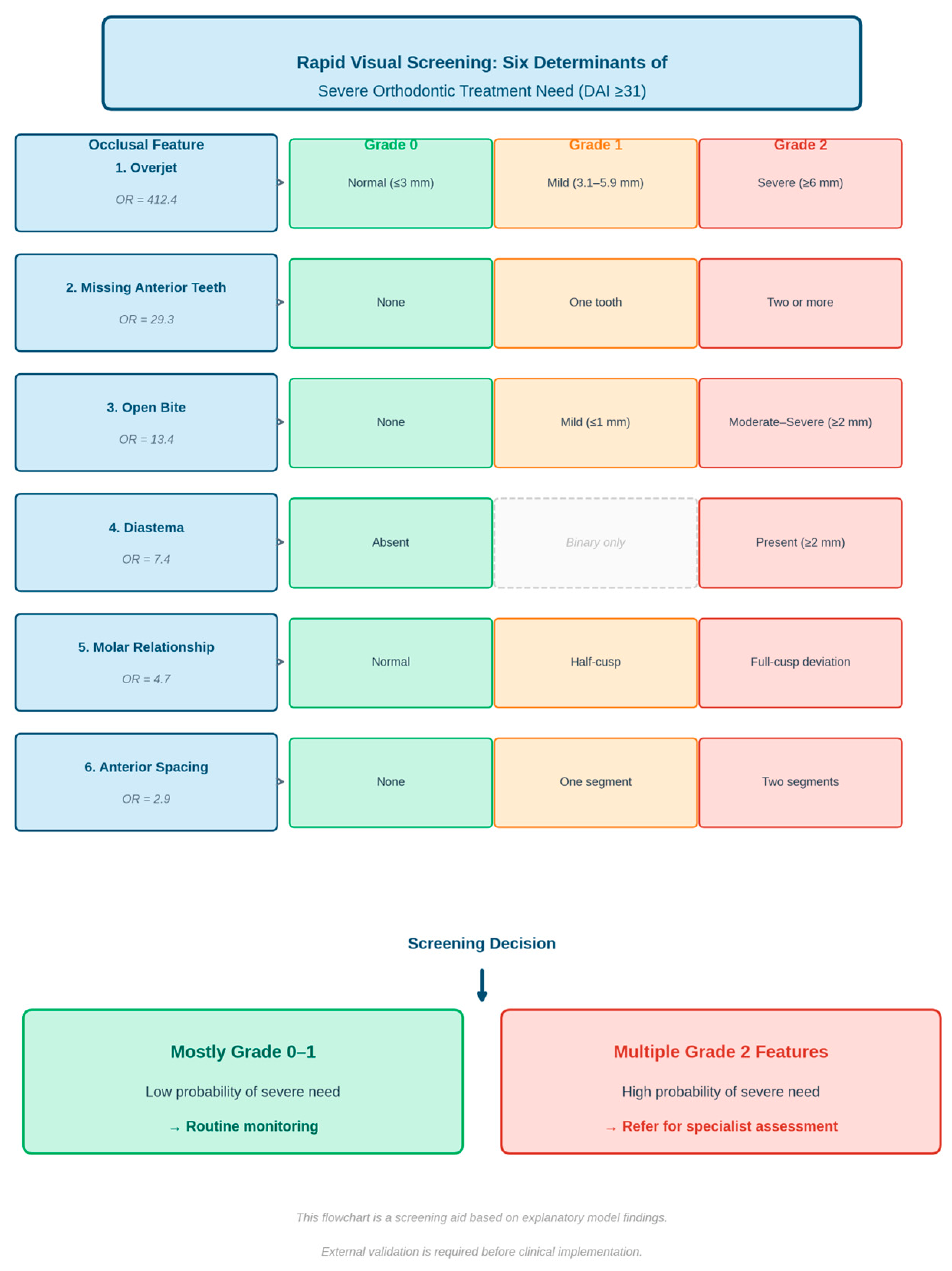
Determinants of Severe Orthodontic Treatment Need Using Clinically Categorized Occlusal Features

Abstract
1. Introduction
2. Materials and Methods
Examiner Calibration and Reliability
3. Results
4. Discussion
5. Conclusions
Supplementary Materials
Funding
Institutional Review Board Statement
Informed Consent Statement
Data Availability Statement
Acknowledgments
Conflicts of Interest
References
- Proffit, W.R.; Fields, H.W., Jr.; Moray, L.J. Prevalence of malocclusion and orthodontic treatment need in the United States: Estimates from the NHANES III survey. Int. J. Adult Orthod. Orthognath. Surg. 1998, 13, 97–106. [Google Scholar]
- Gudipaneni, R.K.; Aldahmeshi, R.F.; Patil, S.R.; Alam, M.K. The prevalence of malocclusion and the need for orthodontic treatment among adolescents in the northern border region of Saudi Arabia: An epidemiological study. BMC Oral Health 2018, 18, 16. [Google Scholar] [CrossRef]
- Alajlan, S.S.; Alsaleh, M.K.; Alshammari, A.F.; Alharbi, S.M.; Alshammari, R.S.; Alshammari, L.S.; Alageel, A.S. The prevalence of malocclusion and orthodontic treatment need of school children in Northern Saudi Arabia. J. Orthod. Sci. 2019, 8, 10. [Google Scholar] [CrossRef]
- Al-Emran, S.; Wisth, P.J.; Bøe, O.E. Prevalence of malocclusion and need for orthodontic treatment in Saudi Arabia. Community Dent. Oral Epidemiol. 1990, 18, 253–255. [Google Scholar] [CrossRef]
- Mtaya, M.; Aström, A.N.; Brudvik, P. Malocclusion, psycho-social impacts and treatment need: A cross-sectional study of Tanzanian primary school-children. BMC Oral Health 2008, 8, 14. [Google Scholar] [CrossRef] [PubMed]
- Scapini, A.; Feldens, C.A.; Ardenghi, T.M.; Kramer, P.F. Malocclusion impacts adolescents’ oral health-related quality of life. Angle Orthod. 2013, 83, 512–518. [Google Scholar] [CrossRef]
- Borzabadi-Farahani, A. An insight into four orthodontic treatment need indices. Prog. Orthod. 2011, 12, 132–142. [Google Scholar] [CrossRef] [PubMed]
- World Health Organization. Oral Health Surveys: Basic Methods, 4th ed.; WHO: Geneva, Switzerland, 1997. [Google Scholar]
- Cons, N.C.; Jenny, J.; Kohout, F.J. DAI: The Dental Aesthetic Index; College of Dentistry, University of Iowa: Iowa City, IA, USA, 1986. [Google Scholar]
- Jenny, J.; Cons, N.C. Establishing malocclusion severity levels on the Dental Aesthetic Index (DAI) scale. Aust. Dent. J. 1996, 41, 43–46. [Google Scholar] [CrossRef] [PubMed]
- Brook, P.H.; Shaw, W.C. The development of an index of orthodontic treatment priority. Eur. J. Orthod. 1989, 11, 309–320. [Google Scholar] [CrossRef]
- Beglin, F.M.; Firestone, A.R.; Vig, K.W.; Beck, F.M.; Kuthy, R.A.; Wade, D. A comparison of the reliability and validity of 3 occlusal indexes of orthodontic treatment need. Am. J. Orthod. Dentofac. Orthop. 2001, 120, 240–246. [Google Scholar] [CrossRef]
- de Oliveira Meira, A.C.L.; Custodio, W.; Vedovello Filho, M.; Anholete Gouveia, S.A.; de Carvalho Meneghim, M.; Vedovello, S.A.S. How is orthodontic treatment need associated with perceived esthetic impact of malocclusion in adolescents? Am. J. Orthod. Dentofac. Orthop. 2020, 158, 668–673. [Google Scholar] [CrossRef]
- Silva, D.A.F.; Carneiro, D.P.A.; Nabarrette, M.; Vedovello Filho, M.; Santamaria, M., Jr.; Vedovello, S.A.S. Impact of Dental Aesthetic Index characteristics on the severity levels of malocclusion in a non-White population. Am. J. Orthod. Dentofac. Orthop. 2022, 162, e252–e256. [Google Scholar] [CrossRef]
- de Melo, K.C.P.A.; Vedovello-Filho, M.; Furletti-Góis, V.F.; de C. Meneghim, M.; Vedovello, S.A.S. Is the adolescent’s esthetic concern associated with anterior occlusal conditions or the malocclusion severity level? Angle Orthod. 2021, 91, 496–501. [Google Scholar] [CrossRef] [PubMed]
- Avila Carranza, M.B.; Torre Delgadillo, A.; Martínez Zumarán, A.; Gutiérrez Rojo, J.F.; Guerrero Castellón, M.P.; Gutiérrez Villaseñor, J. Orthodontic treatment need and its relation to gender, oral hygiene, and age range in a Mexican population. Cureus 2024, 16, e75088. [Google Scholar] [CrossRef]
- Alhazmi, A.; Alshehri, M.; Alrefai, A.; Abudiak, H.; Alshehri, A.; Alanazi, M.; Alshahrani, A. Assessment of severity of malocclusion and orthodontic treatment need using the Dental Aesthetic Index and Angle’s classification: A retrospective study. J. Contemp. Dent. Pract. 2021, 22, 1167–1170. [Google Scholar] [CrossRef]
- Collins, G.S.; Reitsma, J.B.; Altman, D.G.; Moons, K.G.M. Transparent Reporting of a multivariable prediction model for Individual Prognosis Or Diagnosis (TRIPOD): The TRIPOD Statement. Ann. Intern. Med. 2015, 162, 55–63. [Google Scholar] [CrossRef]
- Moons, K.G.M.; Altman, D.G.; Reitsma, J.B.; Ioannidis, J.P.A.; Macaskill, P.; Steyerberg, E.W.; Vickers, A.J.; Ransohoff, D.F.; Collins, G.S. Transparent Reporting of a multivariable prediction model for Individual Prognosis or Diagnosis (TRIPOD): Explanation and Elaboration. Ann. Intern. Med. 2015, 162, W1–W73. [Google Scholar] [CrossRef]
- Peduzzi, P.; Concato, J.; Kemper, E.; Holford, T.R.; Feinstein, A.R. A simulation study of the number of events per variable in logistic regression analysis. J. Clin. Epidemiol. 1996, 49, 1373–1379. [Google Scholar] [CrossRef]
- Koo, T.K.; Li, M.Y. A guideline of selecting and reporting intraclass correlation coefficients for reliability research. J. Chiropr. Med. 2016, 15, 155–163. [Google Scholar] [CrossRef]
- Landis, J.R.; Koch, G.G. The measurement of observer agreement for categorical data. Biometrics 1977, 33, 159–174. [Google Scholar] [CrossRef]
- Hosmer, D.W.; Lemeshow, S. Applied Logistic Regression, 2nd ed.; Wiley: New York, NY, USA, 2000. [Google Scholar]
- DeLong, E.R.; DeLong, D.M.; Clarke-Pearce, D.L. Comparing the areas under two or more correlated receiver operating characteristic curves: A nonparametric approach. Biometrics 1988, 44, 837–845. [Google Scholar] [CrossRef] [PubMed]
- Steyerberg, E.W. Clinical Prediction Models: A Practical Approach to Development, Validation, and Updating, 2nd ed.; Springer: New York, NY, USA, 2019. [Google Scholar]
- Firth, D. Bias reduction of maximum likelihood estimates. Biometrika 1993, 80, 27–38. [Google Scholar] [CrossRef]
- Vedovello, S.A.S.; de Carvalho, A.L.M.; de Azevedo, L.C.; Dos Santos, P.R.; Vedovello-Filho, M.; de C. Meneghim, M. Impact of anterior occlusal conditions in the mixed dentition on oral health-related quality-of-life item levels. Angle Orthod. 2020, 90, 564–570. [Google Scholar] [CrossRef]
- Chen, M.; Feng, Z.C.; Liu, X.; Li, Z.M.; Cai, B.; Wang, D.W. Impact of malocclusion on oral health-related quality of life in young adults. Angle Orthod. 2015, 85, 986–991. [Google Scholar] [CrossRef]
- Tessarollo, F.R.; Feldens, C.A.; Closs, L.Q. The impact of malocclusion on adolescents’ dissatisfaction with dental appearance and oral functions. Angle Orthod. 2012, 82, 403–409. [Google Scholar] [CrossRef] [PubMed]
- Madiraju, G.S.; Almugla, Y.M.; Mohan, R.; Alnasser, B.M. An epidemiological study on early orthodontic treatment need among eastern Saudi Arabian children in the mixed dentition stage. Sci. Rep. 2024, 14, 4084. [Google Scholar] [CrossRef] [PubMed]
- Sato, H.; Shimpo, Y.; Sekiya, T.; Rikitake, H.; Seki, M.; Wada, S.; Nomura, Y.; Tomonari, H. Correlation Between Dental Health and Aesthetic Components of Malocclusion in Junior High and High School Students: An Epidemiological Study Using Item Response Theory. J. Clin. Med. 2025, 14, 4802. [Google Scholar] [CrossRef] [PubMed]
- Al-Hummayani, F.M.; Taibah, S.M. Orthodontic treatment needs in Saudi young adults and manpower requirements. Saudi Med. J. 2018, 39, 822–828. [Google Scholar] [CrossRef] [PubMed]
- Stetzel, L.; Foucher, F.; Jang, S.J.; Wu, T.-H.; Fields, H.; Schumacher, F.; Richmond, S.; Ko, C.-C. Artificial Intelligence for Predicting the Aesthetic Component of the Index of Orthodontic Treatment Need. Bioengineering 2024, 11, 861. [Google Scholar] [CrossRef]
- Baram, D.; Yang, Y.; Zhan, Y.; Tian, L.; Zhi, Q.; Lin, H. Orthodontic treatment need and the psychosocial impact of malocclusion in 12-year-old Hong Kong children. Sci. World J. 2019, 2019, 2685437. [Google Scholar] [CrossRef] [PubMed]
- Dos Santos, P.R.; Meneghim, M.C.; Ambrosano, G.M.; Vedovello Filho, M.; Vedovello, S.A.S. Influence of quality of life, self-perception, and self-esteem on orthodontic treatment need. Am. J. Orthod. Dentofac. Orthop. 2017, 151, 143–147. [Google Scholar] [CrossRef]



| Variable | Total (N = 292) | No Need (n = 151) | Severe Need (n = 141) | p Value |
|---|---|---|---|---|
| Age (years), mean ± SD | 23.6 ± 6.0 | 24.2 ± 5.7 | 22.9 ± 6.2 | 0.065 † |
| Sex, n (%) | 0.55 | |||
| Male | 141 (48.3) | 76 (50.3) | 65 (46.1) | |
| Female | 151 (51.7) | 75 (49.7) | 76 (53.9) | |
| Overjet severity, n (%) | <0.001 * | |||
| None (≤3 mm) | 204 (69.9) | 148 (98.0) | 56 (39.7) | |
| Mild (4–5 mm) | 69 (23.6) | 3 (2.0) | 66 (46.8) | |
| Severe (≥6 mm) | 19 (6.5) | 0 (0.0) | 19 (13.5) | |
| Missing anterior teeth, n (%) | <0.001 * | |||
| None | 224 (76.7) | 140 (92.7) | 84 (59.6) | |
| One | 35 (12.0) | 11 (7.3) | 24 (17.0) | |
| Two or more | 33 (11.3) | 0 (0.0) | 33 (23.4) | |
| Anterior crowding, n (%) | 0.57 | |||
| None | 53 (18.2) | 25 (16.6) | 28 (19.9) | |
| One segment | 80 (27.4) | 45 (29.8) | 35 (24.8) | |
| Two segments | 159 (54.5) | 81 (53.6) | 78 (55.3) | |
| Anterior spacing, n (%) | <0.001 * | |||
| None | 127 (43.5) | 84 (55.6) | 43 (30.5) | |
| One segment | 98 (33.6) | 42 (27.8) | 56 (39.7) | |
| Two segments | 67 (22.9) | 25 (16.6) | 42 (29.8) | |
| Diastema, n (%) | 0.001 * | |||
| Absent | 225 (77.1) | 127 (84.1) | 98 (69.5) | |
| Present | 67 (22.9) | 24 (15.9) | 43 (30.5) | |
| Open bite severity, n (%) | <0.001 * | |||
| None (0 mm) | 230 (78.8) | 131 (86.8) | 99 (70.2) | |
| Mild (1–2 mm) | 37 (12.7) | 14 (9.3) | 23 (16.3) | |
| Severe (≥3 mm) | 25 (8.6) | 6 (4.0) | 19 (13.5) | |
| Molar cusp relationship, n (%) | <0.001 * | |||
| Normal | 47 (16.1) | 30 (19.9) | 17 (12.1) | |
| Half-cusp | 107 (36.6) | 66 (43.7) | 41 (29.1) | |
| Full-cusp | 110 (37.7) | 41 (27.2) | 69 (48.9) | |
| No occlusion | 28 (9.6) | 14 (9.3) | 14 (9.9) | |
| Angle classification, n (%) | <0.001 * | |||
| Class I | 70 (24.0) | 51 (33.8) | 19 (13.5) | |
| Class II division 1 | 197 (67.5) | 76 (50.3) | 121 (85.8) | |
| Class II division 2 | 12 (4.1) | 11 (7.3) | 1 (0.7) | |
| Class III | 13 (4.5) | 13 (8.6) | 0 (0.0) | |
| Skeletal classification, n (%) | 0.56 | |||
| Skeletal I | 93 (31.8) | 44 (29.1) | 49 (34.8) | |
| Skeletal II | 109 (37.3) | 60 (39.7) | 49 (34.8) | |
| Skeletal III | 90 (30.8) | 47 (31.1) | 43 (30.5) | |
| DAI score, mean ± SD | 31.3 ± 9.3 | 24.3 ± 3.7 | 38.8 ± 7.6 | <0.001 † |
| Predictor | Crude OR | 95% CI | p Value | Selected ‡ |
|---|---|---|---|---|
| Age (years) | 0.96 | 0.93–1.00 | 0.065 | Yes |
| Sex (female vs. male) | 1.18 | 0.75–1.88 | 0.470 | No |
| Overjet severity (ordinal) | 58.76 | 17.87–193.20 | <0.001 | Yes |
| Missing anterior teeth (ordinal) | 5.90 | 3.23–10.75 | <0.001 | Yes |
| Anterior crowding (ordinal) | 0.97 | 0.72–1.31 | 0.857 | No |
| Anterior spacing (ordinal) | 1.89 | 1.39–2.57 | <0.001 | Yes |
| Diastema (present vs. absent) | 2.45 | 1.42–4.20 | 0.001 | Yes |
| Open bite severity (ordinal) | 2.56 | 1.42–4.62 | 0.002 | Yes |
| Molar cusp relationship (ordinal) | 2.32 | 1.69–3.19 | <0.001 | Yes |
| Angle Class II division 1 | 6.34 | 3.55–11.31 | <0.001 | Yes |
| Angle Class II division 2 | 0.34 | 0.09–1.29 | 0.114 | Yes |
| Angle Class III | 0.66 | 0.21–2.06 | 0.471 | No |
| Skeletal Class II | 0.81 | 0.50–1.30 | 0.385 | No |
| Skeletal Class III | 1.05 | 0.65–1.69 | 0.849 | No |
| Predictor | Adjusted OR | 95% CI | p Value | Firth OR § | Firth 95% CI |
|---|---|---|---|---|---|
| Overjet severity | 412.4 | 82.1–2072.1 | <0.001 | 275.5 | 62.3–1218.3 |
| Missing anterior teeth | 29.3 | 8.6–99.5 | <0.001 | 22.2 | 7.4–66.8 |
| Open bite severity | 13.4 | 4.6–39.5 | <0.001 | 11.3 | 4.0–31.5 |
| Diastema (present) | 7.4 | 2.4–22.5 | <0.001 | 6.5 | 2.3–18.9 |
| Molar cusp relationship | 4.7 | 2.3–9.5 | <0.001 | 4.1 | 2.1–8.1 |
| Anterior spacing | 2.9 | 1.5–5.4 | <0.001 | 2.7 | 1.5–4.9 |
Disclaimer/Publisher’s Note: The statements, opinions and data contained in all publications are solely those of the individual author(s) and contributor(s) and not of MDPI and/or the editor(s). MDPI and/or the editor(s) disclaim responsibility for any injury to people or property resulting from any ideas, methods, instructions or products referred to in the content. |
© 2026 by the author. Licensee MDPI, Basel, Switzerland. This article is an open access article distributed under the terms and conditions of the Creative Commons Attribution (CC BY) license.
Share and Cite
Alhazmi, A.S. Determinants of Severe Orthodontic Treatment Need Using Clinically Categorized Occlusal Features. Dent. J. 2026, 14, 342. https://doi.org/10.3390/dj14060342
Alhazmi AS. Determinants of Severe Orthodontic Treatment Need Using Clinically Categorized Occlusal Features. Dentistry Journal. 2026; 14(6):342. https://doi.org/10.3390/dj14060342
Chicago/Turabian StyleAlhazmi, Anwar S. 2026. "Determinants of Severe Orthodontic Treatment Need Using Clinically Categorized Occlusal Features" Dentistry Journal 14, no. 6: 342. https://doi.org/10.3390/dj14060342
APA StyleAlhazmi, A. S. (2026). Determinants of Severe Orthodontic Treatment Need Using Clinically Categorized Occlusal Features. Dentistry Journal, 14(6), 342. https://doi.org/10.3390/dj14060342