
Longitudinal Changes in Occlusal Outcomes and Case Complexity with Invisalign® First in Early Mixed Dentition



Abstract
1. Introduction
2. Materials and Methods
2.1. Study Design and Sample Eligibility Criteria
2.2. Ethical Considerations
2.3. Intervention Protocol and Records Acquisition
2.4. Outcome Measures and Indices
2.4.1. Peer Assessment Rating (PAR) Index: Occlusal Outcome and Stability Assessment
2.4.2. Align® Protocol-Based Complexity Index and Global Complexity Score (Nested Subsample, n = 47)
2.5. Measurement Reliability and Potential Bias
2.6. Sample Selection Considerations
2.7. Statistical Analysis
3. Results
3.1. Descriptive Statistics
3.2. Case Series for the PAR Index
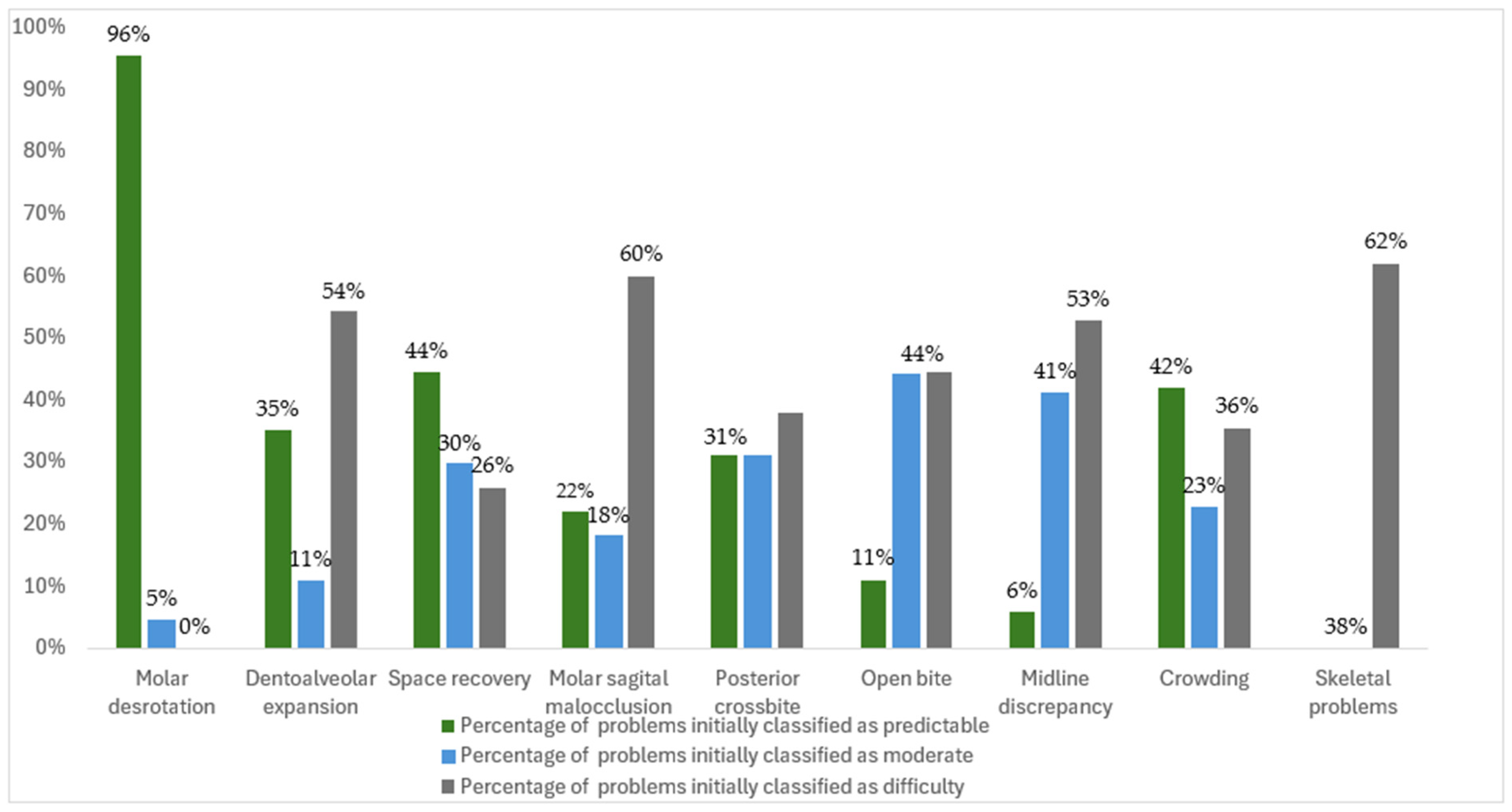
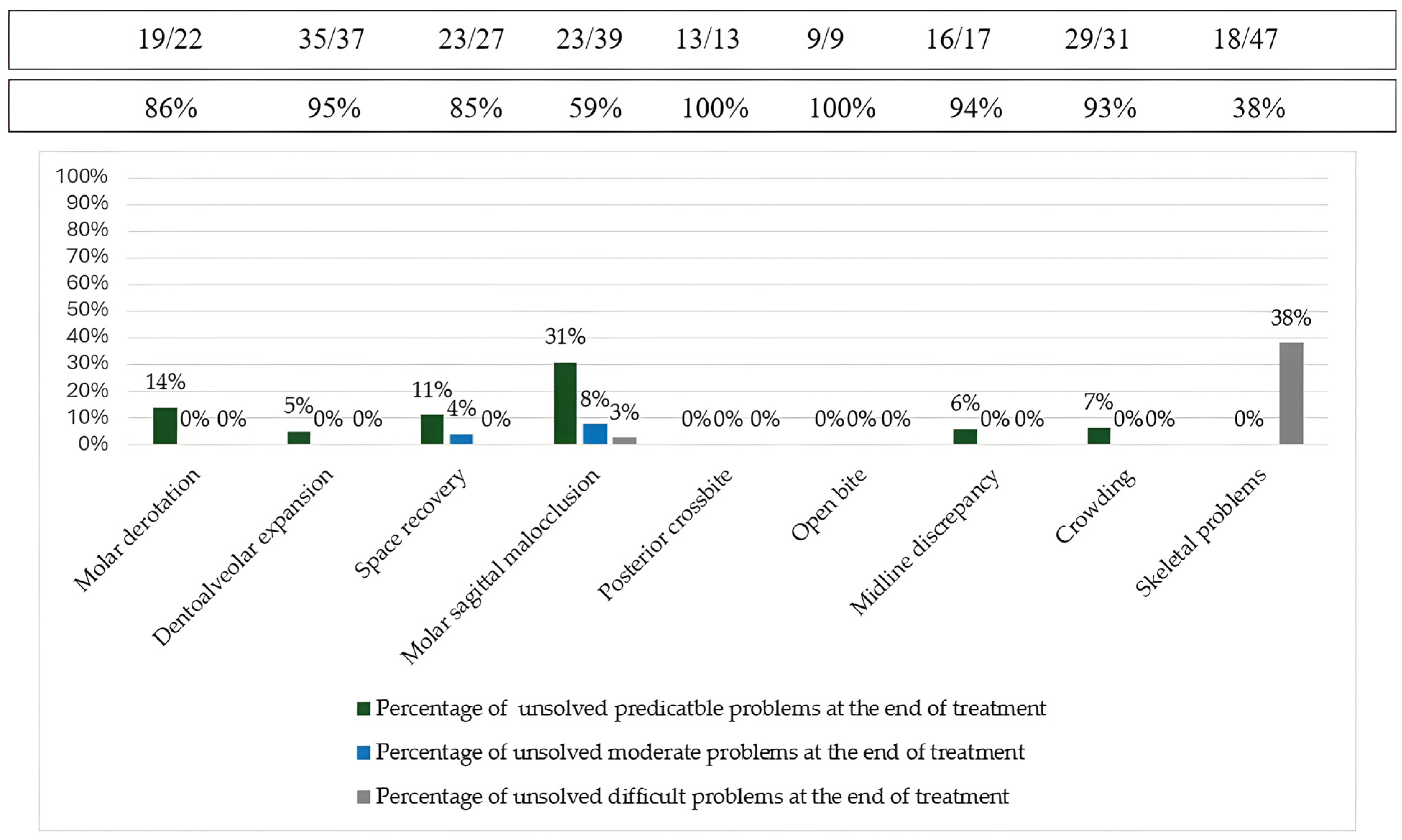
3.3. Case Series for the Align® Based Protocol Index Used in the Previous Study [4]
4. Discussion
4.1. Study Strengths and Limitations
4.2. Clinical Implications
5. Conclusions
Supplementary Materials
Author Contributions
Funding
Institutional Review Board Statement
Informed Consent Statement
Data Availability Statement
Acknowledgments
Conflicts of Interest
Abbreviations
| PAR | Peer Assessment Rating |
References
- Thilander, B.; Lennartsson, B. A Study of Children with Unilateral Posterior Crossbite, Treated and Untreated, in the Deciduous Dentition. J. Orofac. Orthop/Fortschr. Kieferorthop. 2002, 63, 371–383. [Google Scholar] [CrossRef] [PubMed]
- Stahl, F.; Baccetti, T.; Franchi, L.; McNamara, J.A. Longitudinal growth changes in untreated subjects with Class II Division 1 malocclusion. Am. J. Orthod. Dentofac. Orthop. 2008, 134, 125–137. [Google Scholar] [CrossRef] [PubMed]
- Brierley, C.A.; DiBiase, A.; Sandler, P.J. Early Class II treatment. Aust. Dent. J. 2017, 62, 4–10. [Google Scholar] [CrossRef] [PubMed]
- Pinho, T.; Rocha, D.; Ribeiro, S.; Monteiro, F.; Pascoal, S.; Azevedo, R. Interceptive Treatment with Invisalign® First in Moderate and Severe Cases: A Case Series. Children 2022, 9, 1176. [Google Scholar] [CrossRef]
- Schneider-Moser, U.E.M.; Moser, L. Very early orthodontic treatment: When, why and how? Dent. Press J. Orthod. 2022, 27, 2. [Google Scholar] [CrossRef] [PubMed]
- Pinho, T.; Clemente, C.; Castro, I.d.; Gonçalves, M.d.P. Retrospective Evaluation of Invisalign® Mandibular Advancement in Growing Patients: Cephalometric, PAR and 3D Molar Displacement Outcomes. Dent. J. 2025, 13, 517. [Google Scholar] [CrossRef] [PubMed]
- Richmond, S.; Shaw, W.C.; Roberts, C.T.; Andrews, M. The PAR Index (Peer Assessment Rating): Methods to determine outcome of orthodontic treatment in terms of improvement and standards. Eur. J. Orthod. 1992, 14, 180–187. [Google Scholar] [CrossRef] [PubMed]
- Papageorgiou, S.N.; Giannakopoulou, T.; Eliades, T.; Vandevska-Radunovic, V. Occlusal outcome of orthodontic treatment: A systematic review with meta-analyses of randomized trials. Eur. J. Orthod. 2024, 46, cjae060. [Google Scholar] [CrossRef]
- Kim, C.H.; Moon, S.J.; Kang, C.M.; Song, J.S. The predictability of arch expansion with the Invisalign First system in children with mixed dentition: A retrospective study. J. Clin. Pediatr. Dent. 2024, 48, 91–100. [Google Scholar] [CrossRef] [PubMed]
- Inchingolo, A.D.; Dipalma, G.; Ferrara, I.; Viapiano, F.; Netti, A.; Ciocia, A.M.; Mancini, A.; Malcangi, G.; Palermo, A.; Inchingolo, A.M.; et al. Clear Aligners in the Growing Patient: A Systematic Review. Children 2024, 11, 385. [Google Scholar] [CrossRef]
- McNamara, J.A.; Franchi, L. The cervical vertebral maturation method: A user’s guide. Angle Orthod. 2018, 88, 133–143. [Google Scholar] [CrossRef] [PubMed]
- Weir, T. Clear aligners in orthodontic treatment. Aust. Dent. J. 2017, 62, 58–62. [Google Scholar] [CrossRef] [PubMed]
- Dinesh, A.; Mutalik, S.; Feldman, J.; Tadinada, A. Value-addition of lateral cephalometric radiographs in orthodontic diagnosis and treatment planning. Angle Orthod. 2020, 90, 665–671. [Google Scholar] [CrossRef]
- Dyken, R.A.; Sadowsky, P.L.; Hurst, D. Orthodontic Outcomes Assessment Using the Peer Assessment Rating Index. Angle Orthod. 2001, 71, 164–169. [Google Scholar] [PubMed]
- Lanteri, V.; Farronato, G.; Lanteri, C.; Caravita, R.; Cossellu, G. The efficacy of orthodontic treatments for anterior crowding with Invisalign compared with fixed appliances using the Peer Assessment Rating Index. Quintessence Int. 2018, 49, 581–587. [Google Scholar] [CrossRef] [PubMed]
- Freitas, K.M.S.; Freitas, D.S.; Valarelli, F.P.; Freitas, M.R.; Janson, G. PAR evaluation of treated class I extraction patients. Angle Orthod. 2008, 78, 270–274. [Google Scholar] [CrossRef] [PubMed]
- da Silva, V.M.; Ayub, P.V.; Massaro, C.; Janson, G.; Garib, D. Comparison between clear aligners and 2 × 4 mechanics in the mixed dentition: A randomized clinical trial. Angle Orthod. 2023, 93, 3–10. [Google Scholar] [CrossRef]
- Loberto, S.; Pavoni, C.; Fanelli, S.; Lugli, L.; Cozza, P.; Lione, R. Predictability of expansion movements performed by clear aligners in mixed dentition in both arches: A retrospective study on digital casts. BMC Oral Health 2024, 24, 694. [Google Scholar] [CrossRef] [PubMed]
- Levrini, L.; Zecca, P.A.; Borgese, M.; Scurati, E.I.; Deppieri, A.; Saran, S.; Caccia, M.; Carganico, A. Efficacy of Maxillary Expansion with Clear Aligner in the Mixed Dentition: A Systematic Review. Appl. Sci. 2025, 15, 7233. [Google Scholar] [CrossRef]
- Torbaty, P.M.; Suh, H.; Tai, S.K.; Baird, M.; Boyd, R.L.; Oh, H. Vertical and transverse treatment effects of Invisalign First system compared to Hyrax maxillary expanders with fixed appliances in mixed dentition patients. Angle Orthod. 2024, 94, 496–503. [Google Scholar] [CrossRef]
- Pamukçu, H.; Özsoy, S.; Aksoy, P.C.; Özsoy, Ö.P. Evaluation of maxillary dimensional changes in the mixed dentition: Clear aligners vs acrylic expanders. Angle Orthod. 2024, 94, 392–399. [Google Scholar] [CrossRef] [PubMed]
- Mirzen Arat, Z.; Rü Bendü, Z.M. Changes in Dentoalveolar and Facial Heights during Early and Late Growth Periods: A Longitudinal Study. Angle Orthod. 2005, 75, 69–74. [Google Scholar] [CrossRef]
- Levrini, L.; Carganico, A.; Abbate, L. Maxillary expansion with clear aligners in the mixed dentition: A preliminary study with Invisalign® First system. Eur. J. Paediatr. Dent. 2021, 22, 125–128. [Google Scholar] [CrossRef] [PubMed]
- D’Antò, V.; De Simone, V.; Caruso, S.; Bucci, P.; Valletta, R.; Rongo, R.; Bucci, R. Effects of clear aligners treatment in growing patients: A systematic review. Front. Oral Health 2024, 5, 1512838. [Google Scholar] [CrossRef] [PubMed]
- Bruni, A.; Ferrillo, M.; Gallo, V.; Parrini, S.; Garino, F.; Castroflorio, T.; Deregibus, A. Efficacy of clear aligners vs rapid palatal expanders on palatal volume and surface area in mixed dentition patients: A randomized controlled trial. Am. J. Orthod. Dentofac. Orthop. 2024, 166, 203–214. [Google Scholar] [CrossRef]
- Graf, I.; Puppe, C.; Schwarze, J.; Höfer, K.; Christ, H.; Braumann, B. Evaluation of effectiveness and stability of aligner treatments using the Peer Assessment Rating Index. J. Orofac. Orthop. 2021, 82, 23–31. [Google Scholar] [CrossRef] [PubMed]


| Malocclusion Traits /Required Movements | Type of Measurement | Predictability with Aligners | ||
|---|---|---|---|---|
| Predictable (1) | Intermediate (2) | Difficult (3) | ||
| Molar derotation (teeth 16 & 26) | Initially planned by ClinCheck® | 15–30° | >30–40° | >40° |
| Dentoalveolar Expansion | The difference between the initially ClinCheck® planned and experimentally measured (STL) | 3–4 mm and negative molar torque | >4–6 mm and negative molar torque | >6 mm or >4 mm and Positive molar torque and Skeletal compression |
| Space to recover | The difference between the initially planned by ClinCheck® and experimentally measured (STL) | 2–4 mm | >4–6 mm | >6 mm |
| Molar sagittal malocclusion | ClinCheck® and ANB ceph | Class II Functional/Dental ≤½ cusp or molar ectopic eruption) | Mild skeletal ½ cusp Tendency for Class III | Skeletal Class II (complete) ≥1 cusp or Class III |
| Posterior crossbite | Intraoral Photographs STL | Crossbite only on deciduous teeth | Crossbite in deciduous/ permanent teeth and Negative molar torque | Crossbite in permanent teeth and Positive molar torque and Skeletal compression |
| Open bite | Initially planned by ClinCheck® and FMA | Posterior intrusion: <0.5 mm and/or Anterior extrusion: <2.5 mm | Posterior intrusion: >0.5–1 mm and/or Anterior extrusion: >2.5–3.5 mm | Hyperdivergent Posterior intrusion: >1 mm and/or Anterior extrusion: >3.5 mm |
| Midline discrepancy | Initially experimentally Measured STL | 2 mm | >2 and <3 mm | ≥3 mm |
| Crowding | Required space initially experimentally measured and required incisor rotation planned by ClinCheck® | 3–6 mm | >6–8 mm or Lateral incisors: 30–40◦ or Central incisors 40–50◦ | >8 mm or Lateral incisors: >40◦ or Central incisors: >50◦ |
| Skeletal problem | Cephalometric Analysis ANB/FMA | ANB ≥ 7° or ANB ≤ 0° and/or FMA ≥ 30° or FMA < 20° | ||
| Age & Sex | Molar Derotation (n = 22) | Dentoalveolar Expansion (n = 37) | Space to Recover (n = 26) | Molar Sagittal Class (n = 40) | Posterior Crossbite (n = 13) | Open Bite (n = 9) | Midline Discrepancy (n = 17) | Crowding (n = 31) | Skeletal Problem (n = 42) | TOTAL | |
|---|---|---|---|---|---|---|---|---|---|---|---|
| Case 1 | 9 M | 0 | 3 | 2 | 2 | 3 | 0 | 3 | 3 | 3 | 19 |
| Case 2 | 8 F | 0 | 0 | 2 | 0 | 1 | 3 | 0 | 3 | 3 | 12 |
| Case 3 | 9 F | 0 | 1 | 1 | 3 | 0 | 0 | 0 | 1 | 3 | 9 |
| Case 4 | 9 F | 1 | 2 | 2 | 0 | 0 | 0 | 0 | 1 | 3 | 11 |
| Case 5 | 9 F | 1 | 0 | 2 | 2 | 0 | 0 | 0 | 3 | 3 | 11 |
| Case 6 | 8 M | 1 | 3 | 0 | 3 | 0 | 0 | 0 | 0 | 3 | 10 |
| Case 7 | 9 M | 1 | 0 | 0 | 3 | 0 | 0 | 0 | 0 | 3 | 7 |
| Case 8 | 9 F | 1 | 1 | 0 | 3 | 0 | 1 | 0 | 0 | 0 | 6 |
| Case 9 | 8 F | 1 | 3 | 3 | 1 | 0 | 3 | 0 | 2 | 3 | 16 |
| Case 10 | 9 F | 1 | 2 | 1 | 3 | 2 | 0 | 3 | 0 | 0 | 12 |
| Case 11 | 8 F | 0 | 0 | 0 | 3 | 1 | 0 | 0 | 0 | 0 | 4 |
| Case 12 | 8 M | 0 | 1 | 1 | 2 | 2 | 0 | 0 | 1 | 3 | 10 |
| Case 13 | 9 M | 0 | 3 | 3 | 0 | 2 | 0 | 3 | 3 | 0 | 14 |
| Case 14 | 11 M | 1 | 3 | 0 | 1 | 0 | 0 | 0 | 2 | 3 | 10 |
| Case 15 | 9 M | 0 | 3 | 3 | 1 | 0 | 0 | 0 | 3 | 0 | 10 |
| Case 16 | 10 F | 2 | 3 | 3 | 2 | 0 | 0 | 3 | 1 | 3 | 17 |
| Case 17 | 10 F | 1 | 3 | 0 | 3 | 0 | 0 | 1 | 0 | 3 | 11 |
| Case 18 | 8 F | 0 | 3 | 0 | 3 | 0 | 0 | 0 | 0 | 0 | 6 |
| Case 19 | 9 F | 0 | 1 | 1 | 2 | 0 | 0 | 3 | 0 | 3 | 10 |
| Case 20 | 8 M | 1 | 1 | 2 | 3 | 0 | 0 | 0 | 1 | 3 | 11 |
| Case 21 | 10 M | 0 | 1 | 0 | 2 | 0 | 0 | 0 | 0 | 3 | 6 |
| Case 22 | 8 F | 1 | 1 | 2 | 3 | 0 | 0 | 0 | 1 | 3 | 13 |
| Case 23 | 8 M | 0 | 3 | 1 | 1 | 2 | 0 | 2 | 0 | 0 | 9 |
| Case 24 | 7 M | 0 | 3 | 0 | 1 | 3 | 0 | 3 | 0 | 0 | 10 |
| Case 25 | 10 M | 0 | 1 | 1 | 0 | 0 | 0 | 0 | 2 | 3 | 7 |
| Case 26 | 9 F | 1 | 0 | 0 | 3 | 0 | 3 | 0 | 2 | 3 | 12 |
| Case 27 | 8 M | 0 | 3 | 1 | 1 | 0 | 0 | 2 | 1 | 0 | 8 |
| Case 28 | 7 F | 1 | 3 | 0 | 3 | 0 | 0 | 2 | 2 | 3 | 14 |
| Case 29 | 10 M | 0 | 3 | 0 | 3 | 3 | 0 | 0 | 1 | 0 | 10 |
| Case 30 | 7 F | 0 | 0 | 1 | 3 | 0 | 0 | 0 | 3 | 0 | 7 |
| Case 31 | 9 F | 1 | 1 | 3 | 1 | 0 | 0 | 3 | 3 | 3 | 15 |
| Case 32 | 9 F | 0 | 1 | 0 | 2 | 3 | 0 | 2 | 0 | 0 | 8 |
| Case 33 | 7 F | 1 | 3 | 1 | 3 | 1 | 3 | 0 | 3 | 3 | 18 |
| Case 34 | 10 F | 1 | 1 | 2 | 0 | 0 | 0 | 2 | 2 | 0 | 8 |
| Case 35 | 11 M | 0 | 3 | 3 | 1 | 0 | 0 | 0 | 3 | 0 | 10 |
| Case 36 | 6 M | 1 | 3 | 0 | 0 | 0 | 2 | 0 | 1 | 3 | 10 |
| Case 37 | 9 F | 0 | 3 | 0 | 3 | 0 | 0 | 2 | 1 | 3 | 12 |
| Case 38 | 8 M | 0 | 0 | 0 | 3 | 0 | 2 | 0 | 0 | 3 | 8 |
| Case 39 | 9 F | 0 | 2 | 1 | 3 | 0 | 0 | 0 | 1 | 3 | 10 |
| Case 40 | 9 F | 1 | 1 | 0 | 3 | 0 | 0 | 3 | 0 | 3 | 11 |
| Case 41 | 9 F | 1 | 0 | 1 | 3 | 0 | 2 | 0 | 1 | 0 | 8 |
| Case 42 | 8 M | 0 | 0 | 0 | 3 | 3 | 0 | 0 | 0 | 0 | 6 |
| Case 43 | 9 M | 1 | 2 | 0 | 0 | 1 | 0 | 2 | 0 | 0 | 6 |
| Case 44 | 8 F | 1 | 1 | 0 | 3 | 0 | 0 | 0 | 2 | 3 | 10 |
| Case 45 | 7 M | 0 | 3 | 3 | 3 | 0 | 0 | 3 | 3 | 3 | 18 |
| Case 46 | 8 M | 0 | 0 | 2 | 1 | 0 | 0 | 0 | 3 | 3 | 9 |
| Case 47 | 6 F | 0 | 3 | 1 | 3 | 0 | 2 | 0 | 1 | 0 | 10 |

| n | Mean Rank | Z | p | ||
|---|---|---|---|---|---|
| PAR index after (T1–T2) vs. PAR index before (T0–T1) | Negative Ranks | 55 † | 28.00 | −6.455 | <0.001 |
| Positive Ranks | 0 | 0.0 | |||
| Ties | 0 | ||||
| Total | 55 |
| T0 vs. T1 | T0 vs. T2 | T1 vs. T2 | |||||
|---|---|---|---|---|---|---|---|
| n | Median [IQR] | χ2 | p | p | p | p | |
| Total after T0 | 55 | 22.0 [17.0, 30.0] | 88.72 | <0.001 | <0.001 | <0.001 | 0.546 |
| Total after T1 | 55 | 6.0 [1.0, 8.0] | |||||
| Total after T2 | 55 | 7.0 [2.0, 10.0] |
| Mean | SD | Median | Min | Max | n | |
|---|---|---|---|---|---|---|
| Dental Component | ||||||
| Molar derotation (°) | ||||||
| Initially planned, 16 | 13.53 | 7.39 | 12.80 | 0.6 | 35.9 | 47 |
| Planned at the end, 16 | 2.83 | 3.98 | 1.60 | 0.0 | 16.5 | 47 |
| Dif. (initially planned), 16 | 10.70 | 8.30 | 10.50 | −13.50 | 35.10 | 47 |
| Initially planned, 26 | 10.30 | 5.94 | 10.80 | 0.0 | 22.2 | 47 |
| Planned at the end, 26 | 2.72 | 3.50 | 1.14 | 0.0 | 15.40 | 47 |
| Dif. (initially planned), 26 | 7.58 | 6.28 | 7.60 | −5.50 | 21.10 | 47 |
| Dentoalveolar expansion upper Arch (mm) | ||||||
| Initially measured, 16–26 | 3.36 | 1.43 | 3.80 | −1.30 | 6.10 | 47 |
| Measured after treatment, 16–26 | 0.34 | 0.97 | 0.0 | −0.90 | 3.89 | 47 |
| Dentoalveolar expansion lower Arch (mm) | ||||||
| Initially measured, 36–46 | 2.20 | 1.97 | 2.30 | −1.10 | 6.80 | 47 |
| Measured after treatment, 36–46 | −0.08 | 0.83 | 0.0 | −1.40 | 3.70 | 47 |
| Measured in retention, 36–46 | −0.06 | 0.98 | −0.10 | −1.40 | 3.70 | 27 |
| Space recovery upper Arch(mm) | ||||||
| Initially measured (available space) | 2.70 | 3.26 | 2.00 | 0.0 | 12.0 | 47 |
| Measured after treatment | 0.43 | 1.00 | 0.0 | 0.0 | 5.50 | 47 |
| Space recovery lower Arch(mm) | ||||||
| Initially measured (available space) | 1.28 | 2.83 | 0.0 | 0.0 | 13.0 | 47 |
| Measured after treatment | 0.18 | 0.59 | 0.0 | 0.0 | 10.0 | 47 |
| Crowding upper Arch (mm) | ||||||
| Initially measured (available space) | 3.22 | 3.42 | 3.00 | 0.0 | 14.0 | 47 |
| Measured after treatment | 0.70 | 1.27 | 0.0 | 0.0 | 5.5 | 47 |
| Crowding lower Arch (mm) | ||||||
| Initially measured (available space) | 3.12 | 3.41 | 1.50 | 0.0 | 14.0 | 47 |
| Measured after treatment | 0.54 | 0.72 | 0.0 | 0.0 | 2.5 | 47 |
| Cephalometry (mm) | ||||||
| Overbite, initially measured | 2.00 | 3.30 | 2.70 | −7.0 | 9.0 | 47 |
| Overbite, measured at the end | 3.26 | 1.14 | 3.10 | 0.90 | 6.30 | 47 |
| Overjet, initially measured | 4.94 | 2.80 | 4.80 | −1.60 | 10.70 | 47 |
| Overjet, measured at the end | 3.31 | 1.14 | 3.20 | 1.50 | 7.90 | 47 |
| Skeletal component Cephalometry (°) | ||||||
| ANB, initially measured | 4.14 | 2.41 | 4.60 | −1.60 | 7.90 | 47 |
| ANB, measured at the end | 3.57 | 2.00 | 3.80 | −2.00 | 8.20 | 47 |
| FMA, initially measured | 27.64 | 5.55 | 27.40 | 14.60 | 40.00 | 47 |
| FMA, measured at the end | 26.19 | 4.87 | 27.10 | 13.80 | 36.5 | 47 |
| IMPA, initially measured | 92.00 | 8.48 | 92.50 | 77.80 | 114.90 | 47 |
| IMPA, measured at the end | 94.47 | 6.37 | 94.20 | 79.40 | 107.50 | 47 |
| n | Mean Rank | Z | p | ||
|---|---|---|---|---|---|
| ANB final (measured) vs. ANB initial (measured) | Negative Ranks | 28 † | 24.88 | −2.021 | 0.043 |
| Positive Ranks | 17 | 19.91 | |||
| Ties | 2 | ||||
| Total | 47 | ||||
| IMPA final (measured) vs. IMPA initial (measured) | Negative Ranks | 15 † | 19.30 | −2.905 | 0.004 |
| Positive Ranks | 32 | 26.20 | |||
| Ties | 0 | ||||
| Total | 47 | ||||
| FMA final (measured) vs. FMA initial (measured) | Negative Ranks | 32 † | 24.08 | −2.513 | 0.012 |
| Positive Ranks | 14 | 22.18 | |||
| Ties | 1 | ||||
| Total | 47 | ||||
| Overbite final (measured) vs. Overbite initial (measured) | Negative Ranks | 16 † | 18.38 | −2.858 | 0.004 |
| Positive Ranks | 31 | 26.90 | |||
| Ties | 0 | ||||
| Total | 47 | ||||
| Overjet final (measured) vs. Overjet initial (measured) | Negative Ranks | 36 † | 24.29 | −3.650 | <0.001 |
| Positive Ranks | 10 | 20.65 | |||
| Ties | 1 | ||||
| Total | 47 |
| n | Mean Rank | Z | p | ||
|---|---|---|---|---|---|
| Derotation molar final (measured) vs. Derotation molar initial (measured), 16 | Negative Ranks | 44 † | 23.80 | −5.534 | <0.001 |
| Positive Ranks | 2 | 17.00 | |||
| Ties | 1 | ||||
| Total | 47 | ||||
| Derotation molar final (measured) vs. Derotation molar initial (measured), 26 | Negative Ranks | 41 † | 19.30 | −5.392 | <0.001 |
| Positive Ranks | 6 | 26.20 | |||
| Ties | 0 | ||||
| Total | 47 | ||||
| Dentoalveolar expansion upper arch final (measured) vs. Dentoalveolar expansion upper arch initial (measured) | Negative Ranks | 45 † | 24.08 | −5.820 | <0.001 |
| Positive Ranks | 1 | 22.18 | |||
| Ties | 1 | ||||
| Total | 47 | ||||
| Dentoalveolar expansion lower arch final (measured) vs. Dentoalveolar expansion lower arch initial (measured) | Negative Ranks | 43 † | 18.38 | −5.562 | <0.001 |
| Positive Ranks | 4 | 26.90 | |||
| Ties | 0 | ||||
| Total | 47 | ||||
| Space recovery upper arch final (measured) vs. Space recovery upper arch initial (measured) | Negative Ranks | 25 † | 24.29 | −4.345 | <0.001 |
| Positive Ranks | 5 | 20.65 | |||
| Ties | 17 | ||||
| Total | 47 | ||||
| Crowding upper arch final (measured) vs. Crowding upper arch initial (measured) | Negative Ranks | 11 † | −2.052 | <0.001 | |
| Positive Ranks | 4 | ||||
| Ties | 32 | ||||
| Total | 47 | ||||
| Crowding lower arch final (measured) vs. Crowding lower arch initial (measured) | Negative Ranks | 26 † | −4.434 | <0.001 | |
| Positive Ranks | 5 | ||||
| Ties | 16 | ||||
| Total | 47 |
Disclaimer/Publisher’s Note: The statements, opinions and data contained in all publications are solely those of the individual author(s) and contributor(s) and not of MDPI and/or the editor(s). MDPI and/or the editor(s) disclaim responsibility for any injury to people or property resulting from any ideas, methods, instructions or products referred to in the content. |
© 2026 by the authors. Licensee MDPI, Basel, Switzerland. This article is an open access article distributed under the terms and conditions of the Creative Commons Attribution (CC BY) license.
Share and Cite
Pinho, T.; Novais, M.; Gonçalves, M.d.P. Longitudinal Changes in Occlusal Outcomes and Case Complexity with Invisalign® First in Early Mixed Dentition. Dent. J. 2026, 14, 338. https://doi.org/10.3390/dj14060338
Pinho T, Novais M, Gonçalves MdP. Longitudinal Changes in Occlusal Outcomes and Case Complexity with Invisalign® First in Early Mixed Dentition. Dentistry Journal. 2026; 14(6):338. https://doi.org/10.3390/dj14060338
Chicago/Turabian StylePinho, Teresa, Martim Novais, and Maria dos Prazeres Gonçalves. 2026. "Longitudinal Changes in Occlusal Outcomes and Case Complexity with Invisalign® First in Early Mixed Dentition" Dentistry Journal 14, no. 6: 338. https://doi.org/10.3390/dj14060338
APA StylePinho, T., Novais, M., & Gonçalves, M. d. P. (2026). Longitudinal Changes in Occlusal Outcomes and Case Complexity with Invisalign® First in Early Mixed Dentition. Dentistry Journal, 14(6), 338. https://doi.org/10.3390/dj14060338