
PEEK Intraoral Scan Bodies—A Scoping Review

 , , , and
Abstract
1. Introduction
2. Materials and Methods
2.1. Protocol and Reporting
2.2. Research Question and Framework
- Population (P): Patients receiving dental implants, or implant models used in in vitro studies.
- Concept (C): Use of PEEK (polyetheretherketone) ISBs for digital impression procedures and intraoral scanning.
- Context (C): Implant dentistry workflows, including in vitro studies, clinical studies (prospective or retrospective), and technical reports.
2.3. Eligibility Criteria
- Inclusion criteria:
- ○
- Studies evaluating PEEK ISBs in dental implantology.
- ○
- Study types include in vitro studies, randomized controlled trials (RCTs), observational studies (both prospective and retrospective), and technical reports.
- ○
- Publications from peer-reviewed journals.
- ○
- Language: English.
- ○
- Publication period: 2010–present.
- Exclusion criteria:
- ○
- Studies focusing exclusively on ISBs made of other materials (e.g., titanium, resin, hybrid) without including PEEK.
- ○
- Case reports, reviews, editorials, expert opinions, and conference abstracts without full text.
- ○
- Animal studies.
2.4. Search Strategy
2.5. Selection Process
- Stage 1: Titles and abstracts were screened independently by two reviewers (IR, AP).
- Stage 2: Full texts of potentially relevant articles were assessed against eligibility criteria.
- Disagreements: Resolved by discussion or consultation with a third reviewer (CR).
2.6. Data Extraction
- Author(s);
- Year;
- Study design (in vitro, RCT, observational study);
- Jaw/region;
- Type of edentulism;
- No. of implants;
- Implant system/connection;
- Scan body material;
- Control group;
- Type of intraoral/lab scanner used;
- Metrics;
- Measurement method for accuracy (e.g., trueness, precision, superimposition analysis);
- Key outcomes related to PEEK scan bodies.
2.7. Data Synthesis
3. Results
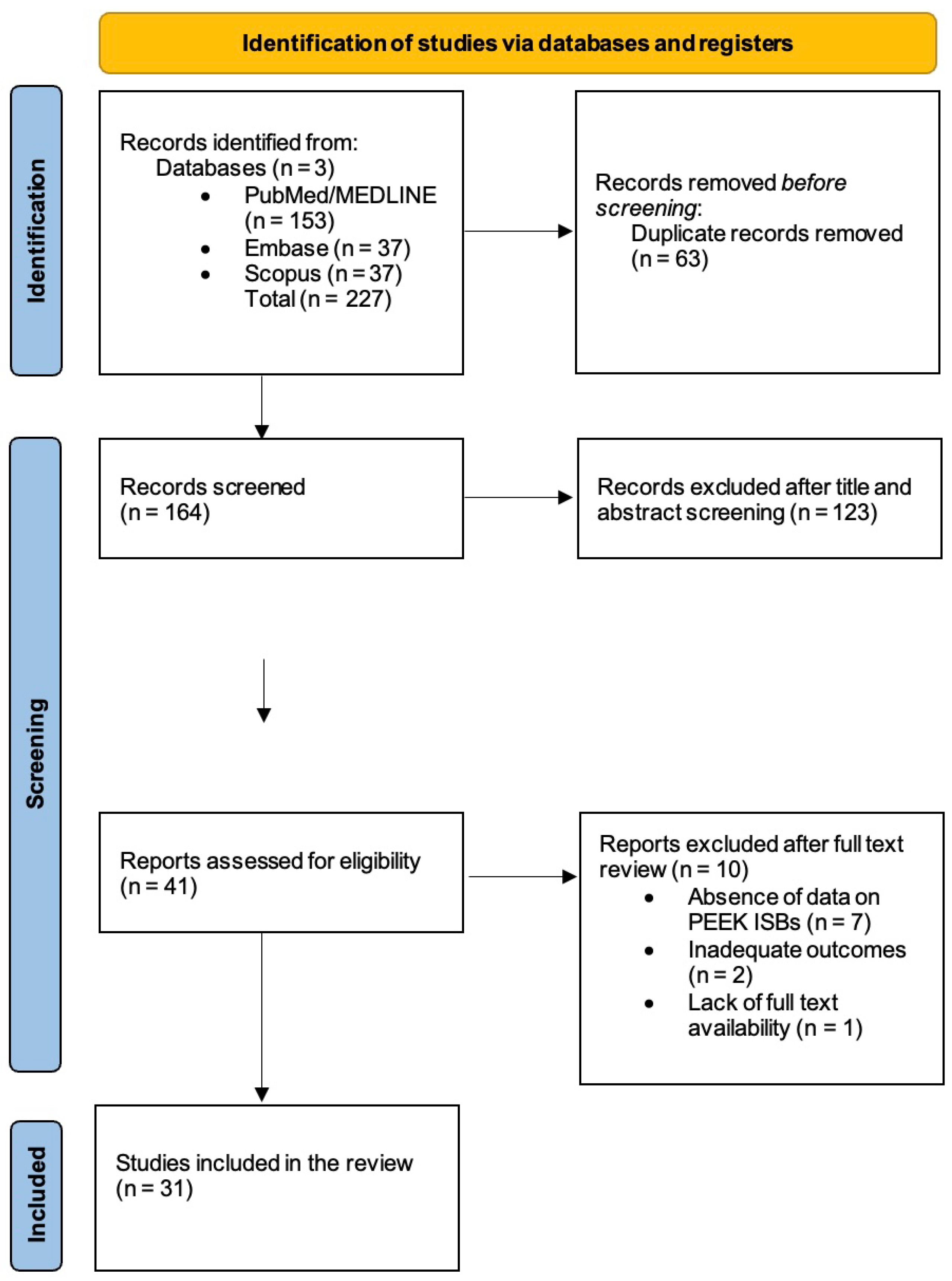
3.1. Study Selection and Characteristics
3.2. Comparative Findings on PEEK and Titanium Scan Bodies
3.3. Factors Affecting Scan Accuracy
4. Discussion
4.1. Material and Reuse-Related Aspects
4.2. Geometry and Height/Exposure
4.3. Accuracy of PEEK Scan Bodies in Intraoral Scanning Workflows
4.4. Clinical Implications and Recommendations
- Select ISBs with sufficient exposure height so that the body is well above soft tissue level and accessible to the scanner tip. This enhances signal capture and reduces distortion.
- Ensure firm, repeatable seating and tightening of the ISB using the manufacturer’s torque specification, to reduce micro-motion or mis-seating.
- Avoid excessive reuse or sterilisation cycles of PEEK scan bodies beyond documented wear thresholds. Consider inspection or replacement after a defined number of cycles.
- Control the scanning environment: dryness, limited saliva pooling, good access, minimal angulation and spacing, adequate operator training. These factors continue to influence accuracy significantly.
- Limit span and complexity when possible: For long-span or complete-arch implant cases, or angulated implants, the risk of cumulative stitching error and ISB-related distortion increases; in these scenarios, the choice of scan body material is only one of many risk factors, and the workflow should be optimised.
4.5. Research Gaps and Future Directions
- There is a lack of well-designed clinical studies that compare PEEK vs. titanium (or other materials) scan bodies in actual patient workflows, since the majority of current studies are in vitro.
- Longitudinal data linking scan body material to prosthetic outcomes (fit, misfit, mechanical complications, biological peri-implant responses) are essentially lacking.
- Studies investigating clinical reuse protocols of PEEK scan bodies under real-world conditions are limited.
- Standardisation of reporting metrics for trueness/precision (e.g., consistent units, reference models, exposure heights, reuse cycles) would enable future meta-analysis and more robust evidence synthesis.
4.6. Strengths of This Review
4.7. Limitations of This Review
5. Conclusions
Supplementary Materials
Author Contributions
Funding
Data Availability Statement
Conflicts of Interest
Abbreviations
| ISB | Intraoral Scan Body |
Appendix A. Detailed Search Strategies
- PubMed (MEDLINE):
- Embase:
- Scopus:
References
- Rhee, Y.K.; Huh, Y.H.; Cho, L.R.; Park, C.J. Comparison of intraoral scanning and conventional impression techniques using 3-dimensional superimposition. J. Adv. Prosthodont. 2015, 7, 460–467. [Google Scholar] [CrossRef] [PubMed]
- Albanchez-González, M.I.; Brinkmann, J.C.; Peláez-Rico, J.; López-Suárez, C.; Rodríguez-Alonso, V.; Suárez-García, M.J. Accuracy of Digital Dental Implants Impression Taking with Intraoral Scanners Compared with Conventional Impression Techniques: A Systematic Review of In Vitro Studies. Int. J. Environ. Res. Public Health 2022, 19, 2026. [Google Scholar] [CrossRef] [PubMed]
- Schwarz, M.S. Mechanical complications of dental implants. Clin. Oral Implant. Res. 2000, 11, 156–158. [Google Scholar] [CrossRef]
- Abduo, J.; Judge, R.B. Implications of implant framework misfit: A systematic review of biomechanical sequelae. Int. J. Oral Maxillofac. Implant. 2014, 29, 608–621. [Google Scholar] [CrossRef]
- Wu, Z.D.; Wei, D.H.; Di, P.; Lin, Y. Application of and progress in computer aided design and computer aided manufacture materials by chairside digital workflow in implant prosthodontics. Zhonghua Kou Qiang Yi Xue Za Zhi 2019, 54, 707–711. [Google Scholar] [CrossRef]
- Blatz, M.B.; Conejo, J. The Current State of Chairside Digital Dentistry and Materials. Dent. Clin. N. Am. 2019, 63, 175–197. [Google Scholar] [CrossRef] [PubMed]
- Michelinakis, G.; Apostolakis, D.; Kamposiora, P.; Papavasiliou, G.; Özcan, M. The direct digital workflow in fixed implant prosthodontics: A narrative review. BMC Oral Health 2021, 21, 37. [Google Scholar] [CrossRef]
- M Mangano, F.G.; Hauschild, U.; Veronesi, G.; Imburgia, M.; Mangano, C.; Admakin, O. Trueness and precision of 5 intraoral scanners in the impressions of single and multiple implants: A comparative in vitro study. BMC Oral Health 2019, 19, 101. [Google Scholar] [CrossRef]
- Siqueira, R.; Galli, M.; Chen, Z.; Mendonça, G.; Meirelles, L.; Wang, H.-L.; Chan, H.-L. Intraoral scanning reduces procedure time and improves patient comfort in fixed prosthodontics and implant dentistry: A systematic review. Clin. Oral Investig. 2021, 25, 6517–6531. [Google Scholar] [CrossRef]
- Park, J.S.; Alshehri, Y.F.A.; Kruger, E.; Villata, L. Accuracy of digital versus conventional implant impressions in partially dentate patients: A systematic review and meta-analysis. J. Dent. 2025, 160, 105918. [Google Scholar] [CrossRef]
- Alfaraj, A.; Alqudaihi, F.; Khurshid, Z.; Qadiri, O.; Lin, W.S. Comparative analyses of accuracy between digital and conventional impressions for complete-arch implant-supported fixed dental prostheses-A systematic review and meta-analysis. J. Prosthodont. 2025, 35, 252–274. [Google Scholar] [CrossRef]
- Lin, W.S.; Harris, B.T.; Morton, D. The use of a scannable impression coping and digital impression technique to fabricate a customized anatomic abutment and zirconia restoration in the esthetic zone. J. Prosthet. Dent. 2013, 109, 187–191. [Google Scholar] [CrossRef]
- Kim, K.R.; Seo, K.Y.; Kim, S. Conventional open-tray impression versus intraoral digital scan for implant-level complete-arch impression. J. Prosthet. Dent. 2019, 122, 543–549. [Google Scholar] [CrossRef]
- Mangano, F.; Lerner, H.; Margiani, B.; Solop, I.; Latuta, N.; Admakin, O. Congruence between Meshes and Library Files of Implant Scanbodies: An In Vitro Study Comparing Five Intraoral Scanners. J. Clin. Med. 2020, 9, 2174. [Google Scholar] [CrossRef] [PubMed]
- Ramsey, C.D.; Ritter, R.G. Utilization of digital technologies for fabrication of definitive implant-supported restorations. J. Esthet. Restor. Dent. 2012, 24, 299–308. [Google Scholar] [CrossRef]
- Mizumoto, R.M.; Yilmaz, B. Intraoral scan bodies in implant dentistry: A systematic review. J. Prosthet. Dent. 2018, 120, 343–352. [Google Scholar] [CrossRef] [PubMed]
- Revilla-León, M.; Gómez-Polo, M.; Rutkunas, V.; Ntovas, P.; Kois, J.C. Classification of Complete-Arch Implant Scanning Techniques Recorded by Using Intraoral Scanners. J. Esthet. Restor. Dent. 2025, 37, 236–243. [Google Scholar] [CrossRef]
- Lee, J.H.; Bae, J.H.; Lee, S.Y. Trueness of digital implant impressions based on implant angulation and scan body materials. Sci. Rep. 2021, 11, 21892. [Google Scholar] [CrossRef] [PubMed]
- Arcuri, L.; Pozzi, A.; Lio, F.; Rompen, E.; Zechner, W.; Nardi, A. Influence of implant scanbody material, position and operator on the accuracy of digital impression for complete-arch: A randomized in vitro trial. J. Prosthodont. Res. 2020, 64, 128–136. [Google Scholar] [CrossRef]
- Pachiou, A.; Zervou, E.; Tsirogiannis, P.; Sykaras, N.; Tortopidis, D.; Kourtis, S. Characteristics of intraoral scan bodies and their influence on impression accuracy: A systematic review. J. Esthet. Restor. Dent. 2023, 35, 1205–1217. [Google Scholar] [CrossRef]
- Karthhik, R.; Raj, B.; Karthikeyan, B.V. Role of scan body material and shape on the accuracy of complete arch implant digitalization. J. Oral Res. Rev. 2022, 14, 114. [Google Scholar] [CrossRef]
- Panayotov, I.V.; Orti, V.; Cuisinier, F.; Yachouh, J. Polyetheretherketone (PEEK) for medical applications. J. Mater. Sci. Mater. Med. 2016, 27, 118. [Google Scholar] [CrossRef] [PubMed]
- Skirbutis, G.; Dzingutė, A.; Masiliūnaitė, V.; Šulcaitė, G.; Žilinskas, J. PEEK polymer’s properties and its use in prosthodontics. Stomatologija 2018, 20, 54–58. [Google Scholar] [PubMed]
- Papathanasiou, I.; Kamposiora, P.; Papavasiliou, G.; Ferrari, M. The use of PEEK in digital prosthodontics: A narrative review. BMC Oral Health 2020, 20, 217. [Google Scholar] [CrossRef]
- Wan, Q.; Limpuangthip, N.; Hlaing, N.H.M.M.; Hahn, S.; Lee, J.H.; Lee, S.J. Enhancing scanning accuracy of digital implant scans: A systematic review on application methods of scan bodies. J. Prosthet. Dent. 2024, 132, 898.e1–898.e9. [Google Scholar] [CrossRef]
- Grande, F.; Nuytens, P.; Zahabiyoun, S.; Iocca, O.; Catapano, S.; Mijiritsky, E. Factors influencing the intraoral implant scan accuracy: A review of the literature. J. Dent. 2025, 161, 105973. [Google Scholar] [CrossRef]
- Gehrke, P.; Rashidpour, M.; Sader, R.; Weigl, P. A systematic review of factors impacting intraoral scanning accuracy in implant dentistry with emphasis on scan bodies. Int. J. Implant. Dent. 2024, 10, 20. [Google Scholar] [CrossRef]
- Mohajerani, R.; Djalalinia, S.; Alikhasi, M. The Effects of Scan Body Geometry on the Precision and the Trueness of Implant Impressions Using Intraoral Scanners: A Systematic Review. Dent. J. 2025, 13, 252. [Google Scholar] [CrossRef] [PubMed]
- Fratila, A.M.; Saceleanu, A.; Arcas, V.C.; Fratila, N.; Earar, K. Enhancing Intraoral Scanning Accuracy: From the Influencing Factors to a Procedural Guideline. J. Clin. Med. 2025, 14, 3562. [Google Scholar] [CrossRef]
- Shetty, P.S.; Gangurde, A.P.; Chauhan, M.R.; Jaiswal, N.V.; Salian, P.R.; Singh, V. Accuracy of the digital implant impression with splinted and non-splinted intraoral scan bodies: A systematic review. J. Indian Prosthodont. Soc. 2025, 25, 3–12. [Google Scholar] [CrossRef]
- Page, M.J.; Moher, D.; Bossuyt, P.M.; Boutron, I.; Hoffmann, T.C.; Mulrow, C.D.; Shamseer, L.; Tetzlaff, J.M.; Akl, E.A.; Brennan, S.E.; et al. PRISMA 2020 explanation and elaboration: Updated guidance and exemplars for reporting systematic reviews. BMJ 2021, 372, n160. [Google Scholar] [CrossRef] [PubMed]
- Stimmelmayr, M.; Güth, J.F.; Erdelt, K.; Edelhoff, D.; Beuer, F. Digital evaluation of the reproducibility of implant scanbody fit--an in vitro study. Clin. Oral Investig. 2012, 16, 851–856. [Google Scholar] [CrossRef] [PubMed]
- Gimenez-Gonzalez, B.; Hassan, B.; Özcan, M.; Pradíes, G. An In Vitro Study of Factors Influencing the Performance of Digital Intraoral Impressions Operating on Active Wavefront Sampling Technology with Multiple Implants in the Edentulous Maxilla. J. Prosthodont. 2017, 26, 650–655. [Google Scholar] [CrossRef]
- Papaspyridakos, P.; Gallucci, G.O.; Chen, C.J.; Hanssen, S.; Naert, I.; Vandenberghe, B. Digital versus conventional implant impressions for edentulous patients: Accuracy outcomes. Clin. Oral Implant. Res. 2016, 27, 465–472. [Google Scholar] [CrossRef] [PubMed]
- Amin, S.; Weber, H.P.; Finkelman, M.; El Rafie, K.; Kudara, Y.; Papaspyridakos, P. Digital vs. conventional full-arch implant impressions: A comparative study. Clin. Oral Implant. Res. 2017, 28, 1360–1367. [Google Scholar] [CrossRef]
- Arcuri, L.; Lio, F.; Campana, V.; Mazzetti, V.; Federici, F.R.; Nardi, A.; Galli, A. Influence of Implant Scanbody Wear on the Accuracy of Digital Impression for Complete-Arch: A Randomized In Vitro Trial. Materials 2022, 15, 927. [Google Scholar] [CrossRef]
- Azevedo, L.; Marques, T.; Karasan, D.; Vincent, F.; Irena, S.; André, C.; Miguel, G.P. Influence of Implant ScanBody Material and Intraoral Scanners on the Accuracy of Complete-Arch Digital Implant Impressions. Int. J. Prosthodont. 2024, 37, 575–582. [Google Scholar] [CrossRef]
- Costa Santos, F.H.P.; de Melo, P.S.; Borella, P.S.; Neves, F.D.D.; Zancope, K. Effect of autoclaving process on trueness and qualitative marginal fit of intraoral scan body manufactured from two materials: An in vitro study. PLoS ONE 2025, 20, e0325068. [Google Scholar] [CrossRef]
- Diker, E.; Terzioglu, H.; Gouveia, D.N.M.; Donmez, M.B.; Seidt, J.; Yilmaz, B. Effect of material type, torque value, and sterilization on linear displacements of a scan body: An in vitro study. Clin. Implant. Dent. Relat. Res. 2023, 25, 419–425. [Google Scholar] [CrossRef]
- Grande, F.; Mosca Balma, A.; Mussano, F.; Catapano, S. Effect of Implant Scan Body type, Intraoral scanner and Scan Strategy on the accuracy and scanning time of a maxillary complete arch implant scans: An in vitro study. J. Dent. 2025, 159, 105782. [Google Scholar] [CrossRef]
- Mahmoud Hashemi, A.; Hasanzadeh, M.; Payaminia, L.; Alikhasi, M. Effect of Repeated Use of Different Types of Scan Bodies on Transfer Accuracy of Implant Position. J. Dent. 2023, 24, 410–416. [Google Scholar] [CrossRef]
- Kato, T.; Yasunami, N.; Furuhashi, A.; Sanda, K.; Ayukawa, Y. Effects of Autoclave Sterilization and Multiple Use on Implant Scanbody Deformation In Vitro. Materials 2022, 15, 7717. [Google Scholar] [CrossRef] [PubMed]
- Kim, J.; Son, K.; Lee, K.B. Displacement of scan body during screw tightening: A comparative in vitro study. J. Adv. Prosthodont. 2020, 12, 307–315. [Google Scholar] [CrossRef]
- Lawand, G.; Ismail, Y.; Revilla-León, M.; Tohme, H. Effect of implant scan body geometric modifications on the trueness and scanning time of complete arch intraoral implant digital scans: An in vitro study. J. Prosthet. Dent. 2024, 131, 1189–1197. [Google Scholar] [CrossRef]
- Baranowski, J.H.; Stenport, V.F.; Braian, M.; Wennerberg, A. Effects of scan body material, length and top design on digital implant impression accuracy and usability: An in vitro study. J. Adv. Prosthodont. 2025, 17, 125–136. [Google Scholar] [CrossRef]
- Althubaitiy, R.; Sambrook, R.; Weisbloom, M.; Petridis, H. The Accuracy of Digital Implant Impressions when Using and Varying the Material and Diameter of the Dental Implant Scan Bodies. Eur. J. Prosthodont. Restor. Dent. 2022, 30, 305–313. [Google Scholar] [CrossRef]
- Meneghetti, P.C.; Li, J.; Borella, P.S.; Mendonça, G.; Burnett, L.H., Jr. Influence of scanbody design and intraoral scanner on the trueness of complete arch implant digital impressions: An in vitro study. PLoS ONE 2023, 18, e0295790. [Google Scholar] [CrossRef] [PubMed]
- Morita, D.; Matsuzaki, T.; Sakai, N.; Ogino, Y.; Atsuta, I.; Ayukawa, Y. Influence of material and tightening torque on the subsidence of implant scan bodies. J. Prosthodont. Res. 2025, 70, 37–42. [Google Scholar] [CrossRef]
- Nagata, K.; Fuchigami, K.; Okuhama, Y.; Wakamori, K.; Tsuruoka, H.; Nakashizu, T.; Hoshi, N.; Atsumi, M.; Kimoto, K.; Kawana, H. Comparison of digital and silicone impressions for single-tooth implants and two- and three-unit implants for a free-end edentulous saddle. BMC Oral Health 2021, 21, 464. [Google Scholar] [CrossRef]
- Pan, Y.; Tam, J.M.Y.; Tsoi, J.K.H.; Lam, W.Y.H.; Pow, E.H.N. Reproducibility of laboratory scanning of multiple implants in complete edentulous arch: Effect of scan bodies. J. Dent. 2020, 96, 103329. [Google Scholar] [CrossRef] [PubMed]
- Pan, Y.; Dai, X.; Tsoi, J.K.; Lam, W.Y.; Pow, E.H. Effect of shape and size of implant scan body on scanning accuracy: An in vitro study. J. Dent. 2025, 152, 105498. [Google Scholar] [CrossRef] [PubMed]
- Park, G.S.; Chang, J.; Pyo, S.W.; Kim, S. Effect of scan body designs and internal conical angles on the 3-dimensional accuracy of implant digital scans. J. Prosthet. Dent. 2024, 132, 190.e1–190.e7. [Google Scholar] [CrossRef]
- Pozzi, A.; Arcuri, L.; Lio, F.; Papa, A.; Nardi, A.; Londono, J. Accuracy of complete-arch digital implant impression with or without scanbody splinting: An in vitro study. J. Dent. 2022, 119, 104072. [Google Scholar] [CrossRef]
- Qasim, S.S.B.; Akbar, A.A.; Sadeqi, H.A.; Baig, M.R. Surface Characterization of Bone-Level and Tissue-Level PEEK and Titanium Dental Implant Scan Bodies After Repeated Autoclave Sterilization Cycles. Dent. J. 2024, 12, 392. [Google Scholar] [CrossRef]
- Ren, X.; Son, K.; Lee, K.B. Accuracy of Proximal and Occlusal Contacts of Single Implant Crowns Fabricated Using Different Digital Scan Methods: An In Vitro Study. Materials 2021, 14, 2843. [Google Scholar] [CrossRef] [PubMed]
- Revilla-León, M.; Fogarty, R.; Barrington, J.J.; Zandinejad, A.; Özcan, M. Influence of scan body design and digital implant analogs on implant replica position in additively manufactured casts. J. Prosthet. Dent. 2020, 124, 202–210. [Google Scholar] [CrossRef]
- Sami, T.; Goldstein, G.; Vafiadis, D.; Absher, T. An in vitro 3D evaluation of the accuracy of 4 intraoral optical scanners on a 6-implant model. J. Prosthet. Dent. 2020, 124, 748–754. [Google Scholar] [CrossRef]
- Shely, A.; Lugassy, D.; Rosner, O.; Zanziper, E.; Nissan, J.; Rachmiel, S.; Khoury, Y.; Ben-Izhack, G. The Influence of Laboratory Scanner versus Intra-Oral Scanner on Determining Axes and Distances between Three Implants in a Straight Line by Using Two Different Intraoral Scan Bodies: A Pilot In Vitro Study. J. Clin. Med. 2023, 12, 6644. [Google Scholar] [CrossRef]
- Tawfik, M.H.A.; El Torky, I.R.; El Sheikh, M.M. Effect of saliva on accuracy of digital dental implant transfer using two different materials of intraoral scan bodies with different exposed lengths. BMC Oral Health 2024, 24, 1428. [Google Scholar] [CrossRef] [PubMed]
- Soltan, H.; Mai, X.; Ramdan, A.S.; Saleh, M.Q.; Ashour, S.H.; Xie, W. Impact of implant scan body material and angulation on the trueness and precision of digital implant impressions using four intraoral scanners-an in vitro study. BMC Oral Health 2025, 25, 1288. [Google Scholar] [CrossRef] [PubMed]
- Sun, X.; Li, L.; Wen, C. Effects of inter-implant tooth loss and scan body material on digital impression accuracy: An in vitro study. BMC Oral Health 2025, 25, 1502. [Google Scholar] [CrossRef] [PubMed]
- Aktas, A.; Manav, T.Y.; Zortuk, M. Effect of reusing impression posts and scan bodies on recording accuracy. J. Prosthet. Dent. 2025, 133, 1324.e1–1324.e7. [Google Scholar] [CrossRef]
- Anitua, E.; Lazcano, A.; Anitua, B.; Eguia, A.; Alkhraisat, M.H. Influence of scan body geometry on the trueness of intraoral scanning. BDJ Open. 2025, 11, 83. [Google Scholar] [CrossRef] [PubMed]
- Sicilia, E.; Lagreca, G.; Papaspyridakos, P.; Finkelman, M.; Cobo, J.; Att, W.; Revilla-León, M. Effect of supramucosal height of a scan body and implant angulation on the accuracy of intraoral scanning: An in vitro study. J. Prosthet. Dent. 2024, 131, 1126–1134. [Google Scholar] [CrossRef]
- Lee, J.H.; Jo, J.S.; Lee, S.Y. Digital impression accuracy for bone-level and tissue-level implants using scan bodies of different heights. Sci. Rep. 2025, 15, 37367. [Google Scholar] [CrossRef]
- Chen, Z.; Yu, J.; Lu, J.; Wang, H.L.; Li, J. Influence of scan aid surface color on accuracy of calibrated intraoral scan protocol in complete arch implant digital scans. J. Prosthet. Dent. 2025, 135, 118.e1–118.e9. [Google Scholar] [CrossRef]
- Biadsee, A.; Yusef, R.; Melamed, G.; Ormianer, Z. Scan Body Discrepancies in Bone- and Tissue-Level Implants: In Vitro Study. Int. J. Oral Maxillofac. Implant. 2025, 1–16. [Google Scholar] [CrossRef]
- Karakuzu, M.; Öztürk, C.; Karakuzu, Z.B.; Zortuk, M. The effects of different lighting conditions on the accuracy of intraoral scanning. J. Adv. Prosthodont. 2024, 16, 311–318. [Google Scholar] [CrossRef] [PubMed]
- Thanasrisuebwong, P.; Kulchotirat, T.; Anunmana, C. Effects of inter-implant distance on the accuracy of intraoral scanner: An in vitro study. J. Adv. Prosthodont. 2021, 13, 107–116. [Google Scholar] [CrossRef]


| Author | Design | Comparison | Outcome | Result | Conclusion |
|---|---|---|---|---|---|
| Arcuri et al., 2020 [19] | In vitro | PEEK vs. titanium scan body materials | Accuracy | Scan body material influenced complete-arch digital impression accuracy | Material choice affected accuracy in complete-arch scanning |
| Lee et al., 2021 [18] | In vitro | PEEK vs. titanium | Trueness | Titanium showed better trueness, whereas PEEK showed a higher within-tolerance percentage | Material effects varied according to angulation and scanning conditions |
| Azevedo et al., 2024 [37] | In vitro | PEEK vs. plasma-coated titanium | Trueness and precision | Plasma-coated titanium generally showed higher trueness and precision than PEEK | Accuracy depended on both material and IOS type |
| Costa Santos et al., 2025 [38] | In vitro | PEEK vs. titanium after repeated autoclaving | Dimensional stability | PEEK showed greater deformation than titanium, although both remained within clinically acceptable limits | Both materials remained clinically usable, but titanium was more dimensionally stable |
| Diker et al., 2023 [39] | In vitro | PEEK vs. titanium under different torque and sterilization conditions | Displacement | PEEK displaced more than titanium, especially at higher torque and after sterilization | Titanium showed greater stability; PEEK should be used with controlled torque and limited sterilization cycles |
| Hashemi et al., 2023 [41] | In vitro | PEEK vs. titanium after reuse/sterilization | Dimensional stability | PEEK showed less inter-implant distance variation, but greater diameter change | Reuse affected different dimensional parameters differently according to material |
| Baranowski et al., 2025 [45] | In vitro | PEEK vs. titanium prototypes | Trueness | Titanium scan bodies were more accurate than PEEK | Titanium appeared more favorable in full-arch scanning, although design also influenced performance |
| Althubaitiy et al., 2022 [46] | In vitro | PEEK vs. titanium | Precision | Titanium performed better in desktop scanning, whereas PEEK performed better in intraoral scanning | Accuracy depended on both material and scanner type |
| Morita et al., 2025 [48] | In vitro | PEEK vs. titanium | Vertical displacement under torque | Titanium behaved more similarly to the titanium abutment than PEEK under higher torque | Titanium showed greater mechanical stability under increased tightening torque |
| Qasim et al., 2024 [54] | In vitro | PEEK vs. titanium scan bodies after repeated sterilization | Surface and chemical stability | Repeated autoclaving minimally affected titanium but caused measurable alterations in PEEK | Reuse should be more cautious for PEEK scan bodies |
| Tawfik et al., 2024 [59] | In vitro | PEEK vs. titanium under dry/wet conditions and different exposure heights | Inter-implant accuracy | Titanium tended to be more precise than PEEK; wet conditions worsened accuracy and greater exposure improved it | Material effects interacted with saliva and scan body exposure height |
| Soltan et al., 2025 [60] | In vitro | PEEK vs. titanium at 0° and 30° angulation | Trueness and precision | PEEK showed higher trueness and precision than titanium | PEEK may perform better under specific angulation and scanner conditions |
| Influencing Factor | Main Findings | Clinical/Technical Implications |
|---|---|---|
| Material type (PEEK vs. titanium) [18,19,37,38,39,41,45,46,54,59,60] | PEEK shows comparable or slightly superior optical performance but lower mechanical rigidity. Titanium often exhibits higher trueness in controlled conditions. | Material choice should consider scanning environment: PEEK for optical scanning ease; titanium for mechanical stability. |
| Sterilization and reuse [38,39,41,42,54] | Minor dimensional changes occur after multiple autoclave cycles (≤10–50); accuracy generally within clinically acceptable limits (<100 µm). Excessive cycles increase surface wear and base deformation. | Limit PEEK ISB reuse to ≤10 cycles; inspect for deformation before each use. |
| Torque and seating [39,48] | High torque (>10 Ncm) causes vertical displacement and deformation in PEEK ISBs; optimal torque range is 5–10 Ncm. | Standardized torque control is critical to maintain reproducible seating accuracy. |
| Implant angulation and span length [18,49,50,53,60] | Minimal impact for short spans and aligned implants; deviations increase with long spans, posterior sites, or >25° angulation. | Use caution in multi-unit or full-arch cases; favor splinting or calibrated scanning protocols. |
| Scanner type and scanning strategy [37,45,46,47,53,60] | Scanner model strongly affects accuracy, Primescan (Dentsply Sirona, Bensheim, Germany), TRIOS (3Shape A/S, Copenhagen, Denmark), Medit i700 (Medit Corp., Seoul, South Korea) perform best). Zig-zag or segmental scanning reduces stitching error. | Select high-performance IOS systems; optimize scanning path for long spans. |
| Geometry and height of scan body [45,47,59] | Simple cylindrical designs and flat surfaces enhance trueness; excessive height or complex shapes may reduce accuracy. | Prefer geometrically simple, well-indexed designs with adequate supragingival exposure. |
| Environmental conditions [59] | Light intensity, color temperature, and saliva presence influence optical detection, particularly in full-arch scans. | Control illumination and moisture during scanning to reduce data noise and stitching errors. |
| Connection type and interface stability [19,40,41,43,47,56,58] | Instability at ISB–implant interface (especially in hybrid PEEK–titanium models) contributes to positional errors. | Ensure precise fit and avoid mixed-material ISBs where possible. |
Disclaimer/Publisher’s Note: The statements, opinions and data contained in all publications are solely those of the individual author(s) and contributor(s) and not of MDPI and/or the editor(s). MDPI and/or the editor(s) disclaim responsibility for any injury to people or property resulting from any ideas, methods, instructions or products referred to in the content. |
© 2026 by the authors. Licensee MDPI, Basel, Switzerland. This article is an open access article distributed under the terms and conditions of the Creative Commons Attribution (CC BY) license.
Share and Cite
Rachiotis, I.; Pachiou, A.; Thoma, D.S.; Naenni, N.; Rahiotis, C. PEEK Intraoral Scan Bodies—A Scoping Review. Dent. J. 2026, 14, 222. https://doi.org/10.3390/dj14040222
Rachiotis I, Pachiou A, Thoma DS, Naenni N, Rahiotis C. PEEK Intraoral Scan Bodies—A Scoping Review. Dentistry Journal. 2026; 14(4):222. https://doi.org/10.3390/dj14040222
Chicago/Turabian StyleRachiotis, Ioulianos, Aspasia Pachiou, Daniel S. Thoma, Nadja Naenni, and Christos Rahiotis. 2026. "PEEK Intraoral Scan Bodies—A Scoping Review" Dentistry Journal 14, no. 4: 222. https://doi.org/10.3390/dj14040222
APA StyleRachiotis, I., Pachiou, A., Thoma, D. S., Naenni, N., & Rahiotis, C. (2026). PEEK Intraoral Scan Bodies—A Scoping Review. Dentistry Journal, 14(4), 222. https://doi.org/10.3390/dj14040222