
The Perio-Resto Interface: In Vitro Comparison of Two Deep Margin Elevation Techniques on Surface Roughness, Marginal Adaptation and Material Integrity

 , , and
 Abstract
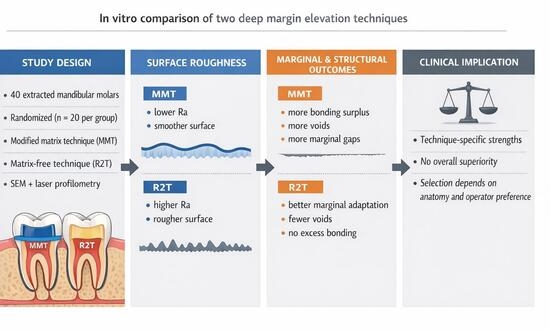
Share and Cite
Cores Ziskoven, P.; Vogel, D.; Schumann, S.; Kiramira, D.; Nguyen, T.; Geyer, A.M.; Weusmann, J.; Deschner, J. The Perio-Resto Interface: In Vitro Comparison of Two Deep Margin Elevation Techniques on Surface Roughness, Marginal Adaptation and Material Integrity. Dent. J. 2026, 14, 161. https://doi.org/10.3390/dj14030161
Cores Ziskoven P, Vogel D, Schumann S, Kiramira D, Nguyen T, Geyer AM, Weusmann J, Deschner J. The Perio-Resto Interface: In Vitro Comparison of Two Deep Margin Elevation Techniques on Surface Roughness, Marginal Adaptation and Material Integrity. Dentistry Journal. 2026; 14(3):161. https://doi.org/10.3390/dj14030161
Chicago/Turabian StyleCores Ziskoven, Pablo, Dorothea Vogel, Sven Schumann, David Kiramira, Thanya Nguyen, Andreas M. Geyer, Jens Weusmann, and James Deschner. 2026. "The Perio-Resto Interface: In Vitro Comparison of Two Deep Margin Elevation Techniques on Surface Roughness, Marginal Adaptation and Material Integrity" Dentistry Journal 14, no. 3: 161. https://doi.org/10.3390/dj14030161
APA StyleCores Ziskoven, P., Vogel, D., Schumann, S., Kiramira, D., Nguyen, T., Geyer, A. M., Weusmann, J., & Deschner, J. (2026). The Perio-Resto Interface: In Vitro Comparison of Two Deep Margin Elevation Techniques on Surface Roughness, Marginal Adaptation and Material Integrity. Dentistry Journal, 14(3), 161. https://doi.org/10.3390/dj14030161