Article

3D Correspondence Between Maxillary Central Incisor Morphology and Facial Shape in Young Adults

by
Laura Iosif
1,†,
Mihaela Pantea
1,†,
Ana Maria Cristina Țâncu
1,
Teodor-Raul Constantin
2,
Vlad Gabriel Vasilescu
2,*,
Radu Ilinca
3,*,
Mirela-Veronica Bucur
2,
Marina Imre
1,
Silviu Pițuru
4 and
Lucian Toma Ciocan
2
1
Department of Prosthodontics, Faculty of Dentistry, “Carol Davila” University of Medicine and Pharmacy, 37 Dionisie Lupu Street, District 2, 020021 Bucharest, Romania
2
Department of Dental Prostheses Technology, Faculty of Dentistry, “Carol Davila” University of Medicine and Pharmacy, 37 Dionisie Lupu Street, District 2, 020021 Bucharest, Romania
3
Discipline of Medical Informatics and Biostatistics, Faculty of Dentistry, “Carol Davila University “ of Medicine and Pharmacy, 4-6 Eforie St, 50037 Bucharest, Romania
4
Department of Organization, Professional Legislation and Management of the Dental Office, Faculty of Dentistry, “Carol Davila” University of Medicine and Pharmacy, 17-23 Plevnei Str., 020021 Bucharest, Romania
*
Authors to whom correspondence should be addressed.
These authors contributed equally to this work.
Dent. J. 2026, 14(1), 35; https://doi.org/10.3390/dj14010035
Submission received: 29 October 2025 / Revised: 20 December 2025 / Accepted: 30 December 2025 / Published: 6 January 2026
(This article belongs to the Special Issue Advances in Esthetic Dentistry)

Abstract

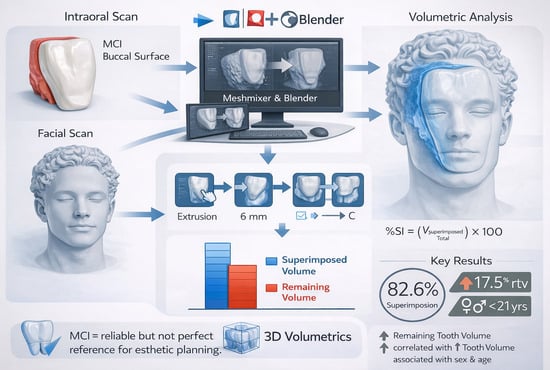
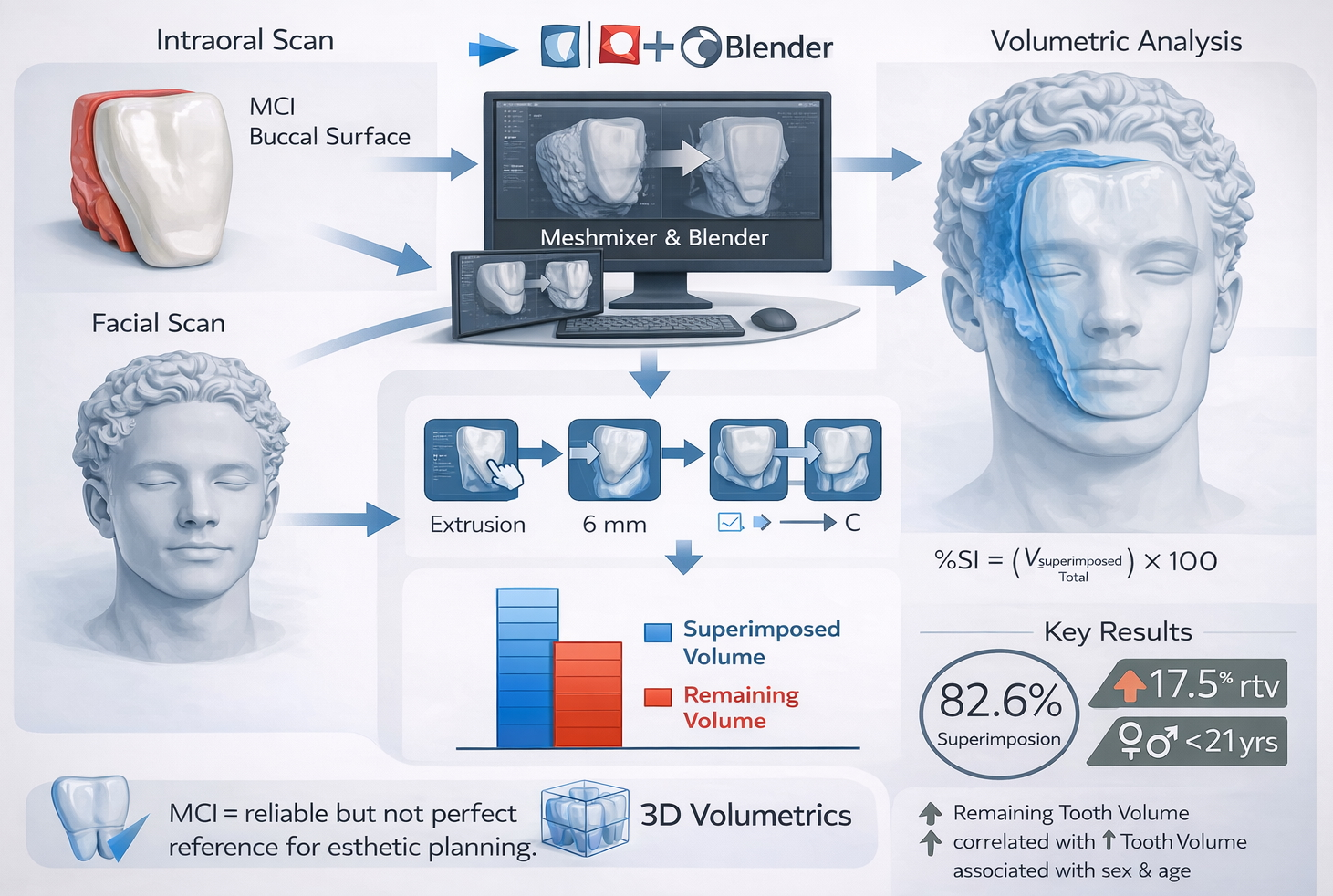
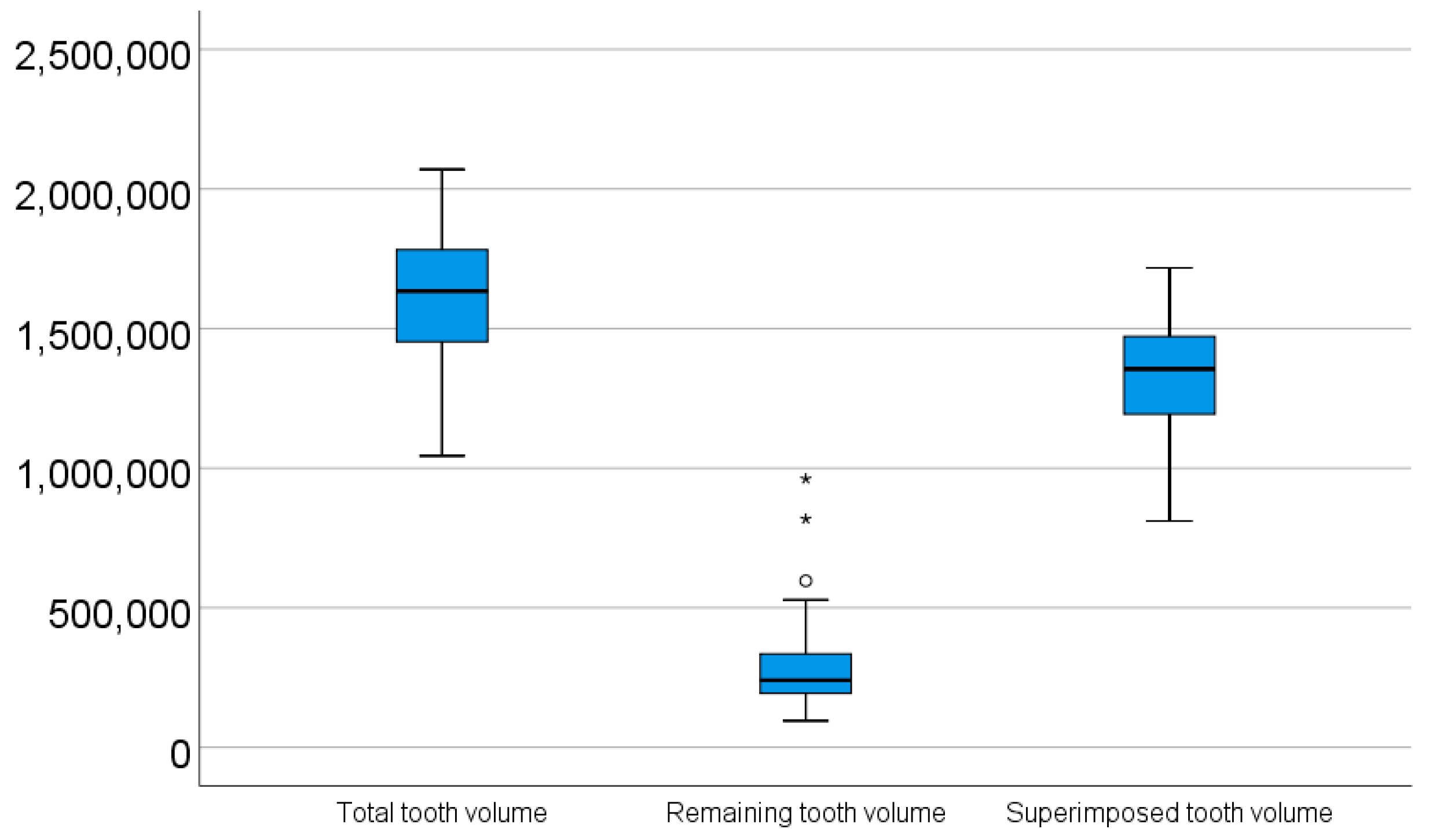
Backround: This cross-sectional study aimed to quantify the proportion of 3D tooth–face superimposition in young adults and examine age- and gender-related differences. Methods: In 98 dental students, intraoral MCI and facial scans were acquired under standardized protocols, processed in Mesh Mixer v. 3.5.474and Blender v. 4.3.2., and aligned to reference planes for superimposition. Residual tooth volume, reflecting tooth–face correspondence, was computed via Boolean subtraction. Statistical analyses were performed in IBM SPSS Statistics 25 at α = 0.05. Results: Total tooth volume (1,626,120.79 ± 210,659.56 × 103) exceeded the superimposed volume by 285,052.34 × 103 (17.53%; 95% CI: 15.84–19.22%; p < 0.001), giving a superimposition proportion of 82.6%. Positive correlations between total and remaining tooth volumes were observed overall (ρ = 0.448; p < 0.001), in females (ρ = 0.515; p < 0.001), and in participants < 21 years (ρ = 0.662; p < 0.001). Men had higher total tooth volume than women (1,706,232 ± 151,086 vs. 1,583,561 ± 225,978; p = 0.005). Conclusions: Volumetric analysis revealed high but incomplete dentofacial correspondence. Larger tooth volumes were associated with greater incongruence in females and younger participants, confirming volumetric size as a determinant of morphological congruence. Results highlight clinically meaningful superimposition, supporting the MCI as a reliable reference for restorative planning and esthetic reconstructions, and emphasize the value of 3D analysis for precise dentofacial evaluation and individualized esthetic planning.
Keywords: maxillary central incisor; facial morphology; three-dimensional imaging; dental esthetics; intraoral scanners; facial scanning; morphometrics maxillary central incisor; facial morphology; three-dimensional imaging; dental esthetics; intraoral scanners; facial scanning; morphometrics
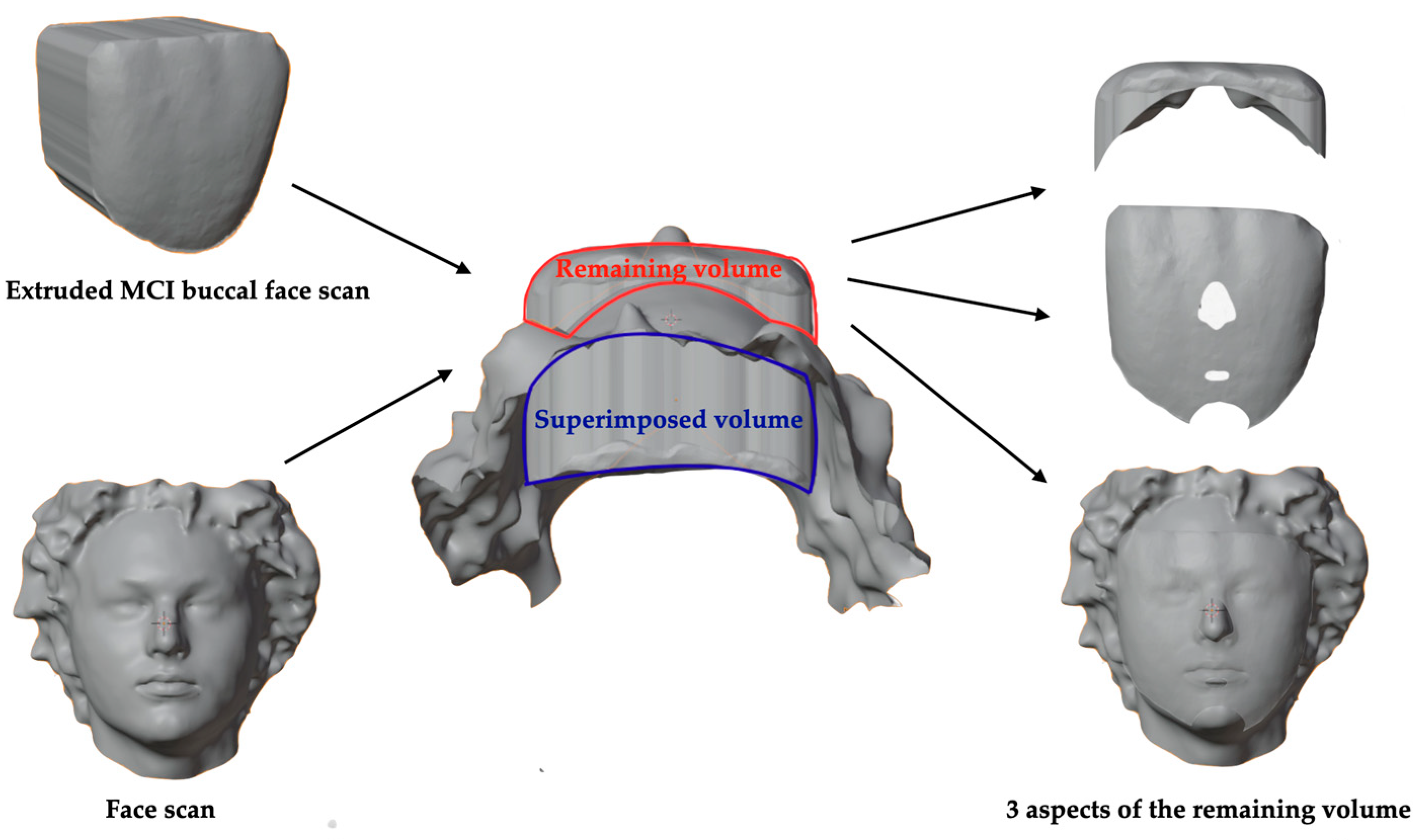
Graphical Abstract