


Accuracy of a Novel Desktop Micro-CT Scanner for Direct Digitization of Dental Impressions: A Comparative In Vitro Study

 ,
,  and
and
Abstract
1. Introduction
2. Materials and Methods
2.1. Reference Model
2.2. Sample Preparation
2.3. Scanning Methods
2.3.1. Direct Scanning of Impressions Using Desktop Micro-CT Dental Scanner (MCTI)
2.3.2. Extraoral Scanning of Impressions (F8I) and Plaster Models (F8PM) Using F8 Desktop Optical Scanner
2.3.3. Intraoral Scanning of Plaster Models Using Trios 5 Scanner (IOSPM)
2.4. Linear Distance Measurement
2.5. Three-Dimensional Surface Deviation Analysis
2.6. Statistical Analysis
3. Results
3.1. Linear Distance Measurement
3.2. Three-Dimensional Surface Deviation Analysis
4. Discussion
5. Conclusions
Author Contributions
Funding
Institutional Review Board Statement
Informed Consent Statement
Data Availability Statement
Conflicts of Interest
Abbreviations
| Micro-CT | Micro-computed tomography |
| MCTI | Direct scanning of impressions via desktop micro-CT dental scanner |
| F8I | Extraoral scanning of impressions via F8 desktop optical scanner |
| F8PM | Extraoral scanning of plaster models via F8 desktop optical scanner |
| IOSPM | Intraoral scanning of plaster models using Trios 5 scanner |
| DCRM | Linear distance measurements obtained from the reference model using a digital caliper |
| ICC | Intraclass Correlation Coefficient |
| RMS | Root mean square |
| RSD | Relative standard deviation |
| ANOVA | Analysis of variance |
| STL | Standard tessellation language |
Appendix A

| Linear Distance (mm) | MCTI | F8I | F8PM | IOSPM |
|---|---|---|---|---|
| Segment A | 0.0062 ± 0.0053 | 0.2862 ± 0.0204 | 0.0090 ± 0.0059 | 0.0099 ± 0.0087 |
| Segment B | 0.0079 ± 0.0060 | 0.2296 ± 0.0061 | 0.0137 ± 0.0041 | 0.0132 ± 0.0061 |
| Segment C | 0.0090 ± 0.0050 | 0.3198 ± 0.0334 | 0.0075 ± 0.0057 | 0.0063 ± 0.0050 |
| Segment D | 0.0085 ± 0.0060 | 0.2623 ± 0.0271 | 0.0045 ± 0.0038 | 0.0066 ± 0.0048 |
| Segment E | 0.0041 ± 0.0039 | 0.1633 ± 0.0156 | 0.0079 ± 0.0062 | 0.0112 ± 0.0071 |
| Segment F | 0.0104 ± 0.0064 | 0.2262 ± 0.0275 | 0.0091 ± 0.0038 | 0.0055 ± 0.0051 |
References
- Leeson, D. The digital factory in both the modern dental lab and clinic. Dent. Mater. 2020, 36, 43–52. [Google Scholar] [CrossRef] [PubMed]
- Kaitatzidou, A.; Chalazoniti, A.; Faggion, C.M., Jr.; Bakopoulou, A.; Barbosa-Liz, D.M.; Giannakopoulos, N.N. Digital scans versus conventional impressions in fixed prosthodontics: An overview of systematic reviews. J. Prosthet. Dent. 2024, 134, 2156–2164. [Google Scholar] [CrossRef]
- Kong, L.; Li, Y.; Liu, Z. Digital versus conventional full-arch impressions in linear and 3D accuracy: A systematic review and meta-analysis of in vivo studies. Clin. Oral Investig. 2022, 26, 5625–5642. [Google Scholar] [CrossRef]
- Suganna, M.; Kausher, H.; Tarek Ahmed, S.; Sultan Alharbi, H.; Faraj Alsubaie, B.; Ds, A.; Haleem, S.; Meer Rownaq Ali, A.B. Contemporary Evidence of CAD-CAM in Dentistry: A Systematic Review. Cureus 2022, 14, e31687. [Google Scholar] [CrossRef]
- Rudolph, H.; Salmen, H.; Moldan, M.; Kuhn, K.; Sichwardt, V.; Wöstmann, B.; Luthardt, R.G. Accuracy of intraoral and extraoral digital data acquisition for dental restorations. J. Appl. Oral Sci. 2016, 24, 85–94. [Google Scholar] [CrossRef]
- Heshmati, R.H.; Nagy, W.W.; Wirth, C.G.; Dhuru, V.B. Delayed linear expansion of improved dental stone. J. Prosthet. Dent. 2002, 88, 26–31. [Google Scholar] [CrossRef]
- Azer, S.S.; Kerby, R.E.; Knobloch, L.A. Effect of mixing methods on the physical properties of dental stones. J. Dent. 2008, 36, 736–744. [Google Scholar] [CrossRef] [PubMed]
- Marti, A.M.; Harris, B.T.; Metz, M.J.; Morton, D.; Scarfe, W.C.; Metz, C.J.; Lin, W.S. Comparison of digital scanning and polyvinyl siloxane impression techniques by dental students: Instructional efficiency and attitudes towards technology. Eur. J. Dent. Educ. 2017, 21, 200–205. [Google Scholar] [CrossRef]
- Lim, J.-H.; Park, J.-M.; Kim, M.; Heo, S.-J.; Myung, J.-Y. Comparison of digital intraoral scanner reproducibility and image trueness considering repetitive experience. J. Prosthet. Dent. 2018, 119, 225–232. [Google Scholar] [CrossRef] [PubMed]
- Moon, Y.-G.; Lee, K.-M. Comparison of the accuracy of intraoral scans between complete-arch scan and quadrant scan. Prog. Orthod. 2020, 21, 36. [Google Scholar] [CrossRef]
- Lee, K.C.; Park, S.-J. Digital Intraoral Scanners and Alginate Impressions in Reproducing Full Dental Arches: A Comparative 3D Assessment. Appl. Sci. 2020, 10, 7637. [Google Scholar] [CrossRef]
- Shen, Y.; Gong, Z.; Wang, J.; Fang, S. Accuracy of digital tooth preparations recorded using the plaster model scanning technique and two silicone impression scanning techniques. Heliyon 2024, 10, e40477. [Google Scholar] [CrossRef]
- Kerr, M.; Park, N.; Leeson, D.; Nikolskiy, S. Dimensional accuracy of microcomputed tomography-scanned half-arch impressions. J. Prosthet. Dent. 2019, 121, 797–802. [Google Scholar] [CrossRef] [PubMed]
- Logozzo, S.; Zanetti, E.M.; Franceschini, G.; Kilpelä, A.; Mäkynen, A. Recent advances in dental optics—Part I: 3D intraoral scanners for restorative dentistry. Opt. Lasers Eng. 2014, 54, 203–221. [Google Scholar] [CrossRef]
- Emir, F.; Ayyıldız, S. Evaluation of the trueness and precision of eight extraoral laboratory scanners with a complete-arch model: A three-dimensional analysis. J. Prosthodont. Res. 2019, 63, 434–439. [Google Scholar] [CrossRef] [PubMed]
- Yang, X.; Lv, P.; Liu, Y.; Si, W.; Feng, H. Accuracy of Digital Impressions and Fitness of Single Crowns Based on Digital Impressions. Materials 2015, 8, 3945–3957. [Google Scholar] [CrossRef]
- Rudolph, H.; Luthardt, R.G.; Walter, M.H. Computer-aided analysis of the influence of digitizing and surfacing on the accuracy in dental CAD/CAM technology. Comput. Biol. Med. 2007, 37, 579–587. [Google Scholar] [CrossRef]
- Pauwels, R.; Araki, K.; Siewerdsen, J.H.; Thongvigitmanee, S.S. Technical aspects of dental CBCT: State of the art. Dentomaxillofac. Radiol. 2015, 44, 20140224. [Google Scholar] [CrossRef]
- Zwanenburg, E.A.; Williams, M.A.; Warnett, J.M. Performance testing of dimensional X-ray computed tomography systems. Precis. Eng. 2022, 77, 179–193. [Google Scholar] [CrossRef]
- Ye, J.; Wang, S.; Wang, Z.; Liu, Y.; Sun, Y.; Ye, H.; Zhou, Y. Comparison of the dimensional and morphological accuracy of three-dimensional digital dental casts digitized using different methods. Odontology 2023, 111, 165–171. [Google Scholar] [CrossRef]
- Da Silva-Dantas, L.A.; Yamashita, A.L.; Sigua-Rodriguez, E.A.; Chicarelli, M.; Vessoni-Iwaki, L.C.; Filho, L.I. Accuracy of Linear Measurements of Dental Models Scanned Through 3D Scanner and Cone-Beam Computed Tomography in Comparison with Plaster Models. CES Odontol. 2018, 32, 7–16. [Google Scholar] [CrossRef]
- Emara, A.; Sharma, N.; Halbeisen, F.S.; Msallem, B.; Thieringer, F.M. Comparative Evaluation of Digitization of Diagnostic Dental Cast (Plaster) Models Using Different Scanning Technologies. Dent. J. 2020, 8, 79. [Google Scholar] [CrossRef]
- Sang-Mi, L.; Yanan, H.; Jin-Hyoung, C.; Hyeon-Shik, H. Dimensional accuracy of digital dental models from cone-beam computed tomography scans of alginate impressions according to time elapsed after the impressions. Am. J. Orthod. Dentofac. Orthop. 2016, 149, 287–294. [Google Scholar] [CrossRef]
- Zaw Thin, M.; Moore, C.; Snoeks, T.; Kalber, T.; Downward, J.; Behrens, A. Micro-CT acquisition and image processing to track and characterize pulmonary nodules in mice. Nat. Protoc. 2023, 18, 990–1015. [Google Scholar] [CrossRef] [PubMed]
- Ashy, L.M.; Marghalani, H. Internal and Marginal Adaptation of Adhesive Resin Cements Used for Luting Inlay Restorations: An In Vitro Micro-CT Study. Materials 2022, 15, 6161. [Google Scholar] [CrossRef] [PubMed]
- Attia, M.A.; Blunt, L.; Bills, P.; Tawfik, A.; Radawn, M. Micro-CT analysis of marginal and internal fit of milled and pressed polyetheretherketone single crowns. J. Prosthet. Dent. 2023, 129, 906.e901–906.e910. [Google Scholar] [CrossRef]
- Yılmaz, B.K.; Kızılırmak, K.T.; Ocak, M.; Tamam, E. Micro-CT evaluation of marginal and internal fit of provisional fixed dental prostheses produced with additive and subtractive manufacturing. BMC Oral Health 2025, 25, 797. [Google Scholar] [CrossRef]
- Kim, C.; Baek, S.H.; Lee, T.; Go, J.; Kim, S.Y.; Cho, S. Efficient digitalization method for dental restorations using micro-CT data. Sci. Rep. 2017, 7, 44577. [Google Scholar] [CrossRef]
- Baghani, M.T.; Shayegh, S.S.; Johnston, W.M.; Shidfar, S.; Hakimaneh, S.M.R. In vitro evaluation of the accuracy and precision of intraoral and extraoral complete-arch scans. J. Prosthet. Dent. 2021, 126, 665–670. [Google Scholar] [CrossRef]
- Nedelcu, R.; Olsson, P.; Nyström, I.; Rydén, J.; Thor, A. Accuracy and precision of 3 intraoral scanners and accuracy of conventional impressions: A novel in vivo analysis method. J. Dent. 2018, 69, 110–118. [Google Scholar] [CrossRef]
- Wang, F.; Hao, H.; Tang, Q.; Lu, Y. Comparative evaluation of the morphological accuracy of dental crowns fabricated by different technologies. J. Prosthet. Dent. 2021, 125, 645–650. [Google Scholar] [CrossRef]
- Tapie, L.; Lebon, N.; Mawussi, B.; Fron-Chabouis, H.; Duret, F.; Attal, J. Understanding dental CAD/CAM for restorations—Accuracy from a mechanical engineering viewpoint. Int. J. Comput. Dent. 2015, 18, 343–367. [Google Scholar] [PubMed]
- Mezied, M.; Alnasser, N.; Owaid, R.A.; Bakhsh, R.; Alkhudhayr, L.; Almazyad, A. A literature review of the current major intraoral digital impression systems and their accuracy. Int. J. Community Med. Public Health 2021, 8, 3607. [Google Scholar] [CrossRef]
- ISO 5725-1; Accuracy (Trueness and Precision) of Measurement Methods and Results—Part 1: General Principles and Definitions. International Organization for Standardization: Geneva, Switzerland, 2023.
- Park, J.-M. Comparative analysis on reproducibility among 5 intraoral scanners: Sectional analysis according to restoration type and preparation outline form. J. Adv. Prosthodont. 2016, 8, 354. [Google Scholar] [CrossRef]
- Bohner, L.O.L.; De Luca Canto, G.; Marció, B.S.; Laganá, D.C.; Sesma, N.; Tortamano Neto, P. Computer-aided analysis of digital dental impressions obtained from intraoral and extraoral scanners. J. Prosthet. Dent. 2017, 118, 617–623. [Google Scholar] [CrossRef] [PubMed]
- Lee, K.-M. Comparison of two intraoral scanners based on three-dimensional surface analysis. Prog. Orthod. 2018, 19, 6. [Google Scholar] [CrossRef]
- Zhang, F.; Suh, K.-J.; Lee, K.-M. Validity of Intraoral Scans Compared with Plaster Models: An In-Vivo Comparison of Dental Measurements and 3D Surface Analysis. PLoS ONE 2016, 11, e0157713. [Google Scholar] [CrossRef]
- Hayama, H.; Fueki, K.; Wadachi, J.; Wakabayashi, N. Trueness and precision of digital impressions obtained using an intraoral scanner with different head size in the partially edentulous mandible. J. Prosthodont. Res. 2018, 62, 347–352. [Google Scholar] [CrossRef]
- Hirota, Y.; Tawada, Y.; Komatsu, S.; Watanabe, F. Effect of impression holding time and tray removal speed on the dimensional accuracy of impressions for artificial abutment tooth inclined. Odontology 2021, 109, 157–167. [Google Scholar] [CrossRef]
- Puleio, F.; Lizio, A.S.; Coppini, V.; Lo Giudice, R.; Lo Giudice, G. CBCT-Based Assessment of Vapor Lock Effects on Endodontic Disinfection. Appl. Sci. 2023, 13, 9542. [Google Scholar] [CrossRef]
- Blanco, D.; Fernandez, P.; Cuesta, E.; Mateos, S.; Beltran, N. Influence of surface material on the quality of laser triangulation digitized point clouds for reverse engineering tasks. In Proceedings of the 2009 IEEE 14th International Conference on Emerging Technologies & Factory Automation, Palma de Mallorca, Spain, 22–25 September 2009; pp. 1–8. [Google Scholar] [CrossRef]
- Fernandes, C.P.; Vassilakos, N. Accuracy, detail reproduction, and hardness of gypsum casts produced from silicone impressions treated with glow discharge. J. Prosthet. Dent. 1993, 70, 457–464. [Google Scholar] [CrossRef] [PubMed]
- Grünheid, T.; McCarthy, S.D.; Larson, B.E. Clinical use of a direct chairside oral scanner: An assessment of accuracy, time, and patient acceptance. Am. J. Orthod. Dentofac. Orthop. 2014, 146, 673–682. [Google Scholar] [CrossRef] [PubMed]
- Favero, R.; Volpato, A.; Francesco, M.D.; Fiore, A.D.; Guazzo, R.; Favero, L. Accuracy of 3D digital modeling of dental arches. Dent. Press J. Orthod. 2019, 24, 38.e1-e7. [Google Scholar] [CrossRef]
- Gómez-Polo, M.; Sallorenzo, A.; Cascos, R.; Ballesteros, J.; Barmak, A.B.; Revilla-León, M. Conventional and digital complete arch implant impression techniques: An in vitro study comparing accuracy. J. Prosthet. Dent. 2024, 132, 809–818. [Google Scholar] [CrossRef] [PubMed]
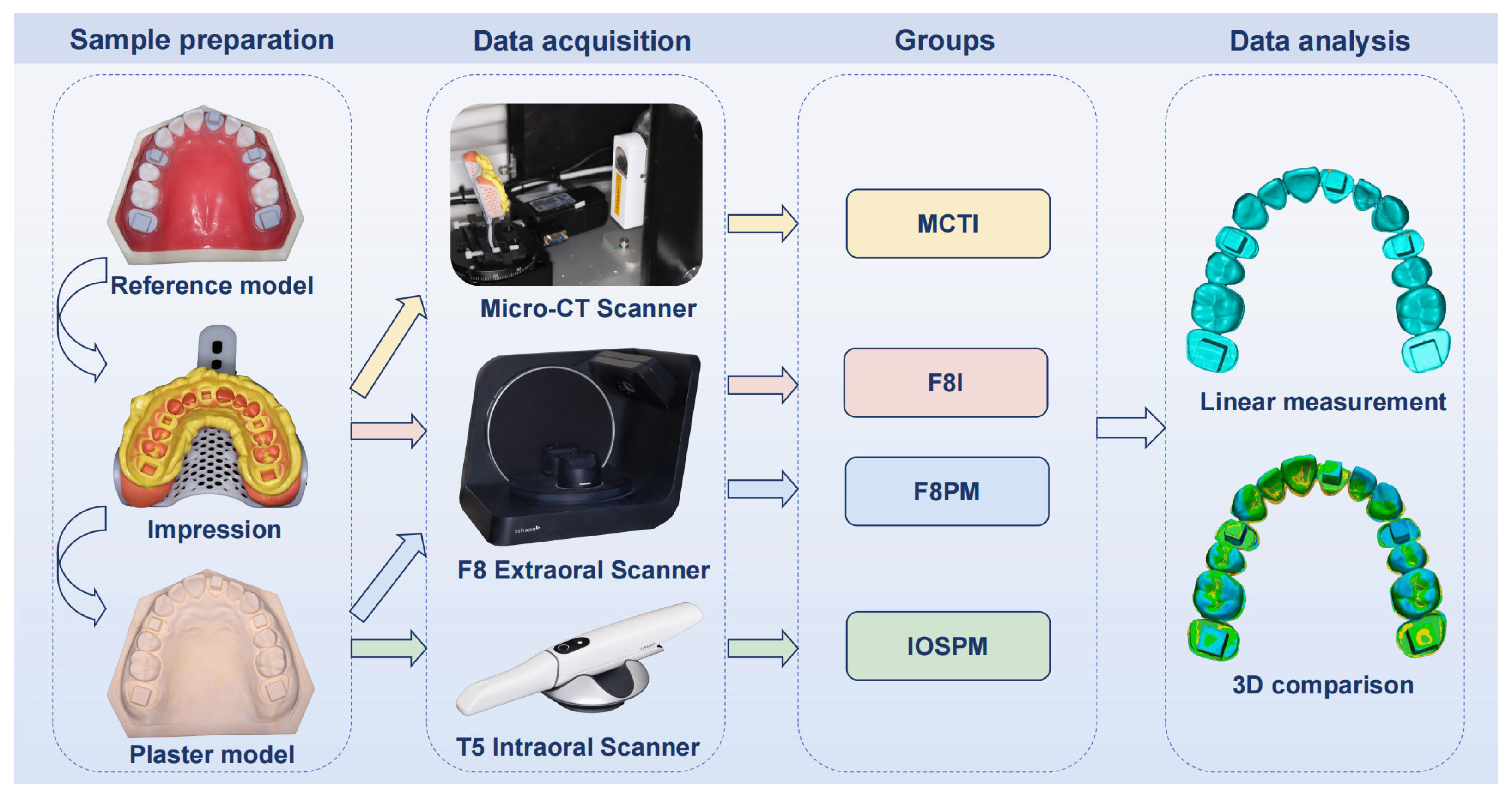
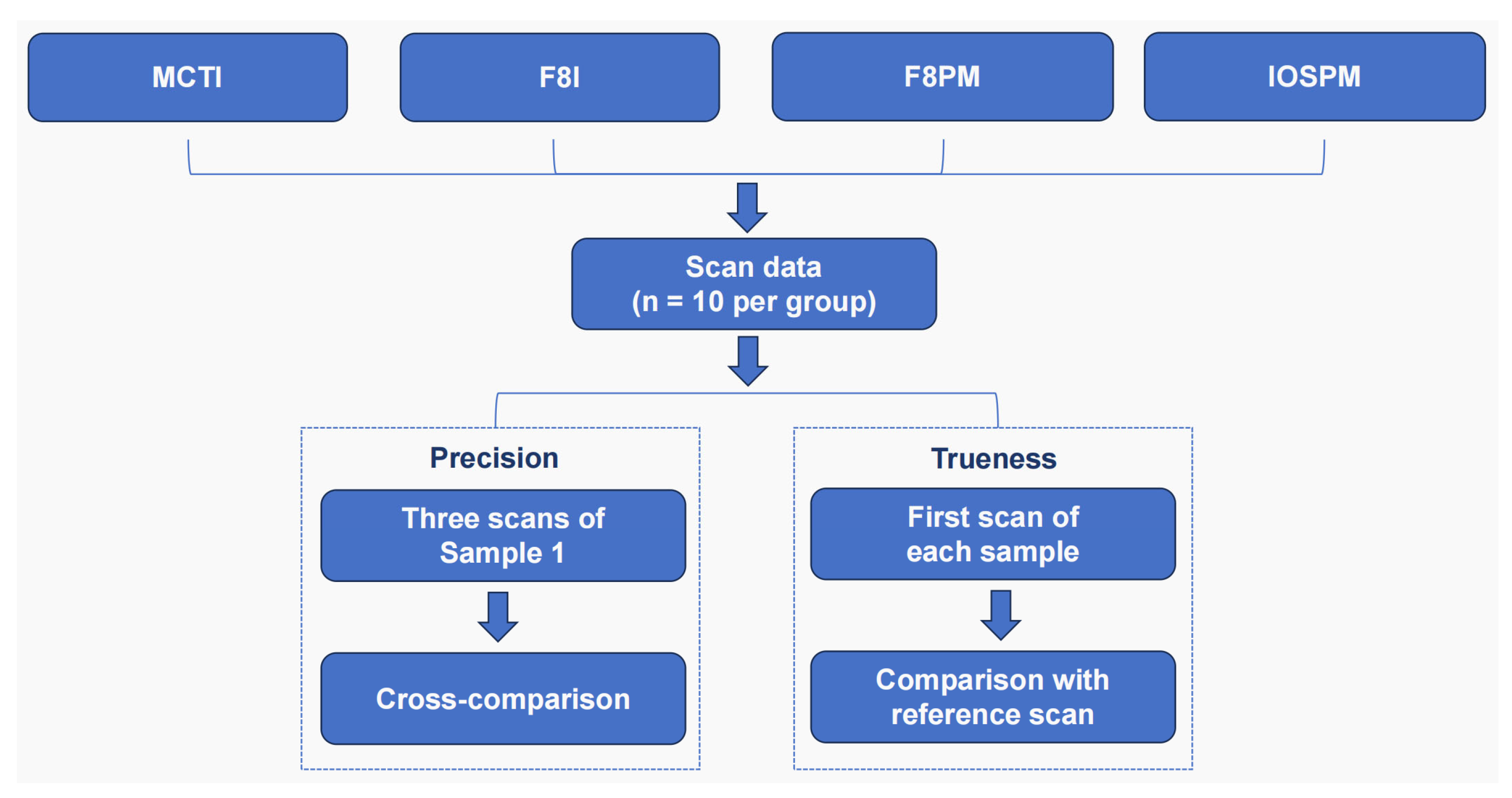
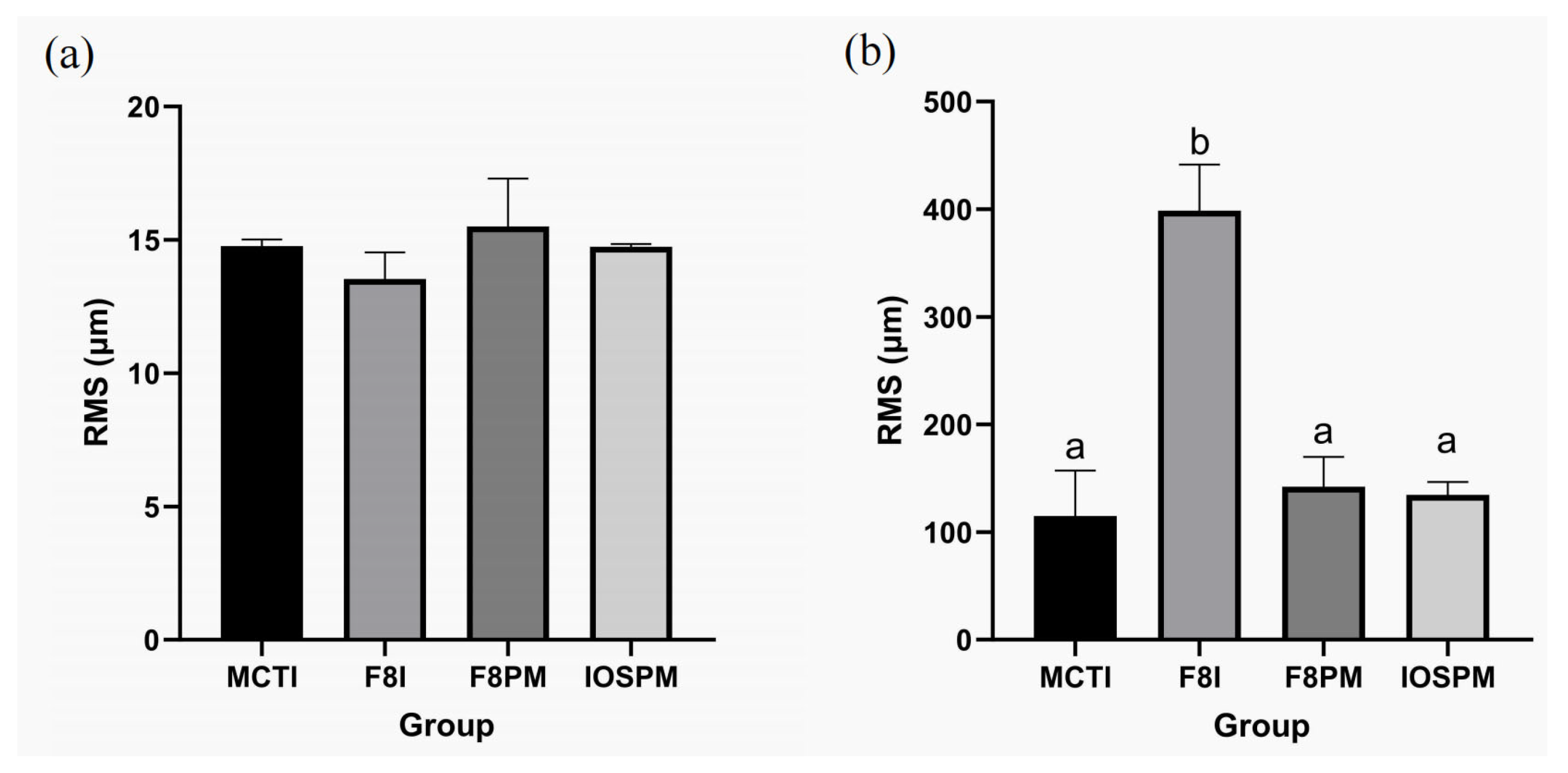
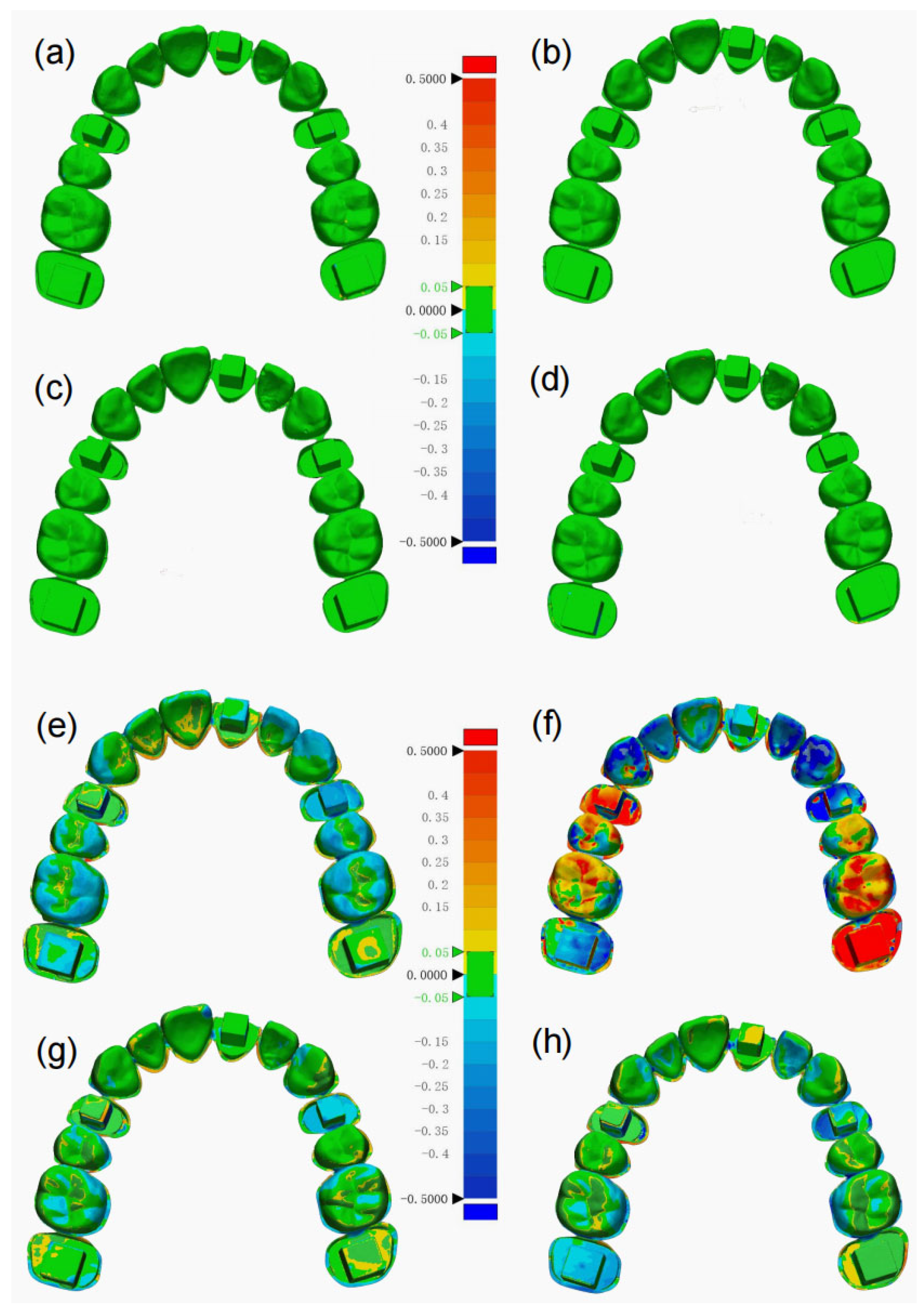
| Category | Linear Distance | Definition |
|---|---|---|
| Short Distance | Segment A | The distance between Mesial-Buccal-Occlusal points of #21 and #24 |
| Segment B | The distance between Mesial-Buccal-Occlusal points of #21 and #14 | |
| Medium Distance | Segment C | The distance between Mesial-Buccal-Occlusal points of #21 and #27 |
| Segment D | The distance between Mesial-Buccal-Occlusal points of #14 and #24 | |
| Long Distance | Segment E | The distance between Mesial-Buccal-Occlusal points of #17 and #27 |
| Segment F | The distance between Mesial-Buccal-Occlusal points of #14 and #27 |
| Linear Distance (mm) | MCTI | F8I | F8PM | IOSPM |
|---|---|---|---|---|
| Segment A | 23.7664 ± 0.0084 a | 23.4794 ± 0.0204 b | 23.7727 ± 0.0083 a | 23.7563 ± 0.0093 a |
| Segment B | 27.4392 ± 0.0066 a | 27.2171 ± 0.0061 b | 27.4604 ± 0.0041 c | 27.4338 ± 0.0068 a |
| Segment C | 46.8219 ± 0.0065 a | 46.5102 ± 0.0334 b | 46.8225 ± 0.0057 a | 46.8297 ± 0.0083 a |
| Segment D | 41.7104 ± 0.0061 a | 41.4567 ± 0.0271 b | 41.7224 ± 0.0048 a | 41.7242 ± 0.0063 a |
| Segment E | 54.2561 ± 0.0050 a | 54.0900 ± 0.0156 b | 54.2606 ± 0.0069 a | 54.2645 ± 0.0071 a |
| Segment F | 54.3134 ± 0.0086 a | 54.0960 ± 0.0275 b | 54.3131 ± 0.0038 a | 54.3231 ± 0.0077 a |
| Linear Distance (mm) | DCRM | MCTI | F8I | F8PM | IOSPM | ||||
|---|---|---|---|---|---|---|---|---|---|
| t | p | t | p | t | p | t | p | ||
| Segment A | 23.7656 | 0.291 | 0.778 | −44.453 | <0.001 | 2.677 | 0.025 | −3.165 | 0.011 |
| Segment B | 27.4467 | −3.644 | 0.005 | −119.213 | <0.001 | 10.579 | <0.001 | −6.039 | <0.001 |
| Segment C | 46.8300 | −3.965 | 0.003 | −30.244 | <0.001 | −4.160 | 0.002 | −0.122 | 0.905 |
| Segment D | 41.7189 | −4.382 | 0.002 | −30.607 | <0.001 | 2.270 | 0.049 | 2.633 | 0.027 |
| Segment E | 54.2533 | 1.775 | 0.110 | −33.098 | <0.001 | 3.341 | 0.009 | 4.967 | 0.001 |
| Segment F | 54.3222 | −3.235 | 0.010 | −25.971 | <0.001 | −7.451 | <0.001 | 0.367 | 0.722 |
Disclaimer/Publisher’s Note: The statements, opinions and data contained in all publications are solely those of the individual author(s) and contributor(s) and not of MDPI and/or the editor(s). MDPI and/or the editor(s) disclaim responsibility for any injury to people or property resulting from any ideas, methods, instructions or products referred to in the content. |
© 2026 by the authors. Licensee MDPI, Basel, Switzerland. This article is an open access article distributed under the terms and conditions of the Creative Commons Attribution (CC BY) license.
Share and Cite
Gu, J.; Zhu, L.; Yang, W.; Zhang, Y.; He, F.; Xu, Y.; Gu, X.; Tsoi, J.K.H.; Fu, Y. Accuracy of a Novel Desktop Micro-CT Scanner for Direct Digitization of Dental Impressions: A Comparative In Vitro Study. Dent. J. 2026, 14, 16. https://doi.org/10.3390/dj14010016
Gu J, Zhu L, Yang W, Zhang Y, He F, Xu Y, Gu X, Tsoi JKH, Fu Y. Accuracy of a Novel Desktop Micro-CT Scanner for Direct Digitization of Dental Impressions: A Comparative In Vitro Study. Dentistry Journal. 2026; 14(1):16. https://doi.org/10.3390/dj14010016
Chicago/Turabian StyleGu, Jiaying, Liqing Zhu, Wenyue Yang, Yuan Zhang, Fan He, Yunwen Xu, Xiaoyu Gu, James Kit Hon Tsoi, and Yuanfei Fu. 2026. "Accuracy of a Novel Desktop Micro-CT Scanner for Direct Digitization of Dental Impressions: A Comparative In Vitro Study" Dentistry Journal 14, no. 1: 16. https://doi.org/10.3390/dj14010016
APA StyleGu, J., Zhu, L., Yang, W., Zhang, Y., He, F., Xu, Y., Gu, X., Tsoi, J. K. H., & Fu, Y. (2026). Accuracy of a Novel Desktop Micro-CT Scanner for Direct Digitization of Dental Impressions: A Comparative In Vitro Study. Dentistry Journal, 14(1), 16. https://doi.org/10.3390/dj14010016

