Article

Catalytic Oxidation of Toluene over CoMnOx/SBA-15 Catalyst: Promoting Effect of the Interaction Between Metal Active Components and the Support


1
School of Transportation Engineering, Dalian Jiaotong University, Dalian 116021, China
2
SINOPEC Dalian Research Institute of Petroleum and Petrochemicals Co., Ltd., Dalian 116045, China
3
Ministry of Education Key Laboratory of Pollution Processes and Environmental Criteria, Nankai University, Tianjin 300350, China
*
Authors to whom correspondence should be addressed.
Inorganics 2026, 14(9), 240; https://doi.org/10.3390/inorganics14090240
Submission received: 11 August 2026 / Revised: 28 August 2026 / Accepted: 9 September 2026 / Published: 11 September 2026

Abstract

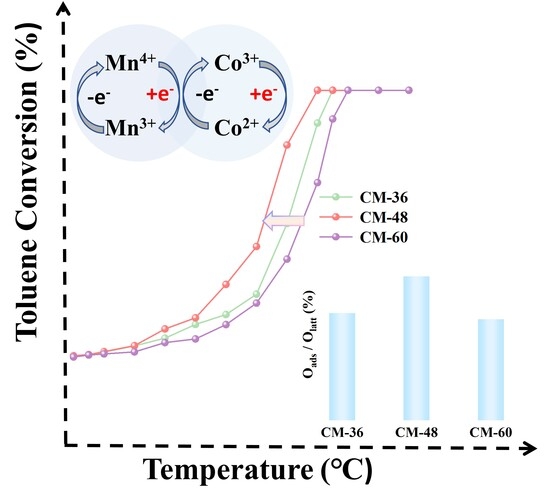
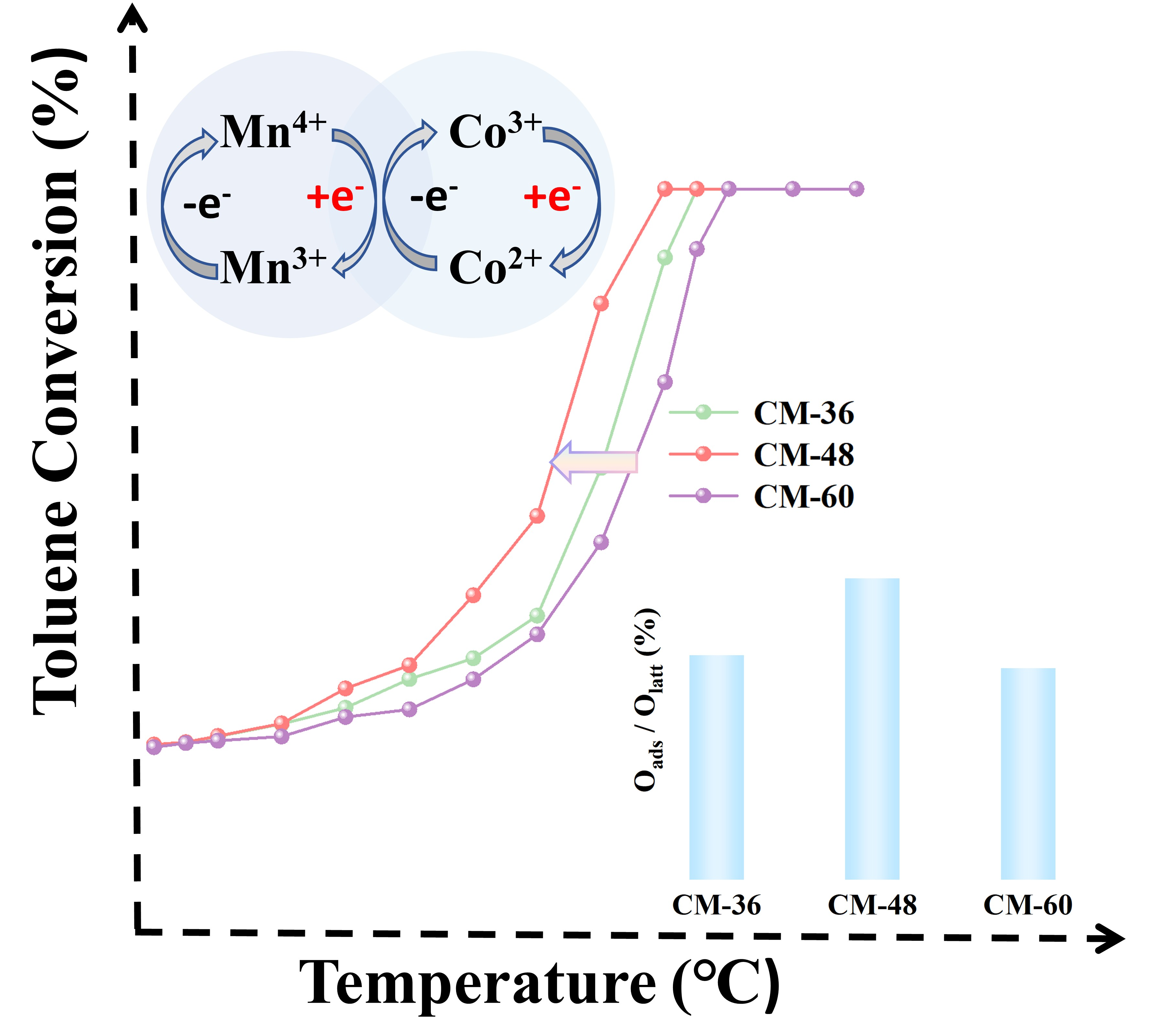
For supported catalysts, the interaction between metal active components and the support plays a crucial role in modifying catalyst properties, such as active sites and oxygen vacancies. Herein, a series of CoMnOx/SBA-15 (Santa Barbara Amorphous-15) catalysts were prepared for catalytic oxidation of toluene, in which the support properties were tailored by varying the hydrothermal crystallization time. The results revealed that subtle changes in support properties could lead to modifications of the supported active component. CM-48 (crystallization time of 48 h) exhibited the optimal low-temperature activity with T90 of 234 °C and good stability for the catalytic oxidation of toluene. The improved performance was attributed to the enhancement of redox properties, abundant oxygen vacancies, and high mobility of lattice oxygen species resulting from the strong interaction between the active components and the support. Furthermore, the reaction mechanism was explored via in situ DRIFTS (Diffuse Reflectance Infrared Fourier Transform Spectroscopy), confirming that both surface-adsorbed oxygen and lattice oxygen served as active oxygen species participating in toluene oxidation, with surface-adsorbed oxygen being particularly favorable for the consumption of key intermediates. This work will guide the design of supported catalysts in practical applications for eliminating VOCs.

Graphical Abstract

1. Introduction

Volatile organic compounds (VOCs), as major air pollutants, not only directly endanger human health due to their intrinsic toxicity and carcinogenicity but also contribute to the formation of ozone and photochemical smog [1,2]. Hence, mitigating and abating VOC emissions has become an urgent and imperative issue. A variety of purification technologies have been developed to control VOC emissions, such as adsorption, photocatalysis, membrane separation, biological treatment, and catalytic oxidation [3,4]. Among them, catalytic oxidation is considered one of the most promising technologies because of its high efficiency, low energy consumption and no secondary pollution [5]. Developing catalysts with superior activity and good durability is the key issue for the application of this strategy. Much research has focused on the design and construction of transition metal oxide catalysts, such as Co3O4, MnO2, CuO and their mixed oxides [6,7,8]. Manganese and cobalt oxides, in particular, have been reported to be promising catalysts for VOC oxidation. Moreover, binary Co-Mn mixed oxides were demonstrated to have higher catalytic activity than single oxides due to the strong synergistic effect [9]. Zhao et al. synthesized the MnO2/CoAlO-P catalyst, which exhibited higher toluene conversion than that of some supported noble metal catalysts, attributing this enhanced performance to the generation of active oxygen vacancies from the Co-O bond adjacent to Mn atoms [10]. To date, current studies on Co-Mn bimetallic oxide catalysts have primarily centered on tuning redox properties and promoting the formation of active oxygen vacancies [6,10,11].
Considering practical applications, an ideal environmental catalyst is usually one in which the active components are deposited onto a suitable support. Yao et al. found that monolithic MnOx/Co3O4/NF (Ni foam) catalysts exhibited better catalytic performance for toluene oxidation compared to the unsupported Co3O4 and MnOx samples [12]. Dispersing the active components on the support not only facilitates the dispersibility of active sites but also can inhibit agglomeration and sintering deactivation, enhancing thermal stability [13,14]. Xiao et al. found that nano-sized ZSM-5 catalysts had higher catalytic activity for toluene than traditional ZSM-5 catalysts because of improved dispersion of the active components [15]. Todorova et al. found that tuning the Co/Mn molar ratio of CoMn-SBA-15 significantly influenced the dispersion of active species, redox properties and oxygen mobility [16]. Furthermore, the textural characteristic of the support and the interaction between the active components and the support also regulates the redox ability and acid–base properties of the catalysts, thus improving the catalytic ability for VOCs [17,18]. For zeolite-supported catalysts, although the role of the support in stabilizing and dispersing the active components has been addressed, its regulatory effect on catalytic activity and redox properties remains unclear.
Herein, the ordered mesoporous material SBA-15 was chosen as the support because of its large specific surface area, unique microporous structure and high hydrothermal stability [19]. Previous studies have revealed that the structure and morphology of zeolites could be controlled by regulating their hydrothermal synthesis condition, e.g., the recrystallization time [20,21]. Therefore, a series of CoMnOx/SBA-15 bimetallic catalysts were synthesized in which the diverse structural properties of SBA-15 supports were tuned by hydrothermal crystallization times, and then the toluene catalytic oxidation performance was evaluated. The nature of the support and its effect on catalytic activity were analyzed by various characterization techniques. Furthermore, the mechanism of toluene oxidation over CoMnOx/SBA-15 bimetallic catalysts was proposed. This work elucidated the role of the support in toluene oxidation and guided the development of supported catalysts for VOC catalytic oxidation.

2. Results and Discussion

2.1. Structural Properties of SBA-15

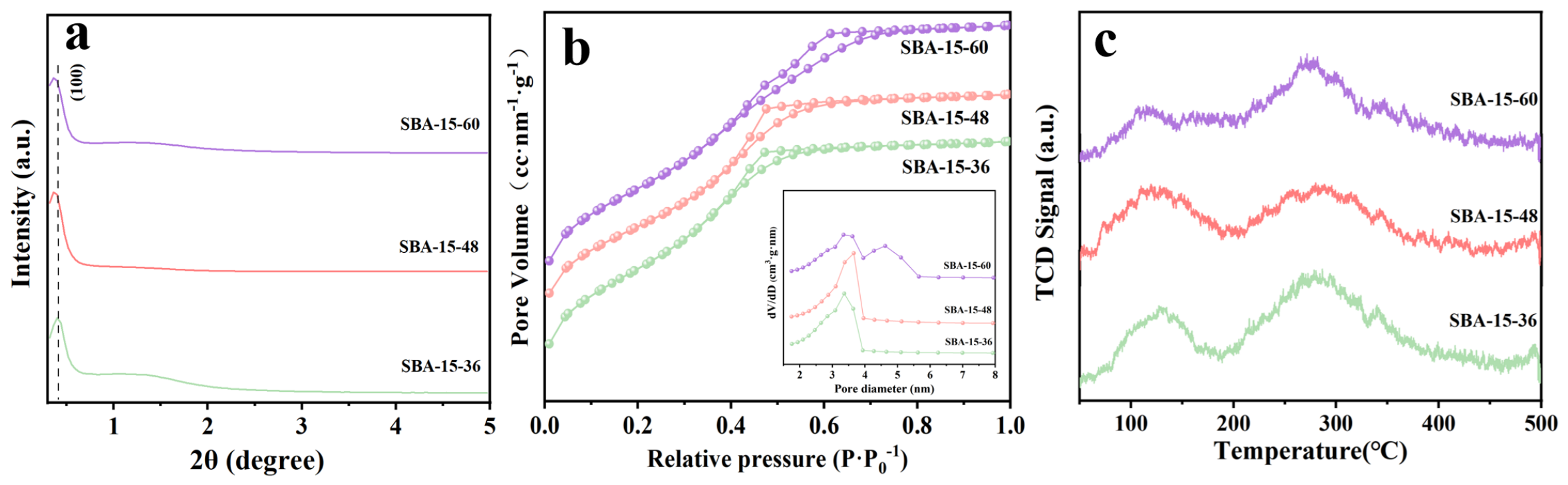
The small-angle X-ray diffraction (SXRD) of SBA-15 samples synthesized with different crystallization times is displayed in Figure 1a. All materials exhibit a featured peak, which is indexed as the (100) crystal plane of P6mm hexagonal symmetry, respectively, confirming the SBA-15 formation with a well-ordered two-dimensional mesostructure [22]. Nevertheless, the crystallization time has a notable influence on the peak intensity, and SBA-15-48 has the strongest intensity of the (100) peak, implying good crystallinity. Further prolonging the crystallization time to 60 h, this diffraction peak intensity becomes weak, which may be attributed to the lesser ordering of the mesostructure [23]. In addition, it is noted that extending crystallization time causes a slight shift of the (100) peak to lower angles, which is attributed to expansion of the unit cells [24]. This is also demonstrated by the increase in the lattice spacings (d100) and the unit cell parameter (a0) (Table 1). In a word, the crystallization time ranging from 30 to 60 h does not influence the framework structure of SAB-15 but may induce some subtle changes, such as slight alterations in unit cell parameters and pore size, which is consistent with previous reports [25]. SEM images further reveal that no significant variations are observed in the morphology of SBA-15 with different crystallization times, and all samples illustrate larger clusters with irregular foam-like particles attached to each other (Figure S1).
Subtle structural changes in SBA-15 are also confirmed by N2 adsorption–desorption analysis. As shown in Figure 1b, all SBA-15 samples exhibit typical type IV isotherms with H1 hysteretic loops. Furthermore, a well-defined condensation step is observed in the relative pressure (p/p0) range of 0.5–0.8, which is ascribed to capillary condensation in uniform tubular mesopores, indicating the existence of ordered mesopores with uniform pore size [26,27]. Moreover, a sharp rise at low pressure of p/p0 = 0.1 suggests that these SBA-15 samples also contain some micropores [26]. Nevertheless, compared with SBA-15-36, the capillary condensation of SBA-15-48 and SBA-15-60 slightly shifts to higher relative pressure, suggesting that prolonging crystallization time could lead to an increase in the pore size. This is also corroborated by the pore size distribution (the insert of Figure 1b), and the average pore diameters of SBA-15-36, SBA-15-48 and SBA-15-60 are 3.0, 3.2 and 3.5 nm (Table 1), respectively. Furthermore, another larger mesopore peak (4.0–6.0 nm) is observed in SBA-15-60. The pore variation could originate from the development of in-wall mesopores connecting parallel mesopores or intergranular pores in the SBA-15 framework [28]. In addition, it is observed that SBA-15-48 shows the smallest specific surface area (785 m2·g−1) among the three materials, while it exhibits the highest toluene conversion. We speculated that the specific surface area may not be a key factor in enhancing the catalytic performance in this case.
Ammonia temperature-programmed desorption (NH3-TPD) was performed to investigate the surface acidity of these SBA-15 samples. As shown in Figure 1c, all samples exhibit two desorption peaks at 120 and 280 °C, which are assigned to weak acid sites and medium-strong acid sites, respectively [25]. Particularly, SBA-15-48 has the highest NH3 desorption amount, suggesting that it possesses the greatest abundance of acid sites (Table S1). This may account for its high dispersion and small particle sizes of the CoMnOx active components [17].

2.2. Catalytic Performance of Toluene Oxidation

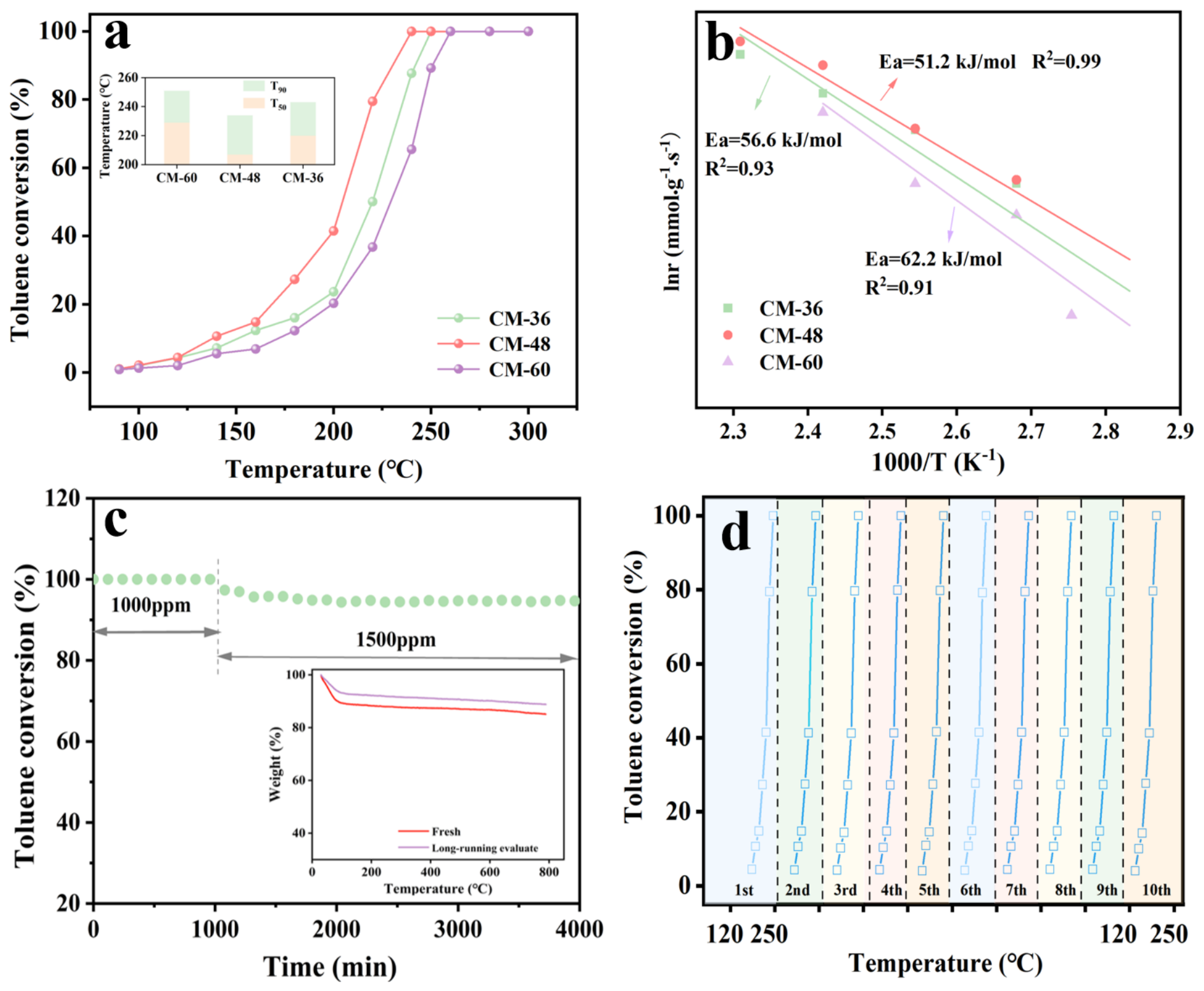
The catalytic activity of the as-prepared CoMnOx/SBA-15 catalysts was evaluated under the reaction conditions of 1000 ppm toluene and 20% O2. In order to explore the effect of the SBA-15 support, investigation of the optimum Mn:Co ratios was first performed, and CoMnOx/SBA-15 with Mn:Co = 4:1 was found to possess the best catalytic activity (Figure S2). Therefore, similar Co and Mn loadings were employed for CM-36, CM-48 and CM-60 samples in this study, with Co and Mn contents of about 1.5 and 6.3 wt.%, respectively (Table S2), corresponding to a Mn:Co ratio of 4:1. The toluene conversion over CoMnOx/SBA-15 catalysts as a function of reaction temperature is illustrated in Figure 2a. All these catalysts exhibit excellent catalytic performance for toluene oxidation, and complete conversion is achieved when the temperature exceeds 260 °C. However, a significant difference in catalytic efficiency is observed at low temperatures, and this becomes particularly evident when comparing the T90 temperature (the temperature corresponding to 90% conversion). The CM-48 catalyst reaches 90% conversion at 234 °C, while the T90 of CM-36 and CM-60 are 243 and 251 °C, respectively (the insert of Figure 2a). Certainly, CM-48 exhibits the highest catalytic activity for toluene oxidation. In addition, CO2 yields are close to toluene conversions for all catalysts (Figure S3), suggesting the deep mineralization of toluene. Furthermore, the catalytic performance of CM-48 is compared with those catalysts reported in the literature (Table S3) [10,12,15,18,29,30,31,32,33]. It is found that the catalytic activity of CM-48 is also higher than that of some CoMn oxide catalysts at low temperatures. Moreover, the apparent activation energy (Ea) was calculated, and the order trend of Ea is as follows: CM-48 (51.2 kJ·mol−1) < CM-36 (56.6 kJ·mol−1) < CM-60 (62.2 kJ·mol−1) (Figure 2b). Obviously, CM-48 has the lowest Ea, meaning that the reactants are more easily activated over CM-48. Based on the above results, it is found that subtle variations in the morphology and structural properties of the support directly influence the catalytic activity for the toluene oxidation reaction. Accordingly, it is speculated that regulating the properties of the support could alter the chemical environment of the active components, thus enhancing intrinsic catalytic performance.
Moreover, the catalytic stability, including reaction stability and cycling tests, was also investigated. Long-term catalytic performance of CM-48 at 260 °C remains above 94% even when the toluene concentration increases to 1500 ppm (Figure 2c). Additionally, no carbon deposition is detected during this process, as evidenced by TG analysis (insert of Figure 2c). Further, CM-48 also exhibits satisfactory cycling stability, and no obvious loss of toluene conversion is observed after ten cycles (Figure 2d). These results reveal that CM-48 possesses excellent reaction stability.

2.3. Physical, Structural and Redox Properties of CoMnOx/SBA-15

2.3.1. Textural and Structural Properties

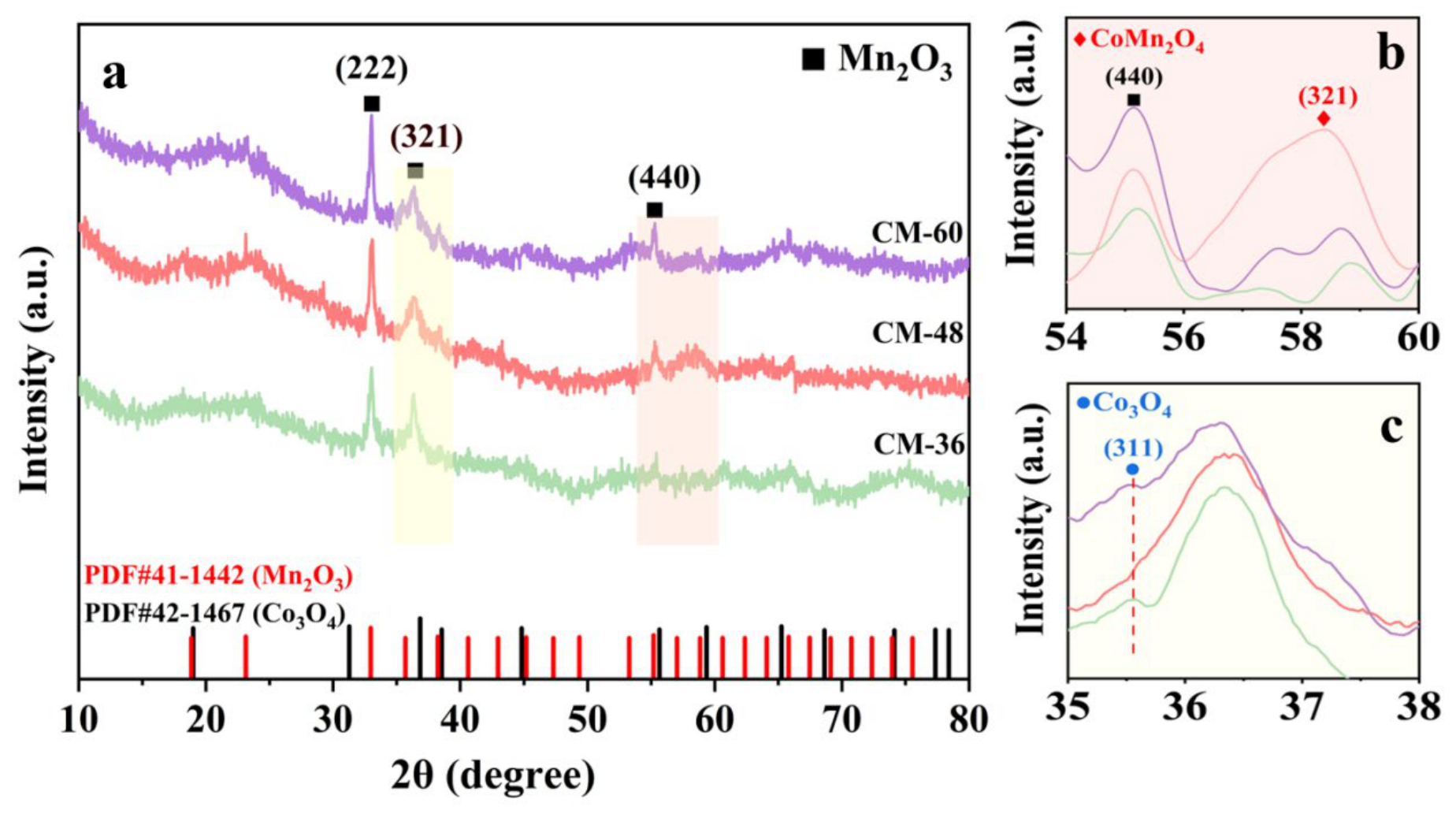
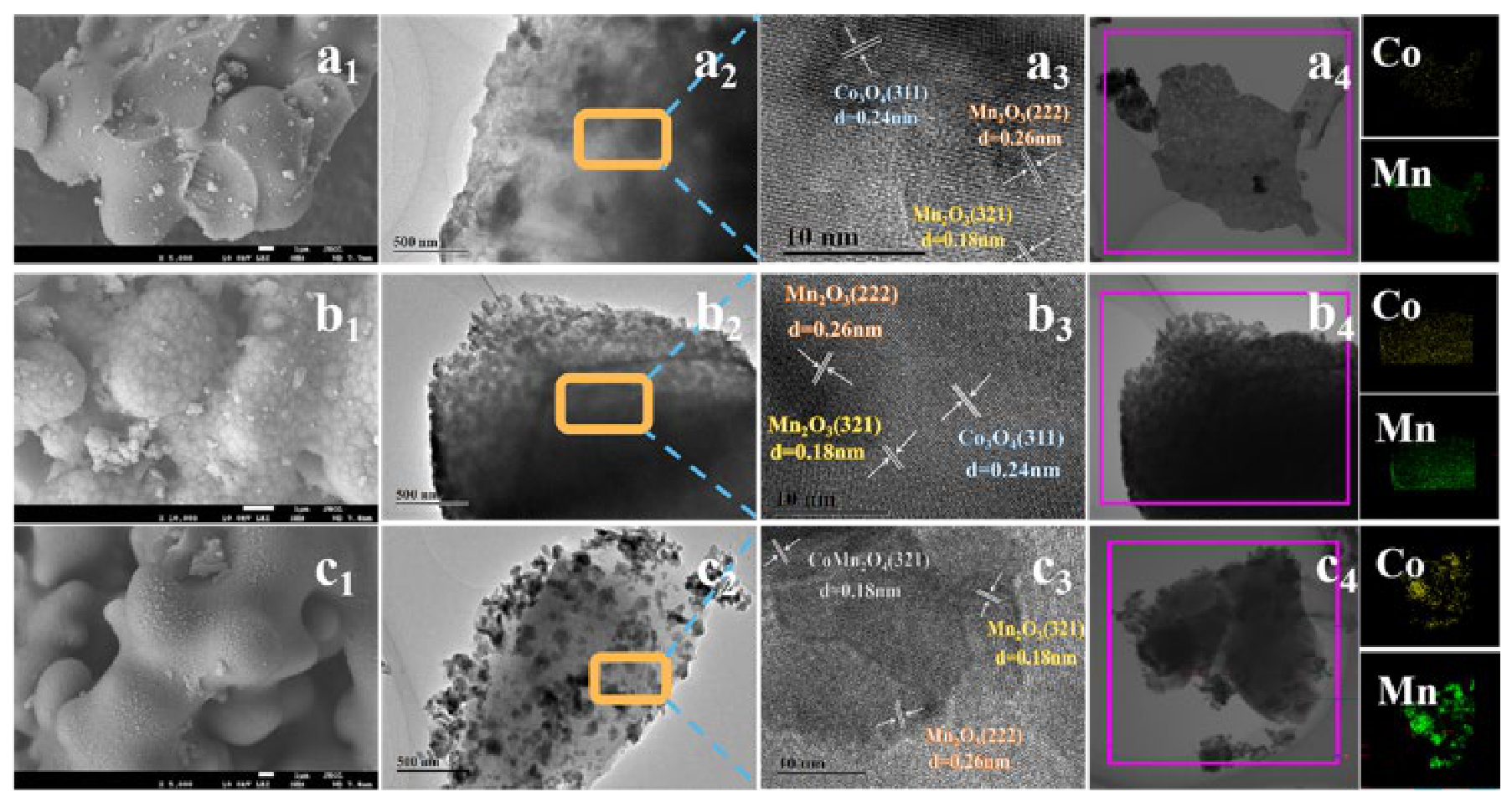
The composition and crystalline structure of CoMnOx/SBA-15 catalysts were investigated by XRD. SXRD spectra of CoMnOx/SBA-15 show that no significant changes are observed compared with pure SBA-15, revealing that the SBA-15 framework is not disrupted during the catalyst preparation process (Figure S4). However, the intensity of the characteristic peaks slightly weakens due to the location of CoMn oxide particles. In the wide-angle XRD patterns (Figure 3a), the diffraction peaks located at 33.1, 36.3, and 55.2° are attributed to Mn2O3 species (PDF#41-1442). A weak diffraction peak ascribed to the CoMn2O4 spinel crystal phase (PDF#77-0471) occurs at 58.2° on CM-48, and the peak shifts towards low angles compared with CM-36 and CM-60 (Figure 3b) [34]. Furthermore, except for CM-48, both CM-36 and CM-60 show detectable XRD peaks of Co3O4 species (PDF#42-1467) at 35.7° (Figure 3c). This indicates that more Co ions could substitute Mn ions to form a Co-O-Mn solid solution in the case of CM-48, which could facilitate strong interactions between Co3O4 and MnO2, resulting in the formation of more defects and probably improving the generation of active oxygen species [34]. In addition, the peak intensity assigned to Mn2O3 gradually increases. Clearly, the slight variation of the SBA-15 support induced by crystallization time can regulate the interaction between the metal species and the support, thereby influencing the elemental composition and the crystallization of the active metal species. The morphology of the CM-36, CM-48 and CM-60 catalysts was analyzed by SEM and TEM. As displayed in SEM photographs (Figure 4(a1–c1)), the introduction of CoMn oxides has no significant influence on the morphology of the catalysts, and all samples remain foam-like particles of SBA-15. Nevertheless, it is noted that CoMn oxide nanoparticles are homogeneously dispersed on the surface of CM-48, while pronounced aggregation is observed on CM-36 and CM-60 from TEM images (Figure 4(a2–c2)). The Mn and Co element mapping images further confirm good dispersion in the case of CM-48 (Figure 4(a4–c4)). The corresponding HRTEM images show that the three samples mainly exposed the (222) and (321) crystal planes of Mn2O3 with 0.26 and 0.18 nm interplanar spacing, respectively (Figure 4(a3–c3)). The (311) crystal plane of Co3O4 is detected in CM-36 and CM-60. Interestingly, clear stripes with an interplanar spacing of 0.18 nm, corresponding to the (321) crystal plane of CoMn2O4, are observed in CM-48 (Figure 4b), which is consistent with the XRD results. Obviously, the subtle changes in the SBA-15 support could also influence the dispersion of CoMn active components, and the strong interaction between active components and SBA-15 may induce the formation of spinel CoMn2O4 species.
After loading of the CoMn oxides, the CoMnOx-SBA-15 catalysts retain a similar N2 physisorption isotherm hysteresis loop shape, confirming that no significant structural collapse or pore blocking of the SBA-15 matrix occurred (Figure S5). However, compared to the corresponding SBA-15 support, the specific surface area and pore volume of the catalysts decrease greatly (Table 1), which is possibly due to pore blockage by the active components. This is verified by the remarkable decrease in average pore diameter. This also implies that some metal oxide particles may be dispersed into the inner channel of the SBA-15 matrix. In addition, the pore size distribution curve shows the disappearance of the large mesopores in CM-60, suggesting the formation of larger CoMn oxide particles (Figure S5), which is in accordance with that from XRD and TEM. In a word, the variation of SBA-15 support can affect the particle sizes and dispersion of supported CoMn oxide particles. In addition, all CoMnOx/SBA-15 catalysts exhibit NH3-TPD profiles similar to those of the zeolite support, with the exception that the total acidity follows the order CM-60 > CM-48 > CM-36 (Figure S6 and Table S1). CM-60 exhibits the strongest acidity, which may be attributed to the additional acidic sites introduced by CoMnOx [35]. Moreover, the acidity alternation trend is not the same as the catalytic activity for toluene oxidation, suggesting that the acidity of CoMnOx/SBA-15 catalysts is not the key factor affecting the catalytic activity.

2.3.2. Redox Properties

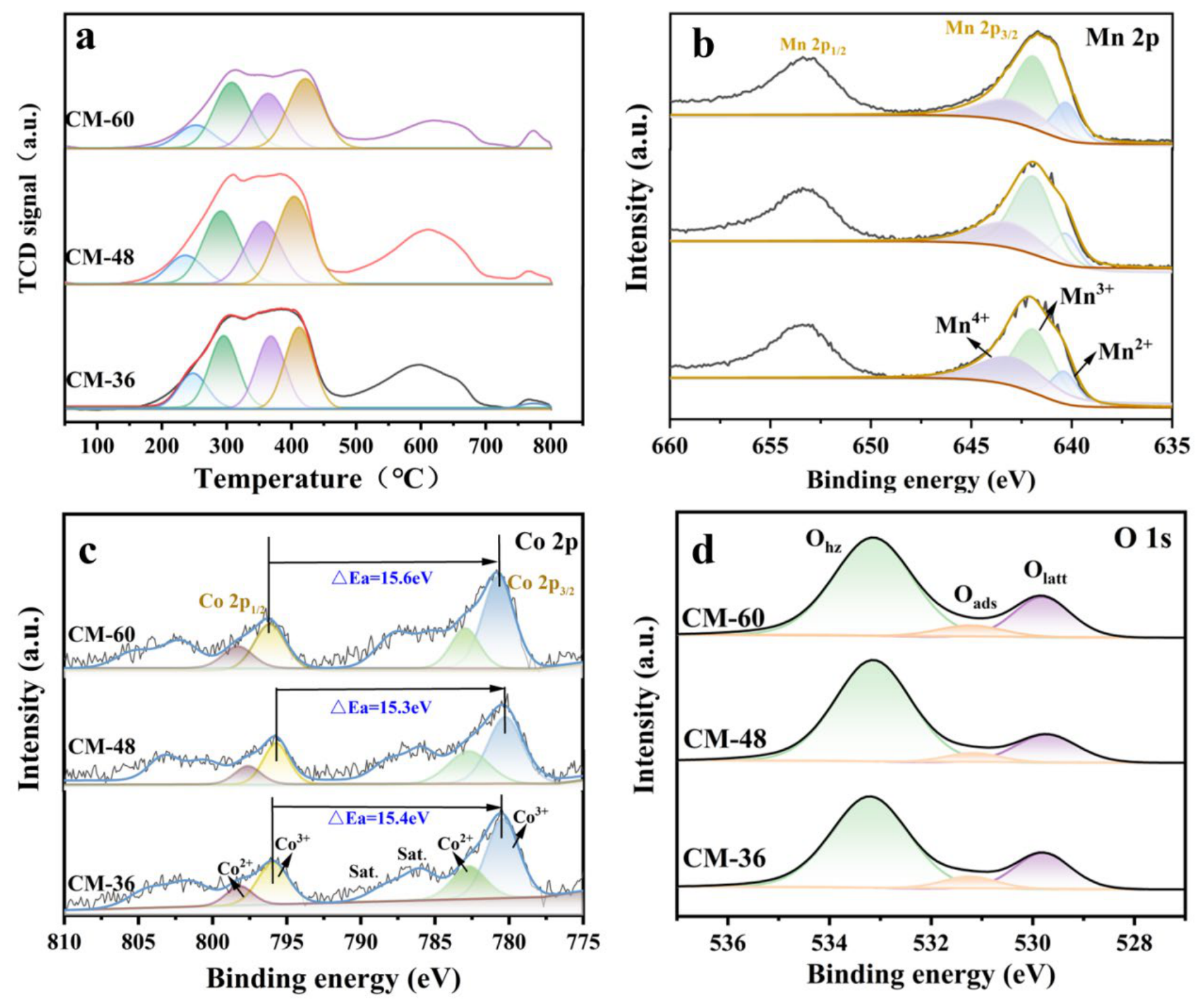
The effect of the SBA-15 support on the reducibility of the catalysts was evaluated by H2-TPD measurement. As shown in Figure 5a, all catalysts exhibit similar curves with two reduction regions at low temperatures (<550 °C) and high temperatures (>550 °C). The broad overlapping peak at low temperatures is divided into four peaks by the peak fitting. The peaks at 237–252, 352–367 and 401–425 °C are related to the continuous reduction of MnO2 → Mn2O3 → Mn3O4 → MnO, while the peak at 290–309 °C is assigned to the reduction of Co3O4 to CoO, respectively [6,36]. The peak located at 550–567 °C is assigned to the reduction of the spinel-like environment MnO and Co2+ to Mn and Co, and the peak at 773 °C is attributed to the reduction of the bulk MnO to Mn, which has a strong interaction with Si-O species of the SBA-15 support [29,30,37]. In comparison of the reduction peak temperature in the low-temperature range, a decreasing trend of CM-48 < CM-36 < CM-60 is observed, suggesting a facilitated redox process of Mn and Co in CM-48. This could be attributed to different synergetic interface interactions between CoMn oxides and the SBA-15 support, and CM-48 might have a more intimate interfacial effect that promotes charge transfer, resulting in H2 spillover from SBA-15 to the CoMn active components, thereby enhancing the reducibility of Co and Mn [29,38]. Moreover, CM-48 has the largest H2 consumption amount among the three catalysts (Table S1), which further implies the formation of more active species and a higher valence state [39]. This is likely an important factor in the superior low-temperature catalytic activity of CM-48. These H2-TPR results indicate that the properties of the SBA-15 support significantly influence the redox capacity of the supported catalysts and demonstrate the synergistic effect of metal active species and the support.

2.3.3. Surface Chemical Status and Oxygen Species

The surface elemental composition and the chemical state of CoMnOx-SBA-15 catalysts were revealed by XPS technology. The Mn 2p, Co 2p and O 1s spectra of the catalysts are shown in Figure 5b–d, and the corresponding XPS data are summarized in Table 2. Owing to the identical synthesis process, all samples have similar bulk-phase Mn and Co contents, as measured by the ICP method, with the Mn/Co molar ratio remaining at approximately 4.0 (Table S2). Interestingly, XPS results show a noticeable change in Mn and Co contents compared to the ICP results, and an obvious surface enrichment of Mn is observed on all catalysts, following the order: CM-60 > CM-36 > CM-48. On the contrary, the surface content of Co is lower than that of the ICP results. Among them, CM-48 exhibits the lowest surface Mn/Co molar ratio of 4.74, which is close to the bulk value. This means that more Mn species are located on the external surface of SBA-15, especially for CM-36 and CM-60 catalysts. The result further confirms that physical properties of SBA-15 can influence the dispersion and spatial distribution of active components on the surface of zeolites.
Figure 5b displays the Mn 2p XPS spectra in which two peaks attributed to Mn 2p3/2 (641.38–641.58 eV) and Mn 2p1/2 (653.08–653.18 eV) are observed on all samples. Compared to CM-60, Mn 2p3/2 peaks of CM-36 and CM-48 slightly shift to lower binding energy, implying some variations in the surrounding chemical environment of Mn. This phenomenon is possibly related to a different electronic interaction between CoMn oxide and the support induced by the variation of SBA-15. By performing a peak-fitting deconvolution, the Mn 2p3/2 peak is categorized into three characteristic peaks at 640.1–640.4, 641.7–641.9, and 644.1–644.7 eV, corresponding to Mn2+, Mn3+ and Mn4+, respectively [40,41]. Mn3+ species are the main form. From Table 2, it is noted that the relative surface content of Mn3+ (Mn3+/Mn) is highest in CM-48, and CM-60 has the lowest Mn3+/Mn ratio. The increase in Mn3+ content may be mainly attributed to a stronger synergistic effect between Mn and Co species, and more oxygen vacancies are generated on the surface of CM-48 due to the electrostatic balance [42,43].
For Co 2p XPS spectra, all samples present the characteristic peak centers at 795.98–798.28 and 780.38–787.28 eV for Co 2p1/2 and Co 2p3/2 respectively, with satellite features (Figure 5c). The occurrence of satellite peaks represents the formation of Co3O4. Furthermore, the coexistence of Co3+ and Co2+ mixed valence states is demonstrated by the spin-orbit splitting values (ΔECo2p) above 15.3 eV [41,44]. Additionally, the ΔECo2p value also reflects the variations in the coordination environment of Co elements. The lowest ΔECo2p value of CM-48 means a weakening of the Co-O bond [38]. The Co 2p3/2 peak is split into two peaks at 780.38 and 783.08 eV, attributed to Co3+ and Co2+, respectively [44,45]. The overlapped Co 2p peaks were deconvoluted into several peaks by searching for the optimal combination of Gaussian bands with the correlation coefficients (r2) above 0.97. It is worth noting that the ratio of Co3+/Co2+ for CM-48 is 2.85, which is higher than that for CM-36 (2.23) and CM-60 (2.03), as shown in Table 2. Together with the Mn XPS results, the increase in Co3+ content may be attributed to enhanced electron transfer from Co to Mn species due to the stronger Co-Mn interaction in CM-48, as well as the charge balance (Mn3+ + Co3+ ↔ Mn4+ + Co2+) [46]. Moreover, the redox cycle can promote lattice oxygen mobility, which is beneficial for the improvement of catalytic activity for toluene oxidation. In addition, abundant Co3+ species would facilitate VOC oxidation at low temperatures, which could be another contributor to the excellent catalytic activity of CM-48.
Figure 5d illustrates O 1s spectra of the prepared catalysts. The O 1s spectra are fitted into three peaks. The peak at 529.8 eV is assigned to the lattice oxygen from metal oxides (Olatt), the peak at 531.1 eV is attributed to the surface-adsorbed oxygen from the defect oxides or nonchemical oxide (Oads), and the peak at 533.2 eV is classified as oxygen from hydroxyl or the regular lattice oxygen from the SBA-15 zeolite structure (Ohz), respectively [38,47,48]. In general, the adsorbed oxygen species play a critical role in the catalytic combustion of VOCs [12]. The Oads/Olatt ratio follows the order: CM-48 > CM-36 > CM-60 (Table 2), which is consistent with the catalytic activity for toluene oxidation. It is deduced that more available oxygen vacancies are formed on the CM-48 surface, which can not only provide more centers for active oxygen adsorption and replenishment but also accelerate the oxygen cycle [29,49]. Taken together, the subtle variation of SBA-15 properties enhances the interaction between the CoMn oxides and the support, promoting the redox cycle (Mn4+/Mn3+ and Co3+/Co2+) and generating abundant surface-active oxygen.
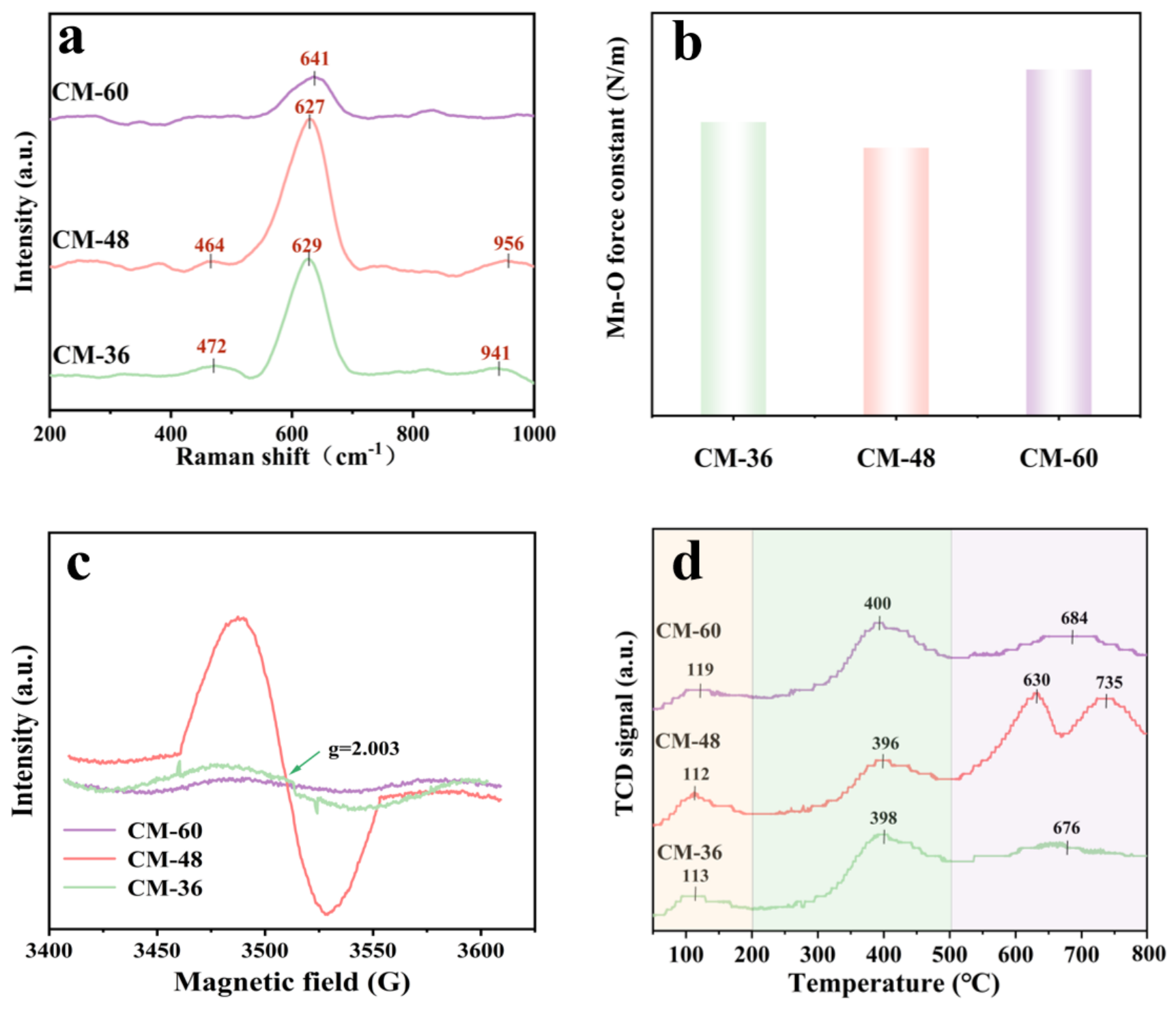
Furthermore, the metal coordination environments and the oxygen vacancies were investigated by Raman and EPR tests. As shown in Figure 6a, the strong Raman peak at about 627/629/641 cm−1 is detected in all samples, corresponding to symmetric stretching vibration of Mn-O in [MnO6] group octahedra [50]. Nevertheless, compared to CM-60 and CM-36, CM-48 has a red shift, demonstrating the formation of more oxygen vacancies [7,10]. The weak peak at 472/464 cm−1 is assigned to metal–oxygen movement of divalent metal ions (M-O-M) [51,52]. In the case of CM-48, a significant red shift is observed, which may be mainly due to the partial replacement of Mn by Co ions on tetrahedral sites [51]. On the contrary, the peak at 941/956 cm−1, corresponding to the terminal Mn-O stretching mode of Mn-O-Si, has a blue shift in CM-48, implying stronger synergy effect of MnOx and the support [51,53]. Based on Hooke’s law, the Mn-O band force constant (k) is calculated using the following equation [52]: ω = k μ , where ω is the Raman shift (cm−1), c is light velocity (2.9 × 10⁸ m·s−1), and μ is effective mass. The Mn-O force constant (k) decreases in the order CM-60 (312 N/m) > CM-36 (294 N/m) > CM-48 (286 N/m) (Figure 6b), which is negatively related to the catalytic activity. In other words, the Mn-O bond is more easily broken in CM-48, thereby facilitating the formation of oxygen vacancies.
Figure 6c presents the electron paramagnetic resonance (EPR) profiles of three CoMnOx/SBA-15 catalysts. All samples show a symmetrical EPR peak at g = 2.004, which is related to unpaired electrons at the oxygen vacancy [54,55]. The intensity of this peak directly represents the oxygen vacancy concentration. CM-48 exhibits the highest peak intensity, indicating that more abundant oxygen vacancies are generated, which is in accordance with the XPS results. Therefore, it is concluded that CM-48 has a highly defective structure, resulting in more active oxygen species and promoting the adsorption and activation of the reactants.
To further evaluate the mobility of oxygen species and the oxygen activation, O2-TPD experiments were performed. As illustrated in Figure 6d, the variation of SBA-15 leads to significant differences in the types of oxygen species and the desorption peak temperature. CM-36 and CM-60 exhibit three desorption peaks, while four desorption peaks are observed on CM-48. The peak at 50–200 °C is ascribed to the desorption of physically and chemically adsorbed oxygen bound to the surface, the peak at 200–500 °C is attributed to surface lattice oxygen species originating from the breakage of unsaturated Mn-O bonds, and the peak above 500 °C is assigned to the bulk lattice oxygen [54,56]. Usually, surface-adsorbed oxygen is widely considered the key reactive species that easily initiates catalytic oxidation, especially at low temperatures, while lattice oxygen serves as the oxygen reservoir and oxygen transfer pathway, reflecting the migration and replenishment of the reactive species [8,9]. Three catalysts exhibit similar peak intensity and the desorption temperature for adsorbed oxygen and surface lattice oxygen. Nevertheless, CM-48 shows a stronger peak of bulk lattice oxygen along with a lower desorption temperature, meaning more active, easily released lattice oxygen species with high mobility. This also suggests that the Mn-O and Co-O bonds may be more easily broken in the case of CM-48, facilitating lattice oxygen migration [50]. High mobility is beneficial for the transfer of lattice oxygen from the bulk phase to the surface to replenish consumed surface lattice oxygen and accomplishes the emergence-consumption cycling of oxygen vacancies, further resulting in an enhancement of the catalytic activity. Thus, it is reasonable to speculate that the migration of bulk lattice oxygen might be another provided pathway for the replenishment of surface lattice oxygen, which may be a factor for the superior toluene conversion over CM-48.

2.4. Reaction Mechanism of Toluene Oxidation

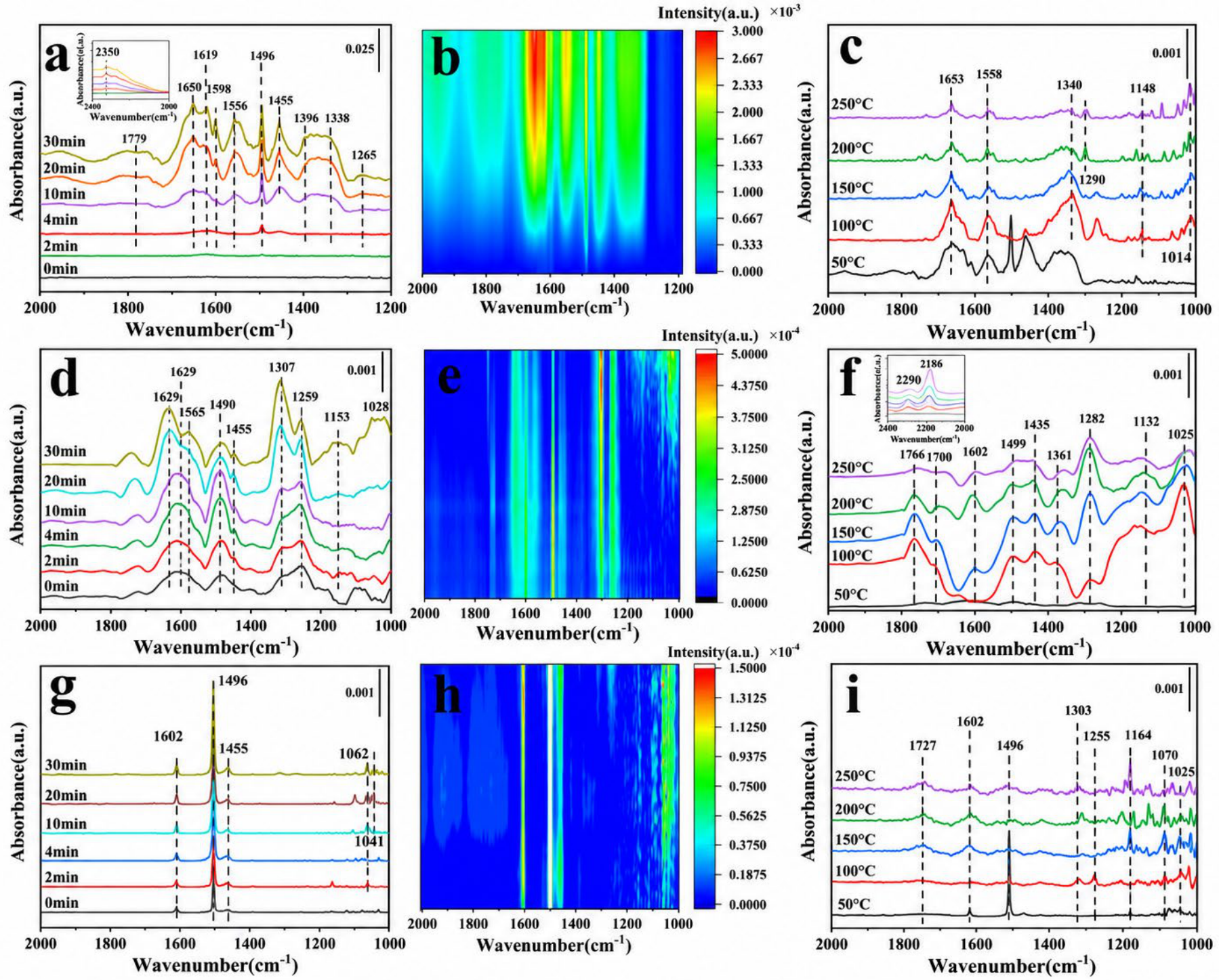
In situ DRIFTS tests were performed to determine the intermediate species and explore the catalytic oxidation process of toluene over CM-48. The results of DRIFTS spectra under different conditions are illustrated in Figure 7. Figure 7a,b show in situ DRIFTS spectra of toluene adsorption as a function of time at 50 °C under 100 ppm toluene/air. The bands at 1598, 1496 and 1455 cm−1 are characteristic of benzene ring out-of-plane and in-plane vibrations [29,57]. The band at 1556 cm−1 is attributed to asymmetric stretching vibrations of νas(COO) carboxylate groups, suggesting the generation of benzoate species [11,31]. The band at 1650 cm−1 corresponding to the C=O stretching vibration of aldehydic species is identified with the formation of benzaldehyde species, while the band at 1265 cm−1 is assigned to the C-O vibration of benzyl alcohol [32,58]. Significantly, the broad band at 1338–1396 cm−1 is attributed to the stretching of conjugated C-C bonds and olefin C=C, and the weak band at 1779 cm−1 is attributed to the C=O vibration of the anhydride, inferring the accumulation of some ring-opening intermediates, such as maleic anhydride species [54,58,59]. It is well known that anhydride species are vital intermediates during the oxidation process of aromatic compounds, and the oxidative ring-opening step of the benzene ring is essential for their complete mineralization [59,60]. Meanwhile, the band at 2350 cm−1 corresponding to CO2 is monitored, suggesting that the produced intermediate species could be further mineralized to CO2 over CM-48 at 50 °C (the insert of Figure 7a).
Furthermore, the development of intermediate species is evaluated during the toluene oxidation process from 50 to 250 °C. As shown in Figure 7c, it is seen that the characteristic bands ascribed to adsorbed original toluene and other intermediate species gradually weaken with increasing temperature, and some even vanish. When the temperature is raised to 250 °C, only the bands corresponding to phenolate (1290, 1148 and 1014 cm−1) and benzaldehyde (1653 cm−1), as well as a little of benzoate (1558 and 1361 cm−1), are detected [33,60,61]. Combining the results above, it could be inferred that the oxidation of toluene over CM-48 could follow the degradation pathway: toluene → benzyl alcohol → benzaldehyde → phenolate→ benzoic acid → maleic anhydride → CO2 and H2O in the presence of O2. In addition, it is noted that compared with phenolate and benzaldehyde intermediates, the negligible accumulation of benzoic acid and maleic anhydride implies that they can be rapidly decomposed. In other words, the ring-opening reaction of the benzene ring could be the rate-determining step due to its sluggish nature [62].
In the toluene catalytic oxidation process, molecular oxygen and lattice oxygen play a crucial role in the adsorption and activation of toluene. Herein, the toluene adsorption test without gaseous oxygen at 50 °C was carried out under 1000 ppm toluene/N2, and the results are illustrated in Figure 7d,e. To eliminate the influence of adsorbed oxygen species, the catalyst was pretreated in N2 at 300 °C for 2 h prior to the experiment. As shown in Figure 7d, the bands of the benzene ring (1602, 1490 and 1455 cm−1) and benzyl alcohol (1259 cm−1) appear immediately when toluene is introduced. Simultaneously, the band corresponding to the CH2 deformation vibration of benzyl species is observed at 1307 cm−1, and its intensity increases with increasing time (Figure 7e) [54,63]. This suggests that toluene adsorption takes place via lattice oxygen, and the H atom of the methyl group is abstracted by lattice oxygen to form the benzoyl oxide species (C6H5-CH2-O). Meanwhile, benzoate species (1565 cm−1) and benzaldehyde (1629 cm−1) are detected, implying that adsorbed toluene can interact with lattice oxygen to produce these intermediates. With prolonged time, the emergence of phenolate (1153 and 1025 cm−1) implies that toluene can be oxidized to phenolate under the action of lattice oxygen. Figure 7f depicts DRIFTS spectra of toluene oxidation under different temperatures without O2. A clear evolution of intermediates is observed as the reaction temperature increases. The bands corresponding to the benzene ring (1602, 1499 and 1435 cm−1), benzoate species (1361 cm−1), benzaldehyde (1700 cm−1) and phenolate (1282, 1132 and 1025 cm−1) are markedly enhanced, and their accumulated amounts reached a maximum at 150 °C. On the contrary, the bands attributed to benzyl alcohol gradually disappear, demonstrating that the formed benzyl alcohol species may be directly oxidized to benzoate and benzaldehyde intermediates by lattice oxygen. In addition, compared with the spectra obtained at 50 °C, the intensities of these intermediates increase. This is presumably due to the promoted migration of lattice oxygen at elevated temperatures, which boosts its activity and thus favors the generation of oxidized intermediates. Interestingly, the band of anhydride species at 1766 cm−1 is observed, meaning that the benzene ring could be cleaved by lattice oxygen. Furthermore, the development of the CO2 bands at 2290 and 2189 cm−1 demonstrates that toluene may be deeply oxidized to CO2 in the absence of gas oxygen. Based on the above analysis, it can be speculated that lattice oxygen directly participates in the adsorption and activation of toluene, and it is capable of completely oxidizing toluene to CO2 without gaseous oxygen.
Furthermore, the effect of surface-adsorbed oxygen species on the catalytic oxidation of toluene was also investigated. The CM-48 sample was pretreated in air at 400 °C for 2 h to promote the formation of surface-adsorbed oxygen species, and then the DRIFTS experiment was performed in N2 flow. Different from the spectra of CM-48 pretreated in N2, apart from the bands originating from toluene (1602, 1496 and 1455 cm−1), only weak bands corresponding to benzyl alcohol (1062 and 1041 cm−1) are observed at 50 °C (Figure 7g,h). This indicates that abundant surface oxygen species on the surface of CM-48 are beneficial for the decomposition of intermediates, which exceed their cumulative rate. Increasing the temperature leads to a sharp decline or even disappearance of the bands from the aromatic ring and benzyl alcohol (Figure 7i). At above 200 °C, only weak bands attributed to benzaldehyde (1727 cm−1), benzyl alcohol (1303, 1255 and 1070 cm−1) and phenolate (1164 and 1029 cm−1) are captured. Compared with the temperature-dependent DRIFTS spectra over CM-48 with and without surface oxygen species (Figure 7f,i), there is less accumulation of benzoate and anhydride species, demonstrating that surface-adsorbed oxygen species play a crucial role in the decomposition of the important intermediates for toluene mineralization. Based on the above in situ DRIFTS analysis, it can be clearly deduced that both the surface-adsorbed oxygen species and lattice oxygen species are simultaneously involved in the adsorption and activation process of toluene. In this process, lattice oxygen species play a key role in the formation and accumulation of these intermediates, while the surface-adsorbed oxygen species might accelerate the conversion of key intermediates to CO2 and H2O.
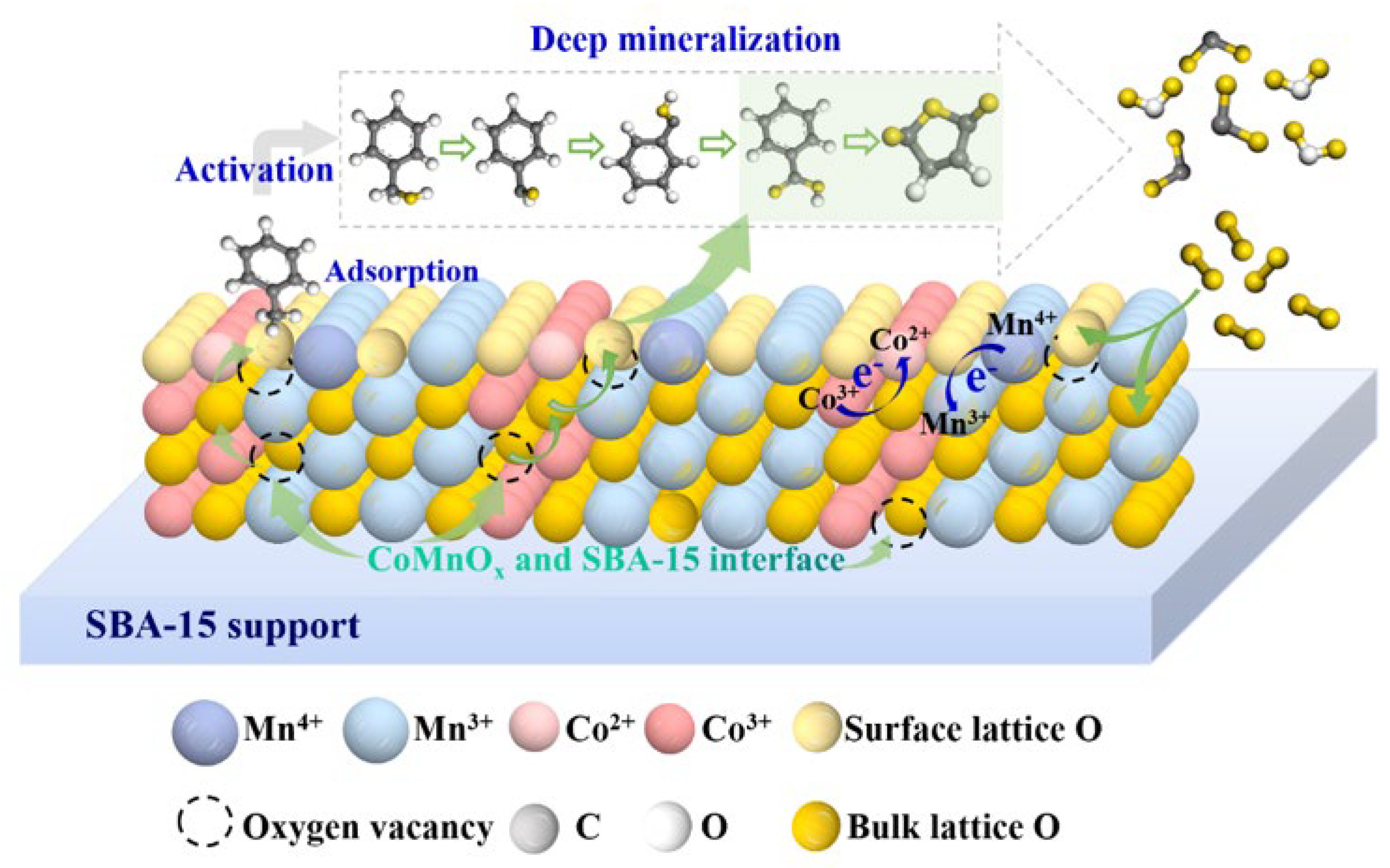
The probable reaction mechanism of toluene over CM-48 is proposed, as illustrated in Scheme 1. Toluene is adsorbed on the catalyst surface via the methyl group with surface oxygen species or lattice oxygen. The dehydrogenation to form benzyl alcohol species is a rapid step, after which it can be oxidized by Oads and/or Olatt to form key intermediates (i.e., benzaldehyde, benzoate, anhydride species). The decomposition of benzoate and anhydride species to CO2 can be accelerated by surface-adsorbed oxygen species. In addition, lattice oxygen can also participate in the deep oxidation of toluene as active oxygen species. In the whole toluene oxidation process, oxygen vacancies have crucial influence on the activation and reaction of toluene, as they favor formation of active surface oxygen species. The interaction between the CoMnOx species and the SBA-15 support not only promotes the generation of oxygen vacancies but also accelerates lattice oxygen mobility, thereby facilitating the replenishment of surface oxygen species.

3. Materials and Methods

3.1. Catalyst Synthesis

SBA-15 was synthesized by a typical hydrothermal method in the presence of a triblock copolymer, Pluronic P123 [(EO)20(PO)70(EO)20] (Macklin Biochemical Co., Ltd., Shanghai, China), as a structure-directing agent [19]. A total of 6.0 g of P123 was dissolved in 90 mL of a hydrochloric acid solution (Tianjin Kermel Chemical Reagent Co., Ltd., Tianjin, China) (4 M). Then, 13.6 mL of tetraethyl orthosilicate (TEOS) (Sinopharm Chemical Reagent Co., Ltd., Shanghai, China) was added, and the mixture was stirred at 40 °C for 24 h. Afterwards, the solution was transferred into a high-pressure autoclave and heated at 100 °C for 36, 48, and 60 h. After filtration, the samples were dried at 100 °C for 24 h and then calcined at 550 °C for 6 h. The prepared SBA-15 carriers were labeled as SBA-15-36, SBA-15-48, and SBA-15-60, respectively.
The CoMnOx/SBA-15 catalyst was synthesized using the impregnation method. Mn(NO3)2 (Sinopharm Chemical Reagent Co., Ltd., Shanghai, China) (4 mmol) and Co(NO3)2·6H2O (Xilong Scientific Co., Ltd., Shantou, China) (1 mmol) were completely dissolved in 20 mL deionized water at room temperature (with Mn:Co molar ratio of 4:1). Subsequently, 1.0 g synthesized SBA-15 samples were added into the above solution under stirring at 60 °C for 2 h. After aging 24 h, the resulting slurry was first evaporated to dryness in a water bath at 80 °C. The obtained solid phase was dried at 100 °C for 24 h and calcined at 550 °C for 6 h. The samples were denoted as CM-36, CM-48 and CM-60, respectively.

3.2. Catalytic Activity Tests

Catalytic activity was evaluated in a quartz fixed-bed tube microreactor (D = 8.0 mm) at atmospheric pressure, and 300 mg of catalyst with 40–60 mesh was used. Toluene vapor was generated by the introduction of air into a thermostatic bubbler (15 °C) filled with liquid toluene (Sinopharm Chemical Reagent Co., Ltd., Shanghai, China). The feed gas consisted of 1000 ppm toluene and 20 vol.% O2 (Dalian Junfeng Gas Chemicals Co., Ltd., Dalian, China) balanced in N2 (Dalian Junfeng Gas Chemicals Co., Ltd., Dalian, China) with a total flow of 200 mL·min−1, corresponding to gas hourly space velocity (WHSV) of 40,000 mL⋅g−1⋅h−1. In order to eliminate the effect of toluene adsorption, the catalysts were pretreated in the reactant mixture for 1 h before each catalytic test. The concentrations of toluene and the generation of catalytic oxidation were monitored by gas chromatography (GC7900) (Techcomp Ltd., Shanghai, China) equipped with a flame ionization detector (FID) and a thermal conductivity detector (TCD). The toluene conversion and CO2 yield were calculated based on the following equations:
Toluene   conversion   ( % ) :   Xt   =   C i n C o u t C i n × 100 %
CO 2   yield   ( % ) :   Xc = [ C O 2 ] o u t 7 C i n × 100 %
where Cin and Cout represent the concentration of toluene in the inlet and outlet gases, respectively. [CO2]out is the concentration of CO2 in the outlet.

3.3. Catalyst Characterization

XRD measurements were conducted on a PANalytical Empyrean X-ray diffractometer equipped with Cu Kα radiation (λ = 1.5406 Å). Scanning electron microscope (SEM) images were obtained on a ZEISS SUPRA 55 SAPPHIRE (ZEISS, Oberkochen, Germany) field emission scanning electron microscope at an accelerating voltage of 5 kV. Transmission electron microscope (TEM) images were obtained on a JEOL JEM-2100FHR (JEOL Ltd., Akishima, Japan) field emission transmission electron microscope operating at 200 kV. The Brunauer–Emmett–Teller (BET) specific surface area, pore volume (Vtotal), and average pore size of the prepared catalysts were determined by N2 adsorption–desorption isotherms measured using a Micromeritics APSP 2460 analyzer (Micromeritics Instrument Corporation, Norcross, GA, USA). Hydrogen temperature-programmed reduction (H2-TPR) experiments were carried out on a chemical adsorption analyzer (Autochem II 2920, Micromeritics Instrument Corporation, Norcross, GA, USA). Before TPR measurement, the sample (50 m) was pretreated under He flow (50 mL·min−1) at 300 °C for 1 h. Then, 10% H2/Ar mixture gas was fed into the quartz tube with a gas flow of 50 mL·min−1, and the temperature was increased from 50 to 800 °C at a rate of 10 °C·min−1. O2-TPD and NH3-TPD experiments were performed on the same instrument. For O2-TPD, He gas was fed into the quartz tube at a gas flow rate of 50 mL·min−1, and oxygen desorption was monitored by increasing the temperature to 800 °C at 10 °C·min−1. For NH3-TPD, the sample was exposed to 9.65 vol% NH3/He (30 mL·min−1) at 250 °C and cooled down to 30 °C. Subsequently, the treated sample was heated to 500 °C with a rate of 10 °C·min−1 in a He flow.
Inductively coupled plasma spectroscopy (ICP) analysis was conducted on the Agilent ICP-OES 725 ES (Agilent Technologies, Santa Clara, CA USA) inductively coupled plasma instrument to determine the percentage content of Mn, Co, and Si elements. X-ray photoelectron spectroscopy (XPS) was performed on a Thermo Scientific K-Alpha spectrometer (Thermo Fisher Scientific, Waltham, MA, USA) using a monochromatic Al Kα source, with the C 1s peak (284.6 eV) as a reference for charge correction. Raman spectra were collected by a Raman microscope (HORIBA LabRAM HR 800, HORIBA Jobin Yvon, Paris, France) equipped with a solid-state laser at 532 nm as the excitation source from 200 to 800 cm−1, recorded at a resolution of 1 cm−1. Electron paramagnetic resonance (EPR) was performed on a Bruker A300-10 (Bruker BioSpin GmbH, Ettlingen, Germany) under vacuum conditions at room temperature without light illumination. In situ diffuse reflectance infrared Fourier transform spectroscopy (in situ DRIFTS) was performed on a Thermo Nicolet iS50 spectrometer (Thermo Fisher Scientific, Waltham, MA, USA) with a liquid nitrogen-cooled mercury cadmium telluride (MCT) detector.

4. Conclusions

CoMnOx/SBA-15 bimetallic catalysts were prepared, in which SBA-15 supports were synthesized at different crystallization times, and the effects of the support on the catalytic performance for toluene oxidation were analyzed. The crystallization time can induce some subtle changes in the structure and surface acidity of the SBA-15 support, thereby modifying the dispersion and redox properties of the supported active components. CM-48 exhibits the highest catalytic activity for toluene oxidation at low temperature, achieving its T90 at 234 °C, which is lower than that of the other two catalysts. Furthermore, CM-48 shows excellent stability, with toluene conversion consistently maintained above 94%. The excellent catalytic performance of CM-48 is attributed to high Mn3+ content, enhanced redox properties resulting from the strong interaction of the CoMnOx active components and the SBA-15 support, abundant oxygen vacancies, good reducibility and high lattice oxygen mobility, all of which greatly promote the activity of surface-adsorbed oxygen and lattice oxygen. In situ DRIFTS results reveal the proposed degradation pathway of toluene over CM-48: toluene → benzyl alcohol → benzaldehyde → phenolate → benzoic acid → maleic anhydride → CO2. Both surface-adsorbed oxygen species and lattice oxygen are active oxygen species that participate in toluene oxidation, and the surface oxygen species are favorable for the consumption of important intermediates and achieving the mineralization of toluene. This work focuses on the modification of CoMnOx active components by regulating the textural properties of the support, which provides a new direction for developing supported catalysts with excellent low-temperature activity for VOCs abatement.

Supplementary Materials

The following supporting information can be downloaded at: https://www.mdpi.com/article/10.3390/inorganics14090240/s1, Figure S1: SEM images of SBA-15-36 (a), SBA-15-48 (b) and SBA-15-60 (c); Figure S2: The catalytic oxidation performance of toluene versus temperature over CoMnOx/SBA-15 catalysts with different Mn/Co molar ratios; Figure S3: CO2 yields as a function of catalytic reaction temperature over CoMnOx/SBA-15 catalysts; Figure S4: Small-angle XRD patterns of CoMnOx/SBA-15 catalysts; Figure S5: N2 adsorption–desorption isotherms of CoMnOx/SBA-15 catalysts; Figure S6: NH3-TPD of CoMnOx/SBA-15 catalysts; Table S1: Number of acidic sites and H2 consumption of SBA-15 and CoMnOx/SBA-15 catalysts; Table S2: Element contents of CoMnOx/SBA-15 catalysts; Table S3: Comparison of the catalytic performance of various catalysts in toluene oxidation.

Author Contributions

Conceptualization, M.S. and H.S.; methodology, Z.L., Y.W. and H.Z.; validation, M.S., P.W. and H.Y.; formal analysis, J.S. and Z.L.; investigation, J.S., M.S., Y.W. and H.Z.; resources, P.W., H.S. and H.Y.; data curation, J.S.; writing—original draft preparation, J.S.; writing—review and editing, Z.L. and H.S.; visualization, J.S.; supervision, Z.L., P.W. and H.S. All authors have read and agreed to the published version of the manuscript.

Funding

This work was funded by the SINOPEC project (No. 325075), the National Natural Science Foundation of China (No. 42577020), and the Opening Foundation of the Ministry of Education Key Laboratory of Pollution Processes and Environmental Criteria (No. 2025b11).

Institutional Review Board Statement

Not applicable.

Informed Consent Statement

Not applicable.

Data Availability Statement

The original contributions presented in this study are included in the article/Supplementary Material. Further inquiries can be directed to the corresponding authors.

Conflicts of Interest

The author Peng Wang was employed by the company SINOPEC Dalian Research Institute of Petroleum and Petrochemicals Co., Ltd. The remaining authors declare that the research was conducted in the absence of any commercial or financial relationships that could be construed as a potential conflict of interest.

References

  1. Zhang, X.; Ye, J.; Yuan, J.; Cai, T.; Xiao, B.; Liu, Z.; Zhao, K.; Yang, L.; He, D. Excellent low-temperature catalytic performance of nanosheet Co-Mn oxides for total benzene oxidation. Appl. Catal. A Gen. 2018, 566, 104–112. [Google Scholar] [CrossRef] [Scilit]
  2. Guo, Y.; Wen, M.; Li, G.; An, T. Recent advances in VOC elimination by catalytic oxidation technology onto various nanoparticles catalysts: A critical review. Appl. Catal. B Environ. 2021, 281, 119447. [Google Scholar] [CrossRef] [Scilit]
  3. Li, X.; Zhang, L.; Yang, Z.; Wang, P.; Yan, Y. Adsorption materials for volatile organic compounds (VOCs) and the key factors for VOCs adsorption process: A review. Sep. Purif. Technol. 2020, 235, 116213. [Google Scholar] [CrossRef] [Scilit]
  4. Yang, J.; Yang, L.; Fang, M.; Li, L.; Fu, F.; Xu, H.; Li, M.; Fan, X. A compact Z-scheme heterojunction of BiOCl/Bi2WO6 for efficiently photocatalytic degradation of gaseous toluene. J. Colloid Interface Sci. 2023, 631, 44–54. [Google Scholar] [CrossRef] [Scilit] [PubMed]
  5. Xu, H.; Yan, N.; Qu, Z.; Liu, W.; Mei, J.; Huang, W.; Zhao, S. Gaseous heterogeneous catalytic reactions over Mn-based oxides for environmental applications: A critical review. Environ. Sci. Technol. 2017, 51, 8879–8892. [Google Scholar] [CrossRef] [Scilit] [PubMed]
  6. Castaño, M.H.; Molina, R.; Moreno, S. Cooperative effect of the Co-Mn mixed oxides for the catalytic oxidation of VOCs: Influence of the synthesis method. Appl. Catal. A Gen. 2015, 492, 48–59. [Google Scholar] [CrossRef] [Scilit]
  7. Li, Z.; Yan, Y.; Jiang, Q.; Gao, Y.; Xue, T.; Li, R.; Liu, Y.; Wang, Q. Oxygen vacancy mediated CuyCo3−yFe1Ox mixed oxide as highly active and stable toluene oxidation catalyst by multiple phase interfaces formation and metal doping effect. Appl. Catal. B Environ. 2020, 269, 118827. [Google Scholar] [CrossRef] [Scilit]
  8. Yang, W.; Su, Z.; Xu, Z.; Yang, W.; Peng, Y.; Li, J. Comparative study of α-, β-, γ- and δ-MnO2 on toluene oxidation: Oxygen vacancies and reaction intermediates. Appl. Catal. B Environ. 2020, 260, 118150. [Google Scholar] [CrossRef] [Scilit]
  9. Ren, Y.; Song, C.; Wang, H.; Qu, Z. Accelerated dual activation of lattice oxygen and molecule oxygen over CoMn2O4 catalysts for VOC oxidation: Promoting the role of oxygen vacancies. ACS Catal. 2024, 14, 4340–4351. [Google Scholar] [CrossRef] [Scilit]
  10. Zhao, Q.; Zhang, Y.; Liu, Q.; Song, C.; Lu, X.; Ma, J.; Wang, L.; He, H. Boosting the catalytic performance of volatile organic compound oxidation over platelike MnO2/CoAlO catalyst by weakening the Co-O bond and accelerating oxygen activation. ACS Catal. 2023, 13, 1492–1502. [Google Scholar] [CrossRef] [Scilit]
  11. Ma, Y.; Wang, L.; Ma, J.; He, G.; Li, D.; He, H. Understanding the different roles of adsorbed oxygen and lattice oxygen species in the distinct catalytic performance of metal oxides for o-xylene oxidation. ACS Catal. 2024, 14, 16624–16638. [Google Scholar] [CrossRef] [Scilit]
  12. Yao, J.; Dong, F.; Feng, H.; Tang, Z. Hierarchical MnOx/Co3O4 nanoarrays on Ni foam for catalytic oxidation of volatile organic compounds. ACS Appl. Nano Mater. 2021, 4, 9322–9332. [Google Scholar] [CrossRef] [Scilit]
  13. Khaleel, A.; Adamson, A.; Pillantakath, A.-R. The impact of surface-impregnated versus support-dispersed Fe in Fe-Ni/γ-Al2O3 catalysts for partial oxidation of methane: Insights into the effect of Fe incorporation method on coking and on the reaction mechanism. Int. J. Hydrogen Energy. 2024, 81, 643–653. [Google Scholar] [CrossRef] [Scilit]
  14. Cao, D.; Ma, X.; Zhang, Y.; Ta, L.; Yang, Y.; Xu, C.; Ye, F.; Liu, J. Highly dispersed NiMo@rGO nanocomposite catalysts fabricated by a two-step hydrothermal method for hydrogen evolution. Int. J. Miner. Metall. Mater. 2023, 30, 2432–2440. [Google Scholar] [CrossRef] [Scilit]
  15. Xiao, J.; Wang, M.; Wang, Y.; Li, X.; He, J.; Liu, Y.; Xu, Q.; Li, H.; Li, N.; Chen, D. Rational design of bimetal Mn-Ce nanosheets anchored on porous nano-sized ZSM-5 zeolite for adsorption-enhanced catalytic oxidation of toluene. Ind. Eng. Chem. Res. 2022, 61, 18382–18389. [Google Scholar] [CrossRef] [Scilit]
  16. Todorova, S.; Blin, J.; Naydenov, A.; Lebeau, B.; Kolev, H.; Gaudin, P.; Dotzeva, A.; Velinova, R.; Filkova, D.; Ivanova, I. Co3O4-MnOx oxides supported on SBA-15 for CO and VOCs oxidation. Catal. Today 2020, 357, 602–612. [Google Scholar] [CrossRef] [Scilit]
  17. Jiang, Z.; Li, Y.; Tang, Z.; Yuan, D.; Lin, F. Strong metal-support interactions in catalytic oxidation of VOCs: Mechanistic insights, support engineering strategies, and emerging catalyst design paradigms. Environ. Sci. Technol. 2025, 59, 19644–19666. [Google Scholar] [CrossRef] [Scilit] [PubMed]
  18. Zhang, W.; Zhou, Y.; Shamzhy, M.; Molitorisová, S.; Opanasenko, M.; Giroir-Fendler, A. Total oxidation of toluene and propane over supported Co3O4 catalysts: Effect of structure/acidity of MWW zeolite and cobalt loading. ACS Appl. Mater. Interfaces 2021, 13, 15143–15158. [Google Scholar] [CrossRef] [Scilit] [PubMed]
  19. Huirache-Acuña, R.; Nava, R.; Peza-Ledesma, C.L.; Lara-Romero, J.; Alonso-Núñez, G.; Pawelec, B.; Rivera-Muñoz, E.M. SBA-15 mesoporous silica as catalytic support for hydrodesulfurization catalysts. Materials 2013, 6, 4139–4167. [Google Scholar] [CrossRef] [Scilit] [PubMed]
  20. Li, Y.; Cao, R.; Liu, Y.; Wang, L.; Ning, P.; Wang, X.; Ma, Y. Controlled dispersion and morphology in MoS2/SBA-15 catalysts for enhanced COS hydrodesulfurization. Fuel 2024, 373, 132390. [Google Scholar] [CrossRef] [Scilit]
  21. Vunain, E.; Malgas-Enus, R.; Jalama, K.; Meijboom, R. The effect of recrystallization time on pore size and surface area of mesoporous SBA-15. J. Sol-Gel Sci. Technol. 2013, 68, 270–277. [Google Scholar] [CrossRef] [Scilit]
  22. Zhu, J.; Kailasam, K.; Xie, X.; Schomaecker, R.; Thomas, A. High-surface-area SBA-15 with enhanced mesopore connectivity by the addition of poly (vinyl alcohol). Chem. Mater. 2011, 23, 2062–2067. [Google Scholar] [CrossRef] [Scilit]
  23. Galarneau, A.; Cambon, H.; Di Renzo, F.; Ryoo, R.; Choi, M.; Fajula, F. Microporosity and connections between pores in SBA-15 mesostructured silicas as a function of the temperature of synthesis. New J. Chem. 2003, 27, 73–79. [Google Scholar] [CrossRef] [Scilit]
  24. Li, C.; Wang, Y.; Guo, Y.; Liu, X.; Guo, Y.; Zhang, Z.; Wang, Y.; Lu, G. Synthesis of highly ordered, extremely hydrothermal stable SBA-15/Al-SBA-15 under the assistance of sodium chloride. Chem. Mater. 2007, 19, 173–178. [Google Scholar] [CrossRef] [Scilit]
  25. Juárez-Serrano, N.; Berenguer, D.; Martínez-Castellanos, I.; Blasco, I.; Beltrán, M.; Marcilla, A. Effect of reaction time and hydrothermal treatment time on the textural properties of SBA-15 synthesized using sodium silicate as a silica source and its efficiency for reducing tobacco smoke toxicity. Catalysts 2021, 11, 808. [Google Scholar] [CrossRef] [Scilit]
  26. Tang, S.; Zhang, M.; Zhang, W.; Liu, W.; Liu, R.; Wang, L.; Zhang, X.; Li, G. Key roles of late-stage crystallization time on the structure and acid properties of ZSM-48 for hydroisomerization. Ind. Eng. Chem. Res. 2025, 64, 7689–7699. [Google Scholar] [CrossRef] [Scilit]
  27. Hao, Q.; Zhao, Y.; Yang, H.; Liu, Z.; Liu, Z. Alumina grafted to SBA-15 in supercritical CO2 as a support of cobalt for fischer-tropsch synthesis. Energy Fuels 2012, 26, 6567–6575. [Google Scholar] [CrossRef] [Scilit]
  28. Reich, S.-J.; Svidrytski, A.; Höltzel, A.; Florek, J.; Kleitz, F.; Wang, W.; Kübel, C.; Hlushkou, D.; Tallarek, U. Hindered diffusion in ordered mesoporous silicas: Insights from pore-scale simulations in physical reconstructions of SBA-15 and KIT-6 silica. J. Phys. Chem. C 2018, 122, 12350–12361. [Google Scholar] [CrossRef] [Scilit]
  29. Dong, C.; Qu, Z.; Qin, Y.; Fu, Q.; Sun, H.; Duan, X. Revealing the highly catalytic performance of spinel CoMn2O4 for toluene oxidation: Involvement and replenishment of oxygen species using in situ designed-TP techniques. ACS Catal. 2019, 9, 6698–6710. [Google Scholar] [CrossRef] [Scilit]
  30. Han, W.; Dong, F.; Han, W.; Tang, Z. Mn-polyacrylonitrile nanofibers decorated with Co-metal-organic frameworks as precursors of CoMnOx catalysts for the combustion of toluene. ACS Appl. Nano Mater. 2020, 3, 7818–7828. [Google Scholar] [CrossRef] [Scilit]
  31. Cui, Y.; Xu, L.; Zhang, Y.; Wu, C.; Zou, W.; Zhang, L.; Wang, N.; Dong, L.; Chen, M. Oxidation of toluene over mesoporous MnO2/CeO2 nanosphere catalysts: Effects of the MnO2 precursor and the type of support. Inorg. Chem. 2023, 62, 9983–10002. [Google Scholar] [CrossRef] [Scilit] [PubMed]
  32. Yan, D.; Li, X.; Zhong, J.; Ren, Q.; Zeng, Y.; Gao, S.; Liu, P.; Fu, M.; Ye, D. Tuning the metal-support interaction by modulating CeO2 oxygen vacancies to enhance the toluene oxidation activity of Pt/CeO2 catalysts. Inorg. Chem. 2024, 63, 11393–11405. [Google Scholar] [CrossRef] [Scilit] [PubMed]
  33. Zhang, H.; Sui, S.; Zheng, X.; Cao, R.; Zhang, P. One-pot synthesis of atomically dispersed Pt on MnO2 for efficient catalytic decomposition of toluene at low temperatures. Appl. Catal. B Environ. 2019, 257, 117878. [Google Scholar] [CrossRef] [Scilit]
  34. Kang, D.; Shi, Q.; Zhang, C.; Zhao, P.; Lyu, H.; Huang, A.; Shen, B. Modulation of acidic and redox properties of Mn-based catalysts by Co doping: Application to the synergistic removal of NOx and chlorinated organics. Sep. Purif. Technol. 2024, 339, 126695. [Google Scholar] [CrossRef] [Scilit]
  35. Calzada, L.A.; Pérez-Estrada, D.; Sánchez-Ramírez, M.; Gómora-Herrera, D.; Gómez-Cortés, A.; Díaz, G.; Klimova, T.E. Boosting the hydrodeoxygenation activity and selectivity of Ni/(M)-SBA-15 catalysts by chemical alteration of the support. ACS Omega 2023, 8, 42849. [Google Scholar] [CrossRef] [Scilit] [PubMed]
  36. Chen, L.; Liu, Y.; Fang, X.; Cheng, Y. Simple strategy for the construction of oxygen vacancies on α-MnO2 catalyst to improve toluene catalytic oxidation. J. Hazard. Mater. 2021, 409, 125020. [Google Scholar] [CrossRef] [Scilit] [PubMed]
  37. Wang, Z.; Wang, H.; Yang, C.; Wang, S.; Gao, P.; Sun, Y. Hierarchical ZSM-5 supported CoMn catalyst for the production of middle distillate from syngas. Ind. Eng. Chem. Res. 2021, 60, 5783–5791. [Google Scholar] [CrossRef] [Scilit]
  38. Xue, H.; Guo, X.; Meng, T.; Guo, Q.; Mao, D.; Wang, S. Cu-ZSM-5 catalyst impregnated with Mn-Co oxide for the selected catalytic reduction of NO: Physicochemical property-catalytic activity relationship and in situ DRIFTS study for the reaction mechanism. ACS Catal. 2021, 11, 7702–7718. [Google Scholar] [CrossRef] [Scilit]
  39. Ding, L.; Yang, W.; Chen, L.; Cheng, H.; Qi, Z. Fabrication of spinel CoMn2O4 hollow spheres for highly selective aerobic oxidation of 5-hydroxymethylfurfural to 2, 5-diformylfuran. Catal. Today 2020, 347, 39–47. [Google Scholar] [CrossRef] [Scilit]
  40. Hu, H.; Cai, S.; Li, H.; Huang, L.; Shi, L.; Zhang, D. Mechanistic aspects of deNOx processing over TiO2 supported Co-Mn oxide catalysts: Structure-activity relationships and in situ DRIFTs analysis. ACS Catal. 2015, 5, 6069–6077. [Google Scholar] [CrossRef] [Scilit]
  41. Yang, L.; Lin, Q.; Guo, D.; Wu, L.; Guan, Z.; Jin, H.; Fang, G.; Chen, X.; Wang, S. Nitrogen plasma activates CoMn-layered double hydroxides for superior electrochemical oxygen evolution. Inorg. Chem. 2023, 62, 17565–17574. [Google Scholar] [CrossRef] [Scilit] [PubMed]
  42. Zheng, Y.; Liu, Q.; Shan, C.; Su, Y.; Fu, K.; Lu, S.; Han, R.; Song, C.; Ji, N.; Ma, D. Defective ultrafine MnOx nanoparticles confined within a carbon matrix for low-temperature oxidation of volatile organic compounds. Environ. Sci. Technol. 2021, 55, 5403–5411. [Google Scholar] [CrossRef] [Scilit] [PubMed]
  43. Wang, F.; Dai, H.; Deng, J.; Bai, G.; Ji, K.; Liu, Y. Manganese oxides with rod-, wire-, tube-, and flower-like morphologies: Highly effective catalysts for the removal of toluene. Environ. Sci. Technol. 2012, 46, 4034–4041. [Google Scholar] [CrossRef] [Scilit] [PubMed]
  44. Xu, Y.; Qu, G.; Wu, H.; Zhao, C.; Xu, R.; Ning, P.; Li, J. Synthesis and optimization of foam copper-based CoMnOx@Co3O4/CF Catalyst: Achieving efficient catalytic oxidation of paraxylene. ACS Appl. Mater. Interfaces 2024, 16, 61970–61982. [Google Scholar] [CrossRef] [Scilit] [PubMed]
  45. Wu, X.; Feng, Y.; Liu, X.; Liu, L.; Du, Y.; Li, Z. Redox & acidity optimizing of LDHs-based CoMnAl mixed oxides for enhancing NH3-SCR performance. Appl. Surf. Sci. 2019, 495, 143513. [Google Scholar] [CrossRef] [Scilit]
  46. Niu, R.; Li, C.; Guo, Q.; Liu, P.; Zhang, C. Boosting catalytic combustion of diesel soot particles over potassium-promoted CoMn-Co3O4 dual spinel structure catalyst. Appl. Catal. B Environ. 2024, 354, 124142. [Google Scholar] [CrossRef] [Scilit]
  47. Shi, Y.; Kong, F.; Wan, J.; Zhou, R. Synergistic effect of ZSM-5 zeolite in Pt-CeO2-TiO2/ZSM-5 catalysts for highly efficient catalytic oxidation of VOCs. Ind. Eng. Chem. Res. 2023, 62, 3546–3556. [Google Scholar] [CrossRef] [Scilit]
  48. Mu, W.; Zhu, J.; Zhang, S.; Guo, Y.; Su, L.; Li, X.; Li, Z. Novel proposition on mechanism aspects over Fe-Mn/ZSM-5 catalyst for NH3-SCR of NOx at low temperature: Rate and direction of multifunctional electron-transfer-bridge and in situ DRIFTs analysis. Catal. Sci. Technol. 2016, 6, 7532–7548. [Google Scholar] [CrossRef] [Scilit]
  49. Fei, X.; Cao, S.; Ouyang, W.; Wen, Y.; Wang, H.; Wu, Z. A convenient synthesis of core-shell Co3O4@ZSM-5 catalysts for the total oxidation of dichloromethane (CH2Cl2). Chem. Eng. J. 2020, 387, 123411. [Google Scholar] [CrossRef] [Scilit]
  50. Ren, Y.; Lei, X.; Wang, H.; Xiao, J.; Qu, Z. Enhanced catalytic performance of La-doped CoMn2O4 catalysts by regulating oxygen species activity for VOCs oxidation. ACS Catal. 2023, 13, 8293–8306. [Google Scholar] [CrossRef] [Scilit]
  51. Han, Y.; Chen, F.; Zhong, Z.; Ramesh, K.; Widjaja, E.; Chen, L. Synthesis and characterization of Mn3O4 and Mn2O3 nanocrystals on SBA-15: Novel combustion catalysts at low reaction temperatures. Catal. Commun. 2006, 7, 739–744. [Google Scholar] [CrossRef] [Scilit]
  52. Xu, R.; Zhou, Z.; Zeng, P.; Liu, X.; Xu, M. Mn-Co binary core shell nanospheres with boosted low-temperature catalytic activity for NO oxidation. Fuel 2025, 386, 134229. [Google Scholar] [CrossRef] [Scilit]
  53. Ramesh, K.; Chen, L.; Chen, F.; Liu, Y.; Wang, Z.; Han, Y. Re-investigating the CO oxidation mechanism over unsupported MnO, Mn2O3 and MnO2 catalysts. Catal. Today 2008, 131, 477–482. [Google Scholar] [CrossRef] [Scilit]
  54. Mo, S.; Zhang, Q.; Li, J.; Sun, Y.; Ren, Q.; Zou, S.; Zhang, Q.; Lu, J.; Fu, M.; Mo, D. Highly efficient mesoporous MnO2 catalysts for the total toluene oxidation: Oxygen-Vacancy defect engineering and involved intermediates using in situ DRIFTS. Appl. Catal. B Environ. 2020, 264, 118464. [Google Scholar] [CrossRef] [Scilit]
  55. Zhang, N.; Li, X.; Ye, H.; Chen, S.; Ju, H.; Liu, D.; Lin, Y.; Ye, W.; Wang, C.; Xu, Q. Oxide defect engineering enables to couple solar energy into oxygen activation. J. Am. Chem. Soc. 2016, 138, 8928–8935. [Google Scholar] [CrossRef] [Scilit] [PubMed]
  56. Shen, Y.; Deng, J.; Impeng, S.; Li, S.; Yan, T.; Zhang, J.; Shi, L.; Zhang, D. Boosting toluene combustion by engineering Co-O strength in cobalt oxide catalysts. Environ. Sci. Technol. 2020, 54, 10342–10350. [Google Scholar] [CrossRef] [Scilit] [PubMed]
  57. Santos, V.; Pereira, M.; Órfão, J.; Figueiredo, J. The role of lattice oxygen on the activity of manganese oxides towards the oxidation of volatile organic compounds. Appl. Catal. B Environ. 2010, 99, 353–363. [Google Scholar] [CrossRef] [Scilit]
  58. Van Hengstum, A.; Pranger, J.; van Hengstum-Nijhuis, S.; Van Ommen, J.; Gellings, P. Infrared study of the selective oxidation of toluene and o-xylene on vanadium oxide/TiO2. J. Catal. 1986, 101, 323–330. [Google Scholar] [CrossRef] [Scilit]
  59. Lu, A.; Sun, H.; Zhang, N.; Che, L.; Shan, S.; Luo, J.; Zheng, J.; Yang, L.; Peng, D.; Zhong, C. Surface partial-charge-tuned enhancement of catalytic activity of platinum nanocatalysts for toluene oxidation. ACS Catal. 2019, 9, 7431–7442. [Google Scholar] [CrossRef] [Scilit]
  60. Su, Z.; Yang, W.; Wang, C.; Xiong, S.; Cao, X.; Peng, Y.; Si, W.; Weng, Y.; Xue, M.; Li, J. Roles of oxygen vacancies in the bulk and surface of CeO2 for toluene catalytic combustion. Environ. Sci. Technol. 2020, 54, 12684–12692. [Google Scholar] [CrossRef] [Scilit] [PubMed]
  61. Shao, Q.; Wei, S.; Hu, X.; Dong, H.; Wen, T.; Gao, L.; Long, C. Tuning the micro-coordination environment of Al in dealumination Y zeolite to enhance electron transfer at the Cu-Mn oxides interface for highly efficient catalytic ozonation of toluene at low temperatures. Environ. Sci. Technol. 2022, 56, 15449–15459. [Google Scholar] [CrossRef] [Scilit] [PubMed]
  62. Zhang, Y.; Martin, A.; Berndt, H.; Lücke, B.; Meisel, M. FTIR investigation of surface intermediates formed during the ammoxidation of toluene over vanadyl pyrophosphate. J. Mol. Catal. A Chem. 1997, 118, 205–214. [Google Scholar] [CrossRef] [Scilit]
  63. Sun, H.; Liu, Z.; Chen, S.; Quan, X. The role of lattice oxygen on the activity and selectivity of the OMS-2 catalyst for the total oxidation of toluene. Chem. Eng. J. 2015, 270, 58–65. [Google Scholar] [CrossRef] [Scilit]
Figure 1. (a) Small-angle XRD patterns, (b) N2 adsorption–desorption isotherms and the corresponding pore size distribution (insert), and (c) NH3-TPD of SBA-15.
Inorganics 14 00240 g001
Figure 2. (a) The catalytic oxidation performance of toluene versus temperature and light-off temperature of toluene conversion (insert). (b) Arrhenius plots for toluene oxidation over CoMnOx/SBA-15 catalysts. (c) Long-term stability and (d) cycling stability of CM-48 catalyst. The insert in part (c) shows TG patterns of the catalysts after long-term stability testing.
Inorganics 14 00240 g002
Figure 3. (a) XRD patterns of the CoMnOx/SBA-15 catalysts, and (b,c) Magnified XRD patterns of the selected region.
Inorganics 14 00240 g003
Figure 4. SEM images (a1c1), TEM images (a2c2), high-resolution TEM images (a3c3) and elemental mapping images (a4c4) of CM-36 (a), CM-48 (b) and CM-60 (c).
Inorganics 14 00240 g004
Figure 5. (a) H2-TPR, (b) Mn 2p, (c) Co 2p and (d) O 1s XPS spectra of CoMnOx/SBA-15 catalysts.
Inorganics 14 00240 g005
Figure 6. (a) Raman spectra, (b) Mn-O force constant, (c) EPR spectra and (d) O2-TPD of CoMnOx/SBA-15 catalysts.
Inorganics 14 00240 g006
Figure 7. Adsorption and activation behavior of toluene over CM-48 catalyst. (a,b) In situ DRIFTS spectra recorded at 50 °C during exposure to toluene + O2 in N2 flow for 0–30 min and (c) toluene catalytic oxidation at different temperatures. (d,e) In situ DRIFTS spectra recorded at 50 °C during exposure to toluene/N2 flow and (f) toluene catalytic oxidation at different temperatures without O2 over CM-48 catalyst pretreated in N2. (g,h) In situ DRIFTS spectra recorded at 50 °C during exposure to toluene/N2 flow and (i) toluene catalytic oxidation at different temperatures without O2 over CM-48 catalyst pretreated in air.
Inorganics 14 00240 g007
Scheme 1. Schematic Depiction of Toluene Oxidation Mechanisms over the CM-48 catalyst.
Inorganics 14 00240 sch001
Table 1. Textural physical characterization of SBA-15 support and CoMnOx/SBA-15 catalysts.
Samplesd100
(nm)
a0
(nm)
Average Pore Size
(nm)
SBET
(m2·g−1)
Pore Volume
(cm3·g−1)
SBA-15-3611.112.83.08690.65
SBA-15-4812.314.23.27850.63
SBA-15-6012.414.33.58360.72
CM-3611.212.92.74640.32
CM-4812.414.42.94290.31
CM-6012.814.73.04610.35
Table 2. XPS element analysis of CoMnOx/SBA-15 catalysts.
SamplesCo3+/Co2+Mn4+/MnMn3+/MnMn2+/MnOads/Olatt
CM-362.230.290.470.240.35
CM-482.850.250.540.210.47
CM-602.030.310.400.290.33
Disclaimer/Publisher’s Note: The statements, opinions and data contained in all publications are solely those of the individual author(s) and contributor(s) and not of MDPI and/or the editor(s). MDPI and/or the editor(s) disclaim responsibility for any injury to people or property resulting from any ideas, methods, instructions or products referred to in the content.