


Abstract
We report on X-ray-induced Sm3+ → Sm2+ reduction in SrF2:Sm3+ nanocrystals of ~40 nm size synthesized via a co-precipitation method. Non-irradiated samples show characteristic Sm3+ f-f 4G5/2 → 6H5/2, 6H7/2, 6H9/2, and 6H11/2 emissions, while X-irradiation induces intense low-temperature Sm2+ 5D0 → 7F1 emission and other Sm2+ lines. The evolution of Sm3+ and Sm2+ photoluminescence intensities with X-ray dose (0–300 Gy) follows first-order kinetics, consistent with a trapping–detrapping mechanism. Compared to CaF2:Sm3+, SrF2:Sm3+ exhibits faster Sm3+ reduction due to the higher X-ray absorption cross section of strontium compared to calcium for Cu-Kα (8 keV) radiation, highlighting its potential as a nanoscale X-ray storage phosphor.
1. Introduction
Samarium-doped materials are widely studied for photonic and radiation-related applications, including optical data storage [1,2,3], solid-state lasers [4,5], and ionizing-radiation storage phosphors [6,7]. A key mechanism is the radiation-induced Sm3+ → Sm2+ valence state conversion, which results in characteristic Sm2+ luminescence arising from 4f-4f or 4f55d1 → 4f6 transitions. This behavior has been reported in various hosts, including fluoride glasses [8], alkaline-earth fluorohalides [9], borate [10], phosphate glasses [11,12], and oxyfluoride glass-ceramics [13]. Although Sm3+ (−1.55 V) is thermodynamically more difficult to reduce than Eu3+ (−0.36 V) and Yb3+ (−1.10 V) [14], the Sm3+/Sm2+ redox pair remains highly advantageous for irradiation-induced reduction studies. The formation of Sm2+ is strongly influenced by defect states and local lattice environments, and its host-dependent 4f-5d emission provides sensitive spectroscopic signatures for probing radiation-induced charge-transfer processes.
Fluorite-type MF2 (M = Ca, Sr, Ba) compounds offer high IR-VUV transparency and low phonon energies (BaF2: 319 cm−1, SrF2: 366 cm−1, CaF2: 466 cm−1) with the latter lowering the nonradiative relaxation probability and hence enhancing the quantum yield [15,16,17]. Previous studies on Sm-activated alkaline-earth fluorohalides (MFX) nanocrystals (M = Ca, Ba, Sr; X = Br, I, Cl) [18,19], fluoroperovskites such as BaLiF3 [20], and CaF2 nanocrystals [21] have shown that Sm3+ → Sm2+ conversion can be induced by optical excitation (blue-violet and UV-C light) or ionizing radiation (β-, γ-, and X-rays). Enhanced Sm3+ → Sm2+ conversion in nanocrystals such as BaFCl, compared with bulk materials, appears to be linked to higher defect densities and larger surface-to-volume ratios. In contrast, oxide-ion impurities in close proximity to the Sm3+ ions in microcrystals tend to stabilize the trivalent oxidation state, thereby limiting reduction.
However, Sm2+ generation by X-irradiation in SrF2:Sm3+ nanocrystals has not yet been examined, despite the favorable properties of SrF2, i.e., low phonon energy, and higher X-ray absorption relative to CaF2. Understanding Sm3+ reduction in this host is therefore of both fundamental and applied relevance.
In this work, we investigate X-ray-induced Sm3+ → Sm2+ conversion in co-precipitated SrF2:Sm3+ nanocrystals, analyze their pre- and post-irradiation photoluminescence, and quantify the reduction kinetics as a function of X-ray dose, with comparison to CaF2:Sm3+ nanocrystals [21]. This study provides insight into the roles of host composition and X-ray absorption in facilitating radiation-driven valence state conversion.
2. Results and Discussion
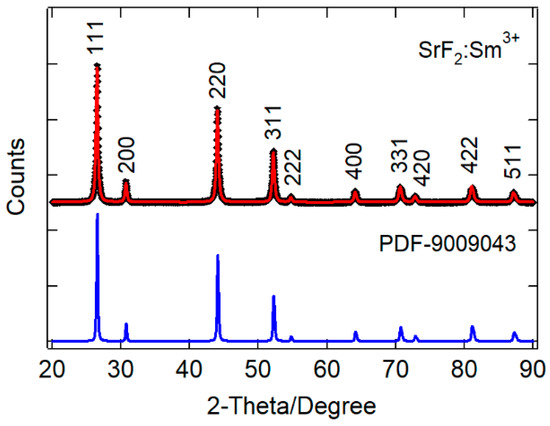
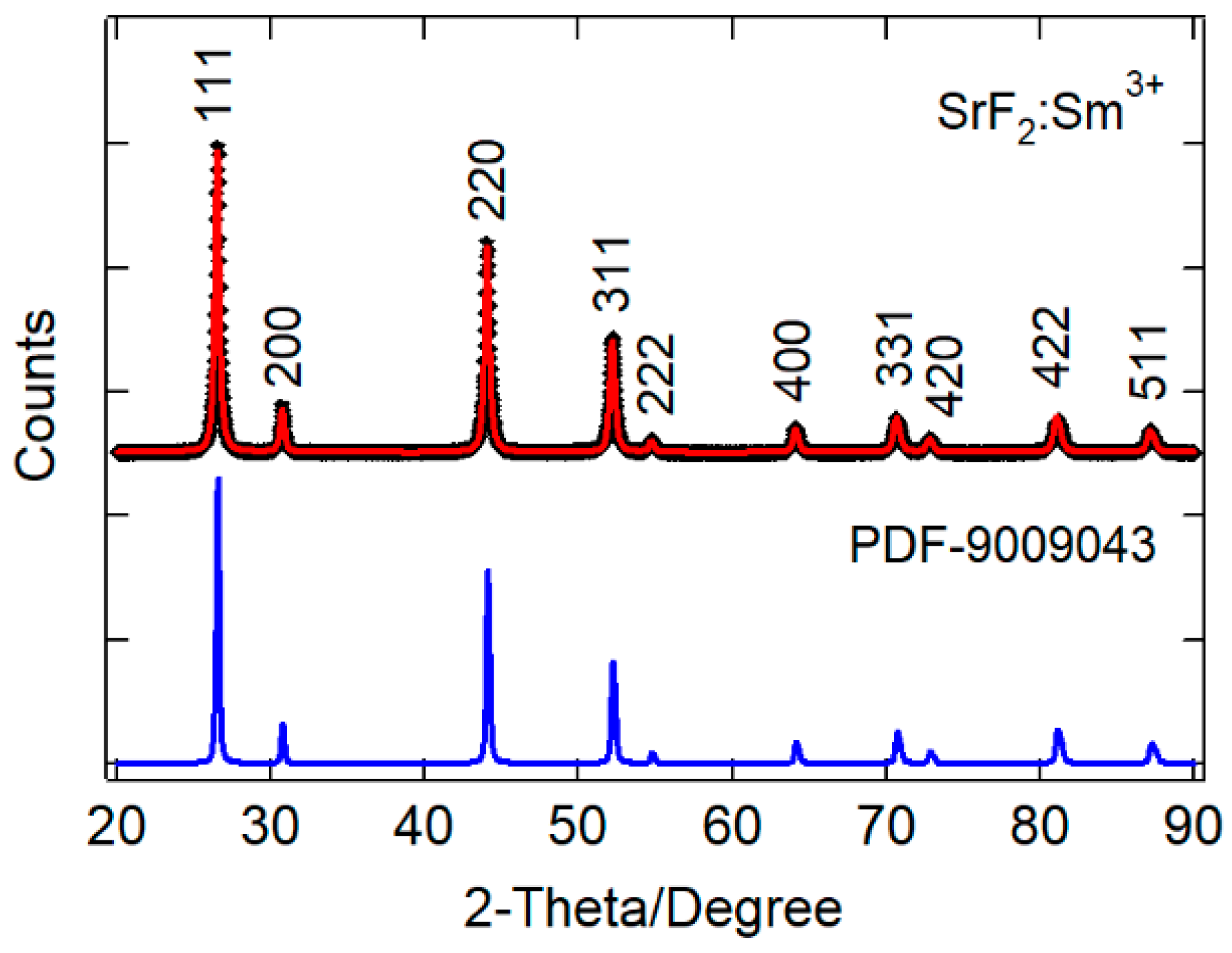
The powder XRD pattern of the as-prepared SrF2:Sm3+ (0.5 mol% Sm) nanocrystals and its Rietveld refinement are presented in Figure 1. The standard SrF2 PDF obtained from the Crystallography Open Database (http://www.crystallography.net/cod/index.php, accessed on 1 December 2019) is also shown for comparison [22]. The Rietveld refinement was performed using the MAUD 2.93 software package [23], applying an isotropic approximation within the default MAUD “Delf” size-strain model, and the refined parameters are summarized in Table 1. As seen in the figure, all diffraction peaks are consistent with the standard SrF2 data, confirming that nanocrystals adopt a cubic fluorite-type structure with the standard fluorite space group Fm-m [24]. The average crystallite size obtained from the refinement is 42 ± 1 nm, with a lattice parameter of 5.8092 ± 0.0002 Å, which is only slightly (~0.2%) larger than that of macroscopic crystals (5.7996 Å) [25]. The goodness of fit value of G = 1.4 implied a good refinement.
Figure 1.
Powder XRD pattern of the as-prepared SrF2:Sm3+ nanocrystals. Experimental data are shown as black diamonds, the Rietveld refinement as a red solid line, and the standard SrF2 pattern (PDF-9009043) as a blue trace.
Table 1.
Rietveld refinement parameters obtained from MAUD. Rwp and Rexp are the weighted-profile and expected R-factor, respectively. G is the goodness of fit (Rwp/Rexp).
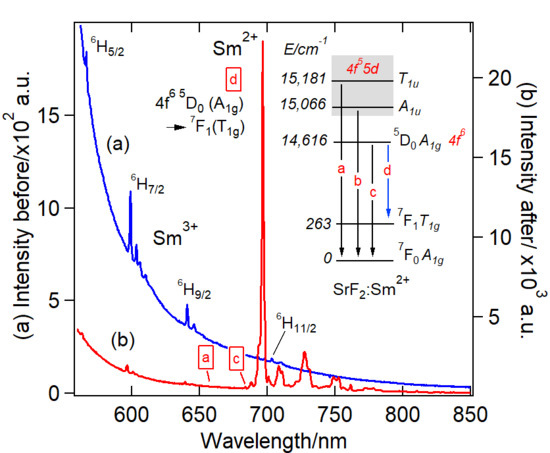
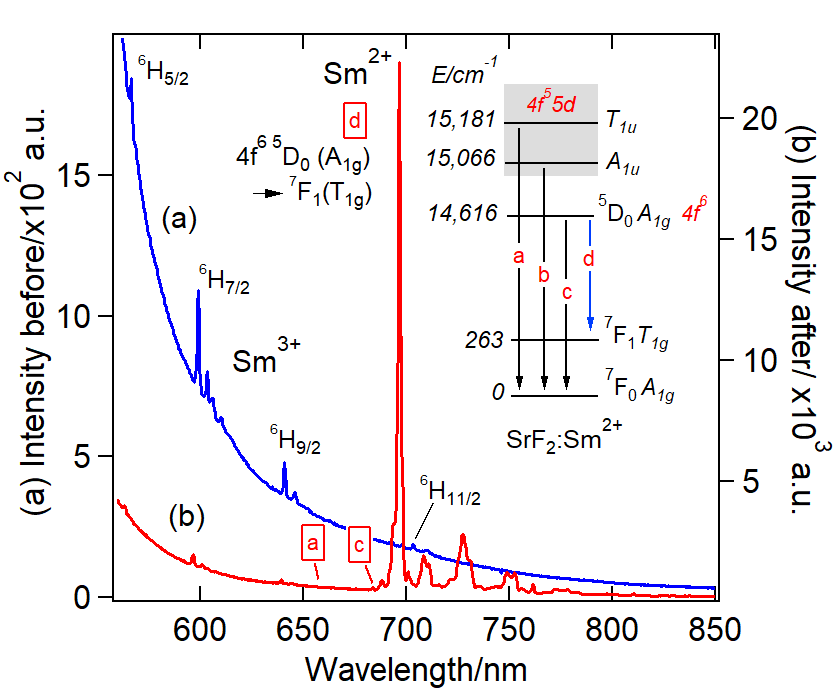
The 27-K photoluminescence spectrum of SrF2:Sm3+ nanocrystals before and after 150 Gy X-irradiation, demonstrating the generation of Sm2+ by X-irradiation, is shown in Figure 2. In the inset, a schematic Sm2+ energy-level diagram with the relevant transitions is depicted [26]. The 4f55d excited state lies 450 cm−1 above the 5D0 4f6 level, with a separation of 115 cm−1 between A1u and T1u levels [27,28]. As follows from the figure, the non-irradiated sample exhibits the Sm3+ f-f transitions 4G5/2 → 6H5/2, 6H7/2, 6H9/2, and 6H11/2 at 566, 599, 645, and 704 nm, respectively, confirming the incorporation of trivalent samarium into the SrF2 lattice [29]. Notably, X-irradiation causes a decrease in Sm3+ luminescence. Unlike the CaF2:Sm2+ system, the 4f55d levels in SrF2:Sm2+ lie above the 4f6 5D0 excited state [30,31]. Consequently, the relatively sharp Sm2+ emission at 696.7 nm observed after 150 Gy X-irradiation corresponds to the magnetic dipole-allowed transition from the 4f6 5D0 (A1g) excited state to the 4f6 7F1 (T1g) ground state level (labeled as “d”) [31,32]. Several relatively strong vibronic sidebands are also present [28,32,33,34]. Additional Sm2+ lines include the 675.6 nm (a) electric dipole-allowed 4f55d (T1u) → 7F0 (A1g) transition, the 683.8 nm (c) very weak magnetic dipole-forbidden 5D0 ↔ 7F0 transition, and the 663.5 nm (b) strongly forbidden 4f55d (A1u) → 7F0 (A1g) transition, previously observed in an external magnetic field [26,28,31].
Figure 2.
27-K photoluminescence spectrum of SrF2:Sm3+ nanocrystals (a) before and (b) after 150 Gy X-irradiation, excited with a 462 nm laser diode (0.3 mW). Inset: simplified energy-level diagram showing the relevant transitions in the SrF2:Sm2+ system. The labels a–d correspond to the spectral transitions indicated in the inset.
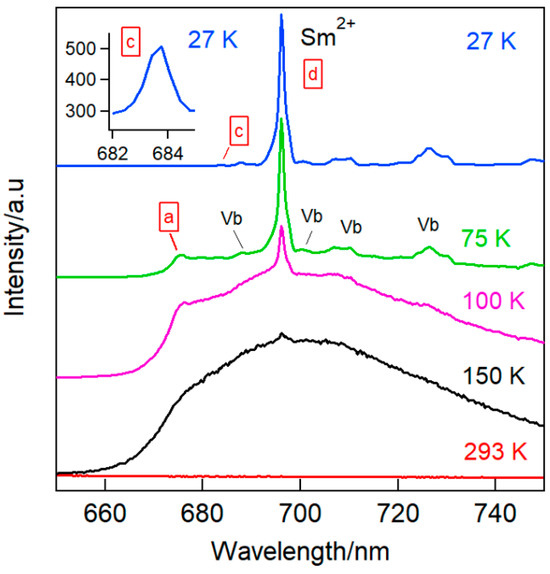
Figure 3 shows the temperature dependence of the Sm2+ photoluminescence spectrum of SrF2:Sm3+ nanocrystals after 200 Gy X-irradiation in the temperature range from 27 to 293 K. With increasing temperature, the prominent 696.7 nm peak (d) broadens and the vibronic sidebands intensify. The 675.6 nm transition (a) is very weak at 27 K, as the T1u level is scarcely populated at low temperature, consistent with a Boltzmann distribution [35]. Note that the Sm2+ emission is quenched above ~200 K in SrF2 and BaF2, while partially preserved in CaF2 [36]. As the temperature rises, the broad d-f luminescence (a) starts to dominate over the sharp f-f emission. This quenching of the f-f emission, i.e., the nonradiative crossover between Sm2+ 5d ↔ 5D0 states, has been quantitatively modeled in some early work by Fonger and Struck [37]. Importantly, the emission is eventually quenched at higher temperature via a two-step quenching pathway, 5D0 → 5d → 7F [35,38], resulting from thermally activated crossover from the 5D0 level to the 5d state, followed by rapid multiphonon relaxation [39].
Figure 3.
Temperature dependence of the Sm2+ luminescence of 200 Gy X-irradiated SrF2:Sm3+ nanocrystals, excited by a 462 nm laser diode (0.3 mW). Inset: 100× magnification of the emission line (c) at 27 K. Vb indicates vibronic sidebands. The labels a, c, and d correspond to the transitions 4f55d (T1u) → 7F0 (A1g) at 675.6 nm, 5D0 ↔ 7F0 at 683.8 nm, and 4f6 5D0 (A1g) → 4f6 7F1 (T1g) at 696.7 nm, respectively.
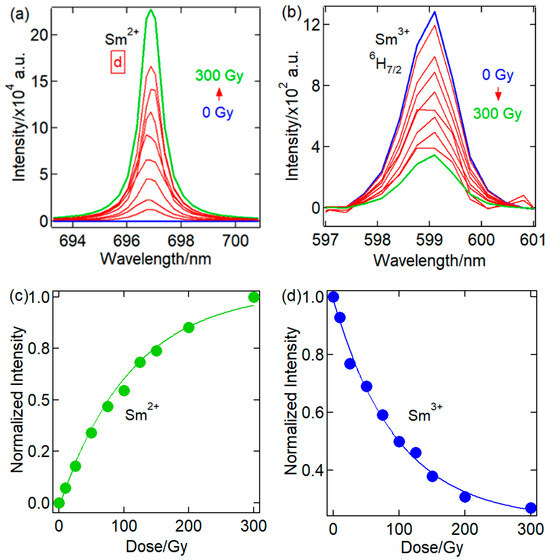
The dependence of the Sm3+ → Sm2+ reduction in SrF2:Sm3+ nanocrystals under Cu-Kα (8 keV) X-irradiation was investigated by monitoring the photoluminescence intensities of the Sm2+ 5D0 (A1g) → 7F1 (T1g) transition at 696.7 nm (d) and the Sm3+ 4G5/2 → 6H7/2 transitions at 599 nm (see Figure 4). As seen in Figure 4b, the Sm3+ luminescence decreased by ~78% upon 300 Gy X-irradiation. The dose dependence of both Sm2+ and Sm3+ intensities, (Figure 4c,d), were well fitted by single-exponential functions:
with fitting amplitudes = 1.02 and = −1.05 for Sm2+, and = 0.22 and = 0.76 for Sm3+, yielding a rate constant = 0.01 Gy−1 for both Sm2+ and Sm3+. These results indicate that the formation of the Sm2+ and the depletion of Sm3+ under X-irradiation follow simple first-order kinetics up to doses of 300 Gy using 8 keV Cu-Kα radiation. A simple possible mechanism for the Sm3+ → Sm2+ reduction in SrF2:Sm3+ under X-irradiation is proposed in Equation (2):
Figure 4.
27 K photoluminescence spectra of SrF2:Sm3+ nanocrystals in the region of (a) the Sm2+ 5D0 (A1g) → 7F1 (T1g) transition at 696.7 nm (label d) and (b) the Sm3+ 4G5/2 → 6H7/2 transition at 599 nm under Cu-Kα X-ray doses of 0–300 Gy. Spectra were excited with 0.3 mW of 462 nm laser light. (c) and (d) Normalized luminescence intensities of (a) and (b), respectively.
The Sm3+ ions occupy Sr2+ lattice sites and are charge-compensated by defects such as interstitial F− ions or O2− impurities [40,41]. X-irradiation generates electron-hole pairs, and some electrons are then captured and trapped directly, or indirectly via F-centers, by Sm3+ to form Sm2+, while the holes are trapped by interstitial F− ions or O2− impurities.
The presence of defect-related trapping states within the bandgap stabilizes the reduced Sm2+ species by suppressing immediate recombination of charge carriers. These traps prolong electron lifetimes and enhance the reduction in Sm3+. Such processes, involving F-centers and Vk centers, are well known in alkaline-earth fluorides and play an important role in charge transfer and recombination dynamics [37,42].
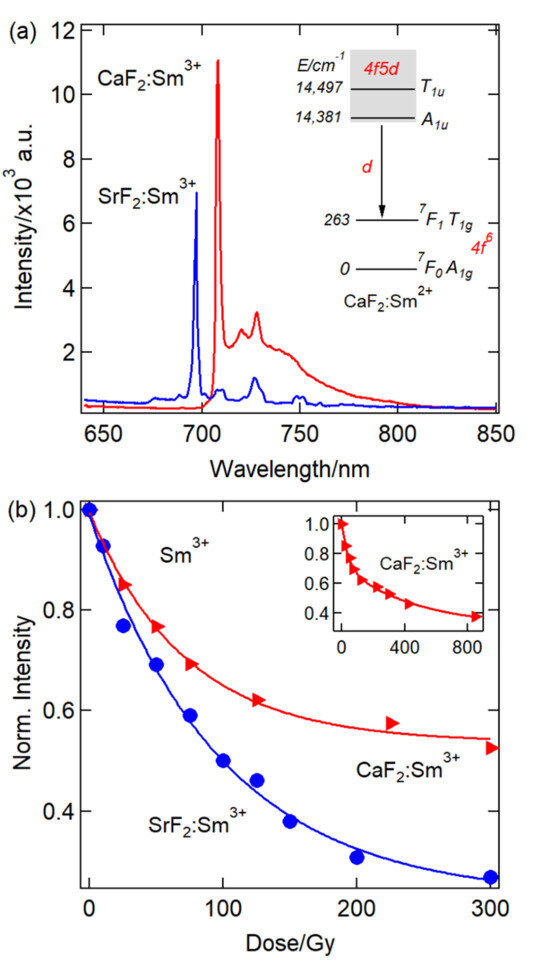
Figure 5a compares the Sm2+ photoluminescence generated upon 150 Gy X-irradiation of SrF2:Sm3+ and CaF2:Sm3+ nanocrystals (0.5 mol% Sm relative to Sr or Ca). In CaF2:Sm3+ nanocrystals, the prominent Sm2+ luminescence is the electric dipole-allowed 4f55d (A1u) → 7F1 (T1g) transition centered at 708.2 nm (d), whereas the intense Sm2+ luminescence at 676.9 nm (d) in SrF2:Sm3+ corresponds to the magnetic dipole-allowed 4f6 5D0 (A1) → 4f6 7F1 (T1g) transition. Figure 5b shows the corresponding decrease in Sm3+ luminescence of both SrF2:Sm3+ and CaF2:Sm3+ nanocrystals with increasing X-ray dose (0–300 Gy), which is well described by a single-exponential behavior, as expressed by Equation (1). The fit of CaF2:Sm3+ yielded a rate constant of = 0.007 Gy−1 with amplitudes of = 0.50 and = 0.48.
Figure 5.
Comparison of Sm2+ photoluminescence in SrF2:Sm3+ and CaF2:Sm3+ nanocrystals upon X-irradiation (0.5 mol% of Sm relative to Sr or Ca). (a) Sm2+ PL after 300 Gy X-irradiation. (b) Normalized Sm3+ PL intensity as a function of X-ray dose. Insets: (a) relevant CaF2:Sm2+ energy level, and (b) normalized Sm3+ PL intensity of CaF2:Sm3+ up to 850 Gy, fitted with a double-exponential function (data adapted from ref. [21] with permission).
As shown in Figure 5b, the Sm3+ → Sm2+ conversion in SrF2: Sm3+ proceeds markedly faster, with approximately 78% of Sm3+ reduced after a 300 Gy X-ray dose, compared with only ~46% in CaF2:Sm3+ under the same conditions. This higher reduction efficiency in SrF2 is due to its higher X-ray mass attenuation coefficient compared to CaF2 [43], which results in more electron-hole pair creation [44] and, consequently, a greater degree of Sm3+ → Sm2+ reduction. The X-ray absorption coefficients computed using the SRS Absorption Calculator (https://11bm.xray.aps.anl.gov/absorb/, accessed on 29 November 2025) yield values of ~246 cm−1 for CaF2 and ~340 cm−1 for SrF2 at the Cu-Kα photon energy of 8 keV, demonstrating that SrF2 absorbs X-rays approximately 1.4 times more strongly than CaF2, which is in good agreement with the ratio (1.43) of the initial conversion rates for the two systems. As shown in the inset of Figure 5b, the Sm3+ reduction up to 850 Gy demonstrated a dispersive first-order kinetics for the latter host.
3. Materials and Methods
Nanocrystalline SrF2:Sm3+ was synthesized by co-precipitation of SrCl2ꞏ2H2O, SmCl3ꞏ6H2O, and NH4F (ACS grade, Sigma-Aldrich, Bayswater, Australia). Briefly, 37.4 mg of SmCl3ꞏ6H2O (0.5 mol% of Sm relative to Sr) was added to 100 mL of an aqueous SrCl2ꞏ2H2O solution (0.3 M). Subsequently, 100 mL of an aqueous NH4F solution (0.6 M) was added, and the mixture was stirred for 3 h. The resulting precipitate was collected by centrifugation (12 min, 4000 rpm), thoroughly washed with deionized water, and dried at 60 °C overnight.
The phase purity of the sample was characterized using a Rigaku Miniflex 600 benchtop XRD diffractometer (Rigaku Corporation, Tokyo, Japan) (Cu-Kα radiation, λ = 0.154 nm; 40 kV, 15 mA). The diffraction patterns were recorded over 2θ range of 20° to 90° with a step size of 0.01° and a scan rate of 0.5° min−1.
The photoluminescence spectra were carried out using a 462 nm laser diode as the excitation source and accumulated on a Spex 500 M monochromator (Spex Industries Inc., Edison, NJ, USA) equipped with an Andor iDus Model DV401A-BV CCD camera(Andor Technology, Belfast, Northern Ireland, UK). Powder samples were placed in an aluminum holder with a 0.5 mm (depth) × 5 mm (diameter) counterbore and mounted on the cold finger of a closed-cycle cryostat (CTI-Cryogenics Cryodyne Model 22, CTI-Cryodyne, Haverhill, MA, USA).
The Sm3+ to Sm2+ reduction by X-irradiation was performed using the Rigaku diffractometer at a fixed 2θ angle of 30°. The delivered dose was cross-calibrated with a Sirona HELIODENT Plus Dental X-ray Source (Sirona Dental Systems GmbH, Erlangen, Germany).
4. Conclusions
We have demonstrated the reduction in Sm3+ → Sm2+ upon X-irradiation in nanocrystalline SrF2:Sm3+ synthesized via co-precipitation of SrCl2, SmCl3, and NH4F. The as-prepared sample, with an average crystallite size of ~40 nm, exhibits clear Sm2+ photoluminescence upon exposure to ionizing radiation. The evolution of Sm2+ and Sm3+ emission intensities as a function of X-ray dose (0–300 Gy) follows first-order kinetics, indicating a basic trapping–detrapping mechanism associated with radiation-generated charge carriers. Compared with CaF2:Sm3+ nanocrystals, the reduction in the SrF2 host is more efficient, i.e., ~78% of Sm3+ ions in SrF2:Sm3+ are converted to Sm2+ after a 300 Gy dose, versus ~46% in CaF2:Sm3+ under identical conditions. This enhanced reducibility is attributed to the higher X-ray absorption cross section of SrF2 relative to CaF2 at 8 keV (~1.4×), which results in more effective generation of electron-hole pairs that participate in the redox conversion. The pronounced radiation sensitivity and robust Sm2+ emission observed in SrF2:Sm3+ nanocrystals highlight its potential as a nanoscale X-ray storage phosphor for high dose dosimetry.
Author Contributions
Z.S.R.: sample preparation, investigation, methodology, data curation, formal analysis, writing—original draft. S.F.A.S.: writing—review and editing. H.R.: supervision, conceptualization, writing—review and editing. All authors have read and agreed to the published version of the manuscript.
Funding
This research was funded by UNSW International Postgraduate Award.
Institutional Review Board Statement
Not applicable.
Informed Consent Statement
Not applicable.
Data Availability Statement
The original contributions presented in this study are included in the article. Further inquiries can be directed to the corresponding author.
Acknowledgments
The authors acknowledge the University of New South Wales (UNSW) at the Australian Defence Force Academy for financial support.
Conflicts of Interest
The authors declare no competing financial interests or personal relationships that could have influenced the work reported in this paper.
Abbreviations
The following abbreviations are used in this paper:
| PL | Photoluminescence |
| XRD | X-ray diffractometer |
References
- Kurita, A.; Kushida, T.; Izumitani, T.; Matsukawa, M. Room-temperature persistent spectral hole burning in Sm2+-doped fluoride glasses. Opt. Lett. 1994, 19, 314–316. [Google Scholar] [CrossRef] [Scilit] [PubMed]
- Macfarlane, R.M.; Shelby, R.M. Photoionization hole burning and nonlinear Zeeman effect in CaF2:Sm2+. Opt. Lett. 1984, 9, 533–535. [Google Scholar] [CrossRef] [Scilit]
- Winnacker, A.; Shelby, R.M.; Macfarlane, R.M. Photon-gated hole burning: A new mechanism using two-step photoionization. Opt. Lett. 1985, 10, 350–352. [Google Scholar] [CrossRef] [Scilit] [PubMed]
- Kaiser, W.; Garrett, C.G.B.; Wood, D.L. Fluorescence and Optical Maser Effects in CaF2:Sm++. Phys. Rev. 1961, 123, 766–776. [Google Scholar] [CrossRef] [Scilit]
- Sorokin, P.P.; Stevenson, M.J. Solid-State Optical Maser Using Divalent Samarium in Calcium Fluoride. IBM J. Res. Dev. 1961, 5, 56–58. [Google Scholar] [CrossRef] [Scilit]
- Edgar, A.; Varoy, C.R.; Koughia, C.; Okada, G.; Belev, G.; Kasap, S. High-resolution X-ray imaging with samarium-doped fluoroaluminate and fluorophosphate glass. J. Non-Cryst. Solids 2013, 377, 124–128. [Google Scholar] [CrossRef] [Scilit]
- Vahedi, S.; Okada, G.; Morrell, B.; Muzar, E.; Koughia, C.; Edgar, A.; Varoy, C.; Belev, G.; Wysokinski, T.; Chapman, D.; et al. X-ray induced Sm3+ to Sm2+ conversion in fluorophosphate and fluoroaluminate glasses for the monitoring of high-doses in microbeam radiation therapy. J. Appl. Phys. 2012, 112, 073108. [Google Scholar] [CrossRef] [Scilit]
- Qiu, J.; Miura, K.; Nouchi, K.; Suzuki, T.; Kondo, Y.; Mitsuyu, T.; Hirao, K. Valence manipulation by lasers of samarium ion in micrometer-scale dimensions inside transparent glass. Solid State Commun. 1999, 113, 341–344. [Google Scholar] [CrossRef] [Scilit]
- Liu, Z.; Stevens-Kalceff, M.; Riesen, H. Photoluminescence and Cathodoluminescence Properties of Nanocrystalline BaFCl:Sm3+ X-ray Storage Phosphor. J. Phys. Chem. C 2012, 116, 8322–8331. [Google Scholar] [CrossRef] [Scilit]
- Fujita, K.; Yasumoto, C.; Hirao, K. Photochemical reactions of samarium ions in sodium borate glasses irradiated with near-infrared femtosecond laser pulses. J. Lumin. 2002, 98, 317–323. [Google Scholar] [CrossRef] [Scilit]
- Huang, Y.; Kai, W.; Lee, H.; Cho, E.; Jang, K.; Cao, Y.; Zhao, W.; Ding, H.; Wang, X. Spectroscopic Characteristics of Olgite (Ba,Sr)(Na,Sr)2Na[PO4]2 Crystals Doped with Sm2+ Ions. Mater. Chem. Phys. 2008, 111, 359–363. [Google Scholar] [CrossRef] [Scilit]
- Huang, Y.; Zhao, W.; Shi, L.; Seo, H.J. Structural defects and luminescence properties of Sm2+ ions doped in BaBPO5 phosphor by X-ray irradiation. J. Alloys Compd. 2009, 477, 936–940. [Google Scholar] [CrossRef] [Scilit]
- Okada, G.; Ueda, J.; Tanabe, S.; Belev, G.; Wysokinski, T.; Chapman, D.; Tonchev, D.; Kasap, S. Samarium-Doped Oxyfluoride Glass-Ceramic as a New Fast Erasable Dosimetric Detector Material for Microbeam Radiation Cancer Therapy Applications at the Canadian Synchrotron. J. Am. Ceram. Soc. 2014, 97, 2147–2153. [Google Scholar] [CrossRef] [Scilit]
- Morss, L.R. Thermochemical Properties of Yttrium, Lanthanum, and the Lanthanide Elements and Ions. Chem. Rev. 1976, 76, 827–841. [Google Scholar] [CrossRef] [Scilit]
- Pandurangappa, C.; Lakshminarasappa, B.N. Optical studies of samarium-doped fluoride nanoparticles. Philos. Mag. 2011, 91, 4486–4494. [Google Scholar] [CrossRef] [Scilit]
- Dolcet, P.; Mambrini, A.; Pedroni, M.; Speghini, A.; Gialanella, S.; Casarin, M.; Gross, S. Room temperature crystallization of highly luminescent lanthanide-doped CaF2 in nanosized droplets: First example of the synthesis of metal halogenide in miniemulsion with effective doping and size control. RSC Adv. 2015, 5, 16302–16310. [Google Scholar] [CrossRef] [Scilit]
- Ritter, B.; Krahl, T.; Rurack, K.; Kemnitz, E. Nanoscale CaF2 doped with Eu3+ and Tb3+ through fluorolytic sol–gel synthesis. J. Mater. Chem. C 2014, 2, 8607–8613. [Google Scholar] [CrossRef] [Scilit]
- Riesen, H.; Badek, K.; Monro, T.M.; Riesen, N. Highly efficient valence state switching of samarium in BaFCl:Sm nanocrystals in the deep UV for multilevel optical data storage. Opt. Mater. Express 2016, 6, 3097–3108. [Google Scholar] [CrossRef] [Scilit]
- Riesen, N.; François, A.; Badek, K.; Monro, T.M.; Riesen, H. Photoreduction of Sm3+ in Nanocrystalline BaFCl. J. Phys. Chem. A 2015, 119, 6252–6256. [Google Scholar] [CrossRef] [Scilit]
- Chowdhury, N.; Riesen, N.; Riesen, H. Efficient Generation of Stable Sm2+ in Nanocrystalline BaLiF3:Sm3+ by UV- and X-Irradiation. J. Phys. Chem. C 2019, 123, 25477–25481. [Google Scholar] [CrossRef] [Scilit]
- Rozaila, Z.S.; Riesen, N.; Riesen, H. Luminescence and photoionization of X-ray generated Sm2+ in coprecipitated CaF2 nanocrystals. Dalton Trans. 2021, 50, 16205–16213. [Google Scholar] [CrossRef] [Scilit] [PubMed]
- Crystallography Open Database. Available online: http://www.crystallography.net/cod/index.php (accessed on 1 December 2019).
- MAUD. Available online: http://maud.radiographema.eu/ (accessed on 2 December 2019).
- Ritter, B.; Haida, P.; Fink, F.; Krahl, T.; Gawlitza, K.; Rurack, K.; Scholz, G.; Kemnitz, E. Novel and easy access to highly luminescent Eu and Tb doped ultra-small CaF2, SrF2 and BaF2 nanoparticles—Structure and luminescence. Dalton Trans. 2017, 46, 2925–2936. [Google Scholar] [CrossRef] [Scilit] [PubMed]
- Yagoub, M.Y.A.; Swart, H.C.; Noto, L.L.; Bergman, P.; Coetsee, E. Surface Characterization and Photoluminescence Properties of Ce3+,Eu Co-Doped SrF2 Nanophosphor. Materials 2015, 8, 2361–2375. [Google Scholar] [CrossRef] [Scilit]
- Crozier, M.H. Magnetically Induced Line Absorption in CaF2(Sm2+) and SrF2(Sm2+). Phys. Rev. Lett. 1964, 13, 394–395. [Google Scholar] [CrossRef] [Scilit]
- Lawson, J.K.; Payne, S.A. Excited-state absorption spectra and gain measurements of CaF2:Sm2+. J. Opt. Soc. Am. B 1991, 8, 1404–1411. [Google Scholar] [CrossRef] [Scilit]
- Wood, D.L.; Kaiser, W. Absorption and Fluorescence of Sm2+ in CaF2, SrF2, and BaF2. Phys. Rev. 1962, 126, 2079–2088. [Google Scholar] [CrossRef] [Scilit]
- Mikhail, P.; Ramseyer, K.; Frei, G.; Budde, F.; Hulliger, J. Bleaching of Sm2+ during photoluminescence and cathodoluminescence. Opt. Commun. 2001, 188, 111–117. [Google Scholar] [CrossRef] [Scilit]
- Lawson, J.K.; Lee, H.W.H.; Payne, S.A.; Boatner, L.A. Excited-State Absorption Measurements of Sm2+ in CaF2, SrF2 and SrCl2. In Advanced Solid State Lasers; OSA Proceedings Series; Optica Publishing Group: Hilton Head, SC, USA, 1991. [Google Scholar]
- Macfarlane, R.M.; Meltzer, R.S. Spectral holeburning and the Stark and Zeeman effects in SrF2:Sm2+. Opt. Commun. 1985, 52, 320–323. [Google Scholar] [CrossRef] [Scilit]
- Cohen, E.; Guggenheim, H.J. Vibronic Transitions of Sm2+ and Eu2+ in SrF2 and Their Zeeman Effect. Phys. Rev. 1968, 175, 354–361. [Google Scholar] [CrossRef] [Scilit]
- Richman, I. Vibronic Spectra of SrF2:Sm2+ and BaF2:Sm2+. Phys. Rev. 1964, 133, A1364–A1366. [Google Scholar] [CrossRef] [Scilit]
- Kaiser, W.; Spitzer, W.G.; Kaiser, R.H.; Howarth, L.E. Infrared properties of CaF2, SrF2, and BaF2. Phys. Rev. 1962, 127, 1950–1954. [Google Scholar] [CrossRef] [Scilit]
- Fonger, W.H.; Struck, C.W. Relation of the Lauer–Fong formula to the SCC model: Application to Sm+2 5d-5D crossovers. J. Chem. Phys. 2008, 69, 4171–4184. [Google Scholar] [CrossRef] [Scilit]
- Radzhabov, E.A.; Kozlovsky, V.A. Sm2+ Spectra in Lanthanum Fluoride. Phys. Procedia 2015, 76, 47–52. [Google Scholar] [CrossRef] [Scilit]
- Luo, C.; Jing, Y.; Hua, Z.; Sui, Z.; Wang, C.; Hu, P.; Zheng, L.; Qian, S.; Yang, L.; Sun, X.; et al. Band Gap and Defect Engineering Enhanced Scintillation from Ce3+-Doped Nanoglass Containing Mixed-Type Fluoride Nanocrystals. ACS Appl. Mater. Interfaces 2023, 15, 46226–46235. [Google Scholar] [CrossRef] [Scilit]
- Struck, C.W.; Fonger, W.H. Unified model of the temperature quenching of narrow-line and broad-band emissions. J. Lumin. 1975, 10, 1–30. [Google Scholar] [CrossRef] [Scilit]
- Yu, D.; Ballato, J.; Riman, R.E. Temperature-Dependence of Multiphonon Relaxation of Rare-Earth Ions in Solid-State Hosts. J. Phys. Chem. C 2016, 120, 9958–9964. [Google Scholar] [CrossRef] [Scilit] [PubMed]
- Kumam, N.; Singh, N.P.; Singh, L.P.; Srivastava, S.K. Enhancement of luminescence in white emitting strontium fluoride core@ calcium fluoride shell nanoparticles. Nanoscale Res. Lett. 2015, 10, 347. [Google Scholar] [CrossRef] [Scilit]
- Zhi, G.; Song, J.; Mei, B.; Zhou, W. Synthesis and Characterization of Er3+ Doped CaF2 Nanoparticles. J. Alloys Compd. 2011, 509, 9133–9137. [Google Scholar] [CrossRef] [Scilit]
- Fowler, W.B. (Ed.) Physics of Color Centers; Academic Press: Cambridge, MA, USA, 1968. [Google Scholar]
- de Laeter, J.R.; Böhlke, J.K.; De Bièvre, P.; Hidaka, H.; Peiser, H.S.; Rosman, K.J.R.; Taylor, P.D.P. Atomic weights of the elements. Review 2000 (IUPAC Technical Report). Pure Appl. Chem. 2003, 75, 683–800. [Google Scholar] [CrossRef] [Scilit]
- Görlich, P.; Karras, H.; Lüdke, W.; Mothes, H.; Reimann, R. Coloration of Yttrium-Doped CaF2 and SrF2 Crystals by X-Ray Irradiation. Phys. Status Solidi (B) 1963, 3, 478–484. [Google Scholar] [CrossRef] [Scilit]

Disclaimer/Publisher’s Note: The statements, opinions and data contained in all publications are solely those of the individual author(s) and contributor(s) and not of MDPI and/or the editor(s). MDPI and/or the editor(s) disclaim responsibility for any injury to people or property resulting from any ideas, methods, instructions or products referred to in the content. |
© 2026 by the authors. Licensee MDPI, Basel, Switzerland. This article is an open access article distributed under the terms and conditions of the Creative Commons Attribution (CC BY) license.