Article

Role of ZrO2 and Porosity Induced by Activated Carbon and Starch Templates in NiMo/Al2O3-ZrO2 Catalysts for Naphthalene Hydrogenation and 4,6-Dimethyldibenzothiophene Hydrodesulfurization


by
Esneyder Puello Polo
1,*,
Elíseo Díaz Varela
1 and
Carlos A. T. Toloza
2
1
Grupo de Investigación en Oxi/Hidrotratamiento Catalítico y Nuevos Materiales, Programa de Química-Ciencias Básicas, Universidad del Atlántico, Puerto Colombia 081007, Colombia
2
Departamento de Ciencias Naturales y Exactas, Universidad de la Costa, Barranquilla 080002, Colombia
*
Author to whom correspondence should be addressed.
Inorganics 2026, 14(4), 109; https://doi.org/10.3390/inorganics14040109 (registering DOI)

Submission received: 10 March 2026 / Revised: 6 April 2026 / Accepted: 8 April 2026 / Published: 11 April 2026
(This article belongs to the Special Issue Multifunctional Composites and Hybrid Materials)

Abstract

The influence of zirconia incorporation and template type on the physicochemical properties of NiMo/Al2O3-ZrO2 catalysts was investigated for the hydrodesulfurization (HDS) of 4,6-dimethyldibenzothiophene (4,6-DMDBT) and the hydrogenation (HYD) of naphthalene (N). Catalysts were prepared by co-impregnation on supports synthesized via a sol-gel method using starch (A) and activated carbon (C) as structure-directing templates, followed by zirconium incorporation through a grafting procedure. The resulting materials were characterized by SEM–EDX, N2 physisorption, H2-TPR, XPS, HRTEM, and pyridine-FTIR. SEM-EDX confirmed homogeneous metal distributions and compositions close to nominal values (Mo = 20 wt%, Ni = 5 wt%, Zr = 11 wt%) with Ni/(Ni + Mo) = 0.30. N2 adsorption–desorption isotherms correspond to type IV(a) with H3-H4 hysteresis loops, characteristic of mesoporous structures. After metal incorporation, surface areas decreased to 96 m2 g−1 for NiMo/Al2O3 and 81 m2 g−1 for Zr-modified catalysts, while the activated carbon-templated sample preserved a larger mesoporous volume (0.335 cm3 g−1) and higher macroporosity (72%). H2-TPR profiles indicated improved reducibility for Zr-containing catalysts. XPS revealed an increase of MoS2 species from 45% in NiMo/Al2O3 to 75% in NiMo/Al2O3-ZrO2(C), accompanied by a higher degree of sulfidation index (DSI) from 47.1% to 73.9%. HRTEM analysis of Zr-modified catalysts revealed longer MoS2 slabs (11.8–12.1 nm) and higher edge-to-corner ratios (17–17.4) compared with NiMo/Al2O3 (6.2 nm; fe/fc = 8.2). Pyridine-FTIR showed a substantial increase in total acidity from 91 to 421 μmol g−1 upon Zr addition. Catalytically, NiMo/Al2O3-ZrO2(C) exhibited the highest HDS conversion (40%), reaction rate (10.5 × 10⁻⁹ mol s−1 g−1), and TOF (4.69 × 10⁻⁵ s−1), whereas NiMo/Al2O3-ZrO2(A) reached the highest naphthalene conversion (97.18%), with a reaction rate of 27.4 × 10⁻⁷ mol s−1 g−1 and TOF of 12.9 × 10⁻³ s−1. These results demonstrate that Zr incorporation and the activated carbon template favored hydrodesulfurization, whereas the starch template promoted hydrogenation performance.

Graphical Abstract

1. Introduction

In recent years, the global refining industry has undergone a progressive transformation driven by the depletion of light crude oil reserves and the increasing availability of heavier feedstocks, which are typically enriched in polycyclic aromatic hydrocarbons and refractory sulfur-containing compounds [1]. These species deteriorate fuel quality and increase pollutant emissions during combustion, prompting the implementation of increasingly stringent environmental regulations [2]. In Colombia, Resolution 90963 of 2021 established maximum limits of approximately 35 vol.% for total aromatics and 10 ppm for sulfur in diesel and gasoline, aligning national regulations with international fuel quality standards and demanding the deployment of more efficient hydrotreating technologies [3]. Within this regulatory and technological context, naphthalene hydrogenation (HYD) has been widely adopted as a model reaction to evaluate the conversion of polycyclic aromatic hydrocarbons, while the hydrodesulfurization (HDS) of 4,6-dimethyldibenzothiophene (4,6-DMDBT) is commonly used as a representative probe molecule for deep desulfurization due to the steric hindrance imposed by its methyl substituents [4,5]. As a result, NiMo-based sulfide catalysts supported on oxide materials have been extensively investigated owing to their high activity in both HDS and HYD reactions. Nevertheless, conventional industrial catalysts based on γ-Al2O3 supports often exhibit intrinsic limitations related to strong metal–support interactions, restricted pore accessibility, and diffusional constraints, which become particularly severe when processing large aromatic molecules or sterically hindered sulfur compounds [6,7].
Recent research has clearly demonstrated that modifying the support composition, especially through the incorporation of ZrO2, plays a decisive role in controlling the dispersion, electronic properties, and intrinsic activity of Mo-based sulfide phases [8]. In this regard, Zhang et al. reported that ZrO2 incorporation into NiMo/Al2O3-ZrO2 catalysts significantly enhances the dispersion of oxidized Mo species by optimizing metal–support interactions [9]. Complementarily, Díaz-García et al. showed that ZrO2-induced electronic modulation leads to an improved NiMoS phase configuration and enhanced HDS activity [10], while Chávez-Esquivel et al. synthesized Al2O3-ZrO2 supports exhibiting well-developed porosity and stable microcrystalline structures [11]. These combined structural and electronic modifications are expected to improve the accessibility and population of specific active sites, in agreement with the findings of Ramírez et al. [12], who demonstrated that naphthalene hydrogenation and HDS do not necessarily occur on the same NiMoS active sites, identifying coordinatively unsaturated sites (CUS) located on the upper basal plane as the primary hydrogenation centers. Consistently, Rana et al. showed that ZrO2-SiO2 mixed oxide supports increase the density and activity of CUS, thereby enhancing hydrogenation performance and improving the balance between HDS and HYD reactions compared with conventional NiMo/Al2O3 catalysts [13].
Beyond compositional effects, several studies have emphasized that mixed oxide chemistry and pore architecture critically govern hydrotreating performance [14]. Escobar et al. demonstrated that CoMo catalysts supported on solvothermally treated ZrO2–TiO2 mixed oxides with wide pore structures exhibit optimal DBT HDS activity at near-monolayer Mo coverage (3.3 atoms nm−2), highlighting the dominant influence of support properties beyond promoter loading [15]. Fan et al. further showed that ZrO2 incorporation into hierarchical TS-1 supports modifies surface hydroxyl density, oxygen vacancy concentration, and the d-band center of supported NiMoS catalysts, promoting the formation of type-II NiMoS phases and enhancing direct desulfurization (DDS) pathways [16]. The versatility of ZrO2-containing supports has also been demonstrated in biomass upgrading applications. Hongloi et al. reported that NiMo/ZrO2 catalysts increased the carbon content of upgraded bio-oil from 43.9 to 68.5 wt% and the higher heating value from 17.4 to 31.2 MJ kg−1 [17], while Hongkailers et al. achieved guaiacol conversions above 98% with 87% selectivity toward phenols over NiMo/Al2O3-ZrO2 catalysts, even in the presence of water, confirming the stabilizing role of ZrO2 in preserving Lewis acidity [18]. The relevance of mesoporosity was further corroborated by Afanasiev [19], Garg et al. [20], and Badoga et al. [21], who linked enhanced HDS and HYD activity to high surface area, optimal Mo loadings (8 wt%), increased anion vacancy concentration, and improved active-site accessibility. At the sulfide level, Liu et al. demonstrated that Zr incorporation into NiMo and NiW systems significantly enhances dispersion and reducibility, increasing HDN rate constants from 2.42 to 9.18 h−1 for Ni(Zr)MoS and from 5.68 to 23.0 h−1 for Ni(Zr)WS at an optimal Zr/Ni atomic ratio of 0.04 [22]. Overall, these studies clearly highlight the central role of ZrO2 in controlling support porosity, structural properties, and metal–support interactions, which in turn critically determine the dispersion, sulfidation degree, and accessibility of NiMoS active phases [9]. In particular, the synthesis route and the use of structure-directing templates strongly influence the development of hierarchical pore architectures and the distribution of ZrO2 within Al2O3-ZrO2 supports. Despite the extensive literature on Zr-containing supports, the combined effect of synthesis templates and ZrO2 incorporation on the simultaneous hydrogenation of polyaromatic molecules and the HDS of sterically hindered sulfur compounds remains insufficiently understood. Therefore, this work evaluates the combined effect of ZrO2 incorporation and templating strategy on the physicochemical properties, active phase formation, and catalytic performance of NiMo/Al2O3-based catalysts in the hydrodesulfurization of 4,6-dimethyldibenzothiophene and the hydrogenation of naphthalene.

2. Results and Discussion

2.1. Elemental Analysis

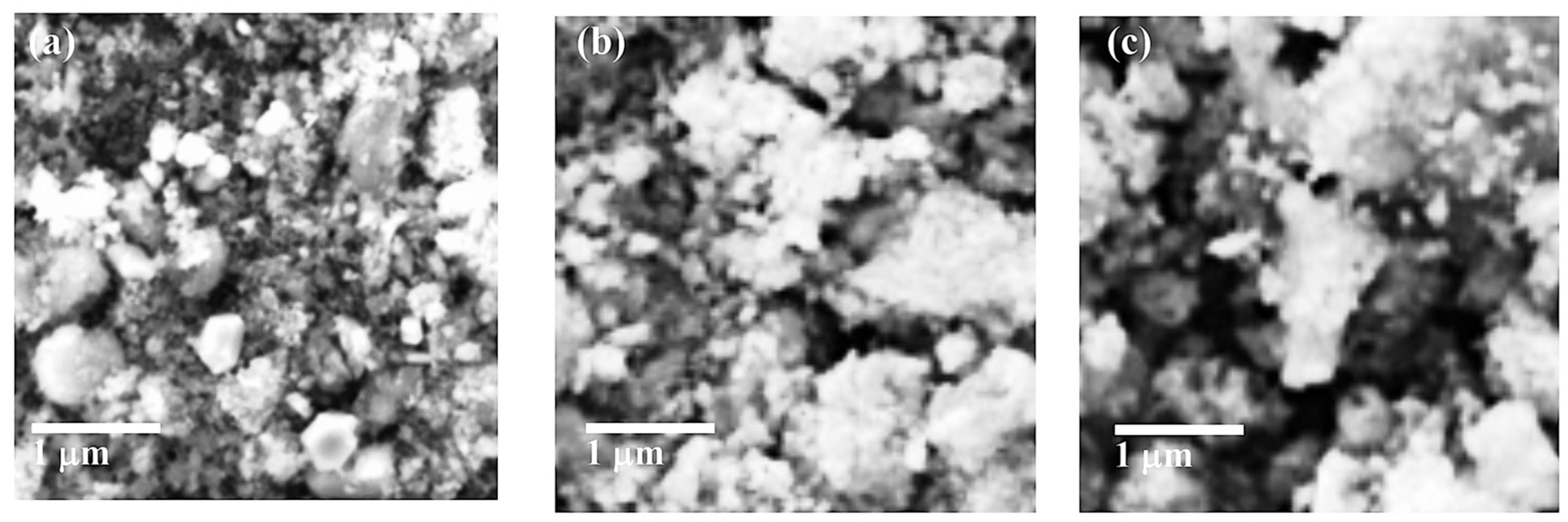
SEM micrographs (Figure 1) indicate that the grafting synthesis and template selection strongly influence aggregate morphology, particle size, and elemental distribution, while maintaining metal loadings close to nominal values and stable Ni/(Ni + Mo) ratios (Table 1). All catalysts consist of irregularly shaped aggregates with sizes ranging from a few hundred nanometers up to approximately 2 μm, indicating good dispersion of the active phase. The NiMo/Al2O3 reference catalyst shows relatively compact agglomerates between 0.6 and 1.0 μm, with rough surfaces and interparticle voids [23].
After Zr incorporation, morphological differences arise depending on the template. The activated carbon-templated catalyst NiMo/Al2O3-ZrO2(C) forms more heterogeneous aggregates (0.4–0.9 μm), suggesting less controlled particle growth; whereas the starch-templated NiMo/Al2O3-ZrO2(A) catalyst displays smaller, more uniformly distributed aggregates, generally below 0.6 μm, indicating more effective inhibition of particle coalescence [24]. Elemental mapping analyses (Figures S1–S3) confirm the presence and distribution of Ni, Mo, S, Al, and Zr within the catalyst particles. For NiMo/Al2O3, Ni and Mo are homogeneously distributed over the alumina, with a strong correlation between Mo and S, consistent with the formation of sulfided species.
In the Zr-modified catalysts, regions of enhanced Zr and Al intensity suggest the formation of mixed Al–Zr oxide domains (Zr-O-Al) [10]. Although Ni and Mo remain broadly dispersed, localized Mo-rich zones are more evident in the starch-templated sample, indicating subtle differences in dispersion associated with the template nature. Nevertheless, the strong Mo with S, and Al with Zr correlation is preserved in all samples.

2.2. Textural Properties

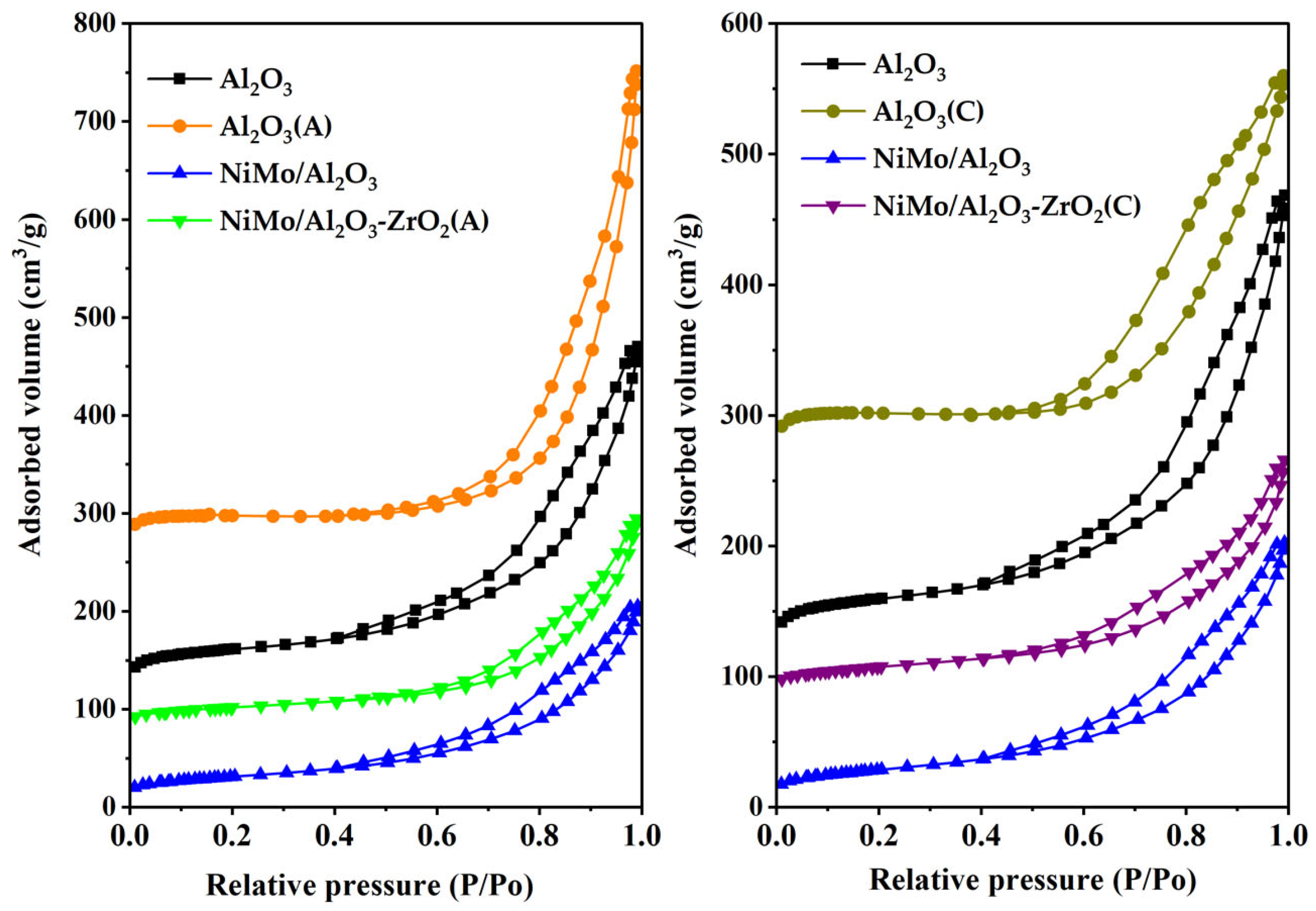
Figure 2 shows the N2 adsorption–desorption isotherms of the supports and catalysts, which exhibit a dominant type IV(a) profile with an initial type II-like region at low relative pressures, characteristic of mesoporous materials where monolayer–multilayer adsorption precedes capillary condensation according to the IUPAC classification [25]. Additionally, all materials show a well-defined hysteresis loop at P/P0 = 0.7–1.0, consistent with H3-type hysteresis, typically associated with slit-shaped mesopores formed by the aggregation of plate-like particles [25], except activated carbon-templated alumina support (Al2O3(C)), which exhibits H4-type hysteresis [25], indicating additional microporosity generated by the removal of the activated carbon template. According to data from Table 2, pristine Al2O3 support shows SBET = 130 m2 g−1, Vmeso = 0.539 cm3 g−1, VT = 0.547 cm3 g−1, and an average pore diameter of 9.9 nm. Template introduction significantly modifies the pore architecture. The carbon-templated support (Al2O3(C)) shows slightly lower surface area (114 m2 g−1) and mesoporous volume (0.446 cm3 g−1), but increased microporosity (Vmicro = 0.0223 cm3 g−1) and a narrower pore diameter (6.2 nm), indicating that the activated carbon template promotes smaller pores and greater microporous contributions [26]. While, the starch-templated support (Al2O3(A)) exhibits SBET = 99 m2 g−1, but significantly larger Vmeso = 0.743 cm3 g−1 and VT = 0.756 cm3 g−1, with Dp = 9.4 nm, evidencing a more open mesoporous network with improved connectivity.
After incorporation of the active phase, all catalysts show reduced surface area due to partial pore filling [27]. The NiMo/Al2O3 catalyst presents SBET = 96 m2 g−1, VT = 0.317 cm3 g−1, and Dp = 10.1 nm, confirming preservation of the mesoporous structure. Moreover, Zr incorporation introduces further differences, i.e., NiMo/Al2O3-ZrO2(A) shows SBET = 81 m2 g−1, VT = 0.285 cm3 g−1, and Dp = 6.8 nm, whereas NiMo/Al2O3-ZrO2(C) maintains Vmeso = 0.335 cm3 g−1, VT = 0.338 cm3 g−1, and Dp = 10.1 nm, indicating better structural preservation with activated carbon templating [26]. Pore size distribution curves confirm these trends (see Figure S4), showing mesopores centered near 10 nm for activated carbon-derived materials and 6–7 nm for starch-templated ones. In the Figure S5, Mercury intrusion porosimetry (MIP) further reveals hierarchical porosity, with macroporosity values of 68% for NiMo/Al2O3 and NiMo/Al2O3-ZrO2(A) and up to 72% for NiMo/Al2O3-ZrO2(C).

2.3. Hydrogen Temperature-Programmed Reduction (H2-TPR)

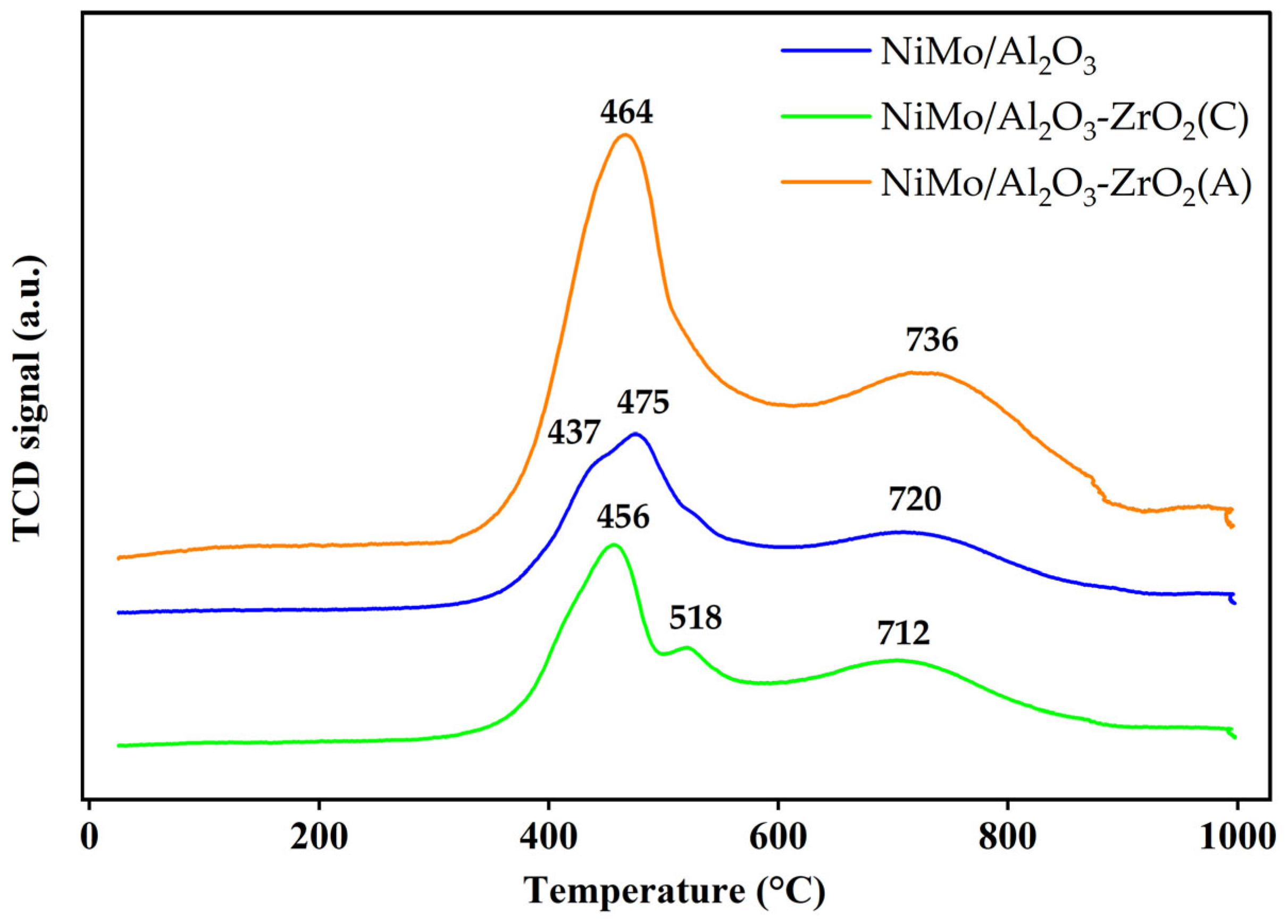
The profiles of the NiMo/Al2O3-ZrO2(x) catalysts are shown in Figure 3 and this exhibit three main reduction regions typical of supported NiMo oxide systems. The first reduction region appears between 430 and 480 °C, with maxima at 437 and 475 °C for NiMo/Al2O3, 456 °C for NiMo/Al2O3-ZrO2(C), and 464 °C for NiMo/Al2O3-ZrO2(A). This region is associated with the reduction of Ni2+ species together with weakly interacting polymeric Mo6+ species in octahedral coordination (Mo6+(Oh)), leading to partially reduced Mo4+ species [28]. The slight shift toward lower temperatures observed for the Zr-modified catalysts, particularly NiMo/Al2O3-ZrO2(C), suggests weaker Mo-support interactions compared with the unmodified catalyst. A second reduction contribution appears in the 500–520 °C region and is mainly observed for NiMo/Al2O3-ZrO2(C) with a maximum at 518 °C, which can be attributed to the reduction of NiMoO4-type mixed oxide species formed during the synthesis [29]. The clearer definition of this peak indicates stronger interaction between Ni and Mo oxide precursors, which may favor the formation of NiMoS active phases during sulfidation [30]. The third broad reduction region extends from 650 to 800 °C, with maxima located at 720 °C for NiMo/Al2O3, 712 °C for NiMo/Al2O3-ZrO2(C), and 736 °C for NiMo/Al2O3-ZrO2(A). This region corresponds to the reduction of strongly interacting Mo species, including isolated tetrahedral Mo6+(Td) species anchored to alumina and polymeric Mo oxide clusters [29]. The shift to lower temperature for NiMo/Al2O3-ZrO2(C) indicates improved reducibility, whereas the higher temperature for NiMo/Al2O3-ZrO2(A) suggests stronger metal–support interactions. Overall, the reducibility follows the order NiMo/Al2O3-ZrO2(C) > NiMo/Al2O3 > NiMo/Al2O3-ZrO2(A), indicating that Zr incorporation, particularly with the carbon template, facilitates Mo reduction and may promote the formation of more active Ni-Mo-S phases during sulfidation.

2.4. Surface Chemical Environment and Sulfidation Degree

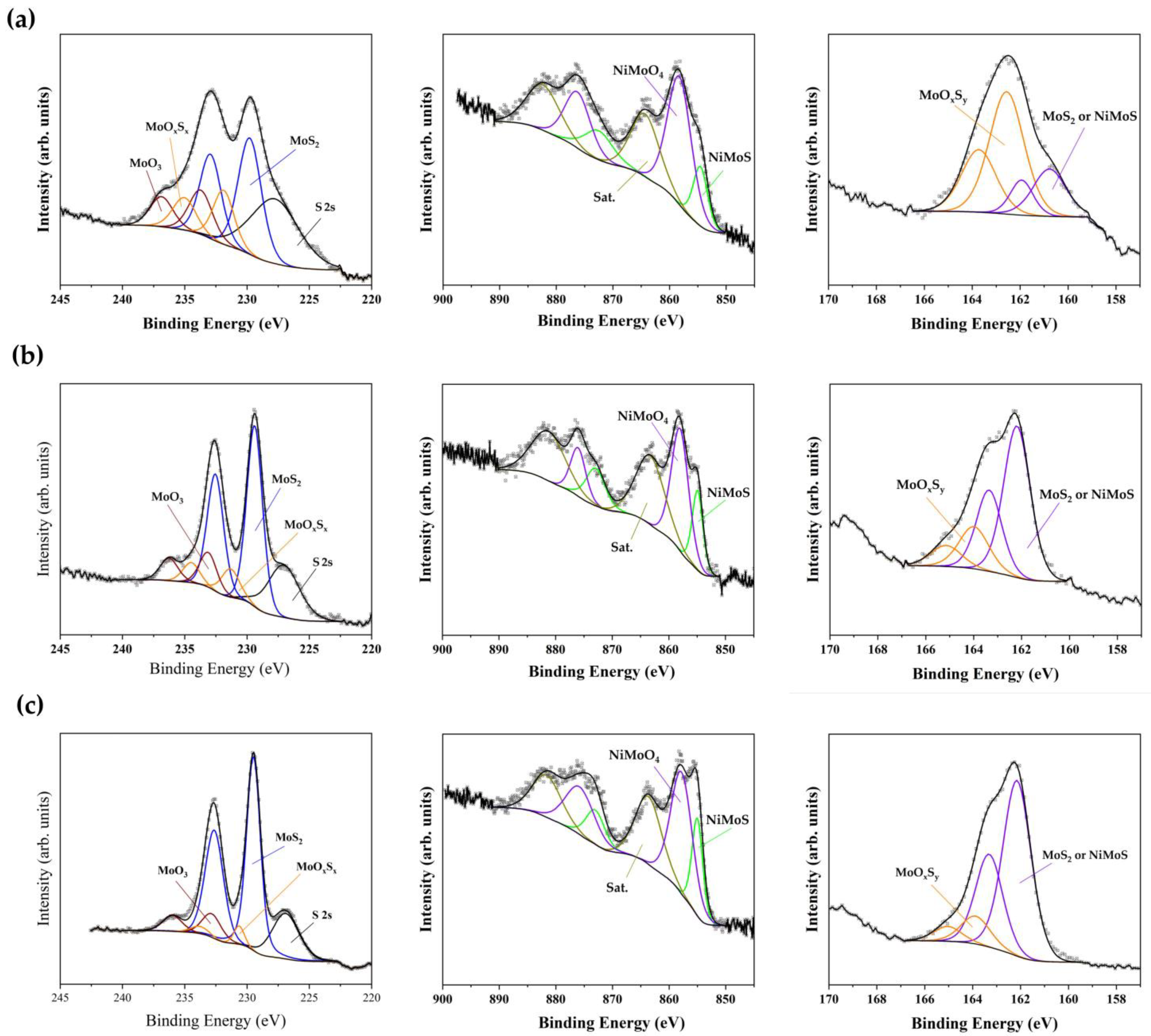
X-ray photoelectron spectroscopy (XPS) was used to investigate the surface chemical environment and oxidation states of the Zr-modified sulfided NiMo catalysts by the grafting method, using starch (A) and activated carbon (C) templates. The deconvoluted spectra corresponding to the Mo 3d, Ni 2p, S 2p, and Zr 3d regions, together with the quantitative distribution of surface species, are presented in Figure 4 and Figure S6 and summarized in Table 3. The Mo 3d XPS spectra reveal the coexistence of three molybdenum species corresponding to Mo4+ (MoS2), Mo5+ (MoOxSx), and Mo6+ (MoO3) [31,32]. The Mo4+ 3d5/2 component located at 228.6–229.3 eV is assigned to sulfided MoS2 species, whereas intermediate oxysulfides (MoOxSx) appear at 231.1–231.5 eV and residual MoO3 is observed between 232.7 and 233.1 eV. Quantitative analysis indicates that the surface sulfidation degree strongly depends on the presence of Zr and template selection. For the NiMo/Al2O3 reference catalyst, MoS2 represents 45% of total Mo species, while MoOxSγ and MoO3 account for 40% and 15%, respectively, indicating incomplete sulfidation and the persistence of oxidic Mo species [33]. After Zr incorporation using the activated carbon template, the fraction of MoS2 increases significantly to 75%, while MoOxSx and MoO3 decrease to 20% and 5%, respectively. While, the starch-templated catalyst exhibits intermediate values with 60% MoS2, 30% MoOxSx, and 10% MoO3.
The Ni 2p spectra further support these observations [32,34]. The Ni 2p3/2 signal attributed to the active NiMoS phase (854.1–854.7 eV) increases upon Zr incorporation. In the undoped catalyst, NiMoS accounts for 40% of Ni species, while β-NiMoO4 represents 60%. For NiMo/Al2O3-ZrO2(C) the NiMoS fraction rises to 70% and β-NiMoO4 decreases to 30%, whereas NiMo/Al2O3-ZrO2(A) shows 60% NiMoS and 40% β-NiMoO4. A shake-up satellite at 862.5 eV confirms the presence of Ni2+ species interacting with Mo sulfide slabs [35].
The S 2p region displays sulfide sulfur (S2−) associated with MoS2/NiMoS and oxysulfide sulfur (S22−) related to MoOxSγ [32,36]. Sulfide sulfur increases from 55% in NiMo/Al2O3 to 65% in NiMo/Al2O3-ZrO2(A) and 75% in NiMo/Al2O3-ZrO2(C). The Zr 3d spectra show Zr4+-O species at 182.2–182.3 eV and lattice Zr at 182.7–183.1 eV (see Figure S6) [32,37]. The carbon-templated catalyst contains a higher fraction of lattice Zr (45%) than the starch-templated sample (35%), suggesting stronger Zr incorporation into the alumina matrix through Al-O-Zr bonds, which can generate oxygen vacancies and weaken Mo-support interactions [38].
The degree of sulfidation index (DSI) was calculated to quantitatively compare the sulfidation efficiency of the catalysts, defined as the average fraction of sulfided species derived from the Mo 3d, Ni 2p, and S 2p regions (Figure 4). Table 3 summarizes the calculated values, which reveal a clear trend, with DSI values of 47.1% for NiMo/Al2O3, 62.8% for NiMo/Al2O3-ZrO2(A), and 73.9% for NiMo/Al2O3-ZrO2(C), establishing the following sulfidation order: NiMo/Al2O3-ZrO2(C) > NiMo/Al2O3-ZrO2(A) > NiMo/Al2O3. The higher sulfidation degree observed for the activated carbon–templated catalyst is consistent with the improved reducibility evidenced in the H2-TPR profiles, indicating that the incorporation of Zr into the support weakens the Mo–support interaction, thereby facilitating the reduction of Mo species and promoting the formation of highly dispersed Ni-Mo-S active phases. In contrast, the starch-templated catalyst retains a larger fraction of oxysulfide species, suggesting slightly stronger residual metal–support interactions that partially limit the sulfidation of Mo species.

2.5. High-Resolution Transmission Electron Microscopy (HRTEM)

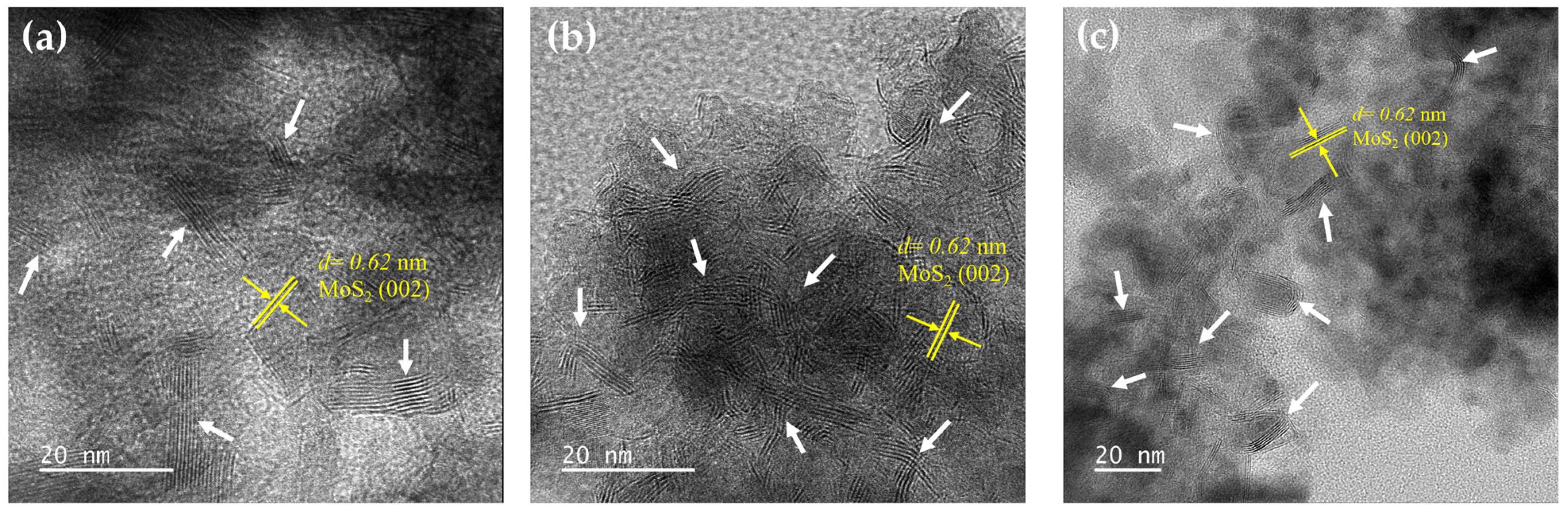
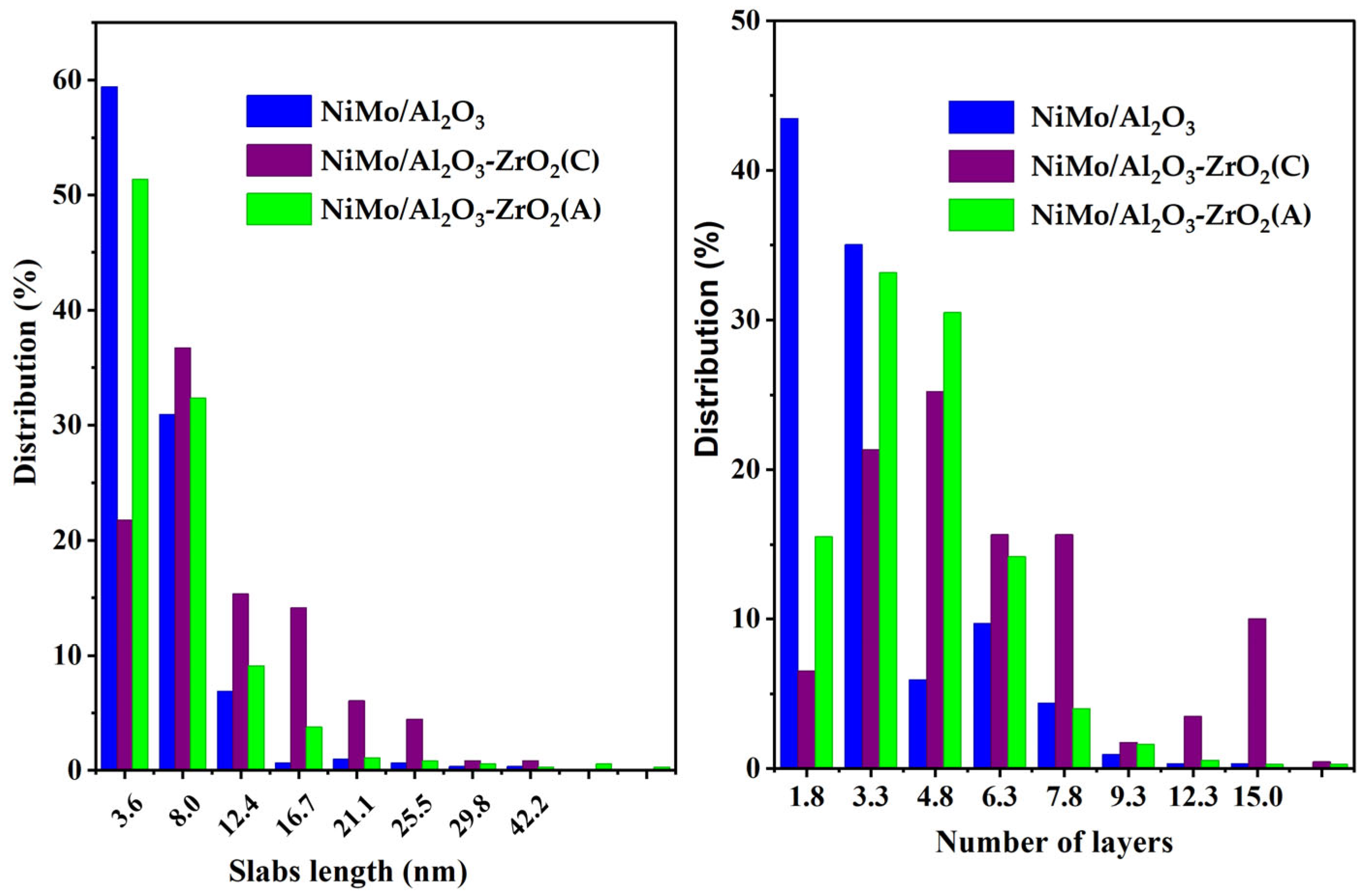
High-resolution transmission electron microscopy (HRTEM) was used to analyze the structural characteristics of the sulfided active phase, including the slab length (L), stacking number (N), dispersion (fMo), edge-to-corner Mo ratio (fe/fc), and the distribution of Ni species on MoS2 slabs and edges [39,40]. The representative micrographs and the statistical distributions of L and N are shown in Figure 5 and Figure 6, respectively. As observed in Figure 5, all catalysts exhibit the typical multilayered structure of MoS2 crystallites, characterized by well-defined lattice fringes with an interplanar spacing of approximately 0.62 nm, assigned to the (002) basal planes [41]. The crystallites are relatively well dispersed over the support surface; however, clear structural differences are observed depending on the presence of Zr and the type of template used during synthesis.
The corresponding quantitative results are summarized in Table 4 using Equations (5)–(8) (see Section 3.3.6). These distributions complement the average values and provide direct evidence of the differences in MoS2 dispersion and stacking among the catalysts. The NiMo/Al2O3 catalyst exhibits relatively short MoS2 slabs with an average length of 6.2 nm and a stacking number of 3.3 layers, leading to a dispersion value of fMo = 0.20. The edge-to-corner ratio (fe/fc = 8.2) indicates a moderate proportion of exposed Mo edge sites. In addition, the Ni/Mo slab ratio (0.61) is significantly lower than the Ni/Mo edge ratio (3.06), suggesting that Ni species are preferentially located at slab edges, although the overall density of accessible edge sites remains relatively limited.
The incorporation of Zr using starch as the template (NiMo/Al2O3-ZrO2(A)), a substantial structural modification of the MoS2 crystallites is observed. The slab length nearly doubles to 11.8 nm, while the high stacking number to 4.42 layers. Although the dispersion decreases to fMo = 0.11, the edge-to-corner ratio increases markedly to 16.9, indicating a significant enhancement in the relative abundance of Mo atoms located at edge positions [42]. The Ni/Mo edge ratio increases to 3.7, confirming a higher degree of Ni decoration at the edges of MoS2 slabs, which is particularly favorable for the formation of NiMoS active sites associated with BRIM-type catalytic centers [39]. The catalyst synthesized using activated carbon as template (NiMo/Al2O3-ZrO2(C)) exhibits slightly similar slab lengths (L = 12.1 nm) but a smaller stacking number (N = 2.8 layers) compared with the starch-templated catalyst. The dispersion remains relatively low (fMo = 0.10), while the edge-to-corner ratio reaches 17.4, indicating a high density of exposed edge sites [42]. A notable feature of this catalyst is the strong enrichment of Ni species at edge positions, as reflected by the Ni/Mo edge ratio of 6.37, which is approximately twice that observed for the undoped catalyst.
HRTEM analysis indicates that the incorporation of Zr significantly modifies the morphology of MoS2 crystallites, promoting longer slabs and a higher proportion of exposed edge sites. Accordingly, the fe/fc ratio increases from 8.2 for NiMo/Al2O3 to 17.0 and 17.4 for NiMo/Al2O3-ZrO2(A) and NiMo/Al2O3-ZrO2(C), respectively, evidencing a substantial increase in edge-site density [42]. These structural changes are consistent with the formation of Zr-O-Al linkages, which weaken Mo-support interactions and facilitate the growth of MoS2 slabs while enhancing the exposure of catalytically active edge sites [43]. This trend correlates well with the XPS results, where the degree of sulfidation index (DSI) increases from 47.1% for NiMo/Al2O3 to 62.8% for NiMo/Al2O3-ZrO2(A) and 73.9% for NiMo/Al2O3-ZrO2(C). The positive relationship between fe/fc and DSI indicates that catalysts with a higher fraction of Mo edge atoms favor the formation of highly sulfided Ni-Mo-S active phases, thereby increasing the density of accessible NiMoS sites responsible for hydrogenation and heteroatom removal during hydrotreating reactions [44].

2.6. Surface Acidity Characterization by Pyridine-FTIR

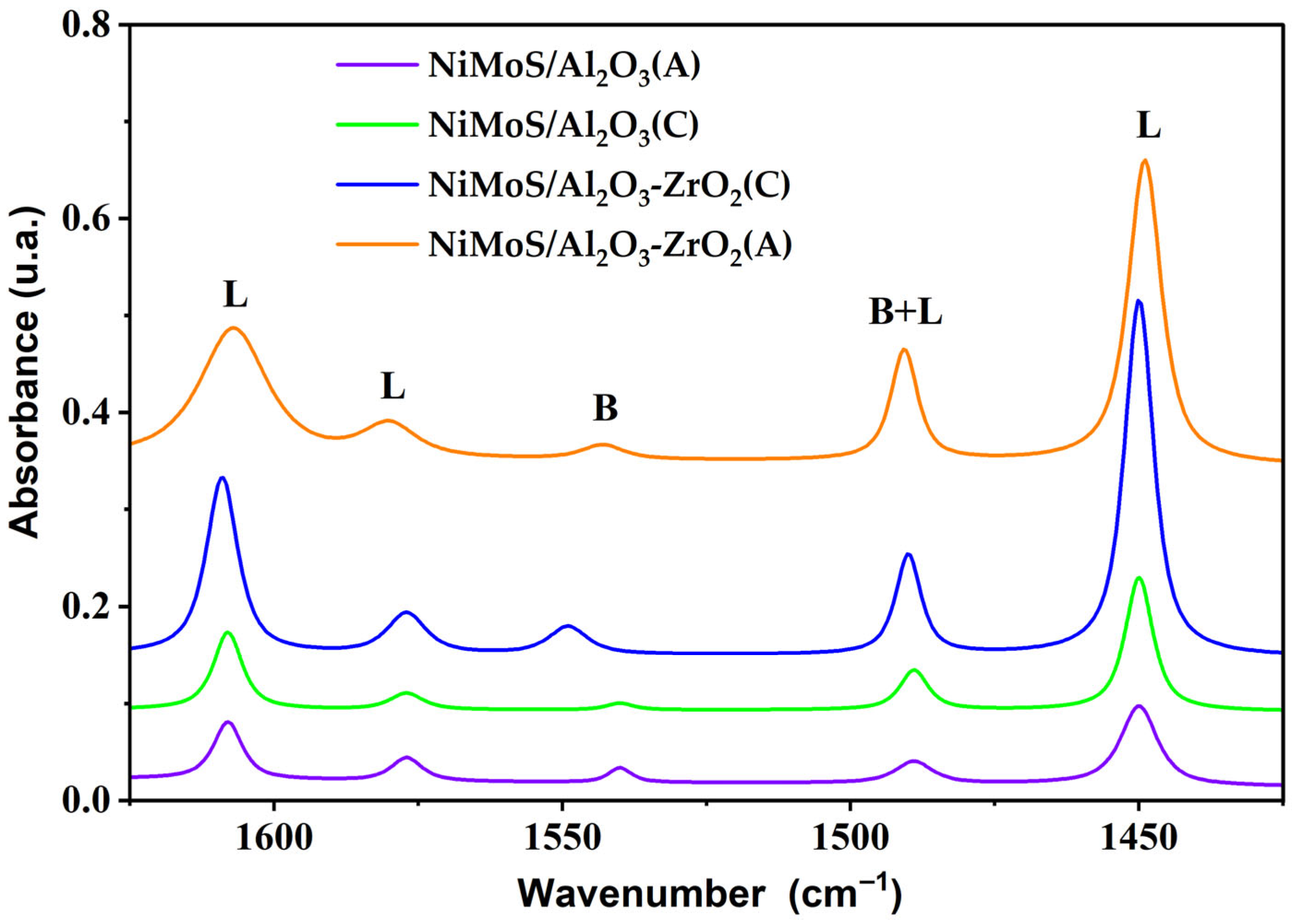
Surface acidity was evaluated by pyridine-FTIR spectroscopy at 300 °C (Figure 7). The spectra show characteristic bands in the 1700–1400 cm−1 region, associated with pyridine coordinated to Lewis and Brønsted acid sites. In particular, bands at 1450, 1577, and 1608 cm−1 correspond to pyridine coordinated to Lewis acid sites (L), whereas bands at 1540 cm−1 and 1489 cm−1 are attributed to pyridine interacting with Brønsted acid sites (B) and to the combined contribution of Lewis and Brønsted sites (B + L), respectively [45]. The relative intensity of these bands indicates that Lewis acidity predominates over Brønsted acidity for all catalysts.
Quantitative analysis of the adsorption bands (Table 5) reveals that both the template nature and the incorporation of ZrO2 significantly influence the acidity of the catalysts. The NiMo/Al2O3(A) catalyst shows 78.7 μmol g−1 of Lewis sites and 12.3 μmol g−1 of Brønsted sites, corresponding to a total acidity of 91 μmol g−1 and a total site density (TSD) of 1.02 μmol m−2; while the activated carbon template (NiMo/Al2O3(C)), the Lewis acidity increases to 106.8 μmol g−1 with a Brønsted acidity decreases slightly to 7.0 μmol g−1, resulting in a total acidity of 113.7 μmol g−1 and a higher TSD of 1.58 μmol m−2. This behavior suggests that the carbon template promotes the formation of a greater number of coordinatively unsaturated surface sites. A much stronger effect is observed after ZrO2 incorporation [9]. Hence, the NiMo/Al2O3-ZrO2(A) catalyst exhibits 225.3 μmol g−1 of Lewis sites and 17.8 μmol g−1 of Brønsted sites, corresponding to a total acidity of 243.1 μmol g−1 and TSD = 3.00 μmol m−2. An even higher acidity is obtained for NiMo/Al2O3-ZrO2(C), which shows 370.4 μmol g−1 of Lewis sites and 51.1 μmol g−1 of Brønsted sites, giving the highest total acidity of 421.4 μmol g−1 and TSD = 5.20 μmol m−2. Overall, the acidity follows the order NiMo/Al2O3(A) < NiMo/Al2O3(C) < NiMo/Al2O3-ZrO2(A) < NiMo/Al2O3-ZrO2(C), indicating that the combined effect of Zr incorporation and activated carbon templating markedly enhances the density of accessible Lewis acid sites. The predominance of Lewis acidity suggests a relevant role in the adsorption and activation of aromatic substrates, particularly in hydrogenation pathways [46].

2.7. Catalytic Performance

The catalysts were evaluated in the hydrodesulfurization (HDS) of 4,6-dimethyldibenzothiophene (4,6-DMDBT) and the hydrogenation (HYD) of naphthalene. As illustrated in the reaction scheme in Figure S7, the HDS of 4,6-DMDBT follows two main pathways [47]. In the direct desulfurization (DDS) route, the sulfur atom is directly removed to produce dimethylbiphenyl (DMBP). Alternatively, the hydrogenation (HYD) route begins with partial hydrogenation of an aromatic ring to form tetrahydro-DMDBT (TH-DMDBT), which can be further hydrogenated to hexahydro-DMDBT (HH-DMDBT). Subsequent hydrogenolysis and additional hydrogenation steps yield products such as methylcyclohexyltoluene (MCHT) and dimethylbicyclohexyl (DMBCH). In the naphthalene hydrogenation (Figure S8), it is first converted to tetralin as an intermediate, which is subsequently hydrogenated to the final products, cis- and trans-decalin [48]. Under the conditions employed in this study, the reaction network considered involved only those products showing yields higher than 5% throughout the reaction time. No indane derivatives were detected among the reaction products by GC–MS analysis.
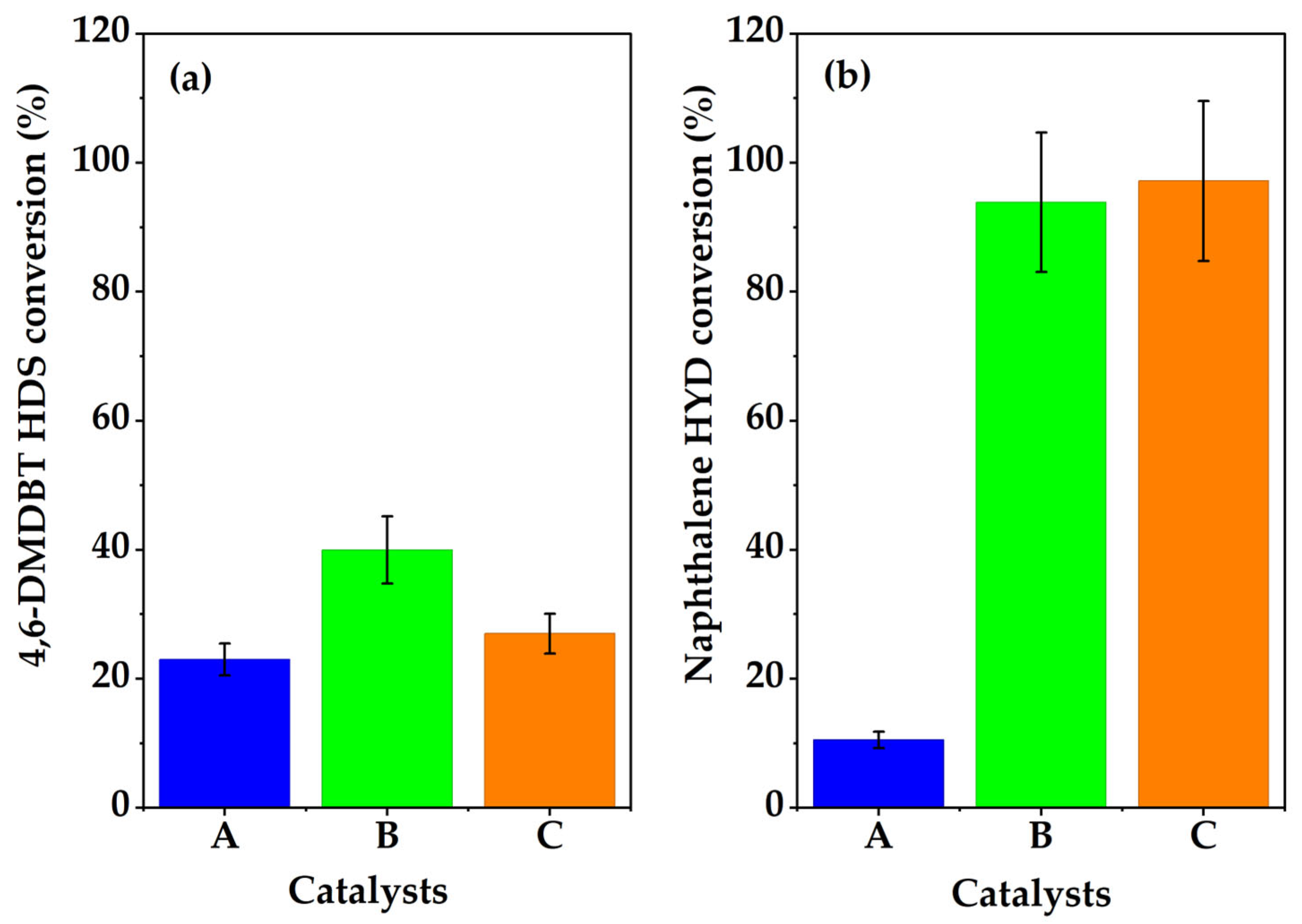
The catalytic conversion results with their corresponding standard deviation bars are shown in Figure 8, confirming the reproducibility of the activity trends observed for both 4,6-DMDBT hydrodesulfurization and naphthalene hydrogenation. The relatively low data dispersion supports the reliability of the catalytic differences discussed in this work and reinforces the superior performance of the Zr-modified catalysts. The catalytic results for 4,6-dimethyldibenzothiophene hydrodesulfurization and naphthalene hydrogenation are summarized in Table 6 and Table 7, respectively. The conversion values are reported as mean ± standard deviation, showing good reproducibility across replicate experiments [49].
In the 4,6-DMDBT HDS, the NiMo/Al2O3 catalyst exhibits a relatively low conversion of 23%, with the reaction mainly proceeding through the hydrogenation (HYD) pathway [50]. The main product is 3,3-dimethylcyclohexylbenzene (3,3DMCHB) with a selectivity of 41.3%, followed by tetrahydro-DMDBT (THDMDBT) (35.7%) and hexahydro-DMDBT (HHDMDBT) (10.5%). The direct desulfurization (DDS) product dimethylbiphenyl (DMBP) accounts for only 10.6%, while the cracking product (CRK) represents 1.9%. Consequently, the catalyst shows a high HYD/DDS ratio of 8.3, together with the lowest reaction rate (r = 6.02 × 10⁻⁹ mol g−1 s−1), rate constant (k = 1.21 × 10⁻⁵ s−1), and TOF (1.52 × 10⁻⁵ s−1), indicating that hydrogenation of the aromatic rings dominates over direct sulfur removal, but with limited overall efficiency.
The incorporation of Zr significantly enhances catalytic performance [10]. The NiMo/Al2O3-ZrO2(C) catalyst exhibits the highest conversion (40%) and the highest reaction rate (10.5 × 10⁻⁹ mol g−1 s−1), together with the highest rate constant (2.36 × 10⁻⁵ s−1) and TOF (4.69 × 10⁻⁵ s−1), confirming its superior HDS efficiency. In this case, the HYD pathway becomes even more dominant, as reflected by the high selectivity toward THDMDBT (77.6%), while the formation of HHDMDBT (8.4%), 3,3DMCHB (8.5%), and DMBP (4%) remains comparatively low. The contribution of cracking products (CRK) is minor (1.5%). As a result, this catalyst presents a markedly higher HYD/DDS ratio of 23.6, indicating a strong preference for hydrogenation-mediated desulfurization. Moreover, the NiMo/Al2O3-ZrO2(A) catalyst shows intermediate performance, reaching 27% conversion, with r = 7.07 × 10⁻⁹ mol g−1 s−1, k = 1.46 × 10⁻⁵ s−1, and TOF = 3.32 × 10⁻⁵ s−1. The selectivity distribution indicates a dominant hydrogenation pathway, with THDMDBT (67.8%) as the main intermediate, followed by 3,3DMCHB (23.4%), HHDMDBT (3.3%), and DMBP (3.6%), while CRK products account for 1.9%. Accordingly, this catalyst also exhibits a high HYD/DDS ratio of 26.3, confirming that the presence of Zr favors hydrogenation routes in the HDS of bulky sulfur compounds such as 4,6-DMDBT [51]. Overall, the HDS trend based on r, k, and TOF follows the order NiMo/Al2O3-ZrO2(C) > NiMo/Al2O3-ZrO2(A) > NiMo/Al2O3, indicating that the carbon-templated catalyst provides the most efficient active phase for this reaction.
The catalytic results presented in Table 7 clearly demonstrate the strong influence of zirconia incorporation on the hydrogenation performance of NiMo catalysts in the naphthalene HYD reaction. The reference NiMo/Al2O3 catalyst shows very low activity, reaching only 10.53% conversion, with an almost exclusive formation of tetralin (99.81%), while the formation of cis-decalin (0.09%) and trans-decalin (0.09%) is negligible. This indicates that the reaction mainly proceeds through the first hydrogenation step, with limited capability for deeper hydrogenation to decalins, as reflected by the lowest reaction rate (r = 2.97 × 10⁻⁷ mol g−1 s−1), rate constant (k = 0.515 × 10⁻⁵ s−1), and TOF (0.748 × 10⁻³ s−1).
On the contrary, the incorporation of zirconia drastically enhances catalytic performance. The NiMo/Al2O3-ZrO2(C) catalyst reaches 93.87% conversion, while NiMo/Al2O3-ZrO2(A) achieves 97.18%, accompanied by a pronounced increase in reaction rate, rate constant and TOF from 26.5 × 10⁻⁷ to 27.4 × 10⁻⁷ mol g−1 s−1, 12.9 × 10⁻⁵ s−1 to 16.5 × 10⁻⁵ s−1, and 11.9 × 10⁻³ s−1 to 12.9 × 10⁻³ s−1, respectively.
Although tetralin remains the dominant product, its selectivity decreases slightly to 96.80% for NiMo/Al2O3-ZrO2(C) and 95.03% for NiMo/Al2O3-ZrO2(A), while the formation of deeper hydrogenation products increases, with cis-decalin selectivities of 0.70% and 1.04% and trans-decalin selectivities of 2.49% and 3.93%, respectively. The greater formation of decalins indicates an enhanced hydrogenation capacity of the Zr-modified catalysts, consistent with the strong preference for hydrogenation pathways observed in the conversion of bulky sulfur compounds, where hydrogenation steps play a dominant role in the overall catalytic behavior [52]. In agreement with r, k, and TOF, the HYD performance follows the order NiMo/Al2O3-ZrO2(A) > NiMo/Al2O3-ZrO2(C) >> NiMo/Al2O3, indicating that the starch-templated catalyst provides slightly more efficient hydrogenation-active sites under the evaluated conditions.
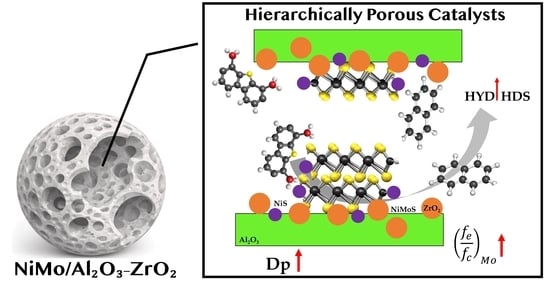
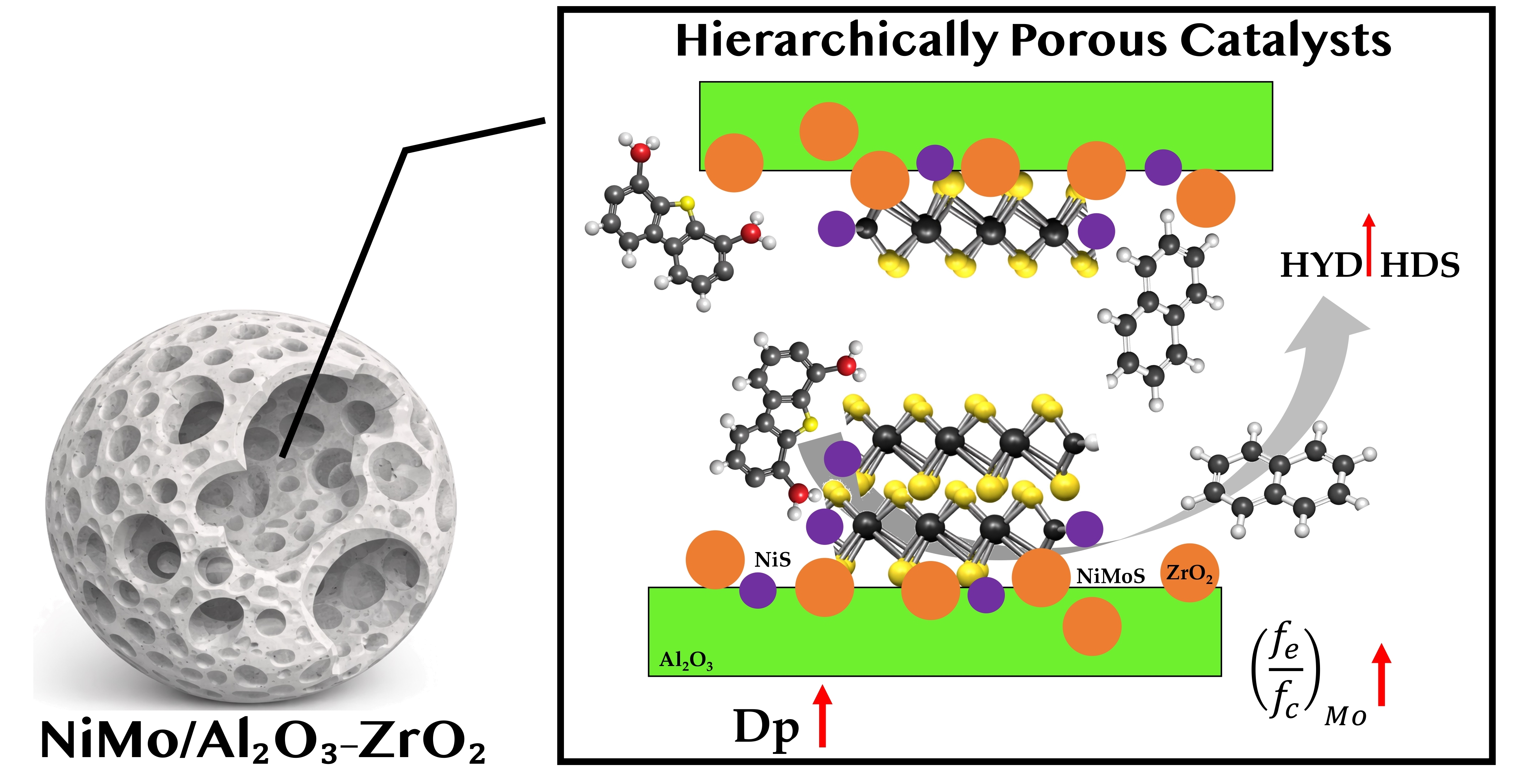
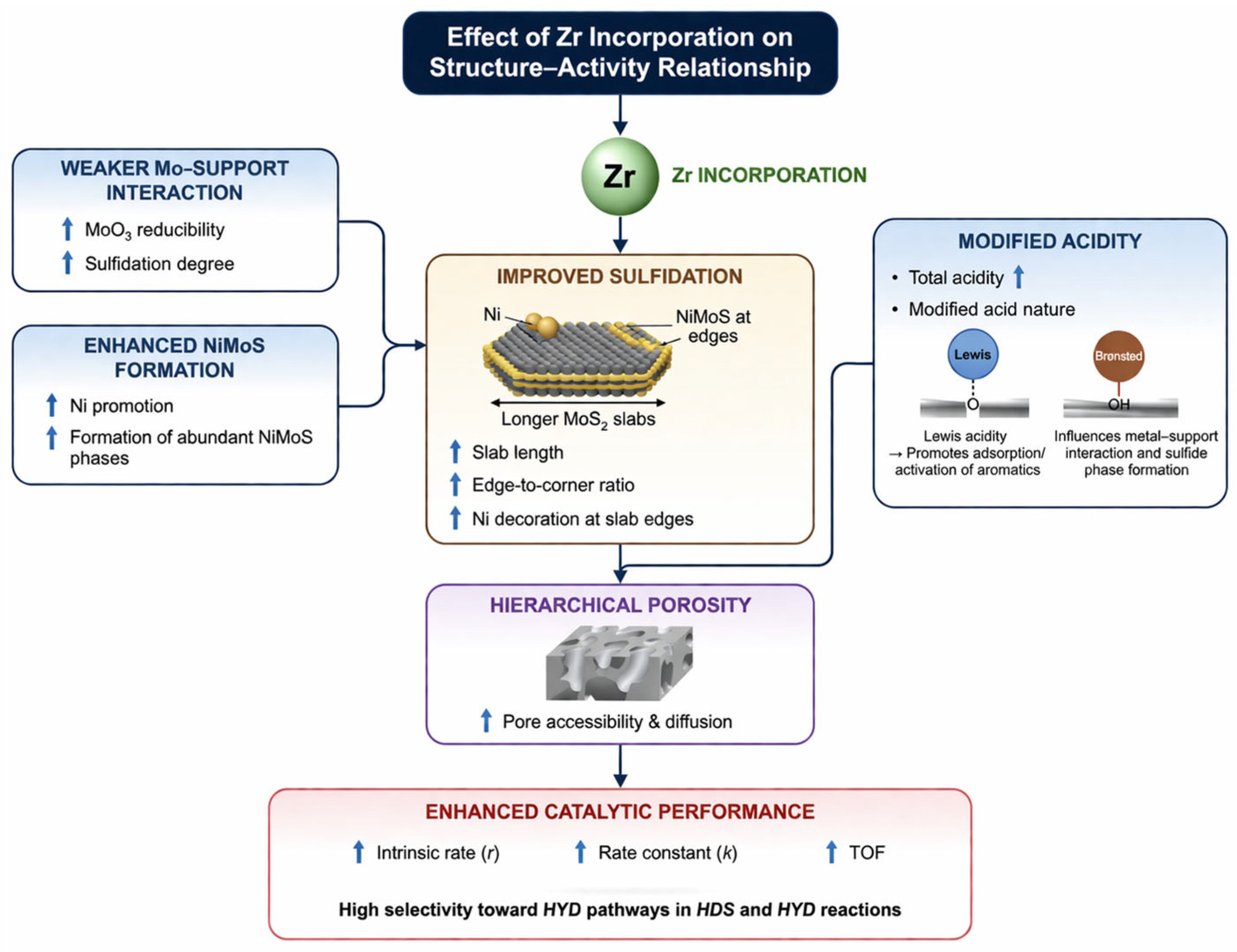
All catalysts maintain metal loadings close to the nominal composition, indicating that the catalytic differences are not due to variations in metal content but rather to structural and surface properties. Textural analysis shows that although NiMo/Al2O3 retains a relatively high SBET; whereas the Zr-modified catalysts exhibit hierarchical porosity and improved pore accessibility, particularly NiMo/Al2O3-ZrO2(C), which preserves a higher mesoporous volume and macroporosity, facilitating the diffusion of bulky molecules such as 4,6-DMDBT and naphthalene [42]. In parallel, H2-TPR results reveal that Zr incorporation weakens Mo-support interactions and improves reducibility, favoring the formation of active sulfiding phases during activation. This trend is confirmed by XPS, where the fraction of MoS2 species increases from 45% in NiMo/Al2O3 to 75% in NiMo/Al2O3-ZrO2(C) and the NiMoS phase increases from 40% to 70%, together with a higher degree of sulfidation index (DSI) rising from 47.1% to 73.9%. These surface changes directly translate into catalytic performance, as the Zr-modified catalysts show higher r, k, and TOF values in both reactions [10]. Moreover, HRTEM analysis reveals that Zr promotes longer MoS2 slabs and a substantial increase in the edge-to-corner ratio (fe/fc) from 8.2 to 17.4, together with a higher Ni decoration at slab edges, particularly for NiMo/Al2O3-ZrO2(C) where the Ni/Mo edge ratio reaches 6.5, generating a greater density of NiMoS active sites associated with hydrogenation functionality [42,44]. Finally, pyridine-FTIR results show a strong increase in acidity after Zr incorporation, mainly due to Lewis sites that can promote adsorption and activation of aromatic molecules [53]. Overall, the catalytic behavior can be rationalized through a combined structure–activity relationship induced by Zr incorporation. Zirconia weakens Mo–support interactions, enhances reducibility, and promotes the formation of highly sulfided MoS2/NiMoS phases. HRTEM results indicate increased slab length, edge-to-corner ratio, and Ni decoration at slab edges, generating a higher density of active sites. In addition to increasing the total acidity, Zr incorporation modified the nature of the acid sites, while Lewis acidity remained predominant in all catalysts. These Lewis acid sites may enhance the adsorption and activation of aromatic molecules through coordination interactions with their π-electron system, favoring subsequent hydrogenation [46]. At the same time, surface acidity may influence metal–support interactions during catalyst preparation and sulfidation, affecting the formation, dispersion, and stabilization of catalytically relevant MoS2/NiMoS phases [54]. Together with improved pore accessibility, these effects explain the substantial increase in r, k, and TOF, as well as the strong preference toward hydrogenation pathways observed in both HDS and HYD reactions. The interplay between Zr incorporation, improved sulfidation, enhanced NiMoS formation, modified acidity, and hierarchical porosity, and its impact on catalytic performance, is schematically summarized in Figure 9.

3. Materials and Methods

3.1. Synthesis of Supports

Hierarchical macro-mesoporous Al2O3 support was synthesized via a conventional sol–gel route, while Al2O3-ZrO2 was obtained by a post-synthesis grafting method [55]. For the preparation of Al2O3, an initial sol was formed by dissolving aluminum isopropoxide (≥98%, Sigma-Aldrich, St. Louis, MO, USA) and citric acid (≥99.5%, Sigma-Aldrich, St. Louis, MO, USA) in isopropyl alcohol (≥99.5%, Sigma-Aldrich, St. Louis, MO, USA), using a molar ratio of 0.08:0.008:2.5, followed by heating at 70 °C under vigorous stirring for 30 min [56]. This precursor solution was then combined with a second solution containing tetramethylammonium hydroxide (25 wt.% in H2O, Sigma-Aldrich, St. Louis, MO, USA) and hexadecyltrimethylammonium bromide (≥98%, Sigma-Aldrich, St. Louis, MO, USA), which acted as structure-directing agents, and the resulting mixture was stirred for an additional 1 h. Macroporosity was introduced by adding 20 wt.% of either activated carbon (Norit® PK 1–3, peat-derived, steam-activated, Cabot Corporation, Boston, MA, USA) or soluble potato starch (puriss. p.a., Sigma-Aldrich, St. Louis, MO, USA). The suspension pH was adjusted to 10 using NH4OH, yielding a gel that was aged for 48 h, filtered, dried at 110 °C for 12 h, and calcined at 600 °C for 6 h in air using a heating rate of 5 °C min−1 in ceramic crucibles, with a typical sample loading of 2 g per batch, to ensure complete removal of the organic templates.
Al2O3-ZrO2 support containing 11 wt.% ZrO2 was prepared by grafting method [57], suspending the preformed hierarchical Al2O3 in an anhydrous ethanol (≥99.5%, anhydrous, Sigma-Aldrich, St. Louis, MO, USA) solution of zirconium propoxide (70 wt.%, Sigma-Aldrich, St. Louis, MO, USA), followed by stirring for 2 h at room temperature in a rotary evaporator. After solvent removal, the solid was washed with anhydrous ethanol, air-dried, and subsequently calcined in air at 600 °C for 6 h using a heating rate of 5 °C min−1 in ceramic crucibles, with a typical sample loading of 2 g.

3.2. Supported NiMo Catalyst Precursors

The as-prepared supports were loaded with Ni and Mo by co-impregnated to excess pore volume at room temperature using aqueous solutions of ammonium heptamolybdate tetrahydrate (ACS reagent, 81.0–83.0% MoO3 basis, Merck Darmstadt, Germany) and nickel nitrate hexahydrate (purum p.a. crystallized, ≥97.0%, Merck Darmstadt, Germany) [27]. This impregnation process was conducted under continuous rotation in a rotary evaporator for 2 h. The molar ratio of Ni/(Ni + Mo) was 0.3, with a Mo content of 20 wt.%. After impregnation, the solid was dried at 105 °C for 12 h and subsequently calcined in air at 450 °C for 4 h.

3.3. Catalyst Characterization

3.3.1. Morphology and Elemental Composition and Mapping

The morphology and elemental analysis, and elemental mapping were determined using scanning electron microscopy coupled with energy-dispersive X-ray spectroscopy (SEM-EDS). The composition and morphology of the NiMo/Al2O3-ZrO2 catalysts were carried out on a TESCAN LYRA3 SEM microscope (TESCAN, Brno, Czech Republic) equipped with a field-emission gun (FEG)-type operating at 20 kV coupled to an EDS detector supplied by Oxford Instruments (Oxford, UK).

3.3.2. Nitrogen Physisorption (SBET, Vp and Dp)

The textural properties of the samples were evaluated by nitrogen adsorption–desorption measurements at 77 K using a Micromeritics ASAP analyzer (Micromeritics Instrument Corporation, Norcross, GA, USA). Prior to analysis, the materials were degassed to remove physisorbed species. The specific surface area was calculated according to the Brunauer–Emmett–Teller (BET) method, while the total pore volume was determined from the adsorption data at a relative pressure (P/P0) close to 0.98. The mesopore size distribution was derived from the desorption branch of the isotherms using the Barrett–Joyner–Halenda (BJH) model.

3.3.3. Mercury Intrusion Porosimetry (MIP)

Experiments were conducted using an automated Micromeritics AutoPore V apparatus (Micromeritics Instrument Corporation, Norcross, GA, USA). The acquisition of data was managed using the MicroActive AutoPore V9600 software package.

3.3.4. Pyridine-Adsorbed Fourier Transformed Infrared Spectroscopy

Pyridine adsorption FTIR measurements were performed using a Nicolet spectrometer (Thermo Fisher Scientific, Waltham, MA, USA) operated with OMNIC 8.1 software (Thermo Fisher Scientific, Waltham, MA, USA), collecting 256 scans with a spectral resolution of 4 cm−1. Self-supported wafers of the sulfiding catalyst (12.8 mg cm−2) were prepared and placed in the IR cell. The samples were first degassed at 350 °C for 2 h, then cooled to 300 °C and exposed to pyridine vapor (≥99.8%, anhydrous, Sigma-Aldrich, St. Louis, MO, USA; 1.5 mbar) for 15 min. Excess pyridine was removed under vacuum (2.5 × 10⁻⁵ mbar), and spectra were recorded at room temperature. Brønsted and Lewis acid sites were identified from bands at 1540 and 1450 cm−1, respectively [45]. The density of acid sites (TSD) was estimated by dividing the concentration of acid sites determined by pyridine-FTIR (μmol g−1) to the BET specific surface area of each catalyst (m2 g−1), and is reported in μmol m−2.

3.3.5. X-Ray Photoelectron Spectroscopy

Surface chemical composition and oxidation states were determined by XPS with a Surface chemical composition and oxidation states were analyzed by X-ray photoelectron spectroscopy using a hemispherical VG Thermo Alpha 110 analyzer (Thermo VG Scientific, East Grinstead, UK) operated under ultra-high vacuum conditions (~10−9 Torr). Spectra were collected using a non-monochromated Al Kα X-ray source (hν = 1486.6 eV) at an operating power of 300 W. Binding energy calibration was performed using the Al 2p and C 1s signals, fixed at 74.4 eV and 284.8 eV, respectively [32]. Spectral deconvolution was carried out using XPS-peak version 4.1 software (Chinese University of Hong Kong, Hong Kong, China), which includes the XPS-graph module (Chinese University of Hong Kong, Hong Kong, China) after background subtraction according to the Shirley method, employing mixed Gaussian–Lorentzian line shapes with variable proportions. The effective Ni content in the NiMoS phase and Mo content in the MoS2 phase were calculated using Equations (1) and (2), respectively.
C NiMoS = [ NiMoS ]   ×   C ( Ni ) T
C MoS 2 = [ MoS 2 ]   ×   C ( Mo ) T
where [NiMoS] and [MoS2] represent the relative contributions of each phase obtained from the deconvoluted XPS spectra, and C(Ni)T and C(Mo)T correspond to the total surface concentrations of Ni and Mo, respectively.
The Ni/Mo atomic ratio within the basal plane of the active phase (slab) was estimated using Equation (3), whereas the corresponding ratio at the edge sites of the active phase was calculated by Equation (4).
Ni Mo slab = C NiMoS C MoS 2
Ni Mo edge = Ni Mo slab Mo e + Mo c   ×   Mo T = Ni Mo slab f Mo
where Cx denotes the absolute concentration of Ni and Mo species present in the NiMoS and MoS2 phases, and fMo is the Mo dispersion obtained from HRTEM results using Equation (6).

3.3.6. High-Resolution Transmission Electron Microscopy (HRTEM)

The morphology of the (Ni)MoS2 crystallites was examined by high-resolution transmission electron microscopy (HRTEM) using a JEOL 2100F HRTEM (JEOL Ltd., Tokyo, Japan) at an accelerating voltage of 200 kV and equipped with a ONE VIEW CMOS camera (Gatan Inc., Pleasanton, CA, USA). For each catalyst, at least ten representative micrographs were acquired, and more than 200 individual crystallites were analyzed. MoS2 crystallites were identified as thread-like fringes with an interlayer spacing of 0.65 nm, corresponding to the (002) basal planes [41]. The average slab length (L) and stacking number (N) were measured using Gatan Digital Micrograph version 3.62.4986.0 software (Gatan Inc., Pleasanton, CA, USA). These parameters were subsequently used to estimate the edge-to-corner ratio and the dispersion of MoS2 crystallites according to Equation (5).
L ( or   N ) = i = 1 n ( x i M i ) i = 1 n ( x i )
where Mi denotes the slab length (Li) or the stacking number (Ni) of a MoS2 crystallite, and xi corresponds to the number of slabs or stacks within a given interval of length or layer number.
The average fraction of Mo atoms located on the edge surface of MoS2 crystallites (fMo) was used as an indicator of the active-phase dispersion; this coefficient was calculated using Equation (6), assuming ideal hexagonal MoS2 geometry [40].
f Mo   = Mo edge Mo total = i = 1 t ( 6 n i 6 ) i = 1 t ( 3 n i 2 3 n i + 1 )
Here, Moedge and Mototal, denote the number of Mo atoms at edge sites and the total Mo atoms in the crystallite, respectively; t represents the number of MoS2 layers, and ni corresponds to the number of Mo atoms per edge, as deduced from the average L using Equation (7). According to Li et al. [39], the edge-to-corner ratio of a MoS2 slab, (fe/fc)Mo, can be calculated using Equation (8).
n i   = L 6.4 +   0.5
f e f c Mo = Mo edge Mo corner = 10   × L 3.2 3 2

3.4. Catalytic Activity of Naphthalene Hydrogenation and 4,6-Dimethyldibenzothiophene Hydrodesulfurization for the NiMo/Al2O3-ZrO2(x) Catalysts

Prior to catalytic evaluation, oxide precursors were sieved to the 80–100 Tyler mesh fraction (average particle diameter of 0.165 mm) and activated by ex situ sulfidation in a continuous-flow stainless-steel reactor at 400 °C (10 °C min−1) under atmospheric pressure, using a hydrogen stream (50 cm3 min−1) saturated with 5 vol.% CS2/heptane for 4 h [58]. After activation, 100 mg of the sulfided catalysts were transferred under inert atmosphere to a high-pressure batch reactor (TGYF-C-100ML, KEDA Instruments Equipment, Zhengzhou, Henan, China), avoiding air exposure. For hydrodesulfurization experiments, the reactor was charged with 20 mL of hexadecane containing 300 ppm sulfur as 4,6-dimethyldibenzothiophene (4,6-DMDBT, 98%, Sigma-Aldrich), while hydrogenation tests employed 20 mL of a hexadecane–xylene solution with 5 vol.% naphthalene (N, 98%, Sigma-Aldrich). The reactor was purged with N2 and pressurized to 1.4 MPa, heated to 300 °C under isothermal conditions, and stirred at 1200 rpm. N2 was then released and H2 introduced to a final pressure of 4 MPa, defining the start of reaction. The selected reaction conditions were chosen to minimize both external mass transfer and internal diffusion limitations. In particular, the use of small catalyst particle sizes and high stirring rates favored operation under kinetically controlled conditions [59]. Aliquots were collected each hour, ensuring that the sum of the volume samples was less than 5% of the initial volume. Reaction products were analyzed by gas chromatography using a CG-2014 Shimadzu (Kyoto, Japan) chromatograph equipped with a flame ionization detector and a BP5 capillary column and further confirmed by GC–MS analysis using an Agilent 7890B gas chromatograph coupled to a 5977A mass selective detector (Santa Clara, CA, USA). Under the reaction conditions employed, bare supports exhibited negligible 4,6DMDBT or N conversion. All catalytic tests were performed at least in triplicate and the reported conversion values correspond to the mean ± standard deviation, with relative deviations below 15%.
Catalytic performance was evaluated in terms of the conversion of naphthalene and 4,6-dimethyldibenzothiophene after 360 min of reaction, as well as the corresponding product selectivity. Conversion (Xa) and selectivity (Sp) were calculated from the variation in reactant concentration at reaction time ([a]t) relative to the initial concentration ([a]0), as defined by Equations (9) and (10):
X a   =   a 0     a t a 0   ×   100
S p = p a 0 a t   ×   100
where a represents N and 4,6DMDBT, and p is the desired product.

Kinetic and TOF Calculations

To assess both catalytic activity and intrinsic efficiency, the reaction rate, pseudo-first-order rate constant, and turnover frequency were determined as follows using Equations (11)–(13):
Pseudo-first-order rate constant
k = ln ( 1 X ) t  
where X is the conversion and t is the reaction time (s), assuming pseudo-first-order kinetics.
Reaction rate
r = a 0 ( 1 e k t ) m c a t · t  
where a 0 is the initial amount of reactant (mol), k Pseudo-first-order rate constant, mcat is the catalyst mass (g), and t is the reaction time (s).
Turnover frequency
TOF = r · m c a t n M o   e d g e  
where r is the observed reaction rate and nMo edge is the estimated molar amount of Mo edge sites by HRTEM.

4. Conclusions

Zirconia modification and template-assisted synthesis strongly influence the physicochemical properties and catalytic performance of NiMo/Al2O3-ZrO2 catalysts. SEM–EDX confirmed homogeneous elemental distributions with compositions close to nominal values (Mo = 20 wt%, Ni = 5 wt%, Zr = 11 wt%) and stable Ni/(Ni + Mo) ratios between 0.29 and 0.31, indicating that catalytic differences arise mainly from structural effects rather than metal loading variations. N2 physisorption revealed a mixture of type II and IV(a) isotherms with H3 hysteresis loops, while the activated carbon-templated support exhibited H4 hysteresis, indicating mesoporosity together with microporosity. Surface area decreased after metal incorporation following Al2O3 (130 m2 g−1) > NiMo/Al2O3 (96 m2 g−1) > NiMo/Al2O3-ZrO2(A) ≈ NiMo/Al2O3-ZrO2(C) (81 m2 g−1), reflecting partial pore filling. Mesoporous volume followed NiMo/Al2O3-ZrO2(C) (0.335 cm3 g−1) > NiMo/Al2O3 (0.314 cm3 g−1) > NiMo/Al2O3-ZrO2(A) (0.283 cm3 g−1), while pore diameter decreased from 10.1 nm to 6.8 nm. Mercury intrusion porosimetry showed hierarchical porosity with macroporosity increasing from 68% to 72% for the carbon-templated catalyst. H2-TPR indicated improved reducibility following NiMo/Al2O3-ZrO2(C) > NiMo/Al2O3 > NiMo/Al2O3-ZrO2(A). XPS revealed that MoS2 increased from 45% to 75%, while MoOxSγ decreased from 40% to 20% and MoO3 from 15% to 5%. The NiMoS phase increased from 40% to 70%, while β-NiMoO4 decreased from 60% to 30%, with sulfide sulfur rising from 55% to 75% and the degree of sulfidation index increasing from 47.1% to 73.9%. HRTEM showed MoS2 slab lengths increasing from 6.2 nm to 11.8–12.1 nm, while the edge-to-corner ratio increased from 8.2 to 17–17.4, with a Ni/Mo edge ratio up to 6.5. Pyridine-FTIR revealed a strong acidity increase from 91 to 421.4 μmol g−1, following NiMo/Al2O3(A) < NiMo/Al2O3(C) < NiMo/Al2O3-ZrO2(A) < NiMo/Al2O3-ZrO2(C), mainly due to higher Lewis acidity (78.7 → 370.4 μmol g−1) and Brønsted acidity (12.3 → 51.1 μmol g−1). Catalytically, HDS activity followed NiMo/Al2O3-ZrO2(C) (40%) > NiMo/Al2O3-ZrO2(A) (27%) > NiMo/Al2O3 (23%), with activities of 10.5 × 10⁻⁹, 7.07 × 10⁻⁹, and 6.02 × 10⁻⁹ mol s−1 g−1, respectively. Naphthalene hydrogenation followed NiMo/Al2O3-ZrO2(A) (97.18%) > NiMo/Al2O3-ZrO2(C) (93.87%) >> NiMo/Al2O3 (10.53%), with activities increasing from 2.97 × 10⁻⁷ to 26.5 × 10⁻⁷ and 27.4 × 10⁻⁷ mol s−1 g−1. Importantly, the catalytic trends indicate that the templating strategy plays a selective role in defining reaction functionality. The activated carbon template favored the formation of a catalyst with higher sulfidation degree, stronger Ni enrichment at slab edges, and better pore accessibility, which translated into superior 4,6-DMDBT hydrodesulfurization performance. In contrast, the starch template promoted a catalyst with slightly higher hydrogenation efficiency in naphthalene conversion. These findings demonstrate that the combination of Zr incorporation and hierarchical pore design provides an effective strategy for tailoring NiMo-based catalysts toward specific hydrotreating functionalities.

Supplementary Materials

The following supporting information can be downloaded at: https://www.mdpi.com/article/10.3390/inorganics14040109/s1, Figure S1. Elemental mapping of the sulfured of the NiMo/Al2O3 catalyst; Figure S2. Elemental mapping of the sulfured of the NiMo/Al2O3-ZrO2(A) catalyst; Figure S3. Elemental mapping of the sulfured of the NiMo/Al2O3-ZrO2(C) catalyst; Figure S4. Pore size distribution of the as-synthesized catalysts determined by nitrogen physisorption; Figure S5. Pore size distribution of the as-synthesized catalysts determined by Mercury intrusion porosimetry; Figure S6. XPS spectra of sulfured catalysts in the Zr 3d region. (a) NiMo/Al2O3-ZrO2(A) and (b) NiMo/Al2O3-ZrO2(C); Figure S7. Reaction network for the hydrodesulfurization (HDS) of 4,6-dimethyldibenzothiophene; Figure S8. Reaction network for the hydrogenation (HYD) of naphthalene.

Author Contributions

Conceptualization, E.D.V., C.A.T.T. and E.P.P.; methodology, E.D.V., C.A.T.T. and E.P.P.; validation, E.D.V., C.A.T.T. and E.P.P.; formal analysis, E.D.V., C.A.T.T. and E.P.P.; investigation, E.D.V., C.A.T.T. and E.P.P.; resources, E.D.V., C.A.T.T. and E.P.P.; writing—original draft preparation, E.D.V., C.A.T.T. and E.P.P.; writing—review and editing, E.D.V., C.A.T.T. and E.P.P.; supervision, E.P.P.; project administration, C.A.T.T. and E.P.P.; funding acquisition, C.A.T.T. and E.P.P. All authors have read and agreed to the published version of the manuscript.

Funding

The research for this publication has been supported by CB859-CIS2024 Project.

Institutional Review Board Statement

Not applicable.

Informed Consent Statement

Not applicable.

Data Availability Statement

The original contributions presented in this study are included in the article/Supplementary Materials. Further inquiries can be directed to the corresponding author.

Acknowledgments

To Universidad del Atlántico for institutional support and thank Franklin Méndez and Raquel Checca for their expert technical assistance.

Conflicts of Interest

The authors declare no conflicts of interest.

References

  1. Ruble, I. The U.S. crude oil refining industry: Recent developments, upcoming challenges and prospects for exports. J. Econ. Asymmetries 2019, 20, e00132. [Google Scholar] [CrossRef]
  2. Pham, D.D.; Nguyen, T.M.; Ho, T.H.; Le, Q.V.; Nguyen, D.L.T. Advancing hydrodesulfurization in heavy Oil: Recent developments, challenges, and future prospects. Fuel 2024, 372, 132082. [Google Scholar] [CrossRef]
  3. Ministerio de Minas y Energía y Ministerio de de Ambiente y Desarrollo Sostenible, Ministerio de Minas y Energía; Ministerio de Ambiente y Desarrollo Sostenible. Resolución 40103 de 2021: Parámetros y Requisitos de Calidad del Combustible Diésel (ACPM), Gasolinas y Biocombustibles en Colombia; Ministerio de Minas y Energía y Ministerio de de ambiente y desarrollo sostenible, Ministerio de Minas y Energía: Bogotá, Colombia; Ministerio de Ambiente y Desarrollo Sostenible: Bogotá, Colombia, 2021. Available online: https://www.minambiente.gov.co/wp-content/uploads/2022/03/Resolucion-40103-2021-minminas.pdf (accessed on 8 March 2026).
  4. Rasrendra, C.B.; Maulidanti, E.G.; Darlismawantyani, S.E.; Nurdini, N.; Rustyawan, W.; Subagjo; Kadja, G.T. Bifunctional NiMo/HY-γ-Al2O3 catalysts for an effective production of ultra-low sulfur diesel. Case Stud. Chem. Environ. Eng. 2023, 8, 100427. [Google Scholar] [CrossRef]
  5. Qiao, X.; Wang, X.; Tan, C.; Ma, L.; Zhang, B.; Cao, J.; Wang, H. Precious Metals Catalyze the Saturated Hydrogenation of Polycyclic Aromatic Hydrocarbons in Coal Tar. Catalysts 2025, 15, 397. [Google Scholar] [CrossRef]
  6. Song, C. An overview of new approaches to deep desulfurization for ultra-clean gasoline, diesel fuel and jet fuel. Catal. Today 2003, 86, 211–263. [Google Scholar] [CrossRef]
  7. Kwao, S.; Vedachalam, S.; Dalai, A.K.; Adjaye, J. Review of current advances in hydrotreating catalyst support. J. Ind. Eng. Chem. 2024, 135, 1–16. [Google Scholar] [CrossRef]
  8. Gutiérrez, O.Y.; Valencia, D.; Fuentes, G.A.; Klimova, T. Mo and NiMo catalysts supported on SBA-15 modified by grafted ZrO2 species: Synthesis, characterization and evaluation in 4,6-dimethyldibenzothiophene hydrodesulfurization. J. Catal. 2007, 249, 140–153. [Google Scholar] [CrossRef]
  9. Zhang, D.; Duan, A.; Zhao, Z.; Wan, G.; Gao, Z.; Jiang, G.; Chi, K.; Chuang, K.H. Preparation, characterization and hydrotreating performances of ZrO2–Al2O3-supported NiMo catalysts. Catal. Today 2010, 149, 62–68. [Google Scholar] [CrossRef]
  10. Díaz-García, L.; Santes, V.; Viveros-García, T.; Sánchez-Trujillo, A.; Ramírez-Salgado, J.; Ornelas, C.; Rodríguez-Castellón, E. Electronic binding of sulfur sites into Al2O3-ZrO2 supports for NiMoS configuration and their application for Hydrodesulfurization. Catal. Today 2017, 282, 230–239. [Google Scholar] [CrossRef]
  11. Chavez-Esquivel, G.; García-Martínez, J.C.; De Los Reyes, J.A.; Suárez-Toriello, V.A.; Vera-Ramírez, M.A.; Huerta, L. The influence of Al2O3 content on Al2O3-ZrO2 composite-textural structural and morphological studies. Mater. Res. Express 2019, 6, 105201. [Google Scholar] [CrossRef]
  12. Ramírez, J.; Castillo-Villalón, P.; Gutiérrez-Alejandre, A.; Ayala, A.; Cruz-Garduza, O.; Ayala, M.; Quintana-Owen, P.; Romero-Galarza, A. Interaction of different molecules with the hydrogenation and desulfurization sites of NiMoS supported particles with different morphology. Catal. Today 2020, 353, 99–111. [Google Scholar] [CrossRef]
  13. Rana, M.S.; Maity, S.K.; Ancheyta, J.; Dhar, G.M.; Rao, T.S.R.P. MoCo(Ni)/ZrO2–SiO2 hydrotreating catalysts: Physico-chemical characterization and activities studies. Appl. Catal. Gen. 2004, 268, 89–97. [Google Scholar] [CrossRef]
  14. Sintarako, P.; Praserthdam, P.; Thammongkol, V.; Pokacharoenwatjana, B.; Yuanglamyai, W.; Inthiwong, C. The suppression of a basic nitrogen compound influence on hydrodesulfurization activity of dibenzothiophene in treated diesel over Al2O3 supported CoMo catalysts by ZrO2 as a secondary support. Catal. Commun. 2015, 62, 89–94. [Google Scholar] [CrossRef]
  15. Escobar, J.; Barrera, M.C.; Reyes, J.A.D.L.; Cortés, M.A.; Santes, V.; Gómez, E.; Pacheco, J.G. Effect of Mo and Co loading in HDS catalysts supported on solvo-thermally treated ZrO2–TiO2 mixed oxides. Catal. Today 2008, 133, 282–291. [Google Scholar] [CrossRef]
  16. Fan, F.; Han, S.; Li, Y.; Qi, L.; Kang, J.; Chen, Z.; Tian, C.; Wang, D.; Zhou, W. Regulating the microenvironments and the d-band center of hierarchical NiMoS/TS-1 catalyst by ZrO2 to enhance the hydrodesulfurization performance of dibenzothiophene. Sep. Purif. Technol. 2025, 354, 128702. [Google Scholar] [CrossRef]
  17. Hongloi, N.; Jahromi, H.; Rahman, T.; Adhikari, S. Pyrolysis oil upgrading via hydrotreatment to produce alternative fuel using ZrO2-supported catalysts and isopropanol as a solvent. J. Anal. Appl. Pyrolysis 2025, 192, 107293. [Google Scholar] [CrossRef]
  18. Hongkailers, S.; Phumpradit, S.; Phanpa, C.; Pattiya, A.; Ngamcharussrivichai, C.; Yokoi, T.; Hinchiranan, N. Bio-phenols production via hydrodeoxygenation of lignin-derived guaiacol and bio-oil over high water-tolerant NiMo/Al2O3-ZrO2 catalysts. Clean. Eng. Technol. 2024, 23, 100858. [Google Scholar] [CrossRef]
  19. Afanasiev, P. Mixed TiO2–ZrO2 support for hydrotreating, obtained by co-precipitation from Zr basic carbonate and Ti oxosulfate. Catal. Commun. 2008, 9, 734–739. [Google Scholar] [CrossRef]
  20. Garg, S.; Soni, K.; Prabhu, T.A.; Rao, K.S.R.; Dhar, G.M. Effect of ordered mesoporous Zr SBA-15 support on catalytic functionalities of hydrotreating catalysts 2. Variation of molybdenum and promoter loadings. Catal. Today 2016, 261, 128–136. [Google Scholar] [CrossRef]
  21. Badoga, S.; Sharma, R.V.; Dalai, A.K.; Adjaye, J. Hydrotreating of heavy gas oil on mesoporous zirconia supported NiMo catalyst with EDTA. Fuel 2014, 128, 30–38. [Google Scholar] [CrossRef]
  22. Liu, X.; Zhang, C.; Liu, T.; Jiang, Z.; Li, C. Effect of Zr on catalytic performance of unsupported Ni(Zr)Mo and Ni(Zr)W sulfide catalysts for quinoline hydrodenitrogenation. Appl. Catal. Gen. 2020, 604, 117744. [Google Scholar] [CrossRef]
  23. Puello-Polo, E.; Checca-Huaman, N.-R.; Toloza, C.A.T.; Santolalla-Vargas, C.E.; Díaz, Y.; Fals, J.; Mendoza, C.D.; Stand, N.; Márquez, E.; Arrieta, A.R.A.; et al. Dibenzothiophene Hydrodesulfurization Performance Over Hierarchically Porous NiMoS(Si,Zr)/Al2O3 Catalysts. Ind. Eng. Chem. Res. 2024, 63, 8553–8565. [Google Scholar] [CrossRef]
  24. Hasanudin, H.; Nakashima, M.; Asri, W.R.; Novia, N.; Hadiah, F.; Maryana, R.; Al Muttaqii, M.; Rinaldi, N. Effect of Aluminium Loading on SiO2/Al2O3-NiMo Catalysts Synthesized via KHP-template for Crude Palm Oil Hydrocracking. Bull. Chem. React. Eng. Catal. 2025, 20, 694–708. [Google Scholar] [CrossRef]
  25. Thommes, M.; Kaneko, K.; Neimark, A.V.; Olivier, J.P.; Rodriguez-Reinoso, F.; Rouquerol, J.; Sing, K.S.W. Physisorption of gases, with special reference to the evaluation of surface area and pore size distribution (IUPAC Technical Report). Pure Appl. Chem. 2015, 87, 1051–1069. [Google Scholar] [CrossRef]
  26. Ryoo, R.; Joo, S.H.; Jun, S. Synthesis of Highly Ordered Carbon Molecular Sieves via Template-Mediated Structural Transformation. J. Phys. Chem. B 1999, 103, 7743–7746. [Google Scholar] [CrossRef]
  27. Puello-Polo, E.; Reales, Y.P.; Marquez, E.; Larruded, D.G.; Arzuza, L.C.C.; Toloza, C.A.T. Effect of Gallium and Vanadium in NiMoV/Al2O3-Ga2O3 Catalysts on Indole Hydrodenitrogenation. Catal. Lett. 2021, 151, 2038–2055. [Google Scholar] [CrossRef]
  28. Stanislaus, K.A.-D.Y.A. Temperature programmed reduction of SiO2–Al2O3 supported Ni, Mo and NiMo catalysts prepared with EDTA. Thermochim. Acta 2011, 520, 67–74. [Google Scholar] [CrossRef]
  29. Brito, J.L.; Laine, J.; Pratt, K.C. Temperature-programmed reduction of Ni-Mo oxides. J. Mater. Sci. 1989, 24, 425–431. [Google Scholar] [CrossRef]
  30. Ramachandrarao, G.V.Y.B. Recent Advances in Hydrotreating/Hydrodesulfurization Catalysts: Part I: Nature of Active Phase and Support. In Catalysis for Clean Energy and Environmental Sustainability; Pant, K.K., Gupta, S.K., Ahmad, E., Eds.; Springer International Publishing: Cham, Switzerland, 2021; pp. 1–33. [Google Scholar] [CrossRef]
  31. Weber, T.; Muijsers, J.C.; Van Wolput, J.H.M.C.; Verhagen, C.P.J.; Niemantsverdriet, J.W. Basic Reaction Steps in the Sulfidation of Crystalline MoO3 to MoS2, As Studied by X-ray Photoelectron and Infrared Emission Spectroscopy. J. Phys. Chem. 1996, 100, 14144–14150. [Google Scholar] [CrossRef]
  32. Wagner, C.D. NIST X-Ray Photoelectron Spectroscopy (XPS) Database; NBS TN 1289; National Bureau of Standards: Gaithersburg, MD, USA, 1990. [CrossRef]
  33. Lamkaouane, H.; Ftouhi, H.; Richard-Plouet, M.; Gautier, N.; Stephant, N.; Zazoui, M.; Addou, M.; Cattin, L.; Bernède, J.C.; Mir, Y.; et al. Efficient and Facile Synthetic Route of MoO3:MoS2 Hybrid Thin Layer via Oxidative Reaction of MoS2 Nanoflakes. Nanomaterials 2022, 12, 3171. [Google Scholar] [CrossRef] [PubMed]
  34. Wang, X.; Ozkan, U.S. Characterization of Active Sites over Reduced Ni−Mo/Al2O3 Catalysts for Hydrogenation of Linear Aldehydes. J. Phys. Chem. B 2005, 109, 1882–1890. [Google Scholar] [CrossRef]
  35. López-Cruz, C.; Guzman, J.; Cao, G.; Martínez, C.; Corma, A. Modifying the catalytic properties of hydrotreating NiMo–S phases by changing the electrodonor capacity of the support. Catal. Today 2021, 382, 130–141. [Google Scholar] [CrossRef]
  36. Le, Z.; Afanasiev, P.; Li, D.; Long, X.; Vrinat, M. Solution synthesis of the unsupported Ni–W sulfide hydrotreating catalysts. Catal. Today 2008, 130, 24–31. [Google Scholar] [CrossRef]
  37. Lin, J.; Ma, C.; Wang, Q.; Xu, Y.; Ma, G.; Wang, J.; Wang, H.; Dong, C.; Zhang, C.; Ding, M. Enhanced low-temperature performance of CO2 methanation over mesoporous Ni/Al2O3-ZrO2 catalysts. Appl. Catal. B Environ. 2019, 243, 262–272. [Google Scholar] [CrossRef]
  38. García-Martínez, J.C.; Chavez-Esquivel, G.; Tavizón-Pozos, J.A.; De León, L.A.R.; Heredia, J.A.d.L.R. Al2O3 Concentration Effect on Deep Hydrodesulfurization of 4,6-Dimethyldibenzothiophene over NiWS/Al2O3-ZrO2 Catalysts. ACS Omega 2024, 9, 40738–40748. [Google Scholar] [CrossRef]
  39. Li, M.; Li, H.; Jiang, F.; Chu, Y.; Nie, H. The relation between morphology of (Co)MoS2 phases and selective hydrodesulfurization for CoMo catalysts. Catal. Today 2010, 149, 35–39. [Google Scholar] [CrossRef]
  40. Hensen, E.; Kooyman, P.; van der Meer, Y.; van der Kraan, A.; de Beer, V.; van Veen, J.; van Santen, R. The Relation between Morphology and Hydrotreating Activity for Supported MoS2 Particles. J. Catal. 2001, 199, 224–235. [Google Scholar] [CrossRef]
  41. Yang, C.; Hu, A.; Dai, Q.; Yang, Q.; Hou, R.; Liu, Z. Study on the Performance of Ni–MoS2 Catalysts with Different MoS2 Structures for Dibenzothiophene Hydrodesulfurization. ACS Omega 2023, 8, 41182–41193. [Google Scholar] [CrossRef]
  42. Cao, J.; Li, H.; Zhang, Y.; Wang, J.; Liu, Y.; Chen, Y.; Zhao, Z.; Sun, X.; Yang, S.; Zhang, L. Influence of the alumina crystal phase on the performance of CoMo/Al2O3 catalysts for the selective hydrodesulfurization of fluid catalytic cracking naphtha. Fuel 2021, 289, 119843. [Google Scholar] [CrossRef]
  43. Ren, Z.; Cao, Y.; Cai, R.; Dai, X.; Wei, Y.; Nie, F.; Yin, X.; Gan, Y.; Wu, B.; Ye, Y.; et al. Metal-Support interaction modulate the sulfidation and dispersion of MoS2 slabs on hierarchical KNiMo|ZnCrAl-Based multifunctional catalysts for selective conversion of syngas to higher alcohols. Chem. Eng. J. 2022, 440, 135831. [Google Scholar] [CrossRef]
  44. Fan, Y.; Shi, G.; Liu, H.; Bao, X. Morphology tuning of supported MoS2 slabs for selectivity enhancement of fluid catalytic cracking gasoline hydrodesulfurization catalysts. Appl. Catal. B Environ. 2009, 91, 73–82. [Google Scholar] [CrossRef]
  45. Barzetti, T.; Selli, E.; Moscotti, D.; Forni, L. Pyridine and ammonia as probes for FTIR analysis of solid acid catalysts. J. Chem. Soc. Faraday Trans. 1996, 92, 1401. [Google Scholar] [CrossRef]
  46. Wang, J.; Chen, H.; Li, Q. Influence of the Brönsted and Lewis Acid Sites in Platinum/Solid Acid Catalysts on the Hydrogenation of Benzene and Toluene. React. Kinet. Catal. Lett. 2000, 69, 277–284. [Google Scholar] [CrossRef]
  47. Landau, M.V.; Berger, D.; Herskowitz, M. Hydrodesulfurization of Methyl-Substituted Dibenzothiophenes:Fundamental Study of Routes to Deep Desulfurization. J. Catal. 1996, 159, 236–245. [Google Scholar] [CrossRef]
  48. Vargas-Villagrán, H.; Ramírez-Suárez, D.; Ramírez-Muñoz, G.; Calzada, L.A.; González-García, G.; Klimova, T.E. Tuning of activity and selectivity of Ni/(Al)SBA-15 catalysts in naphthalene hydrogenation. Catal. Today 2021, 360, 27–37. [Google Scholar] [CrossRef]
  49. James, M.; Jane, M. Statistics and Chemometrics for Analytical Chemistry, 6th ed.; Prentice Hall: Harlow, UK, 2010. [Google Scholar]
  50. Girgis, M.J.; Gates, B.C. Reactivities; reaction networks, and kinetics in high-pressure catalytic hydroprocessing. Ind. Eng. Chem. Res. 1991, 30, 2021–2058. [Google Scholar] [CrossRef]
  51. Brunet, S.; Lebeau, B.; Naboulsi, I.; Michelin, L.; Comparot, J.D.; Marichal, C.; Rigolet, S.; Bonne, M.; Blin, J.-L. Effect of Mesostructured Zirconia Support on the Activity and Selectivity of 4,6-Dimethydibenzothiophene Hydrodesulfurization. Catalysts 2020, 10, 1162. [Google Scholar] [CrossRef]
  52. Albertazzi, S.; Rodriguezcastellon, E.; Livi, M.; Jimenezlopez, A.; Vaccari, A. Hydrogenation and hydrogenolysis/ring-opening of naphthalene on Pd/Pt supported on zirconium-doped mesoporous silica catalysts. J. Catal. 2004, 228, 218–224. [Google Scholar] [CrossRef]
  53. Calin, C.; Leostean, C.; Trifoi, A.R.; Oprescu, E.-E.; Wiita, E.; Banu, I.; Doukeh, R. Mutual inhibition effect of sulfur compounds in the hydrodesulfurization of thiophene, 2-ethylthiophene and benzothiophene ternary mixture. Sci. Rep. 2021, 11, 19053. [Google Scholar] [CrossRef]
  54. Yang, C.; Dai, Q.; Hu, A.; Yuan, H.; Yang, Q. The Influence of Metal–Support Interactions on the Performance of Ni-MoS2/Al2O3 Catalysts for Dibenzothiophene Hydrodesulfurization. Processes 2023, 11, 3181. [Google Scholar] [CrossRef]
  55. Klimova, T.; Peña, L.; Lizama, L.; Salcedo, C.; Gutiérrez, O.Y. Modification of Activity and Selectivity of NiMo/SBA-15 HDS Catalysts by Grafting of Different Metal Oxides on the Support Surface. Ind. Eng. Chem. Res. 2009, 48, 1126–1133. [Google Scholar] [CrossRef]
  56. Blanco, K.L.A.; Baca, W.S.C.; Polo, E.P. Dual-Promoted Trimetallic CoMo-Ni/Al2O3-K2O Catalysts: Impact of K2O Doping on Guaiacol Hydrodeoxygenation Selectivity. Inorganics 2026, 14, 45. [Google Scholar] [CrossRef]
  57. Stein, M.H.L.Y.A. Comparative Studies of Grafting and Direct Syntheses of Inorganic−Organic Hybrid Mesoporous Materials. Chem. Mater. 1999, 11, 3285–3295. [Google Scholar] [CrossRef]
  58. Ayala, G.M.; Puello, P.E.; Quintana, P.; González-García, G.; Diaz, C. Comparison between alumina supported catalytic precursors and their application in thiophene hydrodesulfurization: (NH4)4[NiMo6O24H6]5H2O/γ-Al2O3 and NiMoOx/γ-Al2O3 conventional systems. RSC Adv. 2015, 5, 102652–102662. [Google Scholar] [CrossRef]
  59. García-Sánchez, J.T.; Valderrama-Zapata, R.; Acevedo-Córdoba, L.F.; Pérez-Martínez, D.; Rincón-Ortiz, S.; Baldovino-Medrano, V.G. Calculation of Mass Transfer Limitations for a Gas-Phase Reaction in an Isothermal Fixed Bed Reactor: Tutorial and Sensitivity Analysis. ACS Catal. 2023, 13, 6905–6918. [Google Scholar] [CrossRef]
Figure 1. SEM micrographics of the NiMo/Al2O3-ZrO2(x) catalysts. (a) NiMo/Al2O3, (b) NiMo/Al2O3-ZrO2(A) and (c) NiMo/Al2O3-ZrO2(C).
Inorganics 14 00109 g001
Figure 2. N2 adsorption–desorption isotherms for the support and the catalysts.
Inorganics 14 00109 g002
Figure 3. H2-TPR profiles of the oxidized porous catalysts.
Inorganics 14 00109 g003
Figure 4. XPS spectra of sulfured hierarchically porous catalysts in the Mo 3d, Ni 2p and S 2p regions. (a) NiMo/Al2O3, (b) NiMo/Al2O3-ZrO2(A) and (c) NiMo/Al2O3-ZrO2(C).
Inorganics 14 00109 g004
Figure 5. HRTEM micrography of the NiMo/Al2O3-ZrO2(x) catalysts. (a) NiMo/Al2O3, (b) NiMo/Al2O3-ZrO2(A) and (c) NiMo/Al2O3-ZrO2(C). White arrows indicate the presence of MoS2 slabs.
Inorganics 14 00109 g005
Figure 6. Statistical distribution of slab length (L) and stacking number (N) of MoS2 slabs on sulfured NiMo/Al2O3-ZrO2(x) catalysts.
Inorganics 14 00109 g006
Figure 7. Pyridine-adsorbed FTIR spectra of catalysts.
Inorganics 14 00109 g007
Figure 8. Conversion of 4,6-DMDBT (a) and naphthalene (b) over NiMo-based catalysts with standard deviation bars (n = 3). A. NiMo/Al2O3, B. NiMo/Al2O3-ZrO2(C), C. NiMo/Al2O3-ZrO2(A).
Inorganics 14 00109 g008
Figure 9. Schematic representation of the structure–activity relationship showing the effect of Zr incorporation on sulfidation, NiMoS formation, acidity, active site exposure, and catalytic performance. (↑) indicate an increase in the variable.
Inorganics 14 00109 g009
Table 1. EDAX of the MoNi/Al2O3-ZrO2(x) catalysts.
CatalystsMo (wt.%)Ni (wt.%)S (wt.%)Zr (wt.%)Ni/(Mo + Ni)
NiMo/Al2O321.85.918.8 0.31
NiMo/Al2O3-ZrO2(C)20.55.517.511.90.31
NiMo/Al2O3-ZrO2(A)22.05.41811.30.29
Nominal values: Mo = 20%, Ni = 5.2%, S = 17%, Zr = 11.5%, Ni/(Mo + Ni) = 0.3. Ni/(Mo + Ni) corresponds to the atomic ratio.
Table 2. Textural properties of the support and catalysts.
SolidSBET (m2/g)Sext (m2/g)Smicro (m2/g)Vmeso (cm3/g)Vmicro (cm3/g)VT (cm3/g)Dp (nm)%P
Al2O3130114160.5390.00790.5479.9
Al2O3(C)114101130.4460.02230.4686.2
Al2O3(A)9985140.7430.01380.7569.4
NiMo/Al2O3968880.3140.00330.31710.168
NiMo/Al2O3-ZrO2(A)817650.2830.00220.2856.868
NiMo/Al2O3-ZrO2(C)817560.3350.00270.33810.172
SBET: specific BET area, Sext: external area, Smicro: micropores area, Dp: pore diameter, Vmeso: mesoporous volume, Vmiro: microporous volume, VT: porous total volume; %P: %porosity by MIP.
Table 3. Atomic Compositions (at.%) of the different contributions in the Mo 3d, Ni 2p and S 2p regions from deconvoluted XPS Spectra for the sulfured catalysts.
CatalystsMo 3dNi 2pS 2pDSI
MoS2MoOxSxMoO3NiMoSβ-NiMoO4MoS2 or NiMoSMoOxSy
NiMo/Al2O31.030.910.340.630.941.060.8647.1
NiMo/Al2O3-ZrO2(A)2.021.010.340.820.553.982.1462.8
NiMo/Al2O3-ZrO2(C)1.330.350.090.870.372.000.6773.9
DSI: degree of sulfidation index.
Table 4. Active phase characteristics obtained from HRTEM results.
CatalystsL (nm)Nfe/fcfMo(Ni/Mo)slab(Ni/Mo)edge
NiMo/Al2O36.23.38.20.20.613.1
NiMo/Al2O3-ZrO2(A)11.84.4216.90.110.413.7
NiMo/Al2O3-ZrO2(C)12.12.817.40.10.656.5
L: Length, N: number of stacks, fMo: MoS2 dispersion, fe/fc: ratio of Mo at the edges and corners of a MoS2 crystal; (Ni/Mo)slab and (Ni/Mo)edge Equations (1)–(4).
Table 5. Quantification of Brønsted and Lewis acid sites determined by FTIR pyridine adsorptions of the sulfiding catalysts.
CatalystsAcid Sites Concentration (μmol/g)TSD (μmol/m2)
Lewis Sites (1)Brønsted Sites (2)Total
NiMo/Al2O3(A)78.712.3911.02
NiMo/Al2O3(C)106.87.0113.71.58
NiMo/Al2O3-ZrO2(A)225.317.8243.13.00
NiMo/Al2O3-ZrO2(C)370.451.1421.45.20
(1) Lewis acid sites at 1450 cm−1. (2) B: Brønsted acid sites at 1540 cm−1, TSD: total site density.
Table 6. Catalytic performance and selectivity on 4,6 MDBT HDS reaction of catalysts.
CatalystConversion (%)HDS Selectivity (%) *HYD/DDSr
(mol/g·s) × 109
k
(s−1) × 105
TOF
(s−1) × 105
THDMDBTHHDMDBT3,3DMCHBDMBPCRK
NiMo/Al2O323 ± 2.535.710.541.310.61.98.36.021.211.52
NiMo/Al2O3-ZrO2(C)40 ± 5.277.68.48.541.523.610.52.364.69
NiMo/Al2O3-ZrO2(A)27 ± 3.167.83.323.43.61.926.37.071.463.32
* Selectivity at 6 h of reaction; r: reaction rate; k: pseudo-first-order rate constant; TOF: turnover frequency.
Table 7. Catalytic performance and selectivity on naphthalene HYD reaction of catalysts.
CatalystConversion (%)HYD Selectivity (%)r
(mol/g·s) × 107
k
(s−1) × 105
TOF
(s−1) × 103
Tcis Dtrans D
NiMo/Al2O310.53 ± 1.3099.810.090.092.970.5150.748
NiMo/Al2O3-ZrO2(C)93.87 ± 10.896.800.702.4926.512.911.9
NiMo/Al2O3-ZrO2(A)97.18 ± 12.495.031.043.9327.416.512.9
T: tetralin, cis D: cis decalin, trans D: trans decalin; r: reaction rate; k: pseudo-first-order rate constant; TOF: turnover frequency.
Disclaimer/Publisher’s Note: The statements, opinions and data contained in all publications are solely those of the individual author(s) and contributor(s) and not of MDPI and/or the editor(s). MDPI and/or the editor(s) disclaim responsibility for any injury to people or property resulting from any ideas, methods, instructions or products referred to in the content.