1. Introduction
Electrochemical sensing of oxyanions has received sustained attention over the past decade, driven by the need for rapid, low-cost, and in situ analytical tools across environmental monitoring, industrial process control, and biomedical and agricultural applications [
1,
2,
3,
4]. Oxyanions such as nitrate, nitrite, phosphate, sulphate, arsenate, and perchlorate play critical roles in natural and engineered systems, yet their reliable quantification remains analytically challenging due to strong speciation effects, matrix dependence, and the absence of intrinsic spectroscopic signatures [
5,
6,
7]. Electrochemical methods are therefore attractive, offering sensitivity, portability, and compatibility with complex aqueous environments.
At the same time, the electrochemical oxyanion-sensing literature has expanded rapidly, encompassing direct faradaic detection, surface-modified and electrocatalytic electrodes, accumulation- and stripping-based approaches, and enzyme- or mediator-assisted architectures. Numerous studies report impressive figures of merit, including low detection limits, high sensitivities, and apparent selectivity against common interferents [
8,
9,
10]. However, the relationship between these reported performance metrics and the underlying electrochemical signal-generation mechanisms is not always examined systematically. These performance metrics are often obtained under narrowly defined laboratory conditions and interpreted as evidence of analyte-specific detection without systematic examination of how the underlying electrochemical signals are generated, stabilised, and validated [
1,
8].
Existing reviews and monographs on electroanalytical chemistry, ion-selective electrodes, and chemical sensors provide comprehensive treatments of electrochemical principles, materials, and transduction mechanisms [
3,
4,
11,
12,
13]. More recent reviews have surveyed specific sensor classes or application domains, often emphasising material innovation and numerical optimisation [
2,
10]. What remains comparatively underdeveloped is a cross-cutting, measurement-centred analysis of how electrochemical oxyanion sensors define their measurand, establish selectivity, and justify quantitative claims in the presence of interfacial complexity.
Accordingly, this review does not seek to rank electrochemical oxyanion sensors by numerical performance or to identify optimal materials or device architectures. Instead, performance metrics such as sensitivity, detection limits, and selectivity are considered only insofar as they illuminate how electrochemical signals are generated, stabilised, and interpreted under specific conditions. The emphasis is therefore placed on measurement interpretability and transferability rather than device optimisation or comparative benchmarking. Although the specific chemical behaviour of individual oxyanions varies (e.g., nitrate reduction pathways, phosphate adsorption equilibria, or chromate redox chemistry), the evidentiary requirements for analytical attribution remain governed primarily by the signal-generation mechanism and measurement configuration. While several electroanalytical considerations discussed in this review are broadly applicable to electrochemical sensing in general, oxyanions provide a particularly instructive analytical class because their detection frequently involves strong speciation equilibria, adsorption phenomena, and proton-coupled electron-transfer processes that complicate signal attribution and analytical translation.
Within this scope, the present review critically examines electrochemical oxyanion sensing through the lens of signal attribution and analytical validity rather than device architecture alone. Focusing primarily on literature from the past 5–10 years, we analyse recurring sensor archetypes and evaluate how performance claims relate to interfacial chemistry, surface history, calibration stability, and matrix dependence, while selectively drawing on earlier foundational studies where necessary to establish core electrochemical and metrological principles that continue to underpin contemporary sensor design and interpretation. Rather than cataloguing materials or configurations, the review identifies shared interpretive pitfalls and design constraints that limit the transferability of reported sensors beyond controlled laboratory conditions.
To provide context,
Table 1 summarises representative oxyanions commonly targeted in electrochemical sensing studies, together with typical sample matrices and application drivers. This framing clarifies the chemical diversity encompassed by the term “oxyanions” while allowing the subsequent analysis to remain general and mechanism-agnostic. By synthesising insights across sensing strategies, this review aims to distinguish demonstrations of electrochemical feasibility from evidence of robust analytical determination, and to articulate the conditions under which electrochemical oxyanion sensors can progress toward reliable, application-relevant tools.
Electrochemical detection strategies have been reported for a wide range of oxyanions across environmental and industrial contexts. For example, nitrate and nitrite have been widely studied due to their importance in agricultural runoff and drinking water monitoring, often using catalytic metal electrodes or modified carbon surfaces [
14,
15]. Phosphate detection has been explored using enzymatic and electrocatalytic approaches due to its relevance to eutrophication monitoring [
16,
17]. Similarly, arsenate and chromate sensing have been investigated in the context of toxic oxyanion species in contaminated groundwater [
18,
19], while perchlorate and sulphate detection have been addressed using adsorption-mediated or indirect electrochemical strategies [
20,
21]. Together, these studies illustrate the chemical diversity encompassed by electrochemical oxyanion sensing and how different oxyanions can generate electrochemical signals through distinct mechanisms. In this review, such systems serve as reference cases for discussing how signal-generation archetypes influence analytical signal attribution, speciation effects, interfacial reactivity, and, ultimately, the reliability of electrochemical measurements.
Because these electrochemical responses arise from complex interfacial processes that depend on solution chemistry, surface state, and reaction pathways, performance characteristics observed under simplified laboratory conditions may not always translate directly to complex real sample matrices. These considerations motivate the measurement-centred perspective adopted throughout this review and highlight the need to examine how electrochemical experiments define the measurand and the conditions under which analytical claims can be interpreted reliably.
To evaluate how electrochemical oxyanion sensors establish and justify analytical claims across this chemically diverse group, it is first necessary to clarify how electrochemical measurements define and constrain the measurand.
Section 2, therefore, outlines the electroanalytical concepts most relevant to signal attribution, selectivity, and calibration in oxyanion sensing, with emphasis on interfacial processes rather than sensor architectures.
2. Electrochemical Meaning, Measurands, and Analytical Assumptions
Electrochemical sensing of oxyanions is commonly discussed in terms of device performance and analytical figures of merit. Yet the interpretability of these metrics depends fundamentally on what electrochemical experiments actually measure and how the measured response relates to solution chemistry. In electroanalysis, the observable is an electrical response generated at an electrode interface under defined potential and transport conditions, not a direct readout of bulk composition [
11,
13,
22,
23]. For oxyanions, this distinction is particularly important because pH-dependent speciation, competitive adsorption, and electrode-mediated chemical transformations can alter both the identity and distribution of electroactive species at the interface [
11,
13,
24]. As a result, apparent sensing performance may reflect the behaviour of a specific measurement configuration under constrained conditions rather than intrinsic analyte selectivity. Although the influence of factors such as pH, matrix composition, and electrode surface state is well recognised in electroanalysis, their quantitative impact on the measurand is often not explicitly evaluated in reported sensing studies. Consequently, analytical figures of merit may describe the stability of a particular experimental configuration rather than the intrinsic selectivity of the sensing system. As summarised in
Table 1, electrochemical sensing studies target a chemically diverse range of oxyanions across multiple matrices and analytical motivations, underscoring the breadth of analytical contexts in which interpretability of measurements becomes critical.
The electrochemical principles discussed in this section are grounded in well-established concepts of electrode kinetics, adsorption phenomena, and interfacial electron transfer, extensively described in the electroanalytical chemistry literature and foundational texts [
11,
13,
22,
23]. Because these principles underpin a wide range of electrochemical sensing strategies, the same foundational sources are cited where the corresponding concepts are introduced, providing the theoretical basis for interpreting electrochemical signals across diverse sensing systems.
This section establishes a measurement-centred framework for interpreting electrochemical oxyanion sensing claims. The terminology adopted here is consistent with formal metrological definitions, particularly those provided in the International Vocabulary of Metrology (VIM), in which the measurand, influence quantities, and measurement conditions define how a reported signal should be interpreted. Rather than treating electrode processes, solution chemistry, and calibration behaviour as secondary implementation details, these elements are positioned as defining components of the measurand itself. Clarifying this point is essential for the critical evaluation of reported sensors because many performance claims rely on assumptions about interfacial chemistry and stability that are rarely made explicit [
13,
22,
24].
2.1. What Is Measured in Electrochemical Oxyanion Sensing
Electrochemical measurements report the outcome of interfacial electron-transfer and coupled transport processes occurring at an electrode surface under an applied potential or current programme. The primary observable, whether potential, current, charge, or impedance, reflects the kinetics and thermodynamics of these interfacial processes together with mass transport and local solution composition [
11,
13,
23]. Importantly, this observable does not correspond directly to the concentration of a specific species in the bulk solution [
25]. For oxyanion sensing, the electroactive species at the electrode may differ from the dominant form present in the bulk, and the measured signal may arise from reaction pathways that do not uniquely involve the target analyte.
To clarify how electrochemical signals relate to the analytical quantity of interest, the measurand can be usefully separated into three interrelated levels. The first is bulk composition, referring to the concentrations and chemical forms present in the sample prior to contact with the electrode. The second is interfacial composition, defined as the species that reach and remain accessible at the electrode surface under local pH, ionic strength, and adsorption conditions. The third is the electrochemically accessible reaction manifold, comprising the set of electron-transfer and coupled chemical reactions that are enabled when the electrode perturbs the system via applied potential, local pH shifts, or catalytic surface chemistry [
11,
13,
22]. In much of the oxyanion sensor literature, these three levels are implicitly assumed to align. In practice, such alignment is often absent.
This misalignment arises because electrochemical measurements can actively redefine the chemistry they seek to probe. Applied potentials may induce chemical transformation of oxyanions, generate reactive intermediates, or alter local proton activity, such that the measured response reflects a coupled reaction network rather than a single species concentration [
11,
13]. Preconcentration, adsorption, and surface-mediated catalysis further amplify this effect, rendering the measurand method-defined rather than species-defined and method-dependent on surface state, transport regime, and measurement history [
13,
22,
24]. These behaviours are not exceptional; they are expected features of electroanalysis and must be explicitly acknowledged when interpreting oxyanion-sensing claims.
Speciation and proton-coupled equilibria play a central role in this context. Many oxyanions exist in multiple protonation states, and changes in pH or in the supporting electrolyte can shift both bulk speciation and interfacial structure, thereby modifying adsorption, mass transport, and reaction kinetics [
11,
23]. As a consequence, calibration curves may appear linear within narrow experimental windows while remaining contingent on specific chemical conditions that are not representative of real samples. In such cases, calibration reflects the behaviour of an interfacial process under defined constraints rather than a general relationship between bulk analyte concentration and signal [
13,
22].
Selectivity claims must be interpreted through the same lens. Electrochemical discrimination can arise from differences in redox thermodynamics, electron-transfer kinetics, adsorption behaviour, or transport, but none of these mechanisms guarantees chemical specificity in complex matrices [
11,
13]. Many oxyanions share overlapping potential windows, and matrices frequently contain species that are more readily electroactive than the target analyte. Even when the target oxyanion participates in the measured reaction, the signal may represent an aggregate of pathways, intermediates, or transformation products rather than the parent ion itself [
13,
24]. This provides a mechanistic basis for the common observation that sensor performance degrades substantially when moving from simplified electrolytes to real samples.
Although this review does not focus on potentiometric ion-selective electrodes (ISEs), insights from the ISE literature reinforce these principles. The classical distinction between activity and concentration illustrates how matrix-dependent variables, such as ionic strength and interfering ions, alter the relationship between the signal and the intended measurand [
3,
4,
26]. The broader implication for electrochemical oxyanion sensing is that numerical performance metrics are not portable descriptors of sensing capability unless measurands and boundary conditions are clearly defined and validated [
3,
27].
Taken together, these considerations motivate a practical interpretive rule for this review. A reported electrochemical response should first be interpreted as evidence of a specific interfacial process occurring under the stated conditions, and only subsequently as evidence of selective oxyanion determination. Demonstrating the latter requires explicit definition of the measurand, linkage of the electroactive species to the target oxyanion under realistic conditions, and evidence that the signal remains interpretable across expected variations in pH, matrix composition, and surface state [
11,
13,
22,
24].
2.2. Electrode Processes That Enable Oxyanion Detection
Electrochemical detection of oxyanions relies on coupling electron transfer with mass transport and local chemical equilibria at the electrode interface. Unlike spectroscopic or separation-based techniques, the electrode is not a passive probe. It actively defines which chemical processes are accessible by imposing a potential gradient, altering local concentrations, and frequently catalysing transformations that do not occur in bulk solution [
11,
13,
23]. Consequently, electrochemical signals associated with oxyanion sensing reflect the behaviour of an interfacial reaction network rather than the direct presence of a single solution-phase species.
Detection is often framed as direct faradaic reduction or oxidation of the target oxyanion. In practice, such processes are commonly preceded or accompanied by adsorption, proton-coupled electron transfer, or chemical conversion steps that determine whether electron transfer is kinetically accessible within the applied potential window [
11,
13]. For many oxyanions, direct electron transfer from the parent species is slow or thermodynamically unfavourable, and the observed currents instead arise from reactions involving intermediate or transformed species generated at the interface. Electrochemical transformations of inorganic anions frequently involve multi-electron processes and proton-coupled electron transfer steps occurring at the electrode surface [
28]. Such reactions often proceed through adsorbed intermediates whose formation and stability depend strongly on the electrode material and local interfacial environment. Mechanistic studies of nitrate electroreduction, for example, show that nitrate first adsorbs on the electrode surface and undergoes a rate-determining electron transfer step to form nitrite, frequently followed by the formation of adsorbed nitric oxide intermediates [
29].
Electrocatalytic approaches further complicate signal attribution. While enhanced currents and reduced overpotentials are frequently interpreted as improved sensitivity, the measured response may reflect the overall rate of a multi-step reaction cascade involving adsorbed intermediates or surface-bound species rather than selective interaction with the parent oxyanion [
13,
24]. Signal magnitude can therefore depend strongly on surface state, catalyst morphology, and reaction history, even under nominally similar bulk conditions [
11,
22].
Preconcentration and stripping-based methods illustrate this measurement dependence particularly well. In these systems, the analytical signal is generated only after an accumulation step during which species are deposited, adsorbed, or otherwise concentrated at the electrode surface [
13,
24]. The resulting response depends on accumulation efficiency, surface stability, and stripping reproducibility rather than instantaneous bulk concentration. Small variations in accumulation parameters, surface conditions, or matrix composition can therefore produce large changes in signal even when the analyte concentration remains unchanged [
22,
24].
Enzyme-mediated and redox-mediated sensors introduce an additional level of indirection. Here, the electrode monitors catalytic activity rather than directly interrogating the oxyanion, and the measured signal depends on enzyme loading, mediator transport, local pH, and cofactor availability [
13,
23]. Although such systems can offer enhanced selectivity under controlled conditions, the signal remains a context-dependent measure of catalytic rate and is susceptible to matrix effects and operational drift [
13,
22].
Across these approaches, a unifying feature is that the electrode establishes the chemical context in which detection occurs. Local pH gradients, diffusion-layer effects, and surface evolution can shift dominant reaction pathways over time [
11,
23]. Consequently, electrochemical oxyanion detection is inherently sensitive to experimental configuration, including electrode material, potential programme, hydrodynamic regime, and measurement history. Without explicit consideration of these factors, it is difficult to assess whether a reported response reflects selective oxyanion detection or a more general response of the electrochemical system.
2.3. Speciation, pH, and Matrix Dependence
Beyond the electrode processes discussed above, solution speciation also strongly determines which oxyanion species participate in electrochemical reactions. Oxyanions commonly exist in multiple protonation states or coordination environments governed by pH, ionic strength, and complexing species. In electrochemical experiments, these equilibria strongly influence which forms are electrochemically accessible and how they interact with the electrode surface [
11,
13,
23]. As a result, electrochemical responses attributed to a given oxyanion are frequently dependent on solution chemistry rather than intrinsic to the anion itself.
The pH is particularly influential because many oxyanion-related reactions involve proton-coupled electron transfer. Bulk pH determines solution speciation, while applied potentials can induce local pH gradients within the diffusion layer as protons are consumed or generated at the interface [
11,
13]. Consequently, the species participating in electron transfer may differ from those predicted by bulk equilibrium alone, and measured signals may reflect transient or locally stabilised species.
Matrix composition further complicates interpretation. Supporting electrolytes, background ions, and dissolved organic or inorganic components influence mass transport, adsorption behaviour, and interfacial structure, modifying reaction kinetics and signal magnitude [
13,
22]. Calibration and validation are often performed in simplified electrolytes selected for electrochemical convenience, which rarely capture the chemical complexity of real samples. Changes in matrix composition can therefore shift speciation, promote competitive adsorption, or introduce more readily electroactive species that dominate the observed response [
22,
24].
These effects have direct implications for calibration and quantitative interpretation. A linear calibration curve obtained under fixed conditions does not ensure transferability when pH or matrix composition changes, and apparent sensitivity may reflect stability of the chosen chemical environment rather than an inherent property of the sensing interface [
13,
23]. Insights from the ISE literature reinforce this point by emphasising that electrochemical responses depend on activity rather than concentration and are strongly influenced by matrix-dependent variables [
3,
4,
26]. Although sensing mechanisms differ, the underlying lesson applies equally to faradaic and catalytic electrochemical sensors: without explicit control or correction for matrix effects, signal interpretation remains ambiguous.
2.4. Selectivity, Interference, and the Limits of Electrochemical Discrimination
Selectivity is among the most frequently claimed attributes of electrochemical oxyanion sensors, yet it is also one of the least rigorously defined. In many studies, selectivity is inferred from the presence of a measurable response to a target analyte in the absence of obvious contributions from a limited set of interferents. From an electroanalytical perspective, such observations reflect conditional discrimination rather than chemical specificity [
11,
13].
Electrochemical discrimination may arise from differences in redox potentials, electron-transfer kinetics, or adsorption behaviour, but these factors rarely confer absolute selectivity in complex matrices. Many oxyanions exhibit overlapping potential windows, and changes in pH, electrolyte composition, or surface state can shift reaction pathways and obscure apparent distinctions [
11,
24]. Interference effects further complicate interpretation because species that are more readily electroactive or participate in coupled surface reactions can dominate the signal even at lower concentrations [
13,
22]. Interference testing is often limited in scope and conducted under conditions that do not reflect realistic sample compositions, demonstrating limited selectivity rather than robustness.
The distinction between thermodynamic and kinetic selectivity is therefore critical. Electrochemical sensors often rely on kinetic selectivity, making discrimination dependent on scan rate, overpotential, surface morphology, and mass-transport regime [
11,
13]. Small changes in these parameters can alter apparent selectivity without altering bulk composition, thereby undermining transferability. Insights from ISE theory reinforce that selectivity coefficients are conditional properties of a measurement system rather than universal constants [
3,
4,
26]. The same principle applies to faradaic sensors, underscoring the need for caution when interpreting selectivity claims. Importantly, these limitations in electrochemical discrimination also influence how calibration curves and other quantitative performance metrics should be interpreted.
2.5. Calibration, Stability, and the Interpretation of Quantitative Performance
Calibration curves and numerical figures of merit are central to the reporting of electrochemical oxyanion sensors. However, these metrics are conditional outcomes rather than intrinsic sensor properties. They depend on surface state, interfacial chemistry, transport regime, and environmental stability [
11,
13,
22]. Many studies rely on short-term calibration performed immediately after electrode preparation in freshly prepared electrolytes, where linear behaviour is readily obtained, particularly for surface-controlled or accumulation-based processes [
13,
24]. Such results demonstrate feasibility but not long-term quantitative reliability.
Surface evolution plays a key role in this limitation. Electrodes frequently undergo changes in morphology, composition, or adsorption state during operation, altering reaction kinetics and effective surface area [
11,
22]. As a result, identical bulk concentrations can yield different signals over time even under nominally identical conditions. Calibration drift is therefore an expected consequence of electrochemical measurement rather than an experimental artefact.
Matrix variability further exacerbates instability. Changes in ionic strength or buffering capacity alter mass transport and interfacial equilibria, invalidating calibration parameters derived under simplified conditions [
13,
23]. Extremely low limits of detection obtained under idealised laboratory conditions provide limited insight into operational reliability when drift and interference dominate [
22,
24]. These factors contribute to an apparent quantitative performance, in which reported figures of merit describe short-term behaviour rather than sustained analytical capability. In the absence of evidence of stability, recalibration requirements, and tolerance to matrix variability, such metrics should be interpreted as provisional indicators of feasibility rather than readiness for deployment [
3,
4].
Disposable electrochemical devices, such as single-use sensors based on screen-printed electrode platforms, represent an alternative strategy for mitigating issues related to electrode surface history and long-term stability. These systems employ a fresh electrode surface for each measurement, thereby minimising variability associated with electrode conditioning, fouling, and surface ageing, while enabling low-cost, portable analytical formats. As a result, disposable electrochemical sensors have been widely explored for environmental monitoring, clinical diagnostics, and field-deployable sensing applications, where operational simplicity and reproducibility are important considerations [
30,
31,
32]. However, disposable formats do not eliminate the fundamental analytical challenges discussed in this review. The measured signal is governed by interfacial electrochemical processes under specific chemical and transport conditions and is therefore sensitive to factors such as analyte speciation, matrix composition, and reaction pathways at the electrode interface. Consequently, while disposable sensors can improve operational robustness by reducing electrode history effects, they do not remove the need for explicit definition of the measurand and validation of signal attribution.
2.6. Implications for Interpreting the Electrochemical Oxyanion Sensor Literature
The considerations outlined above collectively define the interpretive constraints under which electrochemical oxyanion sensors must be evaluated. Electrochemical measurements report interfacial behaviour under defined conditions rather than bulk composition in isolation. Performance metrics such as sensitivity, selectivity, and detection limits must therefore be interpreted as conditional descriptors of a measurement system rather than intrinsic properties of sensing materials or devices [
11,
13,
22].
A critical distinction emerges between necessary and sufficient evidence for selective oxyanion determination. A reproducible response in the presence of a target analyte is necessary but not sufficient. Sufficient evidence requires linking the signal to a defined interfacial reaction involving the target oxyanion, explicit treatment of competing processes and matrix effects, and demonstration that the response remains interpretable across relevant operating conditions [
23,
24].
These considerations explain the persistent gap between laboratory performance and practical applicability. Conditional selectivity, calibration drift, and sensitivity to surface and matrix variability are expected consequences of electrochemical measurement. When these factors are not addressed explicitly, apparent performance advantages often collapse under more complex conditions. Throughout this review, a distinction is therefore maintained between electrochemical feasibility, defined as the ability of a system to generate a measurable response, and analytical robustness, defined by the stability, interpretability, and transferability of that response across conditions. In the sections that follow, the electrochemical oxyanion sensor literature is evaluated using the framework established here, prioritising signal origin, interpretive assumptions, and robustness constraints over simple rankings based on numerical performance metrics.
3. Electrochemical Oxyanion Sensors: Mechanisms, Claims, and Limitations
The electrochemical oxyanion sensor literature encompasses a wide range of materials, architectures, and signal-transduction strategies. Despite this diversity, most reported sensors can be grouped according to how the electrochemical signal is generated and how the target oxyanion is assumed to influence the measured response. Applying the framework developed in
Section 2 enables these approaches to be evaluated not only by reported numerical performance but also by the clarity with which the measurand is defined, the robustness of signal attribution, and the extent to which conditionality is acknowledged or addressed [
11,
13,
22,
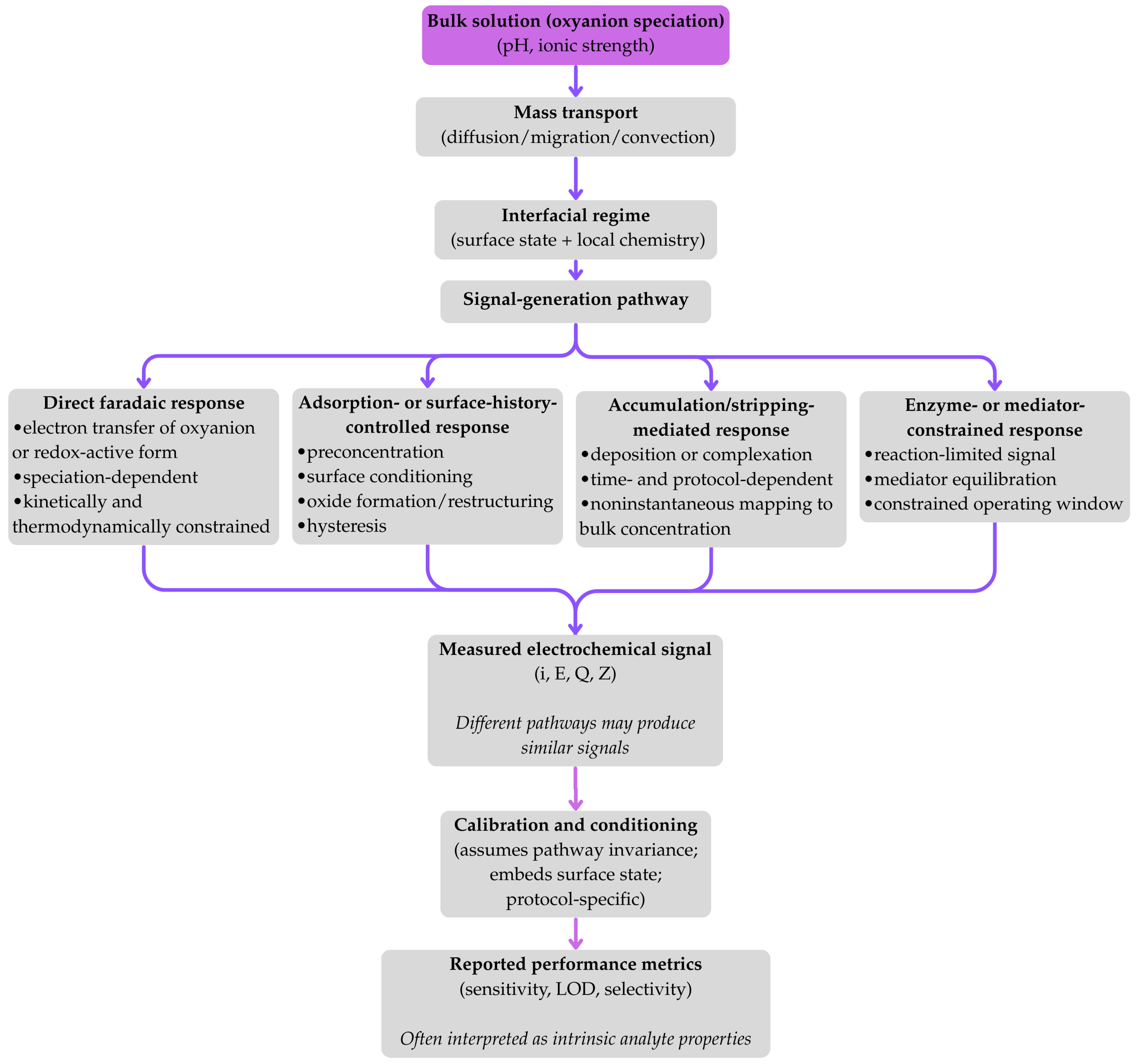
23]. The signal-generation pathways considered in this review are summarised schematically in
Figure 1, which provides a measurement-centred overview of electrochemical signal attribution and serves as a conceptual guide to the sensing archetypes discussed below.
The following subsections examine electrochemical oxyanion sensors according to dominant sensing archetypes. For each class, emphasis is placed on the underlying electrochemical processes, the assumptions linking signal to analyte, and the constraints that limit interpretability and transferability. This approach reflects standard electroanalytical principles: the signal is an interfacial, condition-bound observable, and claims of selective determination require explicit treatment of competing processes, matrix dependence, and stability [
11,
13,
22,
23,
24].
3.1. Direct Faradaic Detection of Oxyanions
Direct faradaic detection refers to sensor designs in which the electrochemical signal arises from oxidation or reduction in the target oxyanion at the electrode surface (
Figure 1, direct faradaic pathway). This approach is conceptually attractive because it suggests a straightforward mapping between analyte concentration and measured current or charge [
11,
13,
23]. In practice, however, direct electron transfer involving intact oxyanions is often kinetically sluggish or thermodynamically constrained, and the observed signal frequently arises from more complex interfacial processes than initially assumed [
11,
13].
For many oxyanions, reduction or oxidation occurs only at substantial overpotentials and is often accompanied by proton-coupled electron transfer, adsorption, and chemical transformation steps [
11,
13]. As discussed in
Section 2, these processes can generate intermediates or products that substantially contribute to the measured response, making it difficult to uniquely assign the signal to the parent oxyanion [
11,
13,
22,
23]. Consequently, claims of direct detection frequently rely on an implicit assumption that the dominant faradaic process corresponds to the intended analyte under the stated conditions, even when mechanistic discrimination is limited [
11,
13].
A common feature of this literature is the use of voltammetric peak position or current magnitude as the primary evidence for selectivity. While peak separation can provide qualitative discrimination under controlled conditions, many oxyanions exhibit overlapping reduction or oxidation windows, and apparent distinctions can shift with pH, electrolyte composition, and electrode surface state [
11,
13,
24]. In such cases, what is presented as selectivity may reflect kinetic bias, adsorption, or local chemical environment rather than thermodynamic exclusivity [
11,
13]. Without explicit evidence that competing reactions are suppressed or absent, attribution of the response to a specific oxyanion remains ambiguous [
11,
13,
22,
23].
These interpretive limitations do not arise from any single factor alone, but from the combined influence of interfacial chemistry, competing reactions, and experimental history. Matrix effects further complicate interpretation. Species that are more readily electroactive than the target oxyanion, or that participate in coupled interfacial chemistry, can dominate the faradaic response even at lower concentrations [
11,
13,
22,
23]. Calibration performed in simplified electrolytes can mask these effects, producing apparently robust responses that deteriorate when applied to chemically more complex matrices [
13,
22,
24]. From an analytical standpoint, such behaviour is expected when the measurand is governed by interfacial equilibria, transport, and competing reactions rather than by bulk concentration alone [
11,
13,
22,
23].
Another recurring limitation is the sensitivity of faradaic responses to surface conditions and measurement history. Changes in electrode roughness, oxide formation, adsorption state, or fouling can alter reaction kinetics and shift peak potentials, producing variability not directly related to analyte concentration [
11,
13,
22]. Treating such effects as experimental noise overlooks their analytical significance: they indicate that the underlying signal-generating process is not invariant and therefore cannot be assumed to support calibration that is transferable across measurement conditions or stable selectivity claims [
11,
13,
22,
23].
Collectively, the direct faradaic detection literature indicates that, although measurable electrochemical responses to oxyanions can be obtained under controlled conditions, signal attribution is often less secure than implied. Without mechanistic validation that links the observed faradaic process to the target oxyanion across relevant pH ranges and matrix compositions, direct detection should be interpreted primarily as evidence of electrochemical feasibility rather than as a selective analytical determination [
11,
13,
22,
23,
24]. These limitations have driven the development of electrocatalytic and modified-electrode strategies, which are examined in the following subsection [
11,
13,
24].
3.2. Electrocatalytic and Modified-Electrode Oxyanion Sensors
Electrocatalytic and modified-electrode strategies constitute a major class of electrochemical oxyanion sensors (
Figure 1, direct faradaic pathway), motivated by the aim to enhance signal magnitude, apparent selectivity, or operational window through engineered interfacial chemistry. In these systems, electrode surfaces are deliberately modified by introducing nanostructured materials, metal oxides, alloys, carbon frameworks, or composite coatings to enhance current response, reduce overpotentials, or promote specific reaction pathways. Such modifications are frequently interpreted as improving sensitivity or selectivity toward a target oxyanion. However, from an electroanalytical perspective, these approaches also introduce additional layers of measurement dependence that complicate signal attribution and quantitative interpretation [
11,
13].
A defining feature of electrocatalytic sensors is that the measured signal reflects the rate of a surface-mediated reaction network rather than direct interaction between the parent oxyanion and the electrode. The modified surface alters local electronic structure, adsorption behaviour, and reaction energetics, often enabling coupled electron-transfer and chemical steps that are inaccessible on unmodified electrodes (
Figure 1, adsorption or surface-history-controlled response). While this can substantially increase the current magnitude, it also broadens the range of species and intermediates that can contribute to the measured response [
23,
24]. As a result, increases in sensitivity do not necessarily correspond to improved analytical specificity.
In many reported sensors, selectivity is inferred from enhanced current response in the presence of a target oxyanion relative to a limited set of potential interferents. However, catalytic surfaces are rarely selective in a chemical sense. Instead, they favour reaction pathways that are kinetically accessible under the imposed conditions. Small changes in pH, electrolyte composition, or surface oxidation state can therefore shift dominant pathways and alter apparent selectivity without altering the bulk analyte composition [
11,
13]. This behaviour is particularly pronounced for oxyanions that undergo proton-coupled electron transfer or surface-assisted decomposition, where local pH gradients and adsorption equilibria play a central role.
Surface heterogeneity further complicates interpretation. Modified electrodes often exhibit active-site distributions with varying catalytic properties, adsorption energies, and reaction kinetics. The measured signal thus represents an ensemble average over multiple interfacial processes rather than a single well-defined reaction. Changes in surface morphology, particle aggregation, or partial surface poisoning during operation can shift this distribution over time, leading to signal drift and variability that are unrelated to analyte concentration [
22,
23]. In many studies, such effects are not monitored explicitly, yet they directly undermine the assumption of stable calibration.
Another recurring issue is the conflation of electrocatalytic activity with analytical selectivity. Enhanced catalytic turnover can amplify signals from background reactions or unintended substrates, particularly in complex matrices containing multiple electroactive species. In such cases, improved current response may reflect increased susceptibility to interference rather than improved discrimination. Calibration curves obtained in simplified electrolytes can therefore exaggerate analytical performance, masking the conditional nature of the underlying reaction network [
3,
4].
Despite these limitations, electrocatalytic approaches are often presented as a route to practical sensing owing to their apparent sensitivity and low detection limits. From a measurement-centred perspective, however, these metrics primarily describe how efficiently a modified surface drives interfacial chemistry under specific conditions. Without mechanistic validation linking the dominant catalytic pathway to the target oxyanion across relevant pH ranges and matrix compositions, such performance metrics cannot be assumed to translate beyond the laboratory setting [
13,
24].
Accordingly, electrocatalytic and modified-electrode oxyanion sensors should be interpreted with caution. While they provide compelling demonstrations of electrochemical feasibility and surface-controlled signal amplification, their analytical meaning is inseparable from surface chemistry, operating conditions, and matrix context. In the absence of explicit treatment of these factors, claims of selectivity and quantitative capability may extend beyond what can be supported for a condition-dependent catalytic response. These issues become even more pronounced in accumulation- and stripping-based approaches, which are considered in the following subsection.
3.3. Accumulation, Stripping, and Preconcentration-Based Approaches
Accumulation- and stripping-based strategies represent an important alternative approach in electrochemical oxyanion sensing (
Figure 1, accumulation/stripping-mediated response), particularly where direct faradaic detection yields weak or poorly resolved signals. In these approaches, the analytical response is generated only after a deliberate preconcentration step, during which the target species or a reaction product is deposited, adsorbed, or otherwise accumulated at the electrode surface prior to measurement. The subsequent stripping or readout step often produces signals orders of magnitude larger than those obtained from direct detection and is therefore frequently interpreted as evidence of enhanced sensitivity [
13,
24]. Numerous nitrate and related oxyanion sensors reported in recent years adopt this strategy, often combining accumulation with surface modification to further amplify response [
33,
34,
35].
From an electroanalytical perspective, the defining feature of these methods is that the measurand is explicitly time- and method-defined. The measured signal reflects the efficiency and reproducibility of the accumulation process rather than the instantaneous bulk concentration of the oxyanion. Accumulation potential, duration, surface state, and mass-transport regime directly determine the amount of material retained at the interface and its release during the stripping step [
11,
22]. As a result, calibration curves derived from stripping signals encode the behaviour of the accumulation-release cycle under specific experimental conditions, a feature evident in many reported oxyanion sensors, where linearity is demonstrated only within tightly controlled accumulation protocols [
33,
36].
For oxyanion sensing, this dependence is further reinforced by the fact that accumulation often involves chemical transformation or indirect binding rather than the deposition of the parent anion. In several reported systems, the accumulated species is a reduced, protonated, or surface-associated form generated during the preconcentration step, rather than the bulk oxyanion originally present in solution [
34,
35]. While such processes can substantially enhance signal magnitude, they also decouple the measurement from bulk speciation, making signal attribution dependent on interfacial chemistry that is rarely characterised beyond qualitative inference [
23,
24].
Selectivity claims based on accumulation efficiency must therefore be interpreted with caution. Apparent discrimination can arise if the target oxyanion accumulates more readily than competing species under the chosen conditions. However, this form of selectivity is inherently context-dependent and sensitive to changes in pH, electrolyte composition, and accumulation parameters. Small variations in these factors can alter adsorption equilibria or reaction pathways, leading to significant signal changes even when bulk analyte concentration is unchanged [
11,
13]. In complex matrices, species with stronger surface affinity or faster accumulation kinetics can dominate the stripping response, a behaviour that is implicitly reported in several accumulation-based oxyanion sensors, where interference testing is restricted to simplified electrolytes [
36,
37].
Surface evolution introduces an additional limitation. Accumulation steps frequently modify the electrode surface via deposition, adsorption, or partial fouling, thereby altering the effective surface area and reaction energetics across repeated cycles. These changes can produce signal drift, hysteresis, or loss of reproducibility that is not directly related to analyte concentration [
22,
23]. In many stripping-based oxyanion sensors, calibration is performed over a limited number of cycles immediately after electrode preparation, masking longer-term instability that emerges during sustained operation [
33,
35].
The frequent reporting of extremely low limits of detection illustrates both the strengths and limitations of accumulation-based approaches. While preconcentration can indeed yield high signal-to-noise ratios under controlled conditions, detection limits derived from short-term laboratory experiments provide limited insight into robustness or applicability. The same features that enable signal amplification, time dependence, surface sensitivity, and reliance on narrowly defined chemical environments also constrain transferability and long-term reliability [
4,
24]. Several recent oxyanion sensors exemplify this pattern, achieving impressive detection limits in buffered electrolytes while providing limited evidence of stability or matrix tolerance [
34,
38].
Viewed as a whole, accumulation- and stripping-based oxyanion sensors show that substantial signal amplification can be achieved by deliberately integrating electrochemical responses through programmed preconcentration steps. However, this amplification comes at the cost of a measurand that is intrinsically method-defined: the measured signal reflects the efficiency and stability of a specific accumulation–release protocol rather than the instantaneous bulk concentration of the target oxyanion. Without explicit evidence that accumulation efficiency, surface state, and signal attribution remain invariant across relevant pH ranges, matrices, and operational timescales, reported figures of merit should be interpreted as method-dependent and protocol-specific. These approaches, therefore, establish electrochemical feasibility under controlled conditions but do not, in themselves, resolve the broader challenge of analytically robust oxyanion determination.
3.4. Enzyme-Mediated and Redox-Mediated Oxyanion Detection
Enzyme- and redox-mediated electrochemical sensors are often proposed to address the selectivity limitations inherent in direct and surface-driven detection of oxyanions (
Figure 1, enzyme- or mediator-constrained response). In these systems, chemical recognition is introduced through a biological catalyst or molecular mediator that interacts selectively with the target analyte, while the electrode primarily serves as a transducer of catalytic activity. Conceptually, this architecture decouples analyte recognition from electron transfer at the electrode surface, thereby enabling greater chemical specificity than purely electrochemical approaches [
11,
13].
In practice, however, enzyme-mediated sensing introduces a different set of analytical constraints that complicate interpretation. The measured electrochemical signal reflects the rate of a catalytic cycle rather than direct interaction with the oxyanion itself. As a result, the signal depends not only on analyte availability but also on enzyme loading, catalytic turnover, mediator diffusion, local pH, cofactor availability, and the efficiency of electron transfer between the catalytic system and the electrode [
22,
23]. Consequently, the measurand is best understood as context-defined catalytic activity rather than bulk analyte concentration.
Redox mediators further shape this measurement dependence. Mediated systems rely on the reversible cycling of a redox couple to shuttle electrons between the enzyme and the electrode. While this can lower overpotentials and stabilise signal generation, it also introduces additional dependencies related to mediator stability, partitioning, and interactions with the surrounding matrix [
11]. In complex samples, mediators may undergo unintended side reactions or exhibit altered diffusion and redox behaviour, leading to signal distortion that is not directly attributable to changes in analyte concentration.
Selectivity in enzyme-mediated oxyanion sensors is therefore fundamentally chemical rather than electrochemical, but it remains context-dependent. Enzymes can exhibit high substrate specificity under controlled conditions, yet their activity is often sensitive to pH, temperature, ionic strength, and the presence of inhibitors or competing substrates. Small deviations from optimal conditions can alter catalytic efficiency or deactivate the enzyme entirely, producing signal changes that mimic concentration effects [
13,
23]. Without careful characterisation, such behaviour can be misinterpreted as an analytical response rather than operational instability.
Another recurring limitation is the lack of stability over time. Enzymatic systems are inherently susceptible to degradation, leaching, and conformational changes during storage and operation. Immobilisation strategies can mitigate some of these effects, but they also introduce additional variables related to mass transport, enzyme orientation, and active-site accessibility. As with accumulation-based approaches, calibration is frequently performed shortly after sensor preparation, and long-term stability or the need for recalibration are rarely examined in detail [
4,
22].
Redox-mediated systems share many of these challenges even in the absence of enzymes. While molecular mediators can provide more stable electron-transfer pathways than biological catalysts, their redox behaviour remains sensitive to matrix composition and electrode surface state. In such cases, apparent improvements in sensitivity or selectivity may reflect favourable mediator kinetics under specific conditions rather than robust analytical discrimination [
24].
Despite these constraints, enzyme-mediated and redox-mediated approaches represent an important conceptual advance in electrochemical oxyanion sensing. By shifting selectivity from the electrode surface to a molecular recognition element, they clarify the distinction between chemical specificity and electrochemical observability. However, this shift does not eliminate conditionality; it relocates it. Claims of selective and quantitative oxyanion determination must therefore demonstrate not only enzyme- or mediator-specificity but also the stability of catalytic activity, resistance to matrix effects, and invariance of signal transduction under realistic operating conditions.
From a measurement-centred perspective, enzyme-mediated sensors should be interpreted as hybrid analytical systems in which electrochemical readout reports catalytic performance rather than analyte concentration directly. When these distinctions are made explicit and validated, such systems can offer meaningful advantages. When they are not, enzymatic selectivity risks being conflated with analytical robustness, which can give an overly favourable impression of practical sensing capability. These themes recur across the electrochemical oxyanion sensor literature and are synthesised in the following section.
3.5. Recurring Failure Modes and Interpretive Pitfalls Across Oxyanion Sensor Archetypes
Across the sensing archetypes examined in
Section 3.1,
Section 3.2,
Section 3.3 and
Section 3.4, a consistent set of analytical challenges becomes apparent. Although sensor architectures vary widely in materials, signal transduction pathways, and degrees of chemical complexity, many reported oxyanion sensors remain constrained by the same underlying limitations of electrochemical measurements. In each case, the measured electrochemical response reflects interfacial behaviour under defined experimental conditions rather than bulk composition in isolation. Consequently, differences in materials or sensing strategies do not eliminate the fundamental dependencies on surface state, solution chemistry, and measurement history that govern signal generation and interpretation.
A primary recurring issue is the ambiguous definition of the measurand. In many studies, the measured electrochemical signal is treated as a proxy for bulk oxyanion concentration even though it originates from interfacial processes that depend on local chemistry, surface state, and experimental history. Whether the signal derives from a transformed species, an accumulated intermediate, or a catalytic cycle, the relationship between signal and analyte is often method-defined rather than species-defined. When this distinction is not made explicit, calibration curves and performance metrics risk being overinterpreted as general descriptors rather than as mappings valid only under tightly controlled conditions.
A second recurring issue is the limited stability of signal attribution. Across sensing archetypes, apparent selectivity often arises from kinetic bias, adsorption preferences, or favourable accumulation behaviour rather than from chemically invariant recognition of the target oxyanion. As a result, the measured response is highly sensitive to changes in pH, electrolyte composition, matrix chemistry, and surface condition. In simplified laboratory systems, these dependencies may remain hidden. In more variable environments, however, the same dependencies can lead to signal collapse, cross-reactivity, or drift.
Calibration instability constitutes a third recurring limitation. Many electrochemical oxyanion sensors achieve linear calibration and low detection limits immediately after fabrication or conditioning, yet the underlying signal-generating processes may evolve over time due to adsorption, fouling, restructuring, mediator degradation, or enzyme deactivation. In such cases, calibration drift is not anomalous but an expected consequence of interfacial chemistry. Short-term repeatability, therefore, cannot be assumed to establish durable quantitative capability.
Overall, these recurring failure modes show that the main challenge in electrochemical oxyanion sensing lies less in generating measurable signals than in maintaining stable and interpretable signal attribution across changing conditions. The framework developed in
Section 2 helps make this distinction explicit and provides the basis for the validation-focused analysis in
Section 4.
4. Applying the Measurement-Centred Framework to Reported Oxyanion Sensors
Section 3.1,
Section 3.2,
Section 3.3 and
Section 3.4 examined the principal electrochemical sensing archetypes used for oxyanion detection and the signal-generation assumptions associated with each. Building on this mechanistic analysis,
Section 4 shifts the focus from how signals arise to how analytical claims are validated in the literature. The evidentiary strength of reported sensors ultimately depends on whether the proposed signal-generating pathways can be uniquely attributed to the target oxyanion and shown to remain stable across relevant operating conditions. Accordingly, this section examines the validation practices commonly used to support electrochemical oxyanion sensing, including calibration strategies, selectivity testing, matrix evaluation, reproducibility, and operational stability. The sensing pathways summarised in
Figure 1 provide a useful reference for interpreting how these validation practices differ across electrochemical sensing architectures.
From this perspective, the key question is not whether a measurable electrochemical response can be obtained, but whether the available evidence is sufficient to justify interpreting that response as analytically meaningful. The following subsections, therefore, assess the validation practices typically used across each sensing archetype and examine whether those practices support claims of selective and quantitative oxyanion determination.
4.1. Analytical Implications of Direct Faradaic Detection
Studies employing direct faradaic detection are among the most common and conceptually fundamental approaches in the electrochemical oxyanion sensor literature. In this body of work, oxidation or reduction features observed in voltammetric or amperometric measurements are attributed to direct interaction between the electrode and the target oxyanion, with peak current, charge, or onset potential interpreted as a proxy for analyte concentration [
27,
34,
39]. Although the mechanistic constraints of this approach are well established (
Section 3.1), closer examination of how direct detection is claimed and validated in the literature reveals recurring evidentiary practices that limit analytical interpretability.
In direct-detection studies, signal emergence, peak enhancement, or peak shifts following analyte addition are often treated as primary evidence of specificity. Selectivity is then commonly supported by comparison against a limited number of interferents under fixed electrolyte conditions [
3,
4,
27]. While these practices may demonstrate differential response within a defined experimental setting, they rarely establish that the underlying faradaic process remains uniquely attributable to the target oxyanion across relevant pH ranges, matrices, or electrode histories [
24,
34].
Calibration practices further illustrate the evidentiary limitations of direct faradaic detection. Linear calibration curves are commonly reported over restricted concentration ranges, typically generated immediately after electrode preparation and under tightly controlled conditions [
27,
37,
40]. These calibrations are often presented as evidence of quantitative capability without accompanying assessment of surface evolution, electrode-to-electrode reproducibility, or stability during extended operation. In this context, calibration functions primarily describe the behaviour of a specific electrode under a specific set of conditions rather than establishing a transferable relationship between signal and bulk analyte concentration.
Matrix effects are frequently acknowledged but weakly interrogated. While some studies employ standard addition or recovery experiments, these are often conducted in diluted or simplified matrices that preserve the original electrochemical environment [
36,
41,
42]. Such approaches can compensate for bulk matrix effects but do not address changes in interfacial chemistry, surface state, or reaction pathways induced by chemically complex samples. As a result, recoveries close to unity are sometimes interpreted as confirmation of analytical validity, even though the underlying signal-generating process remains measurement-specific rather than analyte-defined [
40,
43].
Overall, much of the direct faradaic detection literature demonstrates electrochemical responsiveness rather than analytically secure determination of oxyanions. The available evidence is often sufficient to show that a measurable faradaic process can be induced in the presence of a target oxyanion, but insufficient to establish that the process remains uniquely attributable, stable, and transferable across conditions relevant to practical sensing [
27,
40,
43]. In this sense, feasibility is frequently conflated with specificity.
This observation does not diminish the scientific value of direct faradaic investigations, which provide important insight into interfacial reactivity and electrode-anion interactions. However, when framed as sensors, such systems require a higher evidentiary standard than is typically applied. These limitations motivate the widespread adoption of modified-electrode and electrocatalytic strategies, which are examined in the following subsection.
4.2. Electrocatalytic and Modified-Electrode Oxyanion Sensors: Amplification, Attribution, and Overextension
Electrocatalytic and modified-electrode strategies dominate the contemporary electrochemical oxyanion sensor literature. In these studies, electrode surfaces are deliberately engineered using nanostructured materials, metal oxides, alloys, carbon-based frameworks, or composite coatings to enhance signal magnitude, reduce overpotentials, or promote specific reaction pathways. Reported improvements in sensitivity or detection limit are often interpreted as evidence of superior sensing performance relative to unmodified electrodes [
39,
44,
45]. However, examination of how such enhancements are framed and validated in the literature reveals recurring patterns that complicate analytical interpretation.
A defining feature of this body of work is the conflation of signal amplification with analytical selectivity. The increased current response in the presence of a target oxyanion is commonly attributed to preferential catalytic activity or improved analyte-surface interactions, even when competing reactions are not explicitly excluded [
44,
46]. In many cases, performance is evaluated primarily by comparing current magnitude rather than by mechanistic discrimination or systematic interference analysis. As a result, an enhanced response is often taken as implicit evidence of selectivity, despite the absence of data demonstrating that the amplified signal arises exclusively from the intended oxyanion.
Selectivity testing in modified-electrode studies is often conducted using a restricted, idealised protocol. Interferents are typically examined individually, often at equimolar or sub-equimolar concentrations, under fixed electrolyte and pH conditions chosen to maximise signal clarity [
39,
45]. While such tests can demonstrate differential responses under controlled conditions, they do not establish robustness to the chemically diverse environments encountered in real samples. In several reports, modest changes in pH, electrolyte composition, or electrode pretreatment are sufficient to alter apparent selectivity, yet these sensitivities are rarely discussed in depth [
46,
47].
Across this literature, enhanced current response is often treated as evidence of improved sensing performance without equivalent attention to whether amplification also increases susceptibility to interference, drift, or surface restructuring. Selectivity testing is typically conducted under idealised conditions, with a restricted set of interferents and limited assessment of how pH, electrolyte composition, or electrode pretreatment alter the dominant reaction pathway [
39,
45,
46,
47].
Calibration practices reinforce this problem. Linear calibration curves are commonly obtained immediately after fabrication and are frequently presented as transferable descriptors of sensor capability, even though surface-modified electrodes are inherently sensitive to changes in morphology, oxidation state, and adsorption environment [
37,
40,
42,
44]. Where surface evolution during operation is not explicitly monitored, calibration stability is assumed rather than demonstrated.
Accordingly, much of the modified-electrode and electrocatalytic sensor literature prioritises signal enhancement over interpretability. Engineered surfaces clearly amplify electrochemical response, but the relationship between amplified signal and analyte identity is often insufficiently constrained. Reported figures of merit, therefore, more often describe how effectively a particular surface drives electrochemical response under optimised laboratory conditions than how reliably it determines a target oxyanion across a variable environment [
27,
43].
This observation does not negate the scientific contribution of modified-electrode studies, which have significantly expanded the understanding of oxyanion reactivity at functionalised interfaces. However, when presented as sensors, such systems require evidentiary standards that extend beyond enhanced current response. These limitations become even more pronounced in accumulation- and stripping-based approaches, which are examined in the following subsection.
4.3. Surface-History–Dependent and Adsorption-Influenced Oxyanion Sensors
A substantial fraction of electrochemical oxyanion sensors reported in the literature do not employ explicit accumulation or stripping steps of the type discussed in
Section 3.3. Nevertheless, many of these systems rely on surface-history-dependent processes to achieve measurable signal amplification. In such cases, enhanced response arises implicitly from adsorption, surface-confined intermediates, or progressive modification of the electrode during operation, rather than from a deliberately programmed preconcentration protocol. Because these effects are rarely formalised in the measurement definition, their influence on signal attribution, calibration validity, and selectivity is often under-examined. As a result, analytically significant surface processes are treated as background behaviour rather than as central determinants of sensor performance.
In many studies, signal enhancement is attributed to favourable interactions between the target oxyanion and the electrode surface, often inferred from increased current magnitude or improved signal stability relative to unmodified electrodes [
39,
45]. However, the extent to which this enhancement reflects reversible adsorption, formation of surface-associated reaction intermediates, or gradual surface restructuring is rarely distinguished experimentally. As a result, the measured response may reflect the integrated effects of prior measurements rather than an instantaneous response to the bulk analyte concentration.
Several reported sensors exhibit clear dependence on electrode conditioning and repeated electrochemical operation, with signal magnitude and stability evolving as the surface state stabilises, indicating that the measured response is influenced by prior measurement history rather than reflecting an instantaneous response to bulk oxyanion concentration [
34]. In such cases, the electrode effectively “remembers” prior exposure to the analyte or operating conditions, resulting in signal behaviour that cannot be explained solely by bulk concentration. While this history dependence is sometimes acknowledged qualitatively, its implications for calibration and quantitative interpretation are seldom examined in detail.
Selectivity claims in adsorption-influenced systems frequently rest on preferential surface affinity or differential interaction kinetics between the target oxyanion and potential interferents [
44,
46]. Apparent discrimination is demonstrated by comparing responses under fixed experimental conditions, sometimes after electrode conditioning or stabilisation steps. However, because adsorption equilibria and surface coverage are sensitive to pH, ionic strength, and competing species, such selectivity is inherently situational. Small changes in experimental conditions can shift surface populations and alter response patterns without altering bulk analyte composition, a limitation that is rarely explored systematically.
Calibration in these systems is often achieved only after electrode stabilisation or repeated cycling, indicating that reproducibility depends on reaching a particular surface state rather than on a direct mapping to bulk concentration alone [
37,
40]. This dependence limits transferability across electrodes and operating histories, especially where long-term stability and inter-electrode reproducibility are not evaluated.
Matrix effects are also difficult to constrain in surface-history-dependent systems. Some studies extend performance claims to real or semi-real samples without explicitly evaluating how competing adsorption, surface fouling, or altered interfacial chemistry influence signal generation [
41,
47]. In such cases, favourable agreement with expected concentrations may reflect compatibility with a specific workflow rather than a durable analyte-specific response.
Accordingly, adsorption-influenced oxyanion sensors are best interpreted as workflow-dependent systems whose analytical meaning depends on explicit control of surface history rather than on signal magnitude alone. These issues motivate the use of enzyme- and redox-mediated strategies that aim to constrain signal attribution through molecular recognition; these strategies are examined in the following subsection.
4.4. Analytical Implications of Enzyme- and Redox-Mediated Oxyanion Sensors
Enzyme- and redox-mediated electrochemical sensors are frequently presented as a solution to the selectivity limitations inherent in direct, surface-driven oxyanion detection. In these systems, chemical recognition is achieved through a molecular component that interacts preferentially with the target analyte, while the electrode primarily serves as a transducer of catalytic activity. This architectural separation is often framed as a conceptual advance, shifting selectivity away from electrode surface chemistry and toward a chemically defined recognition step [
48,
49].
Across the literature, the analytical signal in enzyme-mediated sensors reflects the rate of a catalytic cycle rather than direct interaction between the electrode and the oxyanion. Consequently, the measured response depends on multiple coupled variables, including enzyme loading, catalytic turnover efficiency, mediator transport, local pH, and electron transfer efficiency between the catalytic system and the electrode [
48,
49]. The reported signal, therefore, reflects conditional catalytic activity within the sensing configuration rather than bulk analyte concentration alone. While this indirect transduction can suppress certain classes of electrochemical interference, it also complicates quantitative interpretation, as changes in catalytic activity or mediator dynamics may alter the measured signal independently of analyte concentration.
Redox mediators play a central role in shaping this conditionality. Mediated systems rely on the reversible cycling of a redox couple to shuttle electrons between the enzyme and the electrode, thereby often reducing overpotential and improving signal stability compared with direct enzyme-electrode coupling. However, mediator behaviour introduces additional dependencies related to diffusion, partitioning, redox stability, and interaction with the sample matrix [
44,
46]. In complex media, mediators may participate in side reactions or exhibit altered redox kinetics, producing signal changes that are not uniquely attributable to changes in analyte concentration.
Selectivity in enzyme-mediated oxyanion sensors is therefore fundamentally chemical rather than electrochemical, but it remains context dependent. Enzymes can exhibit high substrate specificity under controlled conditions, yet their activity is sensitive to pH, ionic strength, temperature, and the presence of inhibitors or competing substrates. Deviations from optimal operating conditions can alter catalytic efficiency or suppress activity entirely, producing signal variations that mimic concentration effects if not independently verified [
46,
49]. As a result, favourable selectivity observed under buffered laboratory conditions does not automatically translate to robustness in chemically variable samples.
Stability represents a second recurring limitation. Enzymatic systems are inherently susceptible to deactivation, leaching, and conformational changes during storage and operation. Immobilisation strategies can mitigate some of these effects, but they introduce additional variables related to mass transport, enzyme orientation, and active-site accessibility. In many reported sensors, calibration is performed shortly after fabrication, and long-term operational stability or recalibration requirements are either minimally explored or omitted entirely [
44,
47]. Under these conditions, apparent quantitative performance reflects short-term reproducibility rather than sustained analytical reliability.
Redox-mediated systems without biological components share several of these constraints. Although molecular mediators can be more stable than enzymes, their electrochemical behaviour remains sensitive to matrix composition and electrode surface state. Apparent improvements in sensitivity or selectivity often reflect favourable mediator kinetics under specific conditions rather than invariant analytical discrimination [
41,
46]. Without explicit evaluation of mediator stability and matrix tolerance, signal attribution remains conditional.
Enzyme- and redox-mediated strategies highlight a fundamental conceptual distinction in electrochemical oxyanion sensing: chemical recognition and electrochemical observability are not equivalent. These systems can constrain signal attribution more effectively than purely surface-driven approaches, but they do not eliminate conditionality. Instead, they relocate it to the catalytic and mediation steps. Claims of selective and quantitative oxyanion determination therefore require evidence not only of recognition specificity but also of stable catalytic activity, resistance to matrix effects, and invariance of signal transduction under realistic operating conditions.
In the literature, enzyme- and redox-mediated sensors often provide stronger discrimination than purely surface-driven systems, but their analytical value still depends on operational stability, matrix tolerance, and the depth of validation. Where these factors are not examined explicitly, molecular recognition can be mistaken for analytical robustness. When they are addressed, however, such systems offer one of the more credible pathways toward improved oxyanion discrimination in electrochemical sensing.
4.5. Performance Validation, Applicability Claims, and the Persistence of Conditionality
Across electrochemical oxyanion-sensing studies, claims of analytical applicability are most often supported by calibration behaviour, interference testing, and limited validation in real or simulated samples. While these practices are standard in the sensor literature, an examination of their implementation reveals recurring limitations in the evidentiary basis supporting analytical claims. In many cases, validation establishes internal consistency within a defined experimental framework rather than robustness across variable chemical environments.
Calibration remains the primary means of substantiating quantitative performance. Linear response relationships are frequently reported over defined concentration ranges, often accompanied by low apparent limits of detection. However, calibration is typically performed under tightly controlled conditions following electrode conditioning, mediator equilibration, or enzymatic stabilisation. As a result, the reported calibration reflects a specific operational state of the sensing interface rather than a general mapping between bulk oxyanion concentration and signal [
3,
4,
50].
Interference studies are commonly used to support selectivity claims, yet their scope is often limited. Many reports evaluate sensor response in the presence of a small number of competing ions at fixed concentrations, typically under the same electrolyte and pH conditions used for calibration. While such tests can demonstrate differential response under chosen conditions, they rarely establish robustness against changes in ionic strength, buffering capacity, mixed-interferent composition, or competing adsorption [
24,
26].
Extension to real samples is frequently presented as evidence of applicability, but the validation strategies employed are often minimal. In several studies, agreement between measured and expected concentrations is taken as confirmation of analytical accuracy, even when surface chemistry, mediator behaviour, or enzymatic activity under those sample conditions is not independently assessed [
51,
52]. Without an explicit evaluation of how sample composition influences interfacial processes, such agreement cannot, by itself, establish durable signal attribution.
Recovery and standard addition experiments, when performed, can partially address bulk matrix effects. However, these approaches do not eliminate the underlying dependence of the signal on surface-confined species, transformed intermediates, catalytic cycles, or prior conditioning history. In this sense, recovery validates numerical consistency within a method but does not, on its own, establish invariant signal attribution [
27,
34].
A further limitation is the relative scarcity of data on long-term stability, inter-electrode reproducibility, and mixed-interferent behaviour. Many sensors exhibit repeatable responses across short measurement sequences, yet few studies examine how performance evolves under extended operation, storage, repeated exposure to complex matrices, or the combined presence of multiple interferents. This gap directly contributes to the disconnect between laboratory performance and practical deployment observed in electrochemical oxyanion sensors [
37,
40].
An additional but frequently overlooked source of variability in electrochemical sensing arises from the reference electrode. Electrochemical measurements assume a stable reference potential against which working electrode potentials are defined, yet reference electrodes themselves can experience drift, junction potential changes, and fouling when exposed to complex matrices. Such effects can shift apparent peak positions, alter effective overpotentials, and introduce systematic calibration errors without any change in analyte concentration [
53,
54]. In practical measurements, variations in electrolyte composition, junction contamination, or incomplete equilibration of the reference electrode can produce measurable potential offsets that propagate directly into electrochemical sensor response and calibration. Moreover, the use of quasi-reference systems or poorly controlled reference environments can introduce additional uncertainty in the applied potential scale. Despite its analytical importance, explicit evaluation of reference electrode stability is rarely reported in electrochemical oxyanion sensor studies, even though potential referencing is a critical determinant of measurement accuracy [
53,
54].
Taken together, validation practices in the electrochemical oxyanion sensing literature more often establish feasibility than robustness. Calibration, interference testing, and limited real-sample studies can demonstrate internal consistency within a chosen experimental framework, but they do not by themselves establish transferability across matrices, electrode instances, or operating histories. These observations motivate the practical criteria and design implications outlined in
Section 5.
5. Implications for the Design and Interpretation of Electrochemical Oxyanion Sensors
Section 2,
Section 3 and
Section 4 show that the central challenge in electrochemical oxyanion sensing is not signal generation itself, but the evidentiary standard required to interpret that signal as analytically meaningful.
Section 5, therefore, reframes the recurring limitations identified in the literature as design-relevant constraints and criteria for robust oxyanion determination. The aim is not to restate the weaknesses of existing systems, but to clarify what the current literature genuinely supports, what it does not, and what conditions must be satisfied for electrochemical oxyanion sensors to progress from proof-of-concept demonstrations toward reliable analytical tools.
5.1. Reframing Performance: From Figures of Merit to Measurand Integrity
Performance metrics such as sensitivity, linear range, selectivity, and limits of detection dominate the reporting and comparison of electrochemical oxyanion sensors. While these descriptors are essential for characterising signal behaviour under controlled conditions, their analytical meaning depends fundamentally on the relationship between the measurand and the signal domain, as well as on the validity of the calibration model linking them [
25,
55,
56]. As demonstrated throughout this review, electrochemical signals arise from interfacial processes shaped by local chemistry, surface states, transport regimes, and experimental history. When these factors are not invariant, numerical figures of merit describe the behaviour of a particular measurement configuration rather than intrinsic properties of analyte detection. More broadly, classical sensor theory emphasises that figures of merit describe the behaviour of a recognition-transduction system under defined conditions, rather than intrinsic properties of the analyte itself [
12,
57].
Sensitivity, for example, is often interpreted as a direct indicator of analytical capability. In electrochemical systems, however, increased sensitivity frequently reflects amplification of surface-controlled or catalytic processes rather than improved linkage between signal and bulk oxyanion concentration [
11,
24]. Modifications that enhance current magnitude or reduce overpotential can produce impressive calibration slopes while simultaneously increasing susceptibility to surface conditioning, matrix effects, or competing reactions. In such cases, sensitivity is a measure of how efficiently a system transduces interfacial chemistry, rather than how selectively it quantifies an oxyanion.
Limits of detection are similarly prone to misinterpretation. Detection limits derived from short-term signal-to-noise analysis under idealised conditions provide limited insight into robustness, stability, or applicability [
3,
13]. When baseline drift, surface evolution, or matrix-dependent interference dominate signal behaviour, extremely low detection limits offer little practical advantage. A sensor that achieves modest detection limits with stable and interpretable behaviour across operating conditions may therefore be analytically superior to one that exhibits exceptional sensitivity only within narrowly defined laboratory regimes.
Selectivity metrics present an additional challenge. Apparent discrimination is often established by demonstrating differential responses under fixed experimental conditions, yet such behaviour frequently reflects conditional kinetic bias, adsorption preferences, or favourable accumulation dynamics rather than chemical exclusivity. Without explicit evidence that the signal-generating process remains invariant across relevant pH ranges, matrices, and surface states, selectivity metrics risk overstating analytical capability. In this context, selectivity should be understood as a property of the measurement configuration, not of the analyte alone [
4,
27].
These considerations point to the need for a shift in how performance is evaluated and reported [
58]. Rather than prioritising extreme numerical optimisation, analytically meaningful assessment requires that performance metrics be interpreted in relation to measurand integrity: the degree to which the reported signal can be linked reproducibly and uniquely to the target oxyanion under realistic conditions. From this perspective, robustness, interpretability, and transferability become as important as sensitivity or detection limits. Recognising this hierarchy is essential for distinguishing demonstrations of electrochemical responsiveness from evidence of reliable oxyanion determination.
5.2. Why Most Electrochemical Oxyanion Sensors Stall at the Laboratory Stage
Despite the extensive body of work devoted to electrochemical oxyanion sensing, relatively few reported sensors progress beyond proof-of-concept demonstrations in controlled laboratory settings. This gap between publication volume and practical uptake is often attributed to external factors such as deployment complexity or application-specific constraints. However, the analyses presented in this review indicate that the primary causes are analytical rather than logistical [
59]. Many sensors stall because the conditions under which their performance is optimised are inseparable from the conditions under which their signals remain interpretable.
A central limitation is the context dependence of selectivity. Across sensing strategies, apparent discrimination frequently arises from favourable kinetic bias, adsorption behaviour, or catalytic preference under narrowly defined experimental conditions [
57]. While such behaviour can be stabilised in simplified electrolytes, it often collapses when pH, ionic strength, matrix composition, or surface state varies. In these cases, loss of selectivity is not an unexpected failure but a predictable consequence of measurement configurations that rely on fragile interfacial equilibria. Sensors optimised for peak separation or current enhancement under fixed conditions therefore struggle to maintain analytical meaning when transferred to more complex or variable environments.
Calibration fragility further constrains transferability. Many electrochemical oxyanion sensors exhibit linear calibration and low detection limits immediately after fabrication or conditioning, yet these relationships depend on maintaining a specific surface state or catalytic regime. As surface chemistry evolves during operation, through adsorption, fouling, restructuring, or mediator degradation, the signal-generating process shifts accordingly. Recalibration becomes necessary, often frequently, undermining the assumption that a single calibration curve can serve as a stable descriptor of sensor performance. In practice, this instability limits confidence in quantitative readout and complicates long-term or field deployment. From a metrological perspective, such behaviour reflects a breakdown of the assumptions required for valid calibration, namely that all contributing species and interactions are known, stable, and adequately represented in the calibration model [
55].
Matrix dependence compounds these issues. While many studies acknowledge matrix effects qualitatively, systematic evaluation is often limited to a small number of test conditions or interferents. Agreement with expected concentrations in real or semi-real samples is commonly interpreted as validation, even when the underlying interfacial processes differ from those operating in calibration solutions [
50]. Without explicit demonstration that signal attribution remains invariant across relevant matrices, such agreement provides limited assurance of robustness. As a result, sensors that perform convincingly in buffered laboratory systems may yield ambiguous or irreproducible responses when applied outside those regimes.
Another recurring factor is the prioritisation of performance optimisation over analytical interpretation. Performance metrics are frequently maximised by tuning electrode composition, potential programmes, or conditioning protocols, yet the analytical implications of these optimisations are rarely examined in depth [
60]. Enhancements in sensitivity or detection limits can mask increasing dependence on surface history or local chemistry, effectively trading interpretability for signal magnitude. When optimisation is treated as validation, rather than as a step that demands further analytical scrutiny, sensors risk being characterised by impressive figures of merit that do not translate into reliable measurement capability.
Overall, these patterns help explain why many electrochemical oxyanion sensors remain confined to laboratory demonstrations. The limitation is not a lack of electrochemical responsiveness but the difficulty of maintaining a stable, interpretable relationship between the signal and the analyte under realistic conditions. Until issues of conditional selectivity, calibration stability, and matrix dependence are addressed explicitly, progress toward practical deployment will remain incremental. Recognising these constraints does not diminish the value of existing studies; rather, it clarifies the analytical challenges that must be resolved for electrochemical oxyanion sensing to move beyond feasibility toward robust application.
5.3. Design Constraints Implied by the Electrochemical Oxyanion Sensing Literature
The literature surveyed in this review implies a set of design constraints that must be satisfied for electrochemical oxyanion sensors to achieve analytically meaningful performance. These constraints do not constitute prescriptive design rules. Rather, they define the conditions under which performance metrics can legitimately be interpreted as evidence of reliable analyte determination rather than as indicators of conditional electrochemical behaviour. Making these constraints explicit is essential for distinguishing between demonstrations of feasibility and sensors capable of robust operation. From a sensor design perspective, analytical validity depends on maintaining a stable and interpretable relationship between recognition, transduction, and calibration, a principle long emphasised in foundational treatments of chemical sensing [
12].
A first constraint concerns the definition of the measurand. For electrochemical oxyanion sensors to support quantitative interpretation, the signal must be linked to a chemically invariant species or reaction pathway that is demonstrably associated with the target analyte. When signal generation depends on transformed species, accumulated intermediates, or catalytic cycles, this dependence must be explicitly acknowledged and shown to remain stable across relevant operating conditions. Without such linkage, calibration curves describe the behaviour of a method-specific interfacial process rather than the concentration of an oxyanion in bulk solution [
11,
61].
A second constraint relates to interfacial stability. Because electrochemical signals are generated at the electrode surface, stability of surface chemistry is a prerequisite for signal interpretability. Sensor designs that rely on evolving surface states, progressive conditioning, or uncontrolled adsorption inherently couple performance to measurement history. Unless surface evolution is constrained, monitored, or rendered analytically irrelevant, reproducibility across time, electrodes, and sample matrices cannot be assumed. Apparent repeatability achieved under tightly controlled conditioning protocols does not, by itself, satisfy this constraint [
11,
13].
A third constraint involves matrix tolerance or explicit compensation. For many oxyanions, speciation, proton activity, and competitive interactions strongly influence electrochemical accessibility and reaction pathways. Sensors intended for use beyond simplified laboratory electrolytes must therefore demonstrate that signal attribution remains valid across the expected range of pH, ionic strength, and matrix composition, or that appropriate correction strategies are implemented. Validation limited to a single buffer system or a narrow set of interferents does not establish compliance with this constraint [
12,
61].
A fourth constraint concerns calibration integrity. Calibration relationships must remain interpretable over the timescales and conditions relevant to the application. Where calibration depends on a specific surface state, mediator concentration, or enzymatic activity, this dependence must be addressed explicitly through stability testing, recalibration protocols, or design choices that minimise drift. In the absence of such measures, calibration curves function as transient descriptors rather than reliable analytical mappings [
11,
13].
Finally, the literature implies a constraint on interpretive discipline. Performance enhancement through material modification, catalytic amplification, or accumulation strategies must be accompanied by commensurate scrutiny of how these enhancements affect the meaning of the signal. Optimisation that increases sensitivity at the expense of interpretability undermines analytical robustness. Designs that prioritise chemical invariance, stability, and transparency of signal origin are therefore more likely to yield transferable sensing capability, even if their numerical performance metrics are less extreme [
12].
Collectively, these constraints clarify that progress in electrochemical oxyanion sensing depends less on introducing new materials or architectures than on aligning sensor design with the fundamental conditions required for analytical validity. When these constraints are satisfied, electrochemical sensors can reliably determine oxyanions. When they are not, reported performance metrics should be interpreted as conditional indicators of electrochemical responsiveness rather than as evidence of deployable analytical tools.
5.4. What Constitutes Evidence of Robust Electrochemical Oxyanion Sensing
If electrochemical oxyanion sensors are to progress beyond feasibility demonstrations, the literature must adopt clearer criteria for what constitutes evidence of analytically robust sensing. Across the studies reviewed here, the primary limitation is not insufficient signal magnitude, but insufficient justification that the reported signal maintains a stable, interpretable relationship to the target oxyanion under realistic operating conditions. Establishing robustness, therefore, requires a shift from performance optimisation toward evidentiary validation.
Based on recurring validation gaps identified in the literature,
Table 2 summarises a set of minimum validation practices that help distinguish electrochemical feasibility from analytically robust oxyanion sensing. The list is not intended to be exhaustive; rather, it highlights validation aspects that most directly affect the interpretability and transferability of electrochemical oxyanion measurements.
These criteria are not intended as prescriptive requirements but as analytical benchmarks that clarify when electrochemical signals can be interpreted as reliable indicators of oxyanion concentration rather than as condition-specific electrochemical responses.
The validation aspects summarised in
Table 2 are discussed below to clarify their analytical significance for electrochemical oxyanion sensing. The first aspect concerns the explicit definition of the measurand. Robust sensing requires that authors clearly state whether the reported signal corresponds to the bulk oxyanion concentration, to an interfacial species derived from the oxyanion, or to a catalytic or mediated activity indirectly linked to the presence of the analyte. Classical electroanalytical texts emphasise that signals arising from surface-confined or catalytic processes cannot be assumed to report the bulk concentration unless the linkage is explicitly demonstrated and shown to be invariant [
11,
12]. Without this distinction, calibration curves risk being interpreted as concentration mappings when they instead encode method-specific interfacial behaviour.
A second requirement is demonstrated invariance of signal origin. Robust sensors must show that the dominant signal-generating process remains unchanged across the intended operating window. This includes stability with respect to pH, supporting electrolyte composition, surface state, and measurement history. Electroanalytical theory has long recognised that shifts in surface chemistry or reaction pathway invalidate direct comparison of signals across conditions, even when numerical responses appear linear or reproducible [
13,
23]. Evidence of robustness, therefore, requires more than repeatability; it requires mechanistic or phenomenological confirmation that the same process governs signal generation throughout.
A third requirement concerns calibration durability. Calibration relationships must remain valid over time, across electrodes, and under realistic sample conditions. Where calibration depends on conditioning protocols, accumulation history, mediator concentration, or enzymatic activity, this dependence must be characterised explicitly. Short-term linearity alone does not establish analytical reliability if recalibration is required whenever surface chemistry evolves, or operating conditions shift [
3,
24]. Robust sensors either minimise such dependencies by design or incorporate correction strategies that preserve the integrity of the measurand.
Matrix tolerance represents a fourth critical criterion. In oxyanion sensing, bulk speciation, competitive adsorption, and proton-coupled equilibria strongly influence electrochemical accessibility and reaction pathways. Robust sensors must therefore demonstrate that signal attribution remains valid across the matrices relevant to the intended application, or that deviations are predictable and compensable. Agreement with expected concentrations in isolated test samples, without accompanying analysis of how matrix chemistry affects interfacial processes, provides limited assurance of robustness [
11,
13].
Finally, interpretive transparency remains essential. Robust sensing requires that performance enhancements achieved through material modification, catalytic amplification, or preconditioning be accompanied by an explicit discussion of how these interventions alter the meaning of the signal. Optimisation that increases sensitivity while obscuring signal origin undermines analytical validity, even if numerical figures of merit improve. Analytical electrochemistry has repeatedly demonstrated that signal magnitude and analytical meaning are not synonymous [
12,
23].
Taken together, these criteria clarify that robust electrochemical oxyanion sensing is defined not by exceptional figures of merit, but by defensible signal attribution under variable conditions. Sensors that satisfy these evidentiary requirements can support meaningful quantitative claims. Those that do not should be interpreted as demonstrations of electrochemical responsiveness rather than as analytically deployable tools. Making this distinction explicit would not constrain innovation; rather, it would provide a clearer pathway for exploratory sensor designs to mature into reliable analytical technologies.
6. Conclusions and Outlook
This review has examined electrochemical oxyanion sensing through a measurement-centred lens, focusing not on sensor architectures or material novelty but on how electrochemical signals are generated, interpreted, and validated. Across diverse sensing strategies, including direct faradaic detection, modified-electrode and electrocatalytic systems, accumulation-based approaches, and enzyme- or mediator-assisted sensors, a consistent analytical pattern emerges. The dominant limitation in the literature is not the absence of measurable electrochemical responses, but the difficulty of establishing stable and interpretable relationships between those responses and bulk oxyanion chemistry under realistic conditions.
By treating electrochemical signals as conditional observables governed by interfacial chemistry, surface history, mass transport, and experimental constraints, this review highlights why performance metrics such as sensitivity, selectivity, and detection limits are frequently overinterpreted. In many reported sensors, these metrics describe the behaviour of a specific measurement configuration rather than a transferable analytical capability. Apparent selectivity often arises from kinetic bias, adsorption preferences, or catalytic amplification rather than from chemically invariant recognition of the target oxyanion. Likewise, impressive detection limits commonly reflect short-term optimisation within narrowly defined laboratory regimes, offering limited insight into robustness, calibration stability, or matrix tolerance.
The framework developed here clarifies that analytical validity in electrochemical oxyanion sensing depends on satisfying a set of implicit but often unaddressed constraints. These include explicit definition of the measurand, invariance of the signal-generating process across relevant surface histories and operating conditions, stability of surface chemistry, durability of calibration relationships, and transparency in how optimisation strategies affect signal meaning. In the absence of such evidence, electrochemical sensors may still provide valuable insights into interfacial reactivity or material behaviour, but their outputs cannot be assumed to constitute a reliable analytical determination.
Importantly, this conclusion does not argue against innovation in electrode materials, catalytic systems, or sensing architectures. Rather, it emphasises that progress toward deployable oxyanion sensors will depend less on increasing signal magnitude than on demonstrating that signal–analyte relationships remain stable and interpretable under realistic conditions. Designs that prioritise chemical invariance, controlled interfacial behaviour, and explicit treatment of matrix effects are therefore more likely to yield robust sensing capability, even if their numerical figures of merit appear less extreme.
Looking ahead, the electrochemical oxyanion-sensing field would benefit from a recalibration of evaluative priorities. Demonstrations of feasibility should be distinguished clearly from evidence of analytical robustness, and performance metrics should be interpreted in the context of measurand integrity rather than reported in isolation. In this sense, the central challenge facing electrochemical oxyanion sensing is not primarily technological, but conceptual. By treating electrochemical responses as conditional measurements rather than intrinsic analyte signatures, future work can more effectively bridge the gap between laboratory demonstrations and meaningful analytical applications.
From a practical perspective, several priorities emerge for future research in electrochemical oxyanion sensing. Systematic studies that explicitly couple electrochemical measurements with solution speciation analysis will be essential for establishing meaningful signal–analyte relationships. Greater attention should also be given to long-term electrode stability, surface history effects, and reproducibility across independently prepared sensors, as these factors frequently determine whether calibration relationships remain valid outside controlled laboratory conditions. In addition, evaluating sensor behaviour in chemically complex matrices, rather than in simplified model solutions, will be critical for assessing analytical robustness. Addressing these challenges will require closer integration between electroanalysis, solution chemistry, and analytical validation protocols, enabling electrochemical oxyanion sensors whose reported performance reflects chemically interpretable measurements rather than configuration-specific artefacts of the experimental system.