1. Introduction
The high-precision measurement of spatial parameters is a central topic in modern precision measurement. Representative spatial parameters include transverse beam displacement, beam tilt and angular rotation, whose accurate estimations are essential in a wide range of applications such as atomic force microscopy [
1,
2], gravitational wave detection [
3,
4,
5], optical imaging [
6,
7], biological measurement [
8,
9] and optical tweezer manipulation [
10,
11].
Conventional spatial measurements typically employ Gaussian beams [
12]. Although simple in experiments, they have limited efficiency in extracting spatial information, especially when the parameter to be estimated is encoded in higher-order spatial modes or angular degrees of freedom. In such cases, the attainable sensitivity of measurement is often restricted by mode mismatch and imperfect readout efficiency [
13,
14,
15,
16]. In practical systems, detector saturation, technical noise and other experimental imperfections further degrade measurement performance. Therefore, further improving the estimation precision of spatial parameters under the constraints of mode matching, detection efficiency and realistic noise remains a central challenge in high-precision measurement.
Quantum parameter estimation theory provides a unified framework for addressing this problem. In this framework, quantum Fisher information (QFI) quantifies the maximum amount of parameter information that can, in principle, be extracted from a given quantum state, while the quantum Cramér–Rao bound (QCRB) sets the ultimate lower bound on estimation uncertainty [
17,
18]. Whether an actual measurement can approach this limit further depends on whether the corresponding classical Fisher information (CFI) can approach the QFI [
19,
20]. Therefore, achieving high-precision parameter estimation requires not only enhancing the parameter information carried by the probe state itself but also matching the measurement basis to the parameter-excited spatial mode or observable, thereby extracting this information as completely as possible. In this respect, structured light provides a favorable platform for efficient spatial parameter encoding and mode-matched readout. Structured light with special transverse spatial modes, such as Hermite–Gaussian (HG) and Laguerre–Gaussian (LG) modes, is not merely a modification of the optical intensity profile; rather, it provides high-dimensional modal degrees of freedom for parameter encoding [
15,
16]. Spatial parameters such as displacement, tilt, and rotation can be mapped onto intermodal coupling or mode-dependent phase responses [
14,
21], thereby increasing QFI [
22]. Structured light can also be combined with nonclassical resources, including squeezed states and multiphoton entangled states, to further enhance the available parameter information and enable sensitivities beyond the shot noise limit (SNL) or the standard quantum limit (SQL) [
23,
24]. Moreover, structured light has the ability to construct a measurement basis matched to the spatial mode that carries parameter information, where readout schemes such as homodyne detection (HD) [
13], single-mode projection [
25] and parity measurement (PM) [
26] can extract a CFI that approaches, or even attains, QFI. These three aspects are not independent routes but form a coupled framework for structured-light-enabled quantum metrology. Spatial mode encoding determines how the target parameter is mapped onto modal coupling, phase response, or information-bearing observables, thereby setting the available QFI. Nonclassical resources further enhance the encoded information or reduce noise in the parameter-carrying mode, whereas mode-matched readout determines how efficiently this information can be converted into experimentally accessible CFI.
Here, the recent advances of structured-light-enabled quantum metrology are summarized by three closely connected perspectives: spatial mode encoding, enhancement by nonclassical resources, and measurement/readout strategies. On this basis, the major practical challenges and possible directions for future development are discussed.
2. Quantum Estimation Theory for Spatial Parameters
In spatial parameter measurement, assume a parameter to be estimated by
. Depending on the specific problem,
may represent the transverse beam displacement
d, the tilt angle
or the angular rotation
. The parameter is first encoded into the quantum state of the optical field, transforming the initial state
into a parameter-dependent state
. A suitable measurement is then performed to obtain a probability distribution
, from which an estimator of
is constructed [
17,
19].
QFI quantifies the maximum amount of parameter information that can, in principle, be extracted from the parameter-dependent quantum state
[
17]. It is determined by the quantum state and the encoding process while being independent of the specific measurement performed. Encoding can be expressed as a unitary transformation as
where
is the generator associated with the parameter
. For a pure state undergoing unitary encoding, QFI is given by
The QCRB sets the lower bound on the estimation uncertainty achievable by any unbiased estimator [
17]. It follows from QFI as
where ν is the number of independent repeated measurements. The SNL/SQL and the Heisenberg limit (HL) can be regarded as precision scales derived from the QCRB under different quantum resource assumptions. For coherent-state probes or independent photons, the SNL/SQL scales as
, while ideal nonclassical resources can reach the HL scaling of 1/
N, where
N denotes the number of photons participating in the measurement [
27,
28].
For a fixed number of measurements, a larger QFI corresponds to a lower theoretical bound on the parameter estimation error. In spatial parameter measurements, QFI enhancement is determined by the way that the parameter is encoded in the optical field of its spatial degrees of freedom. Compared with fundamental Gaussian beams, structured light offers tailorable transverse modes and momentum degrees of freedom, enabling stronger modal coupling or phase responses induced by displacement, tilt and rotation [
14,
21]. From the viewpoint of quantum parameter estimation, this enhancement can be attributed to the increased variance in the generator associated with parameter encoding. For a pure state undergoing unitary parameter encoding, QFI is proportional to the variance in the corresponding generator. Therefore, engineering the spatial mode of the probe can increase generator variance and consequently enhance QFI [
17,
22]. Specifically, in an HG
m,0 mode, small displacement and tilt are mainly encoded into adjacent orthogonal HG modes through intermodal coupling [
21,
29]. As the HG mode order increases, displacement- or tilt-induced coupling to adjacent modes becomes stronger, which is the manifestation of the increased generator variance in the HG mode basis. For rotation about the optical axis, the relevant generator is the orbital angular momentum (OAM) operator; therefore, a larger OAM order or a larger OAM variance can enhance the rotation-dependent phase response [
14,
26].
Spatial encoding can also be combined with nonclassical states. For classical coherent light, spatial parameter estimation is usually constrained by the SNL or SQL. Squeezed states can reduce the quadrature noise associated with the parameter-bearing mode, while N00N states can amplify the phase response through enhanced photon number correlations. Both mechanisms increase the amount of parameter information available under a given resource constraint, allowing the precision to surpass the classical limit and, in ideal cases, approach the HL [
23,
24]. Spatial mode encoding and nonclassical resources thus play complementary roles, which means that their combination offers a route toward spatial parameter sensitivities beyond those attainable with classical resources alone.
However, a large QFI does not automatically guarantee high precision in an actual experiment. A real measurement is characterized by the CFI associated with a specific measurement scheme [
19]. If the measurement outcome is denoted by
μ, with probability distribution
then CFI is defined as
For a given measurement scheme, CFI determines the corresponding classical Cramér–Rao bound (CRB),
Because QFI represents the maximum parameter information contained in the quantum state, any physically implemented measurement must satisfy
The multimode theory of quantum optical metrology developed by Pinel et al. shows that when parameter information is encoded in multimode Gaussian quantum light, an appropriately chosen measurement can attain the corresponding ultimate sensitivity [
22]. For beam displacement and tilt measurements, TEM
10-based homodyne detection has shown better performance than split detection [
13]. Mode projection is another important readout strategy. When parameter-induced perturbation is mainly coupled into a mode orthogonal to the initial mode, single-mode projection onto that information-bearing mode can efficiently extract parameter information [
25]. For angular rotation measurement, OAM-based parity measurement reads out changes in the parity of the output state and has been used to improve both the sensitivity and the resolving capability of rotation angle estimation [
26]. These examples show that the experimentally accessible CFI can approach QFI and hence the QCRB, only when the measurement and readout strategy is matched to the spatial mode or observable that carries the parameter information.
3. Spatial Mode Encoding with Higher-Order Structured Light and QFI Enhancement
Higher-order HG and LG modes can map spatial parameters like transverse displacement, tilt and angular rotation onto coupling between transverse modes, phase variations, or OAM-dependent responses. In this way, the amount of parameter information carried by the probe state can be increased.
Sun et al. [
29] proposed and experimentally demonstrated a small-displacement measurement scheme based on higher-order HG modes, in which HD was used to read out the modal change induced by displacement. A small transverse displacement can be regarded as a translation applied to the transverse spatial mode of the optical field, satisfying
d ≪
w0, where
w0 is the waist radius of the TEM
00 mode. For a one-dimensional TEM
n0 mode
un(
x), when the beam undergoes a small displacement
d, the translated field can be expanded as follows:
Here, n denotes the mode order. Because the first derivative of an HG mode can be expressed as a linear combination of the adjacent modes un−1(x) and un+1(x), a small displacement predominantly excites these neighboring modes, which carry the main displacement information. This is the essence of spatial mode encoding in higher-order HG displacement measurement: the displacement parameter d does not merely translate the beam profile as a whole but couples the initial mode to adjacent spatial modes that are orthogonal to it. A higher mode order leads to stronger displacement-induced adjacent mode coupling and therefore allows more parameter information to be obtained for the same photon number.
From the QCRB, the minimum detectable displacement for the TEM
n0 mode is
where
N is the photon number. It can be seen from Equation (3) that the QFI associated with the displacement parameter increases with the mode order. Experimentally, when the TEM
10 mode was used as the signal beam, the measurement precision was improved by a factor of 1.41 compared with that obtained using the TEM
00 mode.
Li et al. [
21] used an HG
n,0 mode as the probe and a superposition of HG
n+1,0 and HG
n−1,0 modes as the optimal local oscillator, thereby realizing tilt measurement close to the QCRB. Unlike transverse displacement, beam tilt mainly introduces a position-dependent transverse phase variation. For a tilt angle
, the tilted transverse field can be written as
where
is the wavelength. Similarly to displacement measurement, tilt measurement is also encoded through adjacent mode coupling: tilt information is mainly contained in the modal combination of HG
n+1,0 and HG
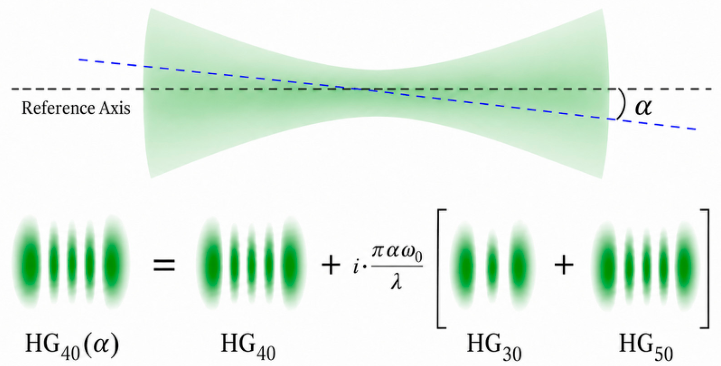
n−1,0. As illustrated in
Figure 1, taking HG
40 as an example, the tilted beam can be decomposed into HG
40, HG
30, and HG
50 components, with the tilt information carried by the combination of HG
30 and HG
50. The QCRB for the tilt angle is
Thus, the minimum detectable tilt angle decreases as , indicating that the extractable information associated with the tilt parameter increases with the mode order.
For angular rotation measurement, Xia et al. [
25] noted that the fundamental Gaussian mode is rotationally symmetric and therefore cannot directly carry angular rotation information. Existing schemes often exploit the enhanced rotational response associated with the OAM quantum number
l so that a mechanical rotation angle
is mapped to an optical polarization rotation amplified by a factor of
l [
14]. However, for rotation parameter estimation, the ultimate precision is determined not simply by the mean OAM but by the variance associated with the rotation generator
. Although HG modes can have zero mean OAM, their OAM distribution variance increases with the transverse mode order. They can therefore serve as sensitive pointers for angular rotation measurement.
Within the weak measurement framework, the estimation precision of the angular rotation parameter is governed by QFI. For an HG pointer with transverse indices
m and
n, OAM variance is
Accordingly, the QCRB gives
where
Aw is the weak value, and
ν is the number of independent repeated measurements. This indicates that the two transverse indices
m and
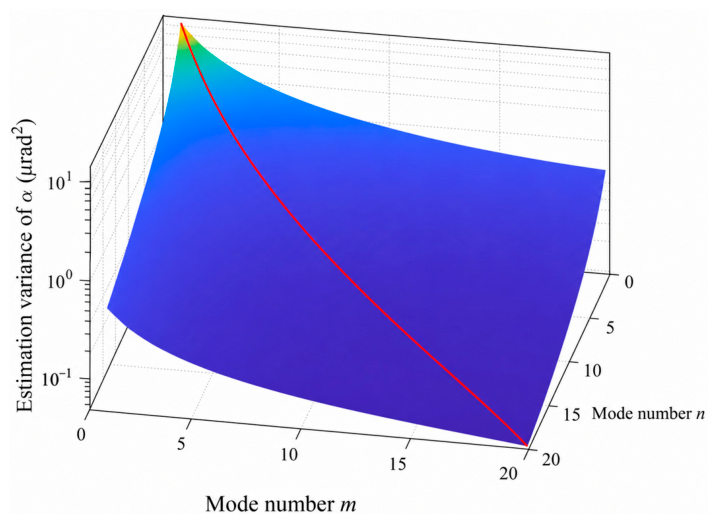
n jointly determine the information available for rotation estimation. By increasing OAM variance, HG modes reduce the lower bound of the angular rotation estimation error.
Figure 2 shows the lower bound on the angular rotation estimation variance for different HG mode indices, with the red curve corresponding to the case
m =
n.
4. Nonclassical Structured Light Sources and Surpassing the SNL
In the preceding section, higher-order modes of structured light show advantages in encoding spatial parameters. To surpass the SNL/SQL associated with coherent-state probes, however, nonclassical resources must be further introduced.
Li et al. [
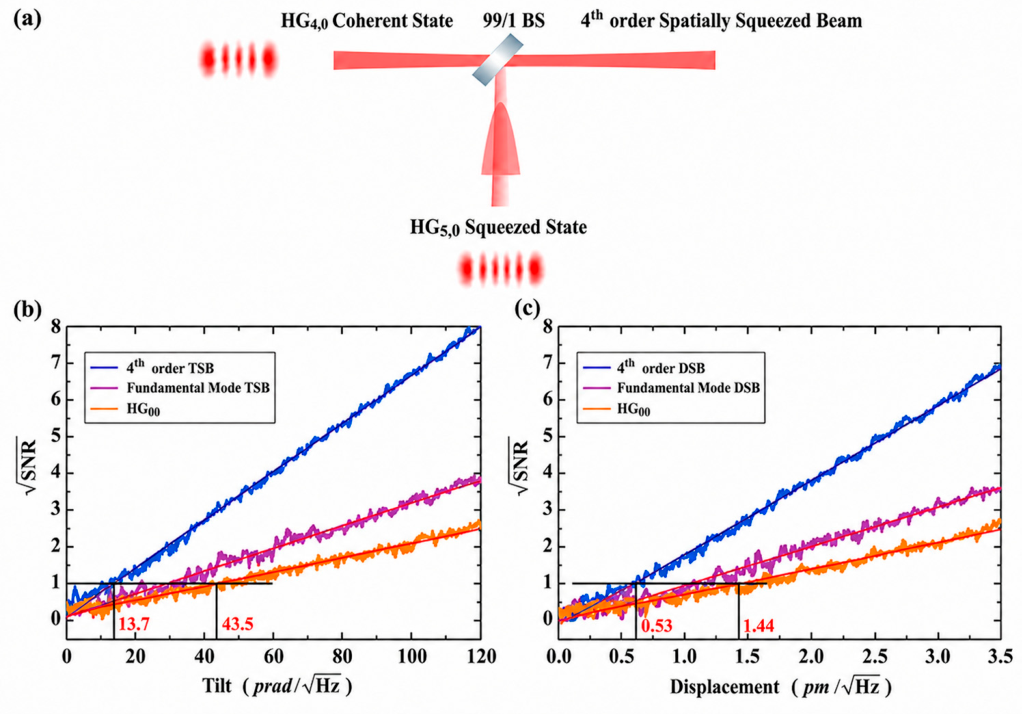
24] proposed a scheme for measuring transverse displacement and tilt using higher-order spatially squeezed beams. The central idea was to construct an
m-th-order spatially squeezed beam by combining a bright HG
m,0 coherent field with a squeezed vacuum state in the adjacent HG
m+1,0 mode. The HG
m,0 mode enhances the adjacent mode coupling induced by displacement or tilt, whereas the squeezed vacuum in the HG
m+1,0 mode reduces the noise of the mode that carries the parameter information. These two mechanisms therefore act simultaneously. The fourth-order spatially squeezed beam realized experimentally is shown in
Figure 3a. For a bright HG
m,0 probe beam, a small displacement d or tilt angle
θ projects part of the field in the initial mode onto the adjacent HG
m+1,0 mode. The displacement information is encoded in the amplitude quadrature of the HG
m+1,0 mode, whereas the tilt information is encoded in its phase quadrature. The corresponding displacement and tilt operators can be written as
where
and
denote the amplitude and phase quadratures of the HG
m+1,0 mode, respectively. If this mode is in the vacuum state, the corresponding fluctuation is at the SNL. If its amplitude or phase quadrature is squeezed, namely
or
, the displacement or tilt noise can be reduced below the SNL. The resulting uncertainties are
Here r is the squeezing parameter. Compared with an HG0,0 coherent-state probe, the ideal improvement factor is approximately . Thus, both increasing the HG mode order and increasing the squeezing level can both increase the QFI available for parameter estimation and reduce the QCRB. Specifically, the mode order mainly increases QFI by enhancing the variance in the parameter-encoding generator or strengthening the intermodal coupling, whereas the squeezing level realizes quantum enhancement mainly by reducing the quantum noise in the information-bearing orthogonal quadrature and improving the distinguishability of parameter-dependent states.
Experimentally, higher-order HG mode squeezed light was directly generated using a doubly resonant optical parametric amplifier, and the spatial signal was read out by using a mode-converting cavity (spatial light modulator) and HD. The generated beams were then applied to tilt and displacement measurements. The fourth-order tilt-squeezed beam (TSB) exhibited approximately 3.5 dB of squeezing and achieved a tilt sensitivity of
, corresponding to an approximately 10 dB SNR improvement over the HG
0,0 mode, as shown in
Figure 3b. The fourth-order displacement-squeezed beam (DSB) exhibited approximately 2 dB of squeezing and achieved a displacement sensitivity of
, corresponding to an approximately 8.6 dB SNR improvement over the HG
0,0 mode, as shown in
Figure 3c.
Liu et al. [
30] proposed a rotation angle measurement scheme based on a squeezed orbital angular position (OAP) state. The basic idea was to use an
mode to construct an angular structured field and to surpass the SNL by squeezing the quadrature associated with the rotation angle information. When the
mode is rotated by an angle
, the parameter information is transferred to the amplitude quadrature of the orthogonal
mode. The OAP operator is therefore defined as
The corresponding OAM operator can be written as
For a coherent state, the rotation angle uncertainty is limited by the SNL,
Because OAP and OAM form a pair of conjugate variables, squeezing the quadrature of
can reduce the fluctuation in the rotation angle variable. For an OAP squeezed state,
which corresponds to a sensitivity beyond the SNL.
As shown in
Figure 4a, the
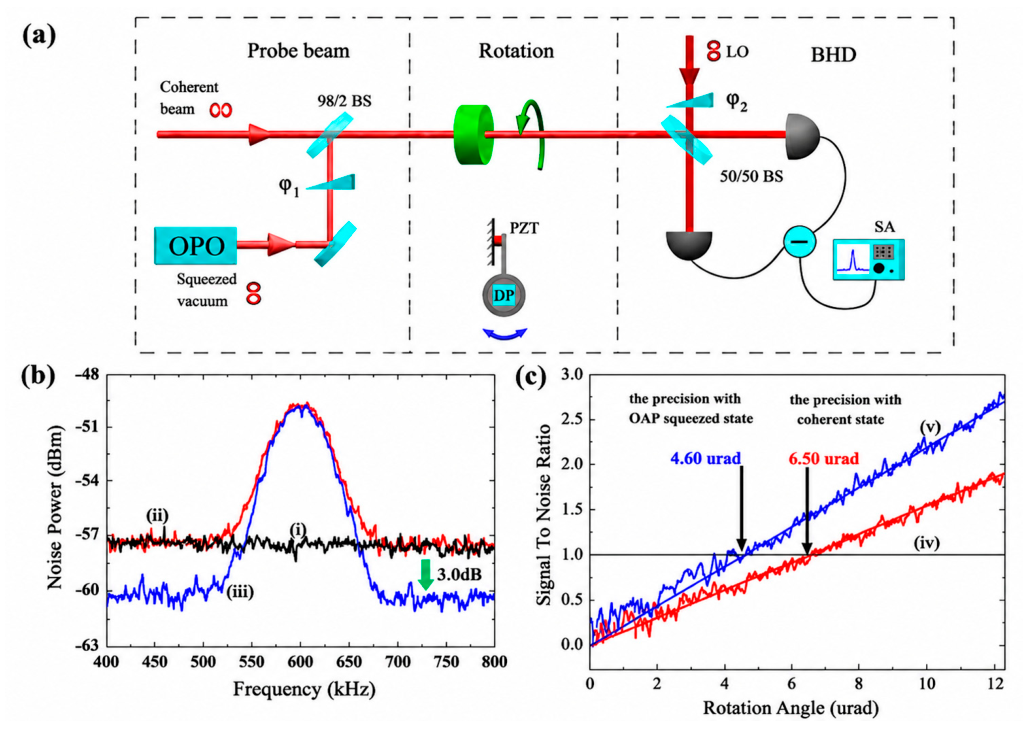
mode squeezed light was generated by an optical parametric oscillator (OPO) and combined with a bright coherent beam in the same mode using a 98:2 beam splitter. A small rotation was then introduced using a Dove prism and a PZT. Finally, BHD was performed, and the rotation signal was read out using a spectrum analyzer. The experimental results in
Figure 4b show that the measurement noise obtained with the OAP squeezed state was approximately 3 dB below the SNL. The minimum measurable angle of the OAP squeezed probe was reduced to
, corresponding to a sensitivity of
, as shown in
Figure 4c, which represents an approximately 1.4-fold improvement over the coherent-state probe.
The quantum enhancement in the above squeezed-state schemes mainly originates from the reduction in noise in a specific quadrature. Another route to quantum enhancement is to use multiphoton entanglement so that the parameter to be estimated acts on the entire multiphoton state and thereby enhances the phase response. An entangled state refers to a state of multiple photons or multiple modes that cannot be written as a direct product of independent component states; its parameter response can appear as collective coherent phase accumulation [
31]. For rotation angle measurement, if the entangled photons also carry nonzero OAM, the phase change induced by rotation not only depends on the OAM mode index
l but is further amplified by the number of entangled photons
N.
Jha et al. [
32] first extended
N-photon entanglement-enhanced phase measurement to angular displacement measurement. They used a
matrix method to describe the propagation of OAM-entangled photons through an interferometric structure containing a Dove prism and analyzed angular displacement measurements with two-photon and four-photon entangled states. The results showed that a two-photon entangled state can reach an angular displacement sensitivity of
, while the four-photon case can further reach
. For
entangled photons, angular resolution is enhanced with
Nl, and angular sensitivity can be written as
This is superior to the sensitivity obtained with
N unentangled single-photon Fock states,
Therefore, the OAM mode index l and the number of entangled photons N jointly enhance angular displacement measurement.
Hiekkamäki et al. [
23] further combined the multiphoton phase sensitivity of a N00N state with the angular rotation response of OAM modes, experimentally realizing photonic angular super-resolution using twisted N00N states. A N00N state is one of the most representative multiphoton entangled states and can be written as
Here, denotes the state in which all N photons occupy the OAM mode with +l, whereas denotes the state in which all N photons occupy the OAM mode with −l. This state is not an independent distribution of N photons over two OAM modes; rather, it is a coherent superposition of the two possibilities in which all photons occupy either the +l mode or the −l mode. Therefore, when the optical field is rotated by an angle about the propagation axis, the N00N state accumulates a relative phase of . The rotation angle information is thus enhanced simultaneously by the photon number N and the OAM index l.
From the perspective of QFI, angular rotation is generated by the OAM operator
. The corresponding QFI is
The associated QCRB is
where
v is the number of independent repetitions. These equations show that the N00N state enhances QFI with an
N2 scaling and, at the level of the theoretical precision bound, surpasses the SQL associated with
N independent photons.
The experimental setup is shown in
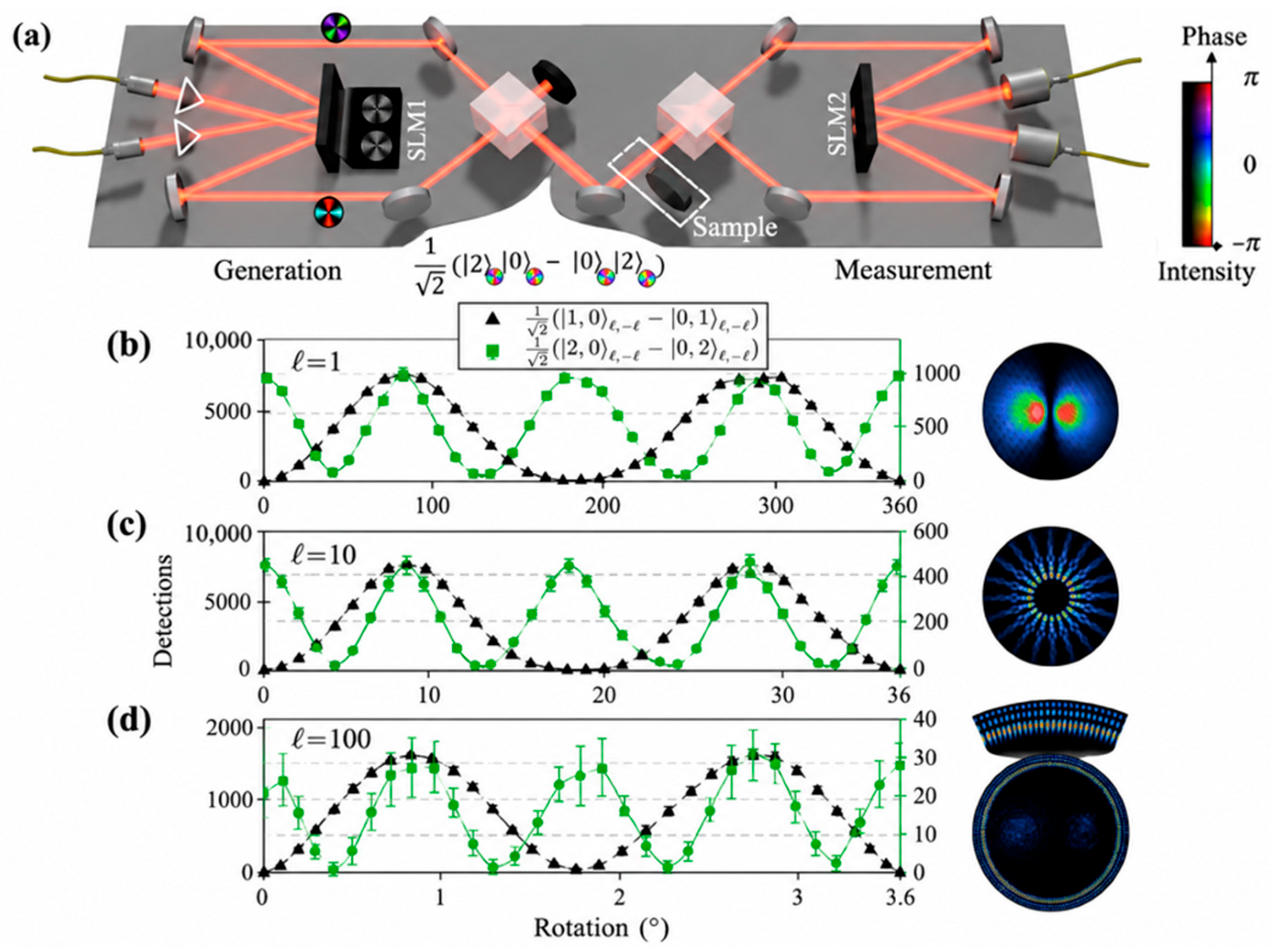
Figure 5a. Photon pairs were generated using a spontaneous parametric down-conversion (SPDC) source. A preset OAM mode was imposed on each photon using SLM1, and the photons were then combined at a beam splitter to form a twisted N00N state. The rotation of the optical field was simulated by rotating the hologram on SLM2, and the coincidence counts were recorded as a function of
. As shown in
Figure 5b–d, when
l was increased from 1 to 10 and 100, the interference fringe period decreased markedly, demonstrating that the OAM order enhanced the angular rotation response. At the same
l, replacing a single-photon state with a two-photon N00N state further doubled the resolution, thereby realizing angular super-resolution.
Compared with squeezed-state schemes, N00N-state schemes exhibit their advantage more prominently through fringe compression and angular super-resolution arising from multiphoton coherence. However, the sensitivity enhancement associated with increasing the OAM order mainly corresponds to the ideal enhancement in the rotation-dependent phase response and should not be interpreted as an unlimited improvement in practical measurement sensitivity with increasing
l. As the OAM order increases, the azimuthal phase of the optical field varies more rapidly, and the transverse spatial structure generally becomes more complex, imposing more stringent requirements on mode generation, propagation, and detection. In practical experiments, finite aperture and detector size, SLM pixelation, wavefront aberrations, beam divergence, propagation-induced distortions, and crosstalk between neighboring OAM modes can reduce mode purity, interference visibility, and mode matching efficiency [
33,
34,
35,
36]. In addition, N00N-state schemes are intrinsically more sensitive to loss, mode matching, and detection efficiency [
37,
38,
39]. Therefore, for practical angular displacement estimation, the advantage of high-order OAM modes relies on maintaining high mode purity, stable propagation, and efficient mode-matched readout. Both nonclassical light sources and suitable readout strategies are thus equally important.
5. Mode-Matched Readout of Spatial Parameters in Structured Light
As for theoretical quantities, QFI and the QCRB are determined by the quantum state and the parameter-encoding process. In an actual experiment, accessible information is CFI which is associated with a specific measurement scheme, and the corresponding precision is bounded by the classical CRB [
19]. If the measurement cannot efficiently read out the spatial mode or observable into which the parameter is encoded, the achieved estimation precision may remain far from the QCRB [
22]. Therefore, it is also important to figure out how to design an appropriate readout strategy such that CFI approaches QFI.
From the perspective of spatial modes, displacement, tilt and angular rotation generally do not merely change total optical intensity. Instead, parameter information is transferred to specific orthogonal spatial modes [
21], their field quadratures [
24] or photon number statistical structures [
26,
40]. Thus, the key to optimal readout is not simply the optical power at the detector but whether the detection mode is matched to the information-bearing mode. By selecting the information mode or information-bearing observable excited by the parameter perturbation, the measurement probability distribution can be made maximally sensitive to the parameter, thereby increasing CFI [
22,
41].
Delaubert et al. [
13] proposed and experimentally verified a TEM
00 mode HD scheme for extracting full displacement and tilt information. For a paraxial TEM
00 Gaussian beam, information about a transverse displacement
and a tilt, represented by the transverse momentum
p, is encoded in the TEM
10 component as
where
A0 is the amplitude of the incident TEM
00 mode. Displacement information is encoded in the in-phase amplitude quadrature of the TEM
10 mode, whereas tilt information is encoded in its phase quadrature.
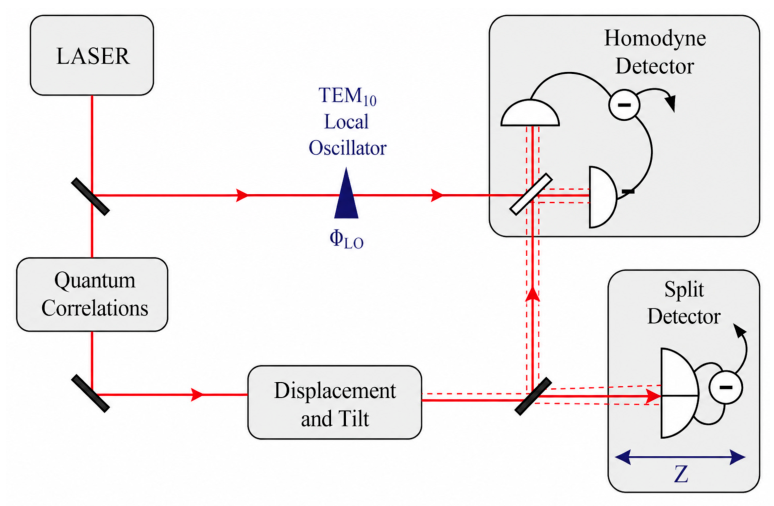
The experiment compared conventional split detection with HD, as shown in
Figure 6. Split detection estimates displacement by measuring the intensity difference between the left and right halves of the beam. In contrast, HD interferes with the signal beam containing displacement and tilt information with a TEM
10 LO at a 50:50 beam splitter, and the signal is obtained from the difference photocurrent of the two output ports. A split detector effectively responds to the flipped mode, i.e., a TEM
00-like mode whose two halves differ by a
-phase jump, rather than to the TEM
10 mode that is matched to the parameter information. By using a TEM
10 LO, HD directly selects the relevant information mode and therefore provides a higher detection efficiency than conventional split detection.
In the differential photocurrent of balanced HD, the signal-dependent term is proportional to
When
, detection mainly reads out displacement; when
, it mainly reads out tilt. Therefore, by tuning the LO phase, the continuous variable readout of displacement and tilt can be realized. Delaubert et al. also compared the SNRs of the two schemes. Under the same signal beam power,
Thus, the detection efficiency of split detection is only 64%, whereas HD yields a CFI closer to the information extraction limit. Furthermore, if squeezed vacuum is injected into the TEM10 mode, the quantum fluctuation in the corresponding noise mode can be reduced, enabling displacement measurement below the quantum noise limit.
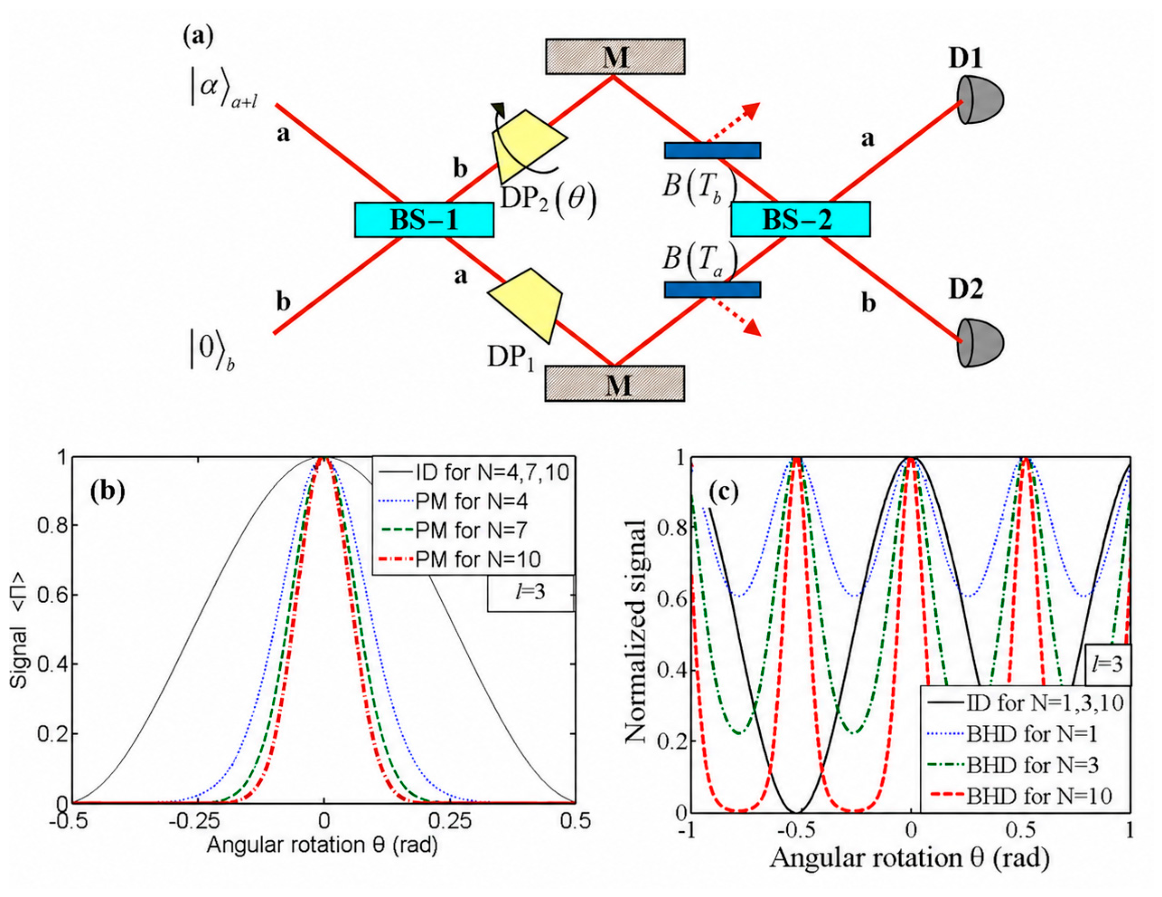
For angular rotation measurement based on photonic OAM, Zhang et al. proposed two different readout strategies: PM and binary-outcome homodyne detection (BHD) [
26,
40]. The central idea of these two strategies is not to modify the OAM probe state but to select different output observables such that the measurement probability distribution becomes more sensitive to angular rotation, thereby increasing the practically extractable CFI. The two schemes used similar experimental configurations, as shown in
Figure 7a. A coherent state carrying OAM quantum number
enters one input port of a Mach–Zehnder interferometer, while the other input port is in the vacuum state. A Dove prism converts a mechanical rotation angle
into an optical phase shift
. Under conventional ID, the signal at output port
in the lossless case is
This expression shows that OAM itself already provides an l-fold enhancement in angular resolution response.
The first strategy is PM [
26]. Instead of using the output intensity as the measurement signal, this method measures the parity of the photon number at the output port. The parity operator is defined as
, where
is the photon number operator, and its expectation value is used as the measured observable:
Here,
is the input mean photon number, and
Ta and
Tb are the transmission coefficients of the two arms, which describe photon loss. In the symmetric lossless case,
Ta =
Tb = 1, Equation (31) reduces to
This signal exhibits a very narrow interference peak near
, as shown in
Figure 7b. Compared with ID, the PM signal is significantly narrower, and the peak width decreases as the photon number
N increases. The main advantage of PM is that it further improves angular resolution performance on top of OAM-induced amplification.
The second strategy is BHD [
40]. This method performs homodyne detection on the phase quadrature of the output port and obtains the probability distribution of the continuous variable
h:
A binary output signal is then constructed at
h = 0:
Figure 7c shows that, under the same
l and
N, the output peak of BHD is narrower than that of ID. Moreover, as the mean photon number
N and the OAM quantum number
l increase, the peak width of BHD decreases further. This result indicates that binary-outcome HD can provide higher angular resolution capability than ID.
In addition to the above schemes, single-mode projection is also an important mode-matched readout method for spatial parameter measurements with structured light. Xia et al. [
25] proposed a scheme for extracting rotation information through single-mode projection. Following postselection, angular rotation information is transferred to an HG superposition state that is orthogonal to the initial HG mode. Therefore, projection onto this specific orthogonal state allows the rotation information to be read out directly, without requiring the full tomography of either the OAM spectrum or the HG mode spectrum. For an initial HG state
subject to a rotation, the rotation parameter to be estimated is mainly mapped onto the following orthogonal information mode:
This state is a superposition composed of adjacent HG modes, and the rotation parameter is carried by this state. Therefore, the readout only requires the projection of the final optical field onto
. To implement this readout, Xia et al. adopted a binary projective measurement
Here,
denotes the projector onto the information mode
, while
represents the orthogonal complement containing all components not projected onto this information mode. This measurement has only two outcomes: one corresponds to the successful projection of the photon onto the HG mode carrying rotation information, and the other corresponds to projection onto the remaining orthogonal modes. Under this projective measurement, CFI for the rotation parameter
is
This result is consistent with the QCRB given in Equation (13), indicating that when the projection mode is matched to the rotation information mode, the CFI obtained from single-mode measurement can reach the theoretical upper bound set by QFI, thereby saturating the QCRB.
Santos Junior et al. [
42] further proposed a parity-sorting measurement scheme for displacement measurement with high-order HG/LG structured light modes from the perspective of spatial inversion symmetry. HG and LG modes have well-defined parity under the spatial inversion transformation
. When the beam undergoes a small transverse displacement, a spatial mode with a definite parity is coupled to modes with the opposite parity. Therefore, separating the opposite-parity component allows the displacement magnitude to be inferred.
For a small displacement
d along the
x direction, the displacement operation can be written as
where
. If the initial mode
has a definite inversion parity, the first-order perturbation term
is orthogonal to the original mode and has the opposite parity. Thus, the displacement information resides in the parity-opposite component that is orthogonal to the original mode.
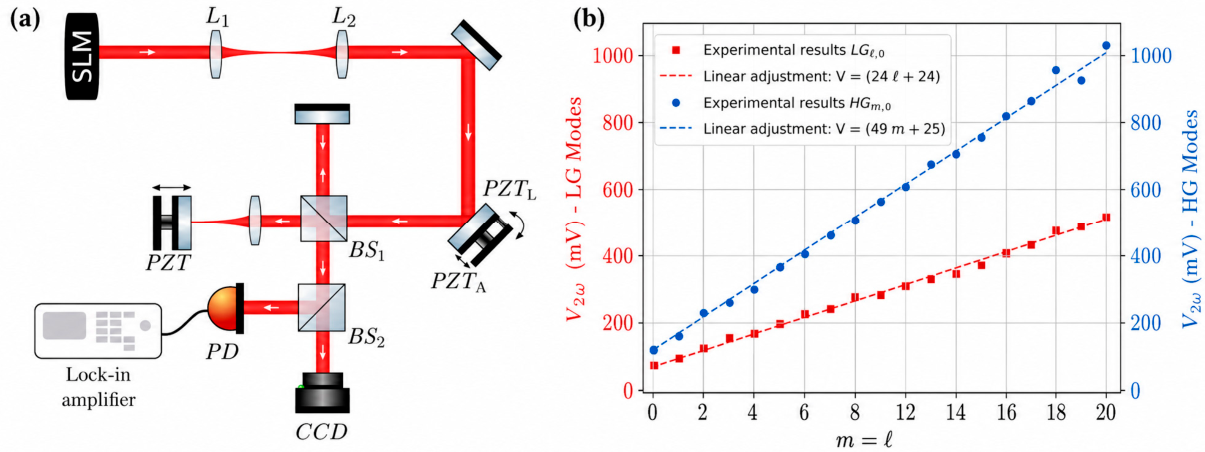
As shown in
Figure 8a, the experimental scheme uses a modified Michelson interferometer to implement parity sorting. One arm contains a 4f system that performs spatial inversion on the input field. Spatial inversion leaves even modes unchanged but adds an additional
phase to odd modes. Therefore, when the longitudinal phase difference between the two arms is set to zero, odd and even modes exit through different output ports. In this way, the original mode and the displacement-induced opposite-parity component are converted into intensity signals at two separate ports.
By measuring the intensities at the two ports, one obtains the probability
P of the original mode and the probability
P′ of the opposite-parity component. For an HG
m,0 mode,
This expression shows that the displacement information is carried by a superposition of the
m + 1 and
m − 1 modes, whose spatial parity is opposite to that of the original mode. Accordingly, the detection probabilities of the original mode and the opposite-parity component are
The CFI obtained from this binary measurement is
The QFI for transverse displacement is
In the small displacement limit, CFI coincides with QFI. Therefore, parity sorting reaches the optimal measurement for this displacement estimation problem, and the same principle also applies to LG modes.
The experimental results shown in
Figure 8b demonstrate that when high-order HG modes were used, the SNR was enhanced by up to a factor of 41 compared with that obtained using the fundamental Gaussian beam. For high-order LG modes, the maximum SNR enhancement reached a factor of 21. These results further indicate that HG modes are more sensitive than LG modes to displacement along a single transverse direction.
6. Summary and Prospect
In conclusion, recent progress in the study of structured light in the quantum metrology of spatial parameters within the framework of quantum parameter estimation was summarized. Through transverse spatial modes, the OAM degree of freedom and intermodal coupling, structured light enables spatial parameters such as beam displacement, tilt and angular rotation to be encoded into specific transverse modes or azimuthal phase responses. This increases the QFI carried by the probe state and lowers the theoretical precision bound according to the QCRB. On this basis, the utilization of squeezed states could further reduce the quadrature noise associated with the information-bearing mode, whereas N00N states and OAM-entangled states could enhance angular rotation sensitivity through multiphoton coherent responses. Structured light spatial encoding and nonclassical resources therefore provide complementary routes toward quantum-enhanced spatial parameter estimation. At the same time, the increased QFI can be converted into practical precision enhancement only when an appropriate readout strategy is employed. Measurement schemes such as HD, PM and parity sorting are designed to extract the observables that carry relevant parameter information, thereby allowing the achieved precision to approach the QCRB.
Despite the demonstrated potential of structured light for spatial parameter estimation, several challenges still remain. First, the generation and propagation of high-order structured light modes for high-precision measurement bring stringent requirements on experimental stability. For high-dimensional OAM modes and multimode HG modes, high-efficiency, low-crosstalk and scalable mode sorting and mode transformation remain key technical challenges for practical implementation [
33,
34,
35,
36]. Second, the preparation of nonclassical structured light sources is experimentally demanding. Spatially squeezed states require stable squeezing in prescribed spatial modes, while multiphoton entangled states and N00N states are highly sensitive to optical loss, detection efficiency and interference visibility. As the photon number and mode dimensionality increase, experimental complexity grows rapidly [
37,
38,
39]. In addition, loss, decoherence, limited detection efficiency and technical noise in realistic measurement environments reduce the accessible Fisher information and make it difficult to fully preserve the quantum advantage [
18,
39]. This explains why many schemes, although theoretically capable of high sensitivity, still retain some distance from stable, reproducible and integrable practical sensing.
Future research should move beyond proof-of-principle demonstrations and place greater emphasis on practical deployment. Higher-fidelity structured light control techniques, including programmable spatial mode transformation, multi-plane light conversion and integrated photonic platforms, should be further developed to improve the generation, transmission and sorting efficiency of complex spatial modes [
35,
36]. In parallel, nonclassical structured light sources need to achieve a better balance among squeezing level, mode purity, loss tolerance and system stability, especially when spatial squeezing, N00N states or OAM-entangled probes are implemented in realistic environments [
37,
38,
39]. Recent studies published in 2025–2026 further support these directions, showing that vortex light metrology, quantum structured light, noise-resilient topological modes, entangled OAM probes and spatially structured quantum optical circuits are becoming important routes toward robust and scalable structured light quantum sensing [
43,
44,
45,
46,
47]. In addition, adaptive measurements, machine-learning-assisted optimization and multiparameter quantum estimation will be important for identifying near-optimal measurement bases under complex noise conditions and realistic sensing scenarios in which displacement, tilt, rotation and wavefront distortion coexist [
48,
49,
50].