1. Introduction
The rapid advancement of 5G/6G wireless communications, broadband radar, high-speed optical interconnects, and quantum information technologies has driven increasing demand for radio-frequency (RF) signals with high carrier frequencies, broad bandwidths, and high fidelity [
1]. As the key interface between digital signal processing and analog signal generation, digital-to-analog converters (DACs) largely determine the system bandwidth, dynamic range, and spectral purity of modern electronic systems [
2]. However, conventional electronic DACs are fundamentally limited by device bandwidth, clock jitter, parasitic effects, and power consumption, making it difficult to simultaneously achieve a high sampling rate, high resolution, and broadband operation [
3]. By exploiting the ultrawide bandwidth, low crosstalk, and strong immunity to electromagnetic interference offered by photonic technologies, photonic digital-to-analog converters (PDACs) have emerged as a promising solution to overcoming the limitations of electronic DACs. By mapping digital information onto the intensity, phase, wavelength, or temporal characteristics of optical carriers and performing signal synthesis in the optical domain, PDACs enable high-speed, broadband, and energy-efficient RF arbitrary waveform generation [
4].
Existing PDAC architectures can generally be categorized into three classes according to their digital-weighting implementation and optical-domain synthesis mechanisms: parallel, serial, and segmented/hybrid architectures [
4]. Parallel PDACs resemble conventional binary-weighted DACs, where digital bits are distributed among multiple spatial or wavelength channels and subsequently combined through weighted optical amplitudes, phases, or photocurrents. Representative implementations include coherent summation, photocurrent summation, and microring-resonator-based weighting architectures. For example, Meng et al. [
5] demonstrated a coherent parallel PDAC on a silicon photonic platform to alleviate electronic bottlenecks in high-speed networks. Chugh et al. [
6] proposed a high-speed integrated PDAC based on photocurrent summation, reducing the reliance on precise coherent phase control. Moazeni et al. [
7] reported a 40-Gb/s PAM-4 PDAC transmitter employing microring resonators. Although parallel PDACs offer high conversion speed and scalability, they generally require multiple modulators and complex optical interconnections, resulting in increased hardware complexity and stringent channel-matching requirements. Serial PDACs perform bit weighting, ordering, and signal synthesis through temporal, wavelength, or dispersive processing mechanisms within a single channel. Typical implementations employ multiwavelength pulse summation, wavelength-to-time mapping, dispersive delay processing, or optical time-division multiplexing. Peng et al. [
8] proposed a 3-bit PDAC based on serially weighted multiwavelength pulse summation, while Zhang et al. [
9] experimentally demonstrated a 4-bit, 10-GSa/s serial PDAC using time–wavelength interleaving. Gao et al. [
10] further employed a 4-bit serial PDAC for arbitrary waveform generation, and Xin et al. [
11] demonstrated the generation and detection of 120-Gbaud PAM-4/PAM-6 signals using a serial PDAC. Owing to their reduced hardware requirements, serial architectures can achieve digital-to-analog conversion with fewer modulators. However, their performance is highly sensitive to timing-delay accuracy, dispersion linearity, and photodetector response characteristics. Moreover, the inherently sequential conversion process imposes constraints on the achievable output waveform bandwidth. Segmented and hybrid PDACs integrate digital-weighting functionality into one or a few electro-optic devices using segmented electrodes, programmable transfer functions, or hybrid coding strategies. These architectures provide a compact and energy-efficient solution, while enabling digitally controlled analog signal synthesis through optimization of electrode lengths, weighting coefficients, or resonant characteristics. Patel et al. [
12] demonstrated a silicon-photonic segmented Mach–Zehnder modulator (MZM)-based DAC for 100-Gb/s PAM-4 generation. Li et al. [
13] improved output linearity through optimized segmented weighting, whereas Aimone et al. [
14] realized a programmable-transfer-function PDAC using an InP segmented MZM. Nazarathy et al. [
15] further proposed a segmented-electrode MZM architecture for optical-domain synthesis of high-order modulation formats. Nevertheless, the linearity and scalability of these approaches remain fundamentally constrained by the nonlinear electro-optic transfer characteristics, which limit the achievable waveform fidelity and system scalability.
To further overcome the tradeoff among bandwidth, accuracy, and implementation complexity in existing PDACs, recent efforts have explored the incorporation of digital noise-shaping techniques into photonic conversion systems [
16,
17]. In particular, delta–sigma (ΔΣ) modulation suppresses in-band quantization noise through oversampling and noise shaping, enabling an enhanced signal-to-noise ratio (SNR) and effective number of bits (ENOBs) even under low-bits quantization. Meanwhile, the limited sampling rate remains a major obstacle to broadband and high-frequency waveform generation in PDAC systems. Fractional temporal Talbot processing, enabled by dispersive propagation, provides an elegant solution by passively multiplying the repetition rate of optical pulse trains, thereby increasing the effective sampling rate and extending the achievable signal bandwidth. Recent studies have further demonstrated the potential of Talbot-based techniques for microwave photonic signal generation and processing [
18,
19].
In this work, we propose and experimentally demonstrate a single-channel two-bit PDAC architecture that integrates ΔΣ noise shaping and Talbot pulse repetition-rate enhancement. A dual-drive Mach–Zehnder modulator (DDMZM) is employed to realize four-level optical intensity mapping within a single modulation channel, enabling high-fidelity digital-to-optical conversion with only two quantization bits. By exploiting the fractional Talbot effect, a 10.2 GHz optical pulse train is passively enhanced to 30.6 GHz, providing an effective sampling rate of 30.6 GSa/s. Based on the proposed architecture, single-chirp and dual-chirp microwave waveforms covering the 6.5–8.5 GHz and 8–12 GHz frequency bands are successfully generated, with measured ENOB exceeding 3.6. In addition, high-fidelity reconstruction of 1 GHz square and triangular waveforms is demonstrated. Compared with conventional PDAC schemes, the proposed approach incorporates ΔΣ noise shaping to suppress in-band quantization noise, employs Talbot pulse repetition-rate enhancement to increase the effective sampling rate, and realizes four-level mapping with a single-channel architecture to reduce system complexity and eliminate inter-channel mismatch, providing a practical and scalable solution for high-performance microwave photonic arbitrary waveform generation and next-generation PDAC systems.
2. Principle of Operation
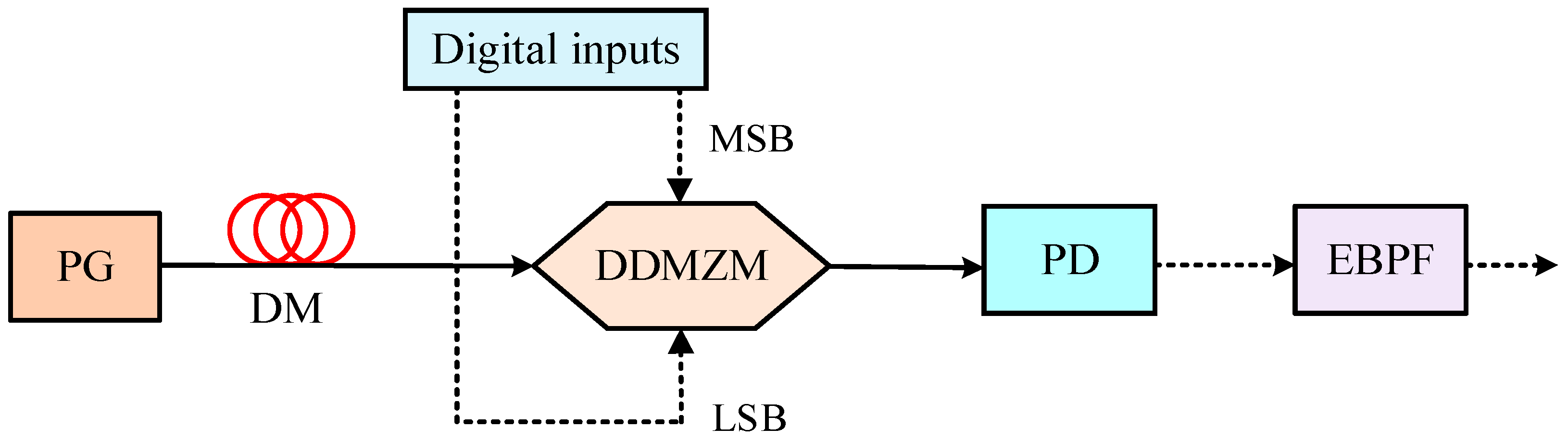
Figure 1 illustrates the operating principle of the proposed single-channel two-bit PDAC architecture incorporating ΔΣ noise shaping and pulse repetition-rate enhancement. The system mainly comprises five stages: high-speed optical sampling clock generation, ΔΣ digital sequence generation, electro-optic multilevel mapping, photodetection, and RF waveform generation. By combining digital noise shaping with optical sampling-rate enhancement, the proposed architecture achieves broadband and high-fidelity microwave waveform synthesis while maintaining a simple hardware configuration.
An ultrashort optical pulse train with a repetition period of
T is first generated by a pulse generator (PG). To enhance the effective sampling rate without relying on an ultrahigh-repetition-rate pulse source, the optical pulse train is directly launched into a dispersive medium (DM). By properly tailoring the accumulated dispersion to satisfy the fractional Talbot condition, the temporal Talbot effect enables passive pulse repetition-rate enhancement, resulting in a high-speed optical sampling clock. The optical intensity of the initial low-repetition-rate pulse train emitted by the PG can be expressed as
where
p(
t) denotes the temporal envelope of an individual optical pulse. After propagating through the dispersive medium, the pulse train undergoes temporal self-imaging. When the accumulated dispersion satisfies the
mth-order fractional Talbot condition, the pulse repetition rate is multiplied by a factor
m. The resulting optical pulse train can be expressed as
where
is the pulse intensity scaling factor and
denotes the pulse period after the Talbot effect. Consequently, the effective sampling rate is increased to
, providing a high-repetition-rate optical sampling clock for subsequent electro-optic modulation.
The high-speed 2-bit sequence x[n] is generated by a digitally implemented 2-bit eighth-order CRFF Delta–Sigma (ΔΣ) modulator with optimized feedback coefficients, where oversampling and noise shaping are employed to suppress the in-band quantization noise. After serial-to-parallel conversion, x[n] is decomposed into the MSB (most significant bit) and LSB (least significant bit) binary streams, which drive the two RF ports of a DDMZM at a rate synchronized with the rate-enhanced optical pulses. A single-channel electro-optic mapping architecture is employed to eliminate the channel-matching issues inherent to multi-modulator PDAC schemes. The MSB and LSB signals, with voltage amplitudes and , are applied to the two arms of the DDMZM, respectively. Through phase modulation and optical interference, the DDMZM converts the binary drive signals into discrete optical intensity levels for subsequent waveform synthesis.
To realize uniformly spaced four-level optical intensity modulation, the DDMZM is biased at the minimum-transmission point, corresponding to a static phase difference of
between its two arms. Neglecting the insertion loss of the device, the output optical intensity
can be expressed as
where
denotes the half-wave voltage of the DDMZM. The analog-domain representations of the MSB and LSB driving signals are denoted by
and
, respectively. Here,
and
represent binary sequences taking values of 0 or 1, while
and
correspond to their respective voltage amplitudes. To establish a linear mapping between the four possible two-bit input codes (00, 01, 10, 11) and four equally spaced optical intensity levels (
), the amplitudes of the two driving signals must be properly optimized. Consequently,
and
are required to satisfy
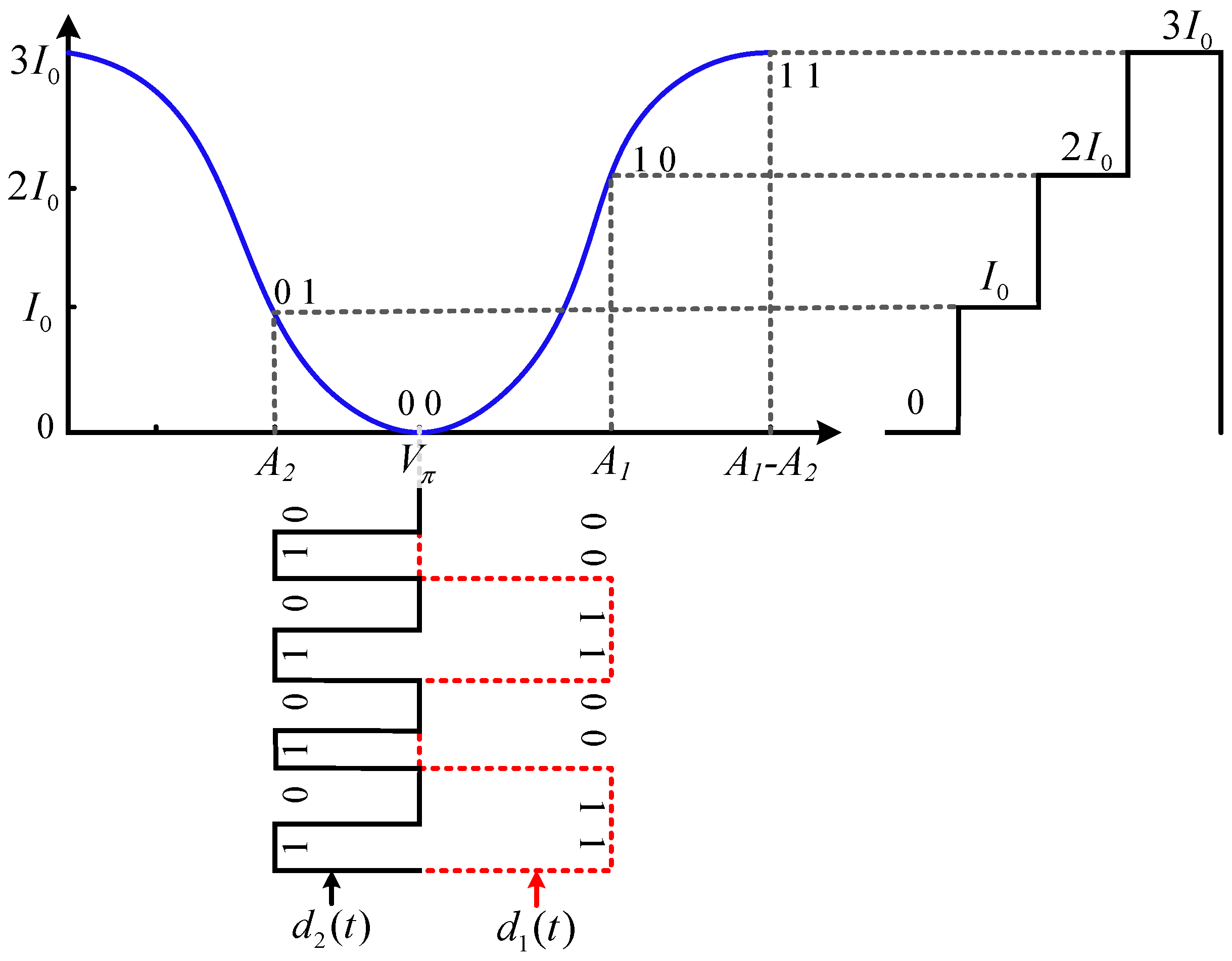
Figure 2 further illustrates the operating principle of the proposed two-bit four-level electro-optic mapping scheme. The horizontal axis represents the voltage difference (
) between two arms of the DDMZM, whereas the vertical axis denotes the output optical intensity. As indicated by Equation (3), the transfer characteristic of the DDMZM follows a cosine response, whose phase offset is determined by the applied bias voltage. When the modulator is biased at the minimum-transmission point, the resulting transfer curve is shown by the blue solid line in
Figure 2. According to the voltage-amplitude ratio specified by Equation (4), the two binary driving sequences independently modulate two arms of the DDMZM with amplitudes
and
, respectively. For illustration, the MSB sequence is assumed to be “0 0 1 1 0 0 1 1” (red dashed line), while the corresponding LSB sequence is “0 1 0 1 0 1 0 1” (black solid line). Different input code combinations generate distinct phase differences, which are subsequently converted into four uniformly spaced optical intensity levels through the transfer characteristic of the DDMZM. The corresponding code-to-intensity mapping and the resulting differential phase shift are summarized in
Table 1. As given in
Figure 2 and
Table 1, the input code “1 1” produces the maximum output intensity of
, whereas the code “0 0” corresponds to the minimum intensity of zero. The intermediate codes “1 0” and “0 1” generate optical intensity levels of
and
, respectively. Therefore, by properly designing the amplitude values of the two driving signals, an accurate linear mapping from two-bit digital codes to discrete four-level optical intensity can be achieved. These uniformly distributed optical samples provide the foundation for subsequent high-fidelity microwave waveform reconstruction.
The modulated four-level optical pulse train is subsequently converted into the electrical domain by a photodetector (PD). Owing to the linear response of the PD, the generated photocurrent
is proportional to the incident optical intensity, i.e.,
, where
denotes the responsivity of the photodetector. For analytical convenience, the two-bit ΔΣ-modulated digital sequence is represented by its equivalent continuous-time multilevel waveform
. By combining Equations (2) and (3), the output electrical signal can be expressed as
Equation (5) indicates that the proposed PDAC operation can be interpreted as pulse sampling of the equivalent analog waveform using a high-repetition-rate optical pulse train. Consequently, the achievable signal bandwidth is directly related to the effective sampling rate provided by the Talbot-enhanced optical pulse.
To further reveal the waveform-generation mechanism of the proposed PDAC, the frequency-domain representation of Equation (5) is derived through Fourier transformation. Assuming the optical pulse train can be approximated as an ideal Dirac pulse sequence and denoting the spectrum of the equivalent digital input signal
by
, the spectrum of the output photocurrent can be expressed as
where
denotes the Nyquist-zone index,
Rs is the effective sampling rate, which is equal to the repetition rate of the Talbot-enhanced optical pulse train. As indicated by Equation (6), the spectrum of the input signal is periodically replicated in the frequency domain. Consequently, the desired waveform can be generated not only within the first Nyquist zone (NZ) but also in higher-order zones through spectral translation. This property enables the direct synthesis of high-frequency microwave signals without requiring an optical pulse source operating at the target carrier frequency. Note that each NZ has a bandwidth of
Rs/2; increasing
Rs not only enlarges the available NZ bandwidth but also extends the achievable microwave waveform bandwidth.
Furthermore, owing to the noise-shaping characteristic of ΔΣ modulation, most quantization noise is shifted outside the signal band. Therefore, by employing an electrical band-pass filter (EBPF) centered at the target frequency band, with a bandwidth determined by both the ΔΣ noise-transfer function and the target bandwidth, the out-of-band quantization noise can be effectively suppressed. As a result, high-fidelity microwave waveforms with enhanced SNR and ENOB can be directly reconstructed.
3. Experiment and Discussions
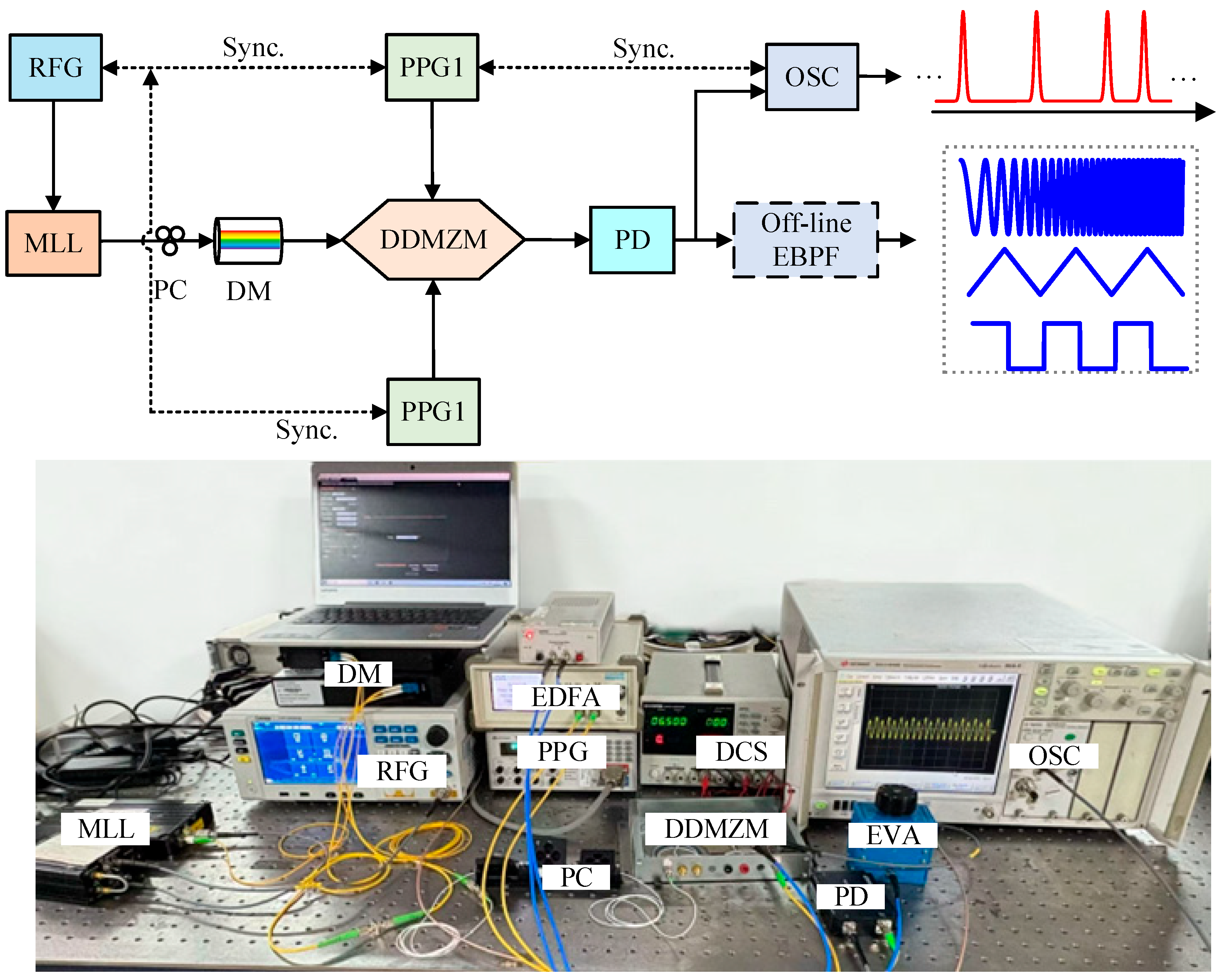
We experimentally demonstrate the proposed single-channel two-bit PDAC system enabled by ΔΣ noise shaping and Talbot pulse-rate enhancement. The schematic diagram and photograph of the experimental setup are given in
Figure 3 (up and down). A mode-locked laser (MLL, Lyra-PPS-1000, Pilot Photonics, Dublin, Ireland) generated an optical pulse train with a center wavelength of 1550 nm, a pulse full width at half maximum (FWHM) of approximately 20 ps, and a repetition rate of 10.2 GHz. After polarization adjustment by a polarization controller (PC), the optical pulses were launched into a dispersive module realized using standard single-mode fiber (SMF). By introducing an accumulated group-delay dispersion of 506.9 ps
2, the third-order fractional Talbot condition was satisfied, resulting in passive pulse-rate enhancement from 10.2 GHz to 30.6 GHz. The resulting high-repetition-rate pulse train served as the optical sampling clock for the subsequent digital-to-analog conversion process. The target waveform was first processed by a two-bit ΔΣ modulator and serial-to-parallel conversion to generate two synchronized 1-bit digital sequences corresponding to the MSB and LSB. These sequences were loaded into a pattern pulse generator (PPG, Keysight N4960A, Keysight Technologies, Santa Rosa, CA, USA) operating at 30.6 Gb/s and applied to the two arms of a dual-drive Mach–Zehnder modulator (DDMZM, Fujitsu FTM7937EZ/202, Fujitsu Limited, Tokyo, Japan). Since the two output ports of the PPG provide identical output amplitudes, an electrical variable attenuator (EVA, RBS-9-26.5-8-10W, Suzhou Rebes Electronic Technology Co., Ltd., Suzhou, China) was inserted into one branch to obtain the two desired driving voltages. The following DDMZM featured a 40 GHz electro-optic bandwidth that was biased at the minimum-transmission point to achieve the linear four-level optical intensity mapping described in
Section 2. The modulated optical pulse train was then amplified by an erbium-doped fiber amplifier (EDFA, AMONICS AEDFA-23-B-FA, Amonics Limited, Hong Kong, China). After amplification, the optical signal was detected by a 40 GHz photodetector (PD, KEYANG KY-PRM-40G-I-FA, Beijing Keyang Photonics Co., Ltd., Beijing, China), converting it into the electrical domain. The resulting electrical signal was captured using a sampling oscilloscope (OSC, Keysight 86100D equipped with an 83484A module, Keysight Technologies, Santa Rosa, CA, USA). To suppress the out-of-band quantization noise introduced by ΔΣ modulation and recover the desired microwave signal, an off-line band-pass filter (EBPF) was applied during post-processing.
Note that accurate waveform synthesis requires strict temporal synchronization among the optical sampling clock, digital driving signals, and measurement instruments. Therefore, the MLL, PPG, and OSC were all referenced to a common 10 MHz clock generated by a radio-frequency generator (RFG, R&S SMB100A, Rohde & Schwarz, Munich, Germany), ensuring stable sampling, detection, and waveform reconstruction throughout the experiment.
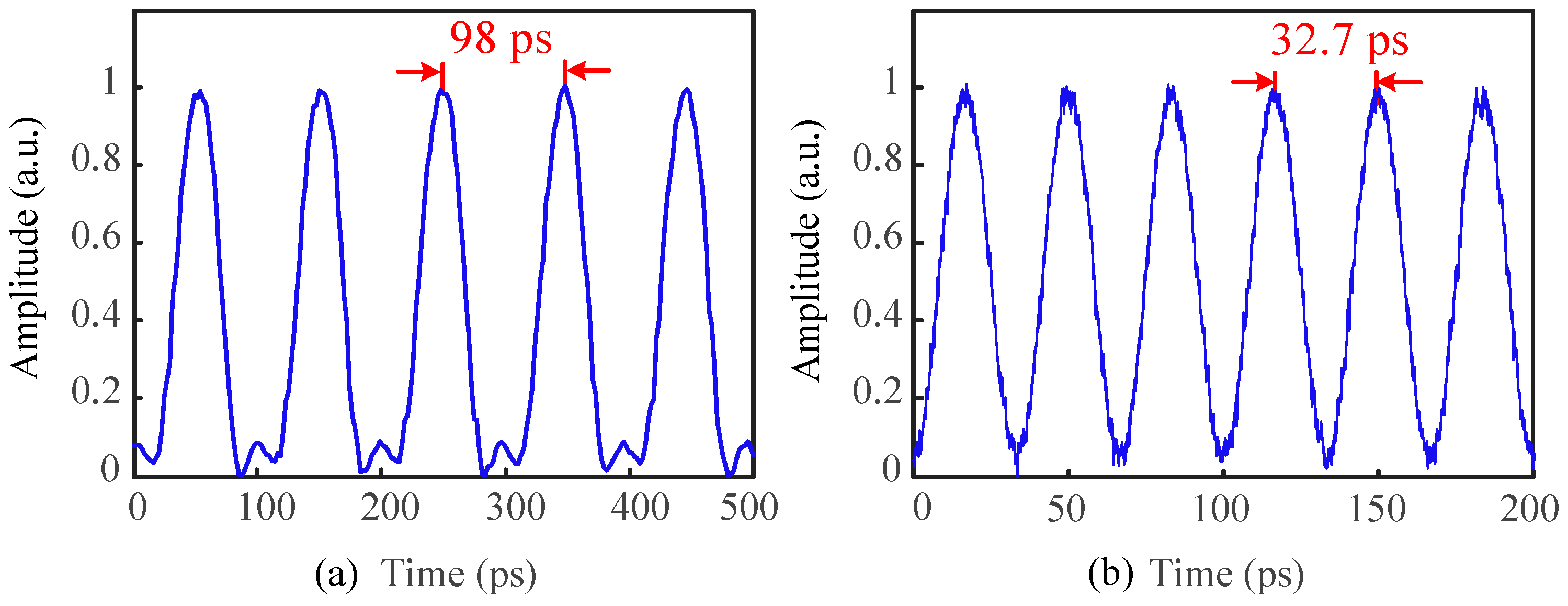
Figure 4 presents the measured temporal waveforms of the optical pulse train before and after DM. As shown in
Figure 4a, the input pulse train exhibits a pulse spacing of approximately 98 ps, corresponding to a repetition rate of 10.2 GHz. After propagation through the SMF, the pulse spacing is reduced to 32.7 ps, as shown in
Figure 4b, corresponding to an increased repetition rate of 30.6 GHz. These results confirm that the introduced group-delay dispersion accurately satisfies the designed third-order fractional Talbot condition, thereby enabling successful threefold pulse repetition-rate enhancement. Consequently, the effective optical sampling rate is increased from 10.2 GSa/s to 30.6 GSa/s, providing the high-speed sampling clock required for waveform synthesis. It is further observed that the multiplied pulse train preserves a well-defined temporal profile without noticeable pulse distortion, indicating that the Talbot-based repetition-rate enhancement maintains good waveform integrity while increasing the sampling rate.
Following pulse-repetition-rate enhancement, the high-speed optical pulse train was intensity-modulated by the two-bit ΔΣ-encoded digital sequences using the DDMZM, establishing a mapping between the digital inputs and optical sampling pulses. In the experiment, the DDMZM was biased at the minimum-transmission point, with a measured half-wave voltage of
Vπ = 5.2 V (the nominal half-wave voltage is 5.5 V). According to the designed four-level mapping condition, the two driving amplitudes were set to
A1 = +3.16 V and
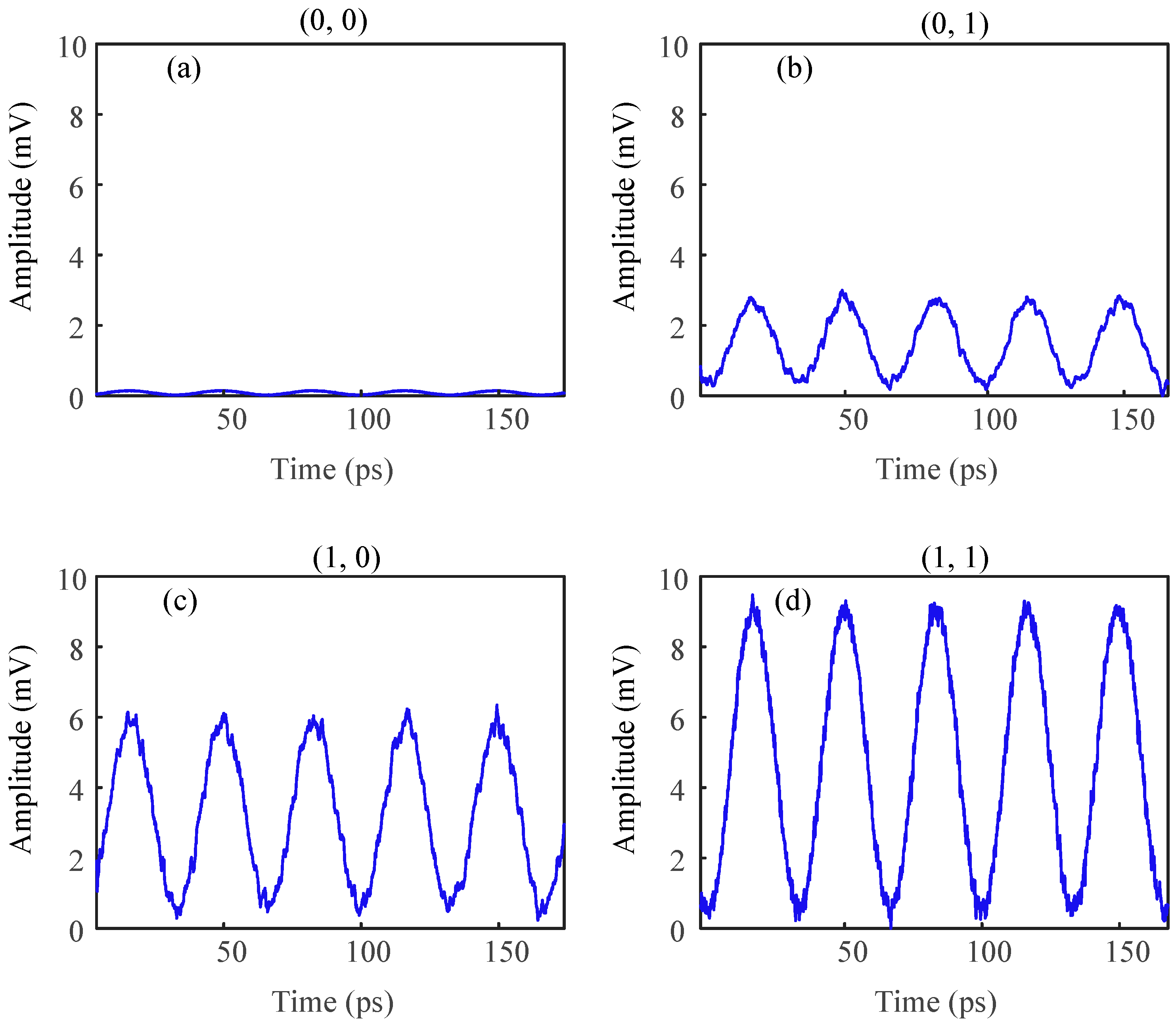
A2 = −2.06 V, where the opposite signs denote the two drive polarities relative to the same bias point. The bias offset was provided by the direct-current source (DCS), while the synchronized dual-channel outputs of the PPG generated either identical or complementary differential driving signals. One driving branch was further adjusted by an electrical variable attenuator (EVA) to realize the required unequal-amplitude condition. The measured four-level output samples for the four digital input patterns are given in
Figure 5, confirming the designed four-level optical intensity mapping.
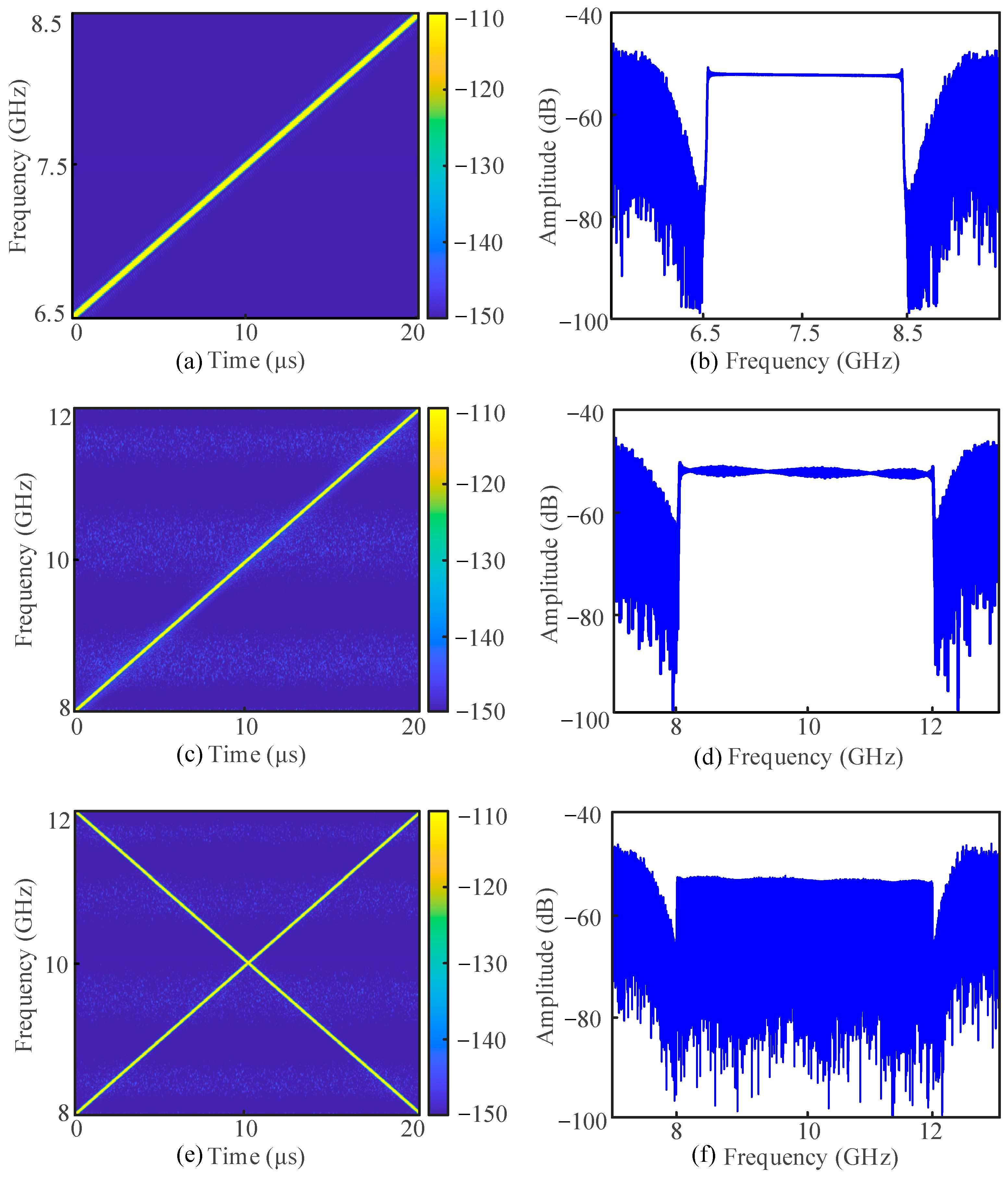
Owing to the operating mode of the available PPG, arbitrary pulse-by-pulse modulation could not be directly implemented. Therefore, after experimentally obtaining the four mapped pulse responses, the ΔΣ-generated digital sequence was used to select and concatenate the corresponding pulse samples during post-processing, thereby reconstructing the target optical pulse train. The desired analog waveform was subsequently recovered using an off-line EBPF. Since this procedure preserves the designed digital-to-optical mapping on a pulse-by-pulse basis, it provides a faithful proof-of-concept validation of the proposed PDAC scheme. Using this implementation, up-chirp LFM microwave waveforms centered at 7.5 and 10 GHz with bandwidths of 2 and 4 GHz, respectively, were successfully synthesized. The corresponding time–frequency distributions are shown in
Figure 6a,c, while the measured spectra are presented in
Figure 6b,d. As observed from the time–frequency representations, both generated signals exhibit clear linear frequency evolution over time. The measured spectra further confirm that the generated signals occupy the frequency ranges of 6.5–8.5 GHz and 8–12 GHz, respectively, demonstrating the capability of the proposed architecture to generate broadband microwave signals over multiple frequency bands. These results also verify that the Talbot-enhanced sampling rate is sufficient to support high-bandwidth waveform synthesis while maintaining accurate reconstruction of the target chirp profiles.
In addition to single-chirp waveform generation, the dual-chirp LFM signal is also generated. The corresponding time–frequency distribution and spectrum are shown in
Figure 6e and
Figure 6f, respectively. Distinct chirp components can be clearly identified, each exhibiting continuous and approximately linear frequency variation across the designed frequency range. The close agreement between the generated and target waveform characteristics confirms the capability of the proposed approach to synthesize more complex broadband microwave waveforms.
It is worth noting that significant out-of-band noise components can be observed in the measured spectra, providing direct experimental evidence of the noise-shaping introduced by ΔΣ modulation. Most of the noise is effectively shifted outside the signal band, whereas the in-band spectral remains comparatively clean. Consequently, by employing an appropriately designed electrical band-pass filter (EBPF), the desired signal components can be preserved while the out-of-band quantization noise is removed, leading to enhanced waveform fidelity and improved signal quality.
To evaluate the reconstruction fidelity, the measured waveform was first aligned to an ideal reference waveform using a complex-valued least-squares fitting procedure that compensates for amplitude, phase, and timing mismatches. The SNR was then calculated as the ratio of the calibrated reference-signal power to the residual error power within the predefined target bandwidth, excluding all out-of-band spectral components. The in-band SNR and ENOB were then calculated from the resulting error values. For the single-chirp waveform spanning 6.5–8.5 GHz, an SNR of 30.84 dB was achieved, corresponding to an ENOB of 4.83. When the signal bandwidth was increased to 4 GHz, covering the X-band frequency range of 8–12 GHz, the measured SNR decreased to 25.60 dB, corresponding to an ENOB of 3.96. The performance degradation at higher bandwidths can be primarily attributed to two factors. First, the increased signal bandwidth reduces the effective oversampling ratio of the ΔΣ modulation process, resulting in higher residual in-band quantization noise. Second, the finite temporal width of the optical sampling pulses introduces a sinc-shaped frequency response, which causes increased amplitude roll-off at higher frequencies. To further evaluate the capability of the proposed PDAC for generating different microwave waveforms, a dual-chirp signal within the X-band was synthesized, as shown in
Figure 6e. In this case, the measured SNR was 23.67 dB, corresponding to an ENOB of 3.64. Compared with the single-chirp case, the additional performance degradation mainly arises from spectral overlap and mutual interference between multiple chirp components, which increase reconstruction errors and reduce the achievable signal fidelity. It is worth noting that the theoretical upper-bound ENOB values for the 2 and 4 GHz broadband signals are 9.1 and 5.2, respectively, as predicted by the optimized eighth-order CRFF 2-bit ΔΣ modulator. These values represent the performance limit imposed solely by quantization noise shaping. The measured ENOB values are lower because they are additionally affected by optical-link impairments, electrical noise, component nonidealities, and other implementation imperfections.
Overall, the experimental results demonstrate that the proposed single-channel two-bit PDAC architecture, combining Talbot pulse repetition-rate enhancement with ΔΣ noise shaping, is capable of generating broadband and high-fidelity microwave waveforms while maintaining a relatively low hardware complexity. Despite an effective sampling rate of only 30.6 GSa/s, the system successfully synthesizes X-band microwave signals with bandwidths up to 4 GHz while maintaining an ENOB exceeding 3.6. These results verify the effectiveness of the proposed approach in simultaneously enhancing the effective sampling rate, suppressing in-band quantization noise, and improving waveform reconstruction fidelity, highlighting its potential for low-complexity, high-speed microwave photonic arbitrary waveform generation and next-generation PDAC systems.
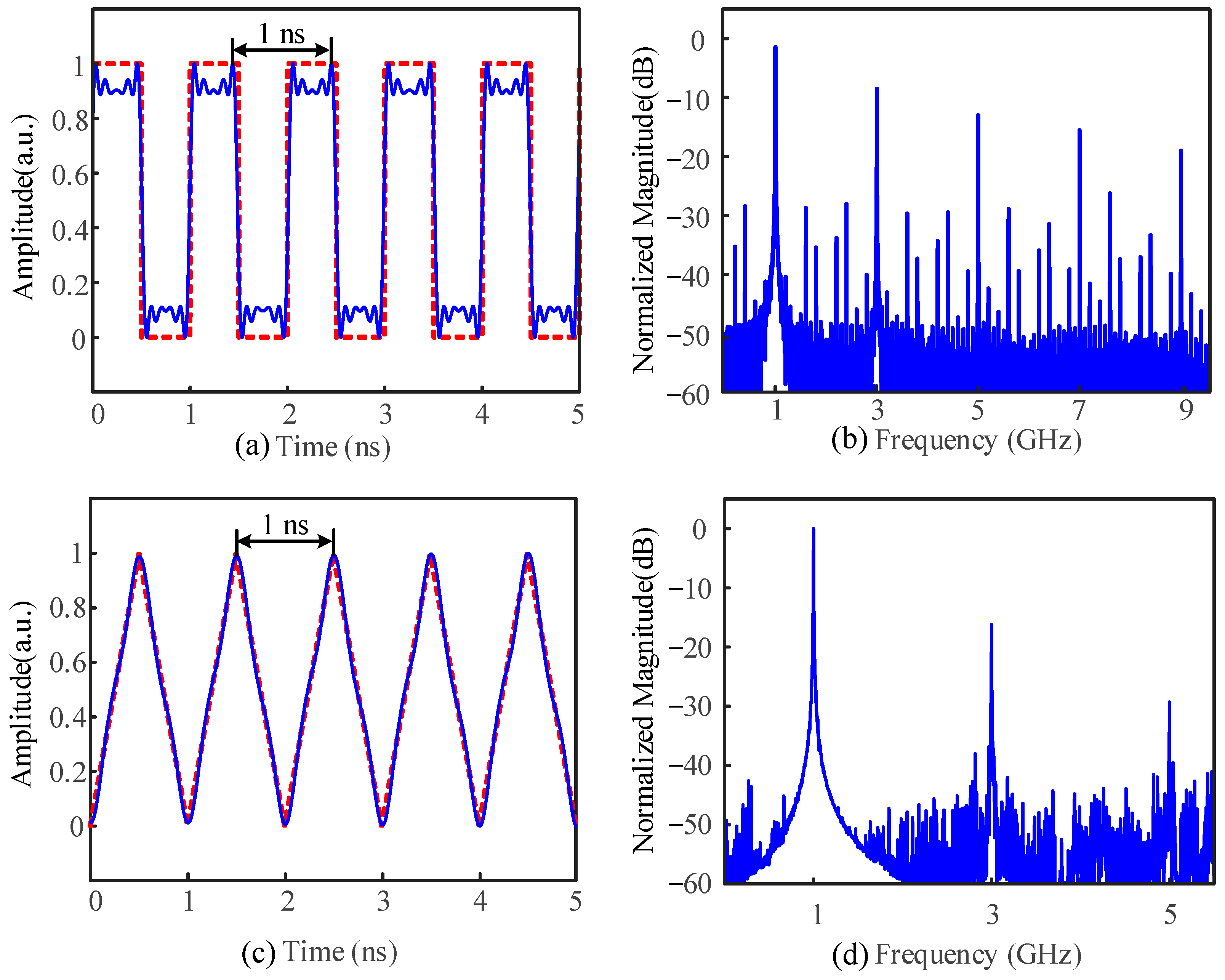
To further evaluate the waveform reconfiguration capability of the proposed PDAC architecture, a 1 GHz square waveform and a 1 GHz triangular waveform were also synthesized. The corresponding measured temporal waveforms and spectra are presented in
Figure 7.
Figure 7a and
Figure 7c show the reconstructed square and triangular waveforms in the time domain, respectively, while
Figure 7b,d present their corresponding spectra. Both waveforms are successfully reconstructed with stable temporal profiles and spectral characteristics that agree well with theoretical expectations.
To quantitatively evaluate the reconstruction accuracy, the measured and ideal waveforms were normalized, and the root-mean-square error (RMSE) was calculated from their time-domain differences. The measured RMSE values are 0.2468 for the square waveform and 0.0172 for the triangular waveform. The higher RMSE of the square waveform is mainly attributed to its richer high-order harmonic content, which is more susceptible to attenuation caused by the finite sampling rate and system bandwidth. In contrast, the spectral energy of the triangular waveform is concentrated in lower-order harmonics, resulting in improved reconstruction fidelity. These results further confirm that the proposed PDAC architecture can accurately synthesize both broadband chirped signals and periodic waveforms, demonstrating its flexibility for high-fidelity microwave arbitrary waveform generation.
It is worth noting that the proposed PDAC architecture can be readily extended to synthesize microwave waveforms in higher-order NZs since optical sampling periodically replicates the signal spectrum with a spacing of the effective sampling rate . By selecting different spectral replicas using appropriate bandpass filtering, waveform generation at higher carrier frequencies can be achieved. In practice, however, the maximum accessible NZ order is constrained by several factors. First, determines the NZ bandwidth and the spectral replication interval. Second, pulse broadening and the frequency response of the sampling process result in progressive attenuation of higher-order spectral replicas, reducing the output SNR. In addition, Talbot pulse repetition-rate enhancement relies on accurate dispersion matching. Any dispersion mismatch introduces pulse distortion and timing degradation, which further degrades the sampling fidelity and SNR, especially in higher-order NZs. Moreover, the finite bandwidths of the modulator, photodetector, and RF components ultimately limit the highest achievable carrier frequency.
Table 2 summarizes a comparison between the proposed PDAC scheme and representative reported PDAC architectures in terms of optical channel requirement, nominal quantization bit depth, resolution, effective sampling rate, and waveform-generation capability. As can be seen, the proposed approach significantly reduces the optical-channel complexity by enabling two-bit digital-to-optical mapping with only a single modulation channel while simultaneously relaxing the pulse-source repetition-rate requirement through Talbot pulse-rate enhancement. In addition, the incorporation of ΔΣ noise shaping effectively suppresses in-band quantization noise, allowing high waveform fidelity to be achieved with low-bit quantization. These features provide a favorable trade-off between implementation complexity and waveform performance, making the proposed architecture well suited for broadband PDAC systems. Nevertheless, the present proof-of-concept implementation still relies on offline digital signal processing and post-processing-based waveform recovery. Future work will focus on real-time hardware implementation and higher-order modulation architectures to further improve system scalability and practical applicability.