1. Introduction
Micro- and nano-scale manipulation constitutes the technological bedrock of modern lab-on-a-chip platforms, enabling transformative advances in single-cell analysis [
1], colloidal assembly [
2], and targeted drug delivery [
3]. Among the diverse manipulation strategies available, optical methods have emerged as the preferred paradigm for handling biological and fragile nanoscopic specimens. Their inherent non-contact and non-destructive nature effectively eliminates the risks of mechanical damage and cross-contamination that plague mechanical approaches [
4]. Since the pioneering inception of optical tweezers by Arthur Ashkin [
5], which utilize the momentum transfer of a tightly focused laser beam to trap particles, optical manipulation has achieved nano-level positioning precision and femtonewton-level force resolution [
6,
7]. Subsequently, optical transport and size-selective manipulation based on structured light have emerged as a rapidly developing direction, aiming to enable controlled particle transport and sorting within reconfigurable optical fields [
4].
Despite their successes, classical optical tweezers based on a simple Gaussian beam are fundamentally a “single-point trapping” approach with limited functionality and faces intrinsic scalability challenges [
8]. Their utility in high-throughput processing is often severely constrained by a limited field of view and the reliance on mechanical stage translation to achieve long-range transport [
9]. Therefore, optofluidic systems, which synergize optical tweezers with microfluidic channels, excel at processing large sample volumes [
10]. However, these systems predominantly rely on fixed physical boundaries fabricated via soft lithography [
11]. Once manufactured, these rigid channels lack reconfigurability, making them ill-suited for adaptive tasks that require real-time modification of transport trajectories. Furthermore, microfluidic channels are notoriously prone to clogging, particularly when handling heterogeneous samples containing cellular aggregates or high-concentration colloids, which can lead to irreversible device failure [
12,
13,
14].
To bridge the gap between the flexibility of optical manipulation and the throughput of microfluidic techniques, recent efforts have increasingly focused on “wall-less” transport schemes based on structured light fields, commonly referred to as optical transport [
15,
16]. Non-diffracting beams, such as Bessel and Airy beams, have demonstrated long-range particle guiding [
4]; however, generating complex arbitrary trajectories remains challenging, as coherent superposition often introduces interference-induced speckle, which degrades the stability of the optical potential and limits transport to simple paths. The discovery of orbital angular momentum in light has provided an additional degree of freedom for optical manipulation [
17,
18,
19,
20,
21], where the associated azimuthal phase gradient can generate transverse optical forces to drive particle motion. Building on this mechanism, holographic optical trapping enables particle transport along continuous and three-dimensional trajectories [
22,
23,
24,
25,
26], but it is typically demonstrated with particles of a single refractive index and lacks intrinsic selectivity. As an open-boundary scheme, it is susceptible to background particle intrusion, which degrades transport stability and precision [
27,
28], making it unsuitable for selective sorting in multi-particle systems.
These limitations highlight the need for an all-optical strategy that not only guides target particles but also actively shields them from surrounding interference while enabling selective transport. In this work, we propose a reconfigurable virtual optical waveguide (VOW) that simultaneously addresses the challenges of trajectory complexity and environmental complexity. By superposing two arbitrarily shaped beams with orthogonal polarization states, we eliminate optical interference, thereby creating a smooth, continuous optical potential channel that requires no physical walls. This incoherent superposition allows for the programmable generation of complex transport trajectories, including space-filling Hilbert fractal curves, which significantly extend the interaction path length and time within a limited field of view. The VOW functions as a protected transport lane: it guides target particles while creating an invisible barrier against environmental interference.
2. Methods
The construction of a VOW-based particle channel begins with the generation of a beam exhibiting a straight-line intensity profile, which can be achieved using the technique of arbitrarily shaped perfect optical vortices [
29]. In existing approaches, such as path-integral-based synthesis and discretized trajectory sampling, the optical field is directly constructed from the target path, requiring re-computation for each specific trajectory and typically favoring closed-loop structures. In contrast, the method adopted here decouples beam generation from trajectory definition. Instead of discretizing the entire path, we define a set of key vertices and construct the beam by integrating along the segments connecting them. This vertex-based formulation enables a more flexible and scalable framework for generating both open and complex trajectories, which is particularly advantageous for optical channel design. The resulting field can be expressed as [
30]
where
ϕ(
x,
y) = exp[i2π(
xjx +
yjy)] is the Fourier phase shift applied to the optical field, (
xj,
yj) represents the Fourier shift factors, and the position matrix
Mj constructed from these factors determines the resulting shape of the optical field. This method discretizes the conventional circular perfect optical vortex into a position matrix
Mc(
xc,
yc), and the target straight-line trajectory into a position matrix
Mq(
xq,
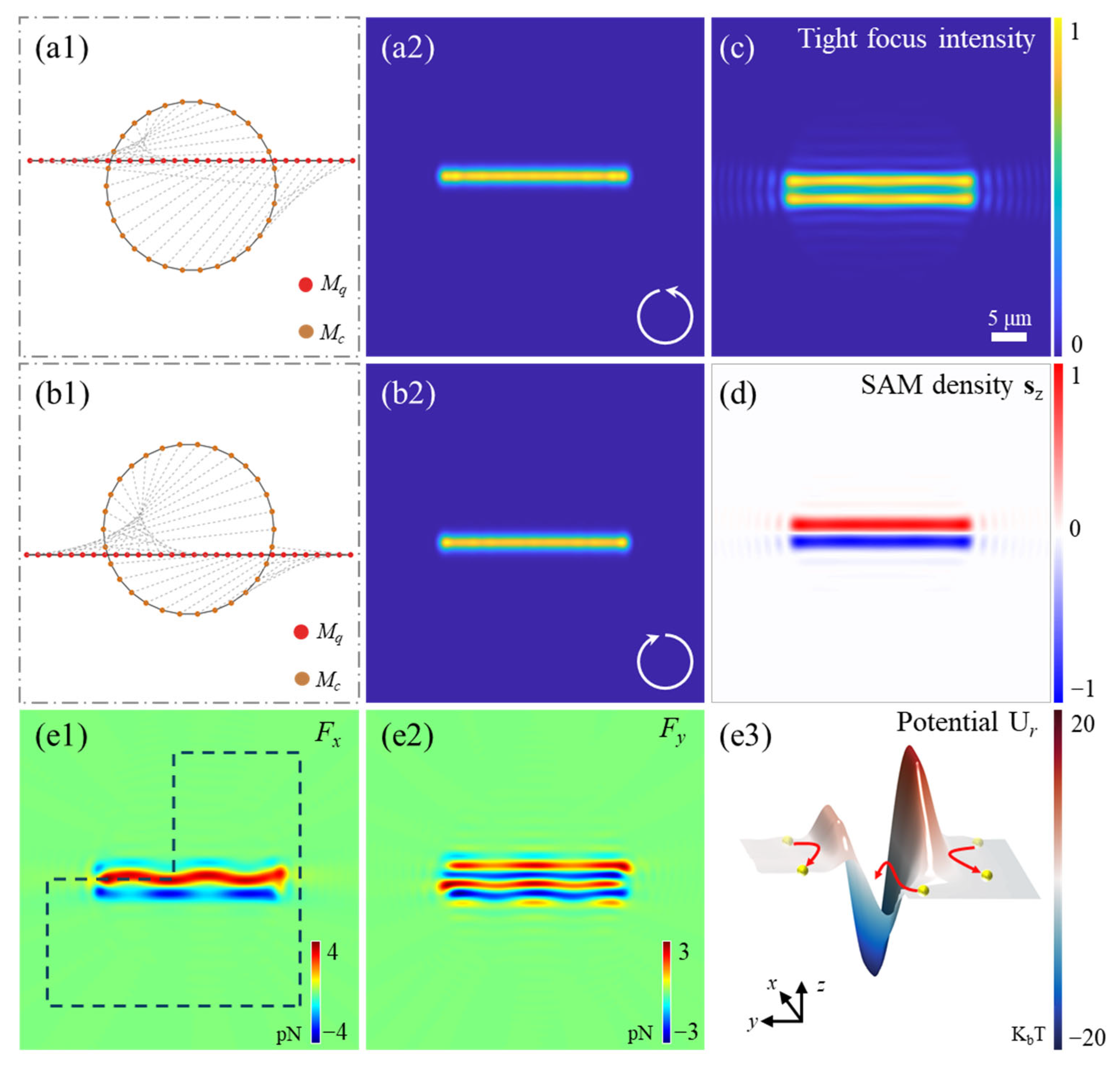
yq), as illustrated in
Figure 1(a1,b1). By assigning the displacement indicated by the dashed lines to each point on the circle, the linear optical field is naturally obtained. The resulting matrix
Mj =
Mc −
Mq corresponds to the required Fourier-shift matrix. In Equation (1), one takes |
c′(
t)| = [
x′
0(
t)
2 +
y′
0(
t)
2]
1/2, where
x0(
t) and
y0(
t) are parametric equations. The contour parameter
t ∈ [0, 2π] is uniformly sampled as
tj =
jΔ
t (
j = 0, 1, …,
N), where Δ
t = 2π/
N. Since the initial trajectory in this work is defined as a circle, we set
x0(
t) =
R0cos(
t) and
y0(
t) =
R0sin(
t). Therefore, |
c′(
t)| =
R0, where
R0 defines the radius of the integration contour in the transverse plane.
φ(
x,
y,
t) is the phase term that defines the phase distribution of the beam, and it can be written as
where
l is the topological charge, set to
l = 5 throughout this work. It mainly influences the magnitude of the optical force and thus the transport speed, while the overall force distribution and transport mechanism remain qualitatively unchanged. At this stage, a straight-line optical field is obtained. To further form a particle channel, a pair of straight-line optical fields with a finite separation is required. Meanwhile, to ensure that this pair of beams can indeed constitute a particle channel and enable particle sorting, the following two conditions must be satisfied:
- (1)
The two beams must not interfere with each other; otherwise, interference will introduce additional intensity singularities, preventing the formation of a particle channel.
- (2)
The two beams must carry different topological charges. If the topological charges of the two beams are identical, intensity superposition will occur, which likewise precludes the formation of a particle channel.
Satisfying the above-mentioned two requirements necessitates that the pair of straight-line beams be orthogonally polarized and carry opposite topological charges. In the presented work, the left- and right-handed circular polarizations are adopted as the orthogonal polarization basis, as they correspond to the eigenstates of photon spin and enable a well-defined decomposition of the field into independent components with opposite helicities. Accordingly, their expressions can be written as
Here, eR and eL denote the unit vectors of right-handed and left-handed circular polarizations, respectively. The coordinate difference between (xj1, yj1) and (xj2, yj2) corresponds to the separation between the centers of two straight-line beams, thereby defining the width of the VOW D.
The vector spherical wave function (VSWF) method is used to expand the VOW in terms of spherical harmonics [
31]. The corresponding expansion coefficients
anm and
bnm are obtained by beam-shape coefficients as follows
where
A*
nm(
α,
β) and
B*
nm(
α,
β) are the angular basis functions corresponding to the electric- and magnetic-type vector spherical harmonics, respectively.
α and
β denote the polar and azimuthal angles, respectively. The maximum convergence angle
αmax is determined by the numerical aperture (NA) of the objective and satisfies sin
αmax = NA/
nm, where NA = 1.45, and
nm = 1.33 is the refractive index of the focusing medium (i.e., water). After obtaining the beam shape coefficients
anm and
bnm, the focused electric field derived by the VSWF formalism can be expressed as
where
km = 2π
nm/
λ0 is the wavenumber in the surrounding medium,
λ0 is the wavelength in vacuum.
re is the physical spatial position vector in the focal region.
and
represent the regular VSWFs based on spherical Bessel functions. According to Equation (5), by setting
R0 = 5 μm and
D = 5 μm, the resulting tightly focused electric field
Etight is obtained, as shown in
Figure 1c. To gain deeper insight into the physical mechanism of particle transport in the linear VOW, we visualize the normalized spin angular momentum (SAM) density, as shown in
Figure 1d. The SAM density is defined as
sz =
ε*Im(
Etight ×
E*
tight)/4ω. The channel formation arises from the coordinated interplay of gradient forces (providing transverse confinement) and phase-gradient and scattering-related forces (driving directional transport), rather than from SAM or phase gradients alone [
32].
A representative scattering-dominated particle, namely a spherical gold particle, is considered, and its scattering response is incorporated through the T-matrix formalism. For a spherical gold particle [
26] (refractive index
np = 0.26 + 6.97i at
λ = 532 nm) with radius
a0, the scattered field of the particle can likewise be expanded in terms of outward-propagating VSWFs, yielding the corresponding scattered electric field and subsequent expansion coefficients. Since the particle size is comparable to the wavelength, the system operates in the Mie scattering regime, where higher-order multipole contributions become significant and the dipole approximation is no longer sufficient. The scattered field resulting from the light-particle interaction is then obtained via the T-matrix formalism, and the optical force is ultimately evaluated using the Maxwell stress tensor [
33], ensuring that all vectorial and multipole contributions to the force are fully considered by
where
TM denotes the time-averaged Maxwell stress tensor,
n is the outwardly directed normal unit vector to the surface,
S is a closed surface containing the particle.
For a clearer depiction of the force landscape within the VOW, the optical force acting on a particle with a radius of
a0 = 250 nm is decomposed into its
Fx and
Fy components and analyzed separately under an incident optical power of 100 mW, as shown in
Figure 1(e1,e2). As shown in
Figure 1(e1), the
Fx distribution exhibits a three-layered structure along the transverse direction. The upper and lower layers generate forces directing particles toward the left entrance of the channel, whereas the central layer provides a forward driving force that guides particles toward the channel exit, thereby enabling directional transport. In contrast, the
Fy distribution in
Figure 1(e2) forms a four-layered structure. The outer layers act as repulsive barriers that prevent particles from entering or escaping the channel, while the two inner layers provide transverse confinement, effectively trapping particles within the channel region and stabilizing their motion. A detailed analysis of the optical force components, including the axial force
Fz and the transverse forces
Fx and
Fy, is provided in
Supplementary Materials S1. The axial force component
Fz primarily drives particle motion along the beam propagation direction and does not provide intrinsic confinement. In practical implementations, this can be readily addressed by introducing external constraints. To further elucidate the stability and transport characteristics of the VOW from the particle perspective, the effective optical potential experienced by a micrometer-sized low refractive index particle is presented in
Figure 1(e3). The potential landscape is obtained by integrating the transverse optical force field [
34]
Here,
ru denotes the spatial position along the integration path, while
r0 represents the target particle position. It should be noted that the total optical force generally contains both conservative and nonconservative components [
35]. In particular, the phase-gradient force responsible for particle transport is nonconservative and cannot be rigorously described by a scalar potential. Therefore, the quantity defined here represents a potential-like measure associated with the transverse (gradient-dominated) confinement, rather than a true potential of the total force field. As shown in
Figure 1(e3), the potential exhibits a pronounced confinement in the transverse direction, where steep potential barriers effectively prevent the particle from escaping the channel. The calculated barrier height exceeds the thermal energy scale, reaching a level sufficient to suppress Brownian crossing according to commonly used optical trapping criteria. In contrast, along the longitudinal direction of the channel, the potential forms a continuous downhill pathway, enabling sustained particle transport. The asymmetric potential heights on the two sides of the channel arise from the opposite topological charges carried by the two linear beams, which generate phase gradients with opposite transverse directions and intrinsically break the left-right symmetry. This asymmetry is an unavoidable consequence of the topological configuration required to form the transport channel, as identical topological charges would not produce the recirculating momentum flow necessary for particle guiding. Importantly, the potential asymmetry does not compromise the channel operation, since the stable transport is governed by the longitudinal driving force and the transverse confinement rather than strict potential symmetry.
3. Results and Discussion
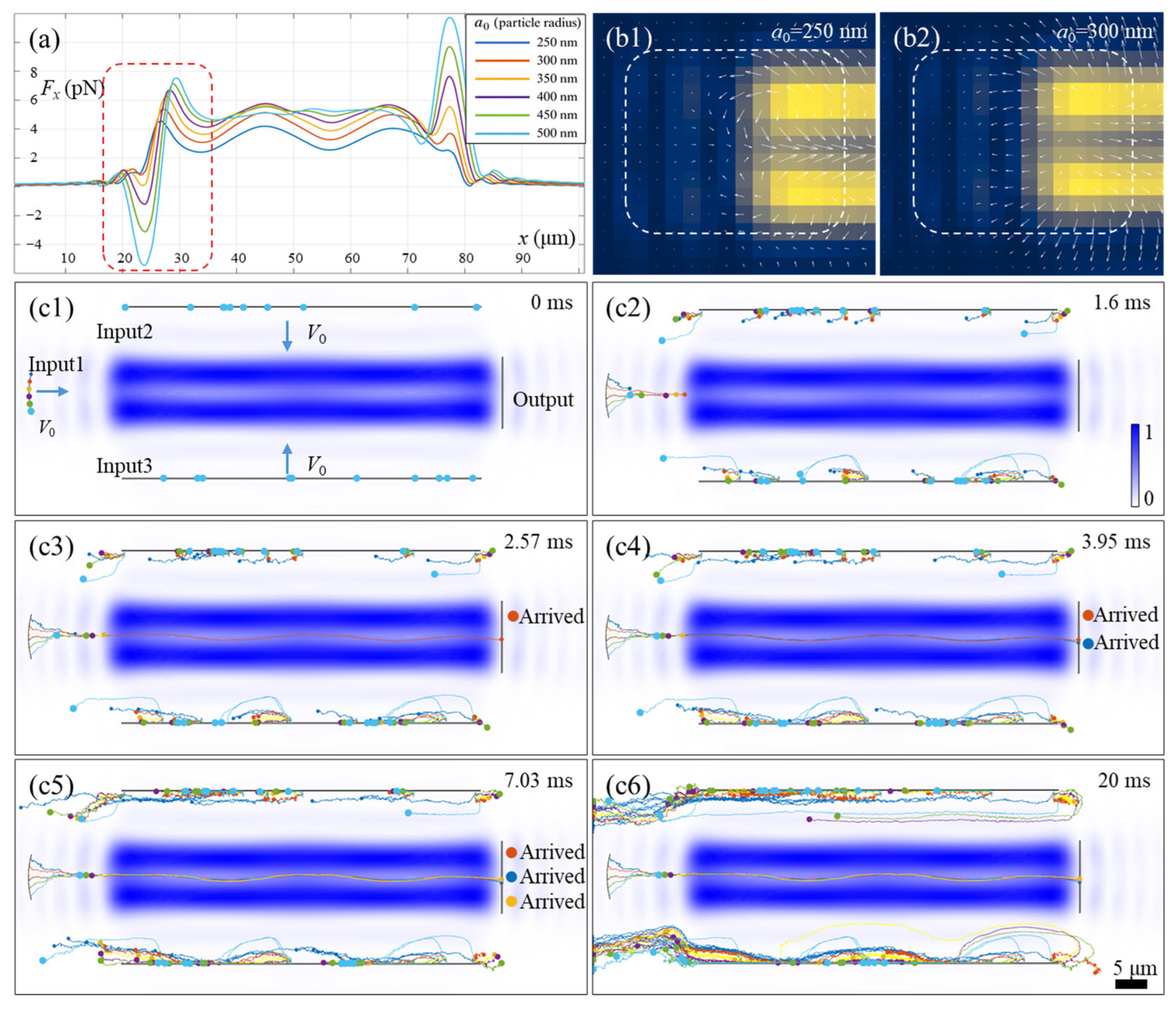
To resolve the force differences more clearly among particles of different sizes, we further select the line segment located at the center of the channel, extract the force components along this line, and plot them as curves, as shown in
Figure 2a. It is clearly observed that a particle with a radius of 350 nm experiences a force at the entrance that is just slightly greater than zero, allowing it to enter the channel. In contrast, larger particles experience negative forces at the entrance and therefore cannot enter the channel. This size-selective phenomenon is attributed to the complex size-dependent optical response of metallic nanoparticles. As the particle size increases, higher-order multipole effects and enhanced scattering significantly alter the net optical force balance, resulting in an effective potential barrier that prevents larger particles from entering the channel. As shown in
Figure 2(b1,b2), these panels illustrate the force distributions at the channel entrance for particles with radii of 250 nm and 500 nm, respectively. Clearly, for a particle radius of 250 nm, the optical forces near the entrance drive the particle into the channel, whereas for a particle radius of 500 nm, the optical forces prevent the particle from entering the channel.
The particle dynamics in the designed optical field are investigated by finite-element simulations implemented in COMSOL Multiphysics 6.2. The particle motion is analyzed within a Langevin dynamics framework by accounting for the optical forces, Brownian forces, and viscous drag exerted by the surrounding fluid. Detailed model parameters and simulation settings are provided in the
Supplementary Materials S1 [
36,
37,
38]. As shown in
Figure 2(c1), after importing the calculated optical field into COMSOL Multiphysics, an arc-shaped Input1 is defined on the left side of the channel, from which particles of six different sizes are launched toward the channel with a fixed initial velocity
V0 = 7500 μm/s. Here,
V0 is applied as an impulsive initial condition at the start of the simulation. Due to viscous damping in the fluid, this velocity rapidly decays within a short relaxation time, and the subsequent particle motion is dominated by the optical forces. Particles with different sizes are distinguished by different colors. Meanwhile, two additional straight-line entrances Input2 and Input3 are introduced, from which gold particles are launched toward the center of the channel, and their trajectories are recorded to examine whether these perturbing particles can overcome the barrier and enter the channel. As shown in
Figure 2(c1–c6), the temporal evolutions of particle positions and their recorded trajectories at different time instants are illustrated. At 1.6 ms, particles begin to approach the left entrance of the VOW under the influence of the initial ejection velocity. Subsequently, at 2.57 ms, the red particle with a radius of
a0 = 300 nm reaches the entrance first, followed by the blue particle with
a0 = 250 nm at 3.95 ms. As indicated by the force profiles shown in
Figure 2a, particles with
a0 = 350 nm are already very close to the threshold for entering the VOW and therefore require a longer time to be captured and guided into the channel. Eventually, at 7.03 ms, the yellow particle with
a0 =350 nm also successfully reaches the entrance. The simulation is then continued up to 20 ms, during which no additional particles are observed to enter the channel. Importantly, as results in
Supplementary Materials S1, the sorting threshold can be flexibly tuned by adjusting the separation between the VOW, enabling precise size-dependent sieving with the channel width acting as a controllable gate. In addition, this tunability can be further extended by jointly modulating the channel separation
D and the beam parameters (e.g., intensity and field distribution), providing enhanced flexibility to meet diverse application requirements. These results demonstrate that the proposed VOW-based optical channel provides robust and immediate size-selective sorting, effectively rejecting particles with nonconforming sizes from all access directions. Although the perturbing particles considered here are metallic gold particles, the channel is equally capable of rejecting absorption-dominated dielectric particles (e.g., polystyrene), as discussed in
Supplementary Materials S2. Additionally, we note that experimental measurements of similar beams show that phase deviations are within acceptable limits [
29], suggesting that moderate imperfections would not alter the qualitative sorting outcome. Together, these results establish the VOW as a versatile, contactless platform for programmable optical logistics, achieving particle sorting performance comparable to established optical transport and filtering approaches [
16] and thereby offering a flexible alternative to fixed microfluidic channels for adaptive particle sorting and micromanipulation.
In microfluidic and photonic systems, a common limitation arises from the inherent trade-off between the limited device footprint and the need to achieve sufficiently long particle-light interaction path lengths. For applications constrained by flow velocity or requiring stable transport conditions, extending the interaction time often necessitates a substantial increase in channel length, which can readily exceed the accessible field of view of a microscope or the physical dimensions of an integrated chip [
39]. As a representative space-filling curve, the Hilbert fractal provides an efficient means of folding a one-dimensional continuous path into a finite two-dimensional area [
40]. Its total path length increases exponentially with the fractal order, while the overall occupied area remains unchanged. Leveraging this property, we employ Hilbert fractal geometry to design the transport trajectory of a VOW, thereby constructing a compact optical delay line within a single field of view.
A more efficient construction of the Hilbert fractal structure in a Cartesian coordinate system enables convenient generation of the displacement matrix. Since the Hilbert curve consists entirely of connected straight-line segments, its vertex coordinates can be determined once the sequence of turning points is specified. For an
h-th order Hilbert curve, the vertex coordinates (
xP,
yP) are generated sequentially starting from an initial point (−
L/2,
L/2) within a square domain of side length
L. A uniform step size
L/(2
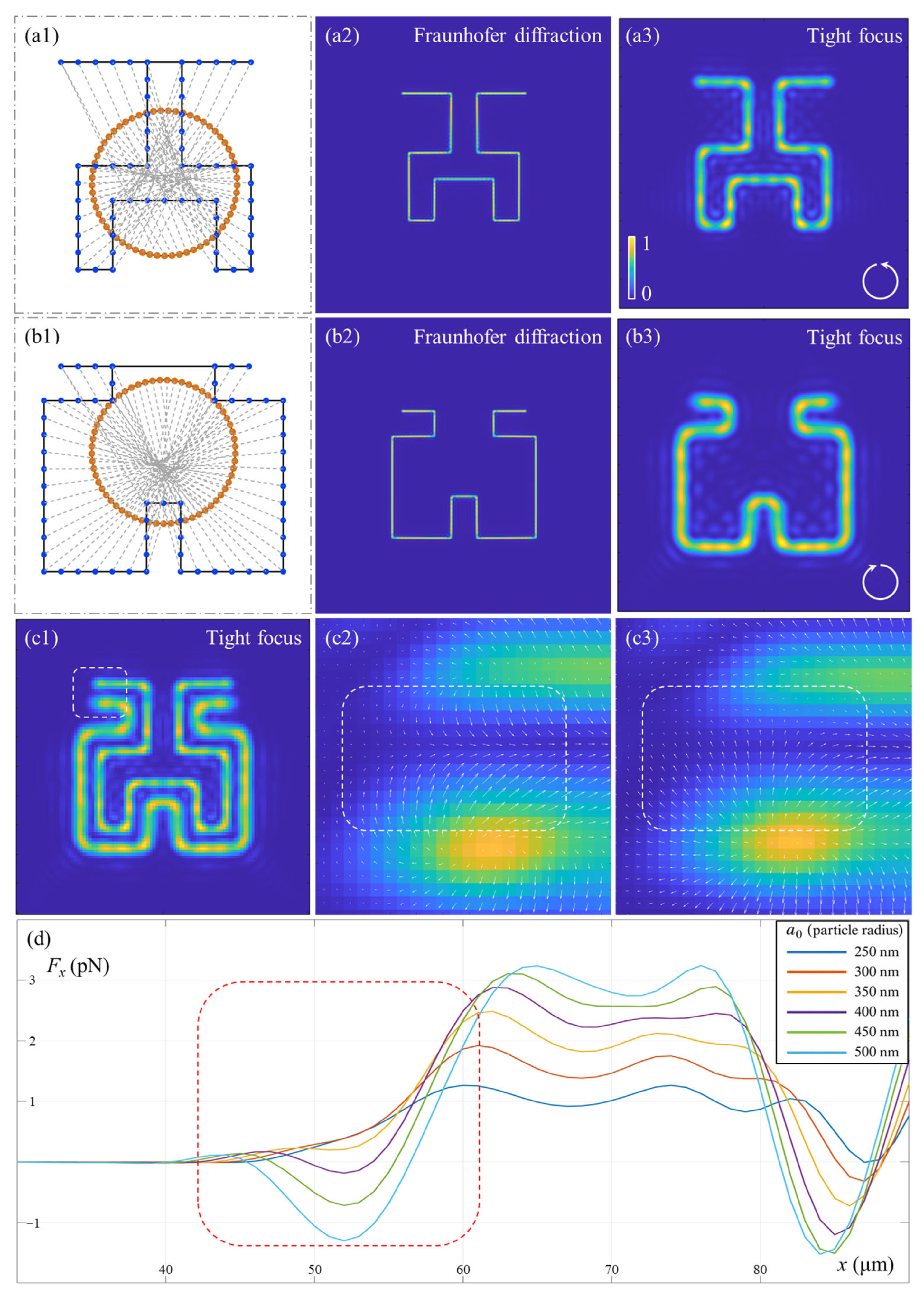
h − 1) defines the spacing between adjacent vertices, while the traversal order is determined by the standard Hilbert recursive construction. The coordinates are then obtained by sequentially advancing along the prescribed directions and updating the orientation at each turning point. To construct the VOW, two Hilbert-structured beams with a prescribed separation are employed. Their corresponding vertex coordinate sets are generated by inward and outward expansion of the original curve. Due to the unequal segment lengths, phase equalization is applied by maintaining a uniform phase gradient and interpolating longer segments to ensure a continuous optical channel. The displacement matrix is then obtained by interpolating the vertex coordinates and subtracting the initial circular coordinate matrix, as shown in
Figure 3(a1,b1).
After setting
L = 80 μm, the corresponding coordinate matrices are substituted into Equation (3), and the resulting optical intensity distributions are obtained via Fraunhofer diffraction, as shown in
Figure 3(a2,b2). Under the same tight-focusing conditions as those used for the straight-line channel, these optical fields are subsequently focused, and the corresponding intensity distributions are shown in
Figure 3(a3,b3). The tightly focused VOW formed by superposing the two beams is displayed in
Figure 3(c1). Optical forces acting on particles with radii ranging from
a0 = 250 to 500 nm are then calculated. Among these results, the force distributions at the channel entrance for the smallest and largest particle sizes (
a0 = 250 nm and 500 nm) are shown in
Figure 3(c2,c3), respectively. Similar to the straight-line channel, the arrows indicate that particles with
a0 = 250 nm are guided into the channel, whereas particles with
a0 = 500 nm are repelled. To further quantify this behavior, the optical force along the path defined by the line is extracted and plotted as force profiles, as shown in
Figure 3d.
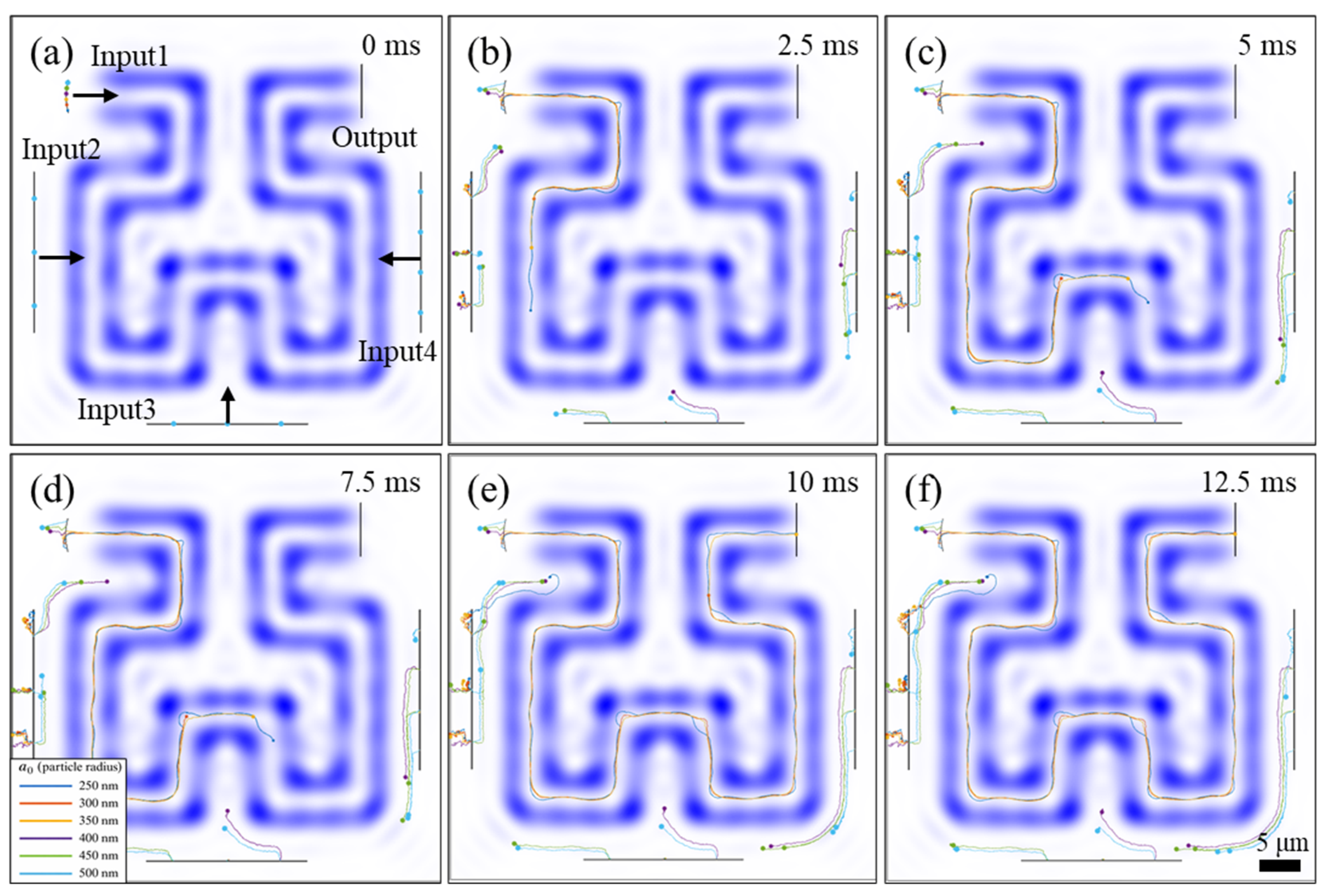
Under the same simulation environment as that used for the straight-line channel, the Hilbert fractal VOW and six particles with radii
a0 = 250 nm to 500 nm are imported into COMSOL Multiphysics. As shown in
Figure 4a, in addition to the main entrance and exit, three additional outlets are introduced, from which particles are launched toward the channel arms, and their trajectories are recorded. The temporal evolution of particle positions and their recorded trajectories at different time instants are illustrated in
Figure 4a–f. Clearly, only the particles injected from the main entrance propagate orderly within the channel and eventually reach the exit sequentially. This Hilbert fractal VOW significantly extends the effective transport path and interaction time of particles within the optical channel. Compared with conventional straight or simply curved channels, the proposed approach achieves higher spatial utilization efficiency and a substantially longer continuous interaction length without sacrificing device footprint or system stability. As a result, it offers distinct advantages for applications requiring prolonged interaction times or high-throughput processing, such as photocatalytic reactions, trace detection, and spectroscopic analysis [
16]. In practice, a balance between path complexity and transport stability should be considered, and the effective interaction time can also be flexibly tuned through system parameters such as the topological charge and optical intensity.
At this stage, we established a theoretical blueprint for particle sorting and transport based on the proposed VOW, together with a systematic evaluation of its operational performance. Importantly, the VOW is fully compatible with existing vector-beam generation architectures, indicating their practical feasibility. Owing to the incoherent superposition of orthogonally polarized beams, the proposed scheme remains robust against polarization crosstalk. Moderate polarization leakage only introduces minor perturbations to the channel geometry, without affecting the overall transport and sorting functionality. In principle, established optical platforms such as Sagnac interferometers [
41], 4
f systems [
42], and related vector-beam generation schemes [
43] provide viable routes for implementation. In the separation and analysis of micro- and nano-scale particles, particularly biological specimens such as viruses and exosomes, traditional ultracentrifugation remains widely used [
44]. However, this technique typically suffers from complex processing procedures, long operation times, and limited sorting efficiency. In addition, the strong centrifugal force fields may cause irreversible damage to structural integrity and biological activity. Although existing microfluidic-optical tweezers hybrid approaches have achieved a certain degree of particle manipulation and sorting, they generally rely on prefabricated microfluidic chip architectures, leading to strong dependence on channel geometry and sample preparation [
45]. Moreover, once the sorting conditions are set, real-time and continuous dynamic adjustment during experiments is often difficult, and the overall system integration remains relatively complex. In contrast, the structured-light-induced optical channel proposed in this work is defined entirely by optical field parameters. Its sorting threshold and transport behavior can be tuned in a real-time, continuous, and reversible manner through purely optical control, without additional labeling or physical contact. This approach therefore provides a more flexible and gentler all-optical alternative for particle sorting and transport.