Review

Wavefront Coherence Stabilization for Large Segmented Telescope: Measurement and Control


1
Changchun Institute of Optics, Fine Mechanics and Physics, Chinese Academy of Sciences, Changchun 130033, China
2
University of Chinese Academy of Sciences, Beijing 100049, China
3
Jilin Provincial Key Laboratory of Intelligent Wavefront Sensing and Control, Changchun 130033, China
*
Authors to whom correspondence should be addressed.
Photonics 2026, 13(4), 360; https://doi.org/10.3390/photonics13040360
Submission received: 7 March 2026 / Revised: 1 April 2026 / Accepted: 2 April 2026 / Published: 9 April 2026
(This article belongs to the Special Issue State-of-the-Art Optical Systems for Astronomy)

Abstract

Large-aperture optical synthetic aperture technology, by combining multiple aperture units, breaks through the limitations of a single reflector and has become the preferred system for extending the resolution and diffraction limit of imaging systems. In particular, segmented telescopes have accumulated extensive engineering practice experience, such as the 30 m TMT and the 39 m ELT. However, the stable maintenance of wavefront coherence between multiple sub-apertures requires strict phase synchronization and group delay matching accuracy, which hinders the further development of sparse aperture telescopes and distributed interferometric telescopes (Long-Baseline Interferometers). This review systematically summarizes the research progress on synthetic aperture systems in wavefront coherence detection and stable maintenance control, focusing on two main physical architectures (Michelson and Fizeau types) and the related control algorithms. Furthermore, based on the basic logic from “measurement” to “modulation”, it prospects the development trends driven by interdisciplinary technologies such as embodied intelligent dynamic prediction, photonic integration, and real-time sensing based on deep learning. The aim is to provide a reference for wavefront-stabilization solutions in the next-generation ultra-large-aperture optical synthetic aperture systems.

1. Introduction

With the continuous growth of demand for high-resolution imaging in fields such as astronomy, space remote sensing, and military reconnaissance, conventional single-mirror optical systems are limited by material technology, manufacturing precision, and transportation conditions, and their apertures have approached physical limits [1]. Against this backdrop, segmented systems, by accurately combining multiple optical sub-apertures into an equivalent continuous mirror surface, not only break through the limitations of large-sized single mirrors but also significantly enhance spatial resolution through baseline extension [2]. Furthermore, by analyzing the “edge curling” effect during the optical closed-loop process of large-aperture segmented mirrors, it can be concluded that a larger aperture can reduce the edge collapse effect in edge layouts. For the single-aperture measurement architecture, it has the advantage that the aperture size is not affected by other apertures, enabling high-precision step difference calculations. Meanwhile, for the fan-shaped architecture, due to the symmetry of the support structure, the impact of the “edge curling” effect is relatively small at this position [3,4,5,6]. The segmented telescope technology has been successfully applied in projects such as the Keck Telescope (Keck), Large Sky Area Multi-Object Fiber Spectroscopy Telescope (LAMOST), Chinese Giant Solar Telescope (CGST), and James Webb Space Telescope (JWST) [7,8]. Moreover, as the technical framework for the under-construction 30 m Thirty Meter Telescope (TMT) and 39 m Extremely Large Telescope (ELT) [9,10], they further confirm the development prospects of this technology. At the same time, ultra-high-resolution observation/imaging also plays an irreplaceable role in studying astrophysical processes such as star formation, galactic nucleus structures, and gravitational lensing effects. Thanks to this, planetary science research in China has entered a stage of rapid development [11,12,13]. Breakthroughs in deep space exploration technology and improvements in precise optical path-control capabilities will provide key observational support for solving cosmological problems such as the nature of dark energy dynamics and the Hubble constant crisis, continue to drive the industrial transformation of technologies like large-scale sky survey systems and real-time wavefront sensing precision measurements, and generate profound scientific theoretical changes and social benefits.
With the increase in the number of segments, the problem of maintaining wavefront coherence caused by the coordinated operation of sub-mirrors becomes increasingly complex, which has become a core challenge restricting the actual performance of the system [14]. Wavefront coherence means that the incident wavefronts reflected by each sub-mirror must meet strict phase synchronization (phase delay error < λ/10) and group delay matching (optical path difference < atmospheric coherence length/10) during interference synthesis [15]. Once misaligned, it will lead to a decrease in the contrast of interference fringes and degradation of the Modulation Transfer Function (MTF); in severe cases, it may cause image blurring or even information loss [16]. At the same time, ground-based telescopes are susceptible to atmospheric turbulence and thermal disturbances [17], and the fluctuation of optical path differences between sub-mirrors can reach hundreds of nanometers (RM), resulting in a decrease in the Strehl Ratio of long-exposure imaging. Although space-based telescopes are free from atmospheric interference, structural thermal deformation and mechanical vibrations in the microgravity environment can still introduce phase noise on the order of tens of nanometers [18,19,20,21,22], which requires real-time correction using active actuators [23,24,25].
To address these challenges, a technical framework centered on active optics and adaptive optics (AO) has been established. Active optics adjusts the pose of sub-mirrors through actuator arrays, while a warping harness with a lever-based whiffle-tree provides fine corrections to compensate for low-frequency gravitational and thermal deformations [26,27,28,29]. Adaptive optics, by contrast, employs a deformable mirror (DM), wavefront sensor (WFS), and guide star (GS) to correct high-frequency atmospheric disturbances and higher-order wavefront aberrations in real time [30,31]. For disturbances beyond the bandwidth of active optical control, additional damping is required, while passive damping is typically used to suppress high-order dense modes. To mitigate vibrations from the telescope structure and external wind loads, an integrated system combining actuators and internal encoders can be implemented to achieve precise positioning, pointing, and vibration suppression.
Nevertheless, phase coherence measurement and maintenance technology still faces multiple bottlenecks. Traditional phase-detection methods mostly focus on static piston phase extraction or rough phase coherence adjustment, lacking the ability to sense overall piston, Tip/Tilt (PTT) errors [32,33]. Furthermore, their adaptability is limited under extreme working conditions such as strong turbulence (atmospheric coherence length < 10 cm), large temperature differences (>20 °C), or high-frequency vibrations (>500 Hz), which may even increase the wavefront reconstruction error by λ/4, making it difficult to meet the requirements of phase coherence maintenance. On the other hand, existing control models are mostly based on a single disturbance source (e.g., only considering atmospheric turbulence or mechanical vibration), while the coupling effects of thermal deformation, wind load, and structural modes in the actual environment have not been fully quantified, leading to insufficient dynamic disturbance coupling modeling [34]. Under high-intensity wind disturbance of 8 m/s, the interaction between wind-induced vibration and thermal expansion of the support structure can double the noise of edge sensors (ESs), resulting in instability of the control loop. In addition, the next-generation segmented TMT and ELT telescope systems need to handle the parallel control of thousands of channels of actuators [35]. The challenge of real-time control and maintenance of wavefront coherence in such ultra-large-scale systems poses severe challenges to traditional centralized architectures in terms of communication delay (>1 ms) and computational complexity.
Given the aforementioned challenges, this paper systematically reviews the research progress in wavefront coherence measurement and maintenance methods for segmented systems. Firstly, Section 2 introduces the specific requirements for phase measurements and provides a summary and overview of the key hardware technologies for wavefront coherence measurements in segmented systems. Next, Section 3 presents detailed descriptions of the aforementioned technologies under the Michelson and Fizeau interferometric architectures. The application of laser truss technology in these two architectures is largely similar. Subsequently, Section 4 focuses on the calculation models and control methods corresponding to wavefront coherence measurement. Finally, Section 5 and Section 6 summarize the innovative features and trends of existing research and, on this basis, propose future research directions that integrate technologies such as embodied intelligence and photonic integration. This paper aims to provide theoretical support and technical references for the design and optimization of next-generation ultra-large-aperture segmented optical coherence measurement and maintenance systems from an interdisciplinary perspective.

2. Overview of the Purpose and Countermeasures of Phase Coherence Error Measurements

The evolution of astronomical observation from celestial discovery to high-fidelity characterization has placed unprecedented demands on wavefront stability. Specifically, the pursuit of scientific goals such as high-contrast exoplanet imaging (requiring contrast ratios up to 10−10) necessitates the suppression of residual wavefront errors to the picometer level. Maintaining such extreme precision over extended exposure periods is essential to prevent coherence loss and the resulting degradation of the MTF. Therefore, co-phase measurement naturally emerges as a fundamental prerequisite for the normal operation and maintenance of optical synthetic aperture systems. The accuracy and real-time performance of measurement feedback determine the imaging quality to a certain extent.
This section mainly outlines the functional positioning of this technology. For an optical synthetic aperture system to truly achieve the light-gathering area equivalent to the aperture of a single target mirror and other optical performances, it is necessary to measure the phase of each sub-aperture in real time before or during observation and then perform co-phase adjustment and maintenance. Manufacturing errors and splicing errors pose obstacles; the former, as errors generated in a non-operating state, are not within the scope of this paper. The latter, however, is affected by various disturbances, primarily manifested as six rigid-body DOFs errors at the segment level (including in-plane errors (Translation and Clocking, TC) and out-of-plane errors (PTT)), as well as low-order surface figure errors at the full-aperture segmented mirror scale (e.g., defocus and astigmatism). The main purpose of wavefront coherence detection and maintenance is to measure and correct the above-mentioned errors, especially the piston error [36].
For Fizeau interferometers (including segmented telescopes and sparse aperture telescopes), the ES plays a vital role in the above-mentioned process, as they can accurately measure the relative positional relationship between adjacent segmented mirrors [37,38]. However, most ESs are electromechanical sensors; measurement errors caused by environmental factors such as temperature drift propagate through the control matrix (interaction matrix), leading to over-correction or under-correction by actuators. Additionally, they cannot detect low-order surface shape errors, making it impossible to ensure the long-term maintenance of wavefront coherence across the segmented mirror surface. The introduction of optical measurement methods has partially addressed this gap: by adding auxiliary measurement devices such as laser metrology systems [39,40,41,42,43,44,45,46] and wavefront sensors (WFSs) [43,47,48], the active optical system can be calibrated regularly to provide a global absolute reference. Based on this, the zero positions of ES and displacement actuators can be recalibrated, effectively eliminating the Tip/Tilt of segmented sub-mirrors and some low-order surface shape errors. As mentioned earlier, however, the measurement of piston errors is particularly important. Conventional methods represented by the Shack–Hartmann wavefront sensor (SHWFS) mainly perform wavefront measurement based on the spot centroid algorithm, which is not sensitive to piston errors [49,50,51,52]. Moreover, apart from physical vibrations, the use of monochromatic light for detection is also prone to the influence of 2π ambiguity [53,54,55]. On the other hand, wavefront image reconstruction algorithms applied to sparse aperture arrays, such as phase diversity (PD) [56,57], phase retrieval (PR) [58,59,60,61,62], and spatial modulation diversity (SMD) [63,64], analyze the focal-plane images of target objects under specific aberrations (e.g., defocus), use image intensity information to construct a nonlinear cost function, and solve Zernike coefficients to directly reconstruct the wavefront phase and clear images. Compared with wavefront sensors, these algorithms have a lower optical path complexity and cost and are suitable for extended targets. However, they are limited by the drawback that optimization algorithms tend to fall into local optima, and the calculation is relatively complex when solving high-order aberrations. Nevertheless, it is believed that with the continuous breakthroughs in hardware computing capabilities, the PD wavefront-detection technology based on image reconstruction will be further improved and will be more widely applied in the detection of aberrations in Fizeau interferometers and the reconstruction of target images [65].
Fortunately, with the development of Michelson stellar interferometers such as Mark III [66], Palomar testbed interferometer (PTI) [67], Navy Precision Optical Interferometer (NPOI) [68], Keck interferometer (KI) [69,70], LBTI [71], VLTI/GRAVITY [72,73,74,75], and CHARA [76,77], fringe trackers (FTs) [78] have also become increasingly mature. This system detects the position of interference fringes in real time and feedback-controls the optical path difference, thereby suppressing fringe jitter and achieving stable interference fringes. In addition, the application of technologies such as ABCD, closure phase (CP), phase unwrapping, multi-wavelength synchronous measurement/coherence methods (for 2π ambiguity and edge jumps) [79], and Dispersion Fringe Sensors (DFSs) has further solved the problem of difficult detection of the Differential Phase Piston (in particular) and improved the efficiency of phase information extraction [80,81]. Together with FT, these technologies provide another reliable solution for wavefront phase calculation and the stabilization of large-aperture segmented mirrors.

3. Physical Configuration for Wavefront Coherence Stabilization in Michelson and Fizeau Interferometers

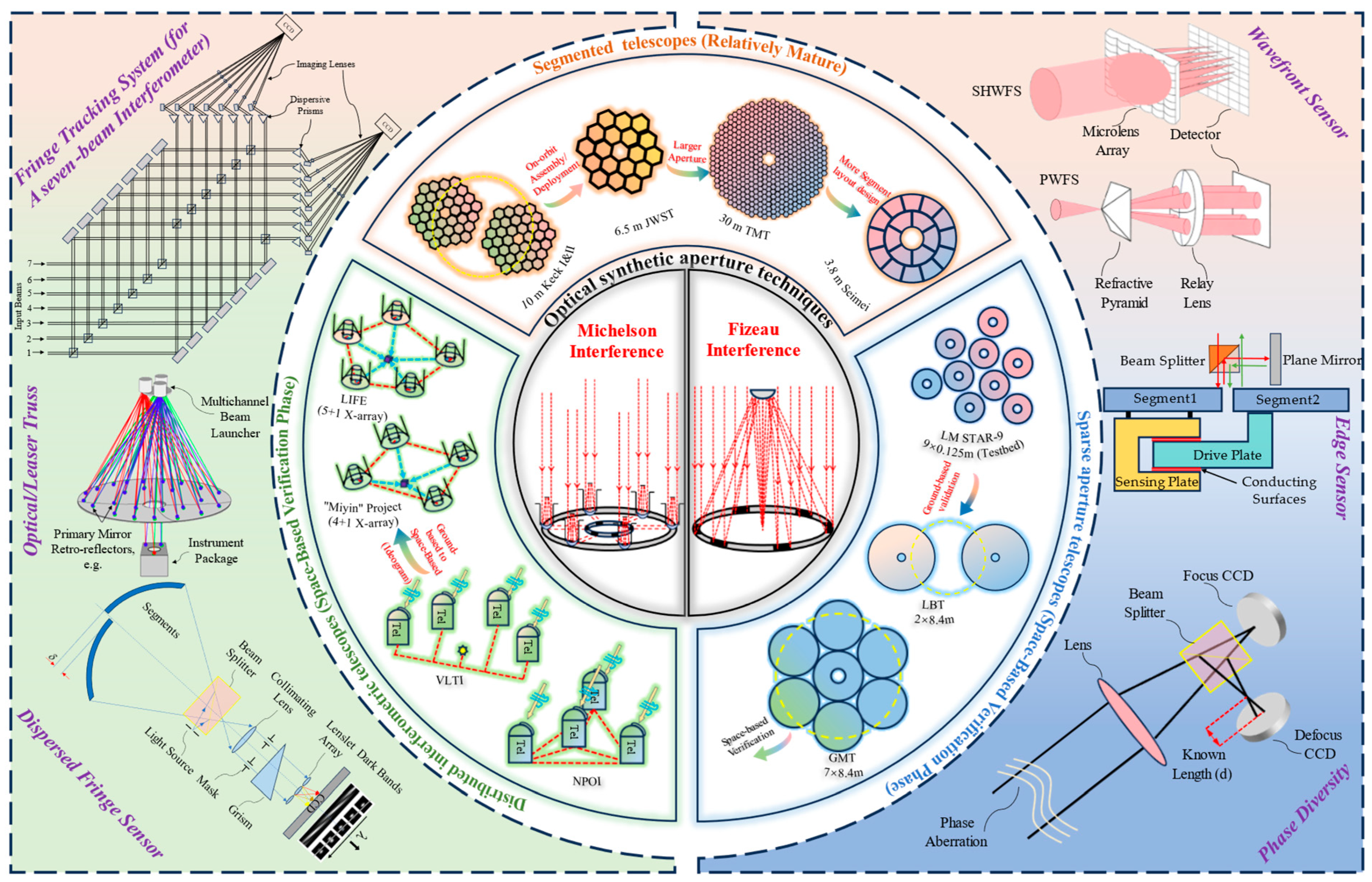
Two configurations of systems—Fizeau interferometric imaging and Michelson interferometric imaging—collectively form the technical framework for distributed optical synthetic aperture coherent detection (see Figure 1) [55]. Among them, the Fizeau configuration belongs to image–plane interferometry and operates based on the principle of equal-thickness interference. It arranges multiple small-aperture optical subsystems in a specific array: first, light from the target scene enters each sub-aperture separately; then, common-phase control technology is used to adjust the optical path difference of each sub-aperture in real time, ensuring that the light collected by all sub-apertures achieves in-phase superposition at the imaging focal plane. Direct imaging is realized through recording by detectors such as CCD/CMOS. However, its baseline length is relatively short, which limits its resolution.
In contrast, the Michelson interferometric system, which adopts long-baseline pupil-plane interferometry, does not directly “capture” the geometric image of an object. Instead, it indirectly reconstructs the image by detecting interference fringes and based on the Van Cittert–Zernike theorem. Although it sacrifices real-time imaging capability, it can extend the baseline to the 100 m scale, thereby significantly improving spatial resolution and sensitivity [82]. It is evident that the Fizeau configuration is suitable for rapid imaging detection, while the Michelson configuration focuses on extreme-resolution detection, with notable advantages especially in deep-space applications.
The two architectures exhibit similar performance in preserving wavefront coherence; for clarity on their distinctions and interrelationships, see Table 1.

3.1. Michelson Interferometers

The Michelson interferometric configuration is currently mainly applied in ground-based distributed systems. The longest baselines of NPOI [83] and VLTI/GRAVITY [84] have reached 437 m and 202 m, respectively. In particular, Very Large Telescope Interferometer (VLTI) can directly serve cutting-edge fields such as quasar gravitational lensing and the measurement of the size of accretion disks in active galactic nuclei, which leads the field of fringe tracking in optical interferometry. However, the development of space-based distributed systems has been relatively tortuous. Currently, represented by the U.S. LIFE mission and China’s “Miyin Project,” such systems are still in the stages of telescope scheme design or demonstration verification.
In this section, we will introduce the dynamic/static ABCD and CP technologies applied to wavefront coherence detection in ground-based interferometers, as well as the FT technology that ultimately achieves interference fringe locking. Naturally, this also includes the laser metrology technology in the Michelson architecture.

3.1.1. Interference Fringe Tracking

An Overview of Fringe Tracking
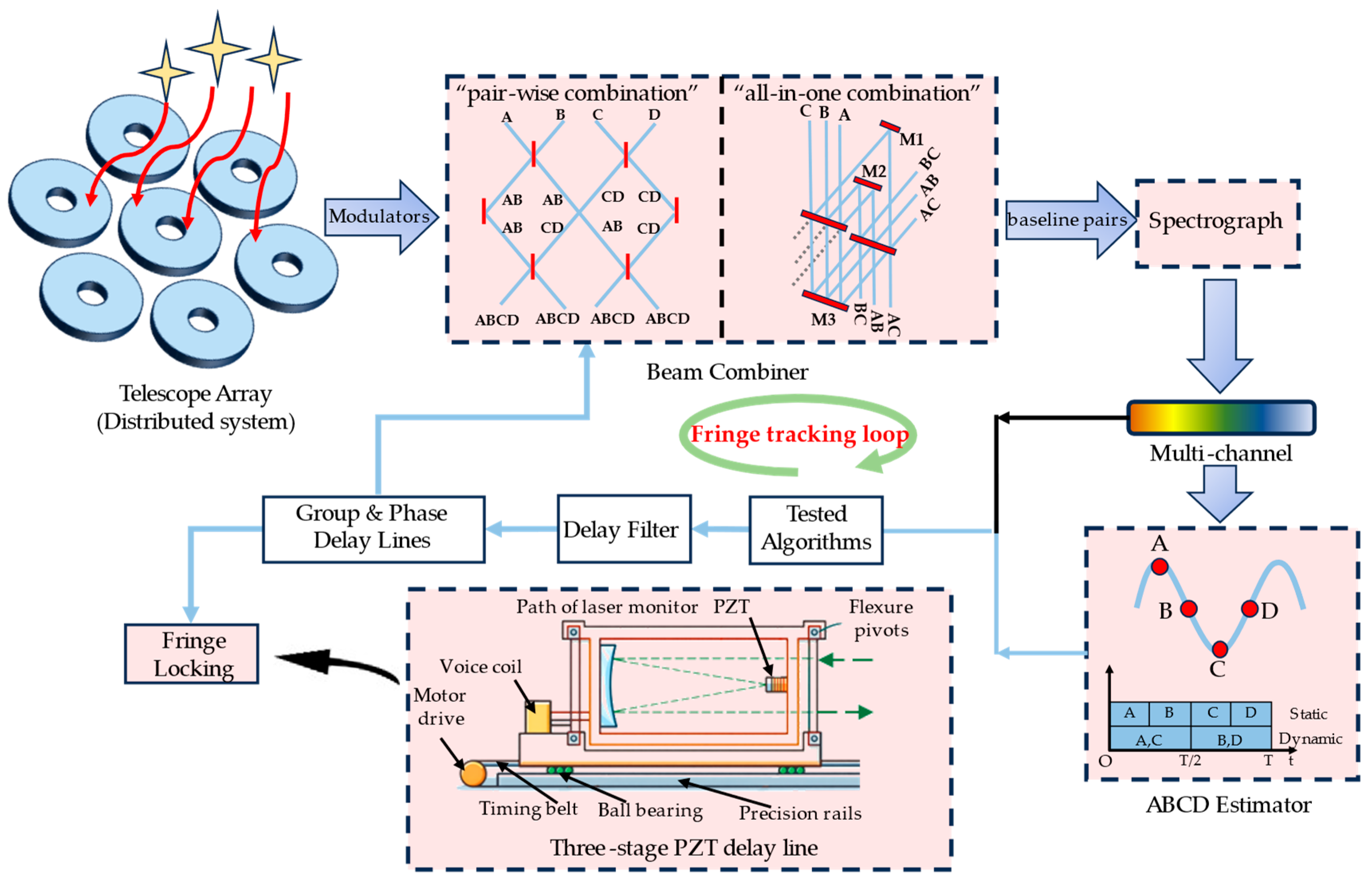
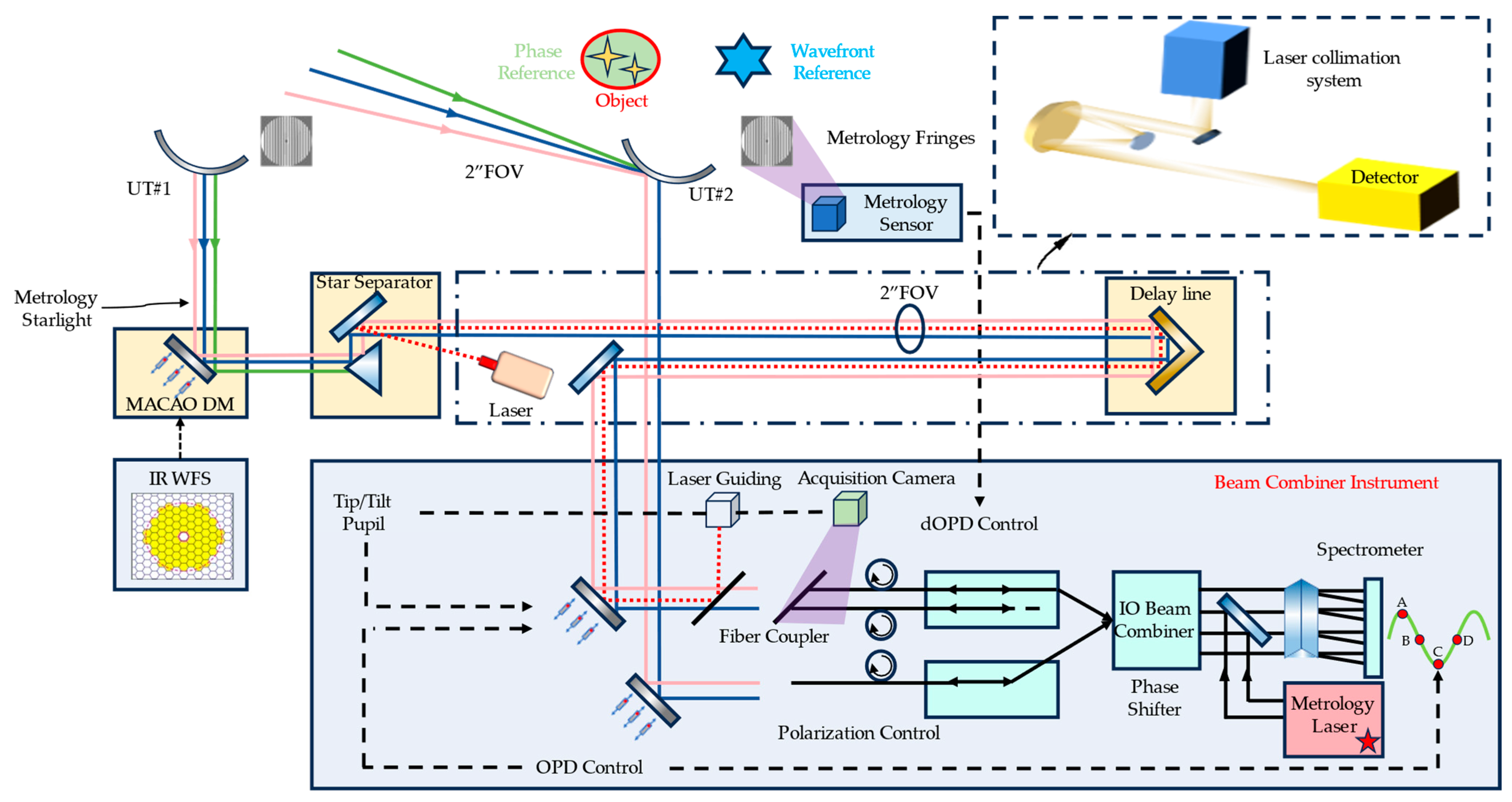
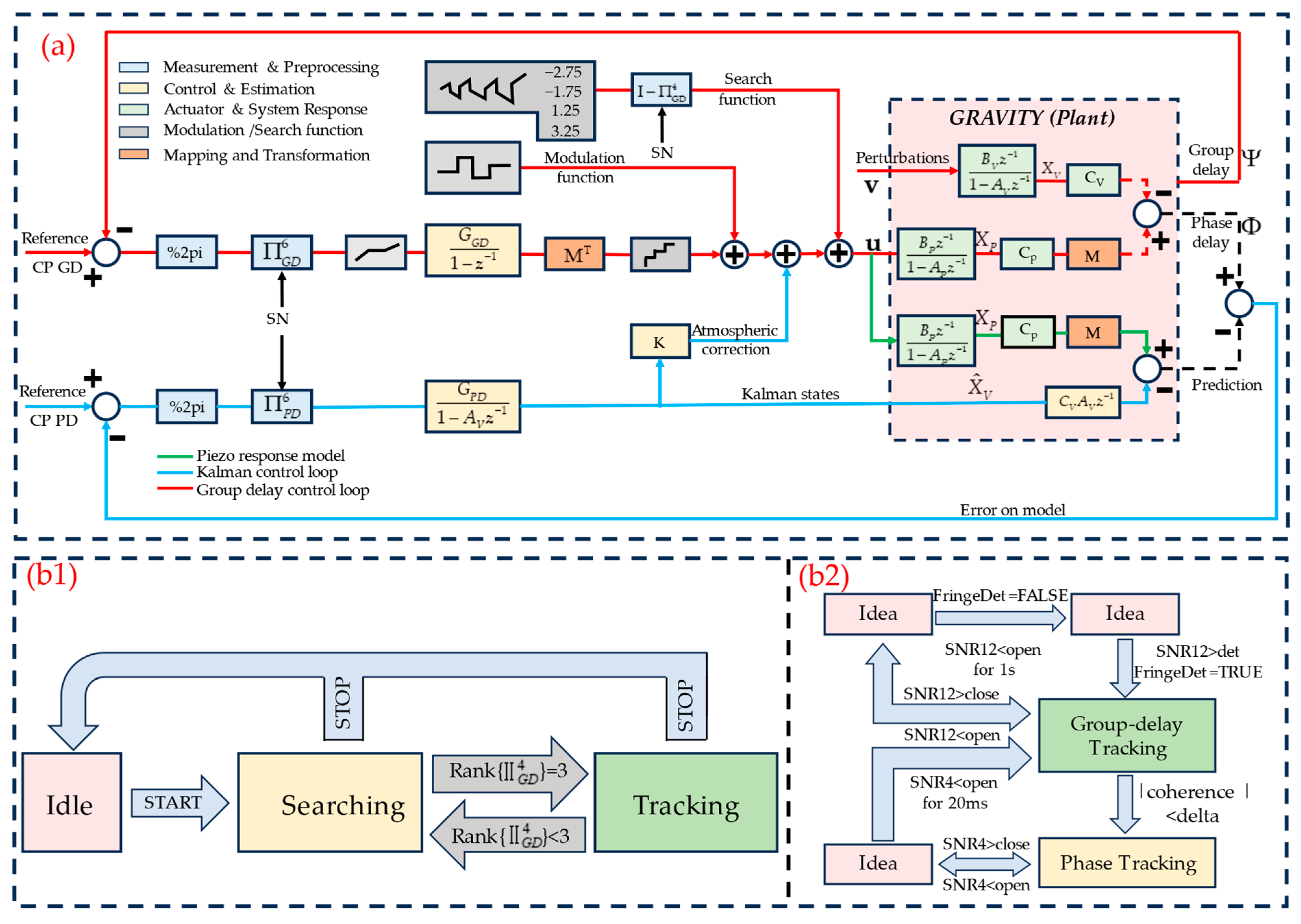
Firstly, we provide an overall overview of FT technology. Since M. Shao and D.H. Staelin founded the modern large-scale optical interferometer (Mark III) in the 1970s [85], the development of ground-based interferometers has been confronted with a major challenge: optical path interference caused by Earth’s atmospheric turbulence and mechanical vibrations leads to the jitter of interference fringes, which severely limits the stability of long-exposure observations. To address this challenge, the backend beam combination system of interferometers adopts a design philosophy of functional separation: the fringe tracker, dedicated to high-speed sensing and control, serves as the “brain” of the system, i.e., the servo unit [72]. It is responsible for locking the envelope of white-light interference fringes through group delay tracking [74] and then realizing the nanoscale closed-loop locking of optical path difference (OPD) via phase delay sampling [86], just like a steady “hand”. Meanwhile, the scientific imaging channel can focus on acquiring high-quality data using stable fringes. As illustrated in Figure 2, this separated design enables the fringe tracker to first lock short baselines through an efficient bootstrapping strategy and derive all phase information from a small number of baselines by means of schemes such as beam combiners. For example, in the seven-beam combination system (see Figure 1) ( N = 7 ), only seven baselines need to be sampled to derive the phases of all C N 2 = 21 baselines (though the actual minimum number is N 1 , a configuration of N baselines is more common for symmetry considerations) [87]. To ensure optical path collimation and internal OPD measurement, the system is also integrated with laser metrology and alignment modules. Laser is injected from the backend, propagates backward to the telescope, and then returns for monitoring. From the early dynamic ABCD measurement [88] to the current advanced systems combining integrated photonic circuits and Kalman filtering [66,73], the iterative development of fringe tracking technology has significantly improved the interferometer’s ability to suppress atmospheric turbulence and the limiting magnitude of observations, making it a technical guarantee for maintaining the diffraction-limited performance of distributed interferometric telescopes.
Static and Dynamic ABCD Method
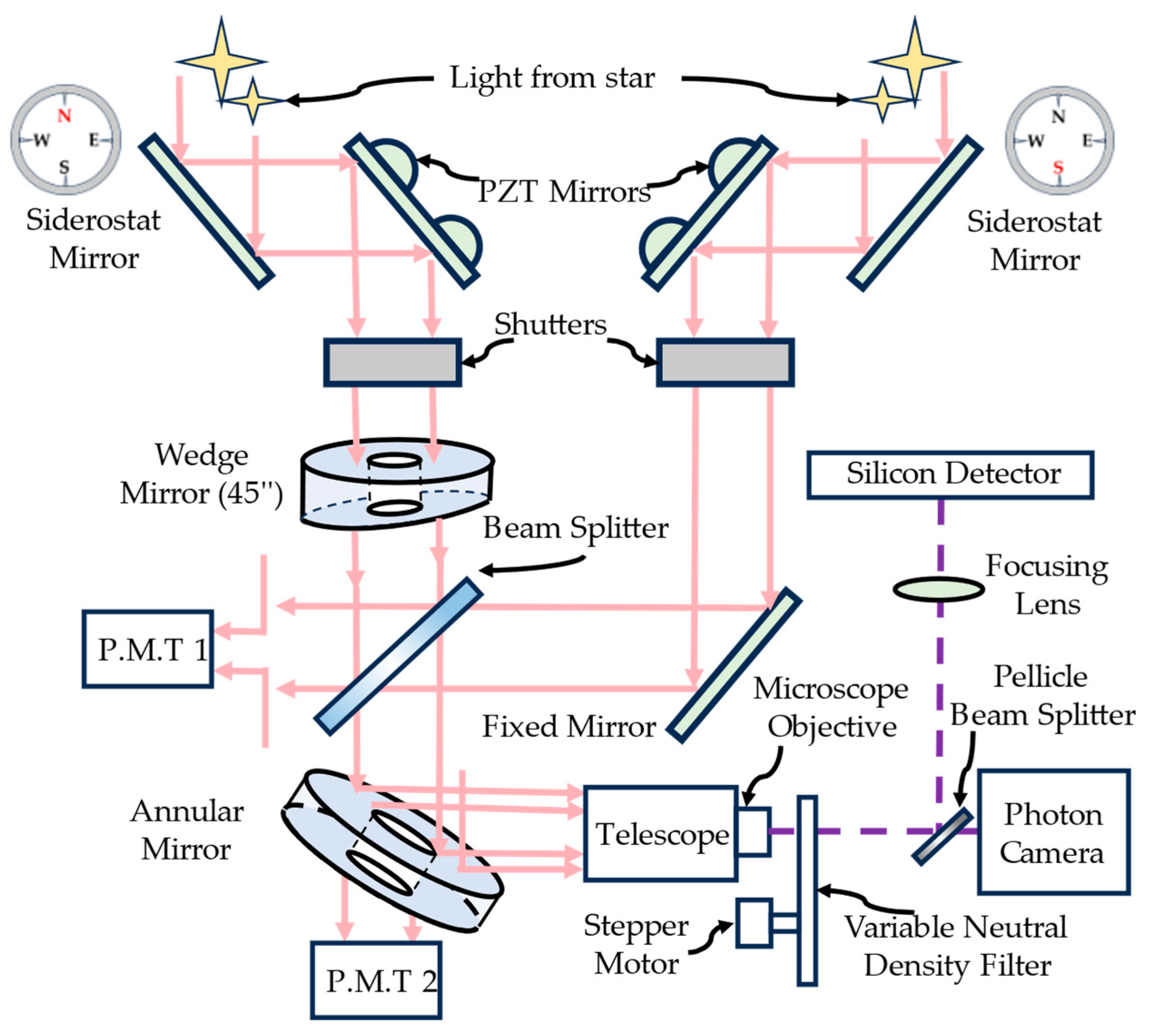
Deployed at Mount Wilson in the 1980s, the Mark III was the first technical prototype to achieve dynamic fringe tracking for white-light interferometry. It adopted a three-stage nested delay line structure to enable precise control of OPD [74]. By moving cat’s-eye mirrors within a vacuum chamber, it compensated for the path difference caused by a 12–32 m baseline, supporting temporal coherence adjustment for segmented systems. This composite control system consisted of three independently programmable subsystems: a piezoelectric ceramic transducer (PZT), a voice coil, and a motor. When atmospheric turbulence caused path jitter (see Figure 2), (i) The PZT performed rapid fine adjustments of the optical path (within 5 μm) with a bandwidth of approximately 100 Hz; (ii) the voice coil and motor maintained the actuator’s dynamic range in a hierarchical manner; the former handled mid-frequency compensation (within 2 mm, 10 Hz bandwidth) to preserve the PZT’s dynamic range, while the latter positioned the voice coil and dynamic center via coarse displacements with a step size of 9 μm. This layered control structure monitored the OPD in real time at 1 kHz using a laser heterodyne interferometer, achieving a phase comparison accuracy of λ/64. Combined with a discrete Kalman filter, it stabilized path errors within the atmospheric turbulence limit of approximately λ/6 under a 12 m baseline. Meanwhile, its star tracker (Figure 3 combined starlight collected by two north–south tilting mirrors via a beam splitter. It used a 45° annular wedge for beam splitting and a photon-counting camera to achieve high-precision tracking of the centroid of binary star images. Additionally, it calculated the centroid offset of star images using an optimal correlation function and drove a piezoelectric tilting mirror to compensate for angular errors—with a corresponding variance of only 0.303 (arcsec)2. This ensured that the wavefront parallelism deviation between the two optical paths was less than 0.1 arcsec, laying the foundation for interference fringe formation [66].
After determining wavefront consistency and completing fringe coherence adjustment, fringe tracking technology comes into play, which tracks OPD fluctuations within a small fraction of the wavelength in real time and achieves final coherent locking. During this stage, the Mark III employed the ABCD modulation method for fringe phase detection to determine visibility [85]—a method originally proposed by Wyant [89]. Even when white-light fringes in the field of view are difficult to identify or are misidentified, the phase estimation results obtained by this method remain unaffected. This makes such a phase delay (phase-shifting interferometry or fringe co-phasing mode) estimation method highly suitable for fringe position measurement [55]:
(1)
Dynamic ABCD method: A 500 Hz triangular wave is applied to the delay line PZT to modulate the optical path, causing interference fringes to sweep across the detector periodically. Broadband white-light fringes are detected at one of the outputs of the beam splitter, and fringe data are recorded synchronously with the dither mirror. There are mainly two implementation methods for temporal phase modulation here: (i) One is discrete phase stepping, i.e., the four-step phase-shifting method [89], which uses optical path modulation with four quarter-wavelength steps. This method is relatively simple but has high requirements for stepping accuracy, requiring closed-loop feedback to ensure precision. (ii) The other is linear optical path scanning, the method used in Mark III [90]. It typically employs a symmetric triangular or sawtooth wave with a peak-to-peak amplitude of one or more integer wavelengths for optical path modulation. Due to its single-stroke characteristic, the sawtooth wave can be used in scenarios where detector noise is relatively high.
Within one modulation cycle, photon counts are divided into four time intervals (A, B, C, D), corresponding to different phase points of optical path difference variation. The phase φ and amplitude A of the corresponding interference fringes can be calculated from the photon counts in the four intervals using Equation (1). Among them, the (C − A) term is related to the cosine component of the fringes, and the (D − B) term is related to the sine component of the fringes. It can be seen that this dynamic method can simultaneously record and obtain two phase states or sample phase states individually. By calculating φ in real time, the system can determine the fringe phase estimation value. After sending the corresponding offset to the interferometer delay line control system, atmospheric turbulence can be corrected almost instantaneously.
φ = tan 1 D B C A π 4 A = ( C A ) 2 + ( D B ) 2
(2)
Static ABCD method: This method employs static optical components to achieve spatial phase modulation, enabling the simultaneous measurement of four phase states (0, π/2, π, 3π/2) with a phase difference of π/2 between adjacent states. It was first implemented in the PRIMA fringe sensor. By introducing an achromatic phase shifter into the interference optical path, a phase shift of π/2 is generated between p-polarized light and s-polarized light; the two polarized lights are then separated by a polarizing beam splitter, allowing the required phase states to be obtained at four output ports. However, due to defects in optical components, there is a deviation between the actual phase shift and the ideal value—this deviation can reach up to π/4 in extreme cases and exhibits a certain degree of dispersion dependence. To improve performance, in 2009, the VLTI developed a “pairwise static ABCD” beam combiner using integrated optics technology [86], which significantly optimized parameters such as phase shift accuracy between the output ports. Later, this technology was further applied in second-generation instrument systems such as VLTI/GRAVITY, VSI, and SPICA, as well as in advanced interferometers including PIONIER and CHARA [76,91,92].
For instance, in GRAVITY, the interference beams transmitted through optical fibers achieve static ABCD encoding via a silica-on-silicon-based integrated optical chip. This chip adopts a dual Michelson structure, with beam splitters and 90° phase shifters etched on SiO2 waveguides. Through a waveguide network, the beams from four telescopes are combined in pairs, generating four-phase outputs for six baselines on a single chip—effectively avoiding errors caused by dynamic phase shifters [72,74].
In theory, the two ABCD methods can achieve the same photon output. However, in practice, due to the presence of disturbances, the dynamic method is more significantly affected by the additional noise caused by edge jitter during the OPD modulation process. Under harsh observation environments/conditions, the degradation of its tracking performance is more severe than that of the static method. In contrast, the static method realizes spatial phase encoding based on optical components and is insensitive to mechanical disturbances. After the accurate correction of instrument effects, it can overcome the limitations of the dynamic ABCD method and exhibits excellent stability.
The ABCD method realized the real-time correction of atmospheric turbulence by interferometers for the first time and verified the observation potential for faint targets (magnitude 14) under the absolute interferometry mode. It has provided direct prototypes for interferometers such as NPOI, PTI, and KI and has become one of the core technical solutions for fringe tracking.
To address the 2π phase jump issue in the phase delay estimator (i.e., its inability to measure OPD outside the range of [−π, +π]), phase unwrapping technology can track the continuity of phase changes and identify and compensate for these integer-multiple jumps of 2π, thereby obtaining continuous phase values.
In addition, fringe coherencing modes such as coherence envelope tracking [77] group delay estimators based on dispersive fringe tracking [93] can be introduced as supplementary measurement methods to retrieve the true phase information. Subsequently, a servo controller is used to drive the delay line to achieve nanoscale optical path locking; however, this approach introduces greater noise compared to the fringe co-phase mode [94,95]. The former (coherence envelope tracking), also known as the temporal method, primarily modulates the OPD to collect multiple high signal-to-noise ratio (SNR) sample amplitudes (or contrasts) near the center of the fringe envelope and fits an envelope model to determine the group delay. Nevertheless, it is time-consuming and labor-intensive due to the large modulation range (typically larger than the coherence length of the fringe envelope) [96]. The latter (dispersive fringe tracking), based on different forms of dispersive spectral measurements, is further divided into the channeled spectrum method [93,97] and multi-wavelength phasor measurements: (i) the channeled spectrum method requires no active OPD modulation and only needs to acquire a single fringe snapshot of the stellar spectral channel. Since the number of interference fringes in the spectral domain is proportional to the OPD, fringe tracking can be achieved by reducing the number of fringes in the spectral domain or lowering the fringe frequency to approach the envelope center at zero OPD. In this method, various data processing techniques such as least squares fitting, Kalman filtering, fast Fourier transform, and the Lomb–Scargle periodogram can be used to estimate the group delay. (ii) The multi-wavelength phasor measurement method is based on OPD modulation and multi-wavelength ABCD phase measurement. It constructs complex fringe phasors by extracting interference fringe phase information at different wavelengths, performs discrete Fourier transform on these phasors, and then locates the group delay via the peak of the power spectrum. This method not only clarifies the delay direction but also avoids zero-frequency term interference, making it more suitable for high-sensitivity tracking near zero group delay.
Although group delay is inferior to phase delay tracking in terms of the resolution and speed; it solves the 2π ambiguity problem and ensures high stability of the detected phase by virtue of its wide spectral bandwidth and high sensitivity. Therefore, the combination of the two has long been the cornerstone for modern interferometers to achieve precise OPD measurement and further adjust wavefront coherence.
Closure Phase Method
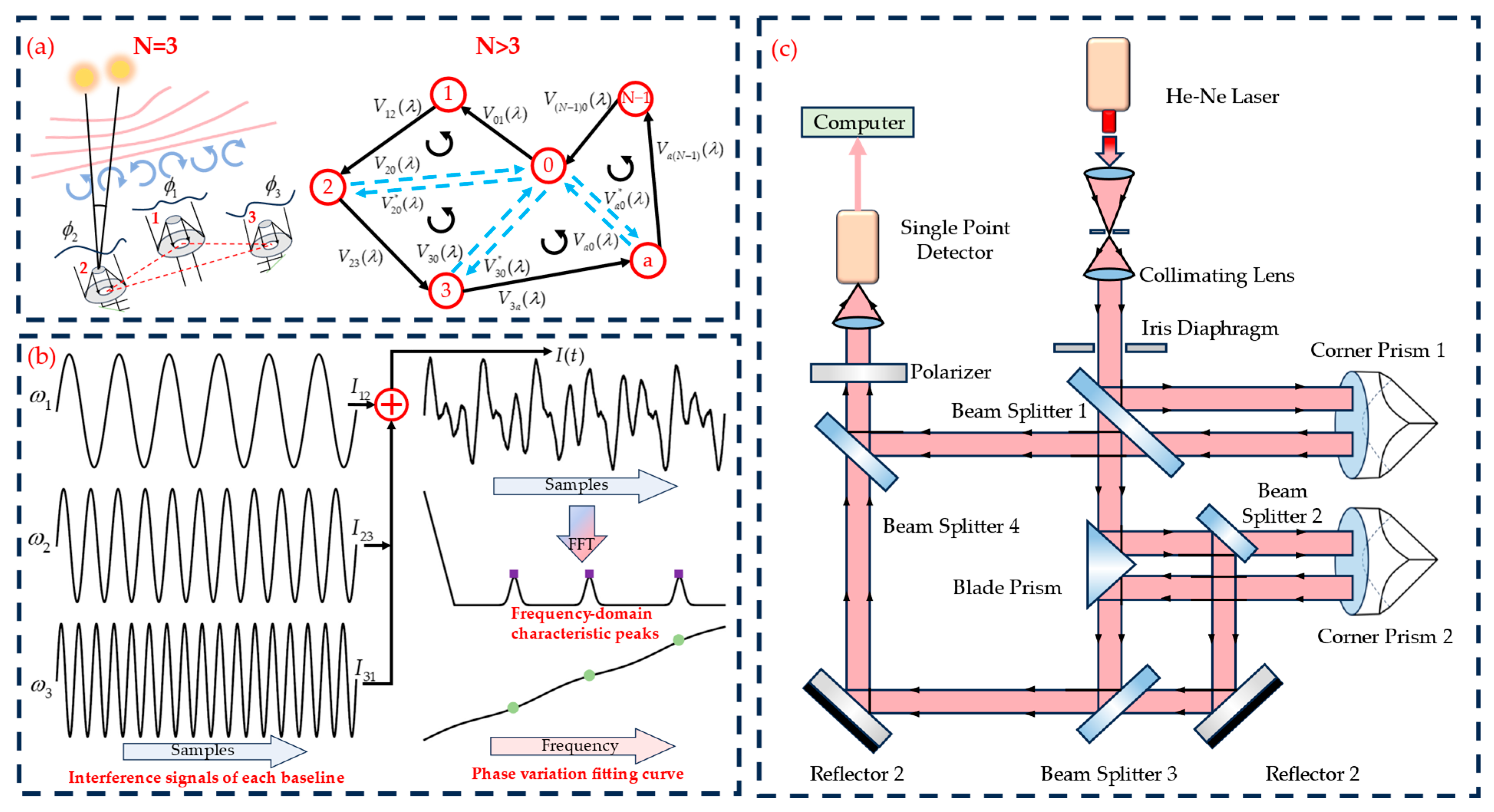
Building on the Mark III, the NPOI has significantly enhanced sensitivity and resolution by extending the baseline length (from 32 m to 437 m), increasing the number of sub-apertures and optimizing automated operations. It can phase up to six elements simultaneously [83]. The NPOI is a representative interferometer that employs closure phase technology for stable imaging [73,76,86,88,89,90,91]. Closure phase technology works by measuring the interference phases of all baselines within a closed loop formed by three or more telescopes and summing these phases. As shown in Figure 4a, the closure phase (CP) is defined as the sum of the visibilities’ phases of the interference fringes measured across all three baselines in the loop:
φ C , 123 = φ 12 + φ 23 + φ 31
where φ i j denotes the phase of the spatial coherence (complex visibility) V i j measured on baseline, i.e., arg ( V i j ) . Each measured phase φ i j consists of two components:
φ i j = φ S , i j + φ A , i j = φ S , i j + ( ϕ j ϕ i )
where φ S , i j represents the true phase information determined by the actual spatial structure of the target celestial object; φ A , i j = ϕ j ϕ i denotes the differential phase error associated with individual telescopes (elements i , j ) introduced during propagation and measurement. This error arises from factors such as atmospheric turbulence disturbances, instrumental errors of telescopes and (e.g., mechanical vibrations, thermal deformation), and environmental perturbations. A key point is that the atmospheric disturbance phase noise φ A , i j is generally much larger than the source phase φ S , i j , making direct imaging via Fourier inversion of observed complex visibilities nearly impossible. However, substituting Equation (3) into Equation (2) yields the following: φ C , 123 = φ S , 12 + φ S , 23 + φ S , 31 . It can be seen that the phase error terms cancel each other out completely during the summation, which is attributed to the relationship where it is proportional to the path difference [98]. Ultimately, the closure phase value becomes an “invariant” that retains only the true structural information of the celestial object [99]. It directly reflects the object’s structural information at the corresponding spatial frequency, enabling long-duration integrated observations far exceeding the atmospheric coherence time.
In terms of technical implementation, the NPOI relies on its specially designed beam combiner (a trade-off between the two beam combining methods: “All-in-One” with high sensitivity and “Pairwise” with low complexity [100]) to simultaneously measure all baseline interference signals within a closed triangular loop (see Figure 4a) [101]. The phase of each baseline is extracted through signal analysis and calculated according to the definition of the closure phase. This method exhibits geometric invariance: in addition to being invariant to element-related phase errors, it is also unaffected by the overall translation of the image. Based on this, geometric methods such as the “triangle height method” or “area product method” can be directly used to extract the closure phase from image data, which is intuitive and robust.
For interferometric arrays with more elements, this technology can be extended by decomposing the closed polygon into multiple basic triangles (see Figure 4a) and summing their closure phases. For an array containing N elements, the number of independent CPs is ( N 1 ) ( N 2 ) / 2 , which is less than the number of all possible baseline phases C N 2 = N ( N 1 ) / 2 , retaining only ( N 2 ) / N (less/more) phase information. It can be seen that as the number N of array elements increases, the number of independent closure phases that can be formed also increases, making it possible to recover richer true celestial phase information. Furthermore, the remaining fringe phases can be supplemented by combining redundant baseline correction algorithms or solving overdetermined systems of equations composed of multiple sets of closure phases.
Having introduced the basic principles, the next issue is how to accurately calculate the closure phase information. In the field of long-baseline optical interferometric high-resolution imaging, the closure phase extraction method based on optical path difference modulation is a reliable technical solution (Figure 4b,c). This method achieves the effective extraction of closure phase information by performing frequency–domain separation based on the interference signals of three or more baselines [102]. From the perspective of technical implementation, it has low engineering difficulty; in terms of numerical processing, it also demonstrates the dual advantages of simplicity and reliability. Based on this, Tang from the Nanjing Institute of Astronomical Optics & Technology proposed a time–domain interference signal closure phase-detection method. By introducing non-redundant triangular wave optical path difference modulations (with frequencies ω 1 < ω 2 < ω 3 respectively) into the three interference arms, the combined time–domain interference signal I ( t ) contains interference components from different baselines:
I ( t ) = I 1 + I 2 + I 3 + 2 I 1 I 2 C 12 cos ( 2 π f 12 t + φ 12 + ϕ 2 ϕ 1 ) + 2 I 2 I 3 C 23 cos ( 2 π f 23 t + φ 23 + ϕ 3 ϕ 2 ) + 2 I 3 I 1 C 31 cos ( 2 π f 31 t + φ 31 + ϕ 1 ϕ 3 )
where I i represents the light intensity on the interferometric arm; I i j represents the interference signal on baseline ij; C i j represents the contrast of the fringes obtained on baseline ij; and f i j is the frequency of the composite modulation signal on baseline ij ( f 12 f 23 f 31 0 ).
I ˜ f = F { I ( t ) } = I 1 + I 2 + I 3 δ f + I 1 I 2 V 12 δ f f 12 + I 2 I 3 V 23 δ f f 23 + I 3 I 1 V 31 δ f f 31
Then, this method utilizes a high-speed detector (with a sampling frequency of 5 kHz) and an A/D converter (16-bit) to collect signals and converts the time–domain signals to the frequency domain via Fourier transform (Equation (5)). It extracts phase information (amplitude I i I j C i j and phase φ i j ) at the modulation frequencies f i j , thereby calculating the closure phase. In the experiment, a PZT is used for optical path modulation, and the cosine error is calibrated through the wavelength–period relationship, controlling the displacement accuracy within 20 nm. Eventually, the closure phase extraction accuracy reaches λ/50. In terms of feedback control [55], the closure phase technology can improve system stability by eliminating the random phase errors introduced by atmospheric turbulence. As an “invariant”, it can be used for the real-time correction of OPD in FT systems and combined with the ABCD method (phase delay) or group delay measurement (group delay) to lock the position of white-light fringes.
VLTI-Internal Configuration of Advanced Interferometers
GRAVITY is the second-generation instrument of the VLTI at the European Southern Observatory (ESO) [103,104]. Operating in the near-infrared K-band (1.95–2.45 μm), it can provide baseline lengths ranging from 8 m to 202 m. In addition to CP, the project addresses the aperture limitation of Alt-Az interferometric arrays caused by atmospheric turbulence by integrating the Coudé Infrared Adaptive Optics (CIAO) system [73]. Meanwhile, leveraging single-mode fiber spatial filtering and low-noise detector technologies, it enables the phase-referenced interferometric imaging of faint celestial objects and high-precision narrow-angle astrometry across the visible to mid-infrared range [91]. Similar to other interferometers, it uses an FT to maintain wavefront coherence, allowing the system to perform interferometric observations of targets as faint as K-band magnitude 17 with 0.25% visibility and 10 μ as precision at an equivalent aperture resolution of 130 m [105].
Figure 5 illustrates the GRAVITY’s multi-optical-path design for simultaneous wavefront sensing and interferometry. The workflow of the VLTI/GRAVITY system begins with the PRIMA star separator, which directs the light beam from a bright reference star into the CIAO system. The CIAO system achieves imaging of the reference star via infrared SHWFSs. Based on this signal and in combination with a deformable mirror, it corrects wavefront aberrations, laying the foundation for subsequent interferometric measurements. The corrected beam enters the main interferometric optical path; after the OPD is compensated for by a delay line, the beam is split via a roof prism and divided into the FT and the scientific spectrometer at a 50/50 ratio. The FT employs a silica-on-silicon integrated optical chip for static ABCD encoding, synchronously generating four-phase outputs for six baselines and avoiding mechanical modulation errors. Crucially, the entire process is underpinned by a suite of laser-assisted active control systems. These systems, including a laser metrology for nanoscale differential OPD monitoring and compensation, ensure the final high-resolution data output from the scientific spectrometer. The system can coherently combine the off-axis phase reference and real-time control mechanisms for light beams from four 8 m Unit Telescopes (UTs) or four 1.8 m Auxiliary Telescopes (ATs) simultaneously [72,73,74].
The laser technologies mentioned above play specific and critical roles throughout the optical path. After the initial wavefront correction by the CIAO system, residual high-frequency Tip/Tilt errors and pupil anomalies, introduced by optomechanical vibrations, necessitate further correction using a dedicated laser guiding system. In this system, a 658 nm laser beacon emitted from the PRIMA star separator illuminates the VLTI beam combination optics. Its signal, detected by a position-sensitive diode, drives a piezoelectric mirror within the fiber coupler at 3.3 kHz to suppress beam jitter, achieving a pointing stability better than 9 mas. Simultaneously, a 1200 nm pupil-guiding laser is utilized to correct low-frequency pupil drift (e.g., caused by delay line motion). The pupil’s lateral/longitudinal displacement is monitored via a microlens array in the GRAVITY acquisition camera, driving pupil actuators and delay line mirrors for compensation. Additionally, H-band measurements correct for low-frequency field and pupil drift, ultimately yielding stable, interference-ready beams free from disturbances. Furthermore, the 1908 nm metrology laser system is injected backwards from the spectrometer. It employs a three-beam interferometric design to monitor the nanoscale differential OPD between the science target and the reference star in real-time. This system forms a closed loop with the fiber differential delay line to suppress residual OPD drift accumulated over long-term observations, a point that will be elaborated on in the following Section 3.1.2.
During operation, GRAVITY also uses single-mode fluoride fibers (with a transmission efficiency > 87.5%) for mode-field matching to filter out high-frequency wavefront aberrations, converting phase noise caused by atmospheric turbulence into intensity fluctuations and mitigating phase noise induced by incoherent fluctuations in the input beam. Meanwhile, a fiber polarization controller aligns the polarization state to ensure an interference contrast > 98.2%, and a dispersion compensator at the spectrometer end controls dispersion loss to below 5%.

3.1.2. Laser Truss in Interferometers

The introduction of laser metrology is of great importance to interferometers. In fact, the operating basis of an interferometer lies in measuring and stabilizing the OPD between light beams from different telescopes. Under ideal conditions, the optical path difference is determined solely by the geometric position of celestial objects:
O P D = B s
where B is the baseline vector, and s is the direction vector of the light source. However, in real-world environments, affected by local factors such as atmospheric turbulence in non-vacuum optical paths and instrument vibrations, additional and rapidly varying optical path difference noise is generated inside the interferometer (from the telescope to the beam combiner). Therefore, although the fringe tracker can actively compensate for part of the disturbances, an independent laser metrology system must be employed to monitor the entire internal optical path in real time. This is to accurately identify the sources of noise, enable the linkage of subsequent observations, and reduce the calibration requirements for the highest-precision measurements, thereby providing nanoscale-precision reference information for closed-loop optical path difference control and open-loop data correction.
The basic equation of narrow-angle astrometry Equation (7) also provides a clear explanation:
Δ O P D = B N A B s + Δ O P D int
where Δ O P D is the total optical path difference between the two targets detected by the scientific camera; B N A B s is the geometric optical path difference determined by the celestial separation angle s of the two targets and the Narrow-Angle Baseline ( B N A B ), which represents the astrophysical information we intend to measure; Δ O P D int refers to the internal optical path difference, and the goal of the laser metrology system is to accurately measure this term so as to eliminate it from the equation. To meet this requirement, various technical solutions have been developed [106]. The foundational application of optical truss or laser metrology can be traced back to the Mark III Interferometer project at Mount Wilson Observatory in 1990. This system deployed a prototype laser metrology optical truss for the first time, which was used to monitor baseline movements [107]. Through development, these solutions have mainly been categorized into the PRIMA-like scheme [108] and the GRAVITY scheme [109].
Based on the PTI and PRIMA projects, the PRIMA-like scheme adopts two independent heterodyne Michelson interferometers. Each interferometer is responsible for tracking the optical path changes of one target (e.g., one for the bright star/fringe tracker (FT) and the other for the scientific target/science combiner (SC)) as they reach the two telescopes. This yields ( T 1 T 2 ) F T and ( T 1 T 2 ) S C , respectively, and further enables the calculation of Δ O P D int :
Δ O P D int = ( T 1 T 2 ) F T ( T 1 T 2 ) S C
The signal is recorded by a photodiode. After filtering and frequency mixing, the path disturbance to be measured is encoded in the phase of the carrier signal. However, this scheme requires that the endpoints of the metrology laser must be placed after the DM of the AO system. The reason is that if the metrology light is reflected before the DM, the surface shape changes of the DM itself (which are generated to correct atmospheric turbulence) will be misread by the metrology system as path noise, thereby introducing significant errors. This limitation causes the metrology endpoints to be far from the primary mirror of the telescope, reducing the stability of the B N A B .
In contrast, the VLTI/GRAVITY system adopts a more innovative three-beam metrology scheme to overcome the aforementioned limitations. This scheme splits the metrology laser into three laser beams with a fixed phase relationship: two of the weaker beams are injected back into the beam combiner chip (propagating toward the telescopes, as shown in Figure 5); the third high-power beam is superimposed inside the instrument with the two weak beams that have passed through optical fibers, acting as a phase-locked amplifier to enhance the detection efficiency of the returned signal and minimize inelastic scattering in the instrument’s optical fibers. Finally, at the pupil plane of each telescope, the three beams interfere to form a fringe pattern. By applying temporal phase modulation at different kilohertz frequencies to the two weak laser beams, the phases of the two optical signals can be demodulated separately. This method enables direct measurement of the path differences between the two target beams reaching the same telescope, namely ( F T S C ) T 1 and ( F T S C ) T 2 , so Δ O P D int can be expressed as follows:
Δ O P D int = ( F T S C ) T 1 ( F T S C ) T 2
The core advantage of this design lies in the fact that since the two metrology laser beams (FTSC) pass through the same DM simultaneously, and the aberrations introduced by the DM are canceled out in the differential measurement. This means that the metrology system “cannot see” the changes in the DM, thereby allowing the metrology endpoints to be extended to the pupil plane of the telescope. This significantly improves the stability of the B N A B and is one of the cornerstones enabling GRAVITY to achieve nanoscale precision.
Regardless of the scheme, extremely high requirements are placed on the frequency stability of the metrology laser itself. This is because the measured OPD is directly related to the laser phase ( ϕ L ) and wavelength ( λ L ) (or frequency, u L ):
O P D = ϕ L λ L 2 π = ϕ L c 2 π u L
Assume that the maximum internal OPD to be measured is L (e.g., 100 mm), with a required measurement error of δ O P D < 1 nm. Taking the derivative with respect to u L yields the requirement for frequency stability, as shown in Equation (11). Therefore, the relative frequency stability of the metrology laser must be better than 10−8, which typically necessitates the use of a frequency-stabilized laser.
δ O P D = O P D u L δ u = ϕ L c 2 π u L 2 δ u L L u δ u L < 1   nm δ u L u L < 1   nm L 1   nm 100   mm = 10 8

3.2. Fizeau Interferometers

Currently, the majority of segmented telescopes worldwide adopt this configuration [110,111,112,113], which is already quite mature and is evolving towards applications in space-based deployable/on-orbit assembled systems and even larger ground-based apertures (see Figure 1). Furthermore, the large-aperture, multi-circular primary mirror segmentation design enhances observational fault tolerance [114]. The GMT, composed of seven 8.4 m mirrors arranged in a ring, can conduct observations independently even when not all segments are utilized [115,116]. A previously similar system, the Large Binocular Telescope (LBT) (two 8.4 m segments), incorporated nulling interferometry, granting it the capability to detect celestial objects with high resolution and sensitivity in single-dimension angular radius measurements [17,117]. Segmented telescopes used for multi-object spectroscopic surveys best exemplify the advantage of the Fizeau configuration’s wide field-of-view observation [118]. The Southern African Large Telescope (SALT) and Hobby–Eberly Telescope (HET) (both featuring 91 segments and a 9.2 m aperture [119,120]), located in the southern and northern hemispheres, respectively, support a 22 arcminute (′) field of view [121]. The Maunakea Spectroscopic Explorer (MSE), comprising 60 hexagonal 1.44 m segments forming an 11.25 m aperture, supports an exceptionally wide field of view up to 1.5 square degrees [122]. It achieves high-reliability wavefront sensing and system-level co-focal stability by integrating a focal plane camera, dynamic defocus analysis, wavefront sensing, and an Atmospheric Dispersion Compensator (ADC). China’s LAMOST employs a novel configuration with a large-aperture meridian-active reflecting Schmidt structure. Based on SHWFS coherent wavefront measurement and utilizing thin-mirror active optics and segmented-mirror active optics technologies, it is capable of maintaining co-focus over a massive 5-degree field of view for large-scale spectroscopic surveys [123,124,125,126,127]. The powerful wide-field imaging capability is the core characteristic distinguishing Fizeau interferometry from Michelson interferometry. This feature enables the discovery and in-depth study of extremely faint stars and galaxies across vast solid angles, objects that were previously beyond observational reach.
This section will focus on introducing partial optical interferometry technologies under the Fizeau configuration, including broad-narrow band detection in Keck and TMT, PD/PR phase reconstruction, dispersive fringe sensing, and the development of ES, which serve as a crucial component in segmented co-phasing control. And similar to the content in Section 3.1.2, this section will also cover laser trusses used for constructing hybrid wavefront sensing.

3.2.1. Interference Detection

Broad–Narrow Band Method
The broad–narrow band method, initially proposed by Chanan et al. [51,52,128] to address the co-phasing challenges of the Keck, represents a classic technical approach in the field of co-phase detection for segmented telescopes. The core distinction between its two modes lies in the selection of light sources, leading to differentiated adaptations in the measurement range and accuracy. The narrowband mode employs monochromatic light. By placing circular aperture masks between adjacent mirror segments, the two halves of each sub-aperture form a structure analogous to the slits in Young’s double-slit interference experiment. The resulting diffraction pattern details are highly sensitive to the piston error between neighboring segments. Piston error can be extracted by cross-correlating the actual diffraction pattern with a theoretical diffraction template. However, constrained by the 2π ambiguity inherent in the theoretical template, the detection range of this mode is limited to λ/2, albeit with a detection accuracy reaching 6 nm. To overcome the limitation imposed by 2π ambiguity, the broadband mode utilizes a continuous wavelength range of light (such as white light) for detection, thereby expanding the measurement range significantly to ±30 μm while maintaining an accuracy of 30 nm. Nevertheless, the broadband method requires scanning with fixed steps, making the process relatively cumbersome. Frequent scanning may also introduce cumulative errors in actuator displacement, which has become a key focus for subsequent technical improvements.
With technological advancements, the broad–narrow band method has progressively integrated with novel optical components to enhance its performance. For instance, the emergence of Computer-Generated Holograms (CGHs) has led to the development of the CGH-SHAPS co-phase detection technique. This technique replaces the conventional pupil mask and imaging lens array in the Shack–Hartmann system with a CGH element, significantly streamlining the system architecture while substantially relaxing the stringent requirements for pupil alignment [129]. This integration provides a more flexible solution for the engineering application of the broad–narrow band method. Regarding the expansion of application scenarios, the Phasing Camera System (PCS) of the Keck fully leverages the large piston error capture range of the broadband SH method. It initially calculates the piston error between adjacent segments roughly, then employs the segmented mirror active optics system to reduce this error within the capture range of the narrowband SH method, ultimately achieving fine co-phasing. The core principle of this broadband phasing approach has also been applied to piston error sensing in the Hobby-Eberly Telescope (HET) [130]. Furthermore, the Keck established four distinct co-phase adjustment modes by selecting filters with four different bandwidths (Table 2). A smaller filter bandwidth corresponds to a larger measurement range but simultaneously causes a reduction in light intensity, thereby decreasing the signal-to-noise ratio of the diffraction spots. Consequently, when using narrow-bandwidth filters, brighter celestial objects must be utilized as light sources. Although the narrowband mode can further refine the piston error between segments to approximately 6 nm, the broadband mode alone currently suffices to meet the piston detection accuracy requirements of the Keck. Thus, the co-phase adjustment tasks are now predominantly performed using the broadband mode, with the narrowband mode primarily serving a verification role to ensure the reliability and precision of the co-phase adjustment process.
To address the issue of time-consuming broadband mode scanning, the under-construction TMT tends to adopt the multi-wavelength Point Spread Function (PSF) detection method in phasing measurements. This method conducts measurements at multiple monochromatic wavelengths, which not only solves the problem of long time consumption in detecting piston errors with the broadband PSF algorithm but also compensates for the defect of limited measurement range in the narrowband PSF method [79]. However, the dual-wavelength PSF detection technology still has a prominent edge jump problem [131]. Researchers of the CGST [132] proposed the dual-wavelength simultaneous measurement method. Based on a synchronous signal generator; it triggers two detectors to perform strictly synchronous exposure with a precision of 5 μs, ensuring that the two selected wavelength channels undergo exactly the same turbulence disturbance at the same time. This eliminates the turbulence component in relative errors and can reduce the jump rate to 10−9. However, wavelength selection itself involves a complex trade-off between expanding the capture range and the sensitivity to system errors. Although Chanan et al. (for the TMT) proposed different optimized wavelength combination schemes to mitigate this risk, ensuring the edge jump probability is reduced to 10−6, such schemes need to be implemented at the cost of sacrificing the detection range. They fail to fundamentally address the technical challenges of optical interferometry in large-range, high-precision, and fast measurements. The selection of dual/multi-wavelengths still requires further research to provide systematic theoretical guidance. In the future, machine learning [62] can be combined to optimize wavelength combinations, thereby further improving robustness.
In addition, TMT has also improved the propagation mechanism of wide and narrowband methods. Different from the Fraunhofer propagation adopted by Keck, TMT uses an SH sensor based on Fresnel propagation. By controlling the imaging distance within an appropriate range of Fresnel numbers, lensless wavefront detection is achieved. Based on this technology, the Tip/Tilt errors of the sub-mirrors can be roughly adjusted from ±12 arcsec RMS to 0.3 arcsec RMS, and the piston errors converge to 6.8 nm RMS (without 2π ambiguity) after three iterations [133], which further enhances the engineering practicality of such technologies.
In 2016, Juan F. Simar et al., referring to the broad–narrowband method of the Keck, proposed a new phase measurement and correction system for large, segmented telescopes above the 10 m class, which was verified on an equivalent 7-segment system [134]. The system also adopts the hierarchical approach of “coarse adjustment-fine correction”: during coarse measurement, sub-apertures are generated through a mask, the PSF is recorded using a spectral filter and a CCD, and the OPD is estimated by calculating the Modulation Transfer Function (MTF) peak of the Optical Transfer Function (OTF) via Inverse Fast Fourier Transform (IFFT). The detection range reaches 300 nm to 200 μm, completing preliminary correction; during fine measurement, referencing Keck’s narrowband SH method, the range is narrowed to 15–300 nm by analyzing the Phase Transfer Function (PTF) of the OTF, and fine adjustment is achieved based on the phase peak, ultimately maintaining the OPD below 15 nm [135]. Compared with the Keck system, the exposure time and fine measurement execution time of this system are only 1/10 and 1/20 of those of Keck’s, respectively, with lower measurement uncertainty. It can be directly applied to space telescopes (additional atmospheric disturbance correction is required if used for ground-based applications) [136]. However, due to the nonlinearity of the Gaussian function, the errors at both ends of its OPD measurement range are relatively large, and it also relies on performances such as starlight brightness and CCD sensitivity. In addition, the limitation of the telescope’s field of view (FOV) may lead to a low phasing success rate in specific sky regions. For example, the ELT has a success rate of only about 10% in the high Lon and Lat directions within its 5′ FOV, requiring repositioning to pre-set bright stars.
Interference Dispersion Fringe Method
The PCS of the Keck, while achieving long-term stable phasing based on the broad-narrowband method (having operated successfully for over 30 years each on Keck I/II and completed more than 1000 mirror phasing operations), also used its own performance as a benchmark to verify for the first time the feasibility of Dispersion Fringe Sensing (DFS) technology in extracting segmented piston errors. It further pointed out that the technology’s characteristic of low dependence on ES makes it more suitable for space telescopes. This verification has laid a crucial foundation for the subsequent development and practical application of the dispersion fringe method, and its technical value has also been fully demonstrated in major projects such as the JWST [137].
The DFS technology was proposed by the NASA research team, and its operation is based on the interference effect of light beams between adjacent sub-mirrors and the dispersion characteristics of polychromatic light: a spectroscopic element is used to decompose polychromatic light into monochromatic light of different wavelengths. When there is a piston error between sub-mirrors, light of different wavelengths will produce corresponding phase differences, which in turn leads to a regular shift in the position of the energy maximum of the light spot in the interference fringes. In the interference direction, the change in light intensity follows the law of double-slit interference; in the dispersion direction, the periodic fluctuation of light intensity is determined by the phase modulation caused by the piston error. By extracting the phase information in the interference fringes and the shift of the light spot position, the piston error between sub-mirrors can be accurately solved [138,139,140]. This technology has a measurement range on the order of hundreds of micrometers and a measurement accuracy better than 0.1 μm, but it also has obvious limitations. When the detection range is less than half a wavelength, its detection sensitivity decreases significantly, and it is insensitive to Tip/Tilt errors; therefore, it is mainly used in the coarse phasing stage [141]. To make up for this deficiency, the Dispersion Hartmann Sensor (DHS) emerged. It combines SHWFS technology with DFS and uses a broadband light source. This not only solves the problem of DFS’s low sensitivity to piston errors below one wavelength but also avoids the cumbersome operation of frequently replacing filters when traditional SH technology is used for coarse phasing. At the same time, it retains the large-range characteristic of DFS, enabling combined adjustment of confocal and phasing, balancing large range and high precision, and can cover the entire stage from coarse phasing to fine phasing [142].
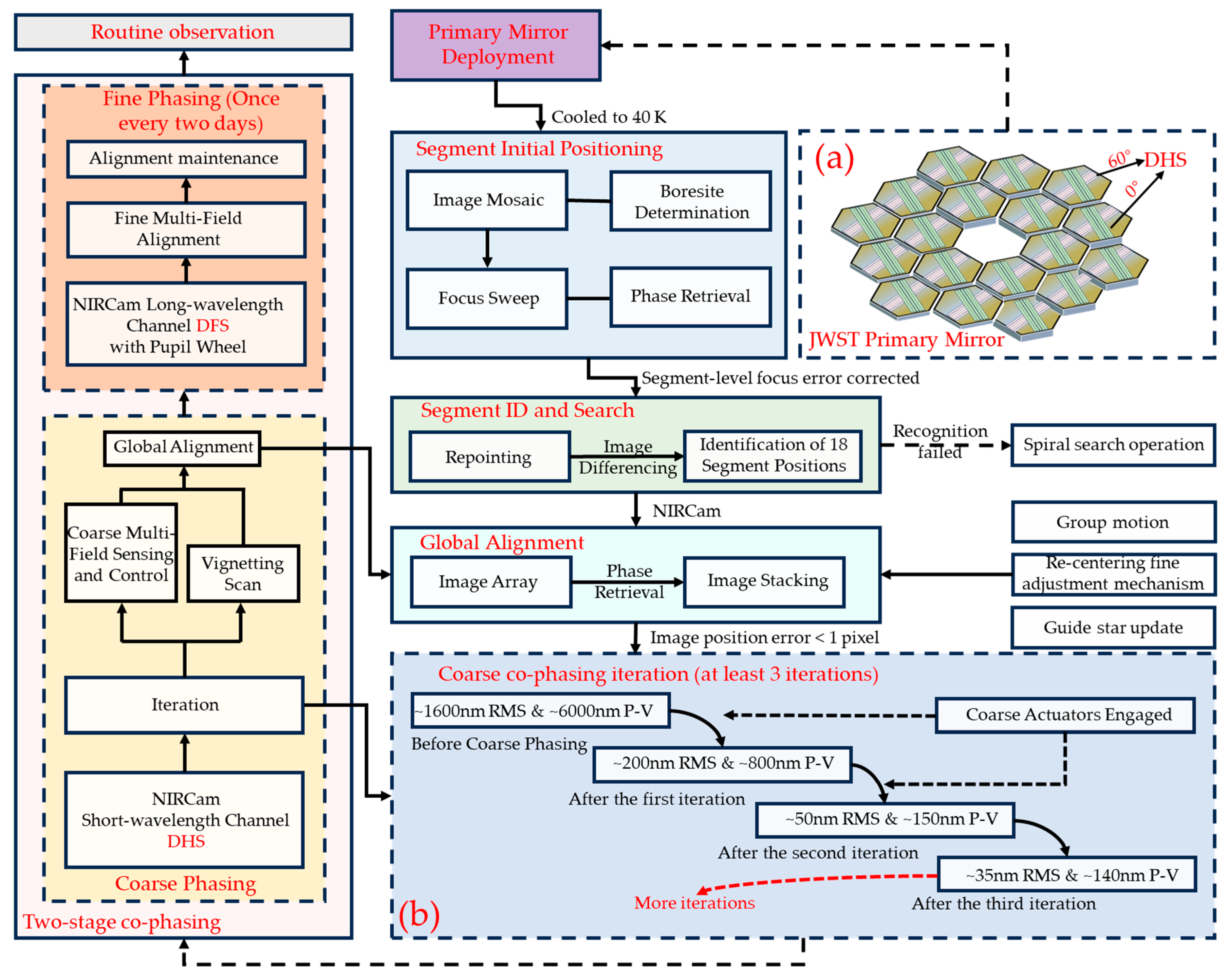
As a typical representative of space-deployable segmented telescopes, the JWST relies heavily on dispersion fringe-related technologies for phasing adjustment. Its Wavefront Sensing and Control (WFSC) process is divided into three core phases (Figure 6), which address the sub-mirror phase desynchronization caused by mechanical deformation and temperature drift in the space environment, ultimately achieving the scientific goal of a full-system wavefront error (WFE) of <150 nm [111,143]. In the second phase, “Segment-level wavefront control,” JWST uses the DHS in the short-wave channel of the Near-Infrared Camera (NIRCam) to perform coarse phasing (Figure 6a): iterative correction is conducted within a capture range of 500 μm, typically requiring at least three iterations (see Figure 6b), which reduces the piston error from 1608 nm RMS to 35 nm RMS [144,145,146]. After completing coarse phasing, the process proceeds to the third phase, “Global phasing.” At this stage, the system switches to the DFS in the long-wave channel of NIRCam, generates multi-focal phase difference images using three sets of weak lenses on the pupil wheel, and employs the Hybrid Diversity Algorithm (HDA) to calculate the wavefront phase. 2π ambiguity is eliminated through cross-validation, enabling further nanoscale fine phasing [147]. Throughout the phasing process, JWST does not rely on an independent wavefront sensor; instead, it completes most WFSC activities through the wavefront sensing design of NIRCam (e.g., critical sampling, pupil imaging mode). Additionally, it leverages specially designed dual-stage actuators (the coarse adjustment mechanism achieves a large stroke of 21 mm, while the fine adjustment unit delivers an output precision of 7 nm) and the low-temperature space environment to suppress thermal noise. Ultimately, the total surface error of the primary mirror is controlled to ~25 nm RMS, which is only 1/5 of the overall error of the Keck, and the segmented phase precision can reach ~20 nm RMS [23]. To maintain observation stability, JWST performs fine phasing measurements once every two days and applies alignment corrections once every two weeks, thus dynamically adapting to environmental drift.
In the field of large ground-based segmented telescopes, the GMT adopts the Holographic Dispersion Fringe Sensor (HDFS) for the critical detection of piston errors [81]. The core advantage of this sensor lies in the following: when a piston error exists between sub-mirrors, the fringes exhibit a characteristic “spiral distortion”; the error can be calculated by analyzing the fringe displacement. Its dynamic range of ±10 μm breaks through the phase wrapping limitation of traditional interferometry, while also solving the problem of sensing failure caused by the sub-mirror gap (>20 cm) being larger than the atmospheric coherence length [149,150]. To ensure the measurement accuracy of the HDFS, the GMT uses the cross-correlation template method for calibration. It precisely inputs piston values in steps through the Non-Common Path Correction Deformable Mirror (NCPC DM) and constructs a piston error reference library, providing a reliable benchmark for subsequent error calculation [151,152].
The reference concept for NASA’s planned next-generation ultraviolet/visible space observatory, Advanced Technology Large-Aperture Space Telescope (ATLAST), draws on JWST’s stepwise strategy for its wavefront control process but achieves higher-precision position servo control through its own metrology system [153,154]. Leveraging the absolute laser ranging mode (“AbsMet” mode), ATLAST can quickly deploy the primary mirror and secondary mirror within a target error range of several micrometers. Meanwhile, the SH camera integrated with high-density deformable actuators ensures a larger capture range and high wavefront sensing accuracy. In the initialization phase, ATLAST first uses the SHWFS to capture relatively large-range errors (>10 μm). Subsequently, a grating is inserted into the visible light camera, and DFS is employed to modulate the inter-segment piston error via spectroscopy, generating a resolvable fringe pattern for accurate phase difference measurement. Immediately after, Phase Retrieval (PR) technology is used to process the defocused images in the science camera, producing a high-resolution wavefront map. Furthermore, improved modified Gerchberg–Saxton (G-S) is utilized to achieve multi-field wavefront optimization, ensuring full-field-of-view alignment. Ultimately, the post-launch wavefront error is reduced from the millimeter level to below λ/14 (~36 nm RMS) [61].
Phase Diversity (Phase Retrieval)
It is noted that ATLAST improves wavefront quality by relying on Phase Retrieval (PR). As an important branch of focal plane phasing detection technology, PR technology reconstructs the wavefront phase via an iterative algorithm by recording the light intensity distribution on the image plane. However, the wavefront reconstruction results after iteration are not unique, and this technology is only applicable to point source targets. This limitation has also become a key driver for promoting the development of its optimized form, namely Phase Diversity (PD) technology [155,156,157].
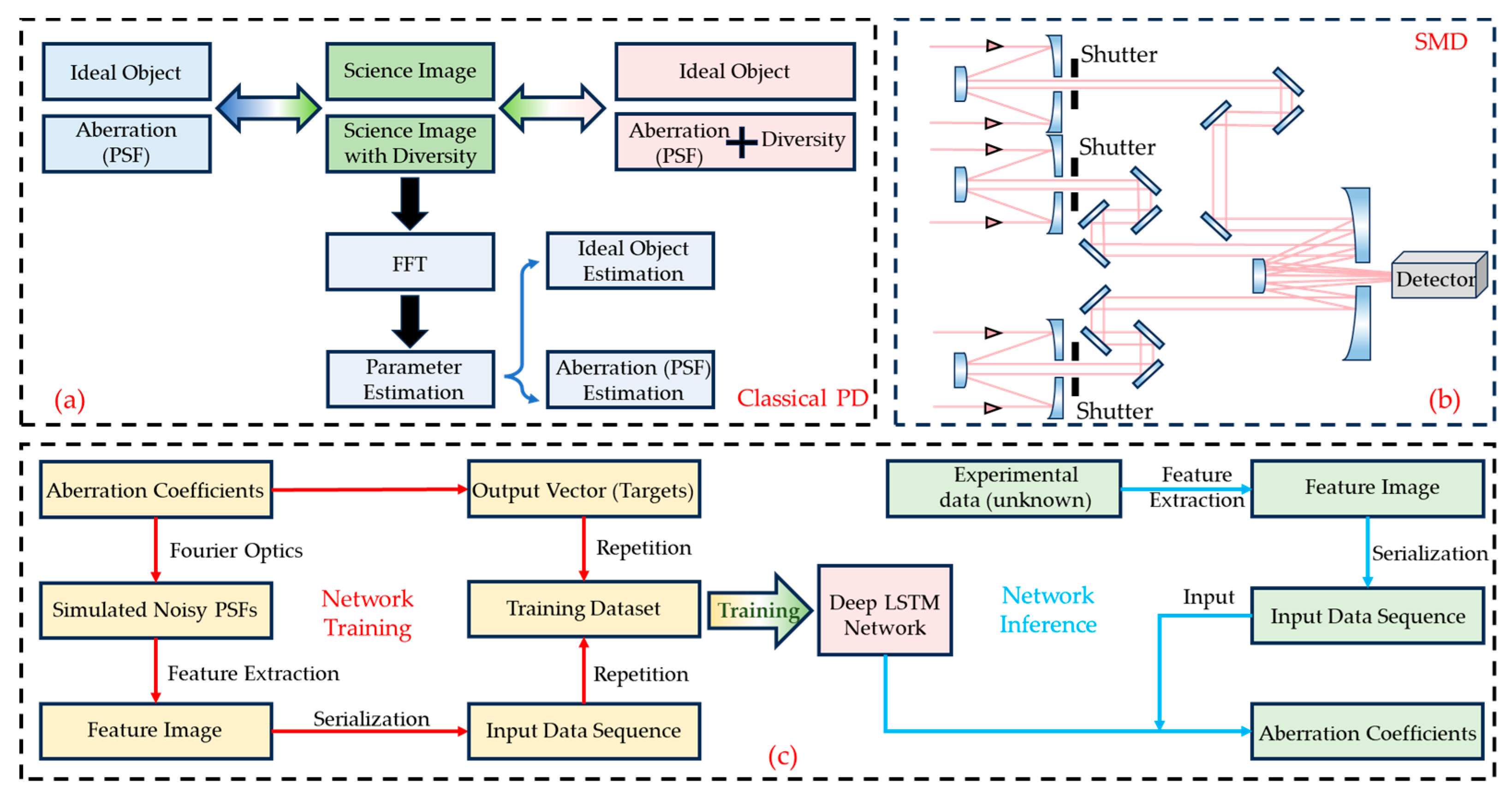
PD technology was proposed by Gonsalves in 1982. It is closely associated with PR technology, as both take the extraction of phase information in imaging systems as their core. However, PD technology effectively eliminates the uncertainty of wavefront reconstruction in traditional PR technology by introducing known aberrations into the imaging system (such as defocus, astigmatism, etc.). Among these aberrations, defocus has become the most commonly used form in practical applications because it is easy to obtain and the phase difference can be accurately calculated through the defocus distance [158]. Figure 7a illustrates the workflow of conventional PD. Additionally, PD technology acquires multiple images containing different aberrations (usually a pair of focal plane and defocused plane images). At the same time, PD technology breaks through the limitation of PR technology, which is only applicable to point source targets, and enables wavefront reconstruction for extended targets. Moreover, it has a simple device structure, requires no additional sensing components, and features high system reliability. However, due to its reliance on monochromatic light measurement, this technology suffers from a 2π ambiguity effect. It also demands a large amount of computation for phase reconstruction and has a narrow measurement range (±λ/2). Therefore, it is more suitable for the fine phasing stage of space telescopes without atmospheric disturbance or segmented telescopes [159].
In addition to DFS, the JWST also uses PD as one component of the HDA for fine phasing adjustment. It acquires phase diversity images through the weak lenses and a filter wheel in the NIRCam. Unlike the mode where sub-mirrors image independently, JWST’s PD fine phasing adjustment is completed based on the superposition of images from all sub-mirrors. Only one set of images is needed to estimate the wavefront phase of the entire telescope, meeting the diffraction-limited requirements for infrared observations. Large-aperture ground-based telescopes also use PD technology to improve phasing accuracy. For example, the Keck II Telescope calibrates the phasing errors of 36 sub-mirrors through PD technology, reducing the residual error to 0.07λ. In the field of image reconstruction, PD technology can also work collaboratively with AO systems. It can post-process sunspot images to restore their fine structures, or increase the imaging resolution of a 2 m aperture telescope by 2.5 times and enhance the peak intensity by 66.7%, further expanding its application scenarios.
Of course, the application of Phase Diversity (PD) technology is not limited to segmented-mirror telescopes; it also demonstrates key value in sparse synthetic aperture systems (an important implementation form of the Fizeau configuration, most of which are currently in the technical verification stage, see Figure 1). The Star-9 distributed aperture imaging testbed developed by the Lockheed Martin Advanced Technology Center in the United States is a typical case of achieving efficient phasing maintenance through PD technology [160]. Star-9 consists of 9 Maksutov–Cassegrain telescopes with a diameter of 125 mm, arranged in a compact manner, with a maximum baseline of 610 mm. At a wavelength of 650 nm, it can achieve an angular resolution of approximately 1 micro arcsecond. Its coherent superposition requires precise control of the wavefront error (PTT) and the relative position of the light beams in each telescope’s optical path, and PD technology is precisely the core that ensures this process [161].
In Star-9, the PD algorithm runs on an external Mercury Computer Systems processor. It takes point sources or extended scenes as input via a scene generator and simultaneously captures image pairs of the focused channel and the channel with a fixed defocus amount. Based on a maximum likelihood estimation framework, the algorithm reconstructs the wavefront phase and calculates the piston/Tip/Tilt error vectors of the nine sub-telescopes by comparing the deviations between the actual imaging PSF and the optical model. It then quantifies aberrations using Zernike polynomial coefficients [56]. The generated error estimates are fed back to the relay active control mirror group (R1, R4) for dynamic correction. Once the system stabilizes, the PD technology captures new images again for iterative optimization, forming a closed-loop control cycle. In addition, Star-9 is also integrated with the Automatic Alignment and Phasing program. The Auto-align function adjusts Tip/Tilt to ±0.4 micro arcseconds by leveraging the correlation of single-telescope images, and the Auto-phase function optimizes the piston to a standard level (achieving a pathlength precision of 100 nm RMS) by maximizing the MTF. This significantly reduces the capture range requirement of the PD technology. In experimental demonstrations, the PD technology can correct manual disturbances within a few seconds. In the steady state, the Tip/Tilt jitter is less than 1 micro arcsecond (object-space RMS), and the piston jitter is an approximately 20 nm RMS pathlength (about 1/20λ at a wavelength of 545 nm). Meanwhile, it supports the field steering function, enabling phasing scanning and image stitching over a 1 milliradian field of view [162].
Although PD technology performs excellently in sparse aperture systems, returning to its principle, phasing maintenance relies on a known defocus phase. This typically requires equipping precision actuators or multi-focal-plane optical components, which not only increases system complexity but also raises hardware costs—contradicting the inherent “simple structure” characteristic of PD technology. To overcome this limitation, Space Modulation Diversity (SMD) technology, which shares the same origin as PD, has emerged [63]. SMD technology leverages the independently controllable property of sub-apertures in sparse apertures to generate diversity images through spatial modulation (e.g., sequentially shutting down individual sub-apertures), eliminating the need for the defocus optical components required by PD technology (see Figure 7b). Based on a dataset containing full-aperture synthetic images and single-sub-aperture-shutdown images and combining the MTF model of the PSF with the Stochastic Parallel Gradient Descent (SPGD) algorithm, it can simultaneously estimate wavefront aberrations and reconstruct high-resolution images. However, SMD technology faces new challenges when observing faint celestial objects. To maintain the consistency of the isopalmitic patch, spatial modulation requires capturing multiple frames within an extremely short time window (≤0.02 s), resulting in images being susceptible to Poisson noise pollution. This leads to a significant decline in both the wavefront estimation accuracy and image reconstruction quality. To address this, Xie et al. proposed an improved SMD (ISMD) technology, which introduces the Block Matching 3D (BM3D) algorithm for denoising preprocessing of noisy images [163,164]. At a noise level of peak signal-to-noise ratio (PSNR) = 25.52 dB, the RMS error of wavefront reconstruction is reduced from 0.0773λ (of SMD) to 0.0186λ, and the image correlation coefficient (Co) is increased from 0.8368 to 0.9723. This effectively enhances the imaging capability for faint celestial objects [64]. In addition, PD algorithms used in classical frameworks typically require numerous iterations, with complexity increasing as the phase amplitude and the number of Zernike modes grow. In contrast, deep learning methods offer fast inference without iterative procedures and improved robustness against local minima and have therefore been increasingly introduced into PD-based wavefront sensing. In particular, denoising neural networks can further mitigate noise contamination in low signal-to-noise scenarios, improving both phase estimation and image reconstruction performance. For example, the LSTM-based method (Figure 7c) can achieve PD sensing of 2nd–9th order Zernike modes within 0.35 ms, while CNN-based frameworks further extend this capability to accurate reconstruction of up to the first 15 Zernike modes within 0.5 ms [165,166,167].

3.2.2. Edge Sensor

The control of a segmented mirror system is generally accomplished through a combination of non-contact ES, a segmented mirror Active Control System (ACS), and high-precision displacement actuators. ESs measure the relative displacement of adjacent sub-mirrors at the seams (segment joints), with a particular focus on monitoring their out-of-plane degrees of freedom [168,169]. Based on the sensor data, the active control system calculates the rigid-body displacement correction for each sub-mirror using an interaction matrix [123] and drives displacement actuators with nanoscale resolution to perform rapid closed-loop adjustments through multiple iterations, typically achieving a correction range of several millimeters [29]. The system features a certain degree of measurement redundancy: the number of actuators is three times the number of sub-mirrors, and a pair of sensors is usually arranged at each segment joint, with driving blocks and sensing blocks alternately placed. While the out-of-plane PTTs are actively corrected by the actuators, the in-plane TC of the sub-mirrors, as well as the resulting Gap variations and Shear motion (segment-to-segment relative motion along an edge), are mainly constrained by a passive support system. This is supplemented by gap sensors for estimation and compensation, collectively maintaining the confocal and common-phase states of the segmented mirror system.
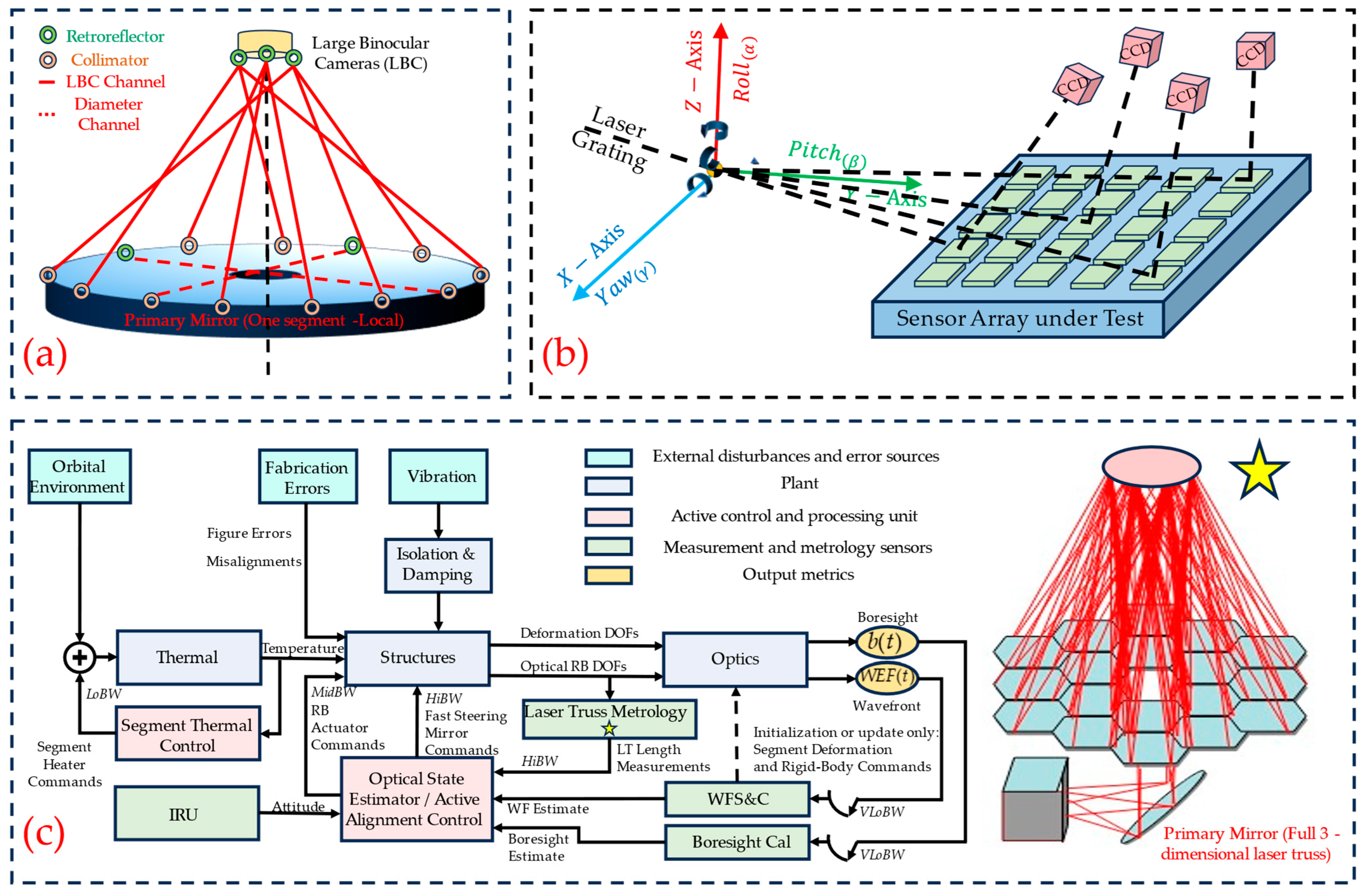
This section will introduce the development of ES technology and some calculation methods. Additionally, the laser metrology hybrid sensing technology, which is used to address the shortcomings of ESs in maintaining long-term wavefront coherence, will also be summarized.
Application of Edge Sensors in Segmented Telescopes
ESs have been applied in multiple generations of ground-based segmented telescopes (see Table 3) and have evolved into two main configurations: capacitive and inductive [170,171]. These two configurations infer displacement by measuring changes in capacitance between plates or coil impedance, respectively. The Keck Telescope adopts traditional capacitive ESs to make its 36 sub-mirrors function equivalently as a single integrated mirror. Benefiting from its interleaved geometry, this sensor is insensitive to in-plane motion. During installation, initial alignment is achieved through manual measurement and shimming (shimmed to alignment), enabling a co-phasing precision of 100 nm RMS [172,173]. Compared with using WFS alone, the greatest advantage of ES lies in its fast response frequency, which allows real-time, closed-loop feedback control. Since ESs are directly installed at the gaps between sub-mirrors and perform continuous sampling, there is no need to interrupt observations to introduce external light sources for calibration—this effectively improves the observation efficiency of the telescope [174]. The lightweight inductive sensors of the HET have improved resolution (50 nm); however, under an ambient temperature difference of 1.5 °C, significant image quality degradation occurs within 3.6 h (increasing from 0.9 arcsec to 1.3 arcsec). It is evident that ESs are susceptible to environmental factors such as temperature differences, humidity, and dust. As a result, the zero point of the ES needs to be calibrated every 3–4 weeks [51,52], which limits their applicability in long-period observations.
To enhance environmental adaptability, subsequent telescopes have made various attempts. The South African Large Telescope (SALT) has designed an L-Bracket inductive ES, with considerations for the effects of temperature and humidity. Its temperature response can be systematically corrected; although its humidity sensitivity slightly exceeds the specifications, and it is acceptable. This design achieves a distortion rejection rate of 2.7%, and its performance met the standards after the final system installation [175]. The 3.8 m Seimei Telescope of Kyoto University (Japan) and the ESO ELT also adopt an inductive ES. The former detects gap changes by measuring variations in the LC oscillation frequency; its sensor arms are made of transparent ceramic material, and a reference probe is installed to suppress the impact of temperature and humidity [176]. The latter adjusts the circuit to extract the mutual inductance change between the transmitting coil and adjacent receiving coils (when the segmented mirror undergoes relative displacement) into a displacement signal, enabling high-precision and high-stability three-dimensional displacement monitoring. The ELT also takes into account the excellent temperature stability of ceramic materials, introducing Embedded Coil Technology (ECT) to suppress ES temperature drift. It is fixed to an ultra-low expansion glass-ceramic bracket via a three-point support, avoiding the “stick-slip” effect caused by differences in the thermal expansion coefficients of materials and further reducing thermal deformation interference. This allows for a piston drift of <10 nm/week and a gap drift of ~0.15 μm/week [177,178]. The conceptual designs of the TMT and India’s Prototype Segmented Mirror Telescope (PSMT) plan to continue using capacitive solutions [179]. The overall basic concept of the TMT ES is similar to that of Keck, but it adopts a different face-on geometry (the same as the ELT). In addition to the ES housing made of ultra-low thermal expansion glass-ceramic blocks, it is also designed with ES protective boots that span the gaps between sub-mirrors to provide gap sealing, dust prevention, and electromagnetic shielding. Moreover, the TMT ES is fixed to the polished spherical foot pads on the back of the mirror via magnetic adsorption, forming a stable non-contact design that allows sub-mirror replacement without moving the sensor components [180]. However, this structure intensifies the coupling effect caused by in-plane motion and sensor installation errors [37].
Naturally, there are also electromechanical ES configurations other than capacitive and inductive ones. The LAMOST has proposed a differential eddy current ES scheme. Based on the eddy current effect, this scheme separates the inductive component from coil impedance changes via a Wheatstone bridge, enabling a linear and high-precision displacement calculation (theoretical precision < 8 nm). Additionally, complementary symmetric differential probes are used to effectively suppress common-mode temperature drift, and reverse tilt compensation is introduced to offset the inherent dihedral angle of LAMOST’s spherical sub-mirrors, reducing the coupling error between gap/tilt variations and piston measurements. Coupled with a thermal expansion-matched support structure, the system successfully maintained the confocal state within a temperature variation range of 1.5 °C during a 13 h experiment. However, under larger temperature differences, the system still faces issues such as uncompensated truss thermal deformation and inconsistent actuator output [123]. To address this, the CGST, which specializes in solar observation, has proposed a detection method based on the optical cross-correlation of the Point Spread Function (PSF). Utilizing the periodic variation of PSF morphology with piston errors, this method achieves rapid zero-point calibration through cross-correlation matching and fitting algorithms, reaching a detection precision of 5 nm within 5 h. Compared with Keck, it can complete a single ES zero-point calibration in just a few minutes, providing an effective technical approach for high-stability co-phasing control in a wide temperature range [181].
Considering the drift of the absolute reference zero point, re-detecting the wavefront coherence of segmented sub-mirrors requires the use of optical measurement methods. Based on this, the zero position of the ES is re-calibrated and corrected, and this process should typically be accomplished by a segmented mirror co-phasing detection system or optical interferometry technology. Technologies such as narrow-band PSF detection [52], SH/pyramid/curvature wavefront detection [181,182], Zernike phase contrast [45], DFS/DHS [80,81], laser interferometric detection [183], and PR [58,59,60]/PD [158]/SMD [163,164] have emerged. Moreover, based on these technologies, while the performance and reliability of sensors are continuously optimized, more complex hybrid measurement systems have also been developed. For example, the ES of the Giant Magellan Telescope (GMT) primary mirror works in conjunction with absolute imaging encoders (AIEs, for coarse measurement) and distance measuring interferometers (DMIs, for fine measurement) to form a Laser Phasing Metrology System [184,185,186,187,188,189,190], balancing measurement range and precision. And global stability is further ensured through outer-ring optical sensing. Another example is the LUVOIR, which uses two configurations of metrology sensors—Laser Truss Metrology (LMET) and Segment Edge Sensors (SES)—in coordination to achieve picometer-level gap measurement precision [191,192,193,194,195]. The specific displacement measurement and calculation methods of ES will be introduced below (Section 4), and the hybrid sensing configuration will be mentioned again in Section 3.2.3.

3.2.3. Laser Truss- Hybrid Edge Sensing Configuration

Superior space environments [145] and comprehensive fault tolerance guarantee technologies [194] enable ESs in space-based telescopes to focus on high-bandwidth dynamic control. Based on this, a picometer-level wavefront stability challenge is proposed for space-based segmentation projects [196,197]. As a typical representative, the JWST is mainly affected by disturbances caused by discrete sources excited by the primary mirror’s structural modes—such as reaction wheel imbalance or fuel sloshing. Coupled with the issue of reduced low-temperature damping, JWST is limited to infrared (IR) detection, with dynamic performance only reaching ~10 nm rms. Picometer-level sensing and control thus remain cutting-edge technologies (with a certain gap to be bridged). To achieve further breakthroughs, optical truss or laser metrology technologies have been integrated into ES configurations. The GMT provides a starting point for this: the project has designed a Laser Phasing Metrology System [187] to achieve the goal of detecting the rigid-body motion of the outer sub-mirrors of M1 and M2 relative to the central mirror. Among them, the internal metrology system of M1 adopts a hierarchical design:
(1)
For coarse sensing, 24 sets of AIEs are used to quickly align with the capture range of the phasing camera (>10 μm Piston error) [184,185,186,187,188,189];
(2)
For fine sensing, 48 Renishaw DMIs can monitor inter-segment micro-displacements with 1 nm precision. Through a cross-beam layout, they offset the impact of thermal deformation on the mirror sidewalls, maintain phase stability by correcting gaps, and support rapid phase recovery and maintenance of ±3 cm after sudden disturbances such as earthquakes—capabilities that traditional electromechanical ESs lack.
To save space and avoid blocking the field of view, GMT uses 12 sets of differential capacitive ES in the M2. These sensors are directly mounted on a Zerodur reference body and measure relative displacements using differential capacitor plates, achieving sub-nanometer sensitivity at a 50 Hz bandwidth. However, Monte Carlo simulations show that the fine sensing error reaches 2.3 nm RMS, and the M2 Piston sensitivity is 5.9 nm RMS—still requiring a three-order-of-magnitude improvement to meet the needs of space applications.
The aforementioned technologies are further embodied in LUVOIR [191]. This telescope continues to integrate a variety of sensing technologies and proposes the collaboration of two metrology sensing methods—LEMT and SES. This collaboration enables the maintenance of telescope configuration stability without guide stars, and particularly provides high-bandwidth maintenance capabilities during maneuvering processes and non-coronagraph observation periods. Among them, the LMET technology originates from NASA’s Space Interferometry Mission (SIM) [192,197]. It forms a laser metrology network through beam launchers (BL) arranged at the edges of sub-mirrors and corner cubes on the secondary mirror, allowing the monitoring of sub-mirror rigid-body poses with picometer precision. The SES, on the other hand, draws on capacitive sensors like those used in TMT; its 15 pm gap measurement precision has been verified in the Laser Interferometer Space Antenna (LISA) mission [195]. The SES measurement can be achieved through a beam projection mechanism [193]. This LMET + SES hybrid configuration (12 segments equipped with LMET + all segments equipped with SES) effectively eliminates the globally unobservable modes of a pure segmented edge sensing system and significantly optimizes the Wavefront Error Multiplier (WEM) from 7.82 (when only ES is used) to 3.68.
In this work, laser metrology applications in segmented telescope systems are compared, as summarized in Table 4. These results indicate that, for addressing segmented mirror co-phasing maintenance and long-baseline phase stabilization, optical truss and laser metrology technologies have demonstrated significant effectiveness, with various innovative implementations developed to meet diverse astronomical observation requirements. In terms of system composition and principles, optical trusses typically adopt multi-channel laser interferometric metrology technology [198]. For instance, their basic structure can be embodied with a fiber-coupled heterodyne laser interferometer as the core: a frequency-difference signal is generated via an acousto-optic modulator, and polarization beam splitting and a quarter-wave plate are combined to realize the separation and recombination of the optical path. Through this setup, the high-precision measurement of displacement and attitude changes of the target mirror surface is achieved.
Conventional single electromechanical sensing methods are significantly affected by atmospheric turbulence disturbances, and the introduction of Laser Truss Sensors (LTSs) has improved this situation [41]. Based on the cross-geometric structure of two point-to-point laser metrology instruments, the LTS achieves high-resolution measurements (<30 nm). It can use coherent or heterodyne detection technology to reduce electronic bandwidth requirements and minimize air refractive index errors through closed beam paths. The LTS technology also supports an absolute metrology mode (dual laser frequencies), which is suitable for long-term tracking. Additionally, it optimizes the complexity of fiber distribution through Range-Gated Metrology (RGM), ensuring micron-level alignment in segmented telescopes. In practical applications, the Large Binocular Telescope (LBT) project—regarded as a pioneer and practitioner in ELT-class telescope development—took the lead in adopting 3D laser truss metrology. It connected collimators around the primary mirror and retroreflectors on the focus corrector via an Etalon Absolute Multiline Technology (EAMT) interferometer, forming a redundant measurement network (see Figure 8a) [199,200]. This network helped achieve real-time phase stabilization for a 23 m baseline and laid the foundation for large-aperture applications of Fizeau interferometric imaging. However, this system is limited by vibration noise and thermal drift [201].
Subsequently, this technology was inherited by the GMT project and developed into a hybrid metrology system. By optimizing noise suppression through SVD, it can cope with vibration interference at observatory sites located in seismic zones. Similarly, the Exo-Life Finder (ELF) [202,203,204,205,206] uses Fizeau laser interferometers to measure sub-aperture OPD and pairs them with photonic lantern wavefront sensors (PLWFSs) based on deep learning for wavefront measurement. The PLWFS employs a Photonic Lantern—a tapered waveguide—to adiabatically couple atmospherically distorted light from each sub-aperture into an array of single-mode fibers, thereby converting complex phase aberrations into measurable intensity variations in the resulting focal-plane speckle patterns. These intensity distributions are processed by a convolutional neural network trained to perform regression from speckle features to wavefront errors, enabling the real-time estimation of PTT corrections required for precise co-phasing of the Fizeau array. This approach provides a fast and robust solution for mitigating atmospheric phase distortions and suppressing scattered light induced by segment misalignment and structural vibrations [206]. In the Prefocal Station-A system of the ELT—a true ELT-class facility—relevant technologies have been further engineered into a combination of dedicated laser trackers and optical sights. Through permanent metrology targets and the M6C fine-tuning mechanism, it achieves 6DOF rigid-body motion measurement and optimizes interference isolation design for both offline and online operations [207]. Furthermore, CGST has also used laser trusses to measure the rigid-body degrees of freedom of the secondary mirror, verifying the applicability of this technology in the active alignment of solar telescopes [208]. Based on improved optical truss technology, An from the Changchun Institute of Optics, Fine Mechanics and Physics (CIOMP) [209] combined the spatial distribution of laser beams with slope measurement to achieve in situ high-precision flatness monitoring of large segmented detector arrays—especially for wide-field survey telescopes (see Figure 8b). Its angular precision is better than 0.1 arcseconds and linear precision is higher than 25 μm, which has improved the accuracy and efficiency of telescope focal plane assembly. This technology has been successfully applied to detector calibration in large optical systems such as the USTC 2.5 m survey telescope and the China Space Station Telescope (CSST) [210,211,212,213].
For space exploration, optical truss technology is advancing further toward high-precision and absolute distance measurement. Breaking free from ground-based limitations, the Precision Segmented Reflectors (PSRs) [214] and SIM [215] projects have developed dual-frequency laser heterodyne interferometry technology. This technology uses synthetic wavelengths to resolve the phase ambiguity issue in absolute distance measurement and employs optical fibers for signal transmission to prevent thermal loads from affecting mirror surfaces. This heterodyne detection method provides far greater precision than traditional interferometry, with a typical precision reaching the nanometer level (3 nm) [198]. After being refined by the LISA [195], this technology achieves picometer-level displacement precision, providing direct reference for the use of Laser Distance Gauges (LDGs) in ATLAST (see Figure 8c) and the LEMT in LUVOIR [60]. Similarly, expandable Segmented Mirror Telescopes (SMTs) are even considering replacing gap sensors with laser truss metrology systems. This replacement avoids issues such as optical path length instability and co-phasing control failure caused by inter-segment latching vibrations, enabling high-precision dynamic measurement of relative displacement between the primary mirror and the focal camera and providing an experimental basis for subsequent space systems. At the same time, the Nautilus Space Observatory continues to integrate the aforementioned technology chain. Through the collaboration of diffractive optical elements (MODE lenses) and laser trusses, it achieves nanometer-level co-phasing maintenance for multi-stage mirrors [42,216]. For its 20 m inflatable primary mirror, the Orbiting Astronomical Satellite for Investigating Stellar Systems (OASIS) Space Observatory has developed a deflection-based metrology system. By combining rotational average error cancellation technology with a portable measurement head, it realizes high-precision deformation monitoring and calibration over long distances λ / 8 67.5   μ m , laying the technical groundwork for high-contrast exoplanet imaging [217].
In the future, laser metrology technology will continue to be applied in next-generation optical systems. Through high-precision optical path closed-loop control, it will work alongside ES and WFS to leverage their respective advantages in solving the co-phasing measurement problem of segmented mirrors. A summary of the co-phasing measurement techniques discussed in this paper is presented in Table 5.

4. Corresponding Calculation Model and Control Method

4.1. Edge Sensor Signal Calculation and Control

Before the signals collected by the ES are converted into actuator commands via the interaction matrix, a series of algebraic decoupling processes is required due to the coupling between various measurement errors.

4.1.1. ES Calculation Approaches

(1)
TMT approach (specific parameters are shown in Table 6):
ESs of the TMT have two main output signals: “Height (R)” and “Gap”. The former is essentially a linear combination of the height difference and dihedral angle between sub-mirrors, while the latter is used to quantify in-plane displacement; together, these two signals drive the control system. The TMT introduces an effective lever arm ( L e   f f ) design as the basis for linear weighting to describe “Height (R)” (see Equation (12)), which reflects the complex dependence of the sensor reading itself on variations in gap y and dihedral angle θ x or θ y (the specific coordinate definition of the ES is shown in [37]). This parameter is defined as the ratio of height sensitivity to dihedral angle sensitivity. Furthermore, by combining the alternating Drive-Sense layout to perform differential summation on the complementary outputs of the two sensors, the system successfully achieves algebraic decoupling of height difference and dihedral angle errors. This method only requires direct measurements of the piston and gap and then uses gap data to indirectly calculate shear (referred to as “Gap to Shear”) [177,218], which significantly simplifies the requirements for sensing hardware. However, it introduces an unobservable global torsion mode (a uniform global Clocking motion of all segments). This mode is usually insignificant in a complete mirror due to symmetry but may cause significant drift due to temperature changes when sub-mirrors are missing [219]. The solution is to deploy a small number of shear sensors and multiply the sensor reading R by g a p P (where P = 1 for baseline compensation, and P = 1.5 can improve calibration performance by 30%) for gap compensation ( R comp ). This reduces the noise multiplier to a level comparable to that of other controllable modes, with extremely low upgrade costs—only modifications to the drive-side hardware and firmware are needed, and there is no requirement to replace the sense-side components or cables. Finally, by integrating the Alignment and Phasing System (APS) for multi-angle and multi-temperature calibration, the system can meet performance requirements across the full temperature/zenith angle range, with an average normalized Point Source Sensitivity (PSSN) greater than 0.993 [220,221].
R = A y k ( B f ) z x θ y + L e f f θ x , w h e r e   L e f f = B 2 f 2 2 y R comp = g a p p A A g a p z + C g a p 2 θ x A = ε 0 w V     Square   wave   excitation A = 2 π f S ε 0 w V     Sine   wave   excitation
(2)
University of Science and Technology (USTC) Fan approach [222]:
This approach enables simultaneous measurement of lateral displacement (plate gap, gap) and axial displacement (positional offset, piston) through the design of the ES interdigital transmitting structure and orthogonal receiving plates. Based on the variable-area capacitance model, phase-opposite excitation signals ± V s are applied to the transmitting plates, and the orthogonal receiving plates output two signals C 1 , C 2 . During the displacement decoupling process, the measurement in the gap direction eliminates the influence of the piston through the combination of orthogonal signals, and the gap (mm) is directly extracted as shown in Equation (13), where C 1 , C 2 represent the capacitance value of the receiving plates (pF). For the piston measurement, the phase difference of the orthogonal signals is used to construct a displacement function f 3 P , which is an integer. Subsequently, the displacement value can be solved using arctangent/arccotangent functions, and the displacement direction is determined by combining direction discrimination logic.
G ap = 0.0739 + 1.521 C 1 2 + C 2 2 + 1.198 f 3 P = tan ( π P ) = C 1 C 2 , ( 0.25 + n P < 0.25 + n ) cot ( π P ) = C 2 C 1 , ( 0.25 + n P < 0.75 + n ) P = 1 π tan 1 ( C 1 C 2 ) , ( C 1 < C 2 ) 1 π cot 1 ( C 2 C 1 ) , ( C 1 C 2 )
(3)
ESO approach:
This approach uses each ES to directly measure the piston, shear, and gap (PSG) simultaneously. This enables it to provide a quasi-static initial estimation of the amplitude of the Zernike “focus mode”, as well as complete in-plane error information for correction. Its advantages lie in its intuitive concept and comprehensive information coverage. However, this method does not account for Dihedral Angle sensitivity, which is an inherent characteristic of the approach. In practical applications, the ELT uses gap/shear measurements simultaneously to correct sensor readings. Nevertheless, tests on the primary mirror (M1) show that piston measurements are still subject to cross-interference from variations in gap and shear between adjacent sub-mirrors; the corresponding crosstalk/coupling coefficients ( α and β ) are provided in Equation (14). Experiments indicate that α < 1 mrad and β < 0.2 mrad—values far below the 5 mrad specification. Even so, non-linear residual errors D e ν persist and require further correction using the linear compensation formula. This necessary decoupling operation, especially when the dihedral angle changes, further increases the complexity of the control system. This, in turn, highlights the potential calculation advantages of the TMT approach [223].
α = Δ P i s t o n Δ S h e a r < 5   m r a d , β = Δ P i s t o n Δ G a p < 5   m r a d Δ P i s t o n = α × Δ S h e a r + β × Δ G a p + D e ν

4.1.2. Calculation Matrix

(1)
LAMOST interaction matrix [224]:
Taking the three-sub-mirror Minimum Confocal Mirror System (MCMS) as an example, let the actuator vector be A = [ a 1 , a 2 , a 3 , a 4 , a 5 , a 6 ] T and the sensor vector be S = [ s 1 , s 2 , s 3 , s 4 , s 5 , s 6 ] T . By establishing a coordinate system with the sub-mirror center as the origin, and defining the sensor layout parameters and sub-mirror gap geometric parameters, this can be expressed as a 6 × 6 interaction matrix function: IM = M ( l , l 1 , g 1 , g 2 , g 3 ) . The precision of this matrix depends entirely on the optimized design of geometric parameters. Based on this matrix, a mapping relationship S = M × A is constructed, which allows the system to convert complex multi-DOF control problems into linear algebra solutions. Furthermore, by combining Singular Value Decomposition (SVD) to calculate the pseudoinverse of the interaction matrix, the actuator commands for adjusting the sub-mirror pose can be obtained.
h e i g h t g a p s h e a r = A 6 D O F t i p t i l t p i s t o n T r a n s l a t i o n X T r a n s l a t i o n Y c l o c k i n g   &   x calculated = H G y measured y calculated = G G y measured
(2)
TMT 6DOF A-Matrix A 6 D O F [37,218]:
As the core of the TMT Primary Mirror Control System (M1CS), the 6DOF A-Matrix establishes a linear relationship between the 6DOF movements of sub-mirrors (out-of-plane PTT; in-plane TC: Translation-X, Translation-Y, Clocking) and the readings of ES (height, gap, shear) through strict three-dimensional geometric mapping. Its matrix form is defined as Equation (15). The construction of this matrix incorporates practical factors such as the ideal geometric parameters of the mirror (e.g., focal length, conic constant), installation errors, gravitational deformation, thermal expansion, and sensor temperature drift, thereby significantly reducing the interference of in-plane motion on co-phasing maintenance. It not only serves as the basis for the TMT gap-to-shear approach but also plays a key role in the following aspects: by decomposing the submatrices G and H and using the pseudoinverse operation of G , the directly measured gap value y measured is converted into the shear value x calculated , while y measured is optimized.
(3)
GMT system matrix [39]:
The GMT project has adopted a system matrix construction method based on geometric response models, aiming to accurately map the correlation between the large sensor network and the pose changes of sub-mirror segments. This matrix is essentially a response matrix that describes the expected changes in all sensor readings when each controlled degree of freedom (e.g., 6 outer segments × 6DOF = 36 controlled modes, undergoes a unit perturbation). For different metrology systems, GMT has constructed high-dimensional matrices respectively: (a) the M1 system matrix is built based on the length change responses of 48 DMIs and the image displacement responses of 24 AIEs; (b) the M2 system matrix is constructed based on the capacitance change responses (ΔX/ΔY/ΔZ and θ X ) of capacitive sensors, with the system matrix visually mapping matrix values through image intensity. To resolve nonlinear coupling effects in the system, GMT also introduces SVD for modal characteristic analysis. Low-order modes (such as PTT) correspond to high eigenvalues and exhibit strong observability, while high-order modes (such as global Clocking) correspond to low eigenvalues with weak observability, which requires the assistance of additional sensors to enhance observability. This analytical method provides a key theoretical basis for optimizing sensor layout and control strategies.

4.2. Kalman Filtering

The Kalman filter, proposed by Rudolf Kalman in 1960, is a general-purpose linear recursive minimum mean square estimation algorithm. It can track and correct the system state in a statistically optimal manner by minimizing the norm of the residual signal [225]. Its recursive processing structure significantly reduces computational requirements and facilitates integration with existing research under a unified framework. Initially designed for parameter estimation in linear models, this filter has since been extended to handle locally linearized approximations of nonlinear processes.
In the field of fringe tracking, P. Nisenson and W. Traub first applied the Kalman filter to group delay tracking in 1987 to improve the performance of power spectrum analysis [226]. In 1990, R.D. Reasenberg further discovered, through IOTA simulations, that incorporating the optical path change rate (rather than merely the path length difference) into state estimation could effectively enhance the estimation accuracy [227]. In the same year, he conceptually proposed the use of Kalman filtering to correct the fringe motion caused by atmospheric turbulence for the first time, though this was not practically implemented. It was not until 1999 that M.M. Colavita successfully implemented a simple single-baseline fringe tracking strategy based on Kalman filtering on the PTI and conducted actual astronomical observations [67]. Around 2012, following the successful application of Kalman filtering in adaptive optics control systems, the VLTI of the European Southern Observatory developed dedicated Kalman filtering control schemes for the fringe tracking subsystems of PRIMA [72,228] and GRAVITY [16,104].
In fringe tracking applications, the Kalman filter controller predicts the latest state of disturbances using a recursive algorithm, based on preset atmospheric and vibration disturbance models, as well as historical measurement data. This method generates control commands in a statistically optimal way by integrating the estimation of disturbance statistical characteristics, system evolution models, and uncertainty analysis of measurement residuals [2]. Compared with classical control strategies, fringe trackers based on Kalman filtering exhibit advantages in multiple performance aspects.
Figure 9a shows the specific loop for GRAVITY phase locking, which adopts an overall dual-loop control strategy based on Kalman filtering to achieve nanoscale optical path stabilization [16]. The system uses a 30th-order autoregressive model (State vector X V ) to accurately describe the OPD disturbances caused by the atmosphere and vibrations, and combines a 5th-order model ( X P ) to characterize the actuator response characteristics. Operating at a frequency ranging from 300 Hz to 1 kHz, the Kalman filter estimates and compensates for phase jitter up to 60 Hz in real time through state prediction and observation residual correction. The phase delay loop is responsible for high-bandwidth precision compensation, but its operating range is limited by 2π phase ambiguity. Therefore, the system incorporates a group delay loop: leveraging the latter’s insensitivity to the optical path difference, it locks the fringe envelope and expands the capture range from ±2.2 μm to ±12 μm (we have already mentioned this in Section 3.1.1). The two loops work in synergy and are further optimized by the actuator prediction model, jointly forming a high-precision predictive control system:
(1)
Utilize the state estimation at the previous moment and the system dynamic model (state transition matrix ( A V , A P ) to predict the current state;
(2)
Combine the residual ( ε ϕ ) between the real-time measured phase delay observation value ( ϕ ) and the predicted value, and update the state estimation ( X ^ V ) by calculating the optimal Kalman gain ( G P D ), thereby obtaining the optimal estimation of the current OPD disturbance.
GRAVITY’s fringe tracking process is managed by a streamlined three-state machine to enable adaptive observation control:
(1)
IDLE: the fringe tracking loop is frozen, and the delay line only follows the predicted fringe position. Operators can start or stop this state via commands. This state does not perform active tracking and is suitable for instrument initialization or observation suspension;
(2)
SEARCHING: the system performs fringe searching and applies optical path modulation (such as a sawtooth wave or triangular wave) around the predicted position. The modulation amplitude increases gradually to scan possible fringe positions (with a scanning range of up to several tens of micrometers). This state operates in a closed loop, where both the Group Delay controller and Phase Delay controller are activated, but the fringes are not locked [67,72];
(3)
TRACKING: Once the SNR meets the threshold, the fringes are locked, and the system enters the “tracking” state. Based on the offset information estimated by the fringe sensor (real-time estimated group delay and phase delay residuals), a correction signal is calculated and sent to the delay line PTZ to stabilize the interference fringes. This state operates in a closed loop, enabling high-precision OPD compensation.
The transition between the three states is determined mainly by criteria based on SNR thresholds (Figure 9(b1)) [16] or the rank of the OPD spatial transfer matrix (Figure 9(b2)) [104]. This state machine ensures that the system can switch its operating mode independently and reliably according to real-time observation conditions.

5. The Future of Wavefront Coherence Stability Technology

The integration of fluidic optics, astrophotonics, and embodied intelligence opens a new paradigm for space telescopes. FLUTE demonstrates the feasibility of ultra-light, large-aperture systems, while PL-based sensors ensure precise wavefront control. Embodied intelligence enables autonomous adaptation to environmental disturbances. Together, these technologies promise scalable, intelligent observatories capable of addressing fundamental questions in cosmology and astrobiology.

5.1. Fluidic Telescope (Plant)

Conventional large-aperture telescopes use solid materials. While lightweight primary mirrors and structures have been explored, scaling beyond 10 m remains economically challenging [229,230]. NASA, in collaboration with Technion–Israel Institute of Technology, proposed a 50 m Fluidic Telescope (FLUTE) that uses liquid mirrors formed in microgravity. This approach enables molecularly smooth surfaces (RMS ~0.75 nm) and self-healing capabilities, validated in parabolic flights and ISS experiments [231]. The design employs a ring-like boundary frame with an optional curved baseplate, reducing the required ionic liquid mass to ~12.6 tons. Fluid dynamic models show that surface perturbations from maneuvers can be limited to micron-level deviations, with the central 80% of the aperture maintaining <20 nm accuracy over 20 years. Modular deployment and robotic liquid filling simplify on-orbit assembly, offering a viable path toward 100 m-scale space telescopes for studying dark energy, the origin of life, and extraterrestrial existence.

5.2. Photonic Lanterns and Astrophotonics (Sensing and Perception)

Astrophotonics advancements are making photonic lanterns (PLs), beam combiners, and integrated photonic devices central to next-generation instruments [232,233,234]. As a full-fiber linear optical device, the PL facilitates low-loss, mode-selective transformations between multimode and single-mode systems, effectively bridging the gap between seeing-limited telescope inputs and diffraction-limited analytical tools [235].
When implemented as a focal-plane wavefront sensor (PLWFS), the device maps the phase information of atmospherically distorted light directly into a corresponding set of intensity signals at its single-mode output array. This focal-plane sensing architecture is particularly advantageous as it eliminates non-common-path aberrations and provides sensitivity to wavefront errors that are often invisible in the pupil plane, such as “island modes” and the low-wind effect caused by thermal turbulence around secondary mirror support structures. The integration of deep learning technologies has further enhanced PLWFS capabilities, enabling the reconstruction of continuous, non-discretely sampled wavefronts from discrete intensity distributions [236,237,238].
Furthermore, the adoption of ultrafast laser inscription allows for the high-precision 3D positioning of waveguides, creating compact and stable integrated photonic chips that can be tailored for specific geometric requirements, such as matching the entrance slits of spectrometers [239]. While current challenges include limited operational bandwidths (typically ~200–300 nm) and the need for higher-order aberration sensitivity, ongoing research into 3D-integrated structures and complex transfer matrices aims to deliver the robust, real-time wavefront control necessary for extremely large telescopes and the high-contrast imaging of exoplanet atmospheres.

5.3. Embodied Intelligence (Control)

Future telescopes may incorporate embodied intelligence, using “world models” and closed-loop evolution for autonomous operation. Multi-sensor data (e.g., displacement, temperature, wind) can build a digital twin of the opto-thermal-mechanical system. With reinforcement learning and counterfactual reasoning, the system shifts from passive compensation to active adaptation, maintaining nanometer-level wavefront stability under dynamic disturbances. A distributed neuromorphic computing configuration could enable low-latency reflexive control, forming a causal “perception-decision-action” loop essential for large, segmented telescopes.
At present, the application of multi-agent model-free reinforcement learning (MARL) to wavefront control has demonstrated its feasibility and effectiveness as a powerful, adaptive, and high-performance method for next-generation telescope systems [240,241]. This data-driven approach allows the controller to learn non-linear policies directly from interaction without requiring a priori information about atmospheric dynamics, effectively mitigating bandwidth errors and the propagation of aliasing to achieve performance comparable to state-of-the-art predictive models. These theoretical advancements are already driving active research and implementation; for instance, the National Astronomical Observatories of China (NAOC) is developing the Embodied Artificial Intelligence Telescope (EAIT) as a definitive solution for the autonomous operational requirements of the GOTTA project. Concurrently, Sun Yat-sen University has commenced research into fully autonomous operating modes for its 80 cm infrared telescope, supported by the Institute of Multi-Agent and Embodied Intelligence (IMAEI), to establish real-time “perception-action” chains capable of rapid response to transient celestial events.

6. Conclusions

With the growing demand for resolution in astronomical observations, the next-generation telescopes need to simultaneously meet the high-resolution observation requirements of diverse astrophysical research fields, including stellar physics, galaxy evolution, and exoplanet detection. This will drive the coordinated development of interferometry and segmented optics. To address the challenges in measuring and maintaining the wavefront coherence of multiple sub-mirrors, this paper systematically reviews the current development status of technologies related to phase coherence measurement and maintenance for large, segmented telescopes. It covers aspects from the fundamental technologies for achieving phase coherence under general disturbances to the wavefront coherence control strategies adopted in various existing typical practical/experimental large-scale segmented systems, with a focus on analyzing the key technical details of each system in terms of sub-mirror PTT measurement, correction, and maintenance.
In terms of measurement, laser metrology truss systems, together with the active optics foundation formed by the ES and WFS, are combined with technologies such as FT, DFS/DHS, and PD/SMD/PR to realize phase coherence detection. At the execution level, hierarchical control configurations of actuators (voice coil/piezoelectric)—such as the Zernike dimension reduction of TMT, the dual-loop optimization of ELT, and the two-stage actuator structure of JWST—are used to compensate for disturbances.
Among typical systems, the Keck pioneered hierarchical correction using PCS, establishing a dynamic paradigm for ground-based telescopes. The JWST, by virtue of WFSC, enables on-orbit deployment and infrared observations in cryogenic environments, becoming a major reference for space telescopes after Hubble Space Telescope (HST). Meanwhile, the laser truss hybrid sensing technologies of LBT and GMT have laid a technical foundation for subsequent high-contrast imaging of ELF projects and picometer-level wavefront precision of LUVOIR. In addition, the solar-specific designs of CGST, including optical cross-correlation detection and dual-wavelength simultaneous measurement, have further expanded the application scenarios of such technologies in extreme environments.
This paper also provides an outlook on future trends from the perspective of interdisciplinary integration. Embodied intelligence can dynamically predict opto-mechanical-thermal coupled disturbances through a “world model” and enhance the real-time performance of sensing by integrating photonics technologies like PL. These efforts offer certain references for achieving nanometer-level wavefront stability in next-generation ultra-large telescopes (e.g., the 100 m-class OWL (Overwhelmingly Large Telescope)) and for the technological development of future segmented telescopes.

Author Contributions

Methodology, W.W. and Q.A.; validation, W.W.; writing—original draft: W.W.; writing—editing: W.W. and Q.A.; project administration, X.W.; funding acquisition, X.W. and Q.A. All authors have read and agreed to the published version of the manuscript.

Funding

This work was supported by the National Natural Science Foundation of China (Grant No. 12133009), the National Natural Science Foundation of China (Grant No. 12373090), the Jilin Provincial Department of Science and Technology (Grant No. 20250101025JJ), and the Science and Technology Application Promotion Fund (Grant No. 145XXX050532000X).

Data Availability Statement

The original contributions presented in this study are included in the article. Further inquiries can be directed to the corresponding authors.

Acknowledgments

I would like to express my sincere gratitude to my advisors, An and Wu, for their dedicated guidance and support. Their valuable advice and patient assistance were instrumental in the completion of this review.

Conflicts of Interest

The authors declare no conflicts of interest.

Abbreviations

The following abbreviations are used in this manuscript:
KeckKeck Telescope
TMTThirty Meter Telescope
ELTExtremely Large Telescope
LAMOSTLarge Sky Area Multi-Object Fiber Spectroscopic Telescope
JWSTJames Webb Space Telescope
LBTLarge Binocular Telescope
GMTGiant Magellan Telescope
ATLASTAdvanced Technology Large-Aperture Space Telescope
CSSTChina Space Station Telescope
ESedge sensor
AOAdaptive Optics
WFSwavefront sensor
DMdeformable mirror
GSguide stars
PTTpiston–tip–tilt
GTCGran Telescopio Canarias
HETHobby-Eberly Telescope
SALTSouthern African Large Telescope
TCTranslation and Clocking
PDphase diversity
PRphase retrieval
CPclosure phase
SMDSpace Modulation Diversity
DFSDispersion Fringe Sensing
DHSDispersion Hartmann Sensor
PTIPalomar testbed interferometer
KIKeck interferometer
NPOINavy Precision Optical Interferometer
VLTIVery Large Telescope Interferometer
FTFringe Trackers
SALsynthetic aperture ladar
SARsynthetic aperture radar
LIFELarge Interferometer For Exoplanets
CIAOCoudé Infrared Adaptive Optics
ADCAtmospheric Dispersion Compensator
MSEMaunakea Spectroscopic Explorer
CGHComputer-Generated Holograms
FOVfield of view
LMETLaser Truss Metrology
LTSLaser Truss Sensor
APSalignment and phasing system
ESOEuropean Southern Observatory
LUVOIRLarge UV/Optical/IR Surveyor
SMTSegmented Mirror Telescope
SIMSpace Interferometry Mission
LISALaser Interferometer Space Antenna

References

  1. Li, X.T.; Cen, Z.F. Geometrical Optical Aberrations and Optical Design; Zhejiang University Press: Hangzhou, China, 2007; pp. 299–300. [Google Scholar]
  2. Choquet, É.; Menu, J.; Perrin, G.; Cassaing, F.; Lacour, S.; Eisenhauer, F. Comparison of fringe-tracking algorithms for single-mode near-infrared long-baseline interferometers. Astron. Astrophys. 2014, 569, A2. [Google Scholar] [CrossRef]
  3. Yaitskova, N.; Dohlen, K.; Dierickx, P. Analytical study of diffraction effects in extremely large segmented telescopes. J. Opt. Soc. Am. A 2003, 20, 1563–1575. [Google Scholar] [CrossRef] [PubMed]
  4. Koliopoulos, C.; Kwon, O.; Shagam, R.; Wyant, J.C.; Hayslett, C.R. Infrared point-diffraction interferometer. Opt. Lett. 1978, 3, 118–120. [Google Scholar] [CrossRef] [PubMed]
  5. Yaitskova, N.; Troy, M. Rolled edges and phasing of segmented telescopes. Appl. Opt. 2011, 50, 542–553. [Google Scholar] [CrossRef] [PubMed]
  6. Hénault, F. Phase-shifting fringe tracking method for sparse aperture interferometer arrays. In Optical and Infrared Interferometry III; SPIE: Bellingham, WA, USA, 2012; Volume 8445, pp. 948–961. [Google Scholar]
  7. Colavita, M.M.; Akeson, R.; Wizinowich, P.; Shao, M.; Acton, S.; Beletic, J.; Bell, J.; Berlin, J.; Boden, A.; Booth, A.; et al. Observations of DG Tauri with the Keck interferometer. Astrophys. J. 2003, 592, L83. [Google Scholar] [CrossRef]
  8. Grant, D.; Lewis, N.K.; Wakeford, H.R.; Batalha, N.E.; Glidden, A.; Goyal, J.; Mullens, E.; MacDonald, R.J.; May, E.M.; Seager, S.; et al. JWST-TST DREAMS: Quartz clouds in the atmosphere of WASP-17b. Astrophys. J. Lett. 2023, 956, L32. [Google Scholar] [CrossRef]
  9. Thirty Meter Telescope (TMT). Available online: http://www.tmt.org (accessed on 7 March 2026).
  10. European Extremely Large Telescope (E-ELT). Available online: https://elt.eso.org/ (accessed on 7 March 2026).
  11. Pan, Y.; Lin, W.; Qin, L. Recent advances in China’s planetary science research. Sci. China Earth Sci. 2025, 68, 3108–3120. [Google Scholar] [CrossRef]
  12. Lin, W.; Shen, J.; Pan, Y. On Astrobiological Research in China. Earth Sci. 2022, 47, 4108–4113. [Google Scholar] [CrossRef]
  13. Pan, Y.X.; Wang, C. Developing the planetary science research for the sustainable deep space exploration of China. Bull. Natl. Nat. Sci. Found. China 2021, 35, 181–185. [Google Scholar]
  14. Tang, J.; Ren, Z.; Wu, X.; Di, J.; Liu, G.; Zhao, J. Object-independent tilt detection for optical sparse aperture system with large-scale piston error via deep convolution neural network. Opt. Express 2021, 29, 41670–41684. [Google Scholar] [CrossRef]
  15. Rao, C.; Zhong, L.; Guo, Y.; Li, M.; Zhang, L.; Wei, K. Astronomical adaptive optics: A review. PhotoniX 2024, 5, 16. [Google Scholar] [CrossRef]
  16. Lacour, S.; Dembet, R.; Abuter, R.; Fédou, P.; Perrin, G.; Choquet, É.; Pfuhl, O.; Eisenhauer, F.; Woillez, J.; Cassaing, F.; et al. The GRAVITY fringe tracker. Astron. Astrophys. 2019, 624, A99. [Google Scholar] [CrossRef]
  17. Patru, F.; Esposito, S.; Puglisi, A.; Riccardi, A.; Pinna, E.; Arcidiacono, C.; Antichi, J.; Mennesson, B.; Defrère, D.; Hinz, P.M.; et al. The LBTI Fizeau imager–II. Sensitivity of the PSF and the MTF to adaptive optics errors and to piston errors. Mon. Not. R. Astron. Soc. 2017, 472, 3288–3297. [Google Scholar] [CrossRef]
  18. Lillie, C.F. Large deployable telescopes for future space observatories. In UV/Optical/IR Space Telescopes: Innovative Technologies and Concepts II; SPIE: Bellingham, WA, USA, 2005; Volume 5899, p. 58990D. [Google Scholar]
  19. Hu, B.; Li, C.; Xiang, M.; Li, L.; Dai, H.; Yao, P.; Li, X. Development and Prospects of Deployable Space Optical Telescope Technology. Infrared Laser Eng. 2021, 50, 347–362. [Google Scholar]
  20. Wang, K.; Wang, B.J.; Xu, B.Q.; Gao, Y. Key Technologies of Opto-Mechanical Structure for On-Orbit Assembled Space Telescopes. Spacecr. Eng. 2024, 33, 110–117. [Google Scholar]
  21. Zhao, K.; Sun, D.; Huang, Q.; Tian, G.; He, J. Research Status and Development Trends of Segmented Space Telescope Technology. Spacecr. Recovery Remote Sens. 2024, 45, 78–89. [Google Scholar]
  22. Yang, W.F.; Cao, X.T.; Zhang, B.; Zhao, W.G.; Lin, G.Y. Precision Control of Six-Degree-of-Freedom Adjustment Mechanism for Secondary Mirror of Space Telescope. Infrared Laser Eng. 2018, 47, 241–248. [Google Scholar]
  23. Streetman, S.; Kingsbury, L. Cryogenic nano-positioner development and test for space applications. In Proceedings of SPIE 4850, IR Space Telescopes and Instruments, Waikoloa, HI, USA, 4 March 2003; SPIE: Bellingham, WA, USA, 2003; Volume 4850, pp. 274–285. [Google Scholar]
  24. Barto, A.; Acton, D.S.; Finley, P.T.; Gallagher, B.B.; Hardy, B.; Knight, J.S.; Lightsey, P.A. Actuator usage and fault tolerance of the James Webb Space Telescope optical element mirror actuators. In Space Telescopes and Instrumentation 2012: Optical, Infrared, and Millimeter Wave; SPIE: Bellingham, WA, USA, 2012; Volume 8442, p. 84422I. [Google Scholar]
  25. Cao, Y.Y. Research on Wind Load Disturbance Analysis and Suppression for Ground-Based Large Optical Telescopes. Ph.D. Thesis, University of Chinese Academy of Sciences (Changchun Institute of Optics, Fine Mechanics and Physics, Chinese Academy of Sciences), Changchun, China, 2023. [Google Scholar]
  26. Jiang, Z.Y.; Lu, J.X.; Yang, D.H.; Wu, C.C.; Jin, Z.Y. Research on Sub-Mirror Pose Adjustment Method for Active Optics with Two Segmented Mirrors. Astron. Res. Technol. 2021, 18, 346–353. [Google Scholar]
  27. Cao, H.F. Research on the Technologies of Active Optics for Large Aperture Segmented Optical/Infrared Telescope. Ph.D. Thesis, University of Chinese Academy of Sciences (Changchun Institute of Optics, Fine Mechanics and Physics, Chinese Academy of Sciences), Changchun, China, 2020. [Google Scholar]
  28. Jared, R.C.; Arthur, A.A.; Andreae, S.; Biocca, A.; Cohen, R.W.; Fuertes, J.M.; Franck, J.; Gabor, G.; Llacer, J.; Mast, T.S.; et al. WM Keck Telescope segmented primary mirror active control system. In Advanced Technology Optical Telescopes IV; SPIE: Bellingham, WA, USA, 1990; Volume 1236, pp. 996–1008. [Google Scholar]
  29. Pei, C.; Yuan, X.; Zuo, H.; Fu, Y.; Cui, X. Study on wide-field Ground Layer Adaptive Optics system for Chinese Large Optical/Infrared Telescope. J. Astron. Telesc. Instrum. Syst. 2025, 11, 029003. [Google Scholar] [CrossRef]
  30. Yan, J.X.; Yu, X.; Zhao, D.Z. Phase Tomography Technology for Hierarchical Correction Adaptive Optics Systems. Opt. Tech. 1996, 6–9. [Google Scholar]
  31. Kong, L.; Yang, K.; Su, C.; Guo, S.; Wang, S.; Cheng, T.; Yang, P. Adaptive Optics Tip-Tilt Correction Based on Smith Predictor and Filter-Optimized Linear Active Disturbance Rejection Control Method. Sensors 2023, 23, 6274. [Google Scholar] [CrossRef]
  32. Jiang, A.; Dong, Z.; Xue, J.; Dai, Y.; Wang, S.; Wang, J. Detection and closed-loop control of piston errors for a Fizeau imaging interferometer. Appl. Opt. 2020, 59, 3892–3900. [Google Scholar] [CrossRef]
  33. Zhang, Y.; Xian, H.; Rao, C. Dispersed fringe cophasing method based on principal component analysis. Opt. Lett. 2023, 48, 696–699. [Google Scholar] [CrossRef] [PubMed]
  34. Ries, P.; Hunter, T.R.; Constantikes, K.T.; Ghigo, F.D.; Balser, D.S.; Brandt, J.; Norrod, R.D.; Srikanth, S. Measuring and correcting wind-induced pointing errors of the Green Bank Telescope using an optical quadrant detector. Publ. Astron. Soc. Pac. 2011, 123, 682. [Google Scholar] [CrossRef]
  35. Chiozzi, G.; Andolfato, L.; Argomedo, J.; Comin, M.; Dippery, M.; Donaldson, R.; Fedrigo, E.; Filippi, G.; Huster, G.; Koch, F.; et al. The ELT Control System: Recent Developments. In Proceedings of the 18th International Conference on Accelerator and Large Experimental Physics Control Systems, Shanghai, China, 14–22 October 2021. [Google Scholar]
  36. Qin, S.; Chan, W.K. A tip–tilt and piston detection approach for segmented telescopes. Photonics 2020, 8, 3. [Google Scholar] [CrossRef]
  37. Shelton, C.; Roberts, L.C., Jr. How to calibrate edge sensors on segmented mirror telescopes. In Ground-Based and Airborne Telescopes IV; SPIE: Bellingham, WA, USA, 2012; Volume 8444, pp. 1926–1941. [Google Scholar]
  38. Coyle, L.E.; Knight, J.S.; Adkins, M. Edge sensor concept for segment stabilization. In Space Telescopes and Instrumentation 2018: Optical, Infrared, and Millimeter Wave; SPIE: Bellingham, WA, USA, 2018; Volume 10698, pp. 1780–1788. [Google Scholar]
  39. Acton, D.S.; Bouchez, A. Phasing metrology system for the GMT. In Ground-Based and Airborne Telescopes IV; SPIE: Bellingham, WA, USA, 2012; Volume 8444, pp. 755–764. [Google Scholar]
  40. Rakich, A.; Schurter, P.; Conan, R.; Bouchez, A.; Filgueira, J.; Johns, M.; McCarthy, P.; Poczulp, G.; Shectman, S.; Trancho, G.; et al. Prototyping the GMT telescope metrology system on LBT. In Ground-Based and Airborne Telescopes VII; SPIE: Bellingham, WA, USA, 2018; Volume 10700, pp. 548–558. [Google Scholar]
  41. Liu, D.T.; Lay, O.P.; Azizi, A.; Doyle, K.B.; Green, J.J.; Hyde, T.T. Laser Truss Sensor for Segmented Telescope Phasing; NASA Tech Briefs: New York, NY, USA, 2011. [Google Scholar]
  42. Esparza, M.A.; Choi, H.; Kim, D.W. Alignment of multi-order diffractive engineered (mode) lens segments using the kinematically-engaged yoke system. In Optical Manufacturing and Testing XIII; SPIE: Bellingham, WA, USA, 2020; Volume 11487, pp. 156–162. [Google Scholar]
  43. Ragazzoni, R. Pupil plane wavefront sensing with an oscillating prism. J. Mod. Opt. 1996, 43, 289–293. [Google Scholar] [CrossRef]
  44. Pinna, E.; Esposito, S.; Puglisi, A.; Quirós-Pacheco, F.; Riccardi, A.; Stefanini, P. Phase ambiguity solution with the Pyramid Phasing Sensor. In Ground-Based and Airborne Telescopes; SPIE: Bellingham, WA, USA, 2006; Volume 6267, pp. 1028–1037. [Google Scholar]
  45. Surdej, I.; Luong, B.; Vigan, A.; Araujo, C.; Bourtembourg, R.; Brast, R.; Duhoux, P.; Dupuy, C.; Frank, C.; Gonte, F.; et al. Fine cophasing of segmented aperture telescopes with ZELDA, a Zernike wavefront sensor in the diffraction-limited regime. Astron. Astrophys. 2017, 603, A23. [Google Scholar] [CrossRef]
  46. Surdej, I.; Luong, B.; Vigan, A.; Dohlen, K.; Fusco, T.; Mouillet, D. Preliminary results obtained with the ZEUS phasing sensor within the APE experiment. In Ground-Based and Airborne Telescopes II; SPIE: Bellingham, WA, USA, 2008; Volume 7012, pp. 483–493. [Google Scholar]
  47. Zhang, Y.; Xian, H. Statistical Properties of Wavefront and Image Field of Misaligned Segmented Optical Systems. Acta Opt. Sin. 2019, 39, 1111004. [Google Scholar] [CrossRef]
  48. Zhang, Y.; Wang, S.; Xian, H.; Rao, C. Unified analytical method for Zernike coefficient transformation of scaled, rotated, and translated pupils based on Shack’s vector multiplication. J. Opt. Soc. Am. A 2021, 38, 1131–1139. [Google Scholar] [CrossRef]
  49. Salama, M.; Guthery, C.; Chambouleyron, V.; Jensen-Clem, R.; Wallace, J.K.; Delorme, J.-R.; Troy, M.; Wenger, T.; Echeverri, D.; Finnerty, L. Keck primary mirror closed-loop segment control using a vector-Zernike wavefront sensor. Astrophys. J. 2024, 967, 171. [Google Scholar] [CrossRef]
  50. Lin, J.; Fitzgerald, M.P.; Xin, Y.; Kim, Y.J.; Guyon, O.; Norris, B.; Betters, C.; Leon-Saval, S.; Ahn, K.; Deo, V.; et al. Experimental and on-sky demonstration of spectrally dispersed wavefront sensing using a photonic lantern. Opt. Lett. 2025, 50, 2780–2783. [Google Scholar] [CrossRef] [PubMed]
  51. Chanan, G.; Troy, M.; Dekens, F.; Michaels, S.; Nelson, J.; Mast, T.; Kirkman, D. Phasing the mirror segments of the Keck telescopes: The broadband phasing algorithm. Appl. Opt. 1998, 37, 140–155. [Google Scholar] [CrossRef] [PubMed]
  52. Chanan, G.; Ohara, C.; Troy, M. Phasing the mirror segments of the Keck telescopes II: The narrow-band phasing algorithm. Appl. Opt. 2000, 39, 4706–4714. [Google Scholar] [CrossRef] [PubMed]
  53. Zhao, W.; Zhang, L.; Zhao, Y.; Dong, L.; Hui, M. High-accuracy piston error measurement with a large capture range based on coherent diffraction. In Optical Measurement Systems for Industrial Inspection XI; SPIE: Bellingham, WA, USA, 2019; Volume 11056, pp. 852–862. [Google Scholar]
  54. Shen, S.D.; Cui, X.Q.; Zhang, Y. Simulation and analysis of co-phasing errors of the segmented primary mirror tiled by hexagonal segments in LOT. Res. Astron. Astrophys. 2021, 21, 245. [Google Scholar] [CrossRef]
  55. Glindemann, A. Principles of Stellar Interferometry; Springer Science & Business Media: Berlin, Germany, 2011. [Google Scholar]
  56. Paxman, R.G.; Schulz, T.J.; Fienup, J.R. Joint estimation of object and aberrations by using phase diversity. J. Opt. Soc. Am. A 1992, 9, 1072–1085. [Google Scholar] [CrossRef]
  57. Gonsalves, R.A. Phase retrieval and diversity in adaptive optics. Opt. Eng. 1982, 21, 829–832. [Google Scholar] [CrossRef]
  58. Dean, B.H.; Aronstein, D.L.; Smith, J.S.; Shiri, R.; Acton, D.S. Phase retrieval algorithm for JWST flight and testbed telescope. In Space Telescopes and Instrumentation I: Optical, Infrared, and Millimeter; SPIE: Bellingham, WA, USA, 2006; Volume 6265, pp. 314–330. [Google Scholar]
  59. Smith, J.S.; Aronstein, D.L.; Dean, B.H.; Acton, D.S. Phase retrieval on broadband and under-sampled images for the JWST testbed telescope. In UV/Optical/IR Space Telescopes: Innovative Technologies and Concepts IV; SPIE: Bellingham, WA, USA, 2009; Volume 7436, pp. 124–135. [Google Scholar]
  60. Redding, D.C.; Hickey, G.; Agnes, G.; Eisenhardt, P.; Green, J.J.; Krist, J.; Peterson, L.; Stapelfeldt, K.; Traub, W.; Unwin, S.; et al. Active Optics for a 16-Meter Advanced Technology Large Aperture Space Telescope; Jet Propulsion Laboratory, California Institute of Technology: Pasadena, CA, USA, 2008.
  61. Unwin, S.C.; Coulter, D.R.; Gallagher, D.B.; Hickey, G.S.; Laskin, R.A.; Redding, D.C.; Traub, W.A.; Werner, M.W. Active space telescope systems—A new paradigm. Bull. Am. Astron. Soc. 2010, 42, 570. [Google Scholar]
  62. Ju, G.; Qi, X.; Ma, H.; Yan, C. Feature-based phase retrieval wavefront sensing approach using machine learning. Opt. Express 2018, 26, 31767–31783. [Google Scholar] [CrossRef]
  63. Ma, H.; Xie, Z.; Long, X.; Qi, B.; Ren, G.; Shi, J.; Cui, Z.; Jiang, Y.; Xu, X. Synthetic aperture imaging by using spatial modulation diversity technology with stochastic parallel gradient descent algorithm. Opt. Express 2015, 23, 14836–14849. [Google Scholar] [CrossRef]
  64. Xie, Z.; Ma, H.; Qi, B.; Ren, G.; He, X.; Dong, L.; Tan, Y.; Qiao, S. Optical sparse aperture imaging with faint objects using improved spatial modulation diversity. Sci. Rep. 2017, 7, 17513. [Google Scholar] [CrossRef]
  65. Zhang, X.; Luo, F.; Li, N.; Yang, C.; Peng, Z.; Mu, Q. Phase diversity wavefront sensing and image reconstruction. High Power Laser Part. Beams 2021, 33, 081010. [Google Scholar]
  66. Shao, M.; Colavita, M.M.; Hines, B.E.; Staelin, D.H.; Hutter, D.J.; Johnston, K.J.; Mozurkewich, D.; Simon, R.S.; Hershey, J.L.; Hughes, J.A.; et al. The Mark III stellar interferometer. Astron. Astrophys. 1988, 193, 357–371. [Google Scholar]
  67. Colavita, M.M.; Wallace, J.K.; Hines, B.E.; Gursel, Y.; Malbet, F.; Palmer, D.L.; Pan, X.P.; Shao, M.; Yu, J.W.; Boden, A.F.; et al. The Palomar testbed interferometer. Astrophys. J. 1999, 510, 505. [Google Scholar] [CrossRef]
  68. Zhang, X.; Armstrong, T.; Restaino, S.; Mozurkewich, D. Design Considerations for the Second-Generation NPOI Fringe Tracker and Science Beam Combiner; Naval Research Lab, Remote Sensing Division: Washington, DC, USA, 2006. [Google Scholar]
  69. Colavita, M.M.; Wizinowich, P.L.; Akeson, R.L.; Ragland, S.; Woillez, J.M.; Millan-Gabet, R.; Serabyn, E.; Abajian, M.; Acton, D.S.; Appleby, E.; et al. The Keck Interferometer. Publ. Astron. Soc. Pac. 2013, 125, 1226. [Google Scholar] [CrossRef]
  70. Colavita, M.M.; Boden, A.F.; Crawford, S.L.; Hutter, D.J.; Johnston, K.J.; Shao, M.; Mozurkewich, D.; Colavita, R.; Armstrong, J.T.; Traub, W.A.; et al. Keck interferometer. In Astronomical Interferometry; SPIE: Bellingham, WA, USA, 1998; Volume 3350, pp. 776–784. [Google Scholar]
  71. Isbell, J.W.; Ertel, S. The LBTI: Pioneering the ELT era. In Optical and Infrared Interferometry and Imaging IX; SPIE: Bellingham, WA, USA, 2024; Volume 13095, pp. 43–58. [Google Scholar]
  72. Sahlmann, J.; Ménardi, S.; Abuter, R.; Accardo, M.; Mottini, S.; Delplancke, F. The PRIMA fringe sensor unit. Astron. Astrophys. 2009, 507, 1739–1757. [Google Scholar] [CrossRef]
  73. Abuter, R.; Accardo, M.; Amorim, A.; Anugu, N.; Ávila, G.; Azouaoui, N.; Benisty, M.; Berger, J.P.; Blind, N.; Bonnet, H.; et al. First light for GRAVITY: Phase referencing optical interferometry for the Very Large Telescope Interferometer. Astron. Astrophys. 2017, 602, A94. [Google Scholar] [CrossRef]
  74. Blind, N.; Absil, O.; Le Bouquin, J.-B.; Berger, J.-P.; Chelli, A. Optimized fringe sensors for the VLTI next generation instruments. Astron. Astrophys. 2011, 530, A121. [Google Scholar] [CrossRef]
  75. Glindemann, A.; Abuter, R.; Carbognani, F.; Delplancke, F.; Derie, F.J.; Gennai, A.; Gitton, P.B.; Kervella, P.; Koehler, B.; Leveque, S.A.; et al. The VLT Interferometer: A unique instrument for high-resolution astronomy. In Interferometry in Optical Astronomy; SPIE: Bellingham, WA, USA, 2000; pp. 2–13. [Google Scholar]
  76. Lehmann, L.; Delage, L.; Grossard, L.; Reynaud, F.; Golden, S.; Woods, C.; Webster, L.; Sturmann, J.; ten Brummelaar, T. Environmental characterisation and stabilisation of a 2 × 200-m outdoor fibre interferometer at the CHARA array. Exp. Astron. 2019, 47, 303–312. [Google Scholar] [CrossRef]
  77. Berger, D.H.; Monnier, J.D.; Millan-Gabet, R.; ten Brummelaar, T.A.; Muirhead, P.; Pedretti, E.; Thureau, N. CHARA Michigan phase-tracker (CHAMP): Design and fabrication. In Advances in Stellar Interferometry; SPIE: Bellingham, WA, USA, 2006; Volume 6268, pp. 1095–1103. [Google Scholar]
  78. Monnier, J.D.; Baron, F.; Anderson, M.; Kraus, S.; Millan-Gabet, R.; Pedretti, E.; Che, X.; ten Brummelaar, T.; Calvet, N. Tracking faint fringes with the CHARA-Michigan Phase tracker (CHAMP). In Optical and Infrared Interferometry III; SPIE: Bellingham, WA, USA, 2012; Volume 8445, p. 84451I. [Google Scholar]
  79. Schoeck, M.; Chanan, G. Analysis of edge jumps in multi-wavelength phasing of segmented-mirror telescopes. Appl. Opt. 2023, 62, 6760–6770. [Google Scholar] [CrossRef]
  80. Zhang, Y.; Xian, H. Coarse co-phasing method based on slope of visibility-enhanced dispersed fringe pattern for segmented telescope. Opt. Commun. 2020, 459, 124998. [Google Scholar] [CrossRef]
  81. van Dam, M.A.; McLeod, B.A.; Bouchez, A.H. Dispersed fringe sensor for the Giant Magellan Telescope. Appl. Opt. 2016, 55, 539–547. [Google Scholar] [CrossRef] [PubMed]
  82. Wang, X.; Zhang, J.; Li, L.; Guo, C. Space-based Distributed Optical Synthetic Aperture Techniques. Chin. J. Space Sci. 2024, 44, 356–367. [Google Scholar] [CrossRef]
  83. Johnston, K.J.; Benson, J.A.; Hutter, D.J.; Tycner, C.; Zavala, R.T.; White, N.M.; Armstrong, J.T.; Pauls, T.A.; Gilbreath, G.C.; Hindsley, R.B. The Navy prototype optical interferometer: Recent developments since 2004. In Advances in Stellar Interferometry; SPIE: Bellingham, WA, USA, 2006; Volume 6268, pp. 51–60. [Google Scholar]
  84. Perrin, G.S.; Ollivier, M.; du Foresto, V.C. Spatial filtering with single-mode fibers for 10-um interferometry. In Interferometry in Optical Astronomy; SPIE: Bellingham, WA, USA, 2000; pp. 1007–1013. [Google Scholar]
  85. Shao, M.; Staelin, D.H. Long-baseline optical interferometer for astrometry. J. Opt. Soc. Am. 1977, 67, 81–86. [Google Scholar] [CrossRef]
  86. Benisty, M.; Berger, J.-P.; Jocou, L.; Labeye, P.; Malbet, F.; Perraut, K.; Kern, P. An integrated optics beam combiner for the second generation VLTI instruments. Astron. Astrophys. 2009, 498, 601–613. [Google Scholar] [CrossRef]
  87. Oswalt, T.D.; Barstow, M.A. Planets, Stars and Stellar Systems; Springer: Dordrecht, The Netherlands, 2013. [Google Scholar]
  88. Shao, M.; Colavita, M.M. Long-baseline optical and infrared stellar interferometry. Annu. Rev. Astron. Astrophys. 1992, 30, 457–498. [Google Scholar] [CrossRef]
  89. Wyant, J.C. Use of an ac heterodyne lateral shear interferometer with real-time wavefront correction systems. Appl. Opt. 1975, 14, 2622–2626. [Google Scholar] [CrossRef]
  90. Colavita, M.M.; Booth, A.J.; Garcia-Gathright, J.I.; Vasisht, G.; Johnson, R.L.; Summers, K.R. Fringe measurement and control for the Keck interferometer. Publ. Astron. Soc. Pac. 2010, 122, 795. [Google Scholar] [CrossRef]
  91. Mourard, D.; Nardetto, N.; ten Brummelaar, T.; Bailet, C.; Berio, P.; Bresson, Y.; Cassaing, F.; Clausse, J.-M.; Dejonghe, J.; Lagarde, S.; et al. SPICA, a new 6T visible beam combiner for CHARA: Science, design and interfaces. In Optical and Infrared Interferometry and Imaging VI; SPIE: Bellingham, WA, USA, 2018; Volume 10701, pp. 587–598. [Google Scholar]
  92. Le Bouquin, J.-B.; Berger, J.-P.; Zins, G.; Lazareff, B.; Jocou, L.; Kern, P.; Millan-Gabet, R.; Traub, W.; Haguenauer, P.; Absil, O.; et al. PIONIER: A status report. In Optical and Infrared Interferometry III; SPIE: Bellingham, WA, USA, 2012; Volume 8445, pp. 176–189. [Google Scholar]
  93. Lawson, P.R. Group delay tracking with the Sydney University Stellar Interferometer. Publ. Astron. Soc. Pac. 1994, 106, 917. [Google Scholar] [CrossRef]
  94. Monnier, J.D. Optical interferometry in astronomy. Rep. Prog. Phys. 2003, 66, 789. [Google Scholar] [CrossRef]
  95. Gai, M.; Corcione, L.; Delatge, L.; Gardiol, D.; Gennai, A.; Lattanzi, M.G.; Loreggia, D.; Massone, G.; Menardi, S.; Reynaud, F. The FINITO fringe sensor for VLTI. In Beyond Conventional Adaptive Optics: A Conference Devoted to the Development of Adaptive Optics for Extremely Large Telescopes. Proceedings of the Topical Meeting, Venice, Italy, 7–10 May 2001; Vernet, E., Ragazzoni, R., Esposito, S., Hubin, N., Eds.; 2002 ESO Conference and Workshop Proceedings; European Southern Observatory: Garching, Germany, 2002; Volume 58, p. 329. [Google Scholar]
  96. Lawson, P. Principles of Long Baseline Stellar Interferometry; Jet Propulsion Laboratory: Pasadena, CA, USA, 2000. [Google Scholar]
  97. Michelson, A.A.; Pease, F.G. Measurement of the diameter of Alpha-Orionis by the interferometer. Proc. Natl. Acad. Sci. USA 1921, 7, 143. [Google Scholar] [CrossRef]
  98. Armstrong, J.T.; Mozurkewich, D.; Rickard, L.J.; Hutter, D.J.; Benson, J.A.; Bowers, P.F.; Elias, N.M., II; Hummel, C.A.; Johnston, K.J.; Buscher, D.F.; et al. The navy prototype optical interferometer. Astrophys. J. 1998, 496, 550. [Google Scholar] [CrossRef]
  99. Thyagarajan, N.; Carilli, C.L. A geometric view of closure phases in interferometry. Publ. Astron. Soc. Aust. 2022, 39, e014. [Google Scholar] [CrossRef]
  100. Tang, L.; Hou, Y.; Wei, W.; Xu, T. Research on Closure Phase Measurement Method of Temporal Domain Interferometric Signal Based on Precise Optical Path Difference Modulation. Acta Astron. Sin. 2019, 60, 53. [Google Scholar]
  101. Garcia, E.V.; Muterspaugh, M.W.; van Belle, G.; Monnier, J.D.; Stassun, K.G.; Ghasempour, A.; Clark, J.H.; Zavala, R.T.; Benson, J.A.; Hutter, D.J.; et al. VISION: A six-telescope fiber-fed visible light beam combiner for the navy precision optical interferometer. Publ. Astron. Soc. Pac. 2016, 128, 055004. [Google Scholar] [CrossRef]
  102. Ceus, D.; Delage, L.; Grossard, L.; Reynaud, F.; Herrmann, H.; Sohler, W. Contrast and phase closure acquisitions in photon counting regime using a frequency upconversion interferometer for high angular resolution imaging. Mon. Not. R. Astron. Soc. 2013, 430, 1529–1537. [Google Scholar] [CrossRef]
  103. Gonté, F.; Woillez, J.; Schuhler, N.; Egner, S.; Merand, A.; Abad, J.A.; Abadie, S.; Abuter, R.; Acuña, M.; Allouche, F.; et al. VLT interferometer upgrade for the 2nd generation of interferometric instruments. In Optical and Infrared Interferometry and Imaging V; SPIE: Bellingham, WA, USA, 2016; p. 99071Z. [Google Scholar]
  104. Le Bouquin, J.-B.; Abuter, R.; Bauvir, B.; Bonnet, H.; Haguenauer, P.; di Lieto, N.; Menardi, S.; Morel, S.; Rantakyrö, F.; Schoeller, M.; et al. Fringe tracking at VLTI: Status report. In Optical and Infrared Interferometry; SPIE: Bellingham, WA, USA, 2008; Volume 7013, pp. 372–381. [Google Scholar]
  105. Wang, Z.; Xu, J. The astrophysical applications of high resolution imaging by optical interferometry. Prog. Astron. 1991, 9, 228–237. [Google Scholar]
  106. Eisenhauer, F.; Monnier, J.D.; Pfuhl, O. Advances in optical/infrared interferometry. Annu. Rev. Astron. Astrophys. 2023, 61, 237–285. [Google Scholar] [CrossRef]
  107. Hines, B.E.; Shao, M.; Colavita, M.M.; Staelin, D.H. Use of laser metrology optical truss for monitoring baseline motion. In Amplitude and Intensity Spatial Interferometry; SPIE: Bellingham, WA, USA, 1990; Volume 1237, pp. 87–100. [Google Scholar]
  108. Leveque, S.A.; Wilhelm, R.; Salvade, Y.; Scherler, O.; Daendliker, R. Toward nanometer accuracy laser metrology for phase-referenced interferometry with the VLTI. In Interferometry for Optical Astronomy II; SPIE: Bellingham, WA, USA, 2003; Volume 4838, pp. 983–994. [Google Scholar]
  109. Lippa, M.; Gillessen, S.; Blind, N.; Kok, Y.; Yazıcı, Ş.; Weber, J.; Pfuhl, O.; Haug, M.; Kellner, S.; Wieprecht, E.; et al. The metrology system of the VLTI instrument GRAVITY. In Optical and Infrared Interferometry and Imaging V; SPIE: Bellingham, WA, USA, 2016; Volume 9907, pp. 559–567. [Google Scholar]
  110. Aubrun, J.N.; Lorell, K.R. Segment alignment control system. In Report of the Asilomar 3 LDR Workshop; Jet Propulsion Laboratory, California Institute of Technology: Pasadena, CA, USA, 1988. [Google Scholar]
  111. Aronstein, D.L.; Smith, J.S.; Zielinski, T.P.; Telfer, R.; Tournois, S.C.; Moore, D.B.; Fienup, J.R. Wavefront-error performance characterization for the James Webb Space Telescope (JWST) integrated science instrument module (isim) science instruments. In Space Telescopes and Instrumentation 2016: Optical, Infrared, and Millimeter Wave; SPIE: Bellingham, WA, USA, 2016; Volume 9904, pp. 63–80. [Google Scholar]
  112. Schoeck, M.; Chanan, G.; Michaels, S.; Troy, M. Thirty Meter Telescope alignment and phasing system risk reduction studies and experiments. In Ground-Based and Airborne Telescopes X; SPIE: Bellingham, WA, USA, 2024; Volume 13094, pp. 971–981. [Google Scholar]
  113. DeHainaut, C.R.; Duneman, D.C.; Dymale, R.C.; Blea, J.P.; O’Neil, B.D.; Hines, C.E. Wide field performance of a phased array telescope. Opt. Eng. 1995, 34, 876–880. [Google Scholar] [CrossRef]
  114. An, Q.C.; Wang, K.; Liu, X.Y.; Li, H.W.; Zhu, J.K. Co-phasing method for sparse aperture optical systems based on multichannel fringe tracking. Chin. Opt. 2025, 18, 401–413. [Google Scholar] [CrossRef]
  115. Huo, Y.L.; Yang, F.; Wang, F.G. Review of Key Technologies for Segmented Mirrors in Large-Aperture Optical Telescopes. Chin. Opt. 2022, 15, 973–982. [Google Scholar]
  116. Li, B. Research on Phase Coherence Detection Technology for Segmented Mirrors. Ph.D. Thesis, Institute of Optics and Electronics, Chinese Academy of Sciences, Chengdu, China, 2017. [Google Scholar]
  117. Ertel, S.; Hinz, P.; Wagner, K.; Leisenring, J.; Stone, J.; Defrère, D.; Eisner, J.; Faramaz, V.; Hoffmann, B.; Rousseau, H.; et al. The Large Binocular Telescope Interferometer as an ELT pathfinder. In Proceedings of the 7th Adaptive Optics for Extremely Large Telescopes Conference, Avignon, France, 25–30 June 2023. [Google Scholar]
  118. Saunders, W.; Gillingham, P.R. Optical designs for the Maunakea Spectroscopic Explorer telescope. In Ground-Based and Airborne Telescopes VI; SPIE: Bellingham, WA, USA, 2016; Volume 9906, pp. 1157–1168. [Google Scholar]
  119. Ramsey, L.W.; Adams, M.T.; Barnes, T.G.; Booth, J.A.; Cornell, M.E.; Fowler, J.R.; Gaffney, N.; Glaspey, J.W.; Good, J.; Hill, G.J.; et al. The Early performance and present status of the Hobby-Eberly Telescope. In Advanced Technology Optical/IR Telescopes VI; SPIE: Bellingham, WA, USA, 1998; Volume 3352, pp. 34–42. [Google Scholar]
  120. Stobie, R.; Meiring, J.G.; Buckley, D.A.H. Design of the Southern African large telescope (SALT). In Optical Design, Materials, Fabrication, and Maintenance; SPIE: Bellingham, WA, USA, 2000; Volume 4003, pp. 355–362. [Google Scholar]
  121. Hill, G.J.; Drory, N.; Good, J.M.; Lee, H.; Vattiat, B.L.; Kriel, H.; Ramsey, J.; Bryant, R.; Fowler, J.; Landriau, M.; et al. Completion and performance of the Hobby-Eberly telescope wide field upgrade. In Ground-Based and Airborne Telescopes VII; SPIE: Bellingham, WA, USA, 2018; Volume 10700, pp. 212–230. [Google Scholar]
  122. Szeto, K.; Bai, H.; Bauman, S.; Crampton, D.; Flagey, N.; Gedig, M.; Gillingham, P.; Gong, X.; Ho, K.; Loewen, N.; et al. Maunakea Spectroscopic Explorer design development from feasibility concept to baseline design. In Ground-Based and Airborne Telescopes VI; SPIE: Bellingham, WA, USA, 2016; Volume 9906, pp. 912–926. [Google Scholar]
  123. Yin, J.; Zhu, S.; Ni, J.; Chen, X.; Feng, Z. Method for LAMOST cofocus maintenance based on an Eddy current edge sensor. Appl. Opt. 2024, 63, 4745–4753. [Google Scholar] [CrossRef]
  124. Gong, X.; Cui, X.; Chen, H.; Ye, X.; Zhang, R. Design and analysis of support system of the LAMOST primary mirror. In Large Ground-Based Telescopes; SPIE: Bellingham, WA, USA, 2003; Volume 4837, pp. 667–674. [Google Scholar]
  125. Xu, X.; Yang, S. Motion control for LAMOST focal plane. In Optomechatronic Systems Control; SPIE: Bellingham, WA, USA, 2005; Volume 6052, pp. 194–201. [Google Scholar]
  126. Zhang, Y. Progress of LAMOST wavefront sensing. In Ground-Based and Airborne Telescopes II; SPIE: Bellingham, WA, USA, 2008; Volume 7012, p. 70123H. [Google Scholar]
  127. Liu, Y.; Zhang, J.; Yang, F. Review on primary mirror segment position actuator of large optical telescope. Laser Infrared 2021, 51, 131–140. [Google Scholar]
  128. Chanan, G.A.; Troy, M.; Ohara, C.M. Phasing the primary mirror segments of the Keck telescopes: A comparison of different techniques. In Optical Design, Materials, Fabrication, and Maintenance; SPIE: Bellingham, WA, USA, 2000; Volume 4003, pp. 188–202. [Google Scholar]
  129. Peng, J. Research on Testing and Co-Phasing Technology for Segmented Large-Aperture Optical Systems Based on Computer-Generated Hologram. Ph.D. Thesis, Changchun Institute of Optics, Fine Mechanics and Physics, Chinese Academy of Sciences, Changchun, China, 2017. [Google Scholar]
  130. Wiegand, H.N.; Lee, H. Algorithm Evaluation on Segmented Mirror Phasing for the Hobby–Eberly Telescope. Res. Notes AAS 2022, 6, 35. [Google Scholar] [CrossRef]
  131. Chanan, G.; Schoeck, M.; Troy, M. Approach based on χ2 to phasing segmented-mirror telescopes using multiple wavelengths: Data reduction, wavelength selection, capture range. Appl. Opt. 2022, 61, 935–944. [Google Scholar] [CrossRef]
  132. Wang, B.; Wang, X.; Wang, J.; Dai, Y.; Wang, K.; Tan, X.; Yang, H.; Yang, D.; Wu, C.; Xu, F.; et al. Enhancing the measurement stability of segmented mirror edge height through synchronous measurement in atmospheric turbulence. Opt. Express 2025, 33, 22699–22710. [Google Scholar] [CrossRef]
  133. Troy, M.; Chanan, G.; Roberts, J. Shack-Hartmann Phasing of Segmented Telescopes: Systematic Effects from Lenslet Arrays. In Ground-Based and Airborne Telescopes III; SPIE: Bellingham, WA, USA, 2010; Volume 7733, p. 77332C. [Google Scholar]
  134. Simar, J.F.; Stockman, Y.; Surdej, J. Single-wavelength coarse phasing in segmented telescopes. Appl. Opt. 2015, 54, 1118–1123. [Google Scholar] [CrossRef]
  135. Guerri, G.; Roose, S.; Stockman, Y.; Mazzoli, A.; Surdej, J.; Defise, J.-M. First steps in the development of a piston sensor for large aperture space telescopes. In Space Telescopes and Instrumentation 2010: Optical, Infrared, and Millimeter Wave; SPIE: Bellingham, WA, USA, 2010; Volume 7731, pp. 1770–1777. [Google Scholar]
  136. Simar, J.F.; Stockman, Y.; Surdej, J. Smart co-phasing system for segmented mirror telescopes. In Ground-Based and Airborne Telescopes VI; SPIE: Bellingham, WA, USA, 2016; Volume 9906, pp. 1884–1891. [Google Scholar]
  137. Shi, F.; Chanan, G.; Ohara, C.; Troy, M.; Redding, D.C. Experimental verification of dispersed fringe sensing as a segment phasing technique using the Keck telescope. Appl. Opt. 2004, 43, 4474–4481. [Google Scholar] [CrossRef]
  138. MacMynowski, D.G.; Roberts, L.C.; Shelton, J.C.; Chanan, G.; Bonnet, H. In-plane effects on segmented-mirror control. Appl. Opt. 2012, 51, 1929–1938. [Google Scholar] [CrossRef]
  139. Abdullah, A.A.; Ioannou, P.A. Real-time control of a segmented telescope test-bed. In Proceedings of the 42nd IEEE International Conference on Decision and Control (IEEE Cat. No. 03CH37475); IEEE: New York, NY, USA, 2003; Volume 1, pp. 762–767. [Google Scholar]
  140. Boucarut, R.; Wilson, M.; Davila, P.; Petrone, P.; Norton, T.; Basinger, S.; Lowman, A.; Bowers, C.; Redding, D.; Shi, F. DCATT dispersed fringe sensor: Modeling and experimenting with the transmissive phase plates. In UV, Optical, and IR Space Telescopes and Instruments; SPIE: Bellingham, WA, USA, 2000; Volume 4013, pp. 757–762. [Google Scholar]
  141. Wang, X.; Shi, F.; Sigrist, N.; Seo, B.-J.; Tang, H.; Bikkannavar, S.; Basinger, S.; Lay, O. Experimental validation of Advanced Dispersed Fringe Sensing (ADFS) algorithm using Advanced Wavefront Sensing and Correction Testbed (AWCT). In Advances in Optical and Mechanical Technologies for Telescopes and Instrumentation; SPIE: Bellingham, WA, USA, 2014; Volume 9151, p. 91512N. [Google Scholar]
  142. Zhang, Y.; Cui, X.; Liu, G. An indoor three-mirror phasing experiment system based on a dispersed Hartmann type sensor. In Ground-Based and Airborne Telescopes III; SPIE: Bellingham, WA, USA, 2010; Volume 7733, p. 773352. [Google Scholar]
  143. Acton, D.S.; Knight, J.S.; Contos, A.; Grimaldi, S.; Terry, J.; Lightsey, P.; Barto, A.; League, B.; Dean, B.; Smith, J.S.; et al. Wavefront sensing and controls for the James Webb Space Telescope. In Space Telescopes and Instrumentation 2012: Optical, Infrared, and Millimeter Wave; SPIE: Bellingham, WA, USA, 2012; Volume 8442, pp. 877–887. [Google Scholar]
  144. Greene, T.; Beichman, C.; Gully-Santiago, M.; Jaffe, D.; Kelly, D.; Krist, J.; Rieke, M.; Smith, E.H. NIRCam: Development and testing of the JWST near-infrared camera. In Space Telescopes and Instrumentation 2010: Optical, Infrared, and Millimeter Wave; SPIE: Bellingham, WA, USA, 2010; Volume 7731, pp. 113–121. [Google Scholar]
  145. McElwain, M.W.; Feinberg, L.D.; Perrin, M.D.; Clampin, M.; Mountain, C.M.; Lallo, M.D.; Lajoie, C.-P.; Kimble, R.A.; Bowers, C.W.; Stark, C.C.; et al. The James Webb Space Telescope Mission: Optical telescope element design, development, and performance. Publ. Astron. Soc. Pac. 2023, 135, 058001. [Google Scholar] [CrossRef]
  146. Feinberg, L.; Dean, B.; Smith, S.; Aronstein, D.; Shiri, R.; Lyon, R.; Hayden, B.; Bowers, C.; Acton, D.S.; Shields, D.; et al. TRL-6 for JWST wavefront sensing and control. In UV/Optical/IR Space Telescopes: Innovative Technologies and Concepts III; SPIE: Bellingham, WA, USA, 2007; Volume 6687, p. 668708. [Google Scholar]
  147. Dean, B.H.; Bowers, C.W. Diversity selection for phase-diverse phase retrieval. J. Opt. Soc. Am. A 2003, 20, 1490–1504. [Google Scholar] [CrossRef]
  148. Contos, A.R.; Acton, D.S.; Atcheson, P.D.; Barto, A.A.; Lightsey, P.A.; Shields, D.M. Aligning and maintaining the optics for the James Webb space telescope (JWST) on-orbit: The wavefront sensing and control concept of operations. In Space Telescopes and Instrumentation I: Optical, Infrared, and Millimeter; SPIE: Bellingham, WA, USA, 2006; Volume 6265, p. 62650X. [Google Scholar]
  149. Kautz, M.Y.; Haffert, S.Y.; Close, L.M.; Males, J.R.; Guyon, O.; Hedglen, A.D.; Gasho, V.; Demers, R.; Bouchez, A.; Quirós-Pacheco, F.; et al. Phasing the Giant Magellan Telescope: Lab experiments and first on-sky demonstration. J. Astron. Telesc. Instrum. Syst. 2024, 10, 049005. [Google Scholar] [CrossRef]
  150. Maiten, J.; Johns, M.; Trancho, G.; Sawyer, D.; Mady, P. Systems engineering implementation in the preliminary design phase of the Giant Magellan Telescope. In Modeling, Systems Engineering, and Project Management for Astronomy V; SPIE: Bellingham, WA, USA, 2012; Volume 8449, pp. 84–98. [Google Scholar]
  151. Hedglen, A.D.; Close, L.M.; Bouchez, A.H.; Males, J.R.; Demers, R.; Kautz, M.; Basant, R.; Parkinson, M.; Gasho, V.; Quirós-Pacheco, F.; et al. The Giant Magellan Telescope high contrast phasing testbed. In Adaptive Optics Systems VII; SPIE: Bellingham, WA, USA, 2020; Volume 11448, pp. 636–649. [Google Scholar]
  152. Kautz, M.; Males, J.; Close, L.; Haffert, S.; Guyon, O.; Hedglen, A.; Gasho, V.; Durney, O.; Noenickx, J.; Fletcher, A.; et al. GMagAO-X: A First Light Coronagraphic Adaptive Optics System for the GMT. In Proceedings of the 7th Adaptive Optics for Extremely Large Telescopes Conference, AO4ELT7 2023, Avignon, France, 25–30 June 2023. [Google Scholar]
  153. Postman, M.; Argabright, V.; Arnold, B.; Aronstein, D.; Atcheson, P.; Blouke, M.; Brown, T.; Calzetti, D.; Cash, W.; Clampin, M.; et al. Advanced Technology Large-Aperture Space Telescope (ATLAST): A Technology Roadmap for the Next Decade. arXiv 2009, arXiv:0904.0941. [Google Scholar] [CrossRef]
  154. Postman, M.; Brown, T.; Koekemoer, A.; Giavalisco, M.; Unwin, S.; Traub, W.; Calzetti, D.; Oegerle, W.; Shull, M.; Kilston, S.; et al. Science with an 8-m to 16-m optical/UV space telescope. In Space Telescopes and Instrumentation 2008: Optical, Infrared, and Millimeter; SPIE: Bellingham, WA, USA, 2008; Volume 7010, pp. 589–600. [Google Scholar]
  155. Zhang, D.; Xu, S.; Liu, N.; Wang, X. Detecting wavefront amplitude and phase using linear phase diversity. Appl. Opt. 2017, 56, 6293–6299. [Google Scholar] [CrossRef] [PubMed]
  156. Piscaer, P.J.; Gupta, A.; Soloviev, O.; Verhaegen, M. Modal-based phase retrieval using Gaussian radial basis functions. J. Opt. Soc. Am. A 2018, 35, 1233–1242. [Google Scholar] [CrossRef]
  157. Zhou, W.-J.; Guan, X.; Liu, F.; Yu, Y.; Zhang, H.; Poon, T.-C.; Banerjee, P.P. Phase retrieval based on transport of intensity and digital holography. Appl. Opt. 2017, 57, A229–A234. [Google Scholar] [CrossRef]
  158. Zhang, P.; Yang, C.; Xu, Z.; Cao, Z.; Mu, Q.; Xuan, L. High-accuracy wavefront sensing by phase diversity technique with bisymmetric defocuses diversity phase. Sci. Rep. 2017, 7, 15361. [Google Scholar] [CrossRef]
  159. Lamb, M.; Norton, A.; Macintosh, B.; Lamb, M.; Norton, A.; Macintosh, B.; Correia, C.; Véran, J.P.; Marois, C.; Sivanandam, S. Application of the phase diversity to estimate the non-common path aberrations in the Gemini planet imager: Results from simulation and real data. In Adaptive Optics Systems VI; SPIE: Bellingham, WA, USA, 2018; Volume 10703, pp. 1344–1355. [Google Scholar]
  160. Wong, M.; Ádámkovics, M.; Benecchi, S.; Bjoraker, G.; Clarke, J.; Pater, I.; Hendrix, A.; Marchis, F.; McGrath, M.; Noll, K.; et al. A Dedicated Space Observatory for Time-Domain Solar System Science. In AAS/Division for Planetary Sciences Meeting Abstracts; American Astronomical Society: Washington, DC, USA, 2009; Volume 41. [Google Scholar]
  161. Kendrick, R.; Duncan, A.L.; Sigler, R. Imaging Fizeau interferometer: Experimental results. In Frontiers in Optics; Optica Publishing Group: Washington, DC, USA, 2003; p. PDP15. [Google Scholar]
  162. Ni, M.; Aubrun, J.-N.; Bishop, M.; Byler, E.; Hamilton, H.H.; Lorell, K.R. The control system of a distributed aperture imaging testbed. IEEE Trans. Control Syst. Technol. 2010, 18, 1338–1344. [Google Scholar] [CrossRef]
  163. Dabov, K.; Foi, A.; Katkovnik, V.; Egiazarian, K. Image denoising by sparse 3-D transform-domain collaborative filtering. IEEE Trans. Image Process. 2007, 16, 2080–2095. [Google Scholar] [CrossRef]
  164. Dabov, K.; Foi, A.; Katkovnik, V.; Egiazarian, K. Image denoising with block-matching and 3D filtering. In Image Processing: Algorithms and Systems, Neural Networks, and Machine Learning; SPIE: Bellingham, WA, USA, 2006; Volume 6064, pp. 354–365. [Google Scholar]
  165. Xin, Q.; Ju, G.; Zhang, C.; Xu, S. Object-independent image-based wavefront sensing approach using phase diversity images and deep learning. Opt. Express 2019, 27, 26102–26119. [Google Scholar] [CrossRef]
  166. Wu, Y.; Guo, Y.; Bao, H.; Rao, C. Sub-millisecond phase retrieval for phase-diversity wavefront sensor. Sensors 2020, 20, 4877. [Google Scholar] [CrossRef]
  167. Zhi, D.; Xiao, Q.; Huang, X.; Bian, Z.; Zhang, P.; Yang, Y. An Improved Method for Image Stripe Noise Removal Based on Fast Fourier Trasform. J. Nav. Aviat. Univ. 2025, 40, 499–506. [Google Scholar]
  168. Minor, R.H.; Arthur, A.A.; Gabor, G.; Jackson, H.G.; Jared, R.C.; Mast, T.S.; Schaefer, B.A. Displacement sensors for the primary mirror of the WM Keck telescope. In Advanced Technology Optical Telescopes IV; SPIE: Bellingham, WA, USA, 1990; Volume 1236, pp. 1009–1017. [Google Scholar]
  169. Gonte, F.; Surdej, I. Lessons learned with the Active Phasing Experiment: Comparison of four optical phasing sensors on a segmented Very Large Telescope. In 1st AO4ELT Conference—Adaptive Optics for Extremely Large Telescopes; EDP Sciences: Les Ulis, France, 2010; p. 05005. [Google Scholar]
  170. Burt, D.P.; Dobson, P.S.; Docherty, K.E.; Jones, C.W.; Leach, R.K.; Thoms, S.; Weaver, J.M.R.; Zhang, Y. Aperiodic interferometer for six degrees of freedom position measurement. Opt. Lett. 2012, 37, 1247–1249. [Google Scholar] [CrossRef] [PubMed]
  171. Zuo, H.; Zhang, X.; Zhang, Y. The edge sensor of segmented mirror based on fringes of equal thickness. Res. Astron. Astrophys. 2023, 23, 065022. [Google Scholar] [CrossRef]
  172. Swiegers, J.; Gajjar, H. Completion of the Southern African Large Telescope (SALT) primary mirror system. In Ground-Based Telescopes; SPIE: Bellingham, WA, USA, 2004; Volume 5489, pp. 881–891. [Google Scholar]
  173. Meng, J.; Franck, J.; Gabor, G.; Jared, R.; Minor, R.; Schaefer, B. Position actuators for the primary mirror of the W. M. Keck telescope. In Advanced Technology Optical Telescopes IV; SPIE: Bellingham, WA, USA, 1990; Volume 1236, pp. 1018–1022. [Google Scholar]
  174. Lefort, B.; Castro, J. The GTC primary mirror control system. In Advanced Software and Control for Astronomy II; SPIE: Bellingham, WA, USA, 2008; Volume 7019, p. 70190I. [Google Scholar]
  175. Krabbendam, V.; Sebring, T.; Ray, F.; Fowler, J. Development and performance of Hobby-Eberly Telescope 11-m segmented mirror. In Advanced Technology Optical/IR Telescopes VI; SPIE: Bellingham, WA, USA, 1998; Volume 3352, pp. 436–445. [Google Scholar]
  176. Yang, D.; Jiang, F. Support system design of the sub-mirror cell of the LAMOST Schmidt plate. In Optomechanical Technologies for Astronomy; SPIE: Bellingham, WA, USA, 2006; Volume 6273, p. 62731H. [Google Scholar]
  177. Lorell, K.R.; Aubrun, J.-N.; Clappier, R.R.; Miller, S.W.; Sirota, M. Design of a prototype primary mirror segment positioning actuator for the Thirty Meter Telescope. In Ground-Based and Airborne Telescopes; SPIE: Bellingham, WA, USA, 2006; Volume 6267, p. 62672T. [Google Scholar]
  178. Witvoet, G.; den Breeje, R.; Nijenhuis, J.; Hazelebach, R.; Doelman, N. Dynamic analysis and control of mirror segment actuators for the European Extremely Large Telescope. J. Astron. Telesc. Instrum. Syst. 2015, 1, 019003. [Google Scholar] [CrossRef]
  179. Deshmukh, P.; Jacob, A.; Kumar, V.; Goudar, A.; Sripadmanaban, S.; Nagabhusan, S.; Govinda, K.V.; Sandeep, D.S.; Kemkar, M.; Anupama, G.C.; et al. Prototype Segmented Mirror Telescope: A Pathfinder for India’s Large Optical-NIR Telescope Project. In Ground-Based and Airborne Telescopes VII; SPIE: Bellingham, WA, USA, 2018; Volume 10700, p. 107001A. [Google Scholar]
  180. Mast, T.; Chanan, G.; Nelson, J.; Minor, R.; Jared, R. Edge sensor design for the TMT. In Ground-Based and Airborne Telescopes; SPIE: Bellingham, WA, USA, 2006; Volume 6267, pp. 974–988. [Google Scholar]
  181. Wang, B.; Dai, Y.; Xu, F.; Jin, Z. Experimental Research on Calibration of the Segmented Mirror Edge Sensors Based on Point Spread Function. Acta Photonica Sin. 2022, 51, 1211001. [Google Scholar]
  182. Kolb, J.; Oberti, S.; Marchetti, E.; Quirós-Pacheco, F. Full characterization of the turbulence generator MAPS for MCAO. In Advances in Adaptive Optics II; SPIE: Bellingham, WA, USA, 2006; Volume 6272, pp. 1665–1673. [Google Scholar]
  183. Wang, K.; Dai, Y.; Wang, B.; Tan, X.; Yang, D.; Jin, Z. Research on fine co-focus adjustment method for segmented solar telescope. Opt. Express 2024, 32, 14187–14199. [Google Scholar] [CrossRef]
  184. Leviton, D.B.; Kirk, J.; Lobsinger, L. Ultrahigh-resolution Cartesian absolute optical encoder. In Recent Developments in Traceable Dimensional Measurements II; SPIE: Bellingham, WA, USA, 2003; Volume 5190, pp. 111–121. [Google Scholar]
  185. Leviton, D.B. Ultrahigh resolution absolute Cartesian electronic autocollimator. In Recent Developments in Traceable Dimensional Measurements II; SPIE: Bellingham, WA, USA, 2003; Volume 5190, pp. 468–475. [Google Scholar]
  186. Kanneganti, S.; McLeod, B.A.; Ordway, M.P.; Roll, J.B., Jr.; Shectman, S.A.; Bouchez, A.H.; Codona, J.; Eng, R.; Gauron, T.M.; Handte, F.; et al. A prototype phasing camera for the Giant Magellan Telescope. In Adaptive Optics Systems III; SPIE: Bellingham, WA, USA, 2012; Volume 8447, pp. 1663–1672. [Google Scholar]
  187. Bouchez, A.H.; McLeod, B.A.; Acton, D.S.; Kanneganti, S.; Kibblewhite, E.J.; Shectman, S.A.; van Dam, M.A. The Giant Magellan Telescope phasing system. In Adaptive Optics Systems III; SPIE: Bellingham, WA, USA, 2012; Volume 8447, pp. 1313–1321. [Google Scholar]
  188. Janin-Potiron, P.; Martinez, P.; Baudoz, P.; Carbillet, M. The self-coherent camera as a focal plane fine phasing sensor. Astron. Astrophys. 2016, 592, A110. [Google Scholar] [CrossRef]
  189. Johns, M.; McCarthy, P.; Raybould, K.; Bouchez, A.; Farahani, A.; Filgueira, J.; Jacoby, G.; Shectman, S.; Sheehan, M. Giant magellan telescope: Overview. In Ground-Based and Airborne Telescopes IV; SPIE: Bellingham, WA, USA, 2012; Volume 8444, pp. 526–541. [Google Scholar]
  190. Shi, F.; Balasubramanian, K.; Hein, R.; Lam, R.; Moore, D.; Moore, J.; Patterson, K.; Poberezhskiy, I.; Shields, J.; Sidick, E.; et al. Low-order wavefront sensing and control for WFIRST-AFTA coronagraph. J. Astron. Telesc. Instrum. Syst. 2016, 2, 011021. [Google Scholar] [CrossRef]
  191. Sacks, L.W.; Blaurock, C.; Dewell, L.D.; Tajdaran, K.; Liu, K.-C.; Collins, C.; West, G.J.; Ha, K.Q.; Bolcar, M.R.; Crooke, J.A.; et al. Preliminary jitter stability results for the large UV/optical/infrared (LUVOIR) surveyor concept using a non-contact vibration isolation and precision pointing system. In Space Telescopes and Instrumentation 2018: Optical, Infrared, and Millimeter Wave; SPIE: Bellingham, WA, USA, 2018; Volume 10698, pp. 1208–1217. [Google Scholar]
  192. Nissen, J.A.; Azizi, A.; Zhao, F.; Zareh, S.K.G.; Rao, S.R.; Jewell, J.B.; Moore, D. Laser metrology for ultra-stable space-based coronagraphs. In UV/Optical/IR Space Telescopes and Instruments: Innovative Technologies and Concepts VIII; SPIE: Bellingham, WA, USA, 2017; Volume 10398, pp. 196–203. [Google Scholar]
  193. Redding, D.C.; Nissen, J.A.; Shelton, J.C.; Lou, J.Z. LUVOIR primary mirror segment alignment control with joint laser metrology and segment edge sensing. In Space Telescopes and Instrumentation 2018: Optical, Infrared, and Millimeter Wave; SPIE: Bellingham, WA, USA, 2018; Volume 10698, pp. 1184–1197. [Google Scholar]
  194. Chen, S.; Wu, C.; Zhai, D.; Liu, J. Misalignment measurement of membrane diffractive telescope segments by means of edge sensors with form closure. Appl. Opt. 2018, 57, 9397–9405. [Google Scholar] [CrossRef]
  195. Bayle, J.-B.; Bonga, B.; Caprini, C.; Doneva, D.; Muratore, M.; Petiteau, A.; Rossi, E.; Shao, L. Overview and progress on the Laser Interferometer Space Antenna mission. Nat. Astron. 2022, 6, 1334–1338. [Google Scholar] [CrossRef]
  196. Bolcar, M.R. The Large UV/Optical/Infrared (LUVOIR) surveyor: Engineering design and technology overview. In UV/Optical/IR Space Telescopes and Instruments: Innovative Technologies and Concepts IX; SPIE: Bellingham, WA, USA, 2019; Volume 11115, pp. 170–183. [Google Scholar]
  197. Zhao, F. Picometer laser metrology for the Space Interferometry Mission (SIM). In Conference on Lasers and Electro-Optics; Optica Publishing Group: Washington, DC, USA, 2004; p. CTuO5. [Google Scholar]
  198. Nerheim, N.M. Fiber coupled heterodyne interferometric displacement sensor. In Active and Adaptive Optical Systems; SPIE: Bellingham, WA, USA, 1991; Volume 1542, pp. 523–533. [Google Scholar]
  199. Kim, D.; Choi, H.; Brendel, T.; Quach, H.; Esparza, M.; Kang, H.; Feng, Y.-T.; Ashcraft, J.N.; Ke, X.; Wang, T.; et al. Advances in optical engineering for future telescopes. Opto-Electron. Adv. 2021, 4, 210040-1. [Google Scholar] [CrossRef]
  200. Rakich, A.; Choi, H.; Veillet, C.; Hill, J.M.; Bec, M.; Zhang, Y.; Brendel, T.; Sitarski, B.; Gardiner, M.; Kim, D.W.; et al. A laser-truss based optical alignment system on LBT. In Ground-Based and Airborne Telescopes VIII; SPIE: Bellingham, WA, USA, 2020; Volume 11445, pp. 127–139. [Google Scholar]
  201. Rakich, A.; Choi, H.; Veillet, C.; Hill, J.; Kuhn, O.; Bec, M.; Zhang, Y.; Brendel, T.; Sitarski, B.; Schoenell, W. Commissioning a laser metrology truss for active optics on the Large Binocular Telescope. In Ground-Based and Airborne Telescopes IX; SPIE: Bellingham, WA, USA, 2022; Volume 12182, pp. 132–146. [Google Scholar]
  202. Moretto, G.; Kuhn, J.; Langlois, M.; Tallon, M.; Gedig, M.; Norton, A.; Capsal, J.-F.; Audigier, D.; Thetpraphi, K.; Berdyugina, S.V.; et al. The exolife finder (elf) telescope: New adaptive optics and hybrid dynamic live-optical surfaces strategies. In Adaptive Optics: Analysis, Methods & Systems; Optica Publishing Group: Washington, DC, USA, 2018; p. OTh2F.4. [Google Scholar]
  203. Berdyugina, S.; Kuhn, J.; Langlois, M.; Moretto, G.; Krissansen-Totton, J.; Grenfell, J.L.; Catling, D.; Santl-Temkiv, T.; Finster, K.W.; Tarter, J.; et al. The Exo-Life Finder (ELF) telescope: New strategies for direct detection of exoplanet biosignatures and technosignatures. In Ground-Based and Airborne Telescopes VII; SPIE: Bellingham, WA, USA, 2018; Volume 10700, pp. 1453–1466. [Google Scholar]
  204. Kuhn, J.R.; Berdyugina, S.V.; Capsal, J.-F.; Gedig, M.; Langlois, M.; Moretto, G.; Thetpraphi, K. The Exo-Life Finder (ELF) telescope: Design and beam synthesis concepts. In Ground-Based and Airborne Telescopes VII; SPIE: Bellingham, WA, USA, 2018; Volume 10700, p. 37. [Google Scholar]
  205. Zhou, Y.; Lee, T.K.; Kuhn, J.R.; Cunnyngham, I.; Jefferies, S.; Langlois, M.; Lewis, K.; Lodieu, N.; Moretto, G.; Rebolo, R.; et al. Small-ELF Telescope: Opto-mechanical design and application of tensegrity. In Ground-Based and Airborne Telescopes IX; SPIE: Bellingham, WA, USA, 2022; Volume 12182, pp. 882–893. [Google Scholar]
  206. Kuhn, J.; Lodieu, N.; Rebolo López, R.; Arteaga-Marrero, N.; Cunnyngham, I.; Fernández-Izquierdo, P.; Padrón-Brito, A.; Tamayo-Guzmán, D.; Ruiz-Sabina, A.; Sola-La-Serna, P.; et al. Creating ground-based telescopes for imaging interferometry: SELF and ELF. Light Adv. Manuf. 2025, 6, 1–15. [Google Scholar] [CrossRef]
  207. Lewis, S.A.E.; Brunetto, E.; Förster, A.; Frank, C.; Guidolin, I.; Guisard, S.; Hammersley, P.; Holzlöhner, R.; Jolley, P.; Kosmalski, J.; et al. Extremely large telescope prefocal station A system concept. In Ground-Based and Airborne Telescopes VII; SPIE: Bellingham, WA, USA, 2018; Volume 10700, pp. 407–425. [Google Scholar]
  208. Fu, Y.; Yuan, S.; Jin, Z.Y. Active alignment modeling and analysis of Chinese giant solar telescope. Acta Opt. Sin. 2022, 42, 1211002. [Google Scholar]
  209. An, Q.; Zhang, H.; Wu, X.; Wang, J.; Chen, T.; Zhang, J.; Li, H. In-situ metrology of large segmented detector based on modified optical truss. IEEE Photonics J. 2023, 15, 1–6. [Google Scholar] [CrossRef]
  210. Manuel, M.; Phillion, D.W.; Olivier, S.S.; Baker, K.L.; Cannon, B. Curvature wavefront sensing performance evaluation for active correction of the large synoptic survey telescope (LSST). Opt. Express 2010, 18, 1528–1552. [Google Scholar] [CrossRef]
  211. Holzlöhner, R.; Taubenberger, S.; Rakich, A.P.; Noethe, L.; Schipani, P.; Kuijken, K. Focal-plane wavefront sensing for active optics in the VST based on an analytical optical aberration model. In Ground-Based and Airborne Telescopes VI; SPIE: Bellingham, WA, USA, 2016; Volume 9906, p. 99066E. [Google Scholar]
  212. Xu, M.; Yang, J. Advanced Optical Design and Manufacturing Technology and Astronomical Telescopes and Instrumentation. In Proceedings of SPIE; SPIE: Bellingham, WA, USA, 2016; Volume 10154, p. 101542C-1. [Google Scholar]
  213. Bruijne, J.D.; Kohley, R.; Prusti, T. Gaia: 1,000 million stars with 100 CCD detectors. In Space Telescopes and Instrumentation 2010: Optical, Infrared, and Millimeter Wave; SPIE: Bellingham, WA, USA, 2010; Volume 7731, p. 77311C. [Google Scholar]
  214. Redding, D.C.; Breckenridge, W.G.; Lau, K.H.; Sevaston, G.E.; Levine, B.M.; Shaklan, S.B. Segmented mirror figure control for a space-based far-IR astronomical telescope. In Structures Sensing and Control; SPIE: Bellingham, WA, USA, 1991; Volume 1489, pp. 201–215. [Google Scholar]
  215. Nemati, B. Metrology for the Space Interferometry Mission. In 2006 Conference on Lasers and Electro-Optics and 2006 Quantum Electronics and Laser Science Conference; IEEE: New York, NY, USA, 2006; pp. 1–2. [Google Scholar]
  216. Apai, D.; Milster, T.D.; Kim, D. Rapid Progress toward the Nautilus Space Observatory: Molecular Oxygen and Biosignature Survey of a Thousand Exo-Earth Candidates with a Satellite Constellation. In Proceedings of the Astrobiology Science Conference (AbSciCon) 2024, Providence, RI, USA, 5–10 May 2024. [Google Scholar]
  217. Kim, D.; Walker, C.K.; Apai, D.; Milster, T.D.; Takashima, Y.; Schneider, G.; Liang, R.; Kim, Y.-S.; Fellows, C.; Zhang, Y.; et al. Disruptive space telescope concepts, designs, and developments: OASIS and Nautilus-INVITED. In EPJ Web of Conferences; EDP Sciences: Les Ulis, France, 2020; Volume 238, p. 06001. [Google Scholar]
  218. Chanan, G.; MacMartin, D.G.; Nelson, J.; Mast, T. Control and alignment of segmented-mirror telescopes: Matrices, modes, and error propagation. Appl. Opt. 2004, 43, 1223–1232. [Google Scholar] [CrossRef]
  219. Nelson, J.; Sanders, G.H. The status of the Thirty Meter Telescope project. In Ground-Based and Airborne Telescopes II; SPIE: Bellingham, WA, USA, 2008; Volume 7012, pp. 504–521. [Google Scholar]
  220. Chanan, G.; Troy, M.; Crossfield, I.; Nelson, J.; Mast, T. The alignment and phasing system for the Thirty Meter Telescope. In Ground-Based and Airborne Telescopes; SPIE: Bellingham, WA, USA, 2006; Volume 6267, pp. 1007–1016. [Google Scholar]
  221. Gilmozzi, R.; Spyromilio, J. The 42m european elt: Status. In Ground-Based and Airborne Telescopes II; SPIE: Bellingham, WA, USA, 2008; Volume 7012, pp. 494–503. [Google Scholar]
  222. Kai, F. Research on Capacitive Displacement Sensors for the Active Optical System of Telescope. Ph.D. Thesis, University of Science and Technology of China, Hefei, China, 2024. [Google Scholar] [CrossRef]
  223. Reinacher, A.; Sedghi, B.; Dimmler, M.; Lampater, U. ELT M1 edge sensors in the figure control loop: Simulations and test results. In Ground-Based and Airborne Telescopes IX; SPIE: Bellingham, WA, USA, 2022; Volume 12182, pp. 698–711. [Google Scholar]
  224. Yin, J.; Zhao, G.; Feng, Z.; Ni, J. A novel dual-differential edge sensor based on the eddy current effect. IEEE Sens. J. 2023, 23, 6129–6138. [Google Scholar] [CrossRef]
  225. Kalman, R.E. A new approach to linear filtering and prediction problems. J. Basic Eng. 1960, 82, 35–45. [Google Scholar] [CrossRef]
  226. Nisenson, P.; Traub, W. Magnitude limit of the group delay fringe tracking method for long baseline interferometry. In Interferometric Imaging in Astronomy; National Optical Astronomy Observatories: Tucson, AZ, USA, 1987. [Google Scholar]
  227. Reasenberg, R.D. Kalman-filter fringe tracking in an optical interferometer. In Amplitude and Intensity Spatial Interferometry; SPIE: Bellingham, WA, USA, 1990; pp. 172–182. [Google Scholar]
  228. Choquet, É.; Abuter, R.; Menu, J.; Perrin, G.; Fédou, P. Simulation of Kalman-filter fringe tracking with on-sky measurements of the PRIMA Fringe Sensor Unit. In Optical and Infrared Interferometry III; SPIE: Bellingham, WA, USA, 2012; Volume 8445, pp. 1002–1009. [Google Scholar]
  229. What is the Fluidic Telescope? 2023. Available online: https://phys.org/news/2023-04-fluidic-telescope.html (accessed on 24 July 2025).
  230. Feinberg, L.D.; Dean, B.H.; Hayden, W.L.; Howard, J.M.; Keski-Kuha, R.A.; Cohen, L.M. Space telescope design considerations. Opt. Eng. 2012, 51, 011006. [Google Scholar] [CrossRef]
  231. Gregg, C.; Balaban, E. Structural Requirements and Scaling Analysis of a Fluidic Mirror Space Telescope Support Structure. In 2024 IEEE Aerospace Conference; IEEE: New York, NY, USA, 2024; pp. 1–8. [Google Scholar]
  232. Tong, X.; Lin, D.; He, J. Research status and application prospects of astrophotonics. Chin. Astron. Astrophys. 2023, 47, 54–90. [Google Scholar] [CrossRef]
  233. Roth, M.; Madhav, K.; Stoll, A.; Bodenmueller, D.; Dinkelaker, A.; Rahman, A.; Hernandez, E.; Günther, A.; Vjesnica, S. Astrophotonics: Photonic integrated circuits for astronomical instrumentation. In Integrated Optics: Devices, Materials, and Technologies XXVII; SPIE: Bellingham, WA, USA, 2023; Volume 12424, pp. 44–59. [Google Scholar]
  234. Wu, N.; Sun, Y.; Hu, J.; Yang, C.; Bai, Z.; Wang, F.; Cui, X.; He, S.; Li, Y.; Zhang, C.; et al. Intelligent nanophotonics: When machine learning sheds light. eLight 2025, 5, 5. [Google Scholar] [CrossRef]
  235. Haynes, D.M.; Gris-Sanchez, I.; Birks, T.A.; Haynes, R. Optical fiber modal noise suppression in the NIR region using multicore fiber and photonic lanterns. In Advances in Optical and Mechanical Technologies for Telescopes and Instrumentation III; SPIE: Bellingham, WA, USA, 2018; Volume 10706, pp. 1750–1759. [Google Scholar]
  236. Cruz-Delgado, D.; Alvarado-Zacarias, J.C.; Cooper, M.A.; Wittek, S.; Dobias, C.; Martinez-Mercado, J.; Antonio-Lopez, J.E.; Fontaine, N.K.; Amezcua-Correa, R. Photonic lantern tip/tilt detector for adaptive optics systems. Opt. Lett. 2021, 46, 3292–3295. [Google Scholar] [CrossRef]
  237. Wright, T.A.; Yerolatsitis, S.; Harrington, K.; Harris, R.J.; Birks, T.A. All-fibre wavefront sensor. Mon. Not. R. Astron. Soc. 2022, 514, 5422–5428. [Google Scholar] [CrossRef]
  238. Lin, J.; Xin, Y.; Norris, B.; Kim, Y.J.; Sallum, S.; Betters, C.; Leon-Saval, S.; Lozi, J.; Vievard, S.; Guyon, O.; et al. Exoplanet detection with photonic lanterns for focal-plane wavefront sensing and control. In Adaptive Optics Systems VIII; SPIE: Bellingham, WA, USA, 2022; Volume 12185, pp. 758–777. [Google Scholar]
  239. Thomson, R.R.; Birks, T.A.; Leon-Saval, S.G.; Kar, A.K.; Bland-Hawthorn, J. Ultrafast laser inscription of an integrated photonic lantern. Opt. Express 2011, 19, 5698–5705. [Google Scholar] [CrossRef]
  240. Pou, B.; Ferreira, F.; Quinones, E.; Gratadour, D.; Martin, M. Adaptive optics control with multi-agent model-free reinforcement learning. Opt. Express 2022, 30, 2991–3015. [Google Scholar] [CrossRef]
  241. Zhang, Y.; Wu, Z.; Li, Z.; Chen, C.; Cong, J.; Han, Z.; Liu, T. Optical performance perception technology in the embodied intelligence-based optical astronomical telescopes. In AOPC 2025: Astronomical Technologies and Instrumentation; SPIE: Bellingham, WA, USA, 2025; Volume 13964, pp. 86–109. [Google Scholar]
Figure 1. Overview of optical synthetic aperture technology and wavefront coherence measurement technology. The former can be broadly classified into three categories based on their structural configuration and interferometric principles: segmented systems, which divide a single primary mirror into multiple sub-segments following the Fizeau principle; sparse aperture systems, which employ multiple independent afocal sub-telescopes on a common platform for wide-field Fizeau imaging; and distributed systems, which consist of separated telescope units connected by optical delay lines and central beam combination to achieve long-baseline Michelson interferometry.
Photonics 13 00360 g001
Figure 2. Schematic of a fringe tracking system for segmented telescope interferometry.
Photonics 13 00360 g002
Figure 3. Optical schematic of star tracker. The system monitors the positions of the two stellar images in real time via a photon camera. If the stellar images shift, the computer drives the PZT to compensate, ensuring that the two light beams remain perfectly parallel and enter the Photomultiplier Tube (PMT) for the final interferometric measurement [66].
Photonics 13 00360 g003
Figure 4. (a) Schematic diagram of the closure phase under different array element numbers N; (b) acquisition of the closure phase based on the optical path difference modulation; (c) experimental light path of acquisition of the closure phase based on the optical path difference modulation [99,100].
Photonics 13 00360 g004
Figure 5. Overview and working principle of GRAVITY (only two of four telescopes, i.e., one out of six baselines, are shown) [73].
Photonics 13 00360 g005
Figure 6. The JWST WFSC phasing process [111,143,145]. (a) JWST Dispersed Hartmann sensor: the placement directions of the DHS are set to 0° and 60°, respectively. The prism-grating assemblies span the sub-mirror edges in the exit pupil image, and each prism-grating generates a corresponding dispersion fringe spectrum [148]; (b) additional iteration of the coarse co-phase algorithm reduces the segment piston errors [146].
Photonics 13 00360 g006
Figure 7. (a) The workflow of conventional PD; (b) an example of a sparse aperture system, where each sub-aperture is equipped with a shutter for individual sub-aperture shut-off operations, enabling SMD through sequential sub-aperture control without requiring additional defocus optics; (c) schematic of the Phase Diversity wavefront sensing framework based on a deep LSTM network.
Photonics 13 00360 g007
Figure 8. (a) LBT laser-truss metrology system. A spatial network of collimators (orange) and retroreflectors (green) monitors channel lengths to solve and compensate for 6-DOF pose misalignments; (b) in situ metrology of segmented detectors based on a modified optical truss, where the geometric network is optimized to estimate inter-segment slope, Tip/Tilt, and piston errors; (c) active optics block diagram and a full 3D laser truss system for ATLAS-T16, illustrating a system-wide metrology network using dense Laser Distance Gauges (LDGs) between segments, the SM, and the instrument bench for real-time 6-DOF monitoring and high-precision wavefront maintenance.
Photonics 13 00360 g008
Figure 9. (a) Block diagram of the GRAVITY fringe-tracking controller. It includes an “Actuators Predictive Model”, which predicts the actuator’s response based on the commands sent to it, further improving the overall gain of the closed-loop system; State Transition Judgment: (b1) based on the rank of the OPD spatial transfer matrix, it is applicable to state-space controllers for multi-aperture interferometric arrays; (b2) based on three user-defined SNR thresholds, namely det, close, and open, it is mostly used in classical controllers.
Photonics 13 00360 g009
Table 1. Comparison and relationship between Michelson and Fizeau configurations.
CategoryMichelson
(Distributed Systems)
Fizeau
(Segmented/Sparse Apertures)
Connections
Interferometric PrinciplePupil–plane interferenceImage–plane interferenceBoth require phase synchronization and group delay matching
Imaging MechanismIndirect reconstruction: Van Cittert–Zernike theoremDirect imaging: real-time recording of in-phase superimposed lightBoth aim to reach the diffraction limit of an equivalent large aperture
Baseline ScaleLong-baseline: typically >100 m, providing extreme resolutionShort-baseline: typically <100 m (within a single structure)Both break the physical limits of a single large mirror
Primary Measurement TechFringe tracking
(ABCD methods and Closure Phase)
Edge sensors and wavefront sensors; broadband–narrowband methods, phase diversity, among othersBoth increasingly rely on a laser Truss Metrology for absolute reference and stability
Coherence AdjustmentOptical delay lines (group/phase)Active optics and adaptive optics (actuator array and deformable mirror)Both use hierarchical control (coarse to fine; adjustment to locking)
Main DisturbancesHigh-frequency atmospheric turbulence and internal OPD jitterStructural thermal deformation, wind loads, and segment misalignmentsBoth are limited by environmental fluctuations (thermal, mechanical, and atmospheric)
Data Processing LogicFrequency–domain separation and Fourier inversionSpatial-domain pose estimation and image reconstructionBoth utilize advanced Kalman filtering or deep learning for disturbance prediction
Table 2. Parameters of broadband PSF co-phase detection technology [51].
ModeWavelength/nmBandwidth/nmCoherence Length/μmStep Size/μmCapture Range/μmStar Magnitude/V
Phasing 10008911040.06.0±304
Phasing 3008523012.02.0±105
Phasing 1008701003.80.6±36
Phasing 307002001.20.2±17
Table 3. Performance comparison of electromechanical edge sensors in segmented telescope systems.
ProjectPrincipleClosed-Loop BandwidthNoise/ResolutionNon-LinearityDynamic RangeTime DriftTemp. SensitivityOperating Temp. RangeKey Techs
Keck I/IICapacitive (Interleaved)30 Hz<2.5 nm rms (measured 1 nm)<1% (Full Range)±12 μm6 nm/week (System drift: 3.2 nm/week)<3 nm/°C2 °C ± 8 °CInterleaved plates reduce sensitivity to in-plane motion
TMTCapacitive (Face-on)40 Hz<5 nm rms (measured 2.2 nm/ H z )<1% (Full Range)±30 μm5 nm/month<3 nm/°C (1 nm/°C after calibration)7 °C~23 °CEquipped with “Gaiters” for dust protection; outputs height and gap
ELTInductive (Face-on)2 Hz<0.2 nm rms<1% (Full Range)±500 μm10 nm/week<1 nm/°C (measured 1.32 nm/°C)−5 °C~25 °CECT; outputs height, gap, and shear
SALTInductive (L-Bracket)A few Hz<5 nm (Calibration accuracy)-±100 μmRejection rate: 2.7% during bondingSensitivity within toleranceSutherland Observatory environmentFogale system; flexible PCBs bonded to glass-ceramic L-brackets
SeimeiInductive (LC Oscillation)-~1 nm level (Measurement precision)---Low (Principle excludes resistance)-Sensor arms made of transparent ceramics
LAMOSTEddy Current (Differential)A few Hz<1 nm/ H z (Accuracy < 8 nm)0.02% (Non-linear error)100 μm30 nm/day<6 nm/°CEffective within < 1.5 °C temp changeDifferential probe design; support structure with 1.35° inclination compensation
Table 4. Comparison of laser truss metrology systems in segmented telescopes.
CategoryProjectMonitoring ScopeSensor ArchitectureResolutionKey Objectives
Ground-basedLBTLocal alignment between M1 and prime focus cameras (LBC)14–28 fiber-coupled absolute distance measurement channels~5 μm absolute accuracyCompensate for gravity and thermal flexure to maintain active alignment
GMTRigid-body motion of 7 M1/M2 segments relative to the central mirrorHierarchical: 24 AIEs (Coarse) and 48 Renishaw DMIs (Fine)Fine sensing: 1 nm precision; Coarse: >10 μmAchieve segment co-phasing and capture range for phasing cameras
CGSTInitial adjustment and maintenance of the ring-segmented primary mirrorLaser tracker (initial) + proposed high-precision edge/displacement sensorsInitial adjustment: typically < 100 μm (limited by tracker precision)Align out-of-plane and in-plane degrees of freedom for unique ring geometry
Space-basedSIMInternal and external baseline geometry monitoringHeterodyne laser interferometers with picometer-class beam launchersPicometer-level delay measurementsEnable ultra-precise astrometry by maintaining sub-nanometer pathlength stability
ATLAST-16System-wide optical chain (segments, SM, and instrument bench)Dense 3D Laser Distance Gauge (LDG) network (six lines per component pair)Nanometer level pose stabilityMaintain diffraction-limited performance via real-time 6-DOF state estimation
LUVOIRSegmented primary mirror stability for high-contrast coronagraphyHybrid: laser truss metrology combined with segment edge sensorsStability goal: 10 pm rms wavefront error (WFE)Day-level wavefront stability for ultra-stable coronagraphic imaging
Table 5. Summary of core co-phasing measurement technologies for segmented telescopes.
Measurement TechnologyPhysical ArchitecturePrincipleCapture RangeDetection AccuracyTarget RequirementAdvantages and Limitations
Broadband PSFPupil/Image PlaneMulti-wavelength/White-light interference±30 μm~30–60 nmBright star (Point source)Large capture range; time-consuming step scanning
Narrowband PSFPupil/Image PlaneMonochromatic point-source diffraction±λ/4~6 nmBright star (Point source)High precision; limited by 2π ambiguity and narrow range
Dispersion Fringe/Hartmann Sensing (DFS/DHS)Pupil PlaneSpectral dispersion interferenceHundreds of μm<0.1 μmPoint sourceSuitable for space environments; insensitive to Tip/Tilt errors
Phase Diversity (PD)Image PlanePhase reconstruction via focal/defocused images±λ/2Nanometer level (up to λ/20)Supports extended targetsSimple hardware; high computational load and limited range
Pyramid WFS (PYWFS)Pupil PlanePupil plane sensing with an oscillating prism±λ/4 to ±λ~5–6 nmPoint sourceHigh sensitivity; complex to implement for large-scale phasing
Edge Sensor (ES)Segment SeamsCapacitive, Inductive, or Eddy current sensingSeveral mmNanometer level (5–100 nm)No star requiredHigh real-time bandwidth; susceptible to environmental drift
Laser Truss Metrology3D Metrology NetworkLaser heterodyne/Absolute distance interferometryLarge rangePico/Nano level (~3 nm)No star requiredHighest precision; provides global absolute reference for stability.
Table 6. TMT edge sensor properties [37].
PropertiesPhysical Meaning/Value
R Sensor reading (coulombs for square wave, amperes for sine wave)
ε 0 8.854 × 10⁻¹² farads/meter
w Sense plate effective width (30 mm)
2 B Sense plate effective height (45 mm)
2 f Effective spacing between drive plates (6 mm)
y Gap from drive to sense (4.8 ± 1.0 mm)
V Drive amplitude (0 to 8.192 Vpp)
f s Drive frequency (50 kHz for height reading, 100 kHz for gap reading)
θ x , θ y Drive-side tip and clocking as seen from sense side
x , y , z Coordinates of drive side origin as seen from sense side
k (Common-mode drive amplitude)/(Differential drive amplitude)
k ( B f ) A height offset term that that comes from adjusting the balance of drive voltages on the two drive plates. It is used to offset each height reading to near zero as part of APS procedure
Disclaimer/Publisher’s Note: The statements, opinions and data contained in all publications are solely those of the individual author(s) and contributor(s) and not of MDPI and/or the editor(s). MDPI and/or the editor(s) disclaim responsibility for any injury to people or property resulting from any ideas, methods, instructions or products referred to in the content.