Article

Molecular Histology for Azoospermia by Submicron-Resolution Mid-IR Photothermal Spectroscopy


1
Key Laboratory for Biomedical Engineering of Ministry of Education, College of Biomedical Engineering & Instrument Science, Zhejiang University, Hangzhou 310058, China
2
Department of Obstetrics and Gynecology, Center for Reproductive Medicine, Guangdong Provincial Key Laboratory of Major Obstetric Diseases, Guangdong Provincial Clinical Research Center for Obstetrics and Gynecology, Guangdong-Hong Kong-Macao Greater Bay Area Higher Education Joint Laboratory of Maternal-Fetal Medicine, The Third Affiliated Hospital of Guangzhou Medical University, Guangzhou 510150, China
3
Zhejiang Key Laboratory of Micro-Nano Quantum Chips and Quantum Control, School of Physics, Zhejiang University, Hangzhou 310027, China
*
Author to whom correspondence should be addressed.
Photonics 2026, 13(4), 348; https://doi.org/10.3390/photonics13040348
Submission received: 17 October 2025 / Revised: 17 March 2026 / Accepted: 27 March 2026 / Published: 3 April 2026

Abstract

Non-obstructive azoospermia (NOA), a severe male infertility condition with impaired or absent sperm production, is treated by microsurgical testicular sperm extraction (micro-TESE), whose success depends on identifying seminiferous tubules with active spermatogenesis. To address this challenge, we demonstrate that mid-infrared photothermal (MIP) microscopy can provide label-free molecular signatures to distinguish different NOA subtypes in patient tissues. We applied MIP microscopy and MIP-guided IR spectroscopy to testicular tissues from obstructive azoospermia (normal spermatogenesis) and idiopathic NOA (abnormal spermatogenesis) patients. Tissue classification was performed using a Singular Value Decomposition–Random Forest (SVD-RF) pipeline. MIP imaging revealed distinct lipid distribution and reduced lipid content in NOA tissues compared to normal spermatogenic tissues. Using SVD to extract spectroscopic features and RF for classification, we achieved 94.03% accuracy in distinguishing testicular tissues as normal spermatogenesis or three pathological subtypes of idiopathic NOA. These findings demonstrate MIP microscopy as an effective tool for characterizing the spermatogenic potential of seminiferous tubules based on their molecular composition, potentially facilitating improved sperm retrieval strategies.

1. Introduction

Azoospermia is a complex disease with various mechanisms, including non-obstructive azoospermia (NOA), which accounts for 60% of cases and is marked by varying degrees of abnormal spermatogenesis [1,2]. Unlike obstructive azoospermia (OA), where spermatogenesis is normal, successful sperm identification in NOA fundamentally depends on accurate classification of the spermatogenic potential of seminiferous tubules [3,4]. Based on the degree of impaired spermatogenesis, NOA tissues are classified into several pathological subtypes: hypospermatogenesis with reduced germ cells at all stages; maturation arrest with halted spermatogenesis at specific stages, including blocked in spermatogonia (SPG) at early stages and blocked in sperm cells (SPT) at late stages [5] and Sertoli cell-only (SCO) syndrome with complete absence of germ cells leaving only Sertoli cells remaining. While some NOA cases have identifiable genetic causes such as Klinefelter syndrome [6], the challenge is most pronounced in idiopathic NOA (iNOA), which comprises the majority of NOA cases where no medical or genetic reasons are found [7]. Despite the typical morphological finding of absent or severely reduced spermatogenic cells, sperm can be retrieved in 10% of iNOA patients by surgery, underscoring the importance of precise tissue evaluation [8].
The accurate tissue assessment is particularly crucial during micro-testicular sperm extraction (micro-TESE) [9], the standard surgical treatment for NOA, which relies on morphological observations to identify healthy seminiferous tubules for sperm extraction. However, distinguishing normal and abnormal seminiferous tubules is challenging, with a success rate of only 50% for NOA patients [10,11,12]. Hematoxylin and eosin (H&E) staining during routine testicular biopsies offers high detection precision, but the stained sperm becomes unusable for assisted reproductive technology [13]. Thus, there is an unmet need for a noninvasive method to monitor sperm production and improve micro-TESE success rates.
To address this unmet need, in situ molecular histology has emerged as a promising approach, providing morphological information with specific molecules for high-precision clinical diagnosis [14,15,16]. Various optical microscopic imaging techniques have been demonstrated. Fluorescence imaging provides information on the presence and distribution of target molecules and is widely used in basic research and clinical applications [17]. Vibrational spectroscopic modalities, including Raman [18,19,20] and IR [21] spectroscopy, offer label-free imaging capabilities, showing potential in clinical applications such as detecting cancer [22,23,24,25], neurodegenerative diseases [26,27], and metabolic disorders [28,29,30]. Although IR imaging provides rich chemical information with a stronger absorption cross-section [31], its resolution is limited by mid-infrared wavelength, in the range of several microns, imposing a challenge for imaging with detailed spatial information in complex tissues.
Recently, mid-infrared photothermal (MIP, also known as O-PTIR) microscopy [32,33] has been developed to address this challenge, enabling in situ molecular imaging of biological samples with submicron spatial resolution. Based on the photothermal phenomenon, MIP microscopy uses visible light as the probe beam to capture changes induced by vibrational infrared absorption, breaking the diffraction limit in far-field IR spectroscopic imaging to reach submicron resolution [34]. Additionally, due to the relatively low thermo-optic and thermal expansion coefficients of water, MIP imaging enables imaging of intact specimens in liquid environments [35]. Importantly, with minimal sample preparation requirements, MIP microscopy shows potential as a technique for molecular histology of clinical samples.
In this study, MIP microscopy was utilized to examine human testicular tissues and identify molecular signatures associated with different pathological subtypes of iNOA (Figure 1). From the MIP images at 1658 cm−1 for proteins and 1743 cm−1 for lipids, differences in lipid distribution between tissues with normal spermatogenesis and with abnormal spermatogenesis were observed within single seminiferous tubules. Furthermore, MIP-guided IR spectroscopic measurements revealed significant variations in molecular composition among different iNOA subtypes. An analysis pipeline using Singular Value Decomposition [36] with Random Forest [37] (SVD-RF) successfully distinguished these tissues, achieving a classification accuracy of 94.03%. These results demonstrate the potential of MIP microscopy to characterize seminiferous tubules based on their molecular composition, providing insights that may contribute to improved iNOA diagnosis and sperm retrieval strategies.

2. Materials and Methods

2.1. Patients and Tissue Specimens

The testicular tissues were obtained from patients who underwent sperm retrieval surgery at the Third Affiliated Hospital of Guangzhou Medical University. A total of 6 patient samples were collected for this study, including 2 patients diagnosed with OA or anejaculation who underwent testicular sperm aspiration (TESA) for assisted reproductive therapy, and 4 iNOA (2SCO, 1SPG, 1SPT) patients who underwent micro-TESE. Patients with known genetic causes of NOA, including Klinefelter syndrome, were excluded from this study. All tissues were immediately snap frozen in liquid nitrogen after retrieval for frozen sectioning. Tissue slides with a thickness of 15 μm were prepared, verified, and graded according to the World Health Organization guidelines by at least two pathologists. Written informed consent was obtained from all subjects, and all experimental protocols were approved by the ethics committee at the Third Affiliated Hospital of Guangzhou Medical University.

2.2. MIP Microscopy

Cryo-sectioned testicular tissues were imaged by a MIP microscope based on the mIRage system (Photothermal Spectroscopy Corp., Santa Barbara, CA, USA). A quantum cascade laser operating at 100 kHz with a pulse duration of 500 ns and a wavelength range of 933–1800 cm−1 was employed as the pump beam for photothermal signal excitation. A continuous wave laser with a wavelength of 532 nm served as the probe beam. The two beams were combined collinearly and focused using a high NA reflective objective (40×, NA = 0.78). The signal was detected using a photodiode and demodulated with a lock-in amplifier. The power of the IR and probe beams was set at 20% and 5.6%, respectively. Spectra were acquired at a rate of 100 cm−1/s, averaging ten measurements.
The images were analyzed using ImageJ (v1.54k). The composite image was created by transforming the raw MIP images (with a lateral resolution of ~500 nm/pixel) into two-channel images, with red and green representing 1658 cm−1 and 1743 cm−1, respectively.

2.3. Spectral Analysis and SVD-RF Algorithm

Lipid-rich pixels were selected for spectral analysis based on our previous observations indicating that lipid droplet distribution is significantly altered in iNOA samples [38]. Based on this biological rationale, we hypothesized that the molecular composition of these subcellular lipid structures carries diagnostic information relevant to iNOA subtyping. Rather than random sampling, spectral acquisition was strategically targeted at regions exhibiting high signal intensities within lipid-enriched areas (Figure S1a). This guided approach ensured that the collected data captured the most informative biochemical markers associated with metabolic dysregulation in the testicular microenvironment.
In the images of seminiferous tubules acquired using the mIRage software (PTIR Studio v4.3), distinct differences in the distribution and intensity of lipid and protein signals are clearly discernible. The peak signal intensities were identified in both protein-rich and lipid-rich regions, and the corresponding IR spectra were subsequently collected at lipid-rich regions. Thereafter, the data underwent processing and classification. All spectral data were processed using MATLAB R2023a, with each spectrum undergoing individual preprocessing through a sequential procedure: baseline correction was first performed using the airPLS [39] algorithm to eliminate baseline drift, followed by smoothing to reduce random noise, and finally normalization relative to the protein-specific peak at 1658 cm−1 to ensure consistent intensity scaling and enhance comparability of key spectral features (Figure S1). Subsequently, we utilized the SVD algorithm to identify the Principal Components (PCs) of the spectra. We then employed RF to correlate the scores from each PC with the diagnostic categories provided by a pathologist (normal or abnormal) to develop a diagnostic algorithm. A total of 342 IR spectra were obtained from testicular tissue, including 146 from normal seminiferous tubules with spermatogenesis and 196 from abnormal tissue (39 SCO, 69 SPT, 88 SPG). Of these 342 IR spectra datasets, 274 (117 normal and 137 abnormal) were used as the training set, while the remaining 68 IR spectra (29 normal and 39 abnormal) were used to test the model. After selecting the optimal regularization parameter, the final tissue classification models were validated using the testing set that was not included in the training set.
To mitigate potential confounding effects arising from spatial correlations between pixels within the same image, sampling points were distributed across different spermatogenic tubules and multiple fields of view. The generalizability of the SVD-RF model was further evaluated using a leave-one-patient-out cross-validation strategy (Figure S3b,c). This approach demonstrates the model’s ability to successfully identify pathological signatures in data from completely unseen patients, confirming that the algorithm captures generalized biomarkers rather than intra-slide artifacts or sample-specific noise. While the current cohort size is limited by the rarity of these specific human specimens, these validation measures support the robustness of the identified spectral features and demonstrate the capacity for broader clinical generalization. The accuracy of the diagnostic algorithm resulting from this analysis is then expressed in terms of sensitivity, specificity, and positive and negative predictive values for detecting spermatogenesis.

3. Results

3.1. Chemical Composition Mapping of Human Testicular Tissues by MIP Microscopy

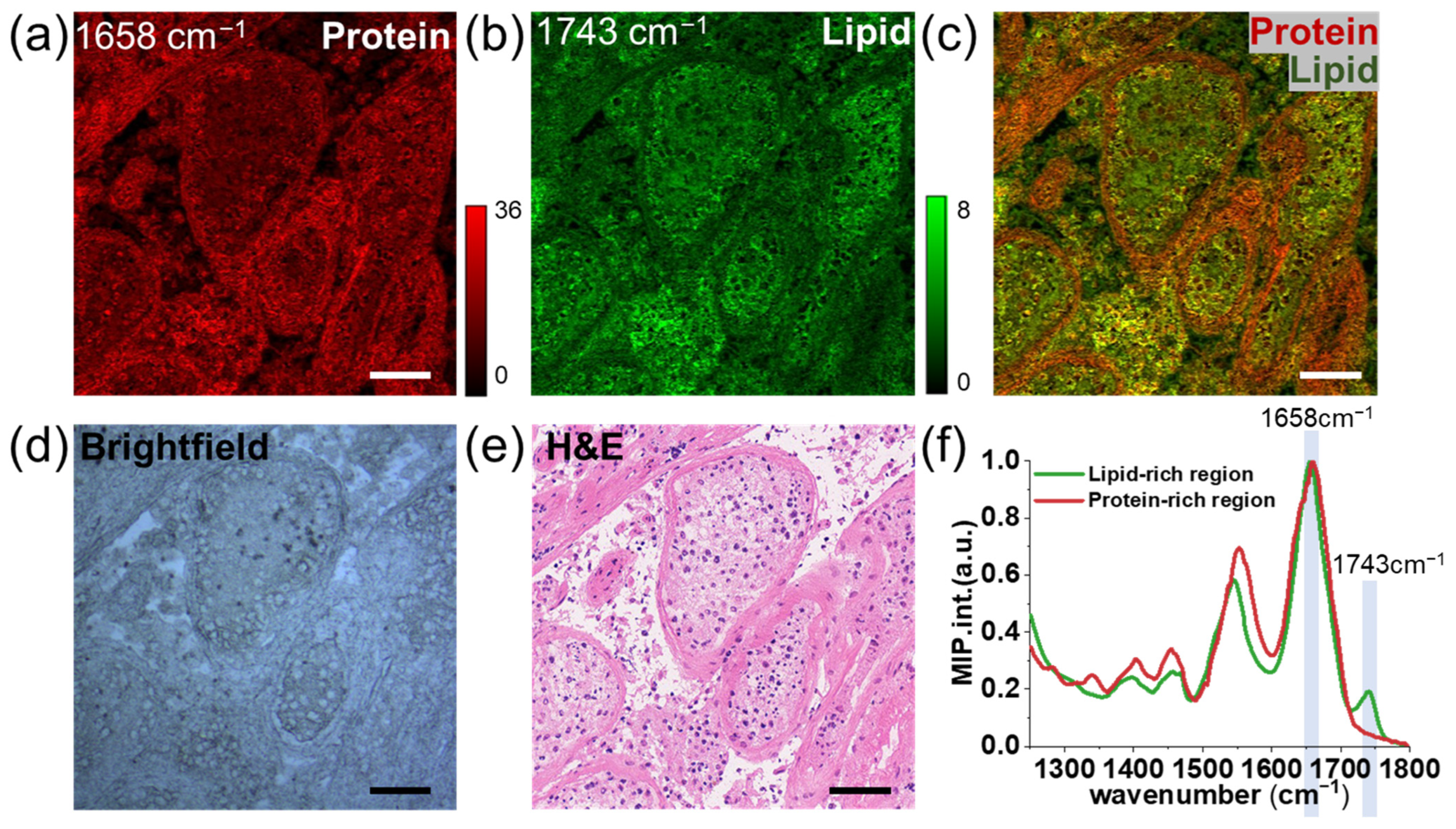
The potential of MIP microscopy to resolve the spatial-spectral features of key biomolecules was evaluated by imaging testicular tissues with normal spermatogenesis obtained from OA patients (Figure 2). MIP imaging was performed using a 5 to 12 µm IR beam with a 532 nm probe beam. Frozen sectioned patient tissues were imaged, and adjacent H&E-stained slices were used as histopathological references. As shown in Figure 2a–c, MIP microscopy provided molecular-level contrasts through distinct IR spectroscopic peaks, 1658 cm−1 corresponding to the Amide I band mainly from proteins [40], and 1743 cm−1 corresponding to the C=O bond vibrations mainly from lipids [41]. Brightfield imaging of the same tissue section on the same microscope, along with adjacent H&E-stained slices, confirmed intact tissue morphology (Figure 2d,e). Within individual seminiferous tubules, proteins and lipids exhibited distinct distribution patterns (Figure 2c), demonstrating the spatial heterogeneity of these biomolecules revealed by MIP imaging. Furthermore, granule structures with high lipid content, indicating the presence of lipid droplets (LDs), were observed in individual seminiferous tubules. Spectral analysis of lipid-rich and protein-rich regions was performed by selecting high-intensity pixels at each wavenumber and sweeping the IR wavelength to obtain complete vibrational spectra (Figure 2f), validating sufficient molecular specificity achieved by 2-channel spectral imaging by MIP. The 1658 cm−1 band, contributed from the Amide I (1600−1720 cm−1), is a well-established vibrational signature of protein-rich structures [42,43,44]. We further validated these protein-rich regions through the presence of other protein-associated bands, including Amide II (~1500–1550 cm−1) and Amide III (~1300–1350 cm−1), alongside the absence of the lipid-dominant C=O ester band at 1743 cm−1. The detection of the 1658 cm−1 signal within lipid-rich regions is attributed to the biological co-localization of lipid droplets with their associated proteins and surrounding cytosolic environment. Consequently, these spectra likely represent a mixed contribution of lipid and protein signals.
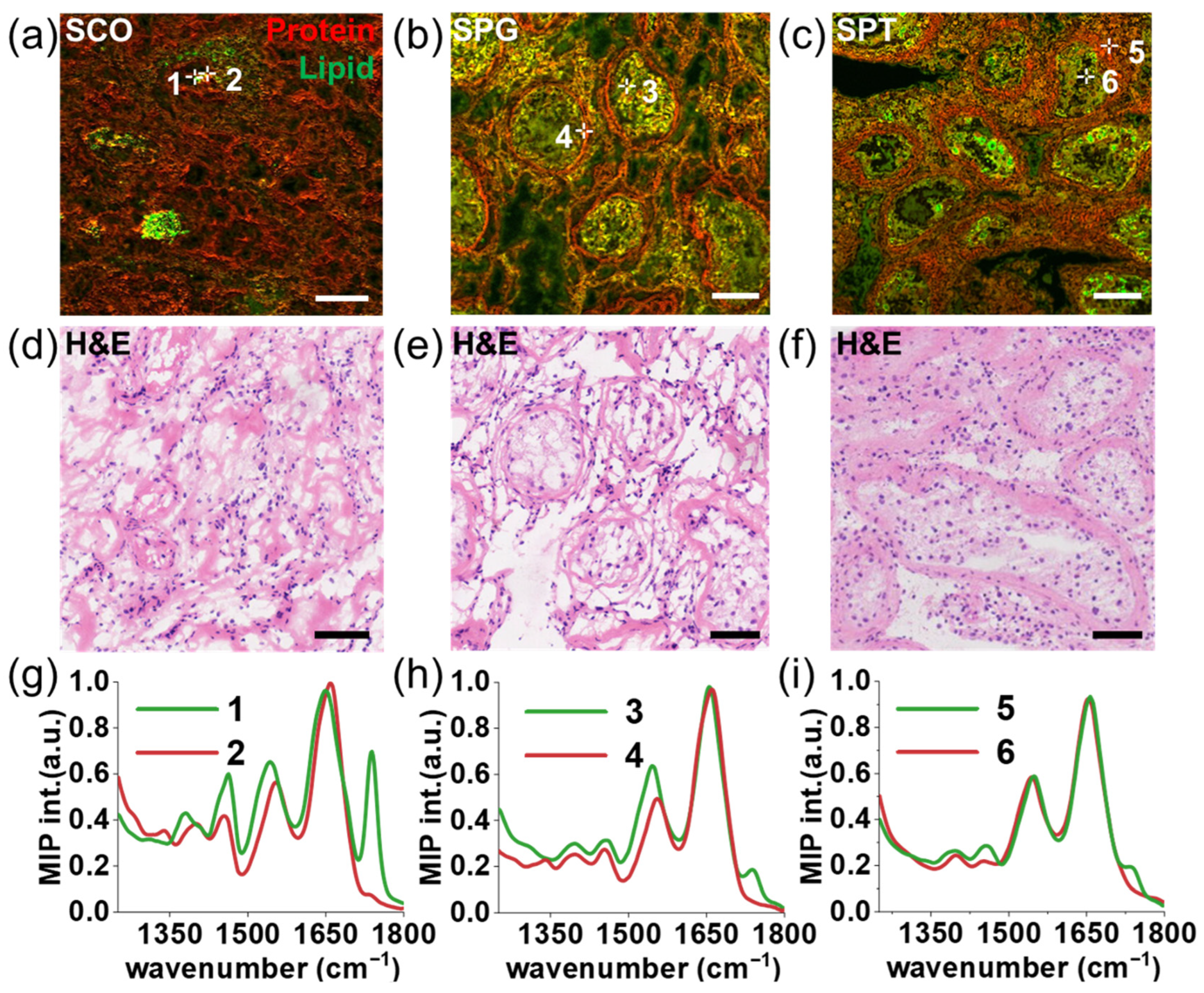
To investigate the spatial-spectral characteristics of biomolecules in abnormal seminiferous tubules, we performed MIP imaging on testicular tissues from patients diagnosed with iNOA. Similar to normal tissues, MIP images at 1658 cm1 (Amide I band) showed cell boundaries and overall tissue architecture, whereas images at 1743 cm1 (C=O band) revealed granular lipid-rich structures within the cells (Figure 3a–c). Importantly, an image-wide analysis of the lipid-to-protein ratio (1743/1658 cm−1) revealed a significantly reduced lipid signal in iNOA tissues compared to normal spermatogenic tissues (Figure S2), indicating a potential alteration in lipid metabolism. Notably, the three different pathological subtypes exhibited distinct biomolecular-specific spatial distribution patterns that were not detectable in H&E staining (Figure 3d–f), demonstrating the spatial heterogeneity of biomolecules associated with different degrees of spermatogenic arrest. Moreover, MIP spectra acquired from lipid-rich and protein-rich regions further revealed compositional heterogeneity across subtypes (Figure 3g–i). Comparing spectral profiles, substantial variations in protein and lipid distribution and abundance among subtypes were found. Collectively, these results suggest the complex biomolecular organization of abnormal seminiferous tubules, which could potentially serve as molecular-level signatures for iNOA subtyping by label-free MIP imaging.

3.2. iNOA Subtyping by Machine Learning-Based MIP Spectra Classification

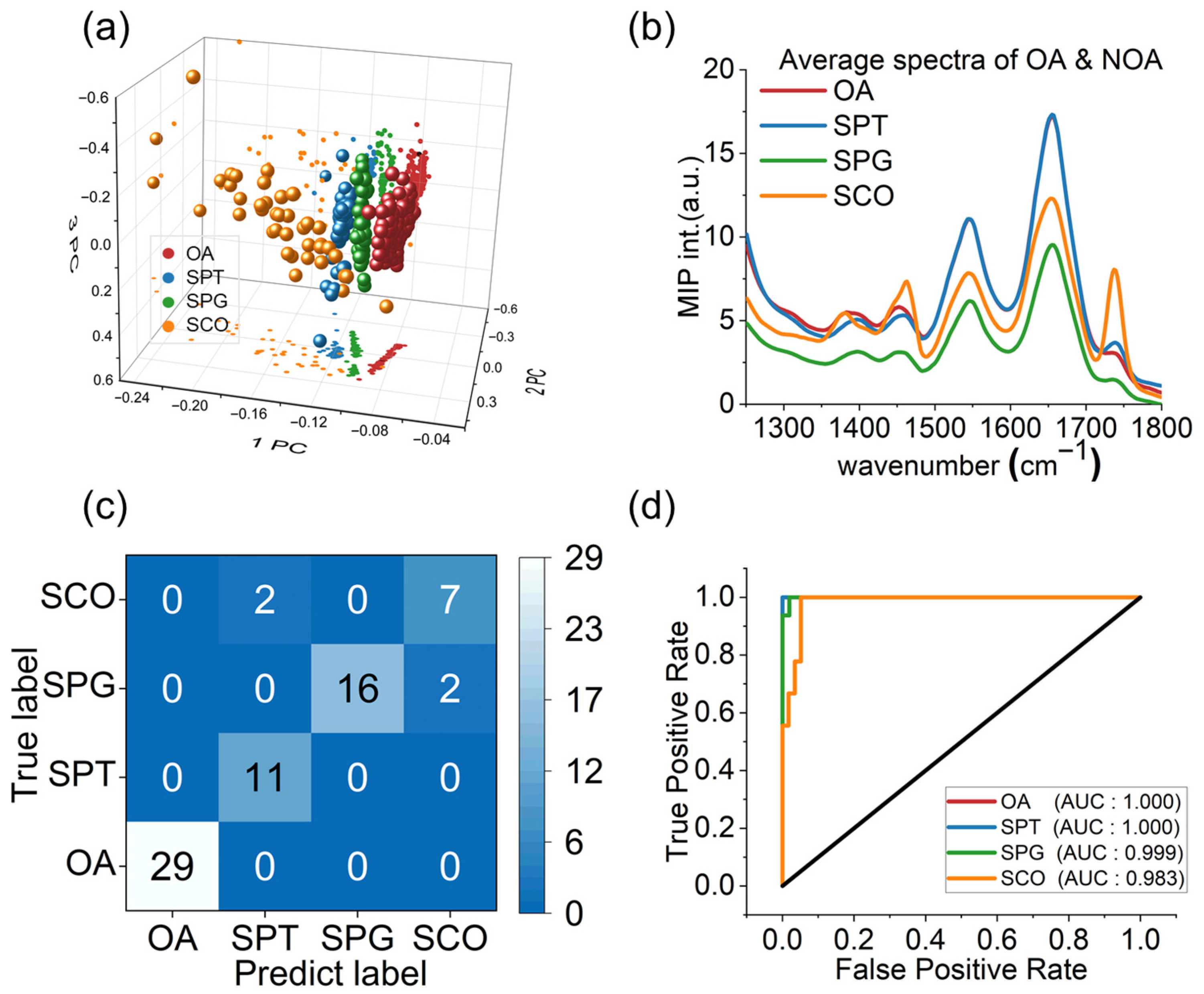
To further evaluate the potential of MIP spectral signatures for iNOA subtyping, we applied a combined analytical framework of Principal Component Analysis (PCA) and RF—two widely used data processing tools that function synergistically like a “magnifying glass” for highlighting key data features and a “filter” for refining classification accuracy. PCA, the first step in our analysis, relies on SVD to break down the large volume of spectral data collected by MIPs into two core components: singular vectors, which capture the fundamental characteristics of the data, and singular values, which quantify the importance of these characteristics. The end product of this process—known as “principal components”—effectively condenses the raw, disorganized spectral data into a streamlined form, retaining only the most critical information that drives differences between samples. When we focused specifically on spectral data from lipid-rich tissue regions, a clear pattern emerged: the SVD-generated plot (Figure 4a) showed distinct clustering of samples—normal spermatogenic tissue (OA) and the three pathological iNOA subtypes formed separate, non-overlapping groups. Each point in the scatter plot corresponds to an individual spectrum obtained from lipid-rich regions, positioning determined by its scores on the selected principal components. Importantly, these principal components primarily reflect variations in lipid-associated spectral signatures (Figure 4b), linking the observed separation to underlying biomolecular differences across tissue types. This interpretation is further supported by the loading profile of Principal Component 1 (PC1), which identified the two most influential spectral features as the expected peaks at 1658 cm−1 and 1743 cm−1 (Figure S3a), consistent with our focus on protein and lipid vibrational modes.
The singular vectors from the two datasets were then merged into a new dataset X, along with a corresponding label vector Y that indicates the origin of each data point. This labelled dataset served as the basis for training and testing the machine learning model. To ensure robust evaluation, the dataset was partitioned into training and test sets using the cvpartition function and the Hold-Out method. Specifically, 20% of the data was allocated to the test set, leaving the remaining 80% for training. This split ensures that the model is trained on a representative subset of the data while reserving an independent portion for unbiased performance assessment. A random forest classifier was trained on the segmented training data using the TreeBagger function. Random forests are ensemble learning methods that combine multiple decision trees to improve prediction accuracy and reduce overfitting. By aggregating the predictions of individual trees, random forests provide a more reliable and stable classification result compared to single-tree models.
The principal components were used as input features for random forest classification. This model achieved high predictive accuracy, correctly classifying 29 MIP spectra from normal (OA) tissues and 34 MIP spectra from abnormal tissues (comprising 11 SPT, 16 SPG, and 17 SCO), as detailed in the confusion matrix (Figure 4c). The classification model demonstrated high discriminatory performance, achieving 94.03% accuracy on the test set and an area under the receiver operating characteristic (ROC) curve exceeding 98% (Figure 4d). To further evaluate model robustness, we performed leave-one-patient-out cross-validation. This approach confirmed clear separability among pathological types in principal component space, with the two OA cases forming a compact cluster (Figure S3b). The classification accuracy obtained under this validation scheme (Figure S3c) further substantiates the model’s strong predictive capability. Together, these results demonstrate that machine learning-based MIP spectra analysis can robustly differentiate tissues with normal spermatogenesis from iNOA subtypes. Beyond classification, this strategy provides molecular-level insights into metabolic heterogeneity in testicular tissues, suggesting potential application for improving iNOA diagnosis and guiding sperm retrieval procedures.

4. Discussion

In this study, we utilized a recently developed MIP microscopy for label-free imaging of the spatial distribution of biomolecules in testicular tissues to classify iNOA. Lipids were identified as potential markers for distinguishing testicular tissues with normal versus abnormal spermatogenesis. This result aligns with previous findings from stimulated Raman scattering imaging of azoospermia [38], suggesting the importance of further investigating the relationship between lipid metabolism and spermatogenesis. Overall, we demonstrated the capability of MIP microscopy to enable label-free molecular histology and to identify spatio-spectral signatures of diseases, which holds significant clinical value. The non-destructive nature of MIP imaging is particularly advantageous for clinical applications where sample preservation is critical. Unlike traditional histology, MIP maintains tissue integrity without chemical fixation or staining. While the current study utilized 15 μm frozen sections, the intrinsic properties of MIP imaging suggest a clear potential toward adapting the modality for thicker, viable specimens, potentially allowing for diagnostic evaluation without compromising the subsequent use of sperm in assisted reproduction [45].
It is essential to look deeper into the biological meaning of the observed lipid signatures to understand their structural origins. The lipid variations we detected likely reflect underlying metabolic dysfunction within the testicular microenvironment. Because our spectral analysis focused on lipid-rich pixels, we are likely observing intracellular lipid droplets rather than membranous lipids. This distinction is biologically significant because the accumulation of lipid droplets within somatic cells is a hallmark of impaired spermatogenesis, particularly in SCO syndrome [46,47]. Thus, the spectral signatures identified by this study likely capture the metabolic dysregulation that occurs in conjunction with or as a consequence of germ-cell depletion.
The translation of these molecular markers into a reliable diagnostic tool requires a rigorous methodological framework regarding how spectral data is sampled and validated. A key aspect of our approach is the use of discrete pixels from lipid-rich regions for classification. This sampling strategy was guided by prior evidence of significant lipid droplet alterations in iNOA samples [38]. By focusing on the molecular composition of these lipid droplets, we aimed to extract diagnostic information that simple morphological imaging might overlook. To ensure these features represent robust pathological markers rather than sample-specific artifacts, we implemented a leave-one-patient-out cross-validation protocol. The high predictive accuracy achieved on held-out patients, combined with independent spectral standardization and tubule-level separation, confirms that our SVD-RF model identifies conserved spectral signatures that generalize across individuals. Nevertheless, we recognize that this work serves as a proof-of-concept study and that larger, multicentre patient cohorts will be required for broader clinical validation in the future.
Meanwhile, we recognize that the full biochemical landscape of the tissue offers further opportunities. Our analysis focused on lipid and protein components, yet other biomolecules, such as nucleic acids and carbohydrates, likely contain additional diagnostic value. Although full fingerprint spectra were incorporated into our model, the spatial targeting of lipid-rich pixels may have de-emphasized the contributions of these other components. Future investigations that include multi-component analysis across a broader range of tissue structures will be important to further enhance the diagnostic accuracy of MIP-based molecular histology.
Beyond the breadth of the current analytical framework, the practical implementation of this technology relies on optimizing imaging efficiency for clinical use. Since our spectroscopic classification relies on key informative pixels rather than the full high-resolution dataset, a strategically sub-sampled approach could provide sufficient spatial context to guide sampling while significantly improving throughput. The primary challenge lies in reliably identifying disease-relevant features, such as lipid droplets, for full spectroscopic analysis. In this study, we addressed this by using a two-channel imaging strategy to identify pixels of interest from a larger field of view before targeted spectral acquisition. The high spatial resolution was necessary here because our targets, intracellular lipid droplets, are relatively small features that require precise localization. However, with a more complete understanding of the spatial and spectroscopic signatures of disease-related lipids, it should be possible to design more efficient acquisition schemes with the help of deep learning techniques [48]. By employing sub-sampled MIP imaging alongside targeted point spectroscopy, it would be possible to achieve the high-throughput analysis necessary for rapid disease classification in a clinical setting.
Finally, evaluating the unique strengths of MIP microscopy alongside established modalities like SRS helps define its specific niche in the clinical landscape. A primary distinction of MIP is its ability to overcome the traditional water absorption limitations of infrared spectroscopy through its photothermal detection mechanism. By using a visible probe beam to detect local thermal expansion generated by mid-IR absorption, MIP avoids the challenges of direct infrared transmission in aqueous biological environments [32,49]. Furthermore, the infrared absorption cross-section is approximately 108 times higher than the Raman scattering cross-section. This inherent sensitivity allows for high signal-to-noise ratios while utilizing lower laser powers, which is a critical consideration for preserving the viability of testicular tissue during sperm extraction procedures. The two modalities also offer different performance profiles regarding acquisition speed. MIP is particularly efficient for broad fingerprint spectroscopy. While spontaneous Raman typically requires 30 s to several minutes per pixel, and hyperspectral SRS is often limited to a narrow spectral window of ~200 cm−1, MIP can capture a full fingerprint spectrum from 1000 to 1800 cm−1 within seconds. Conversely, many current SRS systems lead in imaging speed due to the use of fast galvanometer scanning, while most existing MIP setups employ sample-scanning configurations. However, the field is advancing rapidly, with recent developments in laser-scanning MIP techniques [50,51] pushing the modality toward the frames-per-second speeds required for high-throughput clinical evaluation.
Ultimately, these modalities offer distinct and complementary value for future clinical applications. SRS has demonstrated significant potential for intraoperative use through high-wavenumber C−H imaging for stimulated Raman histology (SRH) [23,24,52,53]. Meanwhile, the clinical feasibility of MIP has been established through molecular fingerprinting and cancer margin detection [54,55,56]. Therefore, both techniques represent unique and valuable tools for future molecular histology.

Supplementary Materials

The following supporting information can be downloaded at: https://www.mdpi.com/article/10.3390/photonics13040348/s1.

Author Contributions

H.J.L., Z.C., G.A. and D.Z. conceived and directed the study; Z.W. performed MIP imaging experiments and constructed spectral analysis and classification pipelines; Z.C. prepared the tissue samples and performed pathology work; P.F. assisted with the MIP system optimization; Z.W. and H.J.L. wrote the paper with contributions from all authors. All authors have read and agreed to the published version of the manuscript.

Funding

This work was supported by the National Natural Science Foundation of China (82372011, 82471639, W2532057), the Zhejiang Provincial Natural Science Foundation of China (LZ25H180001), Guangdong Basic and Applied Basic Research Foundation (2024A1515013031), and the Fundamental Research Funds for the Central Universities (226-2025-00034).

Data Availability Statement

The data that support the findings of this article are not publicly available due to ethical concerns. They can be requested from the author at hjlee@zju.edu.cn.

Acknowledgments

Part of the work reported in this manuscript was previously presented in our SPIE Proceedings paper [57]. In this study, we expanded the patient cohort and optimized the machine-learning pipeline to provide a more comprehensive analysis.

Conflicts of Interest

The authors declare no conflicts of interest.

References

  1. Jarow, J.P.; Lipshultz, L.I.; Espeland, M.A. Evaluation of the azoospermic patient. J. Urol. 1989, 142, 62. [Google Scholar] [CrossRef]
  2. Thonneau, P.; Marchand, S.; Tallec, A.; Ferial, M.L.; Ducot, B.; Lansac, J.; Lopes, P.; Tabaste, J.M.; Spira, A. Incidence and main causes of infertility in a resident population (1,850,000) of three French regions (1988–1989). Hum. Reprod. 1991, 6, 811. [Google Scholar] [CrossRef]
  3. Devroey, P.; Liu, J.; Nagy, Z.; Tournaye, H.; Silber, S.J.; Van Steirteghem, A.C. Normal fertilization of human oocytes after testicular sperm extraction and intracytoplasmic sperm injection. Fertil. Steril. 1994, 62, 639. [Google Scholar] [CrossRef]
  4. Schlegel, P.N. Testicular sperm extraction: Microdissection improves sperm yield with minimal tissue excision. Hum. Reprod. 1999, 14, 131. [Google Scholar] [CrossRef]
  5. Neto, F.T.; Bach, P.V.; Najari, B.B.; Li, P.S.; Goldstein, M. Spermatogenesis in humans and its affecting factors. Semin. Cell Dev. Biol. 2016, 59, 10. [Google Scholar] [CrossRef]
  6. Bonomi, M.; Rochira, V.; Pasquali, D.; Balercia, G.; Jannini, E.A.; Ferlin, A.I. Klinefelter syndrome (KS): Genetics, clinical phenotype and hypogonadism. J. Endocrinol. Investig. 2017, 40, 123. [Google Scholar] [CrossRef] [PubMed]
  7. Tang, D.; Li, K.; He, X.; Zhang, Y.; Cao, Y. Non-invasive molecular biomarkers for predicting outcomes of micro-TESE in patients with idiopathic non-obstructive azoospermia. Expert Rev. Mol. Med. 2022, 24, e22. [Google Scholar] [CrossRef] [PubMed]
  8. Zhao, L.; Yao, C.; Xing, X.; Jing, T.; Li, P.; Zhu, Z.; Yang, C.; Zhai, J.; Tian, R.; Chen, H.; et al. Single-cell analysis of developing and azoospermia human testicles reveals central role of Sertoli cells. Nat. Commun. 2020, 11, 5683. [Google Scholar] [CrossRef] [PubMed]
  9. Achermann, A.P.P.; Pereira, T.A.; Esteves, S.C. Microdissection testicular sperm extraction (micro-TESE) in men with infertility due to nonobstructive azoospermia: Summary of current literature. Int. Urol. Nephrol. 2021, 53, 2193. [Google Scholar] [CrossRef]
  10. Okada, H.; Dobashi, M.; Yamazaki, T.; Hara, I.; Fujisawa, M.; Arakawa, S.; Kamidono, S. Conventional versus microdissection testicular sperm extraction for nonobstructive azoospermia. J. Urol. 2002, 168, 1063. [Google Scholar] [CrossRef]
  11. Najari, B.B.; Ramasamy, R.; Sterling, J.; Aggarwal, A.; Sheth, S.; Li, P.S.; Dubin, J.M.; Goldenberg, S.; Jain, M.; Robinson, B.D.; et al. Pilot study of the correlation of multiphoton tomography of ex vivo human testis with histology. J. Urol. 2012, 188, 538. [Google Scholar] [CrossRef] [PubMed]
  12. Roshandel, E.; Mehravar, M.; Nikoonezhad, M.; Alizadeh, A.M.; Majidi, M.; Salimi, M.; Hajifathali, A. Cell-Based Therapy Approaches in Treatment of Non-obstructive Azoospermia. Reprod Sci. 2023, 30, 1482. [Google Scholar] [CrossRef] [PubMed]
  13. McLachlan, R.I.; Meyts, E.R.-D.; Hoei-Hansen, C.E.; de Kretser, D.M.; Skakkebaek, N.E. Histological evaluation of the human testis—Approaches to optimizing the clinical value of the assessment: Mini Review. Hum. Reprod. 2007, 22, 2. [Google Scholar] [CrossRef]
  14. Sánchez Diaz, I. Molecular histology 2020: Beyond what we can see. J. Mol. Histol. 2020, 51, 1. [Google Scholar] [CrossRef]
  15. Müllauer, L. Milestones in pathology-from histology to molecular biology. Memo 2017, 10, 42. [Google Scholar] [CrossRef]
  16. Fassan, M. Molecular Diagnostics in Pathology: Time for a Next-Generation Pathologist? Arch Pathol. Lab. Med. 2018, 142, 313–320. [Google Scholar] [CrossRef]
  17. Lauwerends, L.J.; van Driel, P.B.A.A.; de Jong, R.J.B.; Hardillo, J.A.U.; Koljenovic, S.; Puppels, G.; Mezzanotte, L.; Löwik, C.W.G.M.; Rosenthal, E.L.; Vahrmeijer, A.L.; et al. Real-time fluorescence imaging in intraoperative decision making for cancer surgery. Lancet Oncol. 2021, 22, e186. [Google Scholar] [CrossRef]
  18. Dodo, K.; Fujita, K.; Sodeoka, M. Raman Spectroscopy for Chemical Biology Research. J. Am. Chem. Soc. 2022, 144, 19651–19667. [Google Scholar] [CrossRef]
  19. Zhou, Y.; Tang, X.; Zhang, D.; Lee, H.J. Machine learning empowered coherent Raman imaging and analysis for biomedical applications. Commun. Eng. 2025, 4, 8. [Google Scholar] [CrossRef] [PubMed]
  20. Lee, M.; Herrington, C.S.; Ravindra, M.; Sepp, K.; Davies, A.; Hulme, A.N.; Brunton, V.G. Recent advances in the use of stimul8%ated Raman scattering in histopathology. Analyst 2021, 146, 789. [Google Scholar] [CrossRef]
  21. Diem, M.; Mazur, A.; Lenau, K.; Schubert, J.; Bird, B.; Miljkovic, M.; Krafft, C.; Popp, J. Molecular pathology via IR and Raman spectral imaging. J. Biophotonics 2013, 6, 855. [Google Scholar] [CrossRef]
  22. Lee, H.J.; Chen, Z.; Collard, M.; Chen, F.; Chen, J.G.; Wu, M.; Alani, R.M.; Cheng, J.X. Multimodal Metabolic Imaging Reveals Pigment Reduction and Lipid Accumulation in Metastatic Melanoma. BME Front. 2021, 2021, 9860123. [Google Scholar] [CrossRef]
  23. Hollon, T.C.; Pandian, B.; Adapa, A.R.; Urias, E.; Save, A.V.; Khalsa, S.S.S.; Eichberg, D.G.; D’Amico, R.S.; Farooq, Z.U.; Lewis, S.; et al. Near real-time intraoperative brain tumor diagnosis using stimulated Raman histology and deep neural networks. Nat. Med. 2020, 26, 52–58. [Google Scholar] [CrossRef] [PubMed]
  24. Liu, Z.; Su, W.; Ao, J.; Wang, M.; Jiang, Q.; He, J.; Gao, H.; Lei, S.; Nie, J.; Yan, X.; et al. Instant diagnosis of gastroscopic biopsy via deep-learned single-shot femtosecond stimulated Raman histology. Nat. Commun. 2022, 13, 4050. [Google Scholar] [CrossRef]
  25. Zhang, S.; He, Y.X.; Yue, S.H. Coherent Raman scattering imaging of lipid metabolism in cancer. J. Innov. Opt. Health Sci. 2023, 16, 2230015. [Google Scholar] [CrossRef]
  26. Ji, M.B.; Arbel, M.; Zhang, L.L.; Freudiger, C.W.; Hou, S.S.; Lin, D.D.; Yang, X.J.; Bacskai, B.J.; Xie, X.S. Label-free imaging of amyloid plaques in Alzheimer’s disease with stimulated Raman scattering microscopy. Sci. Adv. 2018, 4, eaat7715. [Google Scholar] [CrossRef]
  27. Tian, F.; Yang, W.L.; Mordes, D.A.; Wang, J.Y.; Salameh, J.S.; Mok, J.; Chew, J.; Sharma, A.; Leno-Duran, E.; Suzuki-Uematsu, S.; et al. Monitoring peripheral nerve degeneration in ALS by label-free stimulated Raman scattering imaging. Nat. Commun. 2016, 7, 13283. [Google Scholar] [CrossRef] [PubMed]
  28. Huang, X.J.; Xue, Z.X.; Zhang, D.L.; Lee, H.J. Pinpointing Fat Molecules: Advances in Coherent Raman Scattering Microscopy for Lipid Metabolism. Anal Chem. 2024, 96, 7945. [Google Scholar] [CrossRef]
  29. Anantha, P.; Liu, Z.; Raj, P.; Barman, I. Optical diffraction tomography and Raman spectroscopy reveal distinct cellular phenotypes during white and brown adipocyte differentiation. Biosens. Bioelectron. 2023, 235, 115388. [Google Scholar] [CrossRef]
  30. Horvatits, T.; Tamminga, M.; Liu, B.; Sebode, M.; Carambia, A.; Fischer, L.; Püschel, K.; Huber, S.; Fischer, E.K. Microplastics detected in cirrhotic liver tissue. eBioMedicine 2022, 82, 104147. [Google Scholar] [CrossRef] [PubMed]
  31. Contreras-Rozo, J.A.; Mata-Miranda, M.M.; Vazquez-Zapien, G.J.; Delgado-Macuil, R.J. Infrared spectroscopy technique: An alternative technology for diabetes diagnosis. Biomed. Signal Process. Control 2023, 86, 105246. [Google Scholar] [CrossRef]
  32. Zhang, D.; Li, C.; Zhang, C.; Slipchenko, M.N.; Eakins, G.; Cheng, J.X. Depth-resolved mid-infrared photothermal imaging of living cells and organisms with submicrometer spatial resolution. Sci. Adv. 2016, 2, e1600521. [Google Scholar] [CrossRef] [PubMed]
  33. Cheng, J.; Yuan, Y.; Ni, H.; Ao, J.; Xia, Q.; Bolarinho, R.; Ge, X. Advanced vibrational microscopes for life science. Nat. Methods 2025, 22, 912–927. [Google Scholar] [CrossRef]
  34. Xia, Q.; Yin, J.; Guo, Z.; Cheng, J. Mid-Infrared Photothermal Microscopy: Principle, Instrumentation, and Applications. J. Phys. Chem. B 2022, 43, 8597–8613. [Google Scholar] [CrossRef]
  35. Samolis, P.D.; Zhu, X.; Sander, M.Y. Time-Resolved Mid-Infrared Photothermal Microscopy for Imaging Water-Embedded Axon Bundles. Anal Chem 2023, 95, 16514–16521. [Google Scholar] [CrossRef] [PubMed]
  36. Golub, G.H.; Van Loan, C.F. Matrix Computations, 3rd ed.; Johns Hopkins University Press: Baltimore, MD, USA, 1996. [Google Scholar]
  37. Breiman, L. Random Forests. Mach. Learn. 2001, 45, 5–32. [Google Scholar] [CrossRef]
  38. Huang, J.; Tang, X.; Chen, Z.; Li, X.; Zhang, Y.; Huang, X.; Zhang, D.; An, G.; Lee, H.J. Rapid azoospermia classification by stimulated Raman scattering and second harmonic generation microscopy. Biomed. Opt. Express 2023, 14, 5569–5582. [Google Scholar] [CrossRef] [PubMed]
  39. Zhang, Z.; Chen, S.; Liang, Y. Baseline correction using adaptive iteratively reweighted penalized least squares. Analyst 2010, 135, 1138–1146. [Google Scholar] [CrossRef]
  40. Hamm, P.; Lim, M.; Robin, M.; Hochstrasser, H. Structure of the Amide I Band of Peptides Measured by Femtosecond Nonlinear-Infrared Spectroscopy. J. Phys. Chem. B 1998, 102, 10958–10965. [Google Scholar] [CrossRef]
  41. Kochan, K.; Peng, H.; Wood, B.R.; Haritos, V.S. Single cell assessment of yeast metabolic engineering for enhanced lipid production using Raman and AFM-IR imaging. Biotechnol. Biofuels 2018, 11, 106. [Google Scholar] [CrossRef]
  42. Lim, J.M.; Park, C.; Park, J.S.; Kim, C.; Chon, B.; Cho, M. Cytoplasmic Protein Imaging with Mid-Infrared Photothermal Microscopy: Cellular Dynamics of Live Neurons and Oligodendrocytes. J. Phys. Chem. Lett. 2019, 10, 2857–2861. [Google Scholar] [CrossRef]
  43. Zong, H.; Yurdakul, C.; Bai, Y.; Zhang, M.; Ünlü, M.S.; Cheng, J.X. Background-Suppressed High-Throughput Mid-Infrared Photothermal Microscopy via Pupil Engineering. ACS Photonics 2021, 8, 3323–3336. [Google Scholar] [CrossRef]
  44. Zhang, Y.; Yurdakul, C.; Devaux, A.J.; Wang, L.; Xu, X.G.; Conno, J.H.; Ünlü, M.S.; Cheng, J.X. Vibrational Spectroscopic Detection of a Single Virus by Mid-Infrared Photothermal Microscopy. Anal. Chem. 2021, 93, 4100–4107. [Google Scholar] [CrossRef] [PubMed]
  45. Ni, H.; Yuan, Y.; Li, M.; Zhu, Y.; Ge, X.; Yin, J.; Dessai, C.P.; Wang, L.; Cheng, J. Millimetre-deep micrometre-resolution vibrational imaging by shortwave infrared photothermal microscopy. Nat. Photon 2024, 18, 944–951. [Google Scholar] [CrossRef]
  46. Wang, J.; Che, M.; Yao, Y.; Zhu, M.; Jiang, Y.; Duan, J.; Yuan, Y.; Li, L.; Chen, M.; Sha, J. Characterization of Metabolic Patterns in Mouse Spermatogenesis and Its Clinical Implications in Humans. Int. J. Mol. Sci. 2025, 26, 1001. [Google Scholar] [CrossRef] [PubMed]
  47. Sulc, A.; Czétány, P.; Máté, G.; Balló, N.A.; Semjén, D.; Szántó, A.; Márk, L. MALDI Imaging Mass Spectrometry Reveals Lipid Alterations in Physiological and Sertoli Cell-Only Syndrome Human Testicular Tissue Sections. Int. J. Mol. Sci. 2024, 25, 8358. [Google Scholar] [CrossRef]
  48. Tang, X.; Zhang, Y.; Deng, X.; Lee, H.J.; Zhang, D. Overcoming the Nyquist Limit in Molecular Hyperspectral Imaging by Reinforcement Learning. Adv. Intell. Discov. 2026, e202500240. [Google Scholar] [CrossRef]
  49. Cheng, J.X. A 20-year journey on the invention of vibrational photothermal microscopy. Nat. Methods 2025, 22, 883–885. [Google Scholar] [CrossRef]
  50. Jia, D.; Huang, S.H.; Tulegenov, D.; Dong, D.; Shvets, G.; Cheng, J.-X. Metasurface-enhanced infrared photothermal microscopy toward ultrasensitive chemical analysis. Adv. Photon 2025, 7, 056001. [Google Scholar] [CrossRef]
  51. Wang, S.; Fu, P.; Lee, H.J.; Zhang, D. Laser-Scanning Infrared-Raman-Fluorescence Microscopy for Metabolic Flux Imaging in Living Organisms. Laser Photonics Rev. 2026, e02715. [Google Scholar] [CrossRef]
  52. Chen, X.; Wu, Z.; He, Y.; Hao, Z.; Wang, Q.; Zhou, K.; Zhou, W.; Wang, P.; Shan, F.; Li, Z.; et al. Accurate and Rapid Detection of Peritoneal Metastasis from Gastric Cancer by AI-Assisted Stimulated Raman Molecular Cytology. Adv. Sci. 2023, 10, 2300961. [Google Scholar] [CrossRef] [PubMed]
  53. Zhang, L.; Wu, Y.; Zheng, B.; Su, L.; Ma, S.; Hu, Q.; Zou, X.; Yao, L.; Yang, Y.; Chen, L.; et al. Rapid histology of laryngeal squamous cell carcinoma with deep-learning based stimulated Raman scattering microscopy. Theranostics 2019, 9, 2541–2554. [Google Scholar] [CrossRef]
  54. Reihanisaransari, R.; Gajjela, C.C.; Wu, X.; Ishrak, R.; Corvigno, S.; Zhong, Y.; Liu, J.; Sood, A.K.; Mayerich, D.; Berisha, S.; et al. Rapid Hyperspectral Photothermal Mid-Infrared Spectroscopic Imaging from Sparse Data for Gynecologic Cancer Tissue Subtyping. Anal. Chem. 2024, 96, 15880–15887. [Google Scholar] [CrossRef]
  55. Teng, X.; Li, M.; He, H.; Jia, D.; Yin, J.; Bolarinho, R.; Cheng, J. Mid-infrared Photothermal Imaging: Instrument and Life Science Applications. Anal. Chem. 2024, 96, 7895–7906. [Google Scholar] [CrossRef] [PubMed]
  56. Ye, X.; Fu, P.; Tang, X.; Liu, Z.; Wang, S.; Wang, S.; Liu, Y.; Zhao, W.; Zhu, Z.; Wang, H.; et al. AI-enhanced mid-infrared photothermal imaging reveals distinct spatial molecular signatures for label-free cancer staging. PhotoniX 2026, 7, 13. [Google Scholar] [CrossRef]
  57. Huang, J.; Fu, P.; Chen, Z.; An, G.; Zhang, D.; Lee, H.J. In situ molecular mapping of human testicular tissues by mid-infrared photothermal imaging. In Proceedings of the SPIE 12766, Advanced Optical Imaging Technologies VI, Beijing, China, 14–17 October 2023; SPIE: Bellingham, WA, USA, 2023; Volume 1276617. [Google Scholar] [CrossRef]
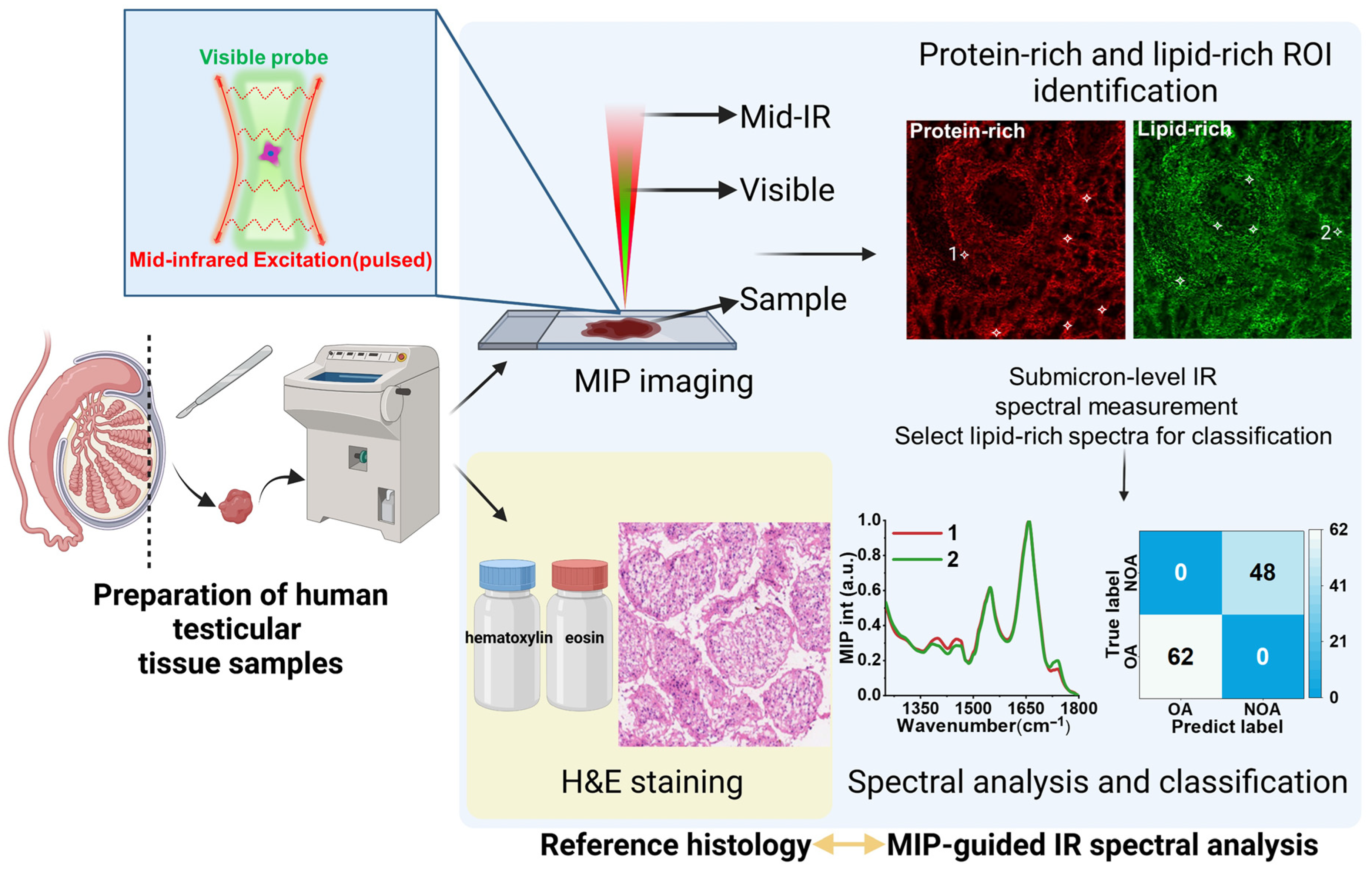
Figure 1. Schematics for the spectroscopic imaging of clinical testicular tissue for azoospermia classification. The clinical human testicular tissue samples were collected and frozen sections were made. One section was used for MIP imaging, and the adjacent section was used for H&E staining. Data analysis includes MIP images and IR spectral analysis, spectral SVD-RF processing.
Photonics 13 00348 g001
Figure 2. MIP imaging of normal human testicular tissue. (a,b) MIP images of the tissue at different wavenumbers ((a): 1658 cm−1, (b): 1743 cm−1). (c) Merged images of protein (red) and lipid (green). (d) Brightfield image of the same tissue under the same microscope. (e) H&E staining image of the adjacent tissue slide. (f) Average IR spectra of protein-rich (Amide I-rich) areas (7 spectra) and lipid-rich (C=O-rich) areas (10 spectra) obtained from normal human testicular tissue. Scale bar: 80 μm.
Photonics 13 00348 g002
Figure 3. MIP imaging of abnormal human testicular tissue. (a–c) MIP imaging of different types (a) Sertoli-cell only (SCO), (b) blocked in sperm cells (SPT), (c) blocked in spermatogonia (SPG). (d–f) H&E staining images of adjacent tissue sections from the same samples shown in (a–c). (g–i) Pinpoint spectra of locations 1–6, as indicated in (a–c). Scale bar: 80 μm.
Photonics 13 00348 g003
Figure 4. Diagnostic algorithm based on SVD-RF of IR spectra from human testicular tissue. (a) SVD of the IR spectra of normal and abnormal testicular tissue. Red dots represent IR spectra from normal tissues from OA patients (n = 146), blue dots from SPT patients (n = 69), green dots from SPG patients (n = 88), and orange dots from SCO patients (n = 39). (b) The average spectra of normal tissues (OA) and three different types of abnormal tissues (SPT, SPG, SCO). (c) Confusion matrix on the test set. (d) ROC curves. The red lines are covered by the blue ones. The diagonal black line represents the chance line (random guess line) with an AUC of 0.5, serving as a benchmark for non-discriminative random classification. The proposed model’s ROC curve lies above this line, indicating effective distinction between positive and negative cases.
Photonics 13 00348 g004
Disclaimer/Publisher’s Note: The statements, opinions and data contained in all publications are solely those of the individual author(s) and contributor(s) and not of MDPI and/or the editor(s). MDPI and/or the editor(s) disclaim responsibility for any injury to people or property resulting from any ideas, methods, instructions or products referred to in the content.