Article

Theoretical Model of Resonant Tunneling Diode Photodetector

1
School of Mathematics and Physics, Beijing Key Laboratory for Magneto-Photoelectrical Composite and Interface Science, University of Science and Technology Beijing, Beijing 100083, China
2
Key Laboratory of Solid-State Optoelectronics Information Technology, Institute of Semiconductors, Chinese Academy of Sciences, Beijing 100083, China
3
School of Science, Minzu University of China, Beijing 100081, China
4
Key Laboratory of Hunan Province on Information Photonics and Freespace Optical Communications, School of Physics and Electronic Science, Hunan Institute of Science and Technology, Yueyang 414006, China
5
Shunde Innovation School, University of Science and Technology Beijing, Foshan 528000, China
6
Center of Materials Science and Optoelectronics Engineering, University of Chinese Academy of Sciences, Beijing 100049, China
7
VITAL Group Co., Ltd., Guangzhou 510665, China
*
Authors to whom correspondence should be addressed.
Photonics 2026, 13(3), 297; https://doi.org/10.3390/photonics13030297
Submission received: 26 February 2026 / Revised: 14 March 2026 / Accepted: 17 March 2026 / Published: 19 March 2026

Abstract

RTD photodetectors have been widely applied in fields such as gas detection, weak signal detection, and single-photon detection. However, during further device design and optimization, it has been found that existing theoretical models cannot fully capture the diverse practical behaviors of RTD photodetectors. In this work, we analyze the influence of optical illumination on the band structure of RTDs and, based on the model proposed by Schulman et al., develop a relatively comprehensive theoretical model for RTD photodetectors. By comparing the model predictions with experimental data reported in the literature, we demonstrate that the proposed model can accurately describe the various physical effects in RTD photodetectors and faithfully reproduce the actual evolution of the I-V characteristics. This model provides a solid foundation for the design and optimization of RTD photodetector devices.

1. Introduction

Resonant tunneling structures have a wide range of applications, including in LEDs [1], photodetection, and other scenarios. Among these, RTD photodetectors offer advantages such as high responsivity [2] and high sensitivity [3,4,5], making them suitable for various fields such as gas detection [6], weak signal detection [4,7], and biological and medical sensing [8]. In addition, RTD photodetectors have been explored for single-photon detection [9,10,11] and for use in optical neural network architectures [12].
The active region of an RTD device consists of a quantum well enclosed by a double-barrier structure. The presence of the barriers causes the current transport through the device to be dominated by tunneling. Owing to the energy localization induced by the quantum well, the tunneling current reaches a maximum when the Fermi level aligns with the resonant energy level of the quantum well; once the Fermi level moves away from resonance, the tunneling current decreases rapidly, giving rise to the negative differential resistance (NDR) effect. Specifically, in RTD photodetectors, photo-generated holes produced in the absorption region (as photo-generated electrons move outward from the device) accumulate near the barrier region and create an additional electric field, resulting in an extra voltage drop. This additional field enhances the current in the linear region but simultaneously introduces an extra bias, thereby reducing the peak voltage of the device.
The theoretical modeling of RTD structures traces back to the 1973 work by Tsu and Esaki on transport phenomena in finite superlattices [13]. Their proposed equations laid the foundation for describing the I-V curves of RTD devices. Building upon this, Schulman and colleagues simplified and refined these equations to develop a compact model for the NDR effect in RTD structures [14]. Celino and co-researchers subsequently introduced a more comprehensive I-V model for complex RTD structures [15], which incorporates voltage-dependent variations in barrier height, tunneling coefficients, resonance linewidths, and multiple quantum effects. In the domain of optoelectronic conversion, Pfenning and Rothmayr et al. developed models describing the influence of light on RTD structure voltages [16,17].
The majority of existing photoelectric conversion models for RTDs are based on the accumulation of photo-generated holes at the edges of the RTD barriers or on photoconductive effects that induce downward band bending. These mechanisms dominate under low optical power conditions. However, when the optical power increases beyond a certain threshold, experiments have shown that, at high optical power levels, the peak voltage of the I-V curve instead increases and can even exceed the peak voltage observed under dark-current conditions [18,19]. Such phenomena cannot be captured by current models.
In this manuscript, we analyze the variations of the fermi level and the resonant energy levels within the quantum well of an RTD photodetector. Based on the model proposed by Schulman, we investigate the influence of optical illumination on the model parameters. By means of parameter fitting, we establish a theoretical framework that accurately reflects the practical behavior of RTD photodetectors. The model is subsequently validated by comparison with experimental data reported in the literature and with numerical simulation results, demonstrating excellent agreement with the actual device characteristics. Furthermore, on the basis of the developed theoretical model, we construct a compact model for the RTD photodetector and perform simulations using EDA tools, which also show good consistency with experimental observations. The proposed model can be employed to guide the structural design of new RTD photodetectors, facilitating the development of devices that meet specific application requirements and providing a solid foundation for device design and optimization.

2. RTD Model

2.1. Baseline Model

The step-like features observed in the negative differential resistance (NDR) region of RTDs have been discussed in several previous studies [20,21,22,23,24]. In particular, following the analysis in Zhao and other co-researchers’ study [20], we attribute the presence of these steps to the existence of an equivalent quantum well. We adopt the model proposed from Schulman [14] as the baseline for our RTD photodetection model and superimpose the terms describing the RTD structure, leading to the following equations:
I = I th + I MQW + I EQW .
Here, I MQW represents the current contribution from the main quantum well (MQW), while I EQW denotes the current contribution from the equivalent quantum well (EQW). Their respective equations are given as follows:
I i = e m e k B T S eff 4 π 2 3 Γ i ln 1 + e ( E F E R , i + e V n 1 , i ) / k B T 1 + e ( E F E R , i + e V ( 1 n 1 , i ) ) / k B T × π 2 + arctan E R , i e V n 1 , i Γ i / 2 .
This equation describes the I-V characteristics of the corresponding quantum well and captures the negative differential resistance behavior of the RTD structure. In this equation, m e means electron effective mass, E F denotes the Fermi level, E R , i is the corresponding resonant energy level (i corresponds to the MQW and EQW, respectively; the same notation applies hereafter), Γ i represents the associated resonant linewidth, n 1 , i is the energy limitation parameter, and S eff is the effective area contributing to the current. The equation for the thermal contribution I th is given as follows:
I th = H S eff ( e n 2 e V / k B T 1 ) .
In this equation, H is the thermal effect coefficient, and n 2 is the thermal limitation parameter.

2.2. Light Modulation Model

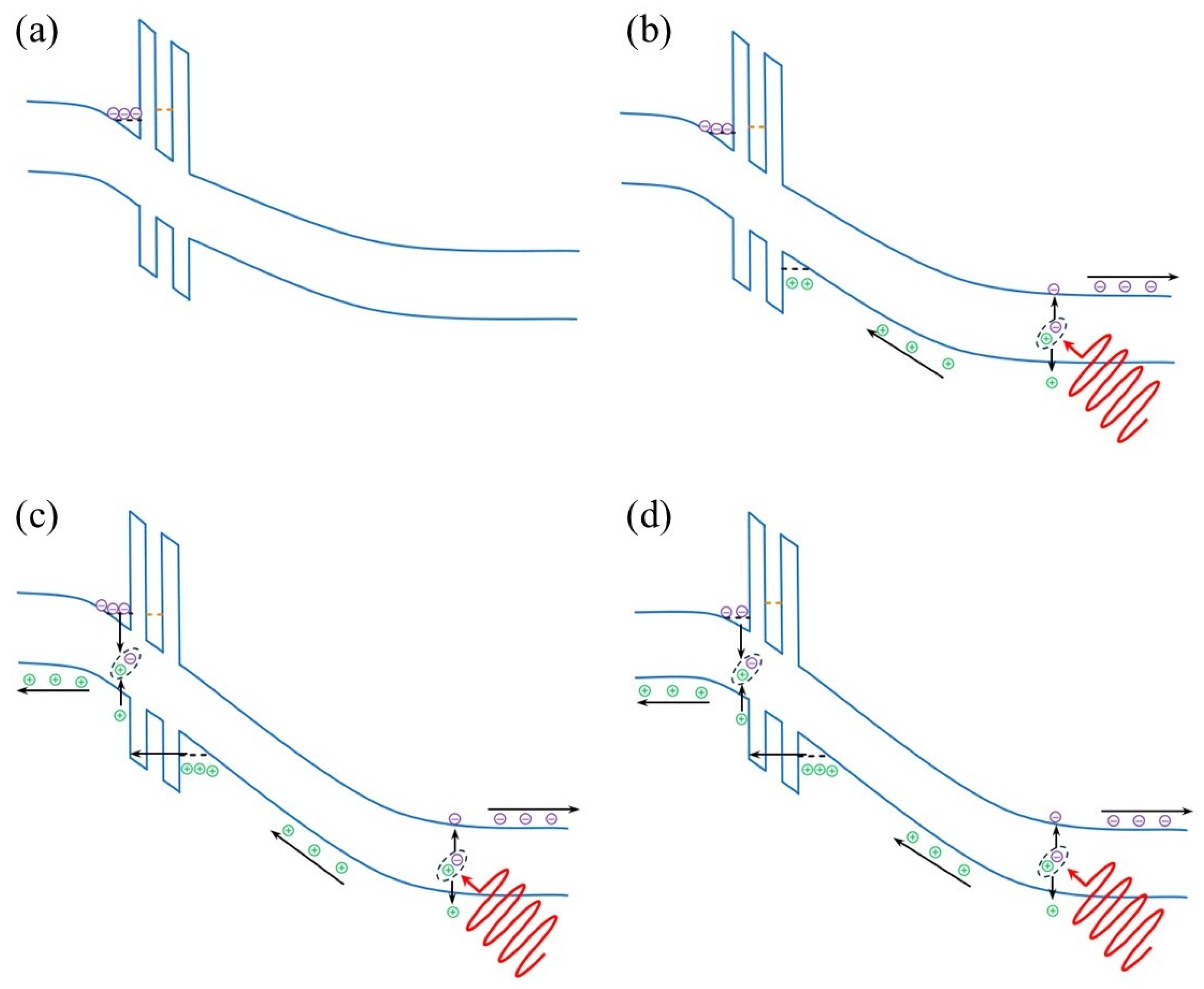
With the baseline model established, the effects of optical illumination on carrier dynamics and energy level variations can be examined on this basis. At low light power levels, photo-generated holes accumulate at the edges of the RTD’s potential barriers, increasing the effective voltage across the quantum well beyond the externally applied bias. This accumulation reduces the resonance voltage. Simultaneously, as the degree of band bending increases, the energy levels within the quantum well shift downward. Under high-light power conditions, however, holes begin to tunnel across the quantum well from one side to the other. The accumulation of holes stabilizes, meaning that the effective voltage across the quantum well no longer depends on increasing light power. Additionally, tunneling holes recombine with electrons on the opposite side, leading to a continuous decrease in electron density. This reduction in electron density decreases the degree of band bending, which increases the resonance voltage until it stabilizes. The schematic diagram of the energy level modulation process is in Figure 1.
This process causes the parameters in Equation (2) to vary with optical power. We assume that the energy confinement factor n 1 , i remains independent of optical power, whereas all other parameters change as a function of illumination intensity. In addition, optical absorption leads to an actual current amplitude that exceeds the value given by e m k B T S eff / ( 4 π 2 3 ) Γ i in Equation (2). Therefore, we replace Γ i with an independent gain coefficient G i , as expressed below:
I i = e m e k B T S eff 4 π 2 3 G i ln 1 + e ( E F E R , i + e V n 1 , i ) / k B T 1 + e ( E F E R , i + e V ( 1 n 1 , i ) ) / k B T × π 2 + arctan E R , i e V n 1 , i Γ i / 2 .
The equation for the gain coefficient G i is given as follows:
G i = A i ln ( P in S light d ξ i h ν B + 1 ) + Γ i , dark .
In this equation, S light denotes the illuminated area, d denotes the thickness of the absorption layer, A i denotes the photoresponse strength, which is related to the optical absorption coefficient, with the MQW and EQW each accounting for a fraction of the total optical absorption. The parameter ξ i is the optical relaxation factor, which characterizes the rate at which optical absorption varies with optical power; a smaller value of ξ i implies that a lower optical power is required to reach the maximum absorption. Γ i , dark denotes the resonant width under dark conditions.
To model the energy level shifts induced by optical absorption, two exponential functions with opposite signs are employed to represent the competition between the two physical mechanisms that influence the evolution of the I-V characteristics. The equation used is as follows:
E f = η h , f e V h , max ( 1 exp ( P τ h , f γ h , f h ν ) ) + η e , f e V e , max ( 1 exp ( P τ e , f γ e , f h ν ) ) + E f , dark .
The first term of this equation describes the reduction in energy levels caused by hole accumulation, while the second term accounts for the increase in energy levels resulting from hole tunneling and subsequent recombination. Here, E f , dark denotes the Fermi level under dark conditions. The parameters τ e , f and τ h , f correspond to the lifetimes of photogenerated electrons and holes in the emitter, respectively, while γ e , f and γ h , f are the optical absorption coefficients, which are related to the illuminated area, absorption coefficient, radiative recombination coefficient, and other device-dependent factors. The parameters η e , f and η h , f serve as weighting factors for the two competing physical mechanisms.
V e , max represents the maximum bias of the triangular potential well in the collector region. According to the formula given in Celino and other co-researchers’ study [15], and considering the limiting case of complete ionization, the carrier concentration is replaced by the intrinsic carrier concentration n i (for doped semiconductors, the intrinsic carrier concentration is replaced by the donor concentration):
V e , max = 72 e n i 2 11 m e ϵ e 2 1 / 3 .
Similarly, the expression for the maximum bias of the triangular potential well in the emitter region V h , max can be obtained as follows:
V h , max = 72 e n i 2 11 m h ϵ h 2 1 / 3 .
Here, m h means hole effective mass. Likewise, for doped semiconductors, the intrinsic carrier concentration is replaced by the acceptor concentration.
The dependence of the resonant energy levels of the MQW and EQW on optical power follows a form similar to that of the Fermi level.
E r , MQW = η h , MQW e V h , max ( 1 exp ( P τ h , MQW γ h , MQW h ν ) ) + η e , MQW e V e , max ( 1 exp ( P τ e , MQW γ e , MQW h ν ) ) + E r , MQW , dark ,
E r , EQW = η h , EQW e V h , max ( 1 exp ( P τ h , EQW γ h , EQW h ν ) ) + η e , EQW e V e , max ( 1 exp ( P τ e , EQW γ e , EQW h ν ) ) + E r , EQW , dark .
Except for τ , the physical meanings of the other parameters in these expressions are similar to those in Equation (6). In Equation (9), τ e , MQW and τ h , MQW represent the lifetimes of electrons and holes in the conduction and valence bands of the main quantum well, respectively. In Equation (10), τ e , EQW and τ h , EQW denote the recombination lifetimes of electrons and holes in the EQW region.
The dependence of the resonant width Γ on optical power is expressed as follows:
Γ i = Γ i , 0 ( exp ( P S light d θ i , 1 h ν B ) exp ( P S light d θ i , 2 h ν B ) ) α P + Γ i , dark .
In this expression, Γ i , 0 denotes the amplitude factor, which is related to optical absorption and quantifies the magnitude of illumination-induced broadening. The parameters θ i , 1 and θ i , 2 are the broadening control factors, describing how the linewidth broadening evolves with optical power. The parameter α is the linear drift factor.

3. Results and Comparison

Alomari et al. designed a series of epitaxial devices for RTD photodetectors and obtained substantial experimental data [18,19]. In this study, we utilized the datasets from their S98 and S99 epitaxial devices (the S98 device featured two illumination areas: 10 × 10 µ m 2 and 20 × 20 µ m 2 ). MATLAB R2025a is employed to fit the measured I-V characteristics of these devices and to extract the parameters appearing in the corresponding expressions. Subsequently, the dependence of each parameter on optical power is fitted according to the proposed formulas, yielding the complete set of model parameters. Finally, the model developed in Section 2 is used to perform calculations, from which the Fermi level, effective energy levels, and I-V characteristics of the photodetectors are obtained and compared with experimental results. The comparison between simulated and experimental results demonstrated that our model can accurately capture the essential features of RTD photodetector devices. The absorption layers of both the S99 and S98 epitaxial devices adopt an AlAs / In 53 Ga 47 As structure, and the material parameters used are listed in Table 1.

3.1. S99 Epitaxial Device

The layer structure of this device is described in Alomari’s thesis [18]. The study reports that the RTD exhibits NDR characteristics only under negative bias. For clarity and convenience, we interchange the definitions of the emitter and collector used in that work and equivalently treat the device as being operated under a positive bias. In this configuration, the structure incorporates a 250-nm-thick absorption layer on the collector side and a 20-nm-thick absorption layer on the emitter side.

3.1.1. Baseline Model

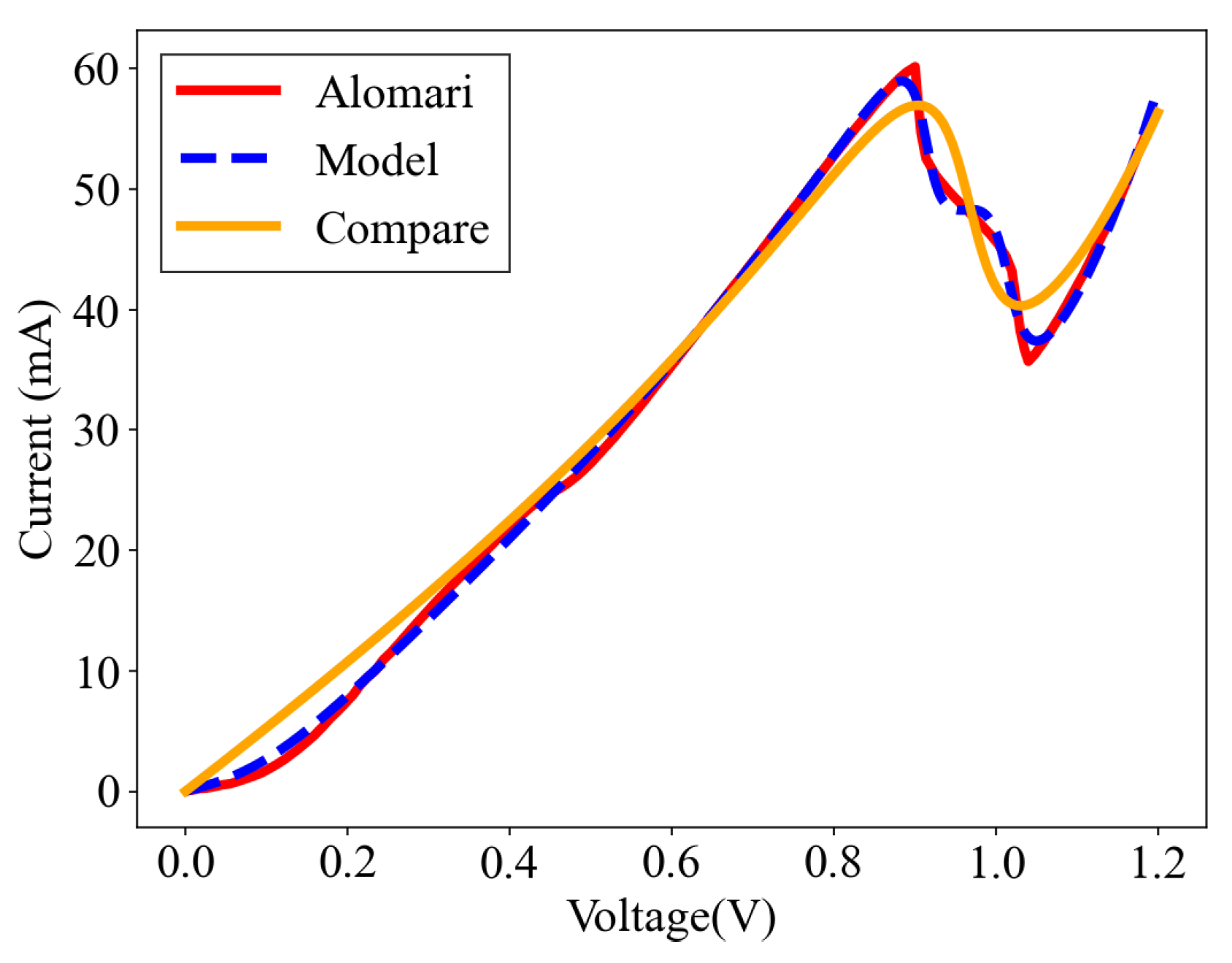
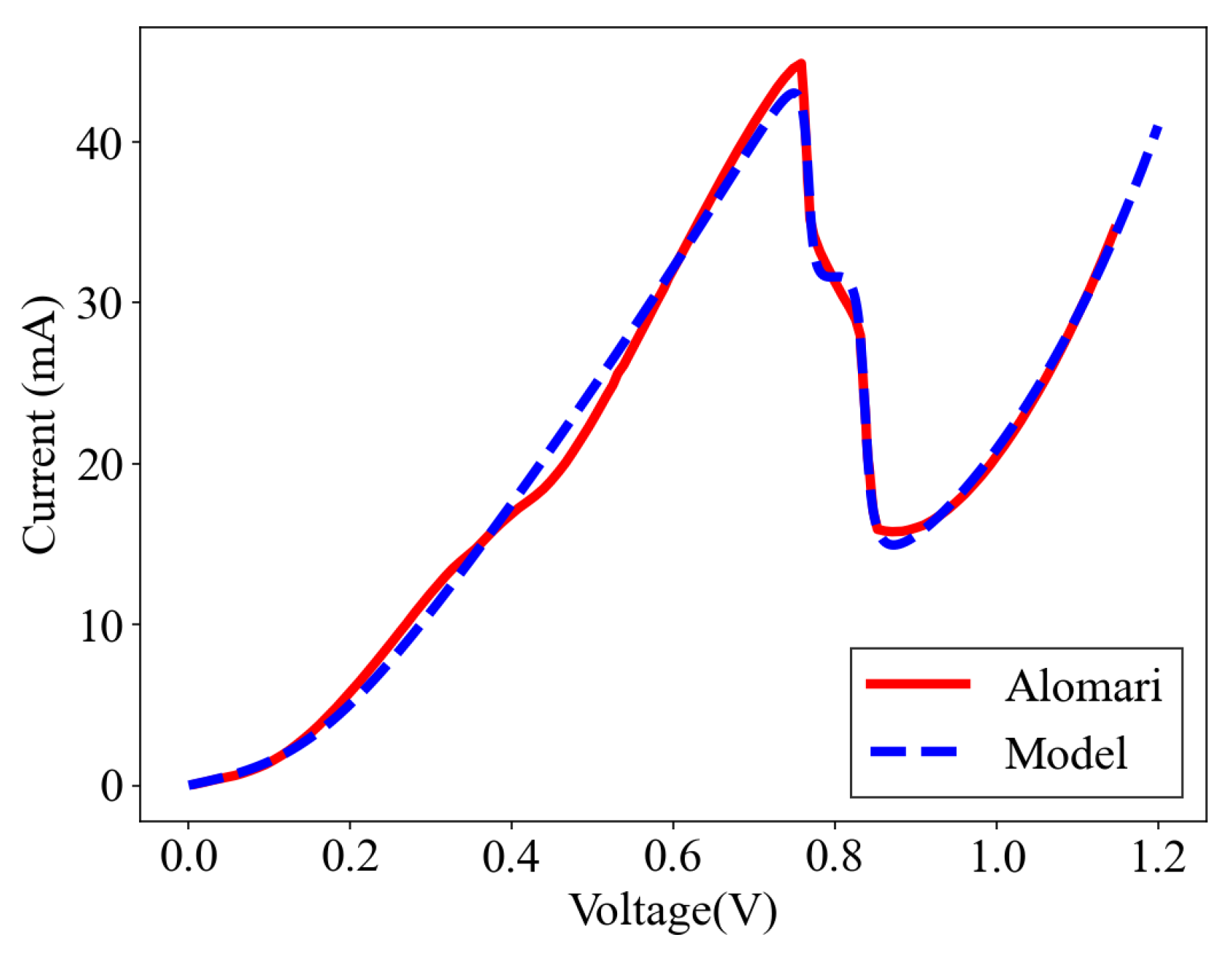
The parameters used in this part are listed in Table 2, and the corresponding I-V characteristics and their comparisons are shown in Figure 2. The step-like features observed in the negative differential resistance region confirm the presence of resonant energy levels associated with the MQW and EQW. Moreover, the overall good agreement between the simulated and measured curves demonstrates the validity and accuracy of the proposed model. The figure also presents a comparison with the results of a single Schulman formula. It can be intuitively observed that the two Schulman formulas used in the model respectively describe the step-like effects of MQW and EQW on the NDR region. This capability is not achievable in other models that employ a single Schulman equation or Tsu equation, such as those in [15,25], among others.

3.1.2. Light Modulation Model

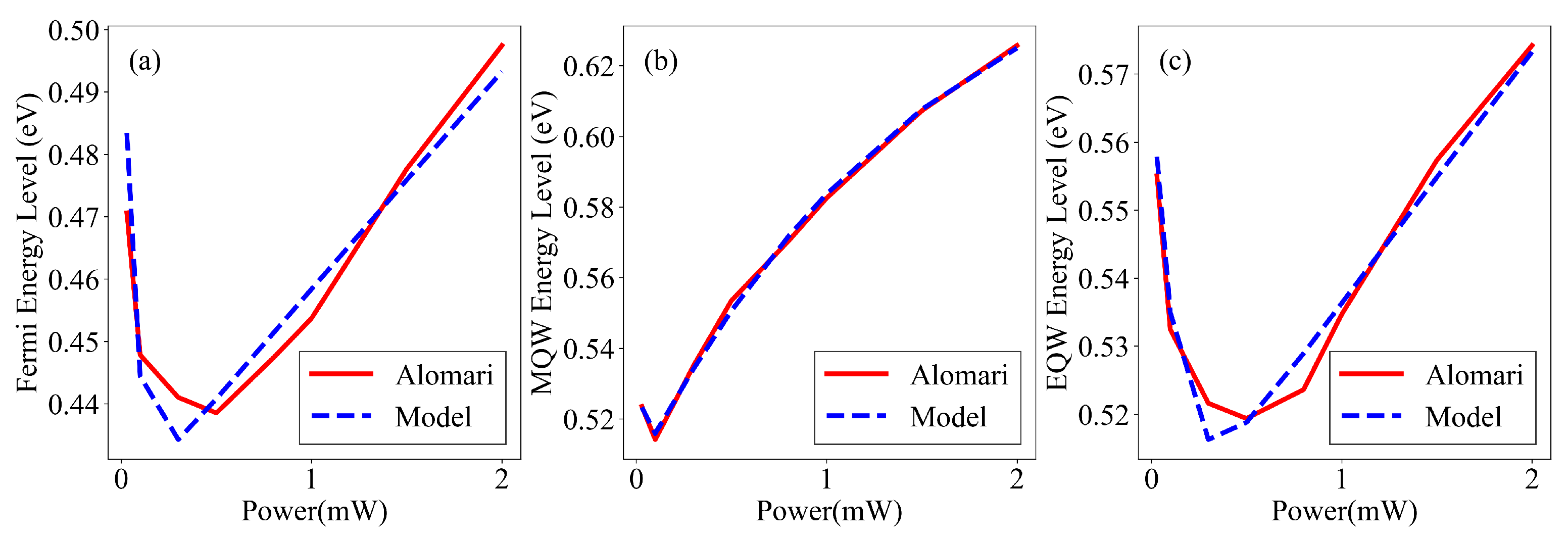
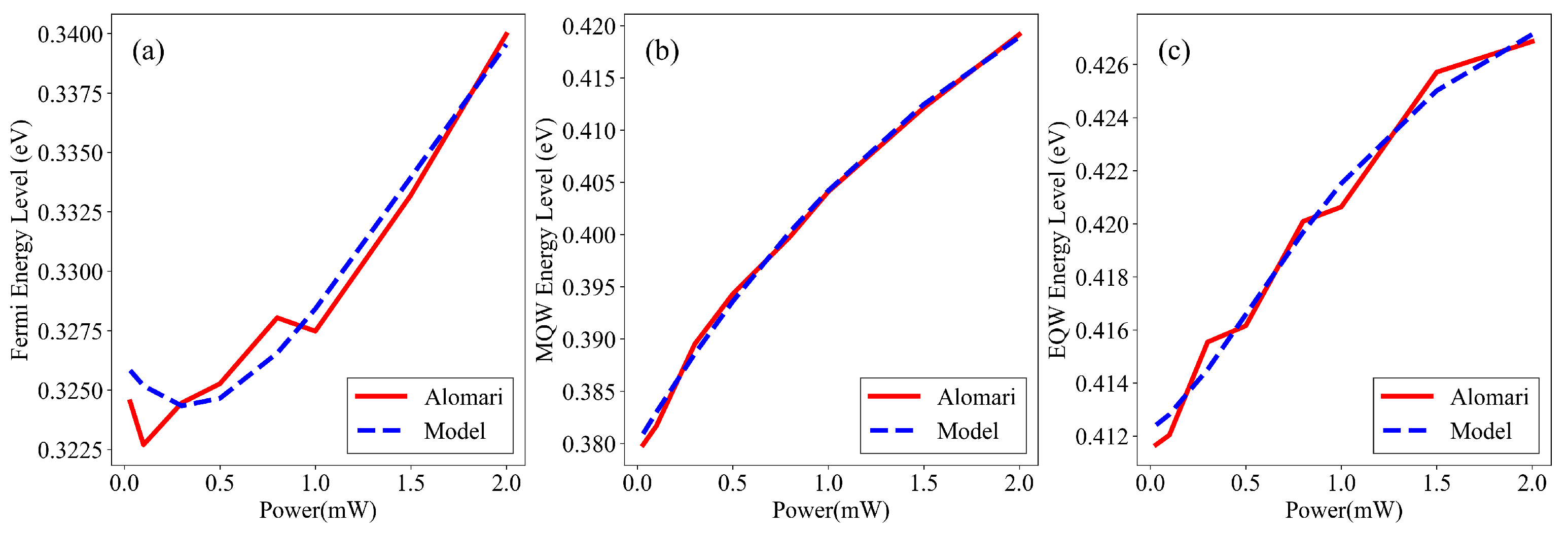
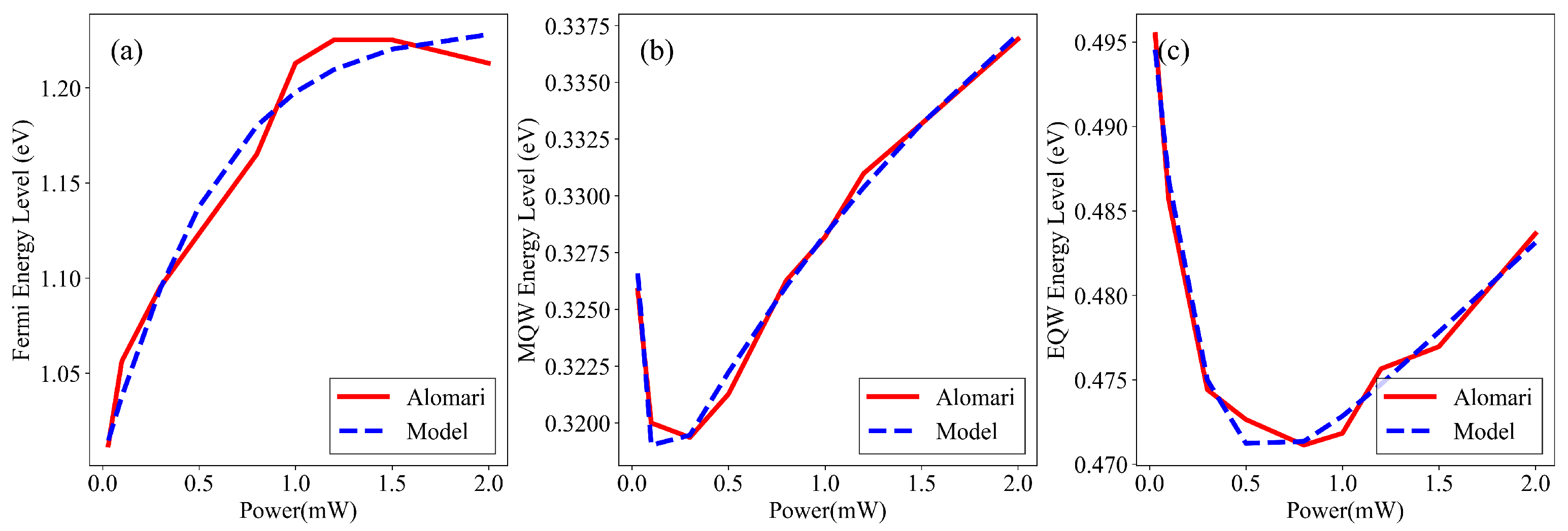
Based on the parameters of the baseline model, we further fit the photoinduced current-related parameters using the proposed model. The extracted fitting parameters are listed in Table 3. The calculated results of the Fermi level and the resonant energy levels in the MQW and EQW, together with their comparisons, are shown in Figure 3. As can be seen, with increasing optical power, all three energy levels initially decrease and then increase, which confirms that optical illumination in RTDs gives rise to two competing physical mechanisms, namely hole accumulation and hole tunneling, as discussed in Section 2.
At low optical power, holes are scarcely able to tunnel and instead accumulate in the valence-band collector barrier region, forming a triangular potential well. This results in a reduction of the energy levels with increasing optical power, corresponding to the term η h , i e V h , max 1 exp P τ h , i γ h , i / ( h ν ) in Equations (6), (9) and (10).
As the optical power increases, the valence-band triangular potential well is gradually filled and the barrier height is progressively reduced. At sufficiently high optical power, the triangular well becomes fully occupied, allowing a fraction of light holes to tunnel toward the emitter and recombine with electrons on the emitter side. Consequently, the energy levels begin to increase with optical power, which is described by the term η e , i e V e , max 1 exp P τ e , i γ e , i / ( h ν ) in Equations (6), (9) and (10).
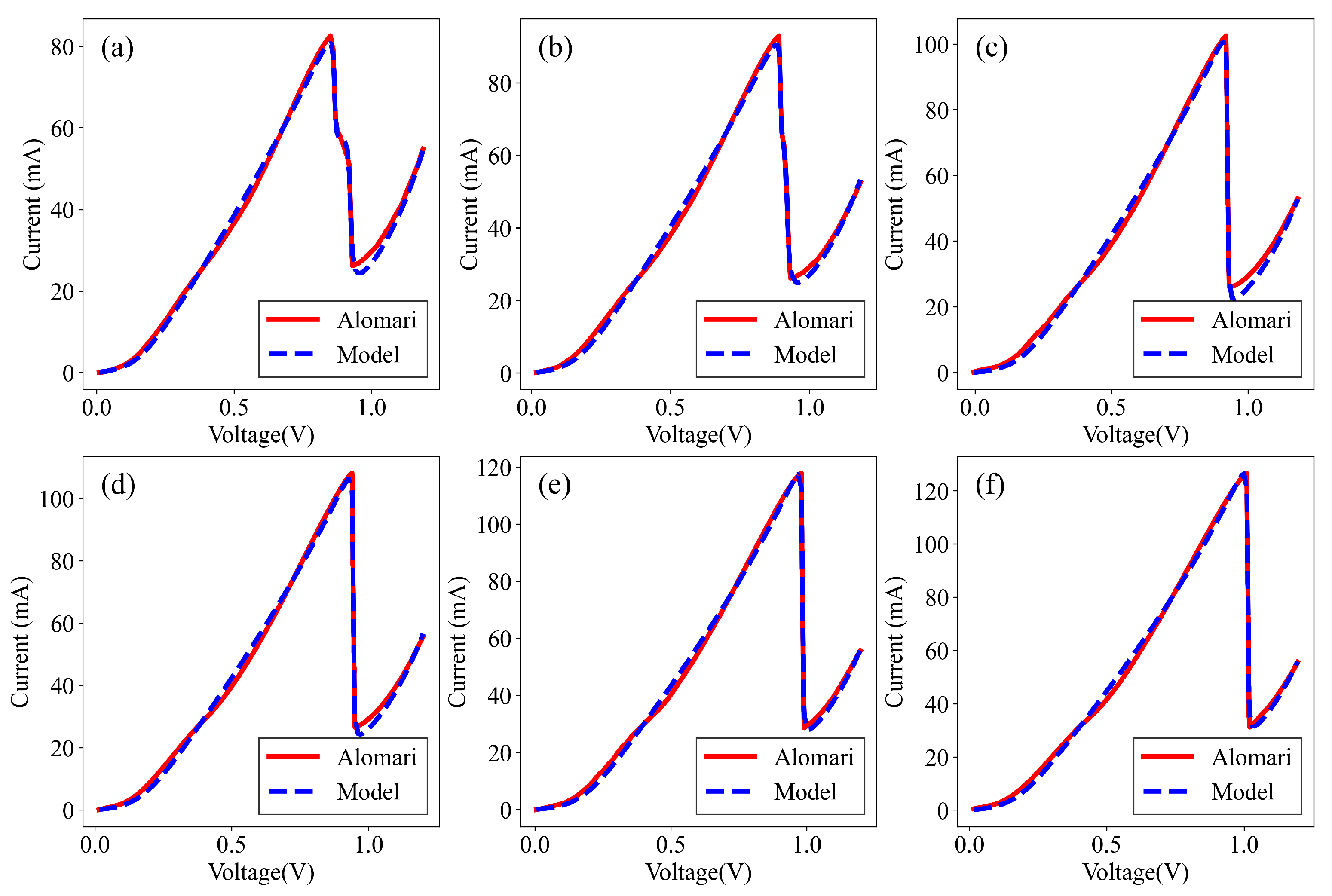
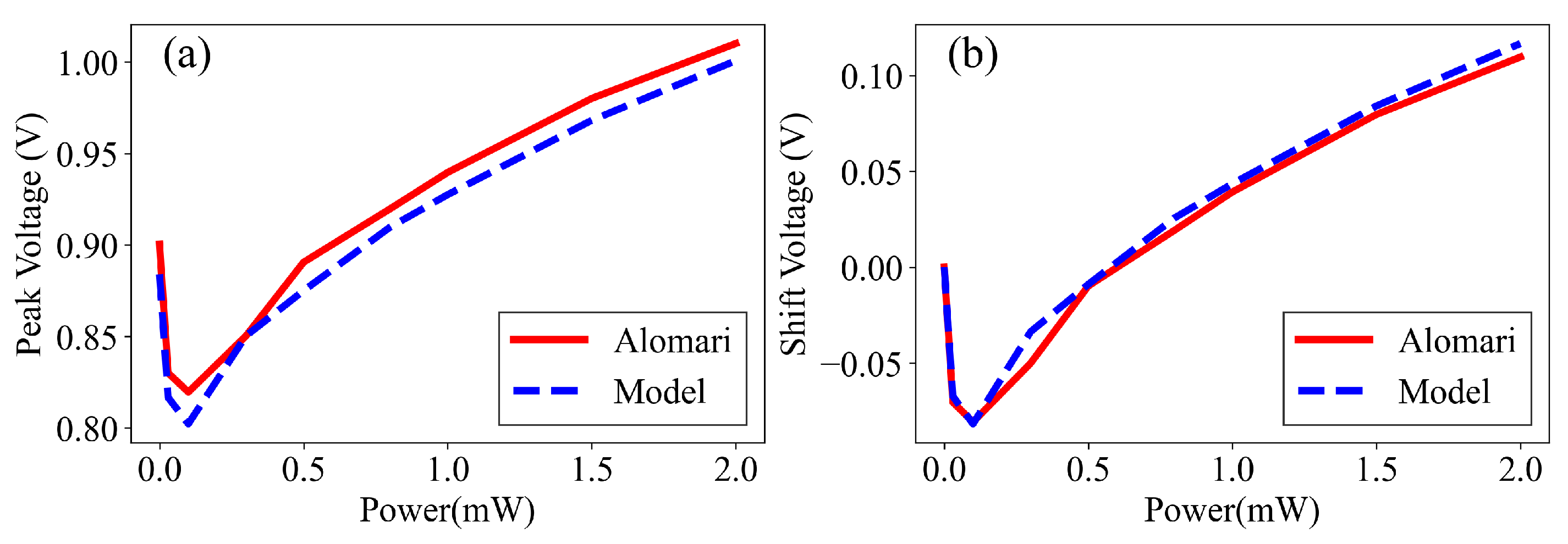
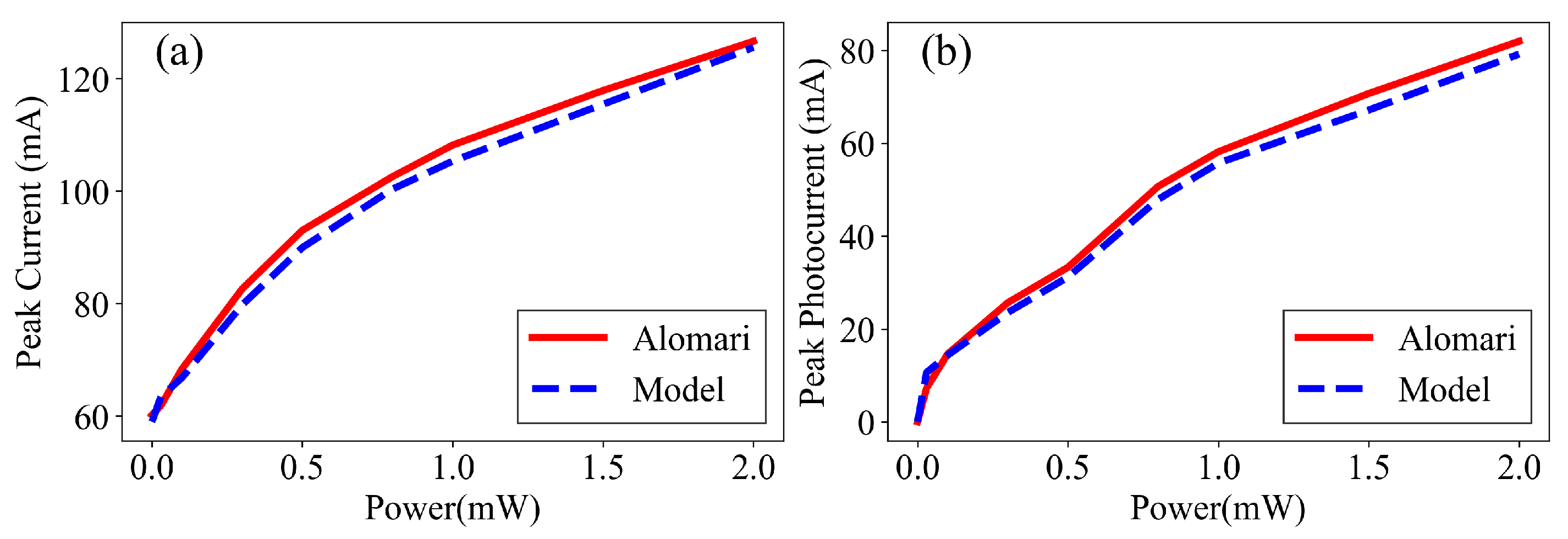
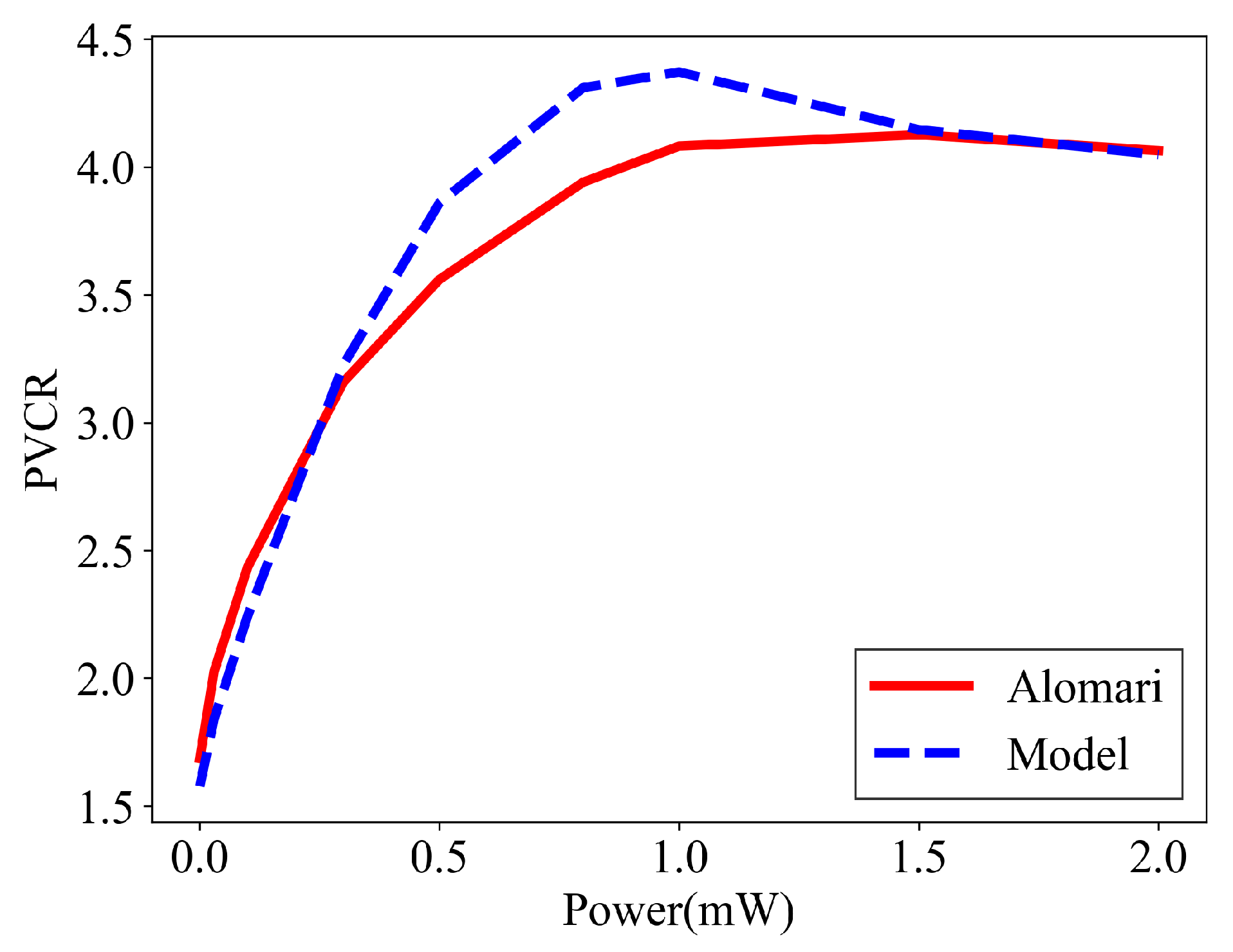
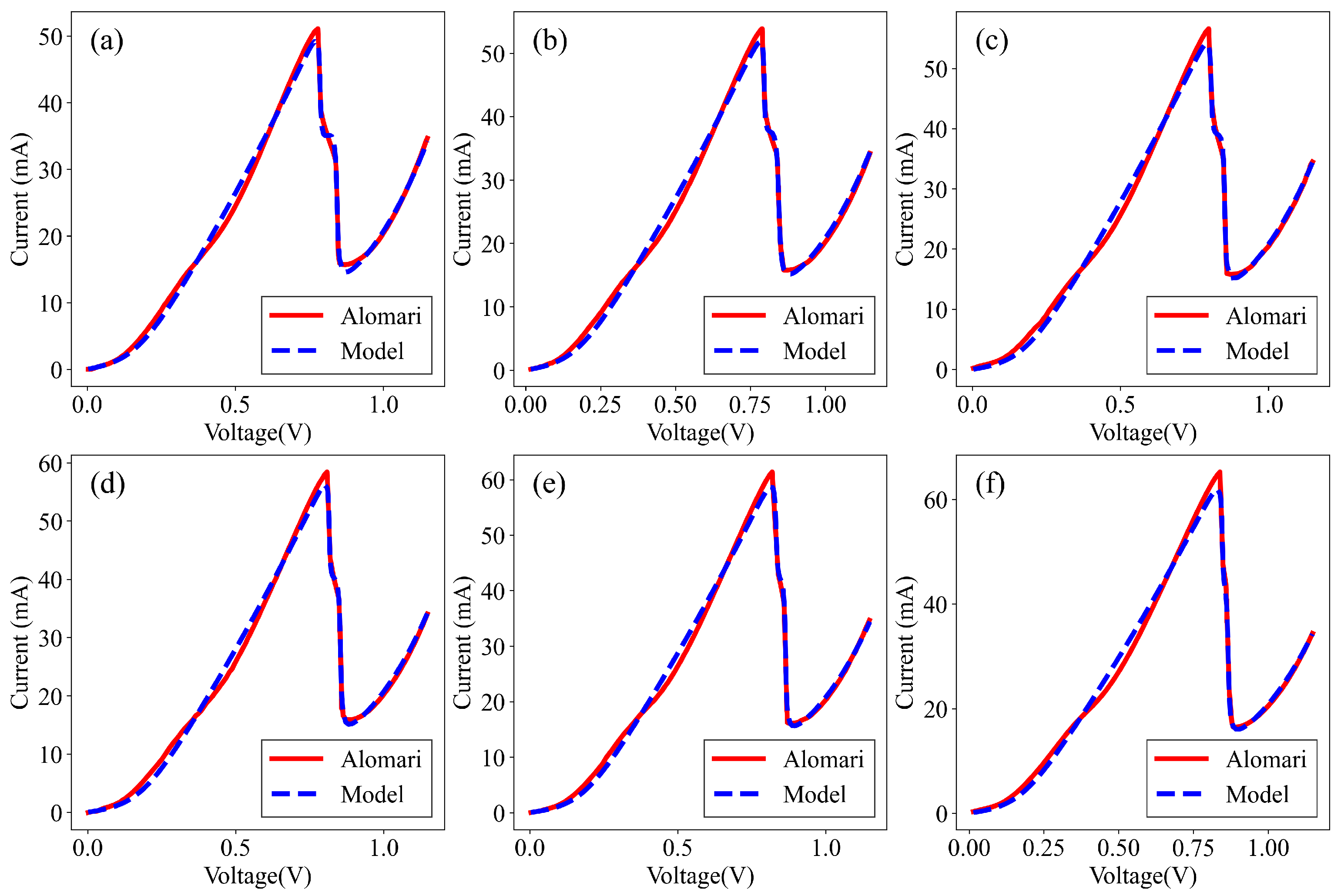
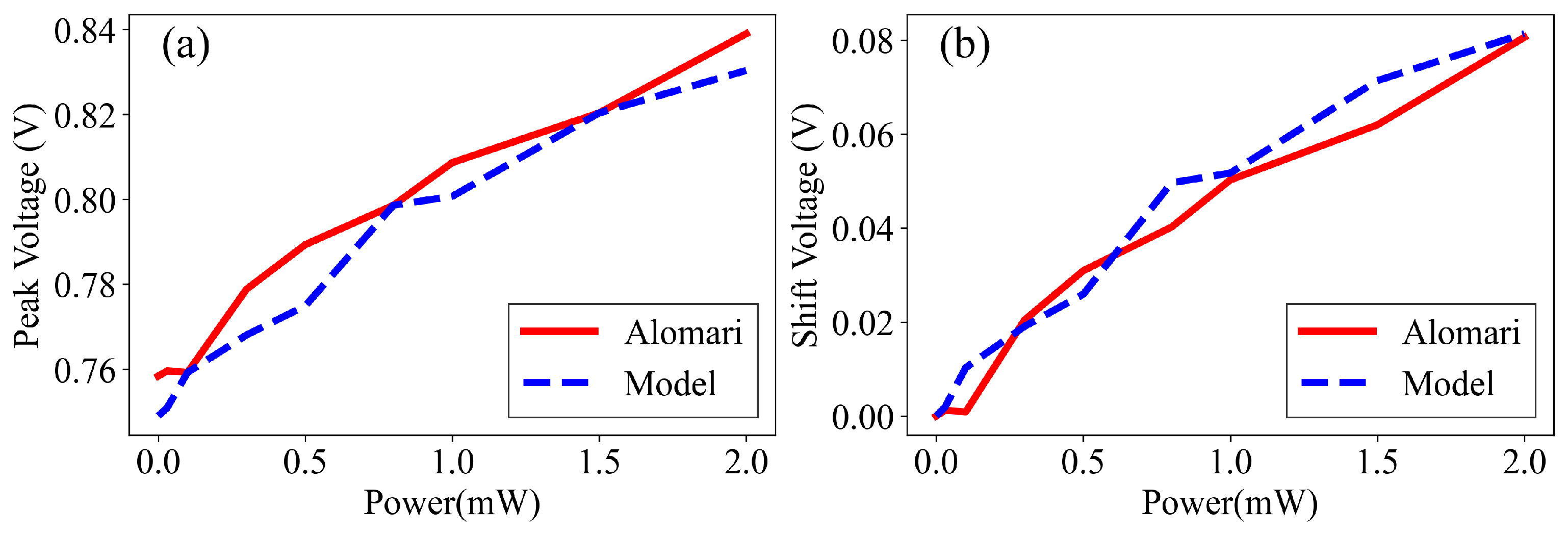
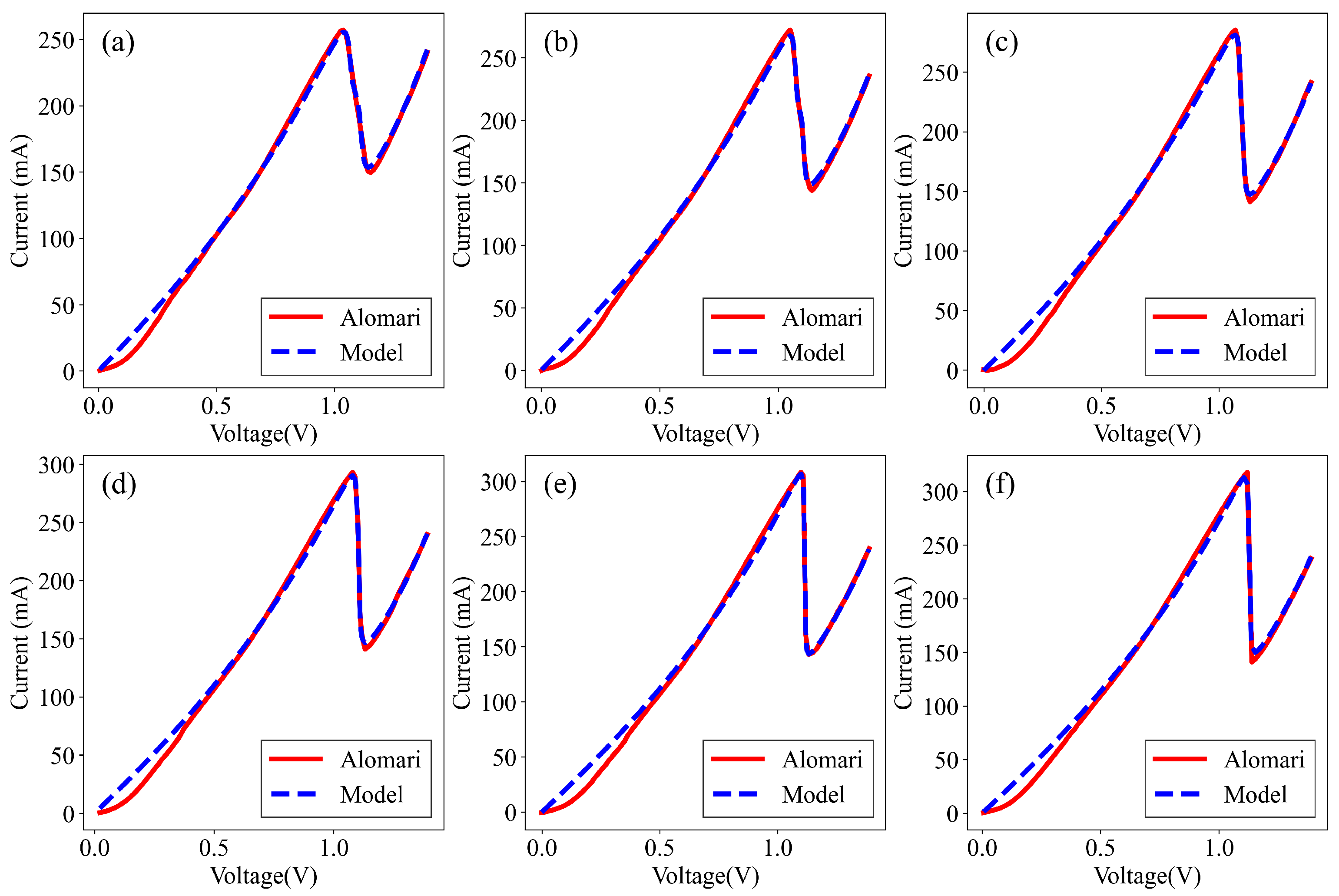
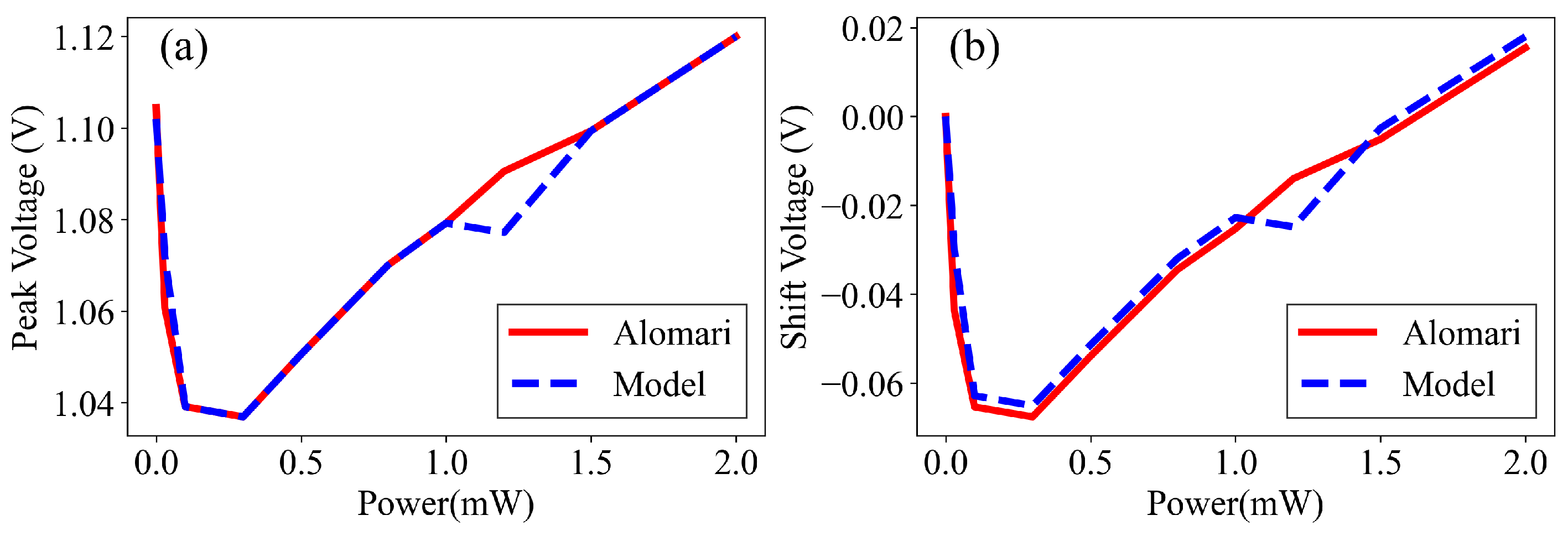
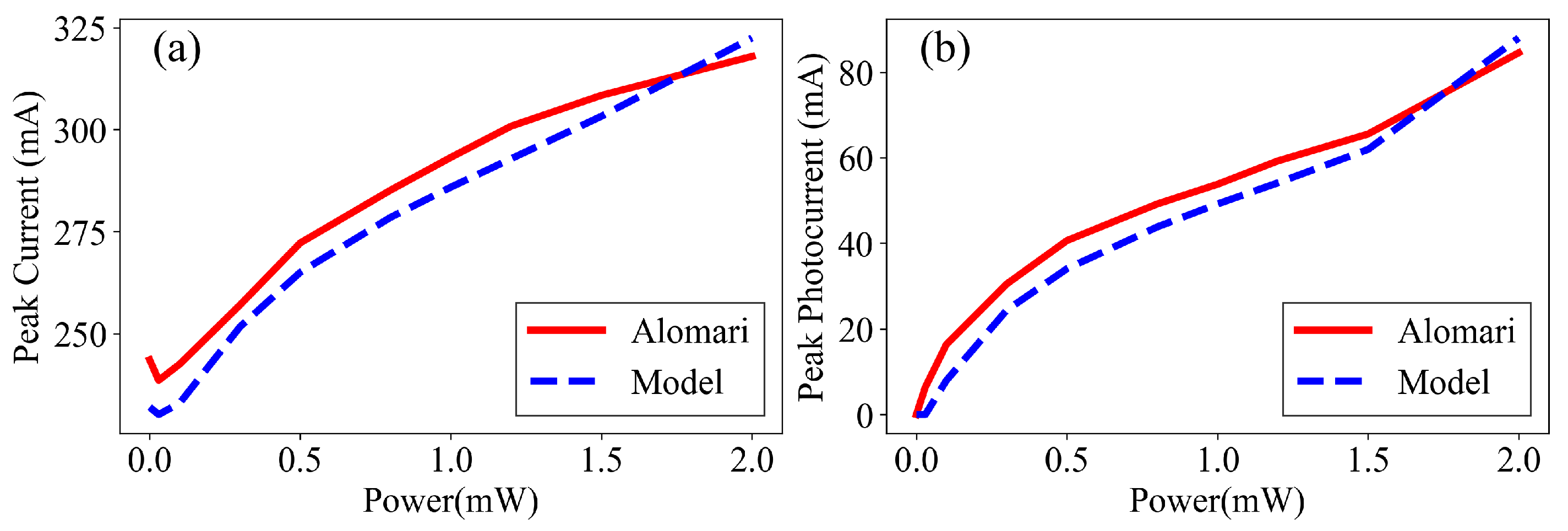
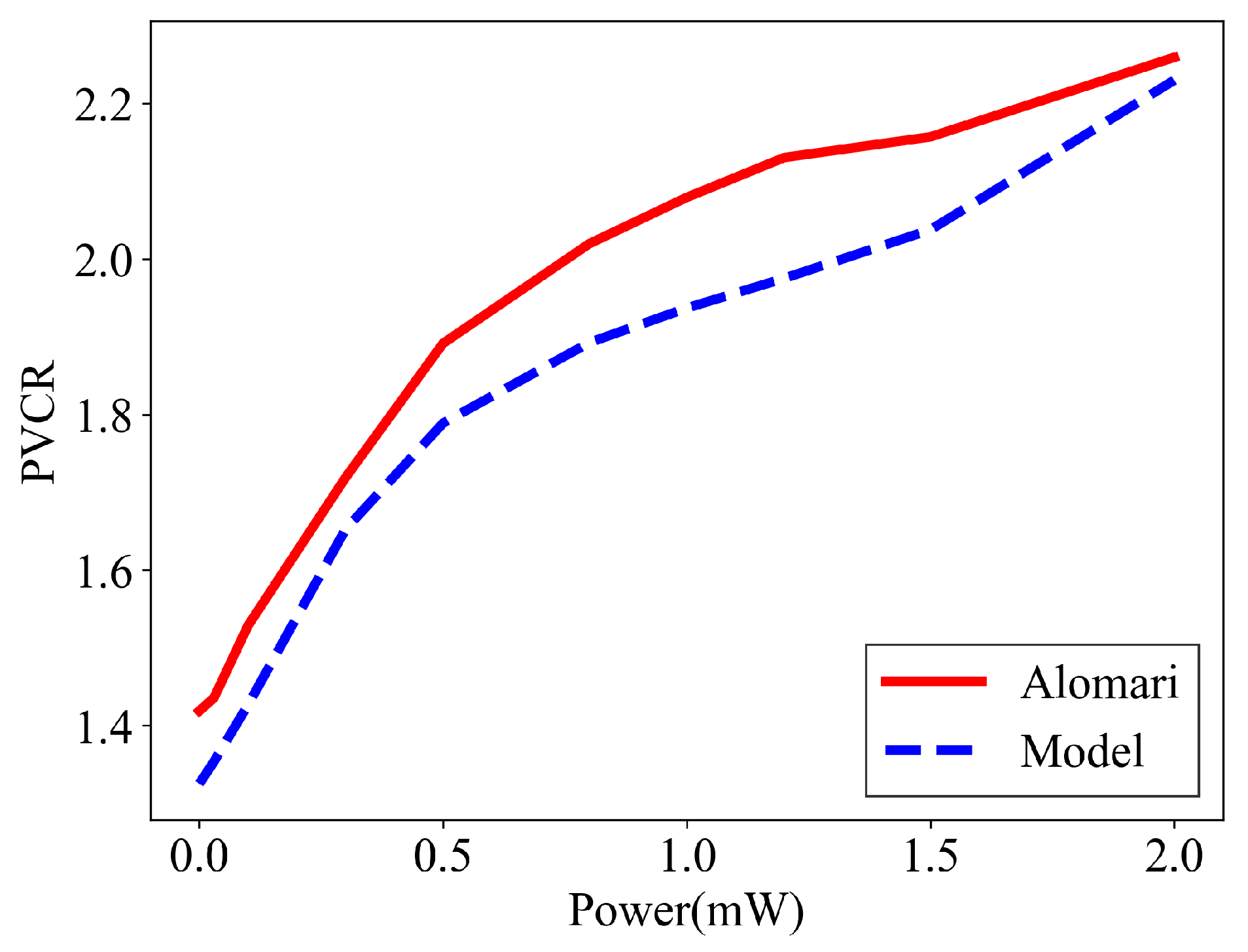
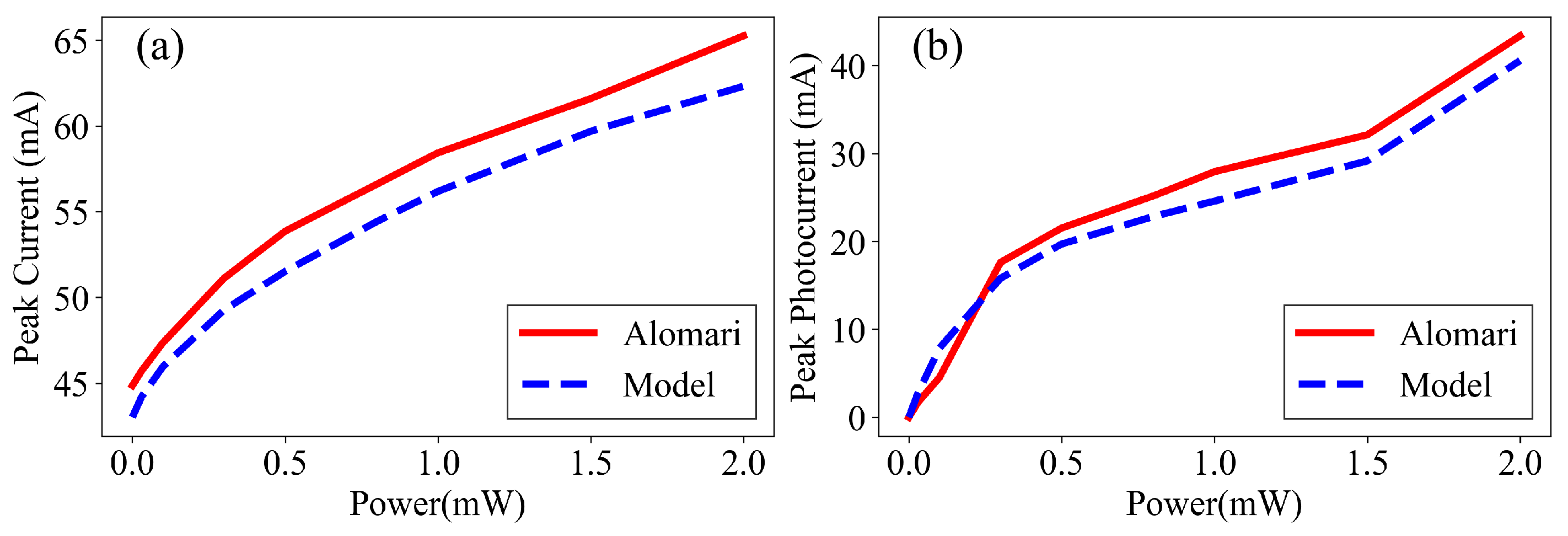
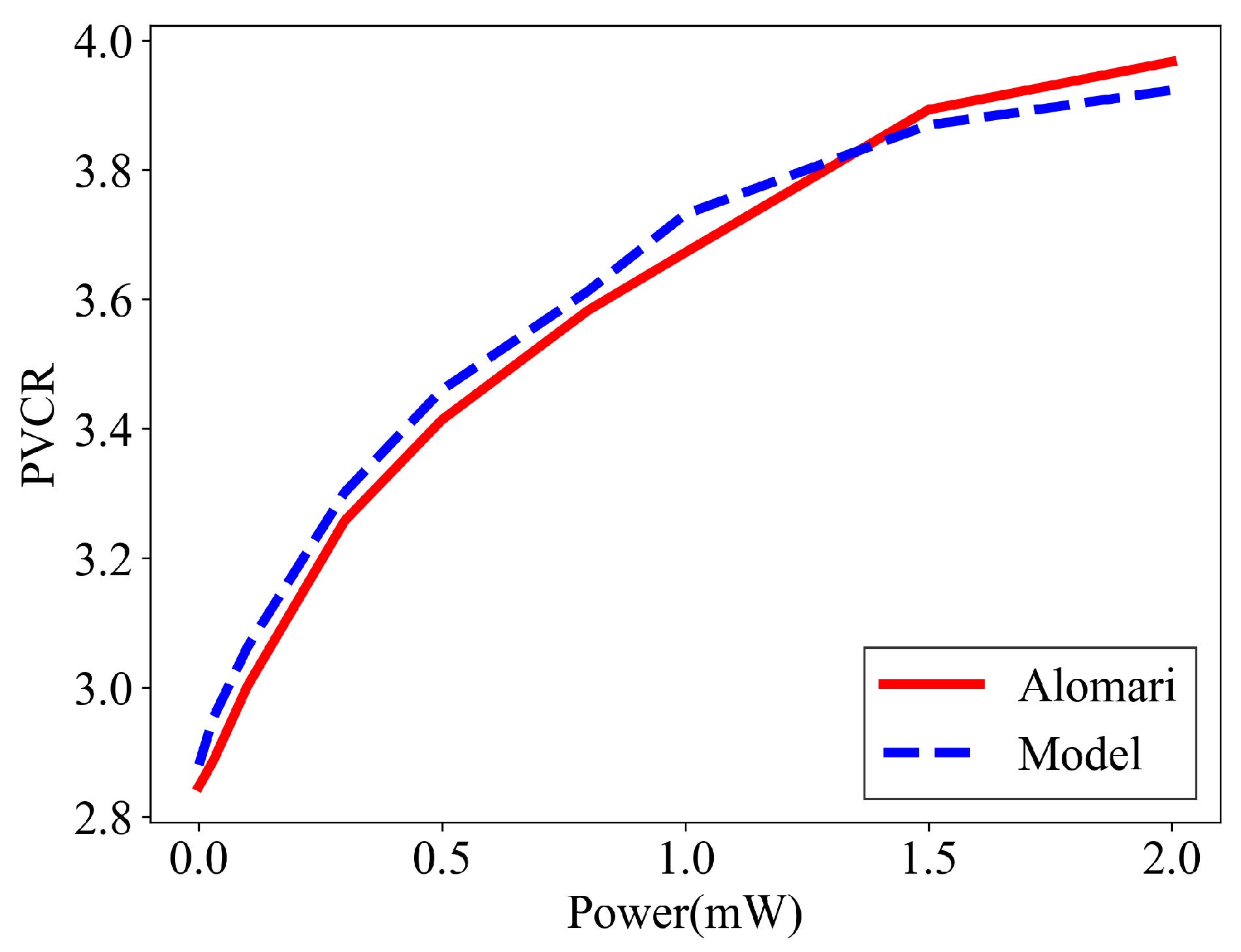
By subtituting the parameters listed in the above table into the model developed in Section 2, the I-V characteristics under different optical power levels can be simulated, as shown in Figure 4. The results demonstrate that the model accurately captures the influence of optical illumination on RTD performance. The device’s peak voltage is directly related to the position of the MQW resonant energy level and shifts correspondingly with changes in this level, as illustrated in Figure 5. Traditional models (such as [25], etc.) can only account for the effects of hole accumulation. This causes the peak voltage in these models to shift monotonically to the left as optical power increases, rendering them incapable of accurately describing the performance of RTD photodetectors under high optical power conditions. The variation of the device’s peak current and peak photocurrent with optical power is shown in Figure 6. This model introduces the influence of light on the amplitude, enabling it to accurately describe the phenomenon of the peak current continuously increasing with the rise in optical power—a feature that other traditional models cannot capture. The PVCR of the device is illustrated in Figure 7. The relatively large discrepancy observed in the middle portion of the PVCR curve is attributed to imperfect fitting at the end of the NDR region. Collectively, these results validate the accuracy and reliability of the proposed model.

3.2. S98 Epitaxial Device (Wafer Area 10 × 10 µ m 2 )

Similar to the case of the S99 epitaxial device, the layer structure of this device is described in Alomari’s thesis [18]. In this structure, a 100-nm-thick absorption layer is present on the collector side, while a 20-nm-thick absorption layer is located on the emitter side.

3.2.1. Baseline Model

The parameters used in this section are listed in Table 4, and the corresponding I–V characteristics and their comparisons are shown in Figure 8. The overall good agreement between the simulated and measured curves demonstrates the validity of the baseline model for this device.

3.2.2. Light Modulation Model

The parameters used in this section are listed in Table 5. The variations of the Fermi level and the resonant energy levels in the MQW and EQW, along with their comparisons, are shown in Figure 9, while the I-V characteristics under different optical power levels and their comparisons are presented in Figure 10. It can be observed that, for this device, hole accumulation reaches saturation even at very low optical power, and hole tunneling becomes the dominant mechanism as the optical power increases. This behavior is further confirmed by the variation of the peak voltage shown in Figure 11. The changes in the device’s peak current and PVCR with optical power are shown in Figure 12 and Figure 13, respectively. Collectively, these results demonstrate the accuracy of the proposed model.

3.3. S98 Epitaxial Device (Wafer Area 20 × 20 µ m 2 )

3.3.1. Baseline Model

The parameters used in this section are listed in Table 6, and the corresponding I-V characteristics along with their comparisons are shown in Figure 14. The overall good agreement between the simulated and measured curves demonstrates the validity of the model for this device. However, as observed in Figure 14, the resonance energy levels of this device are less pronounced compared to the previous two devices. Additionally, it is noted that the dark current curves do not align with the results of devices under a 10 × 10 µ m 2 illumination area. This discrepancy may be attributed to differences in device volume and manufacturing tolerances.

3.3.2. Light Modulation Model

The parameters used in this section are listed in Table 7. The variations of the Fermi level and the resonant energy levels in the MQW and EQW, along with their comparisons, are shown in Figure 15, while the I-V characteristics under different optical power levels and their comparisons are presented in Figure 16. From the figures, it can be seen that the Fermi level of this device is highly sensitive to optical power, even reaching saturation. Additionally, it is noted that A EQW takes a negative value, indicating that the energy absorbed by the EQW under illumination is reduced relative to the dark condition, which may be due to the relatively low electron concentration in the EQW. The variations of the mid-peak voltage, peak current, and PVCR with optical power are shown in Figure 17, Figure 18, and Figure 19, respectively. Collectively, these results confirm the accuracy of the proposed model.

4. Compact Model Development and Simulation Results

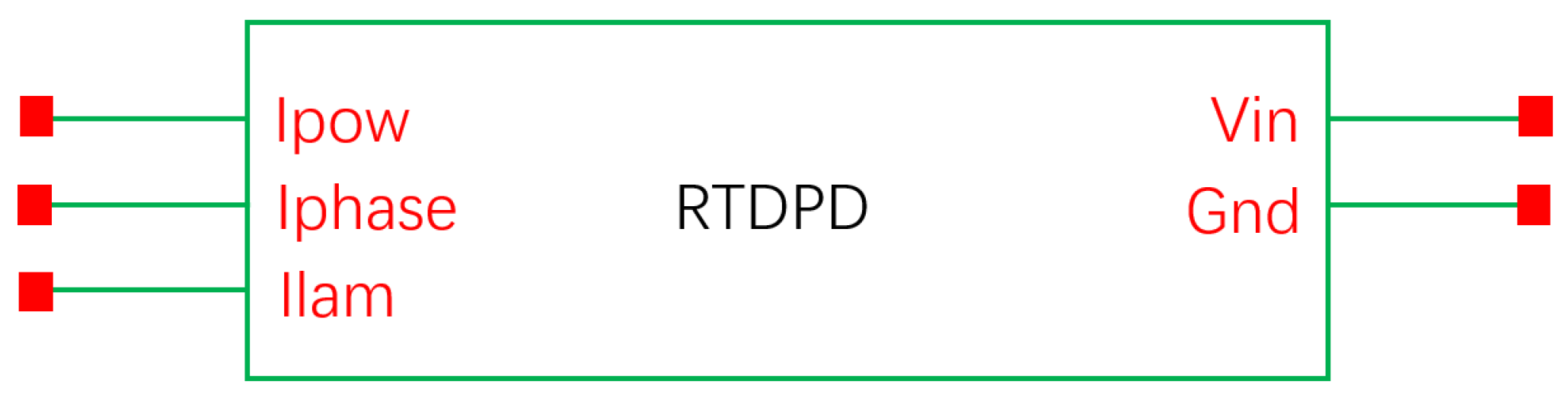
We utilized the AetherPT software by Empyrean, employing Verilog-A language, based on the theoretical model from Section 2, and following the port requirements of our previously developed compact model library [26], to construct the compact model for this device. The symbol diagram of the compact model is shown in Figure 20.
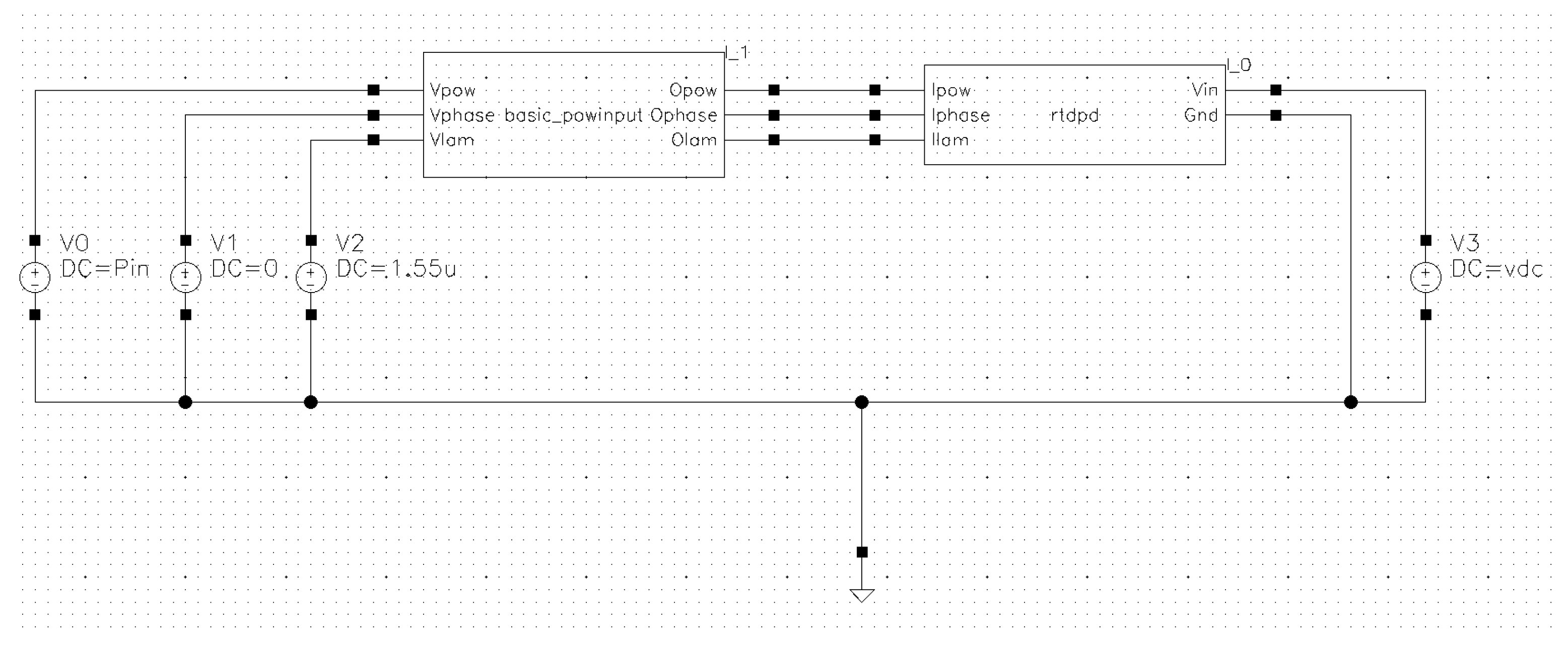
We employed a conventional light source to provide RTD photodetectors with optical signals of different powers at a wavelength of 1550 nm. By varying the voltage at the input terminals of the RTD photodetector and measuring the corresponding changes in current at the output terminals, we obtained the I-V characteristics of the RTD photodetector. The schematic diagram of the simulation setup is shown in Figure 21.
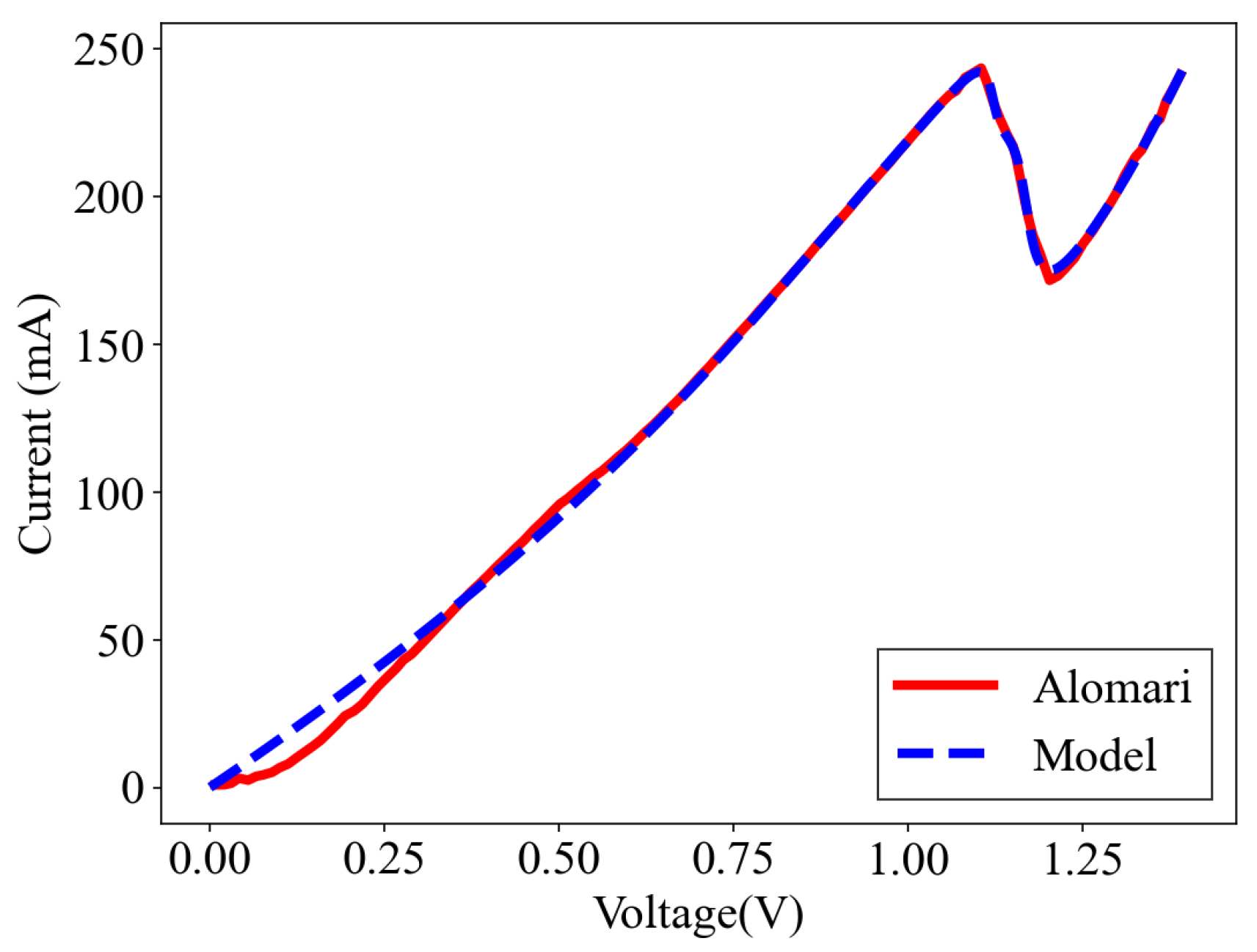
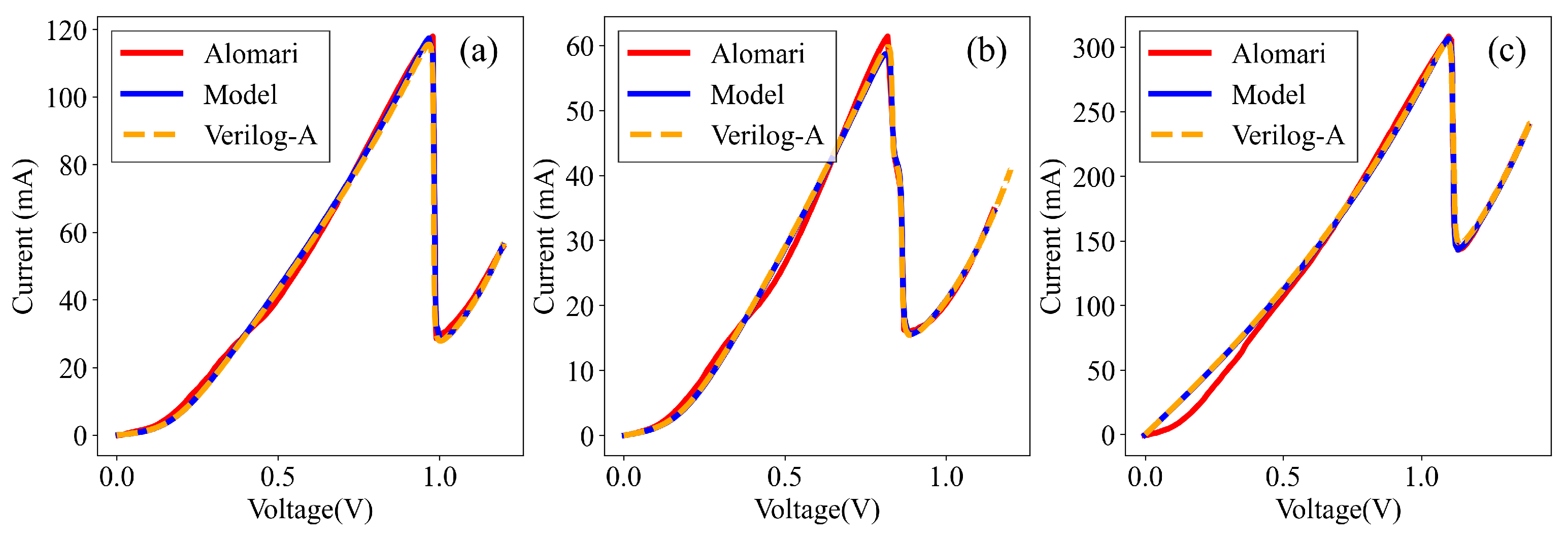
Using this schematic, we generated a netlist and performed simulations with Empyrean’s alps simulator. The simulation results are shown in Figure 22. Due to the close agreement of the curves, only the 1.5 mW simulation results are presented as an example.
The results demonstrate that the simulation outcomes of the compact model closely align with those from the theoretical model presented in Section 3, indicating that the compact model accurately captures various physical phenomena such as NDR effect and light modulation within RTD photodetectors. This validates that our model can be directly utilized for link simulations in EDA tools with excellent accuracy.

5. Conclusions

We have proposed a theoretical model for simulating RTD photodetectors. To establish this model, we first identified the mechanisms by which optical power affects the Fermi level as well as the resonant energy levels of the main quantum well (MQW) and the equivalent quantum well (EQW), and we derived the corresponding relationships between these energy levels and optical power. Building on this, we investigated the variation of the model parameters with optical power based on the Schulman equations and constructed a theoretical model of the RTD photodetector incorporating the resonant energy levels of the MQW and EQW.
The proposed model captures multiple physical effects, including the negative differential resistance behavior inherent to the RTD structure, and accurately describes the modulation of effective energy levels in the quantum wells and the peak voltage of the RTD photodetector under illumination. Compared with other existing models, it provides results that are more consistent with experimental observations, which can assist device developers in designing photodetectors that meet specific application requirements. Moreover, this model can be employed to construct compact models on EDA platforms and perform circuit-level simulations. Subsequently, we will further consider device parameters such as volume and quantum efficiency, as well as dynamic response. Additionally, we will validate the model across different wavelengths using more data to further enhance its accuracy.

Author Contributions

Conceptualization and software, G.C.; methodology, Z.S.; validation, J.Y., S.L. and Z.W.; resources, Z.T.; writing—original draft preparation, G.C.; writing—review and editing, H.W., M.P. and X.Z. All authors have read and agreed to the published version of the manuscript.

Funding

This research was funded by the CAS Project for Young Scientists in Basic Research (Grant No. YSBR-090), the Guangdong Basic and Applied Basic Research Foundation (Grant No. 2023A1515140015), the Proof of Concept Project of the University of Science and Technology Beijing (Grant No. GNYZ-2024-16), Fundamental Research Funds for the Central Universities (Grant No. FRF-AT-25-016), and the National Natural Science Foundation of China (Grant No. 52002021).

Institutional Review Board Statement

Not applicable.

Informed Consent Statement

Not applicable.

Data Availability Statement

The raw data supporting the conclusions of this article will be made available by the authors on request.

Acknowledgments

During the preparation of this manuscript/study, the authors used ChatGPT 5 and DeepSeek V3 for the purposes of language translation and polishing. The authors have reviewed and edited the output and take full responsibility for the content of this publication.

Conflicts of Interest

Author Xinhe Zheng was employed by the company VITAL Group Co., Ltd. The remaining authors declare that the research was conducted in the absence of any commercial or financial relationships that could be construed as a potential conflict of interest.

Abbreviations

The following abbreviations are used in this manuscript:
RTDResonant tunneling diode
NDRNegative differential resistance
MQWMain quantum well
EQWEquivalent quantum well
PVCRPeak-to-valley current ratio

References

  1. Zhou, S.; Liao, Z.; Sun, K.; Zhang, Z.; Qian, Y.; Liu, P.; Du, P.; Jiang, J.; Lv, Z.; Qi, S. High-Power AlGaN-Based Ultrathin Tunneling Junction Deep Ultraviolet Light-Emitting Diodes. Laser Photonics Rev. 2024, 18, 2300464. [Google Scholar] [CrossRef]
  2. Dong, Y.; Wang, G.; Ni, H.; Chen, J.; Gao, F.; Li, B.; Pei, K.; Niu, Z. Resonant tunneling diode photodetector with nonconstant responsivity. Opt. Commun. 2015, 355, 274–278. [Google Scholar] [CrossRef]
  3. Rothmayr, F.; Pfenning, A.; Kistner, C.; Koeth, J.; Knebl, G.; Schade, A.; Krueger, S.; Worschech, L.; Hartmann, F.; Höfling, S. Mid-infrared GaSb-based resonant tunneling diode photodetectors for gas sensing applications. Appl. Phys. Lett. 2018, 112, 161107. [Google Scholar] [CrossRef]
  4. Wang, M.; Jin, X.; Guo, F. Less than 10-13W weak light response for quantum dots photodetector at room temprature. In Proceedings of the 10th IEEE International Conference on Nano/Micro Engineered and Molecular Systems, Xi’an, China, 7–11 April 2015; pp. 44–47. [Google Scholar] [CrossRef]
  5. Pfenning, A.; Hartmann, F.; Langer, F.; Kamp, M.; Höfling, S.; Worschech, L. Sensitivity of resonant tunneling diode photodetectors. Nanotechnology 2016, 27, 355202. [Google Scholar] [CrossRef]
  6. Rothmayr, F.; Pfenning, A.; Kistner, C.; Koeth, J.; Knebl, G.; Schade, A.; Krueger, S.; Worschech, L.; Hartmann, F.; Höfling, S. Resonant Tunneling Diode Photodetectors for Mid-Infrared Gas-Sensing Based on GaSb Substrate. In 2018 Conference on Lasers and Electro-Optics Pacific Rim (CLEO-PR); IEEE: New York, NY, USA, 2018; pp. 1–2. [Google Scholar]
  7. Wang, W.; Hou, Y.; Xiong, D.; Li, N.; Lu, W.; Wang, W.; Chen, H.; Zhou, J.; Wu, E.; Zeng, H. High photoexcited carrier multiplication by charged InAs dots in AlAs/GaAs/AlAs resonant tunneling diode. Appl. Phys. Lett. 2008, 92, 023508. [Google Scholar] [CrossRef]
  8. Namasivayam, V.; Lin, R.; Johnson, B.; Brahmasandra, S.; Razzacki, Z.; Burke, D.T.; Burns, M.A. Advances in on-chip photodetection for applications in miniaturized genetic analysis systems. J. Micromech. Microeng. 2004, 14, 81–90. [Google Scholar] [CrossRef]
  9. Weng, Q.C.; An, Z.H.; Xiong, D.Y.; Zhang, B.; Chen, P.P.; Li, T.X.; Zhu, Z.Q.; Lu, W. Photocurrent spectrum study of a quantum dot single-photon detector based on resonant tunneling effect with near-infrared response. Appl. Phys. Lett. 2014, 105, 031114. [Google Scholar] [CrossRef]
  10. Pfenning, A.; Krüger, S.; Jabeen, F.; Worschech, L.; Hartmann, F.; Höfling, S. Single-Photon Counting with Semiconductor Resonant Tunneling Devices. Nanomaterials 2022, 12, 2358. [Google Scholar] [CrossRef] [PubMed]
  11. Pfenning, A.; Jurkat, J.; Naranjo, A.; Köck, D.; Hartmann, F.; Höfling, S. Resonant tunneling diode photon number resolving single-photon detectors. In Infrared Remote Sensing and Instrumentation XXVII; Strojnik, M., Arnold, G.E., Eds.; SPIE: San Diego, CA, USA, 2019; p. 10. [Google Scholar] [CrossRef]
  12. Lourenço, J.; Al-Taai, Q.R.; Al-Khalidi, A.; Wasige, E.; Figueiredo, J. Resonant Tunnelling Diode–Photodetectors for spiking neural networks. In Journal of Physics: Conference Series; IOP Publishing: Bristol, UK, 2022; Volume 2407, p. 012047. [Google Scholar] [CrossRef]
  13. Tsu, R.; Esaki, L. Tunneling in a finite superlattice. Appl. Phys. Lett. 1973, 22, 562–564. [Google Scholar] [CrossRef]
  14. Schulman, J.; De Los Santos, H.; Chow, D. Physics-based RTD current-voltage equation. IEEE Electron Device Lett. 1996, 17, 220–222. [Google Scholar] [CrossRef]
  15. Celino, D.R.; Ragi, R.; Romero, M.A. Analytical Physics-Based Compact Current–Voltage Model for 2D-2D Resonant Tunneling Diodes. IEEE Trans. Nanotechnol. 2022, 21, 752–762. [Google Scholar] [CrossRef]
  16. Pfenning, A.; Hartmann, F.; Rebello Sousa Dias, M.; Langer, F.; Kamp, M.; Castelano, L.K.; Lopez-Richard, V.; Marques, G.E.; Höfling, S.; Worschech, L. Photocurrent-voltage relation of resonant tunneling diode photodetectors. Appl. Phys. Lett. 2015, 107, 081104. [Google Scholar] [CrossRef]
  17. Rothmayr, F.; Guarin Castro, E.D.; Hartmann, F.; Knebl, G.; Schade, A.; Höfling, S.; Koeth, J.; Pfenning, A.; Worschech, L.; Lopez-Richard, V. Resonant Tunneling Diodes: Mid-Infrared Sensing at Room Temperature. Nanomaterials 2022, 12, 1024. [Google Scholar] [CrossRef]
  18. Alomari, S.A.Y. Resonant Tunnelling Diode Optoelectronic Receivers and Transmitters. Ph.D. Thesis, Universidade de Lisboa, Lisbon, Portugal, 2022. [Google Scholar]
  19. Alomari, S.; Al-Taai, Q.; Elksne, M.; Al-Khalidi, A.; Wasige, E.; Figueiredo, J. Speed limitations of resonant tunneling diode-based photodetectors. Opt. Express 2023, 31, 18300. [Google Scholar] [CrossRef]
  20. Zhao, P.; Cui, H.L.; Woolard, D.; Jensen, K.L.; Buot, F.A. Simulation of resonant tunneling structures: Origin of the I–V hysteresis and plateau-like structure. J. Appl. Phys. 2000, 87, 1337–1349. [Google Scholar] [CrossRef]
  21. Biegel, B.A.; Plummer, J.D. Comparison of self-consistency iteration options for the Wigner function method of quantum device simulation. Phys. Rev. B 1996, 54, 8070–8082. [Google Scholar] [CrossRef]
  22. Mains, R.K.; Sun, J.P.; Haddad, G.I. Observation of intrinsic bistability in resonant tunneling diode modeling. Appl. Phys. Lett. 1989, 55, 371–373. [Google Scholar] [CrossRef]
  23. Sakurai, A.; Tanimura, Y. Self-excited current oscillations in a resonant tunneling diode described by a model based on the Caldeira–Leggett Hamiltonian. New J. Phys. 2014, 16, 015002. [Google Scholar] [CrossRef]
  24. Yoder, P.D.; Grupen, M.; Smith, R.K. Demonstration of Intrinsic Tristability in Double-Barrier Resonant Tunneling Diodes with the Wigner Transport Equation. IEEE Trans. Electron Devices 2010, 57, 3265–3274. [Google Scholar] [CrossRef]
  25. Coêlho, I.J.S.; Martins-Filho, J.F.; Figueiredo, J.M.L.; Ironside, C.N. Modeling of light-sensitive resonant-tunneling-diode devices. J. Appl. Phys. 2004, 95, 8258–8263. [Google Scholar] [CrossRef]
  26. Chen, G.; Song, Z.; Zheng, X. Optoelectronic device library containing multiple Verilog—A models. Sci. Rep. 2025, 15, 1115. [Google Scholar] [CrossRef] [PubMed]
Figure 1. Schematic diagram of the energy level modulation process. The applied voltage in each subfigure is the same, and the electron tunneling current is not drawn. (a) shows the energy band situation without illumination; (b) shows that when the illumination is weak, holes accumulate at the edge of the potential barrier, and at this time, each energy level in the quantum well moves downward; (c) shows that as the illumination gradually increases, holes start to tunnel from one side of the quantum well to the other side and recombine on the other side; (d) shows that the electron density at the edge of the potential barrier decreases, resulting in a decrease in the degree of energy band bending, and each energy level in the quantum well moves upward.
Photonics 13 00297 g001
Figure 2. Comparison of I-V Curves of Dark Current of S99 Epitaxial Device.
Photonics 13 00297 g002
Figure 3. Variation of the Fermi level, MQW resonant energy level, and EQW resonant energy level of the S99 epitaxial device with optical power, along with comparisons. (a) Fermi level, (b) MQW resonant energy level, (c) EQW resonant energy level.
Photonics 13 00297 g003
Figure 4. Comparison of I-V Characteristics for the S99 Epitaxial Device Under Different Optical Powers. (a) 300 µW, (b) 500 µW, (c) 800 µW, (d) 1 mW, (e) 1.5 mW, (f) 2 mw.
Photonics 13 00297 g004
Figure 5. Comparison of Displacement Between Peak Voltage and Peak Voltage of S99 Epitaxial Device. (a) Peak Voltage Comparison, (b) Peak Voltage Displacement Comparison.
Photonics 13 00297 g005
Figure 6. Comparison of Peak Current and Peak Photocurrent of S99 Epitaxial Devices. (a) Peak Current Comparison, (b) Peak Photocurrent Comparison.
Photonics 13 00297 g006
Figure 7. Comparison of the PVCR curves for the S99 epitaxial device.
Photonics 13 00297 g007
Figure 8. Comparison of I-V curves of Dark Current of S98 Epitaxial Device (Wafer Area 10 × 10 µ m 2 ).
Photonics 13 00297 g008
Figure 9. Variation of the Fermi level, MQW resonant energy level, and EQW resonant energy level of the S98 Epitaxial Device (Wafer Area 10 × 10 µ m 2 ) with optical power, along with comparisons. (a) Fermi level, (b) MQW resonant energy level, (c) EQW resonant energy level.
Photonics 13 00297 g009
Figure 10. Comparison of I-V Characteristics for the S98 Epitaxial Device Under Different Optical Powers (Wafer Area 10 × 10 µ m 2 ). (a) 300 µW, (b) 500 µW, (c) 800 µW, (d) 1 mW, (e) 1.5 mW, (f) 2 mw.
Photonics 13 00297 g010
Figure 11. Comparison of Displacement Between Peak Voltage and Peak Voltage of S98 Epitaxial Device (Wafer Area 10 × 10 µ m 2 ). (a) Peak Voltage Comparison, (b) Peak Voltage Displacement Comparison.
Photonics 13 00297 g011
Figure 12. Comparison of Peak Current and Peak Photocurrent of S98 Epitaxial Device (Wafer Area 10 × 10 µ m 2 ). (a) Peak Current Comparison, (b) Peak Photocurrent Comparison.
Photonics 13 00297 g012
Figure 13. Comparison of the PVCR curves for the S98 Epitaxial Device (Wafer Area 10 × 10 µ m 2 ).
Photonics 13 00297 g013
Figure 14. Comparison of I-V curves of Dark Current of S98 Epitaxial Device (Wafer Area 20 × 20 µ m 2 ).
Photonics 13 00297 g014
Figure 15. Variation of the Fermi level, MQW resonant energy level, and EQW resonant energy level of the S98 Epitaxial Device (Wafer Area 20 × 20 µ m 2 ) with optical power, along with comparisons. (a) Fermi level, (b) MQW resonant energy level, (c) EQW resonant energy level.
Photonics 13 00297 g015
Figure 16. Comparison of I-V Characteristics for the S98 Epitaxial Device Under Different Optical Powers (Wafer Area 20 × 20 µ m 2 ). (a) 300 µW, (b) 500 µW, (c) 800 µW, (d) 1 mW, (e) 1.5 mW, (f) 2 mw.
Photonics 13 00297 g016
Figure 17. Comparison of Displacement Between Peak Voltage and Peak Voltage of S98 Epitaxial Device (Wafer Area 20 × 20 µ m 2 ). (a) Peak Voltage Comparison, (b) Peak Voltage Displacement Comparison.
Photonics 13 00297 g017
Figure 18. Comparison of Peak Current and Peak Photocurrent of S98 Epitaxial Device (Wafer Area 20 × 20 µ m 2 ). (a) Peak Current Comparison, (b) Peak Photocurrent Comparison.
Photonics 13 00297 g018
Figure 19. Comparison of the PVCR curves for the S98 Epitaxial Device Under Different Optical Powers (Wafer Area 20 × 20 µ m 2 ).
Photonics 13 00297 g019
Figure 20. Symbol diagram of the RTD photodetector’s compact model.
Photonics 13 00297 g020
Figure 21. Simulation schematic for the RTD photodetector.
Photonics 13 00297 g021
Figure 22. Simulation results of the RTD photodetector’s compact model (optical power: 1.5 mW). (a) S99, (b) S98 (Wafer Area 10 × 10 µ m 2 ), (c) S98 (Wafer Area 20 × 20 µ m 2 ).
Photonics 13 00297 g022
Table 1. Material Parameters.
ParameterValueParameterValue
m e ( m 0 )0.041 S light m 2 )4.909
m h ( m 0 )0.450B ( cm 3 /s) 9.600 × 10 9
ϵ e 13.9 n i ( cm 3 ) 7.645 × 10 11
ϵ h 13.9
Table 2. Basic Parameters of S99 Epitaxial Device.
ParameterValueParameterValue
E F , dark (eV)0.522 Γ EQW , dark (eV)0.0253
E r , MQW , dark (eV)0.565H (A/µ m 2 ) 2.259 × 10 3
E r , EQW , dark (eV)0.573 n 1 , 1 0.6
S eff m 2 )0.212 n 1 , 2 0.6
Γ MQW , dark (eV)0.0215 n 2 0.104
Table 3. Light Effect Parameters of S99 Epitaxial Device.
ParameterValueParameterValue
A MQW (meV)1.075 τ h , MQW ( ns ) 1.173
A EQW (meV)3.692 η e , EQW 1.355
ξ MQW 1.858 × 10 9 η h , EQW 0.072
ξ EQW 3.626 × 10 11 γ e , EQW 1.0 × 10 9
η e , f 1.164 γ h , EQW 1.0 × 10 6
η h , f 0.096 τ e , EQW ( ns ) 1.554
γ e , f 1.0 × 10 9 τ h , EQW ( ns ) 1.065
γ h , f 2.0 × 10 6 Γ MQW , 0 ( eV ) 0.117
τ e , f ( ns ) 1.711 Γ EQW , 0 ( eV ) 0.174
τ h , f ( ns ) 1.100 θ 1 , MQW 1.951 × 10 12
η e , MQW 0.072 θ 1 , EQW 1.353 × 10 12
η h , MQW 0.058 θ 2 , MQW 1.648 × 10 12
γ e , MQW 8.0 × 10 8 θ 2 , EQW 1.184 × 10 12
γ h , MQW 5.0 × 10 6 α MQW (eV/W)4.467
τ e , MQW ( ns ) 1.035 α EQW (eV/W)3.735
Table 4. Basic Parameters of S98 Epitaxial Device (Wafer Area 10 × 10 µ m 2 ).
ParameterValueParameterValue
E F , dark (eV)0.326 Γ EQW , dark (eV)0.0077
E r , MQW , dark (eV)0.380H (A/µ m 2 ) 7.809 × 10 4
E r , EQW , dark (eV)0.412 n 1 , 1 0.5
S eff m 2 )0.907 n 1 , 2 0.5
Γ MQW , dark (eV)0.0056 n 2 0.088
Table 5. Light Effect Parameters of S98 Epitaxial Device (Wafer Area 10 × 10 µ m 2 ).
ParameterValueParameterValue
A MQW (meV)0.512 τ h , MQW ( ns ) 1.066
A EQW (meV)0.328 η e , EQW 0.051
ξ MQW 4.598 × 10 12 η h , EQW 0.096
ξ EQW 4.807 × 10 11 γ e , EQW 1.0 × 10 7
η e , f 1.123 γ h , EQW 2.0 × 10 7
η h , f 2.462 τ e , EQW ( ns ) 1.979
γ e , f 5.0 × 10 8 τ h , EQW ( ns ) 1.138
γ h , f 5.0 × 10 8 Γ MQW , 0 ( eV ) 4.922
τ e , f ( ns ) 2.196 Γ EQW , 0 ( eV ) 4.922
τ h , f ( ns ) 2.238 θ 1 , MQW 1.463 × 10 12
η e , MQW 0.175 θ 1 , EQW 1.463 × 10 12
η h , MQW 0.330 θ 2 , MQW 1.462 × 10 12
γ e , MQW 6.0 × 10 8 θ 2 , EQW 1.461 × 10 12
γ h , MQW 6.0 × 10 8 α MQW (eV/W) 4.023 × 10 4
τ e , MQW ( ns ) 1.066 α EQW (eV/W) 5.835 × 10 4
Table 6. Dark Current Parameters of S98 Epitaxial Device (Wafer Area 20 × 20 µ m 2 ).
ParameterValueParameterValue
E F , dark (eV)1.004 Γ EQW , dark (eV)0.0139
E r , MQW , dark (eV)0.336H (A/µ m 2 )0.027
E r , EQW , dark (eV)0.499 n 1 , 1 0.3
S eff m 2 )0.628 n 1 , 2 0.4
Γ MQW , dark (eV)0.0057 n 2 0.051
Table 7. Effective Energy Level Parameters of S98 Epitaxial Device (Wafer Area 20 × 20 µ m 2 ).
ParameterValueParameterValue
A MQW (meV)1.246 τ h , MQW ( ns ) 1.327
A EQW (meV)−0.057 η e , EQW 0.127
ξ MQW 4.186 × 10 11 η h , EQW 0.036
ξ EQW 2.090 × 10 4 γ e , EQW 4.0 × 10 9
η e , f 1.242 γ h , EQW 5.0 × 10 7
η h , f 2.539 τ e , EQW ( ns ) 1.260
γ e , f 3.0 × 10 7 τ h , EQW ( ns ) 1.092
γ h , f 3.0 × 10 7 Γ MQW , 0 ( eV ) 0.158
τ e , f ( ns ) 1.116 Γ EQW , 0 ( eV ) 0.061
τ h , f ( ns ) 1.156 θ 1 , MQW 2.048 × 10 11
η e , MQW 0.017 θ 1 , EQW 4.427 × 10 12
η h , MQW 0.021 θ 2 , MQW 2.120 × 10 11
γ e , MQW 6.0 × 10 8 θ 2 , EQW 3.962 × 10 12
γ h , MQW 2.0 × 10 6 α MQW (eV/W)1.313
τ e , MQW ( ns ) 0.920 α EQW (eV/W)3.092
Disclaimer/Publisher’s Note: The statements, opinions and data contained in all publications are solely those of the individual author(s) and contributor(s) and not of MDPI and/or the editor(s). MDPI and/or the editor(s) disclaim responsibility for any injury to people or property resulting from any ideas, methods, instructions or products referred to in the content.