1. Introduction
The moiré effect is a physical phenomenon that occurs when periodic or nearly periodic structures (or their projections) are superimposed. It is an incoherent nonlinear interaction. The moiré patterns appear as relatively wide stripes [
1,
2].
Most often, the moiré effect is considered in coplanar layers [
3,
4,
5,
6,
7]. Sometimes, this effect is studied in hollow three-dimensional objects (shells) [
8,
9], including nanoparticles [
10,
11,
12,
13,
14,
15,
16,
17,
18]. The moiré effect in connection with refraction was discussed in [
19,
20,
21,
22]. However, the dynamic moiré effect in volumetric objects filled with a transparent liquid or in a thick layer of glass has rarely been investigated. In [
23], the velocity of moiré patterns in moving grids is calculated.
Unlike many other published works on moiré, which typically consider the absolute value of the wavevector (which is enough to determine the wavelength), the dynamics require distinguishing the directions of moiré waves. Therefore, we need to find either the full wavevector or at least the sign of the wavenumber (if the direction axis is known). This means that we generalized the formulas for the moiré magnification coefficient and, instead of absolute values, calculated the signed magnification.
We considered rectilinear motion along a coordinate axis (left/right or up/down). We assume that the positive direction of the moiré patterns coincides with that of the observer; otherwise (along the same axis anyway), the wavenumber is negative.
The paper is arranged as follows. In
Section 2, we describe the materials and methods we use in the current research.
Section 3 presents the theory, including the generalized (signed) moiré magnification coefficient, the conditions for the counter-movement of the moiré patterns in different media, the velocity of the moiré patterns in relation to the observer displacement, and experiments with links to
Supplementary Videos.
Section 4 contains some related discussion, and
Section 5 concludes the paper. The designations of the formulas are given in the
Supplementary Table S1.
2. Materials and Methods
The fundamental property of the moiré effect [
1,
2] is that the moiré wavenumber is equal to the difference in the projected wavenumbers of two grids, far and near in our case:
Note that the order of summands is important for the moiré mirror effect.
A grid typicallty is a set of parallel vertical or horizontal lines.
We will characterize the moiré patterns in terms of the magnification. The moiré magnification coefficient is equal to the ratio of the moiré period to the period of the first grid (nearest to the observer):
This coefficient can be conveniently used instead of the period when the moiré period is linearly proportional to the grid period, as in the current problem. The formulas for the wavenumber with refraction are available in [
22].
The ratio of grid wavenumbers/periods
ρ is defined as
In [
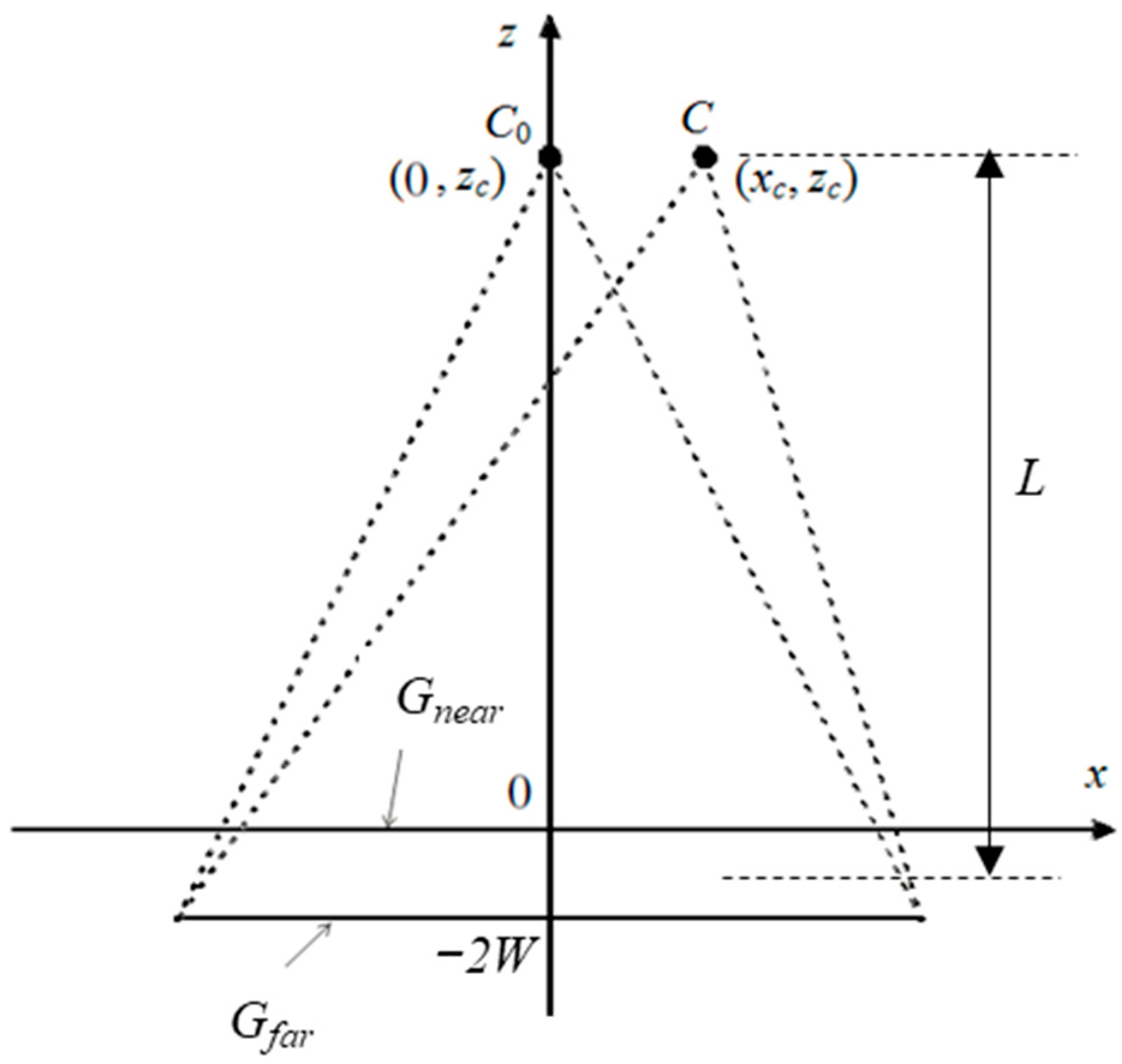
24], the center of the projection (observer or camera) is located at
C = (
xc,
yc,
zc), and the screen is at
z = 0, see
Figure 1.
In this geometry, the origin is at the first grid, and the projection of the point (
x,
y,
z) onto the screen is a product of the homogeneous transformation matrix by a column vector
P = (
x,
y,
z, 1)
T; the original matrix [
24] is
We consider the one-dimensional lateral displacement of the camera, i.e., effectively,
yc ≡ 0; so, the practically used matrix is
Using the above matrix, the projected period is
λ2′, the moiré period is
λM, the magnification coefficient is
μ, and the lateral displacement of more patterns in the parallelepiped in air (no refraction)
xM can be obtained similarly to [
24]:
where
xc and
xM are the lateral displacements of the camera (observer) and the moiré patterns, and the coefficient
s is
For the identical grids with
ρ = 1, the visible displacement of moiré patterns by Equation (9) is equal to the lateral displacement of the observer:
The above formula formally describes the moiré mirror effect in parallel identical grids, which means that the moiré patterns move together with the observer with an identical displacement. This effect in air is confirmed experimentally [
24].
To determine the direction, we need the moiré magnification coefficient and the sign. Therefore, we generalized the original formulas [
24] into Equations (7)–(9) without the modulus operation. However, the sign obtained this way needs to be confirmed. We will do that in
Section 3.
To satisfy Equation (11), at least the signs of the camera and the moiré displacements should be identical:
This means that the moiré magnification coefficient from Equation (8) should have the same sign in both media (air and a substance with
n ≠ 1). Since the sign for the moiré patterns in the air was defined as positive, both
μ must be positive:
where
and
are the magnification coefficients in air and water.
We consider Equation (13) as the necessary condition for the moiré mirror effect.
In analytic derivations, we use the approximation of small angles (within the angular range of ±18°).
For convenience in formal derivations, we use the relative quantity
where
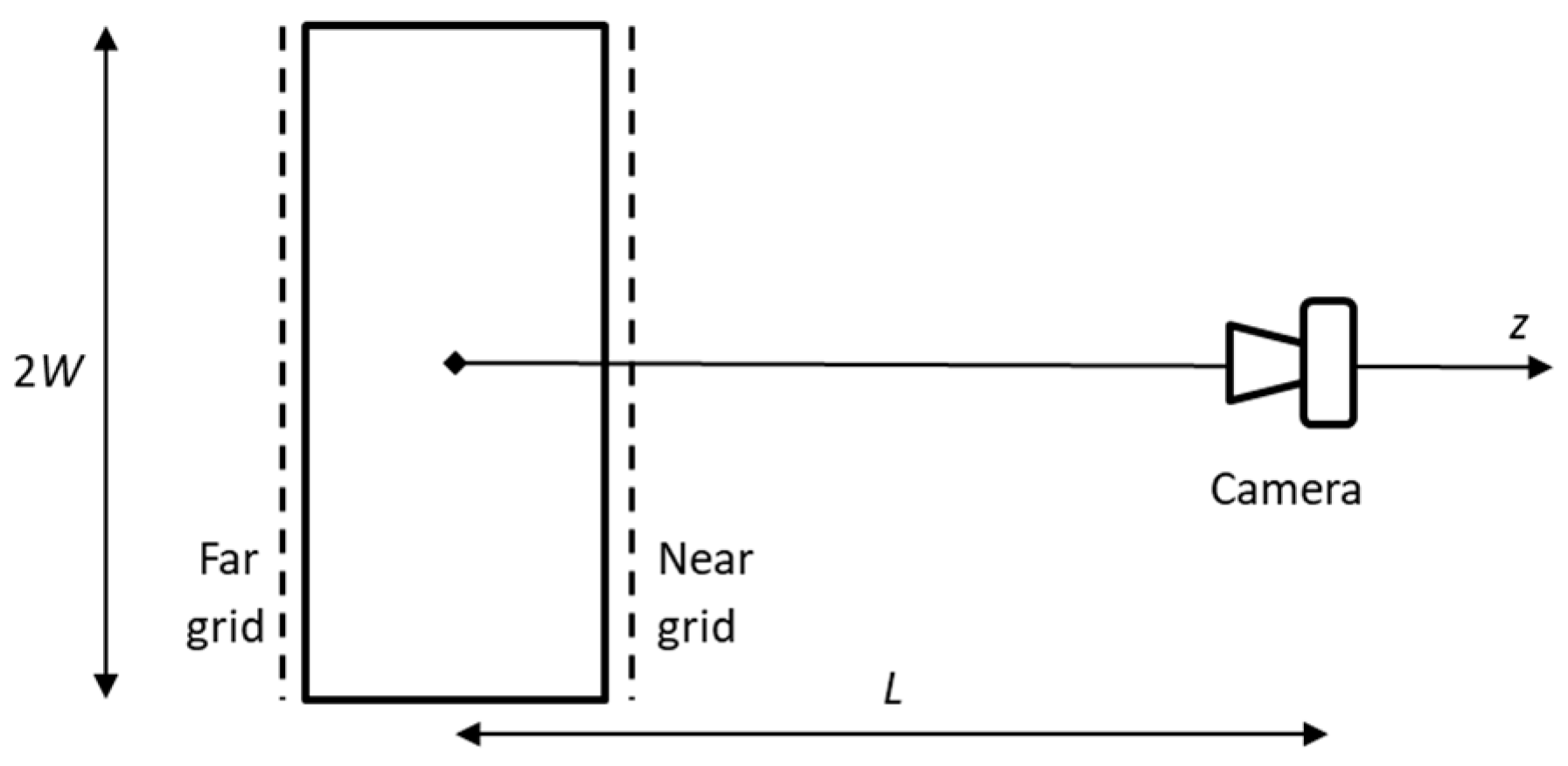
W is the halfwidth of the box (along the line of sight).
Note that the relative quantities μ, ρ, and defined by Equations (2), (3) and (14) are dimensionless ratios that have no unit of measurement.
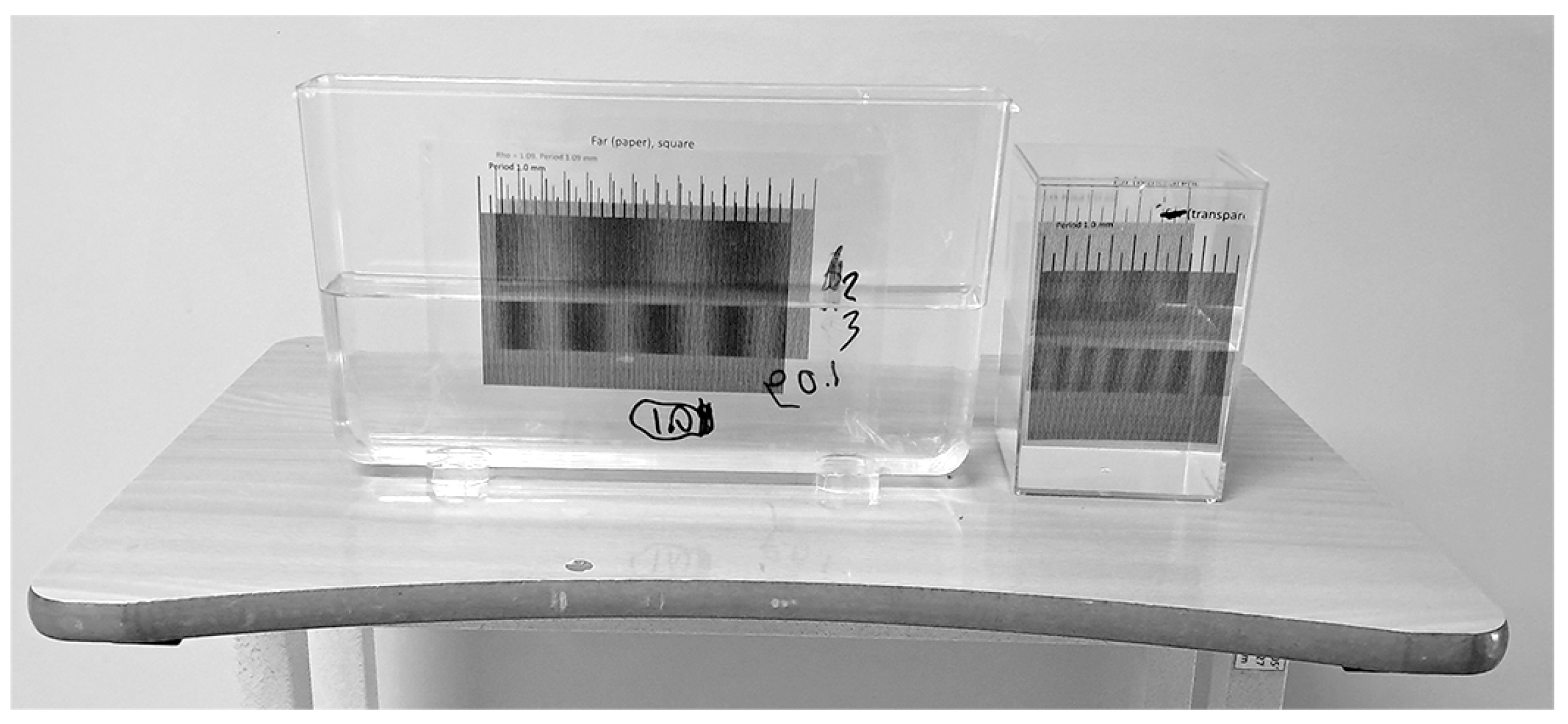
In the experiments, we used transparent rectangular containers with outer dimensions of 32.5 × 21.5 × 6 cm
3 and 10 × 10 × 15.5 cm
3 made of plastic; see
Figure 2.
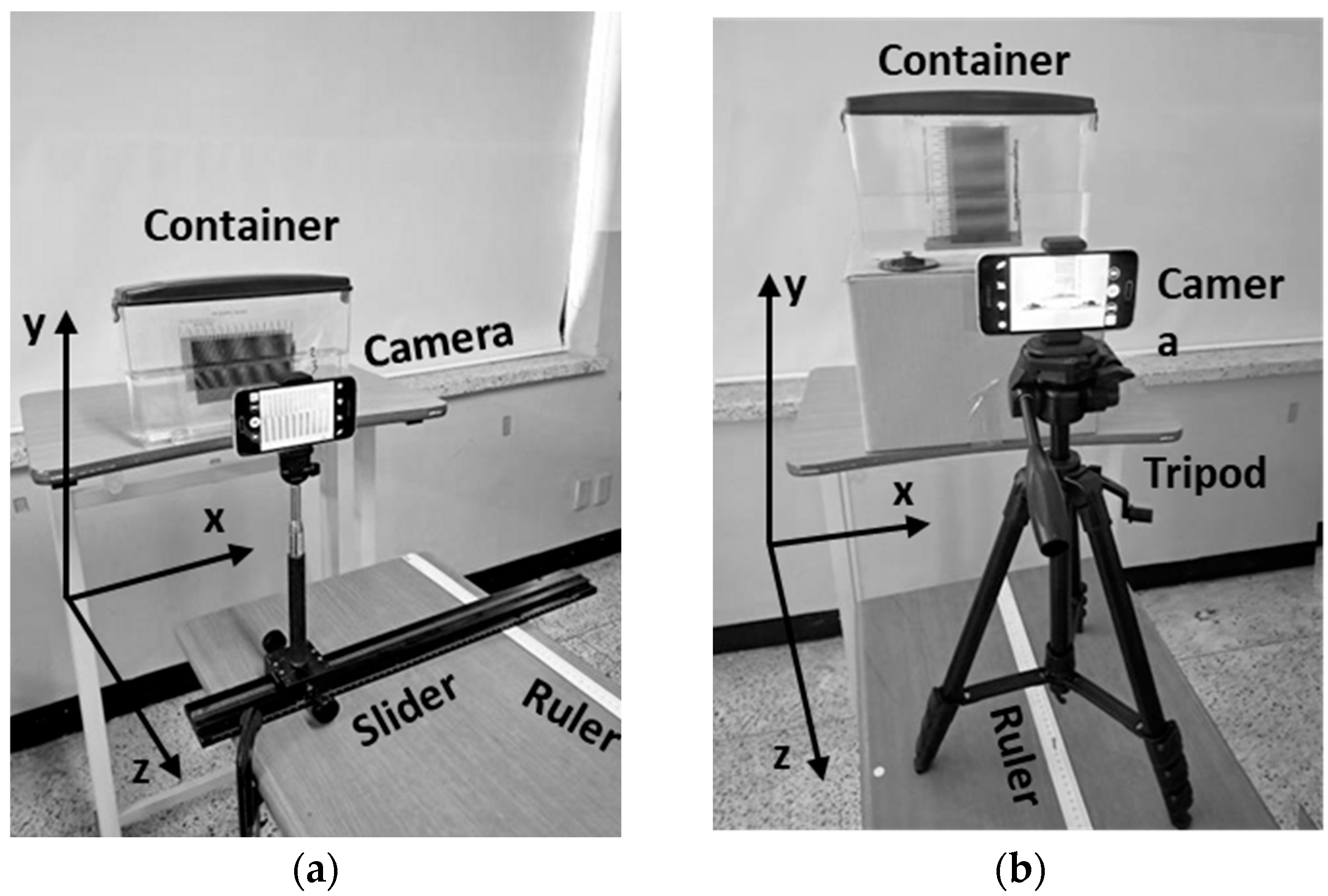
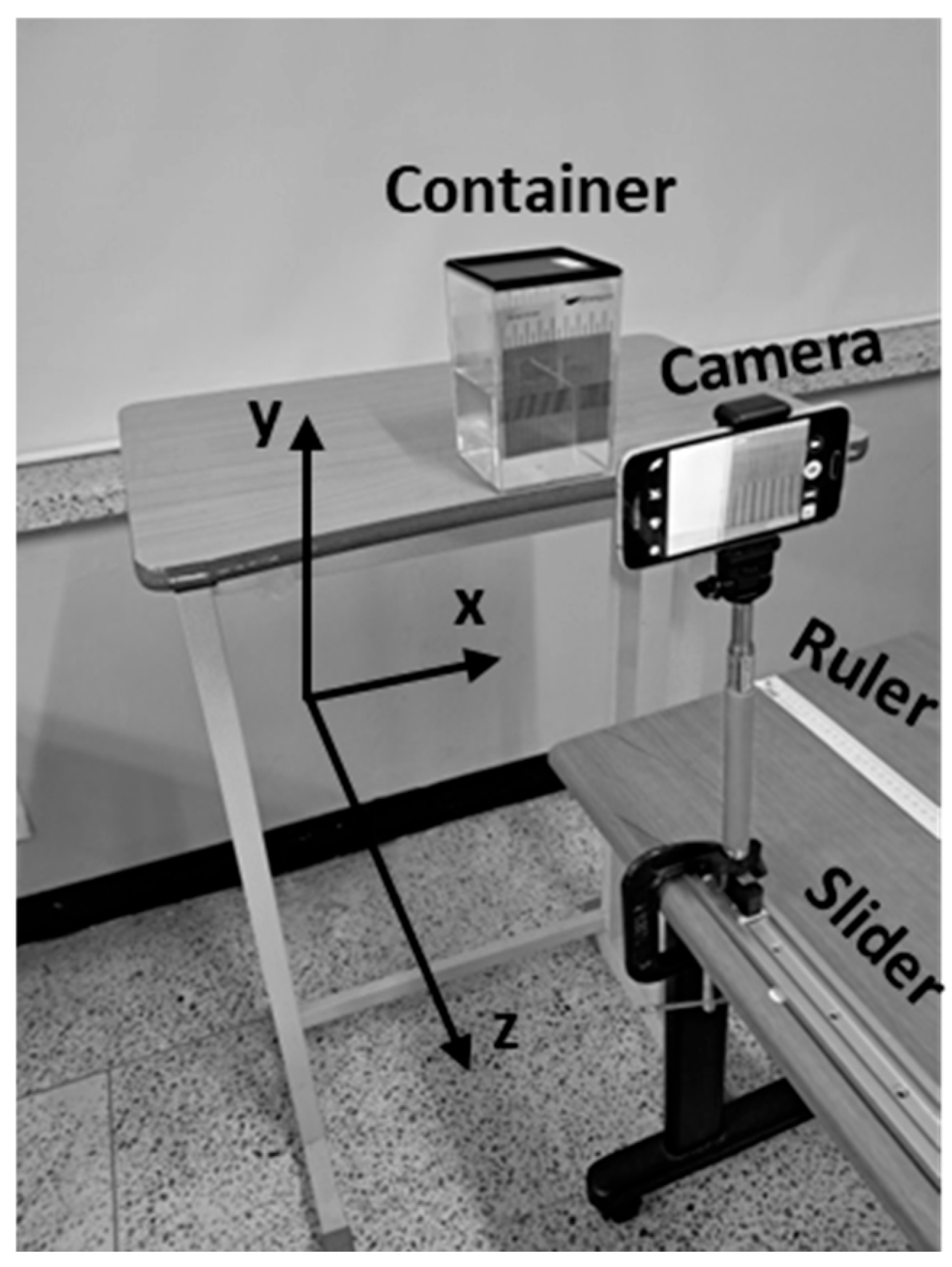
We moved the camera along Cartesian coordinate axes, one axis at a time. The experimental setup for transverse and longitudinal movement is shown in
Figure 3 and
Figure 4.
3. Results
3.1. Signed Moiré Magnification in Rectangular Parallelepiped
The origin is in the center of the parallelepiped (box); see
Figure 5. The transversal axis (perpendicular to the plane of
Figure 5) is either
x or
y. The major difference with
Figure 1 is that the distance
L is measured from the center of the box.
The formula for the moiré wavenumber
kM in the parallelepiped is obtained in [
22]. The derived moiré magnification coefficient (actually signed, because of the correct order of summands) can be written according to the definition in Equation (2) as follows:
where the auxiliary coefficient
ν is defined as
where
n is the refractive index, a dimensionless quantity, such as 1 for air and 1.33 for water. In air, the coefficient
ν equals 1; in water, it equals 0.5. Equation (16) expresses the relative difference in the refractive index with a value of 2 when the length of the refracted ordinate is half as long.
Note that we consider
μ as the function of the distance, while the other quantities (
ρ,
n, etc.) are parameters, which are denoted in formulas by sub- and superscripts, as in [
22].
The asymptotic magnification at infinity (in both air and water) is
Thus, at a large , the moiré magnification coefficient in non-identical grids with ρ < 1 (when λnear > λfar) is positive in any media, i.e., the patterns in such grids at the infinite distance move in the positive direction.
The moiré magnification coefficient tends to infinity at a certain distance
L∞, which can be found from the condition that the denominator of Equation (15) is zero:
where
The particular cases for air and water are, resp.:
(both are positive with
ρ > 1).
Another condition for the infinite
µ is a certain coefficient
ρ∞:
where
The derivative of
µ by
is positive, so
µ (as a signed function of
) rises from
to
, reaching infinity between them at
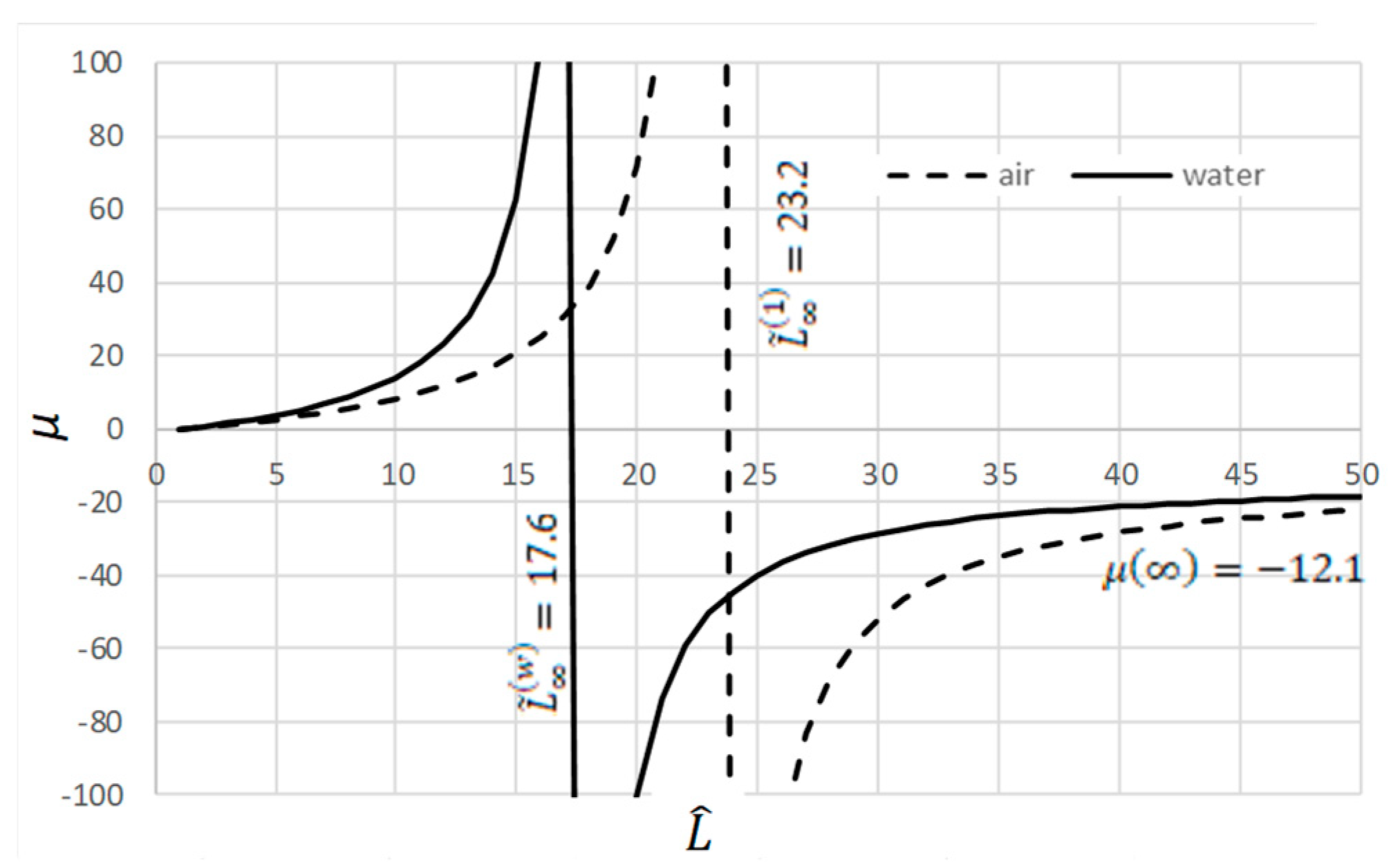
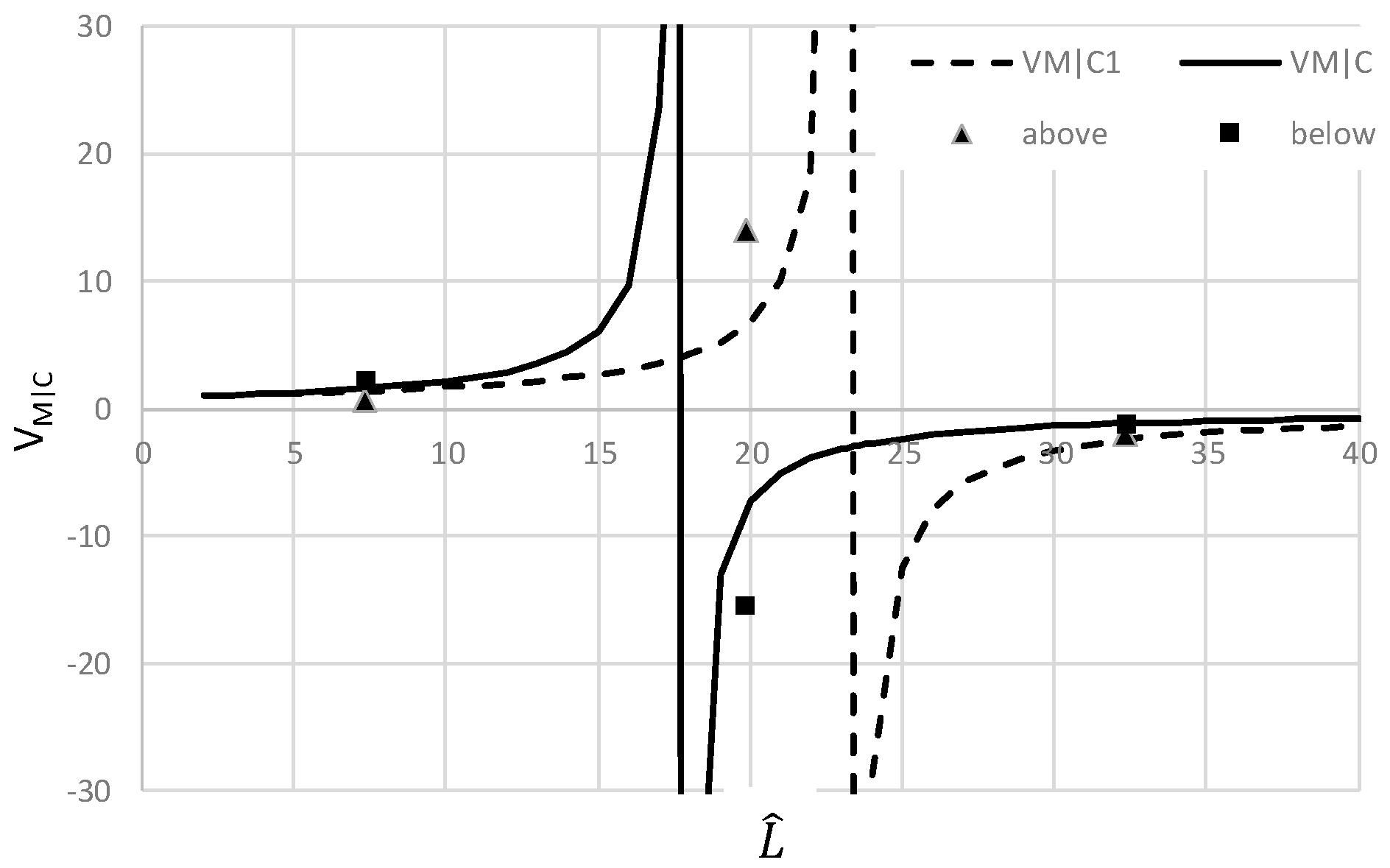
and changing the sign at this point. The calculated signed moiré magnification coefficient in the parallelepiped is shown in
Figure 6 for
ρ = 1.09. Note that, in the interval between two vertical lines
and
,
µ(1) in air is positive, while
µ(w) in water is negative. We call this interval pivotal.
Particular cases of Equation (15)
(a) Identical grids (
ρ = 1)
(c) Identical grids in air (
ρ = 1,
n = 1)
Thus, beyond the container,
and the necessary condition for the moiré mirror effect in identical grids in air (no refraction) Equation (13) in the box is satisfied; this confirms the signs of the summands in Equation (1).
3.2. Counter-Movement of Moiré Patterns in Pivotal Interval
Let us consider the visual effect that occurs at a certain distance within the reference interval when the observer (camera) moves laterally. How will the visible patterns move? Is it particularly possible for the moiré patterns to move in the opposite directions in the same container above and below the surface of the liquid? Formally, in this case, the signed moiré magnification coefficients in the empty and filled parts of a container (
n = 1 and
n ≠ 1) should have opposite signs:
Note that, in planar identical grids with
ρ = 1, the first inequality (28) with (
n = 1,
ρ = 1) represents the original moiré mirror effect condition in air [
24]; refer to Equation (13). The inequalities (28) describe the pivotal interval.
Let us find a ratio of periods
ρ± that satisfies both inequalities (28). From Equation (15), we have
Both sides of the above formula are greater than 1. For n > 1, both numerators on the left are smaller than those on the right, and inequality (30) is satisfied with n > 1 and . Therefore, it is possible for the moiré patterns to move in the opposite directions in the filled and empty parts of the same rectangular container with ρ± from inequality (30).
We refer to the left and right sides of the inequality (30) as
ρmin and
ρmax.
such that
Recall that
. That is, for any
n,
and, particularly for
n = 1,
The additional, stronger condition for the counter-movement of the moiré patterns with identical periods (i.e., the absolute values of wavenumbers) means a certain
where
This can be derived from Equation (15):
where
Note that
ρ±= is the arithmetic mean of
ρmin and
ρmax in Equations (31) and (32).
Note that, for
,
ρ±= > 1 and
3.3. Velocity of Moiré Patterns
The velocity of the moiré patterns was considered in [
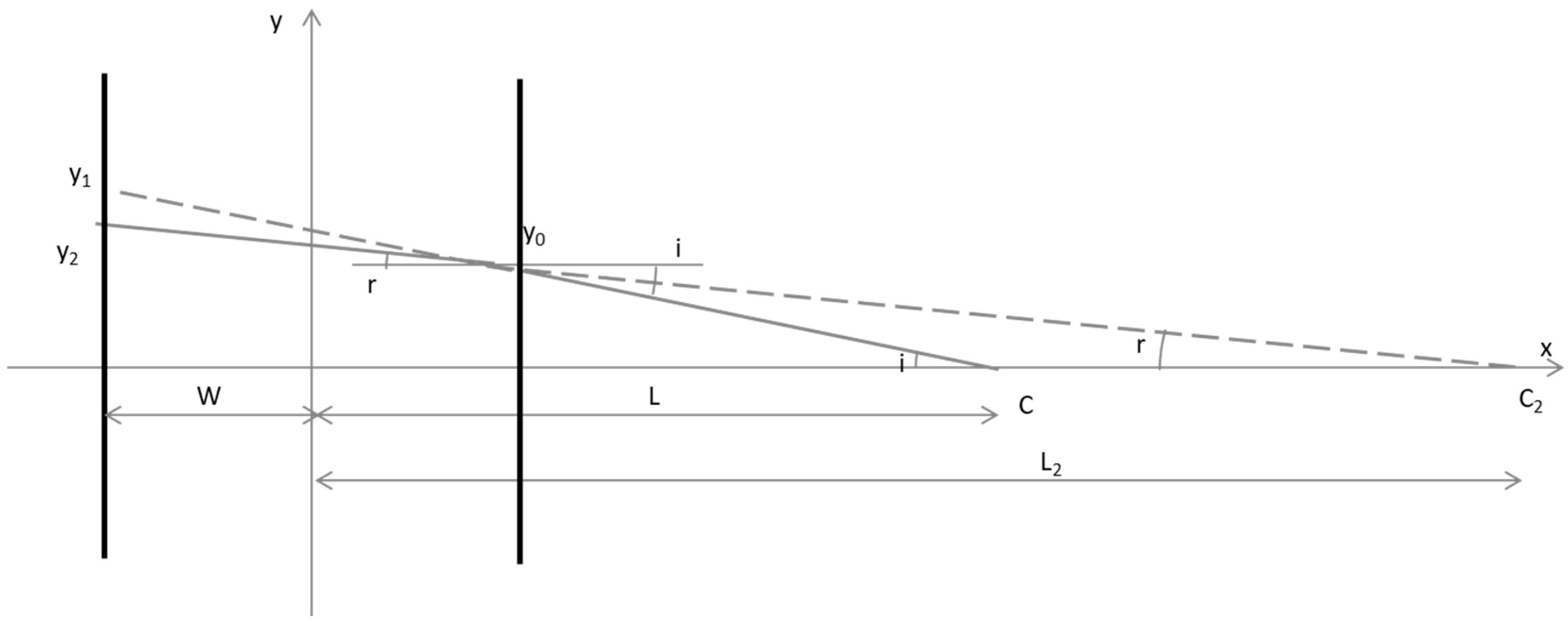
23], but only between the grids. To find the velocity of the moiré patterns in the presence of refraction in connection to the position of the observer, consider grids (with periods
λ1 and
λ2) at the facets of a symmetric rectangular container with the refractive media inside, i.e., at distances
L −
W and
L +
W from the camera. The facets are perpendicular to the camera axis; see
Figure 7.
The angles
r and
i differ in
n times (for small angles):
For a while, similar to [
24], we use the distance from the camera
C to the first grid:
The effective camera is at
C2, and its distance from the first grid is
Therefore, the resulting transformation matrix with refraction is similar to [
24], but includes another effective projection distance
:
After considerations similar to [
24], we obtain the displacement of the moiré patterns in connection to the camera displacement:
where
Recalling the refractive magnifications for the box Equation (15), we can rewrite Equation (49) for
xm as
Then, recalling the definition of
μ from Equation (2), we get an alternative representation:
Or, we can express the same as proportions:
Keeping in mind the necessary condition for the moiré mirror effect in Equation (11), Equation (50) can be rewritten as
From which, with ρ = 1, we obtain the same: ρ = 1. So, the necessary condition remains unchanged.
With the constant observer’s velocity, the velocity of the moiré patterns is
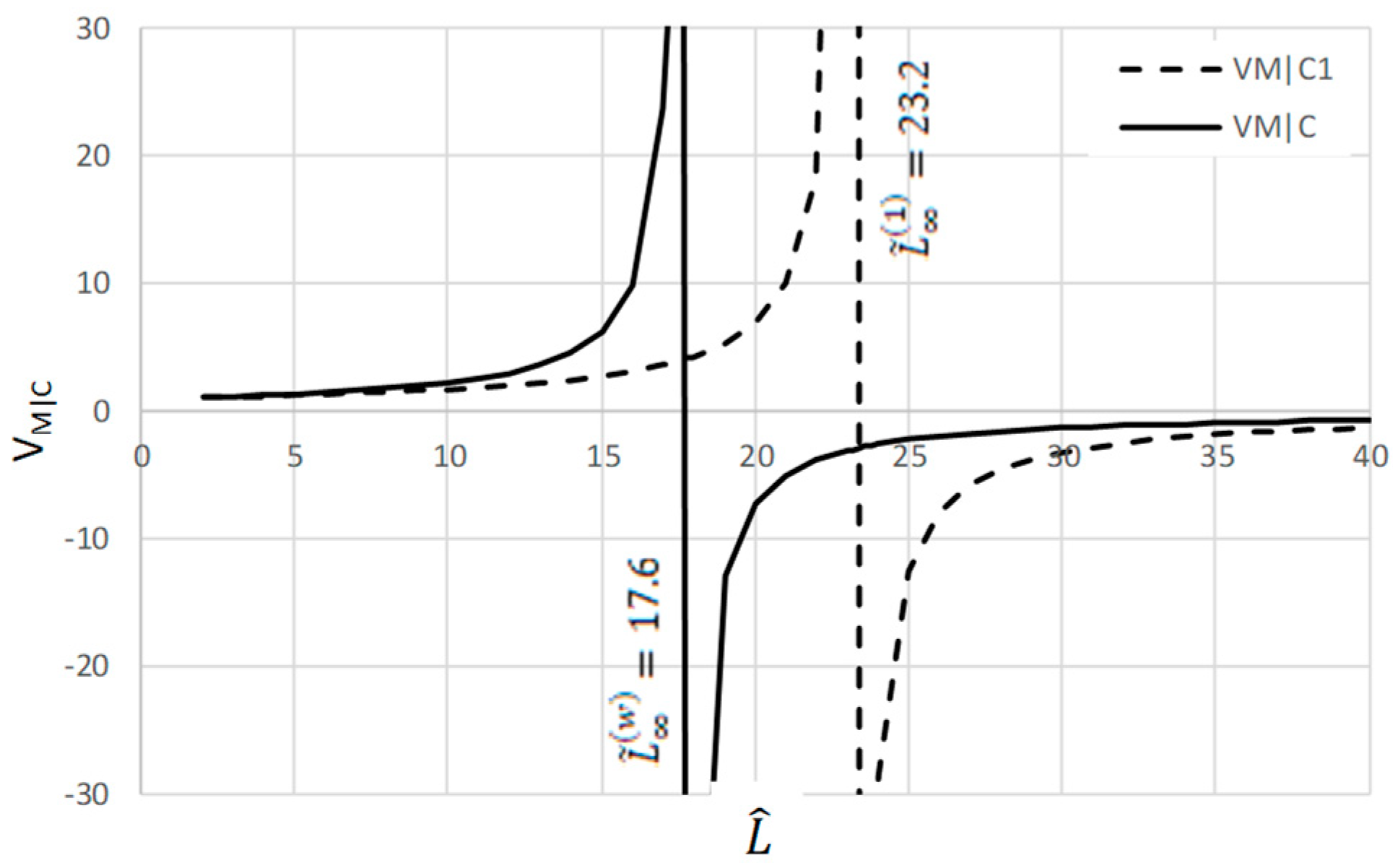
We define the relative velocity
as
The calculated graphs are shown in
Figure 8.
Particularly, in identical grids (in both air and water),
at any distance. Both formulas confirm the moiré mirror effect.
The physical meaning of the above formulas is that both displacement and velocity are proportional to the moiré magnification coefficient.
Now, we can formulate the following result: to obtain the proper signs for the moiré mirror effect in the box in air, we need to subtract the first (near) wavenumber from the second (far) in the fundamental formula in Equation (1).
3.4. Experiments
The behavior of the period in non-identical grids with an increasing distance is shown in
Figure 6, calculated using Equation (15). At a short distance <
, the patterns of a relatively short period above and below liquid move in the same direction as the observer; their period increases, and, at the distance
, the period is infinite and the direction below the surface is reversed while above it is not; and, at a longer distance >
(on the fight side of the pivotal interval), both patterns move opposite to the observer, and their periods became shorter and shorter. Within the pivotal interval, the directions above and below the surface are opposite.
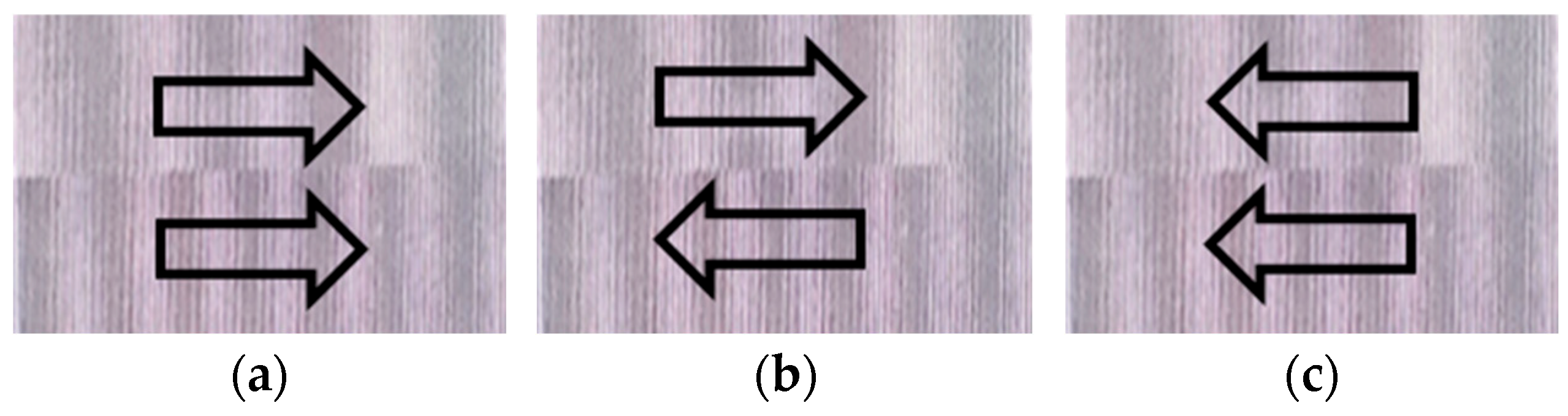
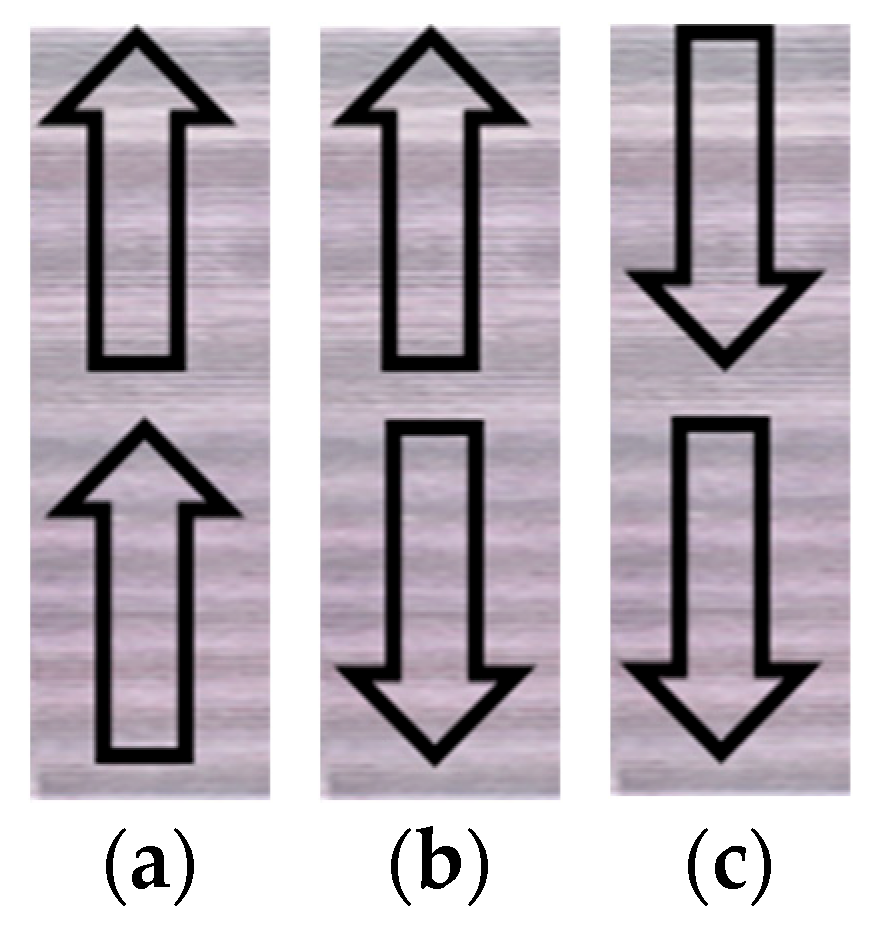
The directions of movement of the moiré patterns in non-identical grids are shown schematically in
Figure 9 and
Figure 10 for horizontal and vertical camera displacement (and horizontal/vertical grids, resp.).
The visual appearance of the moiré patterns with the changed distance can be watched in
Supplementary Video S1 on-line.
Experiments with identical grids confirm the unidirectional movement of the moiré patterns predicted by Equation (58) (although with different periods) with/without the refracting media. The experiments were made with boxes (2W = 4.8 cm, 9.7 cm) at distances between 20 and 150 cm. This is illustrated in
Supplementary Videos S2 and S3 for vertical and horizontal transversal directions.
The experiments with non-identical grids confirmed the results of
Section 3.3 for the grids with
ρ±; see
Figure 6. The experimental graph of the relative velocity of the moiré patterns is shown in
Figure 11.
The simultaneous counter-movement of the patterns in opposite directions within the pivotal interval can be watched in
Supplementary Video S4. Especially interesting (attractive) is that the counter-movement might appear in the vertical direction; see
Supplementary Video S5.
These videos particularly confirm the moiré mirror effect condition in air (the positive direction of the moiré patterns coincides with the direction of the observer) above the liquid surface in the parallelepiped.
4. Discussion
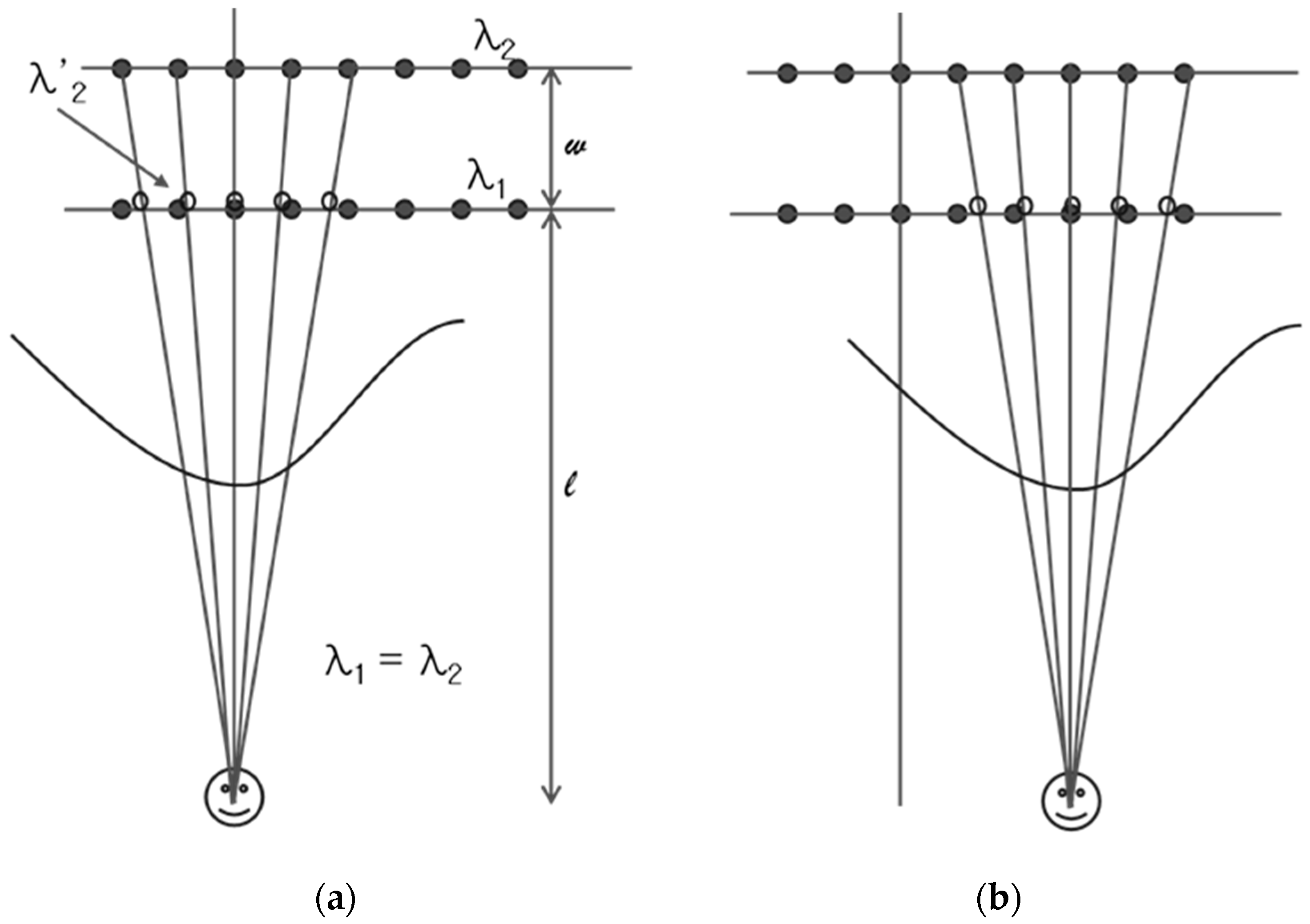
A simple graphical explanation of the moiré mirror effect is shown in
Figure 12, where an observer and identical parallel grids are shown.
Imagine that, in the initial position (
Figure 12a), the maximum of the moiré patterns is directly opposite the observer, that is, the lines of both grids lie on the ordinate. When the observer moves to a displaced position, imagine that, in the new position, the lines of both grids are parallel to the ordinate (
Figure 12b). In this case, the maximum of the moiré patterns is again opposite the observer. This means that the moiré patterns move with the observer (at the same velocity), indicating a specular moiré mirror effect.
It should be noted that the particular observer positions in
Figure 12a,b were chosen for clarity only. However, a careful examination reveals that the moiré mirror effect also occurs in the intermediate positions.
As we saw several times in
Section 3, by subtracting the smaller value from the larger one in Equation (1), we obtained the positive moiré wavenumber. Then, the direction of the moiré patterns coincides with the direction of the observer, and the moiré mirror effect can be observed. This confirms the correct signs of the summands in Equation (1) for the moiré wavenumber.
The signs in Equation (1) were already chosen properly; however, to satisfy Equation (13), we probably would have to consider the reversed signs of the terms in three equations: (3), (3.74), (3.76) in Ref. [
2] (and maybe in Equations (3.67)–(3.73) in [
2] too). However, for the calculation of the period, the sign does not matter.
The counter-movement of the patterns in different parts of a container can create a unique (and therefore appealing) appearance, which is important in advertising. A grid with vertical lines is used to draw the viewer’s gaze laterally; a grid with horizontal lines is used to draw the viewer’s gaze vertically. For the best visual effect, both situations should be appropriately designed: for example, a level floor in the first case and a staircase (elevator) in the second.
For a better visual effect in the
Supplementary Videos, we selected a
ρ0 with
µabove = −
µbelow. However, it is also possible to have different periods of the moiré patterns moving in opposite directions, e.g., the infinite period below and finite above, or other easily recognizable combinations of periods.
5. Conclusions
Formulas were derived for the velocity of moiré patterns in a parallelepiped. The displacement and velocity of moiré patterns in rectangular containers were experimentally measured in two media.
The visual effect of the counter-movement of the moiré patterns (in opposite directions) above and below the surface of the liquid was predicted and confirmed (particularly, observed visually).
This study is important for understanding the dynamic physical properties of the moiré effect under significant refraction. In practice, the results can be used to measure the level or index of refraction. The interesting and probably visually attractive visual effect of the counter-movement can be used in advertising.