1. Introduction
Global deep space exploration is currently advancing into a new phase of development. Consequently, the Moon has re-emerged as the primary focus for major spacefaring nations due to its distinctive scientific significance and strategic relevance [
1]. China is progressing in the planning and execution of major future missions, including manned lunar landings and the construction of lunar research stations. These missions necessitate more detailed information about the lunar geological environment. Furthermore, they require precise evaluations of the potential for in situ resource utilization [
2,
3,
4]. In this context, multispectral remote sensing imaging functions as an essential non-contact detection technology. This approach can concurrently obtain both spatial and spectral data from a target. Consequently, it serves as a fundamental method for the precise identification of lunar surface material composition, the quantitative inversion of element abundance, and the detection of physical states [
5,
6].
Among the different sections of the electromagnetic spectrum, the long-wave infrared (LWIR) band plays an irreplaceable role in lunar exploration of geology and resources due to its unique physical detection mechanisms. The materials on the lunar surface are predominantly composed of silicate minerals. The LWIR band directly correlates with the vibrations of the silicate Si-O bond. Regarding the location of the Christiansen feature (CF) peak, there is an inverse relationship with the degree of polymerization in the crystal structure. Consequently, it becomes a plagioclase, a pyroxene, and an olivine “fingerprint” [
7,
8,
9]. Moreover, LWIR photons get volume-scattered by individual lunar regolith particles. This allows them to go through the amorphous layer and the nanophase iron accumulation layer caused by solar wind implantation. Therefore, LWIR imaging effectively overcomes the problem of spectral reddening and feature attenuation caused by space weathering effects. This capability is crucial for distinguishing highland anorthosite and special silicic volcanic landforms in the context of mature lunar soil [
10,
11]. In addition to chemical composition, the LWIR band contributes to inverting physical structures and thermal environments. Thermal inertia and rock abundance data are derived from the changes in a day’s radiation response. These data are not only a clock to figure out the absolute geological age of young impact craters but also provide engineering evidence for site selection for manned lunar landings [
12,
13,
14]. Especially in polar exploration, the high sensitivity of LWIR payloads at extremely low brightness temperatures is crucial. It is the only method to map the temperature field of cold traps in permanently shadowed regions and where water ice and other volatiles are stable. This capability directly supports in situ resource utilization tasks for future international lunar research stations [
15,
16,
17].
Throughout the history of lunar LWIR exploration, payload technology has gone through a significant evolution from single-point scanning to wide-swath imaging. As early as 1972, the Infrared Scanning Radiometer (ISR) onboard the NASA Apollo 17 mission employed a Cassegrain telescope and a thermopile single-point detector. This instrument obtained lunar surface nighttime temperature data for the first time in the 1.2 to 70 μm spectral range. It has a spatial resolution of approximately 2.0 to 2.6 km [
18]. In 1994, the US BMDO and NASA launched the spacecraft Clementine, which carried an LWIR camera. This instrument uses a catadioptric optical system and a 128 × 128 HgCdTe focal plane array directed at the 8.0–9.5 μm band. It succeeded in achieving early global thermal imaging with a spatial resolution of about one hundred meters [
19]. The Lunar Reconnaissance Orbiter (LRO) Diviner radiometer, launched in 2009, is currently the global benchmark. This instrument employs two off-axis three-mirror telescopes to cover different spectral ranges. These include two solar reflectance channels from 0.35 to 2.8 μm, three mineralogy channels from 7.55 to 8.68 μm, and four thermal infrared channels from 13 to 400 μm. Its cross-track spatial resolution is approximately 160 m, which is no longer sufficient for detailed geological surveys [
20]. In order to solve the problem, the next generation of lunar LWIR payloads is aiming for a higher resolution and smaller size. In 2015, the JAXA Hayabusa2 spacecraft utilized its Thermal Infrared Imager (TIR) during a lunar flyby. This instrument was equipped with an uncooled microbolometer. It successfully acquired thermal radiation images of the Earth–Moon system over the 8–12 μm band with a spatial resolution of 17 m [
21]. The NASA Lunar Trailblazer mission carried the Lunar Thermal Mapper (LTM). This payload utilized an off-axis three-mirror system and an uncooled microbolometer. It aimed to retrieve surface temperature and composition within the 6–100 μm band at a spatial resolution better than 70 m simultaneously [
22]. Furthermore, the Chang’e-7 mission planned by China for 2026 will carry a wide-band infrared imaging spectrometer. This instrument adopts a combined design of an off-axis three-mirror telescope and a plane grating spectrometer. It will acquire hyperspectral images in the 3.0–10.0 μm range with a spatial resolution of 0.3 mrad or better and a spectral resolution of 200 nm or better. This design addresses the challenge of meter-level mid-to-long-wave infrared imaging under the extremely weak radiation conditions of the lunar south pole permanently shadowed regions [
23].
Existing exploration missions have yielded significant scientific results. However, the primary limitation of current global LWIR datasets remains their insufficient spatial resolution. Developing the capability for higher spatial resolution LWIR imaging is now a critical technical trend. Breakthroughs need to be achieved within the framework of China’s lunar exploration project. To bridge this gap in detection capability, this paper discusses an optical system design for an LWIR multispectral imager. This instrument is intended for the planned Lanyue test spacecraft. This study systematically expounds upon the working principles and design specifications of the instrument. It details the design process, optimization methods, and performance evaluation results of the optical system. These contributions provide a theoretical basis and a design scheme for the engineering implementation of this high-performance imaging instrument.
2. Working Principle and Design Specifications
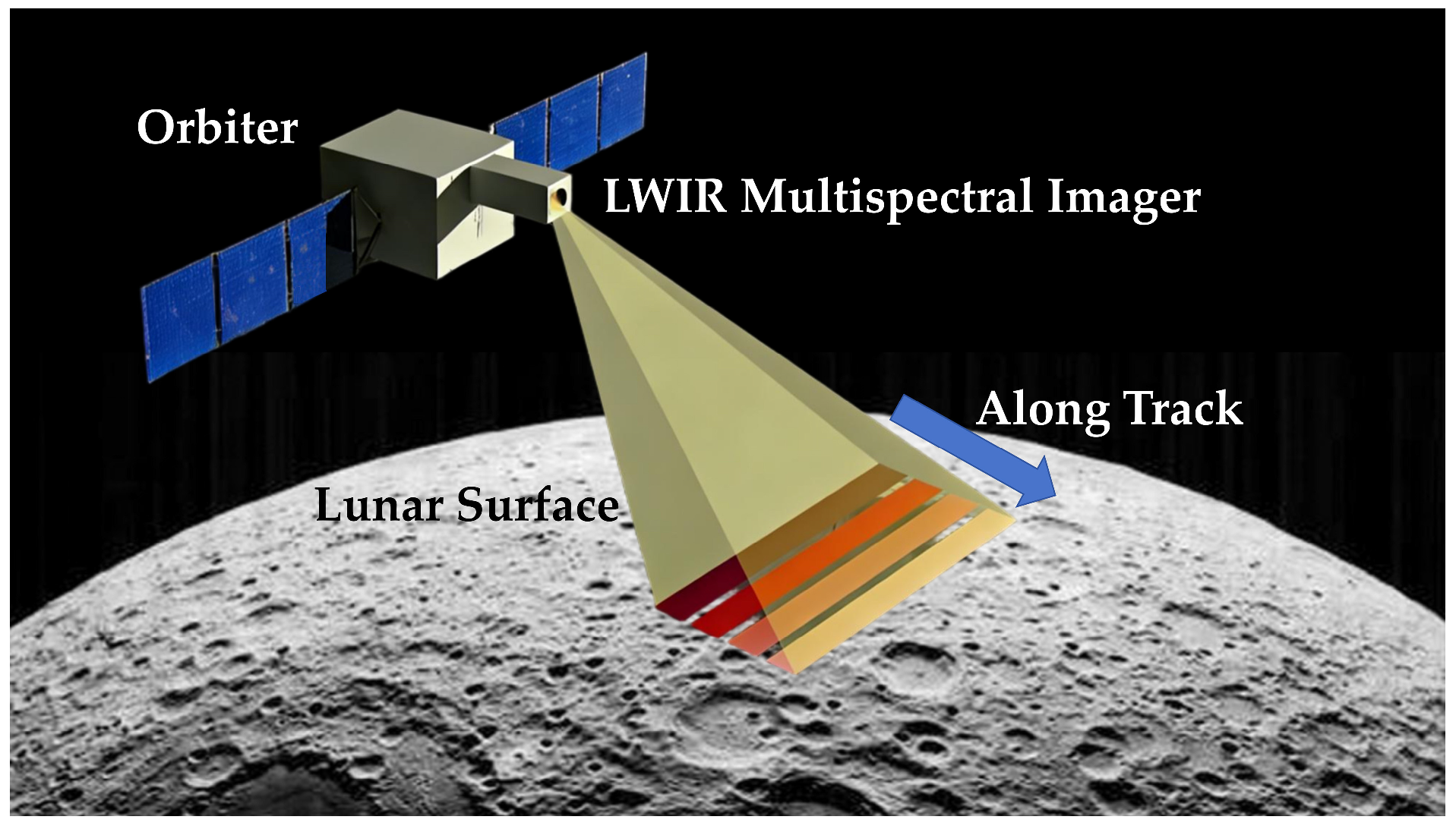
The selection of an imaging mode is the key to achieving high spatial resolution and high Signal-to-Noise Ratio (SNR) spectral imaging of the lunar surface. Compared to staring or whisk-broom imaging, the push-broom imaging mode uses the orbit of the space vehicle to perform along-track integration. It does not require internal scanning mechanisms, which possess inherent advantages such as structural stability, long integration times, and a high SNR. Consequently, this system adopts the push-broom imaging mode. As for the acquisition of spectral information, it is achieved with the integrated filter array. This technology integrates narrow-band filter film arrays for different spectral bands on the focal plane of the area array detector. These filters are positioned in close proximity to the photosensitive surface. This configuration enables the synchronous acquisition of data across multiple spectral channels. This scheme consolidates the spectral separation function within the detector assembly. It can effectively avoid spectral mismatch problems caused by platform jitter or target variations during dynamic detection processes. So, it can guarantee the fidelity of the spectral information. The schematic diagram of the LWIR multispectral imager is shown in
Figure 1.
According to the mission requirements, to obtain multispectral images of the lunar surface with a spatial resolution no greater than 5 m from a 100 km lunar orbit, the instantaneous field of view (IFOV) must be better than 0.05 mrad. This specification allows for the comprehensive design of technical parameters such as the system aperture, focal length, and F-number. The system utilizes an uncooled Vanadium Oxide (VOx) detector (manufacturer: Zhejiang Dali Technology Co., Ltd., Hangzhou, China.) for the LWIR multispectral band. This detector features a pixel size of 12 μm and an effective array size of 1280 × 1024. According to perfect imaging theory, the calculation formula for achieving the diffraction-limited resolution is as follows:
Here,
represents the ground sampling distance.
represents the orbital altitude.
represents the optical aperture.
represents the operating wavelength. The aperture calculated for the minimum optical path is 240 mm. The selection of the focal length
for the optical system primarily depends on the
and the detector pixel size
.
The optical aperture is designed to be approximately 240 mm. The F-number is minimized to 1.0 to enhance light-collecting capability. Simultaneously, a certain margin of redundancy is maintained for spatial resolution. These measures meet the engineering application requirements and weight constraints.
The selected uncooled VOx detector has a maximum detection frame rate of 30 Hz. At an orbital altitude of 100 km, an IFOV of 0.05 mrad corresponds to a subsatellite point dwell time of 3.2 ms. Consequently, a detection frame rate of 320 Hz is required. Therefore, a fast-steering mirror (FSM) is introduced to address the requirements for high-speed detection. It performs image motion compensation. The FSM is an optical device positioned within the optical path. Its actuator drives the mirror to rotate slightly around different axes based on input control signals. This mechanism allows for the rapid and accurate adjustment of the reflected light direction.
Calculations indicate that the image motion compensation range of the FSM is ±0.31 mrad. Therefore, the optical system design must increase the back working distance of the rear optical path. It must also ensure excellent image quality within the compensation range of the FSM. Furthermore, the FSM employs piezoelectric ceramics as actuators. This imposes significant restrictions on the aperture size. Typically, the major axis must not exceed 110 mm. This constraint places specific requirements on the distribution of optical power within the system.
In summary, this system adopts a multispectral imaging scheme comprising a common aperture telescope, channel separation via a dichroic mirror, integrated filter arrays, and image motion compensation using an FSM. The optical design specifications for this system are presented in
Table 1.
3. Optical System Design
The design of the optical system is the major aspect that will give the instrument the desired technical characteristics. The process starts with the selection of the system configuration. Subsequently, it proceeds through the calculation of the initial structure, material selection, optimization, and image quality evaluation. This chapter states the entire design workflow and ends with the optical design result of the LWIR multispectral imager.
3.1. Comparative Analysis of Optical System Configurations
The selection of the optical system configuration requires a balance between major technical specifications and engineering boundary conditions. Key technical indicators include a large aperture, small F-number, large field of view (FOV), wide spectral band, high image quality, and high efficiency across the entire spectrum. Engineering constraints include the optomechanical structural envelope and feasibility.
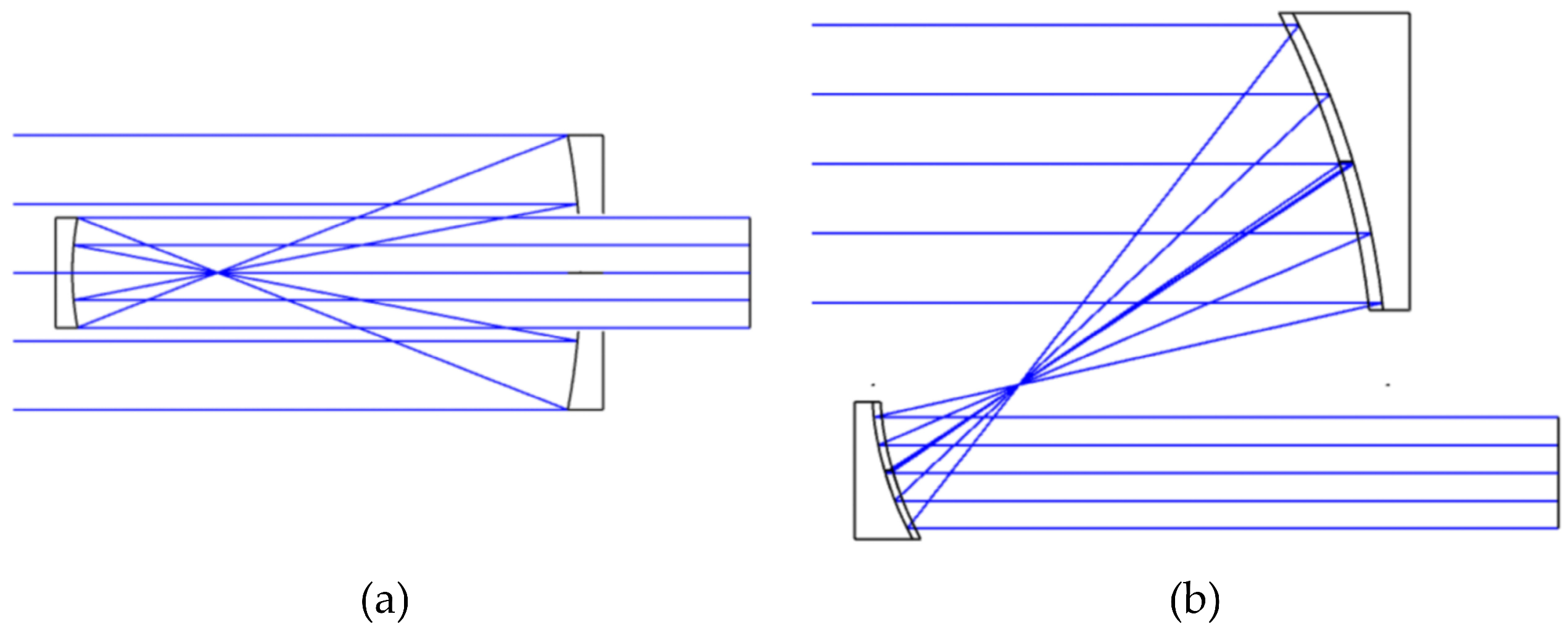
Typical telescope configurations include transmissive, coaxial catadioptric, off-axis three-mirror, and off-axis two-mirror types. The characteristics and functional compliance of each optical configuration are presented in
Table 2.
In summary, the off-axis two-mirror system offers an ideal solution for this mission. Fundamentally, the off-axis application of a coaxial framework has its primary advantage in the elimination of central obscuration. The resulting unobscured aperture maximizes energy collection efficiency and the modulation transfer function (MTF). This enhancement is critical for optimizing the sensitivity of weak thermal signals and resolving fine image details. Additionally, the open structure makes it easy to fold the optical path for a compact system. It also readily accommodates key components such as the FSM. Furthermore, the separation of the FOV from the aperture stop inherently suppresses stray light to improve radiometric measurement accuracy. Although fabrication and alignment are more complex than in coaxial systems, modern manufacturing capabilities have removed significant engineering barriers. Consequently, it is clear that the off-axis two-mirror configuration provides the optimal technical solution for the stringent specification of this LWIR imager.
3.2. Initial Structure
The design employs an off-axis two-mirror Gregorian configuration. Unlike the Cassegrain system, the Gregorian system utilizes a concave secondary mirror positioned behind the primary mirror’s focal point. This layout offers a significant advantage: it forms a real intermediate focus between the primary and secondary mirrors. This location is ideal for placing a field stop to block out the stray light. Consequently, this feature is significant for enhancing the instrument’s SNR and radiometric accuracy.
The design for the off-axis two-mirror Gregorian telescope starts with its corresponding coaxial parent system. First, the structural parameters of the coaxial Gregorian parent system must be solved to satisfy Gaussian optics and third-order aberration theory. For an afocal Gregorian telescope, the angular magnification
is determined by the focal lengths of the primary and secondary mirrors. The relationship is expressed as
This telescope is designed as a beam-reducing afocal telescope. Therefore, must be greater than 1. Since both the primary and secondary mirrors are concave, the conic constant is less than 0. To obtain a high-performance initial solution, two standard paraboloids are adopted as the design starting point. Their conic constants must satisfy .
The focal point of the primary mirror coincides with the focal point of the secondary mirror. In this case, the distance between the primary mirror and the secondary mirror is given by
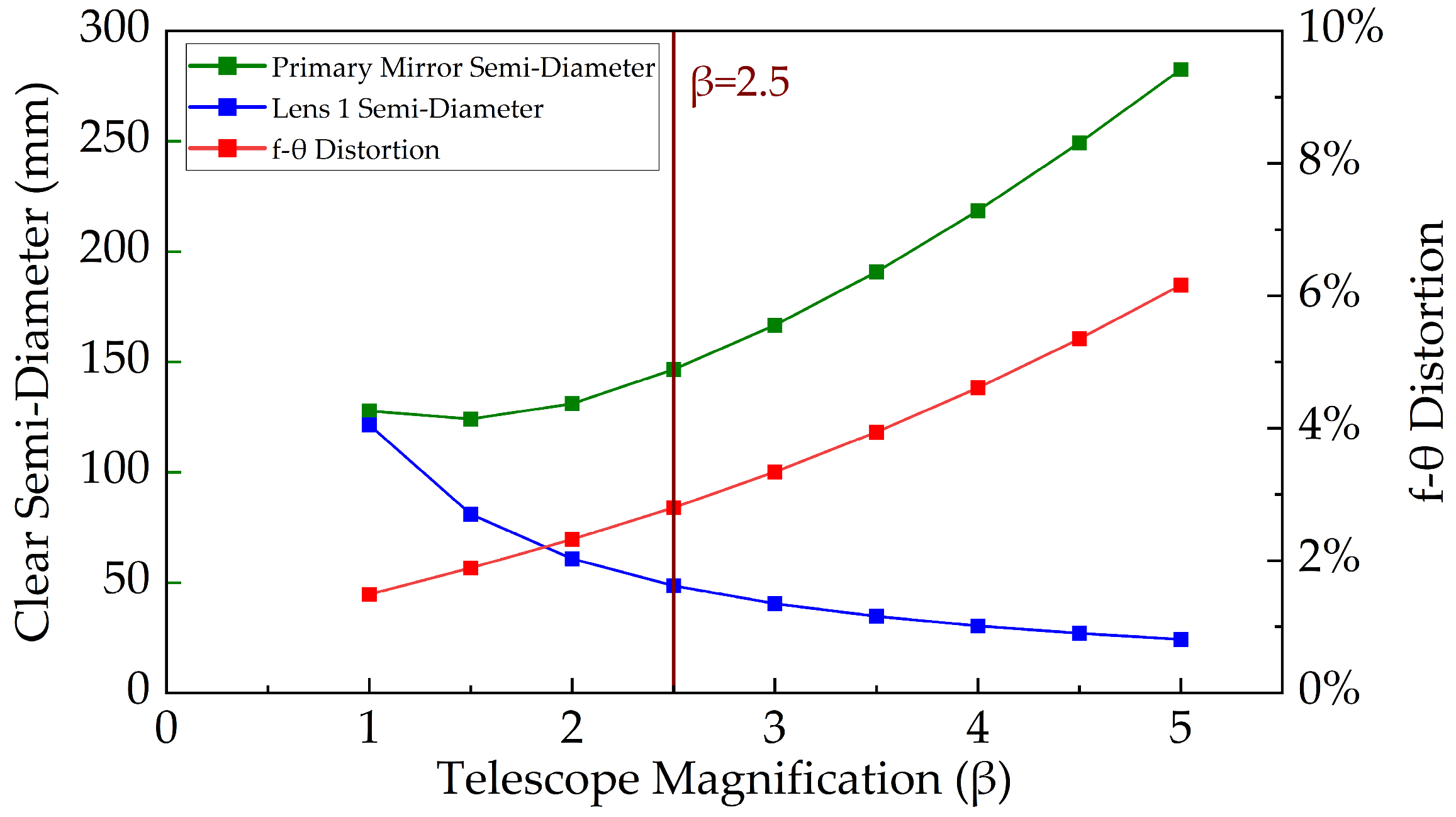
Due to satellite envelope constraints, the axial separation between the primary and secondary mirrors must not exceed 450 mm. The relationship between the telescope magnification and the semi-diameters of both the primary mirror and the first lens when the separation between the primary and secondary mirrors is set to 450 mm is illustrated in
Figure 2. Off-axis designs inevitably introduce distortion. The corresponding distortion curve is also provided in
Figure 2.
Comparison indicates that a magnification of 2.5 balances the semi-diameters of the primary mirror and the first lens. This setting minimizes
distortion and reduces system tolerance sensitivity through the rational distribution of optical power between the telescope and the rear optical path. Therefore, the initial telescope magnification is set to 2.5. The off-axis system is derived from the coaxial parent system by introducing an aperture offset perpendicular to the optical axis. As shown in
Figure 3, a suitable off-axis displacement is selected to ensure that the mirrors do not obscure the optical paths between the primary mirror, intermediate focus, secondary mirror, and final focal plane. This configuration achieves a completely unobscured optical system. The off-axis displacement is typically set to 30% of the radius of curvature.
3.3. System Optimization and Image Quality Evaluation
Post-optical path optimization must satisfy multiple concurrent constraints. Dichroic thin-film technology is utilized for dual-channel spectral separation. Chalcogenide material IRG204 (manufacturer: Hubei New Huaguang Information Materials Co., Ltd., Xiangyang, China) is chosen, which minimizes absorption in the LWIR region and enhances transmittance to ensure an acceptable total system efficiency.
The aperture stop is located on the front surface of the first IRG204 lens. This arrangement accurately limits the beam aperture and FOV while reducing stray light interference. Furthermore, it optimizes the angle of incidence to provide a foundation for aberration correction in subsequent lens elements. The system design incorporates an extended back working distance for the FSM that keeps a clear aperture of no more than 110 mm. A refractive–diffractive hybrid scheme is employed to accommodate the wide spectral band and broad operating temperature range on orbit. This design introduces a binary optical element into the rear optical path of each channel to correct chromatic and thermal aberrations inherent in the transmissive structures. The optimization principles are as follows:
is the paraxial ray height at the
i-th lens
and
represent the focal power of the individual lenses and the total system respectively.
represents the Abbe number of each lens.
represents the coefficient of thermal expansion (CTE) of the mechanical housing material. The term
denotes the rate of change of the focal power of the
i-th element with respect to temperature. For refractive elements and diffractive elements, this is respectively given by
Here,
is the refractive index of the
i-th refractive element,
is its thermo-optic coefficient,
is the refractive index of the substrate material for the diffractive element,
is the thermo-optic coefficient of the diffractive element’s substrate material, and
is the CTE of the optical material for the
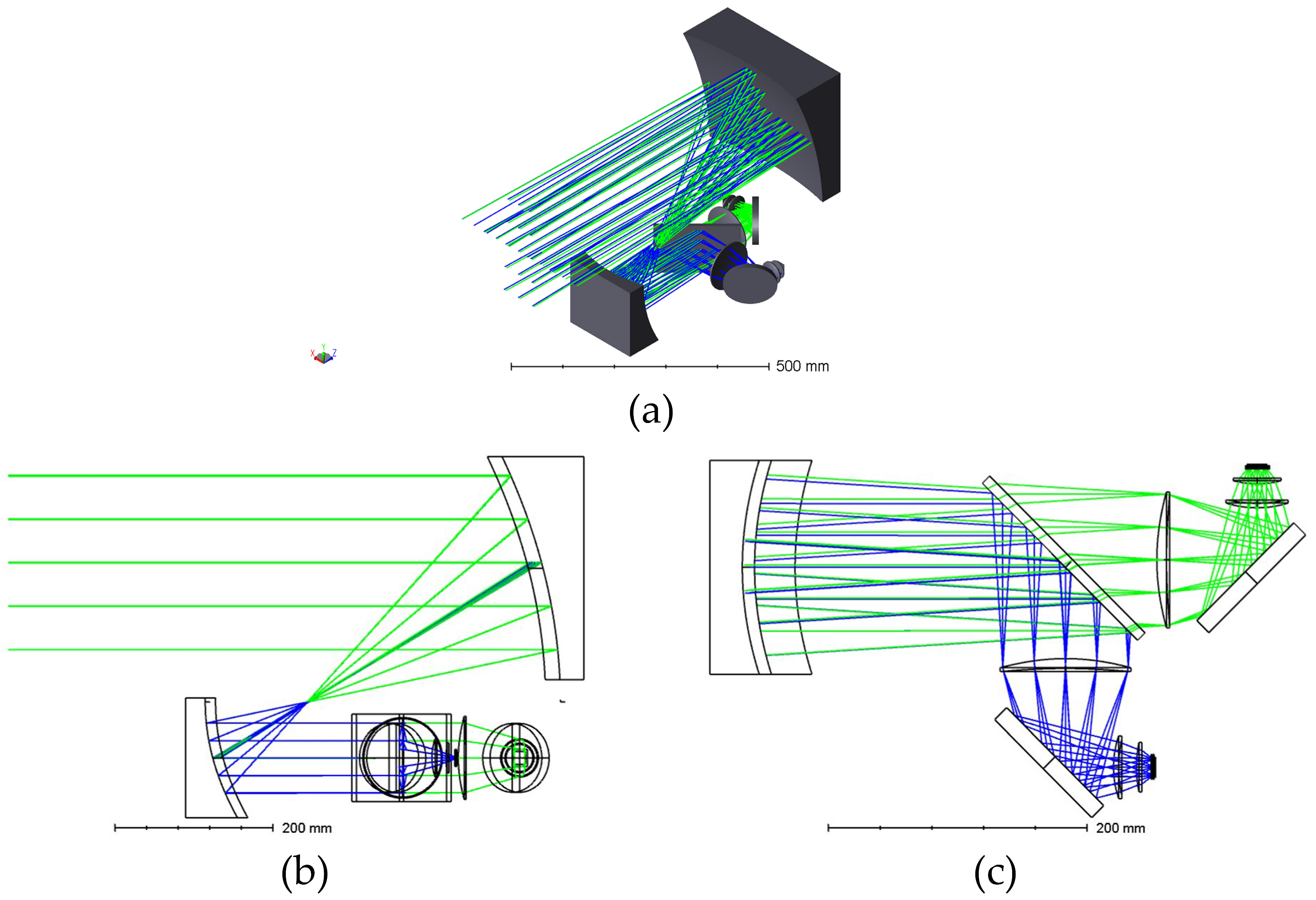
i-th element. Based on the design principles described above, the resulting optical system configuration is illustrated in
Figure 4.
To further suppress image quality degradation caused by non-uniform thermal expansion of the opto-mechanical structure, an integrated opto-mechanical thermal management design is implemented on the basis of the aforementioned optical athermal optimization. For material selection, gradient matching of CTE is adopted to eliminate inter-component thermal deformation mismatch. The telescope frame and primary/secondary mirror blanks use the same 6061 T651 aluminum alloy. The rear optical path lens barrel, mount, and retaining ring use titanium alloy TC4 with a CTE well-matched to IRG204. The FSM blank uses SiC, and its mounting base uses low-expansion Invar 4J36. For structural design, fiberglass thermal insulation pads are used to block non-uniform heat flux from the satellite platform. Independent thermal control zones with isothermal plates are established for temperature homogenization. Flexible support structures are designed to release internal stress from non-uniform thermal expansion. For the thermal control strategy, the system combines closed-loop active temperature control, multi-layer insulation cladding, and high-emissivity coating. The overall temperature gradient of the structure is limited to within ±1.5 °C. The temperature stability is limited to within ±0.1 °C. This design effectively ensures the imaging stability and detection accuracy of the system over the full operating temperature range.
The image quality of the optical system is evaluated with Zemax (version: Ansys Zemax OpticStudio 2024 R1.00). The Root Mean Square (RMS) radii of the spot diagrams across the full FOV are consistently smaller than the Airy disk radii at their respective wavelengths.
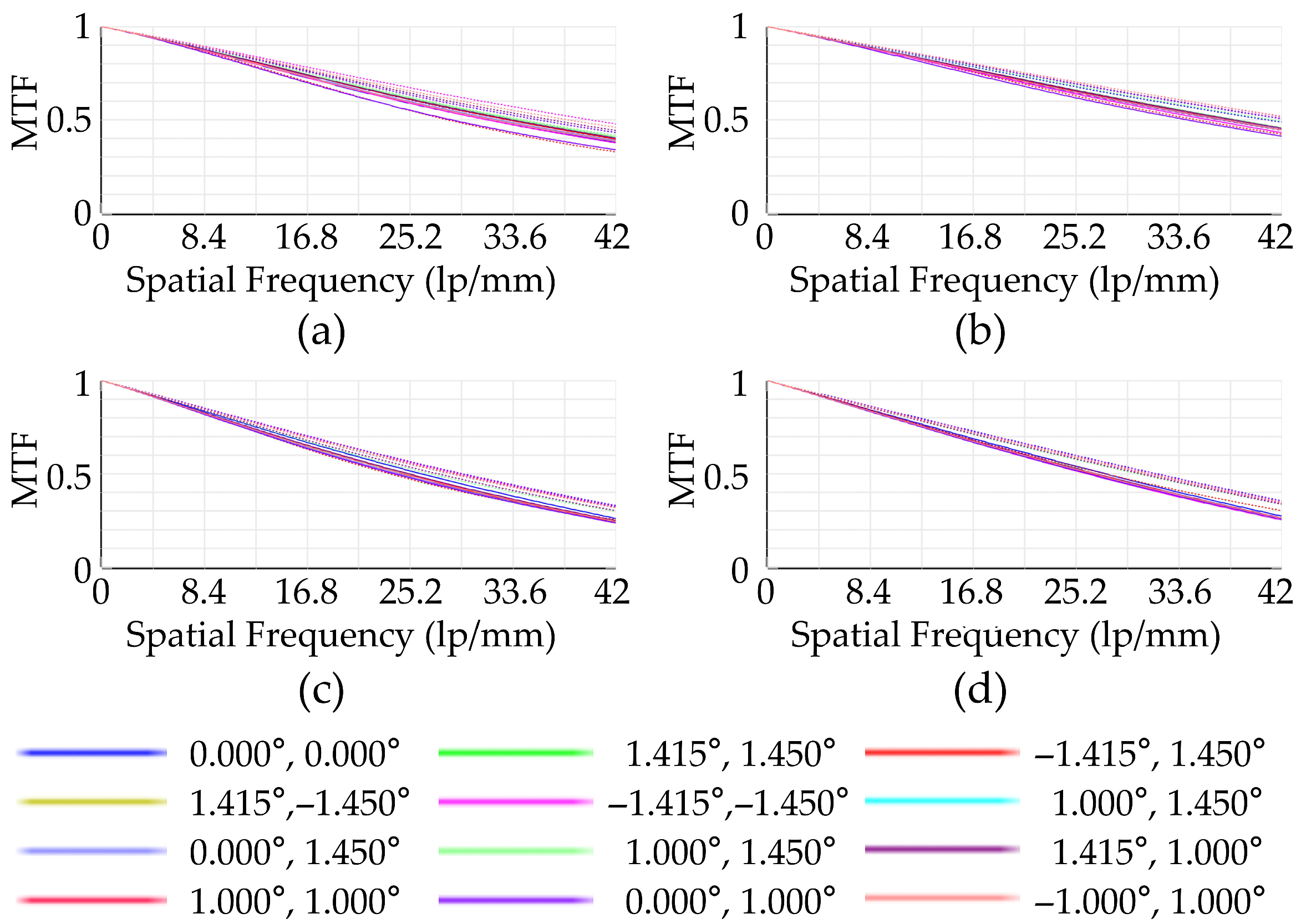
Figure 5 illustrates the MTF of the designed optical system under standard temperature and pressure. Furthermore,
Figure 6 shows the MTF in a vacuum at 0 °C and 40 °C, while
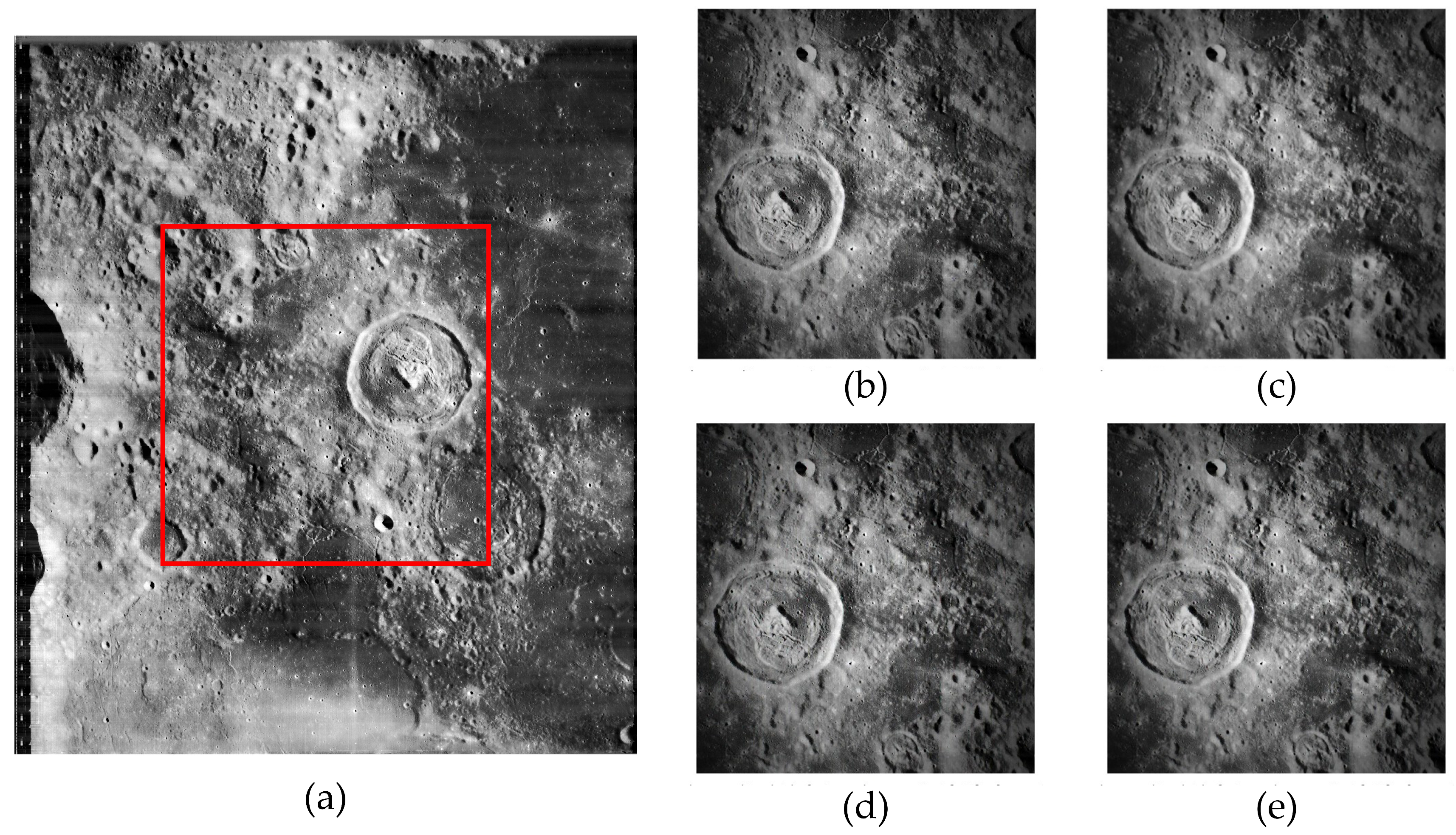
Figure 7 shows the simulated imaging results. These figures demonstrate that the designed MTF values for all channels across the full FOV are at least 0.2. Consequently, the imaging clarity is high and satisfies the system’s requirement for an MTF of 0.1 or greater.
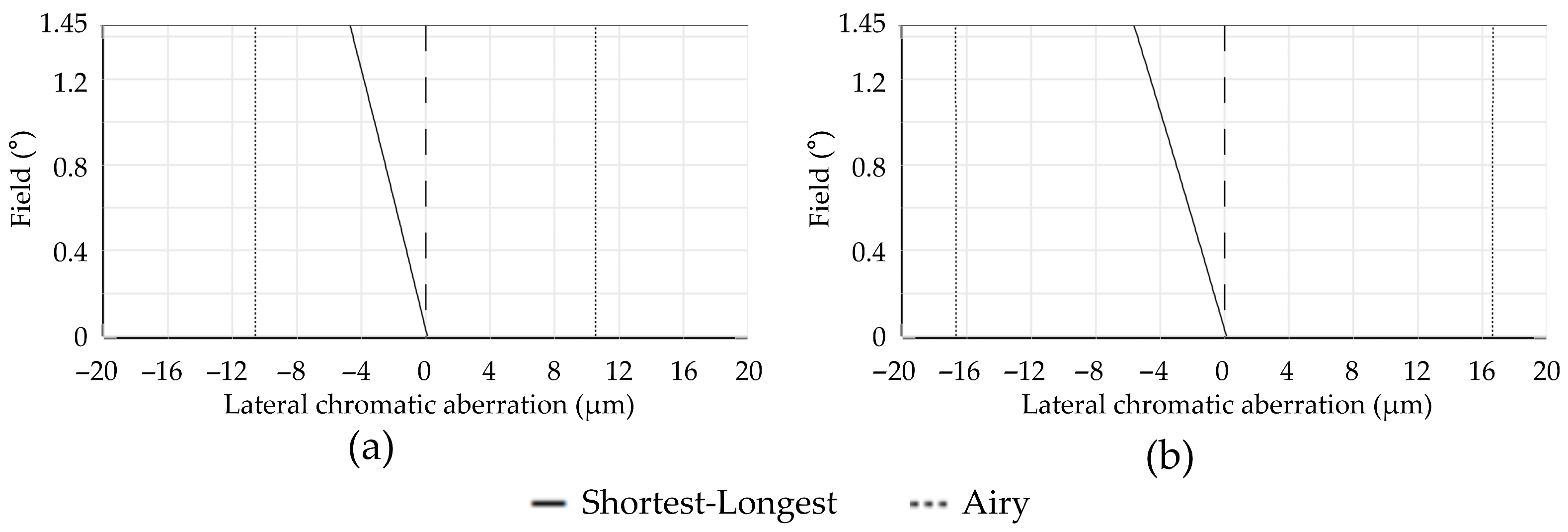
For the optimized optical system, the wide spectral range makes lateral chromatic aberration, field curvature, and distortion the primary off-axis aberrations. The design results for lateral chromatic aberration are presented in
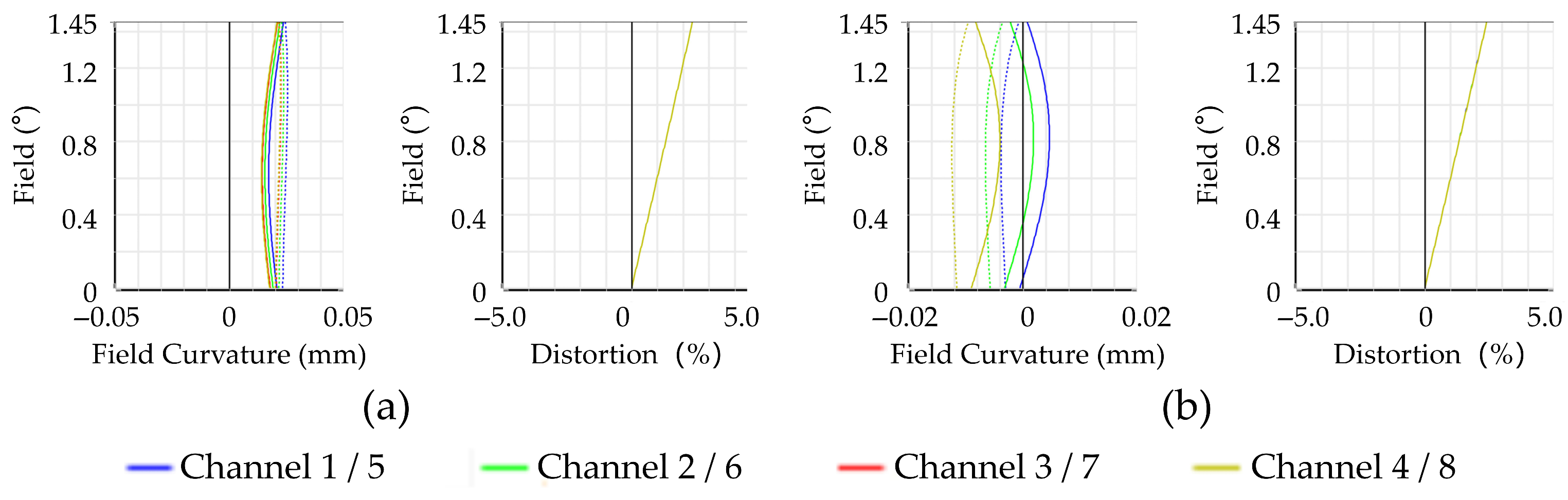
Figure 8. Meanwhile, the field curvature and distortion results are illustrated in
Figure 9.
Figure 8 and
Figure 9 show that the maximum residual lateral chromatic aberration for all channels is smaller than the Airy disk radius. The tangential and sagittal field curvatures for all channels are below 0.03 mm. The system employs push-broom scanning and an FSM for image motion compensation, which requires a linear relationship between image height and FOV angle to ensure consistent cross-track pixel dwell time. Compared with
distortion,
distortion is defined as the deviation between the actual image height and the ideal linear model. The optimized
distortion is below 2.5% across the full FOV. It ensures scanning rate uniformity and provides a basis for subsequent high-precision image motion compensation and geometric calibration.
A distortion calibration method integrating laboratory high-precision target calibration and on-orbit natural feature point calibration is employed to quantitatively characterize and accurately correct full FOV distortion. With a high-precision point source target and a precision electric rotary stage as the core, the system’s full FOV is covered at an equal angular step of 0.1°. The actual coordinates of the target on the detector image plane under different FOV angles are collected. Distortion errors are calculated based on the ideal
linear imaging model. A 4th-order binary polynomial is used to fit the full FOV distortion law, and a coupling term for the x-axis deflection angle of the FSM is introduced to correct distortion deviations induced by dynamic image motion compensation. Thus, a distortion correction model can be established as follows:
Here,
and
are the x-axis and y-axis FOV angles
and
are polynomial fitting coefficients.
is the x-axis deflection angle of the FSM and
is its coupling coefficient, derived from calibration experiments under different x-axis deflection angles. After pixel resampling correction, the system’s full FOV distortion error is controlled within 0.2 pixels. Model coefficients are updated regularly on-orbit using fixed lunar surface natural features such as impact craters and rock mounds, ensuring that the geometric imaging accuracy over the entire life cycle meets the requirements for fine lunar surface mineral detection.
3.4. Tolerance Analysis
Tolerance analysis is an important step to evaluate the feasibility of system processing and alignment. The alignment of the telescope employs an interferometer to control the outgoing wavefront quality of the afocal system. The alignment of the lenses in the rear optical path uses a centering and edging process to control the coaxiality of each component. The tolerance allocation scheme of each component is shown in
Table 3.
Tolerance analysis is performed using the built-in tolerance analysis module of Zemax, with 1000 runs of Monte Carlo simulation carried out. The core evaluation metric for the imaging quality of the system is the diffraction MTF at the Nyquist frequency of 42 lp/mm. As the primary and secondary mirrors are precisely aligned with an interferometer, the relative decenter and tilt between the primary and secondary mirrors can be set as alignment compensation terms together with the back focal length. The results of the Monte Carlo analysis are presented in
Table 4. The analysis results indicate that the probability of the MTF value exceeding 0.34 and 0.20 is greater than 90% for channels 1–4 and channels 5–8, respectively. Since the tolerance settings have reserved redundancy compared with the actual machining and alignment capabilities, the actual on-orbit performance is expected to be superior to the values obtained from the Monte Carlo analysis. Thus, the system satisfies the requirements of the design specifications.
4. Performance Evaluation
4.1. Thermal Background Radiation Analysis
Infrared thermal background radiation’s transfer behavior in the optical system directly influences the accuracy of detection [
30,
31]. The complex layout of off-axis two-mirror systems results in multi-reflection and multi-transmission coupling paths. This paper proposes a radiation transfer algorithm integrating the Monte Carlo method with multiple iterations. It achieves high-precision analysis of the system’s radiation characteristics.
Planck’s Law is the theoretical foundation for radiation transfer. According to Planck’s Law, the spectral radiance of a blackbody at wavelength
and temperature
is
Here,
represents the surface emissivity of the optical component,
represents the component area,
represents the solid angle subtended by the optical system’s entrance pupil at the component, and
is the system operating wavelength band. The algorithm adopts an importance sampling strategy to improve sampling efficiency. The total radiation power of the system is defined as
. The probability of the
i-th component being selected as the emission source is proportional to its energy weight:
. Both the emission and non-specular reflection directions of rays follow the Lambertian cosine distribution. The probability density function for the angle
between the ray and the surface normal satisfies
. During the transmission process, Russian roulette is introduced to simulate the contact of the light ray and the surface, which randomly determines photon survival based on the reflectivity and transmittance of the components. For practical optical mirrors, the model utilizes a hybrid Bidirectional Reflectance Distribution Function (BRDF), which combines specular reflection with a 5% diffuse reflection component to simulate scattering effects caused by surface roughness or contamination. Finally, the stray radiation flux received by the detector is estimated by summing the energy of rays that land on the photosensitive surface and satisfy the FOV constraints:
Here,
is the total number of simulated rays and
is the detection function. If the
k-th ray is absorbed by the detector,
equals 1; otherwise, it is 0. This method effectively handles multiple scattering in complex non-coaxial optical paths. It achieves high-precision prediction of thermal stray light levels.
Table 5 shows the calculated radiant flux on the detector from the thermal radiation of each optical component.
Channels 1–4 and 5–8 use the 7–9 μm and 11–15 μm bands for estimation. Considering the efficiency of the optical system, for a 300 K lunar target with an emissivity of 0.95, the received signal radiant fluxes are 2.8884 × 10
−4 W and 3.8700 × 10
−4 W.
Table 5 shows that the total thermal radiation from optical components is 1.4097 × 10
−3 W and 2.4846 × 10
−3 W for the two bands. The primary radiation sources for both bands are the filters, windows, and the nearest rear lenses. This aligns with the characteristics of uncooled thermal detectors. Temperature sensitivity is approximately proportional to the radiant flux contribution. When the temperature of the filter, the most sensitive component, increases by 0.5 K, the total received radiant flux increases by 4.62 × 10
−6 W and 5.21 × 10
−6 W. These increases account for 0.27% and 0.18% of the total flux. Although the system’s thermal radiation creates a high background baseline, its primary sources are well-defined and predictable with temperature. High-precision on-orbit radiometric calibration and background subtraction can effectively separate target signals from instrument thermal noise. This ensures that the quantitative detection accuracy meets design requirements during on-orbit operation.
4.2. Stray Light Analysis
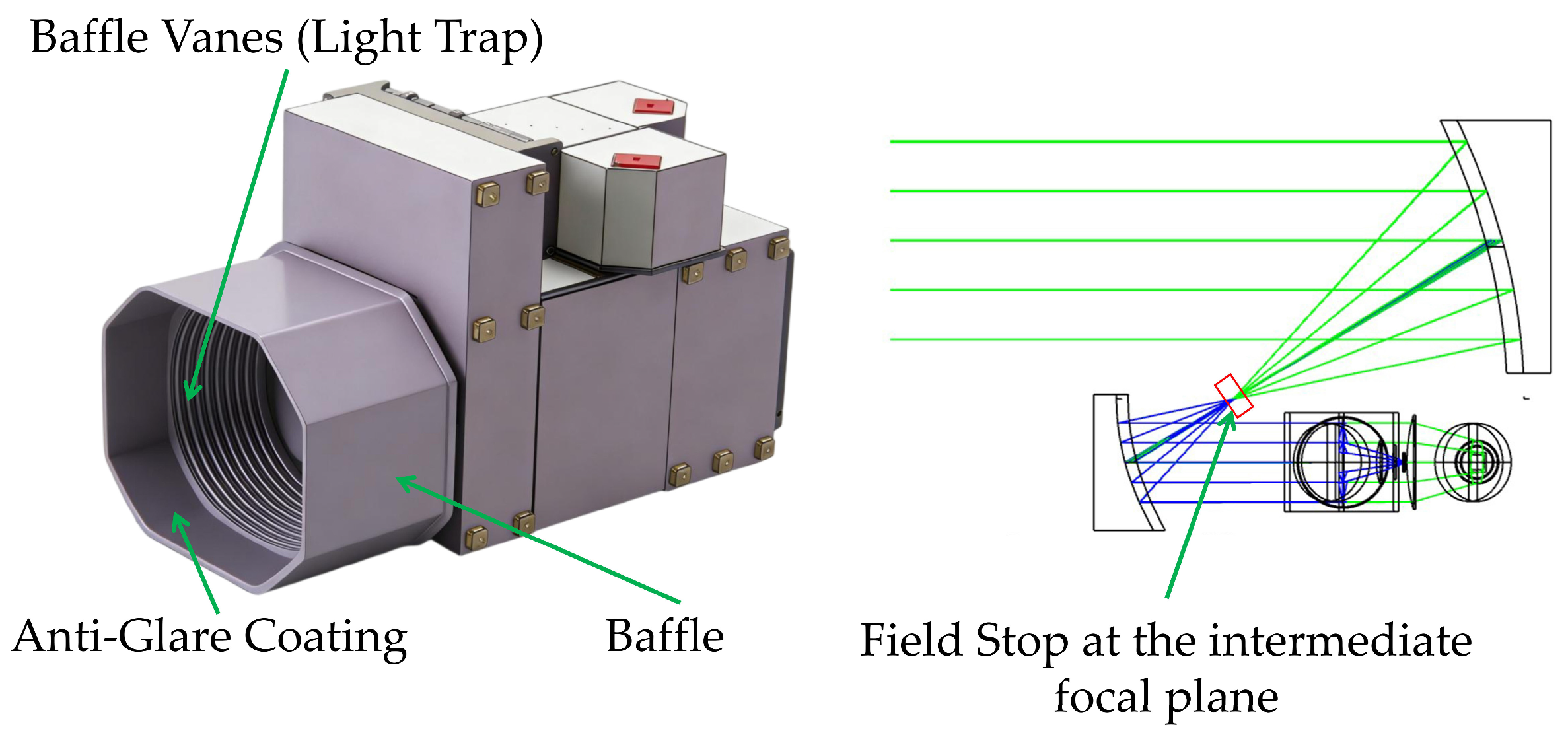
Stray light in optical systems generally falls into four categories: (1) direct illumination from out-of-field light; (2) radiation from out-of-field light reflected by optical surfaces; (3) radiation from out-of-field light reflected and scattered by mechanical structures; and (4) ghost images and stray light formed by in-field light. Effective measures must be taken during the structural design to limit each category. The first two categories are the most harmful and require complete suppression. Lens hoods and baffles are employed to eliminate them. As for the third category, field stops or internal vanes coated with low-reflectivity materials are introduced. The fourth category is suppressed by controlling surface roughness tolerances and anti-reflection films. The schematic diagram of the stray light suppression design is shown in
Figure 10.
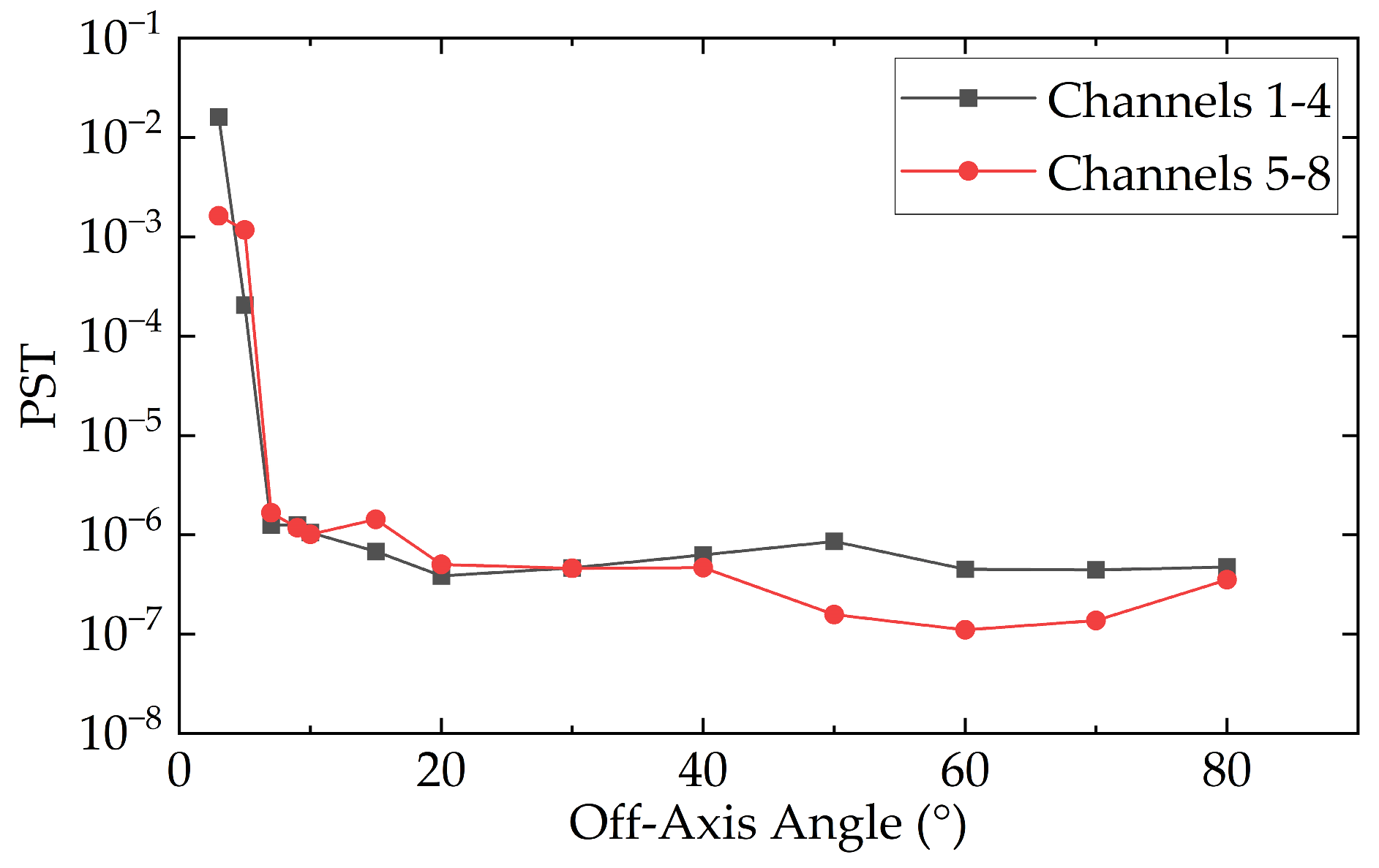
After designing the stray light exclusion of the opto-mechanical part of the system, Point Source Transmittance (PST) is used to evaluate the stray light energy entering the system [
32]. PST is defined as the ratio of the irradiance
at the image plane to the irradiance
at the entrance aperture, caused by a point stray light source at an off-axis angle
. Its mathematical expression is
PST was analyzed with TracePro (version: TracePro Expert 7.4.3).
Table 6 shows the surface parameter settings for each component. As a special reminder, the parameter settings for PST analysis differed from those used in the previous thermal radiation analysis. This was because conservative values were selected to provide specific margins for each respective calculation. The results are presented in
Figure 11.
Figure 11 shows that the PST result is below 1 × 10
−5 when the off-axis angle exceeds 7°. No significant enhancement in PST occurred within the 7° to 90° range. These results indicate that the instrument possesses effective stray light suppression capabilities. It successfully meets the detection requirements.
4.3. Detection Sensitivity Analysis
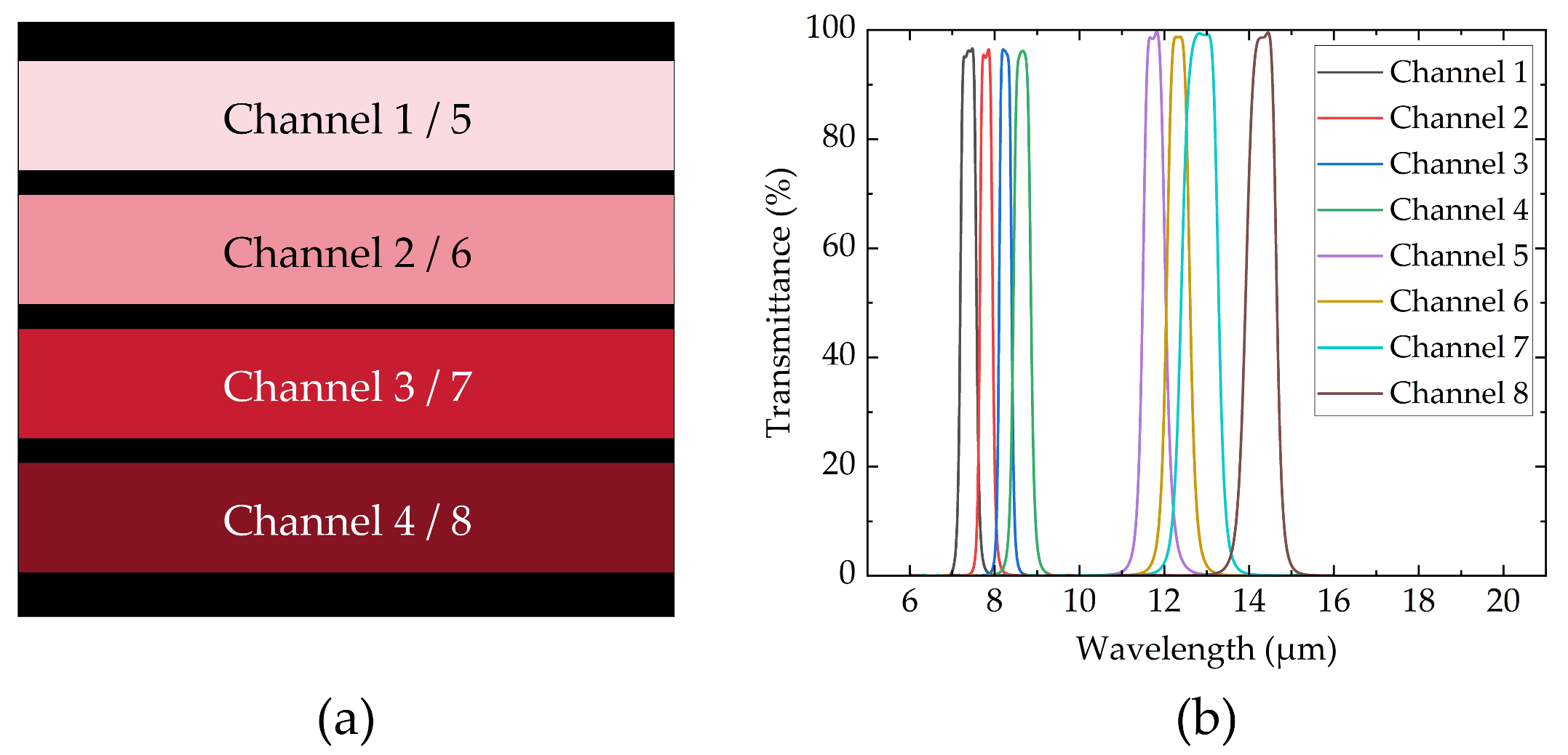
The LWIR multispectral imager employs an integrated filter array for spectral separation. Coatings are applied to the rear surface of each filter to distribute light into four spectral channels. A schematic of the coating design is shown in
Figure 12.
Based on the requirements of the integrated filter array, 1024 pixels are used in the spatial dimension. The designed spatial FOV is 2.90°. The spectral dimension uses 1000 pixels. The designed spectral FOV is 2.83°. Ray tracing is performed by incorporating the optical interface data of the uncooled VOx detector. For the four channels of each detector, the number of effective pixels is approximately 627. Channels are isolated by 125 invalid pixels. The allowable transition zone width between sub-channel filter films is approximately 0.5 mm, which is achievable with current manufacturing technology. The nominal Noise Equivalent Temperature Difference (NETD) of the detector is below 50 mK (@f/1.0, 30 Hz, 300 K, full-pass). Manufacturers typically do not disclose parameters such as response efficiency, integration capacitance, and dark current. Furthermore, the adjustable range for integration time is very limited. These factors make it difficult to calculate system sensitivity directly from the photoelectric conversion process. Instead, the sensitivity of the designed payload is evaluated through comparison with existing equipment. Equivalent conversion is conducted based on optical efficiency, F-number, target temperature, and measured results from the XingHuan uncooled LWIR camera [
33]. The conversion relationship is
The estimated NETD values of each channel are listed in
Table 7. The four channels of each detector utilize 7-pixel, 9-pixel, 9-pixel, and 8-pixel binning respectively. After binning, the NETD is below 0.4 K for all channels except the 14.3 μm channel. This specific channel is not subject to assessment requirements. These results meet the on-orbit detection requirements.
5. Discussion
The optical system presented in this paper achieves a significant breakthrough in the spatial resolution of LWIR imagers for lunar remote sensing. Existing payloads have provided valuable data. However, their spatial resolution limits the identification of fine-scale geological features of the lunar surface. The proposed system achieves an IFOV of 0.04943 mrad, which is a ground sampling distance of less than 5 m at an orbital altitude of 100 km. This represents a nearly 30-fold improvement compared to Diviner, effectively bridging the observational gap between orbital remote sensing and in situ detection. The selected spectral bands align precisely with the CF positions of lunar silicate minerals. The combination of superior spatial and spectral resolutions significantly mitigates spectral mixing effects caused by lunar regolith heterogeneity, thereby supporting advanced scientific applications regarding the fine-scale identification and classification of minerals across the global lunar surface.
This system employs a push-broom imaging scheme utilizing an integrated filter array. To simultaneously satisfy requirements for a compact layout of the FSM and dichroic mirror, large FOV, low F-number, high full-spectrum optical efficiency, chromatic aberration correction over a wide spectral band, and athermalization over a wide temperature range, the system adopts a configuration comprising an off-axis two-mirror Gregorian telescope, dichroic mirror, infrared chalcogenide glass lenses, FSMs for image motion compensation, integrated filter arrays, and uncooled VOx detectors. Comprehensive evaluations, including image quality assessment, tolerance analysis, thermal background radiation analysis, stray light analysis, and detection sensitivity analysis, demonstrate the excellent design performance and engineering feasibility.
Further refinement is still required during the transition from the preliminary design to the flight model phase. First, as no on-orbit flight record has been found for the IRG204 material, rigorous environmental adaptability and radiation resistance tests will be conducted to ensure its long-term stability. Second, as for the integrated filter array, strict control over the transition zone width and alignment accuracy between channels is necessary. Furthermore, spectral mismatch caused by platform jitter during dynamic detection must be prevented to ensure the fidelity of spectral information. Finally, because of the system’s off-axis configuration and the introduction of the FSM, a more comprehensive geometric calibration scheme is required. On one hand, a boresight pointing model incorporating the dynamic deflection of the FSM must be established, and the linear relationship between the FSM control voltage and pixel displacement needs precise calibration to eliminate residual geometric errors introduced by dynamic compensation. On the other hand, addressing the FOV separation characteristic introduced by the integrated filter array, high-precision band-to-band relative position calibration is necessary. This ensures sub-pixel spatial co-registration accuracy during multispectral data reconstruction, which is critical for the subsequent quantitative inversion of lunar mineral spectra.
6. Conclusions
To achieve high-resolution lunar remote sensing in the LWIR band, this paper develops a multispectral imaging system. The system utilizes push-broom scanning combined with an integrated filter array. It consists of an off-axis two-mirror Gregorian telescope, a dichroic mirror, rear lenses, FSM, and an integrated filter array. The FOV reaches 2.90° × 2.83°. The detection spectrum ranges from 7.38 to 14.3 μm. The system features an F-number of 1.0 and a spatial resolution of 0.04943 mrad. It utilizes 1024 × 1000 pixels, providing a swath width of 5.061 km at an altitude of 100 km.
The maximum RMS spot radius across the full FOV is below 12.0 μm. The MTF at the Nyquist frequency of 42 lp/mm is greater than 0.25. All design parameters meet the specified requirements. Thermal background radiation analysis, stray light suppression design, and detection sensitivity analysis were also performed. The results indicate that the system has good compliance with indicators and engineering feasibility. It provides an effective solution for mineral analysis near pre-selected landing zones for future manned lunar missions.
Author Contributions
Conceptualization, L.Y. and Z.H.; methodology, L.Y.; software, H.H., J.X. and S.Q.; validation, J.X. and L.Y.; formal analysis, H.H.; investigation, H.H.; resources, Z.H.; data curation, H.H. and J.X.; writing—original draft preparation, H.H.; writing—review and editing, L.Y.; visualization, H.H. and S.Q.; supervision, L.Y. and Z.H.; project administration, Z.H.; funding acquisition, L.Y. and Z.H. All authors have read and agreed to the published version of the manuscript.
Funding
This research was funded by the National Natural Science Foundation of China, grant number 62427816, and the Youth Innovation Promotion Association CAS, grant number Y2021071.
Data Availability Statement
The original contributions presented in this study are included in the article. Further inquiries can be directed to the corresponding author.
Conflicts of Interest
The authors declare no conflicts of interest.
References
- Mandt, K.E. The scientific importance of the lunar environment. Science 2024, 384, eado9563. [Google Scholar] [CrossRef]
- Liu, J.; Zeng, X.; Li, C.; Ren, X.; Yan, W.; Tan, X.; Zhang, X.; Chen, W.; Zuo, W.; Liu, Y.; et al. Landing Site Selection and Overview of China’s Lunar Landing Missions. Space Sci. Rev. 2021, 217, 6. [Google Scholar] [CrossRef]
- Peng, Q.; Wang, P.; Xing, L. Perspectives on China’s Manned Lunar Scientific Research and Test Station. Adv. Astronaut. Sci. Technol. 2024, 7, 51–64. [Google Scholar] [CrossRef]
- Lin, Y.; Yang, W.; Zhang, H.; Hui, H.; Hu, S.; Xiao, L.; Liu, J.; Xiao, Z.; Yue, Z.; Zhang, J.; et al. Return to the Moon: New perspectives on lunar exploration. Sci. Bull. 2024, 69, 2136–2148. [Google Scholar] [CrossRef]
- Shkuratov, Y.; Kaydash, V.; Korokhin, V.; Velikodsky, Y.; Opanasenko, N.; Videen, G. Optical measurements of the Moon as a tool to study its surface. Planet. Space Sci. 2011, 59, 1326–1371. [Google Scholar] [CrossRef]
- Long-Fox, J.M.; Campins, H.; Britt, D.T. A review of technologies for lunar science, exploration, resources, and settlement. Planet. Space Sci. 2026, 270, 106229. [Google Scholar] [CrossRef]
- Lucey, P.G.; Blewett, D.T.; Hawke, B.R. Mapping the FeO and TiO2 content of the lunar surface with multispectral imagery. J. Geophys. Res. 1998, 103, 3679–3699. [Google Scholar] [CrossRef]
- Greenhagen, B.T.; Lucey, P.G.; Wyatt, M.B.; Glotch, T.D.; Allen, C.C.; Arnold, J.A.; Bandfield, J.L.; Bowles, N.E.; Donaldson Hanna, K.L.; Hayne, P.O.; et al. Global Silicate Mineralogy of the Moon from the Diviner Lunar Radiometer. Science 2010, 329, 1507–1509. [Google Scholar] [CrossRef] [PubMed]
- Lucey, P.G.; Greenhagen, B.; Hanna, K.D.; Bowles, N.; Flom, A.; Paige, D.A. Christiansen feature map from the lunar reconnaissance orbiter diviner lunar radiometer experiment: Improved corrections and derived mineralogy. J. Geophys. Res. Planets 2021, 126, e2020JE006777. [Google Scholar] [CrossRef]
- Lucey, P.G.; Greenhagen, B.T.; Song, E.; Arnold, J.A.; Lemelin, M.; Donaldson Hanna, K.; Bowles, N.E.; Glotch, T.D.; Paige, D.A. Space weathering effects in Diviner Lunar Radiometer multispectral infrared measurements of the lunar Christiansen Feature: Characteristics and mitigation. Icarus 2017, 283, 343–351. [Google Scholar] [CrossRef]
- Glotch, T.D.; Lucey, P.G.; Bandfield, J.L.; Greenhagen, B.T.; Thomas, I.R.; Elphic, R.C.; Bowles, N.; Wyatt, M.B.; Allen, C.C.; Donaldson Hanna, K.; et al. Highly Silicic Compositions on the Moon. Science 2010, 329, 1510–1513. [Google Scholar] [CrossRef]
- Shorthill, R.W.; Saari, J.M. Nonuniform Cooling of the Eclipsed Moon: A Listing of Thirty Prominent Anomalies. Science 1965, 150, 210–212. [Google Scholar] [CrossRef]
- Bandfield, J.L.; Ghent, R.R.; Vasavada, A.R.; Paige, D.A.; Lawrence, S.J.; Robinson, M.S. Lunar surface rock abundance and regolith fines temperatures derived from LRO Diviner Radiometer data. J. Geophys. Res. 2011, 116, E00H02. [Google Scholar] [CrossRef]
- Ghent, R.R.; Hayne, P.O.; Bandfield, J.L.; Campbell, B.A.; Allen, C.C.; Carter, L.M.; Paige, D.A. Constraints on the recent rate of lunar ejecta breakdown and implications for crater ages. Geology 2014, 42, 1059–1062. [Google Scholar] [CrossRef]
- Paige, D.A.; Siegler, M.A.; Zhang, J.A.; Hayne, P.O.; Foote, E.J.; Bennett, K.A.; Vasavada, A.R.; Greenhagen, B.T.; Schofield, J.T.; McCleese, D.J.; et al. Diviner Lunar Radiometer Observations of Cold Traps in the Moon’s South Polar Region. Science 2010, 330, 479–482. [Google Scholar] [CrossRef]
- Williams, J.-P.; Greenhagen, B.T.; Paige, D.A.; Schorghofer, N.; Sefton-Nash, E.; Hayne, P.O.; Lucey, P.G.; Siegler, M.A.; Aye, K.M. Seasonal polar temperatures on the Moon. J. Geophys. Res. Planets 2019, 124, 2505–2521. [Google Scholar] [CrossRef]
- Dsouza, H.; Kumar, S. Characterization of the Moon’s South polar craters using optical, microwave and thermal remote sensing. Adv. Space Res. 2024, 73, 2297–2322. [Google Scholar] [CrossRef]
- Mendell, W.W.; Low, F.J. Infrared scanning radiometer. In Apollo 17 Preliminary Science Report; NASA SP-330; NASA: Washington, DC, USA, 1973; Section 18. Available online: https://ntrs.nasa.gov/citations/19740010343 (accessed on 19 January 2026).
- Nozette, S.; Rustan, P.; Pleasance, L.P.; Kordas, J.F.; Lewis, I.T.; Park, H.S.; Priest, R.E.; Horan, D.M.; Regeon, P.; Lichtenberg, C.L.; et al. The Clementine Mission to the Moon: Scientific Overview. Science 1994, 266, 1835–1839. [Google Scholar] [CrossRef]
- Paige, D.A.; Foote, M.C.; Greenhagen, B.T.; Schofield, J.T.; Calcutt, S.; Vasavada, A.R.; Preston, D.J.; Taylor, F.W.; Allen, C.C.; Snook, K.J.; et al. The Lunar Reconnaissance Orbiter Diviner Lunar Radiometer Experiment. Space Sci. Rev. 2010, 150, 125–160. [Google Scholar] [CrossRef]
- Okada, T.; Fukuhara, T.; Tanaka, S.; Taguchi, M.; Imamura, T.; Arai, T.; Senshu, H.; Ogawa, Y.; Demura, H.; Kitazato, K.; et al. Thermal Infrared Imaging Experiments of C-Type Asteroid 162173 Ryugu on Hayabusa2. Space Sci. Rev. 2017, 208, 255–286. [Google Scholar] [CrossRef]
- Ehlmann, B.L.; Klima, R.L.; Seybold, C.C.; Klesh, A.T.; Au, M.H.; Bender, H.A. NASA’s Lunar Trailblazer Mission: A Pioneering Small Satellite for Lunar Water and Lunar Geology. In Proceedings of the 2022 IEEE Aerospace Conference (AERO), Big Sky, MT, USA, 5–12 March 2022; pp. 1–14. [Google Scholar] [CrossRef]
- Wang, C.; Jia, Y.; Xue, C.; Lin, Y.; Liu, J.; Fu, X.; Xu, L.; Huang, Y.; Zhao, Y.; Xu, Y.; et al. Scientific objectives and payload configuration of the Chang’E-7 mission. Natl. Sci. Rev. 2024, 11, nwad329. [Google Scholar] [CrossRef]
- Greisukh, G.I.; Levin, I.A.; Ezhov, E.G. Design of Ultra-High-Aperture Dual-Range Athermal Infrared Objectives. Photonics 2022, 9, 742. [Google Scholar] [CrossRef]
- Li, J.; Ding, Y.; Liu, X.; Yuan, G.; Cai, Y. Achromatic and Athermal Design of Aerial Catadioptric Optical Systems by Efficient Optimization of Materials. Sensors 2023, 23, 1754. [Google Scholar] [CrossRef] [PubMed]
- Ren, C.; Meng, Q. Design Method for Freeform Off-Axis Three-Mirror Anastigmat Optical Systems with a Large Field of View and Low Error Sensitivity. Photonics 2024, 11, 211. [Google Scholar] [CrossRef]
- Yuan, L.; Wen, M.; Wang, Y.; Xie, J.; Yao, Y.; He, Z.; Wang, J. Development and evaluation of MWIR imaging spectrometer for multi-dimensional detection. Infrared Phys. Technol. 2024, 137, 105148. [Google Scholar] [CrossRef]
- Hanany, S.; Marrone, D.P. Comparison of designs of off-axis Gregorian telescopes for millimeter-wave large focal-plane arrays. Appl. Opt. 2002, 41, 4666–4670. [Google Scholar] [CrossRef]
- Lunar Orbiter Photo Gallery. Available online: https://www.lpi.usra.edu/resources/lunarorbiter/frame/?1005 (accessed on 19 January 2026).
- Yuan, L.; He, Z.; Lv, G.; Wang, Y.; Li, C.; Xie, J.; Wang, J. Optical design, laboratory test, and calibration of airborne long wave infrared imaging spectrometer. Opt. Express 2017, 25, 22440–22454. [Google Scholar] [CrossRef]
- Li, X.; Yuan, L.; Li, C.; Liu, X.; Guo, B.; Lu, J.; Liu, S.; He, Z. Aperture-Coded Long-Wave Infrared Hyperspectral Imager With Noncryogenic Optomechanical System. IEEE Trans. Instrum. Meas. 2025, 74, 4511809. [Google Scholar] [CrossRef]
- Chen, S.; Niu, X. Analysis and Suppression Design of Stray Light Pollution in a Spectral Imager Loaded on a Polar-Orbiting Satellite. Sensors 2023, 23, 7625. [Google Scholar] [CrossRef] [PubMed]
- Ding, F.; Tang, G.; Zhang, T.; Wu, W.; Zhao, B.; Miao, J.; Li, D.; Liu, X.; Wang, J.; Li, C. Spaceborne Lightweight and Compact High-Sensitivity Uncooled Infrared Remote Sensing Camera for Wildfire Detection. Remote Sens. 2025, 17, 1387. [Google Scholar] [CrossRef]
| Disclaimer/Publisher’s Note: The statements, opinions and data contained in all publications are solely those of the individual author(s) and contributor(s) and not of MDPI and/or the editor(s). MDPI and/or the editor(s) disclaim responsibility for any injury to people or property resulting from any ideas, methods, instructions or products referred to in the content. |