1. Introduction
Since double random phase encoding method was proposed [
1], optical information security technologies [
2,
3] have attracted widespread attention from researchers. The core idea of these technologies is to use various optical principles to encode and transform original plaintext information for achieving the goal of information encryption, where typical optical principles include digital holography [
4], computer-generated holography [
5], interferenceless coded aperture correlation holography [
6], computational imaging [
7], deep learning [
8], quantum walks [
9], multimode fiber speckles [
10], and so on. However, traditional optical information security systems generally rely on bulky and complex optical components such as lenses and splitters as well as spatial light modulators, which severely limits the integration of optical cryptosystem, making it difficult to develop toward miniaturization and portability. Fortunately, in recent years, the rapid rise in metasurface has opened up a new path for building flexible and lightweight optical information security systems [
11,
12,
13]. As an artificial electromagnetic structure composed of subwavelength-scale units, metasurface can achieve flexible modulation for the physical properties of incident light, such as amplitude, phase, and polarization, by precisely controlling the geometric parameters and arrangement of these unit structures [
14,
15]. Based on this characteristic, metasurfaces have been continuously introduced into the field of optical information security [
16,
17,
18,
19,
20], playing a key role in enhancing encryption security, expanding information encoding capacity, and improving cryptosystem integration.
At present, the mainstream metasurface-based optical image encryption schemes generally adopt a technical approach of encoding the plaintext image into the complex amplitude distribution of metasurface structure, with subsequent controlling of the physical properties of the incident or probing light, for realizing the encryption and decryption of the plaintext image. However, this type of scheme has a common technical issue: original plaintext information is restored completely and clearly during the decryption process, which poses a potential risk of plaintext information leakage.
To avoid this risk, some researchers have proposed metasurface-based optical image authentication systems in recent years [
21,
22,
23,
24]. Unlike metasurface-based optical image encryption, metasurface-based optical image authentication systems do not need to restore plaintext information, fundamentally eliminating the possibility of plaintext information leakage. At the same time, they possess functions such as user identity recognition and user permission verification, thereby showing a highly promising potential for applications. Typically, in 2017, Wang et al. were the first to propose an information authentication method based on all-dielectric metasurface [
21]. This method can achieve the precise authentication of image information without revealing any plaintext information, effectively ensuring the confidentiality of secret information. However, this scheme does not introduce multiplexing mechanism of any information dimension, resulting in that a single-chip authentication metasurface can only carry and authenticate the information of a single plaintext image. This not only causes a serious waste for information encoding capacity of metasurface, but also creates a rigid authentication mode of single metasurface-to-single image, greatly limiting the capacity and efficiency of authentication metasurface. To address the aforementioned issue, in 2024, Xue et al. proposed a multiple-image authentication method based on mutually exclusive sparse matrix superposition [
22]. By improving the sparse constraint encoding algorithm, the simultaneous authentication of multiple images has been successfully achieved by using a single metasurface only, breaking traditional authentication mode of single metasurface-to-single image. On this basis, in 2025, Zhou et al. also proposed a concept of holographically marked metasurface by separating mutually exclusive sparse matrices into different binary keys and combining the principle of polarization multiplexing [
23]. This not only realized the authentication mode of single metasurface-to-multiple images, but also had the function of multi-user identity verification. Later, Zhou et al. further expanded the functional boundaries of this aforementioned scheme by integrating steganography into multiple-image authentication system [
24], enabling the synchronous encoding of secret image and authentication image on a single-chip polarization-multiplexing metasurface, such that the information decryption function after user identity verification is realized, completing the integrated process of authentication-to-decryption. It should be noted that although these two aforementioned schemes [
23,
24] introduce a polarization multiplexing mechanism, the function of polarization multiplexing in the holographically marked metasurface scheme [
23] and the steganography-authentication collaborative scheme [
24] is to increase the holographic marker and to synchronously encode the secret image and authentication image, respectively. In fact, it does not improve either authentication capacity or authentication efficiency. In other words, the core logic of existing methods for expanding authentication capacity and enhancing authentication efficiency remains limited to algorithmic optimization implemented through mutually exclusive sparse matrices, and the in-depth exploration of multiplexing mechanisms from the perspective of the physical properties of authentication metasurfaces has not yet been carried out. This leads to two problems: (1) the mutual crosstalk between different authentication information, which reduces the authentication accuracy; (2) the increase in algorithmic complexity, which reduces the efficiency. Therefore, there is an urgent need to propose a metasurface-enabled optical image authentication method based on physical characteristic multiplexing, which constructs multiple authentication channels by exploiting the multiplexing potential in the physical characteristic dimension of metasurface, thereby achieving an improvement in both authentication capacity and authentication efficiency.
Under this background, this paper proposes a metasurface-enabled dual-channel optical image authentication method based on polarization multiplexing. During the encryption process, a sparse-constraint-driven authentication-holography (SCDAH) algorithm is firstly used to calculate the dual-channel authentication phases corresponding to two plaintext images. Then, the target transmission phase and geometric phase of the polarization-multiplexing metasurface are obtained based on the principle of composite phase modulation (CPM). Finally, the structural parameters of each nanopillar are determined pixel by pixel according to the parameter scanning database of the nanopillar-type metasurface unit, thereby forming the polarization-multiplexing authentication metasurface (PMAM). During the authentication process, this PMAM is independently illuminated by the left-handed circularly polarized (LCP) and right-handed circularly polarized (RCP) light in order to obtain two pseudo-random images generated by far-field diffraction, and these two diffraction images can be successfully authenticated with two plaintext images, respectively. In such a way, an efficient authentication mode of single metasurface-to-dual images is formed, overcoming the rigid authentication limitation of single metasurface-to-single image. Most importantly, the capacity ceiling and efficiency ceiling of authentication metasurface are enhanced from the perspective of physical characteristic, such that a high-capacity authentication mechanism is created that is parallel to algorithmic optimization logic, and which is compatible with the algorithmic optimization scheme. In addition, each channel information is isolated from each other. Even if an attacker obtains a reproduced information under a single polarization state, they still cannot crack the plaintext-related information across channels, constructing a dual protection barrier and significantly improving the anti-attack capability of the authentication system. Furthermore, each channel authentication process eliminates the potential risk of plaintext information leakage, thereby ensuring both high confidentiality and concealment.
2. The Proposed Color Image Encryption Method
2.1. Encryption Process
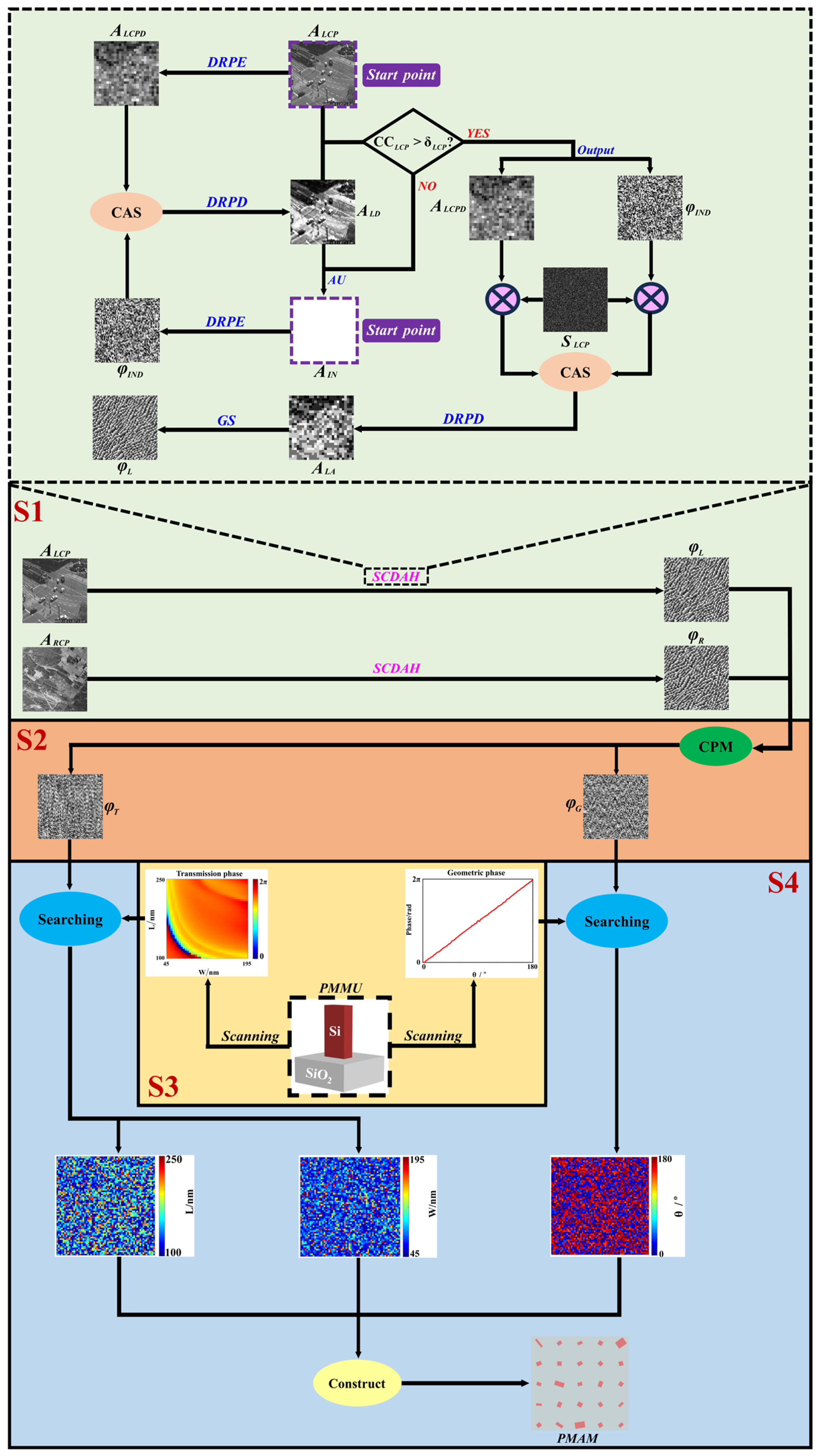
The encryption framework of the proposed metasurface-enabled dual-channel optical image authentication method is depicted in
Figure 1, and the concrete encryption process are divided into the following four steps.
S1: Calculation of dual-channel authentication phases based on SCDAH algorithm
Dual-channel authentication phases corresponding to two plaintext images (LCP channel plaintext image and RCP channel plaintext image ) are respectively calculated by using the SCDAH algorithm, and the concrete calculation process is described as follows.
Taking LCP channel plaintext image
as an example: First, a matrix with the same pixel numbers as
, and with all elements being 1, is set as the initial amplitude
. Subsequently, a double random phase encoding (DRPE) operation is respectively performed on
and
, and the amplitude
generated by
after the DRPE operation and the phase
generated by
after the DRPE operation are extracted, and then
and
are combined into a new complex amplitude
. Thereafter, a double random phase encoding and decoding (DRPD) operation is performed on
, and the amplitude generated by
after the DRPD operation is extracted and served as the decoded image
, which can be expressed as [
25]:
where
,
,
,
respectively represent double random phase encoding, double random phase decoding, amplitude extraction, and phase extraction operations.
Next, the correlation coefficient
between the decoded image
and the plaintext image
is calculated. If the correlation coefficient
does not reach the preset threshold
, the initial amplitude
is updated using the decoded image
, and then Formula (1) is executed again. On the contrary, if the correlation coefficient
exceeds the preset threshold
,
and
in this iteration need to be output, that is
. Subsequently, a sparse constraint operation is imposed on
by using a sparse matrix
to obtain a sparse complex amplitude, after which a DRPD operation is executed on this sparse complex amplitude, thereby the authenticated amplitude
is produced, which can be expressed as
Thereafter,
is employed as the target amplitude, and then GS algorithm in the Fourier domain [
26,
27] is used to iteratively compute the phase-only hologram corresponding to this target amplitude, in which the correlation coefficient
between the holographic reconstructed image and the target amplitude
is selected as the evaluation function, and the preset threshold
is set as
. Finally, the phase distribution of this hologram is output as the LCP channel authentication phase
.
Similarly, according to the above steps, the RCP channel authentication phase corresponding to RCP channel plaintext image is also obtained. Afterwards, the encryption step S2 is run.
S2: Calculation of transmission phase and geometric phase based on CPM
Based on the CPM principle, the target transmission phase
and geometric phase
of the polarization-multiplexing metasurface to be designed can be calculated by using the dual-channel authentication phases (
and
) obtained in the encryption step S1, which can be respectively expressed as
Afterwards, the encryption step S2 is run.
S3: Design structure and parameter scanning of metasurface unit
Firstly, the operating wavelength and material selection for the metasurface unit are set, and a three-dimensional nanopillar geometric model of the metasurface unit is established. Then, the constructed nanopillar performs parameter scanning with the nanopillar height fixed by using an electromagnetic simulation software (Lumerical FDTD Solutions 2020R2). Finally, the transmission phase modulation for different nanopillar lengths and widths, as well as the geometric phase modulation for different nanopillar rotation angles, are obtained, which are recorded separately as the transmission phase database and the geometric phase database. Afterwards, the encryption step S4 is run.
S4: Construction of PMAM
The length L and width W of each nanopillar corresponding to the target transmission phase obtained in the encryption step S2 are searched pixel by pixel from the transmission phase database obtained in the encryption step S3. Likewise, the rotation angle of each nanopillar corresponding to the target geometric phase obtained in the encryption step S2 are also searched pixel by pixel from the geometric phase database obtained in the encryption step S3. After traversing all the pixels, the structural parameters corresponding to each nanopillar are obtained, thereby completing the construction of PMAM.
So far, the encryption process has finished completely.
2.2. Authentication Process
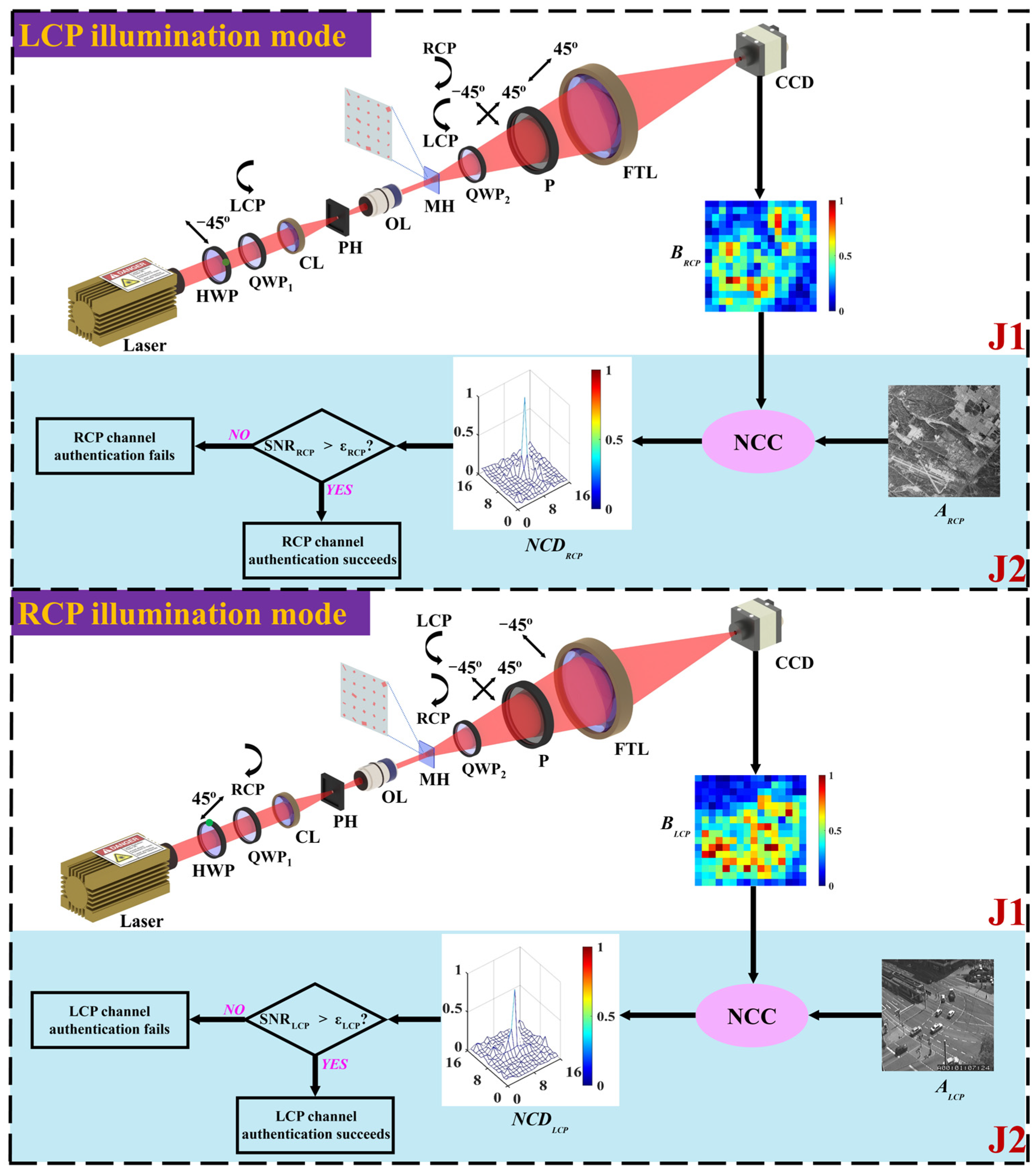
The authentication process in accord with the encryption process described above is shown in
Figure 2, and it is divided into the following two steps.
J1: Diffraction of authentication metasurface under polarized illumination
A collimated RCP light is used to illuminate this PMAM, and then the light wave, after phase modulation by the PMAM, begins to diffract forward. After the RCP background component in the diffracted light is filtered out, the LCP component in the diffracted light is obtained in the far field, and its amplitude information is recorded as the LCP channel diffraction image . Similarly, a collimated LCP light is also adopted to illuminate this PMAM, and then the light wave, after phase modulation by the PMAM, also begins to diffract forward. After the LCP background component in the diffracted light is filtered out, the RCP component in the diffracted light is obtained in the far field, and its amplitude information is recorded as the RCP channel diffraction image . Afterwards, the authentication step J2 is run.
J2: Nonlinear correlation authentication of polarization channel-dependent diffractive images
The nonlinear correlation distribution
between the LCP channel diffraction image
and the LCP channel plaintext image
is calculated by using a nonlinear correlation algorithm [
28,
29,
30], which can be expressed as
where
and
respectively represent the operations of Fourier transform and inverse Fourier transform, and
stands for the nonlinear intensity coefficient. Then, the central peak and the highest peak other than the central peak in the nonlinear correlation distribution
are respectively defined as the signal and the noise, and thus the signal-to-noise ratio
of
can be calculated. Likewise, the nonlinear correlation distribution
between the RCP channel diffraction image
and the RCP channel plaintext image
is also calculated, and then the signal-to-noise ratio
of
also can be calculated.
When the calculated exceeds the preset threshold , it indicates that the LCP channel authentication is successful; otherwise, it indicates that the LCP channel authentication has failed. When the calculated exceeds the preset threshold , it indicates that the RCP channel authentication is successful; otherwise, it indicates that the RCP channel authentication has failed. When and respectively exceed their corresponding preset thresholds and , it signifies that dual-channel authentication has been successfully completed.
So far, the authentication process has finished completely. It is worth noting that the authentication step J1 can be performed either digitally or optically, and when it is carried out optically, a metasurface diffraction imaging system based on polarized illumination needs to be used, which is also shown in
Figure 2.
In fact, the purpose of this system is to obtain the far-field diffraction patterns of the PMAM for the incident LCP and RCP lights, and the far-field diffraction described here is the famous Fraunhofer diffraction. The concrete diffraction imaging process is described as follows: (1) LCP illumination mode: a linearly polarized (LP) light emitted from Laser is sequentially incident perpendicularly onto a half-wave plate (HWP) and a quarter-wave plate (QWP1). By rotating this HWP, the LP direction of the light exiting from HWP forms a 45° angle with the slow axis of the QWP1. At this point, the light emerging from QWP1 is LCP. Subsequently, this LCP light passes through a beam-compressing and collimation system composed of a convex lens (CL), a pinhole (PH), and an objective lens (OL), forming a collimated LCP light which is incident perpendicularly onto the PMAM. The light wave phase-modulated by the PMAM then begins to propagate forward via diffraction. It sequentially passes through another quarter-wave plate (QWP2) and a polarizer (P). By rotating this P, the LP direction of the light exiting from P forms a 45° angle with the fast axis of the QWP2, thereby filtering out the LCP background component in the diffracted light. Thereafter, the diffracted light reaches the CCD through a Fourier transform lens (FTL). It is noted that the distance between the PMAM and the FTL is set to the focal length of the FTL, and the distance between the FTL and the CCD is also set to the focal length of the FTL. So far, the diffraction process of the PMAM under LCP illumination has completed, and the image recorded on the CCD at this time is the RCP channel diffraction image. (2) RCP illumination mode: A LP light emitted from Laser is also sequentially incident perpendicularly onto the HWP and the QWP1. By rotating this HWP, the LP direction of the light exiting from HWP forms a 45° angle with the fast axis of the QWP1. At this point, the light emerging from QWP1 is RCP. Subsequently, this RCP light also passes through the beam-compressing and collimation system, forming a collimated RCP light which is also incident perpendicularly onto the PMAM. Then, the light wave phase-modulated by the PMAM also begins to diffractively propagate forward and also sequentially passes through the QWP2 and the P. By rotating this P, the LP direction of the light exiting from P forms a 45° angle with the slow axis of the QWP2, thereby filtering out the RCP background component in the diffracted light. Thereafter, the diffracted light also reaches the CCD through the FTL. So far, the diffraction process of the PMAM under RCP illumination also has completed, and the image recorded on the CCD at this time is the LCP channel diffraction image.
3. Simulations and Results
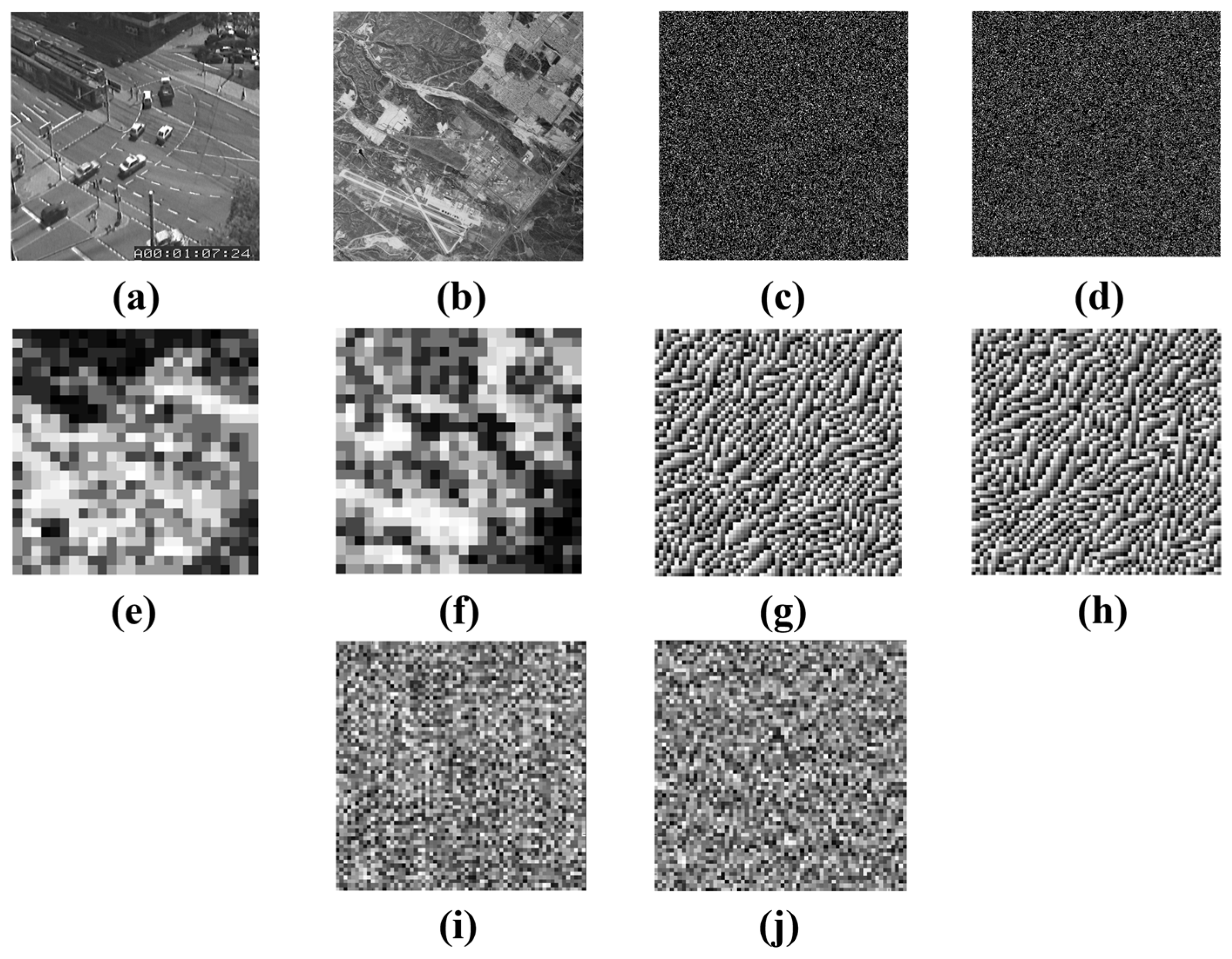
To validate the feasibility of the proposed metasurface-enabled dual-channel optical image authentication method, a series of numerical simulations are conducted by combining MATLAB (R2020b) with FDTD (2020R2). Firstly, two grayscale images (“Surveillance” and “Aerial”) are respectively selected as the LCP channel plaintext image
and the RCP channel plaintext image
, which are shown in
Figure 3a and
Figure 3b, respectively. Then, two sparse matrices with the sparsity of 20% are randomly generated and served as
and
, which are depicted in
Figure 3c and
Figure 3d, respectively. In addition, the wavelength
of light used for encryption is set as 632.8 nm. Both the preset threshold value
for
and the preset threshold value
for
are set as 0.94 in the SCDAH algorithm, and both the preset threshold value
for
and the preset threshold value
for
are set as 0.9995 in the GS algorithm. After performing the encryption step S1, two authentication amplitudes,
and
, are generated, which respectively are shown in
Figure 3e and
Figure 3f; meanwhile, the LCP channel authentication phase
and the RCP channel authentication phase
are also obtained and are respectively depicted in
Figure 3g and
Figure 3h. Thereafter, based on the CPM principle, the target transmission phase
and geometric phase
of the PMAM to be designed are calculated, which are shown in
Figure 3i and
Figure 3j, respectively.
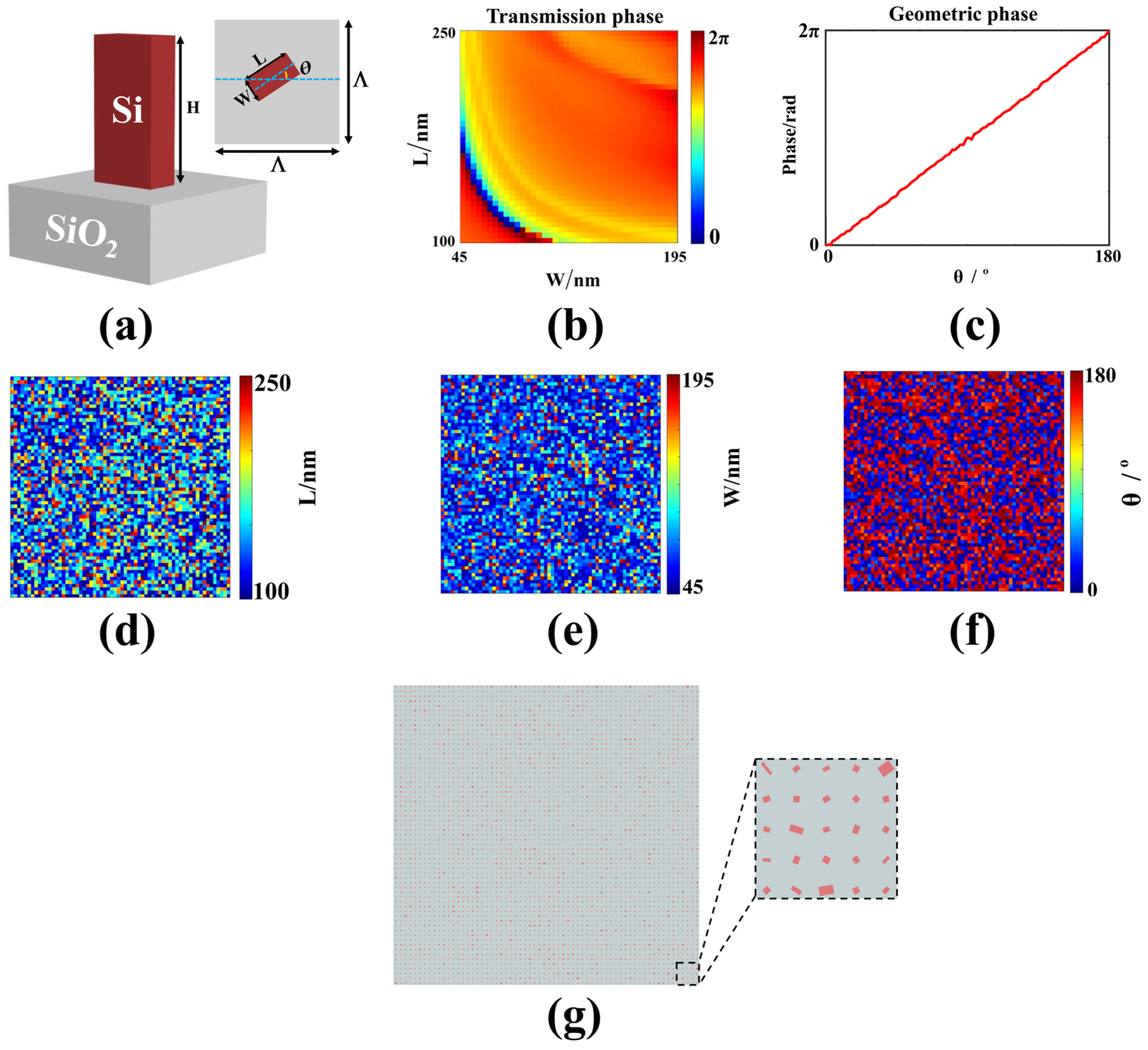
Next, a metasurface unit model combining a silicon dioxide (SiO
2) substrate with a rectangular silicon (Si) nanopillar is designed, whose three-dimensional geometric structure is shown in
Figure 4a. The reason for designing and selecting this type of metasurface unit is from two perspectives of structural configuration and material selection. In terms of structural configuration, a rectangular silicon nanopillar is selected owing to its anisotropic geometric structure with high fabrication feasibility, and this structure allows independent modulation of the transmission phase and the geometric phase, which well satisfies the mechanism requirement of CPM. In terms of material selection, SiO
2 features a relatively low refractive index, high optical transparency, and low absorption loss, making it an ideal substrate material. Then, a high-refractive-index and low-loss material is preferred for the phase-modulating nanopillar structure. Si is abundant in nature, mature in nanofabrication, and possesses high transmittance and a large refractive index at the working wavelength; thus, silicon is employed as the material for the nanopillar. In addition, the period
of this metasurface unit is set as
, and the height
of Si nanopillar is set as
. Subsequently, the length
and width
of the Si nanopillar are used in the operation of parameter scanning in the FDTD to obtain the transmission phase modulation for different nanopillar lengths
and widths
, where the scanning ranges for the length
and width
are set as
and
, respectively. Similarly, the rotation angle
of the Si nanopillar is used in the operation of parameter scanning in the FDTD to obtain the geometric phase modulation corresponding to different nanopillar rotation angles
, where the scanning range for the rotation angle
is set from
to
, respectively. In such a way, both the transmission phase database and the geometric phase database are obtained, which are shown in
Figure 4b and
Figure 4c, respectively. Afterwards, the length
and width
of each Si nanopillar corresponding to the target transmission phase
shown in
Figure 3i are determined pixel by pixel by searching within the transmission phase database illustrated in
Figure 4b. After traversing all pixels, the length and width distributions of nanopillar array are obtained, which are shown in
Figure 4d and
Figure 4e, respectively. Likewise, the rotation angles
of each Si nanopillar corresponding to the target geometric phase
shown in
Figure 3j is also determined pixel by pixel by searching within the geometric phase database illustrated in
Figure 4c. After traversing all pixels, the rotation angle distributions of nanopillar array is also obtained, which is shown in
Figure 4f. In such a way, all structural parameters of each metasurface unit are determined, thereby enabling the construction of PMAM, which is displayed in
Figure 4g. Moreover, the detailed information about this PMAM is summarized in
Table 1. So far, the encryption step has been completed.
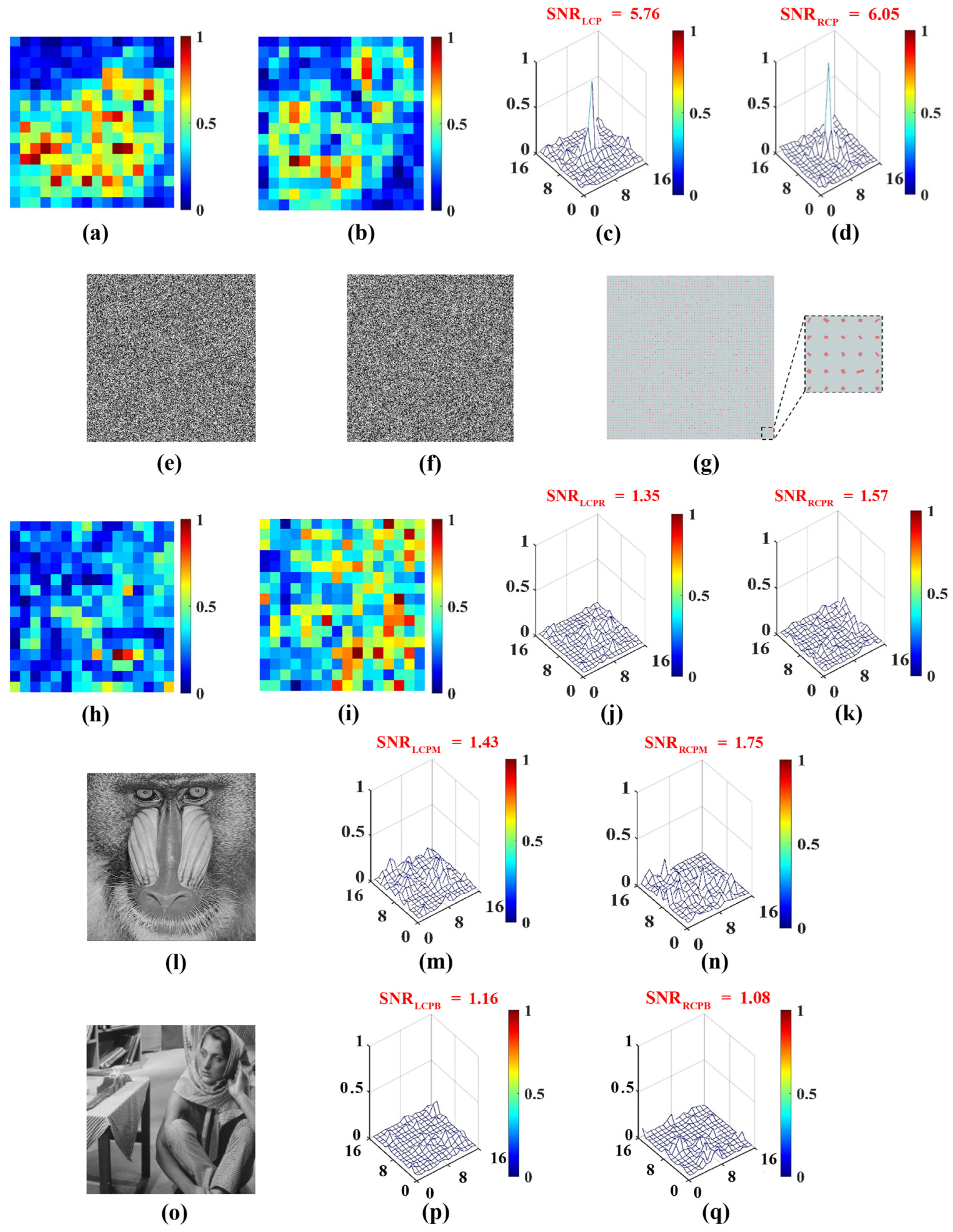
Thereafter, the authentication process begins using the PMAM shown in
Figure 4g. First, the LCP channel diffraction image
and the RCP channel diffraction image
are generated through the authentication step J1 and are displayed in
Figure 5a and
Figure 5b, respectively. Subsequently, the nonlinear correlation distribution
between
and
, as well as the nonlinear correlation distribution
between
and
are calculated, which are shown in
Figure 5c and
Figure 5d, respectively. Afterwards, the signal-to-noise ratio
of
is calculated as 5.76, exceeding the preset threshold
= 3, while the signal-to-noise ratio
of
is calculated as 6.05, also exceeding the preset threshold
= 3. This indicates that this PMAM can be successfully authenticated with a plaintext image under two different polarized illuminations, respectively. In other words, dual-channel authentication is realized, that is, double identities of the user holding this PMAM can be simultaneously verified.
Next, both authentication validity and accuracy of the PMAM are tested. First, two random phases are arbitrarily generated, and they are served as two test phases corresponding to the LCP channel authentication phase
and the RCP channel authentication phase
, which are depicted in
Figure 5e and
Figure 5f, respectively. After completing the encryption steps S2–S4, another PMAM (PMAMR) is constructed, which is shown in
Figure 5g. Then, the LCP channel diffraction image
and the RCP channel diffraction image
corresponding to PMAMR are generated through the authentication step J1, which are displayed in
Figure 5h and
Figure 5i, respectively. Subsequently, the nonlinear correlation distribution
between
and
, as well as the nonlinear correlation distribution
between
and
, are calculated, which are shown in
Figure 5j and
Figure 5k, respectively. Afterwards, the signal-to-noise ratio
of
is calculated as 1.35, which is lower than the preset threshold
= 3, while the signal-to-noise ratio
of
is calculated as 1.57, which is also lower than the preset threshold
= 3. This indicates that this PMAMR cannot realize successful authentication with any plaintext image, thus proving a reliable authentication validity of the PMAM in our proposed method.
In addition, two grayscale images (“Mandrill” and “Barbara”) different from the aforementioned dual-channel plaintext images (“Surveillance” and “Aerial”) are arbitrarily selected, which are displayed in
Figure 5l and
Figure 5o, respectively. Subsequently, the nonlinear correlation distribution
between
and the grayscale image (“Mandrill”), the nonlinear correlation distribution
between
and the grayscale image (“Mandrill”), the nonlinear correlation distribution
between
and the grayscale image (“Barbara”), and the nonlinear correlation distribution
between
and the grayscale image (“Barbara”) are calculated, which are shown in
Figure 5m,
Figure 5n,
Figure 5p and
Figure 5q, respectively. Afterwards, the signal-to-noise ratio
of
and the signal-to-noise ratio
of
are respectively calculated as 1.43 and 1.16, which are lower than the preset threshold
= 3; meanwhile, the signal-to-noise ratio
of
and the signal-to-noise ratio
of
are respectively calculated as 1.75 and 1.08, which are also lower than the preset threshold
= 3. This indicates that this PMAM successfully authenticated with dual-channel plaintext images (“Surveillance” and “Aerial”) cannot be authenticated with other arbitrarily selected grayscale images (“Mandrill” and “Barbara”), thus demonstrating a high authentication accuracy of the PMAM in our proposed method.
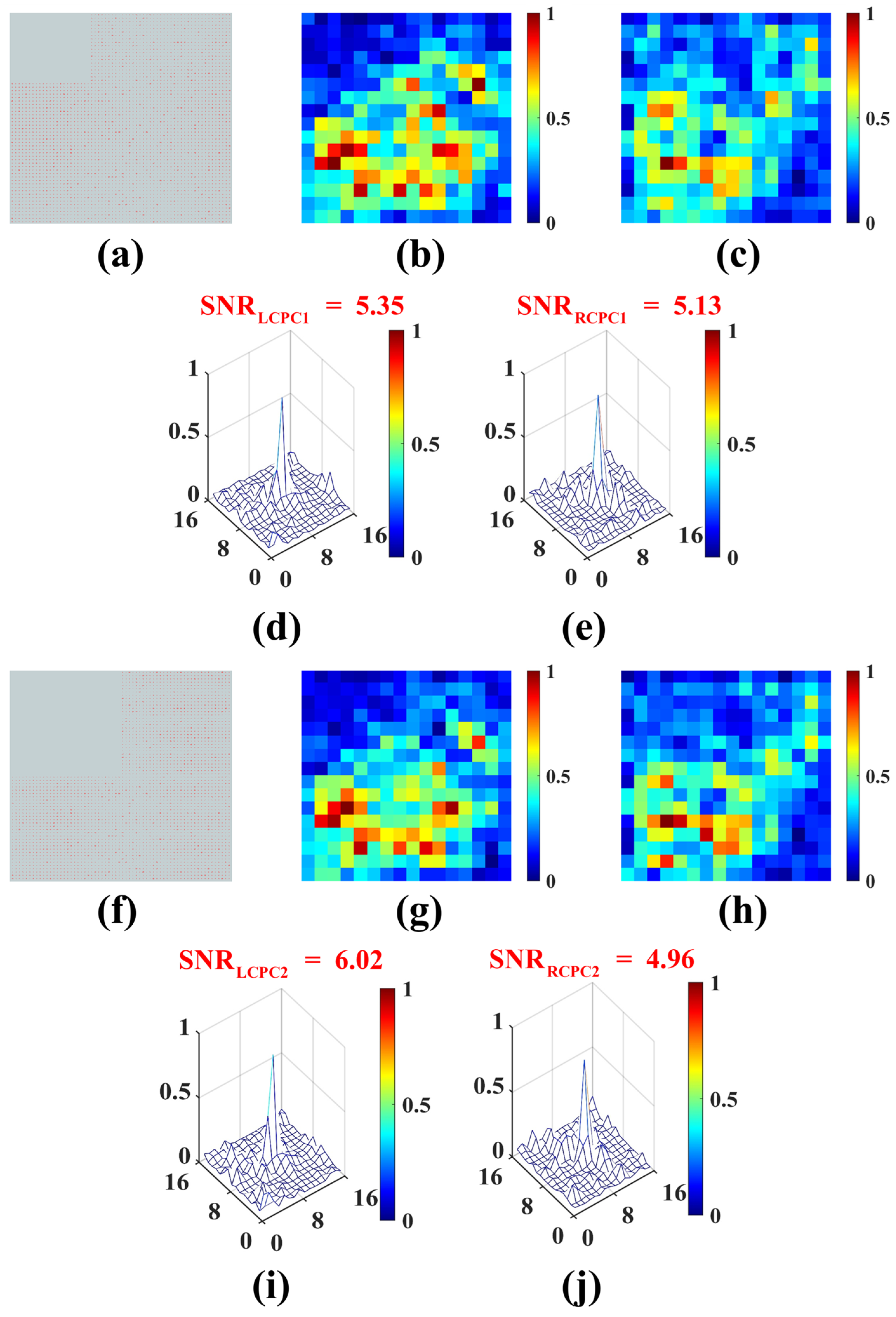
Finally, the resistance of the PMAM to cropping attack is also tested in order to evaluate the robustness. The test results about cropping robustness are shown in
Figure 6, where the cropped PMAMs with the cropping ratios of 12.5% and 25% are respectively presented in
Figure 6a and
Figure 6f. The LCP channel diffraction image
and the RCP channel diffraction image
obtained after performing the authentication step J1 on the cropped PMAM shown in
Figure 6a are respectively displayed in
Figure 6b and
Figure 6c. The nonlinear correlation distribution
between
and
, as well as the nonlinear correlation distribution
between
and
, are respectively shown in
Figure 6d and
Figure 6e. The LCP channel diffraction image
and the RCP channel diffraction image
obtained after performing the authentication step J1 on the cropped PMAM shown in
Figure 6d are respectively displayed in
Figure 6g and
Figure 6h. The nonlinear correlation distribution
between
and
, as well as the nonlinear correlation distribution
between
and
, are respectively shown in
Figure 6i and
Figure 6j. From the nonlinear correlation distributions shown in
Figure 6, it can be clearly observed that obvious correlation peaks appear in all the nonlinear correlation distributions, even if the cropping ratio is as high as 25%, meanwhile the signal-to-noise calculated from each nonlinear correlation distribution is larger than corresponding preset threshold. This indicates that the cropped PMAM can still be effectively authenticated with dual-channel plaintext images, thus demonstrating that the PMAM possesses strong robustness against cropping attack.
4. Discussion and Conclusions
In this paper, we propose a metasurface-enabled dual-channel optical image authentication method based on polarization multiplexing. In the encryption process, the SCDAH algorithm is initially adopted to compute dual-channel authentication phases associated with a pair of plaintext images. The target transmission phase and geometric phase required for the PMAM to be designed are subsequently derived according to the CPM principle. The structural parameters of each nanopillar are then determined on a pixel-by-pixel basis using the pre-established parameter-scanning databases of the metasurface unit, leading to the construction of the PMAM. In the authentication process, the PMAM is separately irradiated by LCP and RCP light, generating two pseudo-random far-field diffraction patterns. These two diffraction patterns can be then authenticated with the corresponding plaintext images individually with the help of NCC algorithm. To demonstrate the feasibility of the proposed metasurface-enabled dual-channel optical image authentication method based on polarization multiplexing, a series of numerical simulations are performed, and the simulation results show that the proposed method exhibits high feasibility and security. Furthermore, the capability of this metasurface to resist cropping attack is also tested, and it is sure that the PMAM has strong robustness against cropping attack. In summary, this proposed method establishes an efficient authentication mode, breaking through the rigid constraint of conventional single metasurface-to-single image. The upper limits of both capacity and efficiency for authentication metasurface are elevated from physical mechanism perspectives, establishing a high-capacity authentication architecture that runs in parallel with algorithm optimization strategies [
22,
23].
Since our proposed method lies at the intersection field of optical information security and metasurface optical field manipulation, one representative existing technique from each field is selected for comparison so as to demonstrate the advantages of our proposed method. Firstly, compared to the authentication metasurface proposed in Ref. [
21], the capacity and efficiency of the authentication metasurface have doubled. This type of improvement is quite intuitive, and our proposed method based on physical characteristic multiplexing is compatible with the algorithmic optimization scheme. In addition, compared to the polarization multiplexing metasurface proposed in Ref. [
31], the integrated single-unit structure of our proposed method does not require splicing and combination of multiple substructures, which greatly reduces the design complexity, processing difficulty and process error of the metasurface. At the same time, the single-unit structure can effectively improve the space utilization rate of the metasurface, providing a better structural foundation for the miniaturization and integration of the metasurface. In contrast, the composite dual-unit structure of the polarization multiplexing metasurface proposed in Ref. [
31] has extremely high requirements on the relative position and angle matching of the two substructures, and assembly errors are easy to occur in the processing process, which in turn affects the polarization regulation effect, resulting in higher difficulty in engineering application.
For future work, two parallel strategies, including our proposed physical characteristic multiplexing method and the previously proposed algorithm optimization methods [
22,
23], can be organically integrated for further improving the authentication capacity and efficiency. In addition, non-orthogonal polarization multiplexing will be considered as a significant upgrade of polarization multiplexing used in our proposed method. Furthermore, the potential combination of the proposed method with classical encryption and quantum encryption [
32] also will be the next research direction for developing advanced cryptographic algorithms. For classical encryption, PMAM is integrated with AES-256 and SM4 to build a dual encryption system of physical and digital encryption, and its polarization multiplexing property is exploited to develop a multi-dimensional multiplexing encryption algorithm combining polarization, wavelength and orbital angular momentum, achieving a larger encoding information capacity for big data scenarios. For quantum encryption, the PMAM can be served as the quantum light modulator to modulate the polarization state of single photons, and the dual-channel polarization characteristic of PMAM can be used to realize the secure distribution and authentication of quantum keys, which solves the problem of low integration of traditional quantum key distribution systems. In addition, the quantum image information also can be encoded into the polarization and phase of the metasurface by using the quantum superposition characteristic of single photons for realizing the non-cloning authentication of quantum image information. Additionally, future research will focus on reconfigurable PMAM based on phase change materials like Ge
2Sb
2Te
5 for dynamic authentication information adjustment, and on-chip integration of PMAM with optical authentication systems via planar lightwave circuit (PLC) technology for miniaturized, portable devices.