Article

On-Chip Optical Signal Enhancement in Micro-Ring Resonators Using a NaYF4:Er3+-Doped Polymer Nanocomposite


State Key Laboratory of Integrated Optoelectronics, College of Electronic Science and Engineering, Jilin University, Changchun 130012, China
*
Author to whom correspondence should be addressed.
Photonics 2026, 13(2), 200; https://doi.org/10.3390/photonics13020200
Submission received: 28 January 2026 / Revised: 10 February 2026 / Accepted: 16 February 2026 / Published: 18 February 2026
(This article belongs to the Section Optoelectronics and Optical Materials)

Abstract

This study develops a micro-ring resonator that provides optical amplification based on NaYF4:5%Er3+ nanoparticles doped with SU-8. By utilizing the frequency selection properties of the micro-ring resonator, a filter with amplification capabilities is successfully developed. The device features a quality factor of 5.72 × 10⁴ and a free spectral range of 0.081 nm. Operating at an on-chip power of 108 mW, the micro-ring resonator amplifier exhibits a relative gain of 8.92 dB within a size of 2.3 cm × 1.5 cm. To the best of our knowledge, the amplification of optical signals in micro-ring resonators using erbium-doped polymers has not been reported. This technology highlights the significant potential of using erbium-doped materials to fabricate various integrated devices for on-chip optical amplification.

1. Introduction

Silicon photonic chips, which are the result of the deep integration of modern semiconductors with photonic technology, have garnered widespread attention in fields such as information transmission, computing, medicine, and energy, owing to their notable advantages in high integration, low cost, and low power consumption. Micro-ring resonators (MRRs), with their small dimensions, low power consumption [1,2,3,4,5], and high level of integration, have emerged as crucial components of silicon optical chips for applications in high-speed communication [6,7], optical sensing [8,9], optical filters [10] and other fields [11,12,13]. They can exert a pivotal influence in application scenarios such as optical signal processing, modulation, and filtering.
A photonic integrated chip comprises not only passive devices like waveguides, splitters, and MRRs but also has active components. Among the latter, the optical waveguide amplifier plays a vital role by providing compensation for on-chip optical signal loss. Recently, among the many optical waveguide amplifier materials [14,15,16], polymers have attracted extensive attention from researchers due to their significant advantages, such as easy adjustment of refractive index, simple processing, and easy integration with various material platforms. Recent years have witnessed substantial progress in rare-earth-doped nanocrystal-based polymer waveguide amplifiers, where continuous technological innovations have led to remarkable enhancements in overall device performance. A maximum internal net gain of 17 dB in the C-band is achieved by the polymer waveguide amplifier employing NaLu0.1Y0.7F4:Er3+,Yb3+@NaLuF4-PMMA nanoparticles as the gain medium [17]. Using an ErIII complex as the gain medium under 365 nm LED pumping, an up-conversion emission pathway distinct from conventional 980 nm or 1480 nm pumping schemes was successfully realized, achieving a relative gain of 10.5 dB at 1535 nm [18]. An S+C dual-band optical waveguide amplifier has been successfully fabricated utilizing NaYF4: Tm, Yb@NaYF4@ NaYF4: Er composite nanoparticles [19]. Optical amplification spanning the C+L telecommunication bands has been successfully achieved employing LiYF4: Yb, Er, Ce@ LiYF4: Yb core–shell nanostructures as the active gain material. The system exhibits net gain coefficients of 12.6 dB at 1535 nm and 3.7 dB at 1610 nm, validating its efficient broadband amplification characteristics across this extended wavelength range [20]. In summary, despite substantial progress in the gain performance of Er-doped polymer optical waveguide amplifiers and the broadening of their operating wavelength range, further improvements are still required. Future efforts should focus on achieving gain flatness across the entire operating spectrum, reducing propagation losses to enable higher signal output power at lower pump thresholds, and advancing monolithic integration with other photonic components. The fabrication of photonic components using rare-earth-doped polymers represents a highly promising research direction. This approach achieves optical signal enhancement through pump excitation of rare earth ions while preserving the original device functionality, offering a viable route toward substantially improved chip performance.
Herein, we innovatively demonstrate the first MRR fabricated from an erbium-doped polymer, enabling signal amplification under pump excitation while maintaining its resonant characteristics. In this work, NaYF4:5%Er3+ nanoparticles (NPs) were doped into a commercial SU-8 2002 photoresist to form the waveguide core, with polymethyl methacrylate (PMMA) serving as the upper cladding layer. The fabricated MRR achieved a quality factor (Q) of 5.72 × 10⁴ and a free spectral range (FSR) of 0.081 nm. Under an on-chip pump power of 108 mW, the MRR exhibited a relative gain of 8.92 dB at 1527 nm.
The experimental results validate the loss compensation capability of the proposed Er3+-doped polymer MRR filter, a key advancement that is expected to significantly enhance the performance of polymer-based photonic integrated circuits (PICs) incorporating such active filters.

2. Materials and Simulation of the Proposed Structure

2.1. Material Preparation and Characterization

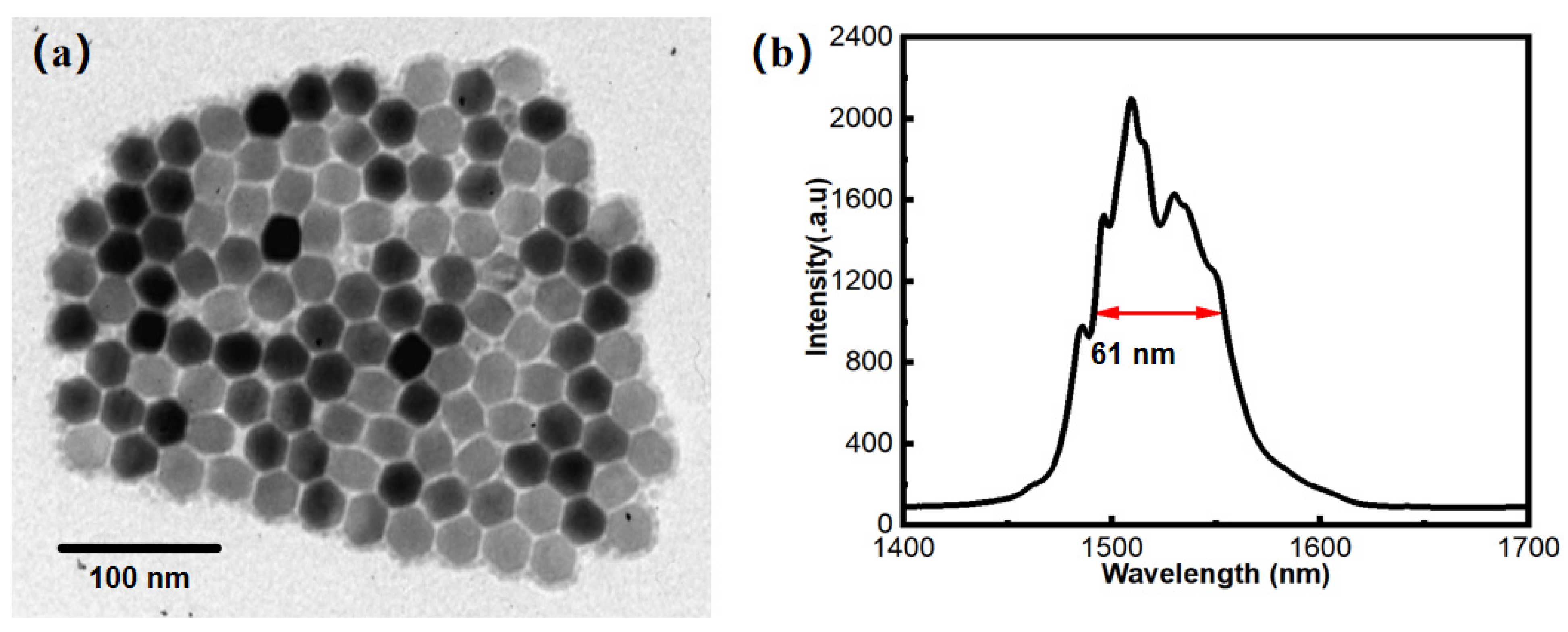
NaYF4:5%Er3+ nanoparticles were synthesized via a thermal decomposition method [21]. These nanoparticles were then incorporated into commercial SU-8 2002 photoresist to form the waveguide core, while PMMA was used as the upper cladding material. To verify the C-band (1530–1565 nm) gain potential of the composite material, the nanoparticles were first characterized by transmission electron microscopy (TEM). Figure 1a presents a TEM image of the NaYF4:5%Er3+ nanoparticles, showing well-defined hexagonal-phase crystals [22], with sizes ranging from 25 to 30 nm and an average diameter of approximately 28.84 nm. The uniform size and homogeneous dispersion of the nanoparticles contribute to the formation of nanocomposite polymers with low scattering loss, which is essential for achieving high gain in polymer optical waveguide amplifiers [23]. As shown in Figure 1b, the emission spectrum of the nanoparticles under 976 nm laser excitation displays a strong emission across the C-band, with a full width at half maximum (FWHM) of 61 nm (1492–1553 nm).

2.2. Simulation of the Proposed Structure

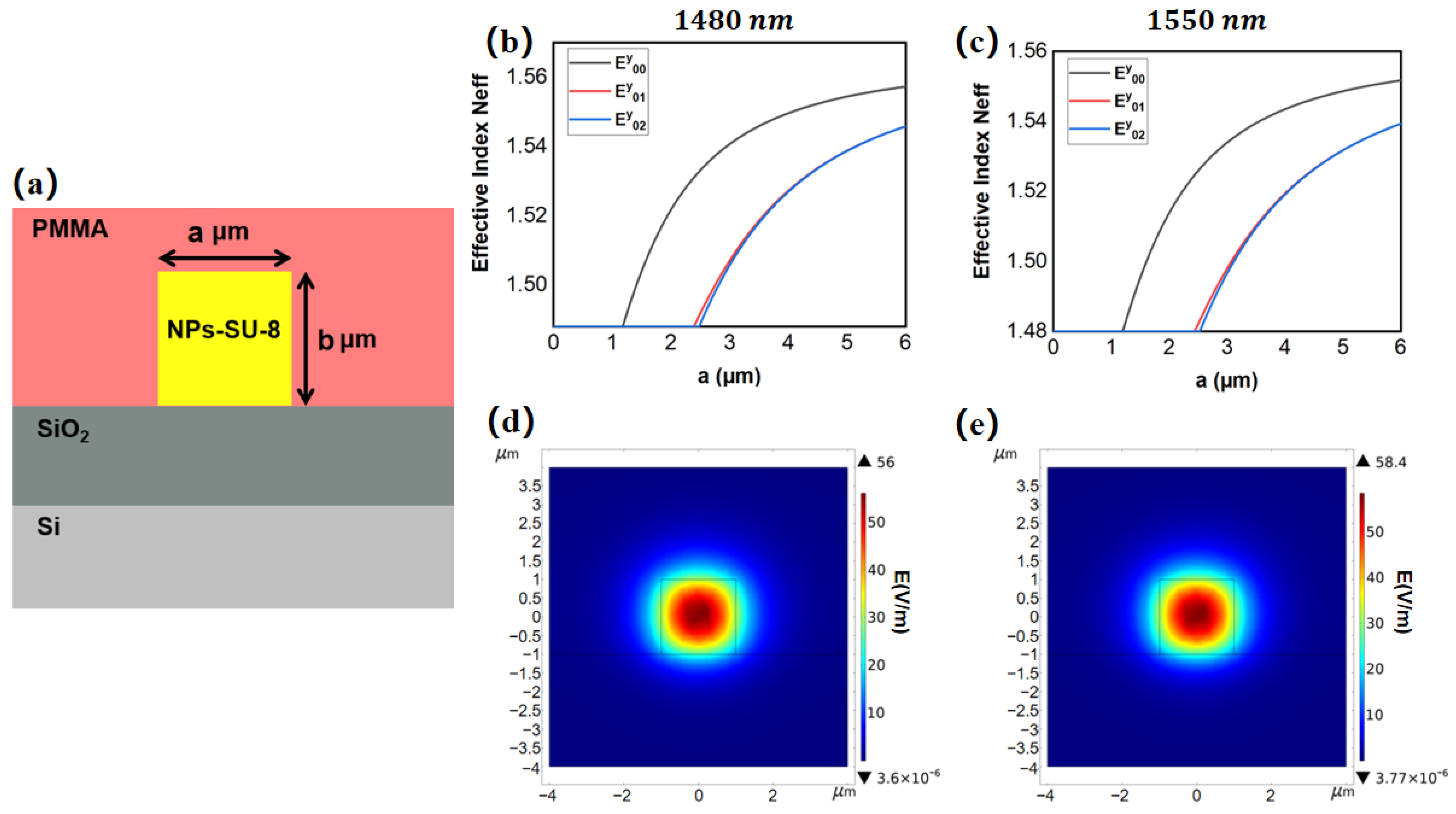
Based on the material refractive indices measured by ellipsometry (SiO2: 1.442; NPs-SU-8-2002: 1.56; PMMA: 1.48 @1550 nm), a waveguide structure was designed using nanoparticle-doped SU-8 as the core material, with PMMA and SiO2 serving as the upper and lower cladding layers, respectively. The waveguide cross section is shown in Figure 2a, where a and b denote the width and height of the waveguide, respectively. Using the effective index method, the relationship between the waveguide width a and the core-mode characteristics was simulated for a fixed waveguide height b = 2 µm. Figure 2b,c present the simulation results at 1480 nm and 1550 nm, respectively. A 2 µm × 2 µm waveguide cross-section is chosen to maintain single-mode operation at both the 1550 nm signal and 1480 nm pump wavelengths. We analyzed the optical field distributions of the 1480 nm pump light and the 1550 nm signal light, as shown in Figure 2d,e. When the Er3+ nanoparticles are uniformly distributed in the waveguide, the overlap integration factors of the signal light and pump light in the Er3+-doped region are 0.79 and 0.8, respectively. This effectively achieves mode overlap and enables efficient optical signal amplification.
The racetrack MRR structure consists of a directional coupler (DC) and a micro-ring waveguide. The wavelength-selective operation relies on optical resonance, enabling specific wavelengths to constructively interfere within the ring while effectively suppressing non-resonant wavelengths. The expression is as follows:
m λ = n e f f L ,
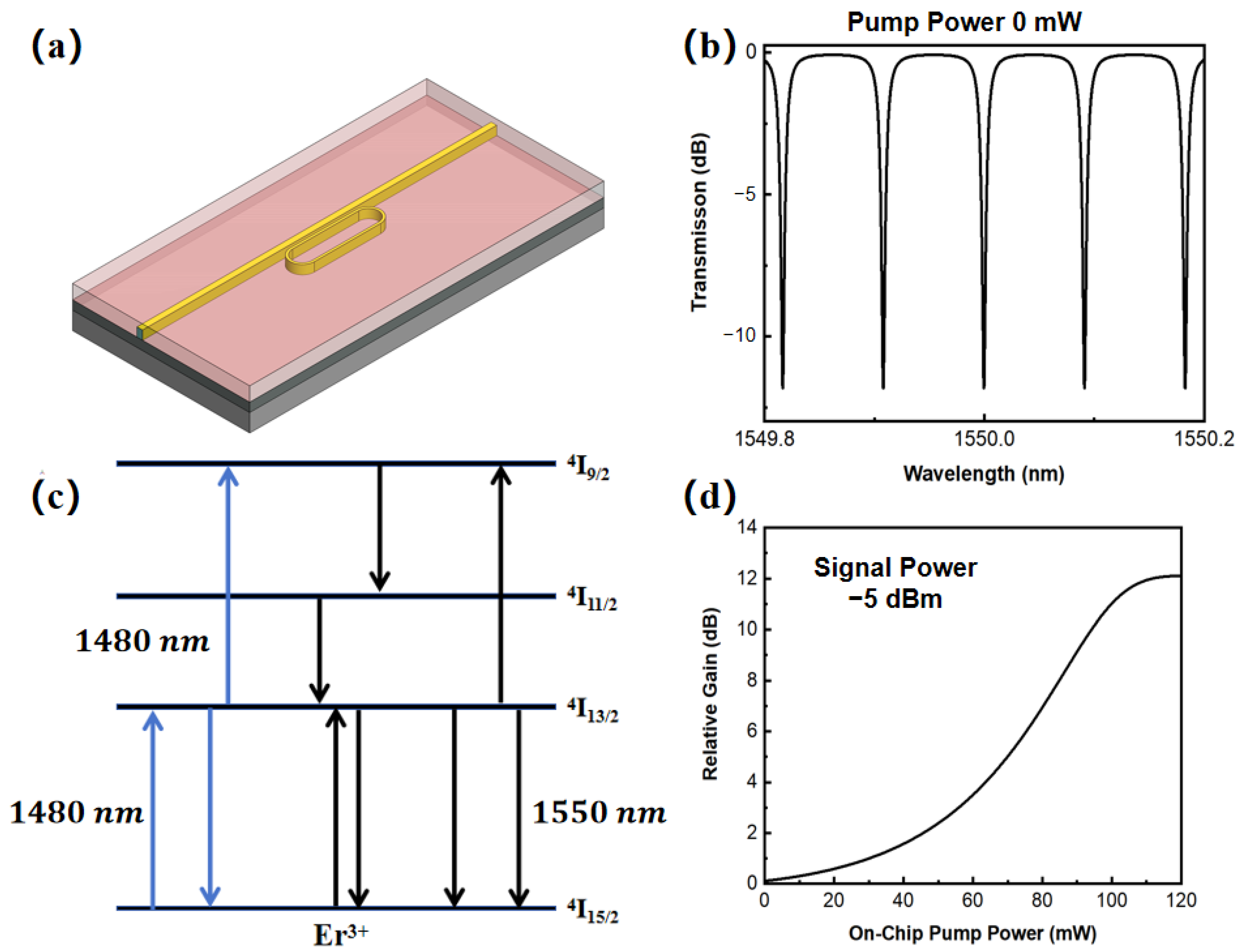
where m represents the resonant order of the MRR, λ is the resonant wavelength, n e f f is the effective refractive index, and L represents the length of the MRR. The MRR dimensions were specifically designed to support simultaneous resonance at both 1480 nm and 1550 nm wavelengths, enabling efficient pump and signal amplification for loss compensation. Figure 3a shows the proposed racetrack MRR configuration with a NPs-doped SU-8 waveguide core. Optical amplification performance is dependent on the coupling gap, which governs the energy coupling efficiency between components. An optimally designed coupling gap significantly enhances energy transfer into the ring waveguide. This allows the pump light to excite nanoparticles effectively over an extended distance, which in turn leads to enhanced amplification of the signal light. The 2 μm coupling gap configuration achieves an optimal trade-off between coupling efficiency and fabrication constraints, ensuring adequate optical performance within practical manufacturing tolerances.
Although a smaller MRR radius yields a larger FSR, it comes at the cost of increased bending loss. To achieve efficient optical resonance and minimize bend-induced radiation loss, it is critical for the resonance orders (mp and ms) of both the pump and signal light to be as close to integers as possible. Therefore, we selected an MRR radius of 1544 µm. Based on the parameters described above, the resonant characteristics of the active MRR were simulated. The simulated transmission spectrum of the MRR under 0 mW pump power is presented in Figure 3b. Figure 3c illustrates the energy-level diagram of Er3+ under 1480 nm pumping. By numerically solving the atomic rate equations and the optical power propagation equations [24,25,26], the relative gain of the waveguide amplifier as a function of pump power was obtained, presented in Figure 3d. The simulation indicates that at a pump power of 108 mW and a signal power of −5 dBm, a relative gain of 12.11 dB is achieved.

3. Results

3.1. Fabrication of Active MRR

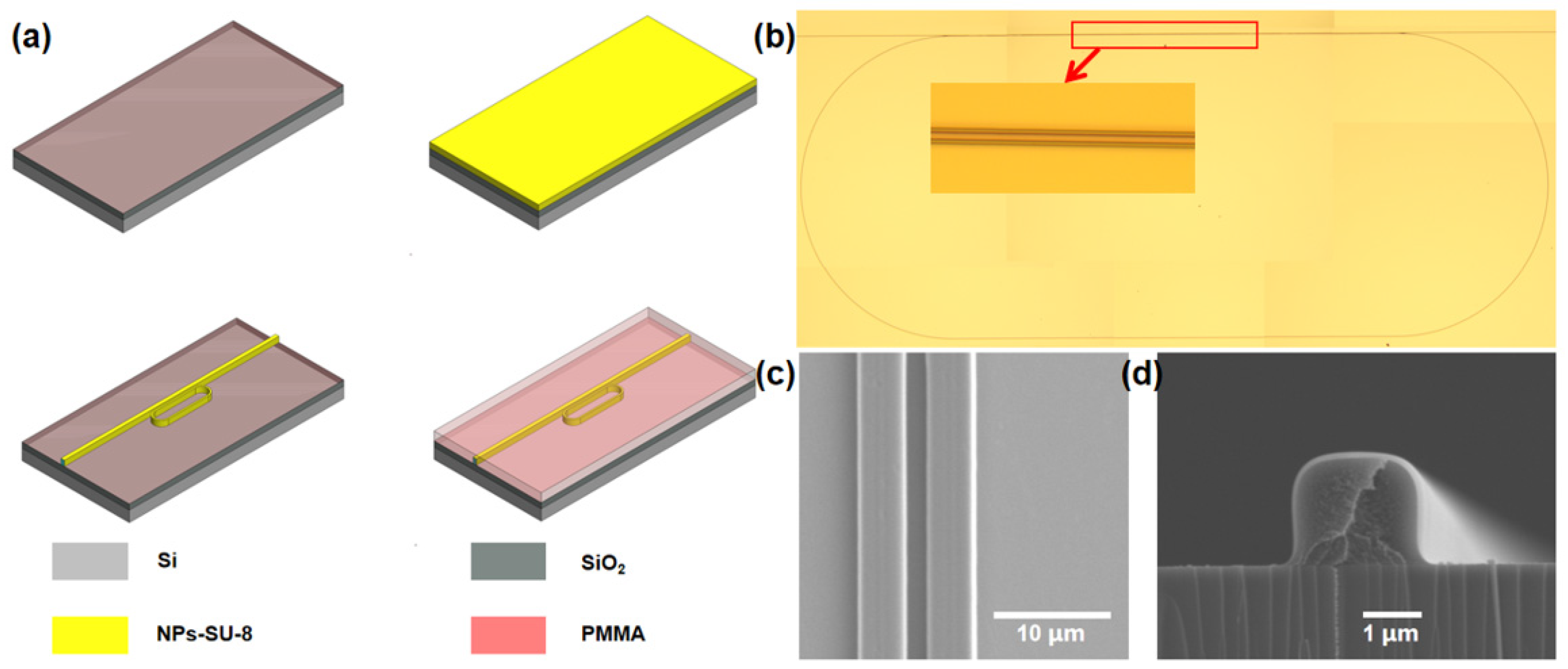
The fabrication process of the active MRR is illustrated in Figure 4a. Initially, NaYF4:5%Er3+ NPs were uniformly dispersed in SU-8 photoresist at 3wt% concentration. Subsequently, a 2 µm thick NP-doped SU-8 composite film was spin-coated onto a cleaned SiO2 substrate. The SiO2 substrate with the coated film underwent a soft-bake process (60 °C for 10 min, then 90 °C for 20 min) to avoid adhesion issues in subsequent fabrication steps. After soft baking, the substrate was cooled naturally to room temperature. The waveguide structure was then patterned on the pre-baked SiO2 substrate using UV lithography. Following lithography, a post-exposure bake was performed on the SiO2 substrate at 65 °C for 10 min and then at 95 °C for 20 min. This step helps to clearly define the developed pattern in the photoresist and improves the adhesion between the photoresist and the SiO2 substrate. After the post-exposure bake, the substrate was again cooled naturally to room temperature. The sample was then sequentially rinsed with PGMEA developer, isopropyl alcohol, and deionized water to remove the unexposed photoresist, thereby forming the MRR waveguide structures. Subsequently, the developed SiO2 substrate was placed in an oven and hard-baked at 120 °C for 120 min to stabilize the waveguide profiles. After hard baking, the substrate was cooled naturally to room temperature. Finally, after spin-coating the PMMA cladding, the fabrication of the erbium-doped polymer MRR resonator was complete. The chip was cleaved at the facets to expose the waveguides, enabling both end-face SEM characterization and direct fiber-to-waveguide coupling.
Figure 4b shows a microscopic image of the fabricated MRR, with the inset providing a detailed view of its directional coupler configuration. Figure 4c,d present scanning electron microscopy (SEM) images of the MRR’s directional coupler and the waveguide cross-section, respectively. From the figures, the fabricated directional coupler has a gap of 2 µm and a waveguide cross-section of 2 µm × 2 µm, both consistent with the design. Table 1 summarizes the key parameters of our designed the active MRR, including the simulated effective refractive index, effective mode area, mode overlap, and measured modal loss.

3.2. Characterization of the Active MRR

3.2.1. Propagation Loss Measurement

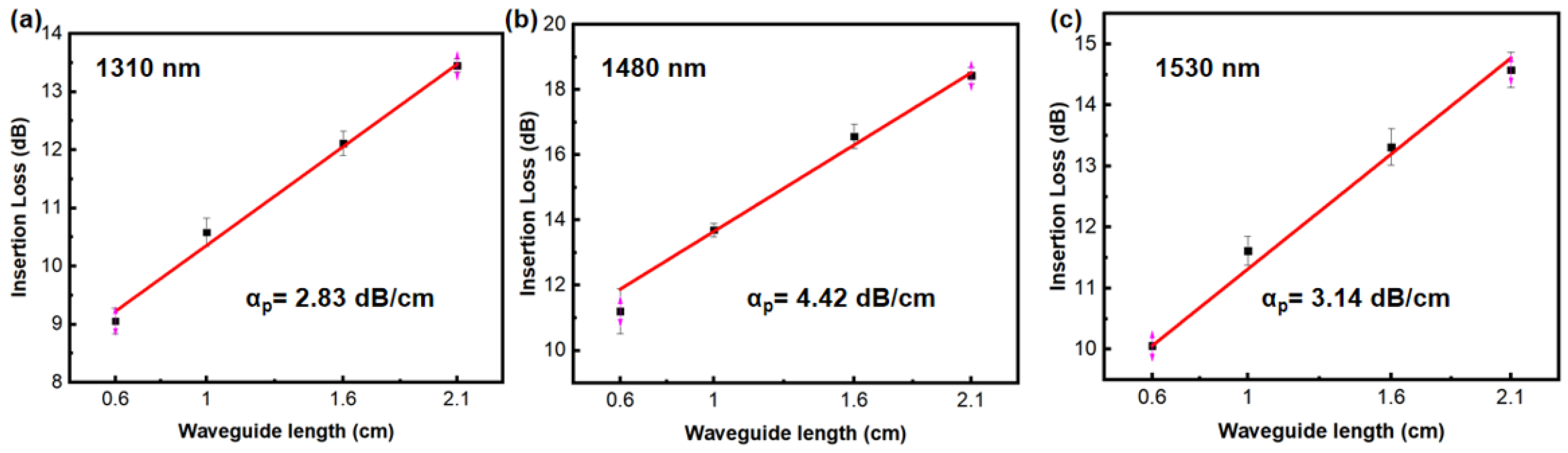
Before characterizing the spectral response and amplification of the active MRR, we measured the transmission loss of the waveguide using the cutback method. Throughout the measurement process, tapered fibers with a core diameter of 3 µm were used to minimize coupling loss between the fiber and the waveguide. The insertion loss (IL) can be expressed as:
I L   d B = α p L + 2 α c ,
where α p is the transmission loss of the waveguide, L is the waveguide length, and α c   is the coupling loss between each waveguide surface and the input/output optical fiber. We measured the insertion loss of waveguides with four different lengths (0.4 cm, 1 cm, 1.6 cm, and 2.1 cm) at wavelengths of 1310 nm, 1480 nm, and 1530 nm. These results are shown in Figure 5a–c. The extracted transmission losses are 2.83 dB/cm at 1310 nm, 3.14 dB/cm at 1530 nm, and 4.42 dB/cm at 1480 nm. The measured coupling losses are 3.7 dB/facet at 1310 nm, 4.6 dB/facet at 1480 nm, and 4.1 dB/facet at 1530 nm. The increased transmission losses observed at 1480 nm and 1530 nm, compared to 1310 nm, are primarily attributed to the absorption by Er3+. Furthermore, the relatively high coupling losses result mainly from the mode field mismatch between the waveguide and the optical fiber.

3.2.2. MRR Performance Measurement

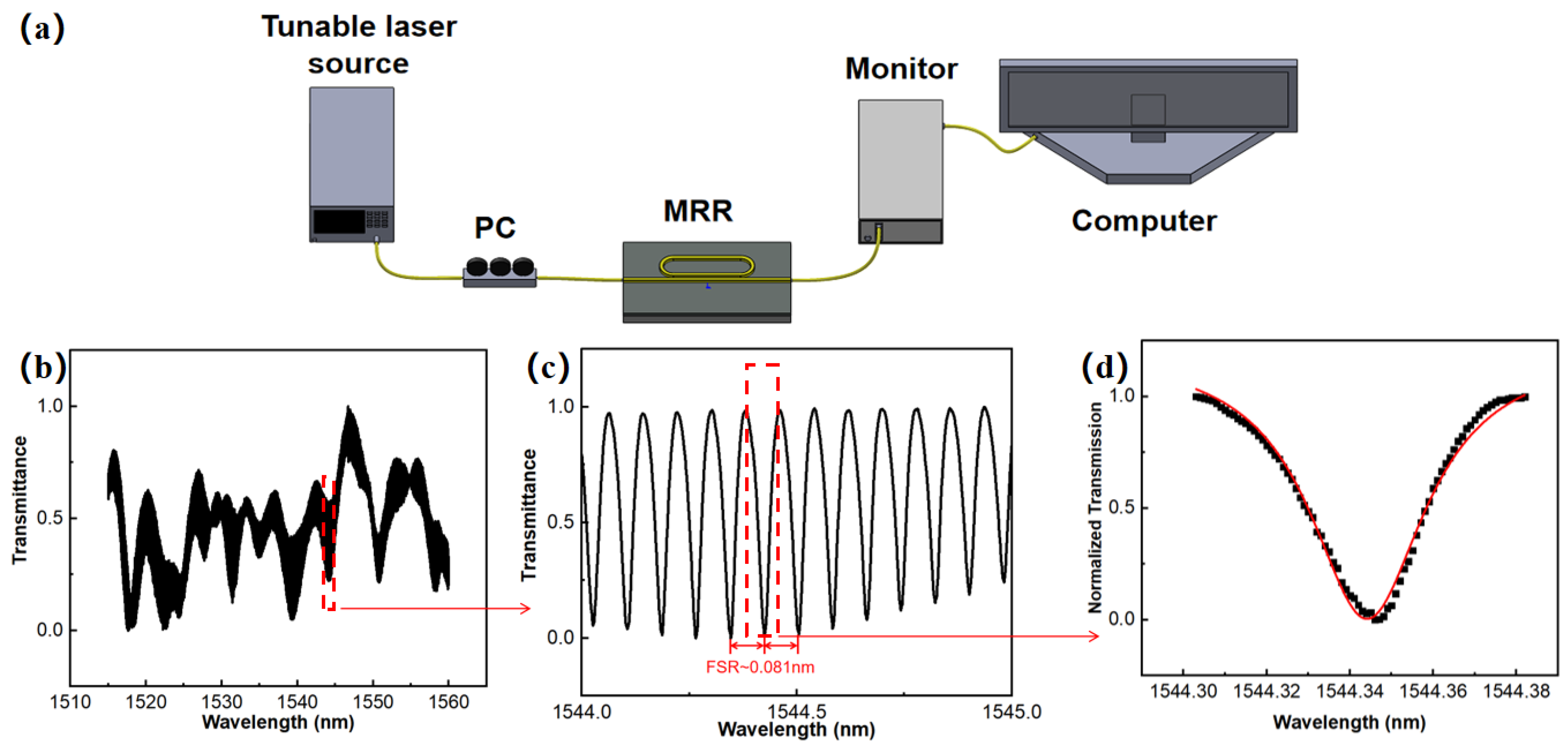
The spectral response of MRR was characterized using the experimental setup shown in Figure 6a. The fabricated MRR chip has dimensions of 2.3 cm × 1.5 cm. In our experiment, the signal light from a tunable laser source (Santec TSL550, Komaki, Japan) was first polarization-controlled and then coupled into the MRR. The output power was measured using an optical power meter (Santec MPM200, Komaki, Japan) connected to the MRR chip output port. To characterize the transmission spectrum, we employed a system where the wavelength scanning of the laser and the power acquisition from the meter were synchronized under computer control. Figure 6b shows the output transmission spectrum of the MRR in the wavelength range of 1510 nm to 1560 nm. FSR is defined as
F S R = λ 2 n g L   ,
where λ is the resonant wavelength, n g is the group refractive index, and L is the resonant cavity length. Figure 6c shows a magnified view of the MRR’s output transmission spectrum over the 1544–1545 nm wavelength range, corresponding to the region enclosed by the dashed box in Figure 6b, from which an FSR of approximately 0.081 nm is obtained. By performing a Lorentzian fit to the resonance peak at 1544.34 nm, which corresponds to the peak marked by the dashed box in Figure 6c, we obtained a Q-factor of approximately 5.72 × 10⁴, as shown in Figure 6d. The Q-factor of the resonance is determined through both coupling mode theory and the Q-factor method [27,28]. The relationship between the measured Q-factor ( Q L ) , the internal Q-factor ( Q i ) , and the external Q-factor ( Q e ) is defined as:
1 Q L = 1 Q e + 1 Q i  
Q L = λ Δ λ F W H M
Q i = 2 π n g λ α .
where λ is the resonant wavelength, ΔλFWHM is the full width at half-maximum, L is the coupling length, ng is the group index, and α is the power attenuation coefficient. Based on the experimentally determined values Q L = 5.72 × 10 4 and Q i 9.56 × 10 4 , we obtain Q e Q L < Q i . This relationship confirms that the resonator operates in the over-coupled regime.

3.2.3. Gain Performance Measurement

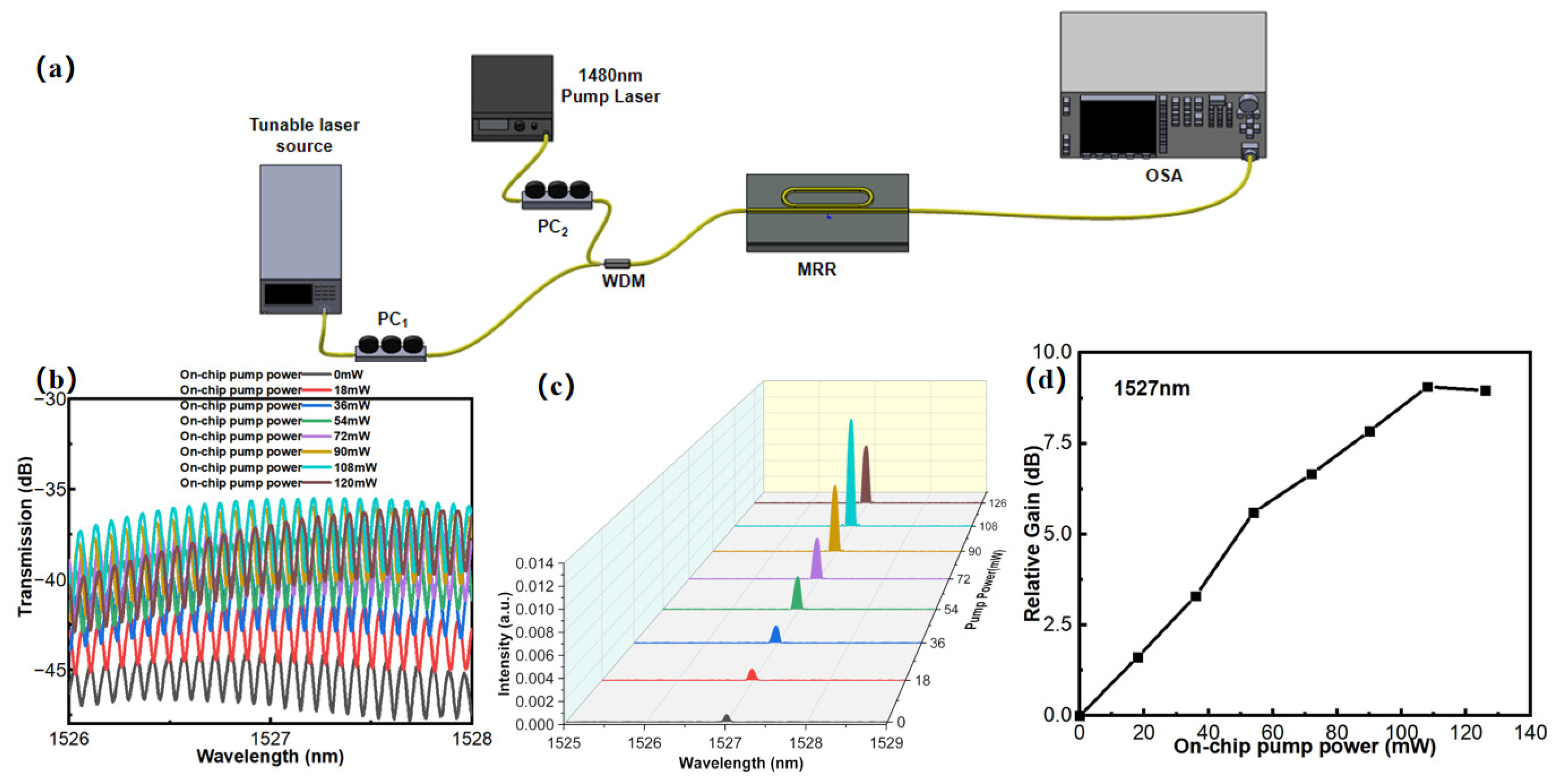
Figure 7a illustrates the gain measurement system for the active MRR optical waveguide amplifier. A 1480 nm laser (YMPSS-1490-400-B-FBG) serves as the pump source, while a tunable laser covering 1500–1630 nm provides the signal light. The pump and signal beams are combined via a wavelength division multiplexer before being coupled into the waveguide. The output signal from the MRR is collected and analyzed using an optical spectrum analyzer (MS9740A, Anritsu, Atsugi, Japan). The formula for calculating the relative gain of an optical waveguide amplifier is given by
G = 10 log 10 ( P S P / P S ) ,
where G represents the relative gain, and P S P and P S are the output powers of the signal light with and without the pump excitation, respectively. Figure 7b displays the wavelength dependent output spectra of the active MRR under varying pump powers when input signal power is −5 dBm. As the pump power increases, the output intensity shows a corresponding enhancement, eventually reaching saturation at higher power levels. In terms of the relative gain at this wavelength, Figure 7c presents the output signal spectrum at 1527 nm under an input signal power of −5 dBm. The relative gain at 1527 nm, derived from this measurement, is shown in Figure 7d. The relative gain increases with on-chip pump power and shows clear saturation behavior. A maximum gain of 8.92 dB is achieved at an on-chip pump power of 108 mW. The measured relative gain is 3.19 dB lower than the simulation result. This discrepancy is primarily attributed to dimensional deviations induced by the fabrication process and the reduction in the overlap factor arising from imperfect waveguide facets during testing. It is worth noting that a pronounced thermo-optic blue-shift was observed in the transmission spectrum of the Er-doped polymer-based MRR, attributable to the material’s substantial thermo-optic coefficient. As shown in Figure 7b, an on-chip pump power of 108 mW resulted in a resonant wavelength shift of 0.126 nm. To mitigate this temperature-dependent wavelength drift and enhance device stability, future implementations could adopt a cladding material with a thermo-optic coefficient opposite to that of the core, or integrate a precise temperature control device.

4. Discussion

The core challenges in the field of waveguide amplifiers currently include achieving gain flatness across a broad operating bandwidth, reducing propagation loss to obtain higher signal output power at lower pump thresholds, and advancing monolithic integration with other photonic devices. We demonstrate an erbium-doped polymer MRR that functions as a resonant amplifier, achieving signal amplification under optical pumping without compromising its resonant properties. This device represents a promising technology for the multifunctional integration of photonic circuits. The Er-doped MRR exhibits a Q factor of 5.72 × 10⁴. Under an on-chip pump power of 108 mW, a signal gain of 8.92 dB is achieved. Table 2 compares the performance of the device in this work with those of other recently reported polymer amplifiers, as well as with typical performance parameters of polymer and Er-doped MRRs.

5. Conclusions

In summary, we have successfully designed and fabricated an active polymer MRR based on NaYF4:5%Er3+ nanoparticles doped with SU-8. The device exhibits an experimental FSR of 0.081 nm and a Q factor of 5.72 × 10⁴, in close agreement with simulation results. Furthermore, it achieves a signal gain of 8.92 dB under an on-chip pump power of 108 mW. This work demonstrates that Er3+-doped polymer materials are effective for realizing on-chip amplification in MRRs. The proposed material and device platform hold significant potential for enhancing the performance of diverse photonic integrated circuits, which is crucial for advancing next-generation optical communications and data center interconnects.

Author Contributions

Conceptualization, Z.W. and F.W.; methodology, Z.W.; software, Z.W. and G.L.; validation, Z.W., C.L., F.W. and D.Z.; formal analysis, Z.W.; investigation, H.H. and S.G.; resources, H.H., S.G., F.W. and D.Z.; data curation, Z.W. and G.L.; writing—original draft preparation, Z.W.; writing—review and editing, F.W.; visualization, Z.W. and F.W.; supervision, F.W. and D.Z.; project administration, F.W.; funding acquisition, F.W. All authors have read and agreed to the published version of the manuscript.

Funding

This research was funded by National Natural Science Foundation of China (62475096 and 62090062).

Data Availability Statement

The data that support the findings of this study are available upon request from the authors.

Conflicts of Interest

The authors declare no conflicts of interest.

Abbreviations

The following abbreviations are used in this manuscript:
MRRMicro-ring resonators
NPsNanoparticles
PMMAPolymethyl methacrylate
Q factorQuality factor
FSRFree spectral range
PICPhotonic integrated circuit
TEMTransmission electron microscopy
FWHMFull width at half maximum
DCDirectional coupler
SEMScanning electron microscopy
ILInsertion loss

References

  1. Almeida, V.R.; Barrios, C.A.; Panepucci, R.R.; Lipson, M. All-optical control of light on a silicon chip. Nature 2004, 431, 1081–1084. [Google Scholar] [CrossRef]
  2. Jalali, B.; Fathpour, S. Silicon Photonics. J. Light. Technol. 2006, 24, 4600–4615. [Google Scholar] [CrossRef]
  3. Soref, R. The Past, Present, and Future of Silicon Photonics. IEEE J. Sel. Top. Quantum Electron. 2006, 12, 1678–1687. [Google Scholar] [CrossRef]
  4. Moss, D.J.; Morandotti, R.; Gaeta, A.L.; Lipson, M. New CMOS-compatible platforms based on silicon nitride and Hydex for nonlinear optics. Nat. Photonics 2013, 7, 597–607. [Google Scholar] [CrossRef]
  5. Roelkens, G.; Zhang, J.; Bogaert, L.; Soltanian, E.; Billet, M.; Uzun, A.; Pan, B.; Liu, Y.; Delli, E.; Wang, D.; et al. Present and future of micro-transfer printing for heterogeneous photonic integrated circuits. APL Photonics 2024, 9, 010901. [Google Scholar] [CrossRef]
  6. Guo, Z.; Lu, L.; Zhou, L.; Shen, L.; Chen, J. 16 × 16 Silicon Optical Switch Based on Dual-Ring-Assisted Mach–Zehnder Interferometers. J. Light. Technol. 2018, 36, 225–232. [Google Scholar] [CrossRef]
  7. Zhang, Z.; Wang, Y.; Tsang, H.K. Tandem Configuration of Microrings and Arrayed Waveguide Gratings for a High-Resolution and Broadband Stationary Optical Spectrometer at 860 nm. ACS Photonics 2021, 8, 1251–1257. [Google Scholar] [CrossRef]
  8. Guo, R.; He, Q.; Zhang, Z.; Xu, Y.; Zhang, S.; Lang, Q.; Xiao, S.; Han, P.; Wang, J.; Ding, T.; et al. High-Q silicon microring resonator with ultrathin sub-wavelength thicknesses for sensitive gas sensing. Appl. Phys. Rev. 2024, 11, 021417. [Google Scholar] [CrossRef]
  9. Zuo, X.; Tang, Z.; Li, B.; Chen, X.; Sun, J. Quantum-Empowered Fiber Sensing Metrology. Photonics 2025, 12, 763. [Google Scholar] [CrossRef]
  10. Yang, L.; Dong, B.; Shao, Q.; Zhang, S.; Chen, Z. Short Carbon Nanotube Nano-Film-Based Polymer/SiO2 Hybrid Waveguide Micro-Ring Filter. ACS Appl. Mater. Interfaces 2023, 15, 28555–28562. [Google Scholar] [CrossRef]
  11. Zou, Y.; Moreel, L.; Lin, H.; Zhou, J.; Li, L.; Danto, S.; Musgraves, J.D.; Koontz, E.; Richardson, K.; Dobson, K.D.; et al. Solution Processing and Resist-Free Nanoimprint Fabrication of Thin Film Chalcogenide Glass Devices: Inorganic—Organic Hybrid Photonic Integration. Adv. Opt. Mater. 2014, 2, 759–764. [Google Scholar] [CrossRef]
  12. Lin, W.K.; Liu, S.; Lee, S.; Zhang, Z.; Wang, X.; Xu, G.; Guo, L.J. High Q-Factor Polymer Microring Resonators Realized by Versatile Damascene Soft Nanoimprinting Lithography. Adv. Funct. Mater. 2024, 34, 2312229. [Google Scholar] [CrossRef]
  13. Wang, P.-H.; Wang, S.-P.; Hou, N.-L.; Yang, Z.-R.; Huang, W.-H.; Lee, T.-H. Flexible dispersion engineering using polymer patterning in nanophotonic waveguides. Sci. Rep. 2023, 13, 13211. [Google Scholar] [CrossRef]
  14. Bao, R.; Fang, Z.; Liu, J.; Liu, Z.; Chen, J.; Wang, M.; Wu, R.; Zhang, H.; Cheng, Y. An Erbium-Doped Waveguide Amplifier on Thin Film Lithium Niobate with an Output Power Exceeding 100 mW. Laser Photonics Rev. 2024, 19, 2400765. [Google Scholar] [CrossRef]
  15. Singh, N.; Lorenzen, J.; Wang, K.; Gaafar, M.A.; Sinobad, M.; Francis, H.; Edelmann, M.; Geiselmann, M.; Herr, T.; Garcia-Blanco, S.M.; et al. Watt-class silicon photonics-based optical high-power amplifier. Nat. Photonics 2025, 19, 307–314. [Google Scholar] [CrossRef]
  16. Bonneville, D.B.; Osornio-Martinez, C.E.; Dijkstra, M.; García-Blanco, S.M. High on-chip gain spiral Al2O3:Er3+ waveguide amplifiers. Opt. Express 2024, 32, 15527–15536. [Google Scholar] [CrossRef] [PubMed]
  17. Tao, S.; Song, H.; Zhao, D.; Yang, Y.; Wang, S.; Yan, J.; Wei, J.; Wang, X.; Qin, G.; Wang, F.; et al. Strip loaded waveguide amplifiers based on erbium-doped nanocomposites with 17 dB internal net gain. Opt. Express 2024, 32, 7931–7939. [Google Scholar] [CrossRef] [PubMed]
  18. Shi, X.; Man, Y.; He, Y.; Xu, H.; Zhang, B.; Yu, D.; Lin, Z.; Lv, Z.; Zhao, Z.; Zhang, L.; et al. Optical Amplification at 1.5 µm in ErIII Coordination Polymer-Doped Waveguides Based on Intramolecular Energy Transfer. Adv. Sci. 2024, 11, e2401131. [Google Scholar] [CrossRef]
  19. Fu, Y.; Sun, T.; Li, J.; Tang, Y.; Yang, Y.; Tao, S.; Wang, F.; Zhang, D.; Qin, G.; Jia, Z.; et al. (S + C)-band polymer waveguide amplifier based on Tm3+ and Er3+ layer-doped core-shell nanoparticles. Opt. Lett. 2023, 48, 391–394. [Google Scholar] [CrossRef]
  20. Cui, H.; Jiang, Z.; Yang, Y.; Tao, S.; Wu, S.; Yin, J.; Wang, F.; Qin, G.; Meng, F.; Zhao, D.; et al. A strategy for preparing broadband polymer based optical waveguide amplifiers: Doping low crystal field symmetric nanocrystals in polymer matrix as gain media. Sci. China Mater. 2024, 67, 3908–3916. [Google Scholar] [CrossRef]
  21. Zhang, Y.-W.; Sun, X.; Si, R.; You, L.-P.; Yan, C.-H. Single-Crystalline and Monodisperse LaF3 Triangular Nanoplates from a Single-Source Precursor. J. Am. Chem. Soc. 2005, 127, 3260–3261. [Google Scholar] [CrossRef]
  22. Wang, F.; Han, Y.; Lim, C.S.; Lu, Y.; Wang, J.; Xu, J.; Chen, H.; Zhang, C.; Hong, M.; Liu, X. Simultaneous phase and size control of upconversion nanocrystals through lanthanide doping. Nature 2010, 463, 1061–1065. [Google Scholar] [CrossRef]
  23. Yang, Y.; Tao, S.; Li, J.; Jiang, Z.; Cui, H.; Ren, X.; Yin, J.; Wang, F.; Qin, W.; Zhao, D. Effect of inorganic compound size on the relative gain of polymer-based optical waveguide amplifiers. J. Lumin. 2025, 277, 120872. [Google Scholar] [CrossRef]
  24. Li, S.F.; Song, C.L.; Xiong, Q.J.; Ran, B. A numerical analysis of gain characteristics of Er-doped Al2O3 waveguide amplifiers. Opt. Quantum Electron. 2002, 34, 859–866. [Google Scholar] [CrossRef]
  25. Toccafondo, V.; Cerqueira, A.; Faralli, S.; Sani, E.; Toncelli, A.; Tonelli, M.; Di Pasquale, F. Er3+-doped BaY2F8 crystal waveguides for broadband optical amplification at 1.5 μm. J. Appl. Phys. 2007, 101, 023104. [Google Scholar] [CrossRef]
  26. Tao, S.; Yan, J.; Song, H.; Wei, J.; Fu, Y.; Zhao, D.; Wang, F.; Zhang, D. Modeling and simulation of erbium-ytterbium co-doped optical waveguide amplifiers with dual-wavelength pumping at 980 nm and 1480 nm. J. Phys. D Appl. Phys. 2023, 56, 344003. [Google Scholar] [CrossRef]
  27. Frankis, H.C.; Kiani, K.M.; Su, D.; Mateman, R.; Leinse, A.; Bradley, J.D.B. High-Q tellurium-oxide-coated silicon nitride microring resonators. Opt. Lett. 2018, 44, 118–121. [Google Scholar] [CrossRef]
  28. Little, B.E.; Chu, S.T.; Haus, H.A.; Foresi, J.; Laine, J.P. Microring resonator channel dropping filters. J. Light. Technol. 1997, 15, 998–1005. [Google Scholar] [CrossRef]
  29. Makela, M.; Lin, Z.; Coté, G.L.; Lin, P.T. Fluorescence enhanced biomolecule detection using direct laser written micro-ring resonators. Opt. Laser Technol. 2024, 174, 110629. [Google Scholar] [CrossRef]
  30. Zhang, R.; Zeng, X.; Zheng, X.; Yang, C.; Zheng, D.; Liu, H.; Yu, X.; Gao, F.; Bo, F.; Kong, Y.; et al. Nonlinear optical oscillation in on-chip erbium-doped lithium niobate microring resonators. Sci. China Phys. Mech. Astron. 2025, 68, 244212. [Google Scholar] [CrossRef]
Figure 1. (a) TEM image of the NPs. (b) The emission spectrum of the NPs.
Photonics 13 00200 g001
Figure 2. (a) Cross-sectional view of the waveguide. Relationship between waveguide width a and core-mode characteristics: (b) 1480 nm, (c) 1550 nm. TE fundamental mode field distribution at (d) 1480 nm and (e) 1550 nm.
Photonics 13 00200 g002
Figure 3. (a) The schematic diagram of the proposed racetrack MRR. (b) Simulated MRR resonance spectrum. (c) Energy-level model of Er3+ under 1480 nm pumping. (d) Simulated relative gain versus on-chip pump power.
Photonics 13 00200 g003
Figure 4. (a) Fabrication process of active MRR. (b) Microscope picture of active MRR with the inset (red box) providing a detailed view of the directional coupler configuration. (c) SEM image of the DC structure of the active MRR. (d) SEM image of the waveguide cross section.
Photonics 13 00200 g004
Figure 5. The measured insertion loss and fitted curves at (a) 1310 nm, (b) 1480 nm, (c) 1530 nm.
Photonics 13 00200 g005
Figure 6. (a) Schematic diagram of test system of MRR. (b) Normalized spectral response of MRR. (c) Transmission spectrum of MRR within 1544–1545 nm corresponding to the red-boxed region in (b). (d) The Q-factor fitting curve at 1544.34 nm corresponding to the red-boxed region in (c).
Photonics 13 00200 g006
Figure 7. (a) Schematic diagram of gain test system of active MRR. (b) Transmission spectrum of MRR at 1526–1528 nm under different on-chip pump power. (c) Measured signal spectrum of the MRR at 1527 nm. (d) Relative gain versus on-chip pump power at 1527 nm.
Photonics 13 00200 g007
Table 1. The key parameters of our designed the active MRR.
ModeEffective IndexEffective AreaModal OverlapMode Loss
Fundamental mode1.5184.8 μm20.9882.83 dB/cm
Table 2. Structures and performance of polymer amplifiers and polymer/Er-doped hybrid MRRs.
Device TypeMaterialWaveguide TypePump WavelengthGainQYearSource
Amplifier and MRREr-doped polymerRectangular1480 nm8.92 dB @1527 nm 5.72 × 10 4 This work
AmplifierEr3+, Yb3+ co-doped nanocompositesStrip loaded980 nm17 dB @1530 nm-2024[17]
AmplifierErIII complexesEvanescent-field365 nm10.5 dB @1535 nm-2024[18]
AmplifierEr3+, Yb3+, Tm3+ co-doped polymer Rectangular980 nm6-8 dB @ S+C Band-2023[19]
AmplifierEr3+, Yb3+, Ce3+ co-doped polymer Rectangular980 nm12.6 dB @1535 nm
3.7 dB @ 1610 nm
-2024[20]
MRRPolymerRectangular-- 3 × 10 4 2024[29]
MRR LaserEr-doped LNOIRidge-- 5.22 × 10 5 2025[30]
Disclaimer/Publisher’s Note: The statements, opinions and data contained in all publications are solely those of the individual author(s) and contributor(s) and not of MDPI and/or the editor(s). MDPI and/or the editor(s) disclaim responsibility for any injury to people or property resulting from any ideas, methods, instructions or products referred to in the content.