2.1. Compensation Algorithm Based on Improved Third-Order NAT
The vector form of the wave aberration for a perturbed optical system can be expressed as [
18,
19]
where
is the aberration field displacement vector for surface
,
is the corresponding wave aberration coefficient,
is the normalized field vector,
is the normalized pupil vector.
In a perturbed optical system, coma and astigmatism are the dominant aberrations. Based on third-order and fifth-order aberrations [
20,
21], the contributions of coma and astigmatism for the perturbed optical system are given by
where
,
,
,
,
,
,
represents the complex conjugate of the field vector
.
In optical testing, the wavefront at the exit pupil is usually fitted to Zernike polynomials to represent the measured wavefront. In the form of Zernike polynomials [
22], the wave aberration for the perturbed system is expressed as
where
is the Zernike term,
is the corresponding Zernike coefficient,
and
represent the x-component and y-component of
, while
,
represent the x-component and y-component of
.
and
represent the components of
, and
represents the power of the aberration field displacement vector
.
is an un-normalized displacement vector in the image plane.
is a vector describing the corresponding dependence of field-of-view (FOV). Equation (4) can be further expanded as
with
where
represents the intrinsic residual error of the nominal optical system.
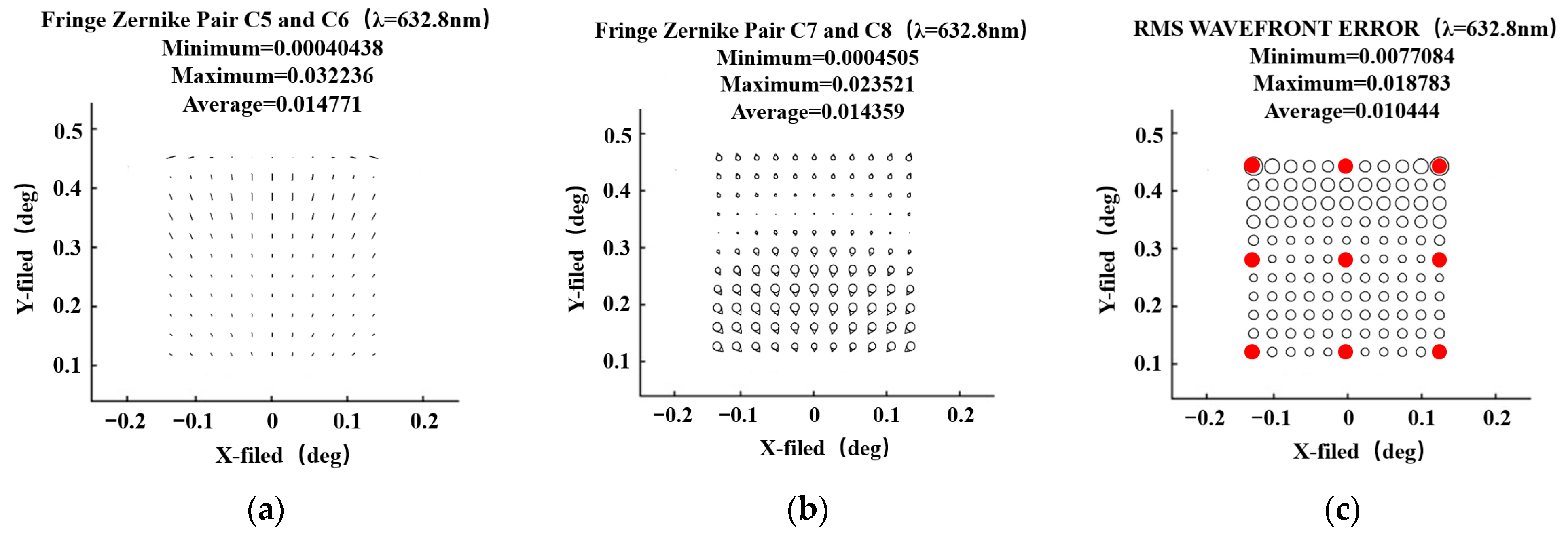
As the aperture of the optical system increases, environmental factors such as vibration, air turbulence, and temperature gradient variations can affect the accuracy of wavefront measurements, resulting in lower fitting accuracy for high-order Zernike coefficients. In this paper, only the first 9 terms of the Fringe Zernike coefficients are considered. For the perturbed system, the SM is used to compensate for the misalignment aberrations. The aberrations introduced by the adjustment of the SM are mainly third-order aberrations. Combining this with Equation (6), then
where
,
,
,
,
and
denote the 5th and 6th Fringe Zernike coefficients,
and
denote the 7th and 8th Fringe Zernike coefficients,
and
are the x-component and the y-component of
.
The displacement vectors
in the image plane are expressed as
By solving Equations (9) and (10), the aberration field displacement vectors of the SM (
) can be determined. According to the method based on paraxial ray trace equations [
23], the compensation parameters for the SM can be determined using the following equations:
where
is the incident angle of the marginal chief ray on the PM,
is the distance from the primary mirror to the SM,
is the curvature of the SM,
is the distance from the SM to the TM,
is the curvature of the tertiary mirror (TM). These parameters are constants.
2.2. Analytic Solution for the Simultaneous Compensation Position of the SM
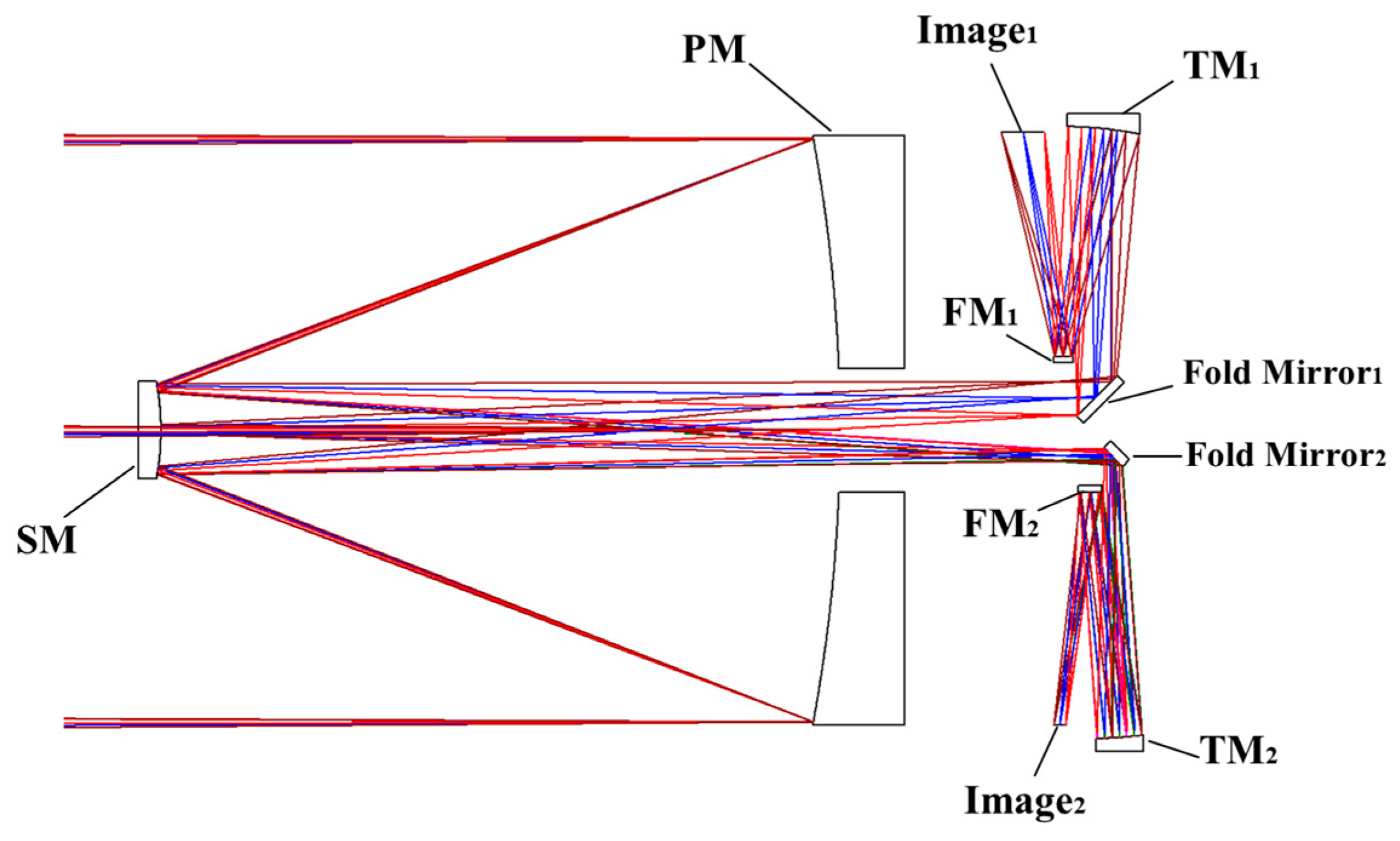
In a common-aperture dual-channel telescope, when the misalignment aberrations of the two channels are inconsistent, compensating one channel to its optimal state can lead to significant degradation in the image quality of the other channel. Therefore, the SM is required to correct the misalignment aberrations of both channels simultaneously.
For the perturbed optical system, the position of the node in the normalized image field shifts to the point indicated by the vector
, which can be expressed as
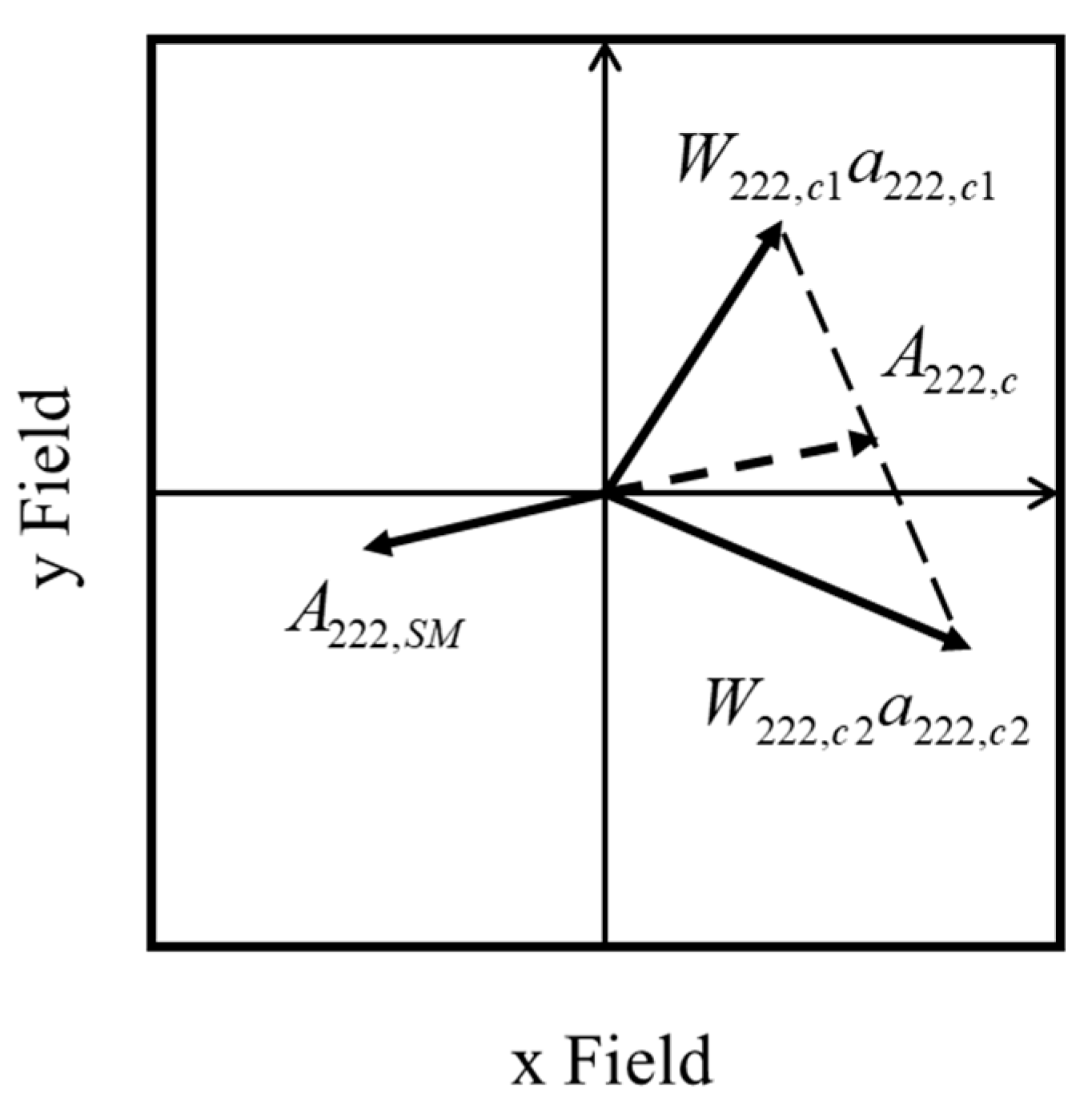
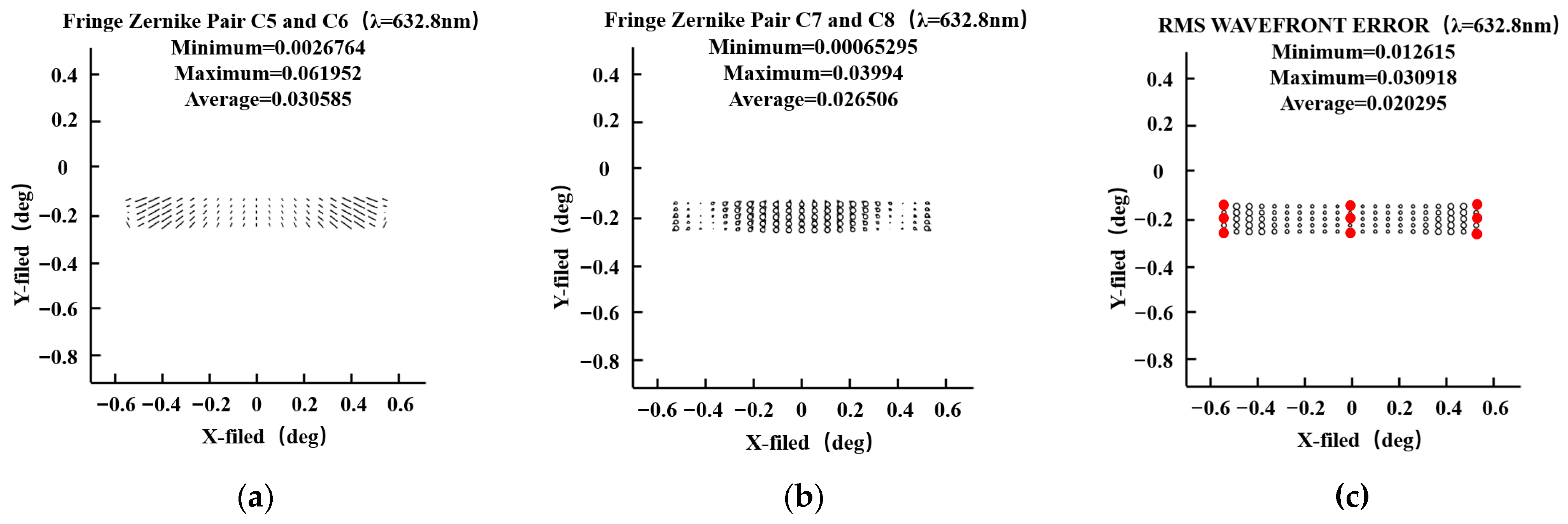
The node positions of the aberration fields are obtained in the normalized image plane as shown in
Figure 1.
Based on the displacement vectors
and
of the two channels, the center position is calculated as
To balance the image quality of the two channels, the un-normalized displacement vector in the image plane corresponding to the compensation position is given by
The displacement vector of the SM is expressed as
Consequently, the simultaneous compensation parameters for the SM can be determined using Equations (11)–(14).
2.3. Theoretical Conditions for Consistent Optimal Compensation Positions
To ensure optimal performance, third-order coma and third-order astigmatism must be fully corrected for each channel. When the optimal compensation positions of the SM for the two channels are consistent, the displacement vectors of the third-order coma and third-order astigmatism in the image plane must also be consistent. This is expressed as
Since the aberration field displacement vector is typically a small quantity (generally
), based on Equations (7) and (8), the theoretical conditions for the consistency of the optimal compensation positions for the two channels are derived as
where
denote the Fringe Zernike coefficients for channel 1, and
denote the Fringe Zernike coefficients for channel 2.
Equations (21)–(23) reveal that compensation by decentration and tilt of the SM primarily induces field-constant coma and linear astigmatism.