Article

Improving Spectral Resolution of Rydberg Atom-Based Electrometry by 2 × 2 Laser Arrays


College of Electronic Science and Technology, National University of Defense Technology, Changsha 410072, China
*
Author to whom correspondence should be addressed.
Photonics 2025, 12(12), 1189; https://doi.org/10.3390/photonics12121189
Submission received: 23 October 2025 / Revised: 19 November 2025 / Accepted: 30 November 2025 / Published: 3 December 2025

Abstract

Rydberg atom-based electrometry based on electromagnetic induced transparency (EIT) and Autler–Townes splitting (EIT-AT) could achieve ultra-high sensitivity measurements. The amplitude and linewidth of EIT spectra significantly impact the accuracy of electric field measurements. This research utilizes cascade diffraction gratings to generate 2 × 2 probe laser arrays for the excitation of Rydberg atoms, thereby enhancing spectral resolution under the power broadening. Compared with one laser, the laser array boosts EIT amplitude, narrowing the linewidth from 23.53 MHz to 12.66 MHz, making EIT-AT more distinguishable under identical fields and achieving an enhancement of the sensitivity of 77.96 nV / cm / Hz . These results indicate that laser arrays can optimize the sensitivity of measurement systems based on the Rydberg EIT effect.

1. Introduction

Rydberg atom-based sensors have developed rapidly and have shown extensive applications in the fields of quantum metrology [1], imaging [2] and communication [3,4] because of their advantages of self-calibration [5], ultra-wideband (DC [6]-THz [7,8]) and SI traceability [9,10] that are not available in conventional antenna-based receivers. These sensors utilize atoms to convert radio frequency (RF) fields into an optical signal that can be read out on a photodetector at baseband to detect the relevant information of the RF field [11,12,13].In Rydberg atom-based electrometry, under the effect of an intense coupling laser, the dispersion property of the medium changes, resulting in the absorption of the weak probe laser being reduced, which is the definition of electromagnetically induced transparency (EIT) [1,14]. Furthermore, when a microwave electric field is applied near resonance using two Rydberg energy levels, the corresponding Rydberg energy levels split, resulting in a two-peak spectrum, known as Autler–Townes splitting (EIT-AT splitting) [15]. The EIT-AT splitting interval Δ f m is proportional to the amplitude of the microwave electric field E MW . By measuring Δ f m , we obtain a direct measurement of the intensity of the E MW .
Recently, the use of the Rydberg atom superheterodyne technique [16] and optical pumping technique [17] dramatically improved the receiver’s sensitivity. However, due to limitations from both classical and quantum levels, the sensitivity enhancement and the minimum measurable value of E MW in Rydberg atom microwave measurements face a bottleneck under current technical conditions. The quantum projection noise-limited sensitivity formula shows that sensitivity scales with the number of Rydberg atoms, indicating that increasing their population could improve sensitivity [18]. To some extent, extending the length of the vapor cell and expanding the beam diameter could efficiently enhance sensitivity with constant laser power. However, due to the limited power, extending the vapor cell’s length would cause a decrease in optical depth [19], and expanding the probe laser diameter reduces the instantaneous bandwidth [20]. Additionally, the laser intensity drops as the beam diameter or path rises, and it is necessary to boost laser power to effectively excite the atoms in the beam path, resulting in a corresponding increase in laser intensity noise, a power broadening and a poor and wide EIT spectrum. When the linewidth of the EIT is too wide, the measurement sensitivity and minimum measurable field intensity based on Rydberg EIT-AT would be adversely affected [21]. In the spectroscopy measurements, a high-amplitude and narrow-linewidth EIT aims to improve the quality of the spectral signal, enabling more accurate measurements that are essential for sensitivity and electric field evaluations. Therefore, probe laser arrays counter-propagating with the coupling laser beam become a promising candidate to excite more Rydberg atoms and form the high-intensity and narrow-linewidth spectra to ultimately enhance the sensitivity.
In this paper, we report the formation of the high-amplitude and narrow-linewidth EIT spectra by utilizing multichannel excitations based on 2 × 2 probe laser arrays. The height of the EIT excited by laser arrays is approximately 4 times higher than that of one of the four lasers, which implies an increase in the utilization of the atoms. Meanwhile, the linewidth of the EIT has been decreased from 23.53 MHz to 12.66 MHz under the same laser power, which implies the enhancement of the spectral resolution and achieves the enhancement of the sensitivity with 77.96 nV / cm / Hz . Our results confirm the viability of employing N × N multiple beams to enhance the spectral resolution and the ability to measure smaller electric fields. It may provide helpful suggestions for the ultra-high sensitivity Rydberg atomic microwave measurement system design for practical applications.

2. Experimental Setup

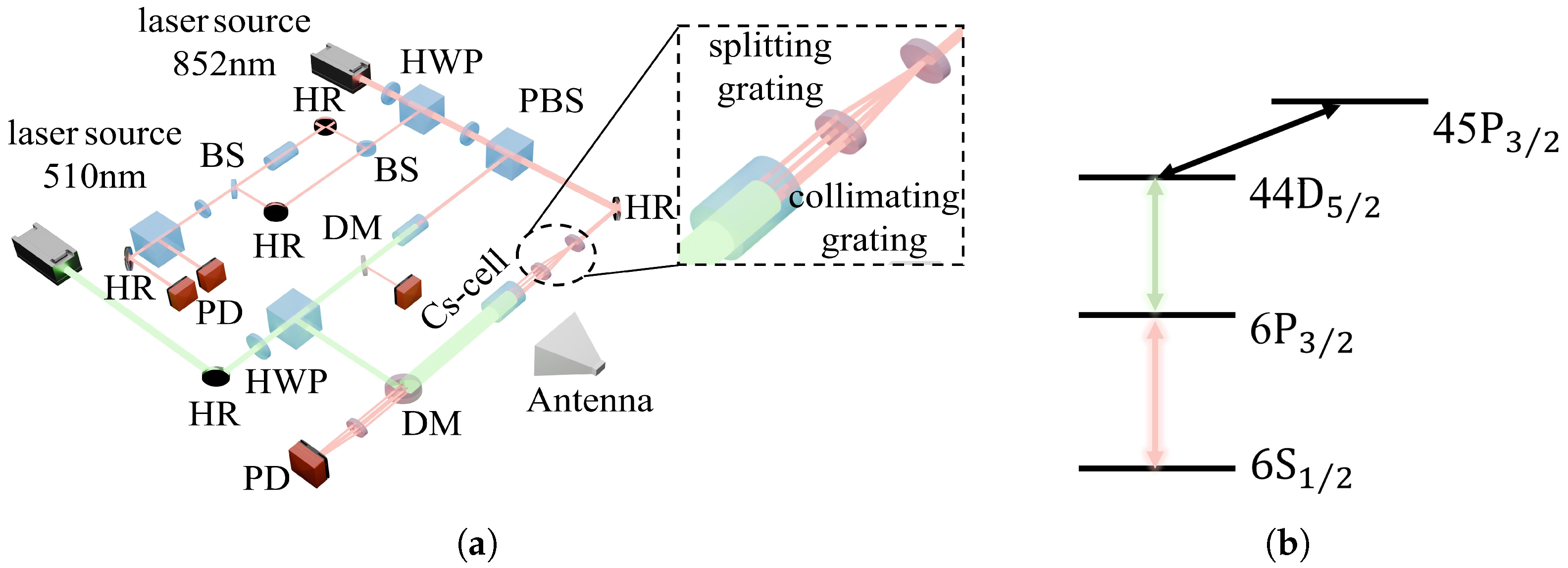
The experimental setup is shown in Figure 1. We adopt a two-photon Rydberg-EIT scheme to excite atoms from a ground state to a Rydberg state. A probe laser drives the atomic transition | 1 : 6 S 1 / 2 , F = 4 | 2 : 6 P 3 / 2 , F = 5 . A coupling laser drives the atomic transition from | 2 to | 3 : 44 D 5 / 2 . The weak probe laser (with a wavelength of about 852 nm, a 1 / e 2 beam diameter of 1 mm each and a power of 400 μW) and the strong coupling laser (with a wavelength of about 510 nm, a 1 / e 2 diameter of 4 mm and a power of 35 mW) interact on a vapor cell at room temperature. The 133Cs atoms are contained in a cylindrical vapor cell with a diameter of 1 cm and a length of 5 cm. Microwave fields drive a radio frequency (RF) transition between the two different Rydberg states | 3 : 44 D 5 / 2 and | 4 : 45 P 3 / 2 . The RF field was generated by a signal generator and was emitted by a horn antenna applied to the atoms with a radiated direction perpendicular to the laser beam propagation direction. The antenna aperture is 4.6 cm × 3.2 cm, which was placed 30 cm in front of the vapor cell to satisfy the far-field condition. In the vapor cell, the probe laser is split and collimated by the 2D grating and the four-zone grating with an interval of 1.6 mm and a diffraction angle of 0°, overlapping and counter-propagating with the coupling laser to constitute the EIT spectra. The probe laser is detected by a photodetector connected to the computer. The energy difference between Rydberg states is 8.566 GHz. We use RF fields to drive the Rydberg states constantly, producing EIT spectra, i.e., the probe transmission spectra.

3. Results and Analysis

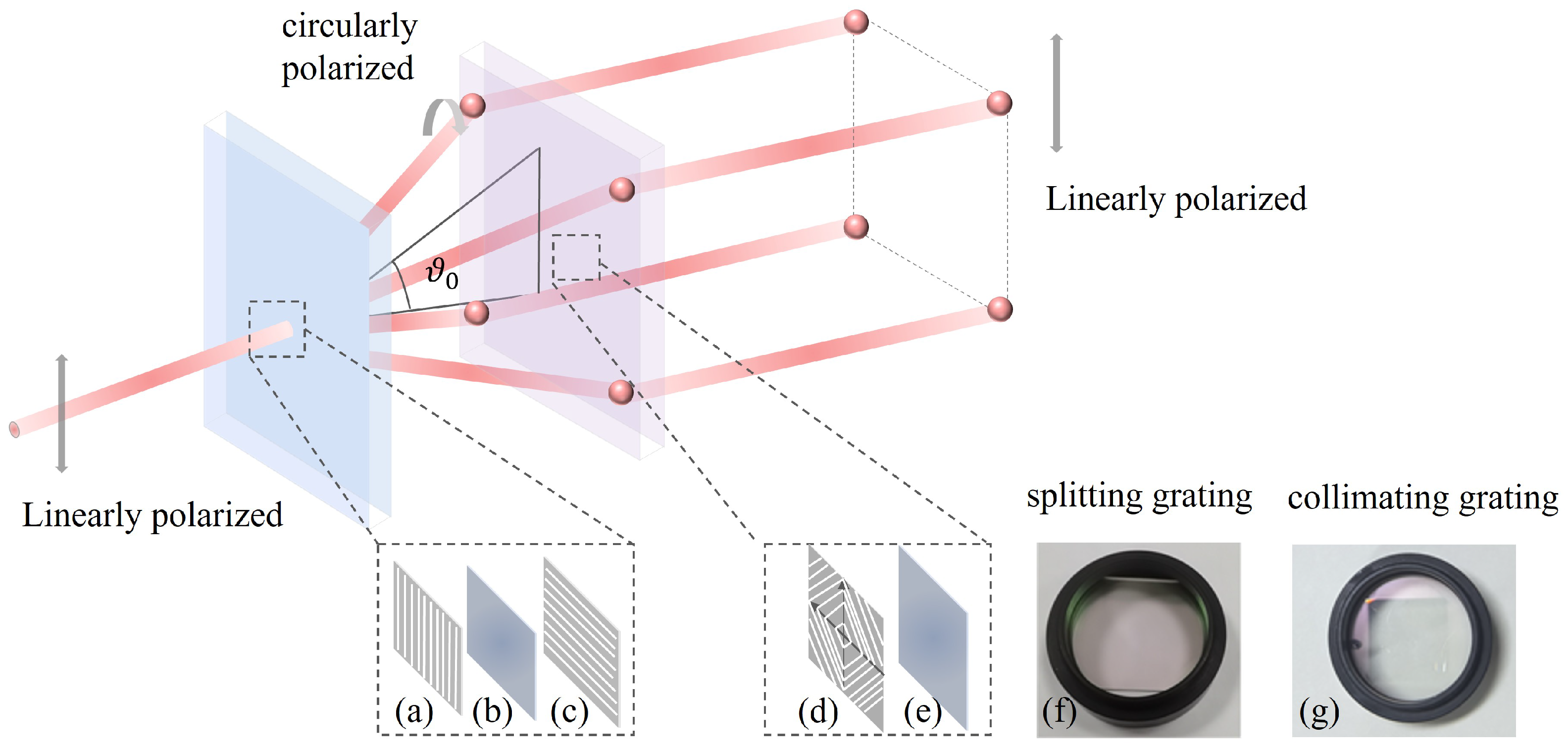
Due to the excitation of the Rydberg atom’s population by one laser beam being constrained, similar to a phased array antenna, we utilize laser arrays on the vapor cell to enhance the Rydberg atom populations. In our work, we designed and utilized a two-dimensional (2D) diffraction grating and a four-zone collimation grating to generate 2 × 2 collimated laser arrays, as shown in Figure 2. Liquid crystal polarization gratings (LCPGs) are employed to generate the laser arrays according to their polarization tunability. The first step involves utilizing the 2D grating to generate four laser beams, which can be expressed by the Jones matrix [22]:
T = R ( Φ ) 1 0 0 exp ( i Γ ) R ( Φ )
In Equation (1),
R ( Φ ) = cos Φ sin Φ sin Φ cos Φ , Φ = π x / Λ , Γ = 2 π / λ ( Δ n ) d ,
where T, Φ , Γ and Δ n are the Jones matrix of the LCPG, LCPG phase gradient, phase delay of LCPG and birefringence. Moreover, d is the thickness of LCPG and λ is the wavelength, which is 852 nm in this article. According to the Fraunhofer formula, when the phase delay Φ satisfies the half-wave condition, the linearly polarized (LP) laser transmitted through the LCPG is separated into right-handed circular polarization (RCP) and left-handed circular polarization (LCP) with the zero diffraction order being suppressed. Moreover, the RCP incident laser deflects to −1 and LCP deflects to +1 [23]. Based on the laser polarization filtering properties of LCPG, the 2 × 2 array is generated in two steps: splitting and collimation. After splitting with two perpendicular grating layers and passing through a quarter-wave plate, the incident probe laser is transformed into a two-dimensional circularly polarized laser array. Subsequently, by collimating the four-zone grating and precisely adjusting the wave plate, we achieved the desired collimated linearly polarized beam array.
The array generated by the initial grating has a divergent component of about 2.06°, resulting in the lasers not being incident on the grating perpendicularly, which impacts the excitation of Rydberg atoms. The second four-zone grating is designed to offset the divergent components at a specific diffraction angle to form a collimation output. The Grating equation is as follows:
( a + b ) sin θ 0 = ± K λ ( K = 0 , 1 , 2 , ) ,
where ( a + b ) = d represents the grating constant, θ 0 is the diffraction angle, K is the dominant maximum order and λ is the wavelength of the probe laser (852 nm). Moreover, the modified Grating equation is
( a + b ) sin ( θ x θ i ) + ( a + b ) sin θ i = ± K λ ( K = 0 , 1 , 2 , ) ,
where θ i is the incidence angle of the four-zone grating. The beam separation interval is preset to Δ x = 1.6 mm, and the distance between the first grating and the second is set to L = 30 mm . The θ i can be calculated by the equation
tan θ i = 2 Δ x / 2 L .
To obtain collimated laser arrays, we set θ x = θ i , and the wavelength of the probe laser is 852 nm. Namely, the diffraction angle generated by the second grating is equivalent to the incidence angle formed by the outgoing laser of the first 2D grating. The suitable period of the gratings must be determined to ensure efficient laser collimation. According to Equations (3)–(5), the 2D grating period is 31.95 μm and the collimation grating period is 26.52 μm (theoretical value).
Based on the above analysis, the gratings for the application were simulated by simulation software. The laser wavelength considered in the simulations is 852 nm. The separation interval Δ x = 1.6 mm, and the diffraction angle is set to 0°, which is preset in the evaluation function to be used as optimization targets. In the lens data, the periods of the two gratings are continuously optimized to achieve a preset interval and diffraction angle. We apply the ray-tracing method to simulate the propagation of a laser through the gratings in sequential mode. After the four-zone grating, the diffraction angle of the probe laser is 0°, signifying that our design generates a collimated output. Without a collimation output, the probe laser and the coupling laser cannot be aligned within the vapor cell, thereby preventing the formation of the EIT spectrum. Through continuous refinement, the 2D grating period is 33.43 μm and the collimation grating period is 23.64 μm (simulation value).
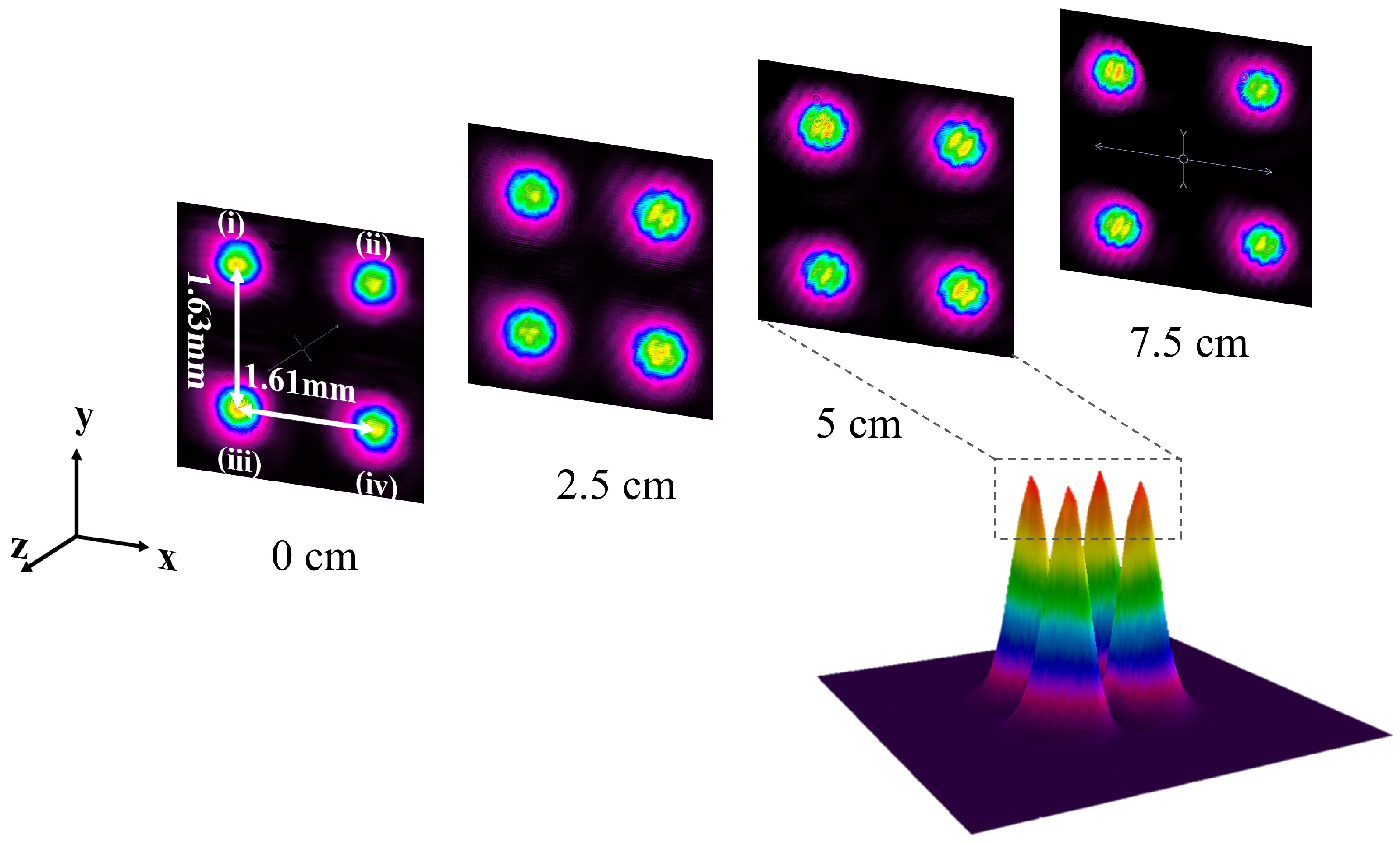
Compared to alternative array generation methods, such as beam splitters and microlens arrays, the former may result in uneven energy distribution among the laser beams and microlens arrays [24] can generate high-density beam arrays while they necessitate high-precision alignment to ensure accurate beam splitting and collimation, thereby complicating the debugging process. In contrast, our cascade diffraction grating produces a well-collimated beam array with excellent uniformity. According to the experiment, the uniformity is up to 97.56%. In the beam splitting and collimating optical path, we collected the spot coordinate information at different positions, respectively; the diffraction angle of the four probe beams after the beam splitting grating is 2.044° by calculation, and the diffraction angle after the collimating grating is 0.001°, which means that the collimated output is realized and the effective collimation is over a distance greater than 7.5 cm, as shown in Figure 3.
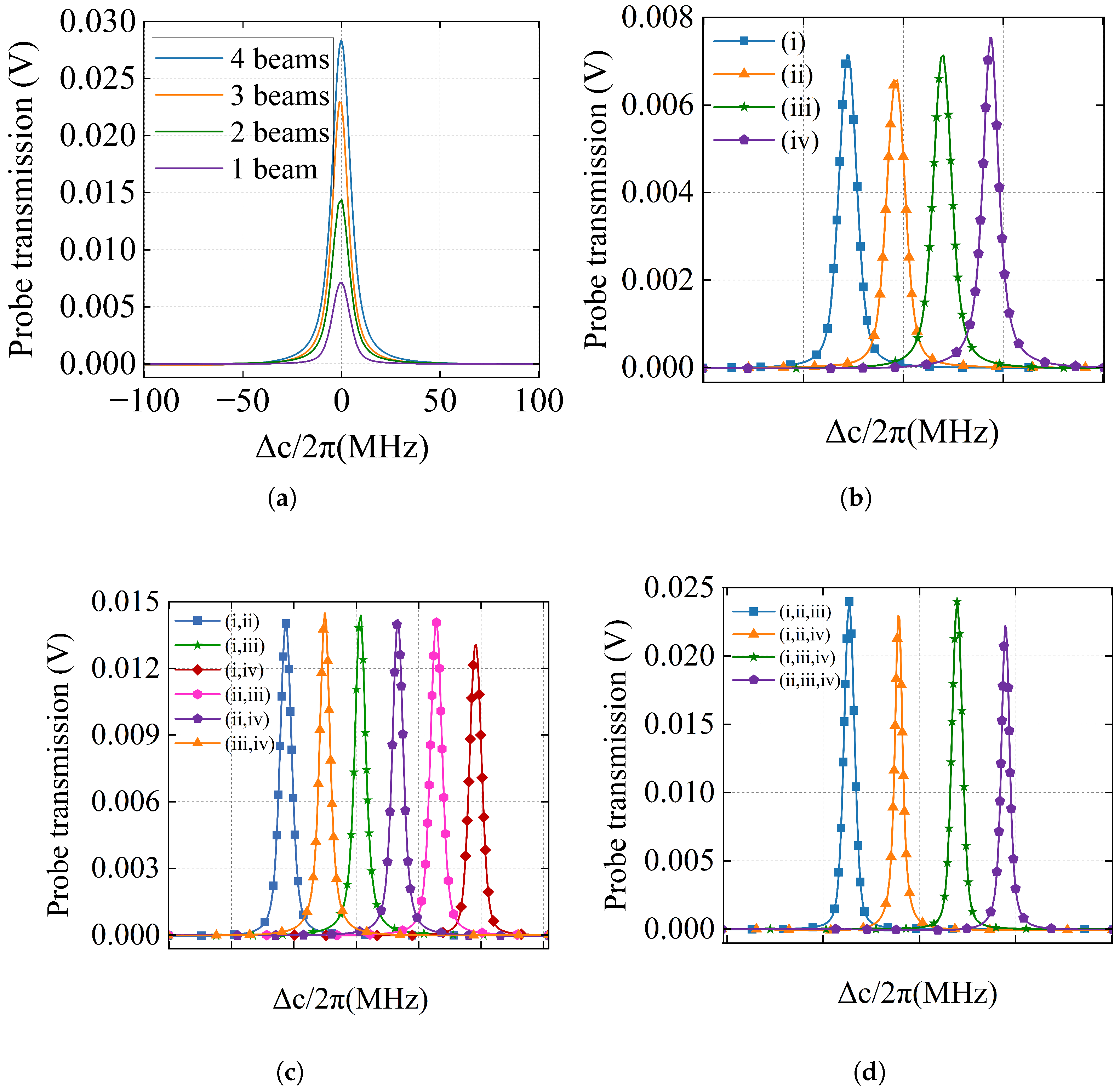
To comprehensively evaluate the performance of a 2 × 2 laser array, we apply the laser array to the measurement system to constitute EIT spectra and collect the EIT data for one, two, three and four probe lasers interacting with the coupling laser. The power of the four lasers is 102 μW, 98 μW, 101 μW and 105 μW. Figure 4a depicts the EIT of one, two, three and four laser beams. The height of the EIT signals increases from 0.007 V with one beam to 0.028 V with four beams, and the intensity is proportional to the number of probe lasers with a ratio of approximately 1:2:3:4, which demonstrates the effectiveness of the laser array in increasing the number of excited atoms. To avoid randomness, four different spot locations were randomly selected and data were collected at each location separately through various combinations. We gathered four sets of data for one beam, six sets for two beams, four sets for three beams, and one set for four beams, as shown in Figure 4b–d. Figure 4b shows the EIT for any one of the four lasers. In Figure 4c, the EIT spectra are formed by the interaction of the coupling laser with any two of the four probe lasers. The power of the four lasers is 200 μW, 202 μW, 202 μW, 201 μW, 200 μW and 199 μW, respectively. Figure 4d displays the results of the interaction of any three beams with powers of 304 μW, 299 μW, 304 μW and 298 μW. When the number of probe lasers is consistent, the height of the EIT spectra formed by the interaction of the probe lasers and the coupling laser at different positions demonstrates a high uniformity with the error range between 6.6% and 13.2%, which confirms the consistency and collimation of our beam splitting.
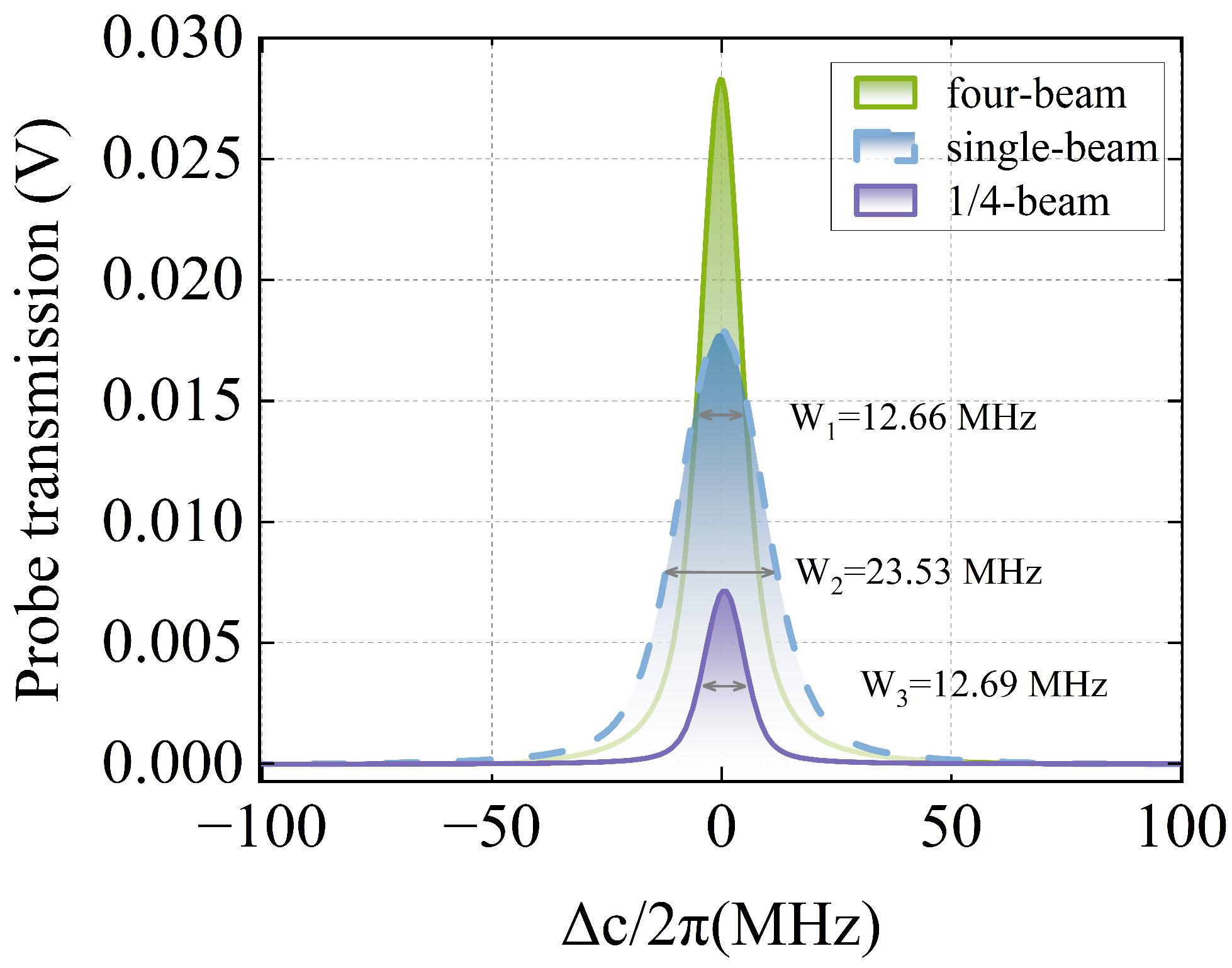
On this basis, we analyze the efficacy of the laser array excitation with that of increasing beam power, as shown in Figure 5. It is noteworthy that the laser array with laser power of 100 μW each is hereinafter referred to as the four-beam, one beam of the laser array with laser power of 100 μW is hereinafter referred to as the 1/4-beam, and the single probe laser beam with a power of 400 μW is hereinafter referred to as the single-beam. Specific parameters are shown in Table 1.
The generalized Rabi frequency Ω i j between the states i and j is defined as [25]
Ω i j = E i j i | r | j
where E i j = 2 I c ϵ 0 is the amplitude of the electromagnetic field and i | r | j is the dipole moment matrix element between these states. The intensity I of the electromagnetic field follows a Gaussian distribution with radial distance r from the beam axis represented by I = I 0 exp 2 r 2 ω 0 2 , where I 0 = 2 P π ω 0 2 is the peak intensity determined by the total power P of the electromagnetic field and the beam waist ω 0 . The constants c and ϵ 0 are the speed of light in vacuum and the permittivity of free space, respectively. The dipole moment matrix element for the | 1 | 2 , | 2 | 3 and | 3 | 4 transitions could be calculated by the open source ARC calculator [26]. The laser area of four-beam is 4 π ω 0 2 ( ω 0 = 1 mm ) and the power is 4P (where P = 100 μW); the areas of 1/4-beam and single-beam are both π ω 0 2 while the power is P and 4P, respectively. We compare the EIT formed by these three laser patterns, as shown in Figure 5. The results depict that the EIT spectra constituted by four-beam exhibit superior performance in the linewidth than that of single-beam while maintaining the same laser power and superior performance in the intensity than that of 1/4-beam while maintaining the same Rabi frequency. This improvement is attributed to the fact that with the total power remaining constant, each spot receives 1/4 of the total power, and the linewidth scaling goes as the square root of the intensity, which means one expects to see a reduction in linewidth by 0.5 from when using 100 μW beams instead of a 400 μW beam, thereby enhancing power utilization efficiency and consequently increasing the probability of atomic excitation. (In addition, the improvement of the intensity has been explained above and it would not be repeated here.) Notably, the full width at half-maximum (FWHM) decreases from 23.53 MHz (single-beam) to 12.66 MHz (four-beam), which implies the formation of high-amplitude and low-linewidth spectra as well as the enhancement of the spectral resolution by utilizing the four-laser beam.
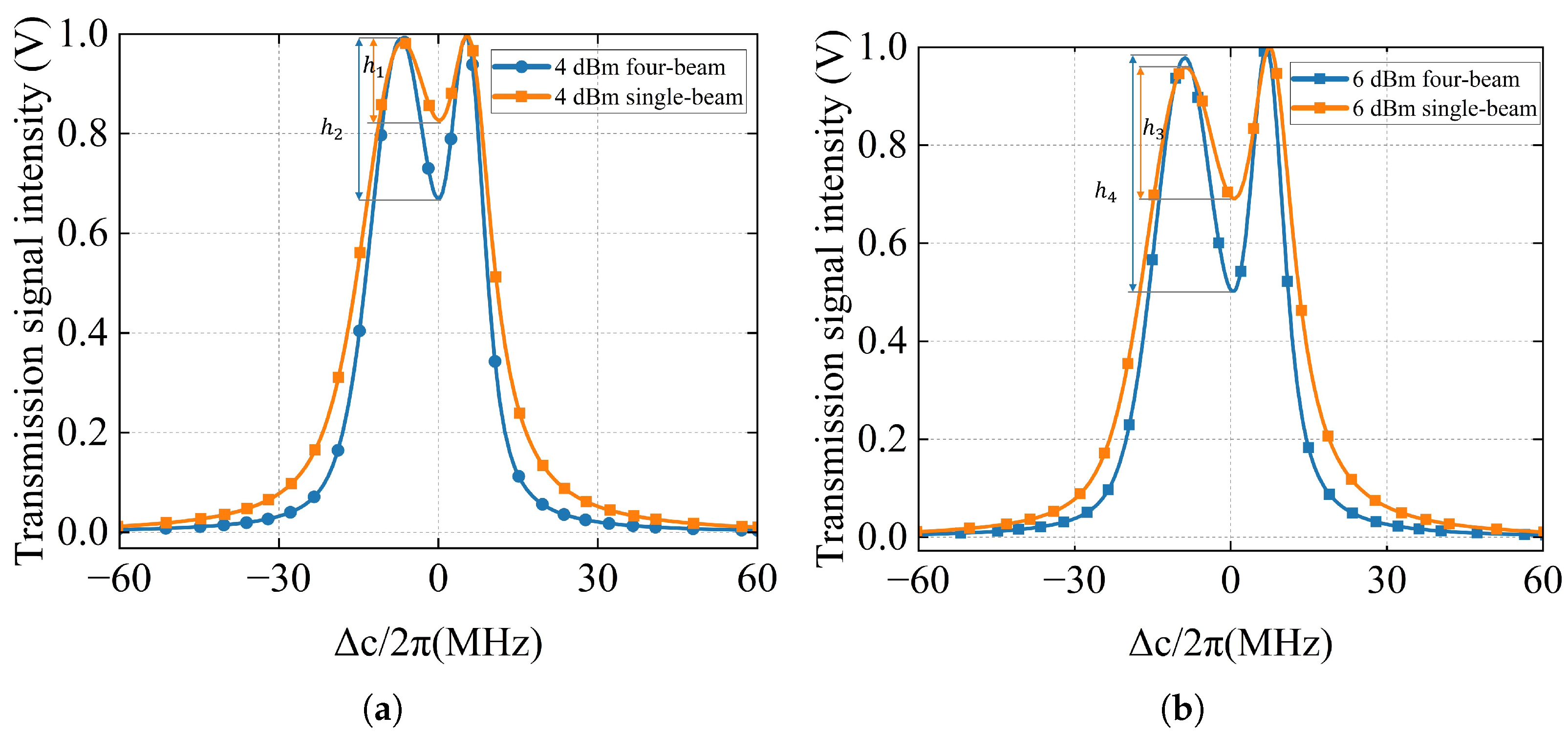
Figure 6 depicts the normalized EIT-AT splitting depth when the atoms are excited by the four-beam and single-beam with the MW power at 4 dBm to 6 dBm @8.566 GHz. At identical field intensity, the splitting depth h i ( i = 1 , 2 , 3 ) of the four-beam is deeper than that of the single-beam, which means that the detection ability of the four-beam is better than that of the single-beam at weaker signals. It can be assumed that when the signal power is further diminished, the EIT generated by single-beam will not exhibit splitting peaks, making it difficult to locate the EIT-AT peaks accurately. In contrast, the four-beam may still be capable of producing splitting and detecting the signal.
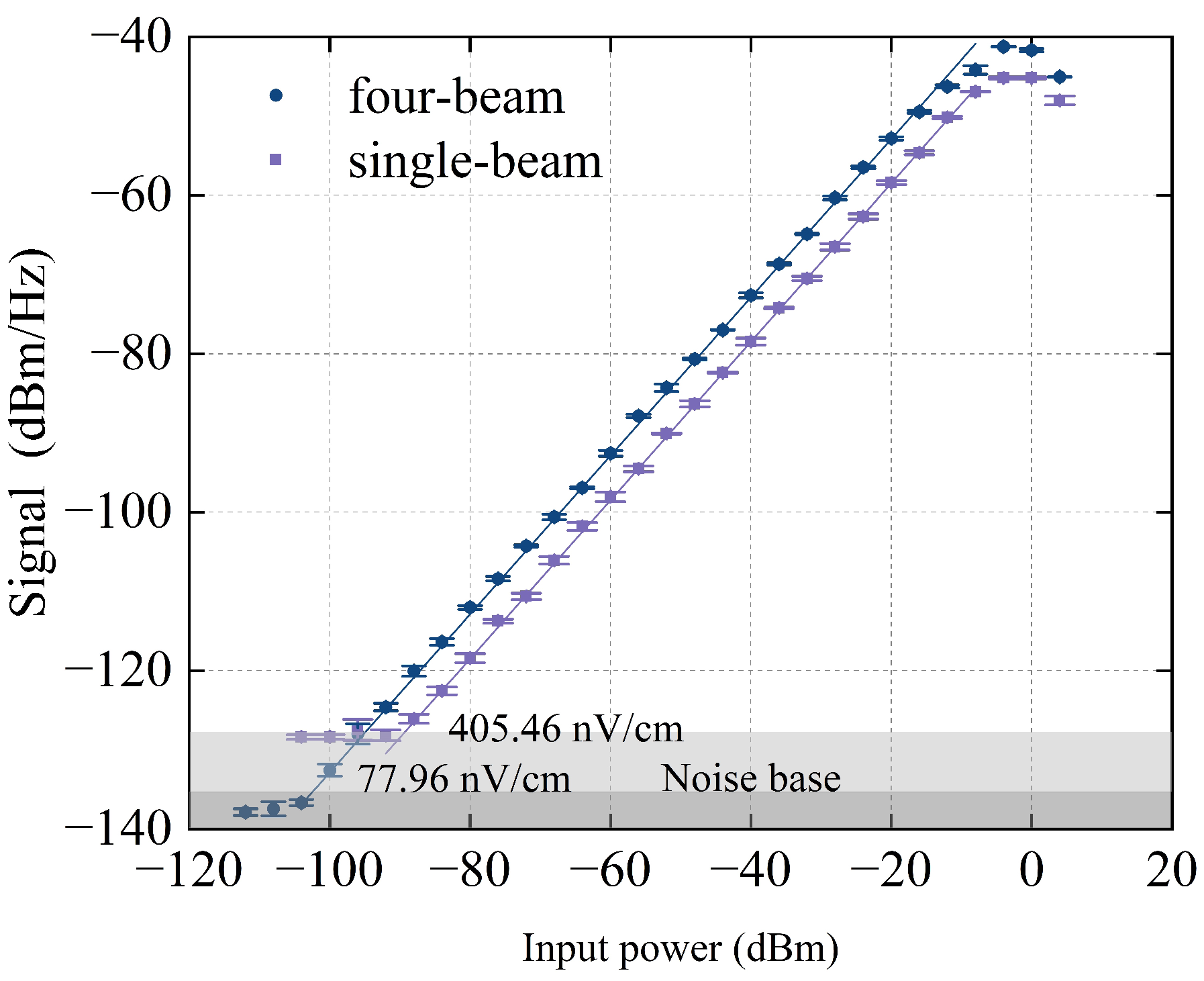
Our work displays a scheme for how to increase the EIT height while also improving the linewidth with limited laser power, which boosts the utilization of the laser and the interaction between laser and atoms to improve the detection abilities eventually. We conducted experiments realizing the minimum field detectable of 77.96 nV / cm / Hz with the laser array at 400 μW, and it could be further improved by optimizing the probe laser, coupling laser power and so on, which demonstrate an improvement compared to a single-beam of 405.46 nV / cm / Hz , as shown in Figure 7. As to other excellent works, like [17,27], we envision that the sensitivity could be achieved by combining both techniques by using more laser arrays (N × N) and a repumping laser or other schemes like Resonator to boost the response and detection capabilities of atoms to signals.

4. Discussion

In summary, we explored and reported an accessible 2 × 2 probe laser array strategy to effectively enhance the Rydberg EIT spectral resolution and sensitivity. Benefitting from 2 × 2 probe laser arrays, Rydberg atomic populations in the vapor cell have been increased, and the height of EIT spectra excited by four beams is approximately 4 times higher than that of any one beam. The FWHM decreases from 23.53 MHz (single-beam) to 12.66 MHz (four-beam) with the constant laser power, which implies that the spectral resolution has also been enhanced. The formation of the high amplitude and low linewidth improves the SNR of the spectral signal, enabling more accurate measurement under the Rydberg atomic EIT-AT regime and achieving a measured sensitivity of about 77.96 nV / cm / Hz . Furthermore, our results lay a foundation for using N × N multi-beams to enhance the sensitivity and it can be combined with other technologies like resonators, which is promising for contributing to a rapid breakthrough in the sensitivity of the Rydberg atomic microwave measurement technique.

Author Contributions

Conceptualization, F.Z. and Q.A.; Experiment, F.Z. and J.Z.; Data curation, F.Z. and J.Z.; Resources, F.Z.; software, F.Z.; Supervision, Q.A. and Y.F.; writing—original draft, F.Z. and Q.A.; writing—review and editing, F.Z. and Q.A. All authors have read and agreed to the published version of the manuscript.

Funding

This work was funded by the National Natural Science Foundation of China (Grant No. 12304436), National Natural Science Foundation Joint Fund (Grant No. U24B2009), and Natural Science Foundation of Hunan Province of China (Grants No. 2022JJ40556).

Institutional Review Board Statement

Not applicable.

Informed Consent Statement

Not applicable.

Data Availability Statement

The data presented in this study are available on request from the corresponding author.

Conflicts of Interest

The authors declare no conflicts of interest.

References

  1. Sedlacek, J.A.; Schwettmann, A.; Kübler, H.; Löw, R.; Pfau, T.; Shaffer, J.P. Microwave electrometry with Rydberg atoms in a vapour cell using bright atomic resonances. Nat. Phys. 2012, 8, 819–824. [Google Scholar] [CrossRef]
  2. Schlossberger, N.; Talashila, R.; Prajapati, N.; Holloway, C.L. Angle-of-arrival detection of radio-frequency waves via Rydberg atom fluorescence imaging of standing waves in a glass vapor cell. Phys. Rev. Appl. 2025, 24, 024056. [Google Scholar] [CrossRef]
  3. Gao, G.; Chen, M.; Feng, H.; Zhu, Z.; Chen, A.; Wu, Z.; Mao, T.; Dai, W.; Peng, P.; Zheng, D. Rydberg communication antennas with self-decoupling for dynamic radar interference based on heterodyne technology. Appl. Phys. Lett. 2025, 126, 134002. [Google Scholar] [CrossRef]
  4. Lin, Y.; Wu, F.C.; Mao, R.-Q.; Yao, J.-W.; Liu, Y.; An, Q.; Fu, Y.-Q. Development of three-port fiber-coupled vapor cell probe and its application in microwave digital communication. Acta Phys. Sin. 2022, 71, 170702. [Google Scholar]
  5. Anderson, D.A.; Sapiro, R.E.; Raithel, G. A self-calibrated SI-traceable Rydberg atom-based radio frequency electric field probe and measurement instrument. IEEE Trans. Antennas Propag. 2021, 69, 5931–5941. [Google Scholar] [CrossRef]
  6. Jau, Y.; Carter, T. Vapor-Cell-Based Atomic Electrometry for Detection Frequencies below 1 kHz, Vapor-Cell-Based Atomic Electrometry for Detection Frequencies below 1 kHz. Phys. Rev. Appl. 2020, 13, 054034. [Google Scholar] [CrossRef]
  7. Hou, L.; He, Q.; Wang, J.; Yang, L.; Shi, W.; Li, H.; Wang, Y.; Zhang, D. High sensitivity THz detection by Rydberg dark states. Opt. Exp. 2025, 33, 13121–13132. [Google Scholar] [CrossRef]
  8. Wade, C.G.; Šibalić, N.; de Melo, N.R.; Kondo, J.M.; Adams, C.S.; Weatherill, K.J. Real-time near-field terahertz imaging with atomic optical fluorescence. Nat. Photonics 2017, 11, 40–43. [Google Scholar] [CrossRef]
  9. Holloway, C.L.; Simons, M.T.; Kautz, M.D.; Haddab, A.H.; Gordon, J.A.; Crowley, T.P. A quantum-based power standard: Using Rydberg atoms for a SI-traceable radio-frequency power measurement technique in rectangular waveguides. Appl. Phys. Lett. 2018, 113, 094101. [Google Scholar] [CrossRef]
  10. Schlossberger, N.; Prajapati, N.; Berweger, S.; Rotunno, A.P.; Artusio-Glimpse, A.B.; Simons, M.T.; Sheikh, A.A.; Norrgard, E.B.; Eckel, S.P.; Holloway, C.L. Rydberg states of alkali atoms in atomic vapour as SI-traceable field probes and communications receivers. Nat. Rev. Phys. 2024, 6, 606–620. [Google Scholar] [CrossRef]
  11. Paradis, E.; Raithel, G.; Anderson, D.A. Atomic measurements of high-intensity VHF-band radio-frequency fields with a Rydberg vapor-cell detector. Phys. Rev. A 2019, 100, 013420. [Google Scholar]
  12. Mao, R.; Lin, Y.; Fu, Y.; Ma, Y.; Yang, K. Digital beamforming and receiving array research based on Rydberg field probes. IEEE Trans. Antennas Propag. 2023, 72, 2025–2029. [Google Scholar] [CrossRef]
  13. Liu, B.; Zhang, L.; Liu, Z.; Zhang, Z.; Zhu, Z.; Gao, W.; Guo, G.; Ding, D.; Shi, B. Highly Sensitive Measurement of a Megahertz rf Electric Field with a Rydberg-Atom Sensor. Phys. Rev. Appl. 2022, 18, 014045. [Google Scholar] [CrossRef]
  14. Meyer, D.H.; O’Brien, C.; Fahey, D.P.; Cox, K.C.; Kunz, P.D. Optimal atomic quantum sensing using electromagnetically-induced-transparency readout. Phys. Rev. A 2021, 104, 043103. [Google Scholar] [CrossRef]
  15. Zhou, F.; Jia, F.D.; Mei, J.; Liu, X.B.; Zhang, H.Y.; Yu, Y.H.; Liang, W.C.; Qin, J.W.; Zhang, J.; Xie, F.; et al. The effect of the Doppler mismatch in microwave electrometry using Rydberg electromagnetically induced transparency and Autler-Townes splitting. J. Phys. B At. Mol. Opt. Phys. 2022, 55, 075501. [Google Scholar] [CrossRef]
  16. Jing, M.; Hu, Y.; Ma, J.; Zhang, H.; Zhang, L.; Xiao, L.; Jia, S. Atomic superheterodyne receiver based on microwave-dressed Rydberg spectroscopy. Nat. Phys. 2020, 16, 911–915. [Google Scholar] [CrossRef]
  17. Prajapati, N.; Robinson, A.K.; Berweger, S.; Simons, M.T.; Artusio-Glimpse, A.B.; Holloway, C.L. Enhancement of electromagnetically induced transparency based Rydberg-atom electrometry through population repumping. Appl. Phys. Lett. 2021, 119, 214001. [Google Scholar] [CrossRef]
  18. Santarelli, G.; Laurent, P.; Lemonde, P.; Clairon, A.; Mann, A.G.; Chang, S.; Luiten, A.N.; Salomon, C. Quantum projection noise in an atomic fountain: A high stability cesium frequency standard. Phys. Rev. Lett. 1999, 82, 4619. [Google Scholar] [CrossRef]
  19. Zhang, P.; Jing, M.; Wang, Z.; Peng, Y.; Yuan, S.; Zhang, H.; Xiao, L.; Jia, S.; Zhang, L. Quantum scaling atomic superheterodyne receiver. EPJ Quantum Technol. 2023, 10, 39. [Google Scholar] [CrossRef]
  20. Hu, J.; Jiao, Y.; He, Y.; Zhang, H.; Zhang, L.; Zhao, J.; Jia, S. Improvement of response bandwidth and sensitivity of Rydberg receiver using multi-channel excitations. EPJ Quantum Technol. 2023, 10, 51. [Google Scholar] [CrossRef]
  21. Zhou, F.; Jia, F.; Liu, X.; Yu, Y.; Mei, J.; Zhang, J.; Xie, F.; Zhong, Z. Improving the spectral resolution and measurement range of quantum microwave electrometry by cold Rydberg atoms. J. Phys. B At. Mol. Opt. Phys. 2023, 56, 025501. [Google Scholar] [CrossRef]
  22. Zhou, Y.Q.; Yin, Y.; Yuan, Y.D.; Lin, T.G.; Huang, H.H.; Yao, L.S.; Wang, X.Q.; Tam, A.M.W.; Fan, F.; Wen, S.C. Liquid crystal Pancharatnam-Berry phase lens with spatially separated focuses, Liquid crystal Pancharatnam-Berry phase lens with spatially separated focuses. Liq. Cryst. 2019, 46, 995–1000. [Google Scholar] [CrossRef]
  23. Yang, Y.; Liu, X.; Wu, Y.; Li, T.; Fan, F.; Huang, H.; Wen, S. Optical edge detection with adjustable resolution based on liquid crystal polarization gratings. Chin. Opt. Lett. 2020, 18, 093501. [Google Scholar] [CrossRef]
  24. Yue, M.; Yan, L.; Xu, Y.; Nguyen, V.; Chen, T. Intense and collimated supercontinuum generation using microlens array. IEEE Photonics Technol. Lett. 2017, 29, 2031–2034. [Google Scholar] [CrossRef]
  25. Shylla, D.; Prajapati, N.; Rotunno, A.P.; Schlossberger, N.; Manchaiah, D.; Watterson, W.J.; Artusio-Glimpse, A.; Berweger, S.; Simons, M.T.; Holloway, C.L. Observation of asymmetric sideband generation in strongly-driven Rydberg atoms. arXiv 2024, arXiv:2408.10989. [Google Scholar] [CrossRef]
  26. Šibalić, N.; Pritchard, J.D.; Adams, C.S.; Weatherill, K.J. Arc: An open-source library for calculating properties of alkali Rydberg atoms. Comput. Phys. Commun. 2017, 220, 319–331. [Google Scholar] [CrossRef]
  27. Mao, R.; Lin, Y.; Zhou, A.; Yang, K.; Fu, Y. Shortwave Ultra-high Sensitivity Rydberg Atomic Electric Field Sensing Based on A Subminiature Resonator. IEEE Trans. Antennas Propag. 2024, 72, 8165–8172. [Google Scholar] [CrossRef]
Figure 1. Overview of experimental setup. We have used the following notations: PD: photodetector, HWP: half-wave plate, PBS: polarizing beam splitter, BS: beam splitter, HR: high-reflection dielectric mirror, DM: dichroic mirror. (a) Schematic of Rydberg atom-based antenna interacting with RF field signals. There are probe laser arrays, which counter-propagate with the coupling laser beam to excite atoms. (b) Illustration of the energy diagram.
Photonics 12 01189 g001
Figure 2. The progress of splitting and collimation of the probe laser. The deflection angle θ 0 of the laser coming out of the beam splitting grating is 2.06°. (a) Vertical LCPG. (b,e) The 1/4 wave plate is used to adjust the polarization of incident laser. (c) Horizontal LCPG. (d) Four-zone grating. (f,g) are the physical images of gratings.
Photonics 12 01189 g002
Figure 3. The 3D and 2D diagrams of the 2 × 2 probe laser arrays are shown. The interval between the left and right spots is 1.61 mm, while the interval between the top and bottom spots is 1.63 mm. This illustration displays the laser spot at various transmission distances, demonstrating effective collimation over a distance greater than 7.5 cm. (i–iv) The relative positions of the four laser spots.
Photonics 12 01189 g003
Figure 4. Experimental data of EIT curves for different spot locations of probe lasers. (a) Probe laser transmission as a function of coupling laser detuning Δ c at different lasers. (bd) Probe laser transmission of 1, 2, and 3 lasers.
Photonics 12 01189 g004
Figure 5. EIT curves for the three laser patterns: four-beam, single-beam and 1/4-beam.
Photonics 12 01189 g005
Figure 6. (a,b) Comparison of splitting depth normalized results for EIT-AT curves formed by single-beam with four-beam interacting with the coupling laser at a MW field power of 4 dBm and 6 dBm.
Photonics 12 01189 g006
Figure 7. Smallest possible field amplitude results measured at 8.566 GHz.
Photonics 12 01189 g007
Table 1. Specific parameters of probe laser beam.
Laser PatternPower [μW]Diameter [mm]
four-beam4001
1/4-beam1001
single-beam4001
Disclaimer/Publisher’s Note: The statements, opinions and data contained in all publications are solely those of the individual author(s) and contributor(s) and not of MDPI and/or the editor(s). MDPI and/or the editor(s) disclaim responsibility for any injury to people or property resulting from any ideas, methods, instructions or products referred to in the content.