Article

Performance Evaluation of Black Phosphorus and Graphene Layers Using Surface Plasmon Resonance Biosensor for the Detection of CEA Antigens


1
Department of Electronics and Communication Engineering, Graphic Era Deemed to be University, Dehradun 248001, UK, India
2
Department of Electronics and Communication Engineering, JB Institute of Technology, Dehradun 248197, UK, India
3
Department of Game, Advanced Arcade Game Regional Innovation Center, Dongseo University, Busan 47011, Republic of Korea
4
Division of Computer & Information Engineering, Regional Innovation Center, Dongseo University, Busan 47011, Republic of Korea
*
Author to whom correspondence should be addressed.
Photonics 2025, 12(11), 1105; https://doi.org/10.3390/photonics12111105
Submission received: 2 October 2025 / Revised: 6 November 2025 / Accepted: 7 November 2025 / Published: 9 November 2025
(This article belongs to the Special Issue Advances in Optical Sensors and Applications)

Abstract

The biomarker carcinoembryonic antigen (CEA) plays an important role in the diagnosis and monitoring of cancer, like breast, surveillance, colon, and liver cancer. The highly sensitive surface plasmon resonance (SPR) sensor presented in this work uses two-dimensional (2D) materials: BP/graphene, and the franckeite layer integrated in a Kretschmann configuration. The sensor structure, which includes a copper (Cu) layer and a CaF2 prism, is intended to detect CEA in aqueous solutions with high accuracy. The proposed sensor’s performance was assessed using the transfer matrix method (TMM), with particular attention paid to important metrics like sensitivity, figure of merit (FoM), detection accuracy (DA), and penetration depth (PD). The proposed sensor achieved a sensitivity of 307.50 deg/RIU and a FoM of 61.62/RIU at a Rmin value of 4.20 × 10⁻⁵ a.u. at a 40 nm Cu thickness, operating at a wavelength of 633 nm. The maximum sensitivity of 348.07 deg/RIU was achieved at 47 nm Cu thickness with BP layer, while the graphene layer yielded maximum sensitivity of 314.32 deg/RIU at the same Cu thickness. The results show that adding 2D layered materials to symmetric SPR sensors greatly improves detection performance, providing a promising foundation for the detection of clinical biomarkers in the future.

1. Introduction

One of the most common and deadly illnesses in the world today is cancer. Nearly 10 million people died from cancer in 2020, according to WHO GLOBOCAN data, and by 2024, that number had increased to about 10.8 million. Lung, breast, colorectal, liver, and prostate cancers remain the most common and significant causes of death worldwide among all cancer types [1,2,3]. Biomarkers, such as proteins, metabolites, and DNA molecules released into the bloodstream by cancerous cells, are essential for the detection of cancer. The biomarker known as CEA has been employed in the identification of lung cancer. CEA, however, is not unique to lung cancer because it can also appear in breast, colorectal, gastric, and pancreatic cancers. Yamaguchi sarcoma viral oncogene homolog 1 (YES1), also known as v-YES1, was recently identified as a distinct lung cancer biomarker [4,5]. Lung cancer detection would be more accurate and reliable if both CEA and YES1 were detected. This is due to the fact that the detection of a single tumor marker typically reduces the accuracy of tumor diagnosis because the prevalence of several cancers is associated with multiple markers [5]. Traditional techniques have been employed to detect CEA, but electrochemical immunosensors have garnered a lot of interest because of their many benefits, which include high selectivity, low sample requirements, fast response, miniaturization, and remarkable sensitivity [4]. It is difficult to prepare distinct immunoprobes with varying redox activities for the multiplex and simultaneous immunosensor fabrication process. Electroactive nanometals can be added to the sensing platform to address this [4]. In order to improve survival rates and impede the progression of the disease, early diagnosis and treatment are essential. Larger tumors can be found more successfully in later stages of the disease progression using traditional diagnostic techniques like MRI and CT [6,7]. Consequently, it is crucial to give priority to earlier and more precise diagnostic methods. Cancer is a complicated illness caused by alterations in cell signaling that are both genetic and epigenetic. Biomarkers are molecules that undergo significant change during cancer and are essential for risk assessment, early diagnosis, treatment response prediction, and recurrence monitoring. CEA is a prominent biomarker that is associated with lung, breast, and pancreatic cancers, in addition to colorectal cancer. After birth, CEA is usually present in very small amounts. Its levels, however, can rise sharply in cancer cases. While smokers’ normal range is below 5 ng/mL, non-smokers’ normal range is typically less than 3 ng/mL [2,4]. RI-based optical biosensing is a good fit for theoretical modeling since, crucially, the RI of solutions containing CEA varies with concentration. Because SPR sensing is highly sensitive to changes in refractive index (RI) at the metal–dielectric interface, it has become a compelling method for the label-free detection of cancer biomarkers. Since the concentration of solutions containing CEA affects their refractive index, SPR offers a useful optical platform for detecting it. A number of recent studies have suggested creative material-integrated SPR designs to improve performance. A silicon-based ROTE sensor, for example, used resonance-enhanced transmission to demonstrate high-Q and label-free CEA detection [1,2,7,8].
Recent developments in optical biosensing technologies have had a major impact on a wide range of scientific and technological fields, particularly increasing the ability to perform analytical and high-precision detection. Among the most widely studied biosensing technologies are optical biosensors, which are used in a wide range of fields such as cancer detection, clinical diagnostics, food safety, and the detection of toxins and pesticides [9,10,11]. Bioluminescent optical fiber biosensors [12], optical waveguide biosensors [13,14], fluorescence-based biosensors [15], and SPR biosensors [11,16] are just a few of the many different types of optical biosensors. In optical biosensing, SPR sensors are a noteworthy technique that provides label-free detection with high sensitivity and stability as well as real-time monitoring [17]. Because of these properties, SPR is a technique that is extensively studied and applied in a variety of detection applications [18,19]. The SPR phenomenon happens at a metal’s surface when it comes into contact with a dielectric material and is exposed to polarized light at a resonance angle. The surface plasmons (SPs) are generated by this interaction, which lowers the intensity of the reflected light at that particular angle. The resonance angle changes in proportion to the sensing medium’s (SM) changing RI. The SPR sensor assists in detecting variations associated with different applications, such as cancer biomarkers, cortisol levels, and glucose concentration. Four common plasmonic metals used in the SPR sensors, such as gold (Au) and silver (Ag), Cu, and aluminum (Al), each offering distinct advantages and limitations. Au’s superior chemical stability, oxidation resistance, and biocompatibility make it the most widely used metal in the SPR technique; however, its high cost restricts large-scale applications, and its broader resonance peaks result in slightly lower sensitivity [20]. Ag is a reasonably priced plasmonic metal that is well-known for its superior optical qualities and effective SPR excitation, which raises sensitivity [21]. In the visible and near-infrared spectrums, Ag exhibits sharper and more intense SPR peaks than Au. Although Ag has the highest sensitivity among noble metals due to its sharpest and most intense plasmonic resonance in the visible to near-infrared range, it has a strong tendency to oxidize and degrade, lowering long-term stability, and frequently requiring protective coatings. This instability often necessitates the use of protective coatings to ensure long-term performance. Cu is cheap, plentiful, and has optical properties similar to Ag [22]. It also has good sensitivity, but it is very oxidation-prone and needs stabilizing layers like graphene or BP to be used reliably [23,24]. Though the oxide layer occasionally serves as a protective coating, the Al surface easily oxidizes, which can change plasmonic performance. In contrast, Al is incredibly affordable and supports plasmonic excitation in the visible and ultraviolet regions, making it unique for UV-based sensor devices. Overall, Ag and Cu perform well in high-sensitivity applications with protective measures, Au is preferred for stable and biocompatible biosensing, and Al is notable for integrated, affordable, and UV-based sensing platforms [19,21,25].
Recent research has demonstrated the potential of two-dimensional (2D) materials, including transition metal dichalcogenides (TMDCs) [26], black phosphorus (BP) [27], hexagonal boron nitride (h-BN) [28], MXenes, and other 2D nanomaterials, for the creation of extremely sensitive SPR sensors. These materials are attractive because of their remarkable surface area-to-volume ratios, which improve the adsorption of biomolecules, in addition to their adjustable optoelectronic characteristics. The large specific surface area of 2D materials promotes efficient molecular adsorption, which is essential for biological SPR applications, according to recent studies that support these conclusions. Additionally, their tunable optical properties enhance light–matter interactions in SPR configurations based on RI, which eventually results in improved sensing performance. As per the literature, many researchers have worked extensively on the detection of CEA using different biosensing platforms, particularly SPR-based sensors. In 2025, Khodaie et al. [2] discussed the MXene-based SPR sensor for the detection of CEA, which shows the maximum sensitivity and FoM of 163.63 deg/RIU and 17.52/RIU. Kumar et al. [29] presented the SPR sensor using graphene, MXene, and MoS2 layers for the detection of CEA antigens, which achieved a sensitivity of 144.72 deg/RIU. In 2025, Khodaie et al. [30] analyzed 2D material-based SPR sensors, like MXene, BP, MoS2, and molybdenum trioxide for the detection of CEA with 196.91 deg/RIU sensitivity and a FOM of 14.87/RIU.
The current design of SPR sensors for carcinoembryonic antigen (CEA) detection is motivated by a number of enduring bottlenecks [4,5]. To begin, increasing the interaction volume can improve sensitivity, but it also dampens and broadens the resonance, which reduces reproducibility and resolution. Second, clinical samples continue to face significant challenges with selectivity and non-specific adsorption (biofouling), necessitating strong surface chemistry and linker strategies that do not impair plasmonic performance. Third, the introduction of reactive plasmonic metals or advanced 2D layers poses challenges to device stability and repeatability. For example, some plasmonic metals experience corrosion or chemical modification that causes the resonance to shift over time, and many high-performance 2D materials, such as graphene or BP, oxidize quickly in ambient conditions. Lastly, translation from lab demonstrations to trustworthy sensors is limited by large-area uniformity and fabrication reproducibility, especially for 2D/metal heterostructures. Cu was selected as the plasmonic metal in this work due to a balance between integration considerations, cost, and optical performance. In some visible-near-IR windows, Cu shows sharper angular resonances and a stronger plasmonic response than many other materials. This results in increased sensitivity to change in RI. Additionally, it is less costly than Au and works with common thin-film deposition methods, making scalable fabrication possible. Nevertheless, under normal circumstances, Cu easily oxidizes and tarnishes; the native oxide severely impairs plasmonic performance and reproducibility. Use of Cu therefore necessitates mitigation techniques that maintain the beneficial optical qualities while averting chemical deterioration, such as ultrathin protective overlayers, in-situ encapsulation, or graphene/barrier layers [31]. Since BP/graphene and franckeite have complementary electronic, chemical, and protective qualities, this combination represents a major innovation. In addition to graphene’s high carrier mobility, superior in-plane conductivity, and an impermeable, atomically thin barrier that can reduce metal oxidation and enhance charge transfer and surface functionalization [32,33], BP offers a tunable direct bandgap and a strong light–matter interaction that can improve local field confinement and sensitivity to changes in RI and biomolecular binding events [34]. A naturally occurring layered sulfosalt with intrinsic van der Waals layering and mixed-metal chalcogenide chemistry, franckeite plays a number of strategic roles in the heterostructure [35]: (i) it acts as an air-tolerant, chemically robust interlayer that can improve environmental stability when compared to exposed BP; (ii) its electronic heterogeneity and intrinsic multi-layer composition are expected to facilitate favorable band alignment and charge redistribution at the BP/graphene–metal interface, promoting plasmon-exciton coupling and a quicker charge separation; and (iii) its sulfide/carrier chemistry provides additional binding sites or chemical affinity for common biomolecular linker chemistries, potentially increasing immobilization efficiency and effective surface coverage of capture antibodies for CEA. When combined, these three elements have synergistic effects that alleviate the SPR bottlenecks mentioned above: BP enhances the optical response through its tunable optical absorption and anisotropy, while graphene and franckeite improve the chemical and oxidative stability of BP and Cu. Enhancing electrical continuity and offering an atomically thin protective cap that barely disturbs the plasmonic near field are two benefits of graphene. Thus, the heterostructure seeks to (a) maintain the high intrinsic sensitivity that can be achieved with Cu and BP, (b) avoid thick damping layers and maintain narrow resonance line shapes for high resolution, and (c) provide the functionalization versatility and practical environmental robustness needed for dependable CEA detection in realistic sample matrices.

2. Proposed Structure, Fabrication Feasibility, Refractive Indices and Modeling

Figure 1 shows the schematic of the suggested SPR sensor, which is intended to detect analytes in the sensing layer with high sensitivity. Surface plasmons at the metal–dielectric interface are excited by incident light in the sensor setup, which uses a CaF2 prism as the coupling medium due to low RI, wide transparency range, and excellent optical transmission [21]. A thin layer of Cu serves as the plasmon-supporting metal layer. Due to its strong plasmonic resonance in the visible and near-infrared spectrum, high conductivity, and relative affordability when compared to Au and Ag, a thin layer of Cu is selected as the metallic layer that supports plasmons [21]. Despite being more oxidation-prone than Ag or Au, Cu’s stability and lifetime are greatly increased when combined with protective 2D materials like graphene or BP, all the while preserving sharp resonance dips.
While each of these materials has its own advantages, graphene’s high surface area, strong optical conductivity, and exceptional carrier mobility allow for better plasmon resonance sharpness and biomolecule adsorption [36]. The tunable bandgap, high sensitivity to changes in RI, and anisotropic optical and electronic properties of BP improve the evanescent field’s confinement [37]. A naturally occurring van der Waals heterostructure called franckeite enhances plasmon stability and device durability by offering intrinsic stability, layered heterogeneity, and broadband optical absorption [38]. Analyte molecules interact with the evanescent field in the sensing layer, which is positioned on top, changing the resonance condition. After that, the reflected light is observed to look for resonance shifts, which are caused by changes in the SM’s RI. Comparing this design to traditional SPR structures, it successfully increases detection accuracy, decreases damping losses, and improves field localization.
The proposed SPR sensor’s fabrication feasibility is illustrated in Figure 2. A methodical approach that guarantees stability and repeatability can be used to explain. The procedure starts with a CaF2 prism, which is thoroughly cleaned to get rid of both organic and inorganic impurities using solvents and plasma treatment. This step is crucial because the cleanliness and smoothness of the prism surface strongly affect adhesion, optical quality, and long-term stability. Physical vapor deposition (PVD), a highly controllable technique that ensures uniform film thickness, excellent adhesion, and minimal surface roughness, is then used to deposit a Cu thin layer [39]. The Cu layer serves as the main metal that supports plasmons, and by adjusting the deposition parameters, stability against oxidation can be increased. Next, chemical vapor deposition (CVD), a popular method for creating large-area, defect-controlled 2D materials, is used to grow graphene or BP layers. The most popular method for creating a large-area graphene layer of superior quality that is appropriate for SPR applications is CVD. A transition metal catalyst substrate, usually copper Cu, is used in this process to break down a hydrocarbon precursor gas, such as methane (CH4), at high temperatures (usually 900–1000 °C). The SPR sensing surface, which is typically coated with a metal layer, is then exposed to the resultant monolayer or few-layer graphene. Frequently, a polymer support layer facilitates the transfer (e.g., A. PMMA), which is subsequently taken out. Strong adherence to the plasmonic layer, uniform thickness, and low defect density are characteristics of CVD-grown graphene that improve light–matter interaction and sensor sensitivity. However, if not adequately managed, possible contamination during transfer and mechanical damage can impair optical performance [32]. In order to create large-area BP layers directly on substrates, CVD and vapor-phase growth techniques have been developed. Better thickness control and integration with plasmonic layers are made possible by these bottom-up approaches; however, because of BP’s instability, they require high temperatures, inert environments, and instant encapsulation. These methods involve thermally converting red phosphorus or phosphine gas to BP at high temperatures and low pressures, frequently with the aid of a catalyst or substrate like sapphire or silicon [34]. Because of its high oxidation sensitivity and quick degradation in the presence of oxygen and moisture, BP must be synthesized and integrated in an inert environment. Numerous methods have been devised to produce superior BP films appropriate for plasmonic detection [34]. Reproducible growth with high crystallinity is made possible by the atomic-scale control in CVD, which is necessary to produce reliable plasmonic responses. A franckeite layer is then added by CVD, which offers stability improvement, strong light–matter interaction, and natural heterostructure properties, all of which increase sensitivity [38]. In order to ensure selectivity and biocompatibility, a sensing layer is functionalized on the top surface for biomolecule interaction. This is usually accomplished by chemical modification or thin-film coating. Because PVD and CVD are standardized, scalable, and able to yield repeatable results across several sensor batches, their combination guarantees high repeatability. Moreover, structural stability is improved by using durable 2D materials like graphene and franckeite, which stop degradation and preserve resonance performance over several sensing cycles. Overall, this manufacturing process shows that the SPR sensor is not only feasible but also scalable, stable, and reliable for use in actual biomedical and environmental applications.
As shown in Table 1, the thickness and RI of each material layer in the proposed SPR biosensor are critical to attaining high sensitivity and stability.
The proposed SPR sensor is analyzed in this study using the transfer matrix method (TMM) and the Fresnel equations as the theoretical basis. The Fresnel equations are crucial for simulating the interaction of incident p-polarized light with the prism, metal, and 2D material layers because they explain how light is reflected and transmitted at the interface of two media with various RIs. By considering the continuity of the tangential components of the electric and magnetic fields across each interface, the TM method applies this idea to a proposed sensor structure. The dielectric constant (εₖ), permeability (μₖ), thickness (dₖ), and RI (nₖ) of the kth layer are important factors that collectively dictate what propagates light through the structure. The sensor is represented as a stack of layers along the z-axis, with the prism (first layer) at the beginning and the SM (Nth layer) at the end. The tangential field components at the boundaries, which enforce the boundary conditions for solving Maxwell’s equations, are represented by the symbols U1, V1 (at the first boundary, z = z1 = 0) and UN−1, VN−1 (at the last boundary, Z = ZN−1) as shown in mathematical Equation (1). These parameters are then used by the TM method to generate a set of matrix relations that determine the structure’s overall reflectivity. Using Equations (2)–(7), performance metrics like sensitivity, full width at half maximum (FWHM), detection accuracy (DA), and figure of merit (FoM) are extracted from the reflectance curve as a function of the incident angle. In order to validate the sensor’s performance under various analyte RIs, the simulations are conducted using MATLAB 2018, which allows for accurate numerical computation and visualization of the reflectance curve for various structural configurations [43].
U 1 V 1 = M U N 1 V N 1
where M = Transfer matrix for the proposed structure.
M = k = 2 N 1 M k
Equation (2) expresses that the TMM is obtained by multiplying the characteristic matrices (Mk) of all internal layers between the incident medium (k = 1) and the sensing medium (k = N).
M k = cos β k ( i sin β k ) / q k i q k sin β k cos β k
For p-polarized light, the propagation properties of the kth layer are defined by Equation (3), where qk is the optical admittance and βk is the phase shift. The coupling between the electric and magnetic fields during light propagation through the layer is described by the off-diagonal elements.
β k = 2 π λ n k cos θ k z k z k 1 = 2 π λ d k ε k n 1 sin θ 1 2
q k = μ k ε k cos θ k = ( ε k n 1 2 sin 2 θ 1 ) ε k
Equation (4) measures the phase difference that light undergoes after passing through the kth layer of thickness dk, internal propagation angle θ1, and RI nk. The permittivity εk and the incident wavelength λ determine it. The kth layer’s magnetic to electric field component ratio, which determines how well the layer transmits or reflects electromagnetic waves, is expressed in Equation (5). The magnetic permeability is represented by μk. Where Zk and Zk−1 represent the kth layer, here k = 0-N-1. Here λ = 633 nm wavelength, and θ1 is the incident light.
The complex reflection coefficient (rp) is defined by Equation (6) and controls the amplitude and phase of reflected light at the interface between the incident and SM. Equation (2) is used to derive the matrix elements Mij. The optical reflectance of incident light reflected by the multilayer stack is represented by Equation (7). The SPR resonance condition, which varies with variations in the SM’s RI, is indicated by the dip in R versus angle.
r p = M 11 + M 12 q N q 1 M 21 + M 22 q N M 11 + M 12 q N q 1 + M 21 + M 22 q N
R = r p 2
Theoretical simulations were carried out using the TMM implemented in MATLAB to analyze the optical response of the multilayer SPR structure. The model calculates the reflectivity as a function of incident angle using the Fresnel equations for p-polarized light. Each layer’s optical properties—RI, thickness, and permittivity—were incorporated to determine the resonance angle and corresponding reflectance dip. Sensitivity and other performance parameters were derived from the shift in resonance angle with respect to changes in the RI of the SM. The sensitivity, full width at half maximum (FWHM), DA, and FoM of the proposed SPR sensor were assessed in this study through MATLAB simulations. As the ratio of the change in resonance angle (Δθres) to the change in the SM’s RI (Δns), sensitivity is one of the most important parameters. This connection is mathematically represented by Equation (8). The sensor’s ability to identify even the smallest variations in analyte concentration is demonstrated. The FWHM, which is the reflectance curve width of the dip at 50% of the minimum reflectance (Rmin) value (0.5 a.u.), is calculated directly from the reflectance curve and provides details about the resonance curve’s sharpness. Since the FWHM and DA are inversely correlated, a narrower resonance dip results in a higher DA; this is expressed mathematically in Equation (9). Equation (10) defines the FoM as the product of sensitivity and DA. By striking a balance between detection precision and sensitivity to variations in RI, the FoM functions as a comprehensive indicator of sensor performance [2,8]. These factors taken together offer a thorough grasp of the biosensor’s effectiveness and dependability in real-world applications.
S e n s i t i v i t y   S = θ r e s n s ( deg / RIU )
D e t e c t i o n   A c c u r a c y   D A = 1 F W H M ( / deg )
F i g u r e   o f   m e r i t   F o M = S F W H M = D A × S ( / RIU )

3. Results and Discussion

3.1. CaF2-Cu-SM

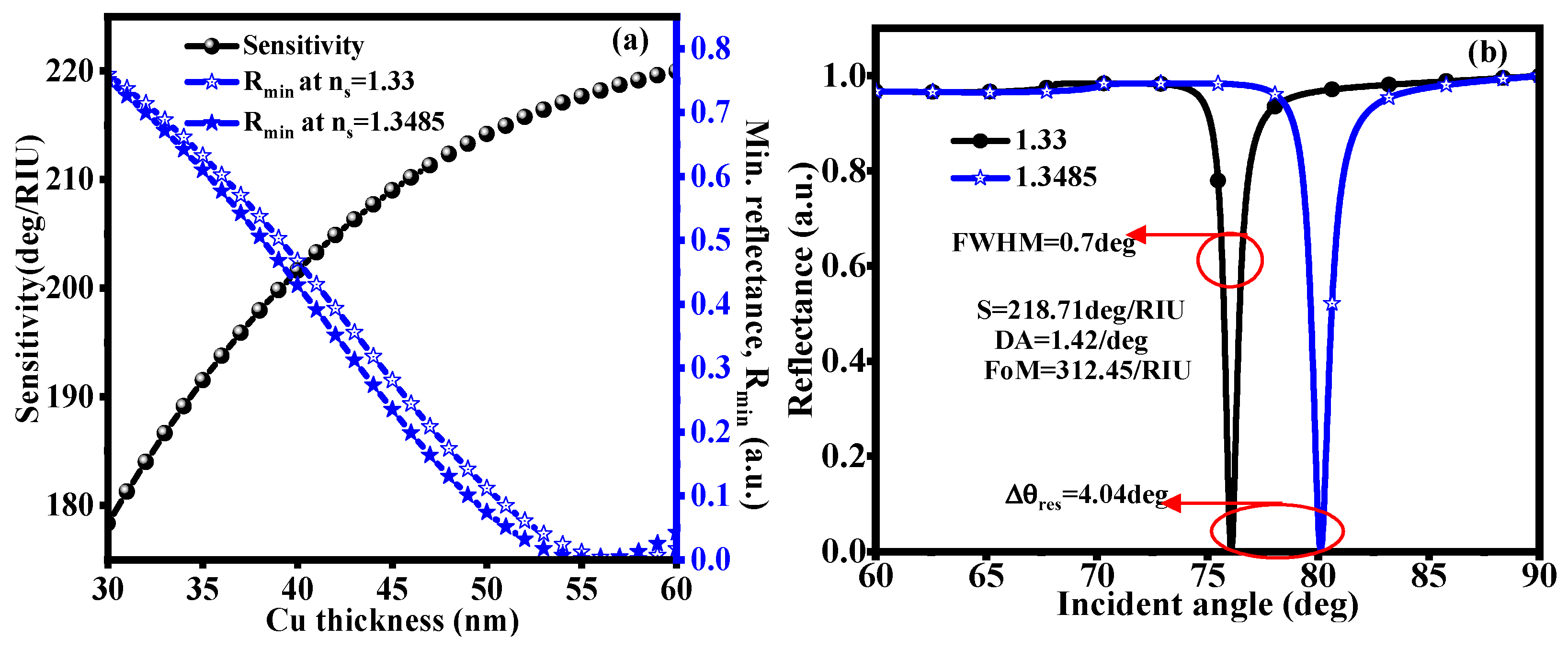
The impact of Cu layer thickness on the Cu layer based SPR sensor’s performance is depicted in Figure 3. Plotting the sensitivity and minimum reflectance (Rmin) variation against Cu thickness is shown in Figure 3a. The sensitivity variation is from 178.36 to 219.95 deg/RIU without BP and graphene layer. The Rmin value (blue curves for ns = 1.33 and ns = 1.3485) exhibits the opposite trend—decreasing to a minimum and then increasing—while the sensor’s sensitivity (black curve) initially stays high but gradually decreases as the Cu thickness increases from 30 nm to 60 nm. The RI = 1.33 represents the reference signal in the absence of the target analyte, serving as the baseline for evaluating variations in RI during CEA detection. The reason for this behavior is that an ideal Cu thickness is necessary for surface plasmon excitation; a layer that is too thin results in significant damping losses, while a layer that is too thick lowers the coupling efficiency between incident photons and surface plasmons. Next, plotting the reflectance curves against the incident angle for refractive indices ns = 1.33 and ns = 1.3485 in Figure 3b reveals steep resonance dips. High sensitivity is indicated by the resonance angle shifting by Δθres = 4.04 deg when the RI changes (S = 218.71 deg/RIU). Excellent sensing performance and precise detection capability are demonstrated by the high FoM of 312.45/RIU and narrow FWHM of 0.7 deg. As a result, the optimal Cu thickness ensures maximum SPR sensitivity and sharp resonance behavior by offering the perfect balance between field confinement and loss.

3.2. With Structure of CaF2-Cu-BP-Franckeite-SM

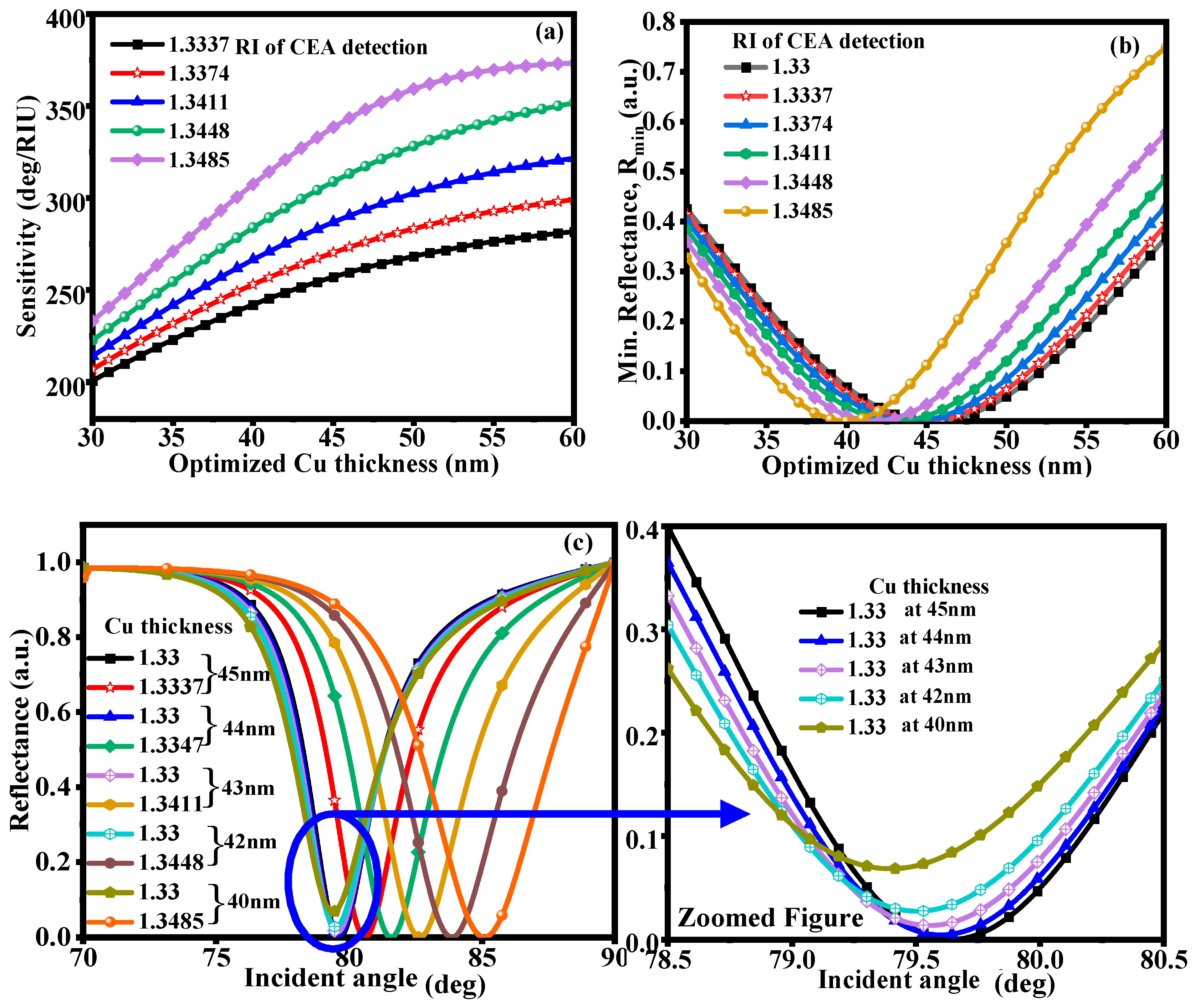
Figure 4 illustrates the effect of optimized Cu layer thickness on the performance of the proposed SPR biosensor in terms of sensitivity and minimum reflectance with BP and franckeite layer. In Figure 4a, the sensitivity (deg/RIU) is plotted against Cu thickness for different RI ranging from 1.3337 to 1.3485. The sensitivity variation is from 200.84–281.67 deg/RIU, 207.03–299.09 deg/RIU, 214.21–321.63 deg/RIU, 222.71–351.59 deg/RIU, and 233.17–373.31 deg/RIU with RI of 1.3337, 1.3374, 1.3411, 1.3448, and 1.3485, respectively. It is observed that sensitivity consistently increases with the increase in Cu thickness, with higher RIs showing a more pronounced sensitivity response. This trend indicates that the optimized Cu layer plays a critical role in enhancing plasmonic resonance and improving DA for CEA sensing. Figure 4b presents the variation of the Rmin value with respect to Cu thickness for the same range of RIs. The results demonstrate that as Cu thickness increases, the reflectance first decreases to an optimum point (around 40–48 nm) and then rises again, highlighting the trade-off between resonance depth and signal strength. The lower values of Rmin correspond to sharper resonance dips, which are desirable for improved sensor resolution. Together, these plots confirm that an optimized Cu thickness not only maximizes sensitivity but also minimizes reflectance, thereby ensuring high detection efficiency and reliable performance of the SPR biosensor for CEA biomarker detection. Figure 4c shows the reflectance response of the proposed SPR sensor structure made of the CaF2 prism, Cu, BP, and franckeite layer for the detection of CEA. Reflectance versus incident angle is displayed in the left panel of Figure 4c for a range of RIs and Cu thicknesses, while the resonance dip for RI = 1.33 at Cu thicknesses between 40 and 45 nm is magnified in the right panel. According to the observed resonance behavior, the sensitivity of the CaF2-Cu-BP-franckeite-SM structure for biomolecular detection is validated as the resonance angle shifts toward higher values as the SM’s RI rises from 1.33 to 1.3485. Moreover, the resonance dip is highly dependent on the Cu thickness: optimized thicknesses of about 44–45 nm generate sharper, deeper dips that improve resolution and DA, while thinner layers (40 nm) produce broader, shallower dips with decreased sensitivity. Improving the metallic layer in the proposed design is crucial, as the zoomed plot highlights in Figure 4c, even slight changes in Cu thickness affect the Rmin value and resonance sharpness. Overall, this structure is very effective for stable and repeatable SPR biosensing because the CaF2 prism ensures strong light coupling, Cu provides plasmon excitation, the BP and franckeite layers improve light–matter interaction and stability, and the SM permits RI-dependent shifts. Key performance parameters of the proposed structure at optimized Rmin values for various RIs that correspond to CEA detection are summarized in Table 2. The findings unequivocally demonstrate the impact that changes in the SM’s RI have on sensitivity, resonance depth, and other FoM. The performance parameters for RI = 1.3337 at 45 nm Cu thickness are a sensitivity of 257.05 deg/RIU, and the Rmin is 6.56 × 10⁻⁵ a.u., FWHM of 3.27 deg, FoM of 78.61/RIU, and DA of 0.305/deg is achieved. Sharpness of resonance and sensitivity are traded off as the RI rises to 1.3374 and 1.3411, improving both sensitivity and DA while slightly decreasing FoM. With deeper resonance dips and higher DA, the sensitivity reaches maximum values of 294.45 deg/RIU and 307.50 deg/RIU, respectively, at higher RI values of 1.3448 and 1.3485. However, FoM continues to decrease (down to 61.62/RIU). Increasing the RI of the SM improves sensitivity and plasmonic field confinement, but it also broadens the resonance curve, which lowers FoM. This behavior illustrates this point. The optimized Cu thickness steadily drops from 45 nm at lower RI to 40 nm at higher RI, demonstrating the importance of precisely adjusting Cu thickness to strike a balance between stability, resonance sharpness, and sensitivity. Overall, the BP layer improves plasmon coupling, resulting in a high sensitivity and consistent detection performance for all RIs.

3.3. With Structure of CaF2-Cu-Graphene-Franckeite-SM

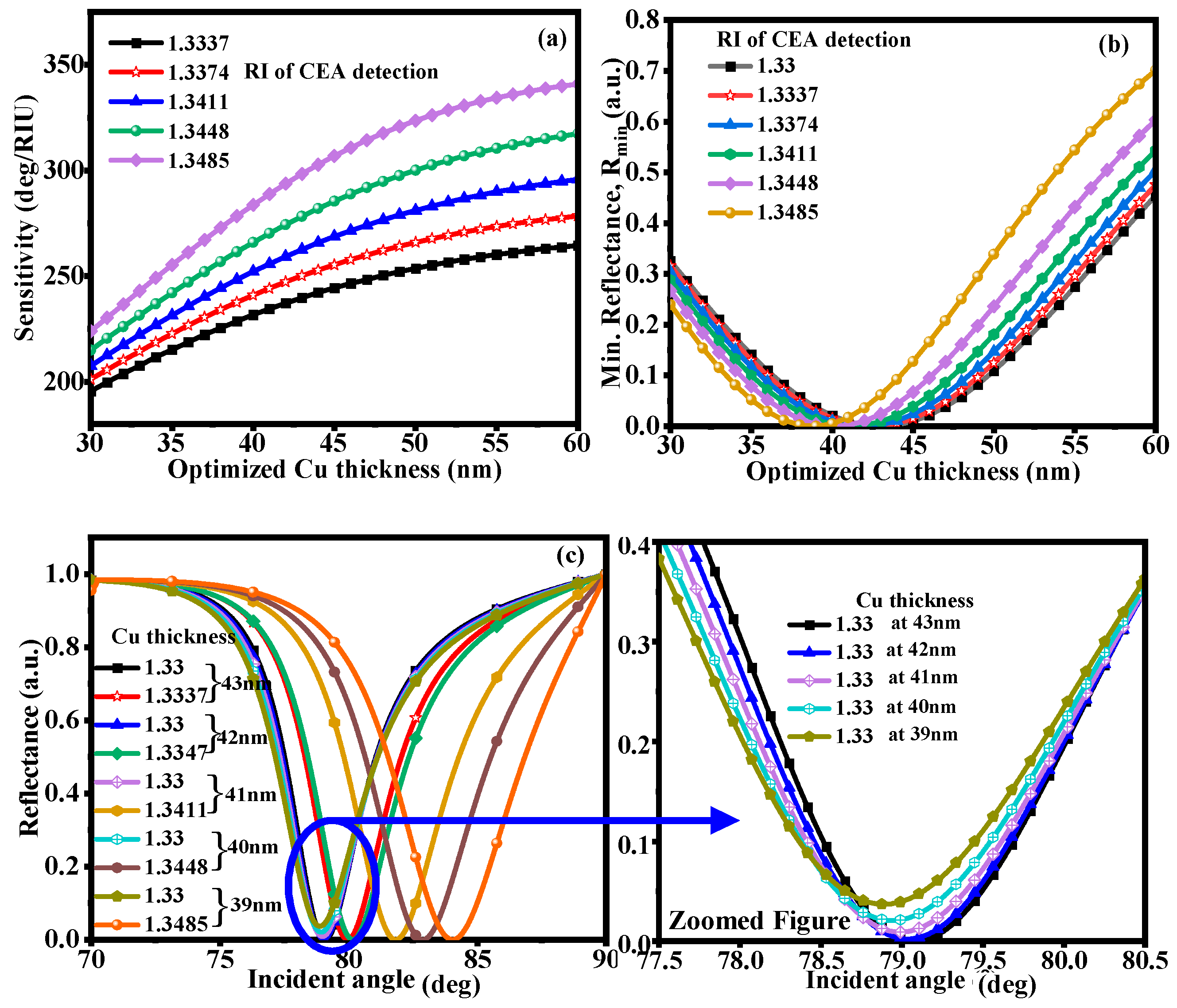
The variation of sensor sensitivity for various refractive indices (1.3337–1.3485) as a function of optimized Cu thickness in the CaF2–Cu–Graphene–franckeite–SM structure is shown in Figure 5a. Higher RIs result in higher sensitivity values, and the sensitivity is seen to increase gradually as the Cu thickness increases. The sensitivity variation is from 195.57–264.48 deg/RIU, 201.15–278.50 deg/RIU, 214.97–317.44 deg/RIU, 223.98–340.89 deg/RIU, and 233.17–373.31 deg/RIU with RI of 1.3337, 1.3374, 1.3411, 1.3448, and 1.3485, respectively. The graphene layer is essential to this improvement because it amplifies the SPR response by tightly confining the electromagnetic field at the metal–dielectric interface with its atomically thin, high electron mobility structure. In addition to providing exceptional optical transparency and acting as a barrier against Cu oxidation, graphene ensures the stability and repeatability of the sensor. Sensitivities are moderate at lower Cu thicknesses (30–35 nm), but they sharpen as the thickness gets closer to 50–60 nm, resulting in sensitivities that surpass 314.32 deg/RIU for RI = 1.3485 with a remarkable Rmin value. For sensitive biomarker detection like CEA, the CaF2–Cu–Graphene–franckeite–SM structure is very effective because it shows that graphene integration not only enhances plasmon confinement but also ensures dependable performance over several sensing cycles. The change in Rmin values in relation to Cu thickness for the same range of RIs is shown in Figure 5b. The findings highlight the trade-off between resonance depth and signal strength by showing that as Cu thickness increases, the reflectance first drops to an optimal point (about 36–48 nm) and then increases once more. Sharper resonance dips, which are preferred for better sensor resolution, are correlated with lower values of Rmin. These plots collectively demonstrate that an ideal Cu thickness maximizes sensitivity while minimizing reflectance, ensuring high detection efficiency and dependable SPR biosensor performance for CEA biomarker detection. The sensor structure using graphene layer is shown in Figure 5c for its reflectance curves. The resonance region at RI = 1.33 for Cu thicknesses between 39 and 43 nm is zoomed in on in the right-hand panel, while the left-hand plot illustrates how the reflectance changes with the incident angle for various RIs of the SM (1.33–1.3485) and optimized Cu thicknesses. The findings make it abundantly evident that the resonance angle shifts toward higher values as the SM’s RI rises, which is the fundamental mechanism of detection in SPR sensors. The addition of the graphene layer improves chemical stability and plasmon confinement, while the naturally occurring van der Waals heterostructure franckeite enhances structural robustness and light–matter interaction. These 2D materials work together to increase sensitivity and offer protection against the underlying Cu layer oxidation. While optimized thicknesses (42–43 nm) show sharp, deep resonance valleys, which are necessary for precise biomolecular detection, thinner Cu layers (39–40 nm) produce wider dips with higher reflectance minima, as the zoomed view demonstrates. Graphene and franckeite layers improve field confinement and stability, the SM introduces RI-dependent angular shifts, the CaF2 prism ensures effective light coupling, and Cu excites strong surface plasmons. These factors validate the multilayer CaF2–Cu–Graphene–franckeite–SM structure’s suitability for stable, repeatable, and high-sensitivity biosensing applications. For various refractive indices (RI) of CEA detection, Table 3 displays the sensor performance parameters at the Rmin values. The sensor achieves the performance parameters at Rmin of 6.4 × 10⁻⁴ a.u. like sensitivity of 239.71 deg/RIU, a FWHM of 3.87 deg, a DA of 0.258/deg, and a FoM of 61.94/RIU, with for RI = 1.3337 at a Cu thickness of 43 nm. The sensitivity improves to 247.22 deg/RIU and 255.81 deg/RIU, respectively, as the RI rises to 1.3374 and 1.3411, while the optimized Cu thickness marginally drops from 42 to 41 nm, demonstrating that graphene and a thinner Cu layer favor higher sensitivity. The strong plasmonic response of graphene-assisted structures is demonstrated by the sensitivity increasing to 265.99 deg/RIU and 278.36 deg/RIU at higher RIs of 1.3448 and 1.3485. This sensitivity gain, however, has a cost: the resonance curve becomes less sharp as the FWHM broadens (from 3.87 deg to 5.31 deg) and the FoM falls (from 61.94 to 52.42 RIU−1). The comparatively greater Rmin values in contrast to BP-based structures indicate that graphene produces somewhat shallower resonance dips, even though it improves plasmon confinement and stability against oxidation. Since graphene has a higher carrier mobility and transparency than BP structures, it helps to improve sensitivity and repeatability overall. However, its lower FoM and wider resonance suggest that graphene is more appropriate for applications where stability and ease of fabrication are more important than ultra-high resolution.
The maximum sensitivity values of the SPR sensor design with BP and graphene layers at Rmin values below 0.30 a.u. are compared in Table 4 for various RI of CEA antigens detection. The graphene-based sensor (257.98 deg/RIU at 53 nm Cu, Rmin = 0.223) is surpassed by the BP-based structure with 56 nm Cu thickness at RI = 1.3337, which achieves a sensitivity of 277.65 deg/RIU and a Rmin value of 0.248 (a.u.). While keeping Rmin values near graphene’s, BP continuously exhibits better sensitivity (292.75 deg/RIU and 309.81 deg/RIU) than graphene (269.29 deg/RIU and 283.12 deg/RIU) as the RI rises to 1.3374 and 1.3411. BP performs better at higher RIs of 1.3448 and 1.3485, with sensitivities of 331.42 deg/RIU and 348.07 deg/RIU, as opposed to graphene’s 300.10 deg/RIU and 314.32 deg/RIU. It is interesting to note that Rmin for BP is still similar to or marginally higher than that of graphene (0.203–0.248 a.u.), indicating that both structures maintain a good resonance depth below the 0.30 a.u. the threshold. BP’s strong light–matter interaction, high anisotropy, and effective plasmon confinement allow it to consistently provide higher sensitivity than graphene across all RI values. With somewhat lower Rmin values at specific points, graphene shows competitive performance despite having a slightly lower sensitivity. This suggests deeper resonance dips and good field confinement. This demonstrates that although BP is the best option for reaching maximum sensitivity, graphene is still a reliable substitute with respectable resonance quality and sensitivity.
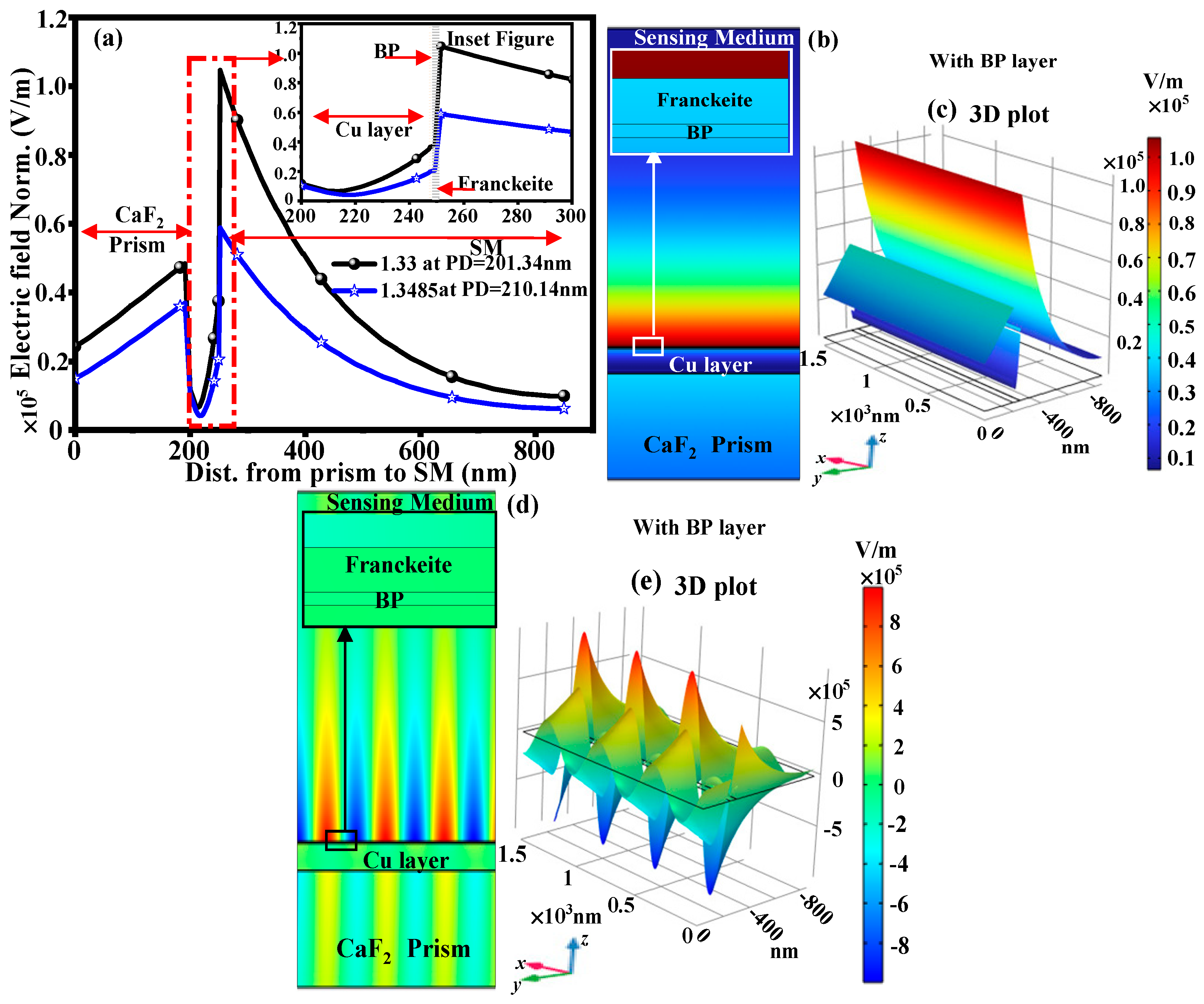
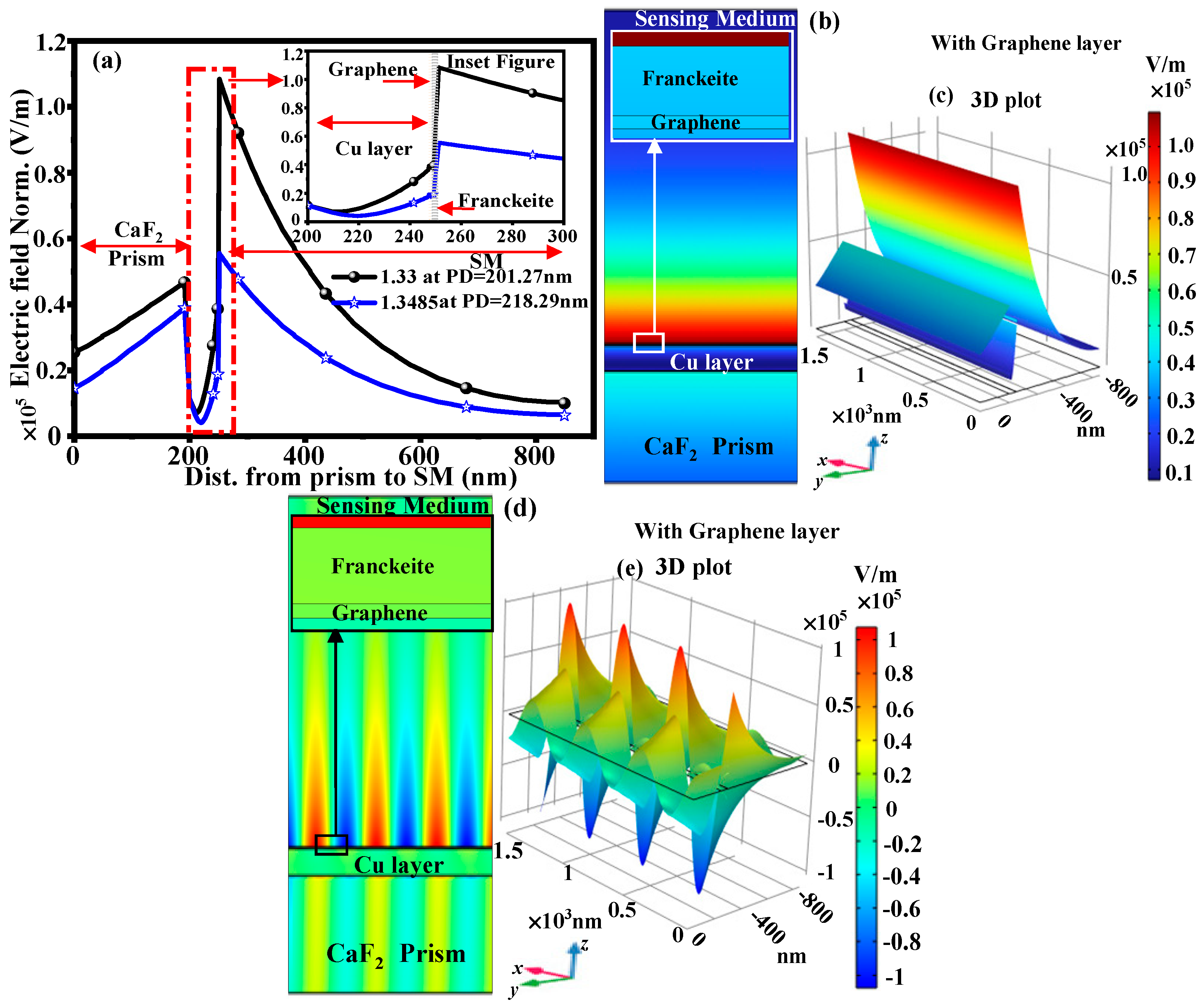
The normalized electric field (norm.) for the BP- and graphene-based SPR structures at various RI that correspond to CEA concentrations is shown in Figure 6 and Figure 7 as a function of distance from the CaF2 prism to the SM. Both instances demonstrate effective excitation of surface plasmon modes, as the plasmonic resonance produces a notable electric field enhancement close to the Cu–2D material interface. The 1/e factor, which is the distance at which the field intensity drops to almost 37% of its maximum value, is used to quantify the spatial decay of the electric field into the sensing medium. The penetration depth (PD) is the distance at which the field strength drops to 1/e of its maximum value. Regarding the structure based on BP. The maximum intensity of 1.04 × 10⁵ V/m and 5.88 × 10⁵ V/m is achieved with RI of 1.33 and 1.3485, respectively. The sensitivity for detecting surface-bound biomolecules is improved by Figure 6a, where the PD shifts from 201.34 nm at RI = 1.33 to 210.14 nm at RI = 1.3485. Figure 6b–e illustrates the simulated electric field distribution and SPP mode in the form of 2D and 3D plots for the proposed SPR sensor incorporating a Cu/BP/franckeite structure. The 2D and 3D electric field intensity distributions for the configuration with the BP layer are displayed in Figure 6b,c, respectively. Strong plasmonic coupling is confirmed by the field confinement seen at the interface between the Cu layer and the BP–franckeite region. The electric field intensity is represented by the color gradient, with the red area denoting the maximum field enhancement. The presence of the BP layer appears to improve light–matter interaction, which raises the sensitivity of the SPR sensor, based on the localized field concentration close to the metal–semiconductor interface. The field variation across the propagation direction (x–z plane) is further visualized in the 3D plot in Figure 6c, which amply illustrates a strong, exponentially decaying field normal to the interface—a characteristic signature of surface plasmon excitation. The 2D and 3D representations of the SPP mode profiles are depicted in Figure 6d,e. These plots show the energy decays into the metal and the SM while being tightly confined along the Cu–BP interface. The field peaks seen in Figure 6e show several plasmonic oscillations along the direction of propagation, indicating that the BP/franckeite heterostructure effectively excites SPPs. BP and franckeite together greatly improve field localization and intensity when compared to the structure without BP. This is mainly because of the synergistic coupling between the anisotropic 2D BP layer and the plasmonic Cu layer, which is reinforced by the charge-transfer stability that franckeite offers. This change reflects stronger confinement and relatively shallow penetration. Conversely, for the structure based on graphene, as shown in Figure 7a, indicating greater field penetration into the sensing medium, the PD rises from 201.27 nm to 218.29 nm with the same RI variation. The maximum intensity of 1.08 × 10⁵ V/m and 5.54 × 10⁵ V/m is attained with RI of 1.33 and 1.3485, respectively, as shown in Figure 7a. The electric field distribution and SPP mode of 2D and 3D plots as shown in Figure 7b–e. In comparison to BP, this permits a stronger interaction with bulk analytes but marginally lessens surface confinement. The localized field distribution across the Cu, BP/Graphene, and franckeite layers is highlighted in the inset figures, which demonstrate how the confinement is altered by each 2D material. Because of its high carrier mobility and anisotropy, the BP layer offers sharper field localization, whereas the graphene layer’s high conductivity and tunable plasmonic response allow for wider evanescent field penetration. These findings collectively demonstrate that while graphene provides improved field overlap with the sensing medium, which enhances detection of bulk analytes, BP is more effective for surface-sensitive detection of low-concentration biomarkers.
The proposed SPR biosensor is compared to previous studies for CEA antigen detection that have been published in the literature in Table 5. A sensitivity of 307.50 deg/RIU and a FoM of 61.62/RIU, which are nearly double or higher than the reported values, demonstrate a notable improvement in performance when compared to these. The main cause of this improvement is the combination of several 2D materials (BP, graphene, and franckeite), CaF2 prism, and Cu, which offer sharper resonance dips, lower losses, and stronger plasmon confinement. Because it performs better than current designs, the suggested sensor is a very dependable and effective option for CEA antigen detection in biomedical applications.

4. Conclusions

In this work, we optimized a Cu layer-based SPR biosensor structure incorporating the BP/graphene and franckeite layer for the detection of CEA biomarkers. TM polarization at a wavelength of 633 nm was used to model the structure. To increase plasmonic field confinement and resonance sharpness, two-dimensional materials had to be strategically integrated at the metal–dielectric interfaces. At a Rmin value of 4.20 × 10⁻⁵ a.u., the sensor achieved a sensitivity of 307 deg/RIU and a FoM of 61.62/RIU at a Cu thickness of 40 nm. The optimized structure, comprising a 47 nm Cu layer, a monolayer of BP, and a franckeite layer, achieved a sensitivity of 348.32 deg/RIU with FoM of 93.06/RIU. Using a graphene layer, a sensitivity of 314.32 deg/RIU is achieved with 47 nm Cu thickness. The efficiency of material-level symmetry in improving SPR sensor performance is confirmed by these findings. Future investigations could include the experimental creation of this structure, investigation of alternative 2D material combinations, and performance assessment in clinical settings using actual biological samples.

Author Contributions

Conceptualization, R.K., P.K., and M.S.; methodology, R.K. and P.K.; software, P.K. and T.S.Y.; validation, R.K. and M.S.; formal analysis, R.K.; investigation, P.K. and T.S.Y.; resources, T.S.Y. and M.S.; data curation, visualization, R.K. and P.K.; writing—original draft preparation, R.K. and P.K.; writing—review and editing, M.S. and T.S.Y.; supervision M.S.; project administration, T.S.Y. and M.S.; funding acquisition, T.S.Y. and M.S. All authors have read and agreed to the published version of the manuscript.

Funding

This work was supported by Dongseo University, “Dongseo Cluster Project (type 1)” Research Fund of 2025 (DSU-20250011, Advanced Arcade Game Regional Innovation Centre).

Institutional Review Board Statement

Not applicable.

Informed Consent Statement

Not applicable.

Data Availability Statement

The original contributions presented in this study are included in the article. Further inquiries can be directed to the corresponding author.

Conflicts of Interest

The authors declare no conflicts of interest.

References

  1. Hariri, M.; Alivirdiloo, V.; Ardabili, N.S.; Gholami, S.; Masoumi, S.; Mehraban, M.R.; Alem, M.; Hosseini, R.S.; Mobed, A.; Ghazi, F.; et al. Biosensor-Based Nanodiagnosis of Carcinoembryonic Antigen (CEA): An Approach to Classification and Precise Detection of Cancer Biomarker. Bionanoscience 2024, 14, 429–446. [Google Scholar] [CrossRef]
  2. Khodaie, A.; Heidarzadeh, H. Ultra-Sensitive Surface Plasmon Resonance Sensor Integrating MXene (Ti3C2TX) and Graphene for Advanced Carcinoembryonic Antigen Detection. Sci. Rep. 2025, 15, 13571. [Google Scholar] [CrossRef]
  3. Bray, F.; Laversanne, M.; Sung, H.; Ferlay, J.; Siegel, R.L.; Soerjomataram, I.; Jemal, A. Global Cancer Statistics 2022: GLOBOCAN Estimates of Incidence and Mortality Worldwide for 36 Cancers in 185 Countries. CA Cancer J. Clin. 2024, 74, 229–263. [Google Scholar] [CrossRef]
  4. Manasa, G.; Mascarenhas, R.J.; Malode, S.J.; Shetti, N.P. Graphene-Based Electrochemical Immunosensors for Early Detection of Oncomarker Carcinoembryonic Antigen. Biosens. Bioelectron. X 2022, 11, 100189. [Google Scholar] [CrossRef]
  5. Gholami, M.D.; Nihal, S.; Liu, Q.; Sarfo, D.; Sonar, P.; Izake, E.L. A Universal Stimuli-Responsive Biosensor for Disease Biomarkers through Their Cysteine Residues: A Proof of Concept on Carcinoembryonic Antigen (CEA) Biomarker. Sens. Actuators B Chem. 2023, 393, 134208. [Google Scholar] [CrossRef]
  6. Mi, J.; Zhang, H.; Cao, W.; Yuan, C. FTO, PIK3CB Serve as Potential Markers to Complement CEA and CA15-3 for the Diagnosis of Breast Cancer. Medicine 2023, 102, E35361. [Google Scholar] [CrossRef] [PubMed]
  7. Rafighirani, Y.; Bahador, H.; Javidan, J. Graphene-Based LSPR Sensors Enable Polarization-Independent Detection of CEA Antigens. Sci. Rep. 2025, 15, 31388. [Google Scholar] [CrossRef] [PubMed]
  8. Sobhanparast, S.; Shahbazi-Derakhshi, P.; Soleymani, J.; Amiri-Sadeghan, A.; Herischi, A.; Chaparzadeh, N.; Aftabi, Y. A Novel Electrochemical Immunosensor Based on Biomaterials for Detecting Carcinoembryonic Antigen Biomarker in Serum Samples. Sci. Rep. 2025, 15, 25396. [Google Scholar] [CrossRef]
  9. Kaur, B.; Kumar, S.; Kaushik, B.K. Recent Advancements in Optical Biosensors for Cancer Detection. Biosens. Bioelectron. 2022, 197, 113805. [Google Scholar] [CrossRef]
  10. Damborský, P.; Švitel, J.; Katrlík, J. Optical Biosensors. Essays Biochem. 2016, 60, 91–100. [Google Scholar] [CrossRef]
  11. Mostufa, S.; Akib, T.B.A.; Rana, M.M.; Islam, M.R. Highly Sensitive TiO2/Au/Graphene Layer-Based Surface Plasmon Resonance Biosensor for Cancer Detection. Biosensors 2022, 12, 603. [Google Scholar] [CrossRef]
  12. Fu, H.; Zhang, S.; Chen, H.; Weng, J. Graphene Enhances the Sensitivity of Fiber-Optic Surface Plasmon Resonance Biosensor. IEEE Sens. J. 2015, 15, 5478–5482. [Google Scholar] [CrossRef]
  13. Duval, D.; Lechuga, L.M. Optical Waveguide Biosensors. Photonics Sci. Found. Technol. Appl. 2015, 4, 323–365. [Google Scholar] [CrossRef]
  14. Mukundan, H.; Anderson, A.S.; Grace, W.K.; Grace, K.M.; Hartman, N.; Martinez, J.S.; Swanson, B.I. Waveguide-Based Biosensors for Pathogen Detection. Sensors 2009, 9, 5783–5809. [Google Scholar] [CrossRef] [PubMed]
  15. Attia, M.S. Fluorescence-Based Biosensors. Fundam. Biosens. Healthc. 2024, 1, 265–313. [Google Scholar] [CrossRef]
  16. Abdalla, S.; Ferjani, H.; Alsaad, A.M.; Tavares, C.J.; Telfah, A.D. Modeling a Graphene-Enhanced Surface Plasmon Resonance Sensor for Cancer Detection. Plasmonics 2024, 20, 1721–1728. [Google Scholar] [CrossRef]
  17. Homola, J. Surface Plasmon Resonance Sensors for Detection of Chemical and Biological Species. Chem. Rev. 2008, 108, 462–493. [Google Scholar] [CrossRef]
  18. Taya, S.A.; Daher, M.G.; Almawgani, A.H.M.; Hindi, A.T.; Zyoud, S.H.; Colak, I. Detection of Virus SARS-CoV-2 Using a Surface Plasmon Resonance Device Based on BiFeO3-Graphene Layers. Plasmonics 2023, 18, 1441–1448. [Google Scholar] [CrossRef]
  19. Houari, F.; El Barghouti, M.; Mir, A.; Akjouj, A. Nanosensors Based on Bimetallic Plasmonic Layer and Black Phosphorus: Application to Urine Glucose Detection. Sensors 2024, 24, 5058. [Google Scholar] [CrossRef]
  20. Rahman, M.S.; Anower, M.S.; Hasan, M.R.; Hossain, M.B.; Haque, M.I. Design and Numerical Analysis of Highly Sensitive Au-MoS2-Graphene Based Hybrid Surface Plasmon Resonance Biosensor. Opt. Commun. 2017, 396, 36–43. [Google Scholar] [CrossRef]
  21. Nisha, A.; Maheswari, P.; Subanya, S.; Anbarasan, P.M.; Rajesh, K.B.; Jaroszewicz, Z. Ag-Ni Bimetallic Film on CaF2 Prism for High Sensitive Surface Plasmon Resonance Sensor. Photonics Lett. Pol. 2021, 13, 58–60. [Google Scholar] [CrossRef]
  22. Muthumanikkam, M.; Vibisha, A.; Lordwin Prabhakar, M.C.; Suresh, P.; Rajesh, K.B.; Jaroszewicz, Z.; Jha, R. Numerical Investigation on High-Performance Cu-Based Surface Plasmon Resonance Sensor for Biosensing Application. Sensors 2023, 23, 7495. [Google Scholar] [CrossRef]
  23. Almawgani, A.H.M.; Sarkar, P.; Pal, A.; Srivastava, G.; Uniyal, A.; Alhawari, A.R.H.; Muduli, A. Titanium Disilicide, Black Phosphorus–Based Surface Plasmon Resonance Sensor for Dengue Detection. Plasmonics 2023, 18, 1223–1232. [Google Scholar] [CrossRef]
  24. Chen, S.; Lin, C. Sensitivity Comparison of Graphene Based Surface Plasmon Resonance Biosensor with Au, Ag and Cu in the Visible Region. Mater. Res. Express 2019, 6, 056503. [Google Scholar] [CrossRef]
  25. Zynio, S.A.; Samoylov, A.V.; Surovtseva, E.R.; Mirsky, V.M.; Shirshov, Y.M. Bimetallic Layers Increase Sensitivity of Affinity Sensors Based on Surface Plasmon Resonance. Sensors 2002, 2, 62–70. [Google Scholar] [CrossRef]
  26. Pal, S.; Verma, A.; Saini, J.P.; Prajapati, Y.K. Sensitivity Enhancement Using Silicon-Black Phosphorus-TDMC Coated Surface Plasmon Resonance Biosensor. IET Optoelectron. 2019, 13, 196–201. [Google Scholar] [CrossRef]
  27. Pandaram, M.; Veeran, R.; Balasundaram, R.K.; Jaroszewicz, Z.; Jha, R.; Ebrahim, H.R.S.M. Hybrid Structured (Cu-BaTiO3-BP-Graphene) SPR Biosensor for Enhanced Performance. Plasmonics 2023, 18, 385–393. [Google Scholar] [CrossRef]
  28. Mudgal, N.; Saharia, A.; Agarwal, A.; Ali, J.; Yupapin, P.; Singh, G. Modeling of Highly Sensitive Surface Plasmon Resonance (SPR) Sensor for Urine Glucose Detection. Opt. Quantum Electron. 2020, 52, 307. [Google Scholar] [CrossRef]
  29. Kumar, A.; Kumar, A.; Srivastava, S.K. A Study on Surface Plasmon Resonance Biosensor for the Detection of CEA Biomarker Using 2D Materials Graphene, Mxene and MoS2. Optik 2022, 258, 168885. [Google Scholar] [CrossRef]
  30. Khodaie, A.; Bahador, H.; Heidarzadeh, H. Development of a Surface Plasmon Resonance Sensor Based MXene (Ti3C2Tx) for the Detection of Carcinoembryonic Antigen (CEA). Plasmonics 2025, 20, 5867–5879. [Google Scholar] [CrossRef]
  31. Xia, S.X.; Zhang, D.; Zhai, X.; Wang, L.L.; Wen, S.C. Phase-Controlled Topological Plasmons in 1D Graphene Nanoribbon Array. Appl. Phys. Lett. 2023, 123, 101102. [Google Scholar] [CrossRef]
  32. Dasari, B.L.; Nouri, J.M.; Brabazon, D.; Naher, S. Graphene and Derivatives–Synthesis Techniques, Properties and Their Energy Applications. Energy 2017, 140, 766–778. [Google Scholar] [CrossRef]
  33. Zhang, D.; Xia, S.; Xu, W.; Zhai, X.; Wang, L. Topological Plasmonically Induced Transparency in a Graphene Waveguide System. Phys. Rev. B 2024, 109, 245420. [Google Scholar] [CrossRef]
  34. Eswaraiah, V.; Zeng, Q.; Long, Y.; Liu, Z. Black Phosphorus Nanosheets: Synthesis, Characterization and Applications. Small 2016, 12, 3480–3502. [Google Scholar] [CrossRef]
  35. Silveira, J.E.; Inacio, G.J.; Batista, N.N.; Morais, W.P.; Menezes, M.G.; Zazo, J.A.; Casas, J.A.; Paz, W.S. Franckeite-Derived van Der Waals Heterostructure with Highly Efficient Photocatalytic NOx Abatement: Theoretical Insights and Experimental Evidences. J. Environ. Chem. Eng. 2024, 12, 111998. [Google Scholar] [CrossRef]
  36. Guy, O.J.; Walker, K.A.D. Graphene Functionalization for Biosensor Applications. Silicon Carbide Biotechnol. A Biocompatible Semicond. Adv. Biomed. Devices Appl. 2016, 2, 85–141. [Google Scholar] [CrossRef]
  37. Luo, M.; Fan, T.; Zhou, Y.; Zhang, H.; Mei, L. 2D Black Phosphorus–Based Biomedical Applications. Adv. Funct. Mater. 2019, 29, 1808306. [Google Scholar] [CrossRef]
  38. Gusmão, R.; Sofer, Z.; Luxa, J.; Pumera, M. Layered Franckeite and Teallite Intrinsic Heterostructures: Shear Exfoliation and Electrocatalysis. J. Mater. Chem. A 2018, 6, 16590–16599. [Google Scholar] [CrossRef]
  39. Kumar, R.; Pal, S.; Prajapati, Y.K.; Kumar, S.; Saini, J.P. Sensitivity Improvement of a MXene- Immobilized SPR Sensor With Ga-Doped-ZnO for Biomolecules Detection. IEEE Sens. J. 2022, 22, 6536–6543. [Google Scholar] [CrossRef]
  40. Kumar, R.; Pandey, V.K.; Singh, S.; Dhasarathan, V. Enhanced Angular Sensitivity of Surface Plasmon Resonance Sensor Based on Si-Ag-MXene Structure for Cortisol Application. Eur. Phys. J. Plus 2025, 140, 121. [Google Scholar] [CrossRef]
  41. Wu, L.; Guo, J.; Wang, Q.; Lu, S.; Dai, X.; Xiang, Y.; Fan, D. Sensitivity Enhancement by Using Few-Layer Black Phosphorus-Graphene/TMDCs Heterostructure in Surface Plasmon Resonance Biochemical Sensor. Sens. Actuators B Chem. 2017, 249, 542–548. [Google Scholar] [CrossRef]
  42. Mishra, A.K.; Mishra, S.K.; Verma, R.K. Graphene and beyond Graphene MoS2: A New Window in Surface-Plasmon-Resonance-Based Fiber Optic Sensing. J. Phys. Chem. C 2016, 120, 2893–2900. [Google Scholar] [CrossRef]
  43. Karki, B.; Sharma, S.; Singh, Y.; Pal, A. Sensitivity Enhancement of Surface Plasmon Resonance Biosensor with 2-D Franckeite Nanosheets. Plasmonics 2022, 17, 71–78. [Google Scholar] [CrossRef]
  44. Ghodrati, M.; Mir, A.; Farmani, A. Numerical Analysis of a Surface Plasmon Resonance Based Biosensor Using Molybdenum Disulfide, Molybdenum Trioxide, and MXene for the Diagnosis of Diabetes. Diam. Relat. Mater. 2023, 132, 109633. [Google Scholar] [CrossRef]
  45. Didar, R.F.; Vahed, H. Improving the Performance of High-Sensitivity Surface Plasmon Resonance Biosensor with 2D Nanomaterial Coating (BP-WS2) Based on Hybrid Structure: Theoretical Analysis. IET Optoelectron. 2023, 17, 284–293. [Google Scholar] [CrossRef]
  46. Gollapalli, R.; Phillips, J.; Paul, P. Ultrasensitive Surface Plasmon Resonance Sensor with a Feature of Dynamically Tunable Sensitivity and High Figure of Merit for Cancer Detection. Sensors 2023, 23, 5590. [Google Scholar] [CrossRef]
  47. Uniyal, A.; Pal, A.; Ansari, G.; Chauhan, B. Numerical Simulation of InP and MXene-Based SPR Sensor for Different Cancerous Cells Detection. Cell Biochem. Biophys. 2025, 83, 2895–2908. [Google Scholar] [CrossRef]
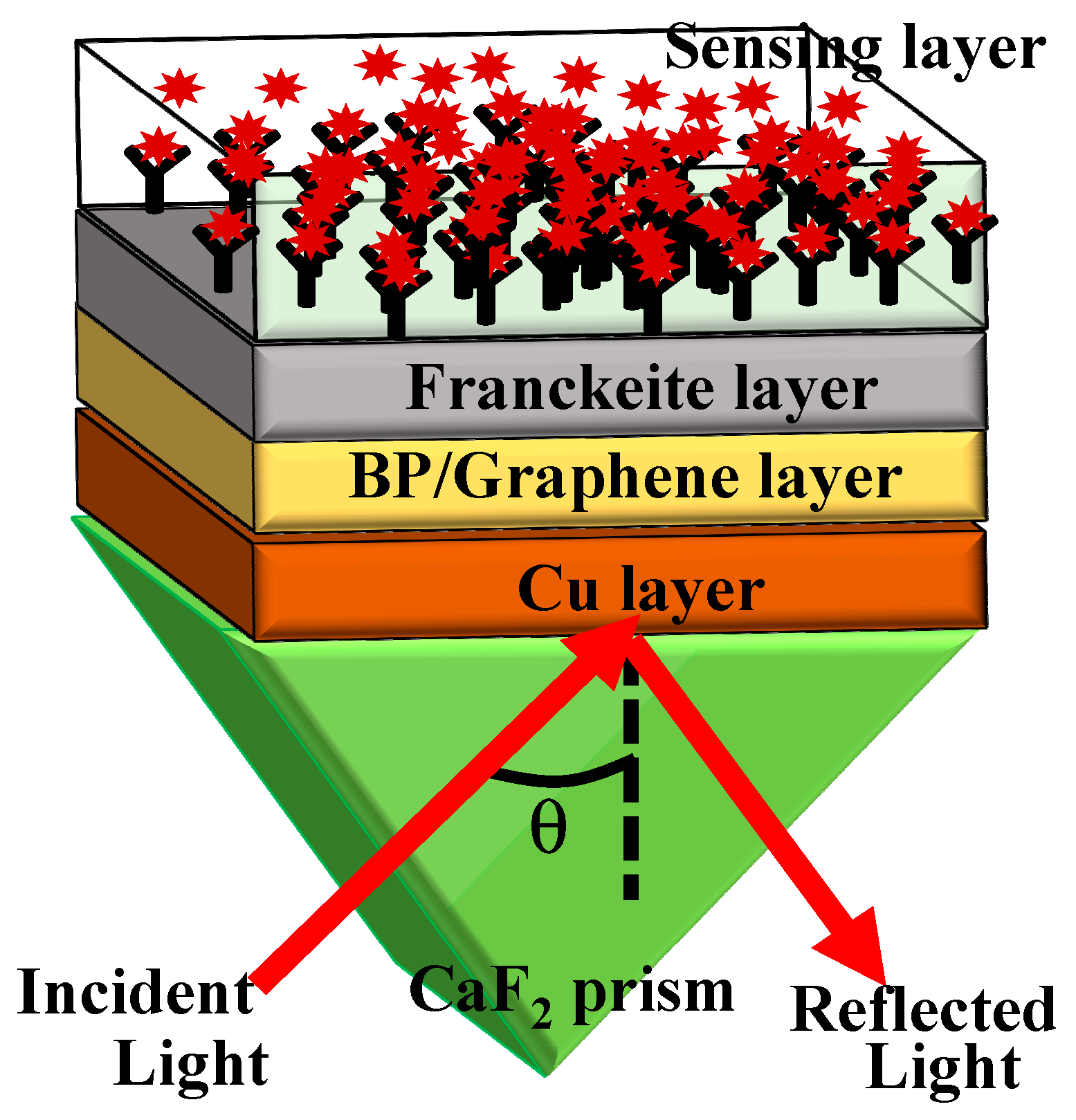
Figure 1. Proposed SPR sensor.
Photonics 12 01105 g001
Figure 2. Fabrication feasibility.
Photonics 12 01105 g002
Figure 3. (a) Variation in sensitivity and Rmin value; (b) reflectance curve at Rmin value.
Photonics 12 01105 g003
Figure 4. Performance with BP layer (a) sensitivity; (b) Rmin value; (c) reflectance curve at various RI of CEA concentration.
Photonics 12 01105 g004
Figure 5. Performance with graphene layer (a) sensitivity; (b) Rmin value; (c) reflectance curve at various RI of CEA concentration.
Photonics 12 01105 g005
Figure 6. With BP layer: (a) electric field normalized at various RI of CEA concentration; electric field distribution: (b) 2D, (c) 3D; SPP mode: (d) 2D and (e) 3D.
Photonics 12 01105 g006
Figure 7. With graphene layer: (a) electric field normalized at various RI of CEA concentration; electric field distribution: (b) 2D, (c) 3D; SPP mode: (d) 2D and (e) 3D.
Photonics 12 01105 g007
Table 1. Thickness and RI of all materials used in proposed sensor.
MartialsThickness (nm)RIRef.
CaF2 prismSemi-Infinite1.4329[40]
Cu layer30–60 nm0.0369 + 4.5393 i[39]
BP0.53 nm3.5 + 0.01 i[41]
Graphene0.34 nm3 + 1.1491 i[42]
Franckeite layer1.8 nm3.53 + 0.39 i[43]
CEA detection-1.33 (Reference RI) −1.3485[7]
Table 2. Performance parameters at Rmin value of particular RI with BP layer.
RI of CEACu Thick. (nm)S
(deg/RIU)
Rmin (a.u.)FWHM
(deg)
DA
(/deg)
FoM
(RIU)
1.333745257.056.56 × 10−53.270.30578.61
1.337444267.193.35 × 10−53.610.27774.01
1.341143279.305.08 × 10−540.2569.82
1.344842294.451.6 × 10−44.440.22566.31
1.348540307.504.20 × 10−54.990.20061.62
Table 3. Performance parameters at Rmin value of particular RI with graphene layer.
RI of CEACu Thick. (nm)S
(deg/RIU)
Rmin (a.u.)FWHM
(deg)
DA
(/deg)
FoM
(RIU)
1.333743239.716.4 × 10−43.870.25861.94
1.337442247.221.9 × 10−53.920.25563.06
1.341141255.816.9 × 10−54.460.22457.35
1.344840265.997.4 × 10−54.880.20454.50
1.348539278.361.3 × 10−45.310.18852.42
Table 4. Maximum sensitivity at below 0.30 a.u. Rmin value with particular RI.
RI of CEAWith BP LayerWith Graphene Layer
Cu Thick. (nm)S
(deg/RIU)
Rmin (a.u.)Cu Thick. (nm)S
(deg/RIU)
Rmin (a.u.)
1.333756277.650.24853257.980.223
1.337455292.750.24652269.290.214
1.341153309.810.22451283.120.216
1.344851331.420.22950300.100.236
1.348547348.070.20347314.320.207
Table 5. Comparison of proposed and existing work for the detection of CEA antigens.
Authors and Ref. Sensitivity (deg/RIU)FoM/Quality Factor (/RIU)Years
Kumar et al. [29]144.72-2022
Ghodrati et al. [44]227.08 35.09 2023
Didar et al. [45]23426.532023
Gollapalli et al. [46]329.189.812023
Khodaie et al. [2] 163.6317.522025
Khodaie et al. [30]196.9114.872025
Uniyal et al. [47]263.5734.622025
Proposed Work348.3293.06-
Disclaimer/Publisher’s Note: The statements, opinions and data contained in all publications are solely those of the individual author(s) and contributor(s) and not of MDPI and/or the editor(s). MDPI and/or the editor(s) disclaim responsibility for any injury to people or property resulting from any ideas, methods, instructions or products referred to in the content.