
Article

Fresnel Coherent Diffraction Imaging Without Wavefront Priors


1
State Key Laboratory of Extreme Photonics and Instrumentation, College of Optical Science and Engineering, Zhejiang University, Hangzhou 310058, China
2
State Key Laboratory of Extreme Photonics and Instrumentation, ZJU-Hangzhou Global Scientific and Technological Innovation Center, Hangzhou 311215, China
*
Authors to whom correspondence should be addressed.
Photonics 2025, 12(11), 1066; https://doi.org/10.3390/photonics12111066
Submission received: 9 October 2025 / Revised: 26 October 2025 / Accepted: 27 October 2025 / Published: 28 October 2025
(This article belongs to the Special Issue Computational Optical Imaging: Theories, Algorithms, and Applications)

Abstract

Fresnel diffraction plays a critical role in coherent diffraction imaging and holography. Experimental setups for these techniques are often designed based on plane-wave illumination. However, two key issues arise in practical applications: on the one hand, it is difficult to obtain an ideal plane wave in experiments, which inevitably introduces wavefront curvature; on the other hand, the use of spherical waves enhances the quality of reconstruction results, while it also imposes additional requirements for the calibration of both the illumination wavefront and experimental parameters. To address these issues, we introduce a diffraction-adapted propagation model that integrates both the spherical wavefront effects and sampling variations within the diffraction model. The parameters of this model can be estimated through prior-free optimization, thereby eliminating the need for prior knowledge of system parameters or specific experimental setups. Our approach enables robust reconstruction across a wide range of Fresnel diffraction patterns. It also allows for the automatic calibration of experimental parameters using only the measured data. The effectiveness of the proposed method has been validated through both theoretical analysis and experimental results.

1. Introduction

Fresnel diffraction is essential to Fresnel coherent diffraction imaging (CDI)—a technique that has become widely used in physics [1], materials science [2], and biology [3]. In Fresnel CDI experiments, a sample is illuminated with coherent light, and the complex amplitude of the sample is reconstructed by applying phase retrieval algorithms to the measured diffraction patterns [4]. While experimental setups for such techniques are often designed based on plane-wave illumination, two key challenges emerge in practical implementation. On the one hand, acquiring an ideal plane wave in experiments is highly challenging, with unavoidable wavefront curvature introduced as a result. On the other hand, using focused light as the illumination source naturally induces phase curvature [5,6], which offers several advantages: it is more tolerant to spatial incoherence than far-field diffraction, enables imaging of extended objects, and reduces reliance on precise knowledge of the object’s support constraints [7,8]. Together, these advantages contribute to faster and more reliable convergence of the reconstruction algorithms [9,10,11].
However, focused Fresnel imaging also presents challenges, particularly in the accurate characterization of the spherical wavefront and system parameters [5]. Any inaccuracies in sample positioning or beam properties can substantially affect the reconstruction process [12]—an issue that is less problematic in plane-wave propagation. While autofocusing algorithms have recently been developed to calibrate diffraction distances from plane-wave diffraction patterns [13,14,15], challenges remain when using spherical-wave illumination.
In this paper, we present a diffraction-adapted propagation model that integrates different propagation conditions, including parallel beams, diverging and converging spherical waves, and mixed propagation scenarios. The parameters of this model can be estimated through prior-free optimization, forming the proposed DAPO (Diffraction-Adapted Propagation Optimization) algorithm. DAPO enables efficient sample reconstruction without resampling or precise prior knowledge of the illumination probe. As a result, DAPO allows the reconstruction of any experimentally recorded Fresnel diffraction pattern without detailed setup information. Furthermore, this method can also be used to estimate experimental parameters directly from diffraction measurements. The effectiveness of the DAPO method is demonstrated through both theoretical analysis and experimental validation.

2. Materials and Methods

2.1. Diffraction Calculation

The analysis starts with the Fresnel diffraction formula:
E ~ x , y = e i 2 π λ z r i λ z r e i π λ z r x 2 + y 2 E x r , y r e i π λ z r x r 2 + y r 2 e i 2 π x r x λ z r + y r y λ z r d x r d y r
where λ is the wavelength, x , y and x r , y r represent the spatial coordinates of the detector and sample planes, respectively, and z r denotes the diffraction distance. By introducing the propagation function H = e i 2 π λ z r 1 λ 2 2 f x 2 + f y 2 , we can rewrite Equation (1) as:
E ~ x , y = I 1 I E x r , y r H f x , f y
where I denotes the fast Fourier transform (FFT) operator, and f x , f y are the spatial frequencies. This expression corresponds to the widely used D-FFT (double fast Fourier transform) method. For uncalibrated plane-wave diffraction data, I D = E ~ 2 , the propagation function optimization (PFO) can be applied:
H A = a r g m i n H L I 1 I I D · H *
where L is the evaluation function (e.g., sharpness [16], total variation [17], or Tamura coefficient [13]), and H A represents the optimized propagation function. Equation (3) performs optimization by propagating the diffraction pattern backward, serving as a simplified preprocessing step. In practice, the PFO process can be integrated with iterative reconstruction, enabling updates during iterations [14]. The propagation distance is then computed as:
z r = a r g ( H A ) π λ f x 2 + f y 2
where a r g denotes the phase function, with the phase constant neglected.
Under focused illumination, the D-FFT solution has the form:
E ~ f x , y = I 1 I E x r , y r · P x r , y r H f x , f y
where the sampling interval of the detector plane δ 0 = x = y is scaled to δ = l l z r δ 0 on the sample plane. However, the D-FFT method assumes equal sampling intervals [18], i.e., δ = δ 0 = l z r l δ . As a result, the reconstructed diffraction pattern needs to be resampled to match the detector sampling:
I D x , y =   E ~ f l z r l x , l z r l y 2
This resampling can be achieved using the Fresnel scaling theorem [19,20]. However, resampling in the frequency domain may introduce artifacts into the diffraction reconstruction, as shown in the Section 3. Furthermore, a comparison of Equations (2) and (5) shows that extra calibration of the spherical phase is required for focused Fresnel diffraction. Inaccurate probe estimates can cause iterative stagnation [12]. Additionally, the incorporation of spherical-wave makes diffraction-based calibration algorithms (i.e., autofocusing algorithms) ineffective when dealing with the actual diffraction distance, as shown in Figure 1.

2.2. Diffraction-Adapted Propagation Optimization

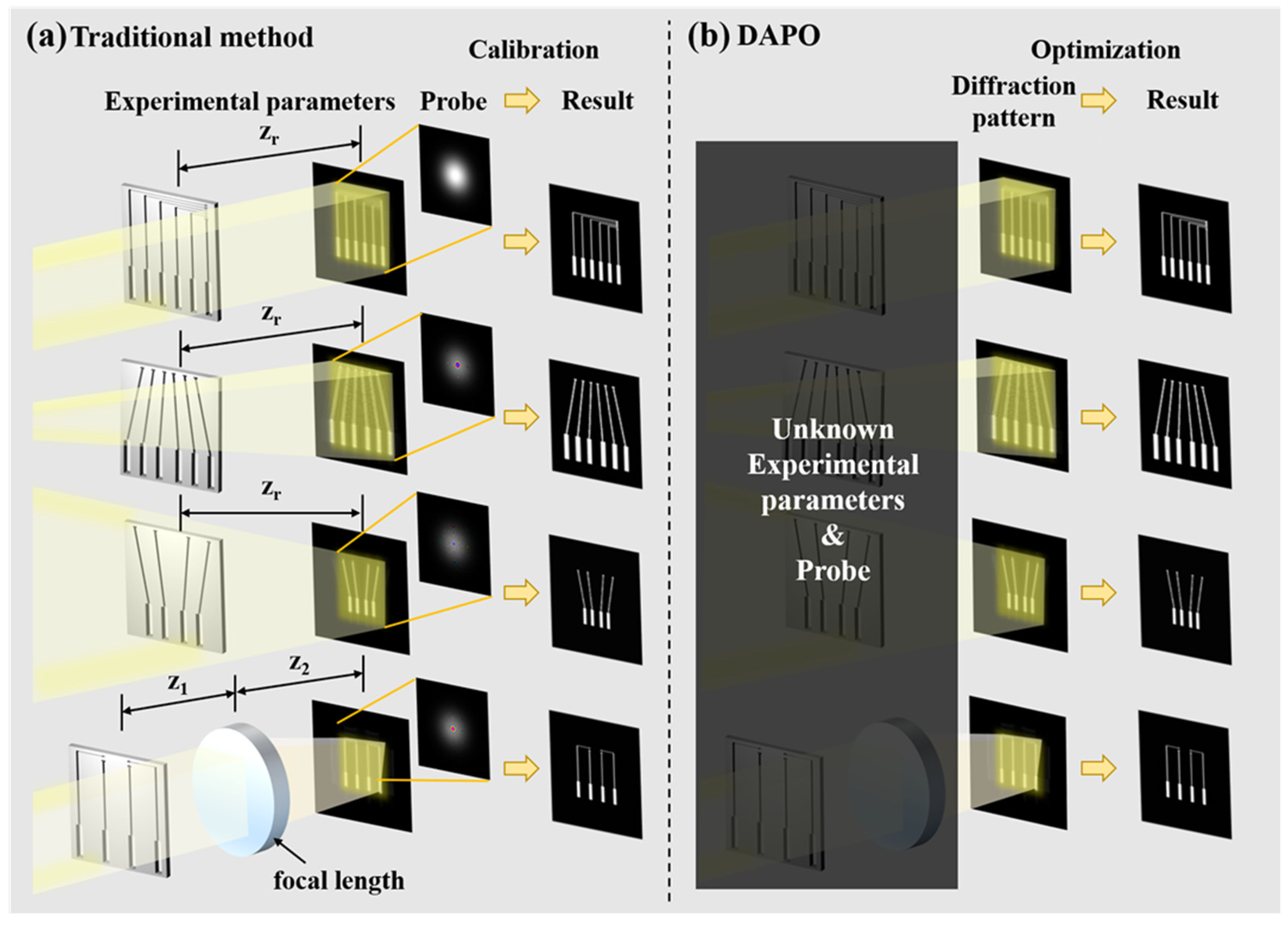
Here, we aim to define a diffraction-adapted propagation model that addresses the resampling issue and ensures compatibility with optimization algorithms, eliminating the need for prior knowledge. Starting with the setup shown in Figure 2a, the focused Fresnel diffraction formula (ignoring constants) is given by:
E ~ f x , y = E · e i π λ z r x r 2 + y r 2 e i 2 π λ l 2 + x r 2 + y r 2 e i 2 π x r x λ z r + y r y λ z r d x r d y r
Using the small-angle approximation commonly applied in Fresnel diffraction, we define d = l z r z r l , leading to the reformulated expression:
E ~ f x , y = E · e i π λ d l l z r 2 x r 2 + y r 2 e i 2 π x r x λ d l l z r 2 · l l z r + y r y λ d l l z r 2 · l l z r d x r d y r
This form supports efficient computation using the D-FFT method:
E ~ f x , y = I 1 I E x r , y r e i π λ d l l z r 2 f x 2 +   f y 2
Here, the transformed spatial coordinates and frequencies are given by x = l l z r x , y = l l z r y , and f x , y = l z r l f x , y . Alternatively, the field can be computed using different sampling conditions:
E ~ f x , y = I 1 I E x r , y r e i π λ d f x 2 + f y 2
Compared with Equation (6), the detected intensity can be computed as:
I D x , y =   E ~ f l z r l x , l z r l y 2 = E ~ f x , y 2
which addresses the resampling issue in Equation (7). By applying propagation function optimization, we can express an equivalent propagation distance as:
z f = a n g l e e i π λ d l z r l 2 f x 2 +   f y 2 π λ f x 2 + f y 2 = d l l z r 2 f x 2 +   f y 2 f x 2 + f y 2 = d
This demonstrates that the diffraction pattern under spherical-wave illumination can be optimized to a diffraction-adapted propagation that is equivalent to plane-wave propagation. Equation (12) is general and encompasses both converging and diverging waves, which are controlled by the parameter   l . Specifically, l takes a positive value for converging spherical waves and a negative value for diverging ones.
Unlike the Fresnel scaling theorem, the DAPO requires compensating for changes in sampling—especially in scenarios where a plane wave is followed by a focusing (or diverging) element—and such scenarios are also modeled within the DAPO framework. Compared with the case of plane-wave illumination, where the field is expressed as
E ~ x , y = I 1 I E x r , y r e i π λ ( z 1 + z 2 ) f x 2 + f y 2
The presence of spherical-wave effects modifies the diffraction field to:
E ~ f x , y = I 1 I E x r , y r e i π λ d t + z 1 f x 2 +   f y 2
where the temporary equivalent propagation distance d t = f z 2 z 2 f · f 2 f z 2 2 = f z 2 f z 2 , and the spatial frequency coordinates are scaled as f x , y = f z 2 f f x , y . This enables computing the optimized propagation distance as
z f = a n g l e e i π λ ( d b + z 1 ) f x 2 + f y 2 π λ f x 2 + f y 2 = f z 2 f z 2 + z 1 · f z 2 2 f 2
When l , f , we obtain z f = z r and z f = z 1 + z 2 , corresponding to the case of parallel wave propagation. In summary, the DAPO model can be used to compute any Fresnel diffraction pattern, including cases of parallel propagation, diverging or converging spherical waves, and convergence following parallel propagation. The only required calibration parameter is the equivalent propagation distance, which can be efficiently estimated using propagation function optimization.
In the derivation above, the D-FFT method is used to describe the Fresnel diffraction process, while for the S-FFT (single fast Fourier transform), the diffraction can be expressed as:
E ~ x , y = e i 2 π λ z r i λ z r e i π λ z r x 2 + y 2 I E x r , y r e i π λ z r x r 2 + y r 2
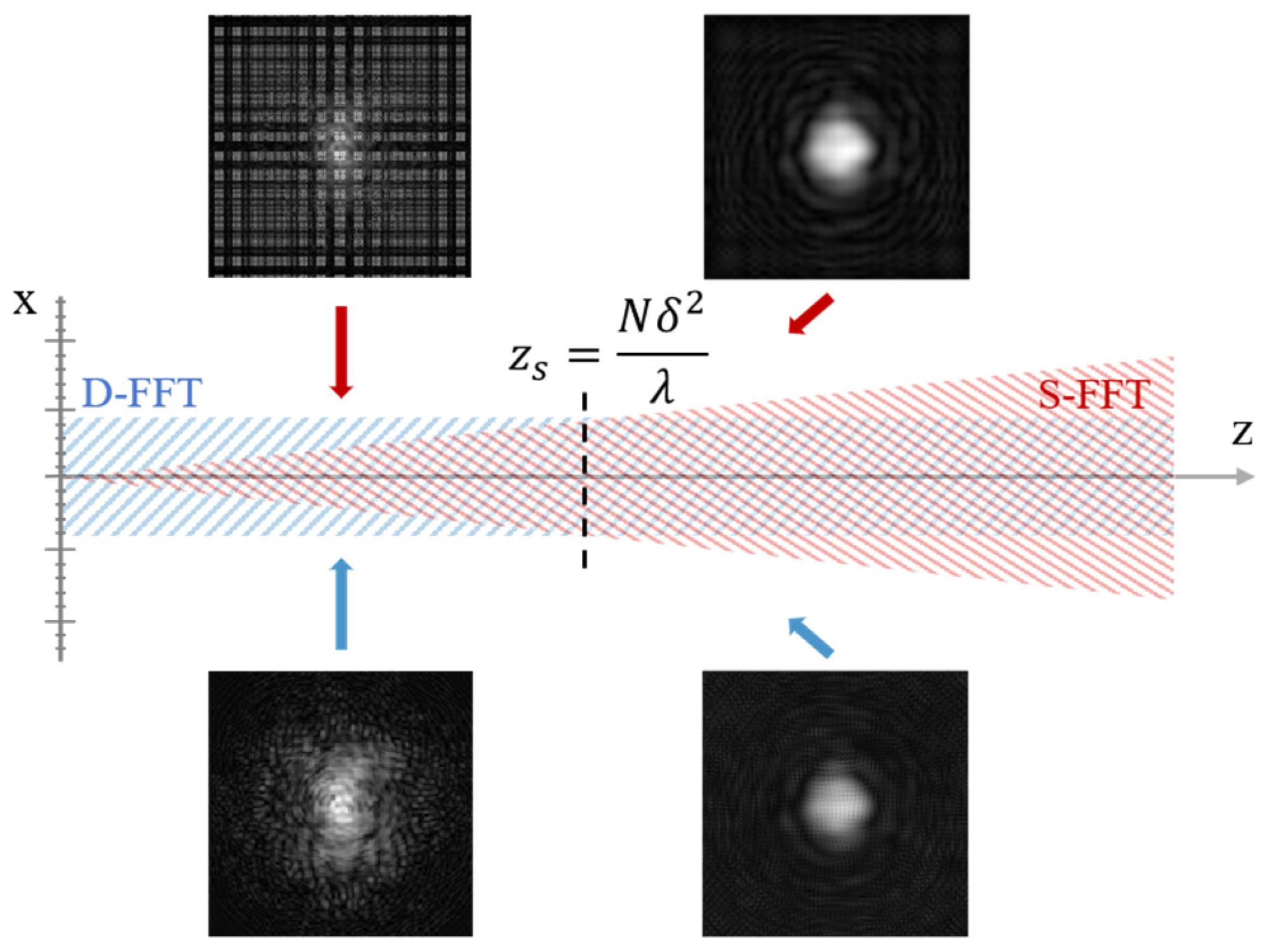
A similar derivation can be applied to determine the DAPO for the S-FFT case. According to the Nyquist sampling condition, S-FFT and D-FFT calculations are suited to different system configurations and diffraction distances. The choice of method can be guided by the critical diffraction distance z s = N δ 2 λ [21]. Specifically, D-FFT is suitable for diffraction distances z z s , while S-FFT is suitable for z z s . These two computational approaches are strictly complementary and allow the DAPO framework to accommodate a range of experimental conditions, as shown in Figure 3.

2.3. Comparison of the Ptychographic Reconstruction Process

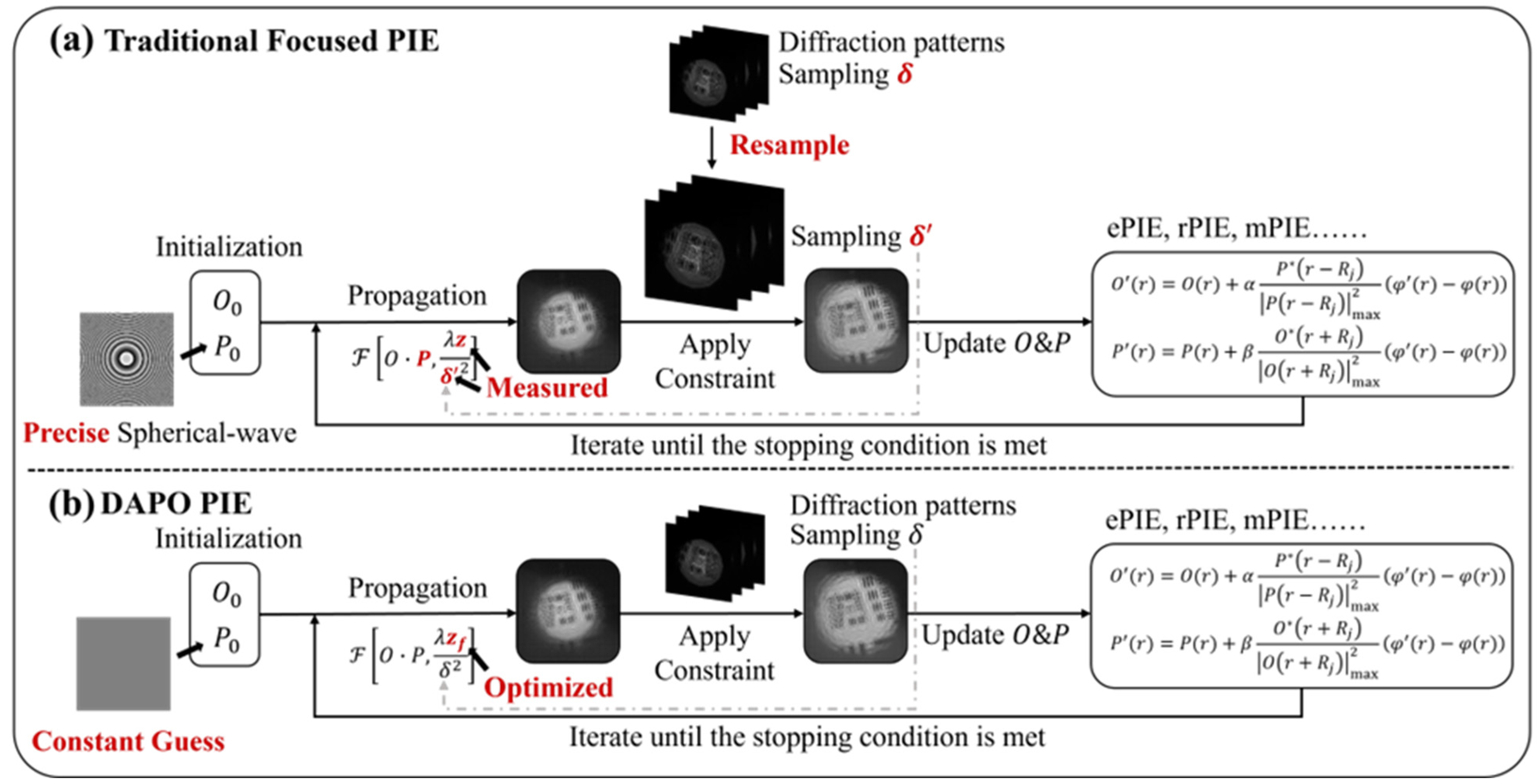
In the ptychographic iterative engine (PIE), the differences in computational procedures between the traditional approach and the DAPO method are clearly illustrated in Figure 4. Traditional methods demand precise calibration of experimental parameters, including physical distances, sampling intervals, and an accurate initial estimate of the probe. Furthermore, the reconstruction algorithm must iteratively update the phase variations of the probe during the process. By contrast, the DAPO method integrates these factors directly into the propagation model, effectively decoupling the reconstruction from the specific experimental setup and reducing computational complexity. By using the PFO to estimate the equivalent propagation distance, DAPO enables prior-free reconstruction across various PIE configurations. Experimental comparisons that validate this approach are presented in Section 3.

3. Results

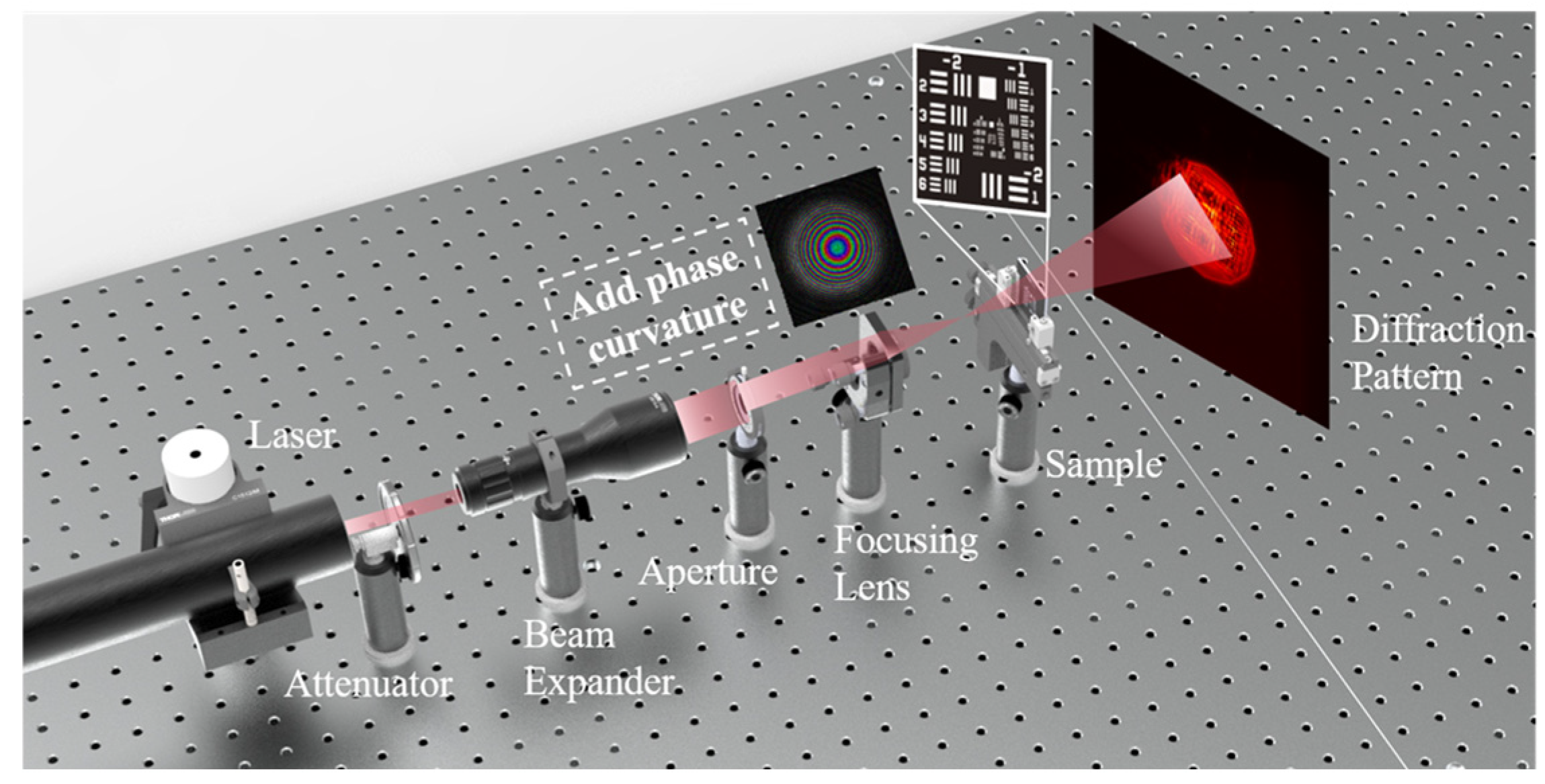
To validate the DAPO method, experiments were conducted using a helium-neon laser (Newport, N-STP-912, Irvine, CA, USA) as the illumination source, with a wavelength of 632.8 nm and a beam diameter of 0.5 mm. A fixed 10× beam expander (Thorlabs, GBE10-A, Newton, NJ, USA) was used to enlarge the illumination field. An aperture placed in front of the sample was used to block the edge light of the illuminating probe. Diffraction imaging and reconstructions were performed using a USAF 1951 resolution target (Lbtek, RTS3AB, Shenzhen, China, minimum line width 2.8 μm) and biological samples. The detector was a scientific-grade sCMOS camera (Tucsen, Dhyana 400BSI V2, Fuzhou, China) with a 16-bit dynamic range, 2048 × 2048 pixels, and a pixel size of 6.5 μm. For the PIE experiments, a precision piezo stage (Micronix, PPS-20, Fountain Valley, CA, USA) was used to perform scanning of the samples. The stage offers a travel range of 12 mm and a repeatability of ±50 nm. The experimental setup is shown in Figure 5. While this figure presents one representative configuration, the relative positions of the focusing lens, sample, and detector are adjustable in practice. All numerical calculations were carried out in MATLAB R2022b on a personal computer with a Core i7-14700 CPU @ 5.60 GHz (Intel) and 32 GB of RAM.
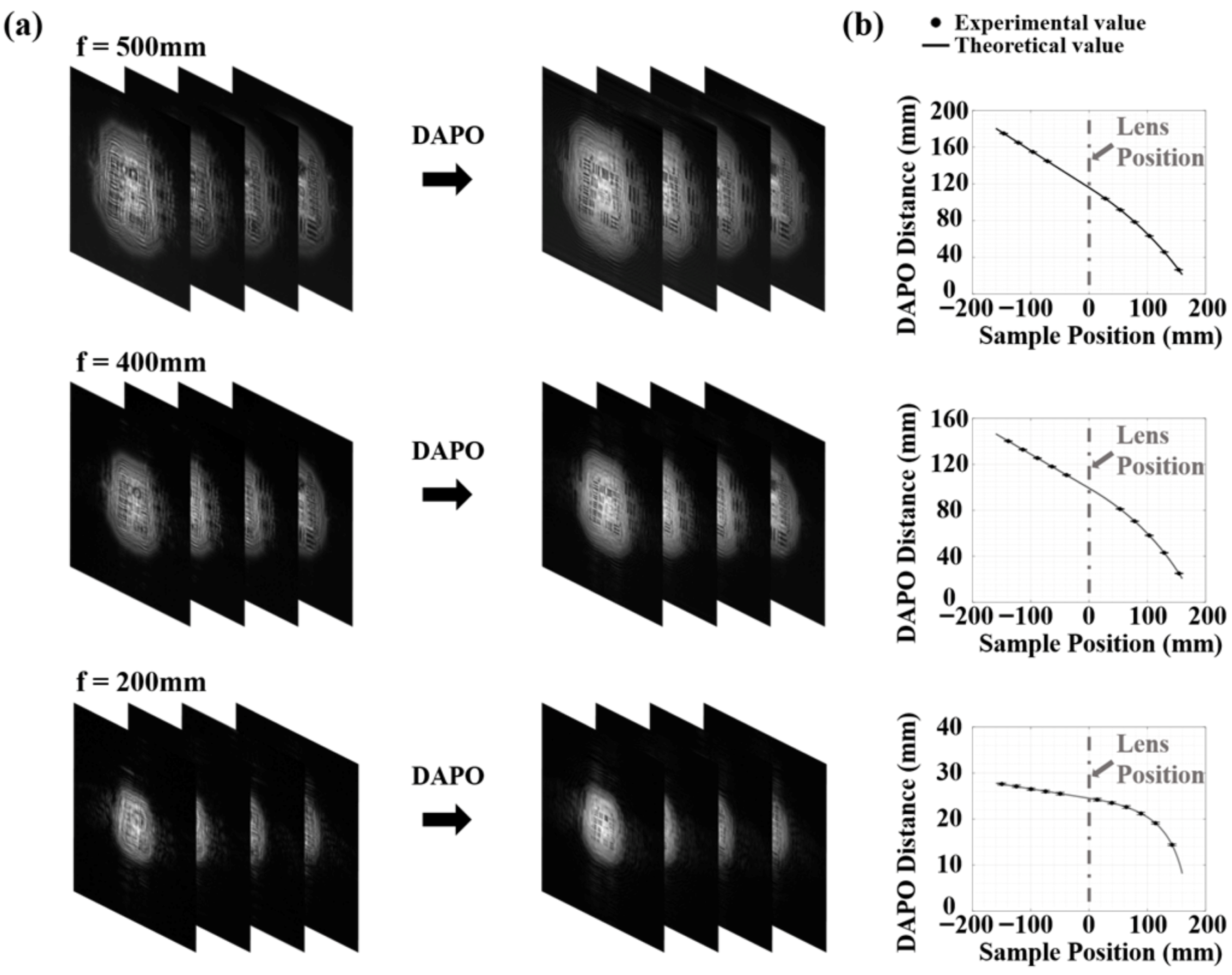
By adjusting the sample position while keeping the lens and detector fixed, we compared the optimized equivalent propagation distance with theoretical values derived from mechanical measurements, as presented in Figure 6. The experimental values closely match theoretical predictions, confirming the validity of the DAPO method. The standard deviation between the theoretical and experimental data is 0.2664 mm. The resulting high precision is reflected by the minimal error bars in Figure 6, where they may be smaller than the symbol size. At this level of deviation, the root mean square error (RMSE) between the reconstructed object and the original sample is 0.0069, and the structural similarity index measure (SSIM) is 0.9662, meeting the computational requirements for diffraction reconstruction. This accuracy is affected by the optimization function and could be further improved through advanced techniques such as automatic differentiation [22]. When the sample is placed in front of the lens, both actual and optimized distances show a linear relationship. This observation indicates that the propagation can be divided into two regions: a linear, parallel diffraction zone before the lens and a focused diffraction zone equivalent to positioning the sample at the lens surface. Therefore, changes in the sample’s position in front of the lens linearly affect the diffraction propagation.
Below is a straightforward method to verify the diffraction-adapted propagation. First, the sample and detector are aligned, and the propagation distance z r is determined via an autofocusing algorithm under plane-wave illumination; this serves as a pre-calibration reference. A lens is then inserted to generate spherical-wave illumination, while the sample and detector remain fixed. The PFO process is used to compute this equivalent propagation distance, which is then substituted into Equation (12) to compute the spherical-wave parameter l. This value is used to derive the lens-to-detector distance as z 2 = f l + z r . Next, the sample is moved in front of the lens, and the PFO process is used again to estimate the equivalent propagation distance, enabling calculation of sample-to-lens distance z 1 via Equation (15). After removing the lens, a final autofocus on the plane-wave diffraction pattern yields sample-to-detector distance z , which should satisfy z = z 1 + z 2 , completing the verification. This method indirectly determines the lens position by combining propagation distances under different illumination conditions, using the lens’s cardinal plane as a high-precision reference. Repeating the process at different sample positions allows for curve fitting, which further improves accuracy.
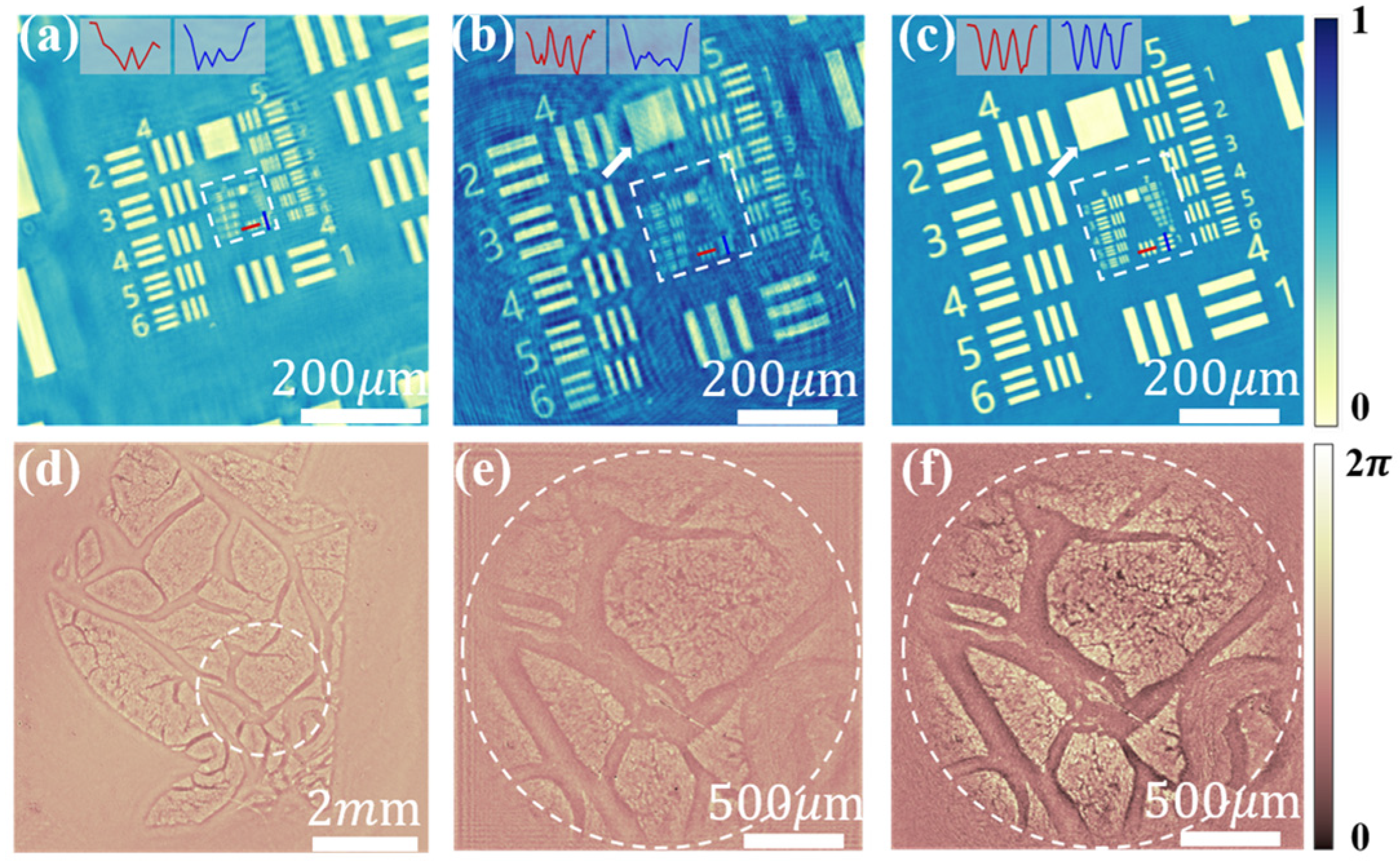
The benefits of DAPO in simplifying the propagation model are further demonstrated through a focused PIE experiment, as shown in Figure 7. To introduce significant phase curvature, a 60 mm lens (Thorlabs, AC254-060-A-ML, Newton, NJ, USA) was used. Using the DAPO algorithm for calibration, we determine the sample-to-detector distance to be 36.9 mm, with an equivalent propagation distance of 108.9 mm. When comparing reconstruction results for both plane-wave and spherical-wave illumination, we observe a clear improvement in resolution due to the introduced phase curvature. Figure 7b,e present the reconstruction results from traditional methods, while Figure 7c,f show those obtained through the DAPO method. Although both algorithms use the same diffraction data for reconstruction, traditional methods are affected by resampling errors and scanning position deviations, resulting in diffraction artifacts and reduced clarity compared to the DAPO method. This improvement is also reflected in the fringe contrast: DAPO (red line: 0.8415, blue line: 0.9164) outperforms the traditional method (red line: 0.6243, blue line: 0.2052). In addition, the difference in local standard deviation, measured in the regions indicated by the white arrows in Figure 7, further illustrates the reduction in artifacts and noise: DAPO (0.0205) achieves a lower value than the traditional method (0.0979). Through self-calibration processes, DAPO simplifies the computational workflow (as shown in Figure 4) while avoiding diffraction artifacts and the additional computational cost of resampling.
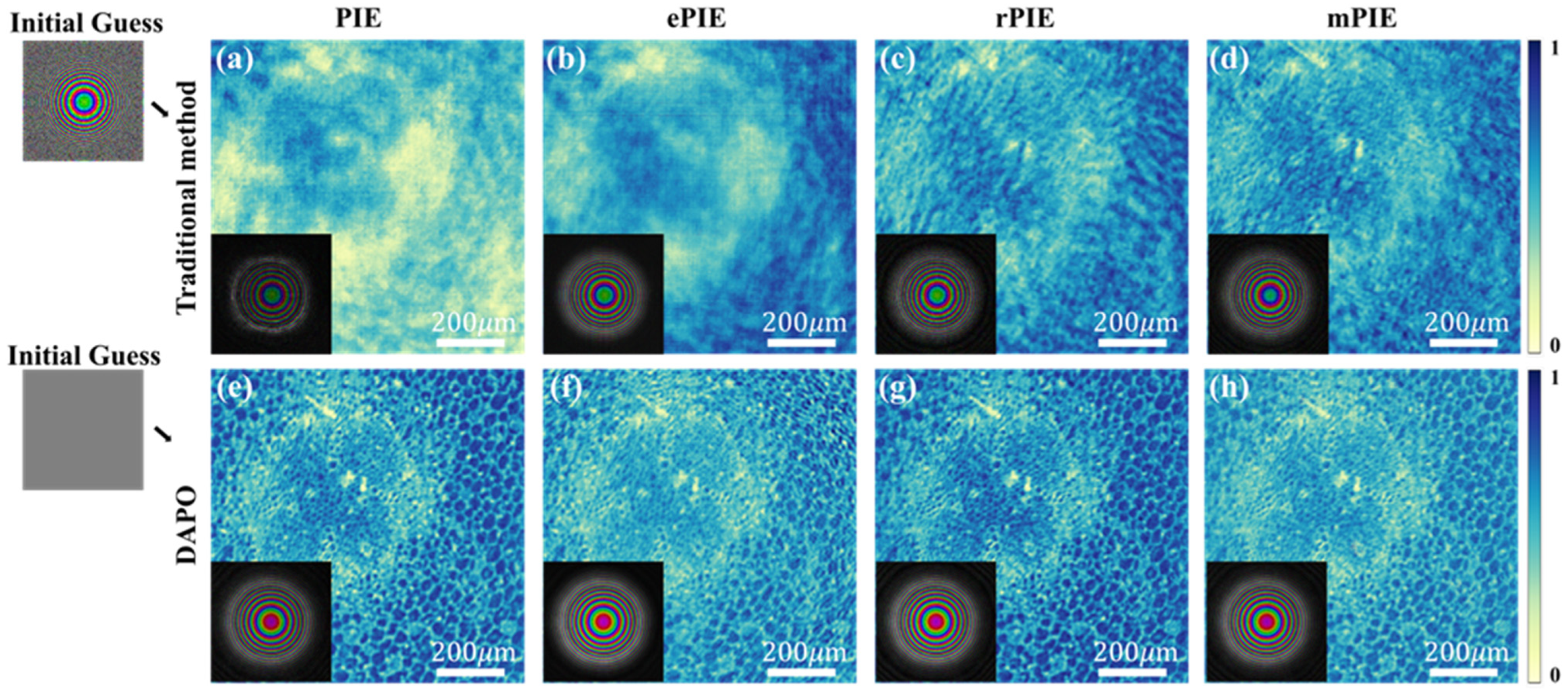
For practical PIE experiments—where achieving ideal calibration is often challenging—we adopted standard probe guesses as initial values and employed different reconstruction algorithms [23,24,25,26]. The corresponding reconstruction results are shown in Figure 8. A comparison of Figure 8a–d highlights differences in the sensitivity of probe estimation across these algorithms. Advanced methods, such as regularized PIE (rPIE) [25] and momentum-accelerated PIE (mPIE) [26], reduce the risk of reconstruction stagnation by incorporating regularization terms and momentum updates. However, spherical-wave illumination significantly increases the accuracy required for initial probe estimation, leading to poor reconstruction results even with slight inaccuracies. By contrast, DAPO incorporates spherical-wave effects directly into the propagation process rather than through probe guesswork, allowing a simple constant value to be used for probe estimation. As a result, all tested algorithms converge successfully, enabling a prior-free implementation of focused PIE. Furthermore, as demonstrated by the quantitative results in Table 1, traditional algorithms exhibit significantly longer computational time. This is primarily due to the upsampling process required to achieve the matching sampling interval. This upsampling considerably enlarges the computational matrix and subsequently increases the computational time for the FFT calculation, particularly with large datasets. Conversely, the DAPO method eliminates this issue by integrating the sampling interval into the adapted propagation model and reducing computational complexity (as detailed in Section 2.3), thereby providing a superior advantage in terms of computational efficiency.

4. Discussion

The DAPO method represents a significant advancement in Fresnel Coherent Diffraction Imaging by providing a generalized and robust solution for various propagation scenarios, including plane-wave and spherical-wave illumination. The core of DAPO lies in its ability to integrate wavefront curvature and sampling variations directly into an adapted diffraction model, allowing for the prior-free estimation of a single parameter: the equivalent propagation distance. This is a key advantage over conventional methods, which rely on precise knowledge of physical distances, sampling intervals, and accurate probe estimates.
Therefore, DAPO can serve as a powerful calibration tool, enabling the estimation of the actual sample-to-detector distance and illumination wavefront directly from diffraction data. Compared with conventional calibration techniques (e.g., laser ranging and interferometric measurement), DAPO requires no additional experimental instruments and enables calibration solely based on diffraction information. Since scanning-position errors can further degrade reconstruction quality in practical PIE experiments, combining DAPO with scanning-position self-correction algorithms [27,28] enables fully prior-free PIE reconstruction for any diffraction pattern. Moreover, in standard parallel-beam setups, such as in-line holography [29], DAPO can also correct sampling errors caused by imperfect plane-wave illumination.
However, because DAPO relies on the PFO evaluation function, the accuracy of the estimated equivalent propagation distance depends on the quality of the chosen evaluation function, particularly under noisy conditions. This limitation could be mitigated in future work by adopting advanced optimization techniques, such as automatic differentiation [22]. Furthermore, while DAPO is highly robust against parameter uncertainty, the model simplifies the wavefront to a spherical term and does not explicitly account for complex higher-order aberrations, which could introduce residual reconstruction errors. Future research could focus on extending the DAPO framework to include more comprehensive aberration modeling, building upon the foundations of existing ptychographic and CDI research [30,31,32].

5. Conclusions

In this paper, we have presented the DAPO method, a robust and general framework for Fresnel CDI that successfully handles both plane-wave and spherical-wave propagation. By integrating phase curvature effects and resampling variations directly into an adapted propagation model, DAPO eliminates the need for precise prior knowledge of system parameters and complex probe calibration. The method’s ability to self-calibrate the equivalent propagation distance significantly simplifies the computational workflow, improves efficiency, reduces reconstruction artifacts, and enhances image clarity. Consequently, DAPO is broadly applicable across experimental setups, serving as an effective tool for both efficient image reconstruction and accurate experimental parameter estimation.

Author Contributions

L.B., W.C., Y.X., C.K. and X.L. have contributed to the development of the research and the elaboration of this paper. Particularly, L.B. and W.C. contributed to the writing, the investigation, the simulation, and the experimental research; Y.X., C.K. and X.L. edited the manuscript. All authors have read and agreed to the published version of the manuscript.

Funding

This research was funded by National Key Research and Development Program of China (2024YFF0726002, 2021YFF0700302); National Natural Science Foundation of China (62205287, 62125504, 52441510); the Fundamental Research Funds for the Central Universities (2022FZZX01-20); STI 2030-Major Projects (2021ZD0200401); Natural Science Foundation of Zhejiang Province (LY24F050004, LZ24F050002).

Data Availability Statement

The data that support the findings of this study are available from the corresponding author upon reasonable request.

Conflicts of Interest

The authors declare no conflicts of interest.

References

  1. Barber, J.L.; Barnes, C.W.; Sandberg, R.L.; Sheffield, R.L. Diffractive imaging at large Fresnel number: Challenge of dynamic mesoscale imaging with hard x rays. Phys. Rev. B 2014, 89, 184105. [Google Scholar] [CrossRef]
  2. Peterson, I.; Abbey, B.; Putkunz, C.T.; Vine, D.; van Riessen, G.; Cadenazzi, G.; Balaur, E.; Ryan, R.; Quiney, H.; McNulty, I.; et al. Nanoscale Fresnel coherent diffraction imaging tomography using ptychography. Opt. Express 2012, 20, 24678–24685. [Google Scholar] [CrossRef] [PubMed]
  3. Jones, M.W.M.; van Riessen, G.A.; Abbey, B.; Putkunz, C.T.; Junker, M.D.; Balaur, E.; Vine, D.J.; McNulty, I.; Chen, B.; Arhatari, B.D.; et al. Whole-cell phase contrast imaging at the nanoscale using Fresnel Coherent Diffractive Imaging Tomography. Sci. Rep. 2013, 3, 2288. [Google Scholar] [CrossRef] [PubMed]
  4. Williams, G.J.; Quiney, H.M.; Dhal, B.B.; Tran, C.Q.; Nugent, K.A.; Peele, A.G.; Paterson, D.; de Jonge, M.D. Fresnel coherent diffractive imaging. Phys. Rev. Lett. 2006, 97, 025506. [Google Scholar] [CrossRef] [PubMed]
  5. Williams, G.J.; Quiney, H.M.; Peele, A.G.; Nugent, K.A. Fresnel coherent diffractive imaging: Treatment and analysis of data. New J. Phys. 2010, 12, 035020. [Google Scholar] [CrossRef]
  6. Nugent, K.A.; Peele, A.G.; Quiney, H.M.; Chapman, H.N. Diffraction with wavefront curvature: A path to unique phase recovery. Found. Crystallogr. 2005, 61, 373–381. [Google Scholar] [CrossRef]
  7. Nugent, K.A.; Peele, A.G.; Chapman, H.N.; Mancuso, A.P. Unique phase recovery for nonperiodic objects. Phys. Rev. Lett. 2003, 91, 203902. [Google Scholar] [CrossRef]
  8. Abbey, B.; Nugent, K.A.; Williams, G.J.; Clark, J.N.; Peele, A.G.; Pfeifer, M.A.; de Jonge, M.; McNulty, I. Keyhole coherent diffractive imaging. Nat. Phys. 2008, 4, 394–398. [Google Scholar] [CrossRef]
  9. Burgard, L.; Neupane, C.; Balodhi, A.; Bista, S.; Butun, S.; Jangid, R.; Barbour, A.; Basit, N.; Agterberg, D.F.; Weinert, M.; et al. Fresnel diffraction imaging of surface nanostructure using coherent resonant x-ray scattering. J. Appl. Phys. 2025, 138, 013902. [Google Scholar] [CrossRef]
  10. Ünal, A. Analytical and numerical fresnel models of phase diffractive optical elements for imaging applications. Opt. Quantum Electron. 2024, 56, 960. [Google Scholar] [CrossRef]
  11. Yan, X.; Diebold, G.J. Determination of Fresnel Integrals for X-ray Phase Contrast Imaging with the Fast Fourier Transform. Microsc. Microanal. 2025, 31 (Suppl. S1), ozaf048.1136. [Google Scholar] [CrossRef]
  12. Quiney, H.M.; Peele, A.G.; Cai, Z.; Paterson, D.; Nugent, K.A. Diffractive imaging of highly focused X-ray fields. Nat. Phys. 2006, 2, 101–104. [Google Scholar] [CrossRef]
  13. Dou, J.; Gao, Z.; Ma, J.; Yuan, C.; Yang, Z.; Wang, L. Iterative autofocusing strategy for axial distance error correction in ptychography. Opt. Lasers Eng. 2017, 98, 56–61. [Google Scholar] [CrossRef]
  14. Cao, W.; Bai, L.; Xu, Y.; Kuang, C.; Liu, X. Fast autofocusing strategy for phase retrieval based on statistical gradient optimization. Opt. Lasers Eng. 2025, 184, 108636. [Google Scholar] [CrossRef]
  15. Seifert, J.; Shao, Y.; van Dam, R.; Bouchet, D.; van Leeuwen, T.; Mosk, A.P. Maximum-likelihood estimation in ptychography in the presence of Poisson–Gaussian noise statistics. Opt. Lett. 2023, 48, 6027–6030. [Google Scholar] [CrossRef] [PubMed]
  16. Ma, R.; Yang, D.; Yu, T.; Li, T.; Sun, X.; Zhu, Y.; Yang, N.; Wang, H.; Shi, Y. Sharpness-statistics-based auto-focusing algorithm for optical ptychography. Opt. Lasers Eng. 2020, 128, 106053. [Google Scholar] [CrossRef]
  17. Loetgering, L.; Du, M.; Eikema, K.S.E.; Witte, S. zPIE: An autofocusing algorithm for ptychography. Opt. Lett. 2020, 45, 2030–2033. [Google Scholar] [CrossRef]
  18. Mas, D.; Garcia, J.; Ferreira, C.; Bernardo, L.M.; Marinho, F. Fast algorithms for free-space diffraction patterns calculation. Opt. Commun. 1999, 164, 233–245. [Google Scholar] [CrossRef]
  19. Paganin, D. Coherent X-Ray Optics; Oxford University Press: Oxford, UK, 2006; pp. 397–400. [Google Scholar]
  20. Cowley, J.M. Diffraction Physics, 3rd ed.; Elsevier: Amsterdam, The Netherlands, 1995; pp. 56–59. [Google Scholar]
  21. Mendlovic, D.; Zalevsky, Z.; Konforti, N. Computation considerations and fast algorithms for calculating the diffraction integral. J. Mod. Opt. 1997, 44, 407–414. [Google Scholar] [CrossRef]
  22. Wu, L.; Yoo, S.; Chu, Y.S.; Huang, X.; Robinson, I.K. Dose-efficient automatic differentiation for ptychographic reconstruction. Optica 2024, 11, 821–830. [Google Scholar] [CrossRef]
  23. Rodenburg, J.M.; Faulkner, H.M.L. A phase retrieval algorithm for shifting illumination. Appl. Phys. Lett. 2004, 85, 4795–4797. [Google Scholar] [CrossRef]
  24. Faulkner, H.M.L.; Rodenburg, J.M. Movable aperture lensless transmission microscopy: A novel phase retrieval algorithm. Phys. Rev. Lett. 2004, 93, 023903. [Google Scholar] [CrossRef]
  25. Maiden, A.M.; Rodenburg, J.M. An improved ptychographical phase retrieval algorithm for diffractive imaging. Ultramicroscopy 2009, 109, 1256–1262. [Google Scholar] [CrossRef] [PubMed]
  26. Maiden, A.; Johnson, D.; Li, P. Further improvements to the ptychographical iterative engine. Optica 2017, 4, 736–745. [Google Scholar] [CrossRef]
  27. Liu, L.; Zhong, L.; Gong, M.; Du, J.; Gu, H.; Liu, S. An efficient and robust self-calibration algorithm for translation position errors in ptychography. IEEE Trans. Instrum. Meas. 2024, 73, 1–12. [Google Scholar] [CrossRef]
  28. Gao, F.; Veetil, S.P.; He, X.; Sun, A.; Jiang, Z.; Kong, Y.; Liu, C. Mitigating reconstruction errors in extended-ptychography with adaptive scanning position correction. Appl. Opt. 2025, 64, 773–781. [Google Scholar] [CrossRef]
  29. Panahi, M.; Darudi, A.; Moradi, A.R. Digital in-line holography for wavefront sensing. Opt. Laser Technol. 2025, 180, 111575. [Google Scholar] [CrossRef]
  30. Chen, L.; Hu, Y.; Nie, J.; Xue, T.; Gu, J. Learning-based lens wavefront aberration recovery. Opt. Express 2024, 32, 18931–18943. [Google Scholar] [CrossRef]
  31. Khorin, P.A.; Dzyuba, A.P.; Khonina, S.N. Optical wavefront aberration: Detection, recognition, and compensation techniques–A comprehensive review. Opt. Laser Technol. 2025, 191, 113342. [Google Scholar] [CrossRef]
  32. Hoshi, I.; Wakunami, K.; Ichihashi, Y.; Oi, R. Wavefront-aberration-tolerant diffractive deep neural networks using volume holographic optical elements. Sci. Rep. 2025, 15, 1104. [Google Scholar] [CrossRef]
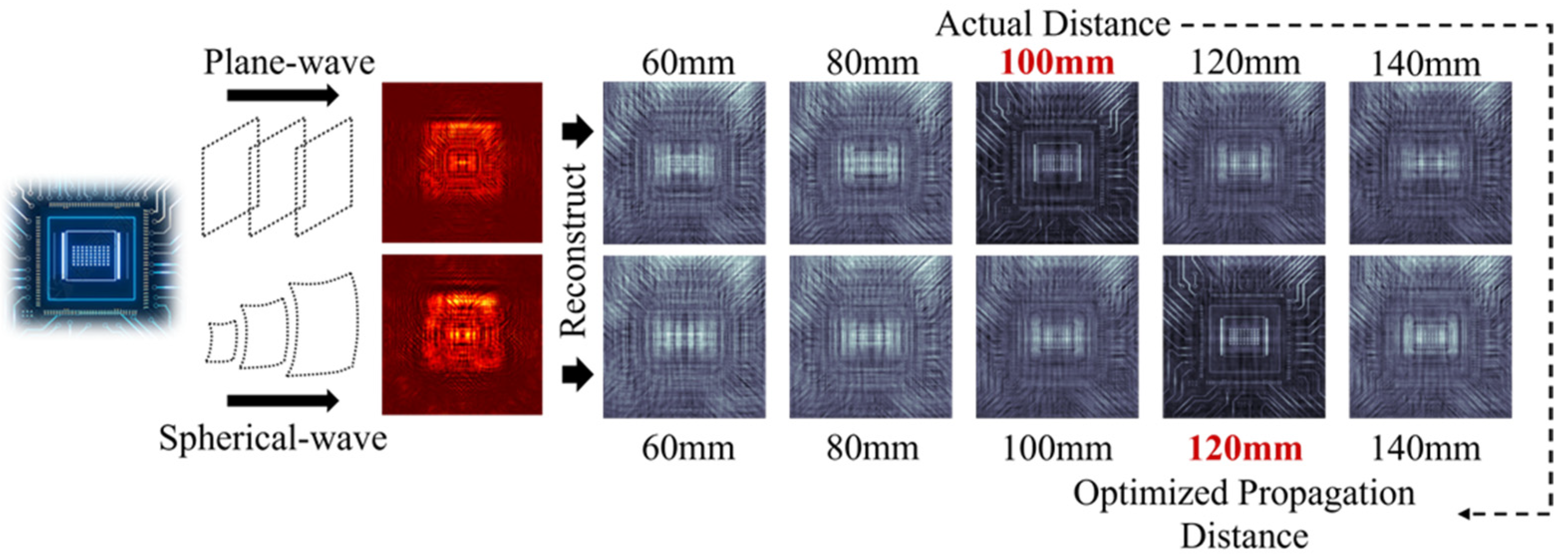
Figure 1. Schematic illustration of refocused reconstruction using diffraction patterns under plane-wave and spherical-wave focused illumination.
Photonics 12 01066 g001
Figure 2. Schematic diagram of (a) the traditional method and (b) the DAPO method under different illumination conditions.
Photonics 12 01066 g002
Figure 3. Extension of the diffracted field obtained through S-FFT (red arrow) and D-FFT (blue arrow).
Photonics 12 01066 g003
Figure 4. Flowchart of the computational procedures for (a) the traditional focused PIE method and (b) the DAPO method. Note that the asterisk (*) denotes the complex conjugate.
Photonics 12 01066 g004
Figure 5. Experimental setup.
Photonics 12 01066 g005
Figure 6. (a) Estimation of the equivalent propagation distance using diffraction patterns under different illumination conditions. (b) Comparison between theoretical and experimental values.
Photonics 12 01066 g006
Figure 7. Reconstruction results for (a,d) plane-wave PIE, (b,e) spherical-wave PIE using the traditional method, and (c,f) spherical-wave PIE using the DAPO method. The top row shows amplitude reconstructions of the USAF 1951 resolution target; the bottom row shows phase reconstructions of biological samples. The white arrow highlights the region of interest for local standard deviation comparison.
Photonics 12 01066 g007
Figure 8. Experimental reconstructed results using the traditional method with: (a) PIE, (b) ePIE, (c) rPIE, (d) mPIE; and using the DAPO method with: (e) PIE, (f) ePIE, (g) rPIE, (h) mPIE. The reconstructed probe is shown in the corner of each image.
Photonics 12 01066 g008
Table 1. Comparison of reconstruction time.
Image SizemPIE(s)mPIE + DAPO(s)
512 × 51252.815.7
1024 × 1024181.830.2
2048 × 20483403.672.9
Disclaimer/Publisher’s Note: The statements, opinions and data contained in all publications are solely those of the individual author(s) and contributor(s) and not of MDPI and/or the editor(s). MDPI and/or the editor(s) disclaim responsibility for any injury to people or property resulting from any ideas, methods, instructions or products referred to in the content.