


Abstract
The minimal geometric deformation method is applied on Einstein–Maxwell field equations in this study to obtain two novel exact anisotropic solutions for polytropic configurations. A static spherically symmetric seed structure penetrated by the anisotropic fluid distribution is taken into consideration in order to accomplish this goal. The gravitational interaction of the new Lagrangian density is then coupled with the initial fluid configuration, representing an additional matter source. We obtain the field equations that correspond to the associated charged fluid sources. Two separate decoupled systems are developed when the field equations are subjected to a radial transformation. By applying the distinct constraints, each system’s solution is determined individually. The entire fluid configuration is then generated by combining these solutions via a certain linear combination. The constraints needed to determine the integration constants in the internal solutions are provided by junction conditions at the interface between the interior and exterior geometry. The suggested models are then verified by comparing them graphically under the observational data from the candidate star. In conclusion, for certain values of the decoupling parameter, our derived relativistic solutions satisfy established physical acceptability requirements.
1. Introduction
The final stage of a star evolution produces noteworthy objects under severe physical conditions, such as high temperatures, strong magnetism, and unique densities demonstrating profound gravitational domination [1,2,3]. Because of their extraordinary density, these celestial objects need to be analyzed within the framework of Einstein’s general theory of relativity (GR). This fundamental theory establishes that distributions of mass, energy, and momentum generate spacetime curvature, manifesting as gravitational phenomena. The mathematical embodiment of this principle is given by Einstein’s field equations, which, in the presence of electromagnetic fields as considered in this work, take the form of the coupled Einstein–Maxwell equations. Deriving solutions to these governing equations is extremely difficult due to their severely non-linear nature, which is still a necessary prerequisite for modeling compact astrophysical systems. In 1916, Schwarzschild [4] developed the metric for the vacuum spacetime encircling a static, spherically symmetric mass distribution and achieved the first exact solution to Einstein’s equations. At the same time, the first comprehensive interior solution for the same configuration had been developed by the work described in [5]. Astrophysicists are constantly examining inner solutions to gravitational field equations in order to describe the physical characteristics of black holes, neutron stars, white dwarfs, and other stellar systems.
In past times, isotropic pressure assumption was used to approximate such astrophysical structures. Significant contributions in references [6,7,8,9,10,11,12] have established this theoretical groundwork. In [13], a comprehensive list of isotropic solutions is provided together with an evaluation of how well they capture real-world star configurations. Multiple works show that subsequent research has produced more significant advancements in this field [14,15,16,17,18,19]. However, true compact star structures cannot be described by the assumption of isotropic pressure. Pressure anisotropy is the product of several physical processes that disturb primordial isotropy [20]. Strong magnetization, ultra-high densities, rotational dynamics, viscous dissipation, superfluid phases, nuclear interactions, and crystalline core formation are some of the physical processes that produce pressure anisotropy [21,22,23,24,25]. Herrera’s recent theoretical work [26] shows that dissipative transport phenomena, energy density inhomogeneities, and relativistic shear stresses are the three main mechanisms by which local pressure anisotropy in compact stars arises naturally throughout stellar evolution. According to the ground-breaking study in [27], local pressure anisotropy has a major impact on important star characteristics, including the maximum equilibrium mass and surface photon redshift. Key studies like those in [20,28] have made substantial progress in understanding how local anisotropy affects star stability and structure. A parallel and rapidly evolving research direction focuses on constructing reliable numerical solutions for complex differential systems, where analytical methods are intractable (see for example, [29]). While powerful, such physics-informed deep learning approaches are, by their nature, numerical and data-driven. In contrast, our study adheres to a complementary philosophy: the pursuit of exact analytical solutions to the Einstein–Maxwell field equations under physically motivated equation of state and a specific density profile.
A recently developed theoretical method for simultaneously recreating a number of important physical characteristics of star interiors, including pressure anisotropy, heat flow, shear stresses, and expansion processes, is gravitational decoupling. The derivation of decoupled solutions is made easier by this methodology, which recasts the gravitational field equations into a framework where different matter sectors are controlled by independent systems. There are two types of geometric distortion produced by the decoupling formalism: minimal geometric deformation (MGD), which only changes the radial metric component, and extended geometric deformation, which modifies the temporal and radial metric potentials. Originally developed by Ovalle [30] to study compact objects using exact solutions, the MGD technique was further extended in [31]. Schwarzschild-like spacetime geometries were derived by Casadio et al. [32] adopting this methodology. Ovalle et al. [33] added an extra Lagrangian density to the pre-existing matter configuration in order to present a new fluid source. Results from this study were statistically significant and physically meaningful, and they have later been expanded to incorporate interactions with the Maxwell field. Two distinct Lagrangian densities were included in this formalism: one represented the original source term, and the other described the electromagnetic field. In order to account for the contribution of an extra source term, a third Lagrangian density was added to the theoretical model [34]. Some other important findings were obtained from the examination of distinct theoretical frameworks using this methodology [35]. Using the Durgapal–Fuloria metric as the initial solution for a perfect fluid, Gabbanelli et al. [36] developed a physically meaningful generalization using a similar methodology. By using this paradigm, researchers have been able to expand the Heintzmann and Tolman VII solutions into more intricate physical domains [37,38]. Ovalle’s methodology has been greatly expanded by Sharif and Naseer’s research [39,40], while maintaining the stability of the generated solutions.
The role of charge is critical in determining various properties of polytropic models, which is why its influence has been widely discussed in the literature. Bekenstein [41] examined the phenomenon of gravitational collapse in charged compact objects through the application of the hydrostatic equilibrium equation. Bonnor [42,43] explored the mass and equilibrium configurations of charged compact objects, observing that repulsive forces generated by charge can also influence the gravitational collapse of realistic stars. Patiño and Rago [44] derived exact solutions of the field equations for a static, spherically symmetric distribution of charged matter. This was achieved by extending a method originally developed for neutral configurations, with the solutions matched to the Reissner–Nordström exterior metric. The electromagnetic field has been shown to influence key properties of compact objects, including their redshift, luminosity, and maximum mass [45,46]. Ray et al. [47] discussed charged compact objects and observed that high-density stars can possess a significant amount of charge. Varela et al. [48] examined analytical solutions for gravitating systems by extending the Krori–Barua ansatz to charged anisotropic configurations incorporating linear/non-linear equations of state. Meanwhile, Gupta and Maurya [49] constructed regular and well-behaved charged models of super-dense stars by employing specific choices of metric and electric field intensity. Pant et al. [50] established that a charged solution yields positive and finite values for pressure and density at the center, in compliance with the causality condition. New charged polytropic models were developed by Takisa and Maharaj [51]. Azam et al. [52] determined the instability regions of charged compact objects through the use of local density perturbations. Within the framework of GR, charge plays a crucial part in the theoretical modeling of astrophysical compact objects.
Within the Einstein’s gravity scenario, this investigation generalizes a class of accurate anisotropic solutions for spherical systems using the MGD technique. The methodological framework described in this paper is followed by our analytical strategy. In Section 2, Einstein–Maxwell field equations for a static, spherically symmetric system are derived. For both matter sources, the sets of gravitationally decoupled field equations are developed in Section 3. In Section 4, density- and pressure-mimicking constraints are used to examine the properties of radially perturbed compact star solutions. In Section 5, the integration constants are methodically ascertained by applying boundary conditions to both solutions. Our models are then graphically interpreted and their conformance to known astrophysical constraints is evaluated in Section 6. The main conclusions of our study are outlined in Section 7, which also highlights the importance of the gravitational decoupling process in creating physically credible relativistic models.
2. Einstein–Maxwell Field Equations Representing a Static Sphere
The relativistic field equations describing static, spherically symmetric geometries connected to an electromagnetic field are formulated in this section. A spherical spacetime manifold, described by coordinates , is partitioned by the hypersurface into distinct interior and exterior regions. The interior spacetime geometry for our analysis is described by the following metric
where and . The Einstein–Maxwell field equations, obtained by varying the total action that includes the Einstein–Hilbert term for gravity, the Lagrangian for the electromagnetic field, and contributions from other matter sources, take the form as
with
where the physical interpretation of these terms is as follows
- is the Einstein tensor, providing a complete description of the local curvature of the spacetime manifold;
- indicates the Ricci tensor and is the Ricci scalar;
- defines the fundamental metric tensor;
- represents the energy–momentum tensor (EMT) for conventional matter;
- forms the conventional EMT;
- represents an extra matter source coupled gravitationally to under the decoupling parameter .
For static metric (1), the Einstein–Maxwell equations allow anisotropic pressure distributions to be supported in spherical symmetry without requiring oblateness or other deformations, as long as the system satisfies hydrostatic equilibrium and the energy conditions. This is a common approximation in relativistic stellar modeling, where the anisotropy is treated as a local effect within the fluid that does not globally distort the geometry significantly. For instance, if the anisotropic stresses are radially symmetric and balanced by gravity, the overall spacetime can remain spherically symmetric, similar to how isotropic models like the Tolman–Oppenheimer–Volkoff equation maintain symmetry despite high densities. Deviations from sphericity would typically require additional factors, such as rotation or non-axisymmetric magnetic fields, neither of which is incorporated in our static setup. Notably, observations from LIGO/Virgo have placed stringent upper limits on the ellipticity of neutron stars based on the absence of continuous GW signals, typically to for known pulsars at frequencies of 10–1000 Hz. These limits assume rotating stars where ellipticity sustains GW emission via quadrupole radiation. Since our models describe static configurations with zero intrinsic ellipticity (and no rotation), they naturally comply with these constraints, as the predicted GW strain would be zero. Even under the anisotropy-induced estimate, our solutions remain well within the observational upper bounds, supporting the physical realism of the models. If rotation were added perturbatively, the small anisotropy in our polytropes would not exceed these limits for realistic spin rates, aligning with the non-detection results.
Since the immense nuclear concentrations, fast rotation, and strong magnetic fields found in the interior of compact star objects render the traditional assumption of isotropy unsustainable, anisotropic pressures must be taken into consideration in order to characterize them effectively. As anisotropic effects significantly affect the structure, stability, and evolutionary pathways of stars, they are crucial for effectively replicating compact objects. Models that take anisotropy into consideration appear to better explain neutron-star behavior, especially in relation to pulsar peculiarities and magnetar explosive outbursts, according to a growing body of observational data [53,54,55,56,57,58,59,60,61,62,63,64,65,66,67,68,69,70,71,72,73,74,75,76,77]. The EMT below illustrates the anisotropic matter distribution used in this study to model the self-gravitating system as
The tangential pressure in this formulation is denoted by , whereas the radial element is represented by . In addition, the energy density is represented by , the four-vector by , and the four-velocity by . Using a co-moving coordinate frame, we derive these quantities from Equation (1) as follows
satisfying the following key relations
As the interior geometry is influenced by the charge, the electromagnetic EMT is defined by
Here, the electromagnetic field tensor is defined as with which follows from the definition of the four-potential. The Maxwell equations take the following tensorial form
where represent the current density, and represents the charge density. From the above expression, we obtain the subsequent differential equation
Solving this integral gives
and .
Using Equations (1)–(4), we obtain three independent field equations corresponding to the two fluid sources as
Further, the conservation law is satisfied by the vanishing covariant divergence of the total EMT, which consolidates contributions from the seed source, electromagnetism, and any additional matter components., i.e., . Applying this to the static spherical metric (1) yields the following form
The equilibrium is attained if and only if the preceding condition holds. The mass function can be derived either from the spacetime geometry or directly from the material configuration, with both approaches yielding equivalent results. The mass function can be expressed in geometric terms as follows
The mass function can be explicitly expressed in terms of the energy density by integrating the relations illustrated by Equations (9) and (13). The quantity is now stated in reference to the mass function specified in Equation (13) using Equation (10), producing the following
This result can be substituted into Equation (12) to produce
For the additional and seed sources, the measure of anisotropy is and . Each expression describes the pressure anisotropy inside their respective matter distributions. Keep in mind that when the decoupling parameter disappears (), the additional source contributes nothing to the system as a whole.
An interesting framework for modeling compact stellar objects involves applying the MGD technique. This method gravitationally decouples two independent anisotropic matter sources, enabling their combined description within a single spacetime geometry. The approach is physically well motivated, since real compact stars often exhibit stratified or composite matter profiles, with distinct physical processes dominating at different radial depths. For instance, the enormous central pressures can trigger a transition from hadronic degrees of freedom to deconfined quark matter, producing regions characterized by markedly different degrees of pressure anisotropy arising from relativistic kinematics or direction-dependent particle interactions. In magnetars, extremely intense magnetic fields (typically G) further break spherical symmetry: the Lorentz force associated with the field introduces significant differences between radial and tangential pressures. In this formalism, one fluid component usually represents a “reference” or baseline configuration that can be described by a well-established hadronic equation of state (for example, SLy or APR parametrizations). The second, supplementary anisotropic source then accounts for additional perturbations, exotic phases (such as color–flavor-locked quark matter, pion or kaon condensates), or other effects that predominantly influence the radial sector of the metric functions.
By construction, the MGD procedure splits the highly coupled Einstein field equations into two separately solvable sets linked only through geometry, without any direct exchange of energy or momentum between the sources. This mirrors astrophysical reality, where distinct matter layers can evolve quasi-independently yet collectively determine global stellar properties (mass, radius, tidal deformability, moment of inertia, etc.). The decoupling automatically respects independent conservation laws for each fluid component. Such models are particularly valuable for confronting theory with modern multimessenger observations including precise radius measurements from NICER X-ray timing of millisecond pulsars and the signatures of anisotropic interiors potentially imprinted in gravitational waveforms from binary neutron-star mergers detected by LIGO/Virgo. Moreover, the inclusion of a positive anisotropic contribution from the secondary source can generate extra outward pressure support, helping to stabilize configurations against gravitational collapse.
3. A Systematic Framework for Spacetime Deformation via Gravitational Decoupling
The complexity of the resulting field equations is increased when the seed anisotropic fluid is supplemented by an extra matter source, introducing new variables . The system’s degrees of freedom must be methodically limited using physically based assumptions or mathematically specified techniques in order to yield accurate responses. Our study utilizes the gravitational decoupling technique [33], a well-established methodology that allows for the extraction of precise solutions through the methodical breakdown of the field equations. The main advantage of this approach is that the governing equations are made simpler while maintaining the temporal and radial metric potentials in their original coordinate representation. The system (9)–(10) is solved using the line element given by
In the framework of gravitational decoupling, the metric components undergo a linear transformation of the form
including the radial L and the temporal deformation function D. By varying the parameter , the deformation’s magnitude can be accurately regulated. By using the MGD approach, which corresponds to the transformations and , deformation is only applied to the metric component while leaving the potential unchanged. This results in the following modified version of Equation (17) as
where . The persistence of spherical symmetry is a crucial characteristic of these linear transformations. When Equation (18) is applied to the system (9)–(11), it is decoupled into two different sets of equations. The system reduces to the initial seed fluid solution when , and is provided as
The following set of equations, on the other hand, governs the supplementary gravitational source as
For the MGD formalism, the energy–momentum exchange between the seed and other sources is excluded as each matter sector’s EMT must be independently conserved. The given condition ensures
Two further constraints must be imposed in order to obtain closure and allow for an accurate solution for the five unknown functions (, , , , and ) that make up the system specified by Equations (19)–(21). To resolve the additional degrees of freedom, the system of Equations (22)–(24) introduces four new unknown functions () that require a constraint based on -sector in order to close the second system.
The effective fluid quantities are defined by the following expressions
where the total effective anisotropy is given by
Pressure anisotropy has a significant impact on the structural integrity of compact stellar objects, and both positive and negative deviations from isotropy can significantly affect stability. Because it generates outwardly directed forces that oppose gravitational collapse, a positive anisotropy, which is described by the condition (), usually stabilize the system. As a counterbalancing force to gravity, the pressure gradient keeps the star structure’s hydrostatic equilibrium. Conversely, negative anisotropy () increases the susceptibility of the net outward pressure to radial instabilities by decreasing its resistance to gravitational collapse. This is a direct physically transparent consequence of the anisotropic Tolman–Oppenheimer–Volkoff equation that governs hydrostatic equilibrium in compact stars [20,78]. Consequently, the stability thresholds of stellar configurations with positive pressure anisotropy are significantly larger than those of those with negative anisotropy.
4. Analytical Solutions Under Non-Perturbative Gravitational Decoupling
For the spherically symmetric system, we use a modified energy density profile in accordance with the methodology presented by Harko and Mak [79]. This is specifically described as
In this case, and stand for the central and surface energy densities, respectively, which represent the density distribution’s maximum and minimum values. The choice of such a density profile is guided by the requirement to construct a physically plausible model for the interior of a compact star within the framework of GR. Compact objects are characterized by extreme central densities that must decrease monotonically outward to match lower surface values, ensuring hydrostatic equilibrium under intense gravitational forces. The selected form incorporates a central density that represents the peak value at , and otherwise introduces a quadratic radial dependence scaled by a characteristic length, which can be related to the stellar radius or a density fall-off parameter. This ensures a smooth, non-singular transition to the surface density, where the density remains positive and finite everywhere inside the star. Physically, this profile captures essential features observed in realistic stellar models, such as those derived from nuclear physics equations of state (e.g., for degenerate fermion matter), where density gradients arise from balancing gravitational compression against quantum degeneracy pressure or strong interactions. Without such a motivated profile, the non-linear nature of the field equations would hinder obtaining closed-form solutions, limiting the model’s applicability to empirical tests.
We now focus on determining the metric potentials and inside the seed gravitational sector. Combining Equations (19) and (29) yields the following differential equation
Integration of this equation leads to the following solution for the metric potential under the known charge distribution ( with having dimension of [80]) as
where the integration constant must fulfill in order to guarantee a non-singular solution, which results in
This choice of the charge distribution is motivated by several interconnected physical and mathematical considerations. First, it guarantees regularity at the stellar center, as ensures a finite electric field, while the corresponding charge density remains constant and non-singular throughout the interior. Second, this ansatz leads to a polynomial structure in the field equations, specifically the term scales as , which naturally combines with the quadratic radial dependence of the energy density profile in Equation (29) to preserve analytical solvability. Third, unlike other power-law choices (e.g., or ), the cubic form avoids the emergence of fractional powers or hypergeometric functions, permitting closed-form integration of the metric potentials. Fourth, this prescription is physically well established in the literature for modeling charged compact objects, as it approximates a nearly uniform proper charge density in the weak-field limit and has been extensively employed in studies of charged neutron stars, quark stars, and strange stars. Fifth, the single parameter provides parametric control over electromagnetic effects, allowing us to study the perturbative influence of charge on anisotropy, and stability, with the neutral case serving as a natural consistency check.
To uniquely determine the second metric potential, an extra restriction is now needed. In order to achieve this, we use the standard non-linear polytropic equation of state, given by
where n stands for the polytropic index and for the equation of state parameter. The equation of state governing matter at supranuclear densities remains one of the most pressing unresolved issues in the field, as it bridges nuclear physics, quantum chromodynamics, and gravitational theory. Theoretical efforts to model this equation often rely on approximations like polytropic relations, which simplify the complex interplay of strong interactions, possible phase transitions (e.g., to quark matter), and relativistic effects in neutron-star cores. Our work contributes to this endeavor by extending the polytropic framework through the MGD approach in Einstein–Maxwell gravity, incorporating anisotropy and electromagnetic charge to derive two new exact solutions for compact stellar configurations. Specifically, we adopt a polytropic equation of state (33), allowing us to probe regimes relevant to dense matter. For instance, values of n around 1–2 correspond to stiffer matter that might mimic neutron-rich matter or hybrid stars with quark cores, while our inclusion of anisotropy accounts for realistic deviations from isotropy arising from pion condensation, superfluidity, or magnetic stresses. This assumption helps illuminate dense matter physics in several ways. First, our solutions provide testable predictions for compactness and surface redshifts, which we shall validate against observational data from the pulsar . Such comparisons can constrain the parameter space of possible equations of state. Second, by incorporating electromagnetic effects, we address how charged matter (potentially from electron degeneracy or charged pion fields) alters the hydrostatic balance at high densities, offering insights into whether such contributions could stabilize against collapse or mimic the effects of hyperonic matter. Unlike purely numerical equations of state (e.g., those based on chiral effective field theory or Skyrme models), our exact analytic solutions allow for precise exploration of these effects across a range of decoupling parameters. Using the indices and , Thirukkanesh and Ragel [81,82] obtained accurate solutions for polytropic fluids. Building upon this framework, Takisa and Maharaj [51] used the parameters as to get accurate solutions for anisotropic charged polytropes. General relativistic polytropic spheres’ structure was examined by de Felice et al. [83] using a variety of indices . When the polytropic index falls between , Nilsson and Uggla [84] quantitatively showed that models of ideal fluids in GR have a restricted radius. To ensure analytical solvability, we concentrate on the situation , which corresponds to a quadratic equation of state, as exact solutions cannot be achieved for arbitrary polytropic indices. Several other interesting studies have been done under this equation of state, providing promising results [85,86,87,88,89,90,91,92,93,94,95,96,97,98]. We determine the differential equation by concurrently evaluating Equations (20), (29) and (33) as
By inserting Equation (32) and carrying out the integration, we obtain the subsequent analytical solution
where
The derivation from Equations (34) to (35) is performed exactly using symbolic integration (e.g., via Mathematica’s DSolve) without any additional assumptions or manual substitutions. The resulting expression contains logarithmic and inverse hyperbolic terms arising naturally from the rational integration of the metric potential and the quadratic density profile, and full reproducibility is ensured.
Equations (32) and (35) fully describe the gravitational field produced by the initial matter source. The field Equations (22)–(24) in the -sector remain to be solved to completely describe the system’s dynamics. It is evident that the system remains under-determined, as three independent equations are inadequate to resolve the four unknown functions. To achieve closure in the -sector, an additional constraint must be imposed. To resolve this system, we impose the following relations
demonstrating that and that is non-singular everywhere. The element and the energy density can thus be simulated simultaneously using this method, and the radial pressure and the component can also be included. This method has been successfully applied by many researchers to model the properties of compact astrophysical objects within both GR and extended theories of gravity. The system of field equations is closed and solved in the current analysis using the mimic constraint approach. The impact of the decoupling mechanism on the structure of compact star objects will now be thoroughly examined.
4.1. The Density-Mimicking Constraint:
By equating the seed energy density to the decoupling source’s component through Equations (22) and (29), we obtain
This constraint implies that the additional source contributes to the total effective energy density in a way that preserves the radial profile of the original seed density. Physically, this corresponds to a scenario where the extra matter distribution (e.g., from anisotropy, charge, or exotic fields) is coherent with the original matter’s energy distribution, meaning that both sources share the same spatial pattern of energy concentration. This is typical in composite stellar interiors where different components (e.g., hadrons and quark matter) are locally coupled through gravity alone but maintain similar density fall-offs, often seen in phase-sorted cores or magnetically dominated regions.
The decoupling function in its exact form is obtained by solving this equation as
Hence, the complete minimally deformed metric, resulting from the density mimic constraint, is therefore given by the following spacetime components
The fluid characteristics of the additional source are derived from Equations (22)–(24), (39) and (40) as follows
4.2. The Pressure-Mimicking Constraint:
This constraint ensures that the total effective radial pressure retains the functional form of the seed radial pressure. Physically, this means that the extra source does not introduce a new independent radial pressure profile but instead redistributes the existing pressure support, similar to a scenario where anisotropy or electromagnetic corrections reconfigure the hydrostatic balance without altering the radial equation of state’s structural dependence. This is physically realized in systems where the secondary source arises from microscopic interactions (e.g., pion condensates or magnetic stresses) that linearly couple to the seed pressure without generating a thermodynamic family. The deformation function is determined by matching the seed radial pressure with the component through Equations (20) and (23), yielding
The corresponding modified gravitational metric for this scenario is characterized by the temporal component (39) and the radial metric function as
Lastly, the expressions of the additional source’s components are given in Appendix A. The integration constants will be determined by applying the appropriate boundary conditions. Both solutions will be further examined in the following analysis, which will show important physical characteristics to confirm their suitability as stellar structure models.
5. Implications of Boundary Conditions
For a compact stellar model with mass M and radius f to be physically viable, the internal geometry must match the external spacetime at the boundary . The exterior spacetime of a static, charged, non-radiating compact object is usually defined by the Reissner–Nordström metric, which generalizes the Schwarzschild vacuum to incorporate electromagnetic effects. However, the behavior of the remaining elements of the EMT, particularly those in the -sector, must also be examined in a thorough examination. Furthermore, the external spacetime’s structure might change with the addition of an extra source term. The line element describing this exterior geometry is given by [99]
When the source influences the exterior geometry, the change is encoded by the geometric deformation function . This metric shows the existence of an effective energy–momentum contribution by characterizing a non-vacuum distortion of the exterior spacetime. The standard vacuum solution is restored when , preserving its simplicity and universality. The Darmois junction criteria must be satisfied for the interior and exterior geometries to match perfectly at the boundary surface . The first fundamental form ensures the continuity of the metric tensor across , expressed as
where the exterior and interior spacetime quantities are indicated by the superscripts and , respectively. The second fundamental form guarantees consistency between the exterior and interior spacetime geometries by governing the matching of extrinsic curvature across the boundary. The continuity of the radial extrinsic curvature component across the boundary yields
which gives
By combining Equations (23) and (49), we obtain
Furthermore, substituting the deformed exterior metric from Equations (50) into (23) leads to
The matching requirements (47) and (51) must be met for the deformed metric (46) to describe a spherically symmetric exterior vacuum compatible with the interior solution (1). Furthermore, the fields connected to could extend outside the source, adding to the outside geometry, also known as the external spacetime geometry. The second fundamental form enforces in (46) and is derived from junction condition (51). The following constraint results from this condition, which guarantees compatibility with the outer geometry as
Now, using the boundary conditions (47) and (52), we calculate the integration constants for our solutions. The detailed calculation is provided in Appendix A. This information will be used in the next section to visually evaluate the physical viability of our models under various diagnostic tests.
6. Graphical Examination of the Minimally Deformed Solutions
We now apply our framework to the specific compact object , which has a mass of and a radius of km [100], in order to evaluate the physical viability of the proposed solutions. Notably, we select this object as a benchmark not with the intent to model its full microphysical or dynamical properties in detail, but rather to validate the physical acceptability of our theoretical solutions against well-constrained observational data from a real compact star. This is an X-ray pulsar (a magnetized neutron star in a binary system with an accretion disk), derived from X-ray timing observations and spectral modeling. These parameters make it an appropriate test case for relativistic models of charged, anisotropic spheres, as they fall within the typical range for neutron stars and allow us to compute quantities like compactness, surface redshift, and stability metrics that can be directly compared to our derived expressions. We specifically examine the behavior of key thermodynamic parameters, including the energy density, radial and tangential pressures, and the anisotropy parameter. The usefulness of both systems for simulating astrophysical phenomena is assessed in this work, with particular focus being placed on how well they represent real compact objects.
6.1. Radial Profiles of Energy Density and Pressure Elements
The stability and internal organization of stellar models are largely determined by the profiles of the fluid variables (density and pressure). An energy density that is positive, finite, and monotonically decreases from the center toward the boundary is necessary for a physically accurate star model. A positive radial pressure that reaches its maximum in the core, diminishes monotonically outward, and disappears at the surface is required. A difference between the tangential and radial pressure components in the star interior causes pressure anisotropy. For our solutions, various parameter values are employed to examine the behavior of the fluid components, including , , and . Here, serves as a control parameter that quantifies the influence of the additional matter source on the seed fluid distribution. Positive ensures that the supplementary source contributes constructively to and , leading to stable and physically viable stellar configurations that align with observational constraints for compact objects like . Negative could invert the effects of the additional source, potentially resulting in unphysical outcomes such as negative effective densities or pressures, which violate energy conditions (e.g., the weak energy condition requiring ) or destabilize the hydrostatic equilibrium. For instance, in our models, negative would reduce below the seed density , risking singularities or collapse scenarios inconsistent with the polytropic equation of state. While negative might be theoretically intriguing for exotic matter scenarios (e.g., mimicking dark energy effects), it falls outside the scope of this work, which prioritizes realistic anisotropic polytropes in GR. We examine two different models in order to look into the impact of electric charge. Notably, our focus on positive electric charge parameter reflects standard astrophysical modeling practices for charged stellar interiors. In compact objects, electric charge arises from processes like electron capture or strong magnetic fields, and positive net charge is a common assumption to explore repulsive electromagnetic effects that counteract gravitational collapse, thereby increasing stability thresholds. Negative charge would primarily flip the sign of the electromagnetic EMT, but due to the quadratic dependence on q in the field equations, the structural impacts on density, pressure, and metric potentials would be qualitatively similar, albeit with potential sign changes in subdominant terms like the conservation law. This symmetry implies that negative does not yield fundamentally new insights for the polytropic models under consideration, and it could complicate junction conditions at the stellar surface without adding value to our analysis. In solution I, charge has no effect on the energy density profile but alters the radial and tangential pressures for values and . While realistic isolated neutron stars are expected to carry negligible net charge because any excess would be rapidly screened by the surrounding plasma, the Einstein–Maxwell framework with a small charge parameter remains a theoretically useful tool for studying electromagnetic contributions to anisotropy, and stability, as extensively explored in the literature. The present models adopt very small values of so that the charge acts only as a perturbative correction. In solution II, electric charge measurably affects all fluid components, including pressure and energy density, for the same variation of . With the charge values, there are noticeable differences in the energy density, radial pressure, and tangential pressure. These profiles are shown in Figure 1, which also shows that solution II has a stronger charge influence than solution I. The numerical values of these parameters are presented in Table 1 and Table 2. The substantially lower central pressure values seen in solution II compared to solution I arise directly from the fundamentally different physical assumption used to close the system of equations. In solution II, we impose the condition that the extra matter source contributes to the stellar structure primarily by modifying how pressure is distributed rather than by adding to the star’s energy density. This choice forces the effective radial pressure to become only a small fraction of the original seed pressure, especially for the range of the decoupling parameter we have adopted. Furthermore, when the boundary conditions, the natural constant governing the stiffness of the polytropic equation of state becomes intrinsically much smaller than in solution I. Since the radial pressure is directly proportional to this stiffness constant, a smaller constant inevitably yields a lower pressure scale throughout the star, including at the center. This outcome is not a flaw or an inconsistency; rather, it is the mathematically expected and physically logical consequence of choosing the pressure-mimicking closure. Although accreting systems such as LMC X-4, SMC X-4 and XTE J1814-334 are expected to lose any primordial net charge through continuous accretion of neutral matter, the small values of the charge parameter adopted in the present work represent a perturbative electromagnetic contribution rather than a macroscopic net charge. Such a residual charge may be sustained or regenerated locally by strong magnetic fields, microscopic charge-separation processes, or the effective anisotropic source arising from gravitational decoupling. The resulting models therefore remain astrophysically viable and serve to illustrate how even minute electromagnetic effects influence the internal structure and stability of polytropic configurations.
Figure 1.
Matter variables (in ) for solutions I (left) and II (right) with (solid) and (dashed).
Table 1.
Numerical values of the fluid parameters for solution I for different choices of .
Table 2.
Numerical values of the fluid parameters for solution II for different choices of .
Increasing from to (while holding other parameters fixed at baseline values provided above) leads to a more compact stellar structure. Specifically, the total mass M rises by ∼15–20%, from ∼1.45 to ∼1.72 , due to enhanced gravitational binding from the denser core. The compactness increases from 0.32 to 0.38, approaching but not exceeding the Buchdahl limit (4/9 ≈ 0.444), which enhances surface redshift z by ∼10% (from 0.28 to 0.31). However, this also amplifies radial anisotropy near the core (up to 25% higher), potentially destabilizing the configuration if exceeds . Conversely, lowering to reduces M by ∼12% and softens anisotropy. Varying the ratio from 0.1 to 0.4 (with fixed at and other parameters at baseline) alters the density profile’s steepness. A higher flattens the profile, reducing central concentration and leading to a ∼8–12% increase in radius R (from ∼9 km to ∼10.2 km) for fixed M, thus lowering compactness by ∼10% (to 0.29). This diminishes core anisotropy by up to 18%, enhancing overall stability with improved tolerance to perturbations. Redshift decreases slightly (∼5%), reflecting weaker surface gravity. For lower (sharper density drop-off), the configuration becomes more neutron-star-like, with higher and (up to 0.35), but risks violating weak energy conditions near the surface if . These trends underscore how controls the transition from core-dominated to extended structures, with optimal values (–0.3) best fitting data.
The radial gradients of important thermodynamic parameters need to be investigated in order to assess the charged solutions’ physical validity. By demonstrating compliance with these regularity requirements, Figure 2 further substantiates the charged models’ physical acceptability and verifies uniform and well-behaved fluid profiles in both scenarios.
Figure 2.
Regularity conditions (in ) for solutions I (left) and II (right) with (solid) and (dashed).
Central Regularity Analysis and Taylor Expansions
To verify the physical admissibility of our solutions near the origin, we expand the metric potentials, energy density, and pressure components in power series around . For both solution classes obtained via density-mimicking and pressure-mimicking constraints, the following central behaviors are observed. The temporal metric potential remains finite at the center, i.e., , as confirmed by the series expansion of Equation (39). The radial metric potential satisfies , ensuring that the spatial geometry is regular and that the circumference radius coincides with the proper radial distance at the origin. Let the central energy density be and the central radial pressure be . The metric potentials are expanded as
which proves by construction.
For solution I, using Equation (29) for the energy density profile, we obtain
Since , we have , guaranteeing a monotonically decreasing density from the center. Also, the effective radial pressure expands as
The three terms in represent, respectively: the gradient from the density profile, the electromagnetic contribution (via the charge parameter ), and the non-linear polytropic correction. Lastly, the radial metric potential from Equation (40) gives
Here, the first term originates from the seed density, the second from the decoupling source via the mimic constraint, and the third from the electromagnetic field.
On the other hand, for solution II, the energy density expansion becomes
Unlike solution I, the charge parameter influences the central density curvature through the decoupling parameter . Also, the effective radial pressure expands as
Finally, from the deformed metric corresponding to solution II (given in Equation (A1)), the radial metric expansion yields
The last term encodes the effect of the pressure-mimicking decoupling.
6.2. Anisotropy
Anisotropy shows a monotonic increase with increasing decoupling parameter values, as seen in Figure 3. A predetermined decoupling parameter is associated with each curve, and larger values of this parameter result in higher levels of anisotropy. As the decoupling parameter grows in magnitude, so does the rate of anisotropy expansion. The anisotropy starts at zero in the stellar core and increases monotonically toward the border area when charge is present. This increase is consistent with a positive anisotropy, which means that an outwardly directed force is produced since the tangential pressure is greater than the radial component. The stability of the star depends on the repulsive force created by this increasing anisotropy.
Figure 3.
Anisotropy (in ) for solutions I (left) and II (right) with (solid) and (dashed). In all cases, with no sign change, indicating a globally repulsive anisotropic force.
We now rigorously examine the sign of the anisotropy parameter across the stellar interior. Using the analytical expressions for both solutions, we evaluate for the compact star . For all admissible values of the decoupling and charge parameter, we find that is strictly positive for and vanishes only at the center due to the regularity conditions. No sign change occurs anywhere inside the star. The positive anisotropy generates an outward-directed force that opposes gravitational collapse, thereby enhancing stability. The monotonic increase in toward the surface, as shown in Figure 3, confirms that the tangential pressure dominates the radial pressure throughout the configuration. Thus, the condition holds globally, and there are no alternating regions of negative anisotropy that could indicate hydrostatic instability.
6.3. Equation of State Parameters
The equation of state parameter , which represents the tangential and radial pressure components, is . The constitutive relations that govern these parameters indicate their dependence on the system’s basic physical conditions. Within this framework, the following relations hold
In order to satisfy causality and energy limitations, the pressure to density ratios have to remain within the range . These conditions are satisfied, confirming the model’s adherence to the thermodynamic laws regulating star interiors. As seen in Figure 4, the radial and tangential parameters both remain below unity, indicating that in these self-gravitating systems, energy density admits more dominant profile than pressures. This pattern implies that as one gets closer to the stellar boundary, the fluid variables are dropping monotonically.
Figure 4.
Radial and tangential equation of state parameters for solutions I (left) and II (right) with (solid) and (dashed).
6.4. Mass and Other Related Components
The mass contained within a sphere’s radius r is defined by the integral
This equation can be assessed either numerically or analytically by relying on the complexity of the field equations. The physically acceptable mass profile in Figure 5 is confirmed by the absence of a mass at the center, i.e., as , the mass disappears. One important factor controlling gravitational binding energy and structural integrity in relativistic stars is compactness, which is measured by the mass to radius ratio. Because of their extremely high energy density, objects with high compactness produce a large amount of spacetime curvature. The stability of a spherically symmetric arrangement has an upper bound of , according to Buchdahl’s findings [9]. Despite the fact that this limit was initially determined for isotropic materials, later research has verified that it also applies to systems with anisotropic pressure.
Figure 5.
Mass (in km) and other physical quantities for solutions I (left) and II (right) with (solid) and (dashed).
When electromagnetic radiation escapes a strong gravitational field, it shifts toward longer wavelengths, a process known as surface redshift. When photons escape the strong gravitational pull of a dense object, they lose energy, which results in the observable redshift. It is described by the expression
The magnitude of the surface redshift is determined by the compactness’ parameter. As compactness increases, the transmitted light shows a more pronounced surface redshift. For the anisotropic design, the redshift reaches its maximum value of 5.211 close to the surface [101]. They exhibit physically consistent behavior across the domain, as shown in Figure 5.
The moment of inertia is essential for explaining the internal structure and rotational properties of compact stars that spin quickly. By measuring the mass distribution with regard to the rotational axis, it has a direct impact on the star’s stability and evolutionary behavior. This parameter determines the maximum mass limit prior to gravitational collapse into a black hole, the spin frequencies of pulsars, and their stability. According to [102], the expression is given as
An examination of the mass and moment of inertia relationship shows that rotational inertia increases monotonically with increasing mass. Figure 6 provides a graphical representation of this relationship. Since more mass is dispersed away from the axis of rotation, an increase in mass causes a higher moment of inertia. Until the moment of inertia reaches its maximum for the equivalent mass, this tendency persists. After this point, additional mass have a very little impact on the object’s rotational characteristics.
Figure 6.
Moment of inertia (in ) versus total mass (in ) for solutions I (left) and II (right) with (solid) and (dashed).
6.5. Energy Conditions
Any physically feasible distribution of matter must adhere to energy requirements, which are fundamental restrictions. The five types of these conditions are trace (TEC), dominant (DECs), strong (SECs), weak (WECs), and null (NECs). Whether the matter composition of the model represents an ordinary or unusual fluid is shown by the behavior of these restrictions. These requirements ensure compatibility between model predictions and astrophysical observations by establishing theoretical limitations on pressure and energy density. The following is a definition of the previously listed categories
NECs: ,
WECs: ,
SECs: , , ,
DECs: ,
TEC: .
The first three energy criteria are immediately satisfied by the positive of the energy density and pressures, as seen in Figure 1. The well-behaved profiles in Figure 7 show that the DECs and TEC are satisfied, confirming the feasibility of our models.
Figure 7.
Energy conditions (in ) for solutions I (left) and II (right) with (solid) and (dashed).
6.6. Stability Analysis
In order to determine the resulting stellar configurations’ physical plausibility, stability assessment is an essential part of compact star study. By focusing on equilibrium states, this approach aims to evaluate how compact stars react to small radial disturbances. A number of mathematical frameworks have been developed to describe the characteristics that distinguish stable star formations from those that are susceptible to gravitational collapse. Some interesting works have been done in the literature on the stability analysis of astrophysical stellar models. A family of these strategies are used in the following subsections.
6.6.1. Hydrostatic Equilibrium
This subsection looks at how stable the proposed models are under different physical restrictions. A star maintains hydrostatic equilibrium when the inward force of gravity is appropriately counteracted by its internal pressure gradients. White dwarfs and neutron stars maintain this equilibrium by degenerate matter pressure and quantum mechanical processes. The relativistic framework for characterizing this equilibrium state is provided by the Tolman–Oppenheimer–Volkoff equation [6,7]. It maintains the equilibrium between internal pressure gradients and gravitational compression. When metric (1) describes the inner spacetime, the hydrostatic equilibrium Equation (12) looks like
reduces to the following expression
with
A graphic representation of the equilibrium between these forces can be found in Figure 8. The graphs show that hydrostatic equilibrium is maintained in our solutions for every parameter choice, confirming a vanishing net force throughout the star interior. As a result, the polytropic equation of state behaves appropriately when used to simulate compact astrophysical phenomena.
Figure 8.
Forces (in ) for solutions I (left) and II (right) with (upper) and (lower) corresponding to (thick), (dotted) and (dot-dashed).
6.6.2. Sound Speed
In order for causality to occur, the sound speed inside the matter distribution must stay below the light speed. According to the causality requirement, both the tangential and radial sound velocity must be slower than the speed of light [103]. This condition is formally expressed as
The findings in Figure 9 show that both models meet this requirement throughout the entire parameter space.
Figure 9.
Stability via sound speed for solutions I (left) and II (right) with (solid) and (dashed).
For evaluating stellar stability, Herrera’s cracking criterion [104] offers a crucial technique. This method specifically overlooks the overall gravitational contraction or expansion while introducing localized disturbances to equilibrium structures. It assesses the stability of anisotropic stellar formations by examining the dynamical response of the matter distribution to local departures from equilibrium. A stability condition for anisotropic fluids was developed by Abreu et al. [103], which states that must be satisfied by the difference between the squared sound speeds. Figure 9 exhibits this restriction to show the stability of both models.
6.6.3. Adiabatic Index
The adiabatic index measures the ratio of pressure perturbations to density changes under adiabatic conditions, which is used to quantify the stiffness of the equation of state in the study of compact stars. An adiabatic index greater than is a prerequisite for a compact star’s stability [105]. Conversely, gravitational instability, which might cause radial collapse, is indicated by values of less than . This quantity is defined mathematically for the anisotropic fluid as [106,107]
The displayed components, as shown in Figure 10, support the physical viability of both models by proving that they satisfy the required stability condition. Notably, all these analytical validations are parameter-independent in structure; the inequalities hold for any admissible values of the parameters that satisfy the matching conditions and energy positivity. The graphical depiction in this section is provided solely for illustration and cross-check, not as the primary proof.
Figure 10.
Stability via adiabatic index for solutions I (left) and II (right) with (solid) and (dashed).
7. Final Remarks
Two different spherically symmetric solutions were generated, each of which represented a different distribution of matter. Using the MGD method, equilibrium configurations are perturbed locally while aggregate gravitational contraction or expansion is deliberately ignored. We demonstrated how the stability and characteristics of the generated stellar models are affected by the decoupling parameter. The additional source was first incorporated into the distribution of seed matter and then separated by a radial geometric deformation. A comprehensive solution for the system was obtained by combining the outcomes of the independent solutions for each gravitational source. By defining (i) a predetermined energy density profile, and (ii) a polytropic equation of state, the first matter source was resolved. These limitations made it possible to fully characterize the seed spacetime geometry by determining the metric potentials. The additional gravitational source was examined using two different mimic restrictions. Two separate solutions that each represented a self-consistent fluid distribution were obtained by calculating the deformation function for each constraint. The Darmois matching conditions were used to fix the integration constants in these solutions. To find the decoupling function, an analytical solution to a differential equation connecting to the seed density was found. The components of the additional source were fully identified using the derived expression for , which also produced a particular distorted spacetime geometry. Crucially, the energy density and parameter governed the matter–geometry relationship, ensuring thermodynamic coherence in both the seed and decoupled systems. Similarly, the seed radial pressure and the component were applied under a particular relation, creating an algebraic equation whose solution yielded for the second solution.
For a compact star model to be physically possible, the interior spacetime must be smoothly matched to an exterior vacuum solution while accounting for possible geometric distortions caused by additional matter sources. The full set of model parameters could be determined by enforcing junction conditions that guarantee continuity of the measure and its derivatives over the border. The physical acceptability and astrophysical relevance of the deformed solutions were verified by carefully evaluating a number of crucial elements, including as energy conditions, pressure anisotropy, electromagnetic contributions, compactness, and stability against perturbations. There is a monotonic decrease in the energy density profile from its highest at the center to its minimum at the boundary. For example, the decoupling parameter was set at along with , and . The effect of electric charge was assessed using two distinct solutions using , and . Our results show a notable increase in both radial and tangential pressures within the core region of the GR+MGD model, indicating a major confining impact at the stellar center. A crucial element of the model is the elimination of radial pressure at the boundary, which is necessary for hydrostatic equilibrium and structural integrity. The anisotropy, which begins at zero in the core and increases monotonically toward the surface, shows that radial stresses are principally in charge of maintaining overall stellar stability. Importantly, pressure anisotropy is exacerbated by the inclusion of MGD, highlighting its role in enhancing the structural cohesion of the star. A rigorous analysis of the anisotropy sign confirms that throughout the interior without any zero-crossing, thereby guaranteeing a consistent repulsive anisotropic force that supports hydrostatic equilibrium. The interaction of the gravitational sources illustrates that MGD provides a systematic and analytically tractable route to construct anisotropic generalizations of polytropic models.
The stability of the anisotropic solutions was assessed using the adiabatic index, a critical measure of a star’s resistance to radial collapse under disturbance. The stability and dynamic robustness of the models were further validated using cracking and causality conditions. Notably, the pressure mimic constraint-based solution appears to be more stable against slight radial perturbations due to the larger mass provided by the MGD framework. The comparison of our results with the relevant existing studies are provided below.
- Nazar et al. [94] modeled charged anisotropic compact objects using a generalized polytropic equation with specific indices (), but adopted the Finch–Skea ansatz directly on the metric potential without decoupling. Their solutions emphasize general physical attributes and recover linear/quadratic limits, similar to our retrieval of isotropic neutral cases (). However, our MGD framework allows systematic extension of a seed polytrope, enabling finer tuning of anisotropy and charge effects, which better fits ’s high compactness and surface redshift compared to Nazar’s generic models, where maximum is 0.50. Both confirm charge’s stabilizing role, but our decoupled systems provide more flexibility for exotic matter explorations.
- Maurya and his colleagues [108] derived charged solutions under embedding class-1 spacetime, assuming a specific metric form, yielding isotropic perfect fluid distributions with charge. Their models were matched with the charged exterior, satisfying energy conditions, but lack anisotropy, limiting applicability to realistic neutron stars with nuclear stresses. Our anisotropic extension via MGD incorporates pressure differences, enhancing stability and maximum mass, while sharing the uncharged spacetime limit when charge vanishes.
- Maurya et al. [109] presented a general algorithm generating all spherically symmetric charged anisotropic solutions from a monotone source function, with an example for producing strange star models. Their approach emphasized comprehensive families, verifying features like equilibrium and redshift. While broader than our targeted MGD method, it aligns in confirming anisotropy’s role in larger masses and charge’s repulsion against collapse. Our solutions, however, integrate polytropic equation of state directly, offering explicit fits with lower central densities and stronger electric fields, complementing their algorithm by providing a decoupled, observationally tuned subclass.
- Unlike prior applications of MGD with polytropic equations of state, which typically employ linear or Finch–Skea-type seed metrics, our approach simultaneously imposes a quadratic density profile (29), a polytropic equation of state (33), and a charge ansatz. The resulting closed-form expressions represent the first exact, analytically integrated charged anisotropic polytropes obtained via gravitational decoupling, thereby extending the MGD methodology into a previously unexplored parameter regime of dense matter configurations.
Conclusively, this study contributes to our understanding of compact objects by elucidating how density and pressure profiles preserve the structural stability of anisotropic stellar systems, particularly within the derived solutions. Notably, our models reduce to the seed charged polytropic solutions when -sector is absent. Future research may look into higher-order polytropic equations of state (such cubic or quartic forms) or alternative constraint strategies to close the -sector system.
Author Contributions
T.N. and M.S. designed and supervised the research. A.T. and K.H. performed calculations and graphical analysis. T.N., A.T. and A.E. drafted the manuscript. All authors contributed to critically revise the manuscript for important intellectual content, and approved the final version. All authors have read and agreed to the published version of the manuscript.
Funding
This research received no external funding.
Data Availability Statement
Data is provided within the manuscript.
Conflicts of Interest
The authors declare no conflicts of interest.
Appendix A
The following expressions of the additional source’s components for solution II are given as
Appendix A.1. Determination of Solution I’s Constants
For the first solution, we estimate the values of element at the boundary and the radial pressure , given by
Applying these constraints yields the values of the constants and as
where
Appendix A.2. Determination of Solution II’s Constants
For the second solution, we estimate the values of the temporal metric potential and the effective radial pressure at the boundary as
which provides the constants and , given by
References
- Shapiro, S.L.; Teukolsky, S.A. Black Holes, White Dwarfs, and Neutron Stars; The Physics of Compact Objects; Wiley: New York, NY, USA, 1983; Volume 2, pp. 119–123. [Google Scholar]
- Camenzind, M. Compact Objects in Astrophysics; Springer: Berlin/Heidelberg, Germany, 2007; pp. 1–25. [Google Scholar]
- Glendenning, N.K. Compact Stars: Nuclear Physics, Particle Physics and General Relativity; Springer Science and Business Media: Berlin/Heidelberg, Germany, 2012. [Google Scholar]
- Einstein, A. Über das Gravitationsfeld Eines Massenpunktes Nachder Einsteinschen Theorie; Sitzungsberichte der Königlich Preußischen Akademie der Wissenschaften: Berlin, Germany, 1916; pp. 189–196. [Google Scholar]
- Schwarzschild, K. Über das Gravitationsfeld Einer kugel aus Inkompressibler Flüssigkeit Nach der Einsteinschen Theorie; Sitzungsberichte der Deutschen Akademie der Wissenschaften: Berlin, Germany, 1916; pp. 424–434. [Google Scholar]
- Tolman, R.C. Static solutions of Einstein’s field equations for spheres of fluid. Phys. Rev. 1939, 55, 364. [Google Scholar] [CrossRef] [Scilit]
- Oppenheimer, J.R.; Volkoff, G.M. On massive neutron cores. Phys. Rev. 1939, 55, 374. [Google Scholar] [CrossRef] [Scilit]
- Hartle, J.B.; Thorne, K.S. Slowly rotating relativistic stars. II. Models for neutron stars and supermassive stars. Astrophys. J. 1968, 153, 807. [Google Scholar] [CrossRef] [Scilit]
- Buchdal, H.A. General relativistic fluid spheres. Phys. Rev. 1959, 116, 1027. [Google Scholar] [CrossRef] [Scilit]
- Heintzmann, H. New exact static solutions of Einsteins field equations. Z. Phys. 1969, 228, 489–493. [Google Scholar] [CrossRef] [Scilit]
- Durgapal, M.C.; Bannerji, R. New analytical stellar model in general relativity. Phys. Rev. D 1983, 27, 328. [Google Scholar] [CrossRef] [Scilit]
- Florides, P.S. A new interior Schwarzschild solution. Proc. R. Soc. Lond. Ser. A 1974, 337, 529–535. [Google Scholar] [CrossRef] [Scilit]
- Delgaty, M.; Lake, K. Physical acceptability of isolated, static, spherically symmetric, perfect fluid solutions of Einstein’s equations. Comput. Phys. Commun. 1998, 115, 395–415. [Google Scholar] [CrossRef] [Scilit]
- Rej, P.; Bhar, P. Relativistic isotropic stellar model in f(R, T) gravity with Durgapal-IV metric. New Astron. 2024, 105, 102113. [Google Scholar] [CrossRef] [Scilit]
- Waseem, A.; Naeem, S. Study of isotropic stellar models via durgapal-lake solutions in rastall system. Phys. Scr. 2024, 99, 125023. [Google Scholar] [CrossRef] [Scilit]
- Murad, M.H.; Pant, N. A class of exact isotropic solutions of Einstein’s equations and relativistic stellar models in general relativity. Astrophys. Space Sci. 2014, 350, 349–359. [Google Scholar] [CrossRef] [Scilit]
- Malik, A. Impact of Tolman–Kuchowicz potentials on Gauss–Bonnet gravity and isotropic stellar structures. Chin. J. Phys. 2024, 90, 463–473. [Google Scholar] [CrossRef] [Scilit]
- Hansraj, S.; Moodly, L. Minimally modified gravity fitting Planck data better than Λ CDM. Eur. Phys. J. C 2020, 80, 1–19. [Google Scholar]
- Kumar, J.; Bharti, P. An isotropic compact stellar model in curvature coordinate system consistent with observational data. Eur. Phys. J. Plus 2022, 137, 330. [Google Scholar] [CrossRef] [Scilit]
- Herrera, L.; Santos, N.O. Local anisotropy in self-gravitating systems. Phys. Rep. 1997, 286, 53–130. [Google Scholar] [CrossRef] [Scilit]
- Nelmes, S.; Piette, B.M. Phase transition and anisotropic deformations of neutron star matter. Phys. Rev. D 2012, 85, 123004. [Google Scholar] [CrossRef] [Scilit]
- Barreto, W.; Rojas, S. An equation of state for radiating dissipative spheres in general relativity. Astrophys. Space Sci. 1992, 193, 201–215. [Google Scholar] [CrossRef] [Scilit]
- Jones, P.B. Bulk viscosity of neutron-star matter. Phys. Rev. D 2001, 64, 084003. [Google Scholar] [CrossRef] [Scilit]
- Herrera, L.; Di Prisco, A.; Martin, J.; Ospino, J.; Santos, N.O.; Troconis, O. Spherically symmetric dissipative anisotropic fluids: A general study. Phys. Rev. D 2004, 69, 084026. [Google Scholar] [CrossRef] [Scilit]
- Thapa, V.B.; Sinha, M. Dense matter equation of state of a massive neutron star with antikaon condensation. Phys. Rev. D 2020, 102, 123007. [Google Scholar] [CrossRef] [Scilit]
- Herrera, L. Stability of the isotropic pressure condition. Phys. Rev. D 2020, 101, 104024. [Google Scholar] [CrossRef] [Scilit]
- Bowers, R.L.; Liang, E. Anisotropic spheres in general relativity. Astrophys. J. 1974, 188, 657. [Google Scholar] [CrossRef] [Scilit]
- Gleiser, M.; Dev, K. Anistropic stars: Exact solutions and stability. Int. J. Mod. Phys. D 2004, 13, 1389–1397. [Google Scholar] [CrossRef] [Scilit]
- Noorizadegan, A.; Young, D.L.; Hon, Y.C.; Chen, C.S. Power-enhanced residual network for function approximation and physics-informed inverse problems. Appl. Math. Comput. 2024, 480, 128910. [Google Scholar] [CrossRef] [Scilit]
- Ovalle, J. Decoupling gravitational sources in general relativity: From perfect to anisotropic fluids. Phys. Rev. D 2017, 95, 104019. [Google Scholar] [CrossRef] [Scilit]
- Ovalle, J. Decoupling gravitational sources in general relativity: The extended case. Phys. Lett. B 2019, 788, 213. [Google Scholar] [CrossRef] [Scilit]
- Casadio, R.; Ovalle, J.; Da Rocha, R. The minimal geometric deformation approach extended. Class. Quantum Grav. 2015, 32, 215020. [Google Scholar] [CrossRef] [Scilit]
- Ovalle, J.; Casadio, R.; Rocha, R.D.; Sotomayor, A.; Stuchlík, Z. Black holes by gravitational decoupling. Eur. Phys. J. C 2018, 78, 960. [Google Scholar] [CrossRef] [Scilit]
- Sharif, M.; Sadiq, S. Gravitational decoupled charged anisotropic spherical solutions. Eur. Phys. J. C 2018, 78, 410. [Google Scholar] [CrossRef] [Scilit]
- Graterol, R.P. A new anisotropic solution by MGD gravitational decoupling. Eur. Phys. J. Plus 2018, 133, 244. [Google Scholar] [CrossRef] [Scilit]
- Gabbanelli, L.; Rincón, Á.; Rubio, C. Gravitational decoupled anisotropies in compact stars. Eur. Phys. J. C 2018, 78, 370. [Google Scholar] [CrossRef] [Scilit]
- Estrada, M.; Tello-Ortiz, F. A new family of analytical anisotropic solutions by gravitational decoupling. Eur. Phys. J. Plus 2018, 133, 453. [Google Scholar] [CrossRef] [Scilit]
- Hensh, S.; Stuchlík, Z. Anisotropic Tolman VII solution by gravitational decoupling. Eur. Phys. J. C 2019, 79, 834. [Google Scholar] [CrossRef] [Scilit]
- Sharif, M.; Naseer, T. Effect of extended gravitational decoupling on isotropization and complexity in f(R, T) theory. Class. Quantum Grav. 2023, 40, 035009. [Google Scholar] [CrossRef] [Scilit]
- Naseer, T.; Sharif, M. Study of Decoupled Cosmological Solutions in f(R, T) Theory. Fortschr. Phys. 2023, 71, 2300004. [Google Scholar] [CrossRef] [Scilit]
- Bekenstein, J.D. Hydrostatic equilibrium and gravitational collapse of relativistic charged fluid balls. Phys. Rev. D 1971, 4, 2185. [Google Scholar] [CrossRef] [Scilit]
- Bonnor, W.B. The mass of a static charged sphere. Z. Phys. 1960, 160, 59–65. [Google Scholar] [CrossRef] [Scilit]
- Bonnor, W.B. The equilibrium of a charged sphere. Mon. Not. R. Astron. Soc. 1965, 129, 443–446. [Google Scholar] [CrossRef] [Scilit]
- Patiano, A.; Rago, H. New solutions for charged spheres in general relativity. Gen. Relat. Grav. 1989, 21, 637. [Google Scholar] [CrossRef] [Scilit]
- Ivanov, B.V. Static charged perfect fluid spheres in general relativity. Phys. Rev. D 2002, 65, 104001. [Google Scholar] [CrossRef] [Scilit]
- Sharma, R.; Mukherjee, S.; Maharaj, S.D. General solution for a class of static charged spheres. Gen. Relat. Gravit. 2001, 33, 999. [Google Scholar] [CrossRef] [Scilit]
- Ray, S.; Malheiro, M.; Lemos, J.P.S.; Zanchin, V.T. Charged polytropic compact stars. Braz. J. Phys. 2004, 34, 310. [Google Scholar] [CrossRef] [Scilit]
- Varela, V.; Rahaman, F.; Ray, S.; Chakraborty, K.; Kalam, M. Charged anisotropic matter with linear or nonlinear equation of state. Phys. Rev. D 2010, 82, 044052. [Google Scholar] [CrossRef] [Scilit]
- Gupta, Y.K.; Maurya, S.K. A class of regular and well behaved relativistic super-dense star models. Astrophys. Space Sci. 2011, 332, 155. [Google Scholar] [CrossRef] [Scilit]
- Pant, N.; Mehta, R.N.; Pant, M.J. Well behaved class of charge analogue of Heintzmann’s relativistic exact solution. Astrophys. Space Sci. 2011, 332, 473. [Google Scholar] [CrossRef] [Scilit]
- Takisa, P.M.; Maharaj, S.D. Some charged polytropic models. Gen. Relativ. Gravit. 2013, 45, 1951. [Google Scholar] [CrossRef] [Scilit]
- Azam, M.; Mardan, S.A.; Rehman, M.A. Cracking of compact objects with electromagnetic field. Astrophys. Space Sci. 2015, 359, 14. [Google Scholar] [CrossRef] [Scilit]
- Herrera, L.; Ospino, J.; Di Prisco, A. All static spherically symmetric anisotropic solutions of Einstein’s equations. Phys. Rev. D 2008, 77, 027502. [Google Scholar] [CrossRef] [Scilit]
- Abbas, G.; Shahzad, M.R. Models of anisotropic compact stars in the Rastall theory of gravity. Astrophys. Space Sci. 2019, 364, 50. [Google Scholar] [CrossRef] [Scilit]
- Abbas, G.; Shahzad, M.R. Comparative analysis of Einstein gravity and Rastall gravity for the compact objects. Chin. J. Phys. 2020, 63, 1–12. [Google Scholar] [CrossRef] [Scilit]
- Roupas, Z. Secondary component of gravitational-wave signal GW190814 as an anisotropic neutron star. Astrophys. Space Sci. 2021, 366, 9. [Google Scholar] [CrossRef] [Scilit]
- Deb, D.; Mukhopadhyay, B.; Weber, F. Effects of anisotropy on strongly magnetized neutron and strange quark stars in general relativity. Astrophys. J. 2021, 922, 149. [Google Scholar] [CrossRef] [Scilit]
- Das, S.; Parida, B.K.; Ray, S.; Pal, S.K. Role of anisotropy on the tidal deformability of compact stellar objects. Phys. Sci. Forum 2021, 2, 29. [Google Scholar] [CrossRef] [Scilit]
- Sharif, M.; Naseer, T. Influence of f() gravity on cylindrical collapse. Indian J. Phys. 2023, 97, 2853–2863. [Google Scholar] [CrossRef] [Scilit]
- Sarkar, S.; Sarkar, N.; Rudra, P.; Rahaman, F.; Ghorui, T. Relativistic model of anisotropic star with Bose–Einstein density depiction. Eur. Phys. J. C 2023, 83, 1005. [Google Scholar] [CrossRef] [Scilit]
- Bhattacharjee, D.; Chattopadhyay, P.K. Maximum mass of an anisotropic compact object admitting the modified Chaplygin equation of state in Buchdahl-I metric. Eur. Phys. J. C 2024, 84, 77. [Google Scholar] [CrossRef] [Scilit]
- Naseer, T.; Sharif, M.; Faiza, M.; Dayanandan, B. Imprints of the Einasto density profile and complexity factor on traversable wormholes in f(R, T) theory. Eur. Phys. J. C 2024, 84, 1187. [Google Scholar] [CrossRef] [Scilit]
- Demir, E.; Naseer, T.; Ashraf, A.; Güdekli, E. Investigating physical existence of charged stellar models. Chin. J. Phys. 2024, 91, 299–315. [Google Scholar] [CrossRef] [Scilit]
- Siza, B.; Andrade, J.; Santana, D.; Naseer, T. Anisotropic extension of the Kohler–Chao–Tikekar cosmological solution with like Wyman IIa complexity factor. Eur. Phys. J. C 2024, 84, 1203. [Google Scholar] [CrossRef] [Scilit]
- Mustafa, G. Ricci inverse gravity wormholes. Phys. Lett. B 2024, 848, 138407. [Google Scholar] [CrossRef] [Scilit]
- Naseer, T. Complexity and isotropization based extended models in the context of electromagnetic field: An implication of minimal gravitational decoupling. Eur. Phys. J. C 2024, 84, 1256. [Google Scholar] [CrossRef] [Scilit]
- Hassan, K.; Naseer, T.; Sharif, M. Applicability of modified Gauss–Bonnet gravity models on the existence of stellar structures. Chin. J. Phys. 2024, 91, 916–931. [Google Scholar] [CrossRef] [Scilit]
- Yousaf, M. Impact of f() functions on the dynamical evolution of axially symmetric collapsing stars. Chin. J. Phys. 2025, 95, 1278–1302. [Google Scholar] [CrossRef] [Scilit]
- Andrade, J.; Santana, D.; Naseer, T.; Londo, F. Ultra-compact anisotropic stellar model with vanishing complexity. Eur. Phys. J. C 2025, 85, 598. [Google Scholar] [CrossRef] [Scilit]
- Rehman, A.; Naseer, T.; Dayanandan, B. Interpretation of complexity for spherically symmetric fluid composition within the context of modified gravity theory. Nucl. Phys. B 2025, 1013, 116852. [Google Scholar] [CrossRef] [Scilit]
- Yousaf, M.; Asad, H.; Rehman, A. Dynamical evolution of self-gravitating compact fluid with hyperbolic corrections. Phys. Dark Universe 2025, 48, 101888. [Google Scholar] [CrossRef] [Scilit]
- Feng, Y.; Naseer, T.; Mustafa, G.; Maurya, S.K. Non-singular anisotropic solutions for strange star model in f() gravity theory. Eur. Phys. J. C 2025, 85, 18. [Google Scholar] [CrossRef] [Scilit]
- Rehman, A.; Yousaf, M.; Javed, F.; Channuie, P. Interpretation of complexity associated with cylindrically symmetric configuration in f(R, G) theory. Eur. Phys. J. C 2025, 85, 949. [Google Scholar] [CrossRef] [Scilit]
- Yousaf, M.; Alkahtani, B.S.; Mustafa, G.; Maurya, S.K. Interpretation of conservative Morris-Thorne type topologically charged wormhole models and energy conditions with relativistic corrections. Chin. J. Phys. 2025, 97, 1255–1284. [Google Scholar] [CrossRef] [Scilit]
- Rehman, A.; Naseer, T.; Alessa, N.; Abdel-Aty, A.H. Orthogonal splitting of the Riemann curvature tensor and its implications in modeling compact stellar structures. Nucl. Phys. B 2025, 1015, 116897. [Google Scholar] [CrossRef] [Scilit]
- Yousaf, M.; Asad, H.; Rehman, A.; Shahzad, M.R.; Rayimbaev, J.; Davletov, E. Imprints of global monopole charge on the stability and energy conditions of traversable wormholes in f(R) gravity. Phys. Dark Universe 2025, 50, 102123. [Google Scholar] [CrossRef] [Scilit]
- Dai, E.; Yousaf, M.; Javed, F.; Shrahili, M.; Zulqarnain, R.M. Imprints of monopole charge in Morris-Thorne type wormholes and energy conditions under the influence of higher dimensional gravity. Nucl. Phys. B 2025, 1018, 117017. [Google Scholar] [CrossRef] [Scilit]
- Kumar, J.; Bharti, P. Relativistic models for anisotropic compact stars: A review. New Astron. Rev. 2022, 95, 101662. [Google Scholar] [CrossRef] [Scilit]
- Mak, M.K.; Harko, T. An exact anisotropic quark star model. Chin. J. Astron. Astrophys. 2002, 2, 248. [Google Scholar] [CrossRef] [Scilit]
- de Felice, F.; Yu, Y.Q.; Fang, J. Relativistic charged spheres. Mon. Not. R. Astron. Soc. 1995, 277, L17. [Google Scholar] [CrossRef] [Scilit]
- Thirukkanesh, S.; Ragel, F.C. A class of exact strange quark star model. Pramana 2013, 81, 275. [Google Scholar] [CrossRef] [Scilit]
- Thirukkanesh, S.; Ragel, F.C. Exact anisotropic sphere with polytropic equation of state. Pramana 2012, 78, 687. [Google Scholar] [CrossRef] [Scilit]
- de Felice, F.; Yu, Y.; Fang, J. Structure and energy of singular relativistic polytropes. Class. Quantum Grav. 1995, 12, 739. [Google Scholar] [CrossRef] [Scilit]
- Nilsson, U.; Uggla, C. General relativistic stars: Polytropic equations of state. Ann. Phys. 2001, 286, 292. [Google Scholar] [CrossRef] [Scilit]
- Thirukkanesh, S.; Sharma, R.; Das, S. Model of a static spherically symmetric anisotropic fluid distribution in paraboloidal spacetime admitting a polytropic equation of state. Eur. Phys. J. Plus 2020, 135, 629. [Google Scholar] [CrossRef] [Scilit]
- Harko, T.; Mak, M.K. Exact power series solutions of the structure equations of the general relativistic isotropic fluid stars with linear barotropic and polytropic equations of state. Astrophys. Space Sci. 2016, 361, 283. [Google Scholar] [CrossRef] [Scilit]
- Bhar, P.; Singh, K.N.; Pant, N. Compact star modeling with quadratic equation of state in Tolman VII space–time. Indian J. Phys. 2017, 91, 701–709. [Google Scholar] [CrossRef] [Scilit]
- Ngubelanga, S.A.; Maharaj, S.D. Relativistic stars with polytropic equation of state. Eur. Phys. J. Plus 2015, 130, 211. [Google Scholar] [CrossRef] [Scilit]
- Ngubelanga, S.A.; Maharaj, S.D. New classes of polytropic models. Astrophys. Space Sci. 2017, 362, 43. [Google Scholar] [CrossRef] [Scilit]
- Kaisavelu, A.; Thirukkanesh, S.; Govender, M.; Maharaj, S.D. The impact of spheroidicity on the stability of polytropic spheres. Ann. Phys. 2020, 419, 168215. [Google Scholar] [CrossRef] [Scilit]
- Takisa, P.M.; Leeuw, L.L.; Maharaj, S.D. Model of compact star with ordinary and dark matter. Astrophys. Space Sci. 2020, 365, 164. [Google Scholar] [CrossRef] [Scilit]
- Takisa, P.M.; Maharaj, S.D.; Lekala, M.L. Stellar model of compact star with dark matter equation of state. Astrophys. Space Sci. 2021, 366, 102. [Google Scholar] [CrossRef] [Scilit]
- Maharaj, S.D.; Matondo, D.K. Stellar models with generalized polytropic equation of state. New Astron. 2022, 97, 101852. [Google Scholar] [CrossRef] [Scilit]
- Nazar, H.; Azam, M.; Abbas, G.; Ahmed, R.; Naeem, R. Relativistic polytropic models of charged anisotropic compact objects. Chin. Phys. C 2023, 47, 035109. [Google Scholar] [CrossRef] [Scilit]
- Sunzu, J.M.; Lighuda, A.S. A generalised double layered model with polytropic and quadratic equations of state. New Astron. 2023, 100, 101977. [Google Scholar] [CrossRef] [Scilit]
- Lighuda, A.S.; Maharaj, S.D.; Sunzu, J.M.; Mureithi, E.W. A comprehensive analysis of anisotropic stellar objects with quadratic equation of state. Pramana 2023, 97, 5. [Google Scholar] [CrossRef] [Scilit]
- Nasheeha, R.N.; Thirukkanesh, S.; Ragel, F.C. Core-envelope polytropic star with distinct polytropic indexes. Indian J. Phys. 2024, 98, 411. [Google Scholar] [CrossRef] [Scilit]
- Afzal, W.A.; Feroze, T. A generalized polytropic equation of state stellar model with anisotropic charged fluid. Astrophys. Space Sci. 2024, 369, 11. [Google Scholar] [CrossRef] [Scilit]
- Maurya, S.K.; Errehymy, A.; Singh, K.N.; Mustafa, G.; Ray, S. Role of gravitational decoupling on theoretical insights of relativistic massive compact stars in the mass gap. J. Cosmol. Astropart. Phys. 2025, 2025, 004. [Google Scholar] [CrossRef] [Scilit]
- Gangopadhyay, T.; Ray, S.; Li, X.D.; Dey, J.; Dey, M. Strange star equation of state fits the refined mass measurement of 12 pulsars and predicts their radii. Mon. Not. R. Astron. Soc. 2013, 431, 3216. [Google Scholar] [CrossRef] [Scilit]
- Ivanov, B.V. Maximum bounds on the surface redshift of anisotropic stars. Phys. Rev. D 2002, 65, 104011. [Google Scholar] [CrossRef] [Scilit]
- Ravenhall, D.G.; Pethick, C.J. Neutron star moments of inertia. Astrophys. J. 1994, 424, 846. [Google Scholar] [CrossRef] [Scilit]
- Abreu, H.; Hernández, H.; Núnez, L.A. Sound speeds, cracking and the stability of self-gravitating anisotropic compact objects. Class. Quantum Grav. 2007, 24, 4631. [Google Scholar] [CrossRef] [Scilit]
- Herrera, L. Cracking of self-gravitating compact objects. Phys. Lett. A 1992, 165, 206–210. [Google Scholar] [CrossRef] [Scilit]
- Heintzmann, H.; Hillebrandt, W. Neutron stars with an anisotropic equation of state-mass, redshift and stability. Astron. Astrophys. 1975, 38, 51. [Google Scholar]
- Chan, R.; Kichenassamy, S.; Le Denmat, G.; Santos, N.O. Heat flow and dynamical instability in spherical collapse. Mon. Not. R. Astron. Soc. 1989, 239, 91. [Google Scholar] [CrossRef] [Scilit]
- Chan, R.; Herrera, L.; Santos, N.O. Dynamical instability in the collapse of anisotropic matter. Class. Quantum Grav. 1992, 9, L133. [Google Scholar] [CrossRef] [Scilit]
- Maurya, S.K.; Gupta, Y.K.; Ray, S.; Deb, D. A new model for spherically symmetric charged compact stars of embedding class 1. Eur. Phys. J. C 2017, 77, 45. [Google Scholar] [CrossRef] [Scilit]
- Maurya, S.K.; Gupta, Y.K.; Ray, S. All spherically symmetric charged anisotropic solutions for compact stars. Eur. Phys. J. C 2017, 77, 360. [Google Scholar] [CrossRef] [Scilit]
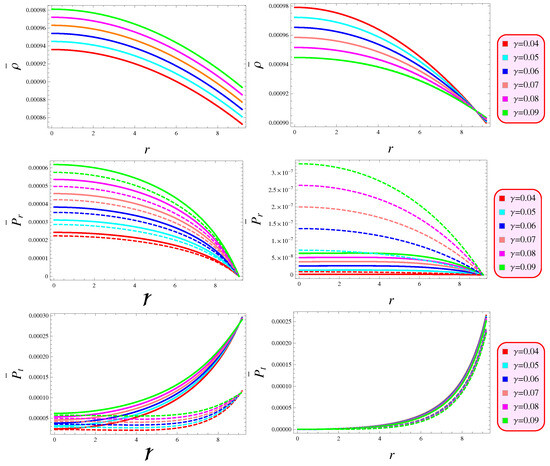
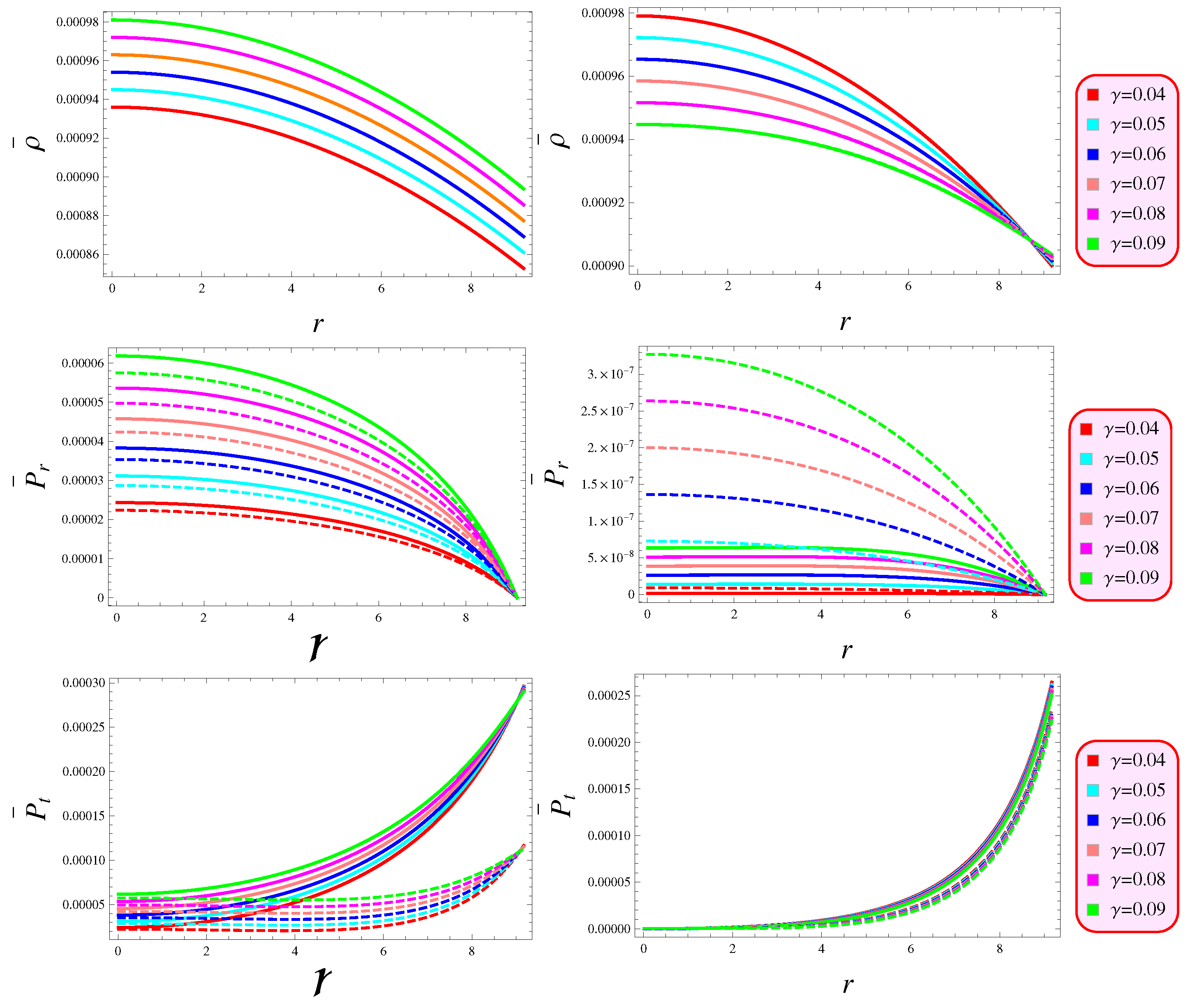
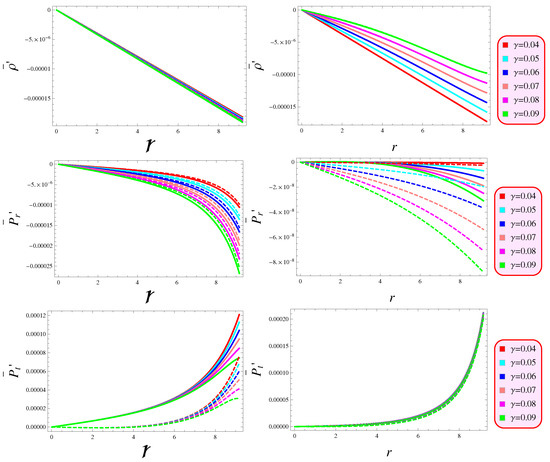
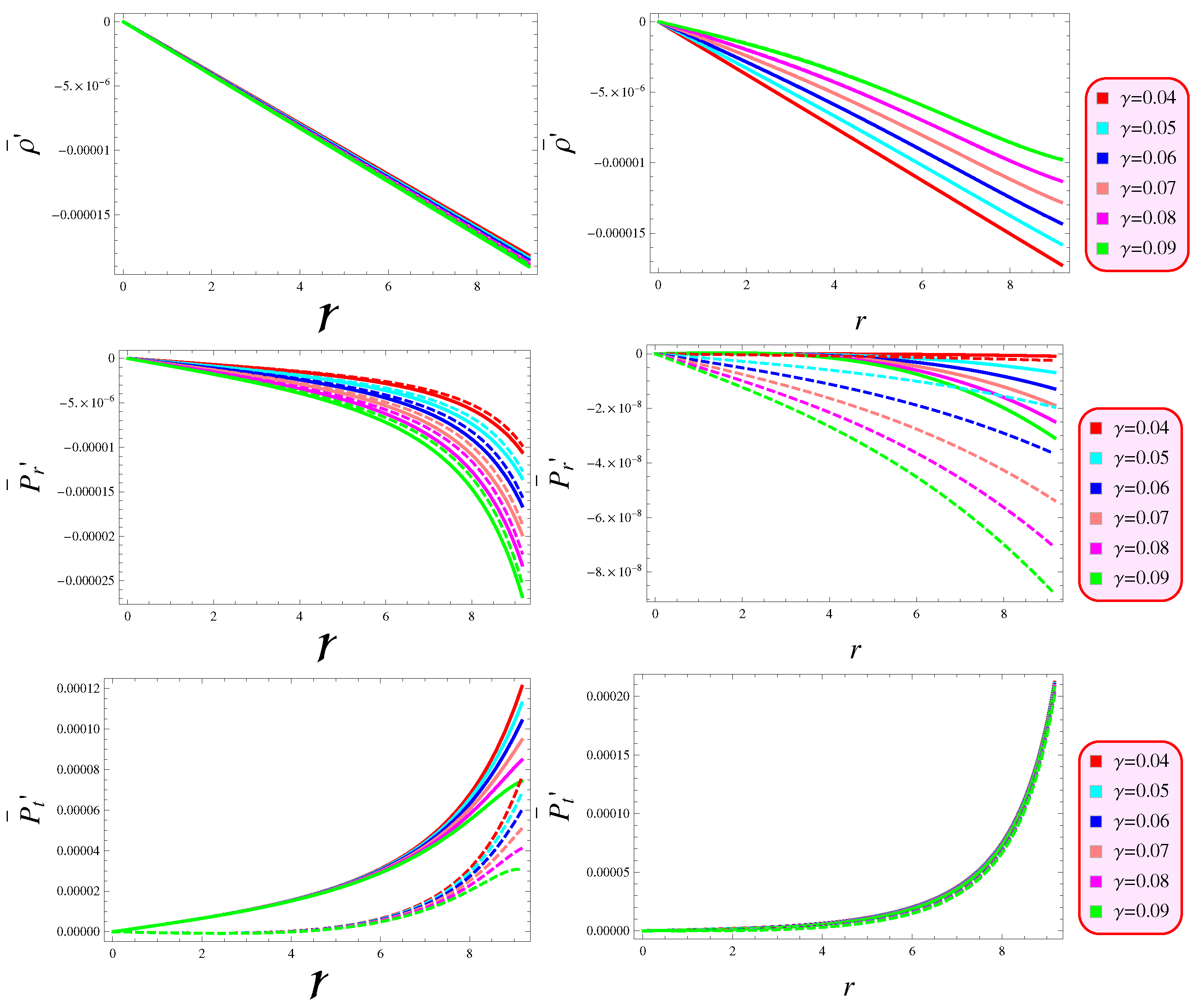
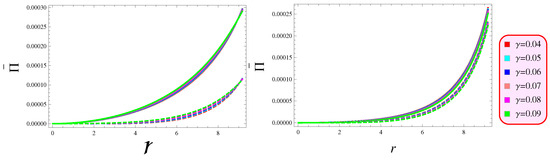
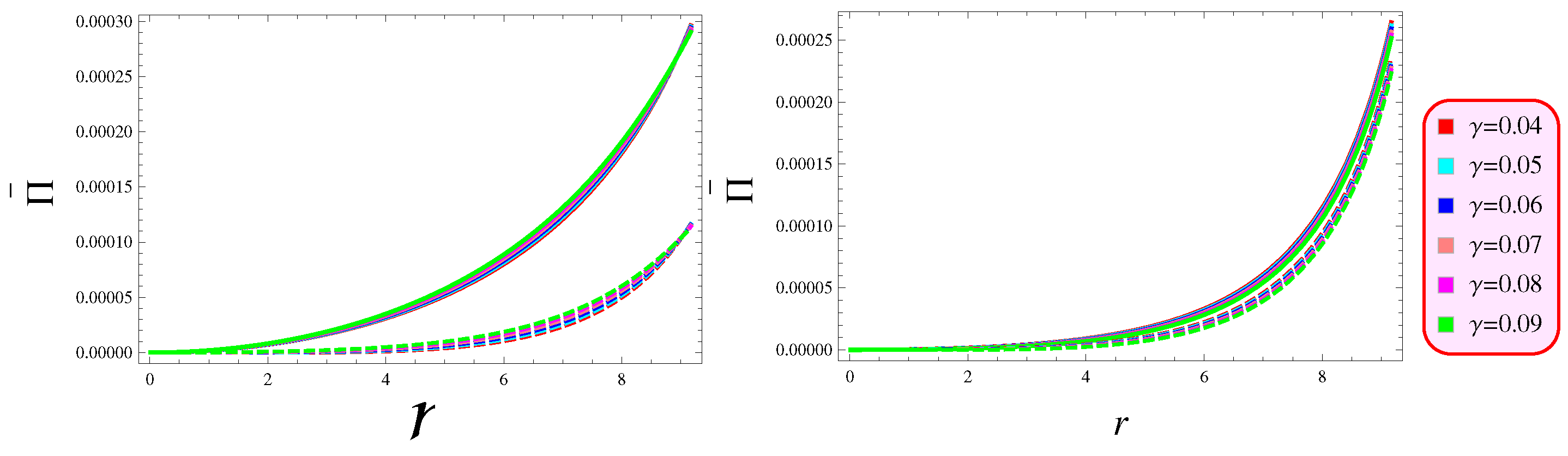
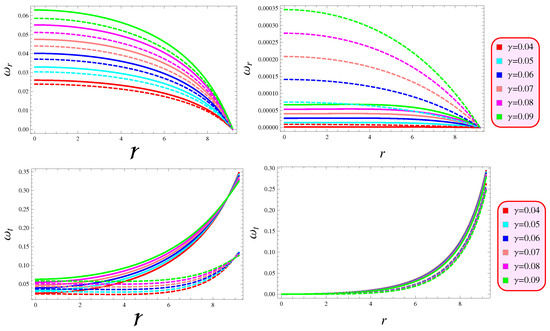
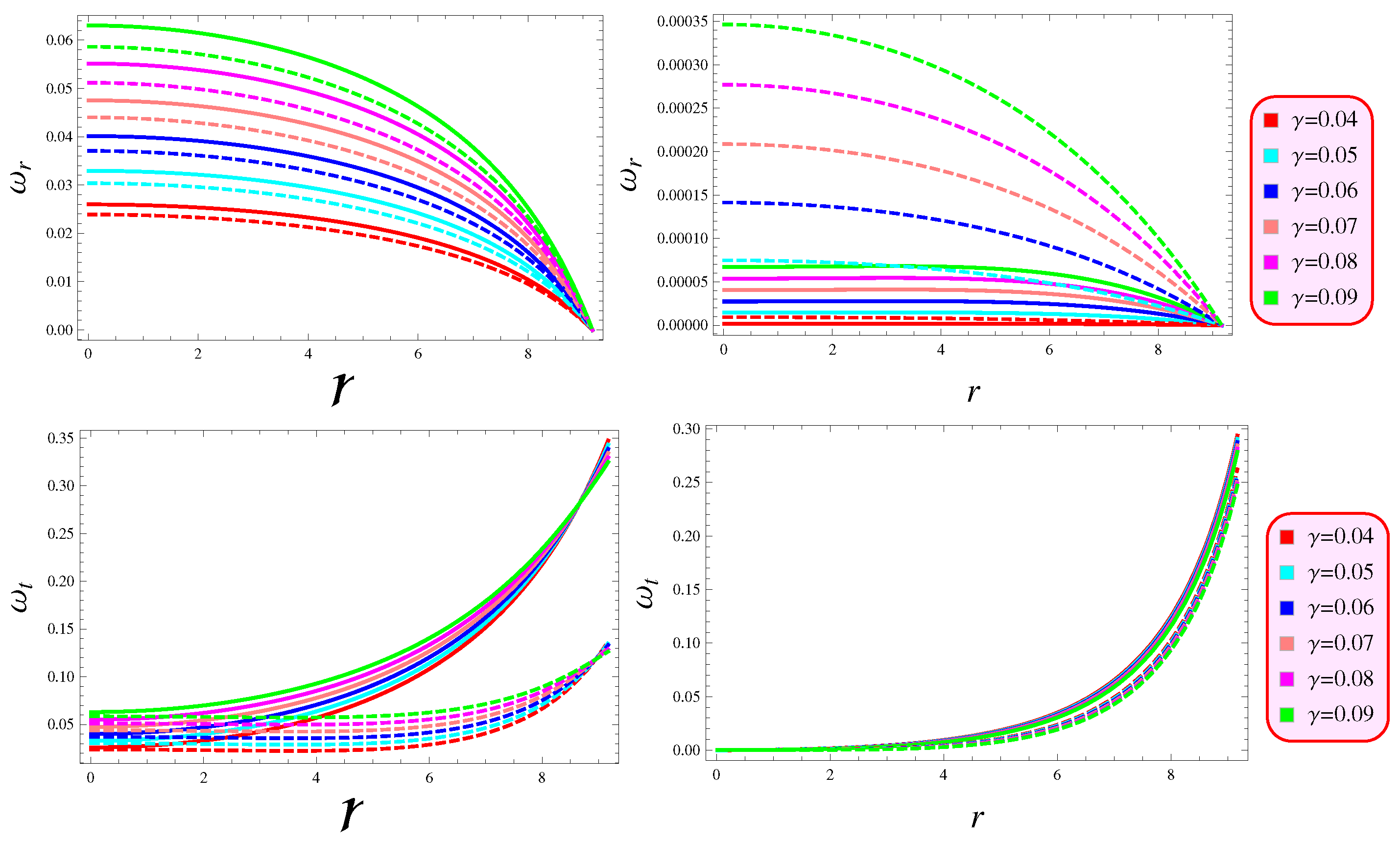
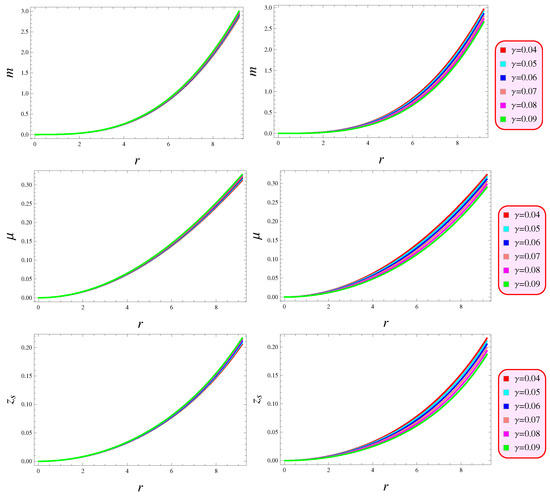
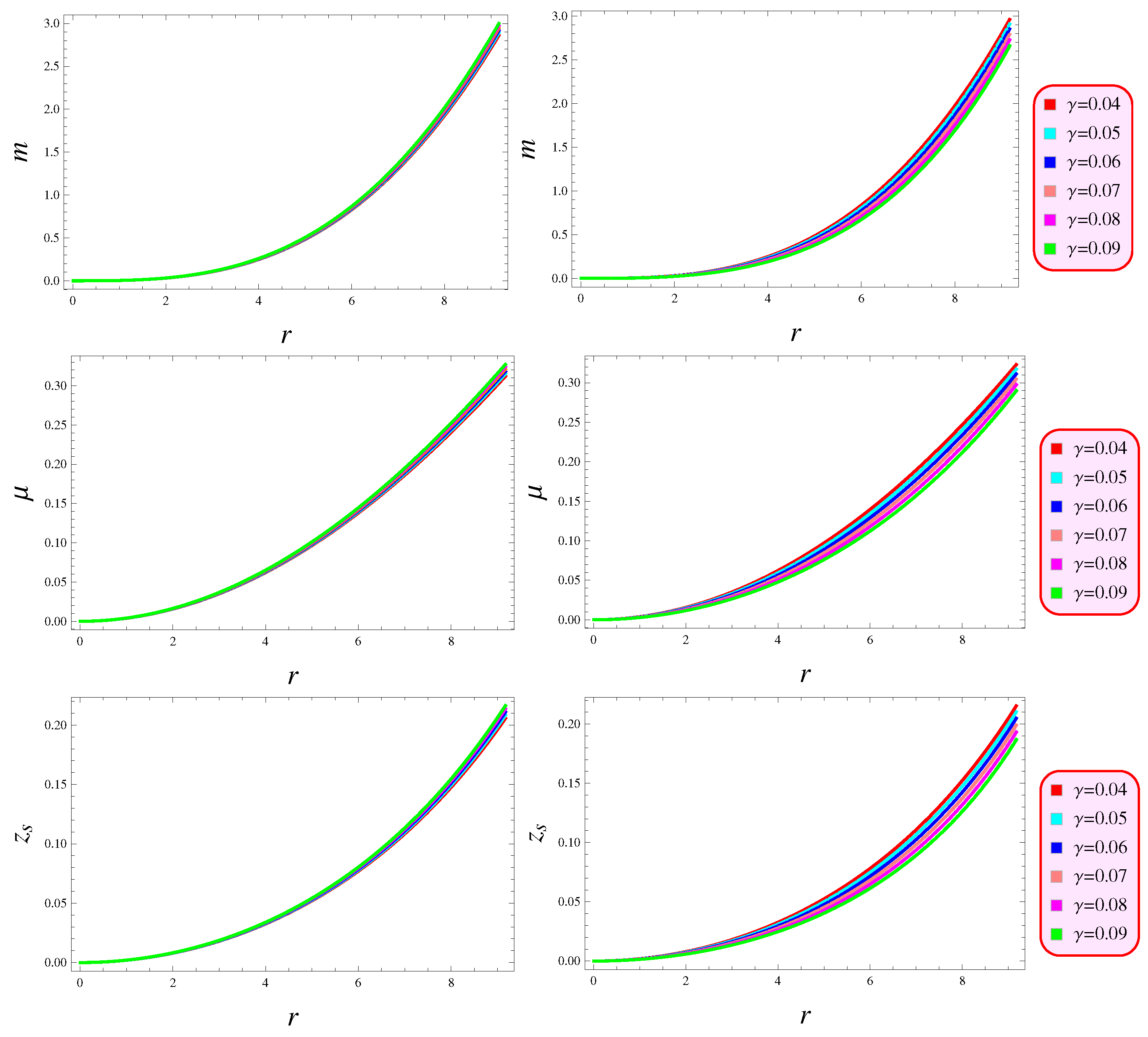
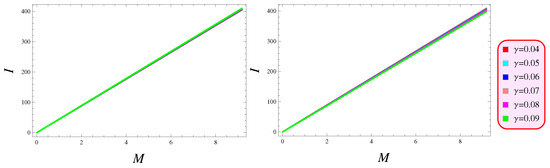
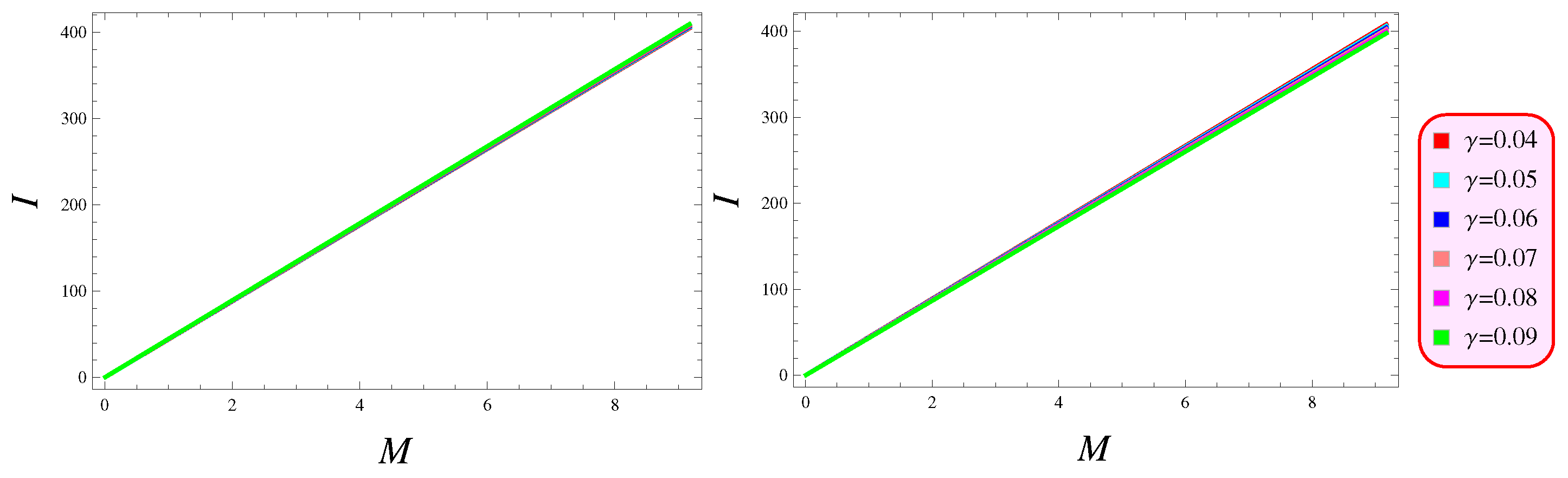
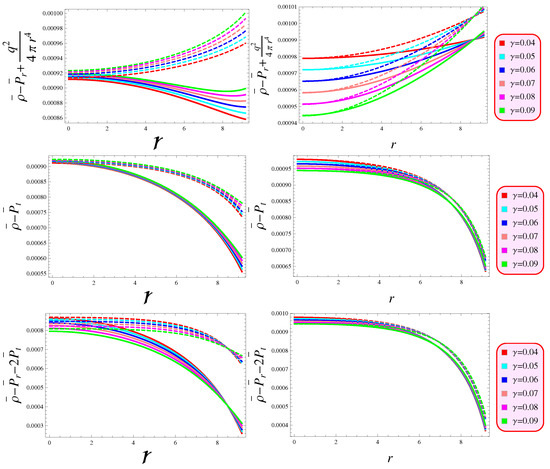
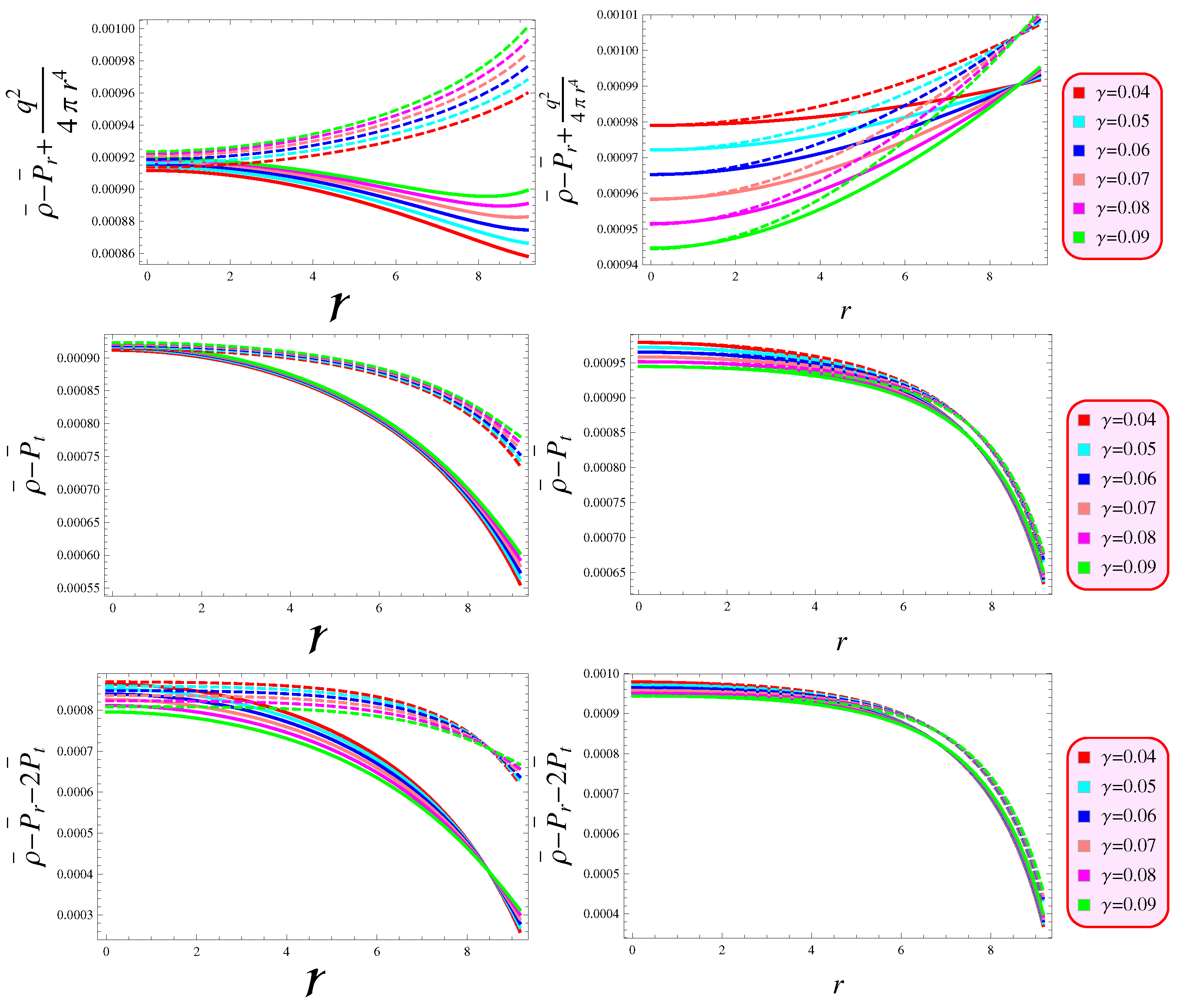
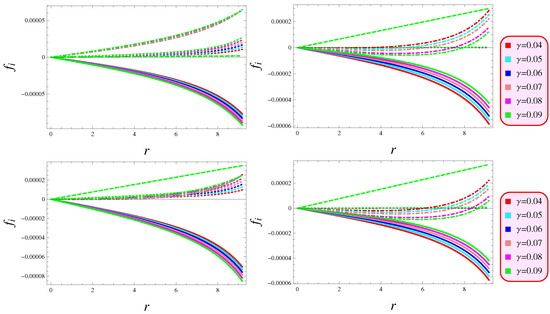
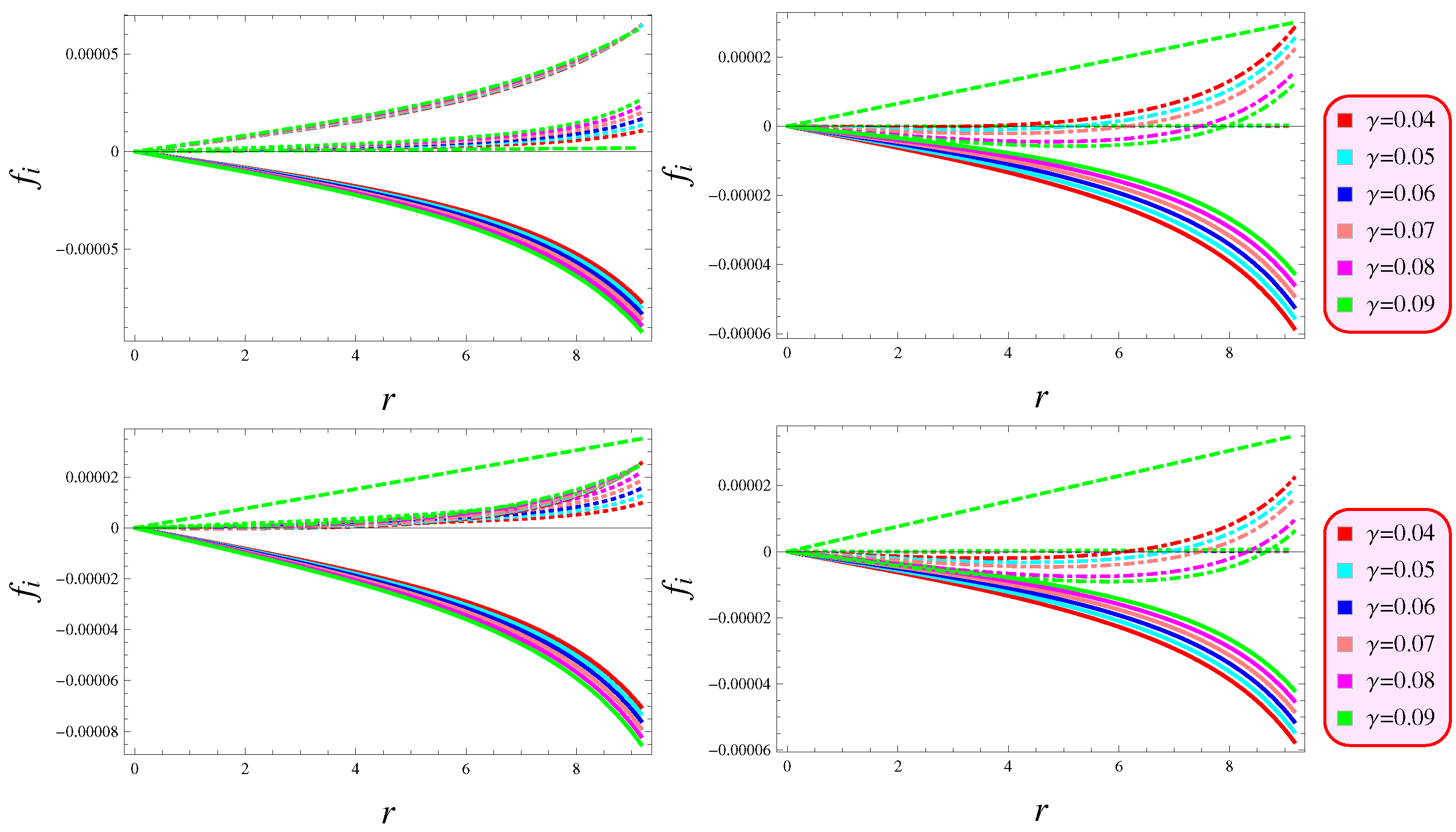
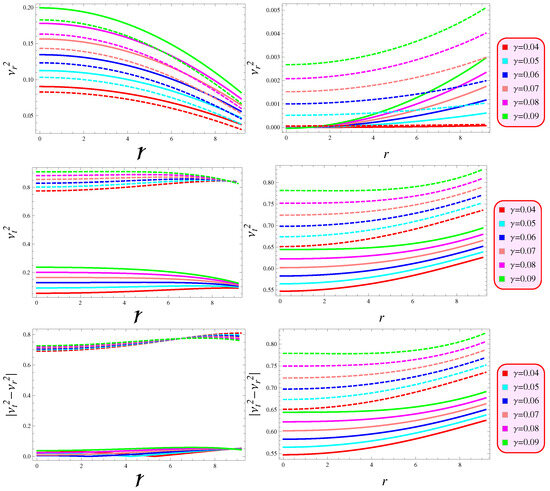
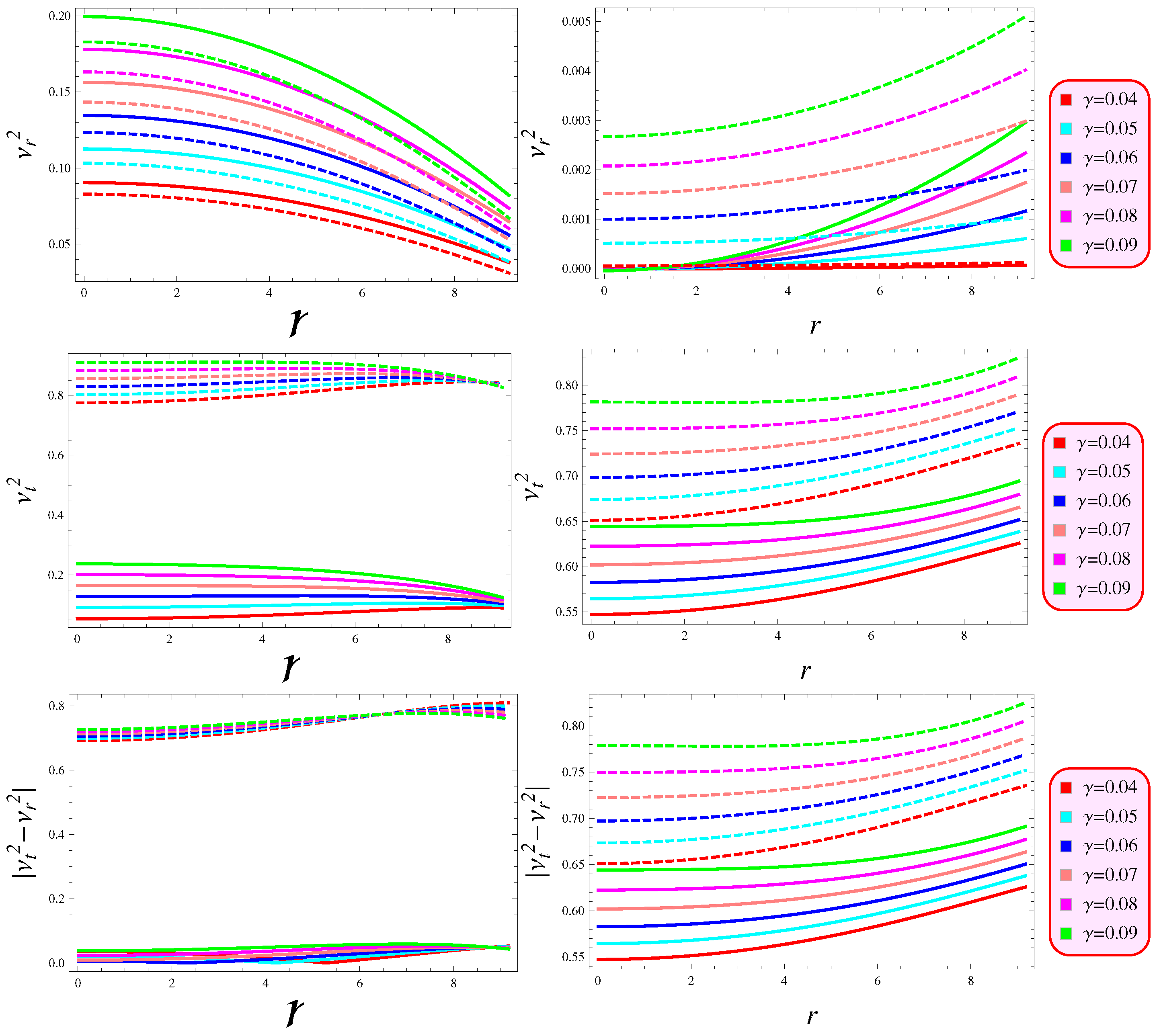
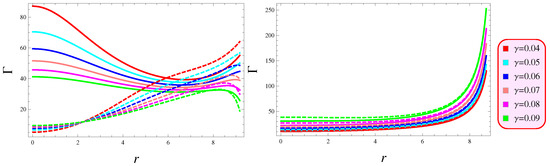
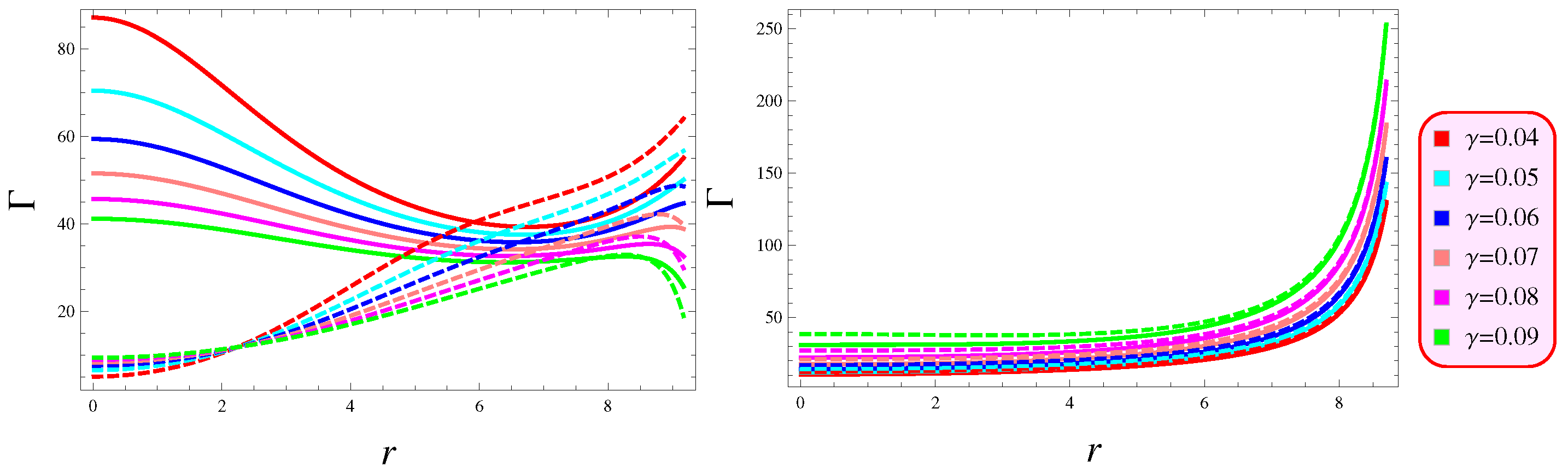

Disclaimer/Publisher’s Note: The statements, opinions and data contained in all publications are solely those of the individual author(s) and contributor(s) and not of MDPI and/or the editor(s). MDPI and/or the editor(s) disclaim responsibility for any injury to people or property resulting from any ideas, methods, instructions or products referred to in the content. |
© 2026 by the authors. Licensee MDPI, Basel, Switzerland. This article is an open access article distributed under the terms and conditions of the Creative Commons Attribution (CC BY) license.