1. Introduction
Triathlon is a multi-sport consisting of three disciplines (swimming, cycling, and running), performed without interruptions over different distances (Sprint, Olympic, Ironman 70.3, Ironman) and categories (age and sex). The different distances in triathlon play a key role, as they require different physical and physiological demands. The Olympic, or standard, distance consists of 1.5 km swim, 40 km bike leg, and 10 km run. Aerobic capacity (VO
2max), economy of motion (submaximal VO
2), and fractional utilization of maximal capacity (%VO
2max) are integrated responses that reflect the triathlete’s ability to meet the required physiological demands of triathlon [
1]. Triathlon has been studied from different scientific perspectives such as anthropometry [
2], biomechanics [
3], and from an analytical perspective across different competitions and distances [
4,
5,
6,
7,
8].
Different studies have explored the impact of the three disciplines on overall triathlon performance across various distances. In the Ironman 70.3 distance, cycling and running were better predictors of overall performance compared to swimming [
9]. The contribution of cycling and running to overall performance in this distance was estimated at 40% by another study [
10]. In other ultra-triathlons, such as the Ultraman of Hawaii, it has been found that the impact of swimming is less than that of cycling or running [
11]. In the sprint distance, some authors consider the bike discipline the most critical for the final result, with running performance also playing a vital role [
12]. In the relay category, it has been revealed that the positions achieved by triathletes in the swimming and cycling segments significantly influence the team’s final result [
13]. On the other hand, Quagliarotti et al. (2022) [
14] set the influence of cycling on the final result at 52%, making it the most important and longest discipline in the relay category.
In the Olympic distance, it is important to highlight the possibility of drafting during the cycling segment, which has been legal since 1995 and is not allowed in longer distances. Moreover, new rules have been introduced throughout the years, such as penalty rules, the allowance or regulation of uniforms, and the format of the World Championship (series vs. single event), among others. Bernard et al. (2010) [
15] established the contribution of swimming, cycling, and running to overall performance at 17.9%, 49.1%, and 28.2%, respectively. Figueiredo et al. (2016) [
10] reported these percentages to be 36% and 47% for cycling and running performance, respectively. Piacentini et al. (2019) [
16] concluded that success in the Olympic triathlon mostly depends on a strong performance in the running discipline and being positioned near the front at the end of cycling. According to their findings, particularly in the male category, cycling is a smooth transition toward running. However, three years later, Olaya-Cuartero et al. (2022) [
17] included data from the World Triathlon Series up until 2019 and employed concordance analysis, refuting the previous claim regarding the cycling segment. These authors argued that cycling actually showed the strongest correlation with final performance. Another study [
18], which examined various triathlon distances, proposed that swimming was the best predictor of overall performance in the Olympic distance. Other authors have determined that running performance significantly differs between podium winners and the remaining triathletes [
19,
20]. These are among the main and most recent studies attempting to determine the most predictive discipline in terms of overall result. The debate remains open, with no agreement reached among the researchers who have explored this topic. Remarkably, none of these studies utilized artificial intelligence in their analysis, and they were limited to collecting data from specific competitions.
Artificial intelligence has gained popularity within sports science and numerous studies have explored how artificial intelligence can influence sports performance [
21] and sport research [
22]. Machine learning has also been applied to triathlon, aiming to determine the fastest race course for professional athletes competing in Ironman [
23] and Ironman 70.3 [
24]. After an extensive literature search, three articles were found that employed machine learning to identify the most predictive discipline in triathlon. Weiss et al. (2024) [
25] focused on the Ironman 70.3 distance and concluded that cycling (non-drafted) is the most significant predictor of final performance. The second one focused on a different category, the mixed team relays, and concluded that running performed by female team members, especially in the third leg, was the most significant determinant of the overall result [
26]. Finally, Ofoghi et al. (2016) [
27] aimed to study the Olympic distance, but the study only considered data collected over four years in one competition, the Triathlon World Series. This study tried to resolve the debate in the literature regarding the most predictive discipline in Olympic distance triathlon by performing a machine learning-based analysis, a novel technique barely used in prior research. In addition, this study utilizes the most extensive database to date, which has not been fully considered in earlier literature.
The aim of the study was to identify the discipline with the greatest impact on overall performance in Olympic-distance triathlon. It is hypothesized that this discipline would differ according to sex and final position achieved.
2. Materials and Methods
2.1. Data Collection
Data were extracted from the API service (Application Programming Interface) on the World Triathlon website (
https://www.triathlon.org/; accessed on 26 May 2024) by signing up for the free service. Since the data were available in the public domain and on the Internet, no formal request was made to the Ethics Committee. To perform the data collection, a custom Python code (Python Software Foundation, Wilmington, DE, USA; ver. 3.12) was written for different operations. The Python code used is available in the GitHub repository (
https://github.com/AEONPHYTON/triathlon_analysis; accessed on 26 May 2024). Once the data were extracted, cleanup operations were performed using Python as the programming language and Jupyter Notebook (Project Jupyter, San Francisco, CA, USA; ver. 7.2) as the working tool [
28]. Two databases were created including Olympic distance races (one for males and one for females) in the elite category. Previous editions of the Olympics were also included in the database.
2.2. Data Extrapolation and Data Cleaning
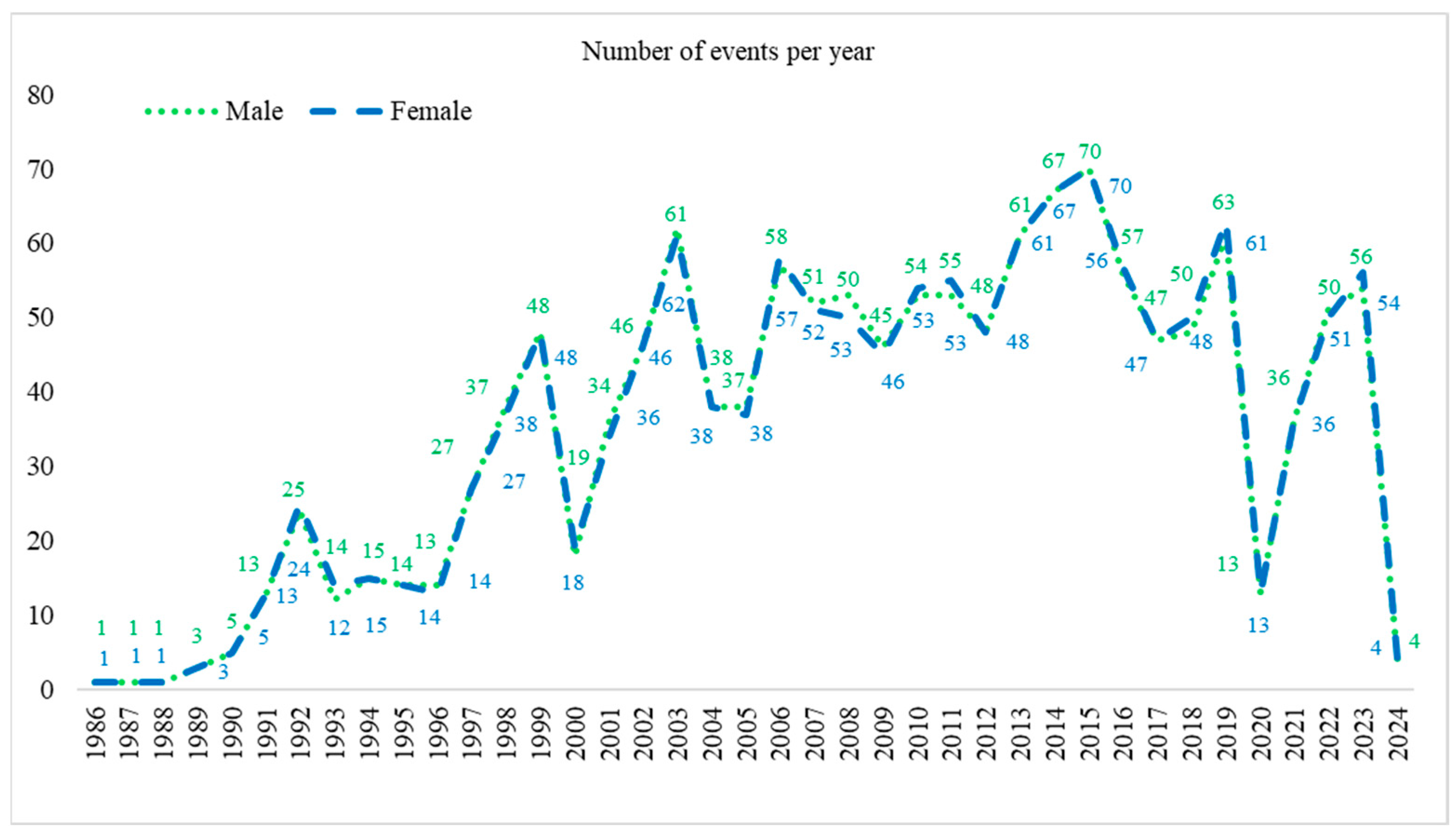
Files identifying the races by race number (prog_id and event_id) were downloaded and used to obtain the corresponding results data. The dataset was restricted to Elite and U23 athletes, with U23 retained due to their participation alongside Elite competitors. Standard-distance events were considered, separated by sex. Different variables were generated to track the record of each athlete’s discipline positions. Athletes lacking data for any discipline or transition, as well as athletes who were disqualified, did not start (DNS), or did not finish (DNF), were removed. Races without complete podium results or with implausible overall times (lower than 1 h, 28 min, and 20 s and higher than 2 h and 30 min) were also excluded. These procedures granted a heterogeneous but valid dataset including more than 30 years of races, from 6 November 1989 to 24 May 2024.
2.3. Preliminary Statistical Analysis
The selected competitions were: Continental Championships, World Championships, World Cup, Continental Cup, Recognised Event, Regional Championships, Recognized Games, Major Games (editions of the Olympics from 2000 to 2021), and World Championship Series. The reason for including different types of competitions was to obtain a large amount of data for analysis.
Shapiro–Wilk, Kolmogorov–Smirnov, and Anderson–Darling tests were conducted to assess normality of distribution. Correlation analyses were then applied to establish baseline bivariate associations, providing an interpretable benchmark against which more complex machine learning methods could be compared. Results indicated that the data sample did not follow a normal distribution in most cases. Nevertheless, all subsequent analyses were conducted in parallel using both parametric and non-parametric tests, producing similar results. The degree and direction of correlation were measured using Spearman’s ρ, Kendall’s τ, and Pearson’s r. Machine learning can estimate feature contributions in the presence of complex and potentially nonlinear relationships. Correlation analyses offer a direct and transparent measure of association between split performance and final race position. The convergence between both approaches was used as methodological triangulation to strengthen the robustness of the conclusions.
In the present study, the term “most predictive discipline” is operationally defined as the discipline whose performance metrics show the highest predictive contribution to the final race position across the applied statistical and machine learning models. This definition reflects the discipline whose variability is most strongly associated with variations in final race outcomes in the analyzed dataset.
2.4. Filtering Data for Analysis
Three databases were generated by filtering the data according to final race position: one containing only winners, one containing podium finishers, and one containing athletes placing fourth through tenth. These datasets were subsequently used for conventional statistical and machine learning analyses employing TensorFlow (Google Corp., Mountain View, CA, USA; ver. 2.14), PyTorch (Meta AI, Menlo Park, CA, USA; ver. 2.3.1), and Scikit-learn (scikit-learn, Paris, Île-de-France, France; ver. 1.5.0). Pytorch networks included feedforward (FFNN), convolutional (CNN), recurrent (RNN), and polynomial (degree 2) models.
2.5. Analytical Framework
The machine learning analyses were conducted using a supervised learning framework. For the TensorFlow/Keras and Scikit-learn models, the dataset was randomly partitioned into training (80%) and testing (20%) subsets, with stratified sampling applied for classification tasks to preserve the proportional representation of finishing categories. These models were trained exclusively on the training data and evaluated on the independent test dataset to assess generalization performance. For the PyTorch classification and regression models, training was conducted on the full filtered subgroup without a held-out test partition; these models were used to identify discipline ranking patterns rather than to assess out-of-sample predictive accuracy.
To facilitate interpretation across heterogeneous analytical families, all approaches were restricted to the same three split-time inputs (swimming, cycling, running). The analytical set combined correlation-based association analyses, regression-based prediction analyses, and classification-based machine learning models. No contextual, environmental, or athlete-related variables were included in order to isolate the contribution of each discipline. Polynomial features up to second degree were generated to capture potential nonlinear relationships between split times and race outcomes. Because these families produce different types of outputs, not all performance metrics are applicable to every approach. Consequently, blank or “N/A” cells in the manuscript tables indicate methodological non-applicability rather than missing results.
The target variable was defined according to the analytical objective. For correlation and regression-based analyses, the target variable was the final race position, treated as an ordinal/numerical outcome depending on the method applied. For classification models, the target was defined as the athlete’s membership in the finishing group under analysis versus the remaining competitors. This dual formulation allowed the study to evaluate both exact performance prediction and competitive outcome prediction, including analysis by finishing group and sex category.
Machine learning and deep learning models were implemented using three frameworks. In Scikit-learn, logistic regression was configured with max_iter = 1000 and class_weight = ‘balanced’, with random_state = 42 used during data splitting. In TensorFlow/Keras, a feedforward neural network with two hidden layers (32 and 16 neurons, ReLU activation) and a sigmoid output layer was trained using Adam, binary cross-entropy loss, 50 epochs, and a batch size of 32, with a 0.2 validation split. In PyTorch, polynomial regression, feedforward neural network, convolutional neural network, and LSTM models were developed using Adam optimization; mean squared error was used for regression tasks and binary cross-entropy for classification tasks. For classification tasks, model performance was evaluated using accuracy, precision, recall, and F1-score on the test set, with class-specific metrics obtained from Scikit-learn’s classification_report.
The PyTorch feedforward neural network (FFNN) consisted of two hidden layers with 64 and 32 neurons, respectively, both using ReLU activation, followed by a single sigmoid output neuron. The convolutional neural network (CNN) comprised one Conv1d layer with 16 filters and a kernel size of 2 (no pooling or padding), followed by a flattening operation and two fully connected layers (32 neurons with ReLU, then 1 neuron with sigmoid). Input features were reshaped to a three-element vector treated as a single-channel one-dimensional signal with shape (N, 1, 3). The recurrent neural network employed a single-layer unidirectional LSTM with a hidden size of 32, followed by one fully connected layer (32 to 1) with sigmoid activation. Input was reshaped to (N, 1, 3), representing one time step with three features; the hidden and cell states were initialized to zeros. The learning rate was set to 0.01 for all PyTorch models and to the Adam default of 0.001 for TensorFlow. All PyTorch models were trained for 1000 epochs using full-batch gradient descent, while an internal 0.2 validation split was used to monitor training progress during TensorFlow model training. However, no regularization techniques (dropout, weight decay, or batch normalization) or early stopping procedures were applied to any of the models.
Hyperparameter values (learning rate, hidden layer sizes, and number of epochs) were selected through manual exploratory trials during the development phase, evaluating training convergence and loss stability across a small number of candidate configurations. A systematic hyperparameter search (e.g., grid search or Bayesian optimization) was not performed, as the study’s primary objective was to identify relative discipline rankings rather than to optimize absolute predictive performance. The consistency of discipline rankings across models with substantially different architectures and hyperparameter settings provides indirect evidence that the conclusions are not sensitive to the specific values chosen. Tree-based models (e.g., Random Forest) were employed in a separate exploratory analysis for time-series forecasting but were not part of the discipline-ranking framework reported in
Table 1 and
Table 2.
Outputs were interpreted according to the nature of each analytical family. Correlation analyses ranked disciplines by strength of association with final position. Regression models were interpreted using standardized or polynomial coefficients. A consensus strategy was adopted in which the discipline most frequently identified as dominant across models was considered the most predictive discipline of performance for each finishing group and sex category.
4. Discussion
The aim of the present study was to identify the discipline with the greatest predictive contribution to overall performance in Olympic-distance triathlon. To the best of our knowledge, this is the first study to combine three key elements into a single analysis: (1) the largest competition dataset to date; (2) an evaluation of discipline-specific predictive value across different finishing positions; (3) the use of multiple AI-based models. This methodological approach may explain why our results generally differ from some previous studies, as well as why they differ from each other. Importantly, the disciplines identified as most predictive by machine learning models consistently matched those showing the strongest correlations with final position, reinforcing the coherence between predictive and statistical approaches. The most notable findings of our study are that the most predictive discipline in Olympic triathlon depends on sex and race finishing position, although running emerges more consistently as the discipline with the strongest overall impact. Another key finding is that swimming was never identified as the most relevant discipline. This may reflect the reduced variability of swim segment performance among elite athletes.
First and foremost, we aimed to compare the results of our study with similar existing literature. Weiss et al. (2024) [
25] conducted a similar analysis by applying machine learning to the 70.3 distance and concluded that cycling is the most decisive discipline. This conclusion is reasonable, considering the significant proportion of time spent on this segment in such races and the non-drafting format. Nonetheless, it is important to note that they did not consider the position at the end of each discipline or the final race position in their analysis. In our study, cycling was identified as the most predictive for winning the race in both males and females according to most statistical models (50%), followed closely by running (33.33% of the models) (
Table 1 and
Table 2). For many athletes, however, the most predictive discipline is the one that will ensure a podium finish. When considering podium finishers, only one statistical model identified cycling as the most predictive discipline for males (11.11%) (
Table 1), while for females, this percentage increased to 33.33% (
Table 2), suggesting a greater predictive contribution to final race time. This finding closely aligns with the results reported by other studies [
16], which indicated that even if cycling is not the most decisive discipline overall, it shows stronger predictive value in females due to the typical race dynamics observed among female triathletes. Our findings also confirm the results reported by García-González & González-Jurado (2025) [
19,
20]. Although their study did not include split-specific race positions, they analyzed data collected over 23 years and compared podium finishers with non-medalists. Their results showed that male medalists swam and cycled at similar performance levels as the rest of the participants but ran faster. In females, although not the only differentiator, running was the discipline that showed significant differences across all analyzed competitions and produced the largest effect size. Both articles considered only data for years where drafting in cycling was allowed. Looking at other studies that also analyze the Olympic distance, some authors identified cycling as the most decisive for final performance [
17]. However, they considered the position within each segment to have limitations as a performance measure and did not include it in their analysis. Additionally, they supported the idea of not mixing different competitions in their concordance analysis, resulting in a smaller sample size compared to our study [
17]. Even with a different analytical approach, our study agreed with their conclusions only when examining the winning position. Nevertheless, when considering the overall distribution of all analyzed race positions, it appears more accurate to state that running holds a greater predictive contribution, as 66.66% of the models identified it as the most predictive discipline for males (
Table 1) and 58.33% for females (
Table 2). In comparison, cycling was identified as the most predictive discipline by 25% of the models for males (
Table 1) and 29.16% for females (
Table 2).
In line with studies that favor running as the most important and decisive part of the race [
10,
16,
19,
27,
29,
30], our analysis confirmed that running was the most predictive discipline by the majority of models for podium finishes and for fourth- to tenth-place finishers in both sexes. To win a triathlon race, running emerged as the second most predictive discipline, overtaken only by cycling for both sexes (
Table 1 and
Table 2). A thorough article supports the extensive belief that running is critical for final performance and emphasizes the importance of exiting from the water near the front [
27]. The primary difference with these authors [
27] lies in the amount of data included in the analysis, as they used machine learning (Bayesian networks) but considered only one Olympic cycle. Likewise, the results of this study are consistent with previous analyses that applied the same approach to evaluate discipline positions within the race, thereby supporting both sets of conclusions [
30]. Similarly, other studies suggest that running is the best predictor of final performance in Olympic triathlon [
10]. The decrease in the contribution of swimming, as described by these authors, may be attributed to several reasons, such as the shift from the ITU World Triathlon Championship to the ITU World Triathlon Championship Series or the use of wetsuits, because these may have provided an advantage for less-skilled swimmers [
10].
Lastly, it is worth mentioning a study that identified swimming as the best predictor of final results in Olympic triathlon [
18]. However, they considered only five years of the ITU World Triathlon Championship Series and did not differentiate between final race position groups.
Overall, our study presents results consistent with those reported by Espejo et al. (2024) [
31]. This similarity between both race distances (Olympic and super-sprint) may be attributed to two main factors: the relatively recent rise in the popularity of this distance and the overlap of athletes who compete in both Olympic and shorter formats, likely transferring their pacing and race strategies from the former.
The present study has some limitations. It adopts a quantitative approach, which implies a lack of consideration for physical or other nature-related variables, such as training, previous experience, circuit layout, or climatic conditions. Moreover, the 35-year dataset span (1989–2024) includes substantial changes in rules (e.g., the legalization of drafting in the mid-1990s), equipment, and competitive structure. The inclusion of this extended period was an intentional methodological decision aimed at increasing statistical robustness and preventing the results from reflecting specific trends or tactical patterns from isolated years. Although preliminary checks suggested that the general pattern of results remained stable, the findings should therefore be interpreted as general performance tendencies across eras rather than as period-specific conclusions. Finally, machine learning models identify statistical associations rather than causal mechanisms; therefore, the findings should be interpreted as probabilistic tendencies rather than deterministic rules of performance. The study adopted a consensus-based interpretation strategy in which the discipline most frequently ranked as dominant across model families was considered the primary determinant. This approach was chosen because the different analytical families (correlation, regression, and classification) produce fundamentally different output types (association coefficients, regression weights, and class probabilities), making direct statistical comparison of their performance metrics neither meaningful nor methodologically appropriate. The convergence of results across independent and methodologically diverse approaches serves as a form of methodological triangulation that strengthens the robustness of conclusions. Additionally, no cross-validation (k-fold or otherwise), bootstrap stability analysis, or systematic overfitting assessment (e.g., comparison of training versus test learning curves) was performed beyond the basic train/test split and the internal validation split used during neural network training. This represents a methodological limitation. However, the use of nine independent analytical approaches spanning three distinct paradigms (correlation-based, regression-based, and classification-based) was intentionally designed to reduce dependence on any single model’s behavior or on the characteristics of a specific data partition. Future studies should incorporate k-fold cross-validation and bootstrap resampling methods to formally quantify the stability of discipline rankings across different data partitions and random seeds.
This study has practical implications for talent identification in Olympic distance triathlon. Our findings show that good performers in Olympic-distance triathlon demonstrate exceptional performance levels in all disciplines, with greater importance placed on running. Triathlon is one discipline and needs to be trained accordingly. As such, decisions regarding excluding young triathletes or transitioning them to other distances should be approached with caution and thoughtful consideration. Moreover, it is important to be cautious when applying these results to non-professional athletes, as the dynamics may differ.
In conclusion, discipline contribution in Olympic triathlon is not fixed but dependent on sex and competitive level. Nonetheless, running remains the most predictive discipline, whereas swimming rarely acts as a performance differentiator. Finally, the importance of methodology in achieving reliable conclusions must be underlined. The results can vary significantly depending on the statistical analyses employed, as well as the number of competitions and races considered. Future studies should incorporate additional parameters in their analyses, such as weather conditions.



 ,
,