1. Introduction
Loans and their repayment on time are a central part of the successful performance of banking institutions in terms of their efficiency of operations, financial stability and long-term sustainability. Proper collections of loans are related to institutional profitability, liquidity management, compliance with regulations, and market credibility and thus increase investor and customer confidence. In contrast, continued loan defaults negatively impact capital adequacy, earnings stability, and asset quality, which may have devastating institutional and systemic effects [
1]. High levels of default place financial pressure on lending institutions and can be detrimental to capital buffers, which makes the precise and prospective evaluation of credit risk critical in contemporary banking mechanisms.
The current factors in the global economic environment have shown that there has been a significant increase in the risk of loan default in various financial sectors. Corporate default risk is currently at its highest point in the United States and stood at 9.2 percent in 2024 since the global financial crisis [
2]. Equally, leveraged loan defaults rose to 7.2 percent in a twelve-month timeframe up to October 2024, the highest since 2020 [
3]. There has also been an increase in mortgage delinquencies, with some 3.1 percent of mortgages in the U.S. reported to be at least 30 days delinquent and serious delinquencies close to 1 percent [
4]. These changes echo the escalation of the stakes and urgency of dealing with default risk, and the need to have sophisticated analytical models that can provide valid and prompt predictions of defaults in volatile economies.
There are numerous reasons why a borrower may be unable to repay loans on time. The previous research has defined some behavioral and psychological characteristics that determine the risk of default, such as integrity, locus of control, personality, self-control, self-efficacy, and materialism [
5]. Although these borrower-specific reasons affect repayment behaviour, lending institutions suffer the greatest effects of default in the form of the loss of both principal and interest revenues, compromising the liquidity and quality of assets. Continued default rates can also decrease the confidence in the market and provoke the action of regulation at the national or regional levels. In unreasonable conditions, broad defaults may lead to overall financial instability, which explains the importance of strong and active risk evaluation and prevention measures.
Conventionally, the bank loan risk rating has been based on a mix of qualitative and quantitative methods, which is usually enhanced by manual or rule-based calculations that are performed on fixed sets of data [
6]. The traditional methods (credit scoring models and financial ratio analysis) are still popular because they exploit historical financial data, credit history, and the background information of a borrower. Nonetheless, these approaches have significant shortcomings in the modern financial setting, where risk dynamics change at a fast rate and have become more reliant on multifaceted elements, such as borrower psychology and environmental, social, and governance (ESG) aspects [
7]. Additionally, the traditional models are not always adaptable to large and heterogeneous data that is constantly updated, and they cannot capture nonlinear patterns and new indicators of risks. Simultaneously, financial institutions will have to find their way among changing regulatory needs, risks in vendor management, and cybersecurity, alongside the preservation of institutional trust and operational stability [
8].
To overcome these analytical limitations, machine learning (ML) and ensemble-based techniques are increasingly being adopted in credit risk prediction due to their capacity to model nonlinear relationships, high-dimensional interactions, and evolving financial patterns. Compared to traditional statistical scoring methods, ML models demonstrate improved adaptability to heterogeneous and large-scale datasets. However, while ML approaches enhance predictive accuracy, they introduce new challenges related to data centralization and interpretability, particularly in regulated financial environments.
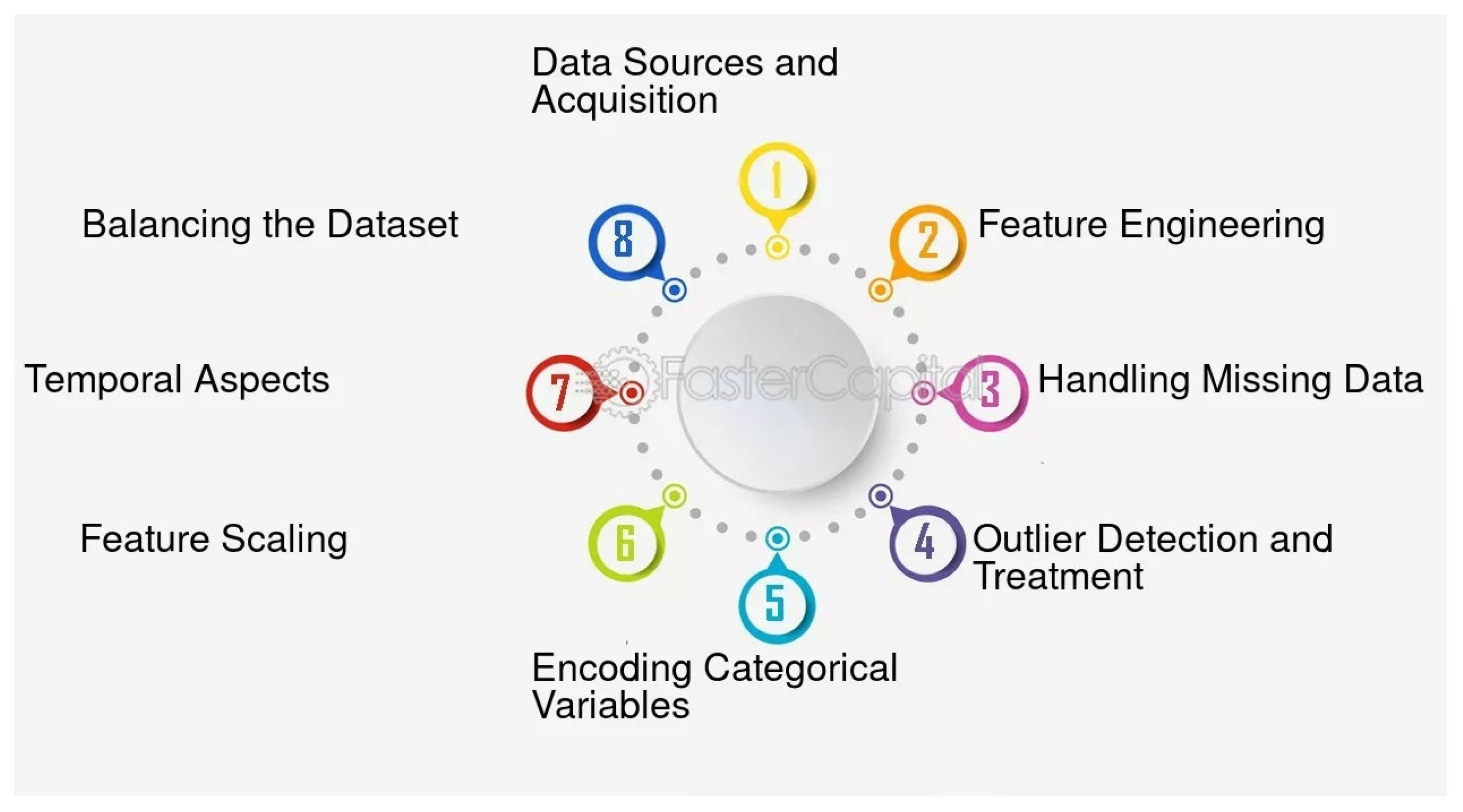
The most important of such challenges are data privacy, as well as secure information sharing, which are especially crucial in terms of the modern credit risk assessment system. Although inter-institutional data sharing may lead to an improved predictive accuracy due to the diversity in data, it also poses a great risk concerning data leakage and regulatory non-compliance. Financial institutions have rigid data protection frameworks, such as GDPR and nationwide privacy regulations, which prevent the accumulation, storage, and sharing of delicate customer data. As shown in
Figure 1, the security issues related to the exposure or abuse of financial information may cause critical negative impacts, such as reputational and regulatory impacts and loss of customer trust [
8]. Additionally, irregularities and quality problems in decentralized data are usually not resolved by conventional risk assessment instruments. These regulatory and privacy constraints, combined with the need for higher predictive accuracy, have encouraged the growing use of machine learning-inspired predictive models, which are capable of providing greater analytical power but require extreme attention to privacy, security, and ethical limits.
The application of machine learning (ML) methods to credit risk assessment has been on the rise because of the ability to serve large-scale, high-dimensional financial data and identify intricate nonlinear associations that traditional statistical models are often unsuccessful at identifying. Decision trees, support vector machines (SVMs), and ensemble techniques are algorithms that have been found to perform well in predicting loan default tasks. More so lately, predictive performance has also been further augmented by deep learning models, such as convolutional neural networks, which use alternative data sources such as transactional behaviour and digital footprints [
10]. Notwithstanding this progress, the effectiveness of ML-based loan default prediction systems should be evaluated based on accuracy and to ensure fairness, transparency, and observance of regulations. ML models can be biased by imbalances in data, sampling bias or historical discrimination, which can lead to unethical outcomes, regulatory breaches and reputational harm to financial institutions [
11]. To overcome these issues, clear and transparent predictive machinery needs to be developed that can assist in establishing equitable lending procedures.
Simultaneously, the growing sensitivity and fragmentation of financial data have raised concerns with regard to data privacy and safe model deployment. Financial institutions are usually engaged in closed data silos and therefore are not able to share borrower data across different organizations while observing rigid data protection rules. To overcome these limitations, federated learning (FL) has been developed as a decentralized model of machine learning that can support the development of a model collaboratively without direct data exchange [
12]. The models in FL are trained locally on institutional data, and only model outputs or updates are exchanged; hence, the potential of data leakage is significantly mitigated [
13,
14]. Such decentralized learning strategies are useful in cases of loan default prediction to maintain the confidentiality of customers as well as share cross-institutional knowledge, hence enhancing generalization and resiliency [
15]. In addition to credit risk analysis, another application of federated learning in open banking systems, fraud detection, and financial risk management has been identified, where privacy protection and efficiency in communication constitute important consideration factors [
16,
17]. Nevertheless, the non-transparency of and inability to interpret decentralized ML models are significant obstacles to their implementation in high-stakes financial decision-making settings.
To address the lack of transparency in ML systems, explainable artificial intelligence (XAI) methods have been created to offer human-understandable explanations as to why a model has predicted something. Explainable AI has been noted to be gaining more significance in enhancing stakeholder cognizance, responsibility, and confidence in automated decision systems, especially in controlled financial sectors [
18,
19]. XAI combats the issues of transparency and accountability that are linked to black-box models by allowing interested parties to perceive the contribution of the features, identify possible biases, and comply with regulations [
20]. Explainability is also relevant in credit risk management to meet the legal and ethical requirements within legal frameworks like GDPR and fair lending laws [
21]. Recently, the complementary nature of XAI and federated learning in alleviating privacy and interpretability issues has been emphasized and is contributing to the creation of ethically and trustworthy AI systems in financial use [
22]. Although there has been increased attention on these methods, the literature tends to consider decentralization and explainability as independent issues, with few studies done to explore the effectiveness of the two methods together to predict loan defaults.
In order to fill this gap, this paper presents a federated-inspired decentralized ensemble learning system with XAI to predict loan defaults. The framework compares the predictive performances of the K-Nearest Neighbor, SVM, random forest, and XGBoost models in decentralized settings and uses SHAP and LIME to make the settings transparent and interpret model decisions. The primary contributions of the work are as follows:
Development of a privacy-preserving decentralized ensemble learning framework suitable for multi-institutional banking environments.
A comprehensive comparative analysis of centralized and decentralized predictive performances across multiple machine learning models.
Integration of SHAP and LIME to provide global and local interpretability, enhancing trust and regulatory compliance in automated credit risk assessment.
2. Literature Review
More recent studies on loan default prediction have devoted more and more importance to machine learning (ML) and deep learning (DL) models to help predict loan defaults and automate credit risk measurement and decision-making processes in financial institutions. Recent publications in the years 2021 through 2025 show a substantial improvement in the management of structured financial data, the imbalance between classes, and feature engineering, though challenges concerning data centralization, interpretability, and real-world implementation in the regulated setting are also still present.
A substantial amount of the literature has addressed classical machine learning and ensemble-based methods of loan default prediction on the basis of structured financial data. Logistic Regression, decision trees, K-Nearest Neighbors (KNN), support vector machines (SVMs), random forests, and variants of gradient-boosting models have been extensively tested on publicly available datasets like Kaggle, Lending Club, and Tianchi, as well as in-house banking datasets [
23,
24,
25,
26,
27,
28,
29]. Ensemble models, specifically random forest and XGBoost, have always shown better results because of their ability to absorb the nonlinear interaction of features and their resistance to noisy financial features [
26,
29,
30]. Although effective, most of these studies provide centralized access to borrower data and usually use static sets of data, which limit their applicability in the multi-institutional banking system with stringent data protection rules.
In order to overcome the issue of class imbalance in loan default datasets, many studies use resampling and cost-sensitive learning methods. Such methods as ADASYN, SMOTE, weighted sampling, and class-weighted loss functions have been found to enhance the recall and F1-scores of the minority (default) classes [
24,
31,
32]. Though the techniques improve the ability to detect risky borrowers, underfitting can be introduced by the techniques because of their ability to distort the underlying rates of data. Some of the authors point out that the mitigation of imbalance is not enough without an overall assessment of the generalization, fairness and bias aspects that are critical in regulatory adherence to credit risk assessment [
28,
32].
Meanwhile, the deep learning methods have become popular in predicting large-scale loan defaults, especially when the datasets represent features with high-dimensional or complex representations. Convolutional neural networks, deep neural networks, and hybrid networks, including CNN LightGBM, demonstrate better prediction performances than the old-fashioned ML models when trained on large public datasets [
24,
25,
33]. The incorporation of alternative sources of information, either behavioural characteristics or mental health indicators, to supplement borrower risk profiles and enhance the accuracy of classification is addressed in other studies [
34]. Also, external credit information, which includes Zhima credit scores, has also been indicated to be very useful in default prediction, especially when it comes to margin-based classifiers such as SVM [
35]. Although they have increased accuracy, deep learning models may be criticized for their high computational costs, low level of transparency, and dependence on centralized data access, which limit their use in real-world banking settings.
The other significant research direction is regional and mortgage-specific loan default forecasting, where the economic conditions and demographics of the borrowers are important factors. The research in Europe, the United States, Ukraine, and Asia shows that regional macroeconomic indicators, loan–value ratios, and debt-service-to-income ratios are the major predictors of mortgage default risk [
36,
37,
38]. Millions of loan records also help prove the effectiveness of boosting-based and ensemble models at explaining the heterogeneity in risk across regions and also underscore the role of interpretability in policy analysis and regulatory supervision [
38]. However, the research work mainly utilizes centralized databases and lacks a discussion of cross-institutional data-sharing limitations.
Along with greater regulatory attention, explainable artificial intelligence (XAI) has become a key element of credit risk modeling. Some of the studies include post hoc methods like SHAP and LIME to determine the influential features, provide more transparency to the model, and comply with the laws of fair lending and data protection [
29,
39]. Such methods allow stakeholders to understand the behaviour of models and their decision-making logic better and enhance confidence in automated loan approval systems. Yet, explainability in the majority of the current literature is viewed as a secondary process to be performed once the model is trained and is not actually systematically integrated into the predictive model. Also, studies based on XAI are mostly centralized in learning assumptions, which makes them less applicable in applications where privacy and decentralization are crucial aspects in financial interactions.
Privacy protection and decentralized learning are relatively under-researched fields in the literature of loan default prediction. Though federated learning has found application in larger financial processes like open banking, fraud detection, and distributed risk management, its use in credit risk and loan default modeling is limited [
12,
15,
16,
17]. Existing research on decentralized learning primarily focuses on algorithmic efficiency and communication optimization, while providing limited empirical evaluation of predictive performance and interpretability on real-world financial datasets. Recent surveys indicate the possibility of synergy between federated learning and XAI to resolve the problem of privacy and transparency; nevertheless, extensive experimental research in this respect is not yet available [
22].
Overall, the existing studies on loan default prediction can be categorized into three primary streams, as summarized in
Table 1, which highlights datasets, models, limitations, and the adoption of XAI and federated learning. The first stream focuses on improving predictive accuracy using classical machine learning and deep learning architectures under centralized data assumptions. These studies demonstrate strong performance gains but often overlook data-sharing constraints and regulatory requirements. The second stream emphasizes explainability through SHAP, LIME, or other post hoc interpretation methods, thereby enhancing transparency; however, such approaches typically operate within centralized training environments. The third stream explores federated learning in financial contexts, primarily targeting fraud detection or secure distributed optimization, but with limited attention to structured loan default prediction combined with systematic interpretability analysis. Consequently, while the individual components of predictive modeling, explainability, and decentralized learning have been explored independently, their integrated application within a unified, privacy-aware, and interpretable loan default prediction framework remains insufficiently investigated.
Research Gap
Although the literature on loan default prediction using machine learning and deep learning techniques is extensive, the majority of the existing studies assume centralized data availability and do not consider the operational constraints of interbank environments, where data sharing is restricted by regulatory and privacy requirements. Ensemble- and boosting-based models have demonstrated strong predictive accuracy; however, issues related to decentralized collaboration, institutional data silos, and regulatory transparency remain insufficiently addressed.
Several recent studies have incorporated explainable artificial intelligence (XAI) methods, such as SHAP and LIME, into credit risk and loan default prediction models [
29,
39]. While these approaches enhance interpretability, they are predominantly developed under centralized learning assumptions and apply explainability as a post hoc analytical layer after model training. Consequently, they do not examine how interpretability behaves in decentralized or collaborative financial settings where the final prediction may result from multiple institutional contributors.
In parallel, federated learning has been explored in financial domains to enable privacy-aware distributed model training. Recent work, including [
13,
40], demonstrates the integration of federated learning and explainable AI in financial fraud detection contexts. However, such studies primarily focus on transaction anomaly detection tasks and parameter-sharing federated optimization frameworks. Limited empirical investigations have been conducted on structured loan default prediction using tabular borrower data under decentralized collaboration constraints, particularly with prediction-level aggregation strategies and comparative evaluations against centralized baselines.
Therefore, a gap exists at the intersection of (i) structured loan default prediction, (ii) decentralized collaborative inference without parameter exchange, and (iii) integrated explainability applied to the final consensus decision. The proposed federated-inspired framework addresses this gap by implementing prediction-level aggregation across multiple classical and ensemble machine learning models and embedding SHAP and LIME analyses at the aggregated inference stage. By jointly evaluating the centralized and decentralized performances while preserving data locality, this study provides a privacy-aware and interpretable approach tailored to multi-institutional financial environments.
3. Methodology
In this study, federated learning is implemented in a federated-inspired decentralized manner, in which institutional data remain local, and model training is performed independently at each participating client. Instead of using the method of parameter aggregation, collaborative learning is accomplished by prediction-level consensus in majority voting. This design option represents realistic financial worlds, in which direct parameter exchange can still be a privacy issue, whereas the privacy-preserving collaborative inference between institutions is possible.
The proposed methodological framework is outlined in this section, and it comprises four primary stages that aim at assessing the centralized accuracy and federated accuracy evaluation of binary loan default classification. The raw data is first gathered and undergoes preprocessing steps, involving a process of data cleaning and data normalization, in order to make the data fit the model training and testing purposes. Second, several machine learning models are trained at the local level to identify institution-specific trends. Third, the simulation of decentralized collaboration is based on aggregating client-level predictions to create a global consensus model. Lastly, explainable artificial intelligence (XAI) methods are implemented to understand model forecasts and extrapolate outcomes to realistic financial decision-making settings, which improves understanding of the suggested model and increases the level of trust in the model.
3.1. Dataset Detail
The dataset employed in this research was retrieved from a publicly available Kaggle repository [
41] and consists of some 116,000 records of loan applications, all of which are accompanied by a binary target variable that indicates default or non-default status. The binary classification task was identified with 34 attributes, both categorical and numerical, which included the loan amount, the loan term, the interest rate, the income of the applicant, and the initial charges. Other features like neg_ammortization and sub-mission_of_application were added, as they attempt to describe borrowers in more detail and the specifics of the loan process. Together, all these characteristics constitute a set of combined financial, behavioural, and procedural indicators applicable to loan default prediction.
After the normalization step, the dataset was divided into training and testing subsets (a 70:30 split), which guaranteed equal evaluation on each of the models. To simulate a cross-silo federated learning environment, the centralized training dataset was partitioned into four equally sized institutional clients using stratified sampling to preserve the original class distribution within each client subset. The individual clients trained their own machine learning model through the same training pipeline in terms of preprocessing and training. Predictions made by these local models were later combined at the inference phase through a federated-inspired strategy where they could learn together without having access to raw institutional data.
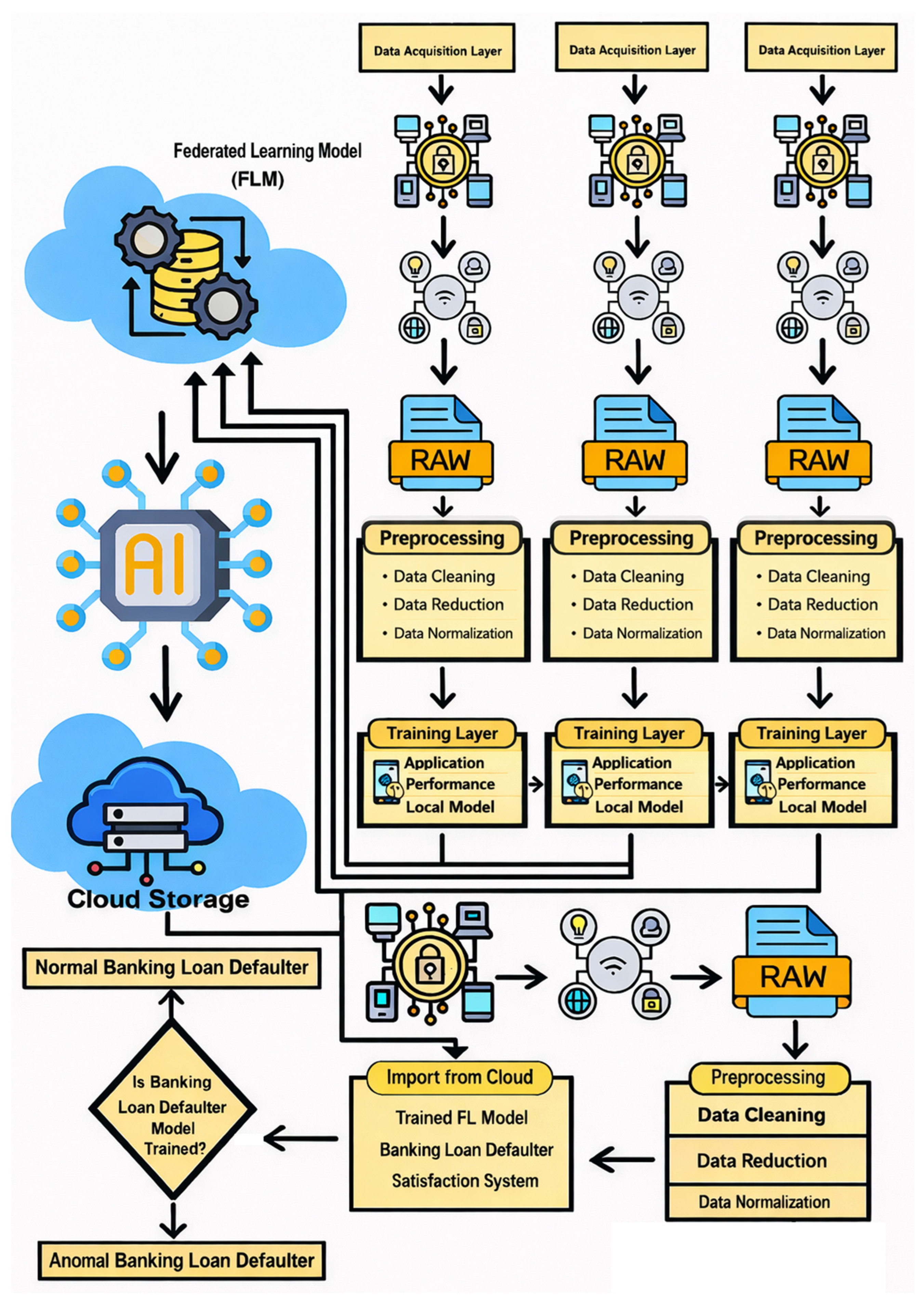
Table 2 provides an overview of the most important dataset attributes, and
Figure 2 depicts the structure of the proposed system in general. As shown in
Figure 2, the raw dataset in the data acquisition layer contains typical real-world data issues, including missing values, inconsistencies, outliers, and duplicates. These problems are dealt with methodically, with the preprocessing steps explained in the next subsection and guarantee the quality and appropriateness of the data in terms of model training and evaluation.
The dataset contains a mixture of numerical and categorical attributes. Numerical features such as loan_amount, income, interest_rate_spread, and property_value exhibit wide value ranges, with loan amounts spanning approximately from low thousands to several hundred thousand monetary units and income values ranging from lower-income brackets to high-income borrowers. The loan-to-value (LTV) ratio and dtir1 (debt-to-income ratio) are bounded, ratio-based variables typically ranging between 0 and 100 percent.
The dataset includes multiple categorical variables, such as credit_type, gender, and loan purpose, each containing between 2 and 6 distinct categories. After one-hot encoding, the total effective feature dimensionality increases accordingly but remains manageable for classical ensemble models. The combination of structured numerical features and low-to-moderate-cardinality categorical variables makes the dataset suitable for tree-based ensemble learning while preserving interpretability.
To provide further clarity regarding the structure of the dataset,
Table 3 presents a small anonymized sample of loan records used in this study for illustrative purposes.
The sample values shown above are representative of the numerical and categorical structure of the dataset, where the binary target variable (Status) exhibits an approximate distribution of 60% non-default (Status = 0) and 40% default (Status = 1) cases. This reflects a moderately imbalanced, yet realistic, credit risk scenario commonly observed in lending datasets. To ensure reliable evaluation under this distribution, stratified splitting and class-weighted model configurations were applied during training.
3.1.1. Dataset Preprocessing
The data were loaded into Pandas DataFrame, and a binary target variable (Status) was split off the set of features. To avoid information leakage, non-informative identifiers like ID, and administrative variables that are not of interest to prediction were dropped. The missing numerical values were imputed with column-wise mean imputation, and the missing categorical values were replaced with the most common category in each of the features. One-hot encoding was used to encode categorical variables following suitable type conversion. All numerical attributes were scaled by Min-Max scaling to the interval [0, 1] in order to be comparable between heterogeneous value scales and to enhance the convergence behaviour of distance- and margin-based classifiers.
In order to facilitate the similar preprocessing of models, a Column Transformer was used to process numerical and categorical variables separately by using suitable imputation, scaling, and one-hot encoding. Categorical variables that had low cardinality (i.e., variables with less than 10 distinct categories) were determined and transformed into strings before being one-hot encoded to ensure homogeneous categorical treatment. The binary target variable (Status) was used to separate the dataset into stratified training (70% and test (30%) to maintain the default-to-non-default ratio in the stratified training and test subsets. Dimensionality reduction and visualization through Principal Component Analysis (PCA) are optional and do not affect the predictive evaluation.
To address class imbalance without altering the original data distribution, class weights were assigned using an inverse frequency strategy implemented via the class_weight = “balanced” setting in Scikit-learn. All these preprocessing measures guarantee comparability of features, compatibility of models and unbiased evaluation of performance. Relationships between numerical variables are investigated with the help of exploratory visualizations, such as correlation heatmaps and boxplots, and the variability and outliers of the data. Such systematic preprocessing and exploratory analysis promote strength, transparency, and methodological soundness in the further training and assessment of models.
3.1.2. Data Leakage Prevention
To prevent data leakage, all preprocessing steps, such as imputation, scaling and encoding, are only fitted on the training data and are later applied to the test and federated evaluation sets. All preprocessing steps exclude the target variable, and stratified splitting based on the target label (Status) was consistently applied in all experimental settings, including centralized training, cross-validation, and decentralized client partitioning.
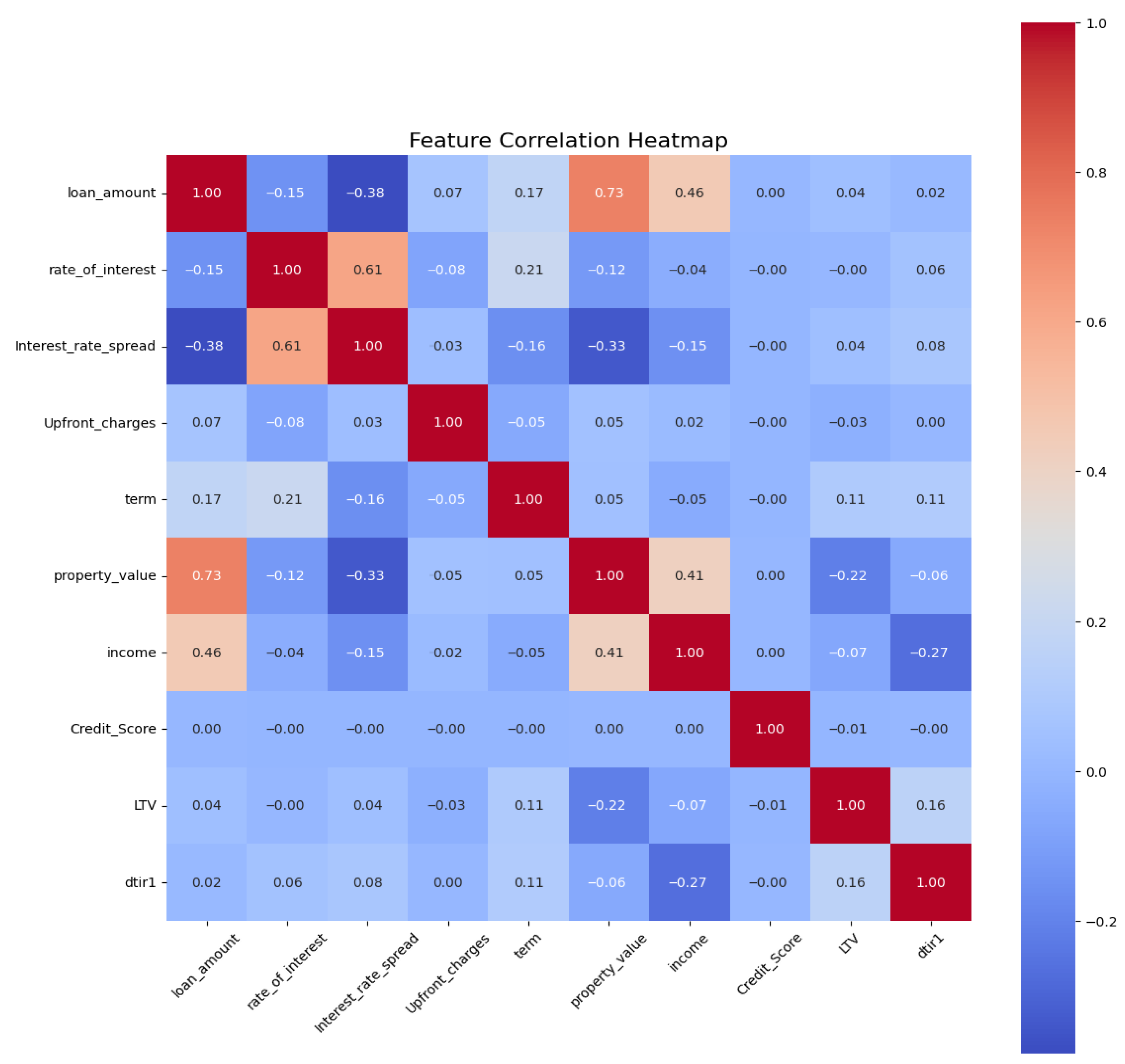
The correlation coefficients between the key numerical variables in the dataset of loan defaults are listed in
Figure 3. In general, the majority of the variables have weak linear values, which means that the multicollinearity level is low, and these variables are suitable for inclusion in multivariate machine learning models. A very high positive relationship is seen between the property value and loan amount (0.73), in which larger property values are normally related to larger loan values. Also, income presents a moderate positive correlation with the loan amount (0.46), which means that the income of a borrower is significant in terms of the amount he/she can take as a loan. On the contrary, the interest rate spread shows a moderate negative relationship with both the loan amount (−0.38) and property value (−0.33), meaning that loans related to higher property values and bigger principal sums are more likely to have better interest rates. Variables like the credit score, loan-to-value (LTV) ratio and dtir1 show the lowest correlation with any other given feature, which means that the variables are comparatively independent in terms of their contributions to creditworthiness estimation and risk assessment.
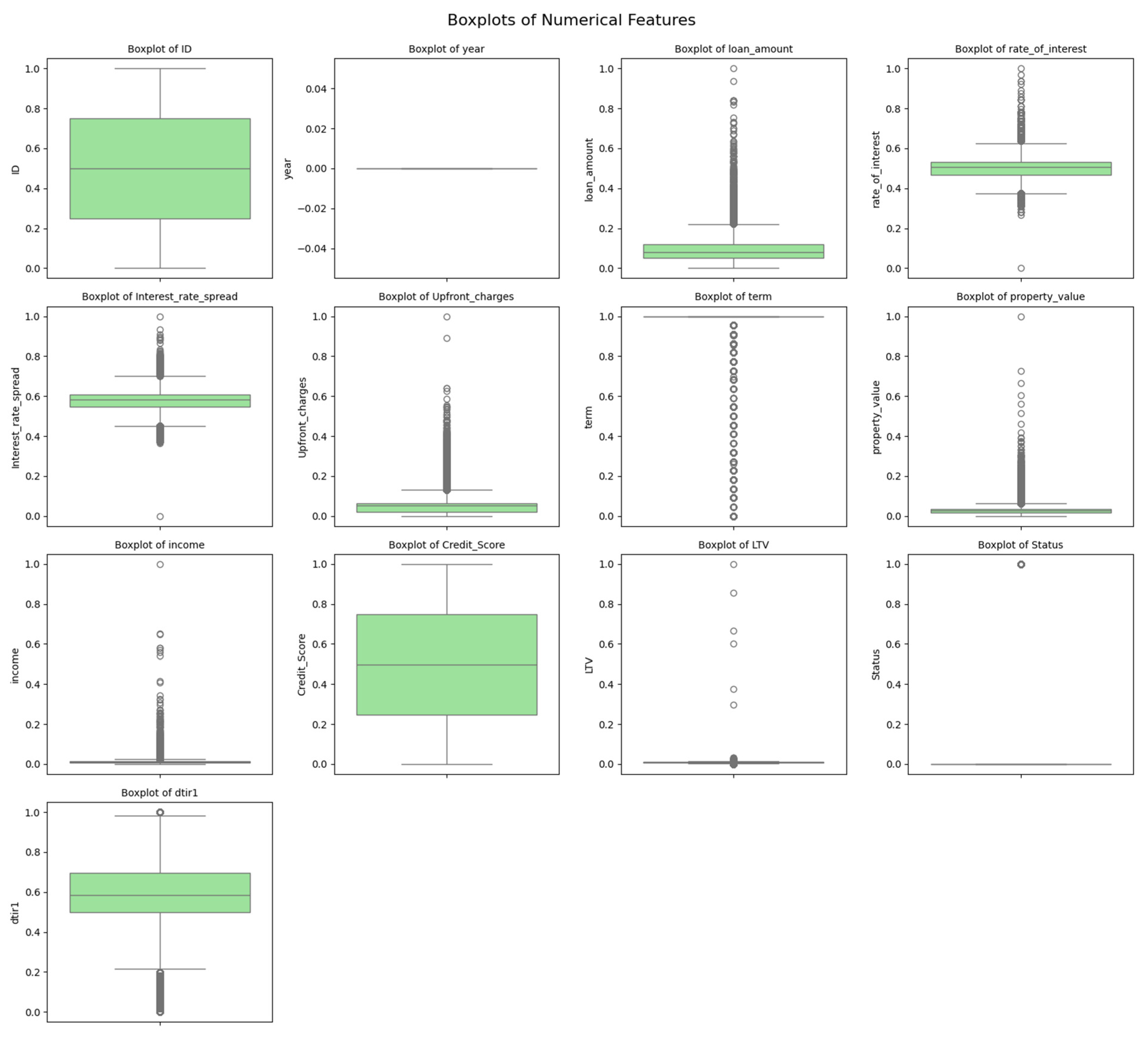
Figure 4 shows the distributional properties of the major numerical variables in the loan prediction data through boxplots, which indicate the central tendency, dispersion and outliers. Various qualities, such as loan amounts, interest rates, initial charges, and property values, have large numbers of outliers, which makes applicants’ profiles widely different in terms of their economic status. The skewness of the term and income variables is strongly right-skewed, with a large concentration of lower values and few extreme values. In response, the credit_score and dtir1 exhibit comparatively balanced distributions, which implies that the variability is more consistent across applicants. The loan-to-value (LTV) ratio and status features have narrow spreads, which reflects restricted variability, which is in line with ratio-based or binary encoding. Such patterns of distributions can be useful dynamically during the later stages of preprocessing, such as normalization, transformation, and selecting a model.
In addition to the 70:30 holdout split used for centralized and federated evaluation, a 5-fold cross-validation strategy was implemented on the centralized training dataset to assess the robustness and stability of the model performance. The dataset was partitioned into five equal folds, where four folds were used for training and one fold for validation in each iteration. The mean and standard deviation of the accuracy and AUC across folds were computed to ensure statistical reliability and reduce variance in the performance estimation.
3.2. Client-Side Models
The suggested federated-like decentralized learning format has several clients that separately train local models using their own personal datasets without sending the raw data to a central computational unit. The entire training data is divided among clients, and each of them is processed through the same pre-processing and model training pipeline to provide methodological uniformity. In this structure, the local models learn local patterns that occur due to heterogeneous data distributions and maintain data locality. In the case of local training, the model predictions are transferred to a central aggregation mechanism only, thus preserving the privacy of data and significantly reducing communication overhead.
These four models are chosen because they represent different learning paradigms, which allow a complete analysis of predictive robustness when the data is partitioned in a decentralized manner. KNN is instance-based learning, in which local neighbourhood similarity in feature space is used to make predictions. SVM represents the margin-based learning, whereby the best separating hyperplanes are built to maximize separation between classes. Random forest uses bagging based ensemble learning, which minimizes variance by combining several decision trees trained on bootstrapped samples. XGBoost is a boosting-based learning algorithm which progressively modifies errors to decrease bias and enhance generalization. By comparing these paradigms, this study assesses how fundamentally different learning strategies respond to decentralized data distribution and federated aggregation.
Such a decentralized model of learning supports the development of a model through collaboration and reduces biases related to centralized training and adherence to data protection and privacy requirements. The choice of the K-Nearest Neighbor (KNN), support vector machine (SVM), random forest (RF) and XGBoost classifiers is based on the theoretical reason that they operate on complementary inductive biases, heterogeneous data, and decentralized learning conditions. Together, these models cover a wide hypothesis space and can be used to holistically assess the performance of decentralized learning over the instance-based, margin-based, bagging-based and boosting-based models of learning.
To ensure a fair comparison and an optimal predictive performance, the hyperparameters for all machine learning models were tuned using GridSearchCV on the centralized training dataset. The overall client-side training workflow is summarized in Algorithm 1. The search was conducted using 5-fold cross-validation, and the best-performing hyperparameters were selected based on the validation accuracy, as shown in
Table 4.
| Algorithm 1. Client-Side Training Procedure |
InputLocal Client Dataset Dk Predefined hyperparameters for each model Preprocessing pipeline (imputation, encoding, scaling)
Procedure- i.
Data Preprocessing
-
Each client applies identical preprocessing steps to its local dataset, including: Imputation of missing numerical values using column-wise mean Imputation of missing categorical values using the most frequent category One-hot encoding of categorical features Min–Max normalization to the range [0, 1]
- ii.
Model Training
-
For each client k, the following models are independently trained on the local training subset:
-
Model-specific hyperparameters are defined in Table 4.
- iii.
Local Validation
-
Each client evaluates its trained model using a local validation subset to compute validation accuracy and other performance metrics.
- iv.
Prediction Generation
-
The trained local models generate predictions fk( x) on the shared test dataset. These predictions are transmitted to the server for aggregation using the majority voting strategy described in Section 3.3.
Output- •
Trained local models - •
Validation performance metrics - •
Predicted labels for the test dataset
|
3.2.1. K-Nearest Neighbor Classifier
The K-Nearest Neighbor (KNN) classifier is a preferred instance-based and non-parametric classifier because it is the simplest and easiest to interpret. KNN serves as a baseline model for loan default classification, enabling the assessment of performance improvements achieved by more complex models.
3.2.2. Support Vector Machine Classifier
Support vector machine (SVM) with a radial basis function kernel was employed in modeling nonlinear decision boundaries between default and non-default classes. The grid search was used to optimize the hyperparameters. Although SVM demonstrated good results in imbalanced data, its calculation cost and the lack of interpretability stimulated the implementation of complementary models and XAI methods.
3.2.3. Random Forest Classifier
The random forest (RF) classifier was chosen because of its ensemble nature, which enhances better predictive accuracy and lower overfitting relative to individual decision trees. It is highly appropriate for structured financial data, as it is robust and stable in its performance.
3.2.4. XGBoost Classifier
The XGBoost classifier was chosen due to its effective gradient-boosting design and good capacity to establish complex nonlinear trends. It is scalable and predictive, which is why it is one of the most important elements of the intended loan default prediction model.
3.3. Federated Learning
A federated-inspired decentralized evaluation strategy is implemented in this paper in a federated-inspired decentralized environment, where several clients (e.g., financial institutions) can train models on their own (on their own local data without exchanging raw data). The server-side aggregation and evaluation process is summarize in Algorithm 2. Decentralization is modeled through the use of multiple client subsets of training data, the local models are trained separately, and collaboration is done via prediction-level aggregation as opposed to the exchange of parameters. This architecture keeps the privacy of data and also allows for learning in a group; hence, it is suitable in sensitive applications like loan default prediction. The number of clients (
K = 4) was selected to emulate a realistic cross-silo interbank collaboration scenario while maintaining sufficient data per client for stable model training and evaluation.
| Algorithm 2. Server-Side Federated Evaluation |
InputProcedure- i.
Collect Client Prediction
-
Each client model independently generates predictions fk(x) for each sample x in the test dataset, where k = 1, 2, …, K.
- ii.
Prediction Level Aggregation
-
For each test sample x, the server aggregates client predictions using majority voting:
-
In the case of a tie, the prediction from the client model with the highest validation accuracy is selected.
- iii.
Performance Evaluation
-
The aggregated predictions are compared with the true labels to compute evaluation metrics, including:
Accuracy Precision Recall F1-score ROC-AUC Confusion matrix
Output |
3.3.1. Aggregation Method
The scheme of majority voting aggregation is done at the prediction level to achieve cooperation among the clients. The clients also train local models on their own data cutoffs independently and make predictions during inference. The statistical mode of the client outputs is used to derive the final global prediction. This plan does not entail the direct exchange of parameters; the likelihood of leakage of privacy is reduced, and it is resistant to the bias of the individual client. Although it is less complex than parameter-averaging schemes like FedAvg, majority voting provides interpretability, robustness to fault and consistency between heterogeneous models of clients, which is in line with the practical limitations of financial settings.
The final federated prediction is obtained through majority voting across client-level predictions. The aggregated global prediction is obtained through majority voting across client-level predictions, as defined previously. The aggregated global prediction (
) is defined as:
where
fk (x) is the predicted class label (default or non-default) from client k;
K is the number of decentralized clients;
mode (.) denotes the statistical majority voting operation.
All client models contribute equally to the voting process, and no performance-based weighting scheme is applied to maintain aggregation simplicity and interpretability. In the case of a tie in the voting process, the prediction from the client model with the highest validation accuracy is selected as the final decision to ensure robustness.
3.3.2. Global Model
The global model is implicitly specified by summing up client-level predictions instead of being trained as a single parameterized model. Its decision behaviour is a measure of the consensus boundary that was created by autonomously trained local models. Empirical measures of performance are based on global accuracy, confusion matrices, and ROC curves and are contrasted with centralized baselines. The findings suggest that the decentralized consensus is used to heavily estimate the centralized performance but maintains data locality, which points to the trade-off between the convergence optimality and privacy preservation of decentralized learning systems.
3.4. Security and Privacy Considerations
The proposed federated-inspired decentralized learning framework aims to reduce exposure risks associated with centralized data processing in financial applications. The framework encourages collaborative inference without moving sensitive borrower data between institutions by allowing local training of models on distributed institutional data, which limits the direct exposure of raw financial data. Cooperation in this study is realized by prediction-level aggregation where no raw data or model parameters are shared between clients and hence the chances of direct data leaks are minimized.
Even though decentralized learning brings the challenges of heterogeneity of clients and overheads on communication, the suggested prediction-level aggregation approach can facilitate effective collaborative inference, maintaining data locality. This design is in line with the general regulatory principles in the banking industry, whereby cross-institutional data sharing is highly regulated.
However, it is worth noting that the current structure is simulating a federated environment with partitioned public data and not a federated learning infrastructure on the scale of production. This study does not implement secure aggregation protocols, differential privacy guarantees (e.g., ε-differential privacy) or adversarial robustness analysis, which are also a focus of future efforts. As such, the privacy advantages addressed in this paper are structural, due to the decentralization of data and the non-sharing of parameters as opposed to being quantified formally in terms of cryptographic or differential privacy.
Although the aggregation level of prediction decreased by decentralized learning systems allows for reduced exposure, the latter is still theoretically susceptible to privacy attacks, including model inversion, membership inference, or inference-time information leakage. Even though these attacks are more widely linked to sharing parameters in federated schemes, these dangers still have to be taken into consideration when developing collaboration-based AI networks in financial contexts. The implementation of a secure multi-party computation, multi-party homomorphic encryption, or formal differential privacy would offer more powerful cryptographic and statistical assurances, and these improvements are viewed as valuable directions in future research.
3.5. Experimental Setup
All experiments were implemented using Python 3.10 in the Google Colab environment. The primary libraries used included:
Scikit-learn (version 1.3) for KNN, SVM, random forest, preprocessing pipelines, and GridSearchCV;
XGBoost (version 1.7) for gradient-boosting implementation;
SHAP (version 0.44) for global explainability analysis;
LIME (version 0.2) for local interpretability;
NumPy and Pandas for data manipulation.
Experiments were conducted on a virtual machine equipped with an Intel Xeon CPU and 12 GB RAM. No GPU acceleration was required due to the tabular nature of the dataset.
To ensure stability and reduce randomness, each experiment was repeated three times, and the average performance metrics were reported. Stratified splitting was applied to maintain the original class distribution in the training and testing subsets.
Hyperparameter optimization was performed using GridSearchCV with 5-fold cross-validation on the centralized training dataset before decentralized simulation.
4. Results
In this section, the results of the experiments with the federated-inspired KNN, SVM, random forest, and XGBoost models are provided with the centralized and federated accuracy and confusion matrices, as well as the explainability results provided by SHAP and LIME. Comparative analysis shows that there is a consistently good performance among the models, with XGBoost showing the greatest predictive accuracy in both centralized and decentralized evaluation environments. Experiments were performed in all standard environments of computing, such as the Google Colab backend and commonly used scientific computing libraries, which allowed for evaluating the reliability of the performance and reproducibility.
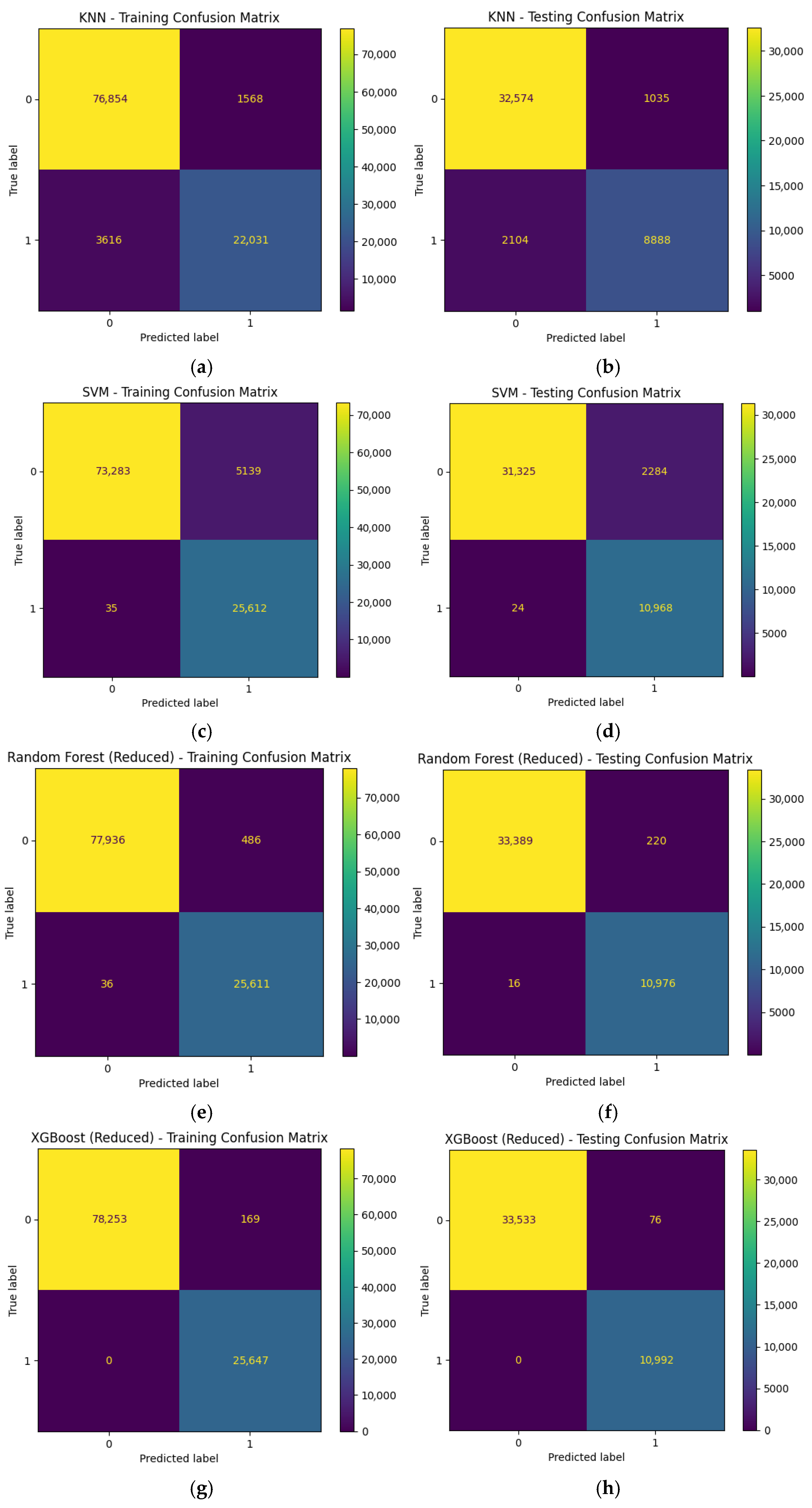
In the case of the KNN model, the confusion matrices of
Figure 5 give detailed information on the behaviour of the classification during the training and testing processes. KNN has a training set accuracy of 95.02, with an accuracy of 76,854 true negatives, 22,031 true positives, 1568 false positives and 3616 false negatives. This shows that there was good discrimination between default cases and non-default cases. The model also had a good performance in the test set, where the accuracy was 92.96 and the true negatives and true positives were 32,574 and 8888, respectively. Despite the fact that there is slightly more false-negative (2104) change, the comparison between the training and testing scores indicates that the model has good generalization and low overfitting, which supports the use of KNN as a baseline classifier.
The SVM model is known to have a very high classification performance both at the training stage and testing stage. In the course of training, SVM reached an accuracy of 95.03, with 73,283 true negatives and 25,612 true positives. The larger number of false positives (5139) compared with the number of false negatives (35) means that there is a tendency to falsely classify some non-default cases as default. During the test stage, the accuracy was also high at 94.83, and there were 31,325 true negatives and 10,968 true positives. It is important to note that false negatives decreased significantly to 24, which is a high sensitivity to the positive category. Although the number of false positives was 2284, the general consistency between the training and testing performances suggests that SVM can be used as a candidate in the real world with regard to loan default classification, where it is of the essence to reduce missed risky cases.
The second-best overall performance is the random forest model, as demonstrated by its confusion matrices. During training, the model achieved a correct classification of 99.50 with an accuracy of 77,936 true negatives, 25,611 true positives, 486 false positives, and 36 false negatives. These results of the test also validate strong generalization with an accuracy of 99.47. The high performance of the two phases demonstrates that the model has a high learning ability and remains robust despite feature abstraction.
The XGBoost model had the best classification performance when compared with all the other tested models. During the training stage, it correctly classified 78,253 true negatives and 25,647 true positives, and only 169 false positives and zero false negatives were obtained, which gives an accuracy of 99.84. On the same note, during the testing stage, XGBoost performed almost equally well with 33,533 true negatives and 10,992 true positives, with only 76 false positives and zero false negatives. This pattern in training and testing means that there is high sensitivity and specificity and overfitting is negligible, which highlights the strength of XGBoost in predicting loan defaults.
Table 5 provides a summary of the client-side performances of the evaluated machine learning models KNN, SVM, random forest, and XGBoost on general classification measures, such as the accuracy, precision, recall and F1-score. These outcomes represent the behaviour of the model before the decentralized aggregation and give information on the personal capacity of the predictors of the individual classifiers.
KNN has the highest accuracy of 92.9 and a high recall, which is 0.97, and it shows that it is efficient in identifying the cases of defaults, but at the cost of lower precision. The SVM model shows a good performance with a high accuracy of 94.8 and absolute accuracy (1.00) and indicates a narrow decision boundary that reduces false positives but slightly decreases the recall (0.93).
The random forest model has a significantly better performance at 99.4% accuracy and almost perfect precision and recall, indicating its strength and ability to reproduce the complex interactions of features under well-structured financial data. XGBoost achieved the best total performance, being 99.8% accurate and having 100% precision, recall and F1-score, which indicates that this model has greater potential to capture nonlinear associations and reduce false positives and false negatives at the client level.
Altogether, the
Table 5 results show that the ensemble-based approaches, specifically random forest and XGBoost, significantly outperform the instance and margin-based classifiers, which leads to their effectiveness in the context of the proposed federated-inspired decentralized learning.
To further validate the robustness of the centralized training results, a 5-fold cross-validation procedure was conducted for all models. In particular, XGBoost achieved an average cross-validation accuracy of 99.68% ± 0.04 and an average AUC of 0.998 ± 0.001, confirming the stability and low variance of the model performance across different data partitions. Similar consistency was observed for random forest, while KNN and SVM showed slightly higher variability.
The high predictive performances of the ensemble-based models are consistent with prior studies using the same Kaggle dataset [
41], where boosting-based methods have demonstrated strong separability between default and non-default classes. The robustness of the results across cross-validation folds further reduces the likelihood of overfitting or data leakage and supports the reliability of the reported federated-inspired evaluation outcomes.
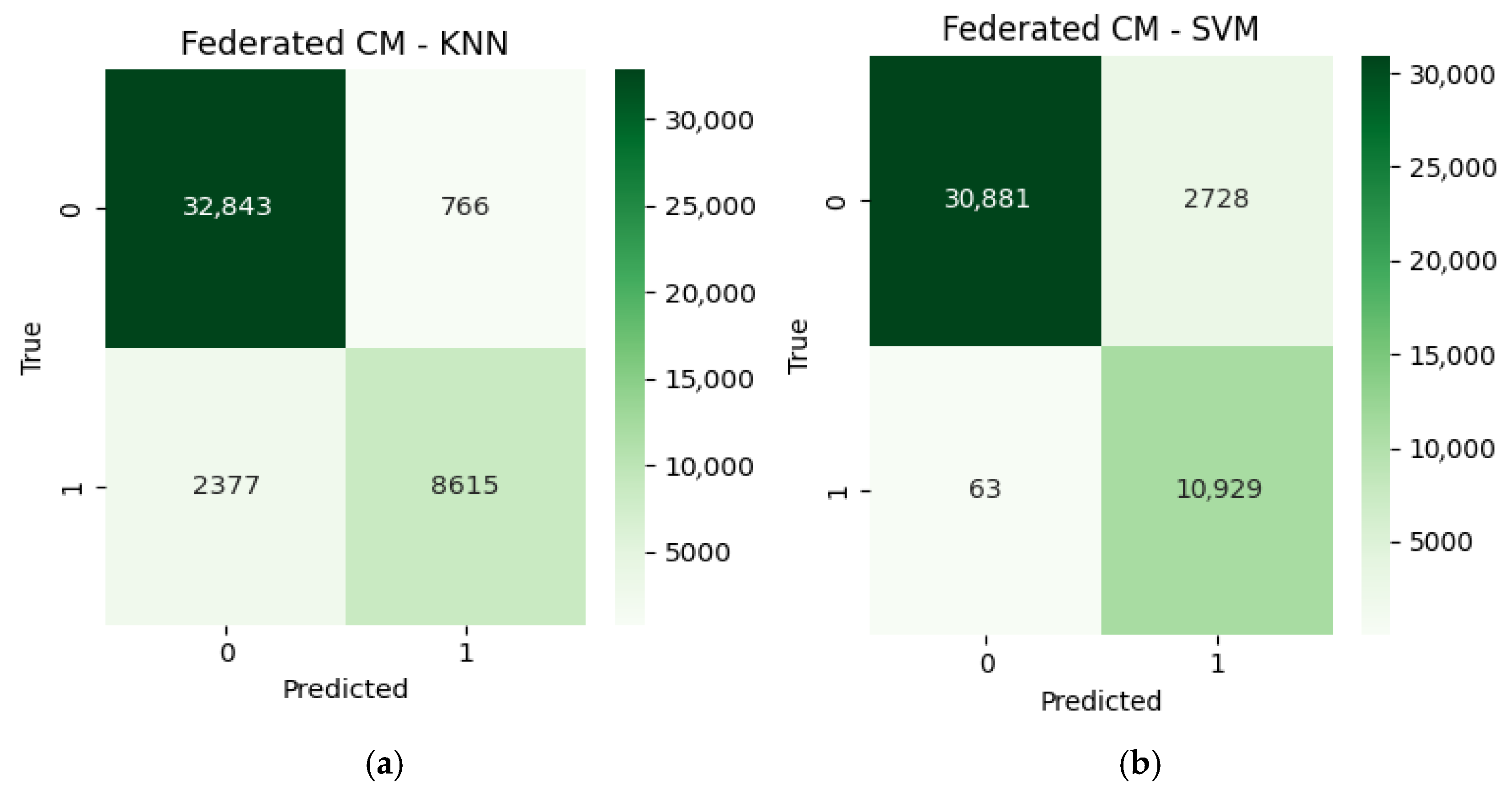
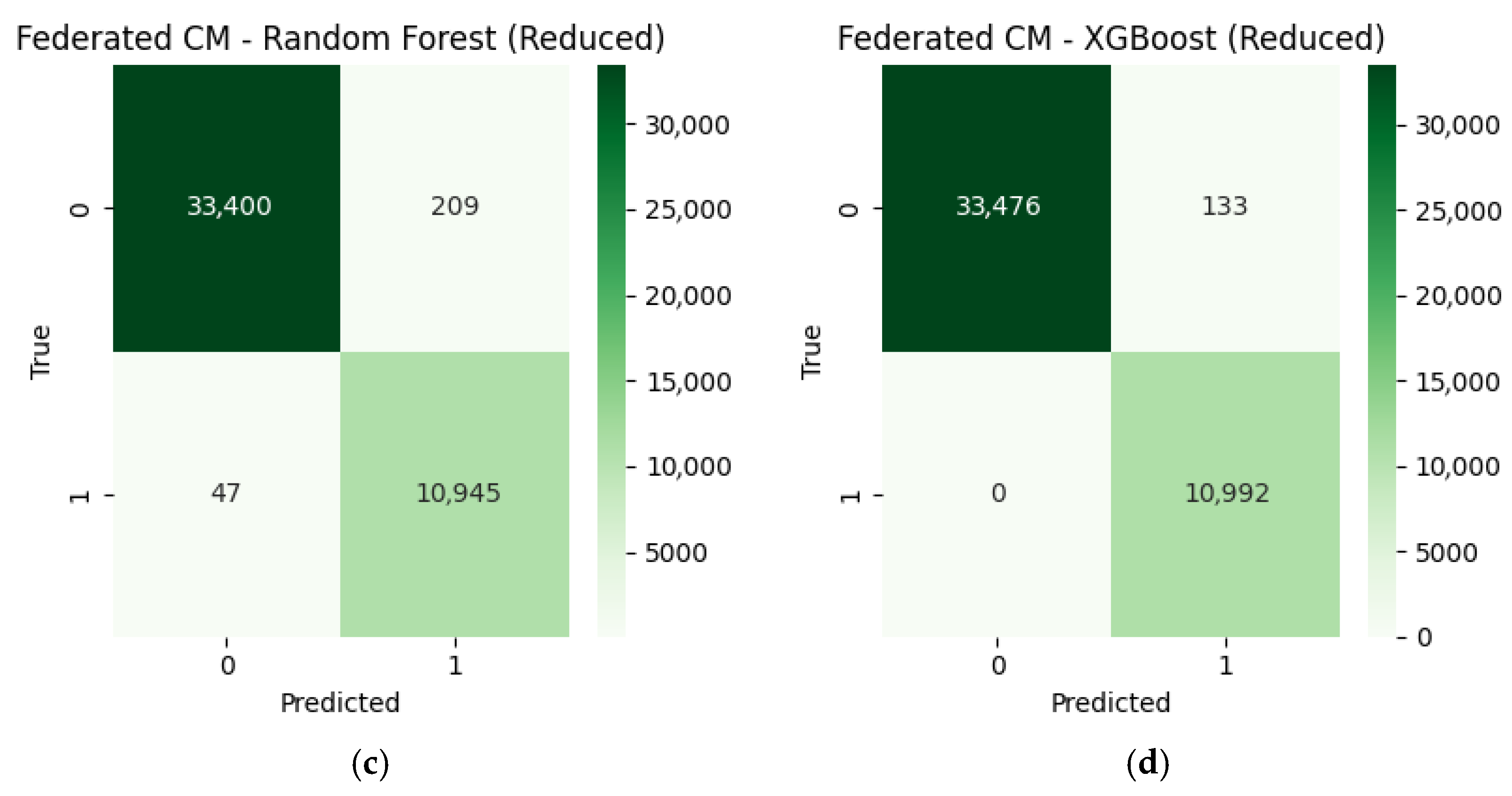
Figure 6 summarizes the results of the confusion matrices of the federated-inspired KNN, SVM, random forest, and XGBoost models in the case of decentralized evaluation. The federated KNN model has an accuracy of 92.95, and it is stable within a decentralized environment.
Figure 6 demonstrates that in the model, there are 32,843 true negatives and false positives = 766, which means that there is good specificity. On the positive class, the true positives are 8615, and the false negatives are 2377, indicating moderate recall. Although KNN works with data decentralization, it has a decent level of sensitivity and precision, which emphasizes its flexibility as a baseline model in privacy-sensitive loan default prediction.
The federated SVM model achieved an accuracy of 93.74, which proves its usefulness in the decentralized learning setting. The confusion table has 30,881 true negatives and 10,929 true positives, with the number of false negatives being quite low (63), which means that it is sensitive to default cases. Nevertheless, 2728 false positives mean that there is a propensity to overpredict the positive class. In general, the model has a good trade-off between recall and specificity, which makes it applicable in federated financial decision-support systems, wherein data confidentiality should be maintained.
The federation random forest model is a strong model whose performance is high at 99.43. The confusion matrix shows 33,400 true negatives and 10,945 true positives, with only 209 false positives and 47 false negatives. This trade-off performance represents excellent generalization on distributed data sources and proves the resilience of the model after the reduction of features. The low misclassification rates consistently make it suitable for the privacy-sensitive prediction of loan defaults.
The federated XGBoost model has the best overall performance, with a federated accuracy of 99.70. Its confusion matrix indicates that it has 33,476 true negatives and 10,992 true positives, with false positives of only 133 and zero false negatives. The fact that the false negatives are zero means that the default detection is perfectly recalled, and the low false-positive rate means that there is high precision. This strong balance, along with the ability to reduce its features and the decentralized assessment, makes XGBoost a very suitable and trustworthy system that can predict loan defaults in a secure state of less risky banking on a multi-institutional level.
Table 6 shows the accuracies of the machine learning models in the proposed ML–FL–XAI model by the federal way. The findings indicate the model performances in a federated-inspired decentralized environment, in which the process of collaboration is provided by means of prediction-level aggregation without exchanging raw data or model parameters.
XGBoost has the highest federated accuracy (99.70%), which indicates better robustness and generalization in the case of inference under decentralization. The example of the random forest model also demonstrates good results (99.43%), which proves the efficiency of the ensemble in the privacy-preserving learning condition. Conversely, the federated accuracies of SVM and KNN are much lower (93.74% and 92.95%, respectively), meaning that these models are less resistant to the heterogeneity of data in the decentralized context.
On the whole, these findings underscore the notion that ensemble-based classifiers, and especially XGBoost, could be deployed in the proposed federated-inspired architecture and survive in almost a centralized mode, justifying why these models can find application in secure and interpretable loan default prediction in distributed financial institutions.
The observed difference in the performance degradation between the ensemble-based models (random forest and XGBoost) and single-structure models (KNN and SVM) can be attributed to their differing robustness under decentralized data partitioning. The ensemble methods automatically minimize the variance by bagging (RF) or boosting (XGBoost) so that they can combine several weak learners and alleviate the influences of local data distribution variations across simulated clients. Conversely, KNN is highly dependent on local distance relations and is vulnerable to the fragmentation of feature space, whereas SVM decision margins can change when trained on chunky subsets with minor distributional changes. Consequently, the ensemble models are more robust to the slight heterogeneity of data presented by decentralized simulation, and the instance-based and the margin-based classifiers are more sensitive to the local differences in distribution.
4.1. Computational Efficiency Analysis
The reported training times correspond to the final model training phase after hyperparameter optimization and exclude preprocessing overhead. Measurements were averaged across three independent runs under identical CPU configurations (Intel Xeon CPU, 12 GB RAM).
Table 7 shows that XGBoost required a slightly longer training time compared to KNN and SVM due to its boosting iterations, while random forest demonstrates a moderate computational cost. However, all models were trained within practical time limits under standard CPU configurations without GPU acceleration. Since the proposed framework relies on prediction-level aggregation rather than iterative federated parameter-sharing rounds, additional communication overhead is minimal. These findings indicate that the proposed federated-inspired ensemble framework is computationally feasible for structured tabular financial datasets in real-world banking environments.
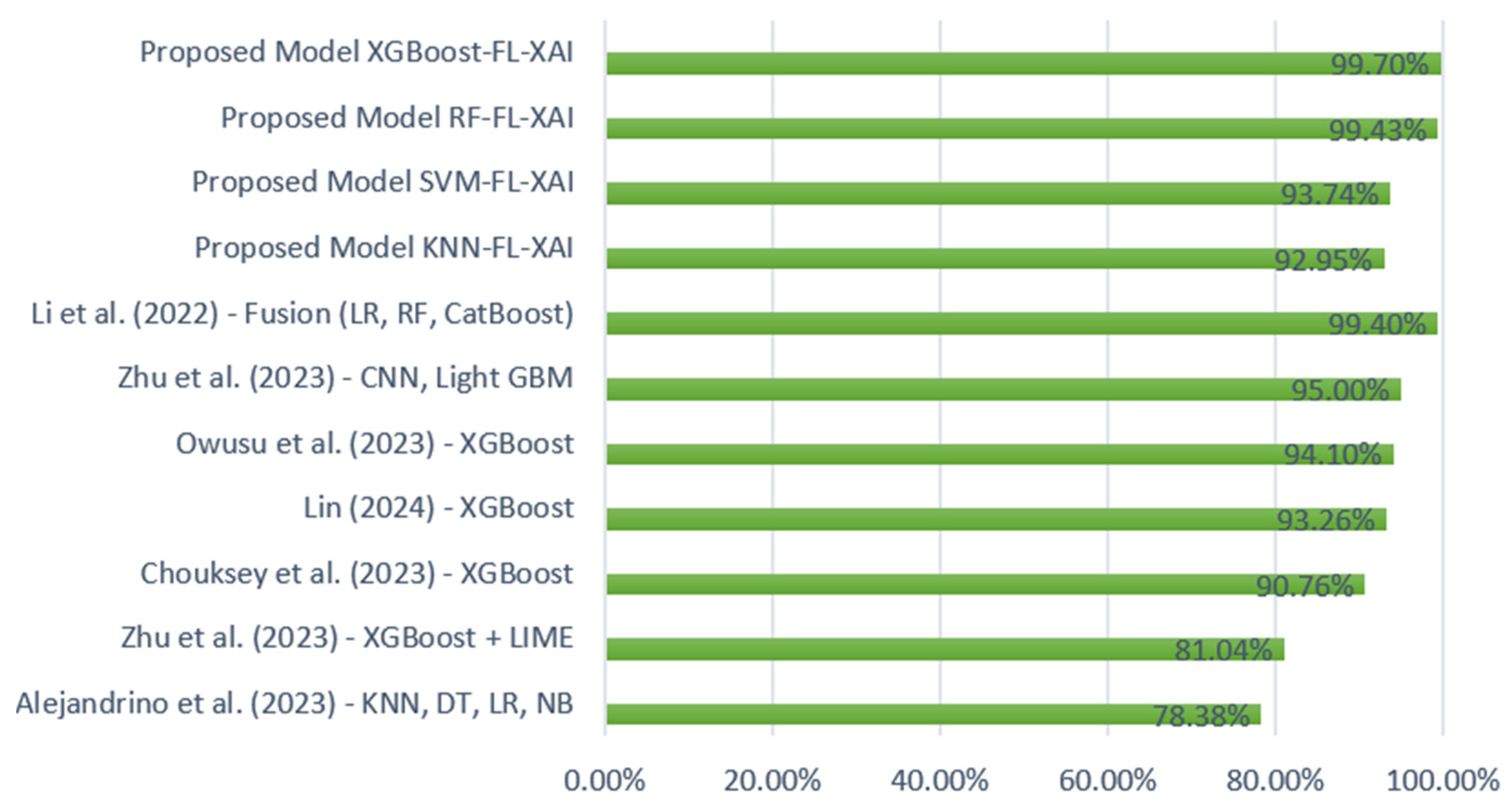
Figure 7 also compares the predictive accuracies of the suggested federated-inspired models to those of model loan default prediction methods published in the past. The findings show that the proposed XGBoost-FL-XAI model has the highest accuracy when compared to all the other methods, which proves its high predictive power in a decentralized and privacy-saving environment. Although there are earlier studies that include competitive performance, including the fusion-based method in [
26] and deep learning models in [
24,
25], they are based on centralized access to data and offer limited interpretability, which limits their use in regulated credit risk settings.
Conversely, the proposed framework incorporates federated-inspired learning and explainable AI, which makes high predictive accuracy possible without sharing raw data across institutions. Other benchmark methods, as illustrated in
Figure 7, are mainly concerned with the model performance under a centralized assumption and are not known to be dedicated to institutional data distribution and privacy limitations. As a result, a comparative analysis shows that the suggested XGBoost-FL-XAI model not only does better than the current approaches based on accuracy but is also more transparent and easier to apply in the specific conditions of reality and multi-institutional loan default prediction systems.
The high predictive quality of the presented XGBoost-FL-XAI framework can be explained by a number of complementary factors. First, the tabular format of the Kaggle data has well-structured financial variables with moderate class imbalance; therefore, tree-based ensemble models can be used to capture nonlinear interactions between features without the need to use deep hierarchical representations. Second, systematic preprocessing, such as stratified splitting, uniform encoding of features, class-weighted learning, and cross-validated hyperparameter optimization through GridSearchCV, is a source of stable generalization. Third, gradient-boosting algorithms like XGBoost have a natural anti-bias and anti-variance component that improves robustness against standalone classifiers or shallow fusion models through the iterative residual correction. In contrast to deep learning methods which need large-scale non-homogeneous feature embeddings, boosting-based models are especially effective with structured financial risk data in which feature significance is localized in a small number of informative variables, which the SHAP analysis validates. As a result, model-data fit and rigor of optimization are the reasons behind the performance advantage, and not solely architectural complexity.
A recent study [
13] reported an accuracy of 99.95% using a centralized machine learning approach for loan default prediction. While the reported performance is slightly higher than the 99.70% achieved by the proposed federated-inspired XGBoost model, it is important to note that the referenced study employed fully centralized training without decentralized data partitioning or privacy-preserving constraints. In contrast, the present work evaluates predictive performance under a federated-inspired setting, where data are partitioned across simulated institutional clients and aggregation occurs at the prediction level. Such decentralized evaluation may introduce mild performance variation due to data heterogeneity. Therefore, the slight difference in accuracy should be interpreted in the context of differing experimental designs and privacy-preserving objectives rather than as a direct methodological superiority comparison.
4.2. Explainable AI Integration
In this study, SHAP analysis was performed using the TreeExplainer module, which is specifically designed for tree-based ensemble models such as random forest and XGBoost. Global feature importance was computed on 5000 randomly sampled instances from the test dataset to ensure the representative coverage of borrower profiles. LIME explanations were generated using the tabular explainer with a neighbourhood size of 500 perturbed samples to analyze local decision boundaries. Both SHAP and LIME were applied to the aggregated federated XGBoost model at the global inference stage, thereby ensuring that interpretability reflects the decentralized consensus prediction rather than isolated client-level models.
To ensure consistency of explainability results in the federated-inspired setting, all client models were trained using an identical preprocessing pipeline, including consistent feature encoding, scaling, and ordering. As the decentralized simulation was performed on a partitioned version of the same structured dataset, the feature space remained homogeneous across all clients. Therefore, SHAP and LIME explanations reflect contributions within a unified feature representation, avoiding discrepancies that could arise from heterogeneous feature schemas in real-world cross-institutional deployments.
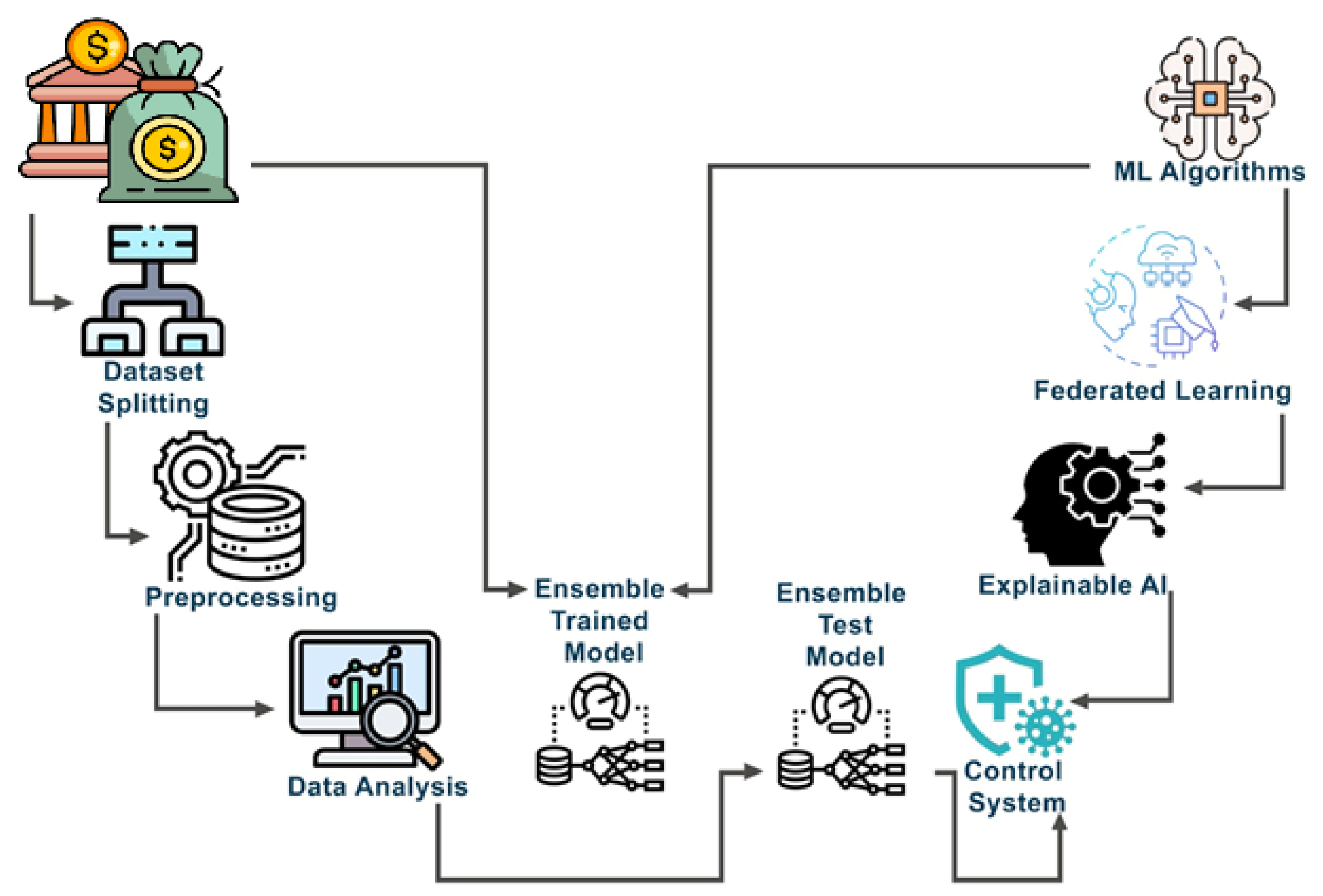
Figure 8 shows how explainable artificial intelligence (XAI) is integrated on an end-to-end basis into the suggested federated-inspired loan default prediction model. It starts with dataset splitting and preprocessing, during which the raw financial information is optimized by using necessary steps such as data cleaning, normalization, and feature preparation. After preprocessing, data are analyzed and a model is trained locally based on several machine learning algorithms, the outputs of which are involved in an ensemble-based learning algorithm within a decentralized framework.
The trained ensemble models are then tested in the testing phase, where predictions are pooled together to create a consensus decision without making raw data or model parameters known. Since the operation of conventional machine learning models is that of a black box, their direct application to financial control systems may not be transparent and interpretable. To circumvent this drawback, XAI techniques are brought into the control layer of the framework, namely, SHAP and LIME. They allow global and local explanations to be provided because these tools measure the contributions of features and explain the results of individual predictions.
The proposed framework promotes model transparency, accountability and reliability by integrating the concept of XAI into the control system, which allows the stakeholders to interpret and justify the decisions made in loan defaults. The integration promotes informed financial decision making and the adaptation of the predictive system to regulatory and ethics requirements in high-stakes banking settings.
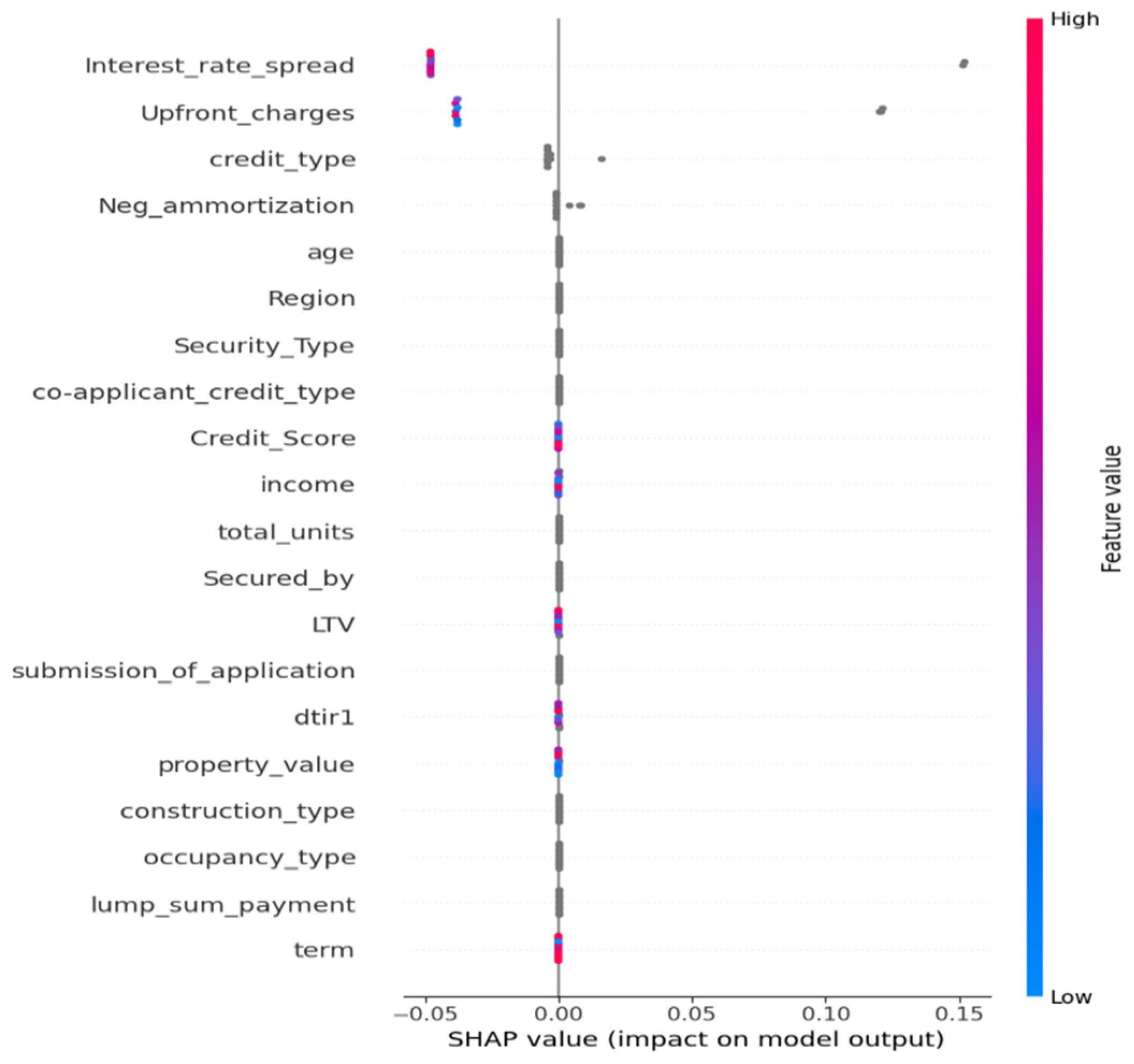
SHAP is a post hoc explainability method which measures the value of individual features to model predictions in the dataset. SHAP allows for determining the major drivers that affect the results of the prediction process by providing consistently and theoretically justified importance values to the input variables in the evaluation stage. This insight can be used to analyze features more intelligently and allows for the refinement of the model in a more efficient way due to the highlighted most influential variables, thereby enhancing the interpretability without worsening the predictive power of the model.
The SHAP summary plot in
Figure 9 shows the importance of features globally in the federated XGBoost model. The findings suggest that interest rate spread and upfront charges are the most powerful predictors with the highest absolute SHAP values and always influence the output of the model. The color distribution also indicates that more of these features have higher values, which are linked to more variation in the impact on prediction, which indicates that these features are key in controlling loan default risk.
Secondary contributors are credit_type and neg_ammortization, with moderate values of SHAP, but which are not negligible, suggesting their applicability in distinguishing the risk profiles of borrowers. Non-response, in contrast, where most of the other attributes, like property value, term and lump sum payment, have SHAP values around zero, implies that they might have little marginal effect on the predictions of the model.
All in all, the wide range of the SHAP values shows the lack of density of the SHAP values on the vast majority of features, which allows the XGBoost model to be highly predictive with a small number of highly informative variables, which are still easy to interpret. This centralization of power contributes to the appropriateness of the model in clear credit risk evaluation, where one needs to be aware of the main factors behind loan defaults.
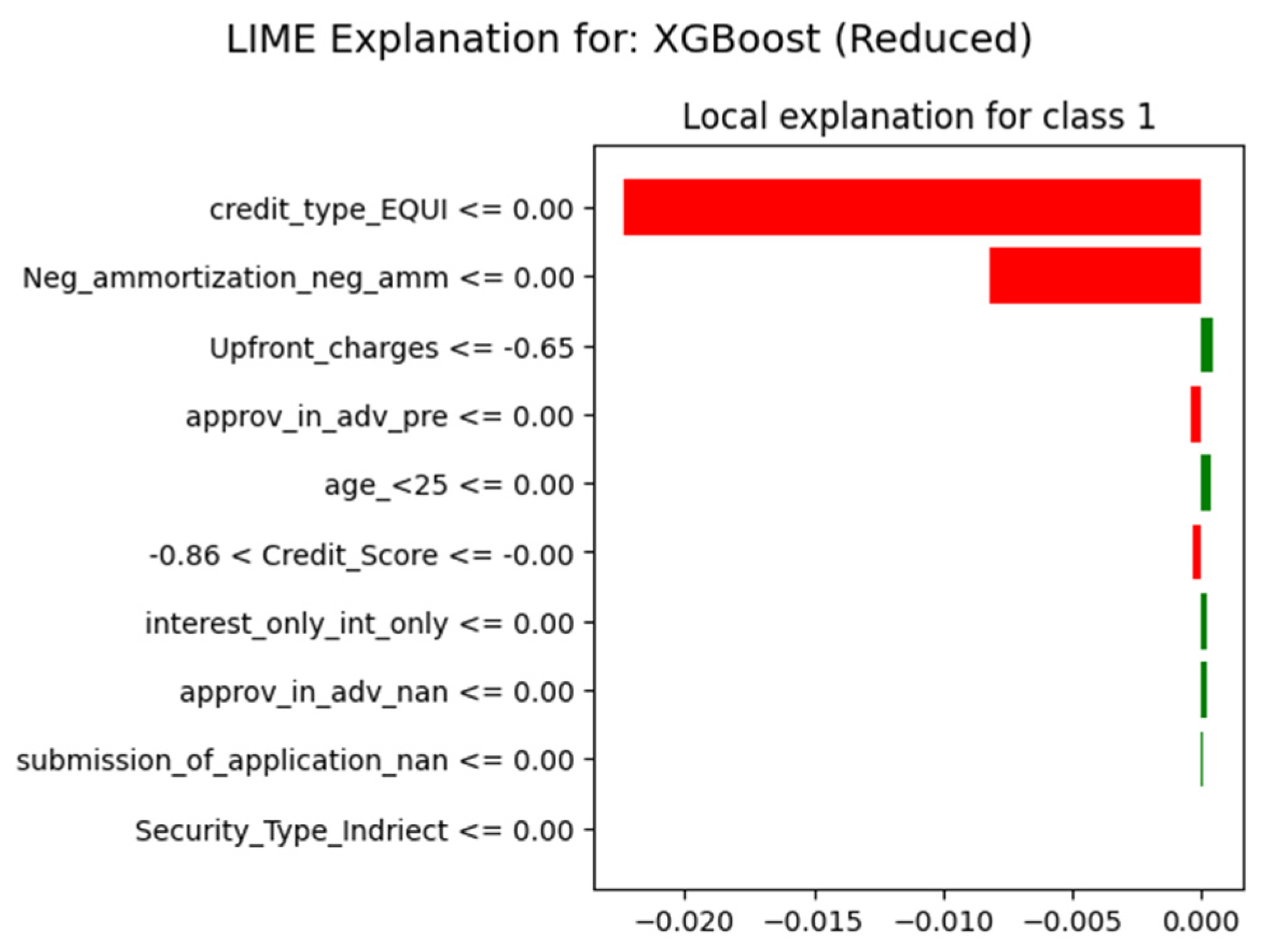
The local explanation in
Figure 10 shows a LIME-based explanation for one of the predictions made by the XGBoost model that explains the most influential features that predict the label in class 1. The visualization reveals that the credit type EQUI and neg-amortization have the largest negative impacts on prediction, which means that the existence of these factors contributes significantly to a reduction in the probability of loan acceptance in the particular case. These are the prevailing features in the local decision boundary, which is in line with their high relevance in global explainability analysis.
The other characteristics, such as upfront charges, prior approval, credit scores, and age-related indicators, are not the final determinants but have relatively smaller positive or negative impacts on the outcome. The small size of such contributions indicates that, in this specific instance, the choice of the model is not influenced by the large-scale combination of features but by a small group of very powerful variables.
In general, the LIME description demonstrates the local decision impact concentration into a small number of predictors supporting model transparency at the single prediction point. This localized interpretability is an extension of the global insights of SHAP and enables the implementation of the model in the real world of loan default assessment, where the interpretation of case-specific decision making is critical to building trust and compliance with regulations.
4.3. Practical Implications
The proposed federated-inspired and explainable framework offers several practical implications for financial institutions operating in regulated environments.
First, the decentralized prediction level aggregation mechanism allows joint credit risk modeling among and between multiple institutions without sharing raw data. This especially applies to banking ecosystems where stringent data protection laws (e.g., GDPR and national financial compliance policies) limit the exchange of data across institutions.
Second, SHAP and LIME integration at the federated aggregation point improves transparency by showing the final consensus decision, instead of the local predictions. Regulators of financial services are requiring more explainability and accountability in AI-based decision making. This capability to offer global feature relevance and local case explanations helps in auditability and regulatory review.
Third, the framework shows that ensemble-based models like XGBoost can continue ensuring a high predictive performance even when data is partitioned decently. It implies that privacy-conscious collaborative analytics can be utilized by financial institutions with a negligible decrease in the risk prediction accuracy.
Finally, the proposed methodology can serve as a blueprint for secure interbank analytics initiatives, consortium-based credit modeling, and privacy-preserving financial AI systems, particularly in multi-branch or cross-regional banking networks.
5. Conclusions
This work proposes a federated-inspired explainable machine learning model of loan default prediction with a combination of multiple machine learning models, prediction-level decentralized collaboration, and explainable artificial intelligence (XAI). The suggested solution resolves critical issues related to contemporary credit risk evaluation, such as the privacy of data and its isolation in institutions and the absence of transparency in the top-performing predictive algorithms.
Large-scale experiments done on a large-scale public loan dataset showed that ensemble models (especially XGBoost and random forest) have consistently good predictive performances in both centralized and decentralized environments. In the federated-inspired evaluation, XGBoost obtained the greatest level of accuracy, which was close to the centralized performance but maintained data locality and confidentiality. The comparative analysis against the previous studies further emphasized that the proposed framework provides competitive or superior accuracy and is the only framework to incorporate the aspects of decentralized learning and interpretability, which is normally not the case in other methods.
The framework combines SHAP and LIME to explain both the global and local behaviour of the model in order to increase transparency and trust. SHAP analysis has shown that a small number of financial attributes, in particular interest rate spread and upfront charges, dominate global prediction results, which allows one to identify central risk drivers. The local explanations using complementary LIME were further used to demonstrate the use of a few influential features that control individual loans and provide practical implications to auditors, analysts, and decision-makers. Collectively, these mechanisms of explainability are what guarantee the attainment of high predictive accuracy without compromising on interpretability, accountability or regulatory alignment.
Practically, the suggested framework is very applicable in the context of a multi-institutional banking setting, where regulatory limits inhibit the sharing of raw data and require clarity and justification in the decision-making process. The approach offers a plausible way to enable collaborative credit risk modeling without requiring parameter or raw data exchange, relying on prediction-level aggregation and reducing privacy and security risks.
Despite the strong predictive performance observed, several limitations should be acknowledged. First, the experimental evaluation was conducted on a single publicly available Kaggle loan dataset, and although cross-validation was performed to ensure robustness, external validation on independent proprietary banking datasets was not conducted. Therefore, the generalizability of the proposed framework across different institutional data distributions, economic environments, or regulatory jurisdictions requires further empirical validation. Second, the federated learning system is simulated using partitioned public data rather than deployed across physically distributed financial institutions. Enhanced privacy-preserving mechanisms such as secure aggregation, homomorphic encryption, or formal ε-differential privacy guarantees are not implemented and remain important directions for future work, particularly for production-scale interbank federated infrastructures.
Comprehensively, this paper has shown that explainable AI in federated-inspired learning can provide accurate, transparent, and privacy-aware loan default predictions and forms a promising future for next-generation credit risk assessment systems in regulated financial settings.