
Multivariate Uncertainty Quantification with Tomographic Quantile Forests


Abstract
1. Introduction
2. Related Work
2.1. Univariate Target Variable
2.2. Multivariate Target Variable
3. QRF++: A Simplified DRF Implementation
3.1. Definition
3.2. Evaluation of QRF++
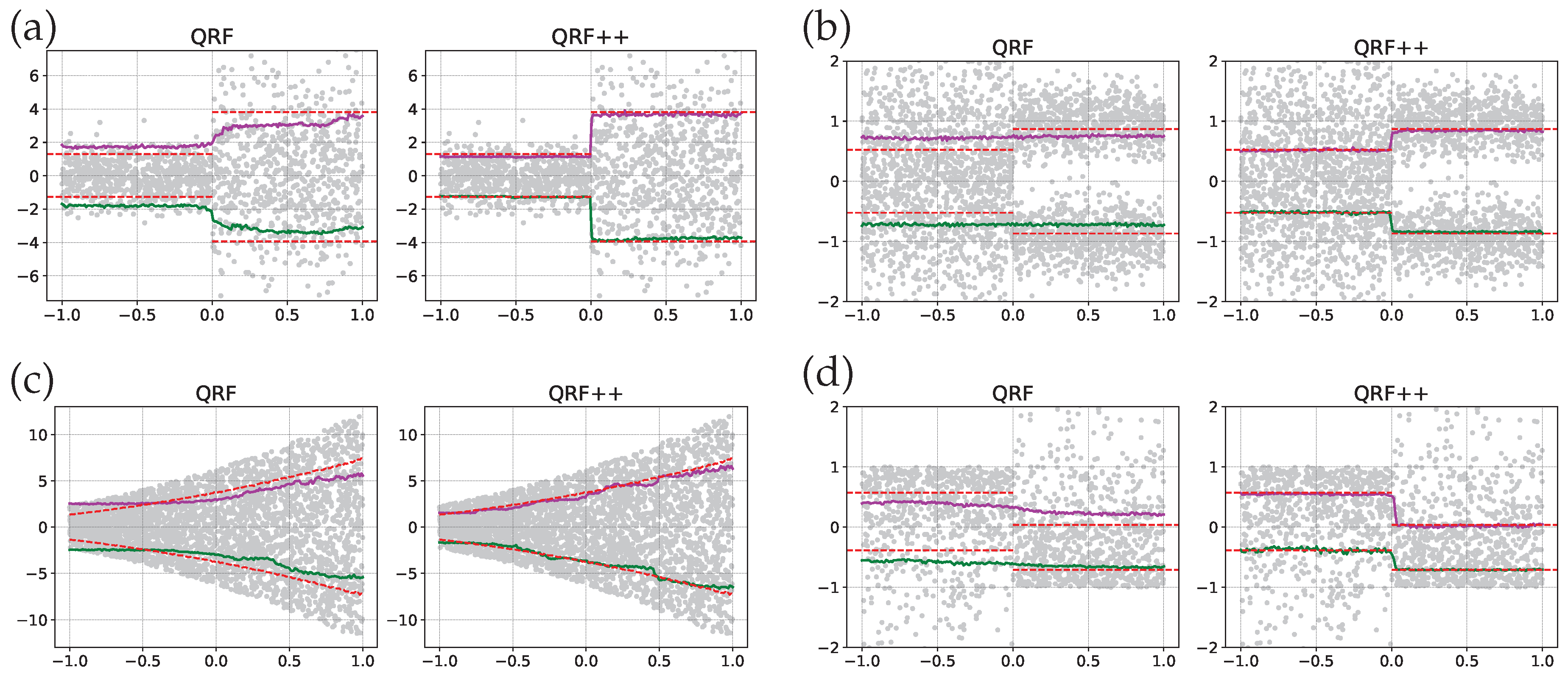
- (a)
- for and for . The mean is constant but the variance jumps at . There are 1500 samples.
- (b)
- for and for , where and . The mean and variance are 0 and 1 for all x. The distribution is unimodal for and bimodal for . There are 3000 samples.
- (c)
- . This dataset exhibits a funnel-like shape when plotted in the -plane. There are 3500 samples.
- (d)
- for and for , where is the exponential distribution with the rate parameter . The mean and variance are 0 and 1 for all x. There are 1700 samples.
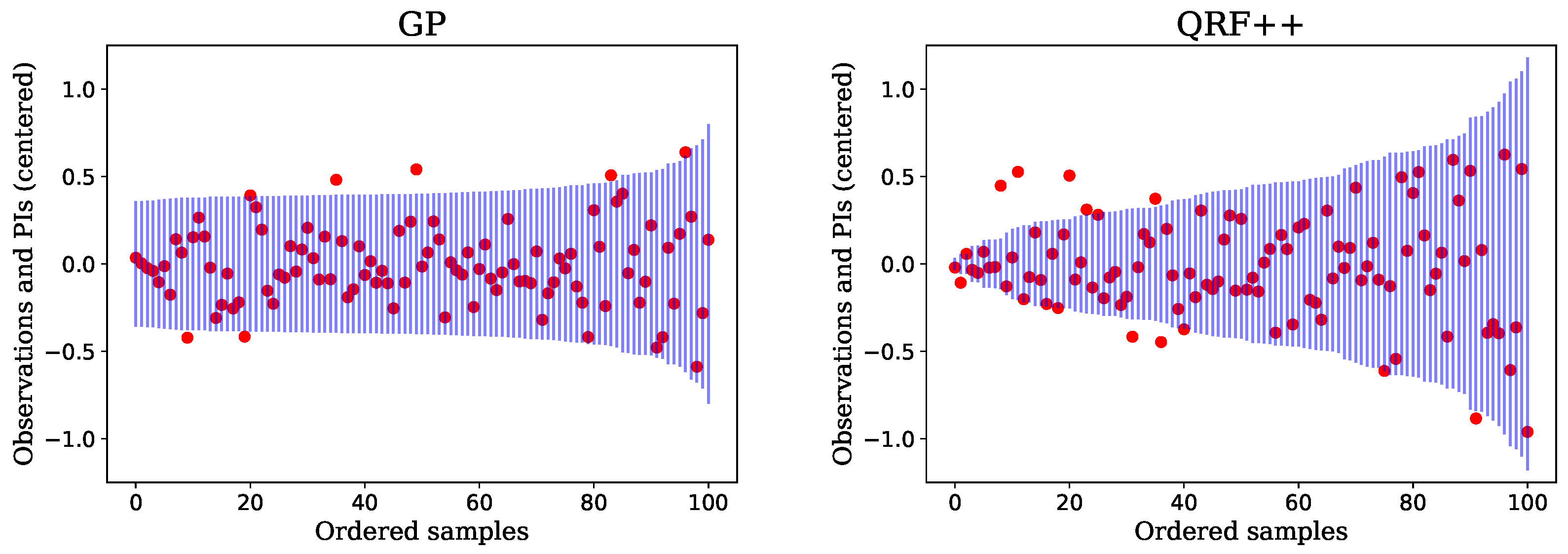
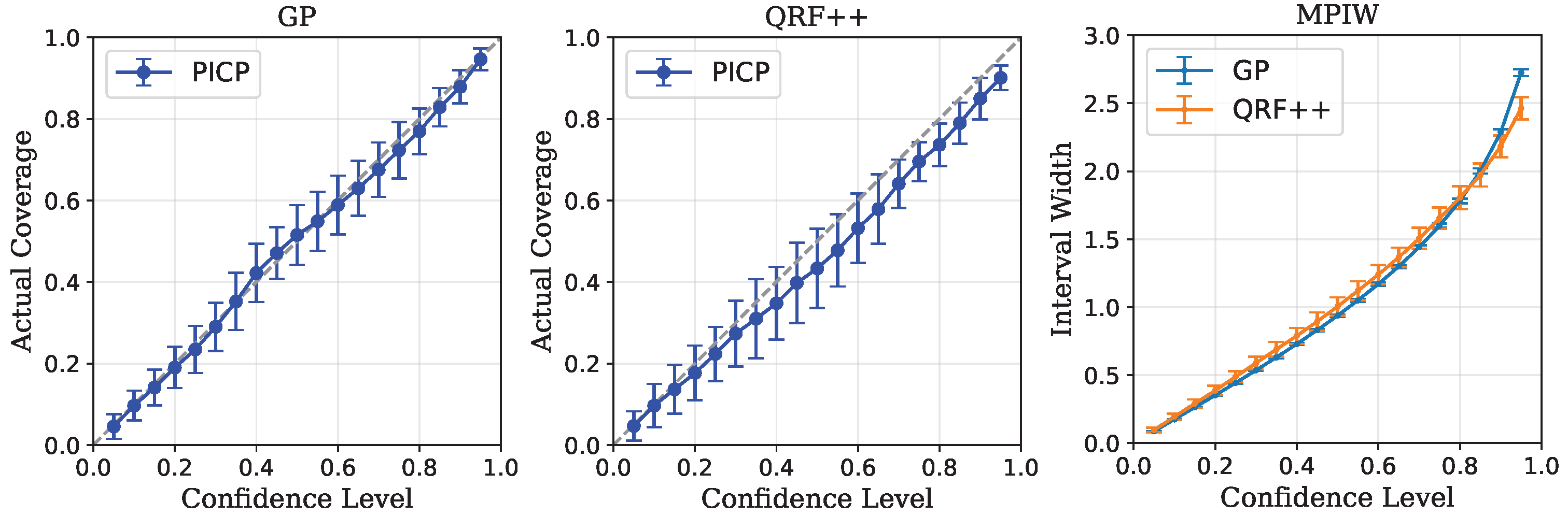
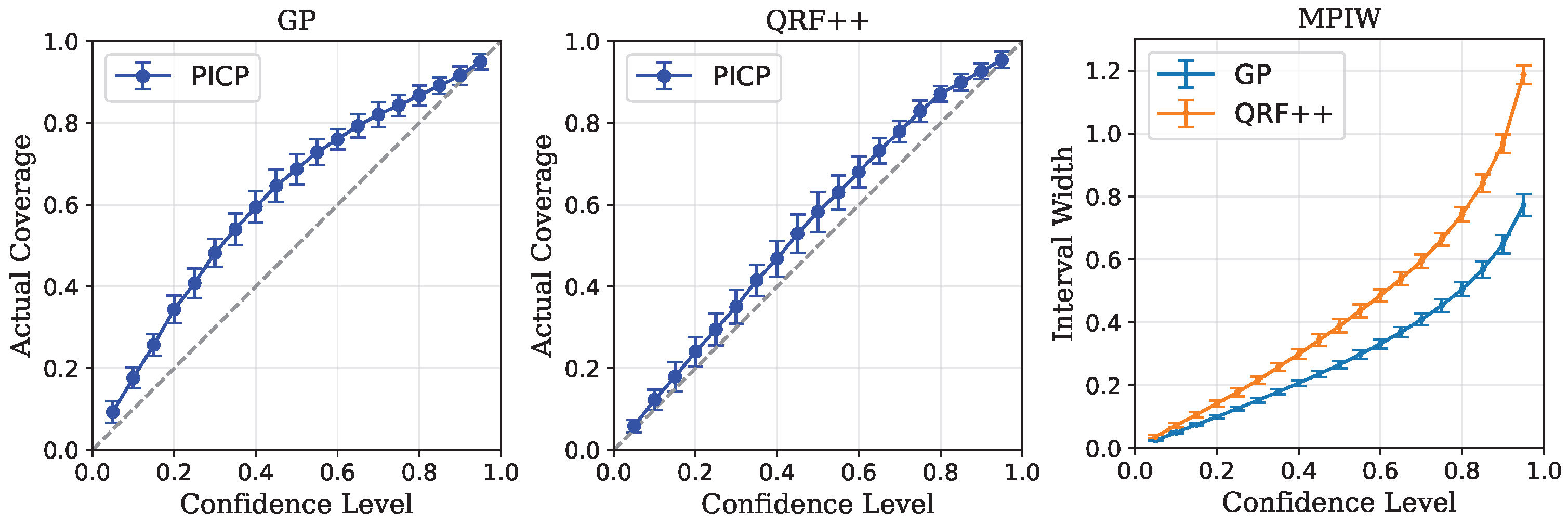
3.3. Prediction Interval Coverage and Width
- Hyperparameters
- Results
4. Proposed Method
| Algorithm 1 Tomographic Quantile Forests (TQF) |
|
4.1. Stage I: Model Fitting
| Algorithm 2 Quantile-Matching Empirical Measure (QMEM) |
|
| Algorithm 3 Prune a Point Cloud |
|
- Computational Complexity
4.2. Stage II: Distribution Reconstruction
- Construction of Quantile Regions
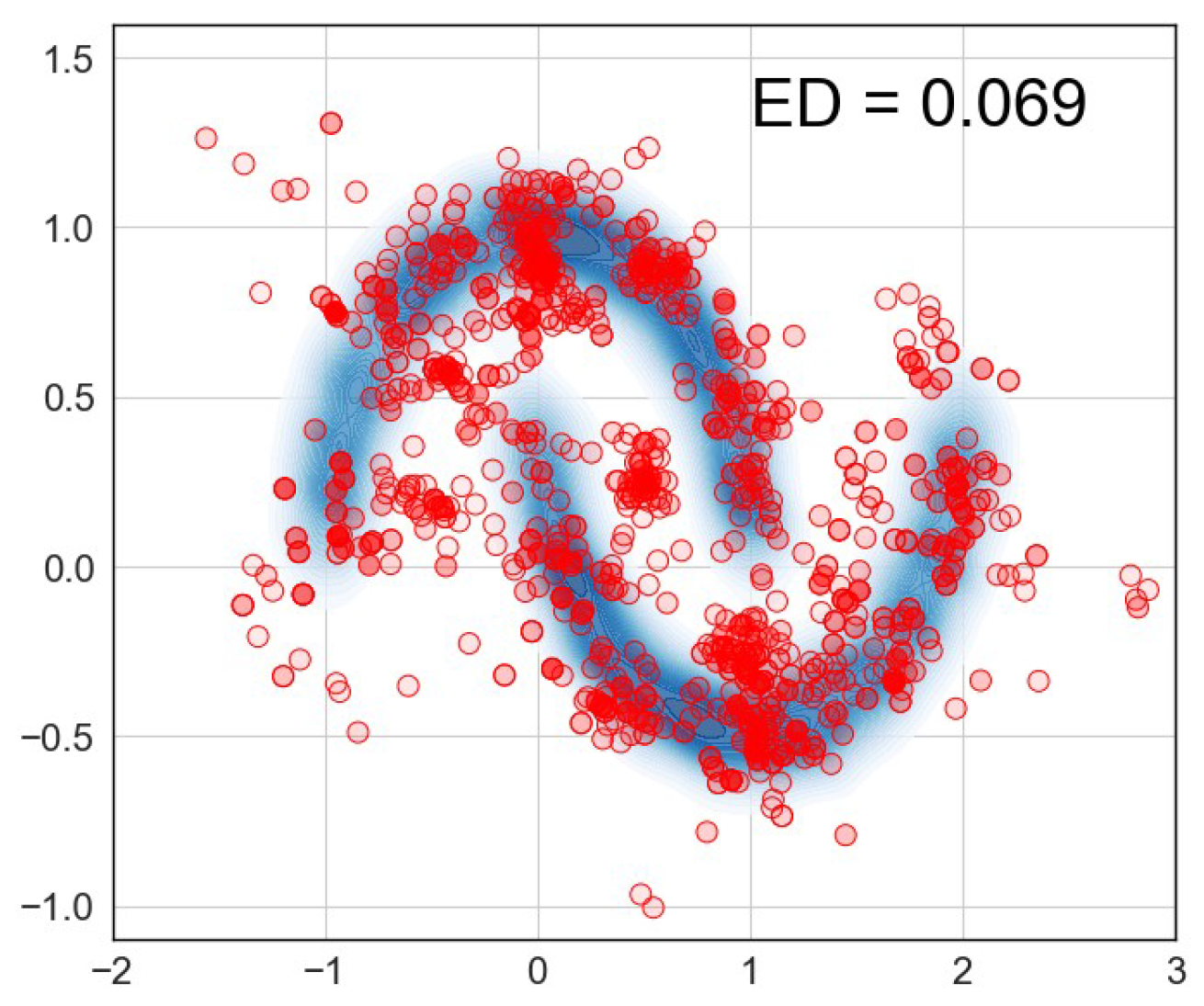
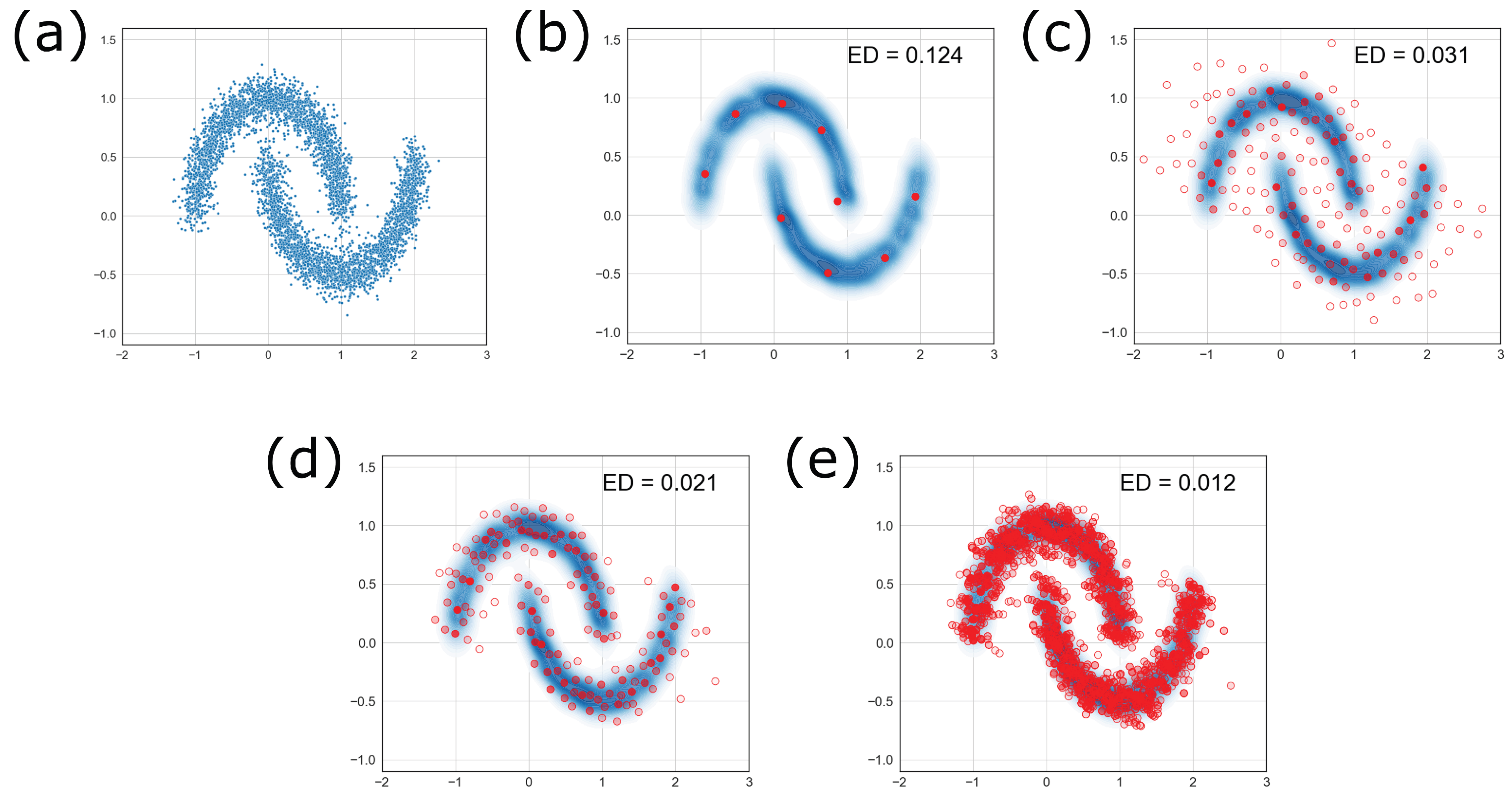
5. Empirical Evaluation of the QMEM Algorithm
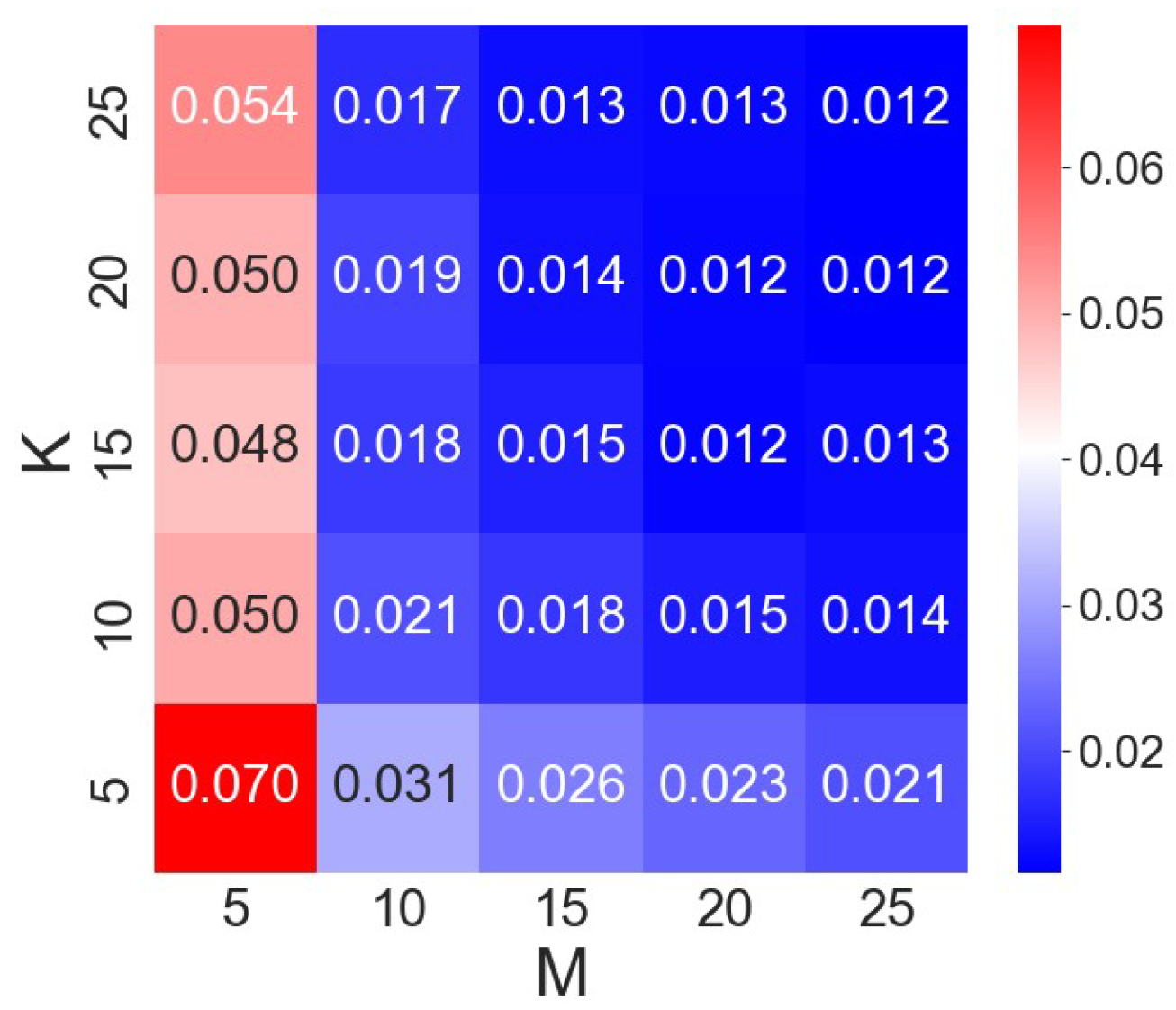
- Hyperparameter Dependence
6. Experimental Results for the TQF Algorithm
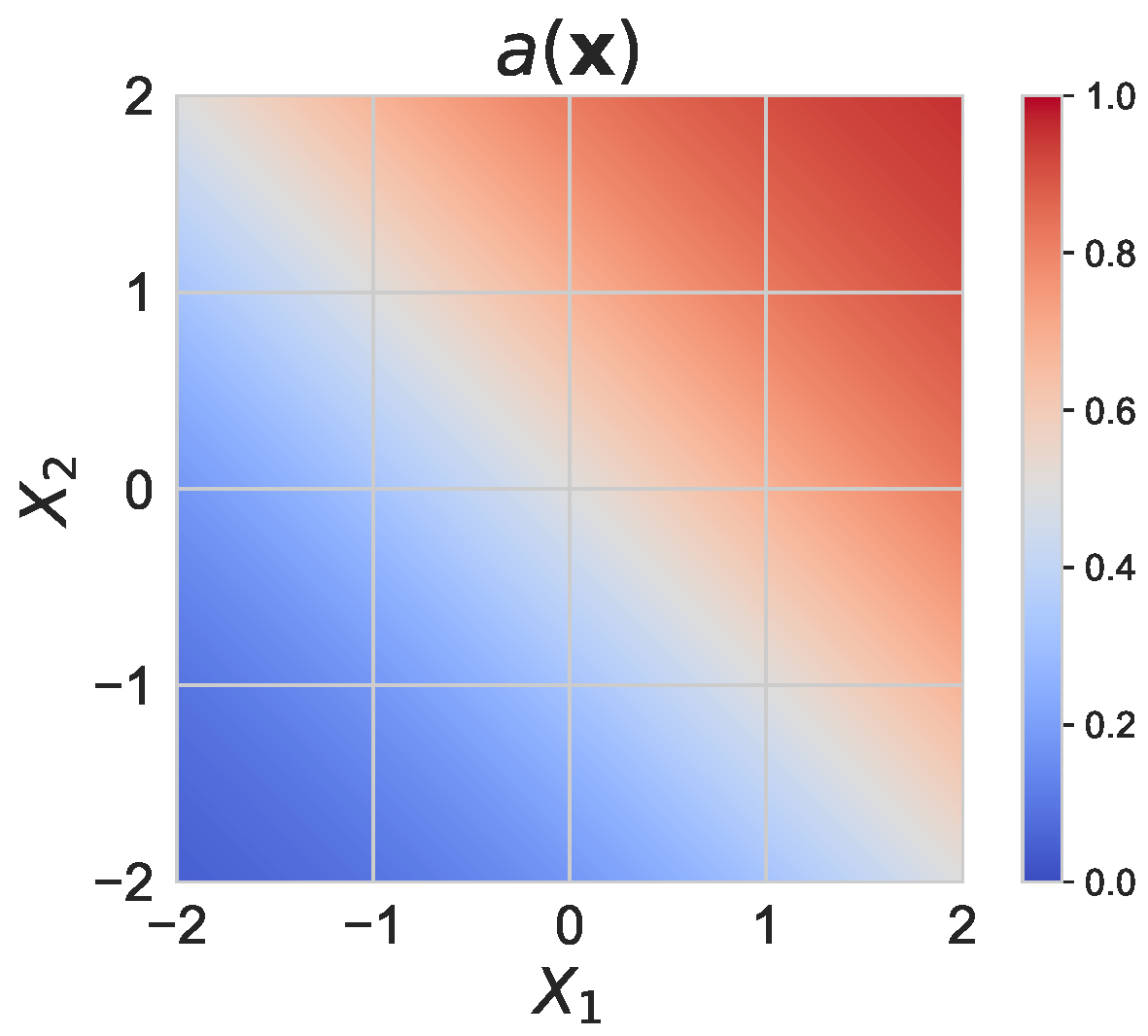
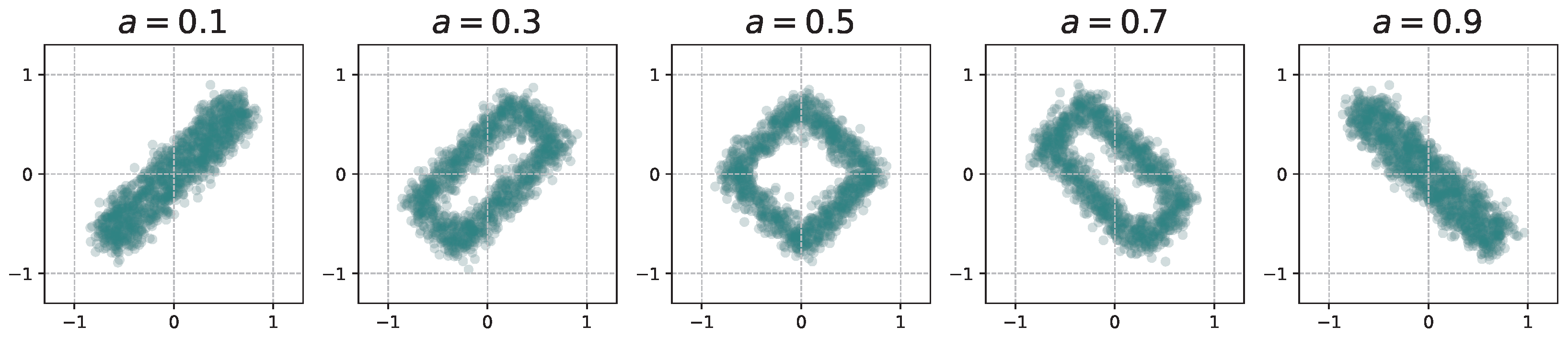
6.1. Evaluation on Synthetic Data I
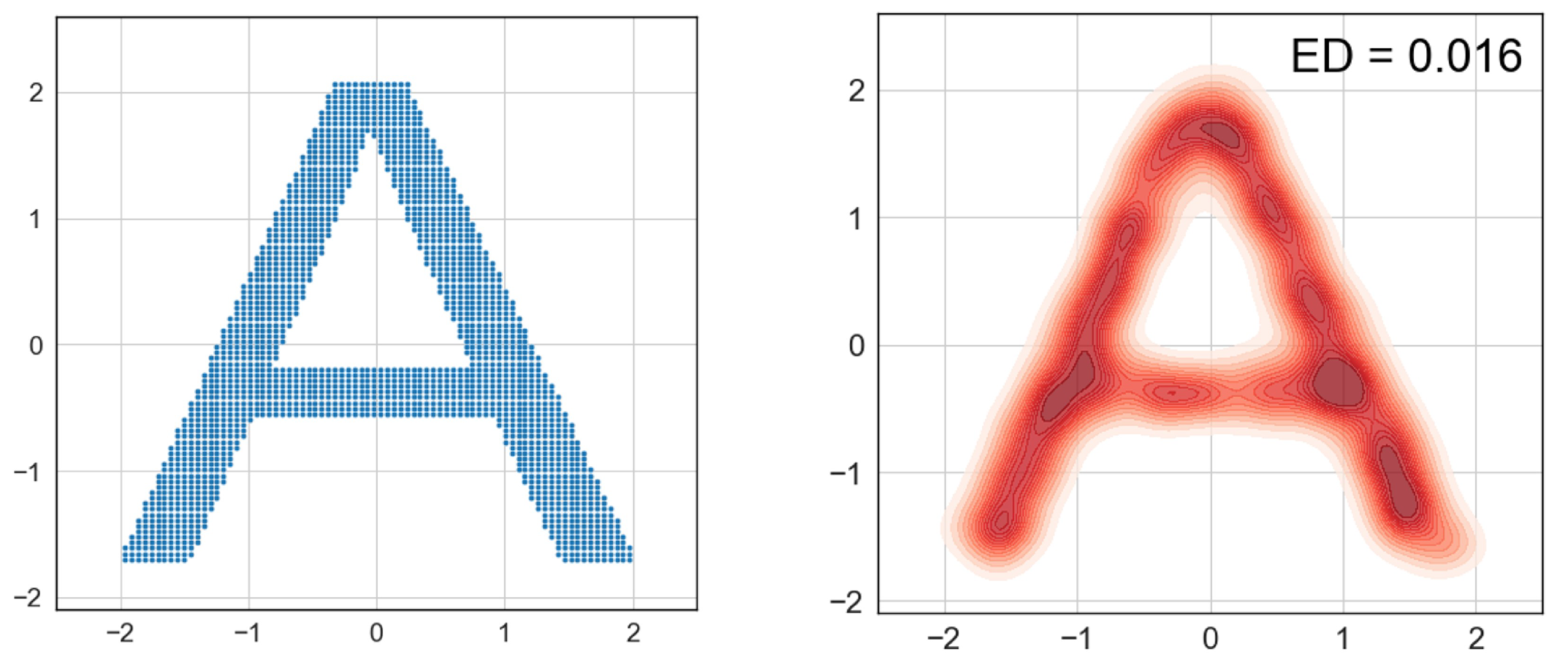
- Dataset
- Model
- Evaluation Metric
- Results
6.2. Evaluation on Synthetic Data II
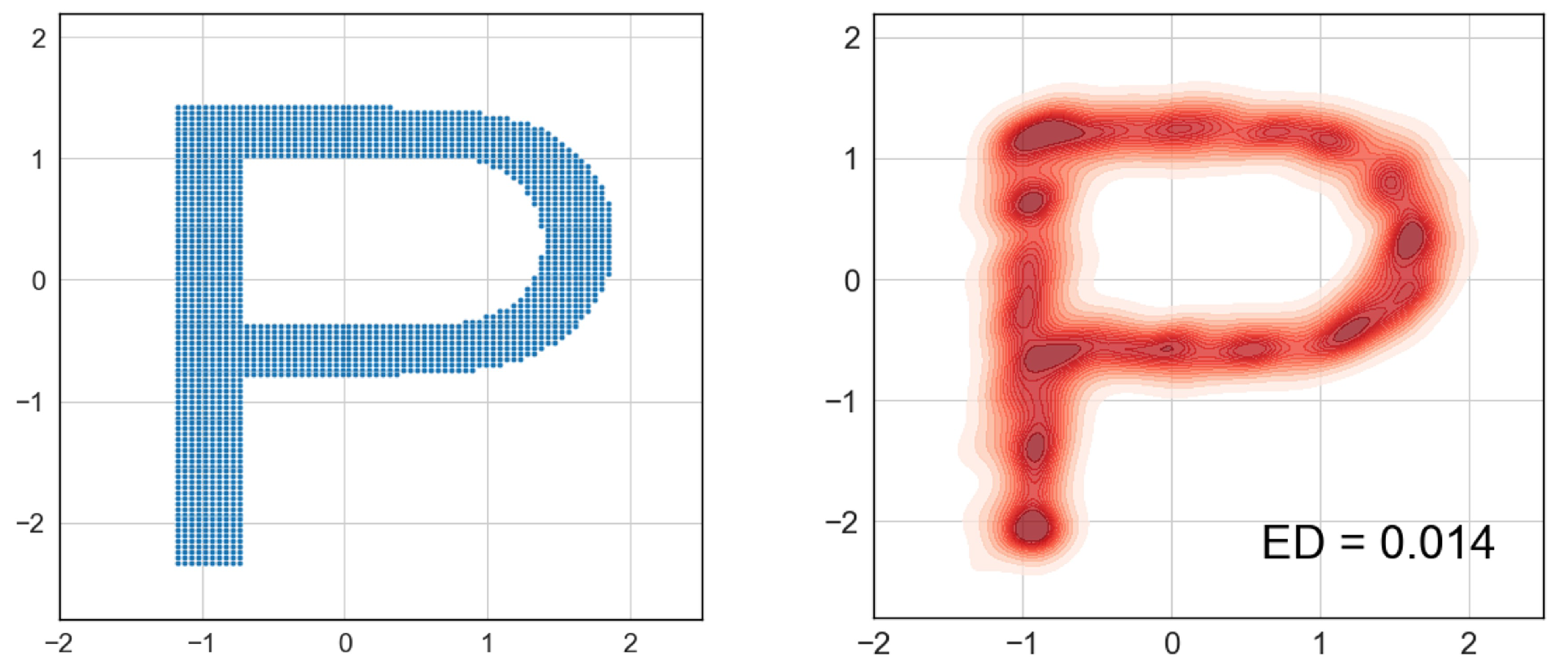
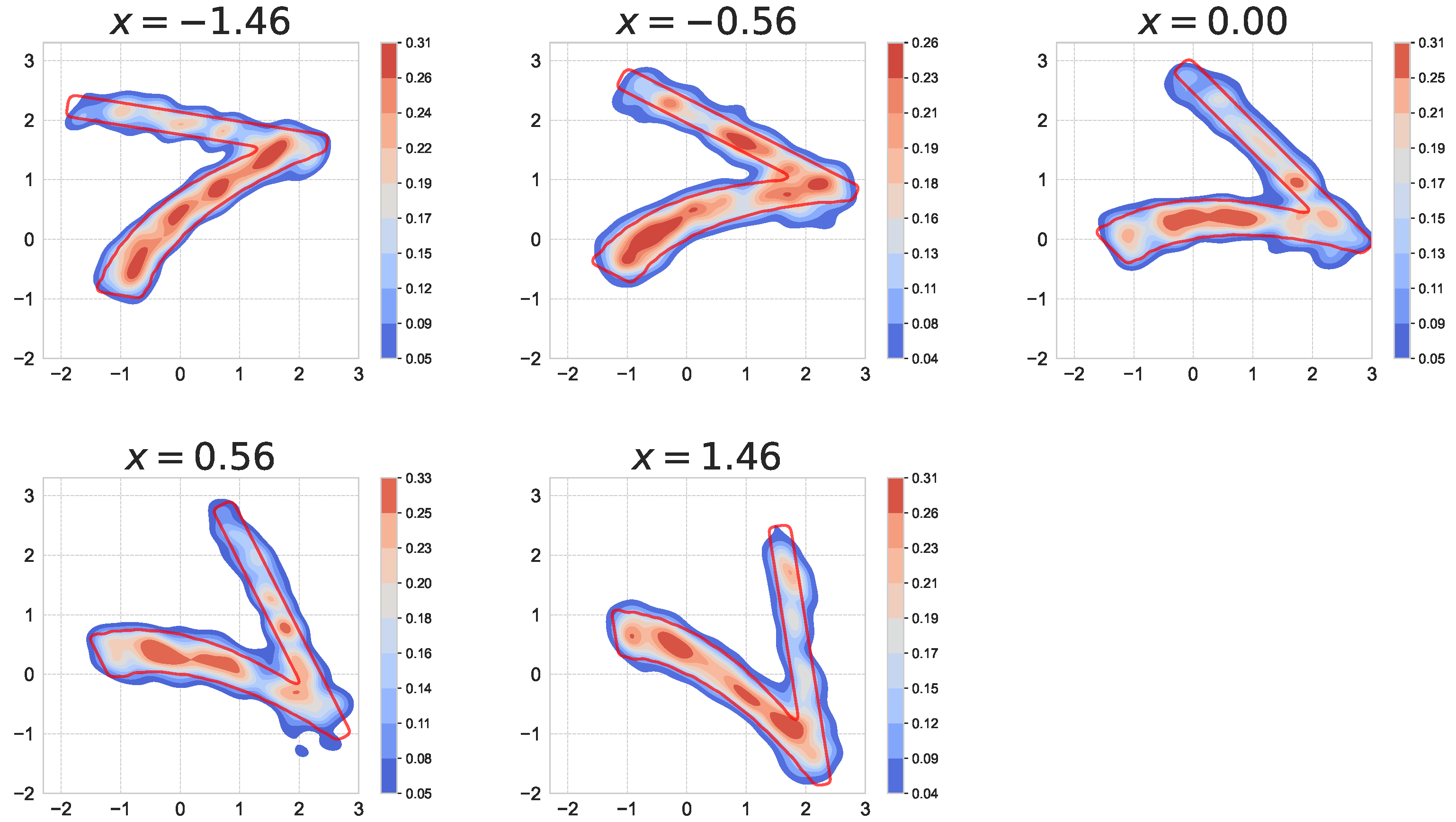
- Dataset
- Model
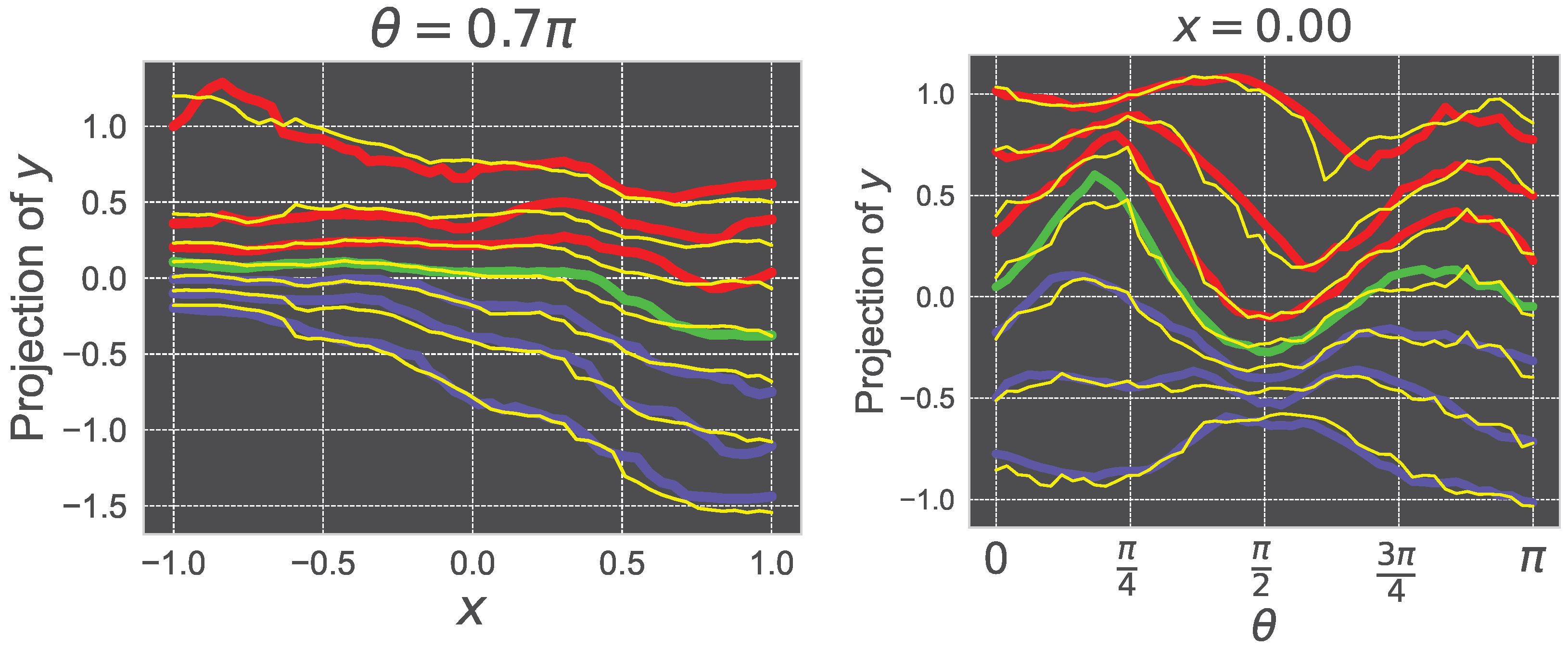
- Results
6.3. Comparing TQF and DRF on Small Data
- Dataset
- Model
- honesty: {True, False}.
- min_node_size: .
- sample_fraction: .
- Evaluation Metric
- Results
6.4. Evaluation on Real-World Data
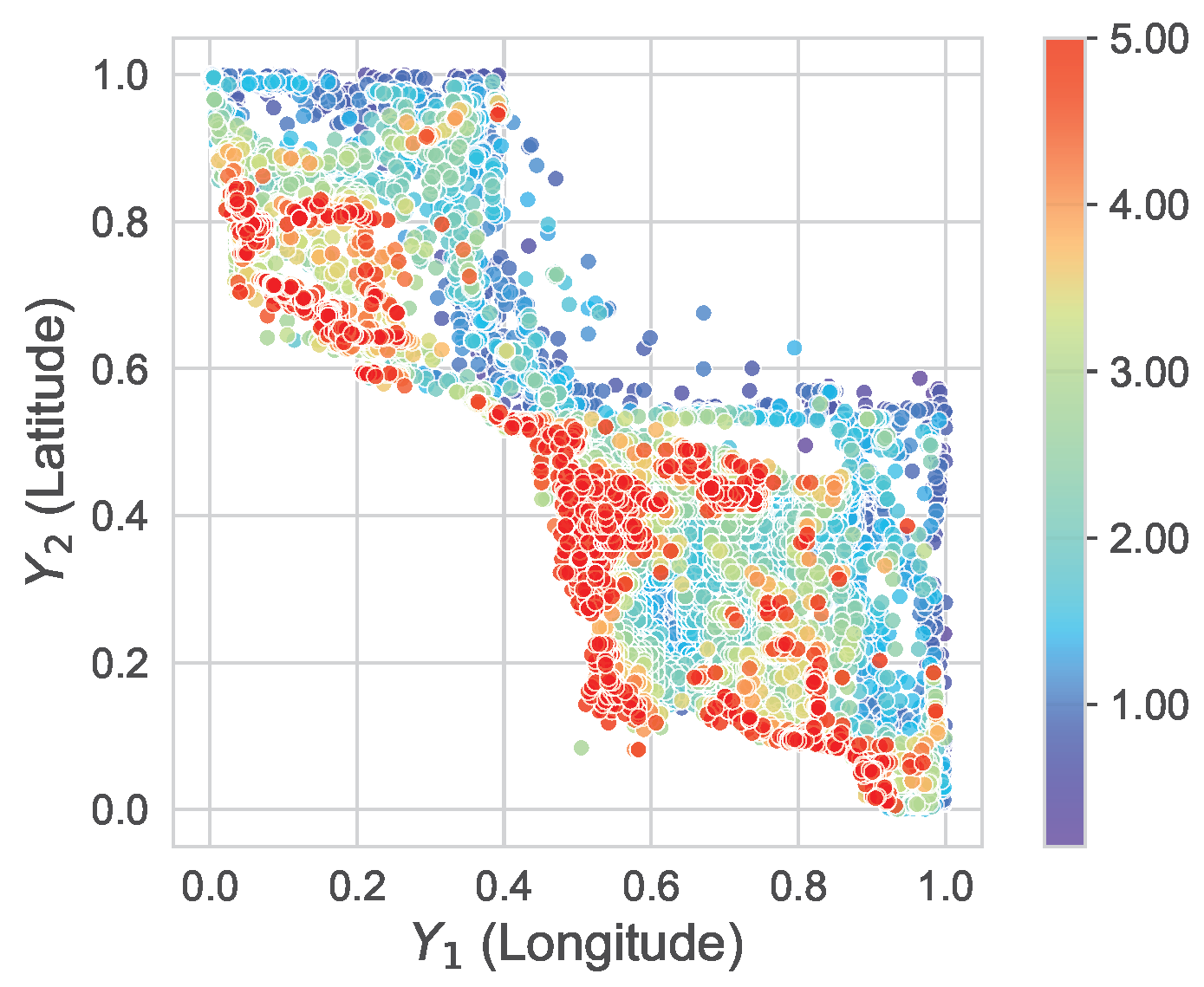
- Dataset
- Models
- “Simple”: A trivial baseline that returns the entire training set as the predictive distribution for every test input.
- RF*: A random forest regressor with 200 trees. We tune min_samples_leaf by grid search over using the loss, and select min_samples_leaf .
- LightGBM*: A gradient-boosted decision-tree model [20]. We tune the hyperparameters over the grids below, using the loss:
- –
- learning_rate: → select .
- –
- min_data_in_leaf: → select 50.
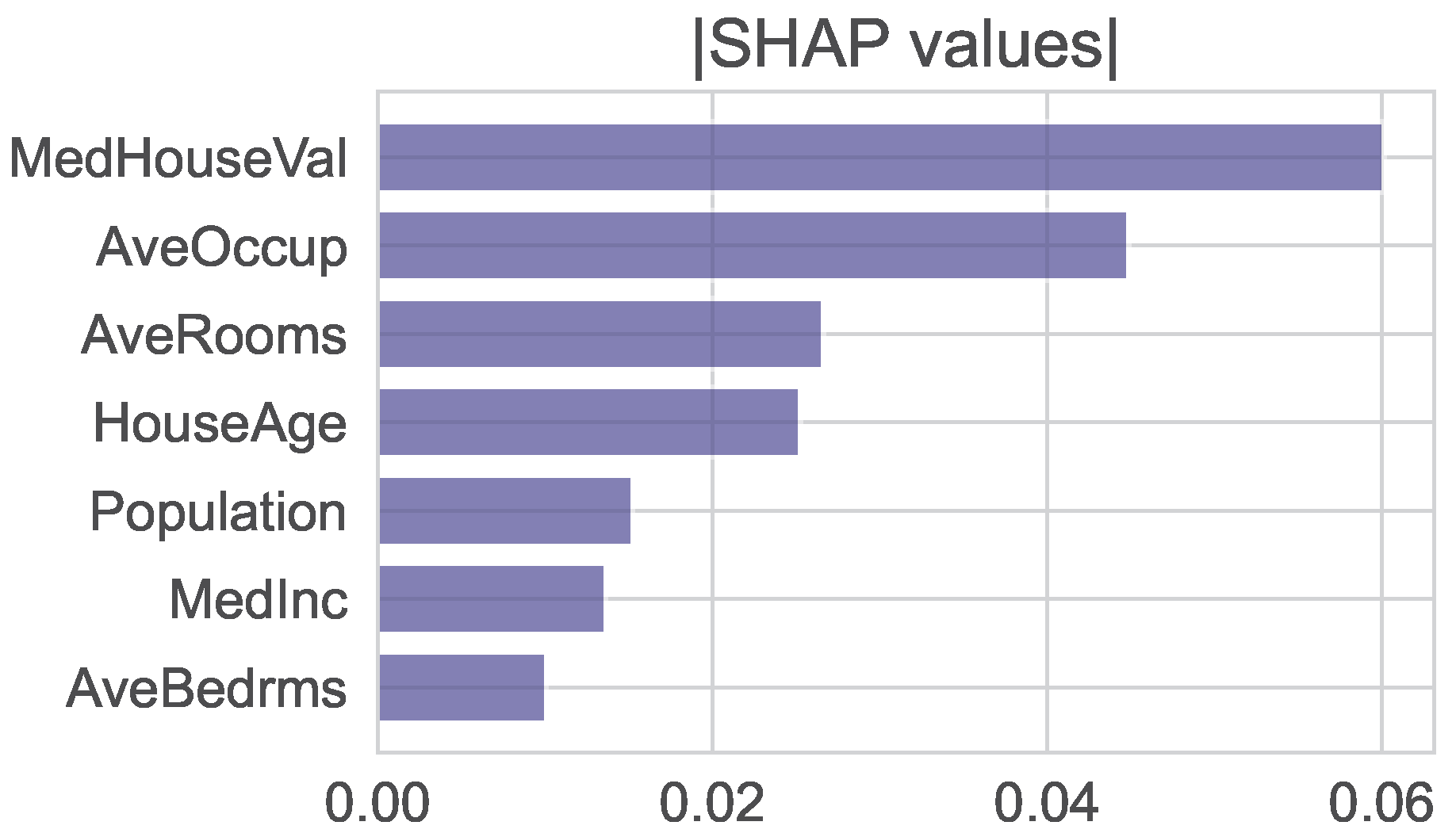
The number of boosting rounds is chosen automatically via early stopping. Since LightGBM does not natively support multivariate targets, we train two independent models, one per target component. - KNN: As we show below, RF feature importances suggest that MedHouseVal and AveOccup are the two most informative features. We standardize these two variables and train a KNN regressor using them. For a test input, we return the responses of the k nearest training points with uniform weights as the predictive distribution. Grid search selects .
- GP: A Gaussian-process-based baseline. Because exact GP inference is prohibitively expensive for , we use a scalable approximation: we generate 1000 random Fourier features using scikit-learn’s RBFSampler and fit a Bayesian linear model in the resulting feature space. To facilitate training, we first apply QuantileTransformer so that each feature is approximately standard normal. To obtain bivariate predictions, we fit two independent models (one per target component), each outputting a predictive mean and standard deviation. This independent modeling ignores cross-correlation between the two target components.
- NGBoost: Natural Gradient Boosting [37,38] (https://stanfordmlgroup.github.io/projects/ngboost/, accessed on 27 December 2025). It models predictive uncertainty by fitting a parametric distribution and optimizing its parameters using natural gradients. In our experiments, we use a bivariate normal distribution. We tune the hyperparameters over the grids below, using the loss. We do not constrain max_depth. The following hyperparameters are used:
- –
- learning_rate: → select .
- –
- min_samples_leaf: → select 100.
The number of boosting rounds is determined via early stopping. - TQF: We use 50 trees. We tune the hyperparameters over the grids below:
- –
- G: → select 10.
- –
- : → select 1.
- –
- T: → select 3.
- –
- min_samples_leaf: → select 5.
- Evaluation Metric
- Results
7. Conclusions
Funding
Data Availability Statement
Conflicts of Interest
Appendix A. Technical Background
Appendix A.1. Discrepancy Measures for Distributions
- Wasserstein Distance
- Sliced Wasserstein Distance
- Energy Distance
- Convexity
Appendix A.2. Radon Transform
Appendix A.3. Proper Scoring Rules
References
- Gneiting, T.; Katzfuss, M. Probabilistic Forecasting. Annu. Rev. Stat. Appl. 2014, 1, 125–151. [Google Scholar] [CrossRef] [Scilit]
- Caldeira, J.; Nord, B. Deeply uncertain: Comparing methods of uncertainty quantification in deep learning algorithms. Mach. Learn. Sci. Technol. 2020, 2, 015002. [Google Scholar] [CrossRef] [Scilit]
- Hüllermeier, E.; Waegeman, W. Aleatoric and epistemic uncertainty in machine learning: An introduction to concepts and methods. Mach. Learn. 2021, 110, 457–506. [Google Scholar] [CrossRef] [Scilit]
- Abdar, M.; Pourpanah, F.; Hussain, S.; Rezazadegan, D.; Liu, L.; Ghavamzadeh, M.; Fieguth, P.; Cao, X.; Khosravi, A.; Acharya, U.R.; et al. A review of uncertainty quantification in deep learning: Techniques, applications and challenges. Inf. Fusion 2021, 76, 243–297. [Google Scholar] [CrossRef] [Scilit]
- Bjerregård, M.B.; Møller, J.K.; Madsen, H. An introduction to multivariate probabilistic forecast evaluation. Energy AI 2021, 4, 100058. [Google Scholar] [CrossRef] [Scilit]
- He, W.; Jiang, Z.; Xiao, T.; Xu, Z.; Li, Y. A Survey on Uncertainty Quantification Methods for Deep Learning. ACM Comput. Surv. 2026, 58, 1–35. [Google Scholar] [CrossRef] [Scilit]
- Gawlikowski, J.; Tassi, C.R.N.; Ali, M.; Lee, J.; Humt, M.; Feng, J.; Kruspe, A.M.; Triebel, R.; Jung, P.; Roscher, R.; et al. A Survey of Uncertainty in Deep Neural Networks. Artif. Intell. Rev. 2023, 56, 1513–1589. [Google Scholar] [CrossRef] [Scilit]
- Tyralis, H.; Papacharalampous, G. A review of predictive uncertainty estimation with machine learning. Artif. Intell. Rev. 2024, 57, 94. [Google Scholar] [CrossRef] [Scilit]
- Klein, N. Distributional Regression for Data Analysis. Annu. Rev. Stat. Appl. 2024, 11, 321–346. [Google Scholar] [CrossRef] [Scilit]
- Wang, T.; Wang, Y.; Zhou, J.; Peng, B.; Song, X.; Zhang, C.; Sun, X.; Niu, Q.; Liu, J.; Chen, S.; et al. From Aleatoric to Epistemic: Exploring Uncertainty Quantification Techniques in Artificial Intelligence. arXiv 2025, arXiv:2501.03282. [Google Scholar] [CrossRef] [Scilit]
- Garnett, R. Bayesian Optimization; Cambridge University Press: Cambridge, UK, 2023. [Google Scholar]
- Gorishniy, Y.; Rubachev, I.; Khrulkov, V.; Babenko, A. Revisiting Deep Learning Models for Tabular Data. In Proceedings of the Advances in Neural Information Processing Systems 34: Annual Conference on Neural Information Processing Systems 2021, NeurIPS 2021, Virtual, 6–14 December 2021; pp. 18932–18943. [Google Scholar]
- Shwartz-Ziv, R.; Armon, A. Tabular data: Deep learning is not all you need. Inf. Fusion 2022, 81, 84–90. [Google Scholar] [CrossRef] [Scilit]
- Grinsztajn, L.; Oyallon, E.; Varoquaux, G. Why do tree-based models still outperform deep learning on typical tabular data? In Proceedings of the Advances in Neural Information Processing Systems 35: Annual Conference on Neural Information Processing Systems 2022, NeurIPS 2022, New Orleans, LA, USA, 28 November–9 December 2022. [Google Scholar]
- McElfresh, D.C.; Khandagale, S.; Valverde, J.; Vishak Prasad, C..; Ramakrishnan, G.; Goldblum, M.; White, C. When Do Neural Nets Outperform Boosted Trees on Tabular Data? In Proceedings of the Advances in Neural Information Processing Systems 36: Annual Conference on Neural Information Processing Systems 2023, NeurIPS 2023, New Orleans, LA, USA, 10–16 December 2023. [Google Scholar]
- Zabërgja, G.; Kadra, A.; Grabocka, J. Is Deep Learning finally better than Decision Trees on Tabular Data? arXiv 2024, arXiv:2402.03970. [Google Scholar]
- Somvanshi, S.; Das, S.; Javed, S.A.; Antariksa, G.; Hossain, A. A Survey on Deep Tabular Learning. arXiv 2024, arXiv:2410.12034. [Google Scholar] [CrossRef] [Scilit]
- Ren, W.; Zhao, T.; Huang, Y.; Honavar, V.G. Deep Learning within Tabular Data: Foundations, Challenges, Advances and Future Directions. arXiv 2025, arXiv:2501.03540. [Google Scholar] [CrossRef] [Scilit]
- Chen, T.; Guestrin, C. XGBoost: A Scalable Tree Boosting System. In Proceedings of the 22nd ACM SIGKDD International Conference on Knowledge Discovery and Data Mining (KDD ’16), New York, NY, USA, 13–17 August 2016; pp. 785–794. [Google Scholar] [CrossRef] [Scilit]
- Ke, G.; Meng, Q.; Finley, T.; Wang, T.; Chen, W.; Ma, W.; Ye, Q.; Liu, T.Y. LightGBM: A highly efficient gradient boosting decision tree. In Proceedings of the 31st International Conference on Neural Information Processing Systems (NIPS’17), Long Beach, CA, USA, 4–9 December 2017; pp. 3149–3157. [Google Scholar]
- Bouchacourt, D.; Kumar, M.P.; Nowozin, S. DISCO nets: Dissimilarity coefficient networks. In Proceedings of the 30th International Conference on Neural Information Processing Systems (NIPS’16), Red Hook, NY, USA, 5–10 December 2016; pp. 352–360. [Google Scholar]
- Russell, R.L.; Reale, C.P. Multivariate Uncertainty in Deep Learning. IEEE Trans. Neural Networks Learn. Syst. 2022, 33, 7937–7943. [Google Scholar] [CrossRef] [Scilit]
- Kan, K.; Aubet, F.X.; Januschowski, T.; Park, Y.; Benidis, K.; Ruthotto, L.; Gasthaus, J. Multivariate Quantile Function Forecaster. In Proceedings of the 25th International Conference on Artificial Intelligence and Statistics; Camps-Valls, G., Ruiz, F.J.R., Valera, I., Eds.; Proceedings of Machine Learning Research (PMLR): Cambridge, MA, USA, 2022; Volume 151, pp. 10603–10621. [Google Scholar]
- Kanazawa, T.; Gupta, C. Sample-based Uncertainty Quantification with a Single Deterministic Neural Network. In Proceedings of the 14th International Joint Conference on Computational Intelligence, IJCCI 2022, Valletta, Malta, 24–26 October 2022; SCITEPRESS: Setúbal, Portugal, 2022; pp. 292–304. [Google Scholar] [CrossRef] [Scilit]
- Vedula, S.; Tallini, I.; Rosenberg, A.A.; Pegoraro, M.; Rodolà, E.; Romano, Y.; Bronstein, A. Continuous Vector Quantile Regression. In Proceedings of the ICML Workshop on New Frontiers in Learning, Control, and Dynamical Systems, Online, 28 July 2023. [Google Scholar]
- Feldman, S.; Bates, S.; Romano, Y. Calibrated Multiple-Output Quantile Regression with Representation Learning. J. Mach. Learn. Res. 2023, 24, 1–48. [Google Scholar]
- Braun, S.; Aolaritei, L.; Jordan, M.I.; Bach, F.R. Minimum Volume Conformal Sets for Multivariate Regression. arXiv 2025, arXiv:2503.19068. [Google Scholar] [CrossRef] [Scilit]
- Cramér, H.; Wold, H. Some Theorems on Distribution Functions. J. Lond. Math. Soc. 1936, 11, 290–294. [Google Scholar] [CrossRef] [Scilit]
- Meinshausen, N. Quantile Regression Forests. J. Mach. Learn. Res. 2006, 7, 983–999. [Google Scholar]
- Rasmussen, C.E.; Williams, C.K.I. Gaussian Processes for Machine Learning; The MIT Press: Cambridge, MA, USA, 2005. [Google Scholar] [CrossRef] [Scilit]
- Sugiyama, M.; Takeuchi, I.; Suzuki, T.; Kanamori, T.; Hachiya, H.; Okanohara, D. Conditional Density Estimation via Least-Squares Density Ratio Estimation. In Proceedings of the Thirteenth International Conference on Artificial Intelligence and Statistics, Chia Laguna Resort, Sardinia, Italy, 13–15 May 2010; Teh, Y.W., Titterington, M., Eds.; Proceedings of Machine Learning Research: Cambridge, MA, USA, 13–15 May 2010; Volume 9, pp. 781–788. [Google Scholar]
- Hallin, M.; Paindaveine, D.; Šiman, M. Multivariate quantiles and multiple-output regression quantiles: From L1 optimization to halfspace depth. Ann. Stat. 2010, 38, 635–669. [Google Scholar] [CrossRef] [Scilit]
- Paindaveine, D.; Šiman, M. On directional multiple-output quantile regression. J. Multivar. Anal. 2011, 102, 193–212. [Google Scholar] [CrossRef] [Scilit]
- Kong, L.; Mizera, I. Quantile tomography: Using quantiles with multivariate data. Stat. Sin. 2012, 22, 1589–1610. [Google Scholar] [CrossRef] [Scilit]
- Schlosser, L.; Hothorn, T.; Stauffer, R.; Zeileis, A. Distributional regression forests for probabilistic precipitation forecasting in complex terrain. Ann. Appl. Stat. 2019, 13, 1564–1589. [Google Scholar] [CrossRef] [Scilit]
- Athey, S.; Tibshirani, J.; Wager, S. Generalized random forests. Ann. Stat. 2019, 47, 1148–1178. [Google Scholar] [CrossRef] [Scilit]
- Duan, T.; Avati, A.; Ding, D.Y.; Thai, K.K.; Basu, S.; Ng, A.Y.; Schuler, A. NGBoost: Natural Gradient Boosting for Probabilistic Prediction. In Proceedings of the 37th International Conference on Machine Learning, ICML 2020, Virtual Event, 13–18 July 2020; Proceedings of Machine Learning Research (PMLR): Cambridge, MA, USA, 2020; Volume 119, pp. 2690–2700. [Google Scholar]
- O’Malley, M.; Sykulski, A.M.; Lumpkin, R.; Schuler, A. Multivariate Probabilistic Regression with Natural Gradient Boosting. arXiv 2021, arXiv:2106.03823. [Google Scholar] [CrossRef] [Scilit]
- Hothorn, T.; Zeileis, A. Transformation Forests. arXiv 2017, arXiv:1701.02110. [Google Scholar]
- Hothorn, T.; Zeileis, A. Predictive Distribution Modeling Using Transformation Forests. J. Comput. Graph. Stat. 2021, 30, 1181–1196. [Google Scholar] [CrossRef] [Scilit]
- Du, Q.; Biau, G.; Petit, F.; Porcher, R. Wasserstein Random Forests and Applications in Heterogeneous Treatment Effects. In Proceedings of the 24th International Conference on Artificial Intelligence and Statistics; Proceedings of Machine Learning Research (PMLR): Cambridge, MA, USA, 2021; Volume 130, pp. 1729–1737. [Google Scholar]
- März, A. XGBoostLSS—An extension of XGBoost to probabilistic forecasting. arXiv 2019, arXiv:1907.03178. [Google Scholar]
- März, A.; Kneib, T. Distributional Gradient Boosting Machines. arXiv 2022, arXiv:2204.00778. [Google Scholar] [CrossRef] [Scilit]
- März, A. Multi-Target XGBoostLSS Regression. arXiv 2022, arXiv:LG/2210.06831. [Google Scholar]
- Cevid, D.; Michel, L.; Näf, J.; Bühlmann, P.; Meinshausen, N. Distributional Random Forests: Heterogeneity Adjustment and Multivariate Distributional Regression. J. Mach. Learn. Res. 2022, 23, 1–79. [Google Scholar]
- Näf, J.; Emmenegger, C.; Bühlmann, P.; Meinshausen, N. Confidence and Uncertainty Assessment for Distributional Random Forests. J. Mach. Learn. Res. 2023, 24, 1–77. [Google Scholar]
- Chen, H.; Müller, H.G. Sliced Wasserstein Regression. arXiv 2023, arXiv:2306.10601. [Google Scholar]
- Matsubara, T. Wasserstein Gradient Boosting: A Framework for Distribution-Valued Supervised Learning. In Proceedings of the Advances in Neural Information Processing Systems 38: Annual Conference on Neural Information Processing Systems 2024, NeurIPS 2024, Vancouver, BC, Canada, 10–15 December 2024. [Google Scholar]
- del Barrio, E.; Sanz, A.G.; Hallin, M. Nonparametric Multiple-Output Center-Outward Quantile Regression. J. Am. Stat. Assoc. 2024, 120, 818–832. [Google Scholar] [CrossRef] [Scilit]
- Koenker, R. Quantile Regression; Cambridge University Press: Cambridge, UK, 2005. [Google Scholar]
- Newey, W.K.; Powell, J.L. Asymmetric Least Squares Estimation and Testing. Econometrica 1987, 55, 819–847. [Google Scholar] [CrossRef] [Scilit]
- Artzner, P.; Delbaen, F.; Eber, J.M.; Heath, D. Coherent Measures of Risk. Math. Financ. 1999, 9, 203–228. [Google Scholar] [CrossRef] [Scilit]
- Gneiting, T. Making and Evaluating Point Forecasts. J. Am. Stat. Assoc. 2011, 106, 746–762. [Google Scholar] [CrossRef] [Scilit]
- Taylor, J.W. A quantile regression neural network approach to estimating the conditional density of multiperiod returns. J. Forecast. 2000, 19, 299–311. [Google Scholar] [CrossRef]
- Cannon, A.J. Quantile regression neural networks: Implementation in R and application to precipitation downscaling. Comput. Geosci. 2011, 37, 1277–1284. [Google Scholar] [CrossRef] [Scilit]
- Breiman, L. Random Forests. Mach. Learn. 2001, 45, 5–32. [Google Scholar] [CrossRef] [Scilit]
- Hastie, T.; Tibshirani, R.; Friedman, J. The Elements of Statistical Learning; Springer Series in Statistics; Springer: New York, NY, USA, 2009. [Google Scholar] [CrossRef]
- Villani, C. Topics in Optimal Transportation; Graduate Studies in Mathematics; American Mathematical Society: Providence, RI, USA, 2003; Volume 58. [Google Scholar]
- Villani, C. Optimal Transport—Old and New; Grundlehren der mathematischen Wissenschaften; Springer: Berlin/Heidelberg, Germany, 2009; Volume 338. [Google Scholar] [CrossRef] [Scilit]
- Peyré, G.; Cuturi, M. Computational Optimal Transport. Found. Trends Mach. Learn. 2019, 11, 355–607. [Google Scholar] [CrossRef] [Scilit]
- Montesuma, E.F.; Mboula, F.M.N.; Souloumiac, A. Recent Advances in Optimal Transport for Machine Learning. IEEE Trans. Pattern Anal. Mach. Intell. 2025, 47, 1161–1180. [Google Scholar] [CrossRef] [Scilit]
- Peyré, G. Optimal Transport for Machine Learners. arXiv 2025, arXiv:2505.06589. [Google Scholar] [CrossRef] [Scilit]
- Borchani, H.; Varando, G.; Bielza, C.; Larrañaga, P. A survey on multi-output regression. WIREs Data Min. Knowl. Discov. 2015, 5, 216–233. [Google Scholar] [CrossRef] [Scilit]
- Waegeman, W.; Dembczyński, K.; Hüllermeier, E. Multi-target prediction: A unifying view on problems and methods. Data Min. Knowl. Disc. 2019, 33, 293–324. [Google Scholar] [CrossRef] [Scilit]
- Xu, D.; Shi, Y.; Tsang, I.W.; Ong, Y.S.; Gong, C.; Shen, X. Survey on Multi-Output Learning. IEEE Trans. Neural Netw. Learn. Syst. 2020, 31, 2409–2429. [Google Scholar] [CrossRef] [Scilit]
- Serfling, R. Quantile functions for multivariate analysis: Approaches and applications. Stat. Neerl. 2002, 56, 214–232. [Google Scholar] [CrossRef] [Scilit]
- Carlier, G.; Chernozhukov, V.; Galichon, A. Vector quantile regression: An optimal transport approach. Ann. Stat. 2016, 44, 1165–1192. [Google Scholar] [CrossRef] [Scilit]
- Hallin, M.; del Barrio, E.; Cuesta-Albertos, J.; Matrán, C. Distribution and quantile functions, ranks and signs in dimension d: A measure transportation approach. Ann. Stat. 2021, 49, 1139–1165. [Google Scholar] [CrossRef] [Scilit]
- Rasul, K.; Seward, C.; Schuster, I.; Vollgraf, R. Autoregressive Denoising Diffusion Models for Multivariate Probabilistic Time Series Forecasting. In Proceedings of the 38th International Conference on Machine Learning; Proceedings of Machine Learning Research (PMLR): Cambridge, MA, USA, 2021; Volume 139, pp. 8857–8868. [Google Scholar]
- Gretton, A.; Borgwardt, K.M.; Rasch, M.J.; Schölkopf, B.; Smola, A.J. A Kernel Method for the Two-Sample-Problem. In Proceedings of the Advances in Neural Information Processing Systems 19: Proceedings of the 2006 Conference; MIT Press: Cambridge, MA, USA, 2006; pp. 513–520. [Google Scholar]
- Gretton, A.; Borgwardt, K.M.; Rasch, M.J.; Schölkopf, B.; Smola, A.J. A Kernel Two-Sample Test. J. Mach. Learn. Res. 2012, 13, 723–773. [Google Scholar]
- Petersen, A.; Müller, H.G. Fréchet regression for random objects with Euclidean predictors. Ann. Stat. 2019, 47, 691–719. [Google Scholar] [CrossRef] [Scilit]
- Rabin, J.; Peyré, G.; Delon, J.; Bernot, M. Wasserstein Barycenter and Its Application to Texture Mixing. In Proceedings of the Scale Space and Variational Methods in Computer Vision—Third International Conference, SSVM 2011 Lecture Notes in Computer Science, Ein-Gedi, Israel, 29 May–2 June 2011; Revised Selected Papers; Lecture Notes in Computer Science; Springer: Berlin, Germany, 2011; Volume 6667, pp. 435–446. [Google Scholar] [CrossRef] [Scilit]
- Bonneel, N.; Rabin, J.; Peyré, G.; Pfister, H. Sliced and Radon Wasserstein Barycenters of Measures. J. Math. Imaging Vis. 2015, 51, 22–45. [Google Scholar] [CrossRef] [Scilit]
- De’ath, G. Multivariate Regression Trees: A New Technique for Modeling Species-Environment Relationships. Ecology 2002, 83, 1105–1117. [Google Scholar] [CrossRef] [Scilit]
- Kocev, D.; Vens, C.; Struyf, J.; Džeroski, S. Ensembles of Multi-Objective Decision Trees. In Proceedings of the Machine Learning: ECML 2007; Lecture Notes in Computer Science; Springer: Berlin/Heidelberg, Germany, 2007; Volume 4701, pp. 624–631. [Google Scholar] [CrossRef] [Scilit]
- Denil, M.; Matheson, D.; De Freitas, N. Narrowing the Gap: Random Forests In Theory and In Practice. In Proceedings of the 31st International Conference on Machine Learning, Bejing, China, 21–26 June 2014; Volume 32, pp. 665–673. [Google Scholar]
- Wager, S.; Athey, S. Estimation and Inference of Heterogeneous Treatment Effects using Random Forests. J. Am. Stat. Assoc. 2018, 113, 1228–1242. [Google Scholar] [CrossRef] [Scilit]
- Scikit-Garden. 2017. Available online: https://github.com/scikit-garden/scikit-garden (accessed on 27 December 2025).
- Meinshausen, N.; Michel, L. quantregForest. 2017. Available online: https://cran.r-project.org/web/packages/quantregForest/index.html (accessed on 27 December 2025).
- Johnson, R.A. quantile-forest: A Python Package for Quantile Regression Forests. J. Open Source Softw. 2024, 9, 5976. [Google Scholar] [CrossRef] [Scilit]
- Gretton, A.; Sriperumbudur, B.K.; Sejdinovic, D.; Strathmann, H.; Balakrishnan, S.; Pontil, M.; Fukumizu, K. Optimal kernel choice for large-scale two-sample tests. In Proceedings of the Advances in Neural Information Processing Systems 25: 26th Annual Conference on Neural Information Processing Systems, Lake Tahoe, NV, USA, 3–6 December 2012; pp. 1214–1222. [Google Scholar]
- Bischoff, S.; Darcher, A.; Deistler, M.; Gao, R.; Gerken, F.; Glöckler, M.; Haxel, L.; Kapoor, J.; Lappalainen, J.K.; Macke, J.H.; et al. A Practical Guide to Sample-based Statistical Distances for Evaluating Generative Models in Science. arXiv 2024, arXiv:2403.12636. [Google Scholar]
- Khosravi, A.; Nahavandi, S.; Creighton, D. Construction of Optimal Prediction Intervals for Load Forecasting Problems. IEEE Trans. Power Syst. 2010, 25, 1496–1503. [Google Scholar] [CrossRef] [Scilit]
- Pearce, T.; Brintrup, A.; Zaki, M.; Neely, A. High-Quality Prediction Intervals for Deep Learning: A Distribution-Free, Ensembled Approach. In Proceedings of the 35th International Conference on Machine Learning, Stockholm, Sweden, 10–15 July 2018; Volume 80, pp. 4075–4084. [Google Scholar]
- Sluijterman, L.; Cator, E.; Heskes, T. How to evaluate uncertainty estimates in machine learning for regression? Neural Netw. 2024, 173, 106203. [Google Scholar] [CrossRef] [Scilit] [PubMed]
- Wibbeke, J.; Schönfisch, N.; Rohjans, S.; Rauh, A. Evaluating the Quality of the Quantified Uncertainty for (Re)Calibration of Data-Driven Regression Models. arXiv 2025, arXiv:2508.17761. [Google Scholar]
- Yeh, I.C. Concrete Compressive Strength; UCI Machine Learning Repository: Irvine, CA, USA, 1998. [Google Scholar] [CrossRef]
- Efron, B.; Hastie, T.; Johnstone, I.; Tibshirani, R. Least angle regression. Ann. Stat. 2004, 32, 407–499. [Google Scholar] [CrossRef] [Scilit]
- Brooks, T.; Pope, D.; Marcolini, M. Airfoil Self-Noise; UCI Machine Learning Repository: Irvine, CA, USA, 1989. [Google Scholar] [CrossRef]
- Shafer, G.; Vovk, V. A Tutorial on Conformal Prediction. J. Mach. Learn. Res. 2008, 9, 371–421. [Google Scholar] [CrossRef] [Scilit]
- Fontana, M.; Zeni, G.; Vantini, S. Conformal prediction: A unified review of theory and new challenges. Bernoulli 2023, 29, 1–23. [Google Scholar] [CrossRef] [Scilit]
- Angelopoulos, A.N.; Bates, S. Conformal Prediction: A Gentle Introduction. Found. Trends Mach. Learn. 2023, 16, 494–591. [Google Scholar] [CrossRef] [Scilit]
- He, X. Quantile Curves without Crossing. Am. Stat. 1997, 51, 186–192. [Google Scholar] [CrossRef] [Scilit]
- Zhao, Q. Restricted Regression Quantiles. J. Multivar. Anal. 2000, 72, 78–99. [Google Scholar] [CrossRef] [Scilit]
- Andrychowicz, M.; Crow, D.; Ray, A.; Schneider, J.; Fong, R.; Welinder, P.; McGrew, B.; Tobin, J.; Abbeel, P.; Zaremba, W. Hindsight Experience Replay. In Proceedings of the Advances in Neural Information Processing Systems 30: Annual Conference on Neural Information Processing Systems 2017, Long Beach, CA, USA, 4–9 December 2017; pp. 5048–5058. [Google Scholar]
- Tsoumakas, G.; Spyromitros-Xioufis, E.; Vrekou, A.; Vlahavas, I. Multi-target Regression via Random Linear Target Combinations. In Proceedings of the Machine Learning and Knowledge Discovery in Databases; Springer: Berlin/Heidelberg, Germany, 2014; pp. 225–240. [Google Scholar] [CrossRef] [Scilit]
- Yamaguchi, T.; Yamashita, Y. Multi-target regression via target combinations using principal component analysis. Comput. Chem. Eng. 2024, 181, 108510. [Google Scholar] [CrossRef] [Scilit]
- Louppe, G. Understanding Random Forests: From Theory to Practice. arXiv 2014, arXiv:1407.7502. [Google Scholar]
- Hyndman, R.J.; Fan, Y. Sample Quantiles in Statistical Packages. Am. Stat. 1996, 50, 361–365. [Google Scholar] [CrossRef] [Scilit]
- Claici, S.; Chien, E.; Solomon, J. Stochastic Wasserstein Barycenters. In Proceedings of the 35th International Conference on Machine Learning; Proceedings of Machine Learning Research (PMLR): Cambridge, MA, USA, 2018; Volume 80, pp. 999–1008. [Google Scholar]
- Rubinstein, R. The Cross-Entropy Method for Combinatorial and Continuous Optimization. Methodol. Comput. Appl. Probab. 1999, 1, 127–190. [Google Scholar] [CrossRef] [Scilit]
- Hyndman, R.J. Computing and Graphing Highest Density Regions. Am. Stat. 1996, 50, 120–126. [Google Scholar] [CrossRef] [Scilit] [PubMed]
- Virtanen, P.; Gommers, R.; Oliphant, T.E.; Haberland, M.; Reddy, T.; Cournapeau, D.; Burovski, E.; Peterson, P.; Weckesser, W.; Bright, J.; et al. SciPy 1.0: Fundamental Algorithms for Scientific Computing in Python. Nat. Methods 2020, 17, 261–272. [Google Scholar] [CrossRef] [Scilit] [PubMed]
- Pedregosa, F.; Varoquaux, G.; Gramfort, A.; Michel, V.; Thirion, B.; Grisel, O.; Blondel, M.; Prettenhofer, P.; Weiss, R.; Dubourg, V.; et al. Scikit-learn: Machine Learning in Python. J. Mach. Learn. Res. 2011, 12, 2825–2830. [Google Scholar]
- Goldman, L.W. Principles of CT and CT Technology. J. Nucl. Med. Technol. 2007, 35, 115–128. [Google Scholar] [CrossRef] [Scilit]
- Biewen, M.; Glaisner, S. Using Distributional Random Forests for the Analysis of the Income Distribution; IZA Discussion Papers 17774; Institute of LaborEconomics (IZA): Bonn, Germany, 2025. [Google Scholar]
- Kelley Pace, R.; Barry, R. Sparse spatial autoregressions. Stat. Probab. Lett. 1997, 33, 291–297. [Google Scholar] [CrossRef] [Scilit]
- Lundberg, S.M.; Lee, S. A Unified Approach to Interpreting Model Predictions. In Proceedings of the Advances in Neural Information Processing Systems 30: Annual Conference on Neural Information Processing Systems 2017, Long Beach, CA, USA, 4–9 December 2017; pp. 4765–4774. [Google Scholar]
- Csiszár, I.; Shields, P.C. Information Theory and Statistics: A Tutorial. Found. Trends Commun. Inf. Theory 2004, 1, 417–528. [Google Scholar] [CrossRef] [Scilit]
- Szabo, A.; Boucher, K.; Carroll, W.L.; Klebanov, L.B.; Tsodikov, A.D.; Yakovlev, A.Y. Variable selection and pattern recognition with gene expression data generated by the microarray technology. Math. Biosci. 2002, 176, 71–98. [Google Scholar] [CrossRef] [Scilit]
- Szabo, A.; Boucher, K.; Jones, D.; Tsodikov, A.D.; Klebanov, L.B.; Yakovlev, A.Y. Multivariate exploratory tools for microarray data analysis. Biostatistics 2003, 4, 555–567. [Google Scholar] [CrossRef] [Scilit]
- Baringhaus, L.; Franz, C. On a new multivariate two-sample test. J. Multivar. Anal. 2004, 88, 190–206. [Google Scholar] [CrossRef] [Scilit]
- Székely, G.J.; Rizzo, M.L. Testing for Equal Distributions in High Dimension. InterStat 2004, 5. [Google Scholar]
- Klebanov, L.B. N-Distances and Their Applications; Charles University, Karolinum Press: Prague, Czech Republic, 2005. [Google Scholar]
- Baringhaus, L.; Franz, C. Rigid motion invariant two-sample tests. Stat. Sin. 2010, 20, 1333–1361. [Google Scholar]
- Székely, G.J.; Rizzo, M.L. Energy statistics: A class of statistics based on distances. J. Stat. Plan. Inference 2013, 143, 1249–1272. [Google Scholar] [CrossRef] [Scilit]
- Székely, G.J.; Rizzo, M.L. Energy distance. WIREs Comput. Stat. 2016, 8, 27–38. [Google Scholar] [CrossRef] [Scilit]
- Deans, S.R. The Radon Transform and Some of Its Applications; Wiley: New York, NY, USA, 1983. [Google Scholar]
- Helgason, S. The Radon Transform; Progress in Mathematics; Springer: New York, NY, USA, 1999. [Google Scholar] [CrossRef] [Scilit]
- Hsieh, J. Computed Tomography: Principles, Design, Artifacts, and Recent Advances, 3rd ed.; SPIE: Bellingham, WA, USA, 2015. [Google Scholar] [CrossRef] [Scilit]
- Willemink, M.J.; Noël, P.B. The evolution of image reconstruction for CT—From filtered back projection to artificial intelligence. Eur. Radiol. 2019, 29, 2185–2195. [Google Scholar] [CrossRef] [Scilit]
- Bracewell, R.N.; Riddle, A.C. Inversion of Fan-Beam Scans in Radio Astronomy. Astrophys. J. 1967, 150, 427–434. [Google Scholar] [CrossRef] [Scilit]
- Ramachandran, G.N.; Lakshminarayanan, A.V. Three-dimensional Reconstruction from Radiographs and Electron Micrographs: Application of Convolutions instead of Fourier Transforms. Proc. Natl. Acad. Sci. USA 1971, 68, 2236–2240. [Google Scholar] [CrossRef] [Scilit] [PubMed]
- Logan, B.F.; Shepp, L.A. Optimal reconstruction of a function from its projections. Duke Math. J. 1975, 42, 645–659. [Google Scholar] [CrossRef] [Scilit]
- Boas, F.E.; Fleischmann, D. CT artifacts: Causes and reduction techniques. Imaging Med. 2012, 4, 229–240. [Google Scholar]
- Purisha, Z.; Jidling, C.; Wahlström, N.; Schön, T.B.; Särkkä, S. Probabilistic approach to limited-data computed tomography reconstruction. Inverse Probl. 2019, 35, 105004. [Google Scholar] [CrossRef] [Scilit]
- Gneiting, T.; Raftery, A.E. Strictly Proper Scoring Rules, Prediction, and Estimation. J. Am. Stat. Assoc. 2007, 102, 359–378. [Google Scholar] [CrossRef] [Scilit]
- Alexander, C.; Coulon, M.; Han, Y.; Meng, X. Evaluating the discrimination ability of proper multi-variate scoring rules. Ann. Oper. Res. 2024, 334, 857–883. [Google Scholar] [CrossRef] [Scilit]
- Pic, R.; Dombry, C.; Naveau, P.; Taillardat, M. Proper scoring rules for multivariate probabilistic forecasts based on aggregation and transformation. Adv. Stat. Climatol. Meteorol. Oceanogr. 2025, 11, 23–58. [Google Scholar] [CrossRef] [Scilit]
- Waghmare, K.; Ziegel, J. Proper Scoring Rules for Estimation and Forecast Evaluation. Annu. Rev. Stat. Appl. 2025, 13, 271–296. [Google Scholar] [CrossRef] [Scilit]
- Matheson, J.E.; Winkler, R.L. Scoring Rules for Continuous Probability Distributions. Manag. Sci. 1976, 22, 1087–1096. [Google Scholar] [CrossRef] [Scilit]
- Korotin, A.; V’yugin, V.; Burnaev, E. Mixability of integral losses: A key to efficient online aggregation of functional and probabilistic forecasts. Pattern Recognit. 2021, 120, 108175. [Google Scholar] [CrossRef] [Scilit]













| Admits | Nonpara- Metric | Use NNs | Use Decision Trees | Limited to Convex Predictive Regions | Curse of Dimensionality When Is High | |
|---|---|---|---|---|---|---|
| Rasmussen & Williams 2005 [30] | Yes | No | No | No | Yes | No |
| Meinshausen 2006 [29] | No | Yes | No | Yes | No | No |
| Sugiyama et al., 2010 [31] | Yes | Yes | No | No | No | Yes |
| Hallin et al., 2010 [32] | Yes | Yes | No | No | Yes | No |
| Paindaveine & Šiman 2011 [33] | Yes | Yes | No | No | Yes | No |
| Kong & Mizera 2012 [34] | Yes | Yes | No | No | Yes | No |
| Bouchacourt et al., 2016 [21] | Yes | Yes | Yes | No | No | No |
| Schlosser et al., 2019 [35] | No | No | No | Yes | No | No |
| Athey et al., 2019 [36] | No | Yes | No | Yes | No | No |
| Duan et al., 2020 [37] and O’Malley et al., 2021 [38] | Yes | No | No | Yes | No | No |
| Hothorn & Zeileis 2017, 2021 [39,40] | No | No | No | Yes | No | No |
| Du et al., 2021 [41] | Yes | Yes | No | Yes | No | No |
| März 2019 [42], März & Kneib 2022 [43], and März 2022 [44] | Yes | Yes | No | Yes | No | No |
| Russell & Reale [22] | Yes | No | Yes | No | Yes | No |
| Kanazawa & Gupta 2022 [24] | Yes | Yes | Yes | No | No | No |
| Kan et al., 2022 [23] | Yes | Yes | Yes | No | No | No |
| Vedula et al., 2023 [25] | Yes | Yes | Yes | No | No | No |
|
Cevid et al., 2022 [45] and Näf et al., 2023 [46] | Yes | Yes | No | Yes | No | No |
| Feldman et al., 2023 [26] | Yes | Yes | Yes | No | No | No |
| Chen & Müller 2023 [47] | Yes | Yes | No | No | No | Yes |
| Matsubara 2024 [48] | No | Yes | No | Yes | No | No |
| Barrio et al., 2024 [49] | Yes | Yes | No | No | No | Yes |
| This Work | Yes | Yes | No | Yes | No | No |
| Dataset | # Instances | # Input Features | Reference |
|---|---|---|---|
| Concrete | 1030 | 8 | [88] |
| Diabetes | 442 | 10 | [89] |
| Airfoil | 1503 | 5 | [90] |
| a(x) | Point | Naïve | GMM1 | GMM2 | GMM3 | TQF | Oracle |
|---|---|---|---|---|---|---|---|
| 0.1 | 0.586(5) | 0.205(5) | 0.079(6) | 0.035(5) | 0.023(5) | 0.038(7) | 0.025(9) |
| 0.2 | 0.601(5) | 0.166(6) | 0.090(7) | 0.051(4) | 0.040(4) | 0.033(6) | 0.027(8) |
| 0.3 | 0.619(3) | 0.127(6) | 0.106(5) | 0.072(4) | 0.056(5) | 0.038(9) | 0.025(8) |
| 0.4 | 0.633(2) | 0.098(4) | 0.118(5) | 0.086(4) | 0.055(4) | 0.039(6) | 0.025(8) |
| 0.5 | 0.638(1) | 0.086(3) | 0.121(4) | 0.094(4) | 0.054(3) | 0.043(12) | 0.026(7) |
| (15,1) | (15,5) | (15,10) | (15,15) | (1,10) | (5,10) | (10,10) | (20,10) | |
|---|---|---|---|---|---|---|---|---|
| 0.1 | 0.067(23) | 0.042(16) | 0.036(14) | 0.039(18) | 0.050(13) | 0.046(22) | 0.037(13) | 0.053(26) |
| 0.2 | 0.055(10) | 0.037(5) | 0.035(5) | 0.038(4) | 0.046(7) | 0.035(6) | 0.038(6) | 0.036(5) |
| 0.3 | 0.045(11) | 0.046(11) | 0.040(13) | 0.043(11) | 0.060(16) | 0.043(10) | 0.043(7) | 0.045(14) |
| 0.4 | 0.054(12) | 0.045(10) | 0.043(10) | 0.045(10) | 0.055(9) | 0.045(8) | 0.045(7) | 0.041(7) |
| 0.5 | 0.061(17) | 0.048(17) | 0.051(22) | 0.051(18) | 0.059(16) | 0.053(16) | 0.050(17) | 0.051(17) |
| a(x) | Point | Naïve | GMM1 | GMM2 | GMM3 | TQF | Oracle |
|---|---|---|---|---|---|---|---|
| 0.1 | 0.920(8) | 0.208(6) | 0.196(7) | 0.110(25) | 0.058(9) | 0.056(12) | 0.035(11) |
| 0.2 | 0.920(8) | 0.207(6) | 0.196(7) | 0.110(25) | 0.058(9) | 0.050(14) | 0.035(11) |
| 0.3 | 0.920(8) | 0.192(5) | 0.196(7) | 0.110(25) | 0.058(9) | 0.060(19) | 0.035(11) |
| 0.4 | 0.920(8) | 0.164(4) | 0.196(7) | 0.110(25) | 0.058(9) | 0.063(16) | 0.035(11) |
| 0.5 | 0.920(8) | 0.136(4) | 0.196(7) | 0.110(25) | 0.058(9) | 0.065(20) | 0.035(11) |
| ED (↓) | ES (↓) | NLL (↓) | |
|---|---|---|---|
| TQF | 0.290(133) | 0.538(18) | 2.01(69) |
| DRF | 0.345(109) | 0.544(21) | 1.86(26) |
| p-value | 0.238 |
| Simple | RF* | LightGBM* | KNN | GP | NGBoost | TQF | |
|---|---|---|---|---|---|---|---|
| 0.202(7) | 0.204(8) | ||||||
| ES | 0.215(122) | 0.216(128) |
Disclaimer/Publisher’s Note: The statements, opinions and data contained in all publications are solely those of the individual author(s) and contributor(s) and not of MDPI and/or the editor(s). MDPI and/or the editor(s) disclaim responsibility for any injury to people or property resulting from any ideas, methods, instructions or products referred to in the content. |
© 2026 by the author. Licensee MDPI, Basel, Switzerland. This article is an open access article distributed under the terms and conditions of the Creative Commons Attribution (CC BY) license.
Share and Cite
Kanazawa, T. Multivariate Uncertainty Quantification with Tomographic Quantile Forests. Math. Comput. Appl. 2026, 31, 53. https://doi.org/10.3390/mca31020053
Kanazawa T. Multivariate Uncertainty Quantification with Tomographic Quantile Forests. Mathematical and Computational Applications. 2026; 31(2):53. https://doi.org/10.3390/mca31020053
Chicago/Turabian StyleKanazawa, Takuya. 2026. "Multivariate Uncertainty Quantification with Tomographic Quantile Forests" Mathematical and Computational Applications 31, no. 2: 53. https://doi.org/10.3390/mca31020053
APA StyleKanazawa, T. (2026). Multivariate Uncertainty Quantification with Tomographic Quantile Forests. Mathematical and Computational Applications, 31(2), 53. https://doi.org/10.3390/mca31020053