


Article

A Belief Model for BDI Agents Derived from Roles and Personality Traits
by
Eduardo David Martínez-Hernández
*,
Bárbara María-Esther García-Morales
,
María Lucila Morales-Rodríguez
*,
Claudia Guadalupe Gómez-Santillán
and
Nelson Rangel-Valdez
División de Estudios de Posgrado e Investigación, Tecnológico Nacional de México/I.T. Ciudad Madero, Av. Primero de Mayo, Col. Los Mangos, Ciudad Madero 89440, Tamaulipas, Mexico
*
Authors to whom correspondence should be addressed.
Math. Comput. Appl. 2026, 31(2), 37; https://doi.org/10.3390/mca31020037
Submission received: 31 December 2025 / Revised: 3 February 2026 / Accepted: 7 February 2026 / Published: 3 March 2026
(This article belongs to the Special Issue Numerical and Evolutionary Optimization 2025)

Abstract

Recent advancements in AI have enabled autonomous agents to interact within complex environments, with deliberative BDI (Belief–Desire–Intention) agents standing out for their human-inspired reasoning capabilities. However, defining the initial beliefs that constitute an agent’s cognitive profile remains a significant challenge. This process often relies on manual approaches that limit scalability and validation. This study proposes the Personality–Role–Belief (P–R–B) Model for BDI agents, introducing a novel architecture for generating cognitive profiles applicable to domains such as social simulation and non-player characters (NPCs). The model translates Five-Factor Model (FFM) scores into specific social roles, assigning base beliefs to each. A key contribution is a weighting mechanism designed to resolve conflicts between beliefs when multiple roles coexist. Inspired by Cohen’s effect size conventions, this mechanism establishes an influence hierarchy that quantifies belief strength based on social roles. Consequently, this approach not only enables agents to exhibit coherent behavior consistent with their personality but also establishes a foundation for modeling ethical decision-making through role–trait alignment, thereby facilitating the creation of agents capable of navigating morally complex social contexts.

1. Introduction

Although the BDI architecture has established itself as one of the most popular approaches for designing deliberative agents [1,2,3], defining the initial set of beliefs remains a significant challenge. This difficulty stems primarily from the absence of a systematic methodology capable of translating agent attributes, such as the personality profile, into a logically congruent set of beliefs. It is imperative that this process generates a cognitive profile that faithfully reflects the agent’s behavioral tendencies, thereby ensuring coherence between its psychological disposition and its cognitive model.
In practice, the most widespread approach to carrying out this belief assignment consists of employing manual and ad hoc procedures based on the designer’s intuition or domain-specific rules [4]. While functional in bounded scenarios, this approach presents severe limitations regarding scalability and reproducibility. Furthermore, it compromises consistency within multi-agent systems, as the lack of a standardized derivation method introduces arbitrary variations between agents, even when they share similar personality profiles.
In response to these limitations, an alternative approach has involved linking beliefs to predefined social roles, such that the agent adopts those beliefs most congruent with its situational context [5]. However, this method does not explicitly address the resolution of cognitive conflicts arising from concurrent roles, nor does it provide a robust theoretical foundation regarding the interrelationship between personality, role, and the belief system.
Finally, with the objective of simplifying the cognitive architecture, some proposals opt to shift the focus away from traditional logical reasoning. In these approaches, the personality (or affective) model acts as the main determinant of behavior, directly modulating the agent’s actions and expressions based on psychological traits without necessarily depending on a deductive derivation of beliefs [6,7]. While pragmatic, this approach entails a significant methodological limitation: personality adjusts the intensity of behavior, but not the cognitive structure that sustains it. Consequently, the layer of deliberative reasoning that rationally justifies the agent’s actions is omitted.
The utility of a model capable of addressing these shortcomings extends to diverse application domains. In intelligent tutoring systems, it would enable the design of virtual tutors capable of adapting their pedagogical style to the student’s personality. In the realm of social simulations and video games, it would foster the creation of autonomous agents and non-player characters (NPCs) with more believable, consistent, and humanized behaviors. Likewise, in the field of virtual assistants and social robotics, endowing agents with a grounded cognitive profile constitutes a crucial step toward achieving more natural, personalized, and empathetic interactions with users [8].
While this research focuses on the cognitive and social alignment of agents via the P–R–B architecture, we recognize that the successful deployment of Multi-Agent Systems (MASs) also relies on the security and robustness of the underlying network. Recent studies have highlighted the critical importance of addressing communication disruptions through adaptive control [9] and ensuring fault tolerance against stochastic attacks in nonlinear systems [10]. Although our model operates at the decision-making level, these secure communication protocols form the necessary infrastructure for reliable agent interaction.
Previous work has extensively explored the use of BDI agents in social simulations and the incorporation of psychological constructs into agent architectures. Adam and Gaudou [11] provide a comprehensive survey of BDI agents in social simulation contexts. Ahrndt et al. [12,13] examine how personality theories from psychology can be translated into formal and implementable agent models, while Alfonso et al. [14] propose affective extensions to BDI architectures. These contributions motivate the need for structured mechanisms that connect personality traits to internal cognitive elements such as beliefs, which the proposed P–R–B architecture aims to address.
In response to the aforementioned challenges, this work proposes a methodological architecture that systematically links personality with the belief system. In the proposed model, FFM personality traits determine the agent’s predisposition toward certain social roles, associating a set of fundamental beliefs with each role. The central contribution lies in a weighting mechanism designed to manage the relative influence of these beliefs, thereby resolving conflicts derived from the coexistence of multiple roles. In this way, a theoretical bridge is established between personality psychology and the BDI architecture, generating a belief assignment method that is coherent, scalable, and theoretically grounded. Furthermore, this framework lays the foundation for modeling decision-making processes that express ethical behavioral tendencies.
To explicitly position the proposed approach with respect to prior work, Table 1 presents a focused conceptual comparison between representative BDI-based models. The comparison highlights differences in the issues addressed, modeling assumptions, and solution scope, with particular emphasis on how beliefs are generated and modulated. As summarized in the table, existing approaches either focus on social simulation, personality integration, or affective extensions of the BDI architecture, but do not provide an explicit and empirically grounded mechanism for generating and resolving belief conflicts arising from multiple concurrent social roles, which constitutes the central contribution of the proposed P–R–B model.
The remainder of this paper is organized as follows. Section 2 introduces the preliminaries and core concepts underlying BDI agents and personality modeling. Section 3 presents the proposed Personality–Role–Belief (P–R–B) model, including its formal mathematical formulation. Section 4 describes the empirical validation methodology and analyzes the obtained results. Section 5 discusses the implications, limitations, and applicability of the proposed approach. Finally, Section 6 concludes the paper and outlines directions for future work.

2. Preliminaries

This section establishes the theoretical foundations and core concepts underpinning the proposed model. It begins by defining rational agents and the BDI cognitive architecture, followed by an overview of the Five-Factor Model (FFM) of personality. Finally, it addresses the conceptualization of social roles and the statistical conventions used for belief weighting. These elements constitute the necessary framework for understanding the methodology detailed in subsequent sections.

2.1. Rational Agents and Architectures

In the realm of Artificial Intelligence (AI), an agent is formally defined as an entity capable of perceiving its environment via sensors and interacting with it through actuators [15]. However, the fundamental goal in designing intelligent systems is not merely autonomy, but rationality. A rational agent is one that, for each possible percept sequence, selects the action that maximizes its expected performance measure, based on the evidence perceived and its stored knowledge [15].
This relationship between perception and action is determined by the agent’s architecture, which constitutes its internal logical and computational structure. While diverse architectures exist—ranging from simple reactive agents that respond to immediate stimuli—the complexity of current tasks requires systems capable of maintaining an internal state and reasoning about long-term goals. It is within this category that deliberative agents are framed.

2.2. BDI Architecture

Among architectures for deliberative agents, the BDI (Belief–Desire–Intention) model stands out as one of the most influential and widely used, providing a formalization of practical reasoning inspired by human psychology [1,2]. Unlike models that attempt to replicate neurological processes, BDI models deliberation at a conceptual level through three fundamental mental components:
  • Beliefs: Represent the information the agent possesses about the state of the environment, itself, and other agents. It is crucial to distinguish that beliefs constitute the agent’s subjective perspective, which may be incomplete or incorrect, rather than necessarily objective truths [2]. This knowledge base is dynamic and is constantly updated through perception.
  • Desires: Correspond to the states of the world the agent aspires to reach. They represent long-term goals or motivations guiding its behavior, but upon which the agent has not yet committed to executing, and they may even be mutually conflictive.
  • Intentions: Constitute the subset of desires to which the agent has actively committed. Intentions are persistent and drive practical reasoning, focusing the system’s attention and resources on the pursuit of a specific plan until it is completed, becomes unachievable, or loses relevance [1].
The agent’s behavior is governed by a reasoning cycle (or execution cycle) in which it continuously updates its beliefs, deliberates on its desires to adopt intentions, and executes plans to satisfy them. It is precisely in the definition of the initial set of beliefs where our work intervenes, given that this foundational cognitive profile conditions the evolution of the entire subsequent deliberative cycle.

2.3. Five-Factor Model (FFM)

To theoretically ground the belief assignment, our model recurs to the Five-Factor Model (FFM) [16]. This is a trait-based personality model positing that the human psychological structure can be described through five main dimensions, commonly known by the acronym OCEAN:
  • Openness to Experience: Evaluates an individual’s disposition toward novelty and intellectual curiosity. High scores denote creativity and imagination, while low scores are associated with a more conventional, pragmatic approach attached to routine.
  • Conscientiousness: Measures self-discipline, organization, and achievement orientation. Individuals with high conscientiousness tend to be planned and reliable; in contrast, those with low scores tend to be more spontaneous, impulsive, and occasionally disorganized.
  • Extraversion: Reflects the tendency to seek stimulation in the company of others and the external environment. Extroverts are characterized as sociable and energetic, whereas introverts are more reserved and reflective, and prefer less stimulating environments.
  • Agreeableness: Indicates the propensity to be compassionate and cooperative rather than suspicious or antagonistic. High scores are associated with empathetic and trusting agents, while low scores relate to more competitive, skeptical, and self-interest-oriented behavior.
  • Neuroticism: Refers to the tendency to experience negative emotions such as anxiety, sadness, or anger. High scores indicate greater emotional sensitivity and instability, while low scores suggest resilience and calmness in the face of stress.
At a more detailed level, the model structures each of these dimensions into six specific facets. A facet is defined as a lower-order trait representing a particular and distinctive aspect of the global dimension. This hierarchical decomposition provides a high-granularity quantitative basis, allowing the agent’s profile to be defined with greater precision than global scores and serving as a starting point for deriving specific roles and beliefs in our architecture.

2.4. Social Roles in Computational Agents

The concept of social role is fundamental for structuring interactions within multi-agent systems. Formally, a role defines a standardized set of behaviors, expectations, and norms associated with a specific function within a social context [2].
In the literature, the predominant approach is based on the use of predefined organizational roles. Under this paradigm, the agent is assigned a static function (e.g., “coordinator”) that entails a set of exogenously established rules and goals [5].
In contrast, our model proposes an approach of emergent roles, where the assumption of a role does not obey an external imposition but arises dynamically as a consequence of the agent’s personality profile, grounded in the FFM. From this perspective, an agent is not statically defined as a ‘leader’; rather, it manifests a natural predisposition to adopt said role in appropriate contexts due to its trait configuration (e.g., high Extraversion and Conscientiousness). This approach grants greater flexibility and psychological coherence, ensuring that the agent’s social behavior is intrinsically sustained by its natural disposition.

2.5. Cohen’s Effect Size Conventions

To model the influence of personality traits, it is indispensable to quantify the strength of said influence to avoid arbitrary assignments. To this end, this work adapts the concept of effect size proposed by Jacob Cohen. Effect size is a standardized measure that quantifies the magnitude of a phenomenon or the strength of a relationship between variables [17].
Specifically, Cohen established operational conventions for interpreting these magnitudes in behavioral sciences. For correlations, an effect is defined as small ( r 0.10 ), medium ( r 0.30 ), or large ( r 0.50 ). This framework provides a standardized reference scale for assigning numerical weights to conceptual influences within our computational model, allowing the translation of qualitative observations from psychology into quantitative parameters in the agent.

3. Proposed Solution: The Personality–Role–Belief (P–R–B) Model

The proposed model introduces a systematic procedure for configuring the cognitive profile of a BDI agent, establishing a formal bridge between a validated psychological model (FFM) and the system’s belief base. As illustrated in the proposed architecture workflow (Figure 1), beliefs are explicitly constructed from the interplay between personality traits and social roles, serving as the foundational component of the BDI architecture, directly influencing the deliberation process. In contrast to direct approaches that rely on manual or ad hoc approximations, our architecture incorporates an intermediate layer of social roles. This structure enables behavior that is not static but rather emerges from the dynamic interaction between the agent’s innate personality and its function within the environment.
At the core of the proposal lies an architecture that transforms abstract personality traits into computable belief values, modulated by the social context. This methodology is structured into three sequential phases of validation and calculation, which are described in the subsequent subsections.

3.1. Association of Social Roles with the FFM Personality Model

For our model, it is necessary to determine the compatibility between the psychological profile and the roles associated with the agent within a specific context (e.g., a school environment). The objective is to generate a list of active roles for the agent. To establish this relationship, we propose an association matrix (see Table 2) that contrasts the FFM facets against archetypal profiles. These profiles represent idealized configurations of personality traits required to perform specific social functions effectively.
It is important to note that while Table 2 presents specific roles for the case study, the proposed framework is domain-independent and scalable. To adapt this architecture to different contexts, the row structure (FFM facets) remains constant, while the columns (Roles) can be populated with new archetypes specific to the target environment by defining the corresponding trait thresholds. Based on this configuration, the role assignment procedure operates as follows:
  • Activation Mechanism: The system verifies whether the agent’s normalized facet scores [ 0 , 1 ] satisfy the conditional thresholds (>, <) defined for each candidate role in the matrix.
  • Assignment Outcome: If all conditions are met, it is determined that the role aligns with the agent’s profile, and it is added to their list of active roles. An agent may maintain single or multiple simultaneous roles depending on the characteristics of its personality and the requirements of the context.
Table 2 results from an analysis of the academic environment to identify observable profile types, attitudes, and behaviors, thereby determining the existing social roles. This characterization allows for a subsequent conceptual comparison of each role against the definitions of the FFM model facets, linking the intrinsic characteristics of the roles with behavioral patterns corresponding to specific psychological dimensions. Consequently, this conceptual alignment enables the translation of qualitative behavioral descriptions into quantifiable logical rules (activation thresholds), ensuring that a social role is activated only when the agent meets the personality requirements that theoretically justify such conduct.
In this context, the activation thresholds are based on the standardized scores of FFM Personality Tests (0–100 scale), normalized to a decimal range from 0.0 to 1.0. The selection of values such as 0.6 and 0.4 is a deliberate design decision intended to avoid the ambiguity of middle-range scores near 0.5, where personality characteristics are non-distinctive and do not allow for the clear definition of a specific social role. To ensure consistency, these thresholds provide an operational margin (holgura) that guarantees the agent only activates a role if its score falls within the ranges that the FFM framework considers an evident manifestation of the trait. This prevents the accidental activation of roles in agents with intermediate profiles who would lack the specific psychological requirements that society expects from such a role.

3.2. Relationship Between Beliefs and FFM Model Facets

The operational link between the social roles and the agent’s cognitive content is established through a selection mechanism. While Table 2 functions as the activation filter—determining the set of valid roles based on personality thresholds—Table 3 serves as the semantic catalog that defines what specific beliefs are associated with each role.
Upon the activation of this set of roles (validated via Table 2), the agent inherits the union of beliefs mapped in Table 3 inherent to those contexts. Since the architecture supports the concurrence of multiple roles (e.g., acting simultaneously as a Student Leader and a Supportive Student), a formal aggregation mechanism is required to integrate the beliefs derived from concurrent roles. This mechanism allows for the calculation of the net weight of beliefs, thereby arbitrating situations of both mutual reinforcement and conflicts of interest.
While the previous section defines activation thresholds, to operationalize the mechanism, it was necessary to formalize the specific cognitive content (beliefs) contributed by each role. This process was conducted through a conceptual analysis of observable behaviors within the educational environment: each typical action was linked to an underlying intention, which was subsequently attributed to a set of fundamental beliefs justifying the decision-making process. Consequently, a structured catalog was generated that semantically associates these beliefs with the FFM Model facets. The resulting classification is detailed in Table 3.
Following this conceptual alignment, the process advanced to numerical parameterization. The weight assigned to each facet is not arbitrary; rather, it is derived from the level of theoretical relevance that each trait holds with respect to the belief’s definition. Within this framework, facets exhibiting greater causal or semantic influence are assigned a higher coefficient. As a design constraint to ensure model consistency, the vector sum of the partial weights w that constitute a given belief is normalized to unity ( i = 1 n w i = 1 ).
The association established between the FFM facets and the environmental beliefs enables the quantification of the initial value of each belief as a function of the agent’s personality. This calculation is defined as the base belief activation degree, which is derived using a weighted linear combination of the contributing facets.
This operation is formalized by the following equation:
B b a s e ( k ) = i = 1 n ( w i , k · f i )
where:
  • B b a s e ( k ) represents the resulting value of the base belief k in the range [ 0 , 1 ] , prior to any social role adjustment.
  • n is the number of FFM facets that compose the definition of said belief.
  • f i represents the normalized value [ 0 , 1 ] of the i-th personality facet of the agent.
  • w i , k is the weight assigned to facet i for belief k, such that i = 1 n w i , k = 1 .
The proposed Personality–Role–Belief (P–R–B) model constitutes a formal belief-generation module within a BDI agent architecture. Rather than redefining the entire BDI deliberation cycle, the model provides a mathematically explicit mechanism for computing belief values that are subsequently used by standard BDI reasoning and planning algorithms.
The weights assigned to the facets in Table 3 are theoretical in nature and are derived from a comparative analysis between the FFM model definitions and the beliefs of the academic environment studied. To ensure a systematic approach, these values are based on effect size conventions; however, a granular weighting was implemented to represent the specific influence of each facet according to the expectations of the context.
In this system, values of 0.2 and 0.3 are used for medium effects, while 0.4 and 0.5 are reserved for large effects. This internal graduation allows the model to distinguish between facets that, although belonging to the same impact category, possess a differentiated relevance based on the environment’s beliefs about which traits are more determinant for each role. By combining these statistical markers with the qualitative perception of the context, the architecture ensures that the influence of personality is faithful to the identified social dynamics.

3.3. Definition of Environmental Belief Weights According to Agent Social Roles

Once the base belief value is calculated from the agent’s personality, the architecture proceeds to model the influence of the social context. In this phase, active social roles are associated with specific situations in the environment, determining how each role modifies the intensity of the base beliefs during decision-making.
To quantify this influence, an adjustment coefficient ( δ ) is applied to each role and belief. The magnitude of this adjustment is grounded in the statistical effect size conventions proposed by Cohen [17]. It is important to clarify that this architecture adopts these values as a heuristic framework rather than a statistical test. In this model, the analogy is functional: just as an effect size quantifies the magnitude of a shift between distributions, the coefficient δ quantifies the magnitude of the shift that a Social Role exerts on a Belief’s intensity. This approach provides a standardized scale for ‘influence,’ classifying it into three intensity levels:
  • Small Effect ( | δ | 0.10 ): The role exerts a subtle or slight influence on the belief.
  • Medium Effect ( 0.11 | δ | 0.30 ): There is a notable and visible modification in behavior.
  • Large Effect ( 0.31 | δ | 0.50 ): The role critically defines the belief, either strongly reinforcing or completely inhibiting it.
The final value of the belief is calculated by integrating the agent’s base tendency with the summation of the modifiers from its active roles. This operation is formalized by the following equation:
B f i n a l ( k ) = Φ B b a s e ( k ) + r R δ r , k
where:
  • B f i n a l ( k ) is the final intensity of belief k to be used in the decision-making process.
  • B b a s e ( k ) is the intrinsic value of the belief derived from personality (calculated in Equation (1)).
  • δ r , k is the adjustment coefficient that role r applies to belief k. This coefficient represents the magnitude of influence assigned to the social role, bounded by the specific intervals (Small, Medium, Large) defined above.
  • R represents the set of currently active social roles.
  • Φ ( x ) is a saturation function that ensures the result remains within the logical interval [ 0 , 1 ] .
The function Φ ( x ) is explicitly defined as follows:
Φ ( x ) = 0 if x < 0 x if 0 x 1 1 if x > 1
This adjustment mechanism allows for modeling the role’s influence on belief weight assignment, where each active role applies a specific modifier that reinforces or inhibits said belief, according to the parameters defined in Table 4.
Accordingly, Equations (1) and (2) together define the core mathematical model of the proposed approach, specifying how beliefs are generated from personality traits and modulated by social roles in a formal and reproducible manner.

4. Analysis of Results and Empirical Validation

This section presents the findings obtained from the application of data collection instruments within the school environment. The primary objective is to contrast the proposed theoretical architecture, specifically the Belief Definition Model for BDI Agents based on the interplay between Social Roles and Personality Traits, against empirical evidence, thereby verifying the consistency between the designed computational profiles and the actual perception of the surveyed subjects.
It is important to note that the quantitative data generated in this analysis serves not only as validation but also constituted the foundational ground truth used to calibrate and define the parameters previously presented in Table 2, Table 3 and Table 4. To detail this process, the chapter is structured into three sections corresponding to the model’s components: Section 4.1 analyzes the correlation between traits and roles; Section 4.2 validates the semantic association of beliefs; and Section 4.3 examines the intensity of the adjustments (deltas) imposed by the social context.

4.1. Validation of Activation Thresholds: Correlation Between Personality and Social Roles

This section presents the empirical validation of the proposed associations between FFM personality traits and social roles. The primary objective of this experimental phase was to quantify social consensus to determine which facets exert the greatest influence on the definition of profiles. Specifically, the aim is to distinguish between facets with high acceptance, which will be used to establish the fundamental requirements of the role, and those with moderate acceptance, which will be employed to introduce variability and flexibility into the agent’s behavior without compromising its identity.
To conduct this analysis, the study involved 49 participants ( N = 49 ), with a predominance of young students, as 85.7% of the subjects were aged between 16 and 20 years. This demographic profile, which is consistent across the study’s data collection phases, is appropriate given the participants’ active status as high school and undergraduate students. This grants them deep familiarity with the roles and norms of the school environment. It is worth noting that these roles are archetypal; even older individuals fully recognize them due to their own academic trajectories. This maturity in social perception is fundamental for validating the P–R–B architecture, as it enables evaluators to precisely identify the agents’ socio-emotional coherence and intentionality.
The gender distribution was 55.1% female and 36.7% male, with 8.2% of participants identifying as non-binary or preferring not to specify. The sample consisted of 55.1% females, 36.7% males, and 8.2% participants who identified as non-binary or preferred not to specify.
The experimental design encompassed the evaluation of 21 distinct social roles identified within the educational context. The study followed a within-subjects design implemented through a survey: each participant evaluated all roles. For every role, the theoretically hypothesized personality facets were presented, and participants assessed the correspondence using a three-level ordinal scale:
  • Relevant: The trait is essential to define the role.
  • Somewhat Relevant: The trait is present but is not defining.
  • Not Relevant: The trait does not correspond to the described role.
Table 5 illustrates the structure of the instrument used for data collection, using the Student Leader role as an example.
The collected data were processed to obtain the relative percentage frequency of acceptance. The complete results of this validation are detailed in Table 6, which presents the breakdown for the entirety of the evaluated roles, demonstrating the scope of the analysis beyond the illustrative examples (Student Leader, Manipulative Student, and Supportive Student) discussed previously.
Upon analyzing Table 6, it is observed that the majority of facets obtained a “Relevance” rating exceeding 60%. Notable cases include the Peacemaker Student, where the Compliance facet reached 81.6% consensus, and the Envious Student, whose low level of Modesty was validated by 79.6% of the sample.
The empirical data in Table 6 serves to validate the relevance of the facets proposed in Table 2. This validation logic is twofold: first, the survey acts as a social relevance filter to determine which facets are significantly recognized by the community as characteristic of each role. Once consensus is reached, the model applies the activation thresholds (e.g., >0.6 or <0.4) based on the standardized FFM assessment scales (0–100 normalized to 0.0–1.0).
It is important to reiterate that these numerical thresholds do not originate from the survey percentages but from established psychometric scores. This process justifies the exclusion of scores near the median (0.5), as social roles are identified by defined behaviors that correspond to clearly differentiated personality scores. By applying these strict theoretical thresholds to the socially validated facets, the model ensures that the agent only assumes a role if its psychological profile is sufficiently distinctive, preventing the activation of specialized identities for ambiguous or neutral profiles.
A clear example is the Manipulative Student. The survey confirmed the high relevance of positive facets like Altruism and Modesty for this profile. This directly validates the low thresholds (<0.4) assigned in Table 2, confirming that the absence of these traits is the determining condition for identifying the role.
Conversely, facets with more moderate relevance percentages in Table 6, ranging between 45% and 55% (such as Assertiveness in the Self-Victimizing Student, at 46.9%), correspond to characteristics that the model handles with greater flexibility. These traits are identified as behavioral nuances that contribute stochastic variability to the agent, allowing for subtle differences between individuals with the same role without breaking the profile’s coherence.
In conclusion, the results in Table 6 confirm that the Facet-Role assignment structure possesses content validity, aligning with actual social perception. Beyond qualitative validation, this quantitative data is critical for model calibration: the obtained acceptance percentages are directly utilized to adjust the weighting coefficients in the instantiation algorithm. Consequently, a facet with stronger empirical backing will carry greater weight in the role activation function, ensuring that the agent prioritizes behaviors that are socially most recognizable.

4.2. Validation of Personality Influence on Belief Configuration

With the purpose of determining the hierarchy of influence between personality facets and agent beliefs, a survey was designed to identify which specific facet (within the set of theoretically associated variables) exerts the greatest relevance in the formation of a particular belief. The fundamental objective is to empirically validate the degree of impact of each facet, providing precise data to establish the association coefficients between these specific components and beliefs within the computational model.
The study encompassed the evaluation of a total of 19 beliefs. It is worth noting that, although these are based on social concepts that are applicable in diverse realms (such as authority, justice, or social support), in this analysis they have been specifically contextualized within the school environment. This particularization responds to the need to model interaction dynamics and social norms specific to the academic realm, without losing sight of the fact that the underlying mechanism could be replicated in other settings.
The study was conducted with a total sample of 38 participants ( N = 38 ). Regarding age distribution, 71.1% of the respondents were in the 16-to-20-year range, while 21.1% were between 21 and 25 years, 5.3% in the 26-to-30-year range, and 2.6% in the 31-to-35-year range. Regarding gender distribution, the sample consisted of 63.2% females, 34.2% males, and 2.6% individuals who identified as non-binary.
For data collection, participants were asked to evaluate the importance of various behaviors and attitudes associated with personality, using a five-point Likert scale (ranging from “Not Important” to “Very Important”). Table 7 presents an example of the instrument’s structure for the belief Valuation of Friendship and Support, illustrating that each row corresponds to the description of a specific facet to be evaluated.
Based on the analysis of the distribution of responses obtained, the validation results detailed in Table 8 were derived. These values reflect the participants’ consensus on which facets are determinants for each belief within the analyzed context and serve as the empirical basis for the model configuration.
The empirical weights ( w i , k ) for each facet i associated with a given belief k were obtained by normalizing the survey responses. First, a relevance score ( P i , k ) was calculated by summing exclusively the frequencies of the categories “Very Important” and “Important”, discarding values of lesser significance. Subsequently, the following normalization equation was applied:
w i , k = P i , k j = 1 m k P j , k
where:
  • w i , k is the empirical weight of facet i for belief k. This value corresponds to the parameter w i , k (weight of facet i on belief k) previously introduced in Equation (1).
  • P i , k is the relevance score of facet i for belief k, defined as the sum of the frequencies in the positive categories of the Likert scale (“Very Important” and “Important”).
  • m k is the total number of facets composing the analyzed belief k.
  • j = 1 m k P j , k is the total summation of the relevance scores of all facets associated with belief k.
This procedure mathematically ensures that the sum of the components equals unity i = 1 m k w i , k = 1 . The resulting distribution of these weights is detailed in the “Empirical” column of Table 8, where it can be verified that the sum of the weights equals one for each belief.
In conclusion, the comparative analysis between theoretical and empirical weights reveals significant nuances in student perception. While the theoretical structure provided a coherent baseline, the empirical data allowed for a precise determination of each facet’s intensity. As evidenced in the results, specifically in beliefs such as Valuation of Friendship and Support, certain facets like Altruism (A3) showed a lower relevance than initially projected, decreasing from 0.4 to 0.24. In contrast, others like Tender-Mindedness (A6) demonstrated a higher impact than theoretically assumed.
This empirical validation is fundamental for the proposed computational model, as it ensures that the agents’ belief configuration is not merely a theoretical abstraction, but a faithful reflection of the axiological priorities and social norms of the actual student population.

4.3. Validation of Social Role Influence

To corroborate the precision of the adjustment coefficients ( δ ) proposed in the model, a validation instrument was designed based on the collective perception of school dynamics. Respondents were asked to evaluate the logical relationship between each defined social role and its associated beliefs, categorizing the impact into two key dimensions:
  • Direction of Effect: Determining whether the role positively influences (reinforces) or negatively influences (inhibits) the belief.
  • Magnitude of Effect: Estimating the intensity of said influence (Strong, Moderate, or Weak).
This qualitative categorization was contrasted with the numerical intervals defined in the model, where a “Strong” influence corresponds to ≈±0.5, ”Moderate” to ≈± 0.3, and “Weak” to ≈±0.1. This approach ensures that the mathematical parameters faithfully reflect the expectations of the actual school environment.
The study was conducted with a total sample of 38 participants ( N = 38 ). Regarding age distribution, 76.3% of the respondents were in the 16-to-20-year range, while 18.4% were between 21 and 25 years, 2.6% in the 26-to-30-year range, and 2.6% in the 41-to-45-year range. Regarding gender distribution, participation consisted of 60.5% females and 39.5% males.
This age composition is highly significant for the model’s validity, since 94.7% of the sample belongs to the target population (high school and higher education students). This ensures that the responses regarding roles, beliefs, and classroom dynamics come from subjects actively immersed in the environment that the system seeks to simulate.
To capture these perceptions and validate the influence coefficients, a structured instrument was applied. Table 9 details the structure of the survey used, illustrating how the definitions were presented and how the direction and magnitude of the effect were evaluated mapping qualitative perceptions to the model’s quantitative parameters.
The validation results are presented in two stages. First, the Direction of Effect was analyzed to confirm whether the students’ perception aligns with the fundamental logic of the role (positive reinforcement or negative inhibition). Table 10 presents the contrast between the theoretical hypothesis and the empirical trend derived from the survey.
Once the direction of the influence was verified, the second stage focused on determining the Magnitude of Effect (Intensity). This analysis is crucial for calibrating the δ parameter, ensuring that the strength of the influence (Small, Medium, or Large) accurately reflects the social norms of the classroom. Table 11 details the comparison between the theoretically designed magnitude and the consensus observed in the survey.
The results obtained from this validation instrument constitute a critical step for the calibration of the proposed multi-agent system. While the analysis of the Direction of Effect confirmed that the semantic definition of the roles aligns with the students’ collective perception in the majority of cases, the Magnitude of Effect revealed the need for specific adjustments.
The discrepancies observed between the theoretical parameters and the empirical consensus do not invalidate the model; rather, they provide the precise numerical data required for its fine-tuning. Consequently, the coefficients used in the final simulation will be updated to match the empirical modes (Survey Data) presented in Table 11. This calibration process ensures that the agents’ interactions are driven by parameters that mirror the actual social cognition of the target population, significantly increasing the ecological validity and reliability of the resulting school dynamics.

5. Discussion

The results obtained in this study offer a deep insight into the complexity of modeling social behavior in artificial agents. While the proposed architecture successfully linked personality traits with social roles and beliefs, the contrast between the theoretical hypothesis and the empirical validation reveals significant nuances that warrant detailed interpretation.

5.1. Validation of Structural Coupling: Personality as a Predictor

The first level of validation focused on the internal consistency of the model, specifically the link between FFM traits, social roles (Table 6), and beliefs (Table 8).
Regarding the Social Role definition (Table 6), the high degree of consensus observed confirms the content validity of the proposed archetypes. For instance, the Peacemaker Student showed an acceptance rate of 81.6% for the Compliance facet, while the Envious Student was validated by 79.6% regarding low Modesty. This empirical backing justifies the use of strict activation thresholds in the computational model: the roles are not arbitrary labels but recognizable behavioral patterns rooted in specific personality configurations.
Simultaneously, the analysis of Belief Composition (Table 8) revealed the necessity of re-weighting the influence of specific traits. A notable finding was observed in the Valuation of Friendship, where the theoretical model assumed Altruism as the primary driver ( w = 0.4 ). However, the empirical data assigned it a lower relevance ( w = 0.24 ), prioritizing instead Sensitivity to Others ( w = 0.39 ). This suggests that, in the students’ perception, friendship is less about self-sacrifice (Altruism) and more about emotional resonance (Sensitivity). These adjustments to the weighting coefficients (w) ensure that Equation (1) produces base belief values that accurately reflect the social prioritization of the target population.

5.2. Divergence in the Direction of Effect: Pro-Social vs. Anti-Social Roles

Moving to the interaction dynamics (Table 10), a clear dichotomy emerged. For pro-social roles—such as the Student Leader or Mediator—the concordance between the theoretical hypothesis and the empirical data was high, confirming that these roles reinforce (+) values like Teamwork and Justice.
However, a notable phenomenon occurred with antagonistic roles regarding the direction of effect (Table 9). Theoretically predicted to inhibit (−) values, the survey data frequently showed a positive association (+). Upon closer inspection, this discrepancy manifests in two degrees of intensity that reveal how students decode these complex behaviors.
First, in instances like the Manipulator’s relation to Friendship, the discrepancy is substantial (57.9% positive vs. 36.8% negative). This suggests a prevailing instrumental perception. Participants view these roles not as rejecting social bonds, but as strategically utilizing them—e.g., ’valuing’ the team as a necessary vehicle for personal victory.
Second, in tighter cases such as the Isolated Student regarding Friendship (47.4% vs. 44.7%) or the Irresponsible Student regarding Discipline (50.0% vs. 44.7%), the results indicate a duality in social perception. Here, the consensus is polarized, likely reflecting a conflict between the agent’s observable behavior (isolation) and perceived latent desires (valuing connection). Consequently, the architecture adopts the empirical majority sign, ensuring the agent’s behavior aligns with the actual—complex and sometimes polarized—social consensus rather than a rigid theoretical definition.

5.3. Underestimation of Magnitude in Theoretical Design

Regarding the Magnitude of Effect (Table 11), a systematic pattern was observed: the theoretical design tended to be conservative (predicting “Medium” effects), whereas the empirical consensus leaned significantly toward “Large” intensities.
For example, in the Student Leader role, the influence on Valuation of Teamwork was theoretically predicted as Moderate ( δ 0.3 ), but 60.5% of participants categorized it as Strong ( δ 0.5 ). This trend indicates that social signals in a classroom environment are perceived as strong determinants of behavior. Consequently, the calibration of the model required a general increase in the δ coefficients (Equation (2)) to match this heightened perception of social reality.

5.4. Implications for BDI Agent Architecture

These findings challenge the traditional top-down approach to BDI agent design, where belief weights are often hard-coded based on the designer’s assumptions. The data demonstrates that human social cognition attributes different weights and directions than those derived from pure logic. By incorporating the “Empirical” parameters obtained from this study—both for the internal structure (Table 6 and Table 8) and the social influence (Table 10 and Table 11)—the P–R–B architecture gains ecological validity. An agent instantiated with these calibrated values will prioritize beliefs with the same intensity distribution as observed in real students, facilitating the emergence of social dynamics that are not only logical but also psychologically believable.

5.5. Scalability and Validation Advantages of the P–R–B Model

A distinctive advantage of the proposed Personality–Role–Belief (P–R–B) model lies in its inherent scalability and its explicit validation strategy, which together address two persistent limitations in the design of deliberative BDI agents.
From a scalability perspective, the P–R–B architecture introduces social roles as an intermediate abstraction layer between personality traits and beliefs. This design choice prevents a direct many-to-many coupling between traits and beliefs, significantly reducing combinatorial complexity as the number of agents, roles, or beliefs increases. New roles can be incorporated by defining additional activation thresholds without altering the underlying belief formulation, while new beliefs can be introduced without redefining personality mappings. Moreover, belief values are computed through linear aggregation and additive modulation operations (Equations (1) and (2)), combined with threshold-based role activation, ensuring computational efficiency when scaling to large multi-agent systems. As demonstrated in the discussion of alternative application domains, this modular structure also supports domain transferability, requiring only contextual redefinition of role and belief tables rather than architectural redesign.
Regarding validation, the P–R–B model departs from ad hoc belief initialization by making all cognitive parameters explicit and empirically assessable. Each architectural layer is independently validated: personality–role associations are confirmed through social relevance surveys (Table 5), belief–facet relationships are empirically weighted based on participant responses (Table 7), and role-based influence coefficients are calibrated using perceived direction and magnitude of effect (Table 9 and Table 10). This layered validation strategy enables both internal consistency checks and external empirical replication. Importantly, the model is not statically bound to the specific parameters reported in this study; instead, it is inherently re-calibrable, allowing weights and influence coefficients to be updated as new empirical data become available or when deployed in different cultural or organizational contexts.
Together, these properties position the P–R–B model as a scalable and empirically grounded framework for belief generation in BDI agents, facilitating the construction of cognitively coherent agents whose internal states can be systematically validated rather than heuristically assumed. In this sense, the proposed architecture is directly applicable to real-world domains such as intelligent tutoring systems, social simulation environments, and decision-support agents, where personality-informed belief configuration is required to produce coherent and explainable agent behavior.

6. Conclusions and Future Work

The definition of the initial state of beliefs in BDI agents has historically represented a methodological gap, often resolved through arbitrary assignments or domain-specific heuristics. This work addressed this challenge by proposing the Personality–Role–Belief (P–R–B) architecture, a model that systematically links the Five-Factor Model (FFM) of personality with the agent’s belief system, utilizing social roles as the primary articulation mechanism.
The central contribution of this research lies in demonstrating that social roles do not emerge arbitrarily, but are inextricably linked to specific personality configurations. Through the empirical validation conducted with 49 participants for role profiling and 38 for belief configuration, we confirmed that the proposed activation thresholds are consistent with social perception. This validates the core hypothesis of the model: that an agent’s personality traits (e.g., high Extraversion and Conscientiousness) effectively predict their predisposition to adopt specific roles (such as the Student Leader), which in turn dictate the configuration of their belief system.
Specifically, the result validation process yielded two critical findings regarding the influence of these roles:
  • Semantic Consistency (Direction): The analysis confirmed that the logical design of the 21 social roles—whether they reinforce or inhibit certain beliefs—aligns with the expectations of the school environment. For instance, the antagonistic nature of the Manipulative Student versus the Supportive Student was empirically verified, ensuring that agents will exhibit coherent behavioral patterns.
  • Parametric Calibration (Magnitude): The comparison between theoretical expectations and the empirical consensus revealed the necessity of calibrating the intensity of the roles’ influence. The discrepancy found between the theoretical δ parameters and the survey results highlights that social norms often demand different intensity levels than those intuitively designed. Consequently, the updated coefficients presented in this work provide a set of ecologically valid parameters, ensuring that a role like the Aggressor or the Mediator exerts the precise amount of influence on the agent’s decision-making.
However, it is necessary to acknowledge certain limitations of the study. The sample size, while sufficient for this exploratory and calibration phase, suggests the need for broader studies to generalize the findings to other cultural contexts or educational levels. Furthermore, the current model focuses on the initialization of beliefs; the dynamic evolution of these beliefs during long-term interactions remains an area for further development.
Regarding future work, the research will focus on analyzing how the concurrent activation of multiple social roles influences the agent’s decision-making process. The objective is to determine how the specific belief configurations derived from these roles interact to shape the agent’s behavior, particularly in scenarios requiring ethical judgments. Future studies will explore how the system manages the competition or reinforcement between overlapping roles (e.g., a Student Leader who is also a Close Friend) to produce coherent choices. Additionally, a crucial component will be the development of a Conflict Resolution Engine designed to arbitrate these interactions when active roles dictate contradictory behavioral stances.
Beyond the educational context, the proposed P–R–B architecture exhibits significant potential for transferability to other complex domains as a reasoning framework for decision-making. For instance, in building maintenance, the system would not perform physical inspections; instead, it would function as the intelligent logic that processes heterogeneous technical reports, such as fault detection records in air-handling units (AFDD) [18] or fire-door defect inspections [19].
In this scenario, the model treats these technical data points as ’perceptions’ and evaluates them according to the agent’s profile. As a practical example, if an electrical panel reports a normal status (green light), an agent with a ’Strict Inspector’ role—whose belief in critical safety is weighted more heavily due to its role—could interpret this data as insufficient and decide that a manual verification is required. Conversely, a ’Pragmatic Technician’ role might accept the signal as sufficient and proceed. This illustrates how the P–R–B architecture enables a system to not only receive data but interpret it with ethical and professional judgment, prioritizing actions based on the significance of its beliefs.
In summary, this work provides not only a theoretical framework but also a calibrated practical methodology for designers of intelligent agents. By grounding the agent’s cognition in a validated structure of personality-driven social roles, we ensure that the “mind” of the agent reflects the complexity, consistency, and ethical nuance of the human behavior it seeks to emulate.

Author Contributions

Conceptualization, E.D.M.-H.; methodology, E.D.M.-H., M.L.M.-R., N.R.-V. and C.G.G.-S.; formal analysis, E.D.M.-H. and M.L.M.-R.; investigation, B.M.-E.G.-M.; writing—original draft preparation, E.D.M.-H.; writing—review and editing, M.L.M.-R.; supervision, N.R.-V. and C.G.G.-S. All authors have read and agreed to the published version of the manuscript.

Funding

This research was funded by the SECIHTI under Award Number 4010245 granted to Eduardo David Martínez-Hernández.

Institutional Review Board Statement

The study was conducted in accordance with the Declaration of Helsinki. Ethical review and approval were waived for this study due to the non-interventional and anonymous nature of the data collection regarding general social perceptions in an educational setting.

Informed Consent Statement

Informed consent was obtained from all subjects involved in the study.

Data Availability Statement

The data presented in this study are available on request from the corresponding author. The data are not publicly available due to privacy considerations regarding the participants.

Acknowledgments

The authors thank SECIHTI for the support granted through the Scholarship for Postgraduate Studies with CVU 1007913. Gratitude is also extended to the Laboratorio Nacional de Tecnologías de Información (LaNTI) at Tecnológico Nacional de México/I.T. Ciudad Madero for the resources provided. The support from TecNM Project 22557.25-P is also appreciated.

Conflicts of Interest

The authors declare no conflicts of interest. The funders had no role in the design of the study; in the collection, analyses, or interpretation of data; in the writing of the manuscript; or in the decision to publish the results.

Abbreviations

The following abbreviations are used in this manuscript:
AIArtificial Intelligence
BDIBelief–Desire–Intention
FFMFive-Factor Model (Personality)
P–R–BPersonality–Role–Belief (Architecture)
NPCNon-Player Character
MASMulti-Agent System

References

  1. Rao, A.S.; Georgeff, M.P. BDI Agents: From Theory to Practice. In Proceedings of the First International Conference on Multi-Agent Systems (ICMAS-95), San Francisco, CA, USA, 12–14 June 1995; pp. 312–319. [Google Scholar]
  2. Wooldridge, M. An Introduction to Multiagent Systems, 2nd ed.; John Wiley & Sons: Hoboken, NJ, USA, 2009. [Google Scholar]
  3. Simari, G.I.; Parsons, S.D. Markov Decision Processes and the Belief-Desire Intention Model: Bridging the Gap for Autonomous Agents; Springer: New York, NY, USA, 2011. [Google Scholar] [CrossRef]
  4. Mateas, M.; Stern, A. A Behavior Language for Story-Based Believable Agents. IEEE Intelligent Systems 2002, 17, 39–47. [Google Scholar] [CrossRef]
  5. Boissier, O.; Bordini, R.H.; Hübner, J.F.; Ricci, A. Multi-Agent Oriented Programming: Programming Multi-Agent Systems Using JaCaMo; MIT Press: Cambridge, MA, USA, 2020. [Google Scholar]
  6. Gratch, J.; Marsella, S. A domain-independent framework for modeling emotion. Cogn. Syst. Res. 2004, 5, 269–306. [Google Scholar] [CrossRef]
  7. Martínez-Hernández, E.D. Configuración de la Expresión Facial de un ACP Socio-emocional basado en el análisis del Diálogo y su Perfil de Personalidad. Master’s Thesis, Instituto Tecnológico de Ciudad Madero, Ciudad Madero, Tamaulipas, México, 2022. [Google Scholar]
  8. Breazeal, C. Sociable Machines: Expressive Social Exchange Between Humans and Robots. Ph.D. Thesis, Massachusetts Institute of Technology, Cambridge, MA, USA, 2000. [Google Scholar]
  9. Liu, G.; Liang, H.; Wang, R.; Sui, Z.; Sun, Q. Adaptive Event-Triggered Output Feedback Control for Nonlinear Multiagent Systems Using Output Information Only. IEEE Trans. Syst. Man, Cybern. Syst. 2025, 55, 7639–7650. [Google Scholar] [CrossRef]
  10. Liu, G.; Sun, Q.; Su, H.; Wang, M. Adaptive Cooperative Fault-Tolerant Control for Output-Constrained Nonlinear Multi-Agent Systems Under Stochastic FDI Attacks. IEEE Trans. Circuits Syst. I Regul. Pap. 2025, 72, 6025–6036. [Google Scholar] [CrossRef]
  11. Adam, C.; Gaudou, B. BDI agents in social simulations: A survey. Knowl. Eng. Rev. 2016, 31, 207–238. [Google Scholar] [CrossRef]
  12. Ahrndt, S.; Fähndrich, J.; Albayrak, S. Modelling of Personality in Agents: From Psychology to Implementation. In Proceedings of the Fourth International Workshop on Human-Agent Interaction Design and Models in conjunction with AAMAS, Istanbul, Turkey, 4 May 2015. [Google Scholar]
  13. Ahrndt, S.; Fähndrich, J.; Lützenberger, M.; Albayrak, S. Modelling of Personality in Agents: From Psychology to Logical Formalisation and Implementation. In Proceedings of the 2015 International Conference on Autonomous Agents and Multiagent Systems, Istanbul, Turkey, 4–8 May 2015. [Google Scholar]
  14. Alfonso, B.; Vivancos, E.; Botti, V. Toward Formal Modeling of Affective Agents in a BDI Architecture. ACM Trans. Internet Technol. 2017, 17, 1–23. [Google Scholar] [CrossRef]
  15. Russell, S.; Norvig, P. Artificial Intelligence: A Modern Approach, 4th ed.; Pearson Education Limited: Harlow, UK, 2022. [Google Scholar]
  16. McCrae, R.R.; Costa, P.T., Jr. Introduction to the empirical and theoretical status of the five-factor model of personality traits. In Personality Disorders and the Five-Factor Model of Personality, 3rd ed.; Widiger, T.A., Costa, P.T., Jr., Eds.; American Psychological Association: Washington, DC, USA, 2013; pp. 15–27. [Google Scholar] [CrossRef]
  17. Cohen, J. Statistical Power Analysis for the Behavioral Sciences, 2nd ed.; Lawrence Erlbaum Associates: Hillsdale, NJ, USA, 1988. [Google Scholar]
  18. Wang, S.; Eum, I.; Park, S.; Kim, J. A semi-labelled dataset for fault detection in air handling units from a large-scale office. Data Brief 2024, 57, 110956. [Google Scholar] [CrossRef] [PubMed]
  19. Wang, S.; Moon, S.; Eum, I.; Hwang, D.; Kim, J. A text dataset of fire door defects for pre-delivery inspections of apartments during the construction stage. Data Brief 2025, 60, 111536. [Google Scholar] [CrossRef] [PubMed]
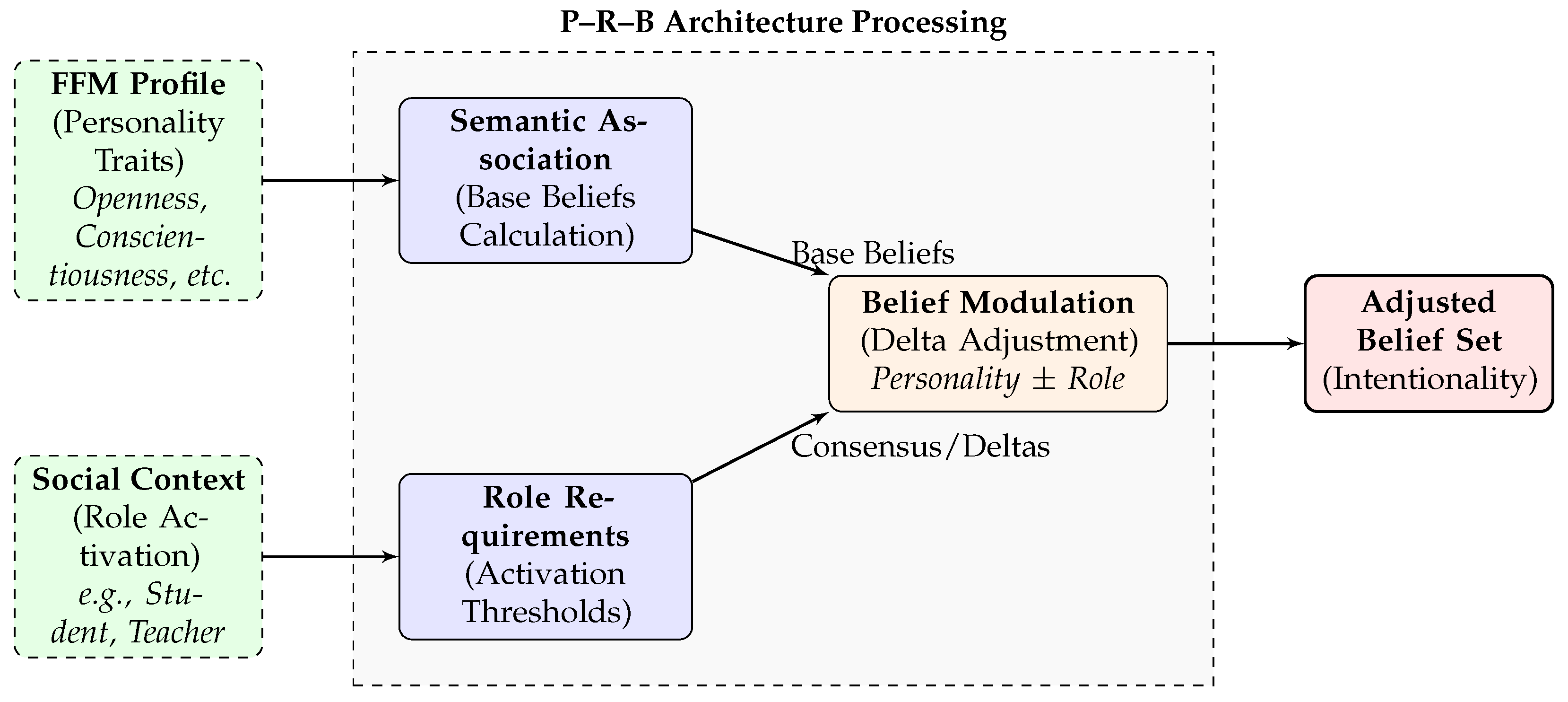
Figure 1. Proposed P–R–B Architecture workflow. The diagram illustrates how the FFM Personality Traits define the base beliefs (via Semantic Association), which are subsequently modulated by the Social Role constraints (Activation Thresholds) to produce the final Adjusted Belief Set. Colors indicate functional blocks: inputs (green), processing modules (blue), belief modulation core (orange), and output (red).
Mca 31 00037 g001
Table 1. Conceptual comparison between the proposed P–R–B model and related approaches in BDI agent research.
WorkIssues AddressedAssumptionsSolution ApproachAdvantages/Limitations
Adam & Gaudou [11]Use of BDI agents in social simulationsSurvey of BDI social simulation approaches; belief handling varies across implementations (often ad hoc)Methodological guide and overview of methodologies
and tools
Comprehensive overview; does not propose a specific belief-generation or weighting mechanism
Ahrndt
et al. [12,13]
Personality influence in agent behaviorPersonality directly modulates BDI functionsFormal personality integration into the BDI reasoning cycleFormal modeling of deliberation; beliefs are not explicitly generated through a dedicated aggregation mechanism
Alfonso
et al. [14]
Affective influence in
BDI agents
Emotions and affective states influence deliberation and
belief revision
Formal affective extensions to the BDI reasoning cycleFormal affect modeling and belief modulation; does not focus on role-based belief conflict generation or resolution
Proposed P–R–B ModelBelief conflicts from multiple concurrent rolesBeliefs emerge from the interaction between personality traits and social rolesEmpirical weighting and formal aggregation of beliefsExplicit belief generation and role-based
conflict resolution
Table 2. Threshold relationship matrix for the activation of three social roles in a school environment context, based on personality facets of (E) Extraversion, (C) Conscientiousness, and (A) Agreeableness.
Social RoleFacet (Abbr.)Cond.ScoreEnvironmental Rationale
Student LeaderWarmth (E1)>0.6Establishes close relationships that facilitate positive influence in the classroom.
Gregariousness (E2)>0.6Seeks interaction and visible roles within the group.
Assertiveness (E3)>0.6Takes the floor and guides collective dynamics.
Activity (E4)>0.6High energy that mobilizes peers.
Competence (C1)>0.6Trusts in their ability to lead and decide.
Manipulative StudentStraightforwardness (A2)<0.4Distorts information to gain social advantage.
Altruism (A3)<0.4Less concern for the group’s well-being.
Compliance (A4)<0.4Prefers conflict or strategic pressure.
Modesty (A5)<0.4Perceives oneself as superior to influence others.
Tender-Mindedness (A6)<0.4Low empathy enables manipulation without guilt.
Supportive
Student
Warmth (E1)>0.7Generates closeness and constant emotional support.
Altruism (A3)>0.7Genuinely helps without seeking personal benefit.
Compliance (A4)>0.7Favors peace and unity in the classroom.
Tender-Mindedness (A6)>0.7Recognizes and attends to others’ emotional needs.
Note: (E) Extraversion, (C) Conscientiousness, and (A) Agreeableness.
Table 3. Weights relating Beliefs to FFM Facets and their theoretical rationale.
BeliefDefinitionFacetWeightTheoretical Rationale
Valuing TeamworkConsiders learning, collaborating, and solving problems with others to be valuable and necessary.Gregariousness (E2)0.4Indicates a preference for participating in groups and collective spaces.
Compliance (A4)0.3Favors cooperation, avoiding conflicts and promoting agreements.
Tender-Mindedness (A6)0.3The capacity to recognize others’ emotions facilitates
effective collaboration.
Valuing Friendship and SupportValues close affective relationships and emotional accompaniment.Warmth (E1)0.3Expresses emotional closeness, facilitating trust bonds.
Altruism (A3)0.4Voluntarily offers help when another needs it.
Tender-Mindedness (A6)0.3Identifies emotional states and adjusts their response to accompany the other.
Seeking Social RecognitionPlaces importance on being seen, valued, and validated by others as part of
their identity.
Assertiveness (E3)0.4The active search for a leading role in social interaction favors the desire
for visibility.
Modesty (A5)0.3Lower modesty relates to a need for external validation and social self-affirmation.
Competence (C1)0.3Motivation to excel in tasks impacts obtaining recognition from the group.
Valuing Justice and EquityOriented toward defending others and correcting unjust situations.Assertiveness (E3)0.4Structural organization is fundamental to establishing norms and routines.
Dutifulness (C3)0.3Moral responsibility motivates compliance with school rules.
Altruism (A3)0.3The capacity for self-regulation contributes to sustaining
internal discipline.
Table 4. Adjustment coefficients ( δ ) for belief modulation according to social role.
Social RoleBeliefAdj. ( δ )Description
Student LeaderValuing Teamwork 0.3 Their influence depends on group coordination and participation.
Valuing Friendship and Support 0.2 Uses affective bonds to sustain social cohesion.
Seeking Social Recognition 0.1 Maintains positive visibility to legitimize their role.
Manipulative StudentValuing Friendship and Support 0.3 Relationships are used instrumentally,
not affectively.
Valuing Justice and Equity 0.3 Alters equity to gain personal advantages.
Seeking Social Recognition 0.2 Uses external approval as an influence tool.
Supportive StudentValuing Friendship and Support 0.4 Reinforces the construction of genuine
affective bonds.
Collective Emotional Sensitivity 0.3 Recognizes emotional needs and acts with empathy.
Table 5. Exemplification of the data collection instrument layout for the ‘Student Leader’ role.
Target Role: Student Leader
Contextual Definition: This type of student tends to have a natural influence on the group. They communicate effectively, organize, and motivate others.

Instruction: Please define the level of importance of the following behavioral descriptors regarding the leader role defined above.
Behavioral DescriptorRelevantSomewhatNot Rel.
Establishes close relationships that facilitate positive influence in the classroom.
Seeks interaction and visible roles within the group.
Takes the floor and guides collective dynamics.
High energy that mobilizes peers.
Trusts in their capacity to direct and decide.
◯ indicates one selectable response per row.
Table 6. Evaluation of the relevance of personality facets associated with each Social Role.
Social RoleFacetRelevantSomewhatNot Rel.
(%) Rel. (%) (%)
Student LeaderWarmth (E1)67.30%30.60%2.00%
Gregariousness (E2)65.30%26.50%8.20%
Assertiveness (E3)75.50%22.40%2.00%
Activity (E4)65.30%26.50%8.20%
Competence (C1)73.50%24.50%2.00%
Manipulative StudentStraightforwardness (A2)71.40%24.50%4.10%
Altruism (A3)65.30%24.50%10.20%
Compliance (A4)57.10%36.70%6.10%
Modesty (A5)79.60%12.20%8.20%
Tender-Mindedness (A6)73.50%18.40%8.20%
Supportive StudentWarmth (E1)69.40%24.50%6.10%
Altruism (A3)65.30%30.60%4.10%
Compliance (A4)53.10%42.90%4.10%
Tender-Mindedness (A6)73.50%24.50%2.00%
Silent Victim StudentAssertiveness (E3)57.10%32.70%10.20%
Anxiety (N1)63.30%24.50%12.20%
Self-Consciousness (N4)63.30%30.60%6.10%
Vulnerability (N6)65.30%32.70%2.00%
Compliance (A4)55.10%32.70%12.20%
Trust (A1)61.20%30.60%8.20%
Self-Victimizing StudentAssertiveness (E3)46.90%44.90%8.20%
Self-Consciousness (N4)63.30%30.60%6.10%
Anxiety (N1)63.30%32.70%4.10%
Straightforwardness (A2)53.10%46.90%0.00%
Compliance (A4)53.10%38.80%8.20%
Modesty (A5)63.30%26.50%10.20%
Flattering StudentStraightforwardness (A2)71.40%26.50%2.00%
Compliance (A4)51.00%40.80%8.20%
Modesty (A5)59.20%34.70%6.10%
Tender-Mindedness (A6)46.90%40.80%12.20%
Achievement Striving (C4)57.10%32.70%10.20%
Teacher’s PetDutifulness (C3)59.20%38.80%2.00%
Competence (C1)59.20%30.60%10.20%
Modesty (A5)44.90%49.00%6.10%
Warmth (E1)53.10%32.70%14.30%
Compliance (A4)49.00%46.90%4.10%
Irresponsible StudentCompetence (C1)69.40%22.40%8.20%
Order (C2)69.40%28.60%2.00%
Dutifulness (C3)65.30%26.50%8.20%
Self-Discipline (C5)67.30%28.60%4.10%
Deliberation (C6)65.30%24.50%10.20%
Disorganized StudentOrder (C2)65.30%30.60%4.10%
Self-Discipline (C5)75.50%20.40%4.10%
Deliberation (C6)73.50%16.30%10.20%
Problematic StudentCompliance (A4)77.60%16.30%6.10%
Angry Hostility (N2)75.50%22.40%2.00%
Impulsiveness (N5)73.50%22.40%4.10%
Deliberation (C6)61.20%30.60%8.20%
Analytical ObserverGregariousness (E2)71.40%22.40%6.10%
Fantasy (O1)65.30%30.60%4.10%
Ideas (O5)73.50%24.50%2.00%
Deliberation (C6)73.50%20.40%6.10%
Respectful StudentDutifulness (C3)79.60%14.30%6.10%
Compliance (A4)75.50%18.40%6.10%
Straightforwardness (A2)71.40%20.40%8.20%
Aggressor StudentAngry Hostility (N2)69.40%26.50%4.10%
Assertiveness (E3)67.30%30.60%2.00%
Tender-Mindedness (A6)75.50%22.40%2.00%
Compliance (A4)79.60%14.30%6.10%
Competitive StudentAchievement Striving (C4)73.50%18.40%8.20%
Assertiveness (E3)63.30%34.70%2.00%
Compliance (A4)73.50%20.40%6.10%
Modesty (A5)69.40%24.50%6.10%
Isolated StudentGregariousness (E2)71.40%22.40%6.10%
Self-Consciousness (N4)77.60%22.40%0.00%
Warmth (E1)71.40%22.40%6.10%
Mediator StudentTender-Mindedness (A6)69.40%26.50%4.10%
Compliance (A4)79.60%16.30%4.10%
Warmth (E1)75.50%18.40%6.10%
Straightforwardness (A2)75.50%22.40%2.00%
Deliberation (C6)79.60%16.30%4.10%
Peacemaker StudentTender-Mindedness (A6)65.30%30.60%4.10%
Assertiveness (E3)75.50%20.40%4.10%
Compliance (A4)81.60%16.30%2.00%
Warmth (E1)75.50%24.50%0.00%
Anxiety (N1)71.40%24.50%4.10%
Defender StudentTender-Mindedness (A6)59.20%34.70%6.10%
Assertiveness (E3)71.40%26.50%2.00%
Altruism (A3)63.30%30.60%6.10%
Dutifulness (C3)67.30%30.60%2.00%
Angry Hostility (N2)63.30%34.70%2.00%
Joker StudentExcitement-Seeking (E5)75.50%24.50%0.00%
Impulsiveness (N5)73.50%12.20%14.30%
Self-Discipline (C5)69.40%26.50%4.10%
Cheating StudentStraightforwardness (A2)67.30%22.40%10.20%
Achievement Striving (C4)71.40%26.50%2.00%
Dutifulness (C3)79.60%16.30%4.10%
Envious StudentModesty (A5)79.60%14.30%6.10%
Angry Hostility (N2)73.50%22.40%4.10%
Tender-Mindedness (A6)77.60%18.40%4.10%
Table 7. Structure of the survey instrument used to evaluate the influence of personality facets on belief configuration. Example: “Valuation of Friendship and Support”.
Target Belief: Valuation of Friendship and Support
Definition: Considering it important to maintain close relationships and provide emotional support to others.
Question: How important do you consider each of the following behaviors for this belief?Not
Important
Slightly
Imp.
Moderately
Imp.
ImportantVery
Important
Expressing emotional closeness, facilitating bonds of trust.
Offering help voluntarily when another needs it.
Identifying emotional states and adjusting response to accompany the other.
◯ indicates one selectable response per row.
Table 8. Weights and acceptance percentages of the personality facets associated with beliefs.
BeliefAssociated FacetsWeightsEmpirical
Accept. (%)
Theor.Emp.
Valuation of Academic AuthorityTrust (A1)0.40.336.84%
Dutifulness (C3)0.30.3544.74%
Order (C2)0.30.3544.74%
Valuation of TeamworkGregariousness (E2)0.40.3747.37%
Compliance (A4)0.30.3342.11%
Tender-Mindedness (A6)0.30.3139.47%
Valuation of Discipline and OrderOrder (C2)0.40.2942.11%
Dutifulness (C3)0.40.3550.00%
Self-Discipline (C5)0.20.3652.63%
Valuation of Friendship and SupportWarmth (E1)0.30.3750.00%
Altruism (A3)0.40.2431.58%
Tender-Mindedness (A6)0.30.3952.63%
Valuation of Empathy and RespectTender-Mindedness (A6)0.40.3352.63%
Straightforwardness (A2)0.30.3047.37%
Warmth (E1)0.30.3757.89%
Valuation of Justice and ProtectionAssertiveness (E3)0.40.3944.74%
Dutifulness (C3)0.30.2528.95%
Altruism (A3)0.30.3642.11%
Valuation of Harmony and MediationCompliance (A4)0.40.2747.37%
Tender-Mindedness (A6)0.40.4071.05%
Deliberation (C6)0.20.3357.89%
Valuation of Autonomy and LeadershipAssertiveness (E3)0.40.3347.37%
Competence (C1)0.40.3244.74%
Activity (E4)0.20.3550.00%
Valuation of Honesty and Academic EthicsStraightforwardness (A2)0.40.3352.63%
Dutifulness (C3)0.40.3555.26%
Deliberation (C6)0.20.3250.00%
Valuation of Coexistence and School PeaceCompliance (A4)0.40.3355.26%
Tender-Mindedness (A6)0.40.3355.26%
Warmth (E1)0.20.3457.89%
Valuation of Effort and AchievementAchievement Striving (C4)0.40.3252.63%
Self-Discipline (C5)0.30.3557.89%
Competence (C1)0.30.3355.26%
Valuation of Ethical Reflection and PrudenceDeliberation (C6)0.50.3155.26%
Dutifulness (C3)0.30.3257.89%
Vulnerability (N6)0.20.3765.79%
Valuation of Moral IndependenceIdeas (O5)0.40.3250.00%
Values (O6)0.40.3250.00%
Straightforwardness (A2)0.20.3655.26%
Valuation of Self-improvement and Self-efficacyCompetence (C1)0.40.2847.37%
Achievement Striving (C4)0.40.3560.53%
Activity (E4)0.20.3763.16%
Valuation of Cooperation and SolidarityAltruism (A3)0.40.3357.89%
Tender-Mindedness (A6)0.40.3357.89%
Warmth (E1)0.20.3357.89%
Valuation of School ResponsibilityDutifulness (C3)0.50.3047.37%
Order (C2)0.30.3655.26%
Self-Discipline (C5)0.20.3452.63%
Valuation of Creativity and OpennessFantasy (O1)0.40.3155.26%
Ideas (O5)0.40.3357.89%
Aesthetics (O2)0.20.3663.16%
Valuation of the Search for Social RecognitionTender-Mindedness (A6)0.330.3444.74%
Warmth (E1)0.330.3242.11%
Deliberation (C6)0.330.3444.74%
Valuation of Collective Emotional SensitivityAssertiveness (E3)0.40.3360.53%
Modesty (A5)0.30.3563.16%
Competence (C1)0.30.3257.89%
Table 9. Structure of the survey instrument designed to validate the social role influence coefficients ( δ ).
SectionContent/Description
I. Contextual Definitions (Information provided to the participant)
Social Role ( R j )Example: Leader Student
Definition provided: Someone who has natural influence over the group, communicates effectively, and organizes others.
Target Belief ( B k )Example: Valuation of Teamwork
Definition provided: Considering that collaborating and solving problems with others is valuable and necessary.
II. Evaluation Items (Validation of δ parameters)
1. Direction of Effect (Sign of δ )Question: Does this belief coincide with or oppose the behavior of the defined Social Role?
Options:
□ Coincides (Positive Effect/Reinforcement +)
□ Opposes (Negative Effect/Inhibition −)
□ Cannot determine
2. Magnitude of Effect (Value of δ )Question: Regardless of the effect type selected above, how strong is the relationship between the belief and the role’s behavior?
Options (mapped to model intervals):
□ Strong (Large impact ≈±0.5)
□ Moderate (Medium impact ≈±0.3)
□ Weak (Small impact ≈±0.1)
Table 10. Comparison of the Direction of Effect: Theoretical Hypothesis vs. Survey Results (Positive/Negative).
Social RoleBeliefEffect DirectionSurvey Data (%)
Theor. Emp. Pos. (+) Neg. (−)
Leader StudentValuation of Teamwork++73.723.7
Valuation of Friendship & Support++63.226.3
Search for Social Recognition++68.423.7
Manipulator St.Valuation of Friendship & Support+57.936.8
Valuation of Justice & Fairness+52.644.7
Search for Social Recognition++60.531.6
Supportive St.Valuation of Friendship & Support++78.913.2
Collective Emotional Sensitivity++60.531.6
Irresponsible St.Valuation of Discipline & Order+50.044.7
Disorganized St.Valuation of Discipline & Order+52.644.7
Valuation of Discipline & Order44.750.0
Collective Emotional Sensitivity+44.744.4
Aggressor St.Valuation of Justice & Fairness36.860.5
Collective Emotional Sensitivity44.750.0
Competitive St.Search for Social Recognition++73.723.7
Valuation of Teamwork+50.039.5
Envious St.Valuation of Friendship & Support28.960.5
Search for Social Recognition++57.931.6
Cheater St.Valuation of Discipline & Order26.357.9
Valuation of Justice & Fairness36.855.3
Joker St.Valuation of Discipline & Order31.657.9
Collective Emotional Sensitivity++50.047.4
Mediator St.Valuation of Justice & Fairness++50.042.1
Collective Emotional Sensitivity++71.123.7
Peacemaker St.Collective Emotional Sensitivity++35.831.6
Valuation of Friendship & Support++60.526.3
Defender St.Valuation of Justice & Fairness++71.123.7
Valuation of Friendship & Support++63.231.6
Analytical Obs.Valuation of Justice & Fairness++57.928.9
Valuation of Teamwork++57.926.3
Silent VictimCollective Emotional Sensitivity++57.936.8
Search for Social Recognition42.147.4
Self-VictimizingSearch for Social Recognition++52.639.5
Collective Emotional Sensitivity42.144.7
Flatterer St.Valuation of Academic Authority++63.228.9
Search for Social Recognition++44.739.5
Teacher’s PetValuation of Academic Authority++55.344.7
Valuation of Discipline & Order+36.839.5
Respectful St.Valuation of Academic Authority++71.123.7
Valuation of Discipline & Order++63.223.7
Isolated St.Valuation of Friendship & Support+47.444.7
Valuation of Teamwork42.150.0
Val. School Peace & Coexistence++47.442.1
Note: Theor. indicates the theoretical direction predicted by the model, while Emp. reflects the empirical results from the survey. Bold values denote the majority response.
Table 11. Comparison of the Magnitude of Effect: Theoretical Hypothesis vs. Survey Results (Intensity).
Social RoleBeliefParameter ( δ )Survey Data (%)
Theor. Emp. Small Med. Large
Leader StudentValuation of TeamworkMedLarge13.223.760.5
Valuation of Friendship & SupportMedLarge7.942.150.0
Search for Social RecognitionSmallMed7.952.639.5
Manipulator St.Valuation of Friendship & SupportMedLarge23.734.239.5
Valuation of Justice & FairnessMedMed15.842.139.5
Search for Social RecognitionMedLarge7.942.147.4
Supportive St.Valuation of Friendship & SupportLargeMed10.550.036.8
Collective Emotional SensitivityMedLarge15.839.544.7
Irresponsible St.Valuation of Discipline & OrderLargeMed18.444.736.8
Disorganized St.Valuation of Discipline & OrderLargeLarge21.136.842.1
Troublesome St.Valuation of Discipline & OrderMedLarge28.928.942.1
Collective Emotional SensitivityMedMed15.847.428.9
Aggressor St.Valuation of Justice & FairnessLargeMed31.639.528.9
Collective Emotional SensitivityLargeMed23.750.023.7
Competitive St.Search for Social RecognitionLargeMed21.150.028.9
Valuation of TeamworkMedLarge21.134.236.8
Envious St.Valuation of Friendship & SupportMedLarge23.734.236.8
Search for Social RecognitionMedMed18.444.728.9
Cheater St.Valuation of Discipline & OrderLargeMed23.744.726.3
Valuation of Justice & FairnessMedMed23.750.023.7
Joker St.Valuation of Discipline & OrderMedLarge31.631.636.8
Collective Emotional SensitivityMedMed18.450.023.7
Mediator St.Valuation of Justice & FairnessLargeMed10.847.436.8
Collective Emotional SensitivityLargeLarge15.826.352.6
Peacemaker St.Collective Emotional SensitivityLargeLarge18.426.350.0
Valuation of Friendship & SupportMedLarge10.534.255.3
Defender St.Valuation of Justice & FairnessLargeLarge7.942.147.4
Valuation of Friendship & SupportMedMed13.247.439.5
Analytical Obs.Valuation of Justice & FairnessMedLarge7.939.542.1
Valuation of TeamworkMedMed13.239.539.5
Silent VictimCollective Emotional SensitivityMedMed28.939.526.3
Search for Social RecognitionMedMed28.936.831.6
Self-VictimizingSearch for Social RecognitionLargeLarge15.834.239.5
Collective Emotional SensitivityMedMed15.836.831.6
Flatterer St.Valuation of Academic AuthorityMedMed13.247.434.2
Search for Social RecognitionLargeMed10.555.331.6
Teacher’s PetValuation of Academic AuthorityLargeLarge15.834.242.1
Valuation of Discipline & OrderMedMed15.839.536.8
Respectful St.Valuation of Academic AuthorityLargeLarge10.542.147.4
Valuation of Discipline & OrderLargeLarge2.642.144.7
Isolated St.Valuation of Friendship & SupportLargeMed18.457.918.4
Valuation of TeamworkMedMed23.734.236.8
Val. School Peace & CoexistenceSmallMed34.239.521.1
Note: Theor. indicates the theoretical magnitude predicted by the model, while Emp. reflects the empirical magnitude obtained from the survey. Bold values denote the majority response.
Disclaimer/Publisher’s Note: The statements, opinions and data contained in all publications are solely those of the individual author(s) and contributor(s) and not of MDPI and/or the editor(s). MDPI and/or the editor(s) disclaim responsibility for any injury to people or property resulting from any ideas, methods, instructions or products referred to in the content.



