





A Belief Model for BDI Agents Derived from Roles and Personality Traits
 , , , and
Abstract
1. Introduction
2. Preliminaries
2.1. Rational Agents and Architectures
2.2. BDI Architecture
- Beliefs: Represent the information the agent possesses about the state of the environment, itself, and other agents. It is crucial to distinguish that beliefs constitute the agent’s subjective perspective, which may be incomplete or incorrect, rather than necessarily objective truths [2]. This knowledge base is dynamic and is constantly updated through perception.
- Desires: Correspond to the states of the world the agent aspires to reach. They represent long-term goals or motivations guiding its behavior, but upon which the agent has not yet committed to executing, and they may even be mutually conflictive.
- Intentions: Constitute the subset of desires to which the agent has actively committed. Intentions are persistent and drive practical reasoning, focusing the system’s attention and resources on the pursuit of a specific plan until it is completed, becomes unachievable, or loses relevance [1].
2.3. Five-Factor Model (FFM)
- Openness to Experience: Evaluates an individual’s disposition toward novelty and intellectual curiosity. High scores denote creativity and imagination, while low scores are associated with a more conventional, pragmatic approach attached to routine.
- Conscientiousness: Measures self-discipline, organization, and achievement orientation. Individuals with high conscientiousness tend to be planned and reliable; in contrast, those with low scores tend to be more spontaneous, impulsive, and occasionally disorganized.
- Extraversion: Reflects the tendency to seek stimulation in the company of others and the external environment. Extroverts are characterized as sociable and energetic, whereas introverts are more reserved and reflective, and prefer less stimulating environments.
- Agreeableness: Indicates the propensity to be compassionate and cooperative rather than suspicious or antagonistic. High scores are associated with empathetic and trusting agents, while low scores relate to more competitive, skeptical, and self-interest-oriented behavior.
- Neuroticism: Refers to the tendency to experience negative emotions such as anxiety, sadness, or anger. High scores indicate greater emotional sensitivity and instability, while low scores suggest resilience and calmness in the face of stress.
2.4. Social Roles in Computational Agents
2.5. Cohen’s Effect Size Conventions
3. Proposed Solution: The Personality–Role–Belief (P–R–B) Model
3.1. Association of Social Roles with the FFM Personality Model
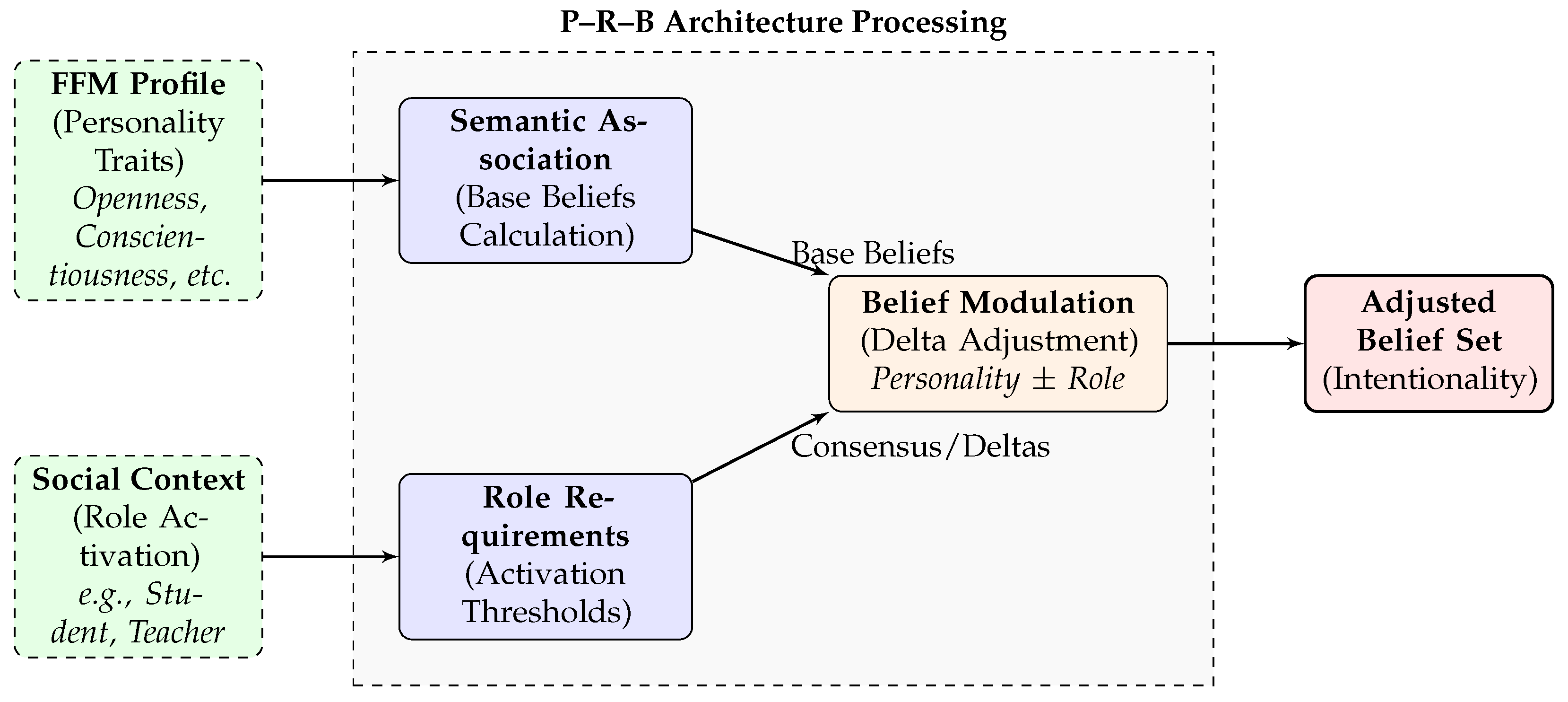
- Activation Mechanism: The system verifies whether the agent’s normalized facet scores satisfy the conditional thresholds (>, <) defined for each candidate role in the matrix.
- Assignment Outcome: If all conditions are met, it is determined that the role aligns with the agent’s profile, and it is added to their list of active roles. An agent may maintain single or multiple simultaneous roles depending on the characteristics of its personality and the requirements of the context.
3.2. Relationship Between Beliefs and FFM Model Facets
- represents the resulting value of the base belief k in the range , prior to any social role adjustment.
- n is the number of FFM facets that compose the definition of said belief.
- represents the normalized value of the i-th personality facet of the agent.
- is the weight assigned to facet i for belief k, such that .
3.3. Definition of Environmental Belief Weights According to Agent Social Roles
- Small Effect (): The role exerts a subtle or slight influence on the belief.
- Medium Effect (): There is a notable and visible modification in behavior.
- Large Effect (): The role critically defines the belief, either strongly reinforcing or completely inhibiting it.
- is the final intensity of belief k to be used in the decision-making process.
- is the intrinsic value of the belief derived from personality (calculated in Equation (1)).
- is the adjustment coefficient that role r applies to belief k. This coefficient represents the magnitude of influence assigned to the social role, bounded by the specific intervals (Small, Medium, Large) defined above.
- R represents the set of currently active social roles.
- is a saturation function that ensures the result remains within the logical interval .
4. Analysis of Results and Empirical Validation
4.1. Validation of Activation Thresholds: Correlation Between Personality and Social Roles
- Relevant: The trait is essential to define the role.
- Somewhat Relevant: The trait is present but is not defining.
- Not Relevant: The trait does not correspond to the described role.
4.2. Validation of Personality Influence on Belief Configuration
- is the empirical weight of facet i for belief k. This value corresponds to the parameter (weight of facet i on belief k) previously introduced in Equation (1).
- is the relevance score of facet i for belief k, defined as the sum of the frequencies in the positive categories of the Likert scale (“Very Important” and “Important”).
- is the total number of facets composing the analyzed belief k.
- is the total summation of the relevance scores of all facets associated with belief k.
4.3. Validation of Social Role Influence
- Direction of Effect: Determining whether the role positively influences (reinforces) or negatively influences (inhibits) the belief.
- Magnitude of Effect: Estimating the intensity of said influence (Strong, Moderate, or Weak).
5. Discussion
5.1. Validation of Structural Coupling: Personality as a Predictor
5.2. Divergence in the Direction of Effect: Pro-Social vs. Anti-Social Roles
5.3. Underestimation of Magnitude in Theoretical Design
5.4. Implications for BDI Agent Architecture
5.5. Scalability and Validation Advantages of the P–R–B Model
6. Conclusions and Future Work
- Semantic Consistency (Direction): The analysis confirmed that the logical design of the 21 social roles—whether they reinforce or inhibit certain beliefs—aligns with the expectations of the school environment. For instance, the antagonistic nature of the Manipulative Student versus the Supportive Student was empirically verified, ensuring that agents will exhibit coherent behavioral patterns.
- Parametric Calibration (Magnitude): The comparison between theoretical expectations and the empirical consensus revealed the necessity of calibrating the intensity of the roles’ influence. The discrepancy found between the theoretical parameters and the survey results highlights that social norms often demand different intensity levels than those intuitively designed. Consequently, the updated coefficients presented in this work provide a set of ecologically valid parameters, ensuring that a role like the Aggressor or the Mediator exerts the precise amount of influence on the agent’s decision-making.
Author Contributions
Funding
Institutional Review Board Statement
Informed Consent Statement
Data Availability Statement
Acknowledgments
Conflicts of Interest
Abbreviations
| AI | Artificial Intelligence |
| BDI | Belief–Desire–Intention |
| FFM | Five-Factor Model (Personality) |
| P–R–B | Personality–Role–Belief (Architecture) |
| NPC | Non-Player Character |
| MAS | Multi-Agent System |
References
- Rao, A.S.; Georgeff, M.P. BDI Agents: From Theory to Practice. In Proceedings of the First International Conference on Multi-Agent Systems (ICMAS-95), San Francisco, CA, USA, 12–14 June 1995; pp. 312–319. [Google Scholar]
- Wooldridge, M. An Introduction to Multiagent Systems, 2nd ed.; John Wiley & Sons: Hoboken, NJ, USA, 2009. [Google Scholar]
- Simari, G.I.; Parsons, S.D. Markov Decision Processes and the Belief-Desire Intention Model: Bridging the Gap for Autonomous Agents; Springer: New York, NY, USA, 2011. [Google Scholar] [CrossRef]
- Mateas, M.; Stern, A. A Behavior Language for Story-Based Believable Agents. IEEE Intelligent Systems 2002, 17, 39–47. [Google Scholar] [CrossRef]
- Boissier, O.; Bordini, R.H.; Hübner, J.F.; Ricci, A. Multi-Agent Oriented Programming: Programming Multi-Agent Systems Using JaCaMo; MIT Press: Cambridge, MA, USA, 2020. [Google Scholar]
- Gratch, J.; Marsella, S. A domain-independent framework for modeling emotion. Cogn. Syst. Res. 2004, 5, 269–306. [Google Scholar] [CrossRef]
- Martínez-Hernández, E.D. Configuración de la Expresión Facial de un ACP Socio-emocional basado en el análisis del Diálogo y su Perfil de Personalidad. Master’s Thesis, Instituto Tecnológico de Ciudad Madero, Ciudad Madero, Tamaulipas, México, 2022. [Google Scholar]
- Breazeal, C. Sociable Machines: Expressive Social Exchange Between Humans and Robots. Ph.D. Thesis, Massachusetts Institute of Technology, Cambridge, MA, USA, 2000. [Google Scholar]
- Liu, G.; Liang, H.; Wang, R.; Sui, Z.; Sun, Q. Adaptive Event-Triggered Output Feedback Control for Nonlinear Multiagent Systems Using Output Information Only. IEEE Trans. Syst. Man, Cybern. Syst. 2025, 55, 7639–7650. [Google Scholar] [CrossRef]
- Liu, G.; Sun, Q.; Su, H.; Wang, M. Adaptive Cooperative Fault-Tolerant Control for Output-Constrained Nonlinear Multi-Agent Systems Under Stochastic FDI Attacks. IEEE Trans. Circuits Syst. I Regul. Pap. 2025, 72, 6025–6036. [Google Scholar] [CrossRef]
- Adam, C.; Gaudou, B. BDI agents in social simulations: A survey. Knowl. Eng. Rev. 2016, 31, 207–238. [Google Scholar] [CrossRef]
- Ahrndt, S.; Fähndrich, J.; Albayrak, S. Modelling of Personality in Agents: From Psychology to Implementation. In Proceedings of the Fourth International Workshop on Human-Agent Interaction Design and Models in conjunction with AAMAS, Istanbul, Turkey, 4 May 2015. [Google Scholar]
- Ahrndt, S.; Fähndrich, J.; Lützenberger, M.; Albayrak, S. Modelling of Personality in Agents: From Psychology to Logical Formalisation and Implementation. In Proceedings of the 2015 International Conference on Autonomous Agents and Multiagent Systems, Istanbul, Turkey, 4–8 May 2015. [Google Scholar]
- Alfonso, B.; Vivancos, E.; Botti, V. Toward Formal Modeling of Affective Agents in a BDI Architecture. ACM Trans. Internet Technol. 2017, 17, 1–23. [Google Scholar] [CrossRef]
- Russell, S.; Norvig, P. Artificial Intelligence: A Modern Approach, 4th ed.; Pearson Education Limited: Harlow, UK, 2022. [Google Scholar]
- McCrae, R.R.; Costa, P.T., Jr. Introduction to the empirical and theoretical status of the five-factor model of personality traits. In Personality Disorders and the Five-Factor Model of Personality, 3rd ed.; Widiger, T.A., Costa, P.T., Jr., Eds.; American Psychological Association: Washington, DC, USA, 2013; pp. 15–27. [Google Scholar] [CrossRef]
- Cohen, J. Statistical Power Analysis for the Behavioral Sciences, 2nd ed.; Lawrence Erlbaum Associates: Hillsdale, NJ, USA, 1988. [Google Scholar]
- Wang, S.; Eum, I.; Park, S.; Kim, J. A semi-labelled dataset for fault detection in air handling units from a large-scale office. Data Brief 2024, 57, 110956. [Google Scholar] [CrossRef] [PubMed]
- Wang, S.; Moon, S.; Eum, I.; Hwang, D.; Kim, J. A text dataset of fire door defects for pre-delivery inspections of apartments during the construction stage. Data Brief 2025, 60, 111536. [Google Scholar] [CrossRef] [PubMed]

| Work | Issues Addressed | Assumptions | Solution Approach | Advantages/Limitations |
|---|---|---|---|---|
| Adam & Gaudou [11] | Use of BDI agents in social simulations | Survey of BDI social simulation approaches; belief handling varies across implementations (often ad hoc) | Methodological guide and overview of methodologies and tools | Comprehensive overview; does not propose a specific belief-generation or weighting mechanism |
| Ahrndt et al. [12,13] | Personality influence in agent behavior | Personality directly modulates BDI functions | Formal personality integration into the BDI reasoning cycle | Formal modeling of deliberation; beliefs are not explicitly generated through a dedicated aggregation mechanism |
| Alfonso et al. [14] | Affective influence in BDI agents | Emotions and affective states influence deliberation and belief revision | Formal affective extensions to the BDI reasoning cycle | Formal affect modeling and belief modulation; does not focus on role-based belief conflict generation or resolution |
| Proposed P–R–B Model | Belief conflicts from multiple concurrent roles | Beliefs emerge from the interaction between personality traits and social roles | Empirical weighting and formal aggregation of beliefs | Explicit belief generation and role-based conflict resolution |
| Social Role | Facet (Abbr.) | Cond. | Score | Environmental Rationale |
|---|---|---|---|---|
| Student Leader | Warmth (E1) | > | 0.6 | Establishes close relationships that facilitate positive influence in the classroom. |
| Gregariousness (E2) | > | 0.6 | Seeks interaction and visible roles within the group. | |
| Assertiveness (E3) | > | 0.6 | Takes the floor and guides collective dynamics. | |
| Activity (E4) | > | 0.6 | High energy that mobilizes peers. | |
| Competence (C1) | > | 0.6 | Trusts in their ability to lead and decide. | |
| Manipulative Student | Straightforwardness (A2) | < | 0.4 | Distorts information to gain social advantage. |
| Altruism (A3) | < | 0.4 | Less concern for the group’s well-being. | |
| Compliance (A4) | < | 0.4 | Prefers conflict or strategic pressure. | |
| Modesty (A5) | < | 0.4 | Perceives oneself as superior to influence others. | |
| Tender-Mindedness (A6) | < | 0.4 | Low empathy enables manipulation without guilt. | |
| Supportive Student | Warmth (E1) | > | 0.7 | Generates closeness and constant emotional support. |
| Altruism (A3) | > | 0.7 | Genuinely helps without seeking personal benefit. | |
| Compliance (A4) | > | 0.7 | Favors peace and unity in the classroom. | |
| Tender-Mindedness (A6) | > | 0.7 | Recognizes and attends to others’ emotional needs. |
| Belief | Definition | Facet | Weight | Theoretical Rationale |
|---|---|---|---|---|
| Valuing Teamwork | Considers learning, collaborating, and solving problems with others to be valuable and necessary. | Gregariousness (E2) | 0.4 | Indicates a preference for participating in groups and collective spaces. |
| Compliance (A4) | 0.3 | Favors cooperation, avoiding conflicts and promoting agreements. | ||
| Tender-Mindedness (A6) | 0.3 | The capacity to recognize others’ emotions facilitates effective collaboration. | ||
| Valuing Friendship and Support | Values close affective relationships and emotional accompaniment. | Warmth (E1) | 0.3 | Expresses emotional closeness, facilitating trust bonds. |
| Altruism (A3) | 0.4 | Voluntarily offers help when another needs it. | ||
| Tender-Mindedness (A6) | 0.3 | Identifies emotional states and adjusts their response to accompany the other. | ||
| Seeking Social Recognition | Places importance on being seen, valued, and validated by others as part of their identity. | Assertiveness (E3) | 0.4 | The active search for a leading role in social interaction favors the desire for visibility. |
| Modesty (A5) | 0.3 | Lower modesty relates to a need for external validation and social self-affirmation. | ||
| Competence (C1) | 0.3 | Motivation to excel in tasks impacts obtaining recognition from the group. | ||
| Valuing Justice and Equity | Oriented toward defending others and correcting unjust situations. | Assertiveness (E3) | 0.4 | Structural organization is fundamental to establishing norms and routines. |
| Dutifulness (C3) | 0.3 | Moral responsibility motivates compliance with school rules. | ||
| Altruism (A3) | 0.3 | The capacity for self-regulation contributes to sustaining internal discipline. |
| Social Role | Belief | Adj. () | Description |
|---|---|---|---|
| Student Leader | Valuing Teamwork | Their influence depends on group coordination and participation. | |
| Valuing Friendship and Support | Uses affective bonds to sustain social cohesion. | ||
| Seeking Social Recognition | Maintains positive visibility to legitimize their role. | ||
| Manipulative Student | Valuing Friendship and Support | Relationships are used instrumentally, not affectively. | |
| Valuing Justice and Equity | Alters equity to gain personal advantages. | ||
| Seeking Social Recognition | Uses external approval as an influence tool. | ||
| Supportive Student | Valuing Friendship and Support | Reinforces the construction of genuine affective bonds. | |
| Collective Emotional Sensitivity | Recognizes emotional needs and acts with empathy. |
| Target Role: Student Leader Contextual Definition: This type of student tends to have a natural influence on the group. They communicate effectively, organize, and motivate others. Instruction: Please define the level of importance of the following behavioral descriptors regarding the leader role defined above. | |||
| Behavioral Descriptor | Relevant | Somewhat | Not Rel. |
| Establishes close relationships that facilitate positive influence in the classroom. | ◯ | ◯ | ◯ |
| Seeks interaction and visible roles within the group. | ◯ | ◯ | ◯ |
| Takes the floor and guides collective dynamics. | ◯ | ◯ | ◯ |
| High energy that mobilizes peers. | ◯ | ◯ | ◯ |
| Trusts in their capacity to direct and decide. | ◯ | ◯ | ◯ |
| Social Role | Facet | Relevant | Somewhat | Not Rel. |
|---|---|---|---|---|
| (%) | Rel. (%) | (%) | ||
| Student Leader | Warmth (E1) | 67.30% | 30.60% | 2.00% |
| Gregariousness (E2) | 65.30% | 26.50% | 8.20% | |
| Assertiveness (E3) | 75.50% | 22.40% | 2.00% | |
| Activity (E4) | 65.30% | 26.50% | 8.20% | |
| Competence (C1) | 73.50% | 24.50% | 2.00% | |
| Manipulative Student | Straightforwardness (A2) | 71.40% | 24.50% | 4.10% |
| Altruism (A3) | 65.30% | 24.50% | 10.20% | |
| Compliance (A4) | 57.10% | 36.70% | 6.10% | |
| Modesty (A5) | 79.60% | 12.20% | 8.20% | |
| Tender-Mindedness (A6) | 73.50% | 18.40% | 8.20% | |
| Supportive Student | Warmth (E1) | 69.40% | 24.50% | 6.10% |
| Altruism (A3) | 65.30% | 30.60% | 4.10% | |
| Compliance (A4) | 53.10% | 42.90% | 4.10% | |
| Tender-Mindedness (A6) | 73.50% | 24.50% | 2.00% | |
| Silent Victim Student | Assertiveness (E3) | 57.10% | 32.70% | 10.20% |
| Anxiety (N1) | 63.30% | 24.50% | 12.20% | |
| Self-Consciousness (N4) | 63.30% | 30.60% | 6.10% | |
| Vulnerability (N6) | 65.30% | 32.70% | 2.00% | |
| Compliance (A4) | 55.10% | 32.70% | 12.20% | |
| Trust (A1) | 61.20% | 30.60% | 8.20% | |
| Self-Victimizing Student | Assertiveness (E3) | 46.90% | 44.90% | 8.20% |
| Self-Consciousness (N4) | 63.30% | 30.60% | 6.10% | |
| Anxiety (N1) | 63.30% | 32.70% | 4.10% | |
| Straightforwardness (A2) | 53.10% | 46.90% | 0.00% | |
| Compliance (A4) | 53.10% | 38.80% | 8.20% | |
| Modesty (A5) | 63.30% | 26.50% | 10.20% | |
| Flattering Student | Straightforwardness (A2) | 71.40% | 26.50% | 2.00% |
| Compliance (A4) | 51.00% | 40.80% | 8.20% | |
| Modesty (A5) | 59.20% | 34.70% | 6.10% | |
| Tender-Mindedness (A6) | 46.90% | 40.80% | 12.20% | |
| Achievement Striving (C4) | 57.10% | 32.70% | 10.20% | |
| Teacher’s Pet | Dutifulness (C3) | 59.20% | 38.80% | 2.00% |
| Competence (C1) | 59.20% | 30.60% | 10.20% | |
| Modesty (A5) | 44.90% | 49.00% | 6.10% | |
| Warmth (E1) | 53.10% | 32.70% | 14.30% | |
| Compliance (A4) | 49.00% | 46.90% | 4.10% | |
| Irresponsible Student | Competence (C1) | 69.40% | 22.40% | 8.20% |
| Order (C2) | 69.40% | 28.60% | 2.00% | |
| Dutifulness (C3) | 65.30% | 26.50% | 8.20% | |
| Self-Discipline (C5) | 67.30% | 28.60% | 4.10% | |
| Deliberation (C6) | 65.30% | 24.50% | 10.20% | |
| Disorganized Student | Order (C2) | 65.30% | 30.60% | 4.10% |
| Self-Discipline (C5) | 75.50% | 20.40% | 4.10% | |
| Deliberation (C6) | 73.50% | 16.30% | 10.20% | |
| Problematic Student | Compliance (A4) | 77.60% | 16.30% | 6.10% |
| Angry Hostility (N2) | 75.50% | 22.40% | 2.00% | |
| Impulsiveness (N5) | 73.50% | 22.40% | 4.10% | |
| Deliberation (C6) | 61.20% | 30.60% | 8.20% | |
| Analytical Observer | Gregariousness (E2) | 71.40% | 22.40% | 6.10% |
| Fantasy (O1) | 65.30% | 30.60% | 4.10% | |
| Ideas (O5) | 73.50% | 24.50% | 2.00% | |
| Deliberation (C6) | 73.50% | 20.40% | 6.10% | |
| Respectful Student | Dutifulness (C3) | 79.60% | 14.30% | 6.10% |
| Compliance (A4) | 75.50% | 18.40% | 6.10% | |
| Straightforwardness (A2) | 71.40% | 20.40% | 8.20% | |
| Aggressor Student | Angry Hostility (N2) | 69.40% | 26.50% | 4.10% |
| Assertiveness (E3) | 67.30% | 30.60% | 2.00% | |
| Tender-Mindedness (A6) | 75.50% | 22.40% | 2.00% | |
| Compliance (A4) | 79.60% | 14.30% | 6.10% | |
| Competitive Student | Achievement Striving (C4) | 73.50% | 18.40% | 8.20% |
| Assertiveness (E3) | 63.30% | 34.70% | 2.00% | |
| Compliance (A4) | 73.50% | 20.40% | 6.10% | |
| Modesty (A5) | 69.40% | 24.50% | 6.10% | |
| Isolated Student | Gregariousness (E2) | 71.40% | 22.40% | 6.10% |
| Self-Consciousness (N4) | 77.60% | 22.40% | 0.00% | |
| Warmth (E1) | 71.40% | 22.40% | 6.10% | |
| Mediator Student | Tender-Mindedness (A6) | 69.40% | 26.50% | 4.10% |
| Compliance (A4) | 79.60% | 16.30% | 4.10% | |
| Warmth (E1) | 75.50% | 18.40% | 6.10% | |
| Straightforwardness (A2) | 75.50% | 22.40% | 2.00% | |
| Deliberation (C6) | 79.60% | 16.30% | 4.10% | |
| Peacemaker Student | Tender-Mindedness (A6) | 65.30% | 30.60% | 4.10% |
| Assertiveness (E3) | 75.50% | 20.40% | 4.10% | |
| Compliance (A4) | 81.60% | 16.30% | 2.00% | |
| Warmth (E1) | 75.50% | 24.50% | 0.00% | |
| Anxiety (N1) | 71.40% | 24.50% | 4.10% | |
| Defender Student | Tender-Mindedness (A6) | 59.20% | 34.70% | 6.10% |
| Assertiveness (E3) | 71.40% | 26.50% | 2.00% | |
| Altruism (A3) | 63.30% | 30.60% | 6.10% | |
| Dutifulness (C3) | 67.30% | 30.60% | 2.00% | |
| Angry Hostility (N2) | 63.30% | 34.70% | 2.00% | |
| Joker Student | Excitement-Seeking (E5) | 75.50% | 24.50% | 0.00% |
| Impulsiveness (N5) | 73.50% | 12.20% | 14.30% | |
| Self-Discipline (C5) | 69.40% | 26.50% | 4.10% | |
| Cheating Student | Straightforwardness (A2) | 67.30% | 22.40% | 10.20% |
| Achievement Striving (C4) | 71.40% | 26.50% | 2.00% | |
| Dutifulness (C3) | 79.60% | 16.30% | 4.10% | |
| Envious Student | Modesty (A5) | 79.60% | 14.30% | 6.10% |
| Angry Hostility (N2) | 73.50% | 22.40% | 4.10% | |
| Tender-Mindedness (A6) | 77.60% | 18.40% | 4.10% |
| Target Belief: Valuation of Friendship and Support Definition: Considering it important to maintain close relationships and provide emotional support to others. | |||||
| Question: How important do you consider each of the following behaviors for this belief? | Not Important | Slightly Imp. | Moderately Imp. | Important | Very Important |
| Expressing emotional closeness, facilitating bonds of trust. | ◯ | ◯ | ◯ | ◯ | ◯ |
| Offering help voluntarily when another needs it. | ◯ | ◯ | ◯ | ◯ | ◯ |
| Identifying emotional states and adjusting response to accompany the other. | ◯ | ◯ | ◯ | ◯ | ◯ |
| Belief | Associated Facets | Weights | Empirical Accept. (%) | |
|---|---|---|---|---|
| Theor. | Emp. | |||
| Valuation of Academic Authority | Trust (A1) | 0.4 | 0.3 | 36.84% |
| Dutifulness (C3) | 0.3 | 0.35 | 44.74% | |
| Order (C2) | 0.3 | 0.35 | 44.74% | |
| Valuation of Teamwork | Gregariousness (E2) | 0.4 | 0.37 | 47.37% |
| Compliance (A4) | 0.3 | 0.33 | 42.11% | |
| Tender-Mindedness (A6) | 0.3 | 0.31 | 39.47% | |
| Valuation of Discipline and Order | Order (C2) | 0.4 | 0.29 | 42.11% |
| Dutifulness (C3) | 0.4 | 0.35 | 50.00% | |
| Self-Discipline (C5) | 0.2 | 0.36 | 52.63% | |
| Valuation of Friendship and Support | Warmth (E1) | 0.3 | 0.37 | 50.00% |
| Altruism (A3) | 0.4 | 0.24 | 31.58% | |
| Tender-Mindedness (A6) | 0.3 | 0.39 | 52.63% | |
| Valuation of Empathy and Respect | Tender-Mindedness (A6) | 0.4 | 0.33 | 52.63% |
| Straightforwardness (A2) | 0.3 | 0.30 | 47.37% | |
| Warmth (E1) | 0.3 | 0.37 | 57.89% | |
| Valuation of Justice and Protection | Assertiveness (E3) | 0.4 | 0.39 | 44.74% |
| Dutifulness (C3) | 0.3 | 0.25 | 28.95% | |
| Altruism (A3) | 0.3 | 0.36 | 42.11% | |
| Valuation of Harmony and Mediation | Compliance (A4) | 0.4 | 0.27 | 47.37% |
| Tender-Mindedness (A6) | 0.4 | 0.40 | 71.05% | |
| Deliberation (C6) | 0.2 | 0.33 | 57.89% | |
| Valuation of Autonomy and Leadership | Assertiveness (E3) | 0.4 | 0.33 | 47.37% |
| Competence (C1) | 0.4 | 0.32 | 44.74% | |
| Activity (E4) | 0.2 | 0.35 | 50.00% | |
| Valuation of Honesty and Academic Ethics | Straightforwardness (A2) | 0.4 | 0.33 | 52.63% |
| Dutifulness (C3) | 0.4 | 0.35 | 55.26% | |
| Deliberation (C6) | 0.2 | 0.32 | 50.00% | |
| Valuation of Coexistence and School Peace | Compliance (A4) | 0.4 | 0.33 | 55.26% |
| Tender-Mindedness (A6) | 0.4 | 0.33 | 55.26% | |
| Warmth (E1) | 0.2 | 0.34 | 57.89% | |
| Valuation of Effort and Achievement | Achievement Striving (C4) | 0.4 | 0.32 | 52.63% |
| Self-Discipline (C5) | 0.3 | 0.35 | 57.89% | |
| Competence (C1) | 0.3 | 0.33 | 55.26% | |
| Valuation of Ethical Reflection and Prudence | Deliberation (C6) | 0.5 | 0.31 | 55.26% |
| Dutifulness (C3) | 0.3 | 0.32 | 57.89% | |
| Vulnerability (N6) | 0.2 | 0.37 | 65.79% | |
| Valuation of Moral Independence | Ideas (O5) | 0.4 | 0.32 | 50.00% |
| Values (O6) | 0.4 | 0.32 | 50.00% | |
| Straightforwardness (A2) | 0.2 | 0.36 | 55.26% | |
| Valuation of Self-improvement and Self-efficacy | Competence (C1) | 0.4 | 0.28 | 47.37% |
| Achievement Striving (C4) | 0.4 | 0.35 | 60.53% | |
| Activity (E4) | 0.2 | 0.37 | 63.16% | |
| Valuation of Cooperation and Solidarity | Altruism (A3) | 0.4 | 0.33 | 57.89% |
| Tender-Mindedness (A6) | 0.4 | 0.33 | 57.89% | |
| Warmth (E1) | 0.2 | 0.33 | 57.89% | |
| Valuation of School Responsibility | Dutifulness (C3) | 0.5 | 0.30 | 47.37% |
| Order (C2) | 0.3 | 0.36 | 55.26% | |
| Self-Discipline (C5) | 0.2 | 0.34 | 52.63% | |
| Valuation of Creativity and Openness | Fantasy (O1) | 0.4 | 0.31 | 55.26% |
| Ideas (O5) | 0.4 | 0.33 | 57.89% | |
| Aesthetics (O2) | 0.2 | 0.36 | 63.16% | |
| Valuation of the Search for Social Recognition | Tender-Mindedness (A6) | 0.33 | 0.34 | 44.74% |
| Warmth (E1) | 0.33 | 0.32 | 42.11% | |
| Deliberation (C6) | 0.33 | 0.34 | 44.74% | |
| Valuation of Collective Emotional Sensitivity | Assertiveness (E3) | 0.4 | 0.33 | 60.53% |
| Modesty (A5) | 0.3 | 0.35 | 63.16% | |
| Competence (C1) | 0.3 | 0.32 | 57.89% | |
| Section | Content/Description |
|---|---|
| I. Contextual Definitions (Information provided to the participant) | |
| Social Role () | Example: Leader Student |
| Definition provided: Someone who has natural influence over the group, communicates effectively, and organizes others. | |
| Target Belief () | Example: Valuation of Teamwork |
| Definition provided: Considering that collaborating and solving problems with others is valuable and necessary. | |
| II. Evaluation Items (Validation of parameters) | |
| 1. Direction of Effect (Sign of ) | Question: Does this belief coincide with or oppose the behavior of the defined Social Role? Options: □ Coincides (Positive Effect/Reinforcement +) □ Opposes (Negative Effect/Inhibition −) □ Cannot determine |
| 2. Magnitude of Effect (Value of ) | Question: Regardless of the effect type selected above, how strong is the relationship between the belief and the role’s behavior? Options (mapped to model intervals): □ Strong (Large impact ≈±0.5) □ Moderate (Medium impact ≈±0.3) □ Weak (Small impact ≈±0.1) |
| Social Role | Belief | Effect Direction | Survey Data (%) | ||
|---|---|---|---|---|---|
| Theor. | Emp. | Pos. (+) | Neg. (−) | ||
| Leader Student | Valuation of Teamwork | + | + | 73.7 | 23.7 |
| Valuation of Friendship & Support | + | + | 63.2 | 26.3 | |
| Search for Social Recognition | + | + | 68.4 | 23.7 | |
| Manipulator St. | Valuation of Friendship & Support | − | + | 57.9 | 36.8 |
| Valuation of Justice & Fairness | − | + | 52.6 | 44.7 | |
| Search for Social Recognition | + | + | 60.5 | 31.6 | |
| Supportive St. | Valuation of Friendship & Support | + | + | 78.9 | 13.2 |
| Collective Emotional Sensitivity | + | + | 60.5 | 31.6 | |
| Irresponsible St. | Valuation of Discipline & Order | − | + | 50.0 | 44.7 |
| Disorganized St. | Valuation of Discipline & Order | − | + | 52.6 | 44.7 |
| Valuation of Discipline & Order | − | − | 44.7 | 50.0 | |
| Collective Emotional Sensitivity | − | + | 44.7 | 44.4 | |
| Aggressor St. | Valuation of Justice & Fairness | − | − | 36.8 | 60.5 |
| Collective Emotional Sensitivity | − | − | 44.7 | 50.0 | |
| Competitive St. | Search for Social Recognition | + | + | 73.7 | 23.7 |
| Valuation of Teamwork | − | + | 50.0 | 39.5 | |
| Envious St. | Valuation of Friendship & Support | − | − | 28.9 | 60.5 |
| Search for Social Recognition | + | + | 57.9 | 31.6 | |
| Cheater St. | Valuation of Discipline & Order | − | − | 26.3 | 57.9 |
| Valuation of Justice & Fairness | − | − | 36.8 | 55.3 | |
| Joker St. | Valuation of Discipline & Order | − | − | 31.6 | 57.9 |
| Collective Emotional Sensitivity | + | + | 50.0 | 47.4 | |
| Mediator St. | Valuation of Justice & Fairness | + | + | 50.0 | 42.1 |
| Collective Emotional Sensitivity | + | + | 71.1 | 23.7 | |
| Peacemaker St. | Collective Emotional Sensitivity | + | + | 35.8 | 31.6 |
| Valuation of Friendship & Support | + | + | 60.5 | 26.3 | |
| Defender St. | Valuation of Justice & Fairness | + | + | 71.1 | 23.7 |
| Valuation of Friendship & Support | + | + | 63.2 | 31.6 | |
| Analytical Obs. | Valuation of Justice & Fairness | + | + | 57.9 | 28.9 |
| Valuation of Teamwork | + | + | 57.9 | 26.3 | |
| Silent Victim | Collective Emotional Sensitivity | + | + | 57.9 | 36.8 |
| Search for Social Recognition | − | − | 42.1 | 47.4 | |
| Self-Victimizing | Search for Social Recognition | + | + | 52.6 | 39.5 |
| Collective Emotional Sensitivity | − | − | 42.1 | 44.7 | |
| Flatterer St. | Valuation of Academic Authority | + | + | 63.2 | 28.9 |
| Search for Social Recognition | + | + | 44.7 | 39.5 | |
| Teacher’s Pet | Valuation of Academic Authority | + | + | 55.3 | 44.7 |
| Valuation of Discipline & Order | + | − | 36.8 | 39.5 | |
| Respectful St. | Valuation of Academic Authority | + | + | 71.1 | 23.7 |
| Valuation of Discipline & Order | + | + | 63.2 | 23.7 | |
| Isolated St. | Valuation of Friendship & Support | − | + | 47.4 | 44.7 |
| Valuation of Teamwork | − | − | 42.1 | 50.0 | |
| Val. School Peace & Coexistence | + | + | 47.4 | 42.1 | |
| Social Role | Belief | Parameter () | Survey Data (%) | |||
|---|---|---|---|---|---|---|
| Theor. | Emp. | Small | Med. | Large | ||
| Leader Student | Valuation of Teamwork | Med | Large | 13.2 | 23.7 | 60.5 |
| Valuation of Friendship & Support | Med | Large | 7.9 | 42.1 | 50.0 | |
| Search for Social Recognition | Small | Med | 7.9 | 52.6 | 39.5 | |
| Manipulator St. | Valuation of Friendship & Support | Med | Large | 23.7 | 34.2 | 39.5 |
| Valuation of Justice & Fairness | Med | Med | 15.8 | 42.1 | 39.5 | |
| Search for Social Recognition | Med | Large | 7.9 | 42.1 | 47.4 | |
| Supportive St. | Valuation of Friendship & Support | Large | Med | 10.5 | 50.0 | 36.8 |
| Collective Emotional Sensitivity | Med | Large | 15.8 | 39.5 | 44.7 | |
| Irresponsible St. | Valuation of Discipline & Order | Large | Med | 18.4 | 44.7 | 36.8 |
| Disorganized St. | Valuation of Discipline & Order | Large | Large | 21.1 | 36.8 | 42.1 |
| Troublesome St. | Valuation of Discipline & Order | Med | Large | 28.9 | 28.9 | 42.1 |
| Collective Emotional Sensitivity | Med | Med | 15.8 | 47.4 | 28.9 | |
| Aggressor St. | Valuation of Justice & Fairness | Large | Med | 31.6 | 39.5 | 28.9 |
| Collective Emotional Sensitivity | Large | Med | 23.7 | 50.0 | 23.7 | |
| Competitive St. | Search for Social Recognition | Large | Med | 21.1 | 50.0 | 28.9 |
| Valuation of Teamwork | Med | Large | 21.1 | 34.2 | 36.8 | |
| Envious St. | Valuation of Friendship & Support | Med | Large | 23.7 | 34.2 | 36.8 |
| Search for Social Recognition | Med | Med | 18.4 | 44.7 | 28.9 | |
| Cheater St. | Valuation of Discipline & Order | Large | Med | 23.7 | 44.7 | 26.3 |
| Valuation of Justice & Fairness | Med | Med | 23.7 | 50.0 | 23.7 | |
| Joker St. | Valuation of Discipline & Order | Med | Large | 31.6 | 31.6 | 36.8 |
| Collective Emotional Sensitivity | Med | Med | 18.4 | 50.0 | 23.7 | |
| Mediator St. | Valuation of Justice & Fairness | Large | Med | 10.8 | 47.4 | 36.8 |
| Collective Emotional Sensitivity | Large | Large | 15.8 | 26.3 | 52.6 | |
| Peacemaker St. | Collective Emotional Sensitivity | Large | Large | 18.4 | 26.3 | 50.0 |
| Valuation of Friendship & Support | Med | Large | 10.5 | 34.2 | 55.3 | |
| Defender St. | Valuation of Justice & Fairness | Large | Large | 7.9 | 42.1 | 47.4 |
| Valuation of Friendship & Support | Med | Med | 13.2 | 47.4 | 39.5 | |
| Analytical Obs. | Valuation of Justice & Fairness | Med | Large | 7.9 | 39.5 | 42.1 |
| Valuation of Teamwork | Med | Med | 13.2 | 39.5 | 39.5 | |
| Silent Victim | Collective Emotional Sensitivity | Med | Med | 28.9 | 39.5 | 26.3 |
| Search for Social Recognition | Med | Med | 28.9 | 36.8 | 31.6 | |
| Self-Victimizing | Search for Social Recognition | Large | Large | 15.8 | 34.2 | 39.5 |
| Collective Emotional Sensitivity | Med | Med | 15.8 | 36.8 | 31.6 | |
| Flatterer St. | Valuation of Academic Authority | Med | Med | 13.2 | 47.4 | 34.2 |
| Search for Social Recognition | Large | Med | 10.5 | 55.3 | 31.6 | |
| Teacher’s Pet | Valuation of Academic Authority | Large | Large | 15.8 | 34.2 | 42.1 |
| Valuation of Discipline & Order | Med | Med | 15.8 | 39.5 | 36.8 | |
| Respectful St. | Valuation of Academic Authority | Large | Large | 10.5 | 42.1 | 47.4 |
| Valuation of Discipline & Order | Large | Large | 2.6 | 42.1 | 44.7 | |
| Isolated St. | Valuation of Friendship & Support | Large | Med | 18.4 | 57.9 | 18.4 |
| Valuation of Teamwork | Med | Med | 23.7 | 34.2 | 36.8 | |
| Val. School Peace & Coexistence | Small | Med | 34.2 | 39.5 | 21.1 | |
Disclaimer/Publisher’s Note: The statements, opinions and data contained in all publications are solely those of the individual author(s) and contributor(s) and not of MDPI and/or the editor(s). MDPI and/or the editor(s) disclaim responsibility for any injury to people or property resulting from any ideas, methods, instructions or products referred to in the content. |
© 2026 by the authors. Licensee MDPI, Basel, Switzerland. This article is an open access article distributed under the terms and conditions of the Creative Commons Attribution (CC BY) license.
Share and Cite
Martínez-Hernández, E.D.; García-Morales, B.M.-E.; Morales-Rodríguez, M.L.; Gómez-Santillán, C.G.; Rangel-Valdez, N. A Belief Model for BDI Agents Derived from Roles and Personality Traits. Math. Comput. Appl. 2026, 31, 37. https://doi.org/10.3390/mca31020037
Martínez-Hernández ED, García-Morales BM-E, Morales-Rodríguez ML, Gómez-Santillán CG, Rangel-Valdez N. A Belief Model for BDI Agents Derived from Roles and Personality Traits. Mathematical and Computational Applications. 2026; 31(2):37. https://doi.org/10.3390/mca31020037
Chicago/Turabian StyleMartínez-Hernández, Eduardo David, Bárbara María-Esther García-Morales, María Lucila Morales-Rodríguez, Claudia Guadalupe Gómez-Santillán, and Nelson Rangel-Valdez. 2026. "A Belief Model for BDI Agents Derived from Roles and Personality Traits" Mathematical and Computational Applications 31, no. 2: 37. https://doi.org/10.3390/mca31020037
APA StyleMartínez-Hernández, E. D., García-Morales, B. M.-E., Morales-Rodríguez, M. L., Gómez-Santillán, C. G., & Rangel-Valdez, N. (2026). A Belief Model for BDI Agents Derived from Roles and Personality Traits. Mathematical and Computational Applications, 31(2), 37. https://doi.org/10.3390/mca31020037

