Article

An m-Polar Fuzzy PROMETHEE Approach for AHP-Assisted Group Decision-Making


1
Department of Mathematics, University of the Punjab, New Campus, Lahore 54590, Pakistan
2
BORDA Research Unit and Multidisciplinary Institute of Enterprise (IME), University of Salamanca, 37007 Salamanca, Spain
*
Author to whom correspondence should be addressed.
Math. Comput. Appl. 2020, 25(2), 26; https://doi.org/10.3390/mca25020026
Submission received: 13 April 2020 / Revised: 26 April 2020 / Accepted: 27 April 2020 / Published: 1 May 2020

Abstract

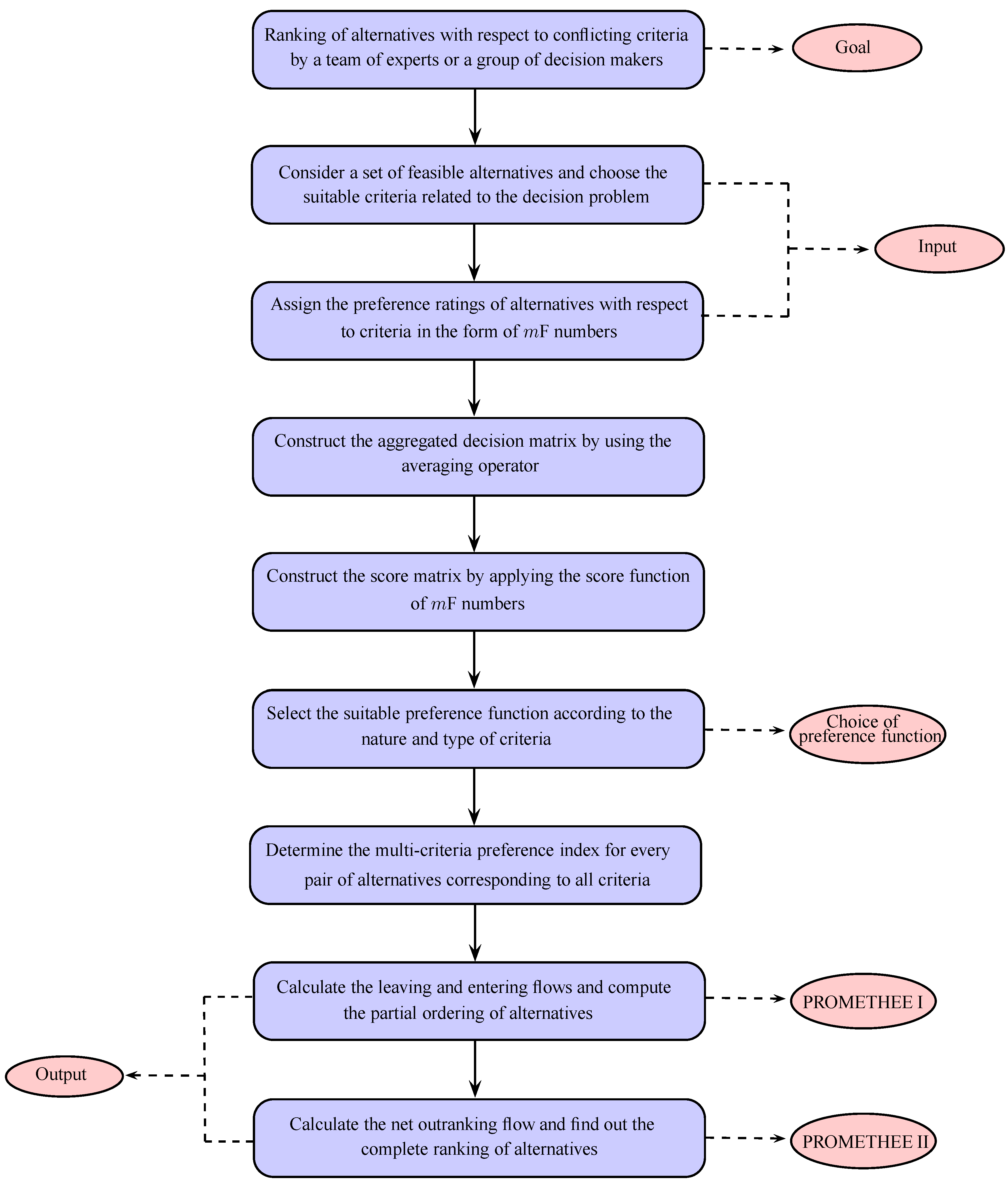
The Analytical Hierarchy Process (AHP) is arguably the most popular and factual approach for computing the weights of attributes in the multi-attribute decision-making environment. The Preference Ranking Organization Method for Enrichment of Evaluations (PROMETHEE) is an outranking family of multi-criteria decision-making techniques for evaluating a finite set of alternatives, that relies on multiple and inconsistent criteria. One of its main advantages is the variety of admissible preference functions that can measure the differences between alternatives, in response to the type and nature of the criteria. This research article studies a version of the PROMETHEE technique that encompasses multipolar assessments of the performance of each alternative (relative to the relevant criteria). As is standard practice, first we resort to the AHP technique in order to quantify the normalized weights of the attributes by the pairwise comparison of criteria. Afterwards the m-polar fuzzy PROMETHEE approach is used to rank the alternatives on the basis of conflicting criteria. Six types of generalized criteria preference functions are used to measure the differences or deviations of every pair of alternatives. A partial ranking of alternatives arises by computing the positive and negative outranking flows of alternatives, which is known as PROMETHEE I. Furthermore, a complete ranking of alternatives is achieved by the inspection of the net flow of alternatives, and this is known as PROMETHEE II. Two comparative analysis are performed. A first study checks the impact of different types of preference functions. It considers the usual criterion preference function for all criteria. In addition, we compare the technique that we develop with existing multi-attribute decision-making methods.
Keywords: m-polar fuzzy numbers; PROMETHEE; AHP; preference functions; decision-making m-polar fuzzy numbers; PROMETHEE; AHP; preference functions; decision-making