Review

From Capture to Conversion: Advances and Challenges in Integrated CO2 Capture and Utilization for Industrial Decarbonization

1
School of Mechanical and Power Engineering, Nanjing Tech University, Nanjing 211816, China
2
School of Chemistry and Molecular Engineering, Nanjing Tech University, Nanjing 211816, China
3
College of Mechanical and Electrical Engineering, Hohai University, Changzhou 213022, China
*
Author to whom correspondence should be addressed.
Separations 2026, 13(6), 179; https://doi.org/10.3390/separations13060179
Submission received: 12 May 2026 / Revised: 13 June 2026 / Accepted: 14 June 2026 / Published: 18 June 2026

Abstract

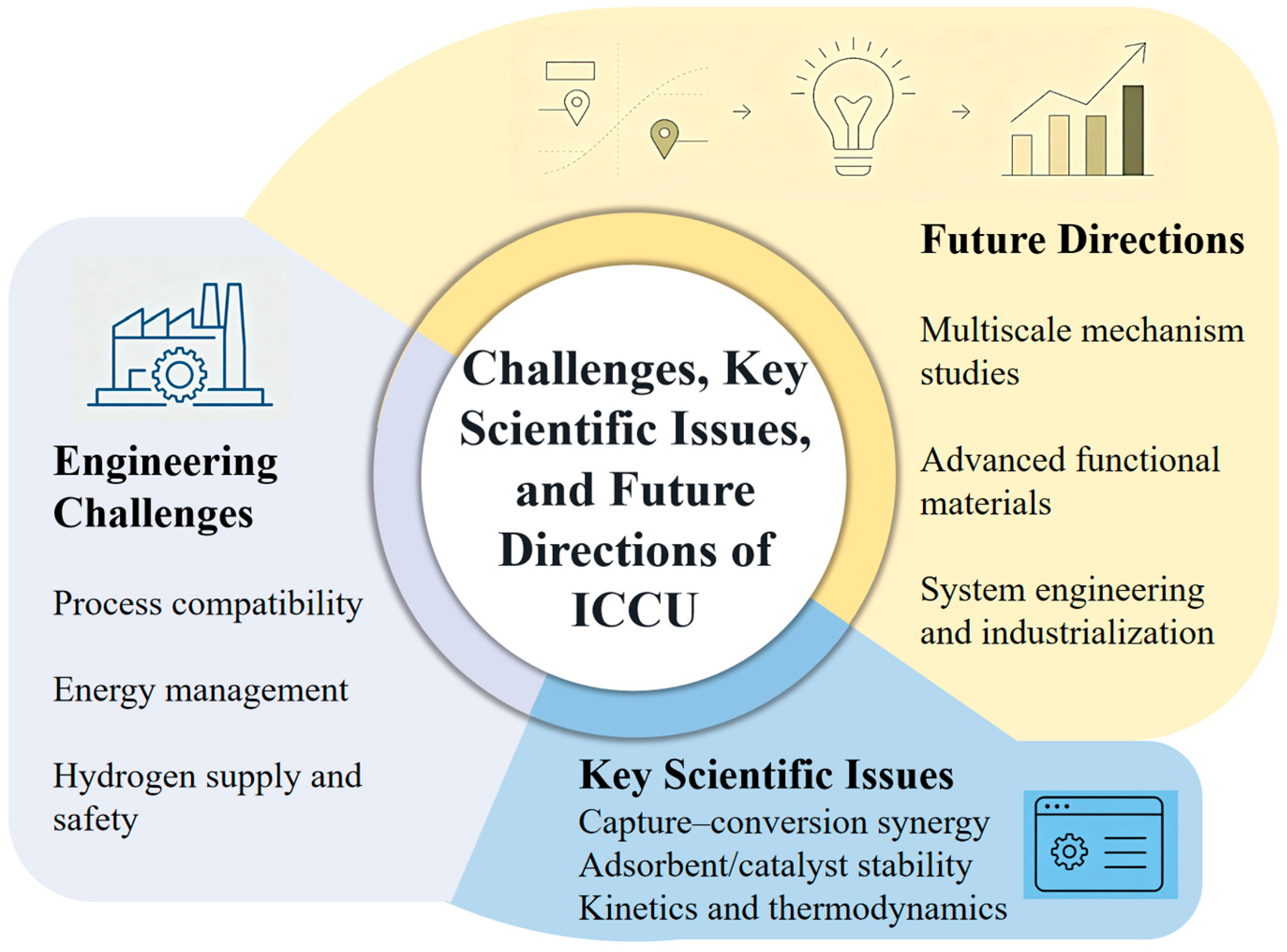
Amid growing pressure to reduce carbon emissions, carbon capture, utilization, and storage (CCUS) has become an important pathway toward deep decarbonization. However, the conventional separated “capture–release–conversion” process suffers from high energy consumption and system complexity, which severely limits its large-scale application. Integrated CO2 Capture and Utilization (ICCU), which enables the capture, activation, and conversion of CO2 within a single system, has attracted widespread attention because it can effectively reduce intermediate energy-intensive steps and improve carbon utilization efficiency. This review systematically summarizes recent progress in ICCU technology, with particular emphasis on reaction mechanisms and interfacial coupling characteristics. The performance features of solvent-based chemical absorption and solid-sorbent adsorption, two widely studied capture routes, are summarized, and typical integrated conversion pathways, including reverse water–gas shift, methanation, and dry reforming of methane, are discussed. On this basis, the roles of non-conventional energy-assisted strategies, such as photocatalysis, electrocatalysis, non-thermal plasma, and microwave irradiation, in expanding ICCU systems are further examined, together with their system-level coupling potential in carbon-intensive industries such as steel, cement, and power generation. Finally, the key scientific issues and engineering challenges currently facing ICCU are analyzed from the perspectives of fundamental mechanisms, material design, and system engineering, and future development directions are proposed. This review highlights that elucidating multiscale synergistic mechanisms, developing high-performance dual-function materials, and optimizing system integration are crucial to promoting the industrial application of ICCU technology.

1. Introduction

Fossil fuels are expected to remain an important part of the global energy structure for the foreseeable future. However, the large-scale use of fossil fuels has resulted in substantial CO2 emissions, posing serious challenges to environmental sustainability and global decarbonization efforts [1]. To address this issue, carbon capture, utilization, and storage (CCUS) is widely regarded as one of the key technological pathways for deep decarbonization [2]. Conventional CCUS systems generally involve several separate steps, including capture, desorption, purification, compression, transportation, and subsequent conversion or storage. Among these steps, capture, desorption, purification, compression, and transportation are highly energy-intensive and often dominate the overall energy penalty of conventional CCUS systems, which not only increases operating costs but also leads to complex process configurations and substantial equipment footprints. These drawbacks have become major obstacles to the large-scale deployment of CCUS [3].
This issue is particularly significant in carbon capture and utilization (CCU) processes, where the capture unit and the conversion reactor are physically separated. As a result, the captured CO2 generally needs to be released, purified, compressed, and then reintroduced into a separate conversion reactor. This process not only increases energy consumption, but also reduces the overall system efficiency [4,5].
In parallel with the development of carbon capture technologies, extensive efforts have also been devoted to the conversion of CO2 into value-added chemicals and fuels. Depending on the primary energy input and activation mechanism, CO2 conversion technologies can generally be classified into thermochemical, electrochemical, or photochemical routes [6]. Thermochemical conversion, including reverse water–gas shift, methanation, and dry reforming of methane, is relatively mature and suitable for producing CO, CH4, syngas, and other carbon-based products, but it usually requires elevated temperatures and considerable external energy input. Electrochemical CO2 conversion can directly utilize renewable electricity to drive CO2 reduction into CO, formate, alcohols, and hydrocarbons under comparatively mild conditions, whereas photochemical conversion aims to use solar energy and semiconductor photocatalysts to achieve sustainable CO2 utilization. Nevertheless, these routes still face challenges related to energy efficiency, product selectivity, catalyst stability, and scale-up. More importantly, most conventional CO2 conversion systems still rely on purified or concentrated gaseous CO2 supplied from a separate capture and regeneration unit, which limits their overall process efficiency and industrial applicability [7]. Therefore, despite the progress of thermochemical, electrochemical, and photochemical CO2 conversion technologies, reducing the energy-intensive intermediate steps in the conventional “capture–release–conversion” route, improving carbon utilization efficiency, and simplifying the process structure have become key challenges in CCUS research and engineering practice. In response to these challenges, Integrated CO2 Capture and Utilization (ICCU) has gradually attracted increasing attention from both academia and industry.
ICCU aims to achieve the integrated implementation of CO2 capture, activation, and conversion within the same material system, reactor unit, or operational process. Compared with the conventional sequential “capture–conversion” route, ICCU places greater emphasis on functional integration, process continuity, and the overall optimization of energy utilization efficiency [8,9,10].
From a process perspective, ICCU is not simply a physical combination of capture materials and catalysts. Instead, it requires intrinsic matching between the capture process and the conversion reaction in terms of temporal sequence, spatial arrangement, and thermodynamic conditions [11,12,13]. The CO2 species formed during the capture stage, such as carbonates, bicarbonates, or chemically adsorbed intermediates, should possess the potential reactivity required for subsequent conversion [14]. Meanwhile, the temperature, atmosphere, and reactant composition required for the conversion step should be coordinated without impairing the capture function [12]. Therefore, the scope of ICCU research extends beyond specific reaction pathways or material systems to include the coupling mechanisms of capture and conversion, as well as the reconfiguration of system boundaries. This broader scope has been partly addressed in previous review articles from different perspectives. Wang et al. reviewed recent advances in solid sorbents for CO2 capture, with emphasis on operating temperature, sorption capacity, kinetics, recycling stability, and cost [15]. Omodolor et al. summarized the development of dual-function materials for CO2 capture and conversion, particularly focusing on adsorbent–catalyst combinations and their applications in methanation, reverse water–gas shift, and dry reforming pathways [16]. Sun et al. further discussed integrated CO2 capture and utilization processes, highlighting key operating parameters, dual-function materials, and the interactions between adsorbents and catalysts in ICCU systems [17]. Nevertheless, these reviews mainly emphasize sorbent performance, dual-function material construction, or thermocatalytic ICCU pathways, while the connections among capture-unit selection, the activation and interfacial migration of captured CO2 species, reaction-pathway regulation, and system-level integration remain insufficiently clarified. This gap indicates the need for a review that links capture mechanisms, conversion pathways, material design, and process integration within a unified ICCU framework.

1.1. Advantages of ICCU

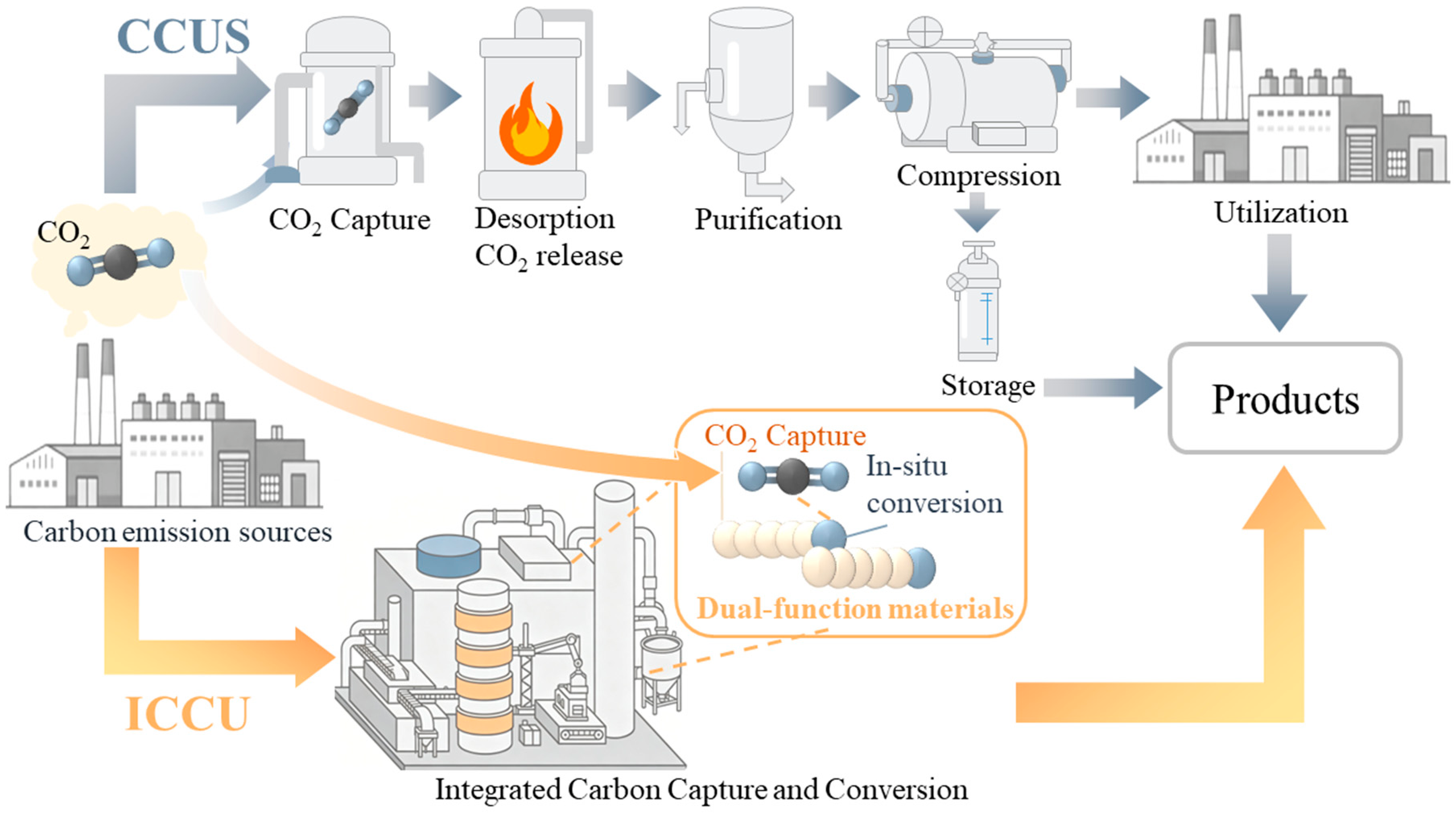
Compared with the conventional CCUS/CCU process, in which the capture unit and the conversion or storage unit operate independently, ICCU redefines the form in which CO2 exists in the system and the way it is utilized through an integrated design concept. In ICCU systems, CO2 directly participates in conversion reactions in the form of captured species or reaction intermediates, rather than relying on highly purified gaseous CO2 [18]. This transformation not only reduces the dependence of the system on high-purity CO2, but also enables some reaction pathways that are otherwise restricted by thermodynamic or kinetic limitations to proceed under integrated conditions [19]. The conceptual difference between conventional CCUS and ICCU is schematically illustrated in Figure 1.
At the system level, ICCU shifts the design logic of conventional CCUS from a focus on separation efficiency toward a more integrated emphasis on overall energy efficiency, reaction selectivity, and system compactness. Some pretreatment or intermediate steps required in conventional processes can be weakened or omitted, thereby reducing the demand for external energy input and minimizing the efficiency loss associated with multistage energy conversion [20]. Meanwhile, the high degree of coupling between capture and conversion allows the heat generated or consumed during the reaction process to be directly utilized locally, thus reducing inter-unit heat transfer and the dependence on additional heat-exchange equipment, while improving system energy efficiency and structural compactness [21]. In addition, the enhanced degree of process integration reduces the complexity associated with intermediate material storage and transport, thereby optimizing the number of equipment units, operational coordination, and potential operating costs [22]. Therefore, the performance of ICCU should be evaluated based on integrated metrics, such as energy consumption per unit of CO2 converted, system coupling efficiency, and cyclic operation performance, rather than solely on a single capture efficiency or conversion efficiency.
One of the core advantages of ICCU is that captured CO2 can participate in subsequent reactions in a manner different from that of free gas-phase molecules. Conventional gas-phase CO2 conversion usually requires high temperatures or high energy input, which leads to high energy consumption and often causes side reactions [23]. In contrast, in ICCU systems, CO2 participates in reactions in the form of captured species or intermediates, and its chemical state and reaction behavior are therefore markedly different. For example, carbonate or carbamate species formed on alkaline components can be activated in situ at the metal–basic interface and gradually participate in reduction or conversion reactions, thereby broadening the kinetic and thermodynamic feasibility window of the reaction [24]. At the same time, the spatial proximity between the capture phase and the catalytic phase reduces CO2 diffusion and nonproductive release losses, thus increasing the probability of conversion toward target products [19]. It may also help suppress over-hydrogenation or competing side reactions, thereby improving selectivity and controllability [19,25].

1.2. Technical Framework and Key Research Aspects of ICCU

In recent years, research on ICCU has increasingly focused on several closely related aspects, including capture–conversion coupling strategies, regulation of reaction pathways, and the design of dual-function materials. Among these aspects, the capture–conversion coupling strategy determines how the captured CO2 species are transferred, activated, and converted within an integrated system. According to the spatial relationship and interaction mode between the capture and conversion steps, ICCU systems can generally be classified into in situ coupling, desorption-substituted coupling, and tandem coupling. In in situ coupling, the capture phase and catalytic phase are integrated within the same material system, allowing adsorbed CO2 species to directly participate in the subsequent conversion reaction [26]. In desorption-substituted coupling, the capture process itself is designed as an integral part of the conversion reaction [27]. In tandem coupling, the capture and conversion units are optimized at the system level through a continuous process configuration, thereby reducing CO2 compression, transportation, and associated energy losses [28].
Typical ICCU reaction pathways include the reverse water–gas shift reaction for CO production, CO2 methanation for CH4 synthesis, and dry reforming for syngas generation. In addition to conventional thermocatalytic routes, emerging energy-input strategies have also been explored, including photo-assisted ICCU, electro-assisted ICCU, non-thermal-plasma-driven ICCU, and microwave-driven ICCU, with the aim of promoting CO2 activation and conversion under milder or non-equilibrium conditions.
To achieve efficient coupling between CO2 capture and conversion, dual-function materials (DFMs) have become an important material platform because they integrate CO2 adsorption sites and catalytic active sites within a single system. Therefore, the rational matching of adsorption sites, catalytic sites, and reaction pathways is critical for improving CO2 conversion efficiency, product selectivity, and cyclic stability.
In view of the above technical framework, a key unresolved issue is how capture-unit selection affects the activation and interfacial migration of captured CO2 species, and how these processes further influence reaction-pathway regulation and system integration. To address this issue, this review focuses on chemical absorption- and solid adsorption-based ICCU systems, which feature relatively well-defined capture mechanisms, mature material platforms, and broad prospects for industrial application. Following the logical sequence of capture units, thermally driven conversion pathways, non-conventional energy-assisted systems, and industrial process integration, this review summarizes recent progress in ICCU, with particular emphasis on reaction mechanisms, material design principles, technical advantages, and engineering challenges. The key contribution of this review lies in its connection of capture mechanisms, conversion pathways, material design, and process integration within a unified ICCU framework, thereby highlighting the novelty, technical significance, and future development priorities of ICCU technologies.

2. CO2 Capture Units in ICCU Systems

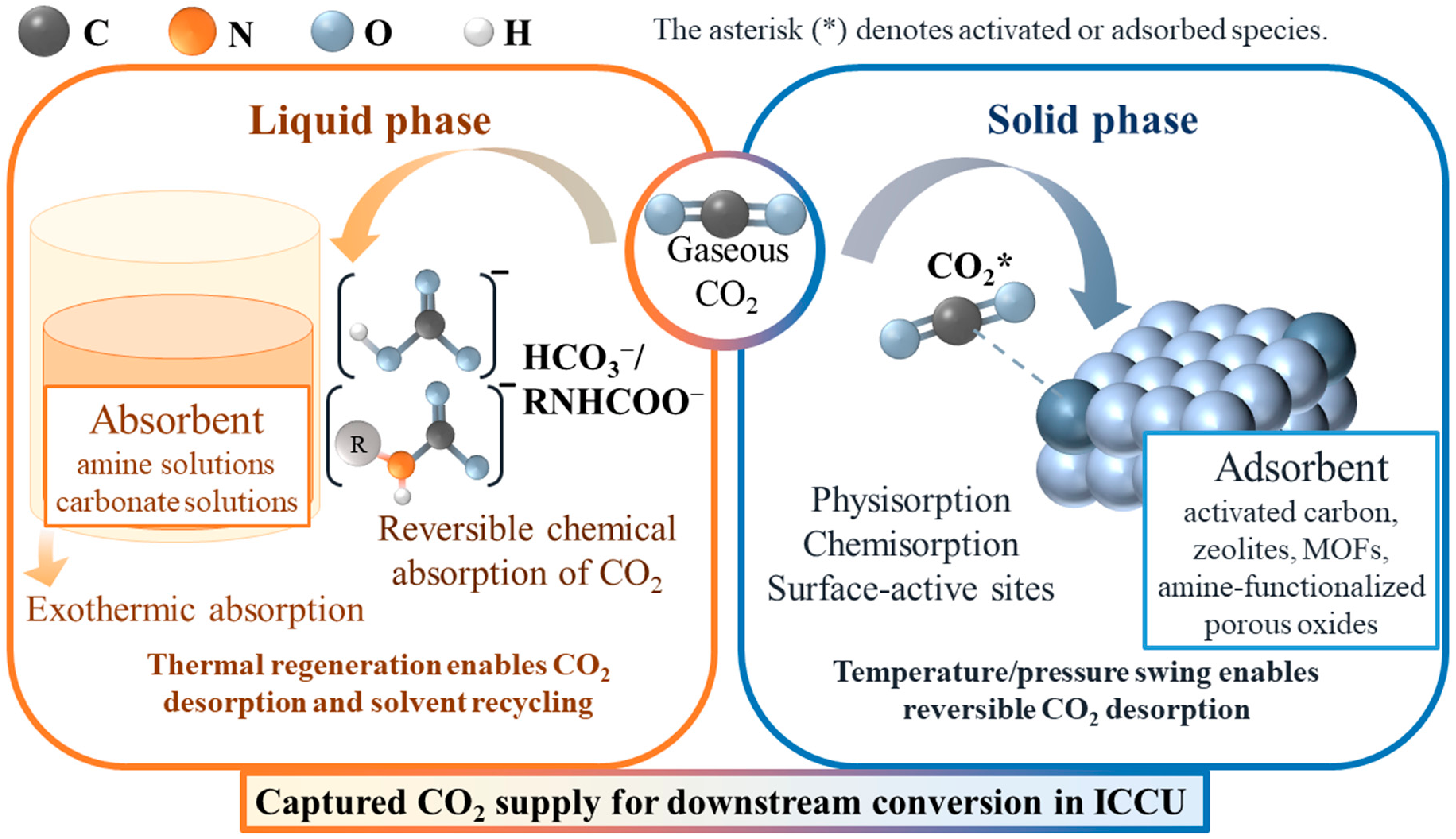
In ICCU systems, the CO2 capture unit is a prerequisite for efficient carbon utilization, and its performance directly affects the efficiency and selectivity of subsequent conversion processes. Unlike stand-alone CO2 capture processes, the capture unit in ICCU should be evaluated not only by conventional capture indicators such as CO2 uptake and regeneration energy, but also by its influence on the chemical form, release behavior, and interfacial availability of captured CO2 species for subsequent conversion. In CO2 capture technologies, solvent-based chemical absorption and solid-sorbent adsorption represent two widely studied capture routes. For clarity, Figure 2 schematically illustrates the representative capture mechanisms of solvent-based chemical absorption systems and solid-sorbent adsorption systems [29,30].

2.1. Solvent-Based Chemical Absorption Systems

Solvent-based chemical absorption systems rely primarily on reversible chemical reactions between liquid-phase solvents and CO2 to efficiently transfer gaseous CO2 into the liquid phase, and they are currently among the most industrially mature and widely applied carbon capture technologies. Common absorbents include amine solutions, such as monoethanolamine (MEA), diethanolamine (DEA), and methyldiethanolamine (MDEA), as well as carbonate solutions and other functionalized liquids. Among these, amine-based absorption systems have been widely adopted because of their fast reaction kinetics and high capture efficiency [31]. In such systems, CO2 molecules react chemically with amine groups in the solvent to form reversible bicarbonate or carbamate intermediates. The absorption process is accompanied by significant heat release, whereas the regeneration stage requires external heat input to achieve CO2 desorption and solvent recycling [32,33].
Owing to the well-established absorber–regenerator process configuration, chemical absorption systems are particularly suitable for coal-fired power plants and industrial flue gas sources with relatively high CO2 concentrations. They also provide a stable and concentrated CO2 supply for integrated capture–conversion processes such as ICCU-RWGS and ICCU-M. Nevertheless, these systems still suffer from several limitations, including high energy consumption, poor solvent stability, and limited adaptability to complex flue gas compositions. Amine solutions require substantial thermal energy input during regeneration, resulting in relatively high overall system energy consumption [34]. In addition, impurities such as SO2 and NOx in flue gas can easily induce solvent degradation and equipment corrosion, thereby affecting capture lifetime and operating economics [35]. Solvent volatilization and potential emissions also pose challenges for engineering application [36].
To address these issues, recent studies have focused on the development of amines and functionalized absorbents with lower regeneration energy requirements. Through molecular-level structural design, the energy demand for CO2 desorption can be reduced, while the absorbent can also be endowed with multifunctionality so that it may directly participate in subsequent catalytic conversion during CO2 capture [37,38]. In addition, membrane-assisted absorption using hollow fiber membrane contactors has been introduced into chemical absorption systems to enhance gas–liquid mass transfer and reduce system energy consumption, thereby providing a process-intensification basis for solvent-based capture in ICCU systems [39]. From the perspective of ICCU, lower regeneration energy and enhanced mass transfer can reduce the integration gap between solvent-based capture and downstream CO2 utilization; however, direct coupling with high-temperature thermocatalytic conversion remains constrained by solvent stability and catalyst compatibility.

2.2. Solid-Sorbent Adsorption Systems

Solid-sorbent adsorption systems selectively enrich CO2 on solid surfaces through gas–solid interfacial interactions, and their primary capture mechanisms include physisorption and chemisorption. Compared with liquid-phase chemical absorption, solid adsorption systems generally offer greater operational flexibility, lower regeneration energy consumption, and certain potential for modular application. For these reasons, they have attracted extensive attention in ICCU systems in recent years [40]. Common adsorbent materials include activated carbon, zeolites, metal–organic frameworks (MOFs), and amine-functionalized porous oxides. Among these, the porous structure and surface chemical properties of the materials play decisive roles in determining the CO2 adsorption capacity and selectivity [41].
During the capture process, CO2 molecules are immobilized either through van der Waals interactions or by forming weak chemical bonds with surface active sites, and can be reversibly desorbed under changes in temperature or pressure, thereby providing a controllable CO2 supply for subsequent conversion [42]. Because solid adsorbents do not involve large-scale liquid circulation, they exhibit clear advantages in terms of system compactness and faster process response. This makes them particularly suitable for spatial or temporal integrated coupling with conversion processes, because CO2 adsorption sites and catalytic active sites can be integrated within the same material or reactor framework, thereby shortening the transfer pathway of captured CO2 species toward catalytic sites [25,43,44].
However, solid-sorbent adsorption capture systems still face challenges in adsorption capacity, mass transfer rate, and long-term stability. Most physisorption-based materials show decreased adsorption performance under high-temperature or high-humidity conditions, whereas chemisorption-based materials may suffer from activity decay or structural instability during repeated cycles [45]. In addition, the matching among CO2 adsorption strength, release behavior, and subsequent conversion kinetics directly affects the overall system efficiency [46]. Therefore, an appropriate balance between CO2 uptake, release, and catalytic transformation is required, because excessively strong adsorption may hinder timely CO2 utilization if it is not effectively coupled with interfacial transport and catalytic conversion. To address these issues, current research has focused on the development of adsorbent materials with high specific surface area, well-developed porous structures, and surface functionalization. By introducing amine groups or basic sites, the selective adsorption of CO2 can be enhanced. At the same time, integrated adsorption–conversion materials and reactors are being optimized to shorten mass transfer pathways and improve system synergy, thereby promoting the engineering application of solid adsorption-based capture systems in ICCU technologies [4,47].
Based on the above discussion, Table 1 summarizes representative materials, main characteristics, advantages, and limitations of solvent-based chemical absorption and solid-sorbent adsorption systems for CO2 capture in ICCU.
As summarized in Table 1, solvent-based chemical absorption systems and solid-sorbent adsorption systems exhibit distinct advantages and limitations for ICCU applications. Amine solutions show fast absorption kinetics and high CO2 uptake, but their high regeneration energy demand, corrosion, and solvent degradation limit their direct integration with downstream conversion processes. Carbonate solutions offer lower cost and better stability, although their relatively slow kinetics and possible precipitation or fouling problems may reduce process efficiency. In contrast, solid sorbents such as activated carbon, zeolites, and metal–organic frameworks provide greater structural tunability and are more suitable for compact and modular ICCU configurations. However, their practical application is still affected by limited CO2 affinity, moisture sensitivity, insufficient stability, and scale-up challenges. Therefore, the selection of CO2 capture materials in ICCU systems should not only consider capture capacity and regeneration energy, but also the compatibility between CO2 release behavior, mass transfer, and subsequent catalytic conversion.
In addition to material properties, operating pressure is also an important parameter affecting the performance of CO2 capture units in ICCU systems. For solvent-based chemical absorption, increasing the CO2 partial pressure can enhance the gas–liquid mass-transfer driving force and increase solvent loading, thereby improving the apparent capture capacity [53,54]. However, when external compression is required, operation at elevated CO2 partial pressure may introduce additional energy demand for gas pressurization and alter the balance among CO2 absorption, desorption, and solvent circulation [53]. For solid-sorbent adsorption systems, elevated CO2 partial pressure generally favors CO2 uptake according to adsorption equilibrium, whereas pressure reduction in pressure-swing or vacuum pressure-swing operation can promote reversible CO2 desorption and sorbent regeneration [55]. Nevertheless, excessively strong adsorption or insufficient depressurization may hinder the timely release of captured CO2 species and reduce the availability of CO2 for subsequent conversion [56]. Therefore, in ICCU systems, pressure regulation in the capture stage should not be evaluated solely from the perspective of maximizing CO2 uptake. Instead, it should be considered together with CO2 release kinetics, mass transfer, regeneration energy, and the compatibility between captured CO2 species and subsequent catalytic conversion. These pressure-dependent behaviors provide important guidance for selecting suitable operating pressure windows in integrated capture–conversion systems.

3. Integrated Conversion Pathways in ICCU

Thermally driven ICCU represents one of the most mature and widely investigated routes for integrated CO2 capture and conversion [57,58,59]. In these systems, thermal energy is used to promote CO2 release, interfacial migration, and catalytic conversion of captured species, while H2 or CH4 is commonly introduced as the reductant or reactant. The core of these systems lies in the deep coupling between CO2 capture and conversion, which shortens intermediate steps, reduces energy consumption, and improves carbon-utilization efficiency. Representative thermally driven ICCU pathways mainly include integrated capture and reverse water–gas shift (ICCU-RWGS), integrated capture and methanation (ICCU-M), and integrated capture and dry reforming of methane (ICCU-DRM). These pathways are directed toward different application scenarios, including syngas production, methane generation, and the production of carbon-based fuels and chemicals.

3.1. ICCU-RWGS

ICCU-RWGS is one of the most representative reaction pathways in integrated capture–conversion systems. Its core advantage lies in the direct conversion of CO2 enriched in the capture unit into CO, thereby providing syngas feedstock for downstream fuel synthesis and chemical production. The reverse water–gas shift reaction is an endothermic process that is strongly affected by temperature and reactant partial pressures, and is therefore usually conducted under medium- to high-temperature conditions [60]. In thermally driven ICCU-RWGS systems, thermal energy not only promotes the RWGS reaction itself, but also facilitates the release, migration, and interfacial activation of captured CO2 species. Meanwhile, the high local CO2 concentration continuously supplied by the capture unit helps improve CO2 availability and the local reaction environment near the catalytic interface, thereby creating favorable conditions for stable reaction operation.
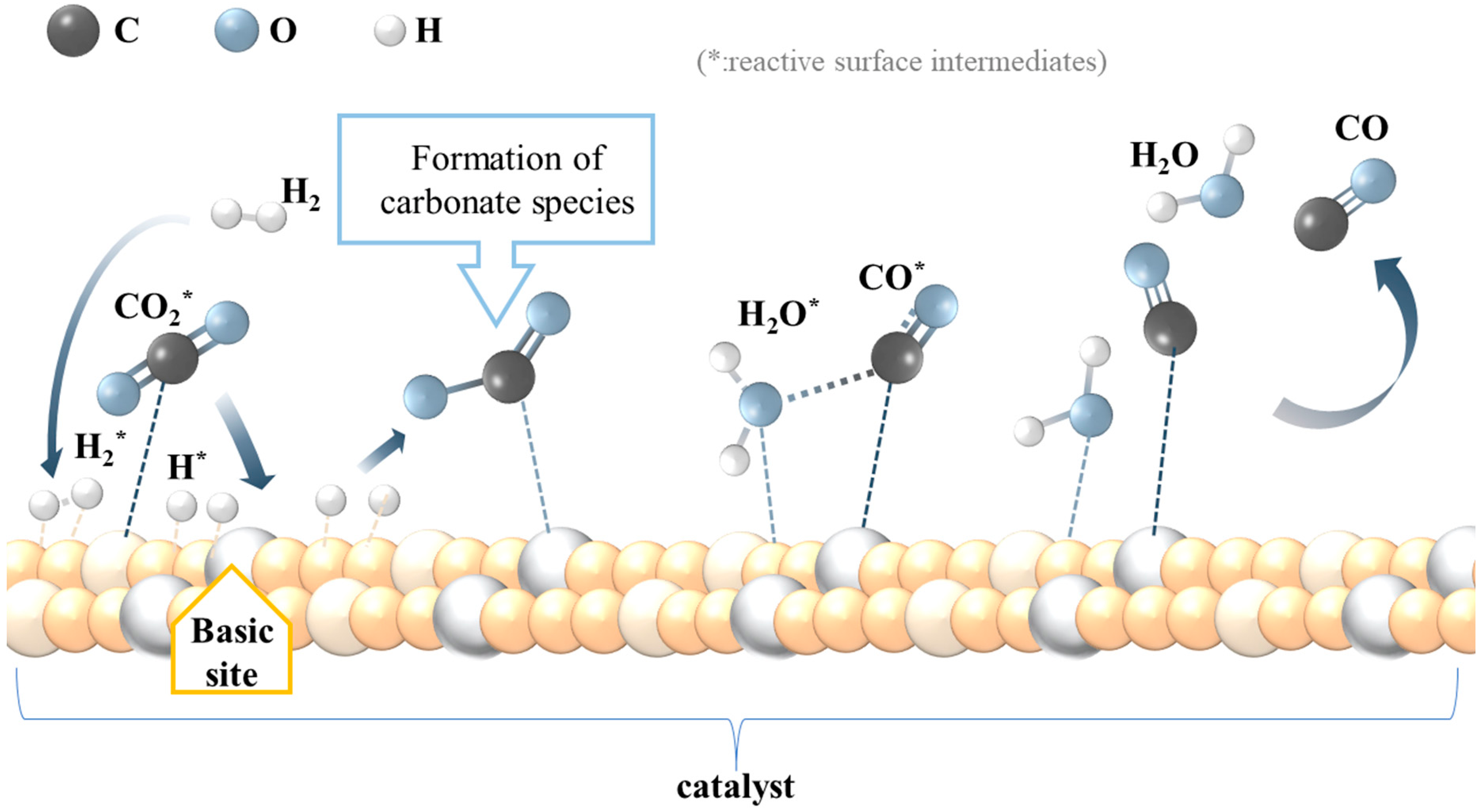
From a mechanistic perspective, ICCU-RWGS is centered on the reverse water–gas shift pathway, in which CO2 reacts with H2 on the catalyst surface to produce CO and H2O. In integrated systems, CO2 is first fixed by the capture material through chemical adsorption or surface coordination, forming intermediate species such as carbonates. Subsequently, under thermal driving forces or interfacial synergistic effects, these captured species migrate to adjacent catalytic sites, where they undergo further activation and conversion [19]. This interfacial migration and subsequent catalytic conversion process are schematically illustrated in Figure 3. Existing studies have shown that the interfacial coupling between the capture material and the catalytic component plays a key role in regulating the formation, migration, and evolution of surface intermediates, thereby significantly affecting the pathway of CO formation and product selectivity [61]. Therefore, the ICCU-RWGS reaction is essentially a dynamic synergistic process involving capture, release, and catalytic conversion at the interfacial scale.
To further summarize the structural features, functional roles, and catalytic performance of representative ICCU-RWGS material systems, related materials are compared in Table 2.
From the perspective of material design, current ICCU-RWGS systems mainly rely on transition metal-based dual-function materials, such as Ni-, Fe-, and Cu-based systems, as well as defective oxide composite systems. Factors including the type of metal, its dispersion state, the properties of the support, and the interfacial structure jointly determine the reaction activity and product distribution of the system [62]. For example, Ni-CaO-CeO2 dual-function materials exhibit high CO2 conversion and CO selectivity because of their high Ni dispersion, abundant oxygen vacancies, and excellent reducibility [63]. Similarly, the CeO2-CaO system, owing to its strong surface basicity, rich oxygen vacancies, and favorable pore structure characteristics, is beneficial for enhancing the chemisorption and activation of CO2 [25]. In addition, by regulating metal components and their synergistic effects, side reactions can be effectively suppressed and cyclic stability can be improved. For example, Ni-Fe bimetallic systems achieve high CO selectivity and good cyclic performance by enhancing reducibility and stabilizing the size of active phases [64]. Meanwhile, Cu-based dual-function materials can achieve nearly quantitative CO selectivity under non-isothermal operating conditions, further demonstrating the importance of matching catalytic component design with reaction conditions for product regulation [13].
In recent years, the single-atom catalytic strategy has gradually attracted increasing attention. By constructing isolated active sites with well-defined coordination environments, this strategy not only improves the utilization efficiency of active sites, but also optimizes the reaction pathway, thereby significantly enhancing RWGS activity and CO selectivity. This direction provides a new theoretical basis and development route for the design of highly efficient ICCU-RWGS catalytic materials [65].
Table 2. Structural features, functional roles, and catalytic performance of representative catalytic materials in ICCU-RWGS systems.
No.Catalyst/Material SystemKey Structural FeaturesFunctional RoleReaction ConditionsTypical Performance MetricsRef.
1CeO2–CaO dual-function materialCeO2 provides favorable surface basicity and abundant oxygen vacancies.Enhances CO2 chemisorption and activation, thereby promoting CO formation.650 °CCO2 conversion of approximately 49%; CO selectivity of approximately 100%; stable over 20 cycles.[25]
2Ni–CaO–CeO2 dual-function materialUniform Ni dispersion, abundant oxygen vacancies, and strong reducibility.Improves overall reaction performance and enhances both CO2 conversion and CO selectivity.N/ACO2 conversion of 92.4%; CO selectivity of 89.1%; performance decay of 11.6% after 10 cycles.[63]
3Ni1Fe9–CaO dual-function materialStable Fe particle size and a synergistic Ni–Fe effect.Improves the reducibility of the Ca–Fe system.650 °CCO2 conversion of 82.5%; CO selectivity of 99.9%; CO yield decreased by 20.9% after 10 cycles.[64]
4Cu/Na–CaO/γ-Al2O3 dual-function materialTunable Cu content and synergistic interaction between the Na–CaO sorption phase and the Al2O3 support.Improves CO selectivity and enhances cyclic stability.CO2 capture at 650 °C; RWGS reaction at 610 °CCO selectivity of 100%; CO2 conversion of approximately 91%; stable over 18 cycles.[13]
5Single-atom Co–N–C catalystIsolated Co–N4 sites with 5 wt% Co loading.Enhances RWGS activity and CO selectivity.500 °CCO2 conversion of 52.4%; CO selectivity close to 100%.[66]
From the perspective of technical advantages, the integrated capture–RWGS route, through the deep coupling of the capture unit and the reaction unit, can achieve a better match between CO2 release and reactor feed demand, thus significantly reducing the energy consumption associated with intermediate separation and compression steps [14]. In addition, the synergistic utilization of heat between the reactor and the capture unit offers opportunities for improving overall system energy efficiency, making ICCU-RWGS particularly attractive in terms of process simplification, energy integration, and compact design [67].
However, the engineering application of ICCU-RWGS still faces several challenges. High-temperature operating conditions impose strict requirements on the stability of both capture materials and catalysts, while the matching between the CO2 release rate and reaction kinetics significantly affects overall system efficiency [28]. At the same time, the control of side reactions and catalyst deactivation during long-term cyclic operation remain unresolved issues [68]. Future research should focus on material design, reactor optimization, and multiscale process-coupling modeling, thereby promoting the development of ICCU-RWGS toward higher efficiency, greater stability, and improved scalability.

3.2. ICCU-M

ICCU-M is an integrated technology that enables the synergistic implementation of CO2 capture and methanation within the same system. Its core concept is the direct introduction of a hydrogen source and catalytic active sites during the capture stage, so that the captured CO2 can be converted in situ into CH4 without undergoing energy-intensive desorption or compression. This system usually employs amine-functionalized solid adsorbents or other adsorptive materials as carriers, which not only enable efficient CO2 enrichment but also provide a high local reactant concentration for methanation, thereby shortening the process chain and improving overall system energy efficiency [69]. In thermally driven ICCU-M systems, thermal energy not only promotes the release of captured CO2 species and their transfer to catalytic active sites, but also provides the necessary activation conditions for CO2 hydrogenation to methane. Meanwhile, CO2 methanation is inherently exothermic; therefore, rational regulation of reaction heat release and its thermal coupling with the capture/conversion process is important for improving the energy efficiency and operational stability of ICCU-M systems [70].
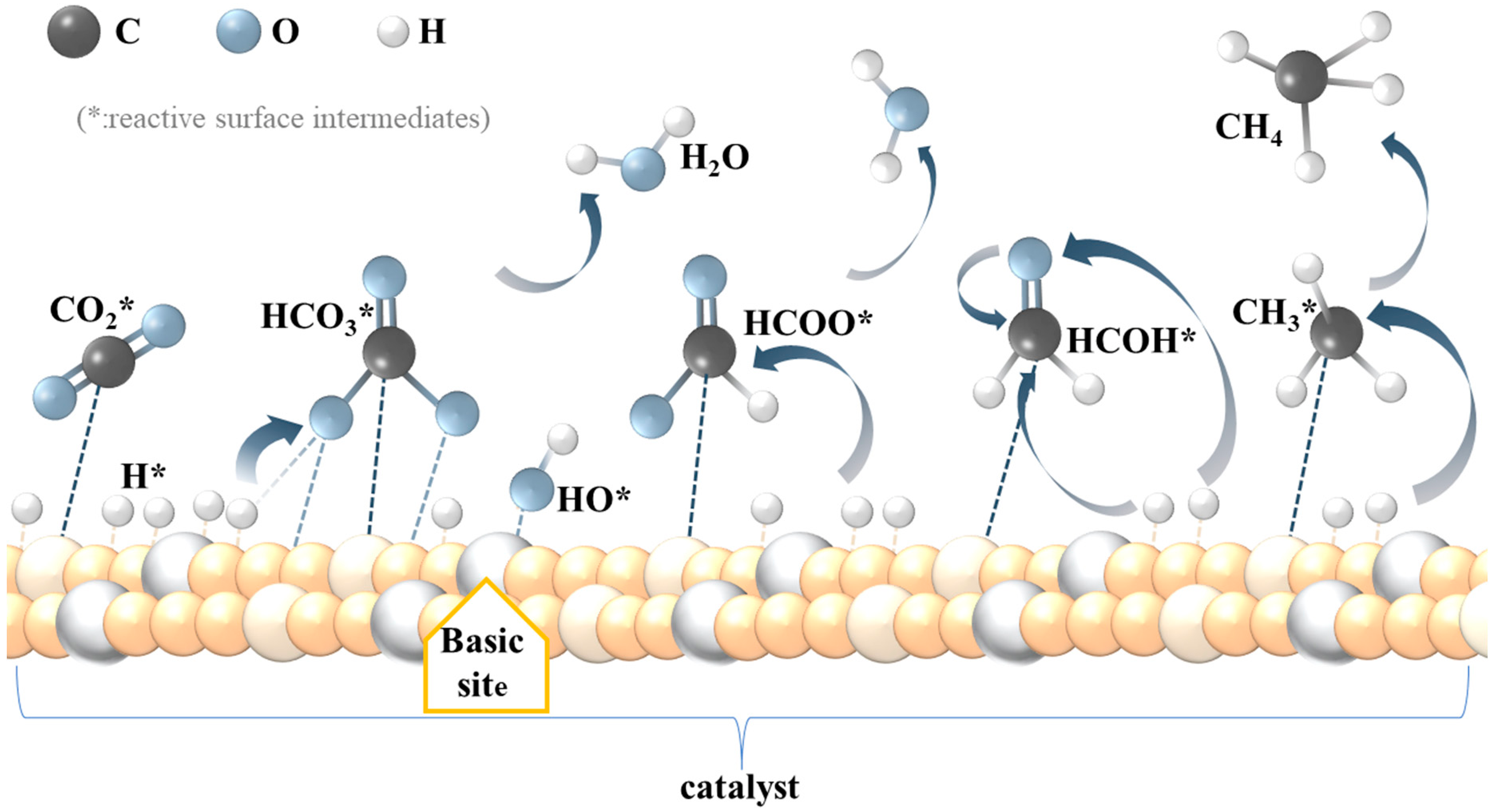
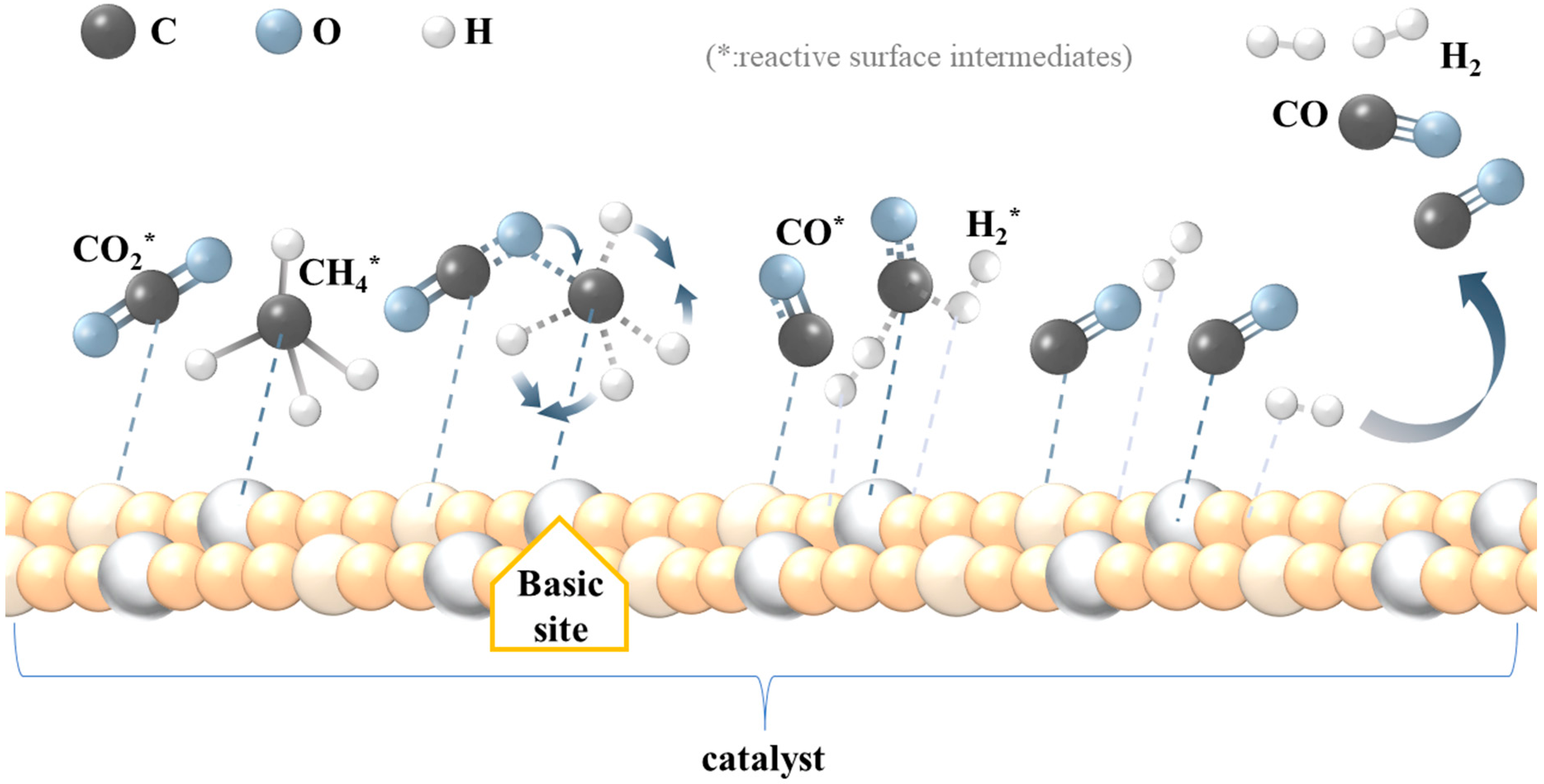
Mechanistically, ICCU-M is based on the Sabatier reaction pathway, in which CO2 undergoes multistep hydrogenation with H2 on the catalyst surface to generate CH4 and H2O [71]. In the integrated system, captured CO2 is first immobilized on the adsorbent through chemical bonding or physical adsorption, and then gradually undergoes C=O bond cleavage and hydrogenation in the presence of hydrogen and catalytic active sites [72]. Figure 4 schematically shows the possible surface hydrogenation sequence from adsorbed CO2-derived species to CH4, involving intermediates such as HCO3*, HCOO*, HCOH*, and CH3*. Because the captured CO2 is locally enriched and may exist as reactive surface intermediates, the apparent activation energy of the reaction can be reduced, enabling methanation to achieve high conversion and selectivity under relatively mild conditions [65].
To provide an evidence-based overview of ICCU-M systems, representative experimentally reported dual-function materials are summarized in Table 3 in terms of their structural features, functional roles, reaction conditions, methane production performance, CO2 conversion/selectivity, and cyclic stability.
As shown in Table 3, most reported ICCU-M systems rely on the spatial coupling between alkaline CO2 storage sites and metal hydrogenation sites. Alkaline components such as MgO, CaO, Na2O, and Na2CO3 mainly contribute to CO2 uptake through the formation of carbonate or bicarbonate species, whereas Ru- or Ni-based sites promote H2 activation and subsequent hydrogenation of the stored CO2 species to CH4. Ru-based dual-function materials generally show high methane selectivity under relatively mild methanation temperatures, while Ni-based systems offer a lower-cost alternative but usually require higher reaction temperatures to achieve comparable activity. These results indicate that the balance between CO2 storage capacity, metal dispersion, interfacial contact, and cyclic structural stability is crucial for improving ICCU-M performance.
From the perspective of technical advantages, ICCU-M avoids heat loss and energy waste associated with the conventional “capture–desorption–compression–conversion” route through capture–conversion coupling, while also reducing overall system complexity. In addition, the methane produced can be directly used as substitute natural gas (SNG) and integrated into the existing natural gas network, thereby enabling the efficient coupling of electricity, hydrogen, and carbon resources. This feature is particularly important for establishing a coordinated low-carbon energy system involving electricity–hydrogen–gas–carbon integration [77].
Despite its broad prospects, ICCU-M still faces several key challenges. The strongly exothermic nature of the methanation reaction leads to difficulties in heat transfer and temperature control [78]. In addition, issues related to the compatibility and long-term stability of capture materials and catalysts remain unresolved [19], and there are still risks of material deactivation and structural degradation during cyclic operation [79]. Current research mainly focuses on the synergistic design of multifunctional capture–catalytic materials, the elucidation of coupled reaction–mass transfer–heat transfer mechanisms, and the intensification of reactor structures, with the aim of achieving high capture efficiency, high methane selectivity, and long-term stable operation [17,19,80].

3.3. ICCU-DRM

ICCU-DRM integrates CO2 capture with the dry reforming of methane, aiming to achieve efficient CO2 enrichment and its subsequent in situ utilization. This technology typically relies on adsorption–catalysis dual-function materials as the core platform. While CO2 is captured from flue gas or process gas, CH4 can be introduced into the conversion stage, and the dry reforming reaction is driven at catalytic active sites, thereby avoiding the additional energy consumption and process complexity associated with repeated CO2 desorption, compression, and transport in conventional processes [81]. Compared with ICCU-M, ICCU-DRM is characterized by the highly endothermic nature of the DRM reaction, which typically requires elevated temperatures due to the difficult activation of CH4 with a high C–H bond energy of 439 kJ mol−1 [82]. Therefore, thermal energy in ICCU-DRM systems not only promotes the release and interfacial transfer of captured CO2 species, but also significantly affects CH4 activation, CO2 conversion in the reforming process, and the rate of syngas formation [83]. Under thermally driven conditions, CO2 released from the capture material can participate in catalytic reforming with CH4 at elevated temperatures, thereby coupling the capture process with the endothermic conversion step [84].
Several experimental studies have provided direct evidence for the feasibility of ICCU-DRM. For example, Tian et al. proposed a calcium-looping reforming of methane process over a CaO–Ni bifunctional sorbent–catalyst, in which CO2 was first captured by CaO and then reduced in situ by CH4 over adjacent metallic Ni sites to form CO [84]. This coupled process promoted CaCO3 decomposition by continuously consuming the released CO2 and showed lower energy consumption than conventional dry reforming, demonstrating the potential energy advantage of integrating CO2 capture with methane reforming. In another study, Ni (10 wt%)–CaO dual-function materials were evaluated under simulated power-plant flue-gas conditions. The results showed that H2O could promote CO2 capture kinetics, whereas O2 oxidized metallic Ni to NiO and inhibited the utilization of captured CO2 during the DRM stage [85]. These results indicate that the performance of ICCU-DRM is strongly affected by realistic flue-gas components and that the oxidation state of Ni active sites plays a critical role in maintaining reforming activity. More recently, Ni–Ca dual-function materials have also been tested under SO2- and NO2-containing flue-gas conditions. For a representative Ni5Al15Ca material, the CO2 conversion remained relatively stable over ten cycles, decreasing only from 81.3% in the first cycle to 76.3% after ten cycles, while the CO2 uptake decreased from 10.9 to 9.5 mmol g−1 [86]. However, high SO2 concentrations led to severe deactivation, suggesting that sulfur- and nitrogen-containing impurities should be carefully considered in the practical application of ICCU-DRM systems.
Mechanistically, ICCU-DRM is centered on the dry reforming reaction between CO2 and CH4, in which the synergistic cleavage of C–H and C=O bonds occurs on the catalyst surface to generate syngas mainly composed of CO and H2 [87]. The proposed surface reaction pathway involving CO2 activation, CH4 dissociation, intermediate conversion, and syngas formation is schematically illustrated in Figure 5. In the integrated system, captured CO2 exists at a high local concentration or in an activated state, which can increase its probability of reacting on the catalytic surface and alleviate the mass-transfer limitations of CO2 in conventional DRM [88]. Under thermally driven conditions, the elevated-temperature environment facilitates C–H bond activation in CH4, while also promoting the release of captured CO2 species and their transfer to catalytic interfaces. These processes enable CO2-derived species to further participate in surface redox reactions, thereby accelerating the conversion of carbonaceous intermediates and the formation of syngas. The synergistic interaction between the capture material and the catalyst is also beneficial for regulating the formation and conversion behavior of reaction intermediates, thereby improving syngas composition and reaction stability [19].
From the perspective of technical advantages, ICCU-DRM shows outstanding potential for the synergistic realization of high-value product generation and carbon emission reduction. Dry reforming can simultaneously consume two greenhouse gases, CO2 and CH4, while producing syngas that can be further used in Fischer–Tropsch synthesis and the production of liquid fuels, olefins, waxes, and other value-added chemicals, thereby enabling the closed-loop utilization of carbon resources [82]. The integrated mode reduces overall system energy consumption and capital investment, and also provides a new technical route for the in situ conversion of CO2 in carbon-intensive industries.
However, ICCU-DRM still faces several engineering challenges. The high-temperature and strongly endothermic nature of the dry reforming reaction gives rise to difficulties in energy supply and thermal management. In addition, catalysts are prone to carbon deposition and deactivation under carbon-rich environments [83], while the structural stability and synergistic matching of capture materials and DRM catalysts at high temperatures still need to be further improved [19,89]. Current research mainly focuses on the development of anti-coking catalytic materials, the integrated design of multifunctional capture–catalytic materials, and the optimization of mass transfer and heat transfer within reactors, with the aim of promoting ICCU-DRM toward efficient, stable, and scalable engineering applications [81,90,91].
Operating pressure not only affects CO2 capture processes, including solvent absorption and solid-sorbent adsorption–desorption behavior, but also plays an important role in thermally driven ICCU conversion pathways. However, its effect varies significantly among different reaction routes. For ICCU-RWGS, elevated pressure does not necessarily improve CO selectivity, because the RWGS pathway is strongly coupled with reactant partial pressures, residence time, surface coverage, and competing methanation reactions. Therefore, pressure optimization in ICCU-RWGS should focus on balancing CO formation, side-reaction suppression, and process energy consumption [92]. In contrast, ICCU-M is generally more favorable under elevated pressure, because higher pressure can promote CO2 hydrogenation toward CH4 and improve methane yield and volumetric productivity [93]. However, high-pressure methanation also increases compression energy demand, heat-removal difficulty, reactor sealing requirements, and safety risks associated with hydrogen-rich atmospheres. For ICCU-DRM, high-pressure operation is usually less favorable, as it may decrease equilibrium conversion and aggravate carbon deposition, thereby accelerating catalyst deactivation [94]. Nevertheless, moderate-pressure operation may still be considered in practical systems when downstream syngas utilization, reactor throughput, or process integration requirements are taken into account. Overall, pressure should not be regarded as a universally beneficial operating parameter for all ICCU conversion pathways. Instead, the suitable pressure window should be selected according to the reaction pathway, product target, catalyst stability, energy consumption, and system-integration requirements. Since direct studies on pressure effects in complete ICCU systems remain limited, pressure-dependent behaviors observed in individual RWGS, methanation, and DRM reactions can provide useful references for the rational design and scale-up of ICCU processes.

4. ICCU Systems with Non-Conventional Energy Inputs

Conventional ICCU systems primarily rely on thermally driven catalytic conversion to achieve capture–conversion coupling. However, this mode usually requires medium- to high-temperature conditions (300–700 °C), which leads to high energy consumption, complex thermal management requirements, and limited compatibility with renewable energy integration [19]. In recent years, with the development of non-conventional energy forms such as light, electricity, plasma, and microwaves, increasing attention has been directed toward ICCU systems with non-conventional energy inputs. These systems are being explored as a means to overcome the limitations of conventional thermally driven processes, expand the boundary of energy utilization, and enable CO2 capture–conversion pathways featuring low-temperature operation, high selectivity, and direct coupling with renewable energy.

4.1. Photo-Assisted ICCU

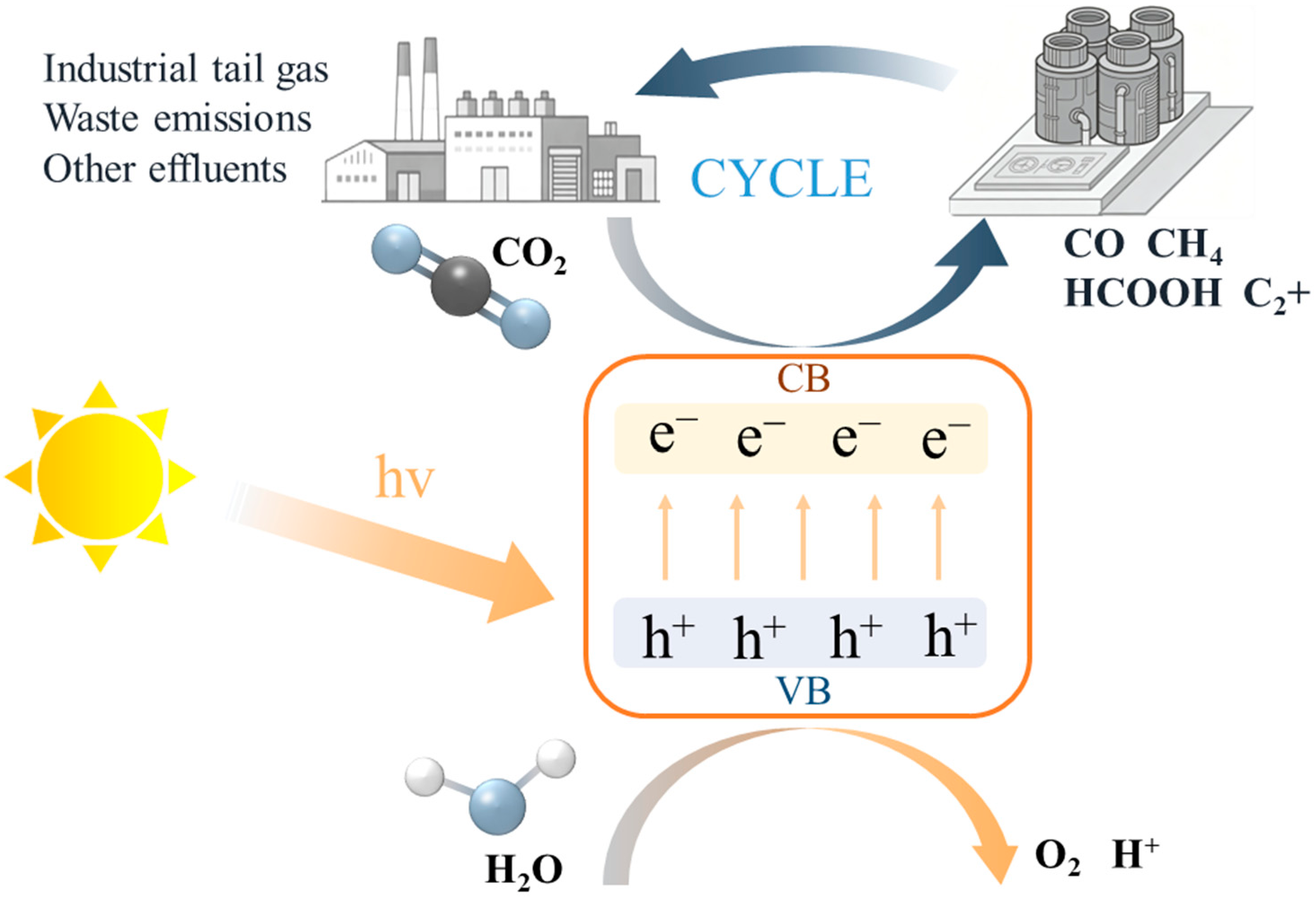
Photo-assisted ICCU aims to overcome the dependence of conventional thermally driven systems on high-temperature energy input by introducing light energy to realize the synergistic coupling of capture and reduction within the same system. The basic concept is to simultaneously construct CO2 adsorption sites and photoresponsive active centers within a single material system or a highly coupled composite structure, so that the capture process is spatially integrated and temporally coordinated with the reduction reaction driven by photogenerated charge carriers [95]. Unlike thermocatalytic systems, which rely on external heat sources to activate molecular vibrations, photocatalytic systems generate electron–hole pairs through photon absorption by semiconductor materials, and then utilize interfacial charge separation and migration to inject electrons into and activate CO2 molecules [96]. In this process, basic sites—such as O2− species in metal oxides or alkali-metal-doped sites—or porous materials, including amine-functionalized materials and metal–organic frameworks (MOFs), first capture CO2 and convert it into carbonate or bicarbonate species, thereby increasing the local concentration and enhancing the probability of interfacial reactions [97]. The photogenerated electrons then accumulate at metal cocatalysts or defect sites, enabling the stepwise reduction of the captured CO2 species [95,98]. Therefore, the essence of photocatalytic ICCU is a coupled system combining adsorption enhancement with photogenerated-electron-driven reduction, in which the key lies in constructing a rational band structure and efficient interfacial charge-transfer pathways so that capture and reduction form a synergistic closed loop. To more clearly illustrate the synergistic nature of photo-assisted ICCU, the core processes and interfacial interactions involved are schematically illustrated in Figure 6.
From the mechanistic perspective, photocatalytic ICCU generally involves three highly coupled processes. First, CO2 is adsorbed at basic sites or within porous framework materials, forming relatively stable carbonate or bicarbonate intermediates. Second, under light irradiation, the semiconductor generates electron–hole pairs, and the electrons migrate to metal cocatalysts or surface defects, where efficient spatial charge separation is achieved. Finally, the captured species accept electrons at the interface and undergo subsequent reduction to produce CO, CH4, or C2+ products, while active sites are regenerated simultaneously [95]. In this process, the capture step not only increases the local concentration of CO2, but also modifies its electronic structure, placing the carbon atom in a state more favorable for reduction. Surface carbonate species can serve as reaction intermediates that participate in stepwise electron transfer, thereby lowering the activation barrier for CO2 reduction [99]. Meanwhile, photogenerated holes can participate in water oxidation or sacrificial-agent oxidation, thereby maintaining charge balance and suppressing charge recombination [100,101]. The interfacial structure is crucial in this system, because the synergy among the metal component, semiconductor, and basic sites determines the electron migration pathway and reaction selectivity. Therefore, photocatalytic ICCU is not simply a superposition of “capture + photocatalysis”, but rather a synergistic reaction system centered on interfacial engineering and governed by band-structure matching.
Compared with conventional thermocatalytic ICCU, the photocatalytic route offers several notable advantages. First, the reaction temperature can usually be controlled within the range from room temperature to 150 °C, which significantly reduces thermal energy input, helps improve overall energy efficiency, and lowers the risk of thermally induced material deactivation [101]. Second, photocatalytic systems can be directly coupled with solar energy, enabling the conversion of light energy into chemical energy and thus providing a potential pathway for carbon-neutral energy systems. Third, because the reaction driving force originates from photogenerated charge carriers rather than bulk heating, photocatalytic ICCU may achieve higher reaction selectivity, particularly by suppressing side reactions under low-temperature conditions. In addition, light irradiation allows rapid start-up and shut-down control, which improves the adaptability of the system to intermittent renewable energy input. From the perspective of process integration, photocatalytic ICCU also shows potential for modular design and can be directly coupled with distributed photovoltaic systems to form compact carbon-resource conversion units. These advantages indicate that photocatalytic ICCU has promising prospects for low-temperature carbon utilization and renewable-energy conversion.
However, photocatalytic ICCU is still at the stage of proof-of-concept demonstration and material optimization, and it faces multiple challenges. First, photon utilization efficiency remains generally low, and the practical quantum efficiency and solar-spectrum matching are still limited, making it difficult to substantially improve the overall conversion rate. Second, electron–hole recombination remains severe, and the efficiency of interfacial charge separation is a key factor limiting system performance [102]. Third, the interfacial matching between capture sites and photoactive centers has not yet been fully resolved. If carbonate species are too stable, electron transfer and subsequent reduction steps may be inhibited; conversely, if adsorption is too weak, local enrichment and activation enhancement become difficult to achieve [95]. In addition, both the product formation rate and product selectivity remain below the requirements for industrial application, particularly because the formation of C2+ products is still constrained by kinetic bottlenecks [103]. Scale-up also faces engineering problems such as limited light transmission and complex reactor design. Therefore, future research should advance synergistically in band-structure regulation, interfacial engineering, extension of charge-carrier lifetime, and reactor light management, so as to promote the transition of photocatalytic ICCU from laboratory exploration to efficient, stable, and sustainable operating systems.

4.2. Electro-Assisted ICCU

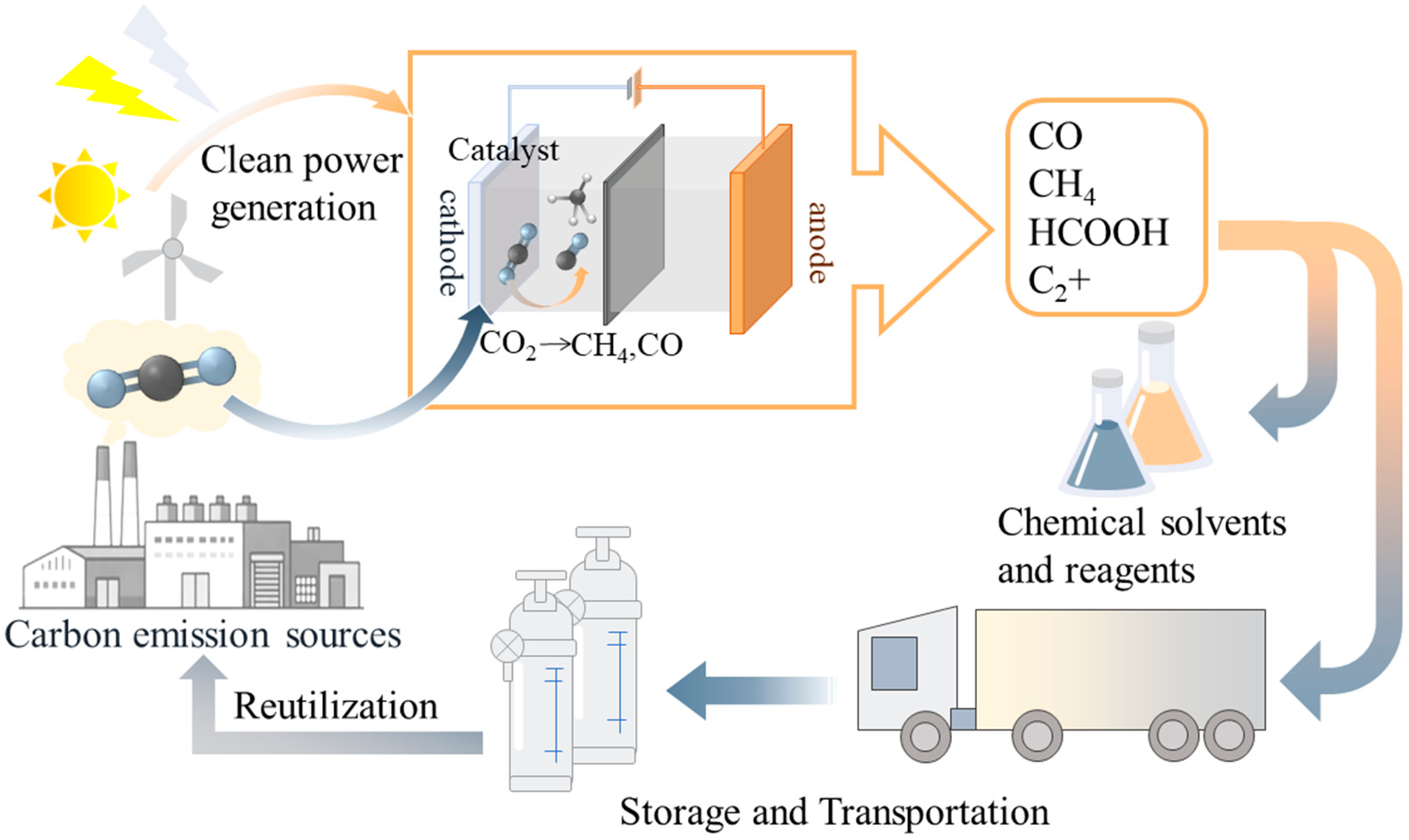
Electro-assisted ICCU has emerged as a promising technological pathway in the context of carbon neutrality goals and the rapid development of renewable energy. The core concept of this approach is to utilize an external electric field to drive the CO2 reduction reaction, thereby enabling the in situ activation and subsequent conversion of captured CO2 species at the electrode interface and establishing a closed-loop system between electrical energy and carbon resources [104]. Unlike conventional thermocatalytic ICCU, which relies on high-temperature driving forces, electrocatalytic systems directly regulate the electron-injection process by controlling the electrode potential, allowing CO2 molecules or captured CO2 species to undergo multielectron reduction under ambient or near-ambient conditions [105]. Because the electricity input can be directly supplied by intermittent renewable sources such as wind and solar power, electrocatalytic ICCU is regarded as a key bridge for realizing an “electricity–carbon cycle” and the value-added utilization of renewable electricity [106]. Within this framework, the capture process is no longer treated as an independent pretreatment step, but is instead coupled with the electrochemical reduction process in the same electrolytic system, enabling the continuous conversion of carbonate- or bicarbonate-based capture media into products such as CO, formate, and ethylene [105]. This mode is expected not only to reduce the regeneration energy demand after carbon capture, but also to avoid the multistage energy losses associated with the conventional “capture–compression–transport–conversion” route, thereby improving carbon-utilization efficiency at the system level. To illustrate the basic concept and process configuration of electro-assisted ICCU, a schematic representation is provided in Figure 7.
In terms of system architecture, electrocatalytic ICCU generally adopts a multifunctional integrated design. One representative strategy is the use of dual-function electrode configurations, in which CO2 adsorption sites and electroreduction active sites are simultaneously constructed within the same electrode material or composite structure [107]. For example, alkali-metal doping or nitrogen-functionalized structures can be introduced onto metal electrocatalysts to enhance the adsorption of bicarbonate or dissolved CO2 while maintaining high electrocatalytic activity [108]. In addition, the capture electrolyte is usually based on carbonate or bicarbonate solutions, allowing CO2 to exist in dissolved form within the electrochemical system and thereby mitigating gas-phase mass-transfer limitations [106]. In recent years, the application of gas diffusion electrodes (GDEs) has further improved interfacial CO2 supply efficiency, making the gas–liquid–solid three-phase interface a highly active reaction zone [109]. The capture–conversion coupling in electrocatalytic ICCU mainly follows three pathways: direct reduction of dissolved bicarbonate species at the electrode surface through electron injection and C–O bond activation; in situ release of CO2 at the electrode interface followed by reduction through the conventional CO2 reduction reaction (CO2RR) pathway; and dynamic regulation of the capture–release process through electric-field-induced control of local pH and carbonate equilibrium. These innovations in architecture and reaction pathways have enabled electrocatalytic ICCU to evolve from a simple electrolysis process into a highly coupled interfacial reaction network.
Electrocatalytic ICCU offers several significant technical advantages. First, potential regulation provides a precise means of controlling reaction selectivity. By adjusting the applied voltage, the electron-transfer rate and the stability of reaction intermediates can be tuned, thereby enabling selective formation of CO, formate, or multicarbon products. Second, these systems usually operate under ambient or near-ambient conditions, thus avoiding the high energy consumption and material-stability problems associated with elevated temperatures [104]. Third, electrochemical processes exhibit rapid start-up and shut-down characteristics, which make them well suited to fluctuating renewable-energy inputs and demand-responsive operation. In addition, electrocatalytic ICCU does not rely on the external supply of high-pressure gases, which to some extent reduces system complexity and safety risks. From the perspective of energy coupling, electricity directly drives the conversion of carbon resources, allowing renewable power to be stored in the form of chemical energy in liquid or gaseous fuels and thereby providing technical support for the construction of multi-energy complementary systems [110]. Therefore, in the context of rapid development in distributed energy and electrochemical energy storage, electrocatalytic ICCU has important strategic significance.
However, electrocatalytic integrated capture and conversion systems still face several critical bottlenecks. First, carbonate and bicarbonate species are thermodynamically stable, and their direct reduction generally proceeds with slow kinetics, often requiring relatively large overpotentials to drive the reaction and thus increasing electricity consumption [111]. Second, CO2RR itself involves multielectron and multiproton coupled transfer processes, and competing reactions, such as the hydrogen evolution reaction (HER), significantly affect Faradaic efficiency and product selectivity [112]. Third, ohmic losses and mass-transfer resistance during electrolysis still lead to relatively low overall energy efficiency, especially under high-current-density operation [113]. Electrode stability is another limiting factor, because long-term operation may induce catalyst restructuring, dissolution, or poisoning, thereby shortening system lifetime. To address these issues, current research mainly focuses on the development of low-energy-consumption electrolysis systems, the design of highly selective dual-function catalysts, and the use of electric fields to enhance the activation of captured species. For example, interfacial engineering to regulate the electronic structure of the electrode surface, the construction of local high-pH microenvironments, and the introduction of ionic-liquid-assisted electrolysis can, to some extent, reduce energy consumption and improve system stability [114,115,116]. Overall, although electrocatalytic ICCU is still in a stage of rapid development, its potential value in the deep utilization of renewable energy and in carbon-neutrality strategies should not be underestimated.

4.3. Emerging Pathways: Non-Thermal-Plasma-Driven ICCU, Microwave-Driven ICCU, and Related Approaches

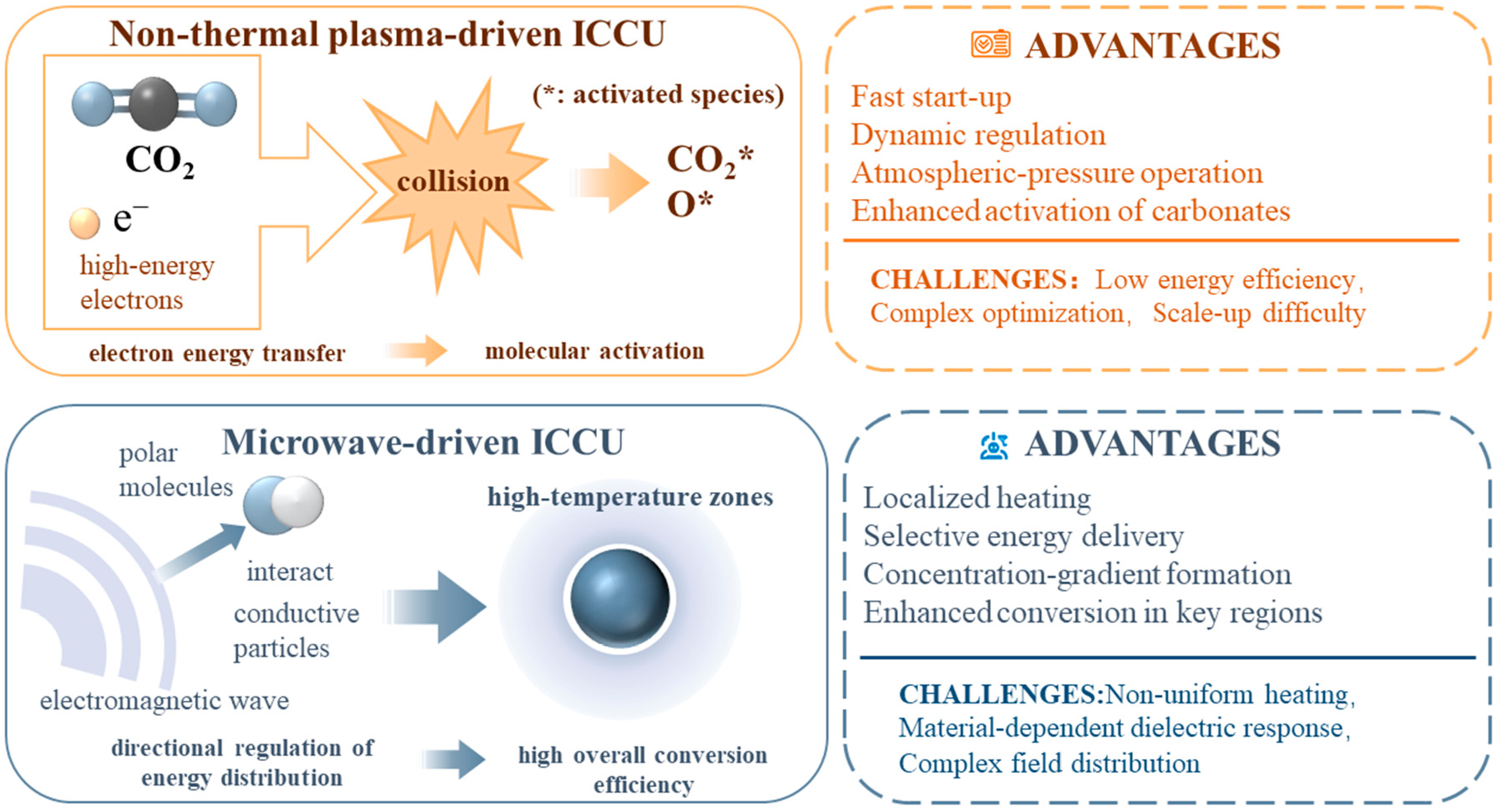
Non-thermal plasma (NTP) provides a representative non-equilibrium energy-input mode for integrated CO2 capture and utilization systems. Its defining characteristic is that the electron temperature is much higher than the bulk gas temperature, thereby creating a “low-temperature, high-energy” excitation environment. Within the non-thermal plasma discharge zone, high-energy electrons undergo inelastic collisions with CO2 molecules, promoting their transition into vibrationally or electronically excited states and facilitating ionization, dissociation, and C=O bond activation [117]. This non-equilibrium energy distribution breaks the constraints of conventional thermodynamic control pathways, so that the reaction no longer relies entirely on bulk heating, but instead proceeds through electron-energy transfer-mediated molecular activation. When NTP is coupled with ICCU systems, captured carbonate or bicarbonate species can be rapidly excited or partially decomposed in the plasma environment, thereby lowering the apparent activation energy required for subsequent reduction reactions [118]. At the same time, reactive plasma species, such as excited CO2*, O*, and H*, can participate in interfacial reactions and promote the conversion of carbonate intermediates [119]. Therefore, NTP-ICCU systems, through the combined mechanisms of electron-driven activation and interfacial synergy, enable efficient activation pathways at relatively low gas temperatures, thus providing new possibilities for low-temperature carbon-resource conversion.
In terms of advantages, non-thermal-plasma-driven ICCU exhibits rapid start-up and dynamic regulation capabilities, and can respond to external power fluctuations on the millisecond timescale, making it suitable for scenarios involving intermittent renewable-energy input. In addition, such systems can usually operate under atmospheric pressure, thereby reducing the safety risks and energy penalties associated with high-pressure equipment [120]. Because reaction activation is mainly induced by high-energy electrons rather than by bulk heating, high activation capability can be achieved even under low-temperature conditions, which reduces the thermal-stability requirements imposed on catalysts [119]. During capture–conversion coupling, plasma may also enhance electron migration at the metal–basic interface, thereby promoting the conversion of carbonates toward CO or syngas. However, this technology still faces clear bottlenecks. First, plasma energy efficiency is generally low, and only a portion of the input electrical energy is effectively used for chemical conversion, while the remainder is dissipated through heat effects, radiation, and related pathways [121]. Second, the synergistic mechanism between plasma and catalysts has not yet been fully clarified. Different discharge modes, such as dielectric barrier discharge (DBD) and gliding arc discharge, can significantly influence the reaction pathway, thereby making system optimization more complex [122]. In addition, the scale-up of plasma devices still faces technical challenges, especially in achieving uniform discharge and well-controlled energy distribution [123]. Therefore, future studies should systematically advance research on improving energy-utilization efficiency, optimizing discharge modes, and designing catalysts resistant to plasma impact.
In addition to plasma, microwave-driven ICCU is another important non-conventional energy pathway. The essence of microwave heating lies in the interaction between electromagnetic waves and polar molecules or conductive particles, which generates dielectric loss or conductive loss within materials, thereby enabling volumetric heating or selective heating [124]. Unlike conventional conductive or convective heating, microwave heating can rapidly create localized hot spots, particularly around metal particles, thereby intensifying interfacial reaction rates [125]. In ICCU systems, microwaves can selectively heat metal catalysts or basic adsorption sites, enhance electron exchange at the metal–basic interface, and promote carbonate decomposition and regeneration [126]. In addition, the temperature gradients caused by non-uniform heating may facilitate the formation of reaction-driven concentration gradients, thereby accelerating gas circulation and interfacial renewal. Through rational design of microwave-absorbing materials and catalyst structures, energy distribution can be directed toward key reaction zones, thus improving overall conversion efficiency. To better summarize the activation modes, advantages, and current challenges of non-thermal-plasma- and microwave-driven ICCU, a comparative schematic illustration is presented in Figure 8.
However, microwave-driven ICCU also faces challenges at both the engineering and material levels. First, control of heating uniformity is a central issue in microwave system design. Excessive concentration of local hot spots may cause catalyst sintering or structural damage, thereby affecting long-term stability [127,128]. Second, the dielectric properties of different materials vary significantly, and therefore catalysts and adsorbents require specifically tailored electromagnetic-response design to achieve effective energy coupling [126]. Third, during scale-up, microwave-field distribution becomes highly complex, making it difficult to maintain uniform heating in large-volume reactors and thereby limiting the potential for industrial application [129]. In addition, the high equipment cost and electromagnetic shielding requirements of microwave systems further increase engineering complexity. Overall, both non-thermal plasma and microwave-driven pathways provide ICCU systems with opportunities to overcome the constraints of conventional thermodynamic routes. Nevertheless, substantial progress is still required in energy efficiency, mechanistic understanding, and scale-up technologies before these approaches can transition from laboratory exploration to practical engineering application.

4.4. Effects and Challenges of Non-Conventional Energy Inputs in ICCU Systems

The introduction of non-conventional energy forms, such as light, electricity, plasma, and microwaves, has shifted ICCU systems from the conventional thermally driven framework toward a new mode characterized by multi-energy coupling and non-equilibrium driving forces, thereby fundamentally changing the thermodynamic boundaries of the system. In conventional thermocatalytic ICCU, reaction pathways are usually constrained by gas-phase thermodynamic equilibrium. For example, the reverse water–gas shift reaction (CO2 + H2 ⇄ CO + H2O) generally requires relatively high temperatures to achieve high conversion, and its equilibrium constant changes significantly with temperature [130]. This means that the system must rely on bulk heating to shift the equilibrium toward the product side. However, elevated temperatures are often accompanied by higher energy consumption and may induce or intensify side reactions such as methanation [131]. In contrast, non-equilibrium energy-input modes, such as light, electricity, and plasma, can alter reaction pathways through mechanisms including electron injection, excited-state molecule formation, and collisions involving locally high-energy electrons, so that the reaction is no longer strictly governed by macroscopic thermal equilibrium [120,132,133]. An applied potential can directly regulate interfacial electron transfer [134], photogenerated charge carriers can accomplish electron transfer under low-temperature conditions [135], and high-energy electrons in plasma can activate molecular bonds even when the bulk gas temperature remains relatively low [119]. These mechanisms can, to some extent, lower the apparent activation energy and make low-temperature CO2 conversion possible, thereby expanding the operable temperature window and energy boundary of ICCU. However, such “non-equilibrium driving” also implies more complex system behavior, and its analysis often requires simultaneous consideration of additional factors such as applied potential, photogenerated charge-carrier dynamics, and electron-energy distribution. As a result, traditional equilibrium models based solely on temperature control are no longer fully applicable.
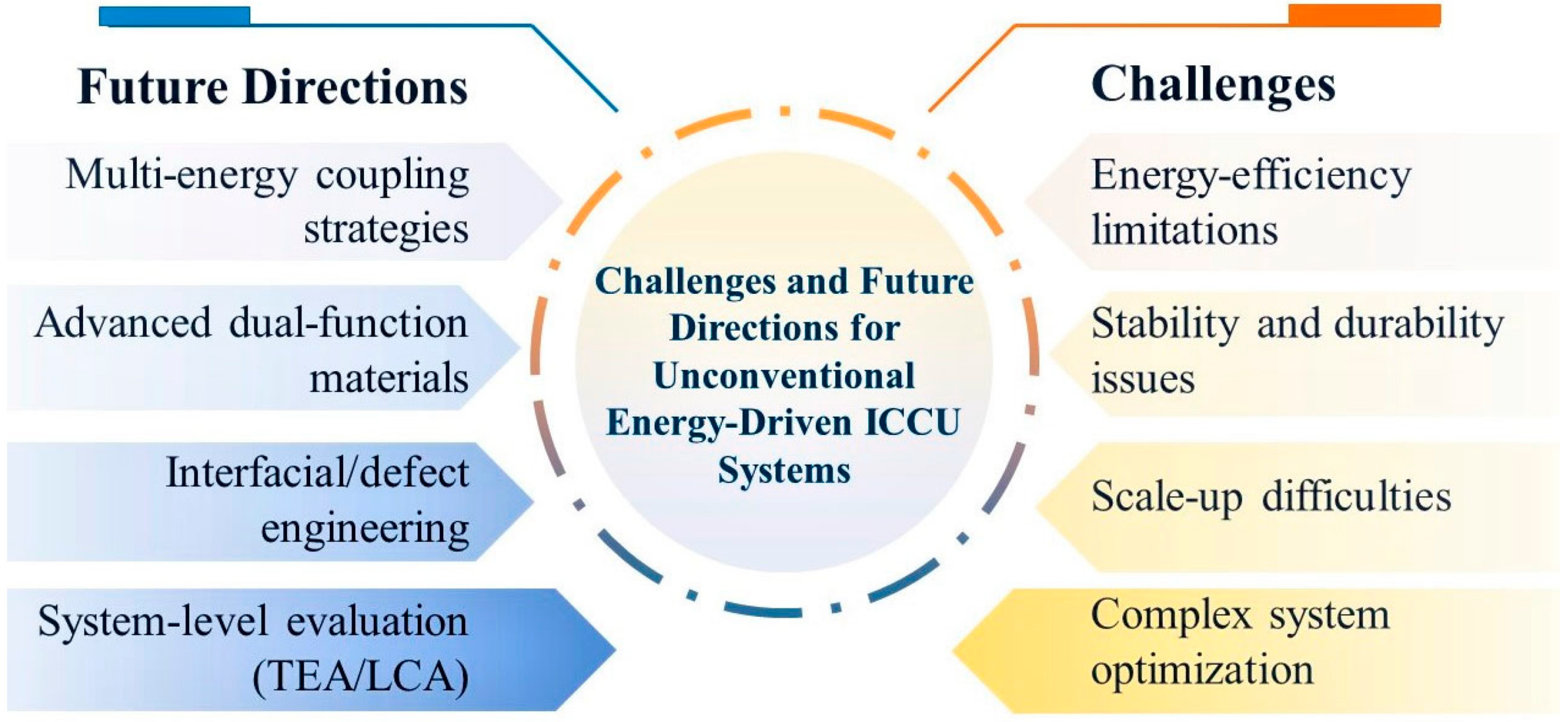
At the kinetic level, non-conventional energy inputs likewise alter the fundamental nature of ICCU reactions. Conventional thermocatalytic pathways mainly depend on molecular adsorption, activation, and subsequent surface reaction steps on catalyst surfaces, and the reaction rate is governed by temperature, surface coverage, and activation energy, thus representing a typical thermally activated process. By contrast, in photocatalytic or electrocatalytic ICCU, electrons become the key factor controlling the reaction rate, and their generation, migration, and recombination behavior directly determine the reaction efficiency [136,137]. Excited-state CO2 or intermediates may participate in new reaction pathways, giving rise to reaction networks fundamentally different from those in conventional thermocatalysis [138]. In plasma environments, the kinetics additionally involve non-equilibrium electron energy distribution functions, multibody collisions, and surface recombination processes, thereby exhibiting multiscale characteristics in which short-timescale electron-energy deposition and reactor-scale mass transfer are strongly coupled [139,140]. In addition, applied electric or electromagnetic fields can modify the surface charge distribution and adsorption configurations of catalysts, leading to the so-called field-induced activation effect [141]. These factors make mechanistic studies of non-conventional ICCU more complex and require systematic investigation by combining in situ spectroscopy, electrochemical analysis, and multiscale simulation. Therefore, from a kinetic perspective, non-conventional energy inputs do not simply replace heat sources, but rather introduce new reaction-control variables and coupling mechanisms. The key challenges and future directions of non-conventional-energy-driven ICCU systems are schematically summarized in Figure 9.
Although non-conventional energy forms provide ICCU with the potential to overcome traditional limitations, severe challenges still remain at the level of system integration. First, energy-conversion efficiency is a core issue. Photocatalytic systems are limited by photon absorption efficiency and charge-carrier recombination losses [142], electrocatalytic systems are constrained by overpotential and ohmic losses [112], and plasma systems suffer from a relatively high proportion of electrical energy dissipation [143]. Under the combined influence of these factors, the overall energy-conversion efficiency of non-conventional-energy-driven ICCU systems still remains below that of mature thermochemical systems. Second, reaction stability and catalyst durability remain major concerns. Non-equilibrium energy inputs may induce surface structural reconstruction, local overheating, or electrochemical corrosion, thereby shortening catalyst lifetime [144]. Third, scale-up remains difficult. Illumination uniformity, electric-field distribution, plasma discharge modes, and microwave-field distribution are all difficult to maintain consistently in large-scale reactors, making it difficult to directly reproduce laboratory performance at industrial scale [123,145,146]. In addition, the economic feasibility of these systems still requires comprehensive evaluation, including equipment cost, operating energy consumption, and maintenance expenses. For non-conventional ICCU to achieve engineering application, a balance must be established among efficiency, stability, and economic viability, rather than pursuing only high conversion under laboratory conditions.
Looking ahead, the development of non-conventional-energy-driven ICCU is likely to focus on multi-energy synergy and interfacial engineering optimization. On the one hand, multi-energy coupling modes, such as photo–electro–thermal synergy, may combine the advantages of different energy forms. For example, photogenerated charge carriers may be used to lower activation barriers, while moderate thermal input can be introduced to increase reaction rates, thus achieving energy complementarity [147]. On the other hand, the design of dual-function catalysts will become central, with the goal of constructing adsorption sites and activation centers within the same material to realize highly efficient capture–conversion coupling. In addition, interfacial engineering and defect regulation can optimize electron-migration pathways and adsorption configurations, thereby improving reaction selectivity. In situ characterization techniques, such as in situ infrared spectroscopy, Raman spectroscopy, and operando electrochemical spectroscopy, will play a crucial role in elucidating non-equilibrium mechanisms and in providing experimental support for model development [148]. Ultimately, system-level energy-efficiency assessment and life-cycle analysis will become essential tools for evaluating technological feasibility. Overall, non-conventional energy inputs have opened up new opportunities for ICCU systems, but their sustainable development will still require coordinated breakthroughs in materials science, reaction engineering, and system integration.

5. System-Level Coupling of ICCU with Carbon-Intensive Industrial Processes

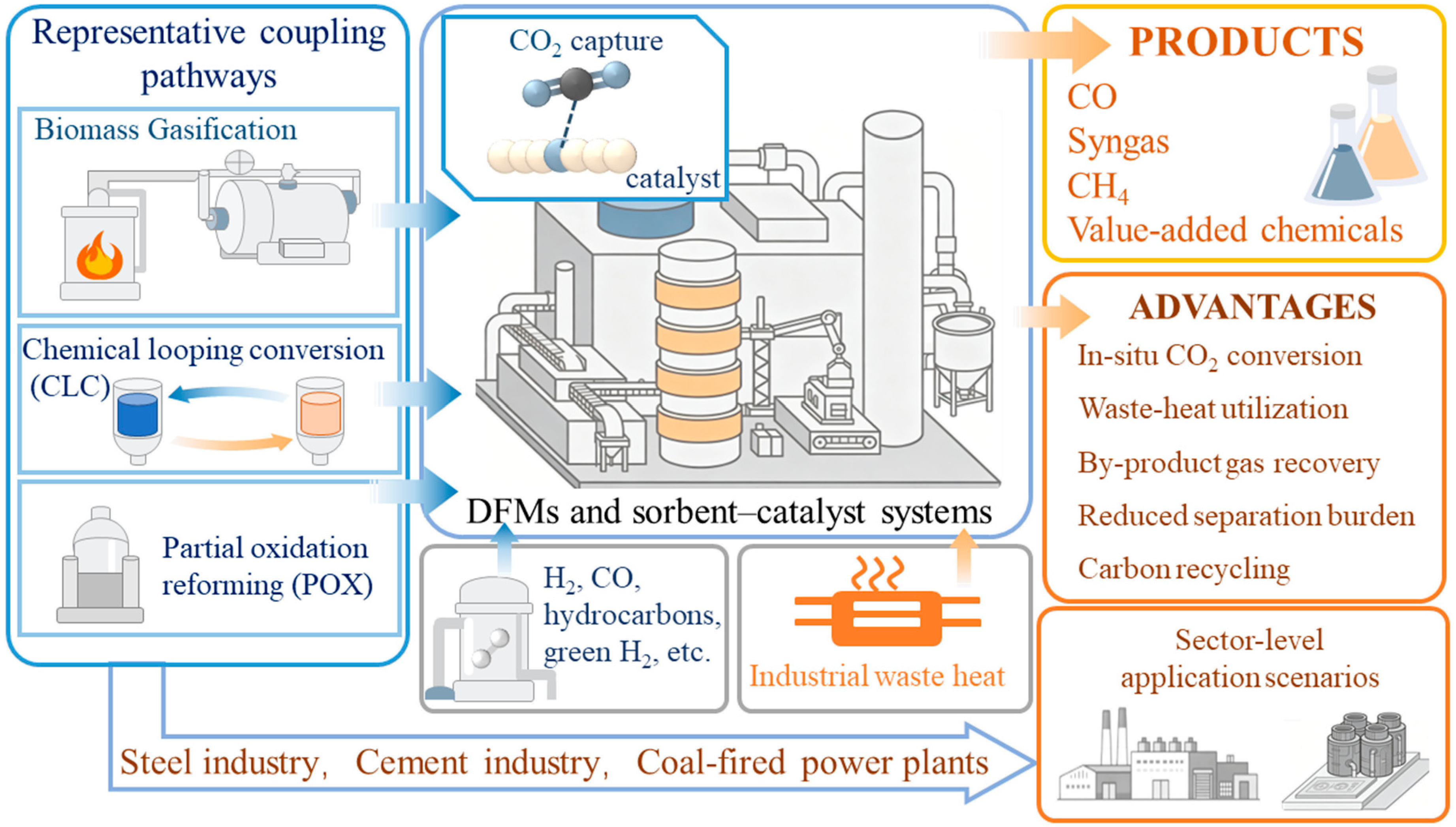
If ICCU operates only as an independent reaction unit, its emission-reduction potential and economic value remain constrained by the CO2 source, the energy structure, and the market scale of downstream products. Embedding ICCU into carbon-intensive industrial processes to realize system-level coupling involving source capture, in situ conversion, and energy-loop closure is therefore a key route for improving carbon-utilization efficiency and promoting industrial decarbonization. Carbon-intensive industrial processes and sectors, including biomass gasification, iron and steel production, cement manufacturing, and coal-fired power generation, generally feature relatively high CO2 concentrations, complex gas compositions, and abundant waste-heat resources, thus providing favorable conditions for ICCU integration. Through rational design of coordinated material-flow and energy-flow networks, it is possible to achieve in situ CO2 conversion, cascade utilization of waste heat, and the production of value-added carbon-based products, thereby constructing low-carbon industrial systems based on multi-energy coupling [149]. As schematically shown in Figure 10, ICCU can be integrated with representative coupling pathways such as biomass gasification, chemical looping conversion, and partial oxidation reforming, while also showing potential applicability in steel, cement, and coal-fired power sectors.

5.1. Coupling of Biomass Gasification with ICCU

Biomass gasification is widely regarded as one of the key technological pathways for achieving carbon neutrality and even negative emissions. Its core advantage lies in the fact that biomass absorbs atmospheric CO2 through photosynthesis during growth, which gives it renewable characteristics and low net emissions on a life-cycle basis. During gasification, biomass is converted at 500–1000 °C into syngas mainly composed of CO, H2, and CO2, together with small amounts of CH4, tar, and trace impurities [150]. In conventional processes, the H2/CO ratio is usually adjusted through the water–gas shift reaction, followed by physical or chemical absorption for CO2 separation. However, this route suffers from high energy consumption, process complexity, and insufficient carbon-utilization efficiency [151]. By embedding an ICCU unit into the gasification system, in situ capture and conversion of CO2 can be achieved during syngas generation or purification, so that CO2 is no longer treated as a terminal emission but instead serves as a reactant for secondary reactions, thereby significantly improving carbon-atom utilization efficiency. Two typical integration modes can be adopted. The first is to install a high-temperature adsorption–catalysis integrated bed downstream of the gasifier, where alkaline solid adsorbents capture CO2 and the captured CO2 is subsequently converted with H2 into CO or syngas over catalytic sites [152]. The second is to introduce dual-function particles into a circulating fluidized-bed gasification system, thereby enabling dynamic cyclic operation involving adsorption, conversion, and regeneration [153]. This capture–conversion integrated strategy not only allows regulation of the H2/CO ratio to satisfy the requirements of downstream methanol synthesis or Fischer–Tropsch synthesis, but also reduces the solvent-regeneration energy demand and corrosion problems associated with conventional amine absorption, thus improving process intensification at the system level [154].
From the perspective of energy and material matching, the biomass gasification–ICCU coupling system exhibits good thermodynamic synergy. Gasification itself is an endothermic process that requires an external heat source to maintain high-temperature operation, while some CO2 conversion reactions, such as the reverse water–gas shift reaction, also require thermal input. By optimizing reactor configuration and heat-exchange networks, the sensible heat of high-temperature flue gas or circulating particles from the gasifier outlet can be utilized to provide energy for carbonate decomposition and active-site regeneration in ICCU, thereby achieving internal cascade heat utilization. At the same time, the H2 generated during gasification can be directly used as the reductant for CO2 conversion, thus avoiding the additional cost and carbon footprint associated with an external hydrogen supply. If this system is further coupled with renewable-electricity-driven water electrolysis for hydrogen production, a negative-emission integrated route based on a biomass carbon source and green-hydrogen input can be established, enabling part of the biogenic carbon to be fixed into products in the form of syngas or liquid fuels and thereby creating a secondary carbon-utilization pathway. At the system level, process simulation and life-cycle assessment indicate that this coupling mode can significantly improve carbon efficiency, reduce the carbon intensity of products, and under certain conditions even achieve net-negative emissions [155]. In addition, the introduction of ICCU can stabilize syngas quality, reduce the scale of downstream shift and separation units, and thus lower overall capital investment and operating costs, providing new technical support for the high-value utilization of biomass resources.
However, the engineering implementation of biomass gasification–ICCU still faces multiple challenges. First, gasification gas often contains tar, sulfur compounds, chlorides, and alkali-metal vapors, which may cause adsorbent deactivation through carbonation, poisoning of catalytic sites, or pore blockage, thereby reducing cyclic stability [156]. Therefore, dual-function materials with resistance to poisoning and good structural stability need to be developed, and their durability should be further enhanced through surface modification or interfacial engineering. Second, in circulating fluidized-bed or moving-bed systems, particles are prone to attrition and sintering during repeated adsorption–reaction–regeneration cycles, which affects mass-transfer efficiency and reaction activity. A balance must therefore be established between material strength and reactivity. Third, after system coupling, the process becomes more complex and involves coordinated control and dynamic regulation across multiple units, placing higher demands on reactor design and process control. How to maximize energy utilization and maintain stable equipment operation while ensuring high carbon-conversion efficiency remains an important direction for future research. Therefore, the development of biomass gasification–ICCU coupling requires coordinated advances in material innovation, reactor intensification, and system-level optimization. By combining multiscale modeling with experimental validation, a foundation can be established for the construction of efficient, stable, and economically competitive negative-emission conversion systems.

5.2. Coupling with Chemical Looping Conversion and Partial Oxidation Reforming

Chemical looping conversion (CLC) and partial oxidation reforming (POX) represent two important technological directions for reaction intensification and reduction in separation energy consumption. Their coupling with ICCU exhibits a high degree of synergy in both reaction pathways and energy-utilization modes. The core concept of CLC lies in the use of metal oxides as oxygen carriers, which circulate between a fuel reactor and an oxidation reactor to realize the indirect oxidation of fuels [157]. During the reduction stage, the fuel reacts with the oxygen carrier to generate CO2 and H2O, whereas in the oxidation stage the oxygen carrier is regenerated by air. Because air and fuel do not come into direct contact, the resulting CO2 stream has a high concentration and low separation cost, thereby creating favorable conditions for subsequent conversion [158]. If an ICCU unit is integrated into a CLC system, adsorption–catalysis dual-function materials can be introduced at the outlet of the fuel reactor or along the circulation pathway to capture the generated CO2 in situ and further convert it using the H2 or CO present in the system, thus forming a dual-loop coupling structure involving both oxygen-carrier circulation and carbon capture–conversion [159]. This coupling mode not only reduces the energy-intensive separation steps required in conventional post-combustion CO2 capture, but also improves the overall thermal efficiency of the system through energy self-balancing enabled by heat release or heat absorption during cyclic reactions.
From the perspectives of thermodynamics and process intensification, CLC–ICCU coupling offers significant advantages. The reduction stage of CLC is usually exothermic or only mildly endothermic, whereas CO2 conversion reactions, such as reverse water–gas shift or methanation, may require specific temperature windows. Through rational reactor design, efficient heat transfer between the two subsystems can be achieved, thereby reducing the demand for external heat input. At the same time, the high-concentration CO2 stream generated by CLC can directly enter the ICCU reaction zone, thus avoiding the mass-transfer limitations caused by diluent gases. Oxygen-carrier materials, such as Fe-, Ni-, and Cu-based oxides, provide active metal sites during cycling, and if they are further combined with basic adsorptive components, multifunctional particle design integrating adsorption, reduction, and regeneration can be realized [160]. However, the reaction mechanism of this system is relatively complex, involving oxygen-migration rates, the formation of surface oxygen vacancies, CO2 adsorption kinetics, and electron-transfer behavior across multiphase interfaces. Coupling among different subreactions may lead to local temperature gradients and composition fluctuations, thereby affecting system stability. Therefore, in material design, the cyclic stability of oxygen carriers must be balanced with the carbonation–regeneration capability of the adsorbent; at the reactor level, gas–solid contact patterns and residence-time distributions must be optimized to achieve continuous and stable operation.
In the case of POX, the main characteristics are fast reaction rates and strongly exothermic behavior, and it is commonly used for syngas production from natural gas or biogas. In POX, the fuel reacts with a limited amount of oxygen to generate CO and H2, while also producing a certain amount of CO2 [161]. If an ICCU unit is introduced into the POX reactor through a dual-function catalyst bed or a zoned structural design, CO2 can be simultaneously captured and converted during syngas generation, thereby increasing the proportion of effective components in the product stream, improving the H2/CO ratio, and reducing the downstream shifting burden [162]. The heat released by POX can be directly used to drive adsorbent regeneration or promote CO2 conversion, thus forming an internally coupled energy network [163]. In addition, by regulating oxygen supply and bed structure, the hot-spot problem commonly encountered in conventional POX can be alleviated, thereby improving reactor thermal management [164]. However, the POX–ICCU coupling system also faces challenges in engineering implementation, including material sintering and carbon deposition risks under high-temperature conditions, reduced reaction selectivity caused by non-uniform oxygen distribution, and insufficient long-term cyclic stability of multifunctional particles. At the same time, system-control complexity increases significantly, requiring precise matching among oxygen-carrier circulation rate, adsorbent regeneration rate, and reactor temperature field. Future research should combine multiscale simulation with in situ characterization techniques to elucidate the interfacial evolution and structural variation that occur under multiprocess coupling conditions. Through reactor intensification and process-integration optimization, efficient synergy among chemical looping conversion, partial oxidation reforming, and ICCU may be achieved, thereby providing a feasible industrial pathway for low-carbon syngas and fuel production.

5.3. Application Potential in the Iron and Steel, Cement, and Power Sectors

The iron and steel, cement, and coal-fired power sectors are among the major sources of global CO2 emissions. Their emission characteristics, including large emission volumes, continuous discharge processes, and accessible flue-gas streams, provide favorable conditions for the deployment of integrated CO2 capture and utilization technologies [149]. In the iron and steel industry, blast furnace gas and basic oxygen furnace gas contain large amounts of CO2 and CO. These gas streams are not only highly concentrated, but are also continuously generated during steelmaking, making them suitable for in situ reaction with surplus hydrogen to produce CO or syngas, which can then be recycled to ironmaking processes for ore reduction, thereby enabling the circular utilization of carbon resources [165]. ICCU units can be closely coupled with blast furnace and converter processes to establish a closed-loop carbon cycle within the steel production system. Through in situ conversion, CO2 emissions can be reduced, while by-products can be reused as energy carriers or chemical feedstocks, thereby improving raw-material utilization efficiency. In practical implementation, ICCU units may be deployed at the outlet of blast furnace gas or converter gas streams, and the product composition can be flexibly adjusted through modular reactor design to meet the requirements of different production processes. In addition, in situ conversion can reduce the energy consumption and cost associated with CO2 compression and transport in conventional capture processes, thereby improving both economic and environmental performance at the system level.
In the cement industry, the relatively high CO2 concentration and moderate temperature of kiln-exit flue gas provide favorable operating conditions for the deployment of fixed-bed ICCU reactors. During cement production, clinker calcination is the main source of CO2 emissions. Conventional capture methods often face challenges such as high energy consumption and high adsorbent-regeneration cost, whereas ICCU can realize capture–conversion coupling by reacting captured CO2 with hydrogen or carbon-based reductants to generate valuable chemicals or fuels, thereby achieving the dual objectives of emission reduction and by-product utilization. At the same time, the cement kiln itself releases a large amount of waste heat, which can be integrated into the process to supply energy for capture-material regeneration or related units, thereby further reducing total system energy consumption [166]. In designing ICCU devices for this sector, the reactor capacity and heat-exchange configuration can be optimized according to the flow rate and temperature characteristics of kiln-exit flue gas, so as to ensure capture efficiency, conversion efficiency, and operational stability. In addition, through close integration with existing cement production lines, ICCU technology may be progressively deployed without significantly affecting the original process, thus facilitating industrial application.
In the coal-fired power sector, because flue gas generally has a relatively low CO2 concentration but a very large emission volume, the application of ICCU requires integration with technologies such as flue-gas preconcentration or membrane separation to achieve staged capture and conversion [167]. Flue gas from coal-fired power plants contains various impurities, including SOx, NOx, and particulates, which impose strict requirements on the selection of adsorbents and catalysts as well as on long-term operational stability [168]. Therefore, large-scale application of ICCU in this sector must account for the effects of impurities on catalytic activity, adsorbent lifetime, and equipment safety, while also incorporating appropriate flue-gas pretreatment units to reduce the risks of corrosion and poisoning. From an economic perspective, hydrogen supply cost, the energy consumption of capture and conversion processes, and market demand for by-products are all key factors influencing technological feasibility. Therefore, the deployment of ICCU in the power sector requires not only technological optimization, but also policy support, carbon-pricing mechanisms, and improvements in green-energy supply systems. Overall, the system-level coupling of ICCU with carbon-intensive industrial processes provides an important pathway toward deep industrial decarbonization. Its successful implementation depends on interdisciplinary collaboration, system-engineering optimization, and compatibility with existing process flows, so as to achieve a balance among emission-reduction benefits, energy-utilization efficiency, and economic performance.

6. Challenges, Key Scientific Issues, and Future Perspectives

Before discussing the scientific and engineering challenges of ICCU, it is necessary to position this technology within the broader framework of CCUS. Well-known CCUS technologies include established capture routes such as post-combustion capture, pre-combustion capture, and oxy-fuel combustion, as well as downstream options such as carbon capture and storage (CCS), conventional CCU, and ICCU. These pathways differ in terms of technological maturity, energy consumption, infrastructure requirements, carbon utilization efficiency, and industrial applicability. Among them, post-combustion capture, particularly solvent-based chemical absorption, remains one of the most mature and commercially available options because it can be retrofitted to existing industrial facilities with relatively limited process modifications. CCS technologies are suitable for large-scale emissions reduction through geological storage, whereas conventional CCU technologies provide opportunities to convert captured CO2 into value-added fuels and chemicals.
Compared with these established CCUS routes, ICCU should not be regarded as a simple replacement for mature CCS or conventional CCU technologies. Instead, it provides a complementary and process-intensified strategy by directly coupling CO2 capture with subsequent conversion. In conventional CCU systems, captured CO2 usually needs to undergo regeneration, purification, compression, and transportation before entering a separate conversion reactor, which increases energy consumption, equipment complexity, and overall process cost. By contrast, ICCU reduces or eliminates some of these intermediate steps by allowing captured CO2 species or reactive intermediates to participate directly in catalytic conversion. This integrated mode can potentially improve carbon utilization efficiency, simplify process configurations, enhance system compactness, and create new opportunities for selective product formation. Nevertheless, ICCU remains at an earlier stage of technological development than many established CCUS technologies, and challenges related to dual-function material design, capture–conversion matching, reactor engineering, process control, and scale-up must still be addressed before industrial deployment.
Within this broader CCUS landscape and in the context of industrial deep decarbonization, the development of ICCU technology is constrained not only by fundamental scientific issues related to capture materials, catalytic active sites, and reaction pathways, but also by engineering challenges associated with process compatibility, energy management, hydrogen supply, and operational safety. Therefore, it is necessary to systematically discuss the development bottlenecks and future directions of ICCU from three interrelated perspectives: key scientific issues, engineering challenges, and future directions. As summarized in Figure 11, these aspects provide an overall framework for the following discussion.
Within this broader CCUS landscape and in the context of industrial deep decarbonization, the development of ICCU technology is constrained not only by fundamental scientific issues related to capture materials, catalytic active sites, and reaction pathways, but also by engineering challenges associated with process compatibility, energy management, hydrogen supply, and operational safety.

6.1. Key Scientific Issues

ICCU has shown great potential for achieving deep industrial decarbonization, but its further development is still constrained by a series of scientific issues. First, the synergistic mechanism between capture and conversion has not yet been fully clarified [62]. In conventional CO2 capture systems, the functions of adsorbents or solvents are relatively well understood. In ICCU systems, however, the capture process and catalytic conversion proceed simultaneously and interact strongly with each other. For example, the influence of reaction heat on adsorbent capacity and the inhibitory effect of CO2 concentration fluctuations on catalytic activity both require further investigation through experiments and numerical simulations.
Second, the long-term stability and regeneration efficiency of adsorbents and catalysts remain among the key scientific issues. Industrial flue gas often contains SOx, NOx, particulates, and trace heavy metals, and these impurities can readily cause adsorbent poisoning, catalyst deactivation, and structural deterioration, thereby affecting system lifetime and economic viability. How to design adsorbent and catalyst materials with high selectivity, resistance to impurity poisoning, and repeatable regenerability is therefore one of the core scientific challenges restricting the wider deployment of ICCU technologies.
In addition, the kinetic and thermodynamic characteristics of in situ CO2 conversion reactions still require in-depth investigation. This is particularly important under conditions involving high temperature, high gas velocity, and complex multicomponent flue gas, where the reaction pathways, rate-determining factors, and product-distribution patterns remain insufficiently understood. These issues need to be addressed through the combined use of microscopic mechanistic simulation, advanced characterization techniques, and reaction-engineering experiments.

6.2. Engineering and Industrialization Challenges

From the perspectives of engineering implementation and industrialization, the large-scale deployment of ICCU technology in carbon-intensive industries still faces multiple challenges. These challenges require systematic solutions to technical, economic, and safety-related issues in order to ensure the feasibility and sustainability of industrial application. Overall, they can be analyzed from three main aspects: retrofit of industrial facilities and process compatibility, system integration and energy-management optimization, and hydrogen supply and operational safety assurance.

6.2.1. Retrofit of Industrial Facilities and Process Compatibility

The iron and steel, cement, and coal-fired power sectors are typical carbon-intensive industries characterized by large-scale production lines and continuous operation, which impose stringent requirements on the integration of new process units. As an integrated capture–conversion module, an ICCU system must be seamlessly incorporated into existing process flows, including interfaces associated with flue-gas flow rate, temperature, pressure, and the supply of hydrogen or other reductants. In the iron and steel industry, blast furnace and converter gas streams are large in volume, complex in composition, and subject to significant fluctuations in temperature and flow rate. If the ICCU unit cannot adjust its processing capacity in real time, it may affect the smelting efficiency of the original blast furnace or converter process and may even interrupt production. In the cement industry, kiln-exit flue gas generally has a moderate temperature but a relatively variable flow rate, and ICCU reactors therefore need to possess rapid-response and load-adjustment capabilities in order to adapt to changes in production rhythm. In addition, coal-fired power plants emit very large volumes of flue gas with relatively low CO2 concentrations. When introducing ICCU systems into such processes, the effects of flue-gas pretreatment, compression, or concentration steps on the main process must be carefully considered. Retrofit of industrial facilities also involves practical engineering issues such as spatial layout, pipeline interfaces, pressure balance, and maintenance access. Any unreasonable design may increase capital cost or reduce operational safety. Therefore, the modular and compact design of ICCU systems, together with their compatibility with existing equipment, constitutes a primary engineering challenge for industrial application.

6.2.2. System Integration and Energy-Management Optimization

The core advantage of ICCU lies in the coupling of CO2 capture with in situ conversion, but this process involves the management of complex energy flows across multiple stages, including capture by adsorbents or solvents, heat release or absorption during catalytic reactions, product separation, and energy recovery. The optimization and coordination of energy flows among different subsystems directly determine the economic performance and operating efficiency of the overall system. For example, adsorbent regeneration usually requires thermal energy. If the system cannot effectively recover waste heat from cement kilns or blast furnaces, energy consumption will increase substantially, thereby weakening techno-economic performance. In addition, thermal management of catalytic conversion reactions is also critical. High-temperature reactions may cause local overheating, leading to catalyst deactivation or localized reactor corrosion, whereas insufficient temperature may reduce CO2 conversion. Therefore, ICCU systems need to be equipped with advanced heat-recovery and heat-distribution units, using heat exchangers, waste-heat boilers, or intelligent control strategies to achieve optimal energy allocation. At the same time, the dynamic regulation capability of the system is equally important. Because the flow rate and composition of industrial flue gas fluctuate over time, ICCU reactors must possess rapid-response mechanisms to ensure that capture efficiency and conversion efficiency remain stable under different operating loads. Overall, system integration involves not only energy management, but also the coordinated optimization of material flows, reaction conditions, equipment capacity, and control strategies, making it a core engineering challenge for achieving efficient and economically viable operation.

6.2.3. Hydrogen Supply and Operational Safety Assurance

In the conversion of CO2 into products such as CO, methanol, or syngas, ICCU technology usually depends on the supply of hydrogen or other reductants. However, the cost of green hydrogen production remains relatively high at present, which directly affects the economic viability of ICCU systems. In large-scale industrial applications, hydrogen demand is substantial. If the system relies on centralized hydrogen production or high-cost water electrolysis, the operating cost may become unacceptable. Therefore, the reliability, affordability, and sustainability of hydrogen supply are among the key issues governing industrial deployment. At the same time, system safety is another engineering challenge that cannot be overlooked. Industrial flue gas is often characterized by high temperature, high flow velocity, and corrosive components, which impose stringent requirements on reactors, pipelines, and control equipment. ICCU systems must ensure long-term stable operation and should be equipped with real-time monitoring and intelligent regulation capabilities to respond to process fluctuations, emergency events, or abnormal operating conditions. In addition, hydrogen and reactive gases such as CO2 and CO present flammability and explosion risks under high-temperature conditions. Equipment design must therefore comply with strict safety standards, including fire protection, explosion prevention, leak detection, and emergency shutdown measures. Advances in industrial operation and maintenance, automation, and online monitoring technologies are essential for ensuring the safe, reliable, and sustainable operation of ICCU in industrial practice.
In summary, ICCU technology faces multilevel engineering challenges during industrial deployment. From the retrofit of existing industrial facilities and the optimization of system integration and energy management to the assurance of hydrogen supply and operational safety, every stage requires scientific design, refined regulation, and interdisciplinary collaboration. Only through simultaneous optimization in engineering and economics, materials and reactions, and equipment safety and intelligent control can ICCU be applied on a large scale in carbon-intensive sectors such as iron and steel, cement, and power generation, thereby providing a feasible pathway for deep industrial decarbonization and green development.

6.3. Future Development Directions

Based on the scientific and engineering challenges discussed above, future ICCU research should move beyond the separate optimization of capture or conversion units and place greater emphasis on the coordinated regulation of mechanisms, materials, reactors, and industrial systems. These future development directions can therefore be summarized from three closely related perspectives: fundamental scientific research, materials innovation, and systems engineering and industrialization. Such coordinated progress is essential for clarifying capture–conversion coupling mechanisms, improving operational efficiency and cyclic stability, and enabling sustainable industrial deployment.

6.3.1. Directions in Fundamental Scientific Research

At the fundamental level, the further development of ICCU requires a deeper understanding of the coupled mechanisms of CO2 capture and in situ conversion. At present, most studies focus mainly on the mechanisms of individual steps, such as the capture performance of adsorbents or the catalytic activity of catalysts, whereas the coupling effects between capture and conversion under industrial flue-gas conditions still lack systematic elucidation. Future research should establish multiscale and multiphysics models that link quantum-chemical descriptions of adsorption and desorption at active sites, molecular-dynamics simulations of reactant migration and surface reaction pathways, and reaction-engineering analyses of coupled heat, mass, and flow fields. By combining multiscale modeling with experimental validation, it will be possible to reveal the synergistic principles governing CO2 capture and conversion, such as the influence of reaction heat on adsorbent capacity and the role of product-formation rates in regulating system energy distribution. In addition, the dynamic response of capture–conversion systems under fluctuating operating conditions should be further investigated. In industrial production, flue-gas flow rate, composition, and temperature often fluctuate, which poses challenges to the stable operation of ICCU systems. By establishing dynamic simulation models, it should be possible to predict system performance under load fluctuations and abnormal operating scenarios, thereby supporting intelligent control strategies and reactor optimization. Therefore, future fundamental research should not be limited to isolated adsorption or catalytic steps, but should further clarify the complete evolution chain of captured CO2 species, including their formation, interfacial migration, activation, and conversion. Such mechanistic understanding will provide a fundamental basis for rational dual-function material design, reactor-structure optimization, and process-parameter regulation.

6.3.2. Directions in Materials Innovation

Materials innovation is a key enabler for overcoming technological bottlenecks in ICCU and improving system stability and economic performance. Future development should focus on three categories of materials: high-performance adsorbents, high-efficiency catalysts, and intelligent responsive materials. First, adsorbents with high capacity, high selectivity, and strong resistance to contamination can effectively cope with SOx, NOx, particulates, and other impurities in industrial flue gas, thereby extending service life and reducing regeneration energy consumption. Examples include MOFs, porous carbon materials, and modified zeolites. Second, catalysts with high activity, long lifetime, and strong resistance to poisoning can maintain efficient in situ CO2 conversion under complex flue-gas environments, such as transition-metal-based catalysts, dual-function catalysts, and heterogeneous catalytic systems. Catalyst design should simultaneously consider active-site distribution, thermal conductivity, and mechanical stability in order to adapt to industrial flue-gas conditions involving high temperature and high flow velocity. Third, the development of intelligent materials is expected to become a new direction in ICCU. Temperature-responsive or atmosphere-responsive adsorbents may dynamically regulate adsorption capacity according to flue-gas conditions, while tunable catalysts may achieve real-time optimization of reaction rates through adjustment of active sites or electronic structure. This offers the possibility of efficient capture and conversion under dynamic operating conditions. Therefore, future materials innovation should move beyond the separate improvement of adsorption capacity or catalytic activity and place greater emphasis on the coordinated matching of CO2 uptake, adsorption strength, release behavior, catalytic activity, impurity resistance, and cyclic stability. Such integrated material design will directly affect overall system energy consumption, product selectivity, economic viability, and industrialization potential.

6.3.3. Directions in Systems Engineering and Industrialization

At the level of systems engineering and industrialization, the future development of ICCU should be centered on modularity, scalability, and flexible coupling. First, modular design is conducive to compatibility with existing industrial processes, enabling flexible integration into production lines of different scales while also facilitating maintenance and upgrading. Second, the optimization of energy and material flows is a major task in systems engineering. Through waste-heat recovery, intelligent temperature control, optimized reactor arrangement, and coordinated energy management across multiple process steps, the total system energy consumption can be significantly reduced, thereby moving closer to near-zero-emission targets. In addition, green hydrogen is a key reductant for many in situ CO2 hydrogenation routes, and its supply mode and cost will directly affect system economics. Future development should make full use of renewable-energy sources, such as photovoltaic, wind, and hydropower-based hydrogen production, in order to provide ICCU with low-carbon hydrogen and thereby reduce the overall carbon footprint while enabling truly low-carbon industrial operation. At the level of industrial deployment, policy support, market incentives, and cross-sector collaboration are equally indispensable. Carbon-pricing mechanisms, green-energy incentives, and joint industry–university–research development platforms can provide both economic driving forces and technical support for large-scale application of ICCU. At the same time, the development of digitalized and intelligent systems will also become an important trend, including online monitoring, intelligent control, operational optimization, and safety-assurance systems, all of which will support the long-term stable operation of ICCU in industrial environments. Overall, future ICCU deployment requires coordinated progress in modular reactor design, heat and mass transfer regulation, renewable hydrogen supply, digital monitoring, techno-economic assessment, life-cycle evaluation, industrial collaboration, and policy support.
In conclusion, integrated CO2 capture and utilization provides a process-intensified strategy for bridging carbon capture and downstream conversion, offering a promising route to reduce the energy consumption, process complexity, and carbon-utilization inefficiency associated with conventional separated CCUS/CCU systems. This review systematically discussed the role of solvent-based absorption and solid-sorbent adsorption units in determining the chemical form, release behavior, and interfacial availability of captured CO2 species. Representative thermally driven ICCU pathways, including RWGS, methanation, and dry reforming of methane, were summarized, together with emerging non-conventional energy-assisted routes such as photocatalysis, electrocatalysis, non-thermal plasma, and microwave-assisted systems. The discussion shows that the performance of ICCU systems is governed not only by the intrinsic activity of capture materials or catalysts, but also by the dynamic matching among CO2 adsorption/desorption, interfacial migration, reaction kinetics, heat and mass transfer, and reactor configuration. Therefore, ICCU should be regarded as a multiscale coupling technology that links material design, reaction-pathway regulation, and system-level process integration. Although challenges remain in mechanistic understanding, material durability, energy management, and industrial scalability, ICCU holds considerable potential for advancing low-carbon transformation in carbon-intensive sectors when high-performance dual-function materials, optimized reactors, renewable energy inputs, and practical engineering strategies are developed in a coordinated manner.

Author Contributions

Conceptualization, P.B. and X.W.; methodology, P.B. and Z.Z.; software, Q.M. and Z.Z.; formal analysis, P.B. and X.Y.; investigation, P.B.; resources, J.H.; writing—original draft preparation, P.B.; writing—review and editing, X.Y., Q.M., Z.Z. and X.W.; visualization, X.Y., Q.M. and J.H.; supervision, X.W.; funding acquisition, X.W. All authors have read and agreed to the published version of the manuscript.

Funding

This research was funded by National Natural Science Foundation of China (52406141, 22338008), the Science and Technology Support Program of Jiangsu Province (BT2024009), and the Natural Science Foundation of Jiangsu Province (BK20240547).

Data Availability Statement

No new data were created.

Conflicts of Interest

The authors declare no conflicts of interest.

Abbreviations

The following abbreviations are used in this manuscript:
CCUCarbon capture and utilization
CCUSCarbon capture, utilization, and storage
CLCChemical looping conversion
CO2RRCO2 reduction reaction
DBDDielectric barrier discharge
DFMsDual-function materials
DRMDry reforming of methane
GDEGas diffusion electrode
HERHydrogen evolution reaction
ICCUIntegrated CO2 capture and utilization
ICCU-DRMIntegrated CO2 capture and dry reforming of methane
ICCU-MIntegrated CO2 capture and methanation
ICCU-RWGSIntegrated CO2 capture and reverse water–gas shift
MOFsMetal–organic frameworks
NTPNon-thermal plasma
POXPartial oxidation reforming
SNGSubstitute natural gas

References

  1. Quadrelli, R.; Peterson, S. The energy–climate challenge: Recent trends in CO2 emissions from fuel combustion. Energy Policy 2007, 35, 5938–5952. [Google Scholar] [CrossRef]
  2. Zhang, G. Merits and Demerits of Carbon Dioxide in Separation Processes. Separations 2022, 9, 419. [Google Scholar] [CrossRef]
  3. Xie, Z.; Tan, Z.; Wang, K.; Shao, B.; Zhu, Y.; Li, J.; Mao, Y.; Hu, J. Which will be a promising route among integrated CO2 capture and conversion to valuable chemicals. Energy Convers. Manag. 2025, 323, 119269. [Google Scholar] [CrossRef]
  4. Chen, J.; Xu, Y.; Liao, P.; Wang, H.; Zhou, H. Recent Progress in Integrated CO2 Capture and Conversion Process Using Dual Function Materials: A State-of-the-Art Review. Carbon Capture Sci. Technol. 2022, 4, 100052. [Google Scholar] [CrossRef]
  5. Ren, L.; Cheng, S.; Xie, T.; Zhang, Q.; Li, R.; Yue, T.; Cai, C. Low-Energy Regeneration Technologies for Industrial CO2 Capture: Advances, Challenges, and Engineering Applications. Sustainability 2025, 17, 9796. [Google Scholar] [CrossRef]
  6. De Luna, P.; Hahn, C.; Higgins, D.; Jaffer, S.A.; Jaramillo, T.F.; Sargent, E.H. What would it take for renewably powered electrosynthesis to displace petrochemical processes? Science 2019, 364, eaav3506. [Google Scholar] [CrossRef]
  7. Ahmed, S.; Khan, M.K.; Kim, J. Revolutionary advancements in carbon dioxide valorization via metal-organic framework-based strategies. Carbon Capture Sci. Technol. 2025, 15, 100405. [Google Scholar] [CrossRef]
  8. Qiu, D.; Zhao, C.; Jin, D.; Guo, Y. Integrated simulation analysis of amine-based carbon capture and electrochemical conversion utilization. Clean Coal Technol. 2025, 31, 249–255. [Google Scholar] [CrossRef]
  9. Teng, L.; Xuan, Y.; Liu, X. Coupling sunlight and carbon cycle: Advances and challenges in solar-driven Ca-based CO2 capture and thermochemical conversion into fuels. Carbon Neutrality 2025, 4, 28. [Google Scholar] [CrossRef]
  10. Masoumilari, S.; Masoumi, Z.; Shamsabadi, A.M.; Kyung, D.; Tayebi, M. From Emissions to Assets: Sustainable Technologies for CO2 Capture, Conversion, and Integrated Strategies. Int. J. Mol. Sci. 2026, 27, 847. [Google Scholar] [CrossRef]
  11. Liu, D.; Chen, L.; Zhu, X.; Ma, J.; Liu, K. Spatial arrangements of dual functional materials for CO2 capture and in-situ methanation at low temperature. Chem. Eng. J. 2025, 511, 162186. [Google Scholar] [CrossRef]
  12. Han, R.; Wang, Y.; Wei, L.; Peng, M.; Li, Z.; Liu, C.; Liu, Q. Integrated CO2 capture and conversion by Cu/CaO dual function materials: Effect of in-situ conversion on the sintering of CaO and its CO2 capture performance. Carbon Capture Sci. Technol. 2024, 12, 100220. [Google Scholar] [CrossRef]
  13. Asgari, M.; Iliuta, M.C. Highly selective and stable Cu-based dual-function materials for integrated CO2 capture and in-situ conversion to CO. Chem. Eng. J. 2025, 515, 163366. [Google Scholar] [CrossRef]
  14. Fu, H.C.; You, F.; Li, H.R.; He, L.N. CO2 Capture and in situ Catalytic Transformation. Front. Chem. 2019, 7, 525. [Google Scholar] [CrossRef]
  15. Wang, J.; Huang, L.; Yang, R.; Zhang, Z.; Wu, J.; Gao, Y.; Wang, Q.; O’Hare, D.; Zhong, Z. Recent advances in solid sorbents for CO2 capture and new development trends. Energy Environ. Sci. 2014, 7, 3478–3518. [Google Scholar] [CrossRef]
  16. Omodolor, I.S.; Otor, H.O.; Andonegui, J.A.; Allen, B.J.; Alba-Rubio, A.C. Dual-Function Materials for CO2 Capture and Conversion: A Review. Ind. Eng. Chem. Res. 2020, 59, 17612–17631. [Google Scholar] [CrossRef]
  17. Sun, S.; Sun, H.; Williams, P.T.; Wu, C. Recent advances in integrated CO2 capture and utilization: A review. Sustain. Energy Fuels 2021, 5, 4546–4559. [Google Scholar] [CrossRef]
  18. Liu, G.; Sun, S.; Sun, H.; Zhang, Y.; Lv, J.; Wang, Y.; Zeng, J.; Yan, Z.; Wu, C. Integrated CO2 capture and utilisation: A promising step contributing to carbon neutrality. Carbon Capture Sci. Technol. 2023, 7, 100116. [Google Scholar] [CrossRef]
  19. Sun, H.; Sun, S.; Liu, T.; Zeng, J.; Wang, Y.; Yan, Z.; Wu, C. Integrated CO2 Capture and Utilization: Selection, Matching, and Interactions between Adsorption and Catalytic Sites. ACS Catal. 2024, 14, 15572–15589. [Google Scholar] [CrossRef]
  20. Sarmad, S.; Lu, D.; Gao, S.; Sun, Z.; Zhou, Z.; Ali, A.; Duan, L. Advancing syngas production: A comparative techno-economic analysis of ICCU and CCU technologies for CO2 emission reduction. J. Environ. Chem. Eng. 2024, 12, 114562. [Google Scholar] [CrossRef]
  21. Yoro, K.O.; Sekoai, P.T.; Isafiade, A.J.; Daramola, M.O. A review on heat and mass integration techniques for energy and material minimization during CO2 capture. Int. J. Energy Environ. Eng. 2019, 10, 367–387. [Google Scholar] [CrossRef]
  22. de Matta, R.; Miller, T. Production and inter-facility transportation scheduling for a process industry. Eur. J. Oper. Res. 2004, 158, 72–88. [Google Scholar] [CrossRef]
  23. Torres-Sempere, G.; Pastor-Perez, L.; Odriozola, J.A.; Yu, J.; Duran-Olivencia, F.J.; Bobadilla, L.F.; Reina, T.R. Recent advances on gas-phase CO2 conversion: Catalysis design and chemical processes to close the carbon cycle. Curr. Opin. Green Sustain. Chem. 2022, 36, 100647. [Google Scholar] [CrossRef]
  24. Gillis, C.N.; Pauker, H.; Ross, R.D.; Hahn, C.; Nielsen, R.J.; Yang, J.Y. Integrated CO2 Capture and Conversion to Formate with a Molecular Platinum Bis(diphosphine) Electrocatalyst. JACS Au 2025, 5, 5359–5366. [Google Scholar] [CrossRef]
  25. Sun, S.; Zhang, C.; Chen, S.; Zhao, X.; Wang, Y.; Xu, S.; Wu, C. Integrated CO2 capture and reverse water–gas shift reaction over CeO2-CaO dual functional materials. R. Soc. Open Sci. 2023, 10, 230067. [Google Scholar] [CrossRef] [PubMed]
  26. Jeong-Potter, C.; Abdallah, M.; Sanderson, C.; Goldman, M.; Gupta, R.; Farrauto, R. Dual function materials (Ru+Na2O/Al2O3) for direct air capture of CO2 and in situ catalytic methanation: The impact of realistic ambient conditions. Appl. Catal. B Environ. Energy 2022, 307, 120990. [Google Scholar] [CrossRef]
  27. Xiao, Y.C.; Sun, S.S.; Zhao, Y.; Miao, R.K.; Fan, M.; Lee, G.; Chen, Y.; Gabardo, C.M.; Yu, Y.; Qiu, C.; et al. Reactive capture of CO2 via amino acid. Nat. Commun. 2024, 15, 7849. [Google Scholar] [CrossRef]
  28. Kim, Y.; Lees, E.W.; Donde, C.; Jewlal, A.M.L.; Waizenegger, C.E.B.; de Hepcée, B.M.W.; Simpson, G.L.; Valji, A.; Berlinguette, C.P. Integrated CO2 capture and conversion to form syngas. Joule 2024, 8, 3106–3125. [Google Scholar] [CrossRef]
  29. Liu, P.; Liu, H.; Li, K.; Fan, Z.; Lu, Q.; Sun, B.; Hu, L.; Yin, L.; Wang, X.; Liu, L. Recent advances in integrating solvent-based CO2 capture with electrochemical regeneration process: A review. Fuel 2025, 385, 133943. [Google Scholar] [CrossRef]
  30. Wang, N.; Jiang, L.; Huang, L.; Wang, Q. Review on Hydrophobic and CO2 Selective Zeolites for Carbon Capture: Recent Advances and Future Perspectives. Energy Fuels 2026, 40, 9778–9802. [Google Scholar] [CrossRef]
  31. Chen, G.; Chen, G.; Lai, L.S.; Zhang, Z.; Chen, X.; Taufiq-Yap, Y.H. Investigation of the Performance and Mechanism of CO2 Capture Using Novel MEA/Polyamine/Sulfolane Biphasic Absorbents. Separations 2025, 12, 342. [Google Scholar] [CrossRef]
  32. Du, J.; Yang, W.; Xu, L.; Bei, L.; Lei, S.; Li, W.; Liu, H.; Wang, B.; Sun, L. Review on post-combustion CO2 capture by amine blended solvents and aqueous ammonia. Chem. Eng. J. 2024, 488, 150954. [Google Scholar] [CrossRef]
  33. Soo, X.Y.D.; Lee, J.J.C.; Wu, W.-Y.; Tao, L.; Wang, C.; Zhu, Q.; Bu, J. Advancements in CO2 capture by absorption and adsorption: A comprehensive review. J. CO2 Util. 2024, 81, 102727. [Google Scholar] [CrossRef]
  34. Raganati, F.; Ammendola, P. CO2 Post-combustion Capture: A Critical Review of Current Technologies and Future Directions. Energy Fuels 2024, 38, 13858–13905. [Google Scholar] [CrossRef]
  35. Peeters, W.; Neerup, R.; Fosbøl, P.L. Solvent degradation & influences on amine-based carbon capture operations. Int. J. Greenh. Gas Control 2025, 147, 104500. [Google Scholar] [CrossRef]
  36. Neerup, R.; Rasmussen, V.E.; Vinjarapu, S.H.B.; Larsen, A.H.; Shi, M.; Andersen, C.; Fuglsang, K.; Gram, L.K.; Nedenskov, J.; Kappel, J.; et al. Solvent degradation and emissions from a CO2 capture pilot at a waste-to-energy plant. J. Environ. Chem. Eng. 2023, 11, 111411. [Google Scholar] [CrossRef]
  37. Jiang, W.; Lin, Y.; Sun, C.; Sun, Y.; Zhu, Y. Comparative Review for Enhancing CO2 Capture Efficiency with Mixed Amine Systems and Catalysts. Molecules 2024, 29, 4618. [Google Scholar] [CrossRef]
  38. Pérez-Gallent, E.; Vankani, C.; Sánchez-Martínez, C.; Anastasopol, A.; Goetheer, E. Integrating CO2 Capture with Electrochemical Conversion Using Amine-Based Capture Solvents as Electrolytes. Ind. Eng. Chem. Res. 2021, 60, 4269–4278. [Google Scholar] [CrossRef]
  39. Jeong, C.; Pandey, S.; Lee, D.; Park, S.; Baik, J.H.; Kim, J. CO2 Capture and H2 Recovery Using a Hollow Fiber Membrane Contactor. Separations 2023, 10, 367. [Google Scholar] [CrossRef]
  40. Samanta, A.; Zhao, A.; Shimizu, G.K.H.; Sarkar, P.; Gupta, R. Post-Combustion CO2 Capture Using Solid Sorbents: A Review. Ind. Eng. Chem. Res. 2012, 51, 1438–1463. [Google Scholar] [CrossRef]
  41. Wang, Y.; Tang, X.; Yi, H. Adsorption Materials for Carbon Capture: Research Advancements and Prospects. Separations 2025, 12, 334. [Google Scholar] [CrossRef]
  42. Gunawardene, O.H.P.; Gunathilake, C.A.; Vikrant, K.; Amaraweera, S.M. Carbon Dioxide Capture through Physical and Chemical Adsorption Using Porous Carbon Materials: A Review. Atmosphere 2022, 13, 397. [Google Scholar] [CrossRef]
  43. Merkouri, L.-P.; Ramirez Reina, T.; Duyar, M.S. Feasibility of switchable dual function materials as a flexible technology for CO2 capture and utilisation and evidence of passive direct air capture. Nanoscale 2022, 14, 12620–12637. [Google Scholar] [CrossRef] [PubMed]
  44. Yu, M.; Shen, X.; She, B.; Zhang, H.; Liu, Z.; Xu, P.; Gu, H. Integrated CO2 capture and dry reforming of CH4 using a dual functional Ca-Ni/La sorbent-catalyst synthesized via sol-gel method. Sep. Purif. Technol. 2025, 366, 132760. [Google Scholar] [CrossRef]
  45. Chimani, F.M.; Bhandari, A.A.; Wallmüller, A.; Schöny, G.; Müller, S.; Fuchs, J. Evaluation of CO2/H2O Co-Adsorption Models for the Anion Exchange Resin Lewatit VPOC 1065 under Direct Air Capture Conditions Using a Novel Lab Setup. Separations 2024, 11, 160. [Google Scholar] [CrossRef]
  46. Choi, D.S.; Kim, H.J.; Kim, J.; Yu, H.; Joo, J.B. Integration of CO2 Adsorbent with Ni-Al2O3 Catalysts for Enhanced Methane Production in Carbon Capture and Methanation: Cooperative Interaction of CO2 Spillover and Heat Exchange. Catalysts 2024, 14, 834. [Google Scholar] [CrossRef]
  47. Zentou, H.; Hoque, B.; Abdalla, M.A.; Saber, A.F.; Abdelaziz, O.Y.; Aliyu, M.; Alkhedhair, A.M.; Alabduly, A.J.; Abdelnaby, M.M. Recent advances and challenges in solid sorbents for CO2 capture. Carbon Capture Sci. Technol. 2025, 15, 100386. [Google Scholar] [CrossRef]
  48. Calva, V.; Játiva, N.; Ricaurte, M. CO2 Capture Using Amine-Based Solvents: Identification of Additives to Improve the Kinetics and Thermodynamics of CO2 Sorption at High-Pressure Conditions. Gases 2025, 5, 4. [Google Scholar] [CrossRef]
  49. Borhani, T.N.G.; Azarpour, A.; Akbari, V.; Wan Alwi, S.R.; Manan, Z.A. CO2 capture with potassium carbonate solutions: A state-of-the-art review. Int. J. Greenh. Gas Control 2015, 41, 142–162. [Google Scholar] [CrossRef]
  50. Khandaker, T.; Hossain, M.S.; Dhar, P.K.; Rahman, M.S.; Hossain, M.A.; Ahmed, M.B. Efficacies of Carbon-Based Adsorbents for Carbon Dioxide Capture. Processes 2020, 8, 654. [Google Scholar] [CrossRef]
  51. Karimi, M.; Shirzad, M.; Silva, J.A.C.; Rodrigues, A.E. Carbon dioxide separation and capture by adsorption: A review. Environ. Chem. Lett. 2023, 21, 2041–2084. [Google Scholar] [CrossRef]
  52. Trickett, C.A.; Helal, A.; Al-Maythalony, B.A.; Yamani, Z.H.; Cordova, K.E.; Yaghi, O.M. The chemistry of metal–organic frameworks for CO2 capture, regeneration and conversion. Nat. Rev. Mater. 2017, 2, 17045. [Google Scholar]
  53. Halim, H.N.A.; Rajiman, V.; Shariff, A.M. A Review on CO2 Absorption using Chemical Solvents at Low and High CO2 Partial Pressure Conditions in a Packed Column. Open Chem. Eng. J. 2022, 16, e187412312204140. [Google Scholar] [CrossRef]
  54. Afkhamipour, M.; Mofarahi, M. Review on the mass transfer performance of CO2 absorption by amine-based solvents in low- and high-pressure absorption packed columns. RSC Adv. 2017, 7, 17857–17872. [Google Scholar] [CrossRef]
  55. Ho, M.T.; Allinson, G.W.; Wiley, D.E. Reducing the Cost of CO2 Capture from Flue Gases Using Pressure Swing Adsorption. Ind. Eng. Chem. Res. 2008, 47, 4883–4890. [Google Scholar] [CrossRef]
  56. Xiao, P.; Zhang, J.; Webley, P.; Li, G.; Singh, R.; Todd, R. Capture of CO2 from flue gas streams with zeolite 13X by vacuum-pressure swing adsorption. Adsorption 2008, 14, 575–582. [Google Scholar] [CrossRef]
  57. Zhuozhuo, L.; Zhiwei, G.; Haocheng, S.; Liang, W.; Xipeng, L.; Yakai, B.; Shuang, Z.; Haisheng, C. Recent advances in dual functional calcium looping for integrated CO2 capture and conversion: A review. J. Mater. Chem. A 2025, 13, 8913–8938. [Google Scholar] [CrossRef]
  58. Zhang, Y.; Zhao, S.; Li, L.; Feng, J.; Li, K.; Huang, Z.; Lin, H. Integrated CO2 capture and utilization: A review of the synergistic effects of dual function materials. Catal. Sci. Technol. 2024, 14, 790–819. [Google Scholar] [CrossRef]
  59. Shen, Y.; Sun, S.; Sun, H.; Xu, Y.; Zhou, H.; Wu, C.; Qiu, H. Dual functional materials for integrated CO2 capture and utilization (ICCU): Design, fabrication, performances, and challenges. Chem. Eng. J. 2025, 512, 162440. [Google Scholar] [CrossRef]
  60. Daza, Y.A.; Kuhn, J.N. CO2 conversion by reverse water gas shift catalysis: Comparison of catalysts, mechanisms and their consequences for CO2 conversion to liquid fuels. RSC Adv. 2016, 6, 49675–49691. [Google Scholar] [CrossRef]
  61. Wu, X.; Chang, R.; Tan, M.; Tao, L.; Fan, Q.; Hu, X.; Tan, H.L.; Åhlén, M.; Cheung, O.; Liu, W. An investigation of the Ni/carbonate interfaces on dual function materials in integrated CO2 capture and utilisation cycles. Appl. Catal. B Environ. 2023, 338, 123053. [Google Scholar] [CrossRef]
  62. Hong, F.; Qi, Y.; Yang, Z.; Yu, L.; Guan, X.; Diao, J.; Sun, B.; Liu, H. Recent advances of CO2 hydrogenation to methanol. DeCarbon 2025, 8, 100111. [Google Scholar] [CrossRef]
  63. Wu, J.; Zheng, Y.; Fu, J.; Guo, Y.; Yu, J.; Chu, J.; Huang, P.; Zhao, C. Synthetic Ni–CaO–CeO2 dual function materials for integrated CO2 capture and conversion via reverse water–gas shift reaction. Sep. Purif. Technol. 2023, 317, 123916. [Google Scholar] [CrossRef]
  64. Sun, S.; He, S.; Wu, C. Ni promoted Fe-CaO dual functional materials for calcium chemical dual looping. Chem. Eng. J. 2022, 441, 135752. [Google Scholar] [CrossRef]
  65. Duyar, M.S.; Wang, S.; Arellano-Treviño, M.A.; Farrauto, R.J. CO2 utilization with a novel dual function material (DFM) for capture and catalytic conversion to synthetic natural gas: An update. J. CO2 Util. 2016, 15, 65–71. [Google Scholar] [CrossRef]
  66. Li, Y.; Zhao, Z.; Lu, W.; Zhu, H.; Sun, F.; Mei, B.; Jiang, Z.; Lyu, Y.; Chen, X.; Guo, L.; et al. Single-atom Co-N-C catalysts for high-efficiency reverse water-gas shift reaction. Appl. Catal. B Environ. 2023, 324, 122298. [Google Scholar] [CrossRef]
  67. Djettene, R.; Dubois, L.; Duprez, M.-E.; De Weireld, G.; Thomas, D. Integrated CO2 capture and conversion into methanol units: Assessing techno-economic and environmental aspects compared to CO2 into SNG alternative. J. CO2 Util. 2024, 85, 102879. [Google Scholar] [CrossRef]
  68. Zhao, P.; Ma, B.; Tian, J.; Li, X.; Zhao, C. Highly stable FeNiMnCaO catalyst for integrated CO2 capture and hydrogenation to CO. Chem. Eng. J. 2024, 482, 148948. [Google Scholar] [CrossRef]
  69. Hack, J.; Maeda, N.; Meier, D.M. Review on CO2 Capture Using Amine-Functionalized Materials. ACS Omega 2022, 7, 39520–39530. [Google Scholar] [CrossRef] [PubMed]
  70. Sun, D.; Simakov, D.S.A. Thermal management of a Sabatier reactor for CO2 conversion into CH4: Simulation-based analysis. J. CO2 Util. 2017, 21, 368–382. [Google Scholar] [CrossRef]
  71. Li, L.; Zeng, W.; Song, M.; Wu, X.; Li, G.; Hu, C. Research Progress and Reaction Mechanism of CO2 Methanation over Ni-Based Catalysts at Low Temperature: A Review. Catalysts 2022, 12, 244. [Google Scholar] [CrossRef]
  72. Proaño, L.; Tello, E.; Arellano-Trevino, M.A.; Wang, S.; Farrauto, R.J.; Cobo, M. In-situ DRIFTS study of two-step CO2 capture and catalytic methanation over Ru,“Na2O”/Al2O3 Dual Functional Material. Appl. Surf. Sci. 2019, 479, 25–30. [Google Scholar] [CrossRef]
  73. Sun, S.; Sun, H.; Guan, S.; Xu, S.; Wu, C. Integrated CO2 capture and methanation on Ru/CeO2-MgO combined materials: Morphology effect from CeO2 support. Fuel 2022, 317, 123420. [Google Scholar] [CrossRef]
  74. Li, L.; Wu, Z.; Miyazaki, S.; Toyao, T.; Maeno, Z.; Shimizu, K.-i. Continuous CO2 capture and methanation over Ni–Ca/Al2O3 dual functional materials. RSC Adv. 2023, 13, 2213–2219. [Google Scholar] [CrossRef]
  75. Bermejo-López, A.; Pereda-Ayo, B.; González-Marcos, J.A.; González-Velasco, J.R. Mechanism of the CO2 storage and in situ hydrogenation to CH4. Temperature and adsorbent loading effects over Ru-CaO/Al2O3 and Ru-Na2CO3/Al2O3 catalysts. Appl. Catal. B Environ. 2019, 256, 117845. [Google Scholar] [CrossRef]
  76. Bermejo-López, A.; Pereda-Ayo, B.; González-Marcos, J.A.; González-Velasco, J.R. Ni loading effects on dual function materials for capture and in-situ conversion of CO2 to CH4 using CaO or Na2CO3. J. CO2 Util. 2019, 34, 576–587. [Google Scholar] [CrossRef]
  77. Quarton, C.J.; Samsatli, S. Power-to-gas for injection into the gas grid: What can we learn from real-life projects, economic assessments and systems modelling? Renew. Sustain. Energy Rev. 2018, 98, 302–316. [Google Scholar] [CrossRef]
  78. Alarcón, A.; Guilera, J.; Andreu, T. An insight into the heat-management for the CO2 methanation based on free convection. Fuel Process. Technol. 2021, 213, 106666. [Google Scholar] [CrossRef]
  79. Jeong-Potter, C.; Porta, A.; Matarrese, R.; Visconti, C.G.; Lietti, L.; Farrauto, R. Aging study of low Ru loading dual function materials (DFM) for combined power plant effluent CO2 capture and methanation. Appl. Catal. B Environ. 2022, 310, 121294. [Google Scholar] [CrossRef]
  80. Faria, C.; Rocha, C.; Miguel, C.; Rodrigues, A.; Madeira, L.M. Process intensification concepts for CO2 methanation—A review. Fuel 2025, 386, 134269. [Google Scholar] [CrossRef]
  81. Zhu, L.; Lv, Z.; Huang, X.; Lu, S.; Ran, J.; Qin, C. Development of dual-functional materials for integrated CO2 capture and utilization by dry reforming of CH4. Fuel Process. Technol. 2023, 248, 107838. [Google Scholar] [CrossRef]
  82. Song, S.; Lyu, Y.; Guo, B.; Liu, H.; Jin, Y.; Ran, J.; Niu, J. Photothermal synergistic empowerment of Ni/Ce1-xZrxO2 catalyst for DRM: Photothermal coupling regulation and product generation mechanism. DeCarbon 2025, 10, 100131. [Google Scholar] [CrossRef]
  83. Hussien, A.G.S.; Polychronopoulou, K. A Review on the Different Aspects and Challenges of the Dry Reforming of Methane (DRM) Reaction. Nanomaterials 2022, 12, 3400. [Google Scholar] [CrossRef]
  84. Tian, S.; Yan, F.; Zhang, Z.; Jiang, J. Calcium-looping reforming of methane realizes in situ CO2 utilization with improved energy efficiency. Sci. Adv. 2019, 5, eaav5077. [Google Scholar] [CrossRef]
  85. Sun, S.; Zhang, Y.; Li, C.; Wang, Y.; Zhang, C.; Zhao, X.; Sun, H.; Wu, C. Upgrading CO2 from simulated power plant flue gas via integrated CO2 capture and dry reforming of methane using Ni-CaO. Sep. Purif. Technol. 2023, 308, 122956. [Google Scholar] [CrossRef]
  86. Yu, B.; Yang, M.; Qiao, Y.; Wang, Y.; Xu, Y.; Bie, X.; Li, Q.; Zhang, Y.; Sun, S.; Zhou, H. Integrated CO2 capture and methane dry reforming over a Ni–Ca dual functional material under SO2/NO2-containing flue gas conditions: A mechanistic study. Ind. Chem. Mater. 2026, 4, 105–117. [Google Scholar] [CrossRef]
  87. Shao, B.; Wang, Z.-Q.; Gong, X.-Q.; Liu, H.; Qian, F.; Hu, P.; Hu, J. Synergistic promotions between CO2 capture and in-situ conversion on Ni-CaO composite catalyst. Nat. Commun. 2023, 14, 996. [Google Scholar] [CrossRef]
  88. Bhaskaran, A.; Singh, S.A.; Reddy, B.M.; Roy, S. Integrated CO2 Capture and Dry Reforming of CH4 to Syngas: A Review. Langmuir 2024, 40, 14766–14778. [Google Scholar] [CrossRef]
  89. Zhang, X.; Guo, J.; Guo, Y.; Yu, Y.; Liu, X.; Zhang, Z.; Zhi, L.; Song, X.; Wang, R.; Zhao, C. Integrated CO2 capture and utilization via calcium-looping and dry reforming of methane: A review on sintering and coke deposition, mitigation strategies and techno-economic analysis. Fuel 2026, 408, 137706. [Google Scholar] [CrossRef]
  90. Papalas, T.; Lypiridis, D.; Antzaras, A.N.; Lemonidou, A.A. Experimental investigation of integrated CO2 capture and conversion to syngas via calcium looping coupled with dry reforming of CH4. Chem. Eng. J. 2024, 485, 149866. [Google Scholar] [CrossRef]
  91. Han, R.; Xing, S.; Wang, Y.; Wei, L.; Li, Z.; Yang, C.; Song, C.; Liu, Q. Two birds with one stone: MgO promoted Ni-CaO as stable and coke-resistant bifunctional materials for integrated CO2 capture and conversion. Sep. Purif. Technol. 2023, 307, 122808. [Google Scholar] [CrossRef]
  92. Adelung, S.; Maier, S.; Dietrich, R.-U. Impact of the reverse water-gas shift operating conditions on the Power-to-Liquid process efficiency. Sustain. Energy Technol. Assess. 2021, 43, 100897. [Google Scholar] [CrossRef]
  93. Stangeland, K.; Kalai, D.; Li, H.; Yu, Z. CO2 Methanation: The Effect of Catalysts and Reaction Conditions. Energy Procedia 2017, 105, 2022–2027. [Google Scholar] [CrossRef]
  94. Tillmann, L.; Schulwitz, J.; van Veen, A.; Muhler, M. Dry Reforming of Methane at High Pressure in a Fixed-Bed Reactor with Axial Temperature Profile Determination. Catal. Lett. 2018, 148, 2256–2262. [Google Scholar] [CrossRef]
  95. Zhang, S.; Li, P.; Liu, H.; Zhang, C.; Huang, D.; Huang, Y.; Xiong, B.; Liu, X. Photocatalytic upcycling of captured carbon dioxide: Current research progress and future directions. Chem. Commun. 2026, 62, 5353–5368. [Google Scholar] [CrossRef]
  96. Liu, L.; Li, Y. Understanding the Reaction Mechanism of Photocatalytic Reduction of CO2 with H2O on TiO2-Based Photocatalysts: A Review. Aerosol Air Qual. Res. 2014, 14, 453–469. [Google Scholar] [CrossRef]
  97. Sun, B.; Xu, H.; Huang, Y.; Wu, D.; Luo, H.; Kuang, F.; Ran, H.; Chen, W.; Gao, L.; Tang, X. Halogen sites regulation in lead-free AgSb-based perovskites for efficient photocatalytic CO2 reduction. DeCarbon 2025, 7, 100095. [Google Scholar] [CrossRef]
  98. Zuo, C.; Su, Q.; Yan, X. Research Progress of Co-Catalysts in Photocatalytic CO2 Reduction: A Review of Developments, Opportunities, and Directions. Processes 2023, 11, 867. [Google Scholar] [CrossRef]
  99. Li, J.; Pei, X.; Wang, Z.; Li, Y.; Zhang, G. Boosted charge transfer and selective photocatalytic CO2 reduction to CH4 over sulfur-doped K0.475WO3 nanorods under visible light: Performance and mechanism insight. Appl. Surf. Sci. 2022, 605, 154632. [Google Scholar] [CrossRef]
  100. Tong, Q.; Tang, Y.; Zou, W.; Ye, Y.X.; Dong, L.; Ouyang, G. Simultaneous photocatalytic CO2 reduction and H2O oxidation under non-sacrificial ambient conditions. Chem. Eur. J. 2024, 30, e202402629. [Google Scholar] [CrossRef] [PubMed]
  101. Nosrati, A.; Javanshir, S.; Feyzi, F.; Amirnejat, S. Effective CO2 Capture and Selective Photocatalytic Conversion into CH3OH by Hierarchical Nanostructured GO–TiO2–Ag2O and GO–TiO2–Ag2O–Arg. ACS Omega 2023, 8, 3981–3991. [Google Scholar] [CrossRef]
  102. Zhou, M.; Wang, Z.; Mei, A.; Yang, Z.; Chen, W.; Ou, S.; Wang, S.; Chen, K.; Reiss, P.; Qi, K.; et al. Photocatalytic CO2 reduction using La-Ni bimetallic sites within a covalent organic framework. Nat. Commun. 2023, 14, 2473. [Google Scholar] [CrossRef]
  103. Li, P.; Liu, Y.; Yan, D. Facts and Fictions About Photocatalytic CO2 Reduction to C2+ Products. ChemSusChem 2025, 18, e202401174. [Google Scholar] [CrossRef]
  104. Hu, X.-M.; Liang, H.-Q.; Rosas-Hernández, A.; Daasbjerg, K. Electrochemical valorization of captured CO2: Recent advances and future perspectives. Chem. Soc. Rev. 2025, 54, 1216–1250. [Google Scholar] [CrossRef] [PubMed]
  105. Gutiérrez-Sánchez, O.; Bohlen, B.; Daems, N.; Bulut, M.; Pant, D.; Breugelmans, T. A State-of-the-Art Update on Integrated CO2 Capture and Electrochemical Conversion Systems. ChemElectroChem 2022, 9, e202101540. [Google Scholar] [CrossRef]
  106. Sun, Y.; Liu, X.; Zhu, M.; Zhang, Z.; Chen, Z.; Wang, S.; Ji, Z.; Yang, H.; Wang, X. Non-noble metal single atom-based catalysts for electrochemical reduction of CO2: Synthesis approaches and performance evaluation. DeCarbon 2023, 2, 100018. [Google Scholar] [CrossRef]
  107. Zhang, W.; Yang, Y.; Li, Y.; Li, F.; Luo, M. Recent progress on integrated CO2 capture and electrochemical upgrading. Mater. Today Catal. 2023, 2, 100006. [Google Scholar] [CrossRef]
  108. Gong, Z.; Xie, L.; Li, W.; Situ, H.; Liu, P.; Zhou, W.; Meng, X. Mechanistic insights into the role of alkali metal activation in CO2 adsorption by nitrogen-doped coal-based carbon materials. RSC Adv. 2025, 15, 44883–44892. [Google Scholar] [CrossRef]
  109. Li, Z.; Wei, X.; Zhu, Z.; Jiang, W.; Hou, Y.; Yuan, R.; Wang, Y.; Xie, D.; Wang, J.; Lin, Y.; et al. Synthesis, characterizations, and structure-activity relationship of dual-atom catalysts for CO2 electroreduction. DeCarbon 2025, 9, 100112. [Google Scholar] [CrossRef]
  110. Dahiru, A.R.; Vuokila, A.; Huuhtanen, M. Recent development in Power-to-X: Part I—A review on techno-economic analysis. J. Energy Storage 2022, 56, 105861. [Google Scholar] [CrossRef]
  111. Badreldin, A.; Li, Y. A critical appraisal of advances in integrated CO2 capture and electrochemical conversion. Chem. Sci. 2025, 16, 2483–2513. [Google Scholar] [CrossRef]
  112. Leonzio, G.; Hankin, A.; Shah, N. CO2 electrochemical reduction: A state-of-the-art review with economic and environmental analyses. Chem. Eng. Res. Des. 2024, 208, 934–955. [Google Scholar] [CrossRef]
  113. Shafaque, H.W.; Lee, C.; Fahy, K.F.; Lee, J.K.; LaManna, J.M.; Baltic, E.; Hussey, D.S.; Jacobson, D.L.; Bazylak, A. Boosting Membrane Hydration for High Current Densities in Membrane Electrode Assembly CO2 Electrolysis. ACS Appl. Mater. Interfaces 2020, 12, 54585–54595. [Google Scholar] [CrossRef]
  114. Li, L.; Sun, Y.F.; Xie, Y. Micro-alkaline environment enables CO2 electroreduction to multicarbons. Natl. Sci. Rev. 2023, 10, nwac230. [Google Scholar] [CrossRef] [PubMed]
  115. Li, J.; Abbas, S.U.; Wang, H.; Zhang, Z.; Hu, W. Recent Advances in Interface Engineering for Electrocatalytic CO2 Reduction Reaction. Nano-Micro Lett. 2021, 13, 216. [Google Scholar] [CrossRef] [PubMed]
  116. Yang, D.; Zhu, Q.; Han, B. Electroreduction of CO2 in Ionic Liquid-Based Electrolytes. Innovation 2020, 1, 100016. [Google Scholar] [CrossRef]
  117. Cao, L.; Qi, F.; Zhang, N.; Pu, Y.; Tang, X.; Huang, Q. Progress and future of CO2 conversion based on plasma catalysis. DeCarbon 2025, 8, 100109. [Google Scholar] [CrossRef]
  118. Umeojiakor, C.; Merkouri, L.-P.; Griffin, A.; Duyar, M.S.; Qiang, Z.; Xiang, Y. Nonthermal plasma assisted desorption and conversion of captured CO2 from atmospheric air. RSC Sustain. 2025, 3, 2632–2643. [Google Scholar] [CrossRef]
  119. Li, S.; Ongis, M.; Manzolini, G.; Gallucci, F. Non-thermal plasma-assisted capture and conversion of CO2. Chem. Eng. J. 2021, 410, 128335. [Google Scholar] [CrossRef]
  120. George, A.; Shen, B.; Craven, M.; Wang, Y.; Kang, D.; Wu, C.; Tu, X. A Review of Non-Thermal Plasma Technology: A novel solution for CO2 conversion and utilization. Renew. Sustain. Energy Rev. 2021, 135, 109702. [Google Scholar] [CrossRef]
  121. Berthelot, A.; Bogaerts, A. Pinpointing energy losses in CO2 plasmas—Effect on CO2 conversion. J. CO2 Util. 2018, 24, 479–499. [Google Scholar] [CrossRef]
  122. Khunda, D.; Li, S.; Cherkasov, N.; Rishard, M.Z.M.; Chaffee, A.L.; Rebrov, E.V. Effect of temperature on the CO2 splitting rate in a DBD microreactor. React. Chem. Eng. 2023, 8, 2223–2233. [Google Scholar] [CrossRef] [PubMed]
  123. Mohamed, R.Y.A.; Kumarachari, R.K.; Bukke, S.P.N.; Neerugatti, D.; Mekasha, Y.T.; Bandarapalle, K. Plasma catalysis for sustainable industry: Lab-scale studies and pathways to upscaling. Discov. Appl. Sci. 2025, 7, 271. [Google Scholar] [CrossRef]
  124. Sun, J.; Wang, W.; Yue, Q. Review on Microwave-Matter Interaction Fundamentals and Efficient Microwave-Associated Heating Strategies. Materials 2016, 9, 231. [Google Scholar] [CrossRef]
  125. Ano, T.; Tsubaki, S.; Fujii, S.; Wada, Y. Designing Local Microwave Heating of Metal Nanoparticles/Metal Oxide Substrate Composites. J. Phys. Chem. C 2021, 125, 23720–23728. [Google Scholar] [CrossRef]
  126. Pu, Z.; Yuan, J.; Gao, J. Microwave-assisted carbon capture and conversion: Materials synthesis, CO2 regeneration and catalysis. J. Environ. Chem. Eng. 2025, 13, 119884. [Google Scholar] [CrossRef]
  127. Yan, L.; Wang, C.; Yin, X. A Review of Methods for Improving Microwave Heating Uniformity. Microwave 2025, 1, 12. [Google Scholar] [CrossRef]
  128. Li, Y.; Zhang, P.; Liang, C.; Chen, X.; Liu, D.; Ma, J. Simulation investigation on heating characteristics of catalysts under microwave irradiation for decomposition of waste plastic. J. Energy Inst. 2024, 117, 101794. [Google Scholar] [CrossRef]
  129. Barham, J.P.; Koyama, E.; Norikane, Y.; Ohneda, N.; Yoshimura, T. Microwave Flow: A Perspective on Reactor and Microwave Configurations and the Emergence of Tunable Single-Mode Heating Toward Large-Scale Applications. Chem. Rec. 2019, 19, 188–203. [Google Scholar] [CrossRef]
  130. Shekari, A.; Labrecque, R.; Larocque, G.; Vienneau, M.; Simoneau, M.; Schulz, R. Conversion of CO2 by reverse water gas shift (RWGS) reaction using a hydrogen oxyflame. Fuel 2023, 344, 127947. [Google Scholar] [CrossRef]
  131. Ebrahimi, P.; Kumar, A.; Khraisheh, M. A Review of CeO2 Supported Catalysts for CO2 Reduction to CO through the Reverse Water Gas Shift Reaction. Catalysts 2022, 12, 1101. [Google Scholar] [CrossRef]
  132. Su, T.-E.; Chen, Y.-X.; Huang, T.-W.; Chien, Y.-H.; Yu, B.-Y. Current progress, potentials, and challenges for developing photo-assisted CO2 conversion processes. Camb. Prism. Carbon Technol. 2025, 1, e7. [Google Scholar] [CrossRef]
  133. Banerjee, A.; Morales-Guio, C.G. Integrated CO2 capture and electrochemical conversion: Coupled effects of transport, kinetics and thermodynamics in the direct reduction of captured-CO2 adducts. EES Catal. 2025, 3, 205–234. [Google Scholar] [CrossRef]
  134. Sullivan, I.; Goryachev, A.; Digdaya, I.A.; Li, X.; Atwater, H.A.; Vermaas, D.A.; Xiang, C. Coupling electrochemical CO2 conversion with CO2 capture. Nat. Catal. 2021, 4, 952–958. [Google Scholar] [CrossRef]
  135. Li, B.; Ren, L.; Jiang, D.; Jia, M.; Zhang, M.; Xu, G.; Sun, Y.; Hou, L.; Yuan, C.; Yuan, Y. Optimizing charge carrier dynamics in photocatalysts for enhanced CO2 photoreduction: Fundamental principles, advanced strategies, and characterization techniques. Next Energy 2025, 7, 100222. [Google Scholar] [CrossRef]
  136. Chen, P.; Zhang, Y.; Zhou, Y.; Dong, F. Photoelectrocatalytic carbon dioxide reduction: Fundamental, advances and challenges. Nano Mater. Sci. 2021, 3, 344–367. [Google Scholar] [CrossRef]
  137. Yu, F.; Deng, K.; Du, M.; Wang, W.; Liu, F.; Liang, D. Electrochemical CO2 reduction: From catalysts to reactive thermodynamics and kinetics. Carbon Capture Sci. Technol. 2023, 6, 100081. [Google Scholar] [CrossRef]
  138. Mei, D.; Zhu, X.; Wu, C.; Ashford, B.; Williams, P.T.; Tu, X. Plasma-photocatalytic conversion of CO2 at low temperatures: Understanding the synergistic effect of plasma-catalysis. Appl. Catal. B Environ. 2016, 182, 525–532. [Google Scholar] [CrossRef]
  139. Lu, X.; Bruggeman, P.J.; Reuter, S.; Naidis, G.; Bogaerts, A.; Laroussi, M.; Keidar, M.; Robert, E.; Pouvesle, J.-M.; Liu, D.; et al. Grand challenges in low temperature plasmas. Front. Phys. 2022, 10, 1040658. [Google Scholar] [CrossRef]
  140. Vanraes, P.; Parayil Venugopalan, S.; Bogaerts, A. Multiscale modeling of plasma–surface interaction—General picture and a case study of Si and SiO2 etching by fluorocarbon-based plasmas. Appl. Phys. Rev. 2021, 8, 041305. [Google Scholar] [CrossRef]
  141. Long, Z.; Meng, J.; Weddle, L.R.; Videla, P.E.; Menzel, J.P.; Cabral, D.G.A.; Liu, J.; Qiu, T.; Palasz, J.M.; Bhattacharyya, D.; et al. The Impact of Electric Fields on Processes at Electrode Interfaces. Chem. Rev. 2025, 125, 1604–1628. [Google Scholar] [CrossRef] [PubMed]
  142. Pan, H.; Heagy, M.D. Photons to Formate-A Review on Photocatalytic Reduction of CO2 to Formic Acid. Nanomaterials 2020, 10, 2422. [Google Scholar] [CrossRef] [PubMed]
  143. Yang, Y.; Murphy, A.B. CO2 conversion using non-thermal plasmas: The path towards industrialisation. Curr. Opin. Green Sustain. Chem. 2025, 51, 100994. [Google Scholar] [CrossRef]
  144. Conlin, S.K.; Muhanga, J.J.; Parette, D.N.; Coridan, R.H. Characterizing the stability of ultra-thin metal oxide catalyst films in non-thermal plasma CO2 reduction reactions. Nanoscale Adv. 2025, 7, 876–885. [Google Scholar] [CrossRef]
  145. Binjhade, R.; Mondal, R.; Mondal, S. Continuous photocatalytic reactor: Critical review on the design and performance. J. Environ. Chem. Eng. 2022, 10, 107746. [Google Scholar] [CrossRef]
  146. Goyal, H.; Mehdad, A.; Lobo, R.F.; Stefanidis, G.D.; Vlachos, D.G. Scaleup of a Single-Mode Microwave Reactor. Ind. Eng. Chem. Res. 2019, 59, 2516–2523. [Google Scholar] [CrossRef]
  147. Li, J.; Sheng, B.; Qiu, L.; Yang, J.; Wang, P.; Li, Y.; Yu, T.; Pan, H.; Li, Y.; Li, M.; et al. Photo-thermal synergistic CO2 hydrogenation towards CO over PtRh bimetal-decorated GaN nanowires/Si. Chem. Sci. 2024, 15, 7714–7724. [Google Scholar] [CrossRef]
  148. Feng, K.; Wang, Y.; Guo, M.; Zhang, J.; Li, Z.; Deng, T.; Zhang, Z.; Yan, B. In-situ/operando techniques to identify active sites for thermochemical conversion of CO2 over heterogeneous catalysts. J. Energy Chem. 2021, 62, 153–171. [Google Scholar] [CrossRef]
  149. Hofstetter, K.; Licht, G.; Licht, S. Industrial scaling of molten carbonate electrolytic carbon capture and production of graphene allotropes. DeCarbon 2025, 9, 100122. [Google Scholar] [CrossRef]
  150. Sher, F.; Hameed, S.; Smječanin Omerbegović, N.; Chupin, A.; Ul Hai, I.; Wang, B.; Heng Teoh, Y.; Joka Yildiz, M. Cutting-edge biomass gasification technologies for renewable energy generation and achieving net zero emissions. Energy Convers. Manag. 2025, 323, 119213. [Google Scholar] [CrossRef]
  151. Jansen, D.; Gazzani, M.; Manzolini, G.; Dijk, E.v.; Carbo, M. Pre-combustion CO2 capture. Int. J. Greenh. Gas Control 2015, 40, 167–187. [Google Scholar] [CrossRef]
  152. Zhu, Y.; Miao, J.; Wang, Y.; Liu, D.; Zhang, Y.; Zhao, X.; Hu, J.; Wu, C. Ultra-low carbon dioxide emissions for biomass gasification using air with nearly 100% CO2 capture and conversion. Chem. Eng. J. 2024, 484, 149778. [Google Scholar] [CrossRef]
  153. Kosaka, F.; Sasayama, T.; Liu, Y.; Chen, S.-Y.; Mochizuki, T.; Matsuoka, K.; Urakawa, A.; Kuramoto, K. Direct and continuous conversion of flue gas CO2 into green fuels using dual function materials in a circulating fluidized bed system. Chem. Eng. J. 2022, 450, 138055. [Google Scholar] [CrossRef]
  154. Hassan, D.M.; Gosselin, R.; Abatzoglou, N. Modelling Fischer–Tropsch synthesis: A review of applications using genetic algorithms and hybrid GA–based models. Chem. Eng. J. Adv. 2025, 24, 100958. [Google Scholar] [CrossRef]
  155. Rojas-Michaga, M.F.; Michailos, S.; Cardozo, E.; Hughes, K.J.; Ingham, D.; Pourkashanian, M. A techno-economic and life cycle assessment of a new power and biomass to liquids (PBtL) configuration with negative emissions for producing sustainable aviation fuel (SAF). Energy Convers. Manag. X 2025, 25, 100841. [Google Scholar] [CrossRef]
  156. Marcantonio, V.; Del Zotto, L.; Ouweltjes, J.P.; Bocci, E. Main issues of the impact of tar, H2S, HCl and alkali metal from biomass-gasification derived syngas on the SOFC anode and the related gas cleaning technologies for feeding a SOFC system: A review. Int. J. Hydrogen Energy 2022, 47, 517–539. [Google Scholar] [CrossRef]
  157. Czakiert, T.; Krzywanski, J.; Zylka, A.; Nowak, W. Chemical Looping Combustion: A Brief Overview. Energies 2022, 15, 1563. [Google Scholar] [CrossRef]
  158. Hossain, M.M.; de Lasa, H.I. Chemical-looping combustion (CLC) for inherent CO2 separations—A review. Chem. Eng. Sci. 2008, 63, 4433–4451. [Google Scholar] [CrossRef]
  159. Jin, B.; Wei, K.; Ouyang, T.; Fan, Y.; Zhao, H.; Zhang, H.; Liang, Z. Chemical looping CO2 capture and in-situ conversion: Fundamentals, process configurations, bifunctional materials, and reaction mechanisms. Appl. Energy Combust. Sci. 2023, 16, 100218. [Google Scholar] [CrossRef]
  160. Zeng, L.; Cheng, Z.; Fan, J.A.; Fan, L.-S.; Gong, J. Metal oxide redox chemistry for chemical looping processes. Nat. Rev. Chem. 2018, 2, 349–364. [Google Scholar] [CrossRef]
  161. Roseno, K.T.d.C.; Alves, R.M.d.B.; Giudici, R.; Schmal, M. Syngas Production Using Natural Gas from the Environmental Point of View. In Biofuels—State of Development; Biernat, K., Ed.; IntechOpen: London, UK, 2018. [Google Scholar]
  162. Wei, L.; Han, R.; Xing, S.; Wang, Y.; Li, Z.; Liu, Q. Calcium-looping coupling methane partial oxidation and dry reforming process for integrated CO2 capture and conversion: Regulable H2/CO molar ratio and excellent coke deposition-resistant. Chem. Eng. J. 2023, 474, 145833. [Google Scholar] [CrossRef]
  163. Cloete, S.; Giuffrida, A.; Romano, M.C.; Zaabout, A. The swing adsorption reactor cluster for post-combustion CO2 capture from cement plants. J. Clean. Prod. 2019, 223, 692–703. [Google Scholar] [CrossRef]
  164. Assabumrungrat, S.; Rienchalanusarn, T.; Praserthdam, P.; Goto, S. Theoretical study of the application of porous membrane reactor to oxidative dehydrogenation of n-butane. Chem. Eng. J. 2002, 85, 69–79. [Google Scholar] [CrossRef]
  165. Perpiñán, J.; Bailera, M.; Peña, B. Outline of all potential Power to Gas integrations in blast furnace ironmaking: A systematic review. Renew. Sustain. Energy Rev. 2024, 201, 114605. [Google Scholar] [CrossRef]
  166. Wang, Y.; Chen, H.; Wang, H.; Xu, G.; Lei, J.; Huang, Q.; Liu, T.; Li, Q. A novel carbon dioxide capture system for a cement plant based on waste heat utilization. Energy Convers. Manag. 2022, 257, 115426. [Google Scholar] [CrossRef]
  167. Wang, Y.; Zhao, L.; Otto, A.; Robinius, M.; Stolten, D. A Review of Post-combustion CO2 Capture Technologies from Coal-fired Power Plants. Energy Procedia 2017, 114, 650–665. [Google Scholar] [CrossRef]
  168. Majchrzak-Kucęba, I.; Wawrzyńczak, D.; Zdeb, J.; Smółka, W.; Zajchowski, A. Treatment of Flue Gas in a CO2 Capture Pilot Plant for a Commercial CFB Boiler. Energies 2021, 14, 2458. [Google Scholar] [CrossRef]
Figure 1. Schematic comparison between conventional CCUS and ICCU.
Separations 13 00179 g001
Figure 2. Schematic illustration of chemical absorption and solid adsorption systems for CO2 capture in ICCU.
Separations 13 00179 g002
Figure 3. Interfacial reaction pathway for ICCU-RWGS over dual-function materials.
Separations 13 00179 g003
Figure 4. Schematic illustration of the surface hydrogenation pathway for integrated CO2 capture and methanation (ICCU-M).
Separations 13 00179 g004
Figure 5. Schematic illustration of the reaction mechanism in the ICCU-DRM system.
Separations 13 00179 g005
Figure 6. Schematic illustration of photo-assisted ICCU.
Separations 13 00179 g006
Figure 7. Schematic illustration of electro-assisted ICCU.
Separations 13 00179 g007
Figure 8. Schematic illustration of non-thermal-plasma- and microwave-driven ICCU pathways, including their activation modes, advantages, and challenges.
Separations 13 00179 g008
Figure 9. Schematic overview of the key challenges and future directions for non-conventional-energy-driven ICCU systems.
Separations 13 00179 g009
Figure 10. Schematic illustration of system-level integration of ICCU with carbon-intensive industrial processes.
Separations 13 00179 g010
Figure 11. Schematic overview of engineering challenges, key scientific issues, and future directions of ICCU technology.
Separations 13 00179 g011
Table 1. Comparison of representative materials for CO2 capture in ICCU systems.
CO2 Capture SystemRepresentative MaterialsMain CharacteristicsAdvantagesLimitationsRef.
Solvent-based chemical absorption systemsAmine solutionsFormation of carbamate or bicarbonate species through reactions with amine groupsFast kinetics; high CO2 uptake; tunable absorption performanceCorrosion; high regeneration energy; solvent degradation[48]
Carbonate solutionsReversible CO2 absorption via carbonate/bicarbonate equilibriumLow cost; low toxicity; good stability; easy regenerationSlow kinetics; promoters often required; precipitation or fouling risks[49]
Solid-sorbent adsorption systemsActivated carbonPhysical adsorption in microporous carbon structuresLow cost; high surface area; good chemical stability; easy handlingLow CO2 affinity; reduced capacity at high temperature; surface modification often required[50]
ZeolitesCrystalline microporous structures with tunable pore channelsWell-defined pores; good thermal stability; tunable pore sizeMoisture sensitivity; limited selectivity under humid conditions; heat required for regeneration[51]
Metal–organic frameworksMetal–ligand frameworks with designable pores and surface functionalitiesHigh porosity; tunable chemistry; strong functionalization potentialHigh cost; complex synthesis; insufficient stability; scale-up challenge[52]
Table 3. Structural features, functional roles, and capture–methanation performance of representative dual-function materials in ICCU-M systems.
No.Catalyst/Material SystemKey Structural FeaturesFunctional RoleReaction ConditionsTypical Performance MetricsRef.
1Ru/rod-CeO2-MgO combined materialHigh surface area, well-dispersed Ru, and strong Ru–CeO2 support–metal interaction.Integrates CO2 capture on MgO with CO2 dissociation and hydrogenation on Ru/rod-CeO2, thereby promoting CH4 formation.300 °CCH4 yield of 0.33 mmol gDFM−1; CO2 conversion of 55.7%; stable over 9 cycles.[73]
2Ni (10 wt%)–CaO (30 wt%)/Al2O3 dual-function materialCa12Al13O33-derived amorphous Ca–Al mixed oxide, and reduced metallic Ni sites.Enhances CO2 capture and promotes hydrogenation of adsorbed CO2 to CH4.450 °CCO2 conversion of 46%, CH4 yield of 45%, CH4 selectivity of 97%; maintained stable CCR performance over 24 h.[74]
3Ru (1 wt%) + Na2O (10 wt%)/Al2O3 dual-function materialRu- and Na-containing species co-dispersed on γ-Al2O3 granules; amorphous Na species and stable Ru dispersion after humid cycling.Na-containing sites capture CO2 as bicarbonate/carbonate species, while Ru sites catalyze hydrogenation to CH4.CO2 capture at 25 °C; methanation at 300 °CCO2 adsorption of ~1300 μmol gDFM−1, CH4 production of ~1040 μmol gDFM−1, and CH4 selectivity of 100% under humid cycling.[26]
4Ru–CaO/Al2O3 and Ru–Na2CO3/Al2O3 dual-function materialsWell-dispersed CaO/Na2CO3-derived storage phases and Ru species on γ-Al2O3; high Na2CO3 loading promotes Ru dispersion and smaller Ru particles.CaO/Na2O and Ca(OH)2/NaOH sites store CO2 as carbonate/bicarbonate species, while Ru sites catalyze hydrogenation to CH4.280–400 °CCH4 production of 414 μmol g−1 for 4 wt% Ru–15 wt% CaO/Al2O3 at 400 °C; 383 μmol g−1 for 4 wt% Ru–10 wt% Na2CO3/Al2O3 at 310 °C.[75]
5Ni-loaded CaO (15 wt%)/Al2O3 and
Na2CO3 (10 wt%)/Al2O3 dual-function materials
Highly dispersed CaO/Na2CO3 storage phases, dispersed Ni species with loading-dependent particle growth, and less pronounced Ni particle growth in Na2CO3-containing samples.CaO/Na2CO3 sites capture CO2 as carbonate species, while Ni sites catalyze hydrogenation of stored CO2 to CH4.280–520 °CCH4 production of 142 μmol g−1 cycle−1 for 15NiCa at 520 °C; 185 μmol g−1 cycle−1 for 10NiNa at 400 °C.[76]
Disclaimer/Publisher’s Note: The statements, opinions and data contained in all publications are solely those of the individual author(s) and contributor(s) and not of MDPI and/or the editor(s). MDPI and/or the editor(s) disclaim responsibility for any injury to people or property resulting from any ideas, methods, instructions or products referred to in the content.