This is an early access version, the complete PDF, HTML, and XML versions will be available soon.
Open AccessReview
Evolution of P Discharge Regulations in China: Necessity Analysis and Advances in Chemical P Removal Technologies for Wastewater Treatment
by
Tao Zhang
 Tao Zhang
 and
and
Yonghong Zhao
 Yonghong Zhao
1
Faculty of Environmental Engineering, School of Materials Science & Food Engineering, Zhongshan Institute, University of Electronic Science and Technology of China, Zhongshan 528400, China
2
School of Resources and Civil Engineering, Gannan University of Science and Technology, Ganzhou 341000, China
*
Author to whom correspondence should be addressed.
Separations 2026, 13(6), 171; https://doi.org/10.3390/separations13060171 (registering DOI)
Submission received: 2 May 2026
/
Revised: 7 June 2026
/
Accepted: 8 June 2026
/
Published: 9 June 2026
Abstract
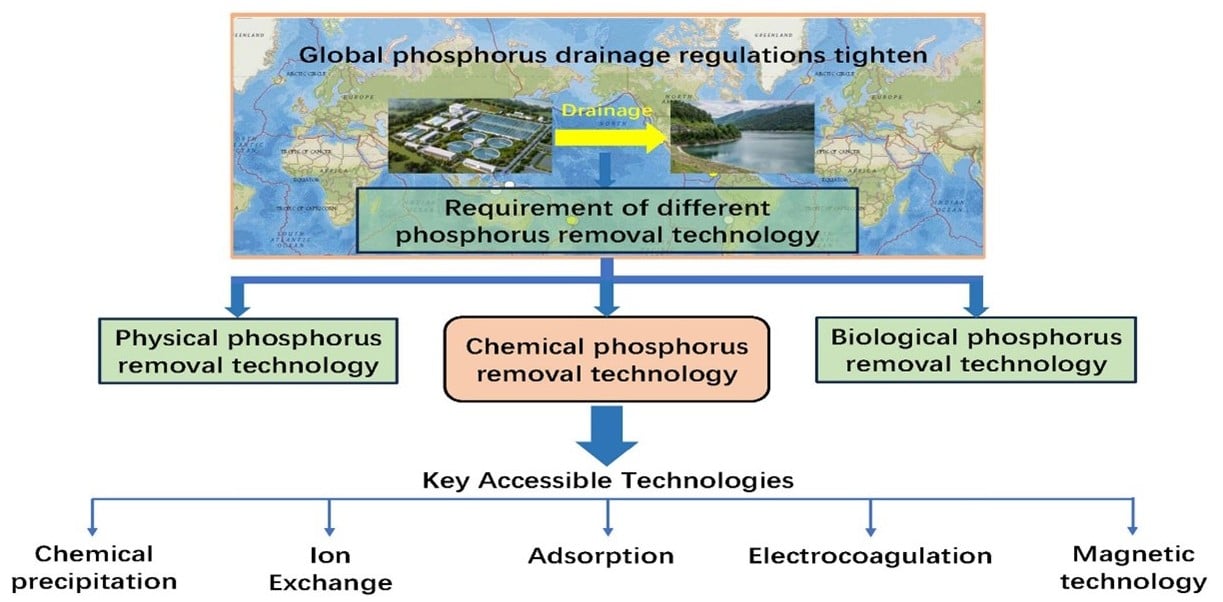
As eutrophication worsens, countries including China, the US, France, Sweden, and South Korea have tightened phosphorus (P) discharge limits for wastewater treatment plants (WWTPs). This paper first reviews China’s evolving P regulations, then classifies P removal technologies into physical, chemical, biological, and combined methods. Analysis of current WWTPs in China shows that biological P removal alone is insufficient, making chemical P removal (CPR) a necessary supplement or primary approach. Thus, the review focuses on CPR technologies: chemical precipitation, ion exchange, adsorption, electrocoagulation, magnetic methods, hybrid biological-chemical methods, and P recovery technologies. For each, the principles, materials, application conditions, advantages, and disadvantages are discussed. This review aims to guide the selection, application, and future research of CPR processes.
Share and Cite
MDPI and ACS Style
Zhang, T.; Zhao, Y.
Evolution of P Discharge Regulations in China: Necessity Analysis and Advances in Chemical P Removal Technologies for Wastewater Treatment. Separations 2026, 13, 171.
https://doi.org/10.3390/separations13060171
AMA Style
Zhang T, Zhao Y.
Evolution of P Discharge Regulations in China: Necessity Analysis and Advances in Chemical P Removal Technologies for Wastewater Treatment. Separations. 2026; 13(6):171.
https://doi.org/10.3390/separations13060171
Chicago/Turabian Style
Zhang, Tao, and Yonghong Zhao.
2026. "Evolution of P Discharge Regulations in China: Necessity Analysis and Advances in Chemical P Removal Technologies for Wastewater Treatment" Separations 13, no. 6: 171.
https://doi.org/10.3390/separations13060171
APA Style
Zhang, T., & Zhao, Y.
(2026). Evolution of P Discharge Regulations in China: Necessity Analysis and Advances in Chemical P Removal Technologies for Wastewater Treatment. Separations, 13(6), 171.
https://doi.org/10.3390/separations13060171
Note that from the first issue of 2016, this journal uses article numbers instead of page numbers. See further details
here.
Article Metrics
Article Access Statistics
For more information on the journal statistics, click
here.
Multiple requests from the same IP address are counted as one view.