
Selective Recovery Lithium from Mother Liquor via Solvent Extraction: A Review on Extractants, Mechanisms, and Efficiency

Abstract
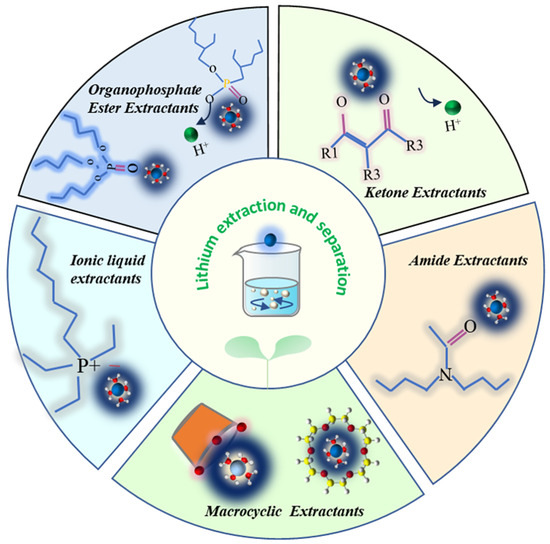
1. Introduction
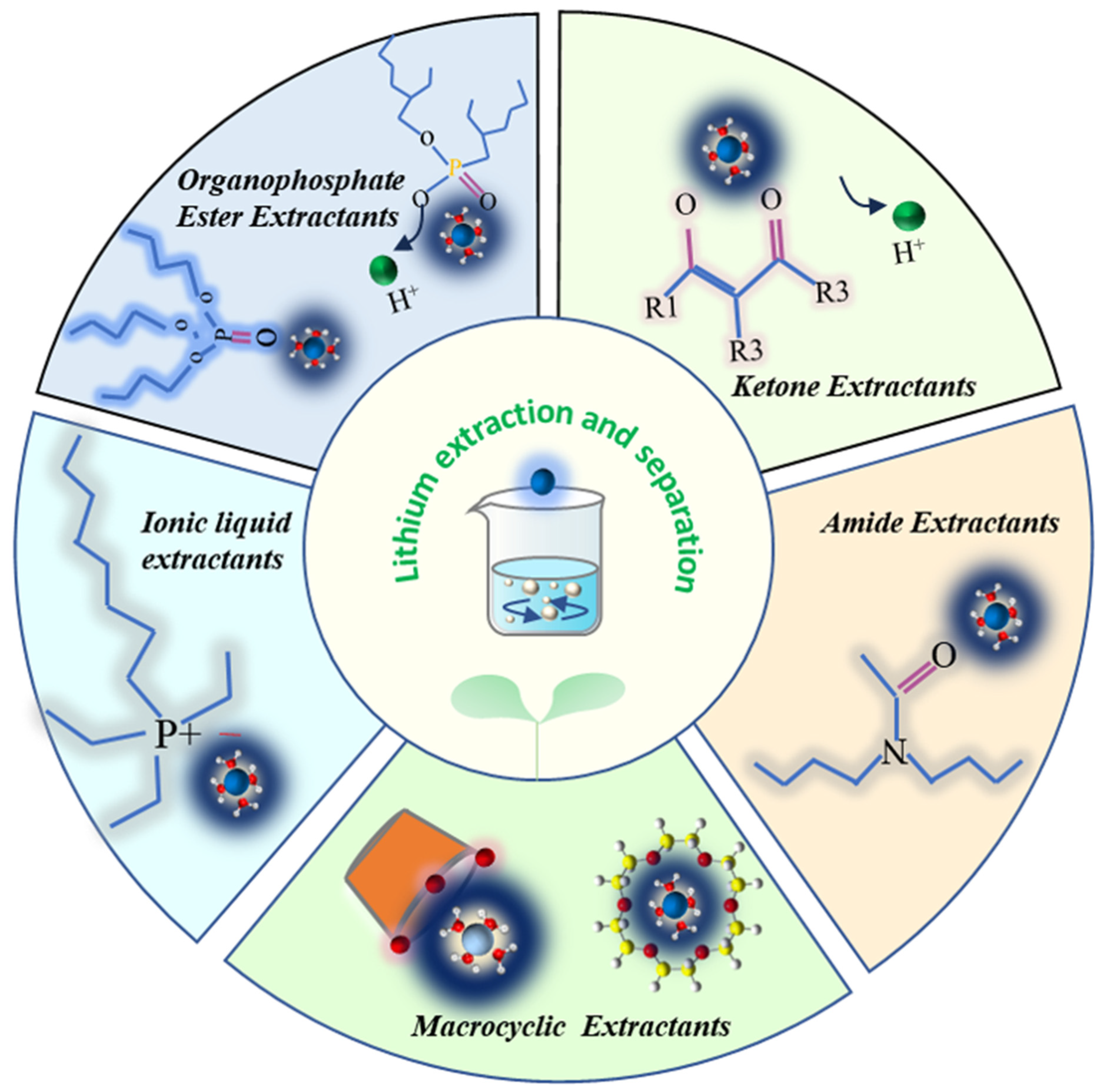
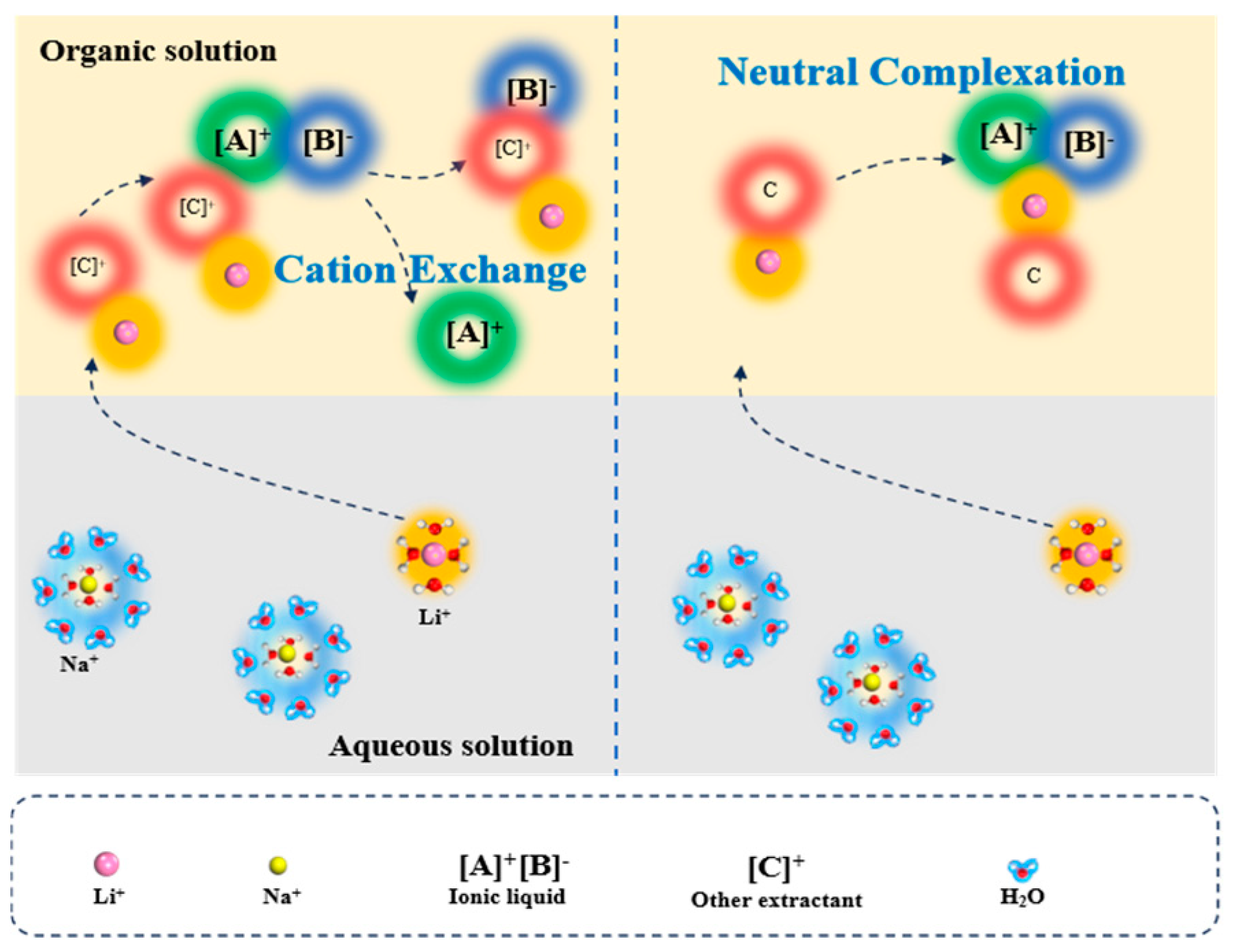
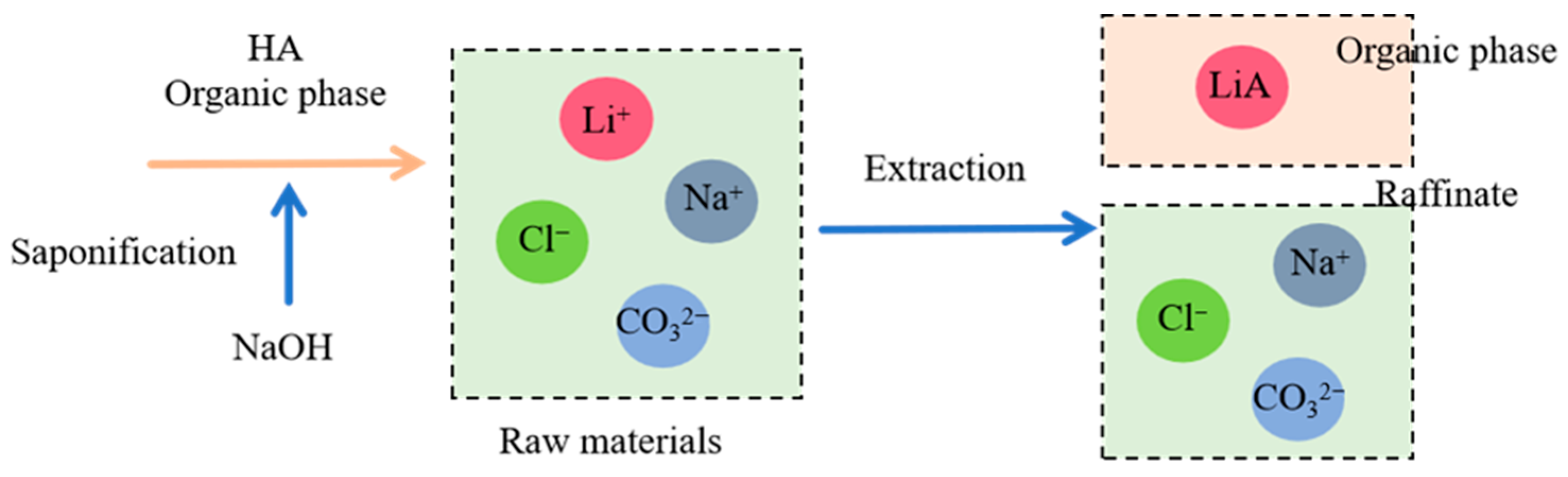
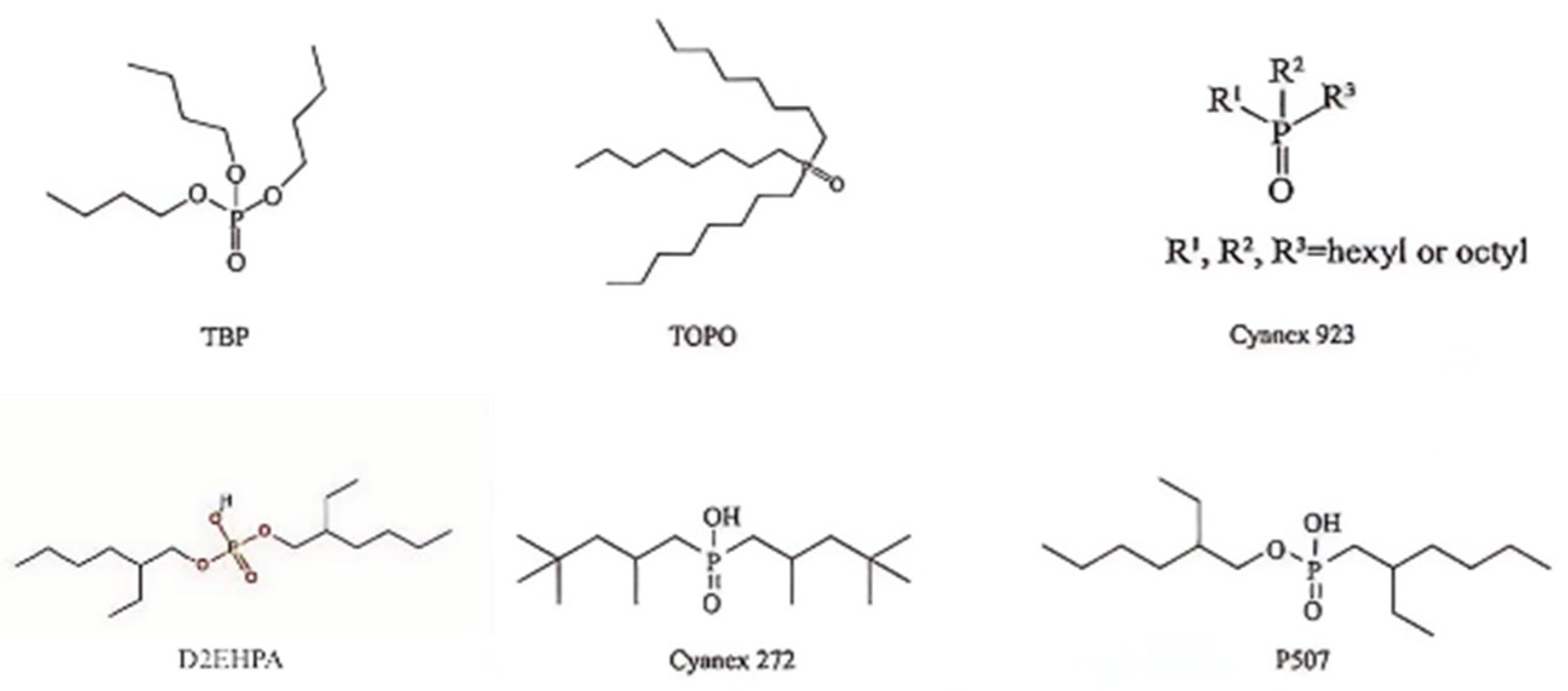
2. Organophosphorus Type Extractants Applied in the Extraction and Separation of Lithium from Mother Liquor
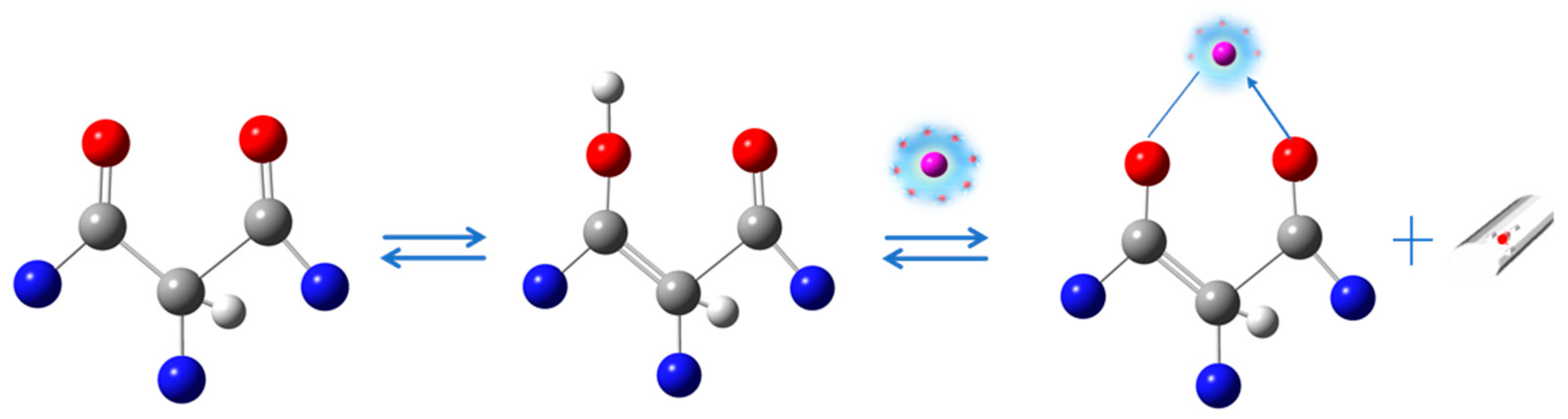
3. Diketone Extractants Applied in the Extraction and Separation of Lithium from Mother Liquor
4. Ionic Liquids Extractant Applied in the Extraction and Separation of Lithium from Mother Liquor
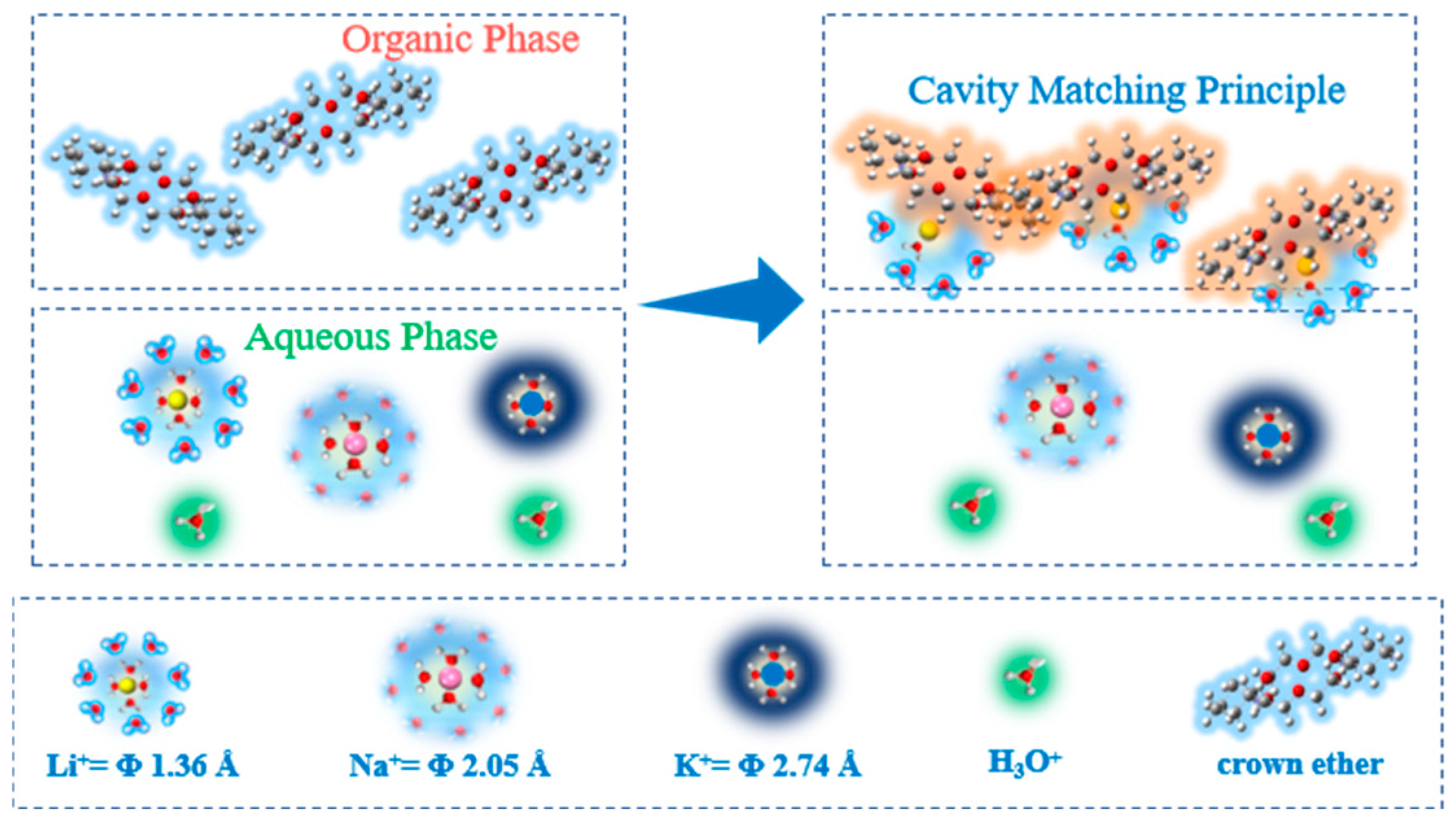
5. Crown Ether Extractant Applied in the Extraction and Separation of Lithium from Mother Liquor
6. Other Extractant Applied in the Extraction and Separation of Lithium from Mother Liquor
7. Conclusions and Prospects
- (1)
- Rational design and low-cost synthesis of novel extractants-particularly green extractants with high selectivity, strong stability, low toxicity, and economic viability—to reduce environmental risks and treatment costs at the source.
- (2)
- Overcoming the limitations of conventional single-process configurations by promoting the in-depth coupling and systematic integration of multiple technologies, and actively introducing external field-assisted intensification methods to address engineering challenges such as emulsification and enhance separation efficiency in lithium recovery.
Author Contributions
Funding
Data Availability Statement
Conflicts of Interest
References
- Tryggestad, C.; Sharma, N.; Rolser, O.; Smeets, B.; Wilthaner, M.; Staaij, J.V.D.; Gruenewald, T.; Noffsinger, J.; Tiemersma, L. Global Energy Perspective 2022; McKinsey & Company: New York, NY, USA, 2022. [Google Scholar]
- He, S.; Zuo, Q.; Shi, H.; Geng, Z.; Liu, C.; Ding, L.; Li, X.; Shao, P.; Yang, L.; Luo, X. Direct recovery of high-purity lithium via nanofiltration membranes from leaching solution of spent lithium batteries. Resour. Conserv. Recycl. 2024, 210, 107846. [Google Scholar] [CrossRef]
- Choi, J.W.; Aurbach, D. Promise and reality of post-lithium-ion batteries with high energy densities. Nat. Rev. Mater. 2016, 1, 16013. [Google Scholar] [CrossRef]
- Chagnes, A.; Światowska, J. Chapter 3-Lithium Production Processes. In Lithium Process Chemistry; Elsevier: Amsterdam, The Netherlands, 2015; pp. 81–124. [Google Scholar]
- Li, Z.; Wang, C.; Chen, J. Supply and demand of lithium in China based on dynamic material flow analysis. Renew. Sustain. Energy Rev. 2024, 203, 114786. [Google Scholar] [CrossRef]
- U.S. Geological Survey. Mineral Commodity Summaries 2023; U.S. Geological Survey: Reston, VA, USA, 2023. [Google Scholar]
- Ni, C.; Liu, C.; Wang, J.; Liang, Y.; Xie, W.; Zhong, H.; He, Z. Advances and promotion strategies of processes for extracting lithium from mineral resources. J. Ind. Eng. Chem. 2024, 140, 47–64. [Google Scholar] [CrossRef]
- Ni, C.; Liu, C.; Liu, J.; Wang, J.; Liang, Y.; Sun, W.; Zhong, H.; He, Z. Thermochemically driven crystal phase transfer via mechanical activation-assisted chlorination roasting toward the selective extraction of lithium from spodumene. J. Ind. Eng. Chem. 2024, 139, 632–640. [Google Scholar] [CrossRef]
- Xie, Y.; Ni, C.; Han, Z.; Zhong, H.; He, Z.; Sun, W. High recovery of lithium from coal residue by roasting and sulfuric acid leaching. Miner. Eng. 2023, 202, 108284. [Google Scholar] [CrossRef]
- Zhang, Y.; Hu, Y.; Wang, L.; Sun, W. Systematic review of lithium extraction from salt-lake brines via precipitation approaches. Miner. Eng. 2019, 139, 105868. [Google Scholar] [CrossRef]
- Chen, W.; Li, X.; Chen, L.; Zhou, G.; Lu, Q.; Huang, Y.; Chao, Y.; Zhu, W. Tailoring hydrophobic deep eutectic solvent for selective lithium recovery from the mother liquor of Li2CO3. Chem. Eng. J. 2021, 420, 127648. [Google Scholar] [CrossRef]
- Chen, L.L. Study on Development and Application of β-Diketone Extraction System in Extraction of Lithium Ions from High Na/Li Ratio Brine. Master’s Thesis, Beijing University of Chemical Technology, Beijing, China, 2025. [Google Scholar]
- Luo, H.; Yao, H.; Wang, X.; Liang, X.; Li, B.; Liu, H.; Li, Y. Selective recovery of lithium from mother liquor of Li2CO3 by synergistic hydrophobic deep eutectic solvents: Performance and mechanistic insight. Sep. Purif. Technol. 2023, 313, 123353. [Google Scholar] [CrossRef]
- Ni, C.; Liu, C.; Wang, J.; Khan, A.; Zhong, H.; He, Z. Selective separation of lithium from the hydrochloric acid leachate of lithium ores via the extraction system containing TBP-FeCl3. Desalination 2024, 583, 117677. [Google Scholar] [CrossRef]
- Wang, J.; Wu, X.; Zhang, S. Development of a thermodynamic model for the Li2CO3-NaCl-Na2SO4-H2O system and its application. J. Chem. Thermodyn. 2018, 123, 62–73. [Google Scholar] [CrossRef]
- Wang, J.; Yang, S.; Bai, R.; Chen, Y.; Zhang, S. Lithium recovery from the mother liquor obtained in the process of Li2CO3 production. Ind. Eng. Chem. Res. 2019, 58, 1363–1372. [Google Scholar] [CrossRef]
- Zhao, Y.; Xing, H.; Rong, M.; Li, Z.; Wei, X.; Chen, C.; Liu, H.; Yang, L. Quantum chemical calculation assisted efficient lithium extraction from unconventional oil and gas field brine by β-diketone synergic system. Desalination 2023, 565, 116890. [Google Scholar] [CrossRef]
- An, J.; Kang, D.; Tran, K.; Kim, M.; Lim, T.; Tran, T. Recovery of lithium from Uyuni salar brine. Hydrometallurgy 2012, 117, 64–70. [Google Scholar] [CrossRef]
- Li, Y.; Dong, L.; Shi, P.; Li, Y.; Yang, H.; Zheng, N.; Ren, Z.; Zhou, Z. Selective leaching and recovery of lithium ions from lithium slag with low lithium content. Can. J. Chem. Eng. 2025, 103, 5635–5647. [Google Scholar] [CrossRef]
- Naumov, A.; Naumova, M. Modern state of the world lithium market. Russ. J. Non-Ferrous Met. 2010, 51, 324–330. [Google Scholar] [CrossRef]
- Nguyen, T.; Lee, M. A Review on the separation of lithium ion from leach liquors of primary and secondary resources by solvent extraction with commercial extractants. Processes 2018, 6, 55. [Google Scholar] [CrossRef]
- Nishihama, S.; Onishi, K.; Yoshizuka, K. Selective recovery process of lithium from seawater using Integrated ion exchange methods. Solvent Extr. Ion Exch. 2011, 29, 421–431. [Google Scholar] [CrossRef]
- Orooji, Y.; Nezafat, Z.; Nasrollahzadeh, M.; Shafiei, N.; Afsari, M.; Pakzad, K.; Razmjou, A. recent advances in nanomaterial development for lithium ion-sieving technologies. Desalination 2022, 529, 115624. [Google Scholar] [CrossRef]
- Xing, M.; Zhang, F.; Zheng, P.; Wang, Y.; Zhao, L.; Xu, C. Selective recovery of lithium from high-aluminum fly ash by using alkali-dissolution-assisted HBTA-TOPO synergistic extraction. J. Clean. Prod. 2024, 434, 139998. [Google Scholar] [CrossRef]
- Zhang, L.; Li, L.; Shi, D.; Li, J.; Peng, X.; Nie, F. Selective extraction of lithium from alkaline brine using HBTA-TOPO synergistic extraction system. Sep. Purif. Technol. 2017, 188, 167–173. [Google Scholar] [CrossRef]
- Li, X.; Mo, Y.; Qing, W.; Shao, S.; Tang, C.; Li, J. Membrane-based technologies for lithium recovery from water lithium resources: A review. J. Membr. Sci. 2019, 591, 117317. [Google Scholar] [CrossRef]
- Liang, T. Synthesis and Extraction of Lithium by Titanium Series Lithium Ion Screen Adapted to Carbonate Type Lithium Mother liquor. Master’s Thesis, East China University of Technology, Fuzhou, China, 2024. [Google Scholar]
- Ahmed, I.; Hussein, H.; Ragab, A.; Al-Radadi, N. Synthesis and characterization of silica-coated oxyhydroxide aluminum/doped polymer nanocomposites: A comparative study and its application as a sorbent. Molecules 2020, 25, 1520. [Google Scholar] [CrossRef]
- Khandaker, S.; Hossain, M.; Saha, P.; Rayhan, U.; Islam, A.; Choudhury, T.; Awual, M. Functionalized layered double hydroxides composite bio-adsorbent for efficient copper(II) ion encapsulation from wastewater. J. Environ. Manag. 2021, 300, 113782. [Google Scholar] [CrossRef] [PubMed]
- Zhang, F.; Si, Y.; Yu, J.; Ding, B. Sub-Nanoporous Engineered Fibrous Aerogel Molecular Sieves with Nanogating Channels for Reversible Molecular Separation. Small 2022, 18, 2202173. [Google Scholar] [CrossRef]
- Bao, L.; Zhang, J.; Tang, W.; Sun, S. Synthesis and adsorption properties of metal oxide-coated lithium ion-sieve from salt lake brine. Desalination 2023, 546, 116196. [Google Scholar] [CrossRef]
- Zhao, B.; Qian, Z.; Qiao, Y.; Li, J.; Wu, Z.; Liu, Z. The Li(H2O)n dehydration behavior influences the Li+ ion adsorption on H4Ti5O12 with different facets exposed. Chem. Eng. J. 2023, 451, 138870. [Google Scholar] [CrossRef]
- Bai, R.; Wang, J.; Cui, L.; Yang, S.; Qian, W.; Cui, P.; Zhang, Y. Efficient extraction of lithium ions from high Mg/Li ratio brine through the synergy of TBP and Hydroxyl functional ionic liquids. Chin. J. Chem. 2020, 38, 1743–1751. [Google Scholar] [CrossRef]
- Chen, L.; Chao, Y.; Li, X.; Zhou, G.; Lu, Q.; Hua, M.; Li, H.; Ni, X.; Wu, P.; Zhu, W. Engineering a tandem leaching system for the highly selective recycling of valuable metals from spent Li-ion batteries. Green Chem. 2021, 23, 2177–2184. [Google Scholar] [CrossRef]
- Luo, X.; Guo, B.; Luo, J.; Deng, F.; Zhang, S.; Luo, S.; Crittenden, J. Recovery of lithium from wastewater using sevelopment of Li ion-imprinted polymers. ACS Sustain. Chem. Eng. 2015, 3, 460–467. [Google Scholar] [CrossRef]
- Masmoudi, A.; Zante, G.; Trébouet, D.; Barillon, R.; Boltoeva, M. Understanding the mechanism of lithium ion extraction using tributyl phosphate in room temperature ionic liquid. Solvent Extr. Ion Exch. 2020, 38, 777–799. [Google Scholar] [CrossRef]
- Shao, H.; Li, C.; Ma, C.; Sun, L.; Chen, R.; Cheng, R.; Liu, Y.; Yan, Y.; Sun, Q.; Wu, C. An ion-imprinted material embedded carbon quantum dots for selective fluorometric determination of lithium ion in water samples. Microchim. Acta 2017, 184, 4861–4868. [Google Scholar] [CrossRef]
- Swain, B. Separation and purification of lithium by solvent extraction and supported liquid membrane, analysis of their mechanism: A review. J. Chem. Technol. Biotechnol. 2016, 91, 2549–2562. [Google Scholar] [CrossRef]
- Wang, S.; Zhang, M.; Zhang, Y.; Zhang, Y.; Qiao, S.; Zheng, S. High adsorption performance of the Mo-doped titanium oxide sieve for lithium ions. Hydrometallurgy 2019, 187, 30–37. [Google Scholar] [CrossRef]
- Zhang, L.; Li, L.; Rui, H.; Shi, D.; Peng, X.; Ji, L.; Song, X. Lithium recovery from effluent of spent lithium battery recycling process using solvent extraction. J. Hazard. Mater. 2020, 398, 122840. [Google Scholar] [CrossRef] [PubMed]
- Ji, L.; Li, L.; Shi, D.; Li, J.; Liu, Z.; Xu, D.; Song, X. Extraction equilibria of lithium with N,N-bis(2-ethylhexyl)-3-oxobutanamide and tributyl phosphate in kerosene and FeCl3. Hydrometallurgy 2016, 164, 304–312. [Google Scholar] [CrossRef]
- Su, H. Study on the Lithium Recovery from Salt Lake Brines Containing High Magnesium Concentration Using Multiple Component Synergistic Solvent Extraction System. Ph.D. Thesis, Institute of Process Engineering, Chinese Academy of Sciences, Beijing, China, 2021. [Google Scholar]
- Zhang, L. Mechanism and Process Study on Lithium Separation from Alkaline Solution Using HBTA/TOPO Extraction System. Ph.D. Thesis, Qinghai Institute of Salt Lakes, Chinese Academy of Sciences, Xining, China, 2019. [Google Scholar]
- Liu, F.D. Lithium Selective Extraction from Carbonate-Type Salt Lake Brine. Ph.D. Thesis, Central South University, Changsha, China, 2022. [Google Scholar]
- Dietz, M.; Dzielawa, J.; Laszak, I.; Young, B.; Jensen, M. Influence of solvent structural variations on the mechanism of facilitated ion transfer into room-temperature ionic liquids. Green Chem. 2003, 5, 682–685. [Google Scholar] [CrossRef]
- Pranolo, Y.; Zhu, Z.; Cheng, C. Separation of lithium from sodium in chloride solutions using SSX systems with LIX 54 and Cyanex 923. Hydrometallurgy 2015, 154, 33–39. [Google Scholar] [CrossRef]
- Xu, J.; Li, Z.; Gu, Z.; Wang, G.; Liu, J. Green and efficient extraction strategy to lithium isotope separation with double ionic liquids as the medium and ionic associated agent. J. Radioanal. Nucl. Chem. 2013, 295, 2103–2110. [Google Scholar]
- Duan, W.J. Development and Application Fundamental Research on a New Extraction System for Selective Extraction of Lithium from Salt Lake Brine and Lithium Precipitation Mother Liquor. Master’s Thesis, Beijing University of Chemical Technology, Beijing, China, 2024. [Google Scholar]
- Li, S.; Zhi, Q.; Darui, L.; Guimei, G.; Yunfeng, Z.; Yu, H.; Jie, Z. Research progress of lithium recovery process from lithium precipitation mother liquor. Rare Met. Cem. Carbides 2024, 52, 11. [Google Scholar]
- Li, S.Y.; Wang, X.; Ma, Y.J.; Zhang, F.K.; Li, J. Effect of coexisting ion concentration on extraction of lithium in [BMIM]PF6-TBP system. Nonferrous Met. 2022, 12, 77–81. [Google Scholar]
- Niu, Z.; Xu, T.; Zhang, L.; Ji, L.; Li, L. Mechanism and process study of lithium extraction by 2-ethylhexyl salicylate extraction system. J. Clean. Prod. 2024, 446, 141351. [Google Scholar] [CrossRef]
- Zhao, R.; Ying, Z.; Sun, H.; Wei, Q.; Ren, X. Extracting Li+ from high Na/Li solution and comparing the affinity of nonylphenol oxygen anion to Na+ and Li+. Sep. Purif. Technol. 2023, 320, 124189. [Google Scholar] [CrossRef]
- Zhang, J.; Wu, H.; Yang, L. Research progress of lithium extraction from salt lake brines. Chin. J. Appl. Chem. 2024, 41, 800–812. [Google Scholar]
- Hano, T.; Matsumoto, M.; Ohtake, T.; Egashira, N.; Hori, F. Recovery of lithium from geothermal water by solvent-extraction technique. Solvent Extr. Ion Exch. 1992, 10, 195–206. [Google Scholar] [CrossRef]
- Zhang, J.; Liu, Y.; Liu, W.; Wang, L.; Chen, J.; Zhu, Z.; Qi, T. Mechanism study on the synergistic effect and emulsification formation of phosphine oxide with β-diketone for lithium extraction from alkaline systems. Sep. Purif. Technol. 2021, 279, 119648. [Google Scholar] [CrossRef]
- Zhou, Z.; Liang, S.; Qin, W.; Fei, W. Extraction equilibria of lithium with tributyl phosphate, diisobutyl ketone, acetophenone, methyl isobutyl ketone, and 2-Heptanone in Kerosene and FeCl3. Ind. Eng. Chem. Res. 2013, 52, 7912–7917. [Google Scholar] [CrossRef]
- Healy, T.V. Synergism in the solvent extraction of metal ions by dibenzoylmethane. J. Inorg. Nucl. Chem. 1969, 31, 499–511. [Google Scholar] [CrossRef]
- Seeley, F.; Baldwin, W. Extraction of lithium from neutral salt-solutions with fluorinated beta-diketones. J. Inorg. Nucl. Chem. 1976, 38, 1049–1052. [Google Scholar] [CrossRef]
- Ishimori, K.; Imura, H.; Ohashi, K. Effect of 1,10-phenanthroline on the extraction and separation of lithium(I), sodium(I) and potassium(I) with thenoyltrifluoroacetone. Anal. Chim. Acta 2002, 454, 241–247. [Google Scholar] [CrossRef]
- Zhao, J.; Chen, H.; Yu, J. Selective lithium recovery from lithium precipitation mother liquor by using a diketone-based solvent. Desalination 2024, 591, 117999. [Google Scholar] [CrossRef]
- Yang, S.C. Research on the Mechanism of Ionic Liquid-Based System for Lithium Extraction from Lithium Deposition on Mother Liquor. Master’s Thesis, Beijing University of Chemical Technology, Beijing, China, 2019. [Google Scholar]
- Wilkes, J.; Zaworotko, M. Air and water stable 1-ethyl-3-methylimidazolium based ionic liquids. J. Chem. Soc. Chem. Commun. 1992, 13, 965–967. [Google Scholar] [CrossRef]
- Cai, C.; Hanada, T.; Fajar, A.; Goto, M. An ionic liquid extractant dissolved in an ionic liquid diluent for selective extraction of Li(I) from salt lakes. Desalination 2021, 509, 115073. [Google Scholar] [CrossRef]
- Zheng, H.; Dong, T.; Sha, Y.; Jiang, D.; Zhang, H.; Zhang, S. Selective extraction of lithium from spent lithium batteries by functional ionic liquid. ACS Sustain. Chem. Eng. 2021, 9, 7022–7029. [Google Scholar] [CrossRef]
- Wang, J.; Yang, S.; Zhang, X.; Wang, Y.; Wang, D.; Li, W.; Ashraf, M.; Park, A.; Li, X. Extraction mechanism of lithium from the alkali solution with diketonate-based ionic liquid extractants. Energy Fuels 2020, 34, 11581–11589. [Google Scholar] [CrossRef]
- Shi, C.; Jing, Y.; Xiao, J.; Wang, X.; Jia, Y. Liquid-liquid extraction of lithium using novel phosphonium ionic liquid as an extractant. Hydrometallurgy 2017, 169, 314–320. [Google Scholar] [CrossRef]
- Shi, C.; Jing, Y.; Xiao, J.; Wang, X.; Yao, Y.; Jia, Y. Solvent extraction of lithium from aqueous solution using non-fluorinated functionalized ionic liquids as extraction agents. Sep. Purif. Technol. 2017, 172, 473–479. [Google Scholar] [CrossRef]
- Shu, Y.Z.; Wu, J.Z.; Deng, W.Q. Application of crown compounds in lithium isotopes separation. J. Nucl. Radiochem. 2015, 37, 12–17. [Google Scholar]
- Xiao, J.; Jia, Y.Z.; Yao, Y.; Shi, C.L.; Sun, H.J.; Xie, S.L.; Jing, Y. A review of separation of lithium isotopes by solvent extraction. J. Nucl. Radiochem. 2016, 24, 62–72. [Google Scholar]
- Torrejos, R.; Nisola, G.; Song, H.; Han, J.; Lawagon, C.; Seo, J.; Koo, S.; Kim, H.; Chung, W. Liquid-liquid extraction of lithium using lipophilic dibenzo-14-crown-4 ether carboxylic acid in hydrophobic room temperature ionic liquid. Hydrometallurgy 2016, 164, 362–371. [Google Scholar] [CrossRef]
- Habata, Y.; Ikeda, M.; Akabori, S. Lithium ion-selective dibenzo-14-crown-4 possessing a phosphoric-acid functional-group as a pendant. Tetrahedron Lett. 1992, 33, 3157–3160. [Google Scholar] [CrossRef]
- Torrejos, R.; Nisola, G.; Park, M.; Shon, H.; Seo, J.; Koo, S.; Chung, W. Synthesis and characterization of multi-walled carbon nanotubes-supported dibenzo-14-crown-4 ether with proton ionizable carboxyl sidearm as Li+ adsorbents. Chem. Eng. J. 2015, 264, 89–98. [Google Scholar] [CrossRef]
- Lu, J.; Qin, Y.; Zhang, Q.; Wu, Y.; Cui, J.; Li, C.; Wang, L.; Yan, Y. Multilayered ion-imprinted membranes with high selectivity towards Li+ based on the synergistic effect of 12-crown-4 and polyether sulfone. Appl. Surf. Sci. 2018, 427, 931–941. [Google Scholar] [CrossRef]
- Bartsch, R.; Yang, I.; Jeon, E.; Walkowiak, W.; Charewicz, W. Selective transport of alkali-metal cations in solvent-extraction by proton-ionizable dibenzocrown ethers. J. Coord. Chem. 1992, 27, 75–85. [Google Scholar] [CrossRef]
- Wilcox, K.; Pacey, G. Selective lithium ion extraction with chromogenic monoaza crown ethers. Anal. Chim. Acta 1991, 245, 235–242. [Google Scholar] [CrossRef]
- Torrejos, R.; Nisola, G.; Song, H.; Limjuco, L.; Lawagon, C.; Parohinog, K.; Koo, S.; Han, J.; Chung, W. Design of lithium selective crown ethers: Synthesis, extraction and theoretical binding studies. Chem. Eng. J. 2017, 326, 921–933. [Google Scholar] [CrossRef]
- Chen, X.; Zhuang, X.; Wang, Z.; Zhu, J.; Tang, S.; Zheng, X.; Liu, Y.; Tong, Q. A multifunctional bipolar host material based on phenanthroimidazole for efficient green and red PhOLEDs with low turn-on voltage. Org. Electron. 2019, 69, 85–91. [Google Scholar] [CrossRef]
- Dong, Z.; Le, X.; Zhou, P.; Dong, C.; Ma, J. Sequential recognition of zinc ion and hydrogen sulfide by a new quinoline derivative with logic gate behavior. RSC Adv. 2014, 4, 18270–18277. [Google Scholar] [CrossRef]
- Manzetti, S.; Lu, T. The geometry and electronic structure of Aristolochic acid: Possible implications for a frozen resonance. J. Phys. Org. Chem. 2013, 26, 473–483. [Google Scholar] [CrossRef]
- Shi, D. A Novel Lithium Extraction System Used for Salt Lake Brines with High Magnesium-to-Lithium Ratio. Ph.D. Thesis, Qinghai Institute of Salt Lakes, Chinese Academy of Sciences, Xining, China, 2013. [Google Scholar]
- Abbott, A.; Capper, G.; Davies, D.; Rasheed, R.; Tambyrajah, V. Novel solvent properties of choline chloride/urea mixtures. Chem. Commun. 2003, 39, 70–71. [Google Scholar] [CrossRef]
- Hanada, T.; Goto, M. Synergistic deep eutectic solvents for lithium extraction. ACS Sustain. Chem. Eng. 2021, 9, 2152–2160. [Google Scholar] [CrossRef]
- Salakjani, N.; Singh, P.; Nikoloski, A. Production of lithium—A literature review. Part 2. Extraction from Spodumene. Miner. Process. Extr. Metall. Rev. 2021, 42, 268–283. [Google Scholar] [CrossRef]
- Disu, B.; Rafati, R.; Haddad, A.; Roca, J.; Clar, M.; Bakhtiari, S. Review of recent advances in lithium extraction from subsurface brines. Geoenergy Sci. Eng. 2024, 241, 213189. [Google Scholar] [CrossRef]
- Zhang, Z.; Jia, Y.; Liu, B.; Sun, H.; Jing, Y.; Zhang, Q.; Shao, F.; Qi, M.; Yao, Y. Extraction and separation of lithium isotopes by using organic liquid film extraction system of crown ether-ionic liquid. Fusion Eng. Des. 2020, 161, 112015. [Google Scholar] [CrossRef]
- Kanagasundaram, T.; Murphy, O.; Haji, M.; Wilson, J. The recovery and separation of lithium by using solvent extraction methods. Coord. Chem. Rev. 2024, 509, 215727. [Google Scholar] [CrossRef]
- Yang, S.; Liu, G.; Wang, J.; Cui, L.; Chen, Y. Recovery of lithium from alkaline brine by solvent extraction with functionalized ionic liquid. Fluid Phase Equilibria 2019, 493, 129–136. [Google Scholar] [CrossRef]







| Extractant | System | Lithium Concentration in Mother Liquor (g/L) | Sodium Concentration in Mother Liquor (g/L) | Feed pH | O/A | Lithium Extraction Percentage | Na | K | Ref. |
|---|---|---|---|---|---|---|---|---|---|
| Organophosphorus type extractants | ES-TRPO | 1.856 | 60.60 | 13.5 | 1 | 99.5% (Three-stage) | 1.2% | / | [51] |
| TBP-HDES | 1.52 | 56.82 | - | 1 | 76.80% (Single-Stage) | 3.15 g/L | 15.4 | [11] | |
| Diketone extractants | Lix54-Cyanex | 1 | 23 | 11.2 | 1 | 97.3% | 2.6% | 1563 | [46] |
| Lix54-Cyanex | 1 | 80 | 11.2 | 1 | 96.3% | 2.5% | 1123 | [46] | |
| PMBP-TIBP | 1.51 | 47.30 | / | 1 | 94.29% | / | 988.55 | [48] | |
| BA-TIBP | 1.51 | 47.30 | / | 1 | 89.79% | / | / | [48] | |
| PHPD-Cyanex923 | 1.39 | 68.97 | 13.06 | 1 | >97% | About 10% | 475.06 | [16] | |
| HBTA-TOPO | 1.423 | 52.25 | 10.5 | 1 | ≥99.9% (Five-stage) | 0.14 g/L | >25,000 | [43] | |
| DEM-TBP | 2.097 | 76.99 | 9.56 | 1 | 99.96% | <10% | >160,000 | [60] | |
| Amide-based extractants | N523-TBP | 2.07 | 0.71 | 1–2 | 2 | 99.53% (Three-stage) | 0.013 g/L | [80] | |
| Ionic Liquids | [A336][TTA]-TRPO | 1.41 | 63.23 | 13.11 | 1 | 97.16% | 8% | / | [65] |
| [OHEMIM][NTf2] | 1.412 | 63.23 | 10.68 | 2 | 93.86% | 15.81% | 38.36 | [87] | |
| Phenolic extractants | HA | 1.791 | 111.244 | 10.23 | 3 | 71.52% (Single-Stage) | −5.91% | −44.99 | [52] |
| Extractant Category | Extraction Mechanism | Advantages | Disadvantages | Industrial Maturity Assessment |
|---|---|---|---|---|
| Organophosphorus | Neutral coordination/Cation Exchange | Low cost, extensive industrial experience. | Prone to degradation and emulsification under acidic conditions, corrosive to equipment; poor Li+/Na+ selectivity. | High (Traditional), but facing obsolescence for lithium recovery from precipitation mother liquor; mostly used as synergists. |
| Diketones | Cation Exchange | Exceptionally high Li+/Na+ selectivity | High cost; prone to emulsification; strongly dependent on high pH conditions; solvent loss issues. | Medium-High (Industrialization in Progress), currently the research and application hotspot for lithium recovery from mother liquor; relies on synergistic systems with organophosphorus esters to overcome drawbacks. |
| Ionic Liquids | Neutral coordination/Cation Exchange | Low volatility, high thermal stability; wide applicable pH range. | Extremely high synthesis cost; high viscosity. | Low (Transition from Lab to Pilot), high cost is the core barrier to industrialization; currently mainly used in high-value-added fields or fundamental research. |
| Crown Ether | “Size-matching” host-guest recognition | Theoretically highest selectivity based on cavity size, especially suitable for Li+/Mg2+ separation | Extremely expensive; relatively high-water solubility; complex synthesis. | Low (Fundamental Research Stage), farthest from large-scale industrial application; near-term goal is to validate its high-selectivity value via methods like immobilization. |
| Amides | Synergy of multiple mechanisms | Good selectivity for Li+; some systems can avoid strong acid/base conditions. | Insufficient research on comprehensive performance; lack of long-term industrial validation data. | Low to Medium (Technology Validation Stage), reported applications in specific fields (e.g., battery recycling leachate), but universality and maturity need improvement. |
Disclaimer/Publisher’s Note: The statements, opinions and data contained in all publications are solely those of the individual author(s) and contributor(s) and not of MDPI and/or the editor(s). MDPI and/or the editor(s) disclaim responsibility for any injury to people or property resulting from any ideas, methods, instructions or products referred to in the content. |
© 2026 by the authors. Licensee MDPI, Basel, Switzerland. This article is an open access article distributed under the terms and conditions of the Creative Commons Attribution (CC BY) license.
Share and Cite
Meng, X.; Zou, X.; Jiang, Y.; Zhou, H.; Zhao, J.; Zhang, S.; Zhang, J. Selective Recovery Lithium from Mother Liquor via Solvent Extraction: A Review on Extractants, Mechanisms, and Efficiency. Separations 2026, 13, 55. https://doi.org/10.3390/separations13020055
Meng X, Zou X, Jiang Y, Zhou H, Zhao J, Zhang S, Zhang J. Selective Recovery Lithium from Mother Liquor via Solvent Extraction: A Review on Extractants, Mechanisms, and Efficiency. Separations. 2026; 13(2):55. https://doi.org/10.3390/separations13020055
Chicago/Turabian StyleMeng, Xiaofei, Xiaoping Zou, Yingping Jiang, Haitao Zhou, Jiantao Zhao, Shengmei Zhang, and Junqi Zhang. 2026. "Selective Recovery Lithium from Mother Liquor via Solvent Extraction: A Review on Extractants, Mechanisms, and Efficiency" Separations 13, no. 2: 55. https://doi.org/10.3390/separations13020055
APA StyleMeng, X., Zou, X., Jiang, Y., Zhou, H., Zhao, J., Zhang, S., & Zhang, J. (2026). Selective Recovery Lithium from Mother Liquor via Solvent Extraction: A Review on Extractants, Mechanisms, and Efficiency. Separations, 13(2), 55. https://doi.org/10.3390/separations13020055