Article

Optimization of Ultra-High-Pressure Extraction and Comparative Evaluation of Antioxidant Activity and Flavonoid Composition in Guanxiang Leaves


1
College of Food Science and Technology, Hunan Agricultural University, Changsha 410128, China
2
State Key Laboratory of Biopharmaceutical Preparation and Delivery, Institute of Process Engineering, Chinese Academy of Sciences, Beijing 100190, China
*
Authors to whom correspondence should be addressed.
Separations 2026, 13(1), 20; https://doi.org/10.3390/separations13010020 (registering DOI)
Submission received: 9 December 2025 / Revised: 24 December 2025 / Accepted: 28 December 2025 / Published: 1 January 2026

Abstract

This paper aimed to optimize the ultra-high-pressure extraction process of flavonoids from guanxiang leaves, evaluate their antioxidant capacity, and identify the flavonoids. Methods: Guanxiang leaves were used as the raw material. The extraction process was optimized through single-factor experiments and a response surface methodology. Ascorbic acid (Vc) was employed as a positive control, and the in vitro antioxidant activity of flavonoids was assessed by determining the DPPH radical-scavenging rate, ABTS radical-scavenging rate, and FRAP ferric-reducing ability. Results: The optimal extraction conditions were determined as follows: ethanol concentration of 50%, solid-to-liquid ratio of 1:60 (g/mL), extraction pressure of 300 MPa, and pressure-holding time of 3 min. Under these conditions, the yield of guanxiang leaf flavonoids was found to be 2.21%, better than the solvent extraction method (1.94%). The antioxidant test results indicated that the IC50 values of the extract from the ultra-high-pressure treatment of guanxiang leaves were 11.8 and 50.72 μg·mL−1 on DPPH and ABTS scavenging, which were lower than those of the solvent’s extract (13.40 and 54.29 μg·mL−1). Moreover, the antioxidant ability could also be confirmed by Fe3+ ion reduction. Mass spectrometry results indicate that ultra-high-pressure extraction can yield components such as spiraeoside, scutellarin, luteolin, and nepetin, which are not present in solvent extraction methods. Conclusions: Therefore, the ultra-high-pressure extraction method can help to improve the flavonoid yield and antioxidant activity as well as to obtain special product types, including spiraeoside, scutellarin, luteolin, and nepetin, than the solvent extraction method.

1. Introduction

Plant-based natural products have been widely used in functional food and pharmaceutical fields for their diverse biological activities and source availability. Many natural products act as modulators of biological functions, such as enzyme inhibitors or cellular activity regulators [1]. Some have been used in clinics for disease treatment, particularly for chronic disorders and other therapeutic applications [2]. Natural products with high bioactivity are often thermally unstable and/or easily oxidized. Flavonoids and polyphenols are typical compounds with low stability. Therefore, heat reflux, solvent extraction, or distillation are widely used and sometimes coupled with microwave or ultrasonic processing [3]. However, heat and/or oxidation often deactivates the flavonoids or polyphenols [4]. Furthermore, conventional extraction processes are time-consuming and inefficient. Additionally, supercritical fluid extraction shows high extraction efficiency, but its high cost and low-processing scale often limits its application for the extraction of natural compounds with high value [5].
Ultra-high-pressure extraction (UHPE) is a new technology for extracting natural products. Compared to the traditional methods, UHPE shows many advantages including low energy consumption, time savings, high extraction yield, no heating process, and simple operation [6]. The application of UHPE has been widely reported for the preparation of polysaccharides, anthocyanins, and color extracts from fruits, green tea, and traditional Chinese medicines. The effect of pressure, temperature, and extraction time and solvent type on the extraction process and efficiency were also investigated [7,8,9]. However, activity recovery is more important concerning the stability of the target compound. It was reported that higher levels of antimicrobial, anti-diabetic activity and hypoglycemic activity in chlorogenic acid, caffeine, and flavonoids were obtained using higher ultra-high-pressure processing, except for extraction rates [10,11]. All these compounds contain phenolic hydroxyl groups, suggesting that UHPE is also crucial for the activity retention of thermally unstable and/or easily oxidized compounds. Existing studies have successfully applied UHPE for the extraction of various plant active ingredients, such as efficiently extracting polysaccharides from Morinda officinalis, flavonoids from sea buckthorn, and phenolics from mango leaves, in which the active ingredients presented excellent antioxidant activity [12,13,14]. These cases collectively demonstrate the technical advantages of UHPE in preserving and improving the efficacy of heat-sensitive bioactive components from plant sources. Based on this, this study extends the application of UHPE technology to a plant with significant potential but insufficient related research—guanxiang leaves.
Guanxiang is a kind of Aquilaria yunnanensis and is mainly found in Dongguan in the Guangdong province of China. It is a traditional Chinese plant with significant historical value [15]. The leaves are rich in various bioactive components, such as flavonoids, phenolic acids, terpenoids, and so on [16]. Studies have indicated that their flavonoids possess significant antioxidant, analgesic, anti-inflammatory, and hypoglycemic/hypolipidemic effects [16]. However, there has been no systematic report on efficient and green extraction processes specifically targeting the thermolabile flavonoids in guanxiang leaves, particularly regarding the UHPE technique, which can maximize the preservation of their bioactivity. This study aimed to develop a method for the extraction of flavonoids from guanxiang leaves using UHPE. The extract’s condition was optimized, and the activity of the flavonoids was determined. The activity retention properties between UHPE and solvent extraction were compared.

2. Materials and Methods

2.1. Materials and Reagents

Guanxiang leaves was purchased from Dongguan City (Guangdong Province, China). The standard substances and chemical reagents employed in this work, along with their respective sources, are provided below in detail.
Reagents: rutin (purity > 97%, analytically pure) was supplied by Shanghai Yuanye Biological Technology Co., Ltd. (Shanghai, China). Sodium nitrite (analytically pure) was supplied by Xilong Chemical Co., Ltd. (Shantou, China). Absolute ethyl alcohol, hydrochloric acid, anhydrous sodium acetate, green vitriol, and sulphuric acid (analytically pure) were obtained from Sinopharm Chemical Reagent Co., Ltd. (Shanghai, China). Acetonitrile (chromatographic pure) and formic acid (chromatographically pure) were purchased from Merck Company, Inc. (Kenilworth, NJ, USA). Other analytical chemical regents were purchased from Shanghai Aladdin Biochemical Technology Co., Ltd. (Shanghai, China).

2.2. Yield of Flavonoids in Guangxiang Leaves

The yield of flavonoids was measured by a previously reported method with minor modifications [17]. In brief, a mixture of the prepared ultra-high-pressure extraction solution or rutin solution and 15 μL of NaNO2 (5%: m/v) solution was incubated for 6 min. Then, the mixture was allowed to react with 15 μL of Al(NO3)3 (10%: m/v) solution for 6 min. Finally, 200 μL of NaOH (4%: m/v) solution was mixed for 15 min of incubation. Absorbance was measured at 510 nm wavelength by a microplate reader (Spectra Max 190, Molecular Devices, SV, Sunnyvale, CA, USA). The flavonoid yield (W, %) was then calculated using Formula (1). The regression equation for the rutin standard curve is y = 0.0036x − 0.0039.
W = C × V 2 × V 3 × d V 1 × m × 1000 × 100
where
  • W is the flavonoid yield of the sample (%),
  • C is calculated based on the standard curve regression equation to determine the flavonoid content in the sample solution (mg·mL−1),
  • V2 is the total volume of ethanol used during extraction (mL),
  • V3 is the final constant volume after volumetric preparation for measurement (mL),
  • d is the dilution factor of the ultra-high-pressure extraction solution,
  • V1 is the volume of ultra-high-pressure extraction solution taken during the measurement process (mL), and
  • m is the mass of the sample (g).

2.3. Optimization of UHPE

The extraction process was carried out using the ultra-high-pressure system (HPP.W1-600/0.5, Tianjin Huatai Senmiao Biological Engineering Technology Co., Ltd., Tianjin, China). The dried guangxiang leaves should be ground using a grinder (No.94223860-5, Beijing Kaichuangtonghe Technology Development Co., Ltd., Beijing, China) and sieved through a 60-mesh screen. The sealed bags containing the powdered guanxiang leaves and an ethanol solution of the appropriate concentration were then placed into the pressure vessel. After centrifugation (8000 r/min, 5 min), the ultra-high-pressure extraction solution was obtained. Subsequently, the ultra-high-pressure extraction solution was concentrated under reduced pressure using a rotary evaporator (RE-2000A, Shanghai Yarong Biochemical Instrument Factory, Shanghai, China) and then dried in an oven (GZX-9140MBE, shanghai Boxun lndustry & Commerce Co., Ltd., Shanghai, China) at 37 °C to obtain the ultra-high-pressure solid coarse extract.
Based on a single-factor experimental design, a four-factor and three-level Box–Behnken design (BBD) and response surface methodology (RSM) were carried out for the optimal combination of this study. The effects of four factors on the dependent variable flavonoid yield (W, %) were investigated: (A) ethanol concentration, (B) solid-to-liquid ratio (guanxiang leaf powder mass to ethanol solution volume), (C) pressure, and (D) pressure-holding time. The selection and range of these factors were based on the results of single-factor experimental data. Twenty-seven experiments were required, including three central point replicates to estimate experimental error, and the statistical significance analysis of the model was based on the pure error calculated from these central point replicates. The factors and levels of response surface test is shown in Table 1. The optimal conditions were determined through a two-step process: (1) identifying the theoretical optimum that maximizes the predicted response using the desirability function in the RSM software and (2) performing a practical adjustment of these theoretical values. The adjustment was guided by the principles of operational feasibility, equipment constraints, and model robustness, ensuring that the adjusted conditions yielded a predicted response value negligibly different from the theoretical maximum.

2.4. Solvent Extraction Method

The extraction method is from previous work [17]. The guangxiang leaf powder was accurately weighed in a sealed bag. A 1:20 solid-to-liquid ratio was used to add 80% ethanol solution, and the mixture was extracted at 65 °C for 3 h. Centrifugation followed by drying yielded the solvent-extracted solid coarse extract, with the procedure consistent with Section 2.3. The absorbance value was measured to calculate the flavonoid yield.

2.5. Antioxidant Activity

2.5.1. DPPH Radical-Scavenging Activity

The DPPH antioxidant assay was performed by a previously reported method [18]. Briefly, the sample (ultra-high-pressure solid coarse extract or solvent-extracted solid coarse extract) was dissolved in 50% ethanol solution. The samples with different concentrations were mixed with 0.05 mg·mL−1 DPPH solution and kept in the dark for 30 min. The absorbance of the reaction mixtures with or without test samples were recorded at 517 nm by the microplate reader, which was assigned as Asample, Acontrol, and Ablank. The scavenging activity (X, %) of DPPH free radicals was determined by Equation (2):
X = A control A sample A control A blank × 100

2.5.2. ABTS Radical-Scavenging Activity

The ABTS antioxidant assay was performed by a previously described method [19]. Sample (ultra-high-pressure solid coarse extract or solvent-extracted solid coarse extract) solutions of different concentrations were mixed with ABTS and incubated for 6 min. The absorbance was recorded at 734 nm by a microplate reader, which was assigned as Asample, Acontrol, and Ablank. The scavenging activity (Y, %) of ABTS free radicals was determined by Equation (3):
Y = 1 A sample A control A blank × 100

2.5.3. Ferric-Reducing Antioxidant Power (FRAP) Assay

The FRAP assay was determined by a previously reported method [20]. Acetate buffer (0.30 mol·L−1, pH 3.60), TPTZ (10 mmol·L−1), and FeCl3 (20 mmol·L−1) were mixed in a ratio of 10:1:1 (v/v/v) to prepare the FRAP reagent. The sample (ultra-high-pressure solid coarse extract or solvent-extracted solid coarse extract) solution and FRAP reagent were added to a 96-well plate and incubated in the dark at 37 °C for 10 min. The absorbance was recorded at 593 nm by a microplate reader. Establish standard curves for FeSO4 at different concentrations, with results expressed as FeSO4 concentration (FRAP) at the same absorbance level.

2.6. HPLC-MS/MS Condition

The ultra-high-pressure solid coarse extract or solvent-extracted solid coarse extract were dissolved in water and subsequently purified by macroporous resin (D3520), then dried at 37 °C, and purified ultra-high-pressure solid extract or solvent solid extract were obtained. Additionally, an appropriate amount was dissolved in methanol solution and filtered through a 0.22 μm membrane.
For the identification of flavonoids, the flavonoids of guanxiang leaves were detected using an Obitrap mass spectrometer (Exploris 480, Thermo Fisher, Waltham, MO, USA) with a mass accuracy of 10 ppm and a maximum resolution of 480 k. The HPLC-MS/MS conditions were as follows.
For the HPLC conditions, the chromatographic separation was carried out in a Agilent ZORBAX C18 column (150 mm× 2.1 mm, 5 μm) (Waters, Milford, MO, USA). The HPLC system was Vanquish UHPLC (Thermo Fisher, Waltham, MO, USA). The mobile phases A and B were 0.1% formic acid in water and 0.1% formic acid in acetonitrile, respectively. A linear gradient of 5%~95% of mobile phase B in 30 min was used, and the flow rate was 0.2 mL/min. The injection volume was 10 μL. The column temperature was kept at 30 °C.
For the MS conditions, the positive and negative modes of electron spray ionization (ESI) were used. The spray voltage of the positive mode was 3.8 kV and of the negative mode was −3.0 kV. The capillary temperature and vaporizer temperature were 320 °C and 300 °C, respectively. The sheath gas and aux gas were 35 mL/min and 10 psi, respectively. The mass scan range was set from m/z 100 to 600. The MS/MS collision energy was 60%. The Compound Discoverer 3.4 software (Thermo Fisher, Waltham, MO, USA) was used to analyze the ingredients in guanxiang leaves.

2.7. Statistical Analysis

All experiments were performed in triplicate and data were expressed as means and standard deviations of three experiments. Data analysis was performed with the SPSS 26.0 software and drawn with the Origin 2021 software.

3. Results and Discussion

3.1. Extraction of Flavonoids from Guanxiang Leaves During UHPE

3.1.1. Effect of Ethanol Concentration on Flavonoid Yield During UHPE

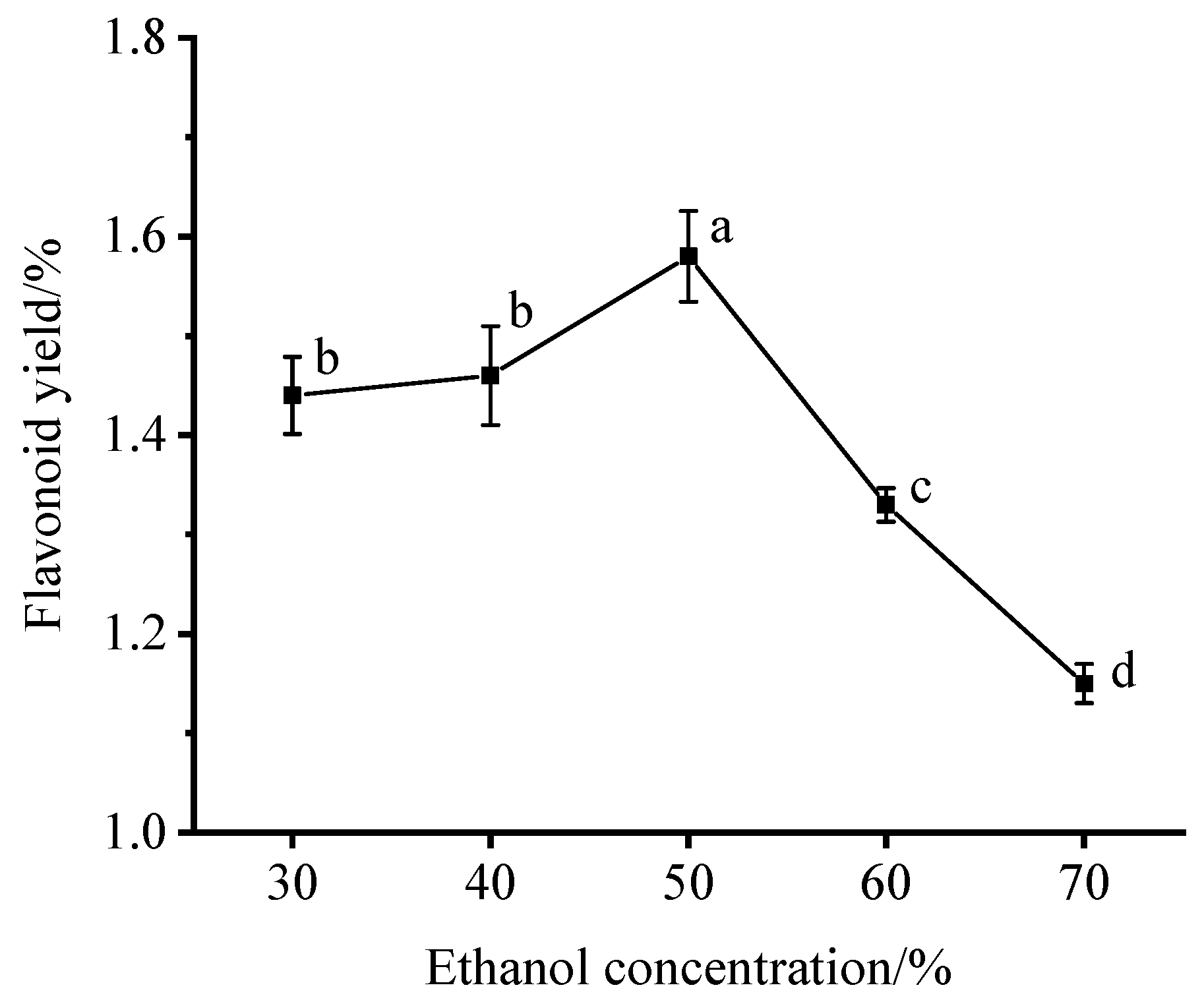
The flavonoid solubility increases with the concentration of ethanol in the solution, which affects the partition coefficient of flavonoids during solid–liquid extraction. Figure 1 shows the flavonoid yield increase with ethanol concentration in the solution. The maximum yield, 1.58%, was obtained when the ethanol concentration was 50%. Continuing to increase the ethanol concentration resulted in a decrease in the flavonoid yield (p < 0.05). A similar tendency was reported with anthocyanins as target products extracted from mulberry using UHPE [20]. One possible reason is that the high pressure changes the solubility of the flavonoids when ethanol concentration is above 50%. The effect of pressure on the partition coefficient of flavonoids during UHPE is crucial for process development [21], but the change in the partition coefficient with pressure lacks supporting data. The other reason is that more compounds, other than flavonoids, were released from guanxiang leaves with the increase in ethanol concentration, which deceased the solubility of flavonoids when ethanol concentration was above 50% [22]. It was reported that the CLogP, the compound’s lipophilicity or hydrophobicity, of a water solution containing 50% ethanol is similar to that of flavonoids, with the highest solubility resulting in the highest recovery of flavonoids from guanxiang leaves. Li et al. [23] reported that the optimal ethanol concentration is 70% for ethanol solution reflux extraction, which is higher than that for UHPE. The difference might be associated with different diffusion coefficients between UHPE and reflux extraction. Thus, the 50% ethanol concentration was used in the following experiments.
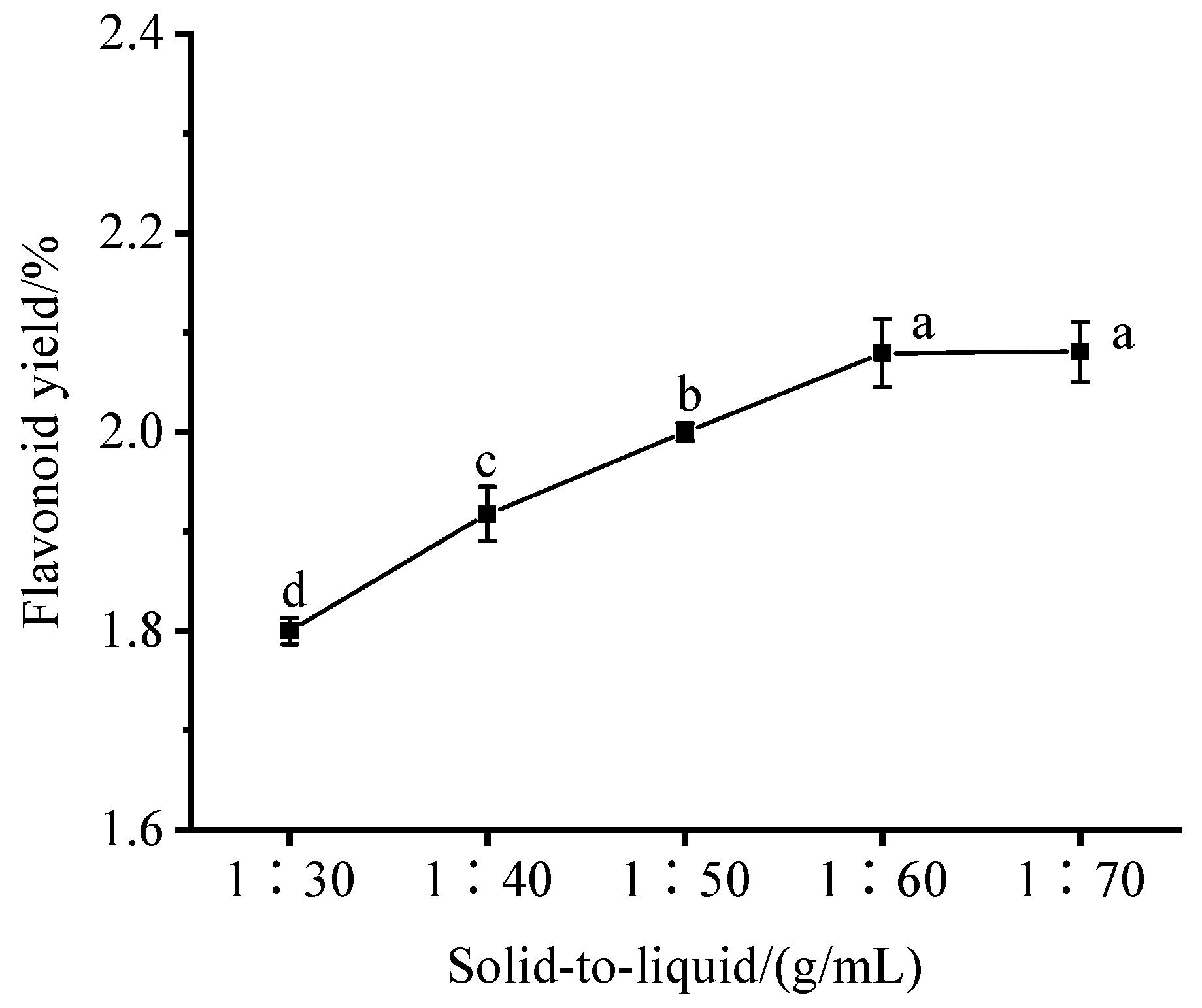
Figure 2. Effect of solid-to-liquid ratio on flavonoid yield during UHPE.
Separations 13 00020 g002
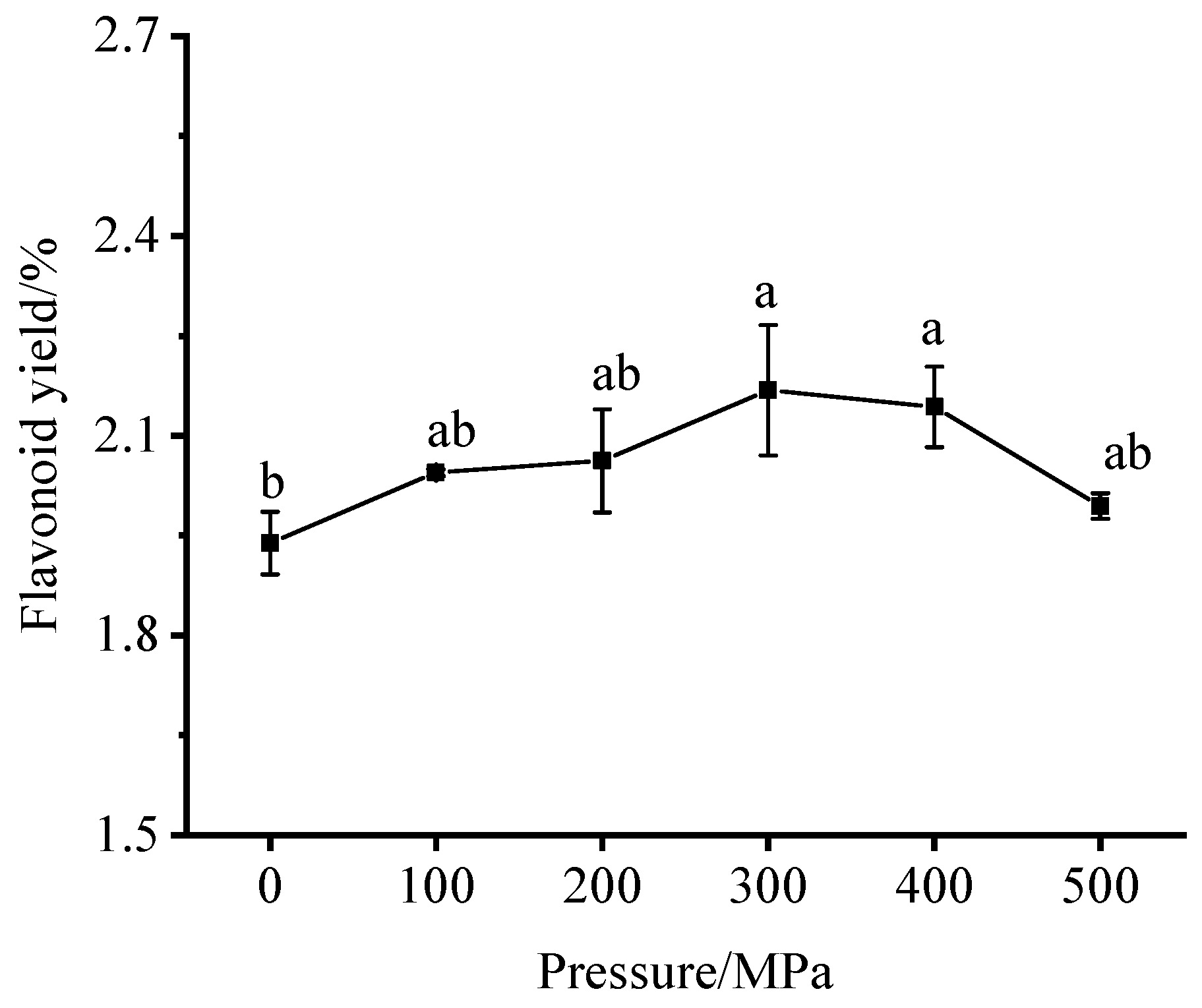
Figure 3. Effect of pressure on flavonoid yield during UHPE.
Separations 13 00020 g003
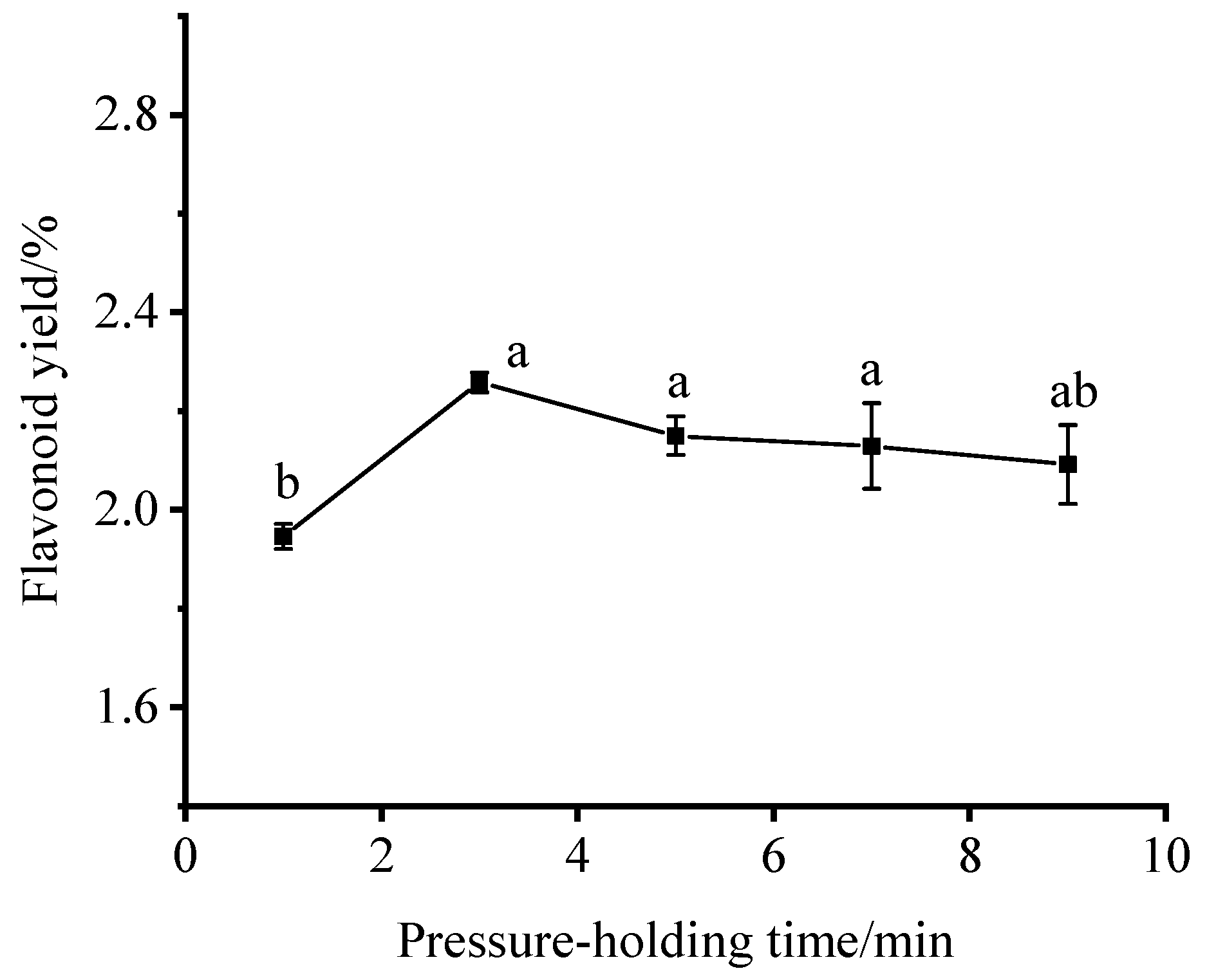
Figure 4. Effect of pressure-holding time on flavonoid yield during UHPE.
Separations 13 00020 g004

3.1.2. Effect of Solid–Liquid Ratio on Flavonoid Yield During UHPE

The solid-to-liquid ratio is another key factor affecting release rate and flavonoid recovery during the UHPE process. Figure 2 presents the different flavonoid yield results with different solid-to-liquid ratios from 1:30 g/mL to 1:70 g/mL with an ethanol concentration of 50%. The flavonoid yield increased from 1.80% to 2.08%. When the solid-to-liquid ratio is above 1:60 g/mL, the flavonoid yield was almost constant. The transfer of flavonoids from the guanxiang leaves to the liquid phase depends on the concentration difference between the two phases. Theoretically, increasing the liquid-to-solid ratio would drive more flavonoids to migrate from the solid to liquid phase, which is also associated with diffusion velocity during extraction. The effect of extraction time on the release rate is shown later. From the economic perspective, each process has its optimal solid-to-liquid ratio. The research by Chen et al. indicated that the optimal solid-to-liquid ratio is 1:12 g/mL for the extraction of anthocyanins from mulberry using UHPE [8]. This may be a result of the higher solubility of anthocyanins than flavonoids.

3.1.3. Effect of Pressure on Flavonoid Recovery

The pressure during UHPE is an important factor affecting the release of flavonoids, together with the yield and recovery rate. In this research, pressures from 100 MPa to 500 MPa were used. Figure 3 shows the flavonoid yield under different pressures. The maximum yield, 2.17%, was obtained when 300 MPa was used. Higher pressures resulted in the decline in flavonoid yield. The research by Yan et al. indicated that the optimal pressure for flavonoid extraction from sea buckthorn was 415 MPa [13]. Overall, the trend of the pressure effect on flavonoid release is consistent with this research. The sea buckthorn and guanxiang leaves belong to the shrub and tree, respectively. A possible reason for the pressure difference may be the structural differences between the raw materials and the hydrophobicity of the residues.

3.1.4. Effect of Pressure-Holding Time on Flavonoid Recovery

The extraction time is associated with pressure, ethanol concentration, the diameter of guanxiang leaves after disruption, and the diffusion rate from the solid phase to liquid phase during UHPE. Figure 4 shows the flavonoid yield during the pressure-holding process, with time ranging from 1 min to 9 min. The pressure-holding time is 3 min with the flavonoid yield of 2.21%. A decline in yield was observed when the holding time is over 3 min. This result indicated that the release and absorption of the liquid phase reached equilibrium at 3 min. Similar research was reported by Sun et al. for the extraction of flavonoids from hawthorn using UHPE, in which the optimal extraction time is 12 min [24]. The difference may be a result of the different characteristic properties of hawthorn and guanxiang leaves.

3.2. Process Optimization Using Response Surface

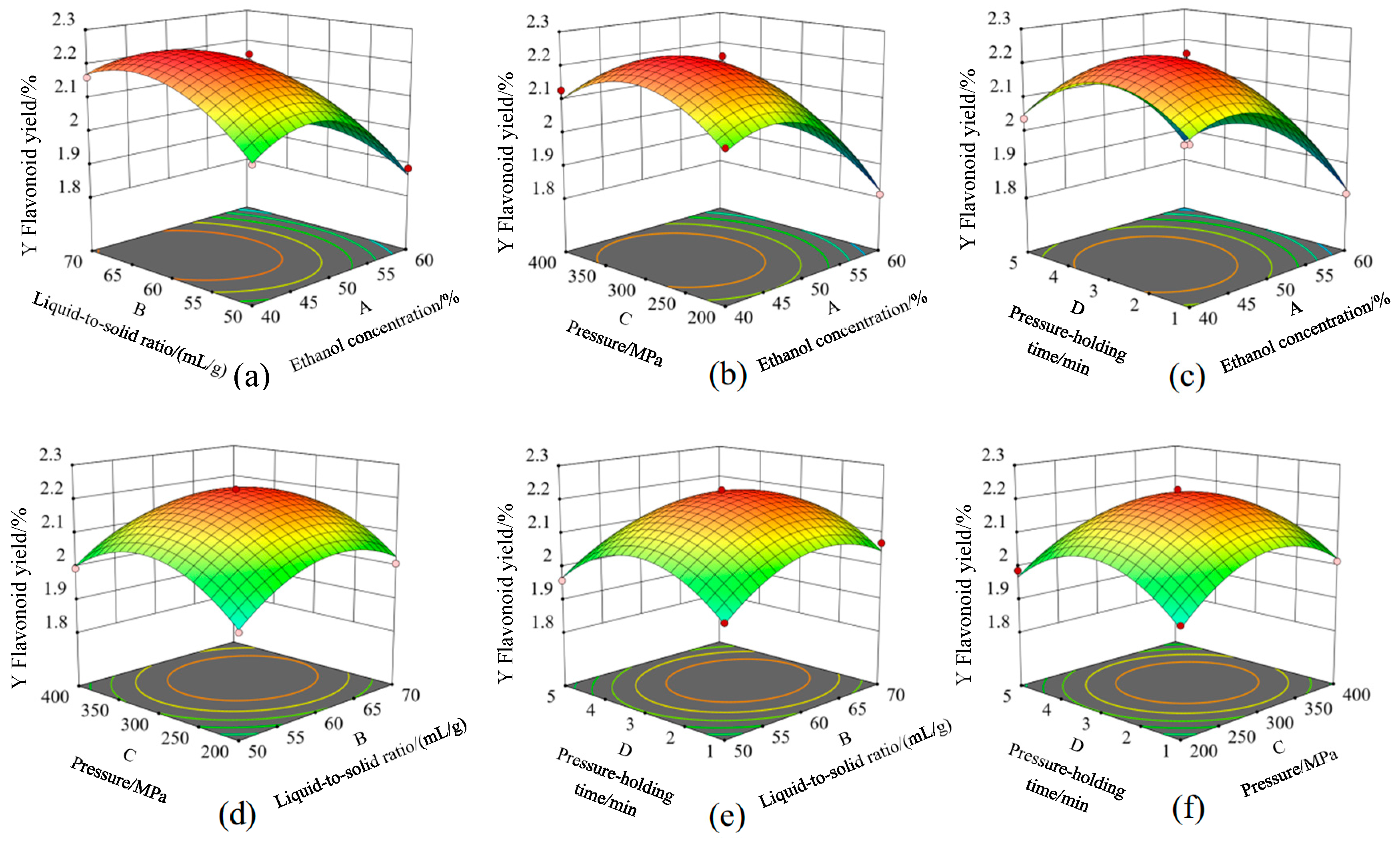
In accordance with the central combination principle of the Box–Benhnken methods, 27 groups of experiments with four factors and three levels were designed. The results are shown in Table 2. The analysis of variance is presented in Table 3. The regression equation of flavonoid yields (Y) was obtained as follows: Y = 2.21 − 0.1116A + 0.0412B + 0.028C − 0.0343AB − 0.1364A2 − 0.0913B2 − 0.1099C2 − 0.1196D2.
The model showed high significance (p < 0.0001), and the lack-of-fit F-value of 1.98 showed that the lack of fit was insignificant. The reasonable agreement between the predicted R2 of 0.9845 and the adjusted R2 of 0.9663 indicated a good agreement between the experimental and predicted flavonoid yields. At the same time, the value of the coefficient of variation (CV = 1.04%) was low, indicating a high degree of precision and the reliability of the experimental values. The smaller the p-value was, the more significant the corresponding linear term was. It can be seen from Table 3 that the linear terms A, B, C, AB, A2, B2, C2, and D2 were very significant, with very small p-values (p < 0.01).
Three-dimensional surface plots were used to visually represent the interaction between the different variables of ethanol concentration (A), solid-to-liquid ratio (B), pressure (C), and pressure-holding time (D) on the flavonoid yield of guanxiang leaves (Figure 5). The ANOVA (Table 3) of the regression model indicated that the interaction term between ethanol concentration and solid-to-liquid ratio was statistically significant (p < 0.05). This significant interaction effect is intuitively reflected in the response surface plot of Figure 5a, where the contour lines appear elliptical and the surface exhibits a steep parabolic shape. In contrast, the p-values for the other two-factor interaction terms were all greater than 0.05, indicating that they are statistically insignificant. The corresponding response surface plots for these interactions are shown in Figure 5b–f, which are consistent with the conclusions drawn from the ANOVA. This result indicated that the interaction effects of ethanol concentration and solid-to-liquid ratio should be considered in process optimization.
The extract conditions for flavonoid yields were optimized via RSM and were as follows: ethanol concentration of 48.45%, solid-to-liquid ratio of 1:62.73 g/mL, pressure of 311.38 MPa, and pressure-holding time of 2.91 min. The model also predicted the maximum flavonoid yield of 2.23%. Tests were performed in triplicate under the adjusted optimized conditions (50%, 1:60, 300 MPa, and 3 min) to confirm the above results. The flavonoid yield was 2.21%, Which matches the theoretical value, implying a high degree of fit between the value observed in the experiment and the value predicted by the regression model. Therefore, RSM could be applied to predict extraction conditions effectively.

3.3. Comparison of the Flavonoid Yields of Different Extraction Methods

The solvent extraction was carried out using the reference method and results were compared with those of the ultra-high-pressure extraction method. Experimental results showed that the flavonoid yield under optimal conditions was 2.21% with UHPE, compared to 1.94% with solvent extraction. ANOVA revealed a statistically significant difference (p < 0.01) between the two methods.

3.4. Antioxidant Capacity

Different extraction methods showed different antioxidant capacities. In the present work, the DPPH, ABTS, and ferric-reducing antioxidant activity (FRAP) were measured accordingly to estimate the antioxidant activity of guanxiang leaf extraction following different extraction methods.
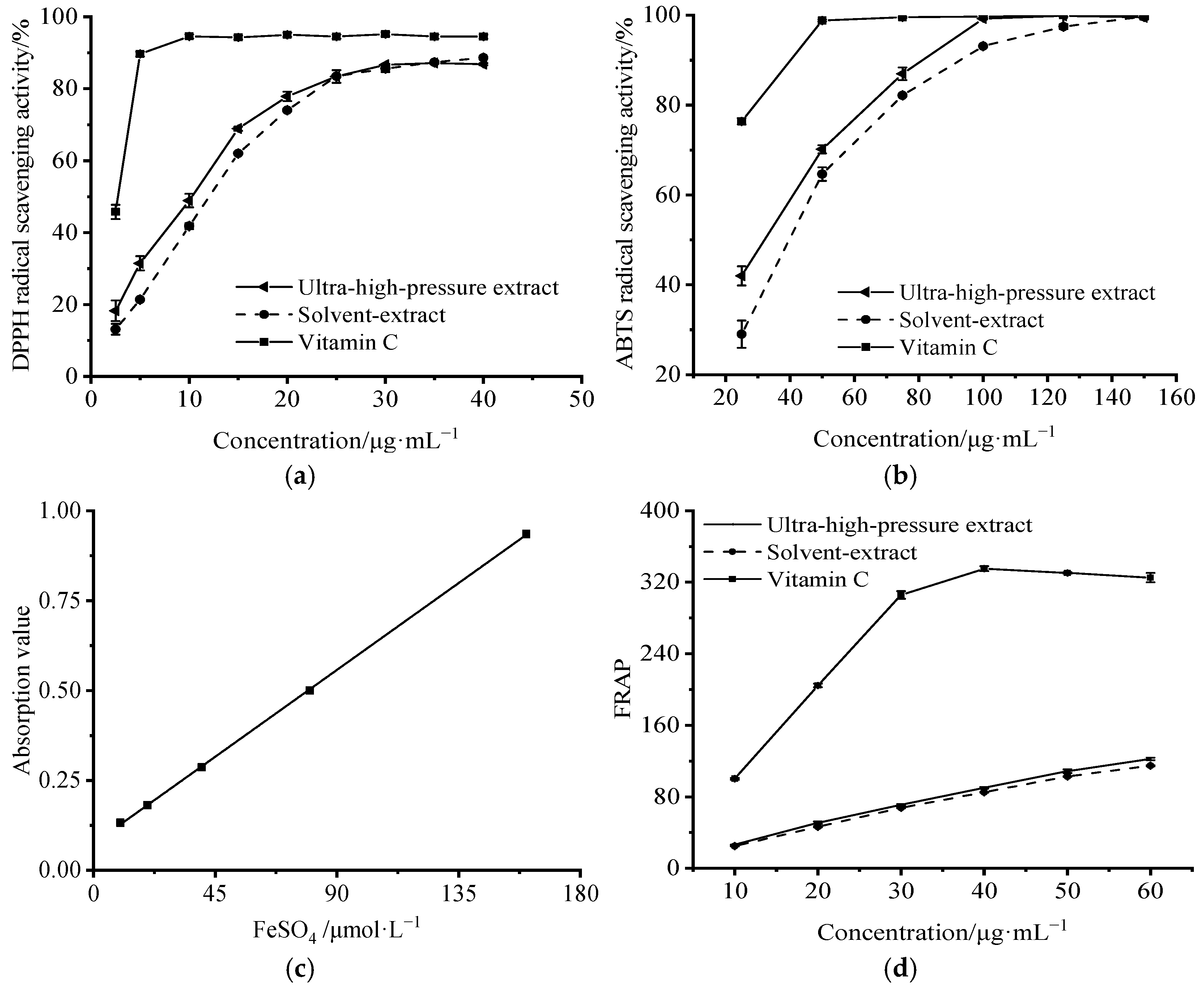
With the concentrations ranging from 0.25 to 25 μg·mL−1, the DPPH radical-scavenging rate of ultra-high-pressure extraction and solvent extraction rose, and the former was higher than the latter at the same concentration (Figure 6a). When the concentration exceeds 25 μg·mL−1, the scavenging rate tended to be unchanged. The IC50 of the ultra-high-pressure extract, solvent extract, and Vc were 11.87, 13.40, and 3.04 μg·mL−1, respectively. The results indicated that ultra-high-pressure extracts were better than solvent extracts in the scavenging of DPPH free radicals.
For the ABTS radical-scavenging activity, the scavenging activity of the ultra-high-pressure extracts was always better than that of the solvent extracts (Figure 6b). When the concentration was 75 μg·mL−1, the scavenging activity for ultra-high-pressure extracts, solvent extracts, and Vc were 86.94%, 82.18%, and 99.55%, respectively. The calculated IC50 values were 50.72, 54.29, and 6.77 μg·mL−1. This indicated that the ABTS radical-scavenging activity of the ultra-high-pressure extracts was higher than that of the solvent extracts.
The standard curve equation for FeSO4 is y = 0.0054x + 0.0739, with R2 = 0.9999 (Figure 6c). The sample also showed a dose-dependent effect on the iron-reducing power assay (Figure 6d). At the same concentration (30 μg·mL−1), the reducing power of iron ions in the ultra-high-pressure extracts, solvent extracts, and Vc were 71.08, 67.78, and 305.58, respectively. Three different in vitro antioxidant activity assays all confirmed that the antioxidant potential of the ultra-high-pressure extracts was higher than that of the solvent extracts.

3.5. LC-MS Analysis

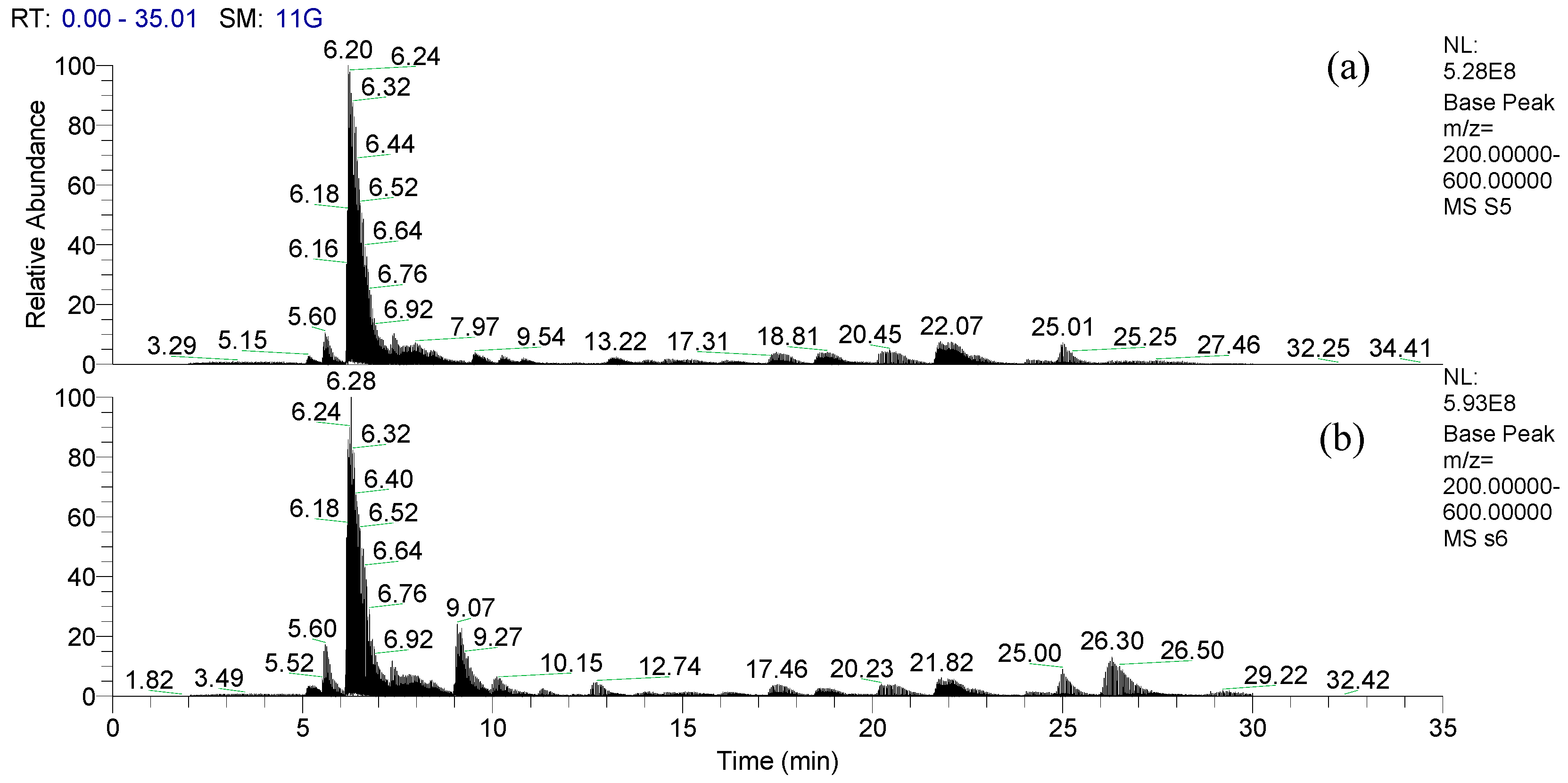
To compare the differences between the products extracted by the ultra-high-pressure and solvent extract methods, LC-MS was used to analyze the components of the respective extracts (Figure 7). The chromatograms of UHPE and solvent extraction exhibit distinct characteristics, indicating better preservation or selective extraction of certain compounds. Eleven flavonoids were putatively identified in two extracts through database matching using the Thermo Compound Discoverer 3.4 software, combined with MS/MS spectral analysis and a comparison with the relevant literature (Table 4 and Table 5). It was speculated that both extraction methods yielded mangiferin, vicenin-2, apigenin, diosmetin, glycitein, and 7,4′-Di-O-methylapigenin, which shows that these compounds were not significantly affected by the extraction method. Additionally, the six flavonoids common to both extracts (e.g., mangiferin and apigenin) represent core bioactive components in guanxiang leaves that are easily extracted, supporting their fundamental antioxidant effects [25]. Unique components found only in the ultra-high-pressure extracts included spiraeoside, scutellarin, luteolin, and nepetin. In contrast, the solvent extracts uniquely contained isovitexin (4), dracocephaloside, 5-Hydroxy-2-[2-hydroxy-3-[3,4,5-trihydroxy-6-(hydroxymethyl)oxan-2-yl]oxyphenyl]-7-methoxychromen-4-one, prunetrin, and kaempferol-7-O-glucoside. As is well known, the unique flavonoids produced by different extraction methods significantly influence biological activity. The distinct composition of each extract suggests that UHPE and solvent extraction may have specific functional advantages. For example, compounds unique to UHPE, such as luteolin and nepetin, have been confirmed to possess strong neuroprotective and anti-inflammatory activities [26]. In contrast, compounds unique to solvent extraction, such as kaempferol-7-O-glucoside, demonstrate notable antibacterial activity [27].
In conclusion, while both ultra-high-pressure extraction and solvent extraction can be applied to extract flavonoids from guanxiang leaves, the chemical composition of the resulting extracts exhibits notable differences and complementarity. These findings indicate that the choice of extraction method significantly affects the final chemical profile of guanxiang leaf extracts.

4. Conclusions

An environmentally friendly technology was applied for the first time in the extraction of flavonoids from guanxiang leaves. UHPE, a green extraction technology, not only improved the stability of flavonoid compounds during extraction but also enhanced the flavonoid yield of guanxiang leaves. The optimal UHPE conditions were as follows: ethanol concentration of 50%, solid-to-liquid ratio of 1:60, pressure of 300 MPa, and pressure-holding time of 3 min. The UHPE of guanxiang leaves possessed a strong scavenging capacity for DPPH and ABTS free radicals, as well as reducing power. Eleven flavonoid compounds were identified in the ultra-high-pressure extract and the solvent extract by HPLC-MS, respectively. The ultra-high-pressure extraction method can help to improve the flavonoid yield and antioxidant activity as well as to obtain special product types, including spiraeoside, scutellarin, luteolin, and nepetin, as compared to the solvent extraction method. Consequently, ultra-high-pressure extraction underscores the promise of guanxiang leaves as a source of natural antioxidants, establishing a foundational platform for their future utilization in food and medicinal products.

Author Contributions

Conceptualization, G.Z.; methodology, H.Y. and J.K.; software, J.Z. and L.L.; validation, J.Z.; formal analysis, G.Z.; investigation, J.Z.; resources, G.Z.; data curation, J.Z.; writing—original draft preparation, J.Z.; writing—review and editing, G.Z., Y.Z. (Yu Zhang), and Y.Z. (Yang Zhang); visualization, J.Z.; project administration, G.Z. and Z.G.; funding acquisition, Z.G. All authors have read and agreed to the published version of the manuscript.

Funding

This research was funded by the Beijing Life Science Academy (BLSA) (No:2024600CD0320) and the Beijing Natural Science Foundation (L234070).

Data Availability Statement

The original contributions presented in this study are included in the article. Further inquiries can be directed to the corresponding authors.

Conflicts of Interest

The authors declare no conflicts of interest.

Abbreviations

The following abbreviations are used in this manuscript:
UHPEUltra-high-pressure extraction
BBDBox–Behnken design
RSMResponse surface methodology
FRAPFerric-reducing antioxidant power
ANOVAAnalysis of variance

References

  1. Rauf, A.; Jehan, N. Natural Products as a Potential Enzyme Inhibitors from Medicinal Plants; IntechOpen Ltd.: London, UK, 2017; pp. 165–177. [Google Scholar]
  2. Aware, C.B.; Patil, D.N.; Suryawanshi, S.S.; Mali, P.R.; Rane, M.R.; Gurav, R.G.; Jadhav, J.P. Natural bioactive products as promising therapeutics: A review of natural product-based drug development. S. Afr. J. Bot. 2022, 151, 512–528. [Google Scholar] [CrossRef]
  3. Liga, S.; Paul, C.; Peter, F. Flavonoids: Overview of Biosynthesis, Biological Activity, and Current Extraction Techniques. Plants 2023, 12, 2732. [Google Scholar] [CrossRef]
  4. Jafari, S.M.; Mahdavee, K.K.; Assadpour, E. Production of a natural color through microwave-assisted extraction of saffron tepal’s anthocyanins. Food Sci. Nutr. 2019, 7, 1438–1445. [Google Scholar] [CrossRef]
  5. Sampatrao, D.; Manjare, K.D. Supercritical fluids in separation and purification: A review. Mater. Sci. Energy Technol. 2019, 2, 463–484. [Google Scholar] [CrossRef]
  6. Shin, J.; Ahn, S.; Choi, S.; Lee, D.; Kim, B. Ultrahigh pressure extraction (UHPE) of Ginsenosides from Korean panax sinseng powder. Food Sci. Biotechnol. 2010, 19, 743–748. [Google Scholar] [CrossRef]
  7. Chen, R.Z.; Jin, C.G.; Li, H.P.; Liu, Z.Q.; Lu, J.; Li, S.Z.; Yang, S.M. Ultrahigh pressure extraction of polysaccharides from Cordyceps militaris and evaluation of antioxidant activity. Sep. Purif. Technol. 2014, 134, 90–99. [Google Scholar] [CrossRef]
  8. Chen, Z.L.; Ma, J.; Li, P.; Wen, B.; Wang, Y.; Ma, Y.H.; Huang, W.Y. Preparation of hypoglycemic anthocyanins from mulberry (Fructus mori) fruits by ultrahigh pressure extraction. Innov. Food Sci. Emerg. Technol. 2023, 84, 103255. [Google Scholar] [CrossRef]
  9. Tang, L.Q.; Liu, H.C.; Wen, J.; Xu, Y.J.; Tian, W.N.; Li, L.; Yu, Y.S.; Lin, X.; Fu, M.Q. Study on ultrahigh-pressure extraction technology on properties of yellow extract from gardenia fruit. J. Food Compos. Anal. 2021, 104, 104186. [Google Scholar] [CrossRef]
  10. Lin, Y.H.; Huang, H.W.; Wang, C.Y. Effects of high pressure-assisted extraction on yield, antioxidant, antimicrobial, and anti-diabetic properties of chlorogenic acid and caffeine extracted from green coffee beans. Food Bioprocess Technol. 2022, 15, 1529–1538. [Google Scholar] [CrossRef]
  11. Zhao, J.M.; Su, T.T.; Sun, Q.Z.; Chen, F.L.; Jiang, Y.M.; Bi, Y.; Wei, J. Ultrahigh pressure enhances the extraction efficiency, antioxidant potential, and hypoglycemic activity of flavonoids from Chinese sea buckthorn leaves. LWT 2024, 207, 116671. [Google Scholar] [CrossRef]
  12. Zhang, S.N.; Yi, W.N.; Wang, Z.H.; Fu, C.; Fan, X.P.; Du, B.; Chen, L.N.; Lu, W.W.; Jiang, Z. Ultrahigh pressure extraction of polysaccharide from Morinda officinalis and effect on the polysaccharide structure. Sep. Sci. Technol. 2021, 56, 1741–1751. [Google Scholar] [CrossRef]
  13. Yan, Z.M.; Feng, X.P.; Li, X.N.; Guo, Z.P.; Wang, Z.L.; Ren, G.X.; Long, F.Y. Sea Buckthorn Flavonoid Extracted by High Hydrostatic Pressure Inhibited IgE-Stimulated Mast Cell Activation through the Mitogen-Activated Protein Kinase Signaling Pathway. Foods 2024, 13, 560. [Google Scholar] [CrossRef] [PubMed]
  14. Zhang, J.; Wang, Y.D.; Xue, Q.W.; Zhao, T.R.; Khan, A.; Wang, Y.F.; Liu, Y.P.; Cao, J.X.; Cheng, G.G. The effect of ultra-high pretreatment on free, esterified and insoluble-bound phenolics from mango leaves and their antioxidant and cytoprotective activities. Food Chem. 2022, 368, 130864. [Google Scholar] [CrossRef]
  15. Fu, C.C.; Huang, B.X.; Zhang, X.H.; Zhou, J.L.; Mao, S.Y.; Fan, T.P.; Zhang, J.H.; Wang, S.S.; Chen, M.X.; Zhu, F.Y. Biosynthesis and Medicinal Value of Flavonoids and Chromones in Agarwood. J. Agric. Food Chem. 2025, 73, 26. [Google Scholar] [CrossRef]
  16. Adam, A.Z.; Lee, S.Y.; Mohamed, R. Pharmacological properties of agarwood tea derived from Aquilaria (Thymelaeaceae) leaves: An emerging contemporary herbal drink. J. Herb. Med. 2017, 10, 37–44. [Google Scholar] [CrossRef]
  17. Zheng, D.; Li, X.M.; He, J.; Lei, J.D. Optimization of extraction process for total flavonoids from leaves of Aquilaria sinensis by response surface method and purification technology. Beijing Linye Daxue Xuebao 2017, 39, 104–110. [Google Scholar]
  18. Tian, Y.X. Study on the Preparation and Biological Activity of Tetrastigma hemsleyanum Flavone Extract Nanoparticles. Master’s Thesis, Zhejiang University, Hangzhou, China, 2024. [Google Scholar]
  19. Zhang, Z.J.; Tian, Y.L.; Xia, J.X.; Ma, A.J. Stractural characterization and antioxidant activity of walnut peptides. Shipin Kexue 2024, 45, 1–8. [Google Scholar]
  20. Chen, Z.L. Study on Ultra-High Pressure Extraction and Biological Activities of Anthocyanins from Blueberry Pomace. Master’s Thesis, Jiangsu University, Zhenjiang, China, 2022. [Google Scholar]
  21. Zhang, L.; Liu, P.Z.; Li, L.L.; Huang, Y.; Pu, Y.F.; Hou, X.J.; Song, L.J. Identification and Antioxidant Activity of flavonoids extracted from xinjiang jujube (Ziziphus jujube mill.) leaves with ultra-high pressure extraction technology. Molecules 2018, 24, 122. [Google Scholar] [CrossRef]
  22. Li, Q.; Qin, J.Y.; Liu, L.L.; Chen, X.Y. Extraction technology and functional activity of flavonoids from bitter wattle tea. Shipin Keji. 2025, 50, 214–222. [Google Scholar]
  23. Li, J.Y.; Huang, X.; Wu, M.Y.; Huang, Q.F.; Ni, S.Y.; Chen, L.L.; Wu, D.W.; Wang, W.B.; Lin, Z.L. Optimization of extraction process of flavonoids from leaves of Aquilaria sinensis by central composite design response surface methodology. Xiandai Shipin 2023, 29, 214–219. [Google Scholar]
  24. Sun, X.J.; Li, X.X.; Feng, Y.B.; Zhang, L.H. Optimization of extracting technique assisted by ultrahigh pressure extraction (UHPE) of flavonoids from hawthorn. Shipin Gongye Keji 2015, 36, 291–295+312. [Google Scholar]
  25. Khumpook, T.; Saenphet, S.; Tragoolpua, Y.; Saenphet, K. Anti-inflammatory and antioxidant activity of Thai mango (Mangifera indica Linn.) leaf extracts. Comp. Clin. Pathol. 2019, 28, 157–164. [Google Scholar] [CrossRef]
  26. Kempuraj, D.; Thangavel, D.; Kempuraj, D.D.; Ahmed, M.E.; Selvakumar, G.P.; Raikwar, S.P.; Zaheer, S.A.; Lyer, S.S.; Govindarajan, R.; Chandrasekaran, P.N. ChandraNeuroprotective effects of flavone luteolin in neuroinflammation and neurotrauma. BioFactors 2021, 47, 190–197. [Google Scholar] [CrossRef]
  27. Singh, D.; Sharma, S.K.; Rani, R.; Mishra, S.; Sharma, R.A. Kaempferol-7-O-glucoside and their antimicrobial screening isolate from Cassia renigera Wall. Int. J. Pharm. Clin. Res. 2011, 3, 30–34. [Google Scholar]
Figure 1. Effect of ethanol concentration on flavonoid yield during UHPE (different lowercase letters in the figure indicate significant differences (p < 0.05), as shown in Figure 2, Figure 3 and Figure 4).
Separations 13 00020 g001
Figure 5. The response surface diagram of the effects of the interaction between two factors on the flavonoid yield from guanxiang leaves. (a) ethanol concentration and liquid-to-solid ratio; (b) ethanol concentration and pressure; (c) ethanol concentration and pressure-holding time; (d) liquid-to-solid ratio and pressure; (e) liquid-to-solid ratio and pressure-holding time; and (f) pressure and pressure-holding time. In each 3D plot, the height (z-axis) and the corresponding color of the surface represent the predicted flavonoid yield (%). The color gradient transitions from red at the peaks (highest yield), through yellow on the slopes (intermediate yield), to green in the lower regions (lowest yield).
Separations 13 00020 g005
Figure 6. Determination of antioxidant activity. (a) DPPH radical-scavenging capacity; (b) ABTS radical-scavenging capacity; (c) FeSO4 standard curve; and (d) ferric-reducing antioxidant power.
Separations 13 00020 g006
Figure 7. LC-MS mass chromatogram of guanxiang leaves. (a) Ultra-high-pressure extraction; (b) solvent extraction.
Separations 13 00020 g007
Table 1. Factors and levels of response surface test.
CodeFactor
(A)
Ethanol Concentration
(%)
(B)
Solid-to-Liquid Ratio
(g/mL)
(C) Pressure
(Mpa)
(D)
Pressure-Holding Time
(min)
−1401:502001
0501:603003
1601:704005
Table 2. Box–Behnken scheme and results.
Number(A)
Ethanol Concentration
(B)
Solid-to-Liquid Ratio
(C)
Pressure
(D)
Pressure-Holding Time
Flavonoid Yield (%)
1401:5030032.02
2601:5030031.88
3401:7030032.16
4601:7030031.89
5501:6020011.95
6501:6040012.01
7501:6020051.99
8501:6040052.00
9401:6030012.07
10601:6030011.81
11401:6030052.04
12601:6030051.85
13501:5020031.93
14501:5020032.01
15501:5040031.99
16501:7040032.05
17401:6020032.06
18601:6020031.81
19401:6040032.13
20601:6040031.89
21501:5030011.95
22501:7030012.07
23501:5030051.96
24501:7030052.05
25501:6030032.20
26501:6030032.23
27501:6030032.20
Table 3. Analysis of variance (ANOVA) of the second-order polynomial model.
SourceSum of SquaresdfMean SquareF-Valuep-ValueSignificance
Model0.3342140.023954.28<0.0001**
A0.149510.1495339.96<0.0001**
B0.020310.020346.23<0.0001**
C0.009410.009421.430.0006**
D0.000010.00000.090.7711
AB0.004710.004710.710.0067**
AC0.000110.00010.140.7172
AD0.001310.00132.850.1170
BC0.000110.00010.200.6589
BD0.000210.00020.360.5601
CD0.000810.00081.750.2100
A20.099210.0992225.48<0.0001**
B20.044410.0444101.04<0.0001**
C20.064410.0644146.54<0.0001**
D20.076310.0763173.46<0.0001**
Residual0.0053120.0004
Lack of Fit0.0048100.00051.980.3813Not significant
Pure Error0.000520.0002
Cor Total0.339426
R2 = 0.9845 R2Adj = 0.9663
** indicates a highly significant effect (p < 0.01).
Table 4. Flavonoid composition of ultra-high-pressure extraction from guanxiang leaves.
NumberRT (min)Compounds[M+H]+ (m/z)Error/ppmMolecular Formula
16.25Mangiferin423.0919−0.63C19H18O11
26.27Vicenin-2595.16547−0.52C27H30O15
310.26Spiraeoside465.10280.07C21H20O12
410.90Scutellarin463.08730.32C21H18O12
513.18Luteolin287.05500.03C15H10O6
613.20Nepetin317.0656−0.09C16H12O7
715.66Apigenin271.0601−0.04C15H10O5
816.01Jaceosidin331.08130.30C17H14O7
916.03Diosmetin301.07070.25C16H12O6
1021.77Glycitein285.0757−0.34C16H12O5
1126.057,4′-Di-O-methylapigenin299.09137−0.10C17H14O5
Table 5. Flavonoid composition of solvent extraction from guanxiang leaves.
NumberRT (min)Compounds[M + H]+
(m/z)
Error/ppmMolecular Formula
16.24Mangiferin423.0920−0.40C19H18O11
26.26Vicenin-2595.1655−0.39C27H30O15
37.83Isovitexin(4)433.1127−0.44C21H20O10
48.22Dracocephaloside449.1077−0.25C21H20O11
58.745-Hydroxy-2-[2-hydroxy-3-[3,4,5-trihydroxy-6-(hydroxymethyl)oxan-2-yl]oxyphenyl]-7-methoxychromen-4-one463.1234−0.29C22H22O11
610.10Prunetrin447.1285−0.21C22H22O10
710.63Kaempferol-7-O-glucoside449.1076−0.45C21H20O11
815.57Apigenin271.0599−0.61C15H10O5
916.06Diosmetin301.0706−0.26C16H12O6
1022.06Glycitein285.0757−0.02C16H12O5
1125.957,4′-Di-O-methylapigenin299.0913−0.20C17H14O5
Disclaimer/Publisher’s Note: The statements, opinions and data contained in all publications are solely those of the individual author(s) and contributor(s) and not of MDPI and/or the editor(s). MDPI and/or the editor(s) disclaim responsibility for any injury to people or property resulting from any ideas, methods, instructions or products referred to in the content.