You are currently viewing a new version of our website. To view the old version click .
Separations
  • Article
  • Open Access

29 December 2025

Quantifying the Molecular Structural Effects on the Reaction Kinetics and Equilibrium Between Organic Amines and CO2: Insights from Theoretical Calculations


,
,
,
and
1
School of Chemical Engineering, East China University of Science and Technology, Shanghai 200237, China
2
International Joint Research Center of Green Energy Chemical Engineering, East China University of Science and Technology, Shanghai 200237, China
3
Ministry Key Laboratory of Oil and Gas Fine Chemicals, School of Chemical Engineering and Technology, Xinjiang University, Urumqi 830046, China
*
Authors to whom correspondence should be addressed.
Separations2026, 13(1), 16;https://doi.org/10.3390/separations13010016 
(registering DOI)

Abstract

Understanding how molecular structure governs the reactivity of organic amines with CO2 is essential for the rational design of next-generation carbon-capture solvents. In this work, three representative series of amines, including linear aliphatic, cyclic aliphatic, and aromatic, were systematically conducted with substituents at different positions, and their reaction rate constants and equilibrium constants with CO2 were calculated using transition state theory. A suite of electronic-structure and steric descriptors, including ALIE, Hirshfeld charge, Fukui functions, and ESP-derived parameters, was developed to quantify structure–reactivity relationships. Linear aliphatic amines were found to be most sensitive to steric hindrance, while cyclic and aromatic amines were predominantly governed by inductive and conjugation effects. Key descriptors such as N_ALIE and q(N) showed strong correlations with both kinetic and thermodynamic parameters, enabling quantitative interpretation of substituent effects. Notably, a positive linear correlation between ln(k) and ln(K) was observed across all amine classes, revealing an intrinsic coupling between reaction rate and equilibrium. These findings deepen the mechanistic understanding of CO2–amine chemistry and provide a theoretical foundation for the targeted design and optimization of high-performance CO2-capture solvents.

1. Introduction

The escalating environmental and economic risks posed by greenhouse effects have prompted countries worldwide to propose carbon-peaking and carbon-neutrality targets [1,2], accelerating low-carbon transitions across the industry, energy, and transportation [3,4]. Among the available greenhouse gas mitigation strategies, carbon capture, utilization, and storage (CCUS) is widely regarded as one of the most technically feasible and scalable approaches to achieve medium- and long-term deep CO2 reduction, owing to its high compatibility with existing fossil-energy systems [5,6]. CO2 capture is a crucial technology in the CCUS. Among various CO2 capture methods such as absorption, adsorption, and membrane separation [7,8,9], the chemical absorption process using recyclable solvents is currently the most mature and widely employed option in industrial fields such as flue gas treatment from coal-fired power plants, natural gas purification, hydrogen production, and methanol synthesis [10,11,12,13,14]. In parallel, adsorption-based capture has also advanced rapidly; recent DFT/DFTB studies on pillar [5] arenes show that CO2 is preferentially physisorbed in the cavity and that functional-group modification can significantly tune the adsorption configuration and strength [15,16].
Monoethanolamine (MEA) and diethanolamine (DEA), as commonly used industrial solvents for carbon capture [17,18,19], have proven to exhibit fast absorption rates in CO2 capture. However, they are limited by their relatively low absorption capacity, which necessitates an increase in the solution circulation rate during the absorption process, leading to higher energy consumption [16,18,20]. Therefore, the development of a new generation of CO2 absorbents that balance both absorption rate and capacity is a core challenge in driving the large-scale application of CCUS technologies. Existing studies [21,22,23,24] have explored the relationship between the molecular structure of amines and CO2 absorption performance, such as carbon chain length, the number of amine groups, and steric effects. Additionally, research [25,26] on the CO2 absorption performance of mixed solvents is ongoing. However, most of these studies are based on absorption kinetics, which have long experimental cycles and can only partially investigate the influence of molecular features with simple physical significance on absorption performance. These studies struggle to systematically analyze the impact mechanisms of structural differences on reaction parameters.
In recent years, the rapid advancement of data-driven methodologies has accelerated the application of machine learning (ML) in development of high-performance materials [27,28,29,30]. ML methods not only accelerate the discovery of new materials but also reveal structure-property relationships [31,32,33]. By learning from large-scale datasets, ML can accurately predict the properties of materials and solvents, playing a crucial role in enhancing experimental efficiency. Despite this progress, these ML models still heavily rely on general or empirical molecular descriptors—such as topological indices, functional group counts, or simple bulk physicochemical parameters—that can only roughly characterize molecular features. While they may achieve good fitting within specific datasets, they fail to capture the key physicochemical factors driving the amine–CO2 chemical reaction, resulting in weak model interpretability and limited extrapolation capabilities. As a result, they cannot provide reliable guidance for the rational molecular design of next-generation CO2 absorbents. Developing a descriptor framework that accurately captures local electronic density, nucleophilicity, steric effects, and their synergistic regulation of the active nitrogen center is crucial for elucidating the structure–reactivity relationships governing the amine–CO2 chemical reaction. Such a descriptor system will provide a new perspective for the development of traditional solvents, significantly enhance the interpretability of machine learning models, and offer a more reliable theoretical foundation for the rational design of high-performance CO2 capture solvents.
In this study, three categories of organic amines, linear aliphatic, cyclic aliphatic, and aromatic, were systematically constructed by introducing substituents at different molecular positions. Based on density functional theory (DFT) calculations, both reaction rate constants and equilibrium constants for the CO2–amine reactions were computed [28,30]. A set of molecular descriptors was then developed to quantitatively characterize the electronic distribution and steric effects of the amines, enabling a detailed examination of how these structural factors influence the interplay between reaction kinetics and thermodynamics. The results reveal that linear aliphatic amines exhibit a stronger sensitivity to steric hindrance than cyclic and aromatic amines, while both electronic and steric effects play decisive roles in modulating the reaction rate and equilibrium constant. Moreover, a positive correlation between kinetic and equilibrium parameters was identified across the CO2–amine reaction systems. These findings provide new mechanistic insights into structure–reactivity relationships in CO2–amine chemistry and establish a theoretical basis for the rational design of high-performance CO2 capture solvents. By optimizing electronic effects and spatial constraints, the efficiency of CO2 absorption reactions can be substantially improved, thereby supporting the development of more effective decarbonization technologies.

2. Methods

2.1. Construction of Three Organic Amine Molecules

In this study, building on previous research [27,28], three classes of organic amine systems were constructed by introducing various functional groups onto representative base molecules: linear aliphatic amines, cyclic aliphatic amines, and aromatic amines. Hexylamine, piperidine, and benzylamine were selected as the corresponding parent structures for these categories and are denoted as A, B, and C, respectively. The carbon atoms adjacent to the amine group were defined as the α, β, and γ positions based on their distance from the nitrogen atom. The total of 33 functional groups introduced at these positions is summarized in Table 1 and Table S1.
Table 1. The information and labels of basic functional groups added to the basic molecules.
Building on this structural framework, derivative compounds were generated by substituting functional groups at the α, β, and γ positions of each parent molecule. For example, the structure formed by attaching a methyl group to the α position of molecule A (hexylamine) is denoted as A-α-1. To facilitate understanding, the definitions of the α, β, and γ substitution positions for linear aliphatic, cyclic aliphatic, and aromatic amines are illustrated schematically in Figure S1.
We analyzed the surface electrostatic potential for each molecule to support the subsequent discussion. Representative surface electrostatic potential maps for several molecules are provided in Figure S2.

2.2. Calculation of Thermodynamic Energy

Quantum chemical calculations were performed using Gaussian 16 to obtain the thermodynamic parameters of all molecules involved in the reaction. To balance computational accuracy and efficiency, the geometric structures of the target molecules were first optimized at the B3LYP/6-311+G(d,p) level of theory to determine their stable conformations [27,28,29,30,34]. Harmonic vibrational frequency analyses were subsequently conducted to confirm the absence of imaginary frequencies and to compute zero-point energies (ZPE) and other thermodynamic corrections. Vibrational frequency calculations allow the ZPE as well as the correction terms for G, H and U to be directly obtained from the corresponding output files.
Single-point energy calculations were then carried out on the optimized geometries using the M06-2X/def2-TZVP level of theory to achieve higher accuracy in electronic energies [27,28,29,30]. All calculations employed an implicit solvation model (water as the solvent) and were performed under standard conditions of 298.15 K and 1 atm. ZPE were corrected using a scaling factor γ of 0.977, as recommended in previous studies [35,36].
The final thermodynamic quantities were obtained using Equations (1)–(3), and the reaction equilibrium constants were calculated according to Equation (4).
G = E e + ( γ 1 )   ·   ZPE +   G corr
H = E e + ( γ 1 )   ·   ZPE +   H corr
U =   E e + ( γ 1 )   ·   ZPE + U corr
where G represents the Gibbs free energy of the system, H is the enthalpy, and U is the internal energy. Gcorr, Hcorr, and Ucorr correspond to the thermodynamic correction terms for the Gibbs free energy, enthalpy, and internal energy, respectively. Ee is the electronic energy, ZPE is the zero-point energy, and γ is the zero-point energy correction factor. They are all in kJ/mol.
Δ G r = G Production   G Reactants   = R   ·   T   ·   ln   K eq ,   C O 2
where ΔGr represents the Gibbs free energy change in the reaction, measured in kJ/mol; GProduction is the Gibbs free energy of the product; and GReactants is the Gibbs free energy of the reactants. In this study, GReactants represents the sum of the Gibbs free energies of the individual reactants, where the amine and CO2 molecules were optimized and evaluated separately as isolated species. They are all in kJ/mol.

2.3. Search for Transition State

The reaction between amine groups and CO2 typically follows a zwitterionic mechanism and can be divided into two main steps [37,38]. In the first step, the nitrogen atom in the amine group performs a nucleophilic attack on the carbon atom of CO2, generating a zwitterionic intermediate, as shown in Equation (5). In the second step, the zwitterionic compound undergoes a deprotonation reaction with another amine molecule or a water molecule to form the final product, as shown in Equation (6). The transition state is located using the Berny optimization algorithm, and the reliability of the obtained transition state is verified through intrinsic reaction coordinate (IRC) analysis.
AmineH + C O 2 k A Amine H + C O 2
Amine H + C O 2 + Amine / H 2 O k B AmineCO 2 + Amine H + / H 3 + O

2.4. Calculation of Reaction Rate Constant

Based on transition state theory (TST) [39], the rate constant k for the reaction between the amine group and CO2 can be calculated using Equation (7). The reaction energy barrier ΔE is given by Equation (8).
k   = β   k B   T h   ( R   T P 0 ) n 1   e Δ E k B   T
where k is the reaction rate constant, in mol−1·s−1; kB is the Boltzmann constant, in J/K; h is Planck’s constant, in J·s; R is the gas constant, in J/(mol·K); P0 is the standard pressure, in kPa; β is the symmetry number of the reaction pathway; n is the number of molecules involved in the reaction; and ΔE is the reaction energy barrier, in kJ/mol.
Δ E =   G Transition G Reactants
where GTransition is the Gibbs free energy of the transition state structure; GReactants is the Gibbs free energy of the reactants. They are all in kJ/mol.

2.5. Definition of Quantitative Descriptors

A set of quantitative descriptors has been defined to analyze the intrinsic factors affecting the reaction rate between amines and CO2. Among these, the chemical descriptor steric hindrance index (SHI) is defined in Equation (9) to characterize the steric hindrance effect caused by substituents. For the calculation details of the van der Waals volumes of different functional groups, please refer to previous literature [40]. The relevant results are provided in Table S2.
SHI = V r
where V is the van der Waals volume of substituents located at the α, β, and γ positions, in Å3; r is a distance factor that reflects the effect of different positions on the steric hindrance of the amine group. The r value at position α is 0.5, the r value at position β is 3, and the r value at position γ is 10.
In previous studies [41,42,43,44,45,46] on electrophilic reactions, researchers have attempted to predict reaction sites and activity by correlating reaction rates with quantum-computed descriptors of electrostatic potential and electron density. Additionally, a series of quantitative descriptors related to the local electronic properties of amine groups was calculated using Multiwfn software (Version 3.8). For electrostatic potential (ESP) analysis, calculations were performed by loading .fchk files, and a visualization file containing molecular ESP data was generated. Using VMD software (Version 1.9.3), the negative ESP extreme value on the amine nitrogen atom was determined as N_ESP. For the two hydrogen atoms of the amine group, the smaller positive ESP value is defined as H1_ESP, and the larger one is defined as H2_ESP, with all ESP values expressed in atomic units. For B-series molecules with secondary amine groups, only H1_ESP is discussed.
Conceptual density functional theory (CDFT) allows the calculation of various descriptors that define the electronic distribution or charge characteristics of molecules. These include global metrics (such as hardness and softness), real space functions (such as Fock functions and dual descriptors), and atomic metrics (such as condensed Fock functions and condensed dual descriptors). In this study, a series of descriptors based on average local ionization energy (ALIE), Hirshfeld charge, and Fukui function were calculated, and their correlation with the reaction rate constant of CO2 was analyzed. Detailed information on these descriptors is provided in Table S3.

3. Results and Discussion

3.1. Effect of Functional Groups on the CO2–Amine Reaction

3.1.1. Linear Aliphatic Amines

Previous studies [27,28,29] demonstrated that the activation energy of the initial step in the CO2–amine reaction is higher than that of the subsequent proton-transfer step, confirming it as the rate-determining step. Because both reaction rate and equilibrium behavior are governed by this step, this work focuses on calculating its rate and equilibrium constants. The reactivity of organic amines toward CO2 is strongly structure-dependent. For linear aliphatic amines, the type and position of substituents substantially alter the electron distribution and steric environment around the amine group. Accordingly, the reaction of hexylamine (A) with CO2 was chosen as the reference system. The effects of different functional groups and substitution positions were quantified using the relative rate index (RRI) and the calculated equilibrium constant. RRI is defined as the ratio of the CO2 reaction rate constant of a given molecule to that of molecule A, with detailed data summarized in Table S4. Owing to molecular stability, the nitro group (No. 24) could not be introduced into linear aliphatic amines.
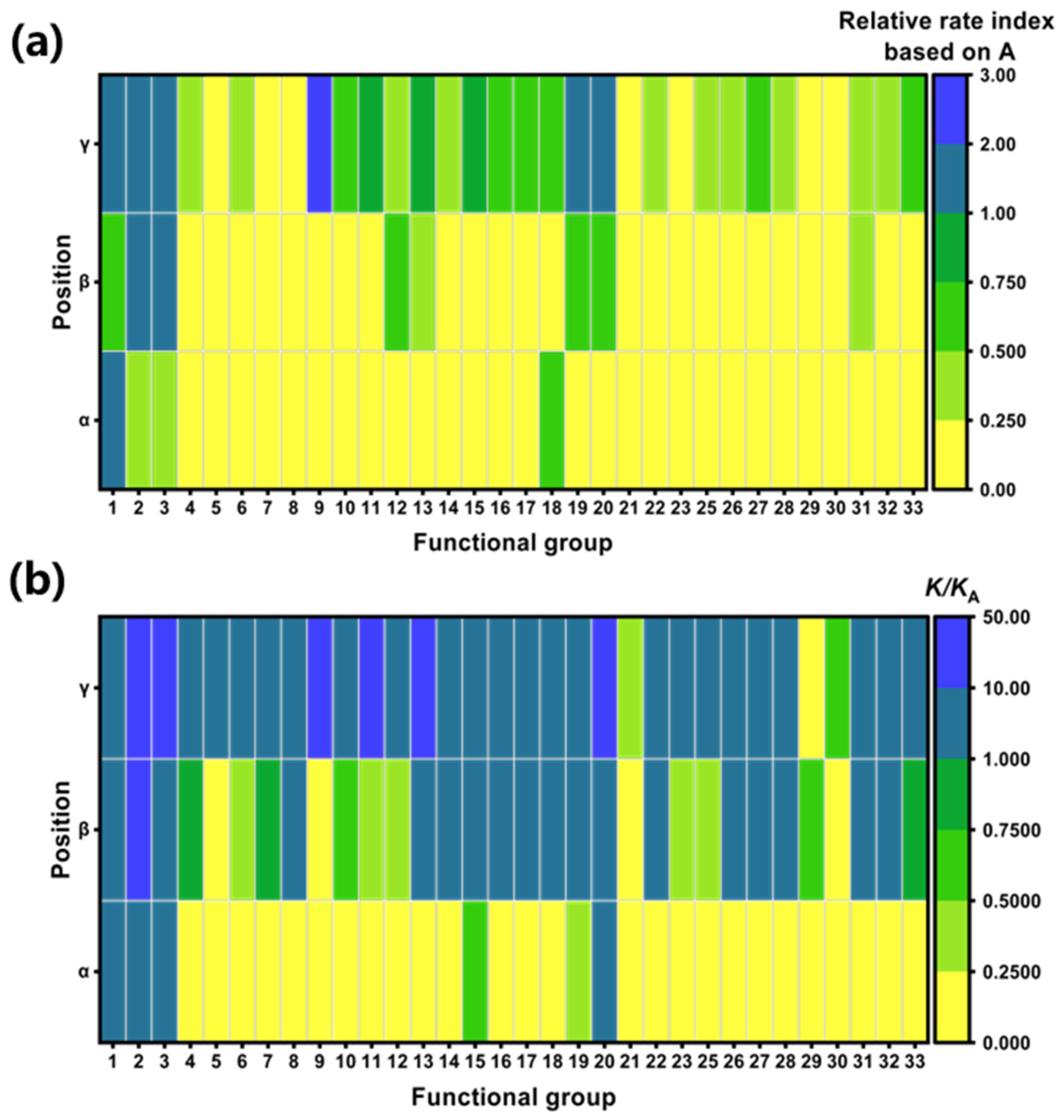
Figure 1a shows the RRI values for organic amines bearing different functional groups in reactions with CO2. The results indicate that both functional-group type and substitution position markedly affect the rate constant. At the α position, most substituents inhibit the reaction, except methyl (No. 1), which enhances it. At the β position, substituents show weaker inhibition than at α, while ethyl (No. 2) and propyl (No. 3) notably promote the reaction. Substitution at the γ position has only a minor effect; however, methyl (No. 1), ethyl (No. 2), propyl (No. 3), acyl chloride (No. 9), secondary amine (No. 19) and tertiary amine (No. 20) groups at γ significantly increase the reaction rate. These trends agree with previous findings that steric hindrance around the amine group is a key factor controlling the reaction rate [28]. In linear amines, steric hindrance is greatest near the reactive nitrogen center, where bulky α-substituents hinder CO2 approach and increase the activation barrier. Accordingly, functional groups with large van der Waals volumes, especially at the α position, cause stronger rate inhibition. As the substitution site shifts from β to γ, steric effects diminish, leading to higher reaction rates.
Figure 1. (a) Relative rate index (RRI) and (b) reaction equilibrium constant ratio (K/KA) of linear aliphatic amine molecules.
Figure 1b shows the equilibrium-constant ratio (K/KA) for organic amines bearing different functional groups reacting with CO2, where KA is the equilibrium constant of hexylamine. Values of K/KA > 1 indicate that the substituent shifts the equilibrium toward product formation, reflecting a promoting effect. This normalized metric enables direct comparison of substituent type and substitution position on the reaction equilibrium. Consistent with the trends in the rate constant, most α-substituents decrease the equilibrium constant, indicating inhibition of product formation. Only a few groups, including small alkyl substituents (methyl, ethyl, propyl) and tertiary amine groups (No. 20), substantially increase K/KA. This suggests that bulky α-substituents impose steric hindrance near the reactive nitrogen center, limiting CO2 approach and stabilization of the zwitterionic intermediate, thereby lowering the equilibrium constant.
In contrast, most β- and γ-substituents markedly increase K/KA, suggesting enhanced nucleophilic addition of the amine to CO2. Because these substituents are farther from the nitrogen atom, steric hindrance is reduced, enabling more favorable interaction between CO2 and the amine lone pair and shifting the equilibrium toward the carbamate product. It is noteworthy that the acyl chloride group (No. 9) gives the largest enhancement of the equilibrium constant when installed at the γ position (K/KA = 40.68). This promotion is unlikely to arise from increased nucleophilicity of the amine nitrogen, because electron withdrawal generally decreases the electron density on N and should disfavor the initial nucleophilic attack on CO2. Instead, we attribute the γ-substitution effect to two competing factors: (i) through-bond inductive withdrawal from –C(=O)Cl is strongly attenuated at the γ position, so N-centered nucleophilicity is only weakly perturbed; (ii) the highly polar –C(=O)Cl moiety can still provide through-space electrostatic (field/dipolar) stabilization and/or intramolecular noncovalent stabilization of zwitterion-like intermediates/transition states and ionic products along the CO2 addition pathway. Consistent with this interpretation, the computed activation energies decrease monotonically from α to β to γ substitution (ΔE = 199.65, 179.40, and 163.80 kJ/mol, respectively; Table S4), indicating that γ substitution facilitates the product-forming pathway and shifts the equilibrium toward carbamate formation, leading to the increased K/KA. In contrast, when the acyl chloride group is at the α or β positions, the promoting effect is diminished and can become inhibitory. At α, close proximity causes pronounced steric congestion that impedes CO2 approach and destabilizes reactive conformations, consistent with the highest ΔE. At β, steric hindrance is less severe; however, the inductive electron-withdrawing effect is stronger than at γ and more noticeably reduces nitrogen nucleophilicity, weakening the CO2–amine interaction and decreasing the equilibrium constant. Overall, the influence of the acyl chloride group reflects a balance between positional steric effects and distance-dependent inductive effects: at γ, minimal steric penalty combined with stabilization of charge-separated species yields net enhancement, whereas at α/β the steric and nucleophilicity penalties dominate and suppress CO2 absorption.

3.1.2. Cyclic Aliphatic Amines

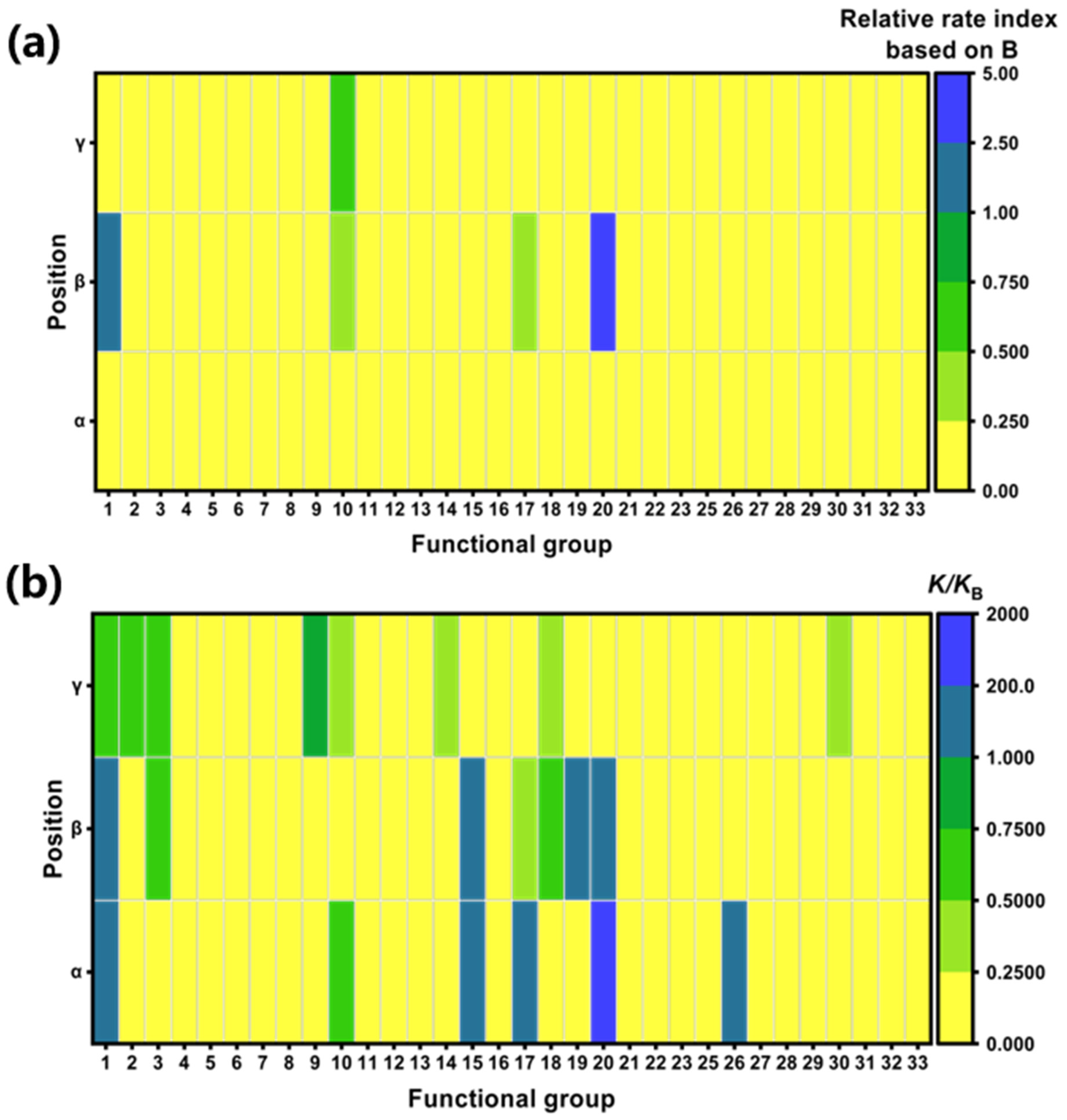
Using the CO2–piperidine (B) reaction as the reference system, RRI values and equilibrium-constant ratios (K/KB) were calculated for each substituted derivative. The results are shown in Figure 2a,b, with detailed data in Table S5. Because of the constraints of the cyclic framework, several substituents, including peroxide groups (No. 16), azo groups (No. 22), and disulfide bonds (No. 32), can be introduced only at specific positions on piperidine. Owing to molecular stability, the nitro group (No. 24) could not be introduced into cyclic aliphatic amines.
Figure 2. (a) Relative rate index (RRI) and (b) reaction equilibrium constant ratio (K/KB) of cyclic aliphatic amine molecules.
Figure 2a shows that most substituents inhibit the reaction rate of piperidine with CO2. Bulky groups or strongly electron-withdrawing substituents reduce piperidine nucleophilicity via steric hindrance or electronic depletion, thereby lowering the rate. α-Substituents impose substantial steric hindrance around the nitrogen center, restricting CO2 approach and increasing the activation energy, which reduces the reaction rate. For β-substituents, electronic effects are more dominant: electron-withdrawing groups decrease electron density on nitrogen, weakening nucleophilicity and further suppressing reactivity toward CO2. However, when located at the β position, the methyl (No. 1) and tertiary amine (No. 20) groups markedly enhance the reaction rate. Methyl increases electron density on the nitrogen via its electron-donating inductive effect, improving nucleophilicity, facilitating CO2 approach, and accelerating the reaction. Similarly, the tertiary amine substituent is strongly electron-donating and introduces relatively little steric hindrance due to its spatial orientation and structural stability, strengthening the CO2–piperidine interaction and increasing the rate. These results show that substituent position and electronic characteristics decisively govern piperidine reactivity toward CO2: electron-donating β substituents promote the rate by enhancing nucleophilicity while minimizing steric interference.
Figure 2b presents the K/KB results. Overall, most substituents decrease the equilibrium constant of the CO2–piperidine reaction. However, several α-substituents, including methyl (No. 1), ether (No. 15), furanyl (No. 17), tertiary amine (No. 20), and pyridyl (No. 26) groups, show a promoting effect, with the tertiary amine giving the strongest enhancement (K/KB = 1886.30). Owing to its electron-donating character, the tertiary amine group increases nucleophilicity at the nitrogen center, strengthening interaction with CO2 and shifting the equilibrium toward products. Ether and furanyl groups, although weaker inductive effects, can also increase K/KB by moderately reducing steric hindrance or increasing local polarity, facilitating CO2 addition. At the β position, methyl (No. 1), ether (No. 15), secondary amine (No. 19), and tertiary amine (No. 20) groups also contribute positively by increasing nitrogen electron density, thereby increasing both the reaction rate and equilibrium constant. These results indicate that electron-donating β substituents are particularly important for promoting CO2 absorption, with secondary and tertiary amine groups showing the largest enhancement.

3.1.3. Aromatic Amines

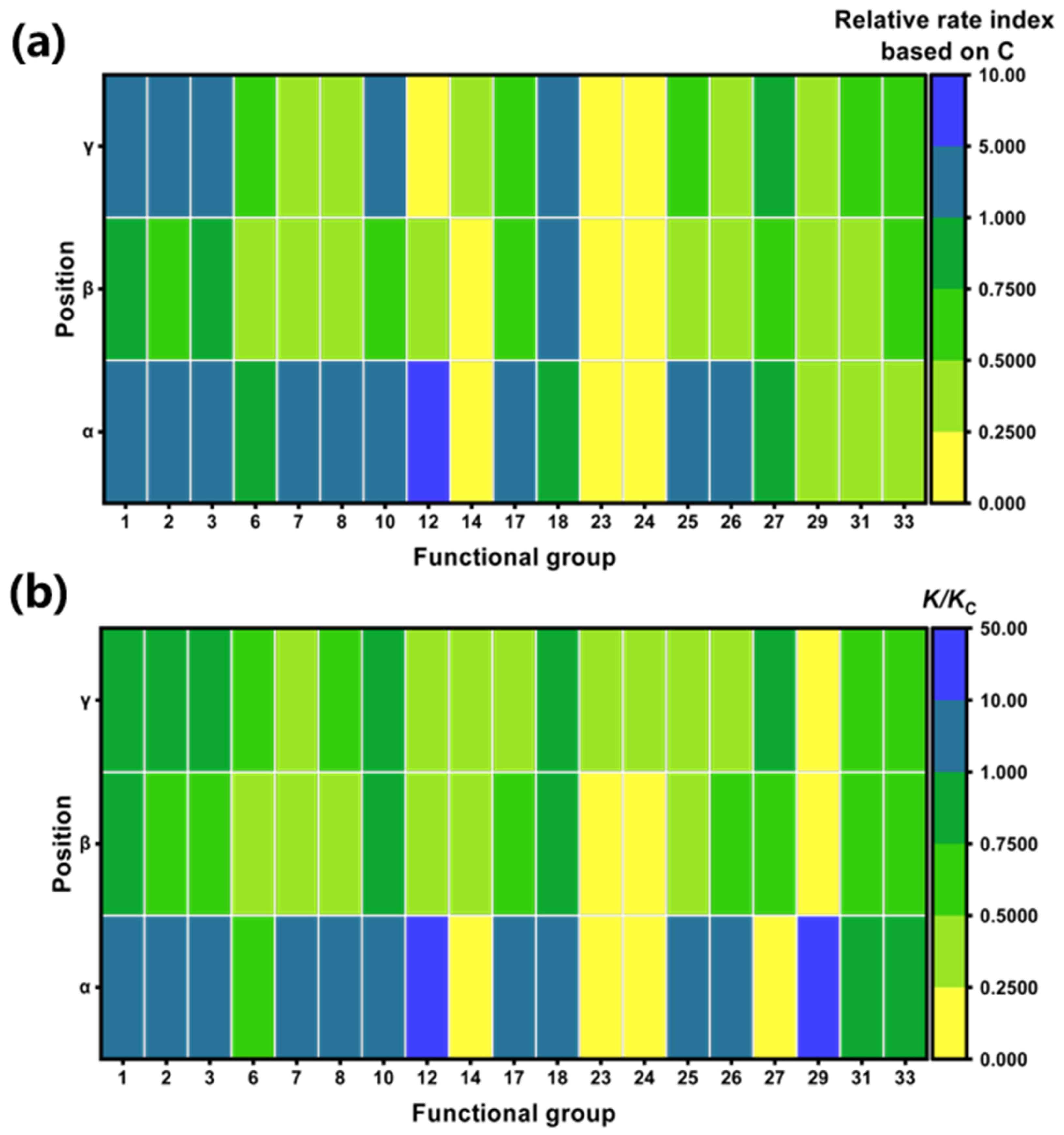
Using the CO2–benzylamine (C) reaction as the reference system, RRI values and equilibrium-constant ratios (K/KC) were calculated for each substituted derivative. Because of the benzene ring structure and molecular stability, several groups could not be incorporated, including the double bond (No. 4), triple bond (No. 5), acyl chloride (No. 9), carbonyl (No. 11), ester (No. 13), ether (No. 15), peroxy (No. 16), secondary amine (No. 19), tertiary amine (No. 20), amylenes (No. 21), azo (No. 22), sulfuric ether (No. 28), sulfinyl (No. 30), and thiophenyl (No. 32) groups. The results are shown in Figure 3a,b, with detailed data in Table S6.
Figure 3. (a) Relative rate index (RRI) and (b) reaction equilibrium constant ratio (K/KC) of aromatic amine molecules.
Figure 3a displays the RRI values. Unlike linear and cyclic aliphatic amines, most α-substituents on benzylamine show a pronounced promoting effect on the reaction rate, indicating that α-position modification strongly enhances reactivity. At the β and γ positions, fewer substituents increase the rate, indicating a strong positional dependence. At the α position, small alkyl groups (methyl, No. 1; ethyl, No. 2; propyl, No. 3) and halogens (chlorine, No. 7; bromine, No. 8) significantly enhance the rate. Polar groups such as hydroxyl (No. 10), carbonyl (No. 12), and furanyl (No. 17) groups also accelerate CO2 addition by increasing nitrogen nucleophilicity. Primary amine (No. 18), pyrrolyl (No. 25) and pyridyl (No. 26) groups likewise show strong rate enhancement. Overall, electron-donating and polarity-enhancing α-substituents play a dominant role in promoting the CO2–benzylamine reaction. At the β position, only the primary amine group (No. 18) shows a pronounced promoting effect, indicating that the reaction is still strongly governed by electronic factors despite modest steric hindrance at this site. At the γ position, several substituents—alkyl groups (methyl, No. 1; ethyl, No. 2; propyl, No. 3), hydroxyl (No. 10), and primary amine (No. 18) groups—also enhance the reaction rate. These groups likely increase nitrogen nucleophilicity through electron-donating or polarity-enhancing effects, while the distant γ position minimizes steric constraints, leading to higher rates.
From Figure 3b, most α-substituents markedly increase the reaction equilibrium constant, with effects much stronger than those at the β or γ positions. This indicates that α substitution generally shifts the equilibrium toward product formation, either by enhancing amine nucleophilicity or by lowering the reaction energy barrier via favorable electronic interactions. Beyond the groups noted above (methyl, ethyl, propyl, chlorine, bromine, furanyl, primary amine, pyrrole and pyridyl groups etc.), hydroxyl (No. 10), aldehyde (No. 12) and sulfonic acid (No. 29) also have a positive effect on the reaction equilibrium constant.
In contrast, β- and γ-substituents have a much weaker promoting effect on the equilibrium constant. At the β position, only a few groups, such as the primary amine substituent, show a noticeable enhancement. This suggests that although β- and γ-substituents may slightly reduce steric hindrance, their overall ability to increase the equilibrium constant is limited. The reduced impact indicates that electronic effects from these more distant positions are insufficient to substantially change nitrogen nucleophilicity or stabilize the product-forming pathway.

3.2. Quantitative Molecular Descriptors Governing the Reactivity of Organic Amines with CO2

3.2.1. Linear Aliphatic Amines

Reactivity-based descriptors such as regioselectivity, electrophilicity, and nucleophilicity are widely used to predict reactive sites. DFT-derived descriptors, including the Fukui function, Hirshfeld charge, and average local ionization energy (ALIE), have been extensively applied to quantitatively analyze electrophilic reactions in aromatic systems and olefins. Here, we used electron-distribution descriptors to examine quantitative relationships between molecular features of organic amines and their reactivity toward CO2, including ESP values at the amine group, ALIE values of the nitrogen atom, and correlation parameters based on Hirshfeld charges and Fukui functions, to assess how electronic and spatial characteristics affect both the reaction rate and equilibrium constant.
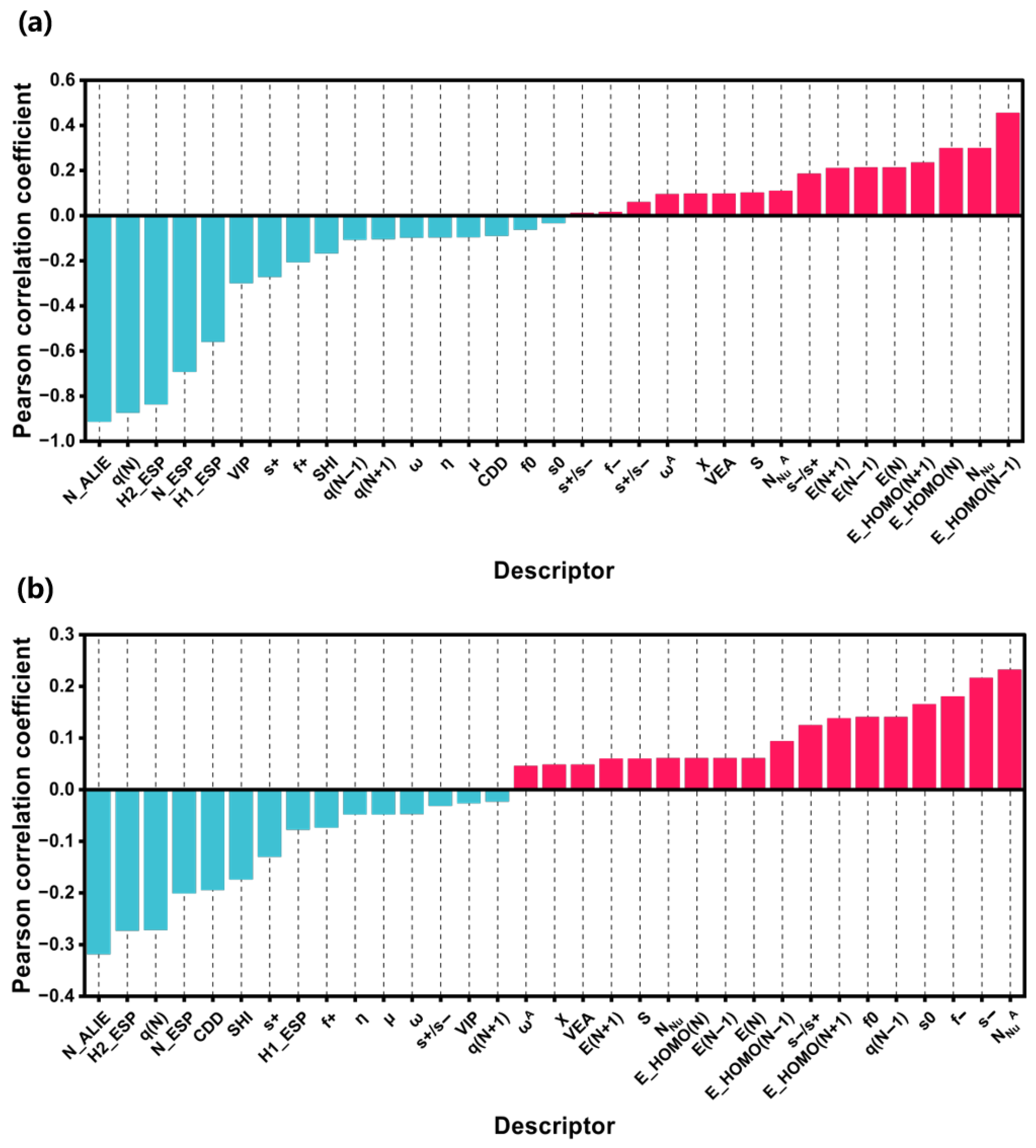
Figure 4a shows the quantitative correlations between the molecular descriptors and ln(k) for linear aliphatic amines, with numerical results in Table S7. Among the descriptors, the N_ALIE value at the amine nitrogen shows the strongest correlation with ln(k), giving a pronounced negative correlation (r = −0.91). This indicates that lower N_ALIE corresponds to a more delocalized electron cloud around nitrogen, enhancing nucleophilicity and facilitating nucleophilic attack on CO2, thereby increasing the reaction rate. Conversely, higher N_ALIE implies greater electron localization at nitrogen, reducing reactivity and decreasing the rate constant. Additionally, the Hirshfeld charge of the amine nitrogen, q(N), shows a strong negative correlation with ln(k) (r = −0.87). A more negative q(N) indicates higher electron density on nitrogen, enhancing nucleophilicity and facilitating interaction with CO2. As q(N) becomes more negative, the nitrogen center becomes more nucleophilic, accelerating the reaction and increasing the rate constants.
Figure 4. Pearson correlation coefficients between (a) ln(k), (b) K, and various molecular descriptors of linear aliphatic amines.
Figure 4b shows the correlations between the molecular descriptors and the equilibrium constant (K) for linear aliphatic amine reactions, with data summarized in Table S8. Among the descriptors, N_ALIE shows the strongest correlation with K, giving a negative correlation (r = −0.32). Although weaker than that for ln(k), this still indicates that lower N_ALIE—reflecting greater electron-cloud delocalization at the nitrogen center—enhances the CO2–amine interaction and shifts the equilibrium toward product formation. Thus, N_ALIE plays a non-negligible role in K, likely by facilitating initial binding between the amine group and CO2: a smaller N_ALIE implies a more loosely distributed nitrogen electron cloud, increased nucleophilicity, and a product-side shift in the equilibrium.
The descriptors N_ALIE, H2_ESP and q(N) are central for quantifying relationships among electron distribution, reaction rate, and equilibrium. The strong negative correlation between N_ALIE and ln(k) indicates that smaller N_ALIE values, reflecting greater electron delocalization at the nitrogen center, enhance nucleophilicity and increase the reaction rate. Although the negative correlation between N_ALIE and the equilibrium constant K is weaker, it still reflects the contribution of nitrogen electron distribution to shifting the equilibrium toward carbamate formation. The Hirshfeld charge q(N) supports this trend: more negative q(N) indicates higher electron density on nitrogen, strengthening nucleophilicity and increasing both the reaction rate and equilibrium constant. Together, N_ALIE and q(N) indicate that electron distribution at the amine nitrogen is a key determinant of CO2–amine reactivity. Additionally, H2_ESP represents the electron density around the hydrogen atom. The more negative the value, the lower the electron density, which has a positive effect on the reaction equilibrium.

3.2.2. Cyclic Aliphatic Amines and Aromatic Amines

The influence of substituents on cyclic aliphatic and aromatic amines is generally weaker than that on linear aliphatic amines. This reduced sensitivity arises from the rigidity of cyclic and aromatic frameworks, which limits conformational flexibility and mitigates steric interactions between substituents and the reactive nitrogen center. Consequently, reactivity variations in these systems are governed mainly by inductive and conjugation effects rather than steric contributions. These electronic effects alter electron-density distribution at the amine nitrogen, thereby changing its nucleophilicity and its interaction with CO2. As a result, inductive and conjugation effects play decisive roles in determining both the reaction rate and the equilibrium constant in cyclic and aromatic amines.
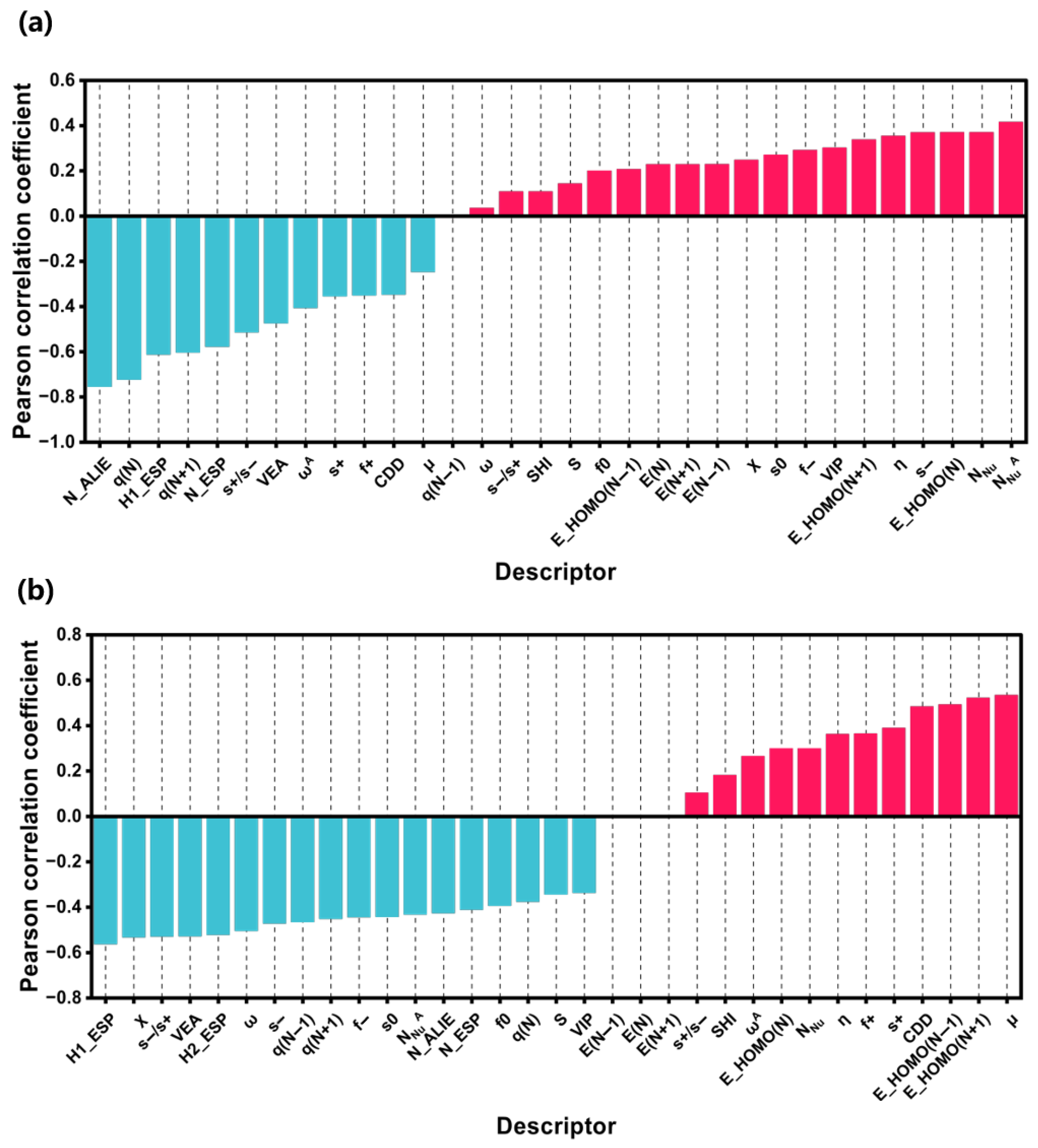
Figure 5a shows the correlations between the descriptors and ln(k) for cyclic aliphatic amines, with detailed results in Table S9. N_ALIE and q(N) still show strong negative correlations with ln(k), with coefficients of −0.76 and −0.72, respectively. This indicates that nitrogen electron-cloud delocalization and charge density are key factors controlling the reaction rate. The negative correlation between N_ALIE and q(N) further underscores the importance of electronic effects, as nitrogen nucleophilicity and reactivity vary with these descriptors.
Figure 5. Pearson correlation coefficients between ln(k) and various quantitative descriptors for (a) cyclic aliphatic amines and (b) aromatic amines.
Figure 5b shows the correlations between the descriptors and ln(k) for aromatic amines, with detailed results listed in Table S10. Among the descriptors examined, H1_ESP and H2_ESP show the strongest negative correlation with ln(k) (r = −0.56 and −0.52), indicating that higher values correspond to a lower reaction rate. Because H1_ESP and H2_ESP reflect the electron density around the hydrogen atom in amine group, larger values suggest reduced nucleophilicity at the reactive nitrogen center, weakening its interaction with CO2 and slowing the reaction. In addition, both μ and EHOMO(N+1) show strong positive correlations with ln(k), each with r = 0.53 and 0.52. μ represents the dipole moment of the molecule, which reflects the charge distribution and polarity within the molecule. A larger dipole moment typically indicates stronger polarity, making the molecule more likely to react with electrophilic reagents and thus increasing the reaction rate. EHOMO(N+1), the HOMO energy associated with the nitrogen center in the most stable configuration, also increases with nucleophilicity, enabling nitrogen to donate electron density more readily to CO2 and thereby promoting the reaction. Overall, the correlation analysis shows that these descriptors collectively capture the electron distribution of aromatic amines and their interaction with CO2. The negative correlation between H1_ESP and H2_ESP suggests that, as the electron density around the hydrogen atom increases, the reactivity decreases. In contrast, the positive correlations of μ and EHOMO(N+1) indicate that a higher dipole moment and elevated nitrogen-centered HOMO energy levels contribute to enhanced reactivity.

3.3. The Correlation Between Reaction Rate and Equilibrium Constant

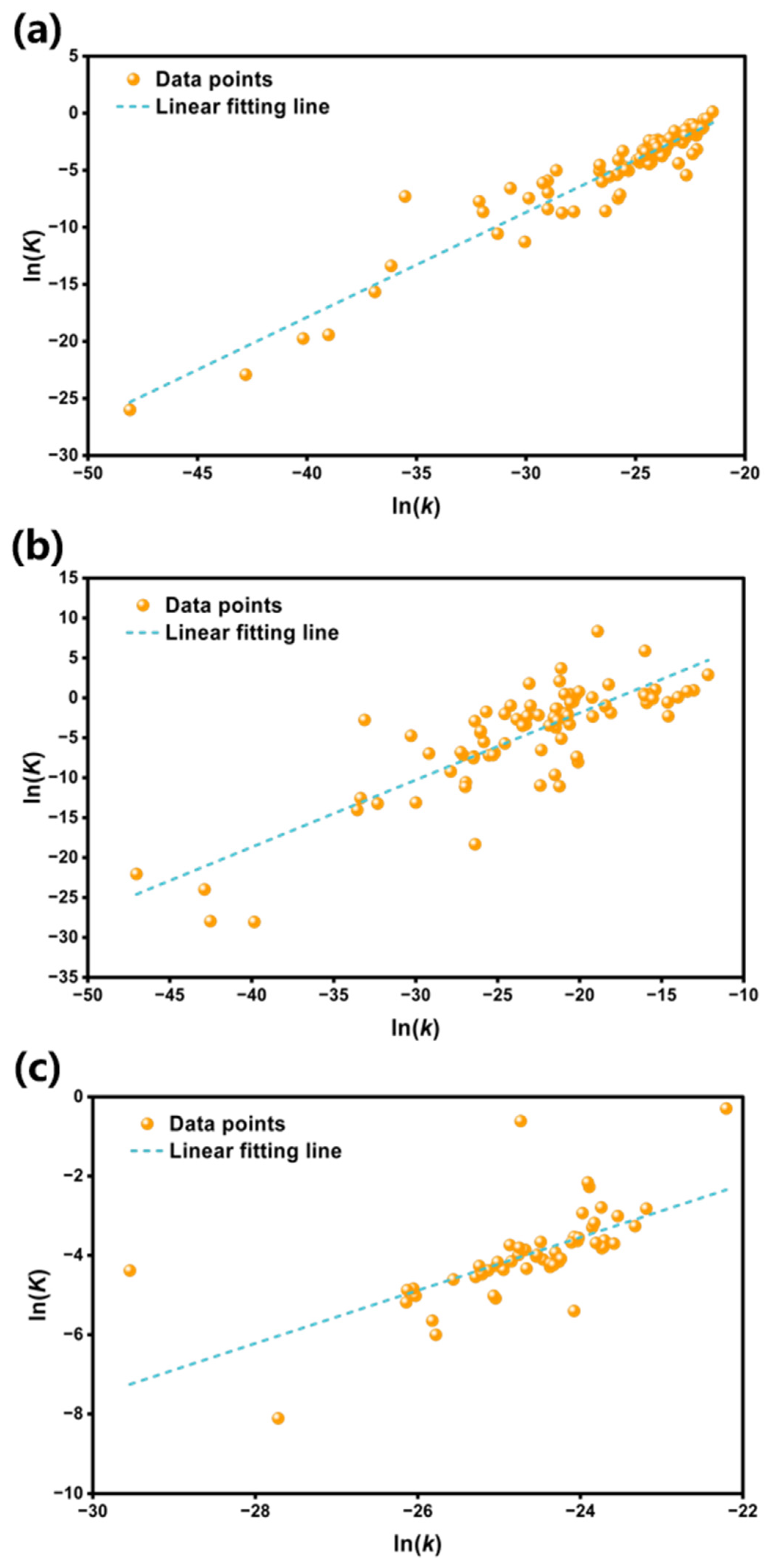
The qualitative analysis of substituent effects on reaction rate and equilibrium, together with the descriptor-based correlations, suggests a positive relationship between these two reactivity parameters. To further support this, the logarithms of the rate constant and equilibrium constant were analyzed, and regression was performed to quantify the correlation between k and K.
Figure 6a shows the relationship between ln(K) and ln(k) for linear aliphatic amines. The fitted line has a steep slope, indicating a strong positive correlation between the rate constant and the equilibrium constant. Thus, faster-reacting systems also tend to have larger equilibrium constants, reflecting coupling between kinetic and thermodynamic favorability. For cyclic aliphatic amines (Figure 6b), a linear correlation is also observed, although the data are more scattered than for linear systems. This dispersion may arise from cyclic rigidity, which limits conformational flexibility and weakens the extent to which kinetic changes translate into equilibrium changes, but the overall linear trend remains clear. Aromatic amines (Figure 6c) likewise show a linear ln(K)–ln(k) relationship, with greater scatter than the aliphatic systems, likely due to aromatic conjugation effects that modulate reactivity more complexly.
Figure 6. Relationship between ln(K) and ln(k) for (a) linear aliphatic amine, (b) cyclic aliphatic amine, and (c) aromatic amine.
Overall, the linear ln(K)–ln(k) relationships observed for all three amine classes confirm an intrinsic linkage between the kinetic and thermodynamic behavior of CO2–amine reactions. This provides a quantitative basis for understanding reaction mechanisms and guides the rational design of CO2-capture solvents and optimization of reaction conditions. Linear aliphatic amines show the strongest correlation, indicating the most direct coupling between rate and equilibrium. Although aromatic and cyclic aliphatic amines display greater variability due to rigidity or conjugation effects, they still exhibit a clear linear trend, showing that the rate–equilibrium relationship holds across diverse molecular frameworks.

4. Conclusions

This study systematically investigated the structure–reactivity relationships governing reactions between CO2 and three representative classes of organic amines, linear aliphatic, cyclic aliphatic, and aromatic, by introducing 33 substituents at different molecular positions and computing both reaction rate and equilibrium constants using transition state theory. Through the development and analysis of quantitative electron distribution and steric descriptors, including N_ALIE, Hirshfeld charge q(N), ESP-based parameters, and dual-descriptor indices, we revealed that molecular reactivity is strongly dictated by the electronic environment of the amine nitrogen and its steric accessibility. Linear aliphatic amines exhibit the greatest sensitivity to steric hindrance, with α-substituents particularly suppressing reactivity through increased congestion. Cyclic aliphatic and aromatic amines, constrained by rigid frameworks, are less affected by steric effects but strongly influenced by inductive and conjugation interactions transmitted through the ring systems. Among all descriptors, N_ALIE and q(N) consistently showed the highest correlations with both kinetic and thermodynamic parameters, demonstrating their effectiveness in capturing the key electronic features controlling reactivity. Importantly, a robust linear correlation between ln(k) and ln(K) was observed across all amine classes, revealing an intrinsic coupling between reaction kinetics and thermodynamic favorability. This relationship provides a quantitative basis for predicting solvent performance and offers valuable mechanistic insight for guiding molecular design. Overall, the findings establish a comprehensive theoretical framework for understanding and optimizing CO2–amine interactions, thereby supporting the rational development of high-efficiency carbon-capture solvents for decarbonization technologies.

Supplementary Materials

The following supporting information can be downloaded at: https://www.mdpi.com/article/10.3390/separations13010016/s1. Tables S1 and S2 present information on 33 functional groups, including their structures and van der Waals volumes; Table S3 shows the descriptors used; Tables S4–S6 provide the calculated results for reaction rate constants and equilibrium constants; and Tables S7–S10 display the Pearson correlation coefficient calculations. Table S1: The information and labels of basic functional groups added to the basic molecules; Table S2: The van der Waals volumes of different functional groups; Table S3: The information of all descriptors obtained from the conceptual density functional theory (CDFT); Table S4: The reaction rates constants (k) and equilibrium constants (K) of A-series molecules; Table S5: The reaction rates constants (k) and equilibrium constants (K) of B-series molecules; Table S6: The reaction rates constants (k) and equilibrium constants (K) of C-series molecules; Table S7: Pearson correlation coefficients between lnk and various descriptors of A-series molecules; Table S8: Pearson correlation coefficients between K and various descriptors of A-series molecules; Table S9: Pearson correlation coefficients between lnk and various descriptors of B-series molecule; Table S10: Pearson correlation coefficients between lnk and various descriptors of C-series molecule; Figure S1: Substitution positions for the three amine molecules; Figure S2: Surface electrostatic potential maps of three representative amine molecules.

Author Contributions

Conceptualization, H.S.; methodology, Y.C.; software, Y.C. and Q.Z.; validation, C.L. and H.S.; formal analysis, Y.C. and C.L.; investigation, Y.Z.; resources, H.S.; data curation, Y.C.; writing—original draft preparation, Y.C. and Q.Z.; writing—review and editing, Y.C., Q.Z., Y.Z., C.L. and H.S.; visualization, Q.Z.; supervision, H.S.; project administration, H.S.; funding acquisition, H.S. All authors have read and agreed to the published version of the manuscript.

Funding

This research was funded by the National Natural Science Foundation of China (Grant number 22178109 and 21878097) and the Natural Science Foundation of Shanghai (Grant number 21ZR1417700).

Data Availability Statement

The original contributions presented in this study are included in the article/Supplementary Materials. Further inquiries can be directed to the corresponding authors.

Conflicts of Interest

The authors declare no conflicts of interest.

Abbreviations

The following abbreviations are used in this manuscript:
kChemical reaction rate constant
KChemical reaction equilibrium constants
GGibbs free energy
HHnthalpy
UInternal energy

References

  1. Güneş, H.; Simba, H.; Karadağ, H.; Şit, M. Global Energy Transformation and the Impacts of Systematic Energy Change Policy on Climate Change Mitigation. Sustainability 2023, 15, 14298. [Google Scholar] [CrossRef]
  2. Nong, D.; Verikios, G.; Whitten, S.; Brinsmead, T.S.; Mason-D’Croz, D.; Rodriguez, S. Early transition to near-zero emissions electricity and carbon dioxide removal is essential to achieve net-zero emissions at a low cost in Australia. Commun. Earth Environ. 2025, 6, 653. [Google Scholar] [CrossRef]
  3. Hou, M.Z.; Luo, J.; Huang, L.; Beck, H.-P.; Mehmood, F.; Wang, Q.; Wu, X.; Wu, L.; Yue, Y.; Fang, Y.; et al. Strategies toward carbon neutrality: Comparative analysis of China, USA, and Germany. Carbon Neutral Syst. 2025, 1, 3. [Google Scholar] [CrossRef]
  4. Zhang, S.; Cai, W.; Zheng, X.; Lv, X.; An, K.; Cao, Y.; Cheng, H.S.; Dai, J.; Dong, X.; Fan, S.; et al. Global readiness for carbon neutrality: From targets to action. Environ. Sci. Ecotechnol. 2025, 25, 100546. [Google Scholar] [CrossRef]
  5. Wang, Z.; Yuan, P.; Yu, H.; Ma, Q.; Xu, B.; Zhao, D. Carbon Capture, Utilization and Storage: Technology, Application, and Policy. Processes 2025, 13, 3414. [Google Scholar] [CrossRef]
  6. Hanson, E.; Nwakile, C.; Hammed, V.O. Carbon capture, utilization, and storage (CCUS) technologies: Evaluating the effectiveness of advanced CCUS solutions for reducing CO2 emissions. Results Surf. Interfaces 2025, 18, 100381. [Google Scholar] [CrossRef]
  7. Soo, X.Y.D.; Lee, J.J.C.; Wu, W.-Y.; Tao, L.; Wang, C.; Zhu, Q.; Bu, J. Advancements in CO2 capture by absorption and adsorption: A comprehensive review. J. CO2 Util. 2024, 81, 102727. [Google Scholar] [CrossRef]
  8. Raganati, F.; Miccio, F.; Ammendola, P. Adsorption of Carbon Dioxide for Post-combustion Capture: A Review. Energy Fuels 2021, 35, 12845–12868. [Google Scholar] [CrossRef]
  9. Fan, Y.; Yu, W.; Wu, A.; Shu, W.; Zhang, Y. Recent progress on CO2 separation membranes. RSC Adv. 2024, 14, 20714–20734. [Google Scholar] [CrossRef]
  10. Khan, U.; Ogbaga, C.C.; Abiodun, O.-A.O.; Adeleke, A.A.; Ikubanni, P.P.; Okoye, P.U.; Okolie, J.A. Assessing absorption-based CO2 capture: Research progress and techno-economic assessment overview. Carbon Capture Sci. Technol. 2023, 8, 100125. [Google Scholar] [CrossRef]
  11. Madejski, P.; Chmiel, K.; Subramanian, N.; Kuś, T. Methods and Techniques for CO2 Capture: Review of Potential Solutions and Applications in Modern Energy Technologies. Energies 2022, 15, 887. [Google Scholar] [CrossRef]
  12. Vaz, S.; Rodrigues de Souza, A.P.; Lobo Baeta, B.E. Technologies for carbon dioxide capture: A review applied to energy sectors. Clean. Eng. Technol. 2022, 8, 100456. [Google Scholar] [CrossRef]
  13. Meng, F.; Meng, Y.; Ju, T.; Han, S.; Lin, L.; Jiang, J. Research progress of aqueous amine solution for CO2 capture: A review. Renew. Sustain. Energy Rev. 2022, 168, 112902. [Google Scholar] [CrossRef]
  14. Loachamin, D.; Casierra, J.; Calva, V.; Palma-Cando, A.; Ávila, E.E.; Ricaurte, M. Amine-Based Solvents and Additives to Improve the CO2 Capture Processes: A Review. ChemEngineering 2024, 8, 129. [Google Scholar] [CrossRef]
  15. Duy Ho, Q.; Rauls, E. Computational Study of the Adsorption of Small Gas Molecules on Pillar[5]arenes. ChemistrySelect 2023, 8, e202204215. [Google Scholar] [CrossRef]
  16. Duy Ho, Q.; Rauls, E. Investigations of Functional Groups Effect on CO2 Adsorption on Pillar[5]arenes Using Density Functional Theory Calculations. ChemistrySelect 2024, 9, e202401490. [Google Scholar] [CrossRef]
  17. Orlov, A.A.; Valtz, A.; Coquelet, C.; Rozanska, X.; Wimmer, E.; Marcou, G.; Horvath, D.; Poulain, B.; Varnek, A.; de Meyer, F. Computational screening methodology identifies effective solvents for CO2 capture. Commun. Chem. 2022, 5, 37. [Google Scholar] [CrossRef]
  18. Uma Maheswari, A.; Palanivelu, K. Carbon Dioxide Capture and Utilization by Alkanolamines in Deep Eutectic Solvent Medium. Ind. Eng. Chem. Res. 2015, 54, 11383–11392. [Google Scholar] [CrossRef]
  19. Hairul, N.A.H.; Rajiman, V.; Mohd Shariff, D. A Review on CO2 Absorption using Chemical Solvents at Low and High CO2 Partial Pressure Conditions in a Packed Column. Open Chem. Eng. J. 2022, 16. [Google Scholar] [CrossRef]
  20. Gouedard, C.; Picq, D.; Launay, F.; Carrette, P.L. Amine degradation in CO2 capture. I. A review. Int. J. Greenh. Gas Control 2012, 10, 244–270. [Google Scholar] [CrossRef]
  21. Calva, V.; Játiva, N.; Ricaurte, M. CO2 Capture Using Amine-Based Solvents: Identification of Additives to Improve the Kinetics and Thermodynamics of CO2 Sorption at High-Pressure Conditions. Gases 2025, 5, 4. [Google Scholar] [CrossRef]
  22. Goto, K.; Yamada, H.; Higashii, T. A Simple Method of Evaluating Alkanolamine Absorbents for Post-Combustion CO2 Capture. J. Chem. Eng. Jpn. 2014, 47, 463–470. [Google Scholar] [CrossRef]
  23. Gao, G.; Jiang, W.; Li, X.; Zhao, Z.; Jiang, C.; Luo, C.; Wu, F.; Zhang, L. Novel assessment of highly efficient polyamines for post-combustion CO2 capture: Absorption heat, reaction rate, CO2 cyclic capacity, and phase change behavior. Sep. Purif. Technol. 2023, 306, 122615. [Google Scholar] [CrossRef]
  24. Wei, D.; Luo, Q.; Ouyang, T.; Liu, Q.; Huang, Y.; Jin, B.; Gao, H.; Luo, X.; Liang, Z. An experimental and theoretical study on the effects of amine chain length on CO2 absorption performance. AIChE J. 2023, 69, e17960. [Google Scholar] [CrossRef]
  25. Esaki, T.; Sugai, Y.; Machida, H. Characteristics of CO2 Capture using Biphasic Absorbent by AMP/DEGDEE/H2OAMP/DEGDEE/H2O. J. MMIJ 2024, 140, 127–133. [Google Scholar] [CrossRef]
  26. Perumal, M.; Jayaraman, D.; Balraj, A. Experimental studies on CO2 absorption and solvent recovery in aqueous blends of monoethanolamine and tetrabutylammonium hydroxide. Chemosphere 2021, 276, 130159. [Google Scholar] [CrossRef] [PubMed]
  27. Liu, C.; Chen, Y.; Jiang, H.; Wu, K.; Peng, Q.; Chen, Y.; Fang, D.; Shen, B.; Wu, D.; Sun, H. Revealing the Structure–Interaction–Dissolubility Relationships through Computational Investigation Coupled with Solubility Measurement: Toward Solvent Design for Organosulfide Capture. Ind. Eng. Chem. Res. 2022, 61, 7183–7192. [Google Scholar] [CrossRef]
  28. Liu, C.; Chen, Y.; Guo, G.; Zhao, Q.; Jiang, H.; Wang, H.; Gao, W.; Yang, F.; Shen, B.-X.; Sun, H. Unveiling the Quantitative Relationships between Electron Distribution and Steric Hindrance of Organic Amines and Their Reaction Rates with Carbonyl Sulfur: A Theoretical Calculation Investigation. J. Phys. Chem. A 2023, 128, 152–162. [Google Scholar] [CrossRef]
  29. Chen, Y.; Liu, C.; Guo, G.; Zhao, Q.; Jiang, H.; Wu, Q.; Fang, D.; Gao, W.; Chen, Y.; Peng, Q.; et al. Physical–chemical coupling machine learning approach to exploring reactive solvents for absorption capture of carbonyl sulfide. Chem. Eng. Sci. 2023, 280, 118984. [Google Scholar] [CrossRef]
  30. Zhao, Q.; Cui, Y.; Liu, C.; Wen, H.; Chen, Y.; Li, P.; Zhou, Y.; Wang, Y.; Jiang, H.; Wu, Q.; et al. Machine learning model based on parallel reaction mechanisms for predicting CO2 capacity of amine solvents. Chem. Eng. Sci. 2026, 320, 122407. [Google Scholar] [CrossRef]
  31. Merchant, A.; Batzner, S.; Schoenholz, S.S.; Aykol, M.; Cheon, G.; Cubuk, E.D. Scaling deep learning for materials discovery. Nature 2023, 624, 80–85. [Google Scholar] [CrossRef]
  32. Orhan, I.B.; Zhao, Y.; Babarao, R.; Thornton, A.W.; Le, T.C. Machine Learning Descriptors for CO2 Capture Materials. Molecules 2025, 30, 650. [Google Scholar] [CrossRef]
  33. Li, Q.; Fu, N.; Omee, S.S.; Hu, J. MD-HIT: Machine learning for material property prediction with dataset redundancy control. npj Comput. Mater. 2024, 10, 245. [Google Scholar] [CrossRef]
  34. Tentscher, P.R.; Arey, J.S. Geometries and Vibrational Frequencies of Small Radicals: Performance of Coupled Cluster and More Approximate Methods. J. Chem. Theory Comput. 2012, 8, 2165–2179. [Google Scholar] [CrossRef] [PubMed]
  35. Kesharwani, M.; Brauer, B.; Martin, J. Frequency and Zero-Point Vibrational Energy Scale Factors for Double-Hybrid Density Functionals (and Other Selected Methods): Can Anharmonic Force Fields Be Avoided? J. Phys. Chem. A 2014, 119, 1701–1714. [Google Scholar] [CrossRef]
  36. Alecu, I.M.; Zheng, J.; Zhao, Y.; Truhlar, D.G. Computational Thermochemistry: Scale Factor Databases and Scale Factors for Vibrational Frequencies Obtained from Electronic Model Chemistries. J. Chem. Theory Comput. 2010, 6, 2872–2887. [Google Scholar] [CrossRef] [PubMed]
  37. Orestes, E.; Ronconi, C.; Carneiro, J. Insights into the interactions of CO2 with amines: A DFT benchmark study. Phys. Chem. Chem. Phys. PCCP 2014, 16, 17213–17219. [Google Scholar] [CrossRef] [PubMed]
  38. Başaran, K.; Topçubaşı, B.U.; Davran-Candan, T. Theoretical investigation of CO2 adsorption mechanism over amine-functionalized mesoporous silica. J. CO2 Util. 2021, 47, 101492. [Google Scholar] [CrossRef]
  39. Davran-Candan, T. DFT Modeling of CO2 Interaction with Various Aqueous Amine Structures. J. Phys. Chem. A 2014, 118, 4582–4590. [Google Scholar] [CrossRef]
  40. Chen, Y.; Liu, C.; Guo, G.; Zhao, Y.; Qian, C.; Jiang, H.; Shen, B.; Wu, D.; Cao, F.; Sun, H. Machine-learning-guided reaction kinetics prediction towards solvent identification for chemical absorption of carbonyl sulfide. Chem. Eng. J. 2022, 444, 136662. [Google Scholar] [CrossRef]
  41. Wei, X.; Cui, L.; Xu, J.; Cen, L.; Ren, M.; Cao, F. Effective electrostatic potential surface and aromatic affinity as quantitative guide for deep extraction denitrification from aromatic-rich oils. Sep. Purif. Technol. 2024, 330, 125476. [Google Scholar] [CrossRef]
  42. Lu, J.; Paci, I.; Leitch, D.C. A broadly applicable quantitative relative reactivity model for nucleophilic aromatic substitution (SNAr) using simple descriptors. Chem. Sci. 2022, 13, 12681–12695. [Google Scholar] [CrossRef]
  43. Murray, J.; Politzer, P. The Electrostatic Potential as a Guide to Molecular Interactive Behavior. In Chemical Reactivity Theory: A Density Functional View; CRC Press: Boca Raton, FL, USA, 2009. [Google Scholar]
  44. Brinck, T.; Carlqvist, P.; Stenlid, J.H. Local Electron Attachment Energy and Its Use for Predicting Nucleophilic Reactions and Halogen Bonding. J. Phys. Chem. A 2016, 120, 10023–10032. [Google Scholar] [CrossRef]
  45. Cao, J.; Ren, Q.; Chen, F.; Lu, T. Comparative study on the methods for predicting the reactive site of nucleophilic reaction. Sci. China Chem. 2015, 58, 1845–1852. [Google Scholar] [CrossRef]
  46. Tian, Y.; Chen, W.; Wang, C.; Xu, L.; Meng, Q.; Tong, B.; Zhao, Z. Computational study for the electrophilic reactivity prediction of crown ethers. J. Mol. Liq. 2021, 341, 117418. [Google Scholar] [CrossRef]
Disclaimer/Publisher’s Note: The statements, opinions and data contained in all publications are solely those of the individual author(s) and contributor(s) and not of MDPI and/or the editor(s). MDPI and/or the editor(s) disclaim responsibility for any injury to people or property resulting from any ideas, methods, instructions or products referred to in the content.

Article Metrics

Citations

Article Access Statistics

Article metric data becomes available approximately 24 hours after publication online.