Article

Cuscohygrine and Hygrine as Biomarkers for Coca Leaf Chewing: Analytical Challenges in GC-MS Detection and Implications for the Differentiation of Cocaine Use in Forensic Toxicology

by
Nélida C. Rubio
1,
Iván Alvarez-Freire
1,
Pamela Cabarcos-Fernández
1,*,
María J. Tabernero-Duque
1,
Inés Sánchez-Sellero
1,
Antonio Moreda-Piñeiro
1,
Pilar Bermejo-Barrera
2 and
Ana M. Bermejo-Barrera
2
1
Forensic Toxicology Service, Forensic Sciences Institute, Faculty of Medicine, University of Santiago de Compostela, Rúa San Francisco, s/n, 15782 Santiago de Compostela, Spain
2
Trace Element, Spectroscopy and Speciation Group (GETEE), Institute of Materials iMATUS, Department of Analytical Chemistry, Nutrition and Bromatology, Faculty of Chemistry, University of Santiago de Compostela, Avenida das Ciencias, s/n, 15782 Santiago de Compostela, Spain
*
Author to whom correspondence should be addressed.
Separations 2025, 12(8), 201; https://doi.org/10.3390/separations12080201
Submission received: 30 June 2025 / Revised: 23 July 2025 / Accepted: 25 July 2025 / Published: 30 July 2025

Abstract

Cuscohygrine (CUS) and hygrine (HYG) are pyrrolidine alkaloids proposed as biomarkers of coca leaf consumption, a culturally accepted practice in some Latin American countries. Differentiating legal coca use from illicit cocaine consumption holds forensic importance. While LC-MS/MS is preferred, GC-MS remains widely used in Latin American toxicology labs due to accessibility. This study critically evaluates the analytical limitations of GC-MS for detecting CUS and HYG in biological matrices. Key parameters—injector temperature (180–290 °C), injection mode (split/splitless), solvent, liner condition, and matrix—were systematically studied. GC-MS showed significant limitations: low-abundance, non-specific fragments (m/z 42, 84, 98, 140) failed to meet the identification criteria in SIM mode. Thermal degradation of CUS to HYG and CUS-d6 to HYG-d3 was observed, especially with splitless injection and aged liners. Matrix effects produced signal enhancement ranging from +29% to +316%, meaning that analyte responses in biological samples were significantly higher than in neat standards, likely due to reduced degradation or adsorption. Although deuterated internal standards (CUS-d6) partially corrected signal variability and matrix enhancement, these corrections were not sufficient to overcome the fundamental limitations of GC-MS, including poor ion specificity and compound instability. These findings support the need for LC-MS/MS-based approaches for reliable alkaloid detection and question the suitability of GC-MS for CUS analysis in forensic toxicology contexts.

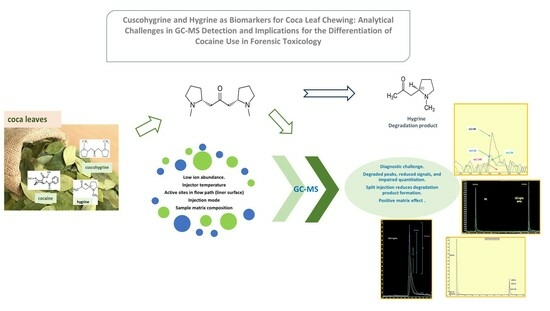
Graphical Abstract

1. Introduction

To contextualize the analytical challenges addressed in this study, it is important to first provide a brief overview of the role of cuscohygrine (CUS) and hygrine (HYG) in forensic toxicology and their relevance in the consumption of coca-based products. CUS and HYG have been proposed as markers for legal coca leaf consumption in several Latin American countries, including Argentina [1,2]. These alkaloids play a crucial role for distinguishing legal uses of coca-based products, such as chewing coca leaves and drinking coca tea, from illicit cocaine use. Therefore, studies on the presence of CUS and HYG in urine, oral fluid, and hair are of particular importance in forensic toxicology [1,3].
Despite their significance, CUS and HYG are not routinely included in drug screening and/or confirmation panels in forensic laboratories, a fact which agrees with the limited number of published analytical methods for CUS and HYG detection/determination. However, due to their critical forensic relevance, some toxicology laboratories in Latin America have recently started to include these alkaloids into their routine assays. This development addresses scenarios in which individuals, such as those subjected to workplace drug testing or arrested by law enforcement, claim that positive results for cocaine are attributable to coca leaf chewing or coca tea consumption rather than illicit cocaine use.
The legal status of coca leaf consumption varies across countries, and consumption is therefore explicitly legal under certain laws in Argentina [4], whereas it holds deep cultural and traditional significance in Peru and Bolivia. This context underscores the urgent need for reliable analytical methods for distinguishing legal coca use and illicit cocaine use in forensic settings, such as driving impairment assessments, criminal liability evaluations, and workplace testing.
HYG and CUS share structural chemical similarities and key differences with other tropane alkaloids commonly analyzed in forensic toxicology, such as cocaine (COC); cinnamoylcocaine (CIN), frequently found in seized samples; ecgonine methyl ester (EME), a cocaine metabolite; and tropacocaine (TRO), a minor alkaloid in coca leaves. These distinctions are crucial for understanding the findings presented in the current study.
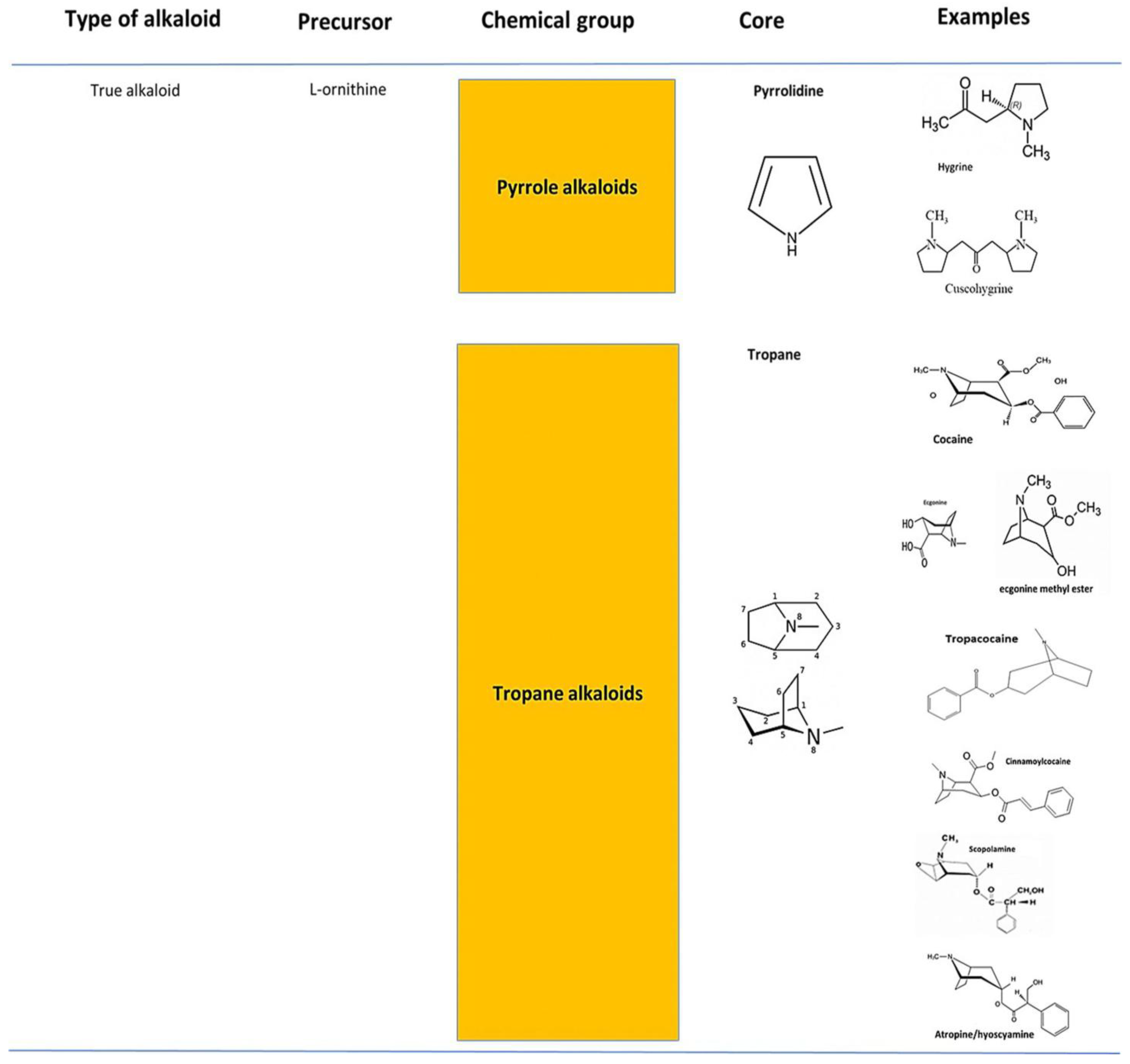
The amino acid L-ornithine serves as a precursor for two groups of alkaloids: pyrrolidine derivatives, including HYG and CUS, and tropane derivatives, including the most prominent alkaloids in coca leaves, such as COC, CIN, EME, and TRO (Figure 1). Their different biochemical origins result in substantial differences in their mass spectral behavior. Tropane-derived alkaloids generate characteristic fragments, such as m/z 82, which comes from the tropane core (a bicyclic ring), and other more abundant fragments (e.g., m/z 182 and m/z 105 in cocaine), derived from several functional groups. In contrast, pyrrolidine-derived alkaloids such as HYG and CUS, due to their monocyclic structure and absence of complex functional groups, tend to produce low-mass fragments with reduced stability. These properties make HYG and CUS detection particularly challenging when gas chromatography–mass spectrometry (GC-MS) is used in Selected Ion Monitoring (SIM) mode, which requires at least three diagnostic ions with enough relative abundance to fit with international identification criteria [5,6].
In our laboratory’s experience, CUS and the deuterated analog (CUS-d6) standards are partially degraded into HYG and deuterated hygrine (HYG-d3). This degradation is influenced by factors such as the injector temperature, the injection mode (split versus splitless), and the matrix composition. Additionally, we have observed variations in response patterns over time and across several biological matrices, which directly impact the performance and accuracy of GC-MS analyses. In a previous study [7], we reported these challenges, and we identified critical gaps in existing methods, which are further explored in this paper.
While LC-MS/MS is the preferred approach in modern forensic toxicology because of its higher sensitivity, selectivity, and ability to handle thermolabile analytes, its cost and limited availability still make GC-MS a common technique in several Latin American laboratories. Previous studies [3,8], along with others that will be discussed throughout the manuscript, have demonstrated the feasibility of LC-MS/MS for CUS and HYG detection. However, the current study aims to critically assess the limitations of GC-MS, which remains the most accessible technology in many regional contexts for the reliable detection of pyrrolidine alkaloids (HYG and CUS), particularly in forensic laboratory applications. The objectives of this study are (a) examination of the mass spectral characteristics of HYG and CUS, identifying the challenges and limitations associated with their accurate detection and identification in biological matrices; (b) assessment of the influence of critical instrumental parameters, including the injector temperature and split/splitless injection mode, on the analytical response of CUS and CUS-d6 and their respective degradation products; and (c) study of the potential interactions of CUS and CUS-d6 with active sites within the GC-MS system, investigating matrix effects with several biological samples (plasma, urine, and oral fluid) and evaluating the influence of the surface activity at the injector inlet.

2. Materials and Methods

2.1. Reagents and Chemicals

Cuscohygrine (10 mg/mL) and CUS-d6 (0.1 mg/mL) in acetonitrile were obtained from Toronto Research Chemicals Inc. (North York, ON, Canada). Hygrine and HYG-d3 were not commercially available at the time of this study. HYG was identified via a 6530 Accurate-Mass QTOF-MS instrument (Agilent Technologies, Santa Clara, CA, USA), as previously reported [8], using coca leaf extracts as the reference material. Identification was based on both retention time and characteristic mass spectral fragmentation. HYG-d3 was identified through its coelution with the degradation product of CUS-d6 under standard EI conditions and by matching its fragmentation pattern, confirming its origin as a deuterated analog of HYG. Methanol (LC-MS grade) was purchased from Riedel-de Haën (Seelze, Germany). Boric acid, potassium chloride, and sodium hydroxide, the reagents used when preparing the borate buffer, were supplied by Merck (Madrid, Spain). Ultrapure water with a resistivity of 18 MΩ·cm was obtained from a water purification device from Millipore Co. (Bedford, MA, USA). OASIS® HLB extraction cartridges (3 cc/60 mg) were obtained from Waters (Cerdanyola del Vallés, Spain). The acetonitrile, ethyl acetate, and acetic acid used were of analytical grade or higher and were supplied by Merck (Madrid, Spain).

2.2. Working Solutions

Working standards were prepared from CUS and CUS-d6 solutions at concentrations of 0.5, 1.0, 2.0, 10, 20, and 25 µg/mL in methanol and ethyl acetate. All working standards were stored at −20 °C when not in use. Working solutions remained stable at −20 °C for at least 3 months, and no significant degradation was observed.

2.3. Instruments and Apparatus

Analysis was performed using a gas chromatography model 7890B from Agilent Technologies (Las Rozas, Spain) combined with an Agilent 5977B mass spectrometer (Las Rozas, Spain) equipped with an electron ionization source (electron impact ionization). An HP5-MS capillary column (30 m × 250 µm i.d., 0.5 µm film thickness; Agilent Technologies) with helium as the carrier gas (1.0 mL/min) was used for target separation. The interface, source, and quadrupole temperatures were 300 °C, 250 °C and 150 °C, respectively. The fixed electron energy was 70 eV and the injector temperature was evaluated at different temperatures (180, 210, 250, 270, and 290 °C) in the splitless mode and split mode 1:5 and 1:10 with an injector temperature of 250 °C. The temperature program was as follows: 70 °C was held for 3 min; then the temperature was increased to 270 °C at 25 °C/min, and finally, it was held at 270 °C for 7 min. The injection volume was 1.0 µL. All compounds were injected in full scan and SIM modes. In full scan (SCAN) mode, mass spectra were acquired over an m/z range of 40–400. To evaluate the spectral fragmentation of CUS and HYG under various experimental conditions, ion extraction was applied post-acquisition to isolate relevant fragments and enhance interpretation. In Selected Ion Monitoring (SIM) mode, the monitored ions for each compound were as follows: for HYG, m/z 42, 84, 98, and 141; for HYG-d3, m/z 45, 87, 101, and 144; for CUS, m/z 42, 84, 98, and 140; and for CUS-d6, m/z 45, 87, 101, and 143. Ion ratios and relative abundances were calculated according to international identification criteria [6].

2.4. Solid-Phase Extraction Procedure for Plasma, Urine, and Oral Fluid

To carry out the SPE procedure, a 20-position manifold obtained from Waters (Milford, MA, USA) was used. Each OASIS® HLB SPE cartridge was conditioned with 2.0 mL of methanol followed by 2.0 mL of ultrapure water. Then, 1.0 mL of blank plasma, urine, or oral fluid, mixed with 1.0 mL of borate buffer (pH 9.2), was loaded on the cartridge. Washing was performed with 2.0 mL of 5.0% (v/v) methanol in ultrapure water, followed by cartridge vacuum drying for 10 min. Targets were eluted by first passing 2.0 mL of methanol and then 2.0 mL of 2.0% (v/v) acetic acid in methanol. The eluent was evaporated under a N2 stream at 40 °C, and the dried extract was further spiked with CUS and CUS-d6 standards in methanol at different concentrations at a final volume of 50 µL. The reconstituted samples were transferred to autosampler vials, and 1.0 μL was injected into the GC-MS instrument under optimized operating conditions [9].

2.5. Procedures for the Study of CUS/CUS-d6 Degradation in the GC-MS System

The formation of the degradation products HYG/HYG-d3 from CUS/CUS-d6 in GC-MS (injector temperature, injection mode, and active sites influence) was evaluated as follows:

2.5.1. Assessment of the Detection Limit and Ion Abundance Mass-to-Charge Ratio (m/z)

To determine the abundance of the mass-to-charge ratio of CUS and its degradation product HYG, a concentration of 20 µg/mL of CUS was used in a GC-MS system. The GC-MS system was operated in standard electron ionization (EI) mode at 70 eV following the specifications outlined in the ‘Instruments and apparatus’ section, with an injector temperature of 250 °C [1,2]. Mass spectra of CUS at 20 µg/mL and CUS-d6 at 25 µg/mL, as well as their respective degradation products HYG and HYG-d3, were obtained under the same chromatographic conditions as detailed. Detection limit standards of CUS at concentrations of 0.5, 2.0, and 10 µg/mL were measured in both SCAN and SIM modes at injector temperatures of 210, 250, 270, and 290 °C in accordance with international guidelines, which state that the detection and identification of a compound in SIM mode require at least three characteristic ions (m/z).

2.5.2. Study of the Effects of the Injector Temperature and Solvent Nature (Methanol and Ethyl Acetate)

The influence of the injector temperature and analyte concentration on the degradation of CUS/CUS-d6 to HYG/HYG-d3 was evaluated using CUS and CUS-d6 standard solutions at 0.5, 2.0, 10, 20, and 25 µg/mL prepared in methanol (a highly polar solvent that acts as both a proton donor and acceptor) and ethyl acetate (a less polar solvent that functions solely as a proton acceptor). The standard solutions were measured at injector temperatures of 180, 210, 250, 270, and 290 °C in the splitless mode. SCAN mode and ion extraction were used to obtain the areas of the analyzed ions.

2.5.3. Study of the Injection Mode

The influence of the injection mode on CUS and CUS-d6 degradation was investigated under routine chromatographic conditions using an ultra-inert liner and CUS and CUS-d6 standard solutions at 10 µg/mL. Three injection conditions, splitless mode, split mode 1:5, and split mode 1:10, were tested.

2.5.4. Study of the Effects of Active Sites Along the GC Flow Path (Liner Surface)

An investigation of the interaction of targets with the liner surface was performed under routine GC-MS conditions in our laboratory by using new deactivated liners and used liners (several uses) for measuring CUS standard solutions at 1.0, 2.0, 10, and 20 µg/mL using injection temperatures of 250 and 290 °C and CUS-d6 standard solutions at 2.0, 10, and 25 µg/mL using injection temperatures of 180, 250, and 290 °C. The number of samples injected into the GC-MS system was approximately 10 to 20 per day, and the samples consisted of biological forensic samples of different natures. In some instances, the liners were intentionally left in use for extended periods to assess the potential interaction between the analyte and the liner surface.

2.5.5. Study of the Influence of the Sample Matrix Composition (Urine, Plasma, and Oral Fluid)

Three drug-free (blank) urine samples, two blank plasma samples, and two blank oral fluid samples from the stock drug-free samples in our laboratory were processed as described in Section 2.4. Blank plasma, urine, and oral fluid samples were obtained from healthy, drug-free volunteers with informed consent and tested negative for common drugs of abuse. A group of extracts from urine, oral fluid, and plasma was spiked with CUS standard solutions at 1.0 µg/mL, whereas the other group was spiked with 2.0 µg/mL of CUS and 2.0 µg/mL of CUS-d6.
The matrix effect (ME%) was calculated as proposed by Matuszewski et al. (2003) [10] with slight modifications. Our results were expressed as absolute areas (ME%) and as normalized areas with deuterated internal standards (ME (n) (%)) as follows:
ME (%) = (B/A × 100) − 100
ME (n) (%) = (B/A × 100) − 100
where A is the neat area from the standard solutions (1.0 and 2.0 µg/mL CUS), B is the neat area from the spiked sample (urine, oral fluid, and plasma) after extraction, and (n) is the normalized area with deuterated internal standards (2.0 µg/mL CUS-d6).
Positive values of ME (%) and/or ME (n) (%) imply signal enhancement, whereas a negative ME% and/or (ME (n) (%)) corresponds to signal suppression.

3. Results and Discussion

The results and discussion presented below address the challenges encountered in the analysis of CUS and HYG using GC-MS, a technique widely employed in forensic laboratories. These compounds have been previously analyzed and validated in earlier studies [1,3,9], which is not the focus of the present work.

3.1. Detection Limit and Ion Abundance Mass-to-Charge Ratio (m/z)

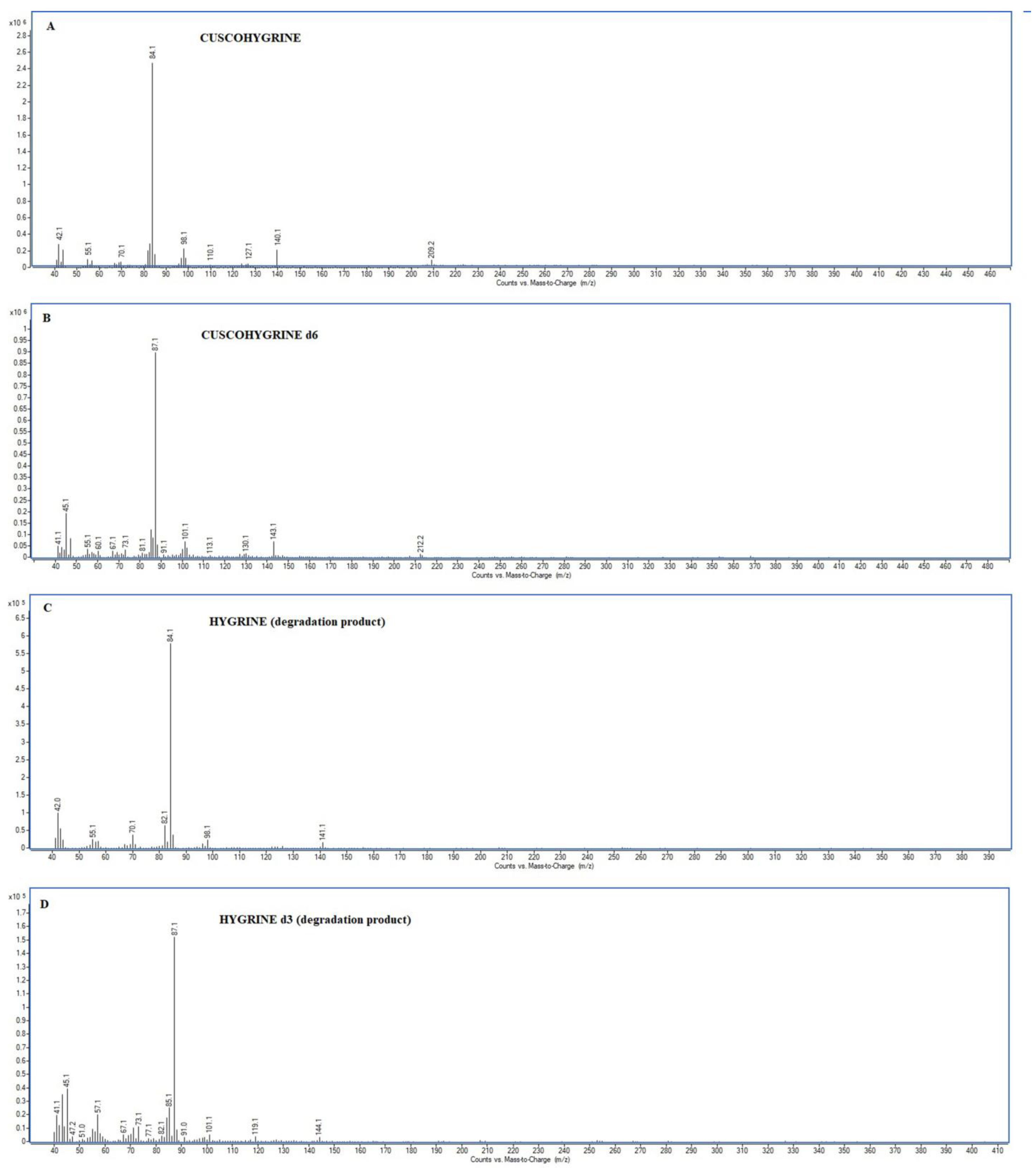
CUS and HYG (also CUS-d6 and HYG-d6) exhibit mass spectra characterized by fragments of low relative intensity (Figure 2). Regarding CUS, the molecular ion (M+, m/z 224) is typically of very low abundance and it is often undetectable due to its instability. This ion undergoes the loss of a methyl group (–CH3) to form the ion at m/z 209. Additional fragments observed in the CUS mass spectrum include those with m/z values of 140, 126, 98, 84, 70, and 42. Similarly, HYG, which is structurally part of the CUS molecule, shares several characteristic ions with it, including m/z 141 (molecular ion), as well as m/z 126, 98, 84, 70, and 42.
In both cases, the base ion in the mass spectra corresponds to m/z 84, which is attributed to the Δ1-dihydropyrrolium cation. The second most intense fragment, m/z 42, is associated with the structure [CH2=N=CH2]+ or [CH3-N=CH]+. Table 1 lists the relative intensities of the m/z ions for CUS and HYG.
Both CUS and HYG display mass spectra with low-intensity ions, where the abundances of m/z fragments are below or near 10%. For instance, the m/z 42 ion (17%), although used as a secondary qualifier ion in SIM mode analysis, is limited in analytical utility due to its low mass, lack of structural specificity, and susceptibility to interference within this range. Furthermore, CUS exhibits m/z ions at 98 and 140 with relative abundances of 9% and 8%, respectively (Table 1).
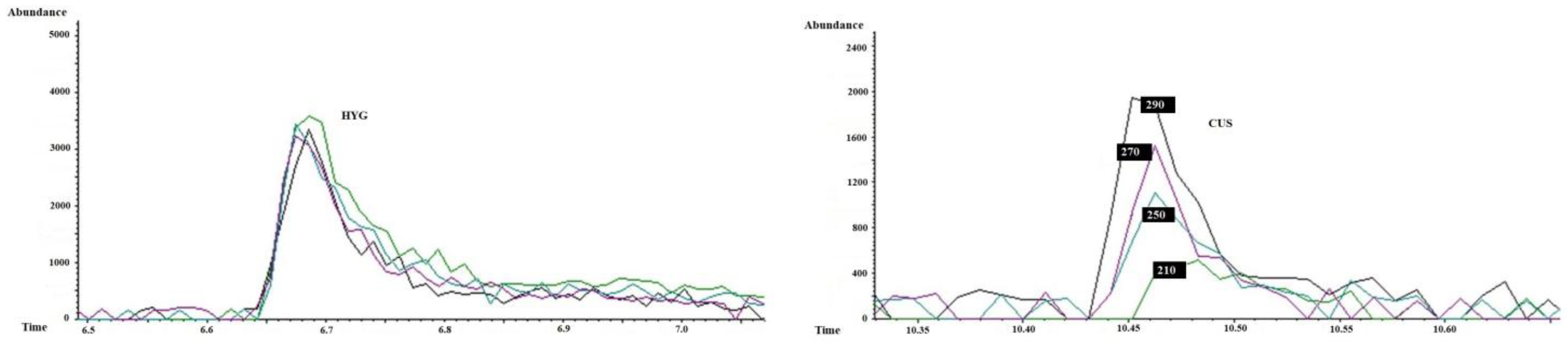
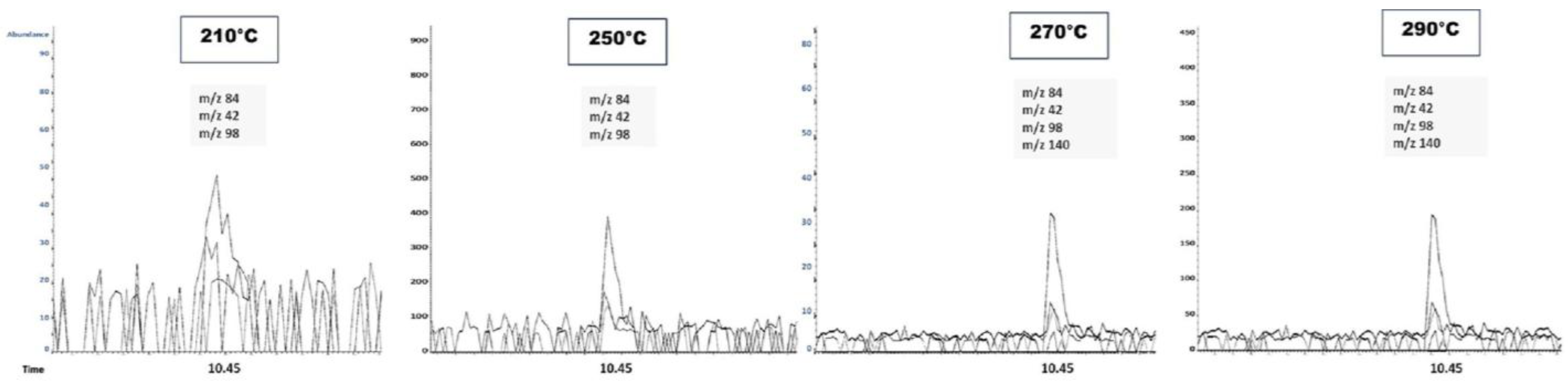
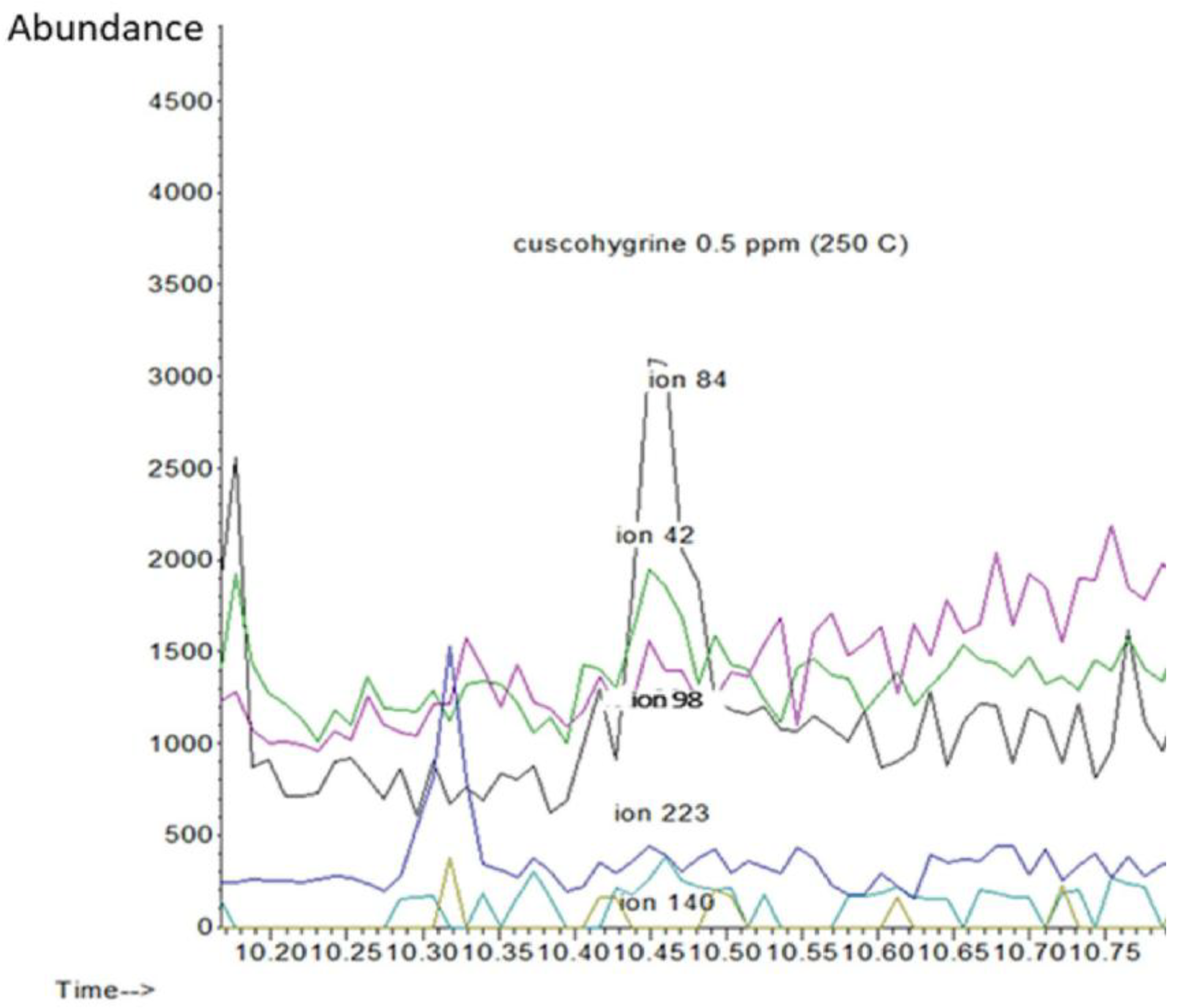
The mass profiles of both CUS and HYG lack high-intensity or structurally diagnostic m/z ions, hindering compliance with international requirements for compound identification. Figure 3 illustrates the challenge of differentiating ions 42, 140, and 98 from baseline noise. At an injector temperature of 250 °C and a concentration of 0.5 µg/mL, only the m/z 84 ion achieves the required signal-to-noise (S/N) ratio of >3, whereas other ions remain indistinguishable from the background noise. The effects of the different injector temperatures tested, 210 °C, 250 °C, 270 °C, and 290 °C, will be discussed later.
These findings underscore a limitation in GC-MS determination of CUS: the low mass and abundance of the m/z fragments complicate the differentiation from background noise and the ability to meet diagnostic criteria. Similar limitations can be discussed for HYG, which is both a degradation product of CUS and a marker of coca leaf use.

3.2. Effect of the Injector Temperature and Solvent Nature (Methanol and Ethyl Acetate)

Heating the sample in the injection port to volatilize analytes is a crucial step in GC. However, this process poses challenges for thermolabile compounds, which can degrade during analysis since analyte degradation reduces analytical sensitivity and leads to difficulties when interpreting analyte breakdown patterns.
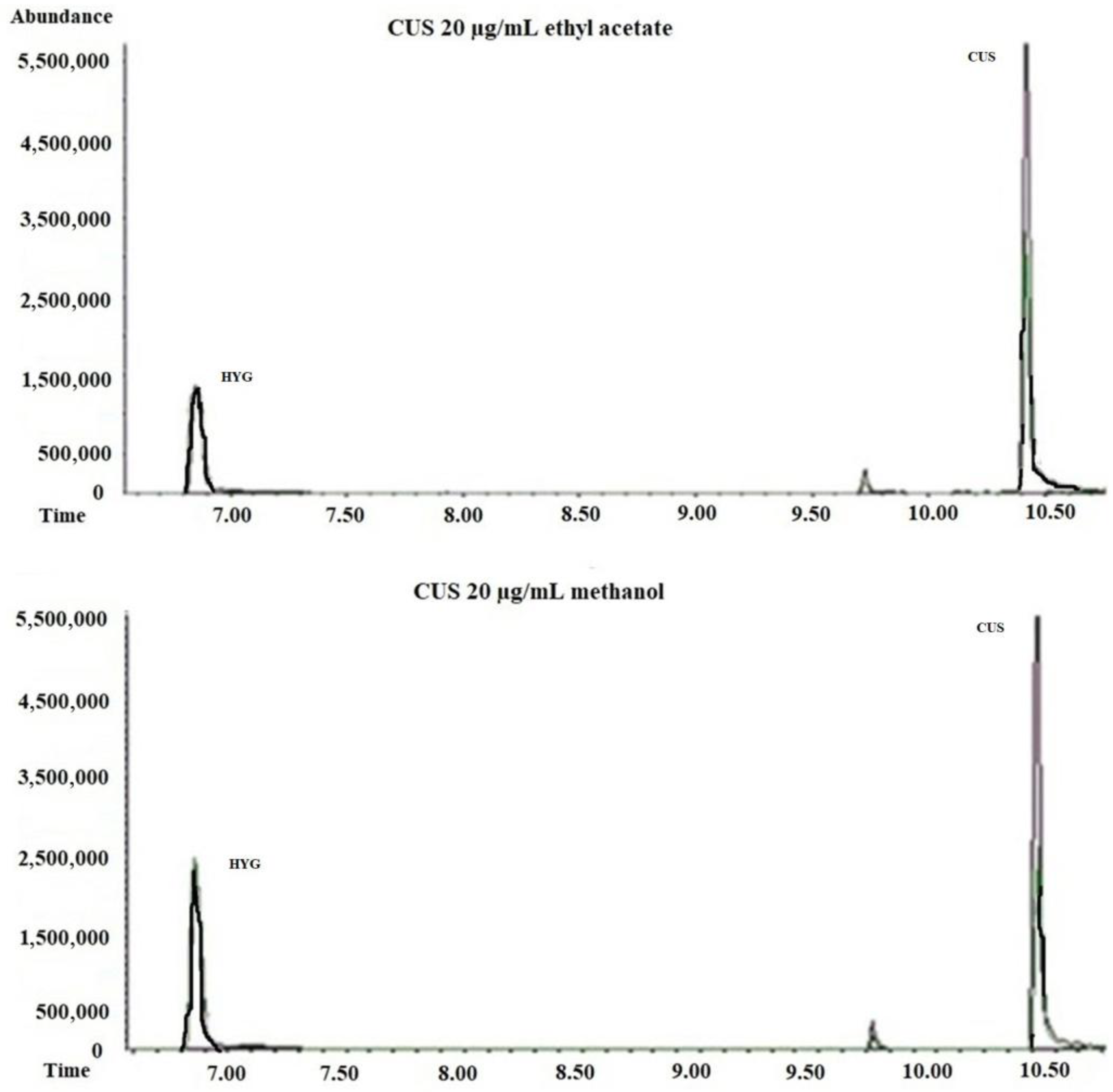
CUS and the deuterated analog (CUS-d6) undergo partial degradation to HYG and HYG-d3, respectively, when analyzed by GC-MS, independently of whether the standards were prepared in methanol or ethyl acetate (Figure 4).
As depicted in Figure 5 and detailed in Table 2A,B, increasing the injector temperature from 180 °C to 290 °C led to an enhanced chromatographic response for both CUS and CUS-d6.
This was reflected in a progressive increase in the percentage of the CUS and CUS-d6 peak areas relative to their respective degradation products, HYG and HYG-d3, whose areas were considered to be 100%. These findings were consistent across different concentrations (1, 10, and 25 μg/mL) and solvent systems (methanol and ethyl acetate). Although a decrease in the CUS signal might be expected due to thermal degradation at higher temperatures, the observed trend likely reflects a competing phenomenon: improved volatilization and reduced analyte adsorption in the liner at elevated temperatures. These factors enhance analyte transfer to the column, particularly under splitless conditions where the residence time is longer. Thus, the increased signal is not indicative of reduced degradation, but rather of enhanced transfer efficiency overriding degradation losses at higher injector temperatures.
As shown in Table 2A, at a CUS concentration of 10 µg/mL * (new liner), the percentage areas of CUS were higher than those of its degradation product HYG (%177 at 180 °C; %268 at 250 °C; and %302 at 290 °C). This phenomenon will be discussed further.

3.3. Effects of Active Sites Along the GC Flow Path (Liner Surface)

The enhanced response of CUS and CUS-d6 at higher injector temperatures may be attributed to improved volatilization or reduced retention of CUS and CUS-d6 at the active sites in the injector and/or column. Regarding HYG and HYG-d3, these targets could degrade more rapidly than CUS and CUS-d6 at elevated injector temperatures due to their lower thermal stability. In addition, both HYG and HYG-d3 could exhibit greater retention within the column and/or detector. Additionally, since CUS is a dimer of HYG, the remote possibility that an increased injector temperature facilitates dimer formation from degraded HYG should be considered. Further experiments using HYG standards, which were not available during this study, are needed to clarify this behavior.
The experimental data have also revealed that the variations in the CUS and CUS-d6 chromatographic peak areas with injector temperature are more marked than those in the degradation products (HYG and HYG-d3). These findings can be seen in Table 3, where the relative standard deviation (RSD%) for CUS was within the 30–90% range and significantly higher than the RSD% observed for HYG (from 6 to 60%).
As shown in Figure 6, increasing the injector temperature (210, 250, 270, and 290 °C) improves the detection of lower-abundance ions from CUS (0.5 µg/mL), including m/z 42, 140, and 98. No significant improvement in the chromatogram was observed when the injector temperature increased from 270 to 290 °C. This observation is relevant for optimizing the critical analytical parameters affecting CUS determination by GC-MS. Finally, the normalization of the CUS peak areas with the deuterated analog (CUS/CUS-d6 ratio) effectively compensates for the variations caused by injector temperature changes, as displayed in Table 2.

3.4. Effect of the Injection Mode

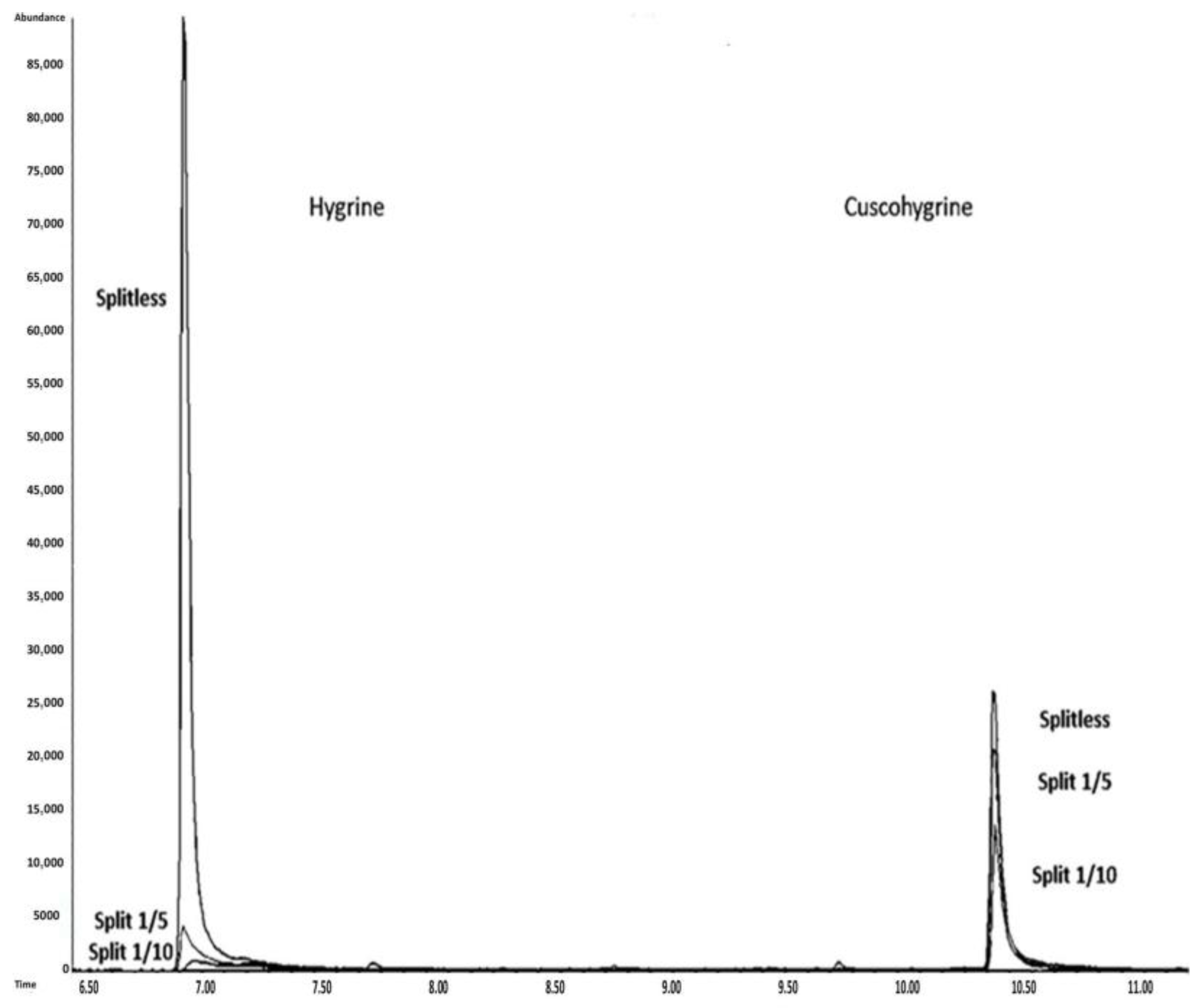
The impact of the injection mode (split versus splitless) on the formation of degradation products (HYG and HYG-d3) was evaluated. Table 4 summarizes the degradation percentages of HYG and HYG-d3 when a 10 µg/mL standard of CUS and CUS-d6 was injected using split (1:5 and 1:10) and splitless modes. In this table, degradation is expressed as %HYG (HYG/CUS), in contrast to other sections that use %CUS (CUS/HYG). This inversion was chosen to more clearly illustrate the extent of degradation caused by the different injection modes.
The results demonstrate that the split injection mode significantly reduces the formation of degradation products, with a direct correlation to the split ratio. Specifically, the percentage of HYG decreases from 29% in split mode 1:5 to 10% in split mode 1:10. In contrast, the percentage of HYG increases when the splitless mode is used, reaching a percentage of 285%. The same behavior is observed for HYG-d3. The calculations are as follows:
%HYG = (HYG (area)/CUS (area)) × 100;
%HYG-d3 = (HYG-d3 (area)/CUS-d6 (area)) × 100
However, this effect is minimized when normalizing the areas of CUS and HYG to their deuterated analogs since the normalized ratios remain nearly constant (Figure 7).
These observations can be explained by the differential impacts of split and splitless injection modes on analyte stability. In split mode, rapid removal of the vaporized sample through the split vent minimizes the analyte residence time in the heated inlet, reducing thermal degradation. Conversely, the splitless mode prolongs exposure in the hot zone, enhancing the degradation of thermolabile compounds such as CUS into HYG. This explains the marked increase in HYG formation under splitless conditions. These findings align with previous studies on CUS behavior in GC-MS systems [11]. However, despite its benefits in reducing degradation, split mode is not commonly used in forensic toxicology because of its lower sensitivity, which is a critical requirement for trace-level analysis.

3.5. Effects of Active Sites Along the GC Flow Path (Liner Surface)

Compounds can interact with active sites along the GC-MS flow path, leading to degradation and/or adsorption. Therefore, the lower the amount of injected analyte is, the greater the probability that the analyte could be lost through the GC flow path [12].
The liner used in this study was a standard Agilent split/splitless deactivated liner, which contains silanized glass wool in the central position. This configuration allows for improved vaporization efficiency and reproducibility in split and splitless injection modes [13]. However, even when deactivated, silanized glass wool can still exhibit residual active sites, especially under prolonged use or when exposed to complex biological matrices. This can contribute to the adsorption or partial degradation of polar or thermolabile compounds such as CUS and HYG.
The injected sample can interact with all the GC flow path components such as the column but also the injector and the detector [14]. The column and the inlet liner account for more than 90% of the total surface area with which the injected sample can interact after injection into the GC system. Interactions between targets and active sites in these regions can lead to degraded peak shapes, reduced signal responses, impaired peak integration, and compromised quantitation accuracy. CUS and HYG detection in oral fluid samples at low concentrations by GC-MS has been reported to be challenging, with evidence of potential adsorption and/or degradation at active sites in the GC-MS system [7]. This can be explained by the fact that CUS and HYG exhibit structural characteristics typical of active compounds (those capable of interacting strongly with active sites), such as polarity (low Log p value of 0.72), and the presence of functional groups, such as the keto group (C=O), that are prone to chemical reactions and can undergo degradation at active sites in the GC system. Additionally, the amino group on the pyrrolidine ring promotes weak interactions (van der Waals), which could increase the adsorption on active surfaces [15]. The results summarized in Table 5 and Table 6 show that the percentage of degradation products (%HYG and %HYG-d3) from CUS and CUS-d6 increases when liners are used several times (increased contamination attributed to residue from injected extracts).
The number of active sites along the flow path of a GC-MS system is not constant; it can vary over time and with use. Although the liners are highly deactivated (as specified by the manufacturer), these coatings can degrade because of exposure to high temperatures and reactive compounds. Therefore, liners must be regularly replaced to maintain optimal system performance.

3.6. Effects of Different Biological Matrices (Urine, Plasma, and Oral Fluid)

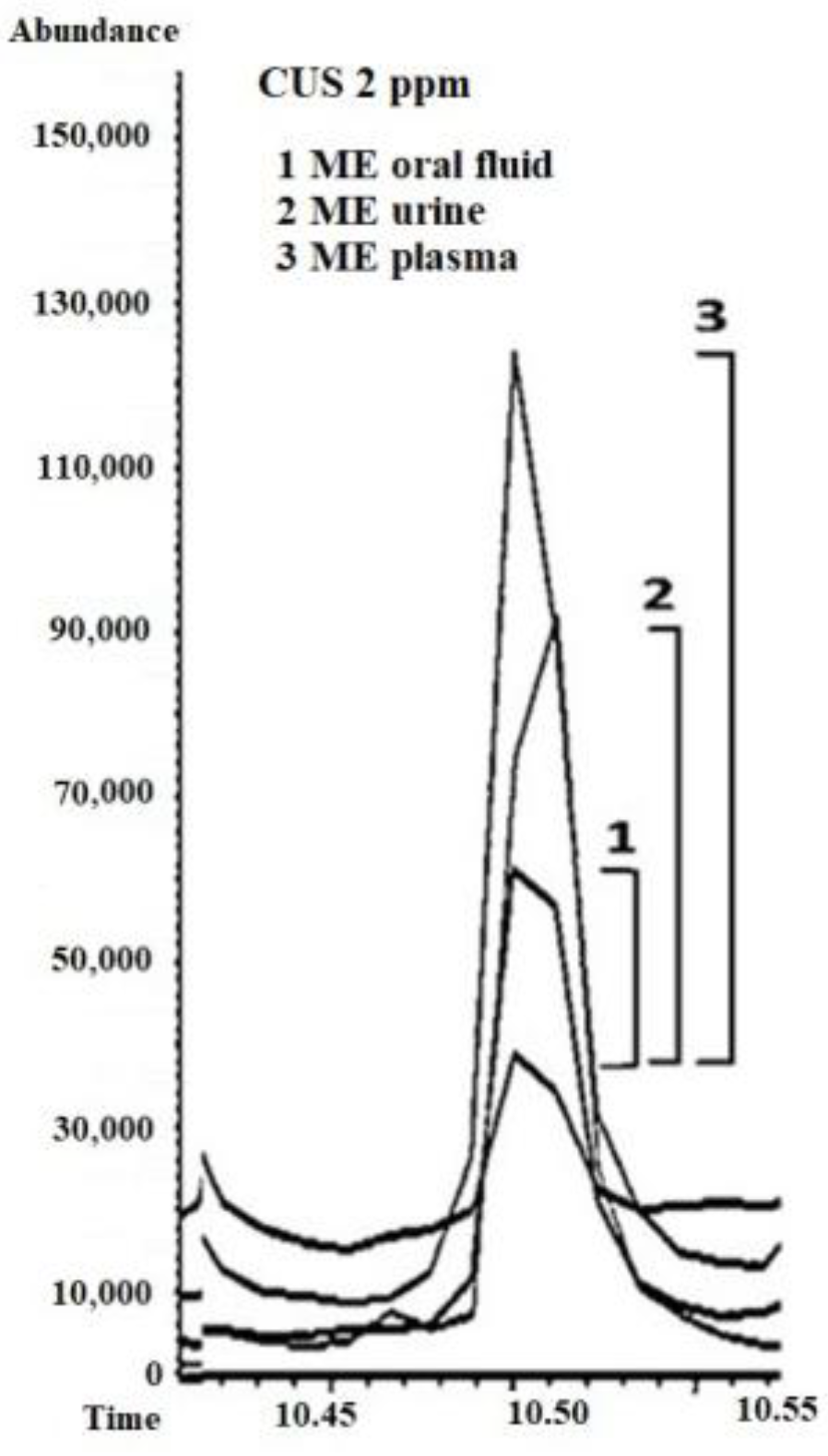
As shown in Table 7, ME% was found to be positive for the tested biological matrices, ranging from +64% to +316% for urine, from +95% to +142% for oral fluid, and from +29% to +256% for plasma. Based on these results and previous findings [7], CUS has a positive and variable matrix effect dependent on the biological matrix, even within the same matrix type (urine, oral fluid, or plasma), depending on the sample donor (Figure 8).
The calculation of the matrix effect when normalized areas were compared against internal standards (ME (n)%) revealed that the matrix composition was less influential (Table 7), and, for example, ME% (+95%) was reduced to +14% (ME (n)%) in oral fluid when areas normalized with internal standards (deuterated analogs) were used.
Although less frequently discussed for GC-MS methods, our findings demonstrate that matrix effects can have a significant impact on analyte response [16,17].
The matrix effect is a well-recognized analytical phenomenon, particularly in LC-MS/MS using electrospray ionization, and it is addressed in validation guidelines, such as those from SWGTOX [18] and the GTFCh (German Society of Toxicological and Forensic Chemistry) [19]. Although matrix effects are more commonly associated with liquid chromatography-based techniques, they can also significantly influence gas chromatography–mass spectrometry (GC-MS) results. In this study, the observed signal enhancement (positive ME%) is attributed to the interaction of the analytes with active sites within the GC-MS system, including the inlet liner, GC column, and electron ionization (EI) source. These active sites—such as unreacted silanol groups or exposed metal surfaces—can adsorb or thermally degrade polar compounds like cuscohygrine. However, when biological matrix components are present, they may compete for or block these sites, reducing analyte loss and resulting in an enhanced signal. Even though silanized glass wool and deactivated liners are used to minimize surface activity, residual sites may still persist, particularly after repeated use or exposure to complex biological matrices. Importantly, this enhancement was not associated with any shift in retention time, which remained consistent across the matrix and solvent conditions in our data. It is worth noting that, unlike LC-MS/MS—where matrix effects primarily affect ionization efficiency—GC-MS matrix effects arise from physicochemical interactions that occur prior to ionization, particularly in the injection port and flow path. This fundamental difference helps explain why matrix effects in GC-MS may result in signal enhancement rather than suppression.
On the other hand, CUS, as previously mentioned, has chemical characteristics that are susceptible to promoting a positive matrix effect like other chemical compounds reported in the literature, such as pesticides [15].

4. Conclusions

We have advanced our understanding of the behavior of CUS when it is assessed by GC-MS. The determination of CUS and HYG by GC-MS has revealed significant analytical challenges due to the low intensity and structural specificity of the generated m/z fragments, which make the assessment of CUS at low concentrations in biological samples extremely difficult. Unlike other coca leaf alkaloids such as COC, TRO, and CIN, CUS appears to be an active compound with significant interactions at active sites within the liner, underscoring the importance of using ultra-deactivated liners. In addition, CUS undergoes adsorption and thermal degradation, as evidenced by the pronounced matrix effects observed in the tested biological matrices (plasma, oral fluid, and urine) and by the variations in the areas of CUS, CUS-d6, and their degradation products (HYG and HYG-d3) with the injector temperature (from 180 to 290 °C). Some of these effects can be corrected by using an internal standard (normalization of CUS chromatographic peak areas using a deuterated analog such as CUS-d6). The behavior of HYG should be further investigated to determine why its response does not correlate with that of CUS. Further studies using HYG standards are necessary to elucidate these conclusions. Additionally, whether the response of CUS could vary in the presence of other alkaloids from the coca leaf, such as cocaine, ecgonine methyl ester, cinnamoylcocaine, and tropacocaine, which are common alkaloids found in biological samples of individuals who consume coca leaf in its various forms, should be examined. Ultimately, the findings of this study provide a rationale for why GC-MS should not be considered a recommended technique for the analysis of the alkaloids HYG and CUS, which have been proposed as biomarkers of coca leaf use.
Although this study focused on assessing the analytical limitations of GC-MS under standard operating conditions common in forensic toxicology laboratories, particularly in resource-limited settings, we acknowledge that alternative approaches such as derivatization strategies or cold on-column injection may warrant further investigation. However, their applicability to CUS and HYG remains to be validated experimentally. In addition, strategies commonly used in pesticide residue analysis—such as the use of analyte protectants (APs) to block active sites in the GC inlet or column—may offer potential for improving analyte stability and recovery [15]. These compounds can minimize adsorption and degradation by occupying reactive surfaces within the GC flow path and could be adapted for polar and thermally labile alkaloids like CUS and HYG. Future studies should explore these techniques in depth, particularly if they can be incorporated into routine workflows without compromising feasibility or compliance with forensic standards.
Although the aim of this work was not to carry out analytical validation, it was carried out in a previous study [7].

Author Contributions

N.C.R. contributed to conceptualization, investigation, methodology, validation, software, and writing—original draft preparation. I.A.-F. contributed to validation, methodology, and writing—review and editing. P.C.-F. contributed to the methodology and writing—review and editing. M.J.T.-D. contributed to conceptualization, resources, and writing—review and editing. I.S.-S. contributed to resources and writing—review and editing. A.M.-P. contributed to conceptualization, supervision, and writing—original draft preparation. P.B.-B. contributed to conceptualization, supervision, and writing—review and editing. A.M.B.-B. contributed to conceptualization, supervision, and writing—review and editing. All authors have read and agreed to the published version of the manuscript.

Funding

This research received no external funding.

Data Availability Statement

The original contributions presented in the study are included in the article; further inquiries can be directed to the corresponding author.

Conflicts of Interest

The authors declare no conflicts of interest.

References

  1. Rubio, N.C.; Hastedt, M.; Gonzalez, J.; Pragst, F. Possibilities for discrimination between chewing of coca leaves and abuse of cocaine by hair analysis including hygrine, cuscohygrine, cinnamoylcocaine and cocaine metabolite/cocaine ratios. Int. J. Leg. Med. 2014, 129, 69–84. [Google Scholar] [CrossRef] [PubMed]
  2. Rubio, N.C.; Strano-Rossi, S.; Tabernero, M.J.; Anzillotti, L.; Chiarotti, M.; Bermejo, A.M. Hygrine and cuscohygrine as possible markers to distinguish coca chewing from cocaine abuse in workplace drug testing. Forensic Sci. Int. 2003, 227, 60–63. [Google Scholar] [CrossRef] [PubMed]
  3. Rubio, N.C.; Moreda-Piñeiro, A.; Bermejo-Barrera, P.; Bermejo, A.M. Coca alkaloids profile in oral fluid from people chewing coca leaves and drinking coca tea: Preliminary study. Acta Toxicol. Argent. 2019, 27, 72–80. [Google Scholar]
  4. Argentine Federal Law 23737, art.15. O.B. October 10, 1989. Ley 23737/1989. Available online: https://docs.argentina.justia.com/federales/leyes/ley-n-23737-oct-11-1989.pdf (accessed on 29 January 2025).
  5. Maurer, H.H. Pitfalls in drugs testing by hyphenated low- and high-resolution mass spectrometry. Drug Test. Anal. 2020, 12, 172–179. [Google Scholar] [CrossRef] [PubMed]
  6. ANSI/ASB Standard 113; ANSI/ASB Standard for Identification Criteria in Forensic Toxicology, First Edition. AAFS Standards Board, LLC: Colorado Springs, CO, USA, 2023.
  7. Cabarcos-Fernández, P.; Álvarez-Freire, I.; Rubio, N.C.; Moreda-Piñeiro, A.; Sánchez-Sellero, I.; Bermejo-Barrera, A.M.; Tabernero-Duque, M.J. Evaluation of an Oral Fluid Collection Device and a Solid-Phase Extraction Method for the Determination of Coca Leaf Alkaloids by Gas Chromatography–Mass Spectrometry. Molecules 2024, 29, 592. [Google Scholar] [CrossRef] [PubMed]
  8. Rubio, N.C.; Strano-Rossi, S.; Tabernero, M.J.; González, J.L.; Anzillotti, L.; Chiarotti, M.; Bermejo, A.M. Application of hygrine and cuscohygrine as possible markers to distinguish coca chewing from cocaine abuse on WDT and forensic cases. Forensic Sci. Int. 2014, 243, 30–34. [Google Scholar] [CrossRef] [PubMed]
  9. Álvarez-Freire, I.; Cabarcos-Fernández, P.; Rubio, N.C.; Moreda-Piñeiro, A.; Tabernero-Duque, M.J.; Sánchez-Sellero, I.; Bermejo-Barrera, P.; Bermejo-Barrera, A.M. Detection of coca alkaloids in oral fluid from coca leaf (tea) consumers: Using solid phase extraction to improve validation parameters and widen the detection window. Anal. Methods 2023, 15, 6177–6183. [Google Scholar] [CrossRef] [PubMed]
  10. Matuszewski, B.K.; Constanzer, M.L.; Chavez-Eng, C.M. Strategies for the Assessment of Matrix Effect in Quantitative Bioanalytical Methods Based on HPLC-MS/MS. Anal. Chem. 2003, 75, 3019–3030. [Google Scholar] [CrossRef] [PubMed]
  11. Kenji, T.; Kenji, K.; Tatsuyuki, K.; Yuko, T.; Iwata, H.I. Thermal degradation of a-pyrrolidinopentiophenone during injection in gas chromatography/mass spectrometry. Forensic Sci. Int. 2013, 231, 296–299. [Google Scholar]
  12. Agilent. Available online: https://www.agilent.com/library/applications/5991-2745EN.pdf (accessed on 20 March 2023).
  13. English, C. Does the Position of Wool in the Inlet Matter? LCGC Int. News Column 2024, 20, 14–17. Available online: www.chromatographyonline.com/view/does-position-wool-inlet-matter- (accessed on 15 July 2025).
  14. Majors, R.E.; Hastings, M. The Inert Flow Path Story for GC and GC–MS: Eliminating the Weakest Links; LCGC North America: Waltham, MA, USA, 2013; Volume 31, pp. 448–454. [Google Scholar]
  15. Poole, C.F. Matrix-induced response enhancement in pesticide residue analysis by gas chromatography. J. Chromatogr. A 2007, 1158, 241–250. [Google Scholar] [CrossRef] [PubMed]
  16. Hayama, T. Matrix effects in mass spectrometry analysis. Anal. Sci. 2020, 36, 1151–1156. [Google Scholar] [CrossRef] [PubMed]
  17. Hajslová, J.; Zrostlíková, J. Matrix effects in (ultra)trace analysis of pesticide residues in food and biotic matrices. J. Chromatogr. A 2003, 1000, 181–197. [Google Scholar] [CrossRef] [PubMed]
  18. SWGTOX Scientific Working Group for Forensic Toxicology. Scientific working groups for forensic toxicology standard practices for method validation in forensic toxicology. J. Anal. Toxicol. 2013, 37, 452–474. [Google Scholar] [CrossRef] [PubMed]
  19. GTFCh Guidelines for Quality Assurance in Forensic-Toxicological Analyses-Requirements for the Validation of Analytical Methods Änderungshinweise. Appendix B. Available online: https://gtfch.org/ (accessed on 1 April 2023).
Figure 1. Alkaloids derived from L-ornitine.
Separations 12 00201 g001
Figure 2. GC-mass spectra of CUS (20 µg/mL; (A)), CUS-d6 (25 µg/mL; (B)), and their degradation products HYG (C) and HYG-d3 (D). SCAN mode. Injector temperature: 250 °C.
Separations 12 00201 g002
Figure 3. GC-MS chromatogram (SIM mode) of specific ions 84, 42, 140, and 98 from CUS at 0.5 µg/mL. Injector temperature: 250 °C.
Separations 12 00201 g003
Figure 4. GC-MS chromatogram (SCAN mode, ion extraction m/z 84) of CUS (20 µg/mL) in methanol and ethyl acetate. The first peak (6.7 min) corresponds to HYG, formed as a thermal degradation product of CUS. The second peak (10.4 min) corresponds to intact CUS. Injector temperature: 250 °C.
Separations 12 00201 g004
Figure 5. GC-MS chromatogram (SCAN mode, ion extraction m/z 84) of CUS (0.5 µg/mL) at different injector temperatures: 210 °C, 250 °C, 270 °C, and 290 °C. The right-hand peak (approx. 10.4 min) corresponds to CUS, while the left-hand peak (approx. 6.5 min) corresponds to its degradation product, HYG. Injector: splitless mode.
Separations 12 00201 g005
Figure 6. GC-MS chromatogram in SIM mode (m/z 84, 42, 140 and 98 for CUS at 210, 250, 270 and 290 °C).
Separations 12 00201 g006
Figure 7. Mode injection effect. Split 1:5 and 1:10 and splitless modes. GC-MS chromatogram, SCAN mode.
Separations 12 00201 g007
Figure 8. Matrix effect of oral fluid, urine, and plasma in SCAN mode (ion extraction m/z 84).
Separations 12 00201 g008
Table 1. Charge-to-mass ratios of CUS and HYG in GC-MS using an injector temperature of 250 °C.
HYGCUS
m/z(%)m/z(%)
8410084100
14011408
14121411
12611261
985989
706702
42164217
2094
2230.3
2240.1
Table 2. CUS and CUS-d6 area percentages considering HYG and HYG-d3 areas as 100% (solvents: methanol (A) and ethyl acetate (B)) and normalized CUS area.
A-CUS_CUS-d6 Methanol
0.5 µg/mLInj. Temp. (°C)%CUS (area)%CUS-d6 (area)CUS/CUS-d6
21010--
25029390.599
27032440.577
29037800.457
2 µg/mLInj. Temp. (°C)%CUS (area)%CUS-d6 (area)CUS/CUS-d6
21013140.712
25011110.754
27031350.759
29037380.720
10 µg/mLInj. Temp. (°C)%CUS (area)%CUS-d6 (area)CUS/CUS-d6
2101090.754
25028260.736
27043380.736
29056500.732
10 µg/mL(*)Inj. Temp. (°C)%CUS (area)
180177
250268
290302
B-CUS_CUS-d6 Ethyl Acetate
10 µg/mLInj. Temp. (°C)%CUS (area)%CUS-d6 (area)CUS/CUS-d6
21014110.810
29050410.711
20 µg/mLInj. Temp. (°C)%CUS (area)
18012
25013
29036
25 µg/mLInj. Temp. (°C)%CUS (area)
25036
29069
(*) New liner. %CUS (area) = (CUS/HYG) × 100; percentage of the area of CUS, considering the area of HYG as 100%. %CUS-d6 (area) = (CUS-d6/HYG-d3) × 100; percentage of the area of CUS-d6, considering the area of HYG-d3 as 100%. CUS/CUS-d6: normalized CUS area.
Table 3. Relative standard deviation of HYG and CUS areas at several injection temperatures, concentrations, and solvents.
SolventInjector Temperature (°C)Concentration
(µg/mL)
%RSD HYG%RSD CUS
Methanol210, 250, 270, 2900.52340
Methanol210, 250, 270, 29021549
Methanol210, 250, 270, 290101747
Methanol180, 250, 290101536
Methanol180, 250, 290206090
Methanol210, 250, 29020833
Methanol250, 290251630
Ethyl Acetate210, 290101769
Ethyl Acetate210, 29010 (d6) *675
RSD: relative standard deviation. (d6) *: CUS-d6.
Table 4. Degradation product percentages (HYG, HYG-d3) and normalized CUS and HYG areas under different injection modes.
Injection Mode%HYG%HYG-d3R = area CUS/area CUS-d6R = area HYG/area HYG-d3
Split 1/1010200.580.50
Split 1/529370.610.48
Splitless2853010.570.54
%HYG = (area HYG/area CUS) × 100%HYG-d3 = (area HYG-d3/area CUS-d6) × 100. R = area CUS/area CUS-d6: normalized CUS area. R = area HYG/area HYG-d3: normalized HYG area.
Table 5. CUS area percentages considering HYG area as 100% for several liner conditions and injector temperatures.
CUS (µg/mL)Day/Liner ConditionInjector Temperature (°C)%CUS (area)
1.01/liner used for 7 days25055
30/liner used for 1 day25065
60/liner used for 9 days25055
90/liner used for 20 days25012
2.01/new liner250125
2/liner used 1 day250102
101/new liner180177
1/new liner250268
1/new liner250302
201/new liner25051
15/liner used for 15 days25027
19/liner used for 19 days25013
20/new liner25045
1/liner used for 6 days29062
2/new liner29087
%CUS (area) = (CUS/HYG) × 100; percentage of the area of CUS, considering the area of HYG as 100%.
Table 6. CUS-d6 area percentages considering HYG-d3 area as 100% in several liner conditions and injector temperatures.
CUS-d6 (µg/mL)Day/Liner ConditionInjector Temperature (°C)%CUS (area)
2.01/new liner250102
2/liner used for 1 day25098
101/liner used for 6 days29050
2/new liner29046
251/liner used for 19 days29069
2/new liner290132
1/liner used for 19 days25023
2/new liner25057
%CUS-d6 (area) = (CUS-d6/HYG-d3) × 100; percentage of the area of CUS-d6, considering the area of HYG-d3 as 100%.
Table 7. Urine, oral fluid, and plasma matrix effect.
CUS (µg/mL)Spiked Blank ExtractME (%)ME (n) (%)
1.0Urine_1+203-
Urine_2+316-
OF_1+142-
Plasma_1+256-
2.0Urine_3+64+14
OF_2+95+14
Plasma_2+29+8
ME (%) = (B/A×100) − 100 ME (n) (%) = (B/A×100) − 100; A: Neat standard solutions. B: Spiked blank (urine, oral fluid, or plasma) samples after extraction. (n): Normalized areas with deuterated internal standards (CUS-d6, 2 µg/mL).
Disclaimer/Publisher’s Note: The statements, opinions and data contained in all publications are solely those of the individual author(s) and contributor(s) and not of MDPI and/or the editor(s). MDPI and/or the editor(s) disclaim responsibility for any injury to people or property resulting from any ideas, methods, instructions or products referred to in the content.