
Adsorption Materials for Carbon Capture: Research Advancements and Prospects

Abstract
1. Introduction
2. Adsorption Mechanisms and Influencing Factors of Carbon Capture
2.1. Adsorption Mechanisms
2.2. Parameters for Assessing Adsorption
2.3. Influencing Factors
2.3.1. Intrinsic Structure of the Adsorbent
2.3.2. External Environmental Conditions
3. Adsorbents and Their Research Progress for Carbon Capture
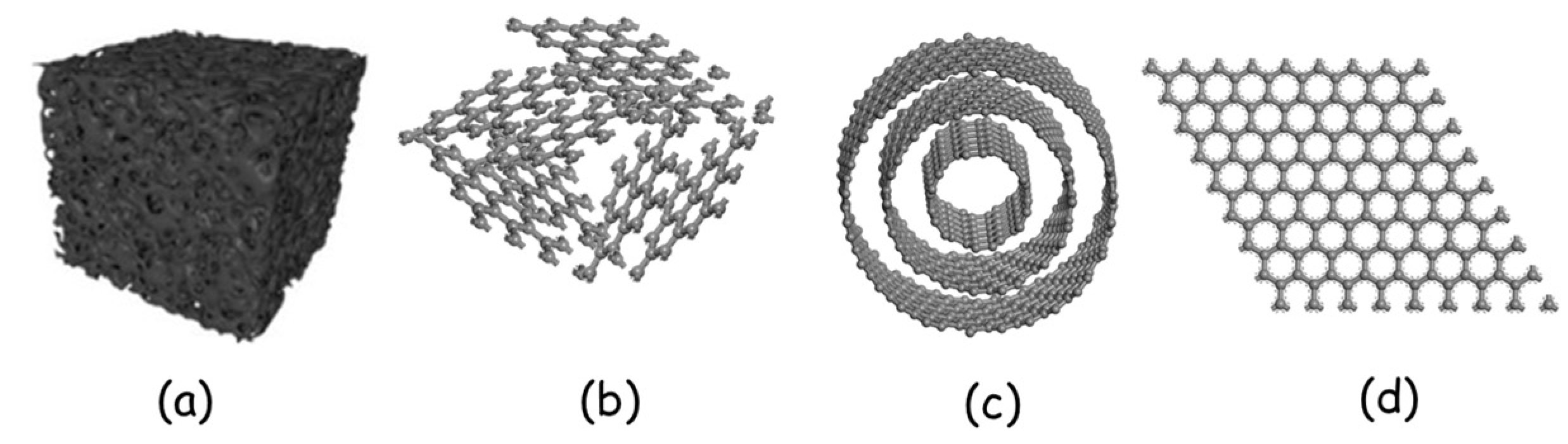
3.1. Porous Carbon-Based Material
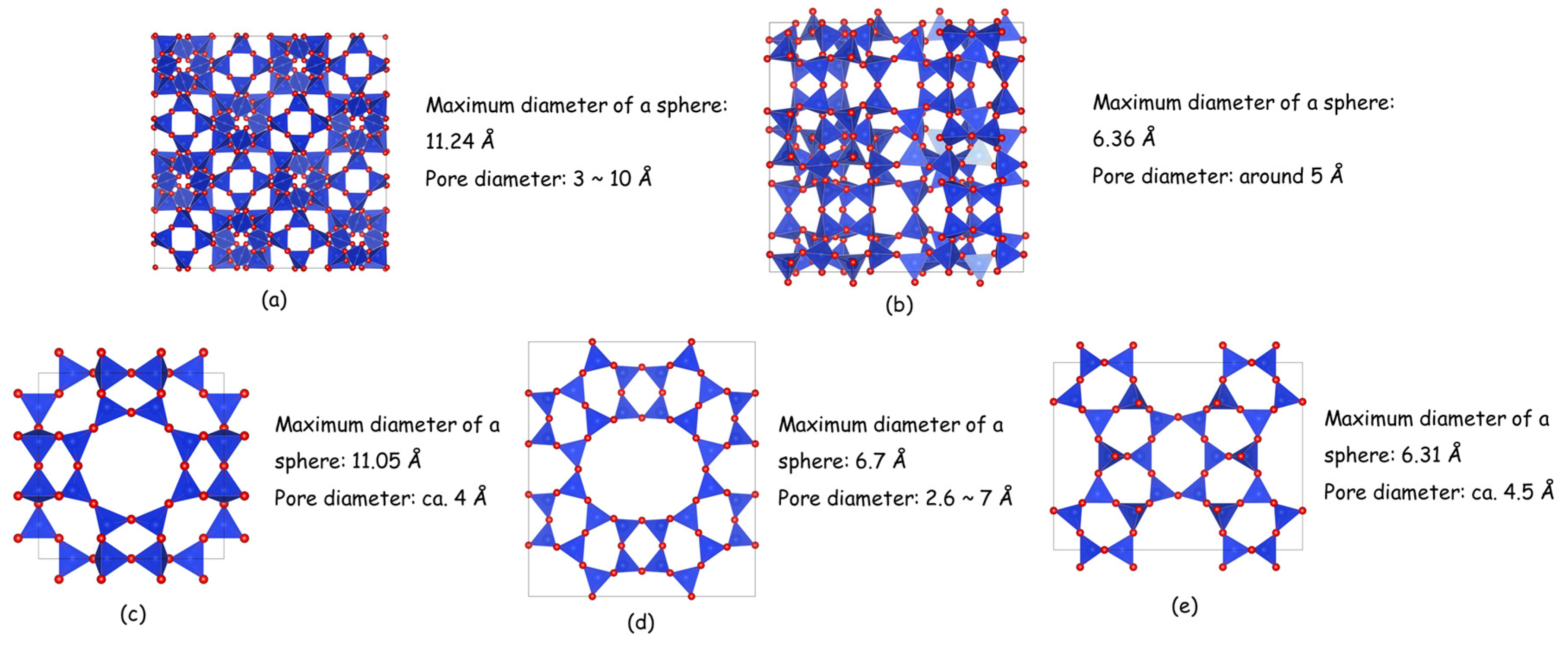
3.2. Zeolites
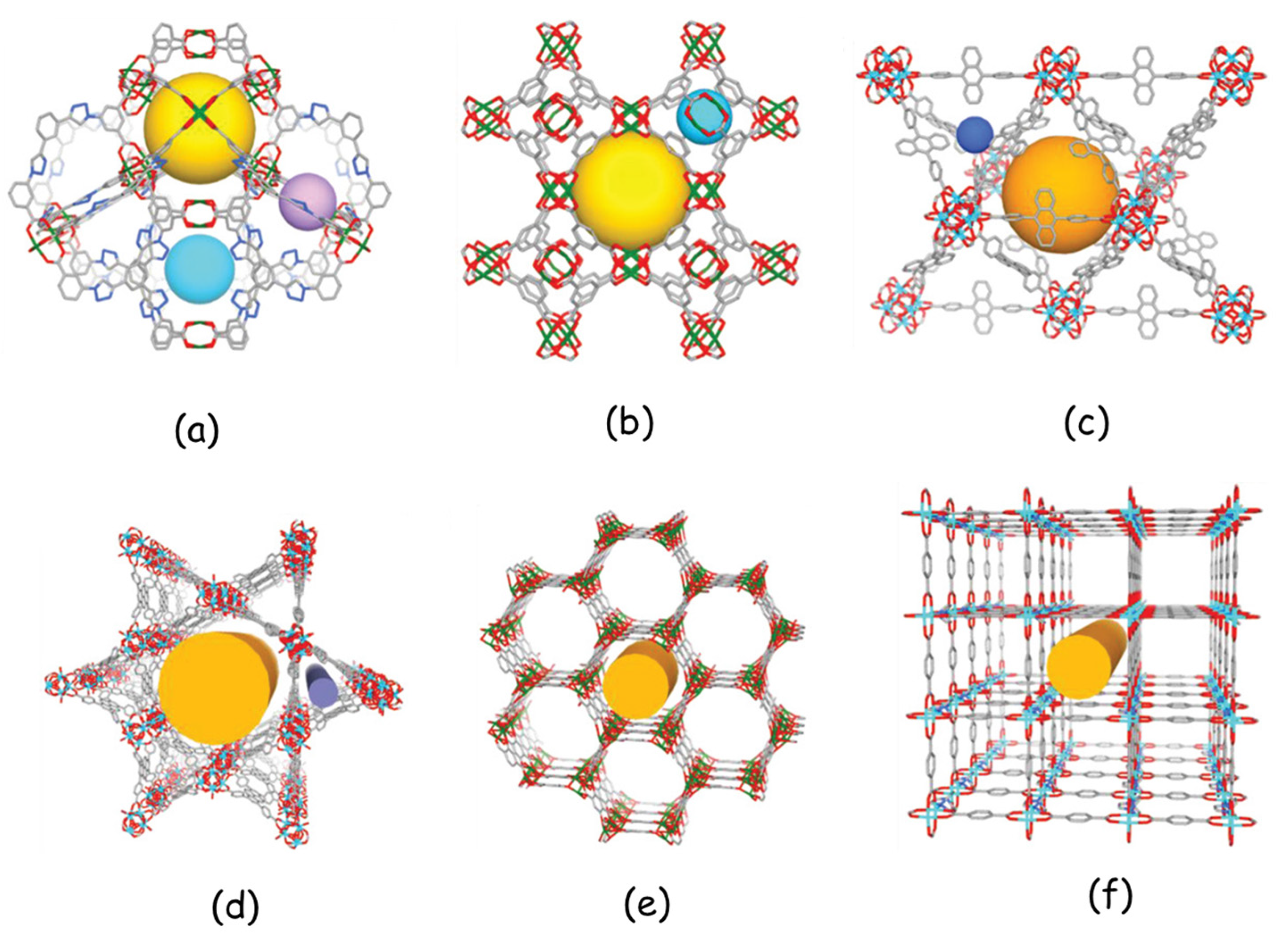
3.3. Metal–Organic Frameworks (MOFs)
3.4. Solid Amines
3.5. Porous Liquids
3.6. Supported Ionic Liquid Phase (SILP)
4. Optimal Design of Adsorbents and Prospects for Carbon Capture
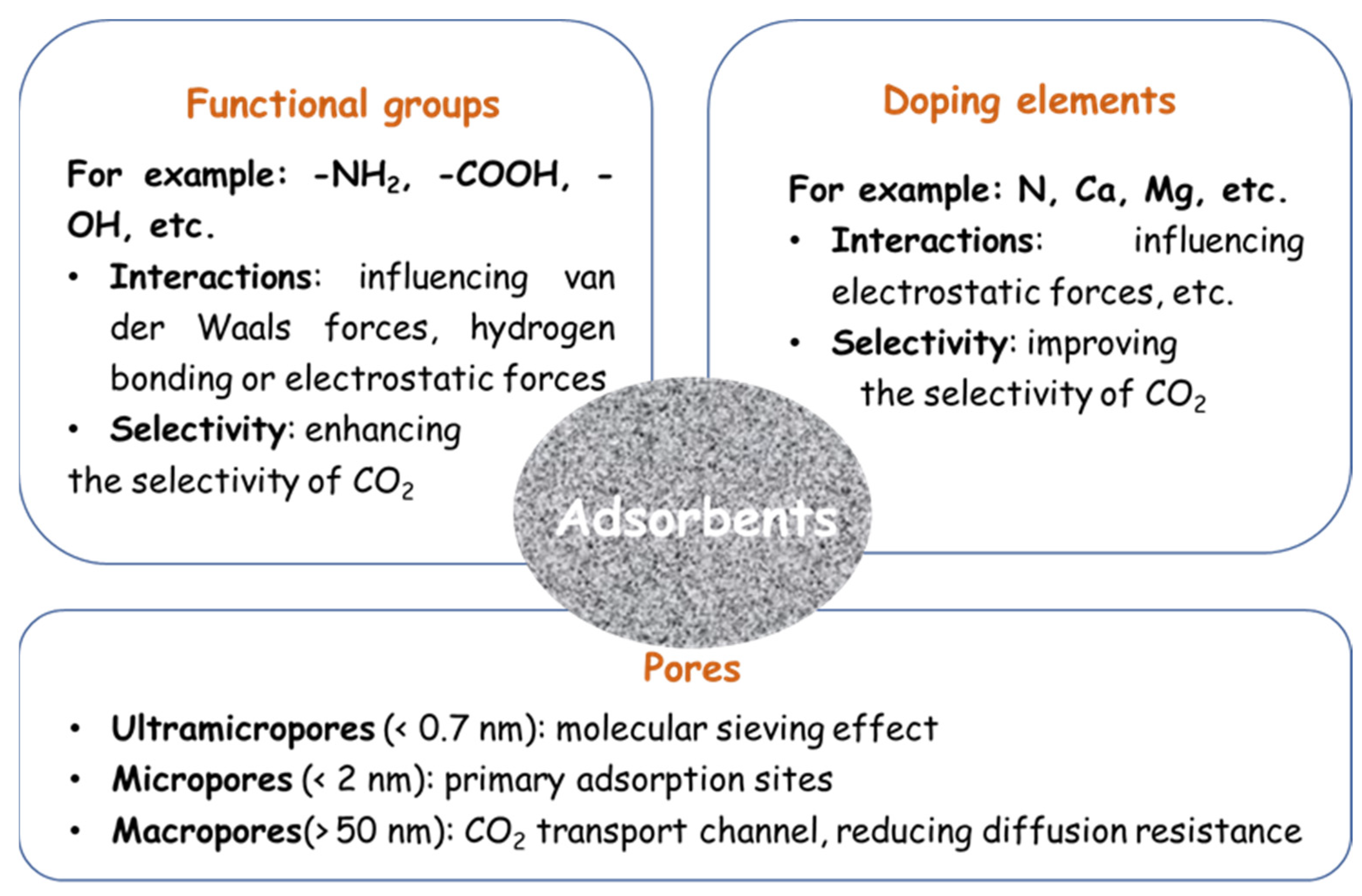
4.1. Design Strategies for Improving CO2 Capture Performance
4.2. Future Perspectives in Adsorbent Design
- (1)
- In real flue gas environments, water vapor can cause the structural collapse of some MOFs, while SOx/NOx can react with amine functional groups, resulting in the adsorbent material poisoning. Hydrophobic and SOx/NOx-resistant CO2 capture adsorbents should be developed in the future.
- (2)
- The mass production and application of high-performance CO2 adsorbents, e.g., carbon nanomaterials-based adsorbents and MOFs, remain limited by some factors, including complex organic ligands, energy-intensive synthesis (high temperature/pressure), etc. Exploring cheap materials or industrial by-products as ligands and developing green, low-energy methods like room-temperature synthesis, optimizing production processes are key strategies for synthesizing novel high-performance adsorbents. It should be noted that the advancement of various computational methods and artificial intelligence (AI) will enable the high-throughput virtual screening of adsorbent materials. Concurrently, these simulation methods and AI prediction can guide the optimization of reaction conditions toward identifying optimal and energy-efficient synthesis routes, which significantly accelerates the rational design of novel adsorbents.
- (3)
- As the theoretical foundation for rationally designing adsorbents, the structural evolution and adsorption mechanisms of adsorbents under operating conditions need to be further investigated. The integration of advanced experimental methods (e.g., in situ/operando X-ray diffraction, infrared spectroscopy, and solid-state nuclear magnetic resonance) and molecular-level theoretical simulations (e.g., density functional theory and molecular dynamics) is crucial for unraveling the CO2 adsorption mechanism. Theoretical computational methods can provide valuable insights into electronic structures, energies, adsorption configurations, and reaction pathways, all of which are particularly vital for elucidating the adsorption mechanisms.
- (4)
- Given that the structure–property relationship in materials is complex, the conventional trial-and-error method for developing novel CO2 capture material is time-consuming and high-cost. Therefore, there is an urgent need to build high-quality databases and establish machine learning models that can predict adsorption capability from adsorbent structures. Moreover, multi-dimensional models integrating reaction conditions with material structural features represent a key future direction. These theoretical prediction results can guide experimental synthesis, thereby accelerating the development of new CO2 capture materials.
5. Conclusions
Author Contributions
Funding
Data Availability Statement
Conflicts of Interest
References
- Lashof, D.A.; Ahuja, D.R. Relative contributions of greenhouse gas emissions to global warming. Nature 1990, 344, 529. [Google Scholar] [CrossRef]
- Filonchyk, M.; Peterson, M.P.; Zhang, L.F.; Hurynovich, V.; He, Y. Greenhouse gases emissions and global climate change: Examining the influence of CO2, CH4, and N2O. Sci. Total Environ. 2024, 935, 173359. [Google Scholar] [CrossRef]
- WMO. Greenhouse Gas Bulletin; World Meteorological Organization: Geneva, Switzerland, 2021. [Google Scholar]
- IPCC. Climate Change 2022: Mitigation of Climate Change; Shukla, P.R., Skea, J., Slade, R., Al Khourdajie, A., van Diemen, R., McCollum, D., Pathak, M., Some, S., Vyas, P., Fradera, R., et al., Eds.; Cambridge University Press: Cambridge, UK; New York, NY, USA, 2022. [Google Scholar]
- Davarpanah, A. Comparative evaluation of carbon capture, utilization, and storage (CCUS) technologies using multi-criteria decision-making approaches. ACS Sustain. Chem. Eng. 2024, 12, 9498–9510. [Google Scholar] [CrossRef]
- El-Kady, A.H.; Amin, M.T.; Khan, F.; El-Halwagi, M.M. Analysis of CO2 pipeline regulations from a safety perspective for offshore carbon capture, utilization, and storage (CCUS). J. Clean. Prod. 2024, 439, 140734. [Google Scholar] [CrossRef]
- Ding, H.B.; Zhang, Y.; Dong, Y.Y.; Wen, C.; Yang, Y. High-pressure supersonic carbon dioxide (CO2) separation benefiting carbon capture, utilisation and storage (CCUS) technology. Appl. Energy 2023, 339, 120975. [Google Scholar] [CrossRef]
- Liang, B.; Chen, C.; Jia, C.S.; Wang, C.H.; Wang, X.Z.; Zha, Y.Q.; Wang, R.; Meng, Z.; Wang, H. Carbon capture, utilization and storage (CCUS) in oil and gas reservoirs in China: Status, opportunities and challenges. Fuel 2024, 375, 132353. [Google Scholar] [CrossRef]
- Herzog, H.; Meldon, J.; Hatton, A. Advanced Post-Combustion CO2 Capture; Clean Air Task Force: Boston, MA, USA, 2009. [Google Scholar]
- Chao, C.; Deng, Y.; Dewil, R.; Baeyens, J.; Fan, X. Post-combustion carbon capture. Renew. Sustain. Energy Rev. 2021, 138, 110490. [Google Scholar] [CrossRef]
- Rubin, E.S.; Chen, C.; Rao, A.B. Cost and performance of fossil fuel power plants with CO2 capture and storage. Energy Pol. 2007, 35, 4444–4454. [Google Scholar] [CrossRef]
- Samanta, A.; Zhao, A.; Shimizu, G.K.H.; Sarkar, P.; Gupta, R. Post-combustion CO2 capture using solid sorbents: A review. Ind. Eng. Chem. Res. 2012, 51, 1438–1463. [Google Scholar] [CrossRef]
- Liu, J.; Baeyens, J.; Deng, Y.; Tan, T.; Zhang, H. The chemical CO2 capture by carbonation-decarbonation cycles. J. Environ. Manag. 2020, 260, 110054. [Google Scholar] [CrossRef]
- Toftegaard, M.B.; Brix, J.; Jensen, P.A.; Glarborg, P.; Jensen, A.D. Oxy-fuel combustion of solid fuels. Prog. Energy Combust. Sci. 2010, 36, 581–625. [Google Scholar] [CrossRef]
- Nouri, E.; Raouf, F.; Alyani, S.J.; Kardan, A.; Moghaddam, A.M. Carbon dioxide capture and utilization in post-combustion: A review. Environ. Sci. Pollut. Res. 2025, 32, 14351–14382. [Google Scholar] [CrossRef]
- Zhang, Z.; Wang, T.; Blunt, M.J.; Anthony, E.J.; Park, A.-H.A.; Hughes, R.W.; Webley, P.A.; Yan, J. Advances in carbon capture, utilization and storage. Appl. Energy 2020, 278, 115627. [Google Scholar] [CrossRef]
- Hanson, E.; Nwakile, C.; Hammed, V.O. Carbon capture, utilization, and storage (CCUS) technologies: Evaluating the effectiveness of advanced CCUS solutions for reducing CO2 emissions. Surf. Interf. 2025, 18, 100381. [Google Scholar] [CrossRef]
- Pfister, M.; Belaissaoui, B.; Favre, E. Membrane gas separation processes from wet postcombustion flue gases for carbon capture and use: A critical reassessment. Ind. Eng. Chem. Res. 2017, 56, 591–602. [Google Scholar] [CrossRef]
- Zhao, L.; Riensche, E.; Blum, L.; Stolten, D. Multi-stage gas separation membrane processes used in post-combustion capture: Energetic and economic analyses. J. Membr. Sci. 2010, 359, 160–172. [Google Scholar] [CrossRef]
- He, X.; Fu, C.; Hägg, M.-B. Membrane system design and process feasibility analysis for CO2 capture from flue gas with a fixed-site-carrier membrane. Chem. Eng. J. 2015, 268, 1–9. [Google Scholar] [CrossRef]
- Shen, M.; Tong, L.; Yin, S.; Liu, C.; Wang, L.; Feng, W.; Ding, Y. Cryogenic technology progress for CO2 capture under carbon neutrality goals: A review. Sep. Purif. Technol. 2022, 299, 121734. [Google Scholar] [CrossRef]
- Lee, S.-Y.; Park, S.-J. A review on solid adsorbents for carbon dioxide capture. J. Ind. Eng. Chem. 2015, 23, 1–11. [Google Scholar] [CrossRef]
- Glenna, D.M.; Jana, A.; Xu, Q.; Wang, Y.; Meng, Y.; Yang, Y.; Neupane, M.; Wang, L.; Zhao, H.; Qian, J.; et al. Carbon capture: Theoretical guidelines for activated carbon-based CO2 adsorption material evaluation. J. Phys. Chem. Lett. 2023, 14, 10693–10699. [Google Scholar] [CrossRef]
- Abd, A.A.; Othman, M.R.; Kim, J. A review on application of activated carbons for carbon dioxide capture: Present performance, preparation, and surface modification for further improvement. Environ. Sci. Pollut. Res. 2021, 28, 43329–43364. [Google Scholar] [CrossRef]
- Cao, L.; Zhang, X.; Xu, Y.; Xiang, W.; Wang, R.; Ding, F.; Hong, P.; Gao, B. Straw and wood based biochar for CO2 capture: Adsorption performance and governing mechanisms. Sep. Purif. Technol. 2022, 287, 120592. [Google Scholar] [CrossRef]
- Chen, Z.; Deng, S.; Wei, H.; Wang, B.; Huang, J.; Yu, G. Activated carbons and amine-modified materials for carbon dioxide capture—A review. Front. Environ. Sci. Eng. 2013, 7, 326–340. [Google Scholar] [CrossRef]
- Ramar, V.; Balraj, A. Critical review on carbon-based nanomaterial for carbon capture: Technical challenges, opportunities, and future perspectives. Energy Fuel 2022, 36, 13479–13505. [Google Scholar] [CrossRef]
- Soo, X.Y.D.; Lee, J.J.C.; Wu, W.Y.; Tao, L.; Wang, C.; Zhu, Q.; Bu, J. Advancements in CO2 capture by absorption and adsorption: A comprehensive review. J. CO2 Util. 2024, 81, 102727. [Google Scholar] [CrossRef]
- Hou, R.; Fong, C.; Freeman, B.D.; Hill, M.R.; Xie, Z. Current status and advances in membrane technology for carbon capture. Sep. Purif. Technol. 2022, 300, 121863. [Google Scholar] [CrossRef]
- Qiao, S.; Xu, M.; Lv, X.; Zhao, H. Analysis and optimization of cryogenic distillation systems: For reducing distillation energy consumption. Chem. Eng. Technol. 2025, 48, e202400296. [Google Scholar] [CrossRef]
- Hasan, H.F.; Al-Sudani, F.T.; Albayati, T.M.; Salih, I.K.; Hharah, H.N.; Majdi, H.S.; Saady, N.M.C.; Zendehboudi, S.; Amari, A.; Gheni, S.A. Solid adsorbent material: A review on trends of post-combustion CO2 capture. Process Saf. Environ. 2024, 182, 975–988. [Google Scholar] [CrossRef]
- Creamer, A.E.; Gao, B. Carbon-based adsorbents for postcombustion CO2 capture: A critical review. Environ. Sci. Technol. 2016, 50, 7276–7289. [Google Scholar] [CrossRef]
- Hasan, M.M.F.; First, E.L.; Floudas, C.A. Cost-effective CO2 capture based on in silico screening of zeolites and process optimization. Phys. Chem. Chem. Phys. 2013, 15, 17601–17618. [Google Scholar] [CrossRef]
- Xiang, S.; He, Y.; Zhang, Z.; Wu, H.; Zhou, W.; Krishna, R.; Chen, B. Microporous metal-organic framework with potential for carbon dioxide capture at ambient conditions. Nat. Commun. 2012, 3, 954. [Google Scholar] [CrossRef] [PubMed]
- Lin, J.-B.; Nguyen, T.T.T.; Vaidhyanathan, R.; Burner, J.; Taylor, J.M.; Durekova, H.; Akhtar, F.; Mah, R.K.; Ghaffari-Nik, O.; Marx, S.; et al. A scalable metal-organic framework as a durable physisorbent for carbon dioxide capture. Science 2021, 374, 1464–1469. [Google Scholar] [CrossRef]
- Ünveren, E.E.; Monkul, B.Ö.; Sarıoğlan, Ş.; Karademir, N.; Alper, E. Solid amine sorbents for CO2 capture by chemical adsorption: A review. Petroleum 2017, 3, 37–50. [Google Scholar] [CrossRef]
- Xin, Y.; Wang, D.; Yao, D.; Ning, H.; Li, X.; Ju, X.; Zhang, Y.; Yang, Z.; Xu, Y.; Zheng, Y. Post-synthetic modification of UiO-66-OH toward porous liquids for CO2 capture. New J. Chem. 2022, 46, 2189–2197. [Google Scholar] [CrossRef]
- Aslam, Z.; Anait, U.; Abbas, A.; Ihsanullah, I.; Irshad, U.; Mahmood, N. Adsorption of carbon dioxide onto activated carbon prepared from lawn grass. Biomass Convers. Biorefin. 2022, 12, 3121–3131. [Google Scholar] [CrossRef]
- Poloni, R.; Smit, B.; Neaton, J.B. CO2 capture by metal–organic frameworks with van der Waals density functionals. J. Phys. Chem. A 2012, 116, 4957–4964. [Google Scholar] [CrossRef] [PubMed]
- Wang, Y.; Qu, L.; Ding, H.; Webley, P.; Li, G.K. Distributed direct air capture of carbon dioxide by synergistic water harvesting. Nat. Commun. 2024, 15, 9745. [Google Scholar] [CrossRef] [PubMed]
- Zhao, S.; Zhang, Y.; Li, L.; Feng, J.; Qiu, W.; Ning, Y.; Huang, Z.; Lin, H. Degradation of amine-functionalized adsorbents in carbon capture and direct air capture applications: Mechanism and solutions. Sep. Purif. Technol. 2025, 354, 129586. [Google Scholar] [CrossRef]
- Hack, J.; Maeda, N.; Meier, D.M. Review on CO2 Capture using amine-functionalized materials. ACS Omega 2022, 7, 39520–39530. [Google Scholar] [CrossRef]
- Mason, J.; Sumida, K.; Herm, Z.R.; Krishna, R.; Long, J.R. Evaluating metal–organic frameworks for post-combustion carbon dioxide capture via temperature swing adsorption. Energy Environ. Sci. 2011, 4, 3030. [Google Scholar] [CrossRef]
- Stevens, R.W., Jr.; Siriwardane, R.V.; Logan, J. In situ Fourier transform infrared (FTIR) investigation of CO2 adsorption onto zeolite materials. Energy Fuels 2008, 22, 3070–3079. [Google Scholar] [CrossRef]
- Mino, L.; Spoto, G.; Ferrari, A.M. CO2 capture by TiO2 anatase surfaces: A combined DFT and FTIR study. J. Phys. Chem. C 2014, 118, 25016–25026. [Google Scholar] [CrossRef]
- Gordijo, J.S.; Rodrigues, N.M.; Martins, J.B.L. CO2 and CO capture on the ZnO surface: A GCMC and electronic structure study. ACS Omega 2023, 8, 46830–46840. [Google Scholar] [CrossRef]
- Wang, J.Y.; Mangano, E.; Brandani, S.; Ruthven, D.M. A review of common practices in gravimetric and volumetric adsorption kinetic experiments. Adsorption 2021, 27, 295–318. [Google Scholar] [CrossRef]
- Hu, Q.; Wang, D.; Pang, S.; Xu, L. Prediction of breakthrough curves for multicomponent adsorption in a fixed-bed column using logistic and Gompertz functions. Arab. J. Chem. 2022, 15, 104034. [Google Scholar] [CrossRef]
- Li, X.; Zhu, L.; Xue, Q.; Chang, X.; Ling, C.; Xing, W. Superior selective CO2 adsorption of C3N pores: GCMC and DFT simulations. ACS Appl. Mater. Interfaces 2017, 9, 31161–31169. [Google Scholar] [CrossRef]
- Xie, F.; Wang, N.; Chen, H.; Li, M.; Li, Y.; Leng, L.; Qu, W.; Yang, J.; Yang, Z.; Li, H. Advances in amine-functionalized metal organic frameworks for carbon capture. J. Mater. Chem. A 2025. [Google Scholar] [CrossRef]
- Abdelmoaty, Y.H.; Tessema, T.-D.; Norouzi, N.; El-Kadri, O.M.; Turner, J.B.M.; El-Kaderi, H.M. Effective approach for increasing the heteroatom doping levels of porous carbons for superior CO2 capture and separation performance. ACS Appl. Mater. Interfaces 2017, 9, 35802–35810. [Google Scholar] [CrossRef]
- Ayeleru, O.O.; Modekwe, H.U.; Onisuru, O.R.; Ohoro, C.R.; Akinnawo, C.A.; Olubambi, P.A. Adsorbent technologies and applications for carbon capture, and direct air capture in environmental perspective and sustainable climate action. Sustain. Chem. Clim. Action 2023, 3, 100029. [Google Scholar] [CrossRef]
- Ben-Mansour, R.; Habib, M.A.; Bamidele, O.E.; Basha, M.; Qasem, N.A.A.; Peedikakkal, A.; Laoui, T.; Ali, M. Carbon capture by physical adsorption: Materials, experimental investigations and numerical modeling and simulations—A review. Appl. Energy 2016, 161, 225–255. [Google Scholar] [CrossRef]
- Feng, C.; Jian, W.; Chen, J.; Bao, A. Preparation of N and S codoped ultramicroporous carbon materials with a high CO2 adsorption capacity. Langmuir 2025, 41, 12792–12801. [Google Scholar] [CrossRef]
- Hu, K.; Liu, Y.; Zhang, Q.; Song, Z.; Thaika, M.A.; Li, R.; Kuru, E.; Shi, J.; Liu, H. From micropores to macropores: Investigating pore characteristics of Longmaxi shale in the Sichuan Basin. Energy Fuels 2024, 38, 3961–3981. [Google Scholar] [CrossRef]
- Veldhuizen, H.; Butt, S.A.; van Leuken, A.; van der Linden, B.; Rook, W.; van der Zwaag, S.; van der Veen, M.A. Competitive and cooperative CO2–H2O adsorption through humidity control in a polyimide covalent organic framework. ACS Appl. Mater. Interfaces 2023, 15, 29186–29194. [Google Scholar] [CrossRef] [PubMed]
- Rezaei, F.; Jones, C.W. Stability of supported amine adsorbents to SO2 and NOx in postcombustion CO2 capture. 2. multicomponent adsorption. Ind. Eng. Chem. Res. 2014, 53, 12103–12110. [Google Scholar] [CrossRef]
- Qin, F.; Guo, Z.; Wang, J.; Qu, S.; Zuo, P.; Shen, W. Nitrogen-doped asphaltene-based porous carbon nanosheet for carbon dioxide capture. Appl. Surf. Sci. 2019, 491, 607–615. [Google Scholar] [CrossRef]
- Ren, X.; Li, H.; Chen, J.; Wei, L.; Modak, A.; Yang, H.; Yang, Q. N-doped porous carbons with exceptionally high CO2 selectivity for CO2 capture. Carbon 2017, 114, 473–481. [Google Scholar] [CrossRef]
- Zhang, Y.; Wei, Z.; Liu, X.; Liu, F.; Yan, Z.; Zhou, S.; Wang, J.; Deng, S. Synthesis of palm sheath derived-porous carbon for selective CO2 adsorption. RSC Adv. 2022, 12, 8592–8599. [Google Scholar] [CrossRef] [PubMed]
- Wahby, A.; Ramos-Fernández, J.M.; Martínez-Escandell, M.; Sepúlveda-Escribano, A.; Silvestre-Albero, J.; Rodriguez-Reinoso, F. High-surface-area carbon molecular sieves for selective CO2 adsorption. ChemSusChem 2010, 3, 974–981. [Google Scholar] [CrossRef]
- Rahimalimamaghani, A.; Godini, H.R.; Mboussi, M.; Tanaka, A.P.; Tanco, M.L.; Gallucci, F. Carbon molecular sieve membranes for selective CO2 separation at elevated temperatures and pressures. J. CO2 Util. 2023, 68, 102378. [Google Scholar] [CrossRef]
- Iqbal, N.; Wang, X.; Yu, J.; Ding, B. Robust and flexible carbon nanofibers doped with amine functionalized carbon nanotubes for efficient CO2 capture. Adv. Sustain. Syst. 2017, 1, 1600028. [Google Scholar] [CrossRef]
- Rahimi, K.; Riahi, S.; Abbasi, M.; Fakhroueian, Z. Modification of multi-walled carbon nanotubes by 1,3-diaminopropane to increase CO2 adsorption capacity. J. Environ. Manag. 2019, 242, 81–89. [Google Scholar] [CrossRef]
- Mendes, P.A.P.; Ribeiro, A.M.; Gleichmann, K.; Ferreira, A.F.P.; Rodrigues, A.E. Separation of CO2/N2 on binderless 5A zeolite. J. CO2 Util. 2017, 20, 224–233. [Google Scholar] [CrossRef]
- Cheung, O.; Bacsik, Z.; Fil, N.; Krokidas, P.; Wardecki, D.; Hedin, N. Selective adsorption of CO2 on zeolites NaK-ZK-4 with Si/Al of 1.8–2.8. ACS Omega 2020, 5, 25371–25380. [Google Scholar] [CrossRef]
- Pirzadeh, K.; Esfandiari, K.; Ghoreyshi, A.A.; Rahimnejad, M. CO2 and N2 adsorption and separation using aminated UiO-66 and Cu3(BTC)2: A comparative study. Korea J. Chem. Eng. 2020, 37, 513–524. [Google Scholar] [CrossRef]
- Salehi, S.; Anbia, M. High CO2 adsorption capacity and CO2/CH4 selectivity by nanocomposites of MOF-199. Energy Fuels 2017, 31, 5376–5384. [Google Scholar] [CrossRef]
- Wang, P.; Guo, Y.; Zhao, C.; Yan, J.; Lu, P. Biomass derived wood ash with amine modification for post-combustion CO2 capture. Appl. Energy 2017, 201, 34–44. [Google Scholar] [CrossRef]
- Panda, D.; Kumar, E.A.; Singh, S.K. Amine modification of binder-containing zeolite 4A bodies for post-combustion CO2 capture. Ind. Eng. Chem. Res. 2019, 58, 5301–5313. [Google Scholar] [CrossRef]
- Wu, J.; Yang, Z.; Xie, J.; Zhu, P.; Wei, J.; Jin, R.; Yang, H. Porous polymer supported amino functionalized ionic liquid for effective CO2 capture. Langmuir 2023, 39, 2729–2738. [Google Scholar] [CrossRef] [PubMed]
- Yin, Z.; Chen, H.; Yang, L.; Peng, C.; Qin, Y.; Wang, T.; Sun, W.; Wang, C. Investigations of CO2 capture from gas mixtures using porous liquids. Langmuir 2021, 37, 1255–1266. [Google Scholar] [CrossRef] [PubMed]
- Pohako-Esko, K.; Bahlmann, M.; Schulz, P.S.; Wasserscheid, P. Chitosan containing supported ionic liquid phase materials for CO2 absorption. Ind. Eng. Chem. Res. 2016, 55, 7052–7059. [Google Scholar] [CrossRef]
- Ismail, S.; Shamsabadi, A.A.; Harris, J.; Adams, T.; Gulec, S.; Brousseau, J.-L.; Nejati, S.; Bavarian, M. Polymer molecular weight as a tuning parameter for enhancing CO2 separation performance in supported ionic liquid membranes. ACS Appl. Polym. Mater. 2025, 7, 12441–12449. [Google Scholar] [CrossRef]
- Kim, C.; Talapaneni, S.N.; Dai, L. Porous carbon materials for CO2 capture, storage and electrochemical conversion. Mater. Rep. Energy 2023, 3, 100199. [Google Scholar] [CrossRef]
- Rahimalimamaghani, A.; Ramezani, R.; Tanaka, D.A.P.; Gallucci, F. Carbon molecular sieve membranes for selective CO2/CH4 and CO2/N2 separation: Experimental study, optimal process design, and economic analysis. Ind. Eng. Chem. Res. 2023, 62, 19116–19132. [Google Scholar] [CrossRef]
- Derevschikov, V.S.; Kuznetsov, V.L.; Veselovskaya, J.V.; Moseenkov, S.I.; Yatsenko, D.A.; Suknev, A.P.; Leonova, A.A.; Makolkin, N.V.; Ruvinskiy, P.S. Composite sorbents based on carbon nanotubes and K2CO3 for CO2 capture from ambient air. Ind. Eng. Chem. Res. 2023, 62, 20340–20351. [Google Scholar] [CrossRef]
- Emadinezhad, L.; Bakhtiari, R.; Bakhtiari, B.; Golzary, A. Graphene-based CO2 capture technologies: Environmental assessment and future prospects. Clean Technol. Environ. Policy 2025. [Google Scholar] [CrossRef]
- Sam, D.K.; Li, H.; Xu, Y.T.; Cao, Y. Advances in porous carbon materials for a sustainable future: A review. Adv. Colloid Interface Sci. 2024, 333, 103279. [Google Scholar] [CrossRef]
- Ding, Y.; Qi, J.; Hou, R.; Liu, B.; Yao, S.; Lang, J.; Chen, J.; Yang, B. Preparation of high-performance hierarchical porous activated carbon via a multistep physical activation method for supercapacitors. Energy Fuels 2022, 36, 5456–5464. [Google Scholar] [CrossRef]
- Wang, S.; Lee, Y.-R.; Won, Y.; Kim, H.; Jeong, S.-E.; Hwang, B.W.; Cho, A.R.; Kim, J.-Y.; Park, Y.C.; Nam, H.; et al. Development of high-performance adsorbent using KOH-impregnated rice husk-based activated carbon for indoor CO2 adsorption. Chem. Eng. J. 2022, 437, 135378. [Google Scholar] [CrossRef]
- Aghel, B.; Behaein, S.; Alobiad, F. CO2 capture from biogas by biomass-based adsorbents: A review. Fuel 2022, 328, 125276. [Google Scholar] [CrossRef]
- Plaza, M.G.; González, A.S.; Pis, J.J.; Rubiera, F.; Pevida, C. Production of microporous biochars by single–step oxidation: Effect of activation conditions on CO2 capture. Appl. Energy 2014, 114, 551–562. [Google Scholar] [CrossRef]
- Xu, C.; Ruan, C.-Q.; Li, Y.; Lindh, J.; Strømme, M. High–performance activated carbons synthesized from nanocellulose for CO2 capture and extremely selective removal of volatile organic compounds. Adv. Sustain. Syst. 2018, 2, 1700147. [Google Scholar] [CrossRef]
- Sevilla, M.; Fuertes, A. Sustainable porous carbons with a superior performance for CO2 capture. Energy Environ. Sci. 2011, 4, 1765–1771. [Google Scholar] [CrossRef]
- Jalilov, A.S.; Li, Y.; Tian, J.; Tour, J.M. Ultra-high surface area activated porous asphalt for CO2 capture through competitive adsorption at high pressures. Adv. Energy Mater. 2017, 7, 1600693. [Google Scholar] [CrossRef]
- Richter, H.; Voss, H.; Kaltenborn, N.; Kämnitz, S.; Wollbrink, A.; Feldhoff, A.; Caro, J.; Roitsch, S.; Voigt, I. High-flux carbon molecular sieve membranes for gas separation. Angew. Chem. Int. Ed. 2017, 56, 7760–7763. [Google Scholar] [CrossRef]
- Ma, Y.; Jue, M.L.; Zhang, F.; Mathias, R.; Jang, H.Y.; Lively, R.P. Creation of well-defined “mid-sized” micropores in carbon molecular sieve membranes. Angew. Chem. Int. Ed. 2019, 58, 13259–13265. [Google Scholar] [CrossRef]
- Lei, L.; Pan, F.; Lindbråthen, A.; Zhang, X.; Hillestad, M.; Nie, Y.; Bai, L.; He, X.; Guiver, M.D. Carbon hollow fiber membranes for a molecular sieve with precise-cutoff ultramicropores for superior hydrogen separation. Nat. Commun. 2021, 12, 268. [Google Scholar] [CrossRef] [PubMed]
- Hu, L.; Bui, V.T.; Krishnamurthy, A.; Fan, S.; Guo, W.; Pal, S.; Chen, X.; Zhang, G.; Ding, Y.; Singh, R.P.; et al. Tailoring sub-3.3 Å ultramicropores in advanced carbon molecular sieve membranes for blue hydrogen production. Sci. Adv. 2022, 8, eabl8160. [Google Scholar] [CrossRef] [PubMed]
- Lei, L.; Lindbråthen, A.; Zhang, X.; Favvas, E.P.; Sandru, M.; Hillestad, M.; He, X. Preparation of carbon molecular sieve membranes with remarkable CO2/CH4 selectivity for high-pressure natural gas sweetening. J. Membr. Sci. 2020, 614, 118529. [Google Scholar] [CrossRef]
- Liu, S.; Kang, Z.; Fan, L.; Li, X.; Zhang, B.; Feng, Y.; Liu, H.; Fan, W.; Wang, R.; Sun, D. Carbon molecular sieve membranes derived from hydrogen-bonded organic frameworks for CO2/CH4 separation. J. Membr. Sci. 2023, 678, 121674. [Google Scholar] [CrossRef]
- Peigney, A.; Laurent, C.; Flahaut, E.; Bacsa, R.R.; Rousset, A. Specific surface area of carbon nanotubes and bundles of carbon nanotubes. Carbon 2001, 39, 507–514. [Google Scholar] [CrossRef]
- Zhu, Y.; Murali, S.; Cai, W.; Li, X.; Suk, J.W.; Potts, J.R.; Ruoff, R.S. Graphene and graphene oxide: Synthesis, properties, and applications. Adv. Mater. 2010, 22, 3906–3924. [Google Scholar] [CrossRef] [PubMed]
- Liu, L.; Bhatia, S.K. Molecular simulation of CO2 adsorption in the presence of water in single-walled carbon nanotubes. J. Phys. Chem. C 2013, 117, 13479–13491. [Google Scholar] [CrossRef]
- Kumar, S.; Srivastava, R.; Koh, J. Utilization of zeolites as CO2 capturing agents: Advances and future perspectives. J. CO2 Util. 2020, 41, 101251. [Google Scholar] [CrossRef]
- McEwen, J.; Hayman, J.D.; Yazaydin, A.O. A comparative study of CO2, CH4 and N2 adsorption in ZIF-8, Zeolite-13X and BPL activated carbon. Chem. Phys. 2013, 412, 72–76. [Google Scholar] [CrossRef]
- Joshi, N.; Sivachandiran, L. CO2 adsorption and storage over FAU-zeolites for environmental remediation: Understanding the role of oxygen vacancy and promotor loading. J. Environ. Chem. Eng. 2024, 12, 112828. [Google Scholar] [CrossRef]
- Wang, Q.; Chen, H.; He, F.; Liu, Q.; Xu, N.; Fan, L.; Wang, C.; Zhang, L.; Zhou, R. High-performance FAU zeolite membranes derived from nano-seeds for gas separation. Membranes 2023, 13, 858. [Google Scholar] [CrossRef]
- Liu, M.; Ge, Y.; Du, J.; Song, Z.; Zhang, C.; Zhou, Q.; Zhang, Y.; Gu, X. Hierarchical MFI zeolite membranes for superior xylene separation. Adv. Funct. Mater. 2024, 34, 2400772. [Google Scholar] [CrossRef]
- Boer, D.G.; van de Bovenkamp, H.H.; Langerak, J.; Bakker, B.; Pescarmona, P.P. Evaluation of binderless LTA and SAPO-34 beads as CO2 adsorbents for biogas upgrading in a vacuum pressure swing adsorption setup. Energy Adv. 2024, 3, 1581. [Google Scholar] [CrossRef]
- Elsayed, M.A.; Zhou, S.; Zhao, X.; Manggada, G.W.; Chen, Z.; Wang, F.; Tang, Z. Insights into the adsorption of carbon dioxide in zeolites ITQ-29 and 5A based on kinetic measurements and molecular simulations. Nanomaterials 2025, 15, 1077. [Google Scholar] [CrossRef]
- de Reviere, A.; Gunst, D.; Sabbe, M.K.; Reyniers, M.-F.; Verberckmoes, A. Dehydration of butanol towards butenes over MFI, FAU and MOR: Influence of zeolite topology. Catal. Sci. Technol. 2021, 11, 2540. [Google Scholar] [CrossRef]
- Wang, Y.; Gao, Y.; Chu, W.; Zhao, D.; Chen, F.; Zhu, X.; Li, X.; Liu, S.; Xie, S.; Xu, L. Synthesis and catalytic application of FER zeolites with controllable size. J. Mater. Chem. A 2019, 7, 7573. [Google Scholar] [CrossRef]
- Momma, K.; Izumi, F. VESTA 3 for three-dimensional visualization of crystal, volumetric and morphology data. J. Appl. Crystallogr. 2011, 44, 1272–1276. [Google Scholar] [CrossRef]
- Mouctar, M.H.; Hassan, M.G.; Binbo, N.; Abbas, S.Z.; Shigidi, I. Comparative assessment and deployment of zeolites, MOFs, and activated carbons for CO2 capture and geological sequestration applications. Inventions 2025, 10, 78. [Google Scholar] [CrossRef]
- Zhang, Z.; Zhao, Y.; Gong, Q.; Li, Z.; Li, J. MOFs for CO2 capture and separation from flue gas mixtures: The effect of multifunctional sites on their adsorption capacity and selectivity. Chem. Comm. 2013, 49, 653–661. [Google Scholar] [CrossRef] [PubMed]
- Boyd, P.G.; Chidambaram, A.; García-Díez, E.; Ireland, C.P.; Daff, T.D.; Bounds, R.; Gładysiak, A.; Schouwink, P.; Moosavi, S.M.; Maroto-Valer, M.M.; et al. Data-driven design of metal-organic frameworks for wet flue gas CO2 capture. Nature 2019, 576, 253–256. [Google Scholar] [CrossRef]
- Czaja, A.U.; Trukhan, N.; Muller, U. Industrial applications of metal-organic frameworks. Chem. Soc. Rev. 2009, 38, 1284–1293. [Google Scholar] [CrossRef]
- Pal, T.K.; De, D.; Bharadwaj, P.K. Metal-organic frameworks for the chemical fixation of CO2 into cyclic carbonates. Coord. Chem. Rev. 2020, 408, 213173. [Google Scholar] [CrossRef]
- Zhang, X.; Lin, R.-B.; Wang, J.; Wang, B.; Liang, B.; Yildirim, T.; Zhang, J.; Zhou, W.; Chen, B. Optimization of the pore structures of MOFs for record high hydrogen volumetric working capacity. Adv. Mater. 2020, 32, 1907995. [Google Scholar] [CrossRef]
- Nguyen, T.S.; Dogan, N.A.; Lim, H.; Yavuz, C. Amine chemistry of porous CO2 adsorbents. Acc. Chem. Res. 2023, 56, 2642–2652. [Google Scholar] [CrossRef]
- Justin, A.; Espín, J.; Pougin, M.J.; Stoian, D.; Schertenleib, T.; Mensi, M.; Kochetygov, I.; Ortega-Guerrero, A.; Queen, W.L. Post-synthetic covalent grafting of amines to NH2-MOF for post-combustion carbon capture. Adv. Funct. Mater. 2024, 34, 2307430. [Google Scholar] [CrossRef]
- Okada, C.; Hou, Z.; Imoto, H.; Naka, K.; Kikutani, T.; Takasaki, M. In situ polymerization electrospinning of amine–epoxy/poly(vinyl alcohol) nanofiber webs for direct CO2 capture from the air. ACS Omega 2024, 9, 50466–50475. [Google Scholar] [CrossRef]
- Fulvio, P.F.; Dai, S. Porous liquids: The next frontier. Chem 2020, 6, 3263–3287. [Google Scholar] [CrossRef]
- Kolding, H.; Fehrmann, R.; Riisager, A. CO2 capture technologies: Current status and new directions using supported ionic liquid phase (SILP) absorbers. Sci. China Chem. 2012, 55, 1648–1656. [Google Scholar] [CrossRef]
- Santiago, R.; Lemus, J.; Hospital-Benito, D.; Moya, C.; Bedia, J.; Alonso-Morales, N.; Rodriguez, J.J.; Palomar, J. CO2 capture by supported ionic liquid phase: Highlighting the role of the particle size. ACS Sustain. Chem. Eng. 2019, 7, 13089–13097. [Google Scholar] [CrossRef]
- Romanos, G.E.; Schulz, P.S.; Bahlmann, M.; Wasserscheid, P.; Sapalidis, A.; Katsaros, F.K.; Athanasekou, C.P.; Beltsios, K.; Kanellopoulos, N.K. CO2 capture by novel supported ionic liquid phase systems consisting of silica nanoparticles encapsulating amine-functionalized ionic liquids. J. Phys. Chem. C 2014, 118, 24437–24451. [Google Scholar] [CrossRef]
- Balsamo, M.; Erto, A.; Lancia, A.; Totarella, G.; Montagnaro, F.; Turco, R. Post-combustion CO2 capture: On the potentiality of amino acid ionic liquid as modifying agent of mesoporous solids. Fuel 2018, 218, 155–161. [Google Scholar] [CrossRef]
- Ma, H.; Fu, H.; Tong, Y.; Umar, A.; Hung, Y.M.; Wang, X. Advances in CO2 capture and separation materials: Emerging trends, challenges, and prospects for sustainable applications. Carbon Capture Sci. Technol. 2025, 15, 100441. [Google Scholar] [CrossRef]
- House, K.Z.; Harvey, C.F.; Aziz, M.J.; Schrag, D.P. The energy penalty of post-combustion CO2 capture & storage and its implications for retrofitting the US installed base. J. Energy Environ. Sci. 2009, 2, 193–205. [Google Scholar]
- Rezaei, F.; Grahn, M. Thermal management of structured adsorbents in CO2 capture processes. Ind. Eng. Chem. Res. 2012, 51, 4025–4034. [Google Scholar] [CrossRef]
- Plaza, M.G.; Pevida, C.; Arias, B.; Fermoso, J.; Arenillas, A.; Rubiera, F.; Pis, J. Application of thermogravimetric analysis to the evaluation of aminated solid sorbents for CO2 capture. Therm. Anal. Calorimeters 2008, 92, 601–606. [Google Scholar] [CrossRef]
- Britt, D.; Furukawa, H.; Wang, B.; Yaghi, O.M. Highly efficient separation of carbon dioxide by a metal-organicframework replete with open metal sites. Proc. Natl. Acad. Sci. USA 2009, 106, 20637–20640. [Google Scholar] [CrossRef] [PubMed]
- Xin, Y.; Wang, D.; Zhang, W.; Su, F.; Zhang, J.; Liu, Y.; Fan, W.; Li, X.; Qian, L.; Yao, D.; et al. A novel “pore-carrier transfer” strategy for preparation of porous liquids toward efficient CO2 capture. Chem. Eng. J. 2024, 497, 154765. [Google Scholar] [CrossRef]
- Wang, D.; Xin, Y.; Li, X.; Ning, H.; Wang, Y.; Yao, D.; Zheng, Y.; Meng, Z.; Yang, Z.; Pan, Y.; et al. Transforming metal–organic frameworks into porous liquids via a covalent linkage strategy for CO2 capture. ACS Appl. Mater. Interfaces 2021, 13, 2600–2609. [Google Scholar] [CrossRef]
- Zheng, B.; Bai, J.; Duan, J.; Wojtas, L.; Zaworotko, M.J. Enhanced CO2 binding affinity of a high-uptake rht-type metal−organic framework decorated with acylamide groups. J. Am. Chem. Soc. 2011, 133, 748–751. [Google Scholar] [CrossRef] [PubMed]
- Sevilla, M.; Valle-Vigón, P.; Fuertes, A.B. N-doped polypyrrole-based porous carbons for CO2 capture. Adv. Funct. Mater. 2011, 21, 2781–2787. [Google Scholar] [CrossRef]



| References | Adsorbent | Adsorption Capacity | Selectivity | Adsorption Mechanisms | Advantages | Limitations |
|---|---|---|---|---|---|---|
| [58] | Porous carbon nanosheet | 4.3 mmol/g (298.15 K, 1 bar), 6.3 mmol/g (273.15 K, 1 bar) | 15.3 (CO2/N2, 273.15 K, 1 bar), 7.3 (CO2/CH4, 273.15 K, 1 bar) | van der Waals forces | Hydrophobic, low cost, easy regeneration | Low selectivity, limited adsorption capacity |
| [59] | Porous carbon | 1.42 mmol/g (308 K, 1 bar) | 63 (CO2/N2, 308 K, 1 bar) | |||
| [60] | Porous carbon | 3.48 mmol/g (298 K, 1 bar), 5.28 mmol/g (273 K, 1 bar) | 32.7 (CO2/N2, 298 K, 1 bar), 7.1 (CO2/CH4, 298 K, 1 bar) | |||
| [61] | Carbon molecular sieve | 380 mg/g (273 K, 1 bar) | - | van der Waals forces | Hydrophobic, high selectivity | A trade-off between permeability and selectivity |
| [62] | Carbon molecular sieve | - | 33~97 (CO2/N2, 473 K, 20 bar) | |||
| [63] | Carbon nanofibers doped with amine-functionalized carbon nanotubes (CNTs) | 6.3 mmol/g (298 K, 1 bar) | 78 (CO2/N2, 298 K, 1 bar) | van der Waals forces, chemical bonding | High adsorption capacity | High cost |
| [64] | Multi-walled carbon nanotubes | 92.71 mg/g (303 K, 17.3 bar) | - | van der Waals forces | ||
| [65] | 5A zeolite | 5.2 mmol/g (308 K, 4 bar) | - | van der Waals forces; electrostatic interactions | High selectivity, high adsorption capacity | Sensitive to water |
| [61] | 13X zeolite | 230 mg/g (273 K, 1 bar) | - | |||
| [61] | 5A zeolite | 180 mg/g (273 K, 1 bar) | - | |||
| [66] | NaK-ZK-4 zeolite | - | 1190 (CO2/N2, 273 K, 1.01 bar) | |||
| [67] | NH2-UiO-66 | 3.32 mmol/g (298.15 K, 1 bar) | 120 (CO2/N2, 298.15 K, 1 bar) | van der Waals forces; electrostatic interactions | High adsorption capacity | Sensitive to water and polar gases |
| [67] | NH2-Cu3(BTC)2 | 3.86 mmol/g (298.15 K, 1 bar) | 53 (CO2/N2, 298.15 K, 1 bar) | |||
| [68] | CNT@MOF-199/30PZ | - | ca. 17 (CO2/CH4, 298 K, 1 bar) | |||
| [69] | Wood ashes modified with tetraethylenepentamine | 2.02 mmol/g (378.15 K, 1 bar) | - | Chemical bonding | High selectivity, high adsorption capacity | High regeneration energy |
| [70] | iso-butylamine-modified binder-containing zeolite 4A bodies (IBA-Z4A) | 1.34 mmol/g (298.15 K, 0.15 bar), | 335 (CO2/N2, 298.15 K, 1 bar) | van der Waals forces; chemical bonding | ||
| [71] | Porous polymer-supported amino-functionalized ionic liquid | 1.29 mmol/g (313.15 K, 1 bar) | - | van der Waals forces | Potentially low energy consumption | Complex synthesis |
| [72] | Porous liquids | - | 4.0 (CO2/N2, 298.15 K, 20 bar) | |||
| [73] | Inverse supported ionic liquid phase | 0.065~0.823 mmol/g (313.15 K, 1 bar) | - | van der Waals forces; chemical bonding | High selectivity, high adsorption capacity | Complex synthesis |
| [74] | Supported ionic liquid membranes | 3.15 ± 0.30 mol/kg (283.15 K, 13.79 bar) | 16 (CO2/N2, 297.15 K, 1 bar) |
Disclaimer/Publisher’s Note: The statements, opinions and data contained in all publications are solely those of the individual author(s) and contributor(s) and not of MDPI and/or the editor(s). MDPI and/or the editor(s) disclaim responsibility for any injury to people or property resulting from any ideas, methods, instructions or products referred to in the content. |
© 2025 by the authors. Licensee MDPI, Basel, Switzerland. This article is an open access article distributed under the terms and conditions of the Creative Commons Attribution (CC BY) license (https://creativecommons.org/licenses/by/4.0/).
Share and Cite
Wang, Y.; Tang, X.; Yi, H. Adsorption Materials for Carbon Capture: Research Advancements and Prospects. Separations 2025, 12, 334. https://doi.org/10.3390/separations12120334
Wang Y, Tang X, Yi H. Adsorption Materials for Carbon Capture: Research Advancements and Prospects. Separations. 2025; 12(12):334. https://doi.org/10.3390/separations12120334
Chicago/Turabian StyleWang, Ya, Xiaolong Tang, and Honghong Yi. 2025. "Adsorption Materials for Carbon Capture: Research Advancements and Prospects" Separations 12, no. 12: 334. https://doi.org/10.3390/separations12120334
APA StyleWang, Y., Tang, X., & Yi, H. (2025). Adsorption Materials for Carbon Capture: Research Advancements and Prospects. Separations, 12(12), 334. https://doi.org/10.3390/separations12120334