


Abstract
Interpersonal violence is among the most frequent preventable causes of premature mortality and morbidity. the association between psychiatric disorders and violence has received substantial attention from both the public and mental health professionals. today, an increased risk for violence has been documented for a number of severe psychiatric disorders. this nonsystematic review summarises the current state of the research and discusses clinical implications with an emphasis on risk assessment and preventive approaches.
Introduction and background

A body of literature has assessed the relationship between mental disorders and violent behaviour. Some consider psychiatric disorders more generally whereas others focus on specific disorders or compare the strength of the relationship for different disorders. In a review of the current research, Whiting, Lichtenstein and Fazel [1] conclude that the relative risk of violent behaviour against others is higher for individuals suffering from psychiatric disorders than for individuals without a diagnosis of a psychiatric disorder. Odds ratios (ORs) ranged between 2 and 4, suggesting that the risk of committing a violent crime is 2- to 4-fold higher among individuals with a mental illness. However, they found marked differences between different types of disorders, which indicates the importance of considering the risk of violence separately by disorder. Although an increased risk of violence is reported for people with psychiatric disorders, multiple factors interact, including social and structural ones, and the relationship remains poorly understood. Moreover, differences in methodology between studies have complicated the emergence of a clearer picture (e.g., [2]). Notwithstanding this issue, mental health practitioners are confronted with the question of assessment and management of the risk of violence presented by individuals with psychiatric disorders in in- and outpatient settings. This non-systematic review provides a general overview on the empirical evidence for violence perpetrated by individuals suffering from psychotic disorders, substance use disorders, personality disorders and affective disorders. Furthermore, we discuss the influence of neurobiological factors and clinical implications for risk assessment and -management.
Empirical evidence
Psychotic disorders
The association between psychotic symptoms and violent acts has been researched extensively since the 1960s. The degree to which the risk of violence is higher for individuals with psychotic symptoms differs between studies, with ORs ranging from 2 to 10 (ORs for men 1–7; ORs for women 4–29) and there are indications that greater methodological rigour is associated with lower ORs [1, 3]. The risk of violent crimes remains elevated compared with the general population even after correcting for sociodemographic factors and substance abuse [1]. Notably, the risk for homicide is substantially higher (OR 19.5). In epidemiological research using data from Sweden, 10.7% of men and 2.7% of women with a diagnosis of schizophrenia were convicted of a violent offence within 5 years of diagnosis [4]. In a study with Swedish twins and siblings by Sariaslan, Larsson and Fazel [5], 23% of all schizophrenia patients had been convicted of a violent offence. Notably, those in close contact are most at risk of violence from individuals with schizophrenia [6].
Substance use disorders
The prevalence of alcohol use disorders in Germany is estimated to be 3–5% [7], and the lifetime prevalence is estimated at 15–16%. Rates among men are 3–4 times higher than among women. The relationship between alcohol and violent behaviour is supported by empirical research. For example, longitudinal studies from Sweden and New Zealand report odds ratios of 8–9 for men and 15–20 for women [4, 8]. Population data from Sweden suggest that 8% of people with an alcohol use disorder commit a violent offence within a mean follow-up of 10 years of diagnosis [1, 9]. In Germany in the year 2006, in 40% of all cases of manslaughter and a quarter of all murders the perpetrators were under the influence of alcohol [7].
Other forensically relevant substances include cocaine, amphetamine, cannabis, anabolic steroids, and testosterone supplements. The 12-month estimates of prevalence are 0.8% for cocaine use, 0.7% for amphetamine use, 4.5% for cannabis use and 0.6% for anabolic steroid use. Estimates for substance dependence are 0.5% for cannabis, 0.2% for cocaine and 0.1% for amphetamine [10, 11]. With substances other than alcohol, longitudinal studies indicate an association of substance use disorders with violence (hazard ratio [HR] for men 16.2; HR for women 36.0; [1]). Some evidence suggests that the use of anabolic steroids is associated with an increased likelihood of criminal arrests but not of convictions [12]. Hallucinations in the context of psychosis have been associated with violence, but no corresponding relationship has been found with psychedelic drugs such as LSD and psilocybin [13, 14]. Population data from Sweden suggest that 18% of sufferers of any type of substance use disorder commit an officially registered violent crime within a mean follow-up of 10 years of diagnosis [1, 9]. Overall, the association of psychoactive substances with violent behaviour is influenced by a complex interplay of factors such as environmental and situational factors, socialisation, cultural context, physiology, personality, biography and sex [15].
Personality disorders
The prevalence of personality disorders in the general population is estimated to be 3–10%; among psychiatric patients rates between 40 and 60% have been reported, and in prison samples, prevalence rates as high as 70% have been found [16, 17]. In Sariaslan et al. [9], the absolute risk of individuals diagnosed with a personality disorder committing a violent crime within 10 years is reported to be 8%. Meta-analyses point to a 3-fold higher risk for individuals with personality disorders of committing a violent crime compared with individuals without personality disorders [18–20]. The largest effect is reported for antisocial personality disorders (OR 10.4) [19]. Among personality disorders, antisocial/dissocial personality disorder is particularly relevant to violent behaviour. This is not surprising, because diagnostic criteria include characteristics and behaviour such as disregard for social norms, rules and obligations, a low tolerance of frustration, a low threshold for aggressive and violent behaviour, and an inability to learn from punishment. Yu, Geddes and Fazel [19] reported that 14% of those suffering from antisocial personality disorder committed a violent crime. Aside from antisocial personality disorder, other Cluster-B personality disorders, especially narcissistic and borderline personality disorders, are associated with violence. Narcissistic patients tend to act violently to perceived insults and humiliation, whereas patients with borderline personality disorder tend to do so in cases of perceived threats and because of overwhelming emotions, high impulsivity and low tolerance for frustration [21]. Associations have been found between these, and other personality disorders such as paranoid and obsessive-compulsive, and violence, whereas a diagnosis of avoidant personality disorders seems to be a protective factor [22]. Additionally, Coid and colleagues conclude that generally speaking, the more severe the personality disorder, as measured by the number of personality disorder categories, the higher is the risk of violence [23].
Affective disorders
The 12-month prevalence rate of depression is estimated at about 6% [24]. For bipolar disorders, the 12-month prevalence in Germany is 2.9%; for manic and hypomanic disorders, rates of 1–1.9% are reported [25]. Depressive disorders are generally not considered to be particularly relevant to violent delinquency. However, depressive disorders may involve agitation and dysphoric symptoms, especially among men, and these are often associated with substance use [26]. Suicidal and homicidal tendencies are a rare development in depression but can lead to severe violence and suicide [26]. According to a Swedish population study, the incidence of violent acts within 3 years of a diagnosis of depression is 3.7% for men and 0.5% for women [27]. The same study reports a three-fold higher risk of violent crimes among patients with depressive disorders than in healthy controls. Yu et al. [28] reach a similar conclusion using data from the Netherlands, USA, UK, and Finland.
The risk of violent behaviour by individuals with bipolar disorder is predominantly discussed with regard to manic and hypomanic phases. In their review, Fazel et al. [29] reported ORs ranging from 2.2 to 8.9 for violent crimes by individuals suffering from bipolar disorder. Results from a Swedish sibling study indicate a fivefold increase in violence, with reduced odds when substance abuse and sociodemographic factors were controlled for [30]. Overall, 8% of men and 2% of women went on to commit a violent crime, with 70% of crimes committed within 5 years of being diagnosed with bipolar disorder. The lifetime risk is reported to be 11% [9].
Neurobiological factors
Besides epidemiological data, the influence of neurobiological factors in psychiatric diseases on violent behaviour has become an area of interest. In a recent study including 129 men and women, Sheehan et al. [31] examined the degree neurological (cortical thickness), psychological (antagonism and disinhibition) and environmental factors (trauma exposure) relate to aggressive behaviour. Concerning neurobiological factors, an increased frequency of aggression was associated with less cortical thickness in the prefrontal and temporal cortices. Aggression was also positively associated with the personality traits antagonism and disinhibition as well as multiples types of assaultive trauma. In a general linear model of lifetime aggression, all three factors provided non-overlapping information about perpetrating aggression. This study highlights the importance of including neurobiological factors in future research about aggression.
Other research has focused on neurobiological factors of specific psychiatric conditions, foremost schizophrenia. In their systematic review of magnetic resonance imaging (MRI) literature on violence among schizophrenic patients Fjellvang, Grøning and Haukvik [32] conclude that there are subtle structural and functional brain correlates of violence and aggression in schizophrenia, particularly affecting regions of affective regulation (amygdala, orbitofrontal cortex, anterior cingulate cortex) and regions for formation of psychosis symptoms (hippocampus, frontal cortex). In their systematic review, Widmayer et al. [33] focused on non-systematic functional neuroimaging correlates of aggression in psychosis. Group comparisons showed differences between violent and non-violent patients with schizophrenia and healthy controls concerning brain structures involved in working memory, face affect recognition, emotion induction and affective theory of mind. Lastly, a study by Kolla et al. [34] described differences in grey matter between forensic patients with and without a psychosis, the first group showing greater loading weights in the basal ganglia, frontal regions, thalamus and parahippocampal gyrus.
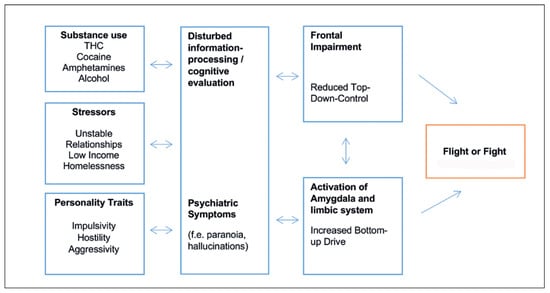
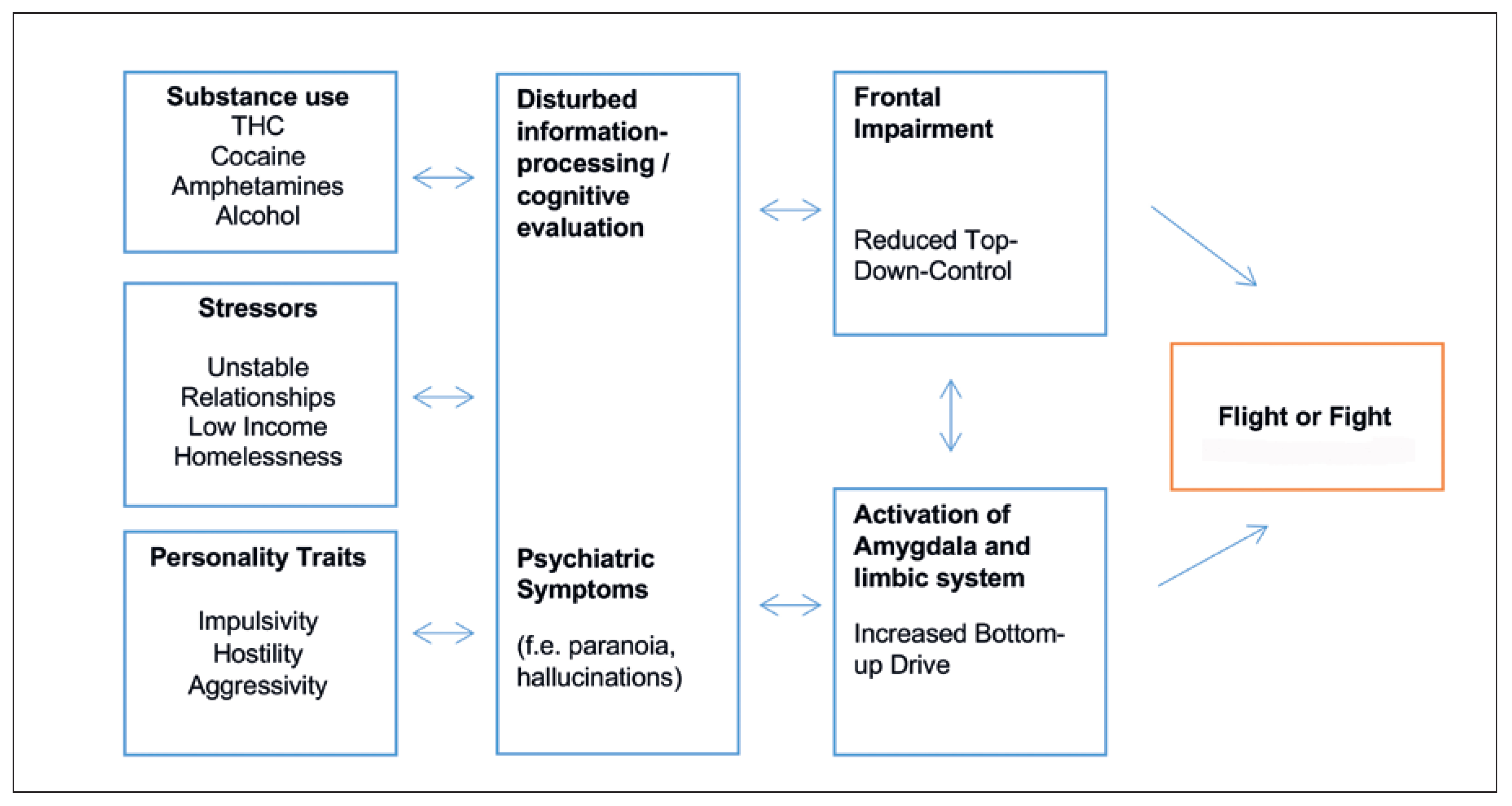
Overall, current research indicates that aggression has neurobiological correlates, which involve a hyperactivation of the amygdala and the limbic system, which the frontal areas cannot counteract due to hypoactivation. However, authors refer to several limitations, such as small and partly overlapping samples and the heterogeneity of study designs and operationalisations (e.g., different definitions of violence, focus on different brain regions). Furthermore, group comparisons cannot be transferred into significant objective physiological correlates to violent behaviour, as some results indicate that abnormalities are not specific to violence in schizophrenia but are also present in non-violent and non-psychotic cohorts. Within forensic psychiatry or criminal justice the contribution of neuroimaging methodology to risk evaluation or even as mitigating evidence has raised critical concerns, pointing out the necessity of careful evaluation of its validity [32]. In sum, there are promising results, but neurobiological factors cannot (yet) be recommended for clinical or forensic evaluations. Violent behaviour of psychiatric patients is a result of a complex interplay between several factors, such as personality, substance abuse, psychiatric symptoms and neurobiological factors, which is illustrated in figure 1.
Figure 1.
Multicausal model for the emergence of violent behaviour of psychotic individuals [35,36].
Relative importance of psychiatric disorders in violent crime
A recent review of 22 meta-analyses of risk factors for interpersonal violence [37] assessed psychiatric disorders, historical factors such as witnessing violence in childhood and youth antisocial behaviour, and individual factors such as poor moral judgement and low empathy. The strongest association with violence was shown for psychiatric disorders. Fazel et al. [37] report the largest odds ratios for substance abuse disorders (OR 7.4) followed by schizophrenia (OR 5.5), psychosis (OR 4.9), bipolar disorder (OR 4.1), any type of personality disorder (OR 3.0), and hyperkinetic disorder (OR 1.8). Notably, comorbidities are common, with additional disorders being associated with higher risk of violence [1].
A recent analysis assessed psychiatric disorders, historical factors such as witnessing violence in childhood and youth antisocial behaviour, as well as poor moral judgment and low empathy as risk factors for interpersonal violence.
Nonetheless, the dangerousness of mental illness is overestimated by the general population and by healthcare professionals [38,39]. It is hypothesised that this is related to a biased depiction of mentally ill persons in fiction and also the news [40–42]. Epidemiological research shows that 5% of the persons with severe psychiatric symptoms commit a violent crime. This rate is only slightly higher than the rate of violent crimes committed by people without a psychiatric disease (3%) [43]. Additionally, the higher risk of violence associated with some disorders must be considered with regard to absolute numbers, as illustrated by Whiting, Lichtenstein and Fazel [1]:
“Between 2006 and 2016, for example, 384 homicides in the UK (excluding Northern Ireland) were committed by people with schizophrenia and delusional disorders (equating to 6% of all homicides); an average of 35 per year, or around 0.06 per 100,000 general population (aged 10 years and older) per year. The risk of stranger homicide is even rarer, and has been estimated to be one in 14 million. In the same period, to compare with other causes of death that might draw public attention, there were 23,393 road accident fatalities in the UK; an average of over 2000 per year, or 3.5 per 100,000 total population per year.”
Notably, however, although the risk of violence is not very high for the general population, it is elevated for those in close contact, such as family members, and staff and patients in psychiatric hospitals. In a meta-analysis by di Giacomo et al. [44], 18% of patients in an acute inpatient ward exhibited some form of violent behaviour against others, and as many as 90% of mental health staff reported having been exposed to inpatient violence [45]. In a Finnish study, 8% of staff reported violence once a week and 16% of staff 1–3 times per month. These numbers illustrate that violence by individuals with psychiatric disorders does not constitute a large proportion of all violent crime, but neither is it negligible.
Besides the risk of harming others, the increased risk of self-harm and suicide among individuals with mental health problems merits note. The relative risk of suicide among individuals with psychiatric disorders has been reported as 7.5-fold higher than that of the general population, with particular risk for individuals with psychotic disorders and mood disorders(see [46]). The risk of self-harm and suicide needs to be part of a comprehensive assessment, and suitable intervention and aftercare structures should be established (e.g., [47, 48]). Besides the risk of self-harm, the risk of victimisation is elevated for patients. Krumm S et al. [49] reports an increased risk for sexual or violent victimisation (relative risk 2.3–11.8) for psychiatric patients compared with the general population. In terms of life-time prevalence, 83.3% of patients with schizophrenia, 41.2% of patients with a personality disorder, 45.8% of patients with depression and 26.7% of patients with a bipolar disorder suffer some form of victimisation. Thus, the risk of victimisation has to be considered during treatment. Protective measures targeting risk factors of victimisation should be established; these include instability and lability, risky behaviour, accessibility, provocative behaviour, and milieu.
Clinical implications
The empirical findings outlined above indicate the importance of assessing and addressing violence risk among patients with psychiatric disorders, especially because psychiatric risk factors are generally modifiable.
Violence risk assessment instruments
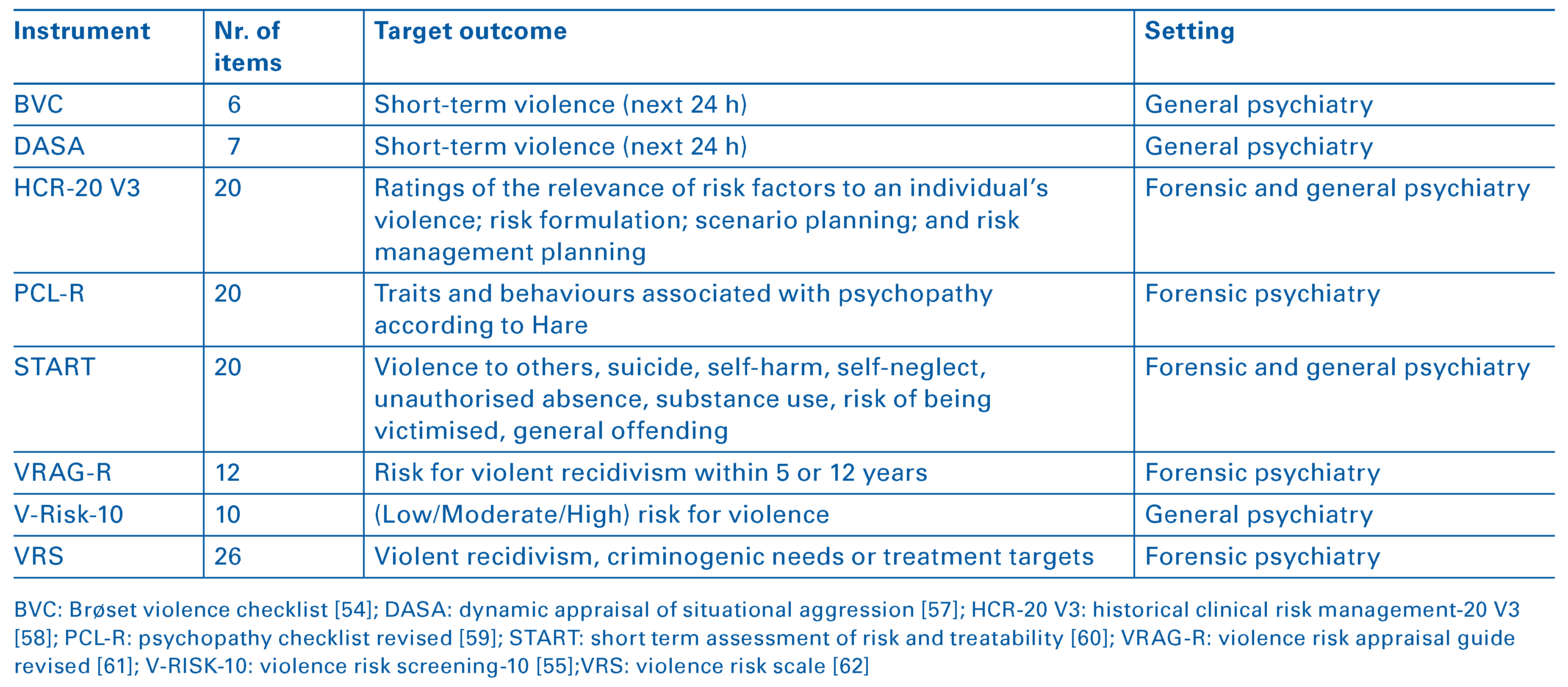
Screening tools for violence risk assessment can help identify patients at higher risk for violence and pinpoint specific targets for intervention. Several instruments are available for estimating the risk of violence, although they are not necessarily developed for individuals with psychiatric disorders. Their output is used to tailor risk management and treatment targets [50, 51]. Actuarial risk assessments rely on a total score that assigns a case to a risk category, whereas structured professional judgement instruments identify the presence and relevance of risk factors and integrate them into a formulation of risk and risk scenarios. Instruments further differ with regard to the risk factors considered and the setting and time-frame of risk estimation. The use of risk assessment instruments requires suitable training and instruction [52]. Instruments validated for specific subpopulations, such as women, and settings, such as inpatient settings, should be used wherever available.
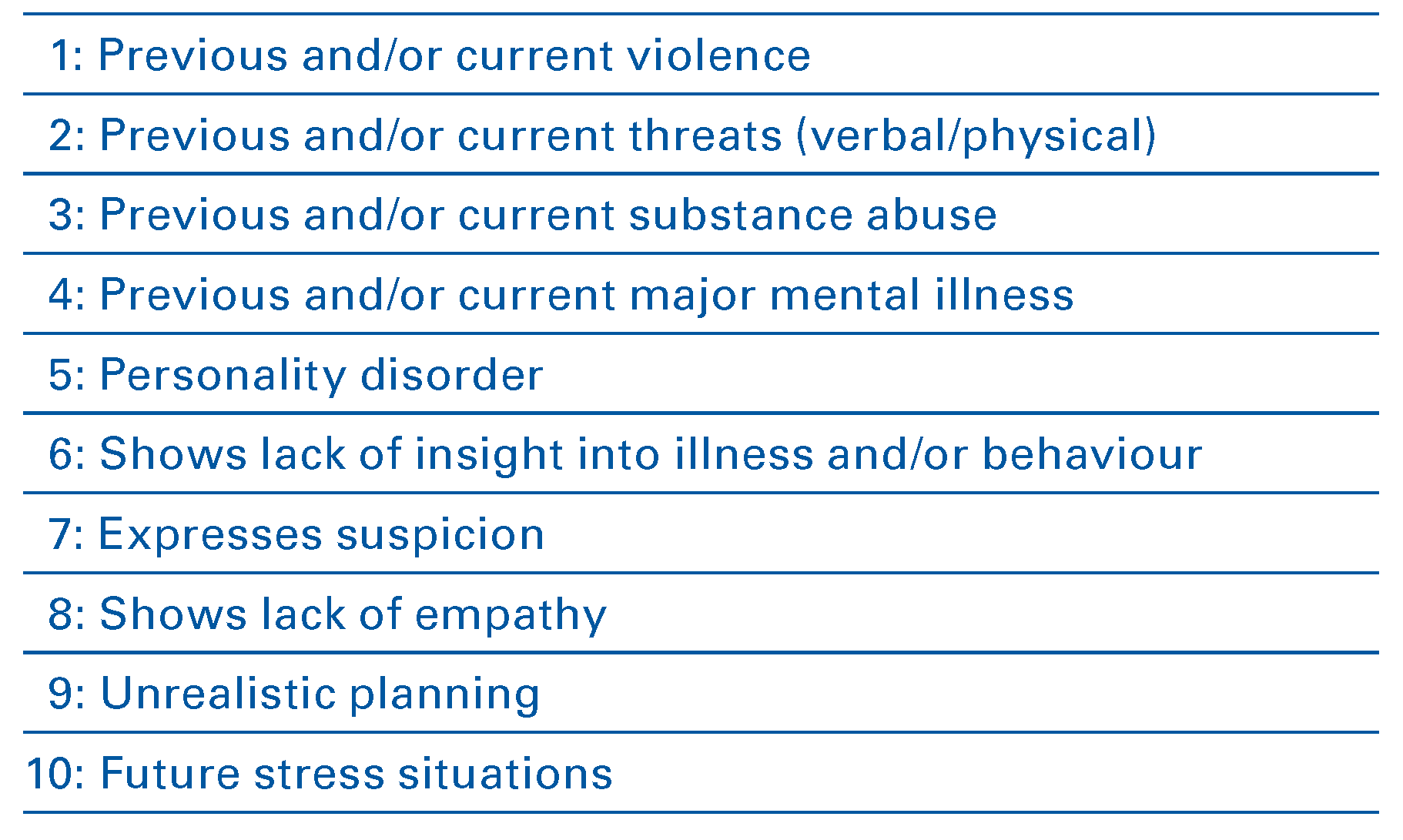
A recent review by Anderson and Jenson [53] concludes that the Brøset violence checklist [54] and the violence risk screening-10 (V-RISK-10) [55] show the best results in terms of predictive validity for violence in acute mental health settings. The items of the V-RISK-10 are shown in table 1. Table 2 lists other frequently used scales with some important characteristics. For a comparison of the predictive validity of violence risk assessment tools see for example Singh et al. [56].
Table 1.
Items of the V-RI SK-10.
Table 2.
Selection of frequently used violence risk assessment instruments.
Although some issues remain with accuracy and specificity (e.g., [2]), systematic screening and the consideration of risk factors can facilitate appropriate steps for early intervention and the allocation of resources. Not all violence is preventable, but the use of standardised instruments may reduce the likelihood of injuries suffered by others [63]. Particular attention should be paid to potential comorbid substance use. For example, among patients with schizophrenia, comorbid substance abuse doubles the risk of violent acts [64].
Risk management / preventive approaches / intervention
Psychiatric risk factors are generally modifiable [37]. Suitable professional care and treatment of psychiatric disorders thus plays an important role in the prevention of violent behaviour by individuals with psychiatric disorders. The importance of suitable care and aftercare is illustrated in a publication by Piontek et al. [65]. They observed an average duration of 6.8 years (standard deviation 5.4) between first inpatient treatment and index offence among convicted schizophrenic patients who had received prior medical treatment. In this period after diagnosis, mental healthcare providers can play a vital role in preventing violent crimes. Depending on the case, attendance in outpatient settings, also after release from inpatient and forensic settings, and compliance with treatment should be closely monitored. In some instances, communication and a common support strategy between medical and judicial and social work professionals may be necessary [65].
Despite their importance and potential, preventive treatment modalities at the interface between forensic and general psychiatry are still rare. Schmidt, Nitschke and Habermeyer [66] describe several opportunities for such interdisciplinary collaborations and discuss the importance of correctly identifying patients with special assistance and treatment needs and high risk of violence whilst keeping in mind the risk of stigmatisation of these patients. Prevention should also include the education of the patient and other people in close contact, such as staff. For example, a recent review on risk factors for inpatient violence recommended training in de-escalation techniques and communication skills for critical situations, and emphasised the importance of an overall supportive, caring, and personcentred approach and climate (see [67]).
Generally speaking, no special or new treatments are needed to address the problem of violent behaviour in psychiatry. First and foremost, the awareness of an increased risk of violent behaviour of patients with severe psychiatric diagnoses is essential for prevention. Similarly to suicidal tendencies and thoughts, the risk of violent behaviour, aggression, and previous legal problems need to be openly addressed with patients The course of treatment should include addressing potential risk factors such as social disintegration and compliance problems. Furthermore, close cooperation between psychiatry and the justice system is important to identify patients with greater needs. Additionally, disseminating knowledge about psychiatric disorders is essential to counteract stigmatisation [6]. Psychiatric disorders are one of many risk factors for violent behaviour, and individuals suffering from psychiatric disorders are responsible for only a fraction of violent crimes.
Conclusion
This overview suggests that the current body of research supports a relationship between psychiatric disorders and violent offending. However, although some psychiatric disorders are associated with an elevated risk of violent offending, only a fraction of violent crimes is committed by individuals suffering from psychiatric disorders. Crucially, a plethora of factors, including biographic, neurobiological, social, criminological, environmental and clinical parameters, moderate this relationship. Clinical practice has to address aggression, violent behaviour and previous conflicts with the law with patients. Moreover, it is essential to consider the specific interplay of factors associated with violent behaviour in each case individually. A systematic consideration of risk factors for violent behaviour using risk assessment instruments is recommended for risk estimation. Outputs such as risk scenarios can indicate potential targets of intervention. Suitable treatment of psychiatric disorders and sufficient aftercare where necessary are central to mitigating the risk of causing harm to themselves or others.
Disclosure statement
No financial support and no other potential conflict of interest relevant to this article was reported.
References
- You find the complete bibliography in the online version of the article at http://doi.org/10.4414/sanp.2022.10068.

This is an open-access article distributed under the terms of the Creative Commons Attribution Non-Commercial No Derivatives (CC BY-NC-ND) 4.0 License.