Strategies and interventions to combat compassion fatigue
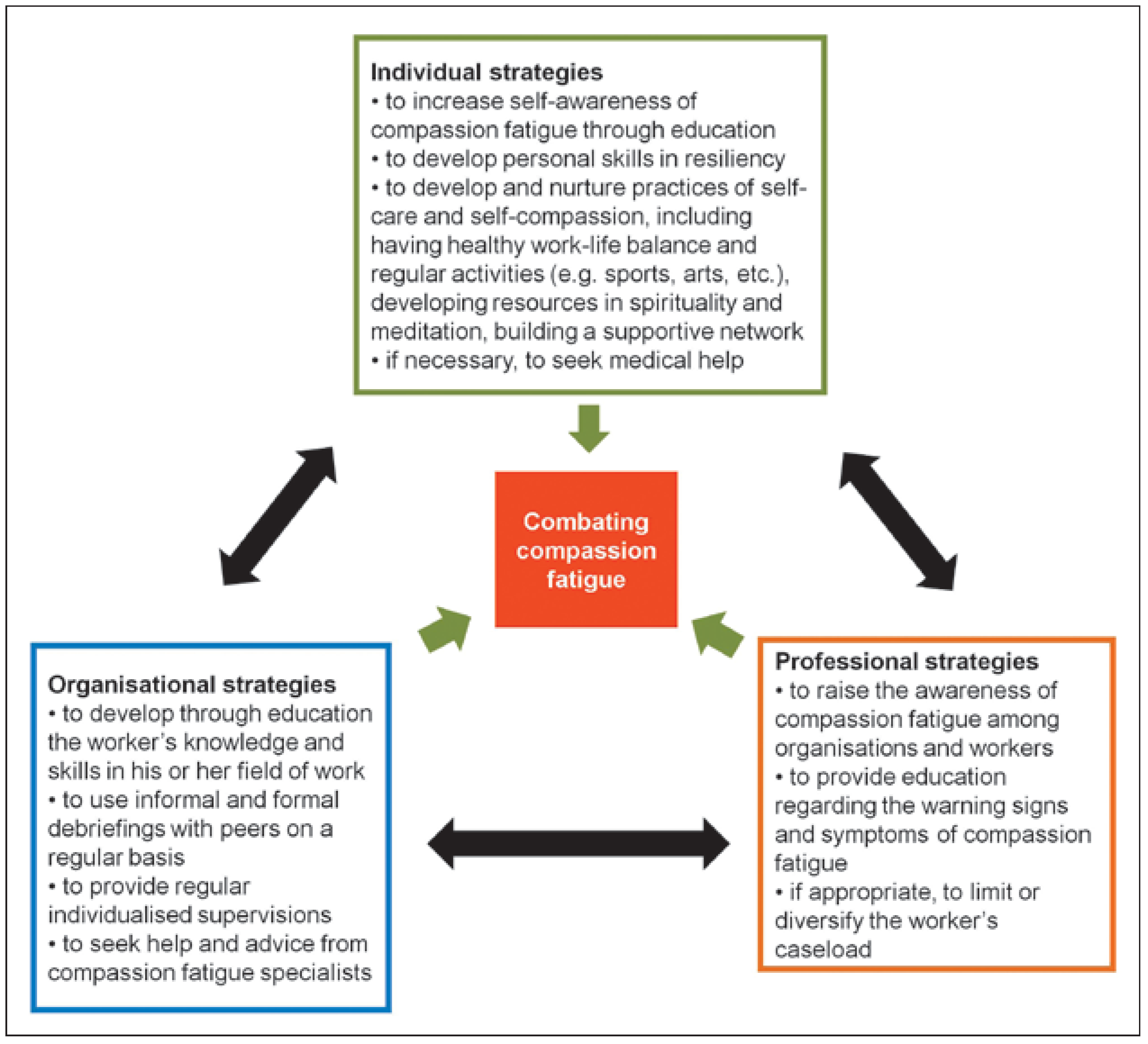
Since the mid-1990s, clinicians and researchers have proposed and studied strategies and interventions to prevent, manage and treat compassion fatigue in helping and social professionals. A summary of the recommendations to combat compassion fatigue suggested in the literature is presented in
Figure 3.
Among professional strategies, a first critical step is acknowledging in a supportive way that compassion fatigue not only exists, but is an expected reality in helping professions [31, 36, 64], and that experiencing emotional distress can be a normal response to difficult and complex patient/client situations [50, 65]. To increase the awareness of compassion fatigue, organisations managers/leaders need to be informed on the propensity of their personnel to develop compassion fatigue, and professionals should be educated regarding the signs and symptoms that may be associated with compassion fatigue [42, 50, 60, 66–68]. Furthermore, the warning signs of compassion fatigue need to be delivered through education as early as possible in professional educational programmes [19]. In order to reduce the direct work of helping professionals with suffering and traumatised patients/clients, limiting or diversifying their caseload should be considered to better manage the proportion of difficult and complex situations they are responsible for [69].
Among organisational strategies suggested to reduce the risks of compassion fatigue, providing sufficient theoretical knowledge and clinical skills for helping professionals in their field of work should be considered to enhance their working and coping skills (e.g., delivering specific training in the management of substance users, psychiatric patients, etc.) [27]. Informal and formal debriefings with team colleagues and coworkers have also been recommended to alleviate the feelings of professional isolation and promote peer support [27, 30, 42, 70–73]; debriefings should occur on a regular basis rather than in response to crisis situations [36]. Great caution should be taken, however, when informal debriefings occur with family and friends as they may not be equipped to offer support without being negatively impacted in the process [39]. Whenever possible, individual supervisions should be offered regularly to helping professionals [39, 44, 63, 72], which may not only provide individualised professional support, but also allow early intervention if compassion fatigue is suspected or is occurring. Workers’ caseloads can be reviewed and redistributed during supervisions if judged appropriate [70, 74]. Organisational measures to reduce or address operational and structural issues such as bureaucratic and financial constraints, high workload and work intensity, and insufficient staff resources may also be required as these issues may impact negatively both on individuals and organisations [75, 76]. Supervisors, organisation managers and leaders may also need support in regards to compassion fatigue, which could be obtained from peers and compassion fatigue specialists [15].
Organisations and managers play an essential part in preventing compassion fatigue in their work environment, but helping and social professionals may have an equally important responsibility for taking measures to mitigate the risks of compassion fatigue. Individual strategies have been suggested in the literature to combat compassion fatigue, starting with increasing the self-awareness of compassion fatigue among helping professionals through education [1, 66, 70, 71, 77]. Some authors have recommended developing personal skills in resiliency [1, 33, 62, 64, 70], which can be defined as the «process of coping with or overcoming exposure to adversity» [49]. Having the ability to be more resilient may help an individual to better cope with stressful and distressing events experienced within the work environment, allowing him or her to have a positive stress response [1]. Among other protective factors, development of self-care and self-compassion strategies seems to be central and has been advocated by many clinicians and researchers [7, 12–14, 25, 28, 30, 43, 50, 60, 66, 68, 69, 72–74, 77–80]. Self-compassion entails having an «empathic response and curiosity to one’s own mistakes and faults» [25]. Self-care strategies that have been suggested in the literature include developing an adequate and healthy work-life balance by setting clear boundaries between work and personal life [1, 7, 12, 43, 69, 71], having regular healthy activities such as sports, arts or narrative work such as keeping a journal [1, 26, 31, 60, 68, 71, 73, 81], developing personal resources in spirituality and meditation [1, 26, 28, 50, 60, 73, 79], building and maintaining a healthy and supportive social network at home and at work [59, 81–83]. The use of humour, a vast and complex phenomenon, has been suggested by some authors to lessen or prevent symptoms of compassion fatigue [82], but the beneficial role of humour has been questioned by other authors who advocated a cautious use of humour when engaging in trauma work, as it may be perceived as inappropriate to the contextual setting [84].
Whenever possible, individual super-visions should be offered regularly to helping professionals.
Over the last two decades, models of interventions to assist helping and social professionals to mitigate the risk of or to treat compassion fatigue have been developed. In the late 1990s, a local programme in the USA, the Accelerated Recovery Program (ARP) for compassion fatigue, was designed in the field of mental health to help professionals who were secondarily exposed to trauma material in their work to combat compassion fatigue [85, 86]. The ARP’s goals focused on the delivery of comprehensive tools to assess compassion fatigue symptoms and triggers, and the elaboration of a selfcare plan [86]. The ARP was further developed and became the Certified Compassion Fatigue Specialist Training (CCFST), which gave promising results in reducing compassion fatigue among participants [87]. Other interventions targeting «compassion fatigue / secondary traumatic stress» have been tested across the globe (in the USA, Mexico, New Zealand) in various disciplines (professional educators, emergency and oncology nurses, military healthcare providers). Various methods were used to enhance and consolidate individuals’ resiliency and coping resources [29, 49, 64, 88], to acquire knowledge and skills for practicing effective self-care [89], and to use practices to reduce stress and negative emotions such as mindfulness techniques [90] and brief structured meditation sessions [91]. Different statistical methods were used in these studies, and the impact of the interventions on participants varied across the studies, from a significant reduction in «compassion fatigue / secondary traumatic stress symptoms» [29, 49, 64, 88, 91] or an increase in «compassion satisfaction» [64, 91] to no significant effect on compassion fatigue / secondary traumatic stress symptoms [89, 90]. Because of potential budget restrictions and chronic lack of human resources in helping professions, organisation managers and leaders may feel reluctant to release their staff to attend to such programmes, but offering professional development for them may constitute a skill-building strategy in the longer run that might increase staff work performance and staff retention [15].
The degree of success of the interventions used in the studies mentioned above may depend on the pathogenesis of compassion fatigue. In its early conceptualisation, developed mainly in the field of psychotraumatology [6], compassion fatigue was considered to be the consequence of experiencing helplessness, fear, horror, «mental defeat» in traumatic experiences in general, emotions that are highly important in the pathogenesis of posttraumatic stress disorder. In the following years, clinicians in the medical and nursing fields have further developed the concept of compassion fatigue by characterising it as the consequence of an affectionate and caring attitude, rather than as the result of a traumatic experience [7, 25], although there is no definitive evidence that this phenomenon results from an extraordinary compassionate attitude. For Boyle et al., compassion fatigue can occur when the «compassion energy» that healthcare providers expend with their patients surpasses their «ability to recover from this energy expenditure», causing «significant negative psychological and physical consequences » [7]. From that perspective, the interventions aimed at combating compassion fatigue may need to be adapted to professionals’ roles and missions, as well as their work environment, which may shape or define, among other factors, the pathogenesis of compassion fatigue.