Next Article in Journal
Aspects cliniques, scanographiques et histologiques des tumeurs cérébrales de l’enfant à Yaoundé, Cameroun
Previous Article in Journal
Engager dans les soins des personnes souffrant de schizophrénie par un suivi intensif dans le milieu (SIM)
 
 
Swiss Archives of Neurology, Psychiatry and Psychotherapy is published by MDPI from Volume 176 Issue 1 (2026). Previous articles were published by another publisher in Open Access under a CC-BY (or CC-BY-NC-ND) licence, and they are hosted by MDPI on mdpi.com as a courtesy and upon agreement with Editores Medicorum Helveticorum (EMH).
Article

Cerebral microbleeds: important or not important? †

University Hospitals Leuven and VIB, Leuven, Belgium
Lecture at the annual meeting of the Swiss Society of Clinical Neurophysiology and the Swiss Stroke Society, 185th Meeting of the Swiss Neurological Society; May 19–21, 2011.
Swiss Arch. Neurol. Psychiatry Psychother. 2011, 162(7), 290-292; https://doi.org/10.4414/sanp.2011.02311

Published: 1 January 2011

Summary

Microbleeds are under intense scrutiny as predictors of intracerebral haemorrhage and as an in-vivo marker of cerebral amyloid angiopathy, a disease that is notoriously difficult to diagnose in a noninvasive way. Microbleeds are common in patients with haemorrhagic and ischaemic cerebrovascular disease. Cortical microbleeds are associated with cerebral amyloid angiopathy and microbleeds in deep cerebral structures and brainstem are thought to be one facet of cerebral small vessel disease. On magnetic resonance imaging a few diseases and artefacts may mimic microbleeds. In the current state of knowledge, the presence of a few microbleeds should probably not be considered a contraindication to thrombolysis or oral anticoagulation.

Introduction

Pathologically, microbleeds are small areas of brain blood products located within the arterioles and capillaries. Typically, the iron deposits are found within macrophages, but their presence in pericytes has also been described. When located in lobar regions, they are intimately associated with bleeding of vessels laden with amyloid. When located in deep brain regions, they are most often, but not exclusively, linked to hypertensive vasculopathy. On a macroscopic level, if visible, they correspond to microhaemorrhages or haemorrhagic lacunar holes [1,2,3].
Some of these microbleeds can be detected using T2*-weighted imaging or susceptibility-weighted magnetic resonance imaging (MRI). They appear as oval or round hypointensities with a size ranging up to 10 mm. Their detection on MRI depends not only on the size of the lesion, but also on the technique and postprocessing used. In this regard, field strength of the magnet and echo time play a major role, as well as the use of susceptibility-weighted postprocessing techniques [4]. The exact sensitivity and specificity with which microbleeds can be detected using MRI when compared to pathology is not yet exactly defined.
Microbleeds on MRI are found in more than half of the patients with intracerebral haemorrhage or vascular dementia and to a lesser extent in patients with ischaemic stroke and in about 17% of patients with Alzheimer’s disease (AD) or patients attending a memory clinic [5]. Population studies have found MB in about 5% of the general population [6,7].

Risk factors

Age is the most important risk factor for the presence of microbleeds, followed by hypertension and diabetes [8]. An association with hypercholesterolaemia was found, but this was not confirmed in subsequent studies [9]. Genetic risk factors, most importantly the apolipoprotein E genotype, also seem to play a role [10].
The location in which microbleeds occur appears to strengthen some risk factors and disease associations. Microbleeds in thalamus, basal ganglia and pons, the typical locations in which hypertensive ICH occurs, are typically found in hypertensive cerebral vascular disease. In this situation they are often found in conjunction with white matter hyperintensities and lacunar lesions. Risk factors for lobar microbleeds are apolipoprotein E ε4 with people harbouring one ε4 allele having a 35% increased odds of having at least one lobar microbleed [10].

Disease associations

Microbleeds can be found in several diseases (see table 1). As already mentioned, microbleeds are commonly found in patients with intracerebral haemorrhage, ischaemic stroke, vascular dementia and patients with cerebral amyloid angiopathy in the context of a cognitive disorder or intracerebral haemorrhage. A case of multiple GRE hypointensities in the context of endocarditis was recently described, however many DWI hyperintensities were also found [11]. In a case control study of 60 patients with endocarditis and 120 age and sex-matched controls, 57% of the patients with endocarditis had microbleeds compared to 18% of the controls [12]. Given the high frequency of microbleeds the authors proposed adding the presence of microbleeds as a supplementary diagnostic criterion for endocarditis, especially when more than three microbleeds were found. A recent study described the development of new cerebral microbleeds after cardiac surgery in 12 of 19 patients [13]. These microbleeds were mostly asymptomatic and did not necessarily correspond to areas of DWI hyperintensity. It is thought that these represent small haemorrhages or air emboli trapped within small cerebral vessels. The fact that some of these GRE hypointensities persisted point to haemorrhage in at least some of these cases.
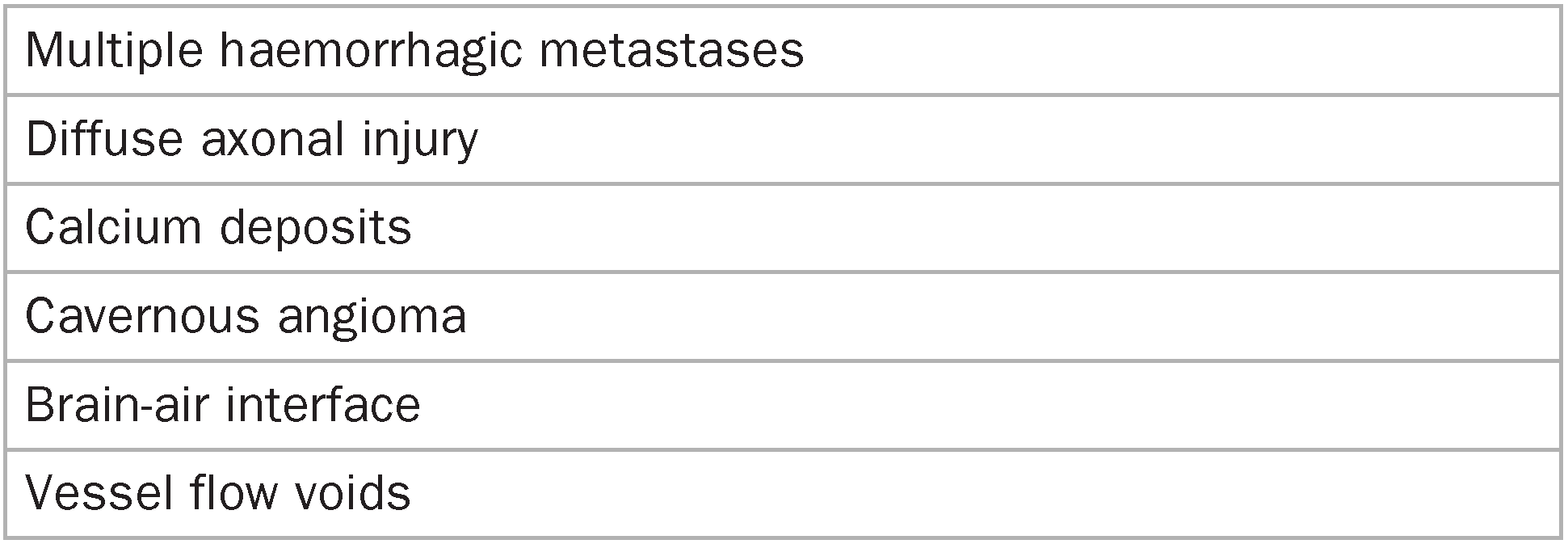
The differential diagnosis of microbleeds is presented in table 2. Small multiple haemorrhagic metastases should be mostly evident in the clinical context. The same is true for hypointensities due to diffuse axonal injury. The location of these lesions within the corpus callosum and diencephalon is also typical in this situation [14]. More difficult is the differentiation in cavernous angiomas. Although typically popcorn-like lesions with associated heterogeneous intensity changes on T2-weighted images are described, anecdotal experience also describes microbleeds in this context without T2 hyperintensity. Microbleeds should be differentiated from calcium deposits within basal ganglia and cerebellum. The use of computed tomography can sometimes help in this situation. Finally, flow voids are often difficult to distinguish from microbleeds. Careful examination of brain sections surrounding the hypointensities can be helpful.
Table 1. Diseases in which microbleeds can be found.
Sanpp 162 00290 i001
Table 2. Differential diagnosis of small hypointense lesions on T2*-weighted imaging.
Sanpp 162 00290 i002

Association with cerebral amyloid angiopathy

One area of intense scrutiny is the use of the presence of lobar microbleeds as a diagnostic tool in cerebral amyloid angiopathy (CAA), either in the context of brain haemorrhage or in the context of AD. Definite CAA can only be diagnosed using brain biopsy [15]. Recently, Pittsburgh compound positron emission tomography (PIB-PET) studies have revealed amyloid deposition in patients with cognitive impairment, AD and CAA in the context of lobar haemorrhage [16,17,18]. Several arguments link CAA with the presence of microbleeds. Firstly, the location of microbleeds is similar to those of the macrobleeds in CAA and their coexistence in patients with lobar haemorrhage is striking. Secondly, the association with apoE ε4 is found in both diseases [19]. Thirdly, limited pathological evidence suggests a common aetiology [3]. Finally, PIB-PET studies have shown a correspondence of microbleeds with amyloid deposition [20]. It is envisaged that both microbleeds and PIB-PET imaging will be incorporated in new diagnostic criteria, which will permit sensitive and specific in vivo diagnosis of this currently untreatable and dramatic condition.

Thrombolysis in the context of microbleeds

Isolated case reports have suggested that thrombolytic therapy could be dangerous in patients harbouring microbleeds [21]. This theoretical concern does not seem to be corroborated by current data, although only a few patients with multiple (more than five) microbleeds have been studied. Thrombolytic therapy is a highly effective therapy for acute ischaemic stroke. Clinical trials proving the efficacy of intravenous tissue plasminogen activator administration did not use MRI to include patients, but instead relied on computed tomography imaging. Leukoaraiosis on CT increases the risk of brain haemorrhage but is in itself a poor marker of the presence of microbleeds [22]. In a large multicentre study of more than 500 patients treated with intravenous thrombolysis within six hours after symptom onset the risk of symptomatic ICH was not significantly increased in the presence of a few microbleeds. Only a few patients with multiple microbleeds were studied [23].

Oral anticoagulation and dual antiplatelet therapy in patients with cerebral ischaemia and microbleeds

Case control studies and prospective studies have shown that the risk of intracerebral haemorrhage is increased in patients with cerebral microbleeds [24]. Some studies have also shown that the risk of ischaemic stroke is increased in these patients. One large study in healthy elderly subjects from Japan prospectively followed up more than 2200 stroke-free subjects during more than three years with 4% harbouring microbleeds. The risk of ischaemic stroke was increased five-fold in these patients but more impressively the risk of intracerebral haemorrhage was increased fifty fold. The absolute numbers of strokes were still relatively small and confidence intervals wide. More than 80% of the patients with microbleeds suffered no recurrent stroke. [25]
A difficult situation then occurs when a stroke or TIA patient with microbleeds on MRI has an indication for oral anticoagulation (e.g. atrial fibrillation) or dual antiplatelet therapy (drug eluting stent or carotid stenting). In these patients it is not clear whether the risk of haemorrhage outweighs the risk of recurrent cerebral ischaemia. We studied 487 TIA or ischaemic stroke patients of whom 26% had cerebral microbleeds [26]. Forty patients with microbleeds received oral anticoagulation or dual antiplatelet therapy at discharge. During a follow-up period of two years only two intracerebral haemorrhages occurred, one in a patient without microbleeds and one in a patient with multiple lobar microbleeds. The frequency of recurrent ischaemic stroke was much higher compared to the risk of intracerebral haemorrhage. Again, in this study only a few patients with multiple microbleeds were included.

Future directions

Future studies should focus on radiological-pathological correlation of microbleeds and the optimal magnetic resonance imaging sequence for detecting microbleeds. For clinicians, it is important to assess the diagnostic contribution of microbleeds to the in vivo diagnosis of cerebral amyloid angiopathy. Finally, studies should focus on whether the increased risk of intracerebral haemorrhage outweighs the benefits of oral anticoagulation and thrombolysis in patients with multiple microbleeds.

Funding / potential competing interests

Funding provided by FWO Flanders and VIB.

References

  1. Fazekas F, Kleinert R, Roob G, Kleinert G, Kapeller P, Schmidt R, et al. Histopathologic analysis of foci of signal loss on gradient-echo T2*-weighted MR images in patients with spontaneous intracerebral haemorrhage: evidence of microangiopathy-related microbleeds AJNR Am J Neuroradiol. 1999;20(4):637–42.
  2. Fisher M, French S, Ji P, Kim RC. Cerebral microbleeds in the elderly: a pathological analysis. Stroke. 2010;41(12):2782–5.
  3. Schrag M, McAuley G, Pomakian J, Jiffry A, Tung S, Mueller C, et al. Correlation of hypointensities in susceptibility-weighted images to tissue histology in dementia patients with cerebral amyloid angiopathy: a postmortem MRI study. Acta Neuropathol. 2009.
  4. Greenberg SM, Vernooij MW, Cordonnier C, Viswanathan A, Al-Shahi Salman R, Warach S, et al. Cerebral microbleeds: a guide to detection and interpretation. Lancet Neurol. 2009;8(2):165–74.
  5. Cordonnier C, van der Flier WM, Sluimer JD, Leys D, Barkhof F, Scheltens P. Prevalence and severity of microbleeds in a memory clinic setting. Neurology. 2006;66(9):1356–60.
  6. Roob G, Schmidt R, Kapeller P, Lechner A, Hartung HP, Fazekas F. MRI evidence of past cerebral microbleeds in a healthy elderly population. Neurology. 1999;52(5):991–4.
  7. Vernooij MW, van der Lugt A, Ikram MA, Wielopolski PA, Niessen WJ, Hofman A, et al. Prevalence and risk factors of cerebral microbleeds: the Rotterdam Scan Study. Neurology. 2008;70(14):1208–14.
  8. Cordonnier C, Al-Shahi Salman R, Wardlaw J. Spontaneous brain microbleeds: systematic review, subgroup analyses and standards for study design and reporting. Brain. 2007;130(Pt 8):1988–2003.
  9. Lee SH, Bae HJ, Yoon BW, Kim H, Kim DE, Roh JK. Low concentration of serum total cholesterol is associated with multifocal signal loss lesions on gradient-echo magnetic resonance imaging: analysis of risk factors for multifocal signal loss lesions. Stroke. 2002;33(12):2845–9.
  10. Maxwell SS, Jackson CA, Paternoster L, Cordonnier C, Thijs V, Salman RA, et al. Genetic associations with brain microbleeds: Systematic review and meta-analyses. Neurology. 2011;77(2):158–67.
  11. Vanacker P, Nelissen N, Van Laere K, Thijs VN. Images in neurology. Scattered cerebral microbleeds due to cardiac myxoma. Arch Neurol. 2009;66(6):796–7.
  12. Klein I, Iung B, Labreuche J, Hess A, Wolff M, Messika-Zeitoun D, et al. Cerebral microbleeds are frequent in infective endocarditis: a case-control study. Stroke. 2009;40(11):3461–5.
  13. Jeon SB, Lee JW, Kim SJ, Chung CH, Kwon SU, Choi CG, et al. New cerebral lesions on T2*-weighted gradient-echo imaging after cardiac valve surgery. Cerebrovasc Dis. 2010;30(2):194–9.
  14. Scheid R, Preul C, Gruber O, Wiggins C, von Cramon DY. Diffuse axonal injury associated with chronic traumatic brain injury: evidence from T2*-weighted gradient-echo imaging at 3 T. AJNR Am J Neuroradiol. 2003; 24(6):1049–56.
  15. Knudsen KA, Rosand J, Karluk D, Greenberg SM. Clinical diagnosis of cerebral amyloid angiopathy: validation of the Boston criteria. Neurology. 2001;56(4):537–9.
  16. Klunk WE, Engler H, Nordberg A, Wang Y, Blomqvist G, Holt DP, et al. Imaging brain amyloid in Alzheimer’s disease with Pittsburgh Compound-B. Ann Neurol. 2004;55(3):306–19.
  17. Greenberg SM, Grabowski T, Gurol ME, Skehan ME, Nandigam RN, Becker JA, et al. Detection of isolated cerebrovascular beta-amyloid with Pittsburgh compound B. Ann Neurol. 2008;64(5):587–91.
  18. Johnson KA, Gregas M, Becker JA, Kinnecom C, Salat DH, Moran EK, et al. Imaging of amyloid burden and distribution in cerebral amyloid angiopathy. Ann Neurol. 2007;62(3):229–34.
  19. Biffi A, Sonni A, Anderson CD, Kissela B, Jagiella JM, Schmidt H, et al. Variants at APOE influence risk of deep and lobar intracerebral haemorrhage. Ann Neurol. 2010;68(6):934–43.
  20. Dierksen GA, Skehan ME, Khan MA, Jeng J, Nandigam RN, Becker JA, et al. Spatial relation between microbleeds and amyloid deposits in amyloid angiopathy. Ann Neurol. 2011;68(4):545–8.
  21. Kidwell CS, Saver JL, Villablanca JP, Duckwiler G, Fredieu A, Gough K, et al. Magnetic resonance imaging detection of microbleeds before thrombolysis: an emerging application. Stroke. 2002;33(1):95–8.
  22. Gorner A, Lemmens R, Schrooten M, Thijs V. is leukoaraiosis on CT an accurate surrogate marker for the presence of microbleeds in acute stroke patients? J Neurol. 2007;254(3):284–9.
  23. Fiehler J, Albers GW, Boulanger JM, Derex L, Gass A, Hjort N, et al. Bleeding risk analysis in stroke imaging before thromboLysis (BRASIL): pooled analysis of T2*-weighted magnetic resonance imaging data from 570 patients. Stroke. 2007;38(10):2738–44.
  24. Lovelock CE, Cordonnier C, Naka H, Al-Shahi Salman R, Sudlow CL, Sorimachi T, et al. Antithrombotic drug use, cerebral microbleeds, and intracerebral haemorrhage: a systematic review of published and unpublished studies. Stroke. 2010;41(6):1222–8.
  25. Bokura H, Saika R, Yamaguchi T, Nagai A, Oguro H, Kobayashi S, et al. Microbleeds are associated with subsequent hemorrhagic and ischemic stroke in healthy elderly individuals. Stroke. 2011;42(7):1867–71.
  26. Thijs V, Lemmens R, Schoofs C, Gorner A, Van Damme P, Schrooten M, et al. Microbleeds and the risk of recurrent stroke. Stroke. 2010;41(9): 2005–9.